Free email delivery
Please sign up for email delivery in the subscription area to the right.
No salesman will call, at least not from us. Maybe from someone else.
Two Newish Birds: Malibu Lagoon, 24 August 2025
[By Chuck Almdale]
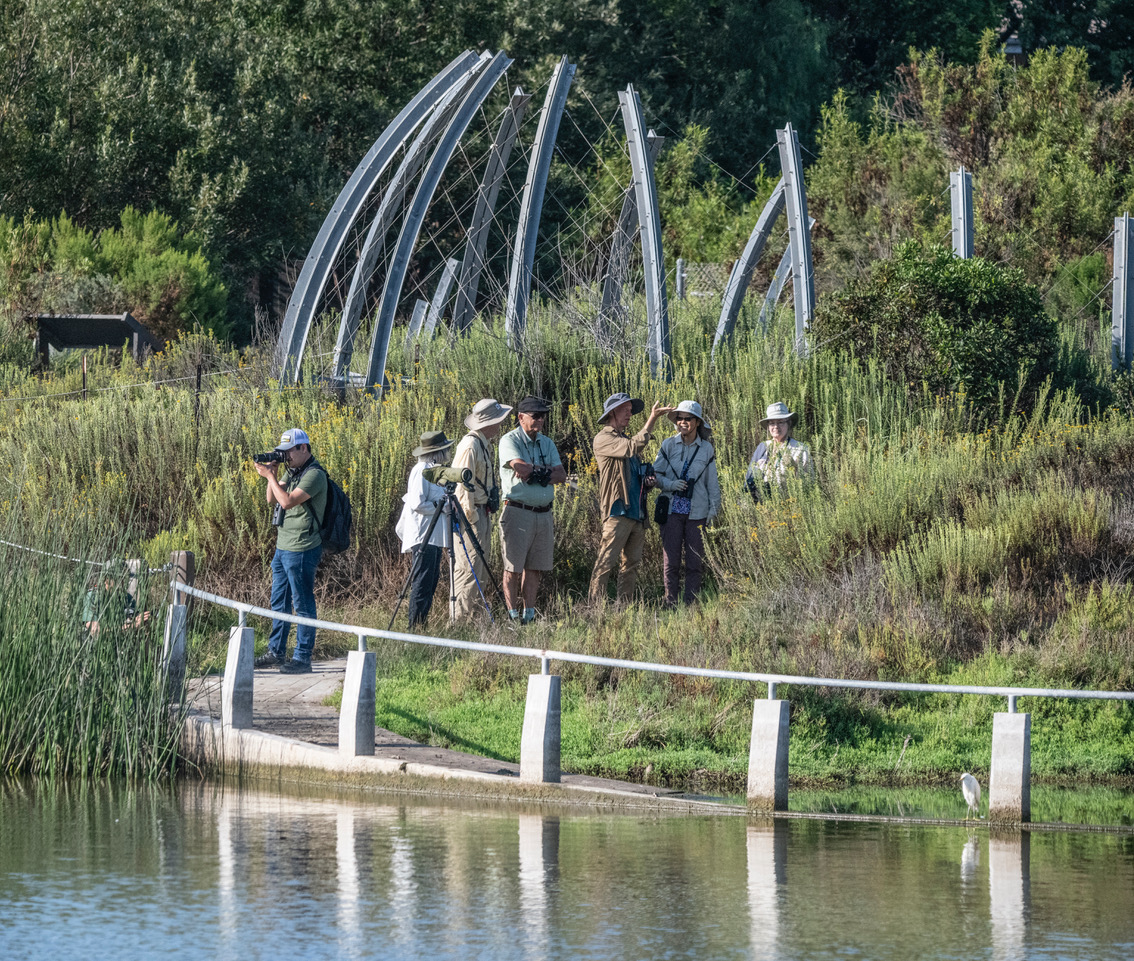
A couple of the early birders had already spotted the bird, perched on a sidewalk railing slightly west of our gathering area, the metal pavilion. It was a poor angle and the bird was facing away, so we trooped over towards that odd-looking structure of bent, cabled girders to get a full-frontal view.
Black-crowned Night Herons are regular at the lagoon. Out of of 338 censuses since October 1979, we’ve recorded them 161 times with a total of 490 birds. So…they show up 48% of the time, averaging three birds per visit. Singletons are common, single digits are the rule, double digits quite uncommon, and the high count was 15 birds on 26 Aug 2007. Before March 2001 we had only seven sightings, total, when they quickly became more common. That was when I began leading the trips and perhaps I checked the trees more thoroughly than my predecessors. After all, they are Night Herons – note the relatively large eyes – and we mostly see them out walking around only on cloudy days or during morning and evening twilight. On sunny days they’re hiding in a tree or thick brush, and they’re excellent at hiding and not moving.
However, this bird below is not a Black-crowned Night Heron, but a Yellow-crowned Night Heron. Notice the bright yellow crown? What…you missed it, it’s right there!
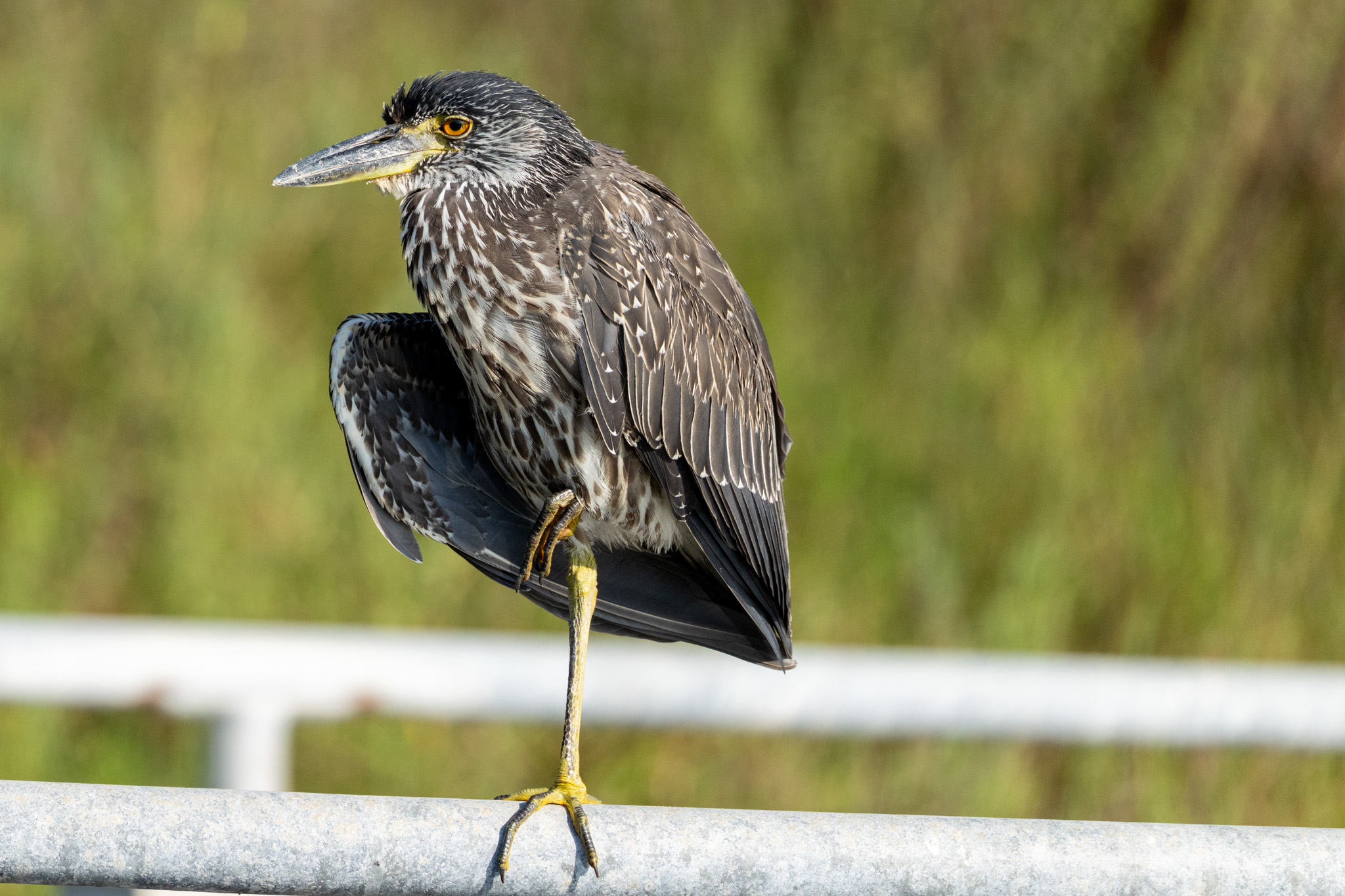
Yeah, that’s right, they don’t get their yellow crown until their second spring (not counting their birth year), when they’re old enough to breed. The bird below is either a juvenile, born this year, or a year old. This species is in the process of spreading generally northward through SoCal. About 30-40 years if you wanted to see one, you drove down to Scripps Lab near San Diego where one – one! – roosted reliably in a particular tree. Some 10-20 years ago they appeared in a marsh on Pt. Mugu Naval Air Station where they outnumbered the Black-crowns the last time I was there. Maybe 5 years ago they began appearing regularly in Ballona Fresh Water Marsh. So it goes…range extensions. The same thing happened with Great-tailed Grackles and Neotropic Cormorants during my SoCal birding lifetime. Other terns and gulls and now boobies on the Channel Islands. Whether global warming has anything to do with this, I don’t know. It’s probably been going on since the last time the ice cap retreated north.

(Ray Juncosa 8-24-25).
Sub-adult Yellow-crowns run grayer than the brownish Black-crowns. Their white spots are smaller and the dark on their bills is black rather than gray. Considering the amount of yellow on this one’s bill, I can’t help but wonder if their isn’t a Black-crown in it’s ancestry. They do hybridize, and we had a hybrid juvenile some 15-20 years ago at the lagoon, before the last reconfiguration.
They’ve been reported at the lagoon before, and a few of the group saw a juvenile by Adamson House a year or two back which we put on the trip report; Chris & Ruth Tosdevin saw it, but I missed it. According to eBird this is the 33rd date on which a YCNH has been seen at Malibu Lagoon. This particular bird has been reported to eBird 27 times (soon to be 28) between 10 August and 24 August. Word gets around.
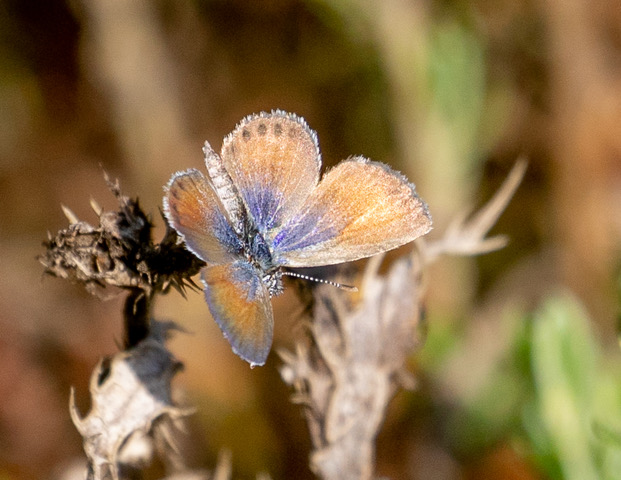
The Western Pygmy Blue Butterfly Brephidium exilis is the smallest butterfly in California and (reportedly) one of, if not the smallest butterfly in the world, and they’re regular at Malibu Lagoon, if you can find them. With wingspan 1/2-3/4th inch, about the same as the tip of your little finger and always very low to the ground, if you spot one it’s hard to be sure what it is, if it’s even alive and not some dead leaf-part blowing around, and when it stops, just exactly where it landed, blending in perfectly. If you’re diligent and lucky and back off a bit, you may find them with your binoculars. They’re native from California to Florida, with subspecies as far away as the Bahamas, Hispaniola, and Yucatan Peninsula. Somehow they’ve even managed to get to Hawaii and the Persian Gulf, flapping away across the stormy sea, I suppose, or inside-by-accident someone’s luggage.
Dark-eyed Juncos (previously Oregon Junco) aren’t what we think of when think about lagoon birds, but they’re become fairly regular in recent years. First recorded on our walks in September 2017, we’ve now recorded them 22 times, and in 10 of the past 13 months, probably mostly by Femi, Chris and Ruth. Usually one or two birds; once there were four. They’re fairly common in our local parks on the lawns during the winter, gathering insects and whatnots. There are a lot of distinguishable subspecies, and I think all of them gather at the mouth of Cave Creek Canyon in SE Arizona by New Year’s Day, should you be so inclined to visit.
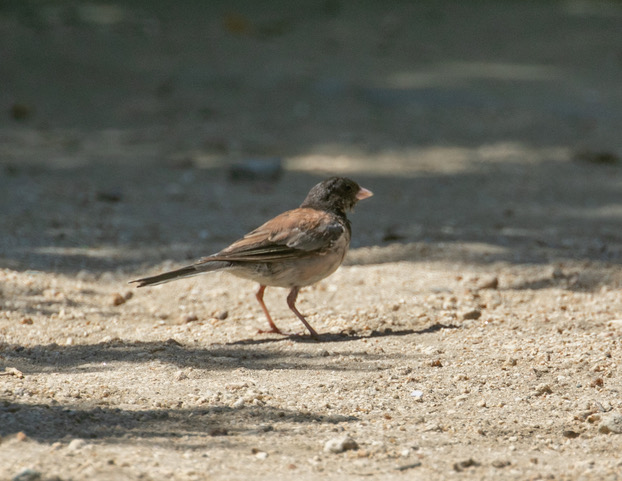
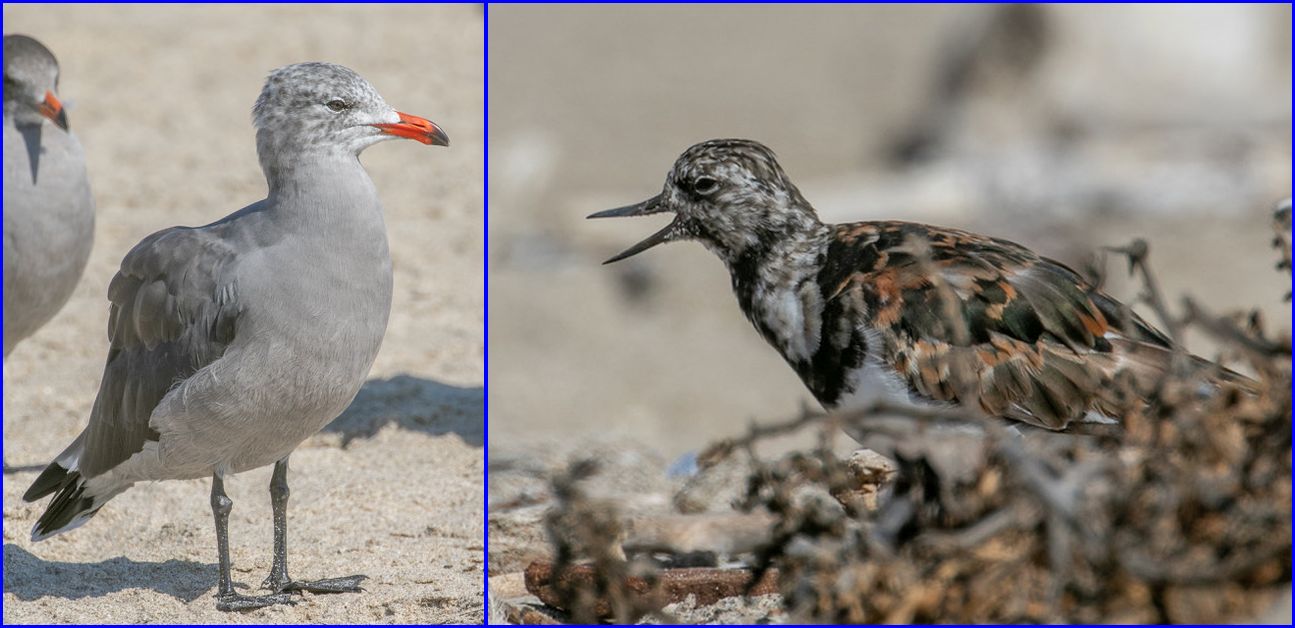
I include these two photos below to show how plumages are changing from spring/summer breeding. Take a look at last months lagoon report to see them, one month younger.
The two following species are easily and often confused, so I put them side-by-side. Song Sparrow, on the right, is common across the U.S., a SoCal resident and breeds at the lagoon. We see them on 98% of visits; they’re always there, I’m sure, but they don’t always pop out of the brush and sit on the trail, staring at you, or sing loudly as you saunter by. They like to live near water.
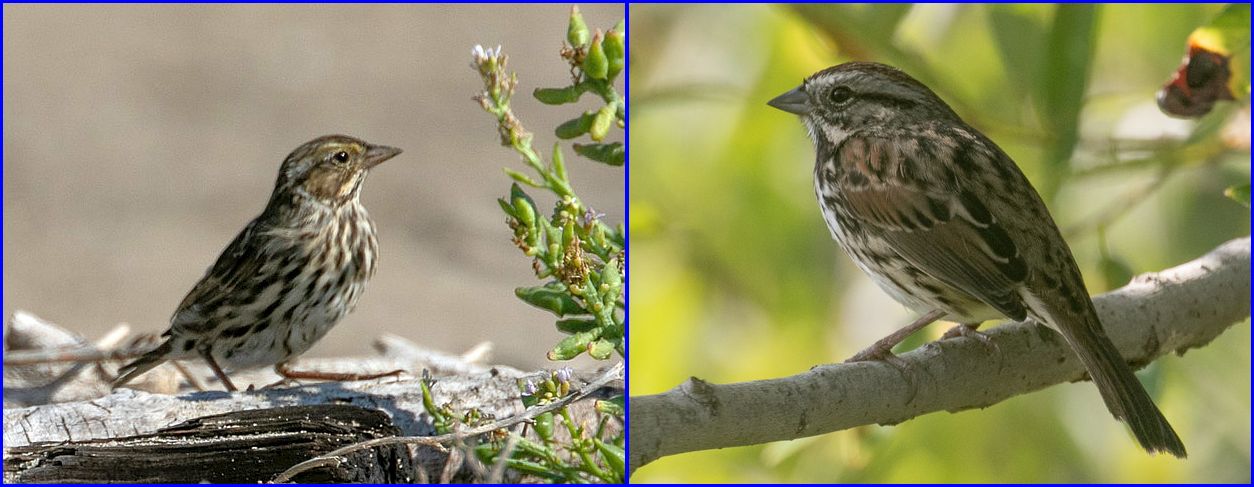
Savannah Sparrow. on the left, breeds from southern Mexico (at least!) to high arctic Alaska, and across the USA, but I don’t think they breed at the lagoon. We see them 1/6th as often as the Song, and never in May and June. Their central breast spot – if any – is less noticeable than the Song’s, the breast streaks usually a bit thinner, the bill slightly thinner and more pointed and they usually have some dull yellow in the lores/eyebrow. When we see them at the lagoon, it’s usually around the edges of the channels or lagoon.
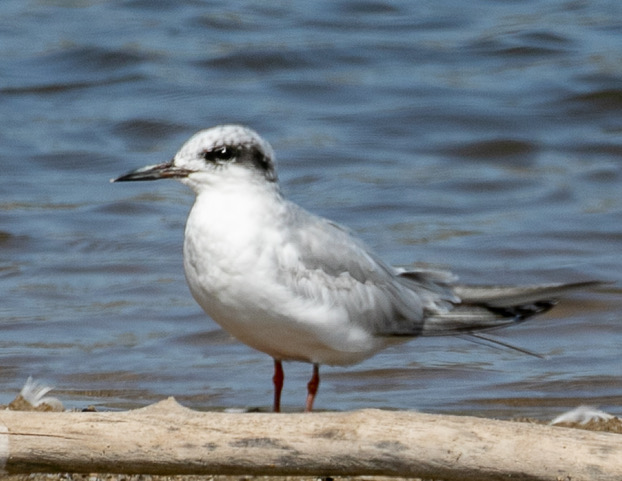
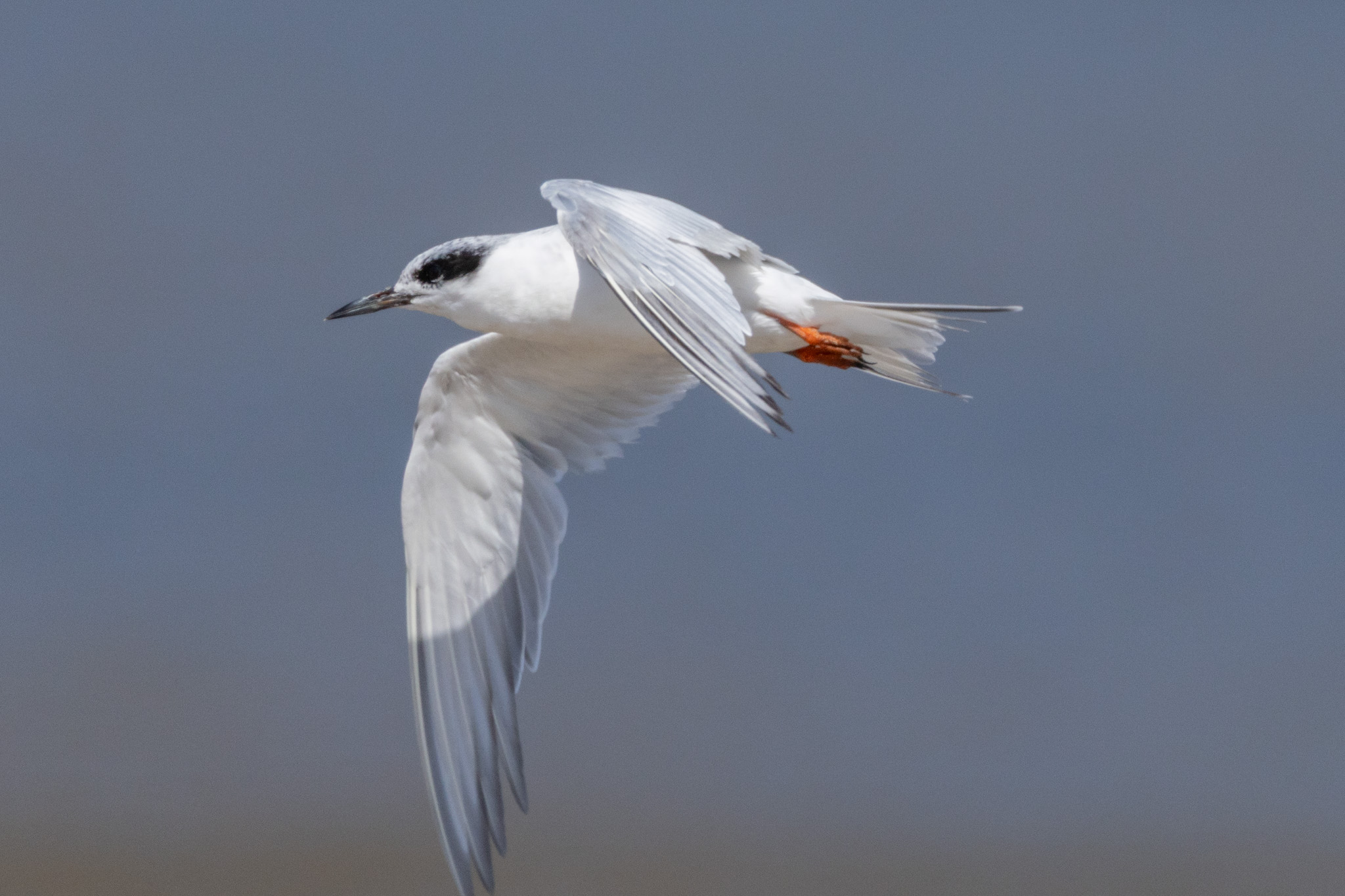
Forester’s Tern used to be a lot more common at the lagoon. Their historical presence peaks Nov-Apr and are nearly absent June-July, when they’re elsewhere breeding. Of 130 sightings at the lagoon since 1979 (892 birds total), we’ve seen them only 10 times (17 birds) since Christmas Day, 2016; that woefully averages to one visit per year. Compare that to my first 11 visits over a 5-month period Oct 1979 – Mar 1980: present 10 out of 11 times for a total of 181 birds. They’re similar to the not-at-all-Common Tern, but it would be tough to confuse them with Royal or Elegant, so sheer ignorance on my part isn’t the explanation. The last time we had more than 100 Forster’s Terns in a single year was 1982, and we haven’t seen them more than six times per year since 2008. Definitely dwindling. Seeing this one standing and flying at the lagoon, pictured just above and in the first photo, was a treat. Compare it to the Royal and Elegant Terns below; not greatly confusable with either of them. Elegants have the more pointy, slender and curved bill and there are at least four of them pictured below. The rest are Royals.

Somewhere along the trail Femi, Ruth and Chris spotted a Swinhoe’s White-eye. They didn’t get a great look at it, but they felt it was sufficient and Femi also recorded it with Merlin. [I’ve previously expressed my doubts about Merlin ID’s when it comes to chip notes and very low volume songs after it ID’d an Osprey and Northern Cardinal in the back yard bushes – then filled with House Sparrows and House Finches – of my north San Fernando Valley home.] The White-eye family Zosteropidae is an old-world family, widespread from sub-Saharan Africa to Australasia, and the Swinhoe’s Zosterops simplex range is from west Indonesia to central China. It is far more widespread as an escaped cagebird, gone feral, which is how they got to SoCal and why they’re becoming more widespread. Our local population extends from northern Baja to Sonoma, with possible outlying populations in Redding and Seattle. The highest concentration of sightings is in the Anaheim – Irvine area. See the link above for a map. We’ve seen them on several field trips.
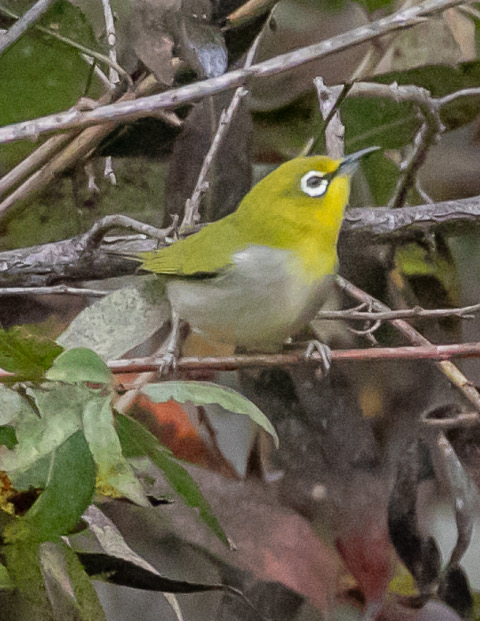
Huntington Beach Central Park)
They’ve been sighted at the lagoon before and there are 19 sightings*** at the lagoon on ebird, many of them for the same six dates (thus probably same bird); most likely six different actual White-eye visits. First sighting was by Dan Cooper on 5-19-24. On the lagoon list they appear as bird #319, an “Exotic-Provisional” species.
I always like seeing White-eyes in SoCal even if we can’t “count” them. I’ve seen 28 White-eye species scattered around the old world, including the Swinhoe’s on Taiwan, and they are always lovely, friendly, bouncy little birds.
***Note: I’ve often wondered how to find out about a particular species at a particular location on eBird. Femi clued me in on this and I’m passing it on to you and preserving it for posterity.
1. Go to eBird https://ebird.org/home Select Explore.
2. Scroll down to and select Species Maps. You’ll need to sign in or create an account. It’s free!
3. Enter the species name, e.g. Swinhoe’s White-eye.
4. When map appears, zoom in to part of the world you want until little red and blue markers appears.
5. These markers are “hot spots.” Click on the one you want.
6. A list of sightings and the hot spot name opens up. Click on the name or sighting to see more detail.
Malibu Lagoon on eBird as of 8-29-25: 8693 lists, 2796 eBirders, 321 species
Most recent new species seen: Nelson’s Sparrow, 11/29/24 by Femi Faminu (SMBAS member). When the newest species added to the list was seen on a date prior to the most recently seen new species, there is no way I can find to easily determine what that bird is. Another minor nit to pick about eBird.
Birds new for the season: Forster’sTern, Elegant Tern, Yellow-crowned Night Heron, White-faced Ibis, Red-tailed Hawk, California Scrub-Jay, Swinhoe’s White-eye, Northern House Wren, Savannah Sparrow. “New for the season” means it has been three or more months since last recorded on our trips.
Many, many thanks to photographers Ray Juncosa, Armando Martinez & Chris Tosdevin.
Upcoming SMBAS scheduled field trips; no reservations or Covid card necessary unless specifically mentioned:
- Coastal Cleanup at the Lagoon, Sat. Sept. 20, 9-12
- Malibu Lagoon, Sun. Sept. 28, 8:30 (adults) & 10 am (parents & kids)
- Huntington Beach Central Park Sat, Oct. 11, 8:00 Leader: Liz Galton egalton687[AT]gmail.com Reservation required
- Malibu Lagoon, Sun. Oct. 26, 8:30 (adults) & 10 am (parents & kids)
- These and any other trips we announce for the foreseeable future will depend upon expected status of the Covid/flu/etc. pandemic, not to mention landslides, at trip time. Any trip announced may be canceled shortly before trip date if it seems necessary. By now any other comments should be superfluous.
- Link to Programs & Field Trip schedule.
The next SMBAS Zoom program: October 7, to be announced.
The SMBAS 10 a.m. Parent’s & Kids Birdwalk has again resumed. Reservations not necessary for families, but for groups (scouts, etc.), call Jean (213-522-0062).
Links: Unusual birds at Malibu Lagoon
9/23/02 Aerial photo of Malibu Lagoon
More recent aerial photo
Prior checklists:
2025: Jan-June
2023: Jan-June, July-Dec 2024: Jan-June, July-Dec
2021: Jan-July, July-Dec 2022: Jan-June, July-Dec
2020: Jan-July, July-Dec 2019: Jan-June, July-Dec
2018: Jan-June, July-Dec 2017: Jan-June, July-Dec
2016: Jan-June, July-Dec 2015: Jan-May, July-Dec
2014: Jan-July, July-Dec 2013: Jan-June, July-Dec
2012: Jan-June, July-Dec 2011: Jan-June, July-Dec
2010: Jan-June, July-Dec 2009: Jan-June, July-Dec
The 10-year comparison summaries created during the Lagoon Reconfiguration Project period, remain available—despite numerous complaints—on our Lagoon Project Bird Census Page. Very briefly summarized, the results unexpectedly indicate that avian species diversification and numbers improved slightly during the restoration period June’12-June’14.
Many thanks to Marie Barnidge-McIntyre, Femi Faminu, Ruth & Chris Tosdevin and others for contributions made to this month’s census counts.
The species list below was re-sequenced as of 12/31/24 to agree with the California Bird Records Committee Official California Checklist, mostly. If part of the right side of the chart below is hidden, there’s a slider button inconveniently located at the bottom end of the list. The numbers 1-9 left of the species names are keyed to the nine categories of birds at the bottom. Updated lagoon bird check lists can be downloaded here.
[Chuck Almdale]
| Malibu Census 2025 | 3/23 | 4/27 | 5/25 | 6/22 | 7/27 | 8/24 | |
| Temperature | 54-64 | 56-64 | 63-68 | 66-73 | 64-70 | 68-75 | |
| Tide Lo/Hi Height | H+4.15 | H+4.29 | H+3.78 | H+3.31 | L-0.46 | H+4.74 | |
| Tide Time | 0433 | 0957 | 0909 | 0824 | 0605 | 1102 | |
| 1 | Brant (Black) | 1 | |||||
| 1 | Canada Goose | 2 | 8 | 1 | 5 | 1 | |
| 1 | Cinnamon Teal | 6 | |||||
| 1 | Gadwall | 35 | 10 | 24 | 25 | 20 | 19 |
| 1 | Mallard | 22 | 21 | 26 | 20 | 40 | 14 |
| 1 | Green-winged Teal | 6 | |||||
| 1 | Surf Scoter | 6 | |||||
| 1 | Red-breasted Merganser | 3 | 1 | 1 | |||
| 1 | Ruddy Duck | 11 | 10 | 4 | 3 | 19 | |
| 2 | Pied-billed Grebe | 8 | 4 | 4 | 4 | 3 | 4 |
| 2 | Western Grebe | 30 | 25 | 4 | 2 | ||
| 7 | Feral Pigeon | 1 | 6 | 5 | 5 | 4 | |
| 7 | Mourning Dove | 1 | 2 | 2 | 1 | 2 | 2 |
| 8 | Anna’s Hummingbird | 3 | 3 | 1 | 1 | 1 | |
| 8 | Allen’s Hummingbird | 6 | 5 | 2 | 2 | 4 | 4 |
| 2 | American Coot | 55 | 11 | 4 | 1 | 6 | 4 |
| 5 | Black-bellied Plover | 21 | 49 | ||||
| 5 | Killdeer | 4 | 3 | 2 | 5 | 4 | 9 |
| 5 | Semipalmated Plover | 2 | 4 | 1 | |||
| 5 | Snowy Plover | 3 | 13 | 17 | |||
| 5 | Whimbrel | 8 | 3 | 1 | 12 | ||
| 5 | Marbled Godwit | 8 | |||||
| 5 | Ruddy Turnstone | 3 | 1 | ||||
| 5 | Dunlin | 1 | |||||
| 5 | Least Sandpiper | 5 | 1 | 10 | 4 | ||
| 5 | Western Sandpiper | 34 | 4 | ||||
| 5 | Spotted Sandpiper | 1 | |||||
| 5 | Willet | 10 | 1 | ||||
| 5 | Greater Yellowlegs | 2 | |||||
| 5 | Wilson’s Phalarope | 1 | |||||
| 6 | Heermann’s Gull | 13 | 36 | 10 | |||
| 6 | Ring-billed Gull | 6 | 2 | 3 | 5 | 2 | 4 |
| 6 | Western Gull | 20 | 20 | 70 | 79 | 52 | 115 |
| 6 | California Gull | 1 | 2 | 82 | 5 | 1 | 4 |
| 6 | American Herring Gull | 1 | |||||
| 6 | Glaucous-winged Gull | 1 | |||||
| 6 | Caspian Tern | 11 | 2 | 6 | 4 | 4 | 2 |
| 6 | Forster’s Tern | 1 | |||||
| 6 | Royal Tern | 10 | 21 | 135 | |||
| 6 | Elegant Tern | 2 | 70 | ||||
| 2 | Pacific Loon | 1 | 1 | ||||
| 2 | Common Loon | 10 | |||||
| 2 | Brandt’s Cormorant | 5 | 12 | 1 | 1 | ||
| 2 | Pelagic Cormorant | 1 | 1 | 2 | |||
| 2 | Double-crested Cormorant | 25 | 25 | 7 | 18 | 98 | 74 |
| 2 | American White Pelican | 5 | |||||
| 2 | Brown Pelican | 200 | 25 | 157 | 138 | 118 | 32 |
| 3 | Snowy Egret | 5 | 1 | 2 | 1 | 10 | 10 |
| 4 | Yellow-crownd Night-Heron | 1 | |||||
| 3 | Black-crownd Night-Heron | 1 | 4 | 1 | 1 | ||
| 3 | Green Heron | 1 | 2 | ||||
| 3 | Great Egret | 2 | 1 | 1 | 3 | 4 | 2 |
| 3 | Western Cattle-Egret | 1 | |||||
| 3 | Great Blue Heron | 2 | 1 | 1 | 9 | 5 | 5 |
| 3 | White-faced Ibis | 1 | |||||
| 4 | Turkey Vulture | 2 | |||||
| 4 | Osprey | 1 | 1 | 1 | 1 | ||
| 4 | Cooper’s Hawk | 1 | |||||
| 4 | Red-shouldered Hawk | 1 | 1 | 1 | |||
| 4 | Red-tailed Hawk | 1 | 1 | 1 | 1 | ||
| 8 | Belted Kingfisher | 1 | 1 | ||||
| 8 | Nuttall’s Woodpecker | 1 | 1 | ||||
| 4 | Peregrine Falcon | 1 | |||||
| 8 | Nanday Parakeet | 2 | 2 | ||||
| 9 | Cassin’s Kingbird | 1 | 1 | 1 | |||
| 9 | Black Phoebe | 3 | 1 | 2 | 2 | 2 | 2 |
| 9 | California Scrub-Jay | 1 | 1 | 1 | |||
| 9 | American Crow | 6 | 5 | 6 | 6 | 9 | 8 |
| 9 | Common Raven | 9 | 2 | 1 | |||
| 9 | Oak Titmouse | 1 | |||||
| 9 | Tree Swallow | 5 | 1 | ||||
| 9 | Violet-green Swallow | 5 | |||||
| 9 | No. Rough-winged Swallow | 17 | 20 | 7 | 1 | 5 | 2 |
| 9 | Barn Swallow | 10 | 20 | 18 | 22 | 20 | 40 |
| 9 | Cliff Swallow | 3 | 7 | 24 | 24 | 12 | |
| 9 | Bushtit | 25 | 2 | 3 | 12 | 20 | 20 |
| 9 | Wrentit | 4 | 2 | 2 | 2 | 2 | 1 |
| 9 | Swinhoe’s White-eye | 1 | |||||
| 9 | Northern House Wren | 1 | |||||
| 9 | Northern Mockingbird | 1 | |||||
| 9 | European Starling | 10 | 10 | 10 | 6 | 25 | 35 |
| 9 | House Finch | 26 | 15 | 5 | 4 | 5 | 12 |
| 9 | Lesser Goldfinch | 4 | 2 | 2 | |||
| 9 | Dark-eyed Junco | 1 | 1 | 2 | 1 | 6 | |
| 9 | White-crowned Sparrow | 5 | 1 | ||||
| 9 | Savannah Sparrow | 1 | |||||
| 9 | Song Sparrow | 10 | 8 | 6 | 5 | 3 | 6 |
| 9 | California Towhee | 3 | 3 | 2 | 1 | 1 | |
| 9 | Spotted Towhee | 1 | 1 | 2 | |||
| 9 | Hooded Oriole | 1 | 1 | 1 | 2 | ||
| 9 | Brown-headed Cowbird | 2 | |||||
| 9 | Great-tailed Grackle | 2 | 3 | 6 | 8 | 1 | |
| 9 | Orange-crowned Warbler | 3 | 1 | 2 | 1 | 1 | |
| 9 | Common Yellowthroat | 6 | 4 | 5 | 1 | 4 | |
| 9 | Yellow-rumped Warbler | 3 | |||||
| 9 | Wilson’s Warbler | 1 | |||||
| Totals Birds by Type | Mar | Apr | May | Jun | Jul | Aug | |
| 1 | Waterfowl | 91 | 50 | 55 | 54 | 81 | 33 |
| 2 | Water Birds – Other | 339 | 104 | 176 | 163 | 227 | 117 |
| 3 | Herons, Egrets & Ibis | 10 | 4 | 4 | 17 | 21 | 22 |
| 4 | Quail & Raptors | 3 | 4 | 3 | 1 | 2 | 2 |
| 5 | Shorebirds | 76 | 9 | 2 | 6 | 61 | 93 |
| 6 | Gulls & Terns | 52 | 26 | 161 | 106 | 116 | 341 |
| 7 | Doves | 1 | 3 | 8 | 6 | 7 | 6 |
| 8 | Other Non-Passerines | 10 | 10 | 5 | 3 | 6 | 6 |
| 9 | Passerines | 160 | 115 | 103 | 103 | 110 | 141 |
| Totals Birds | 742 | 325 | 517 | 459 | 631 | 761 | |
| Total Species by Group | Mar | Apr | May | Jun | Jul | Aug | |
| 1 | Waterfowl | 8 | 5 | 4 | 5 | 5 | 2 |
| 2 | Water Birds – Other | 9 | 8 | 5 | 5 | 6 | 6 |
| 3 | Herons, Egrets & Ibis | 4 | 4 | 3 | 4 | 5 | 7 |
| 4 | Quail & Raptors | 3 | 3 | 3 | 1 | 2 | 2 |
| 5 | Shorebirds | 10 | 4 | 1 | 2 | 9 | 7 |
| 6 | Gulls & Terns | 8 | 4 | 4 | 5 | 6 | 8 |
| 7 | Doves | 1 | 2 | 2 | 2 | 2 | 2 |
| 8 | Other Non-Passerines | 3 | 3 | 3 | 2 | 3 | 3 |
| 9 | Passerines | 25 | 22 | 21 | 16 | 16 | 16 |
| Totals Species – 94 | 71 | 55 | 46 | 42 | 54 | 53 |
Malibu Lagoon bird walks: 8:30 & 10am Sunday, 24 August, 2025

[Chuck Almdale]
Pacific Coast Highway, as of this writing, is apparently still open between Santa Monica and Malibu. However, 7/28-late Sept, Topanga Cyn. Rd. to Las Flores, due to fires, storms, utility repairs and a plethora of diminutive theropodians:
Northbound: 1 lane weekdays 7am-3pm, weekends: 5am-5pm
Southbound: 1 lane weekdays 9am-5pm, weekends: apparently open
But you can confirm this for yourself here.
So… SMBAS lagoon trips (8:30am general and 10am parents & kids) are happening.
The migrating shorebirds are picking up in numbers and diversity, as are gulls and terns. Many may still have their bright breeding plumages. Snowy Plovers have returned from breeding. You never know what might blow, float or wander in.

Left: Chris Tosdevin, Right: Ray Juncosa 8-25-24
Some of the great birds we’ve had in August are:
Green-winged Teal, Brandt’s & Pelagic Cormorant, Snowy Egret, White-faced Ibis, Osprey, White-tailed Kite, Red-tailed Hawk, Semipalmated Plover, Spotted Sandpiper, Ruddy & Black Turnstones, Sanderling, Western & Least Sandpipers, Pectoral Sandpiper, Short-billed Dowitcher, Least, Forster’s, Royal & Elegant Tern, Black Skimmer, White-throated Swift, Belted Kingfisher, Merlin, Western Wood-Pewee, Ash-throated Flycatcher, Western Kingbird, Oak Titmouse, House Wren, Orange-crowned, Warbler & Wilson’s Warbler, Common Yellowthroat, Savannah, Song & Lincoln’s Sparrow, Western Tanager, Red-winged Blackbird, Bullock’s Oriole.
Weather prediction as of 19 August:
Cloudy, warm. Temp: 67-73°, Wind: NW 3>8 mph, Clouds: 90%>15%, rain: 5%
Tide: Very low & rising: Low: -0.20 ft. @ 4:52am; High: +4.74 ft. @ 11:02pm
July 27 trip report link
Adult Walk 8:30 a.m., 4th Sunday of every month. Beginner and experienced, 2-3 hours. Species range from 35 in June to 60-75 during migrations and winter. We move slowly and check everything as we move along. When lagoon outlet is closed we may continue east around the lagoon to Adamson House. We put out special effort to make our monthly Malibu Lagoon walks attractive to first-time and beginning birdwatchers. So please, if you are at all worried about coming on a trip and embarrassing yourself because of all the experts, we remember our first trips too. Someone showed us the birds; now it’s our turn. Bring your birding questions.
Children and Parents Walk, 10:00 a.m., 4th Sunday of every month: One hour session, meeting at the metal-shaded viewing area between parking lot and channel. We start at 10:00 for a shorter walk and to allow time for families to get it together on a sleepy Sunday morning. Our leaders are experienced with kids so please bring them to the beach! We have an ample supply of binoculars that children can use without striking terror into their parents. We want to see families enjoying nature. (If you have a Scout Troop or other group of more than seven people, you must call Jean (213-522-0062) to make sure we have enough binoculars, docents and sand.)

[Written & posted by Chuck Almdale]
Birds take their lumps and splits
[Posted by Chuck Almdale]
Well, it’s that time of year when all good things come to an end and a new beginning…..begins. I’m talking about the annual bird checklist updates of August, of course. [What else could I have possibly meant?]
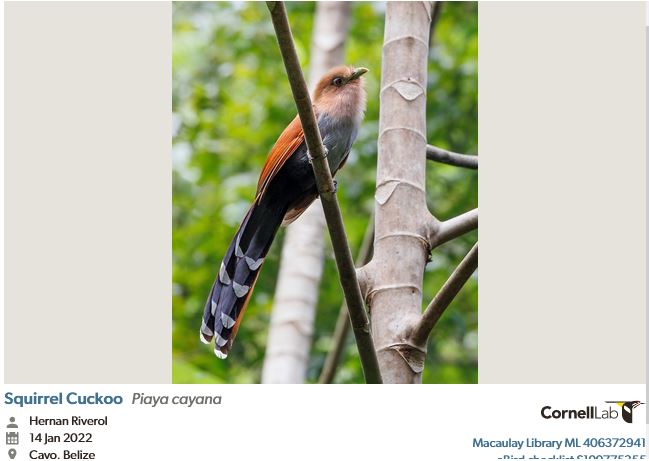
Not everyone does this at the same time, needless to say. Some people and websites lag by years, if not decades. I pity whomever it is that keeps Wikipedia up-to-date. But, this year at least, the American Birding Association (ABA, not that other ABA that purports to deal with legal matters) has done their work, and you, even non-members of either ABA, can read all about it in their Checklist Redux 2025, by Michael L.P. Retter and published today.
Changes include:
Splits
- Warbling Vireo, Vireo gilvus – now two species
- White Tern, Gygis alba – now three species
- Nutting’s Flycatcher, Myiarchus nuttingi – now two species
- Willow Ptarmigan, Lagopus lagopus – now two species
- Eurasian Collared-Dove, Streptopelia decaocto – now two species
- Bank Swallow, Riparia riparia – now two species
The rest of the changes are either higher level splits or lumps in genera or families, or affect only non-ABA area birds. But here’s a few examples for those of you who may have birded elsewhere in the world:
Streptopelia doves genus split
Basileuterus warblers genus split
Apus swifts genus split
Eurasian Hoopoe split off the Madagascar Hoopoe (finally!!)
Garrulax Laughingthrush genus split
Cyanecula (Bluethroats, et.al.) genus disappeared
Four crane-like families in Gruiformes have been reordered, same thing for gull subfamilies in Laridae, families in Pelicaniformes, many species of doves in Columbidae, and Jacamars and Puffbirds swapped places within Piciformes.
Plus: more splits in Squirrel-Cuckoos, Trogons, Xenops, tropical Flycatchers, a Catbird switch, and, and…
“Among the West Indian endemic “tanagers”, Nesospingidae (Puerto Rican Tanager) and Spindalidae (spindalises) are subsumed into Phaenicophilidae (Hispaniolan Tanagers).”
Bummer. I think I lost a family or two on this last one.
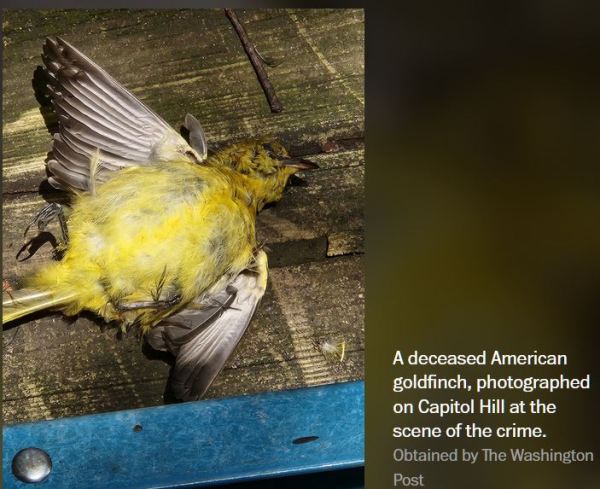
[Posted by Chuck Almdale, submitted by Ted Winterer]
The link is one of those Apple News links that usually don’t work on non-Apple devices, but for some reason, it worked for me. Good luck.
https://apple.news/AhJgT_NC_SkmiMBTC4DL_lg
If that doesn’t work, try this directly to the Washpost site.
https://www.washingtonpost.com/dc-md-va/interactive/2025/capitol-hill-bird-murder-mystery-falcon/
Western Snowy Plovers and Salt Pond Restoration | RWC Pulse

[Posted by Chuck Almdale, suggested by Lucien Plauzoles]
This article, containing an embedded 9-minute video, was spotted by our Santa Monica Beach Western Snowy Plover roosting area maven, warden and censuser (there’s a mouthful), Lu Plauzoles. It details what’s going on up in San Francisco Bay with the rehabilitation of the former salt ponds and their large population – most recently 321 birds – of breeding Western Snowy Plovers. In 2023, the total world (aka our west coast) population of these birds was only 2,336, up from 2,014 in 2016, 1,817 in 2005, and under 1,000 in the 1980s; that makes this current SF Bay population 14% of total WSPs. Not a heck of a lot when compared to the number of people or chickens in California.
Of the total project area, which at around 15,000 acres is slightly larger than the size of Manhattan, anywhere from 50%-90% of ponds will be reverted back to wetlands. Those remaining will be kept dry for the plovers or rehabilitated into deep and shallow ponds for waterfowl.
As the Bay Area’s salt pond restoration project moves forward, a tiny threatened shorebird remains under the watchful eye of biologists [Link to article]
The pivotal project restoring salt ponds to wetlands will also reduce habitat for the western snowy plover as its population is rising. Inside the balancing act to keep plovers on the Peninsula.
by Magali Gauthier July 24, 2025 7:45 pm
Busy time on the salt flats.
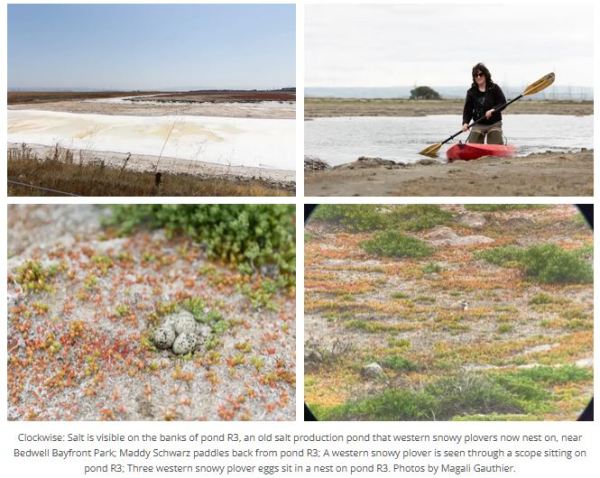
RWC stands for Redwood City, in case you were wondering.



 SANTA MONICA BAY AUDUBON SOCIETY BLOG