Free email delivery
Please sign up for email delivery in the subscription area to the right.
No salesman will call, at least not from us. Maybe from someone else.
Audubon Action Alerts
[Posted by Chuck Almdale]
The good folks at California Audubon and National Audubon wants you to read and act on these two messages.
Add Your Name: Oppose Efforts to Undermine the Endangered Species Act
The Endangered Species Act (ESA) protects the habitat of threatened and endangered species, but a proposal is pending that would weaken the law.
The proposed rule to remove the definition of harm under Endangered Species Act regulations could be devastating to a vast number of birds and other wildlife by weakening protections for habitat. Bird populations are in decline, with a loss of three billion birds in North America since 1970, and numerous species of birds are now protected under the ESA, primarily due to habitat loss.
This proposed rule could open the door to habitat loss for some of our most vulnerable species and discourage proactive measures, making it harder for species to recover.
Add your name [by clicking the above link] to support Audubon in opposing the harmful proposal to undermine the Endangered Species Act.

Take Action to Protect Habitat for Birds and People
Many birds depend on urban areas for nesting, migration, and wintering habitat. At a time when habitat loss threatens the health of bird populations and our communities, conserving and improving urban habitats is essential to a healthy future for birds and people. The Local Communities and Bird Habitat Stewardship Act would benefit these habitats by improving local parks, reducing hazards to birds in urban environments—such as collisions with buildings—and engaging communities with birds and nature.
Act now [by clicking the above link] and urge your U.S. Representative to support the Local Communities and Bird Habitat Stewardship Act.
The recording of this program from 6 May 2025 is now available online.

Dark-eyed Juncos (Junco hyemalis) have become prolific in Californian urban spaces, which makes them a model species to study urban adaptation. Joey Di Liberto and Suu Zhou will discuss their recent two years of research on how juncos are shifting crucial behavioral responses while living in urban environments. While it is known that urban populations of Dark-eyed Juncos’ exhibit altered territorial aggression compared to montane counterparts, we recently found that discrete populations in different urban areas, as well as in a non-urban area, show differing aggressive responses. Additionally, Dark-eyed Juncos have been found to have reduced flight initiation distance and fear response in urban spaces, but little work has focused on how these behavioral responses vary across the birds’ annual cycle. New research indicates that the juncos’ breeding phenology may not have a direct impact on their fear response, but there are signs that the specific time of year, among other variables, may instead impact their flight initiation distance. This research allows us to gain key insights on how wildlife may be affected by human activity, and how they may be adapting their behavior to thrive in the city.
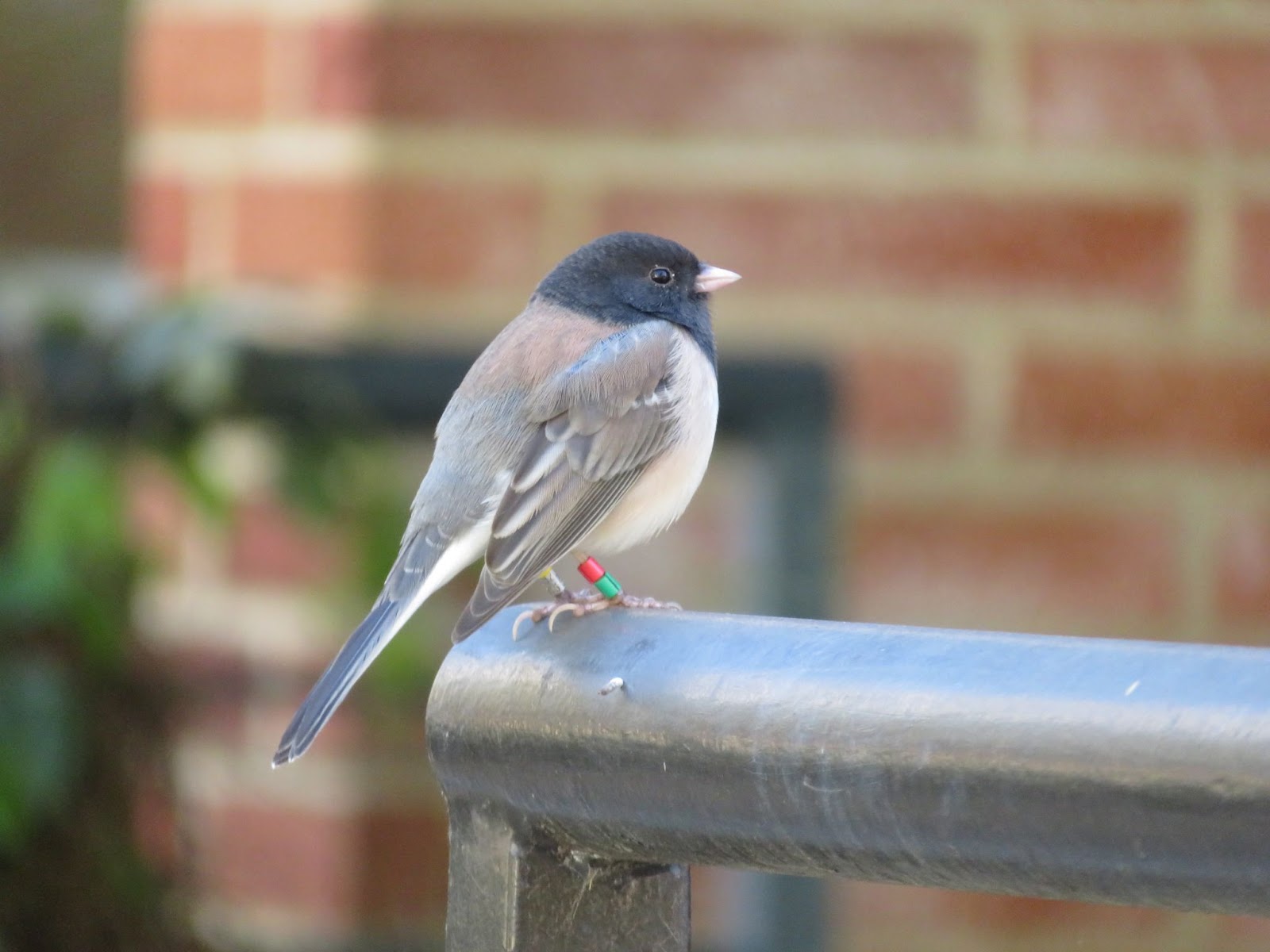
Joey Di Liberto is a second year PhD student in the Yeh Lab. He attended UC San Diego for his Bachelors and The College of William and Mary for his Masters; both in the field of Biology. His work broadly seeks to understand how birds on the front lines of anthropogenic changes adapt and change in response. When not birding, you can find him jamming out on his trumpet, hiking, or listening to music. His favorite bird is the Satin Bowerbird.
Suu Zhou is a second year MS student in the Yeh Lab. They attended Mount Holyoke College, where they majored in Biology. Their research focuses on seasonal changes in urban Junco behavior. Their hobbies include birding (of course), reading, and their favorite bird is the Steller’s Jay.
Link to all SMBAS Zoom Recordings

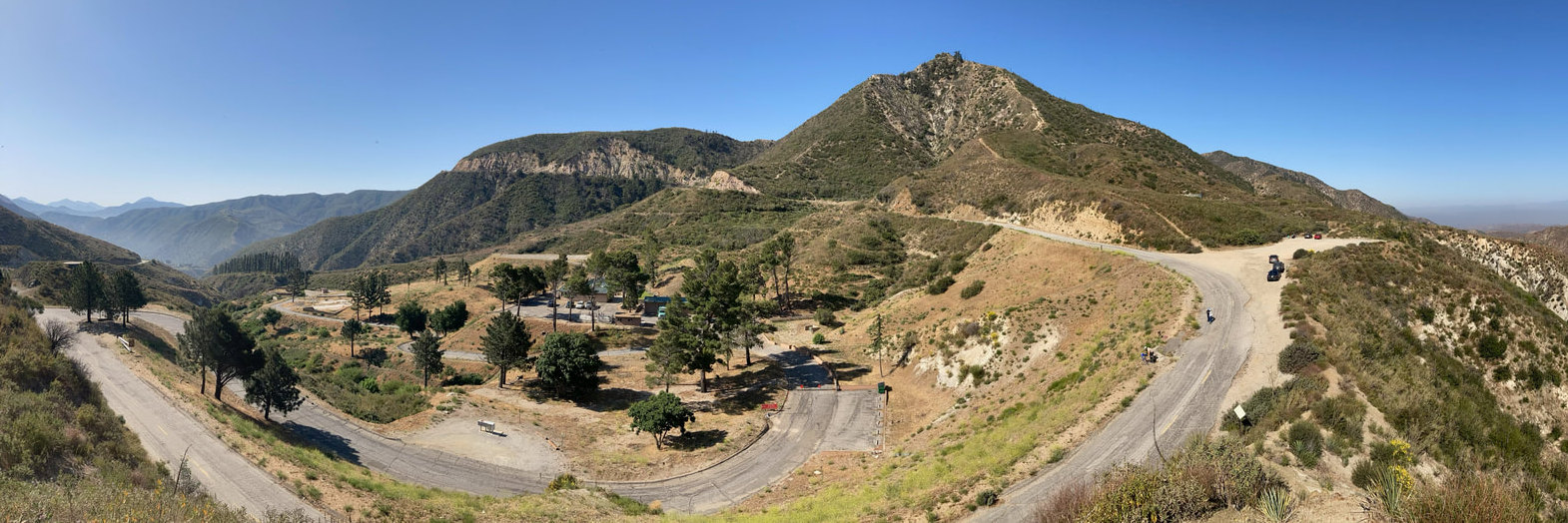
[Posted by Chuck Almdale, photos by Armando Martinez]
A total of nine birders in four vehicles met at the banding site around 7:30 am, as planned, a small logistical miracle in itself. It was very foggy. One of the banding personnel had been kind enough to call us at 6 am to tell us it was fogged in and they wouldn’t be banding today, but off we went anyway. When we arrived we found another twenty or so people, bundled up, standing around in the fog and hoping to see some birds, so it became a bit of a party, as when a rarity is reported and birders gather at the stake-out spot, hoping for a glimpse of a lifer and chattering away while they wait.
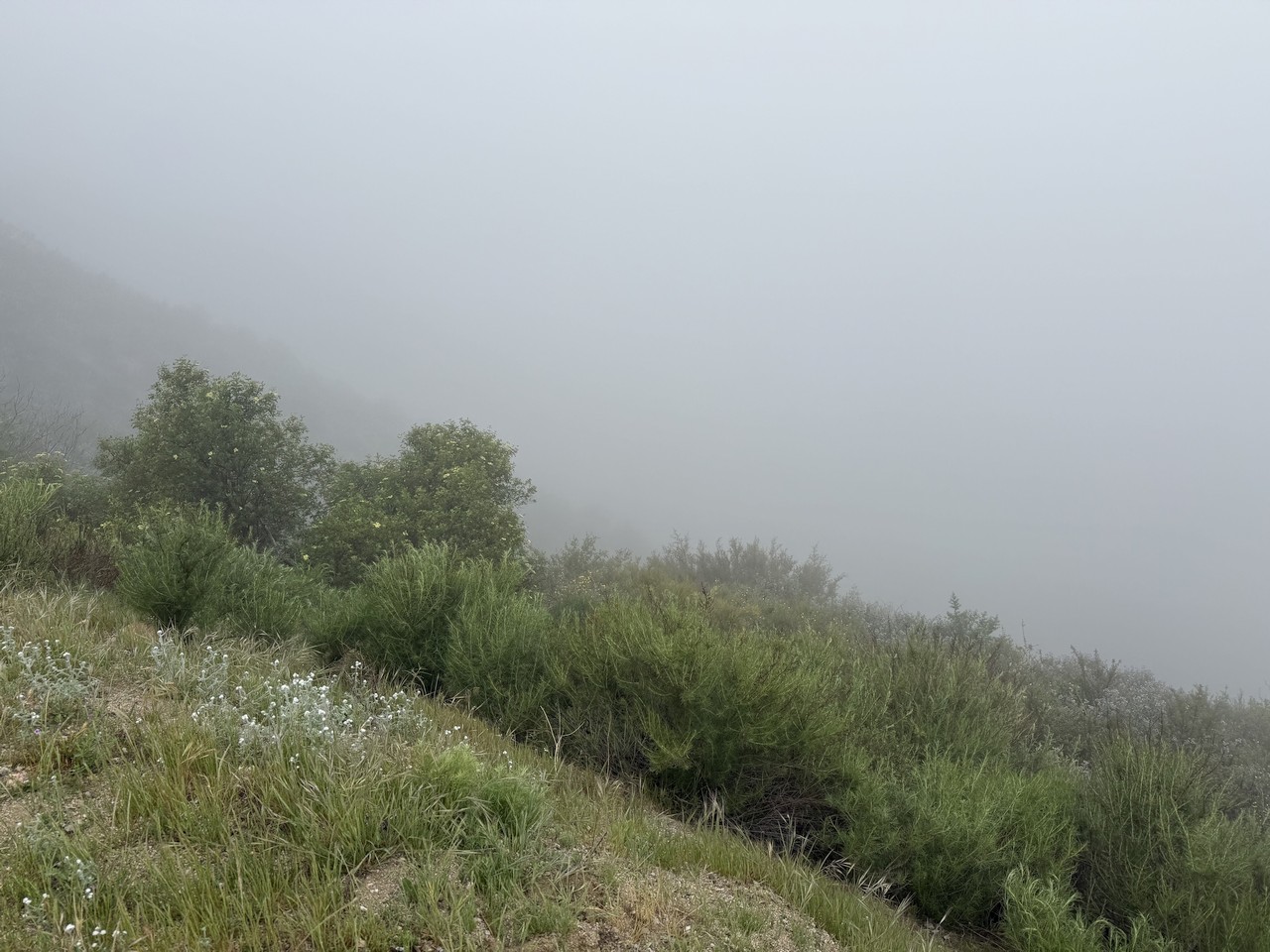
They call off the banding when it’s foggy because 1) most of the birds know enough to fly over the fog if it’s not too high, and (in my opinion) 2) it’s cold, fingers get cold, it’s harder to manipulate the tools and the live birds and thus the fun dissipates faster than the fog.
Every now and then a bird would appear. If it didn’t shoot right on by but landed somewhere we’d all try to spot it and identify it, tricky business in the fog. Here’s one that we thought at the time was a Western Flycatcher (formerly Pacific-slope Flycatcher) but weren’t too sure. Upon examination of Armando’s photograph, I still think it’s a Western Flycatcher, but when it comes to empids (members of the difficult Empidonax genus of Tyrant Flycatchers) one likes decent looks and/or clear photographs.

Fortunately, not all birds were so difficult. We also had both female and male Black-headed Grosbeaks.

Even on the fly, they’re colorful and easy to recognize.

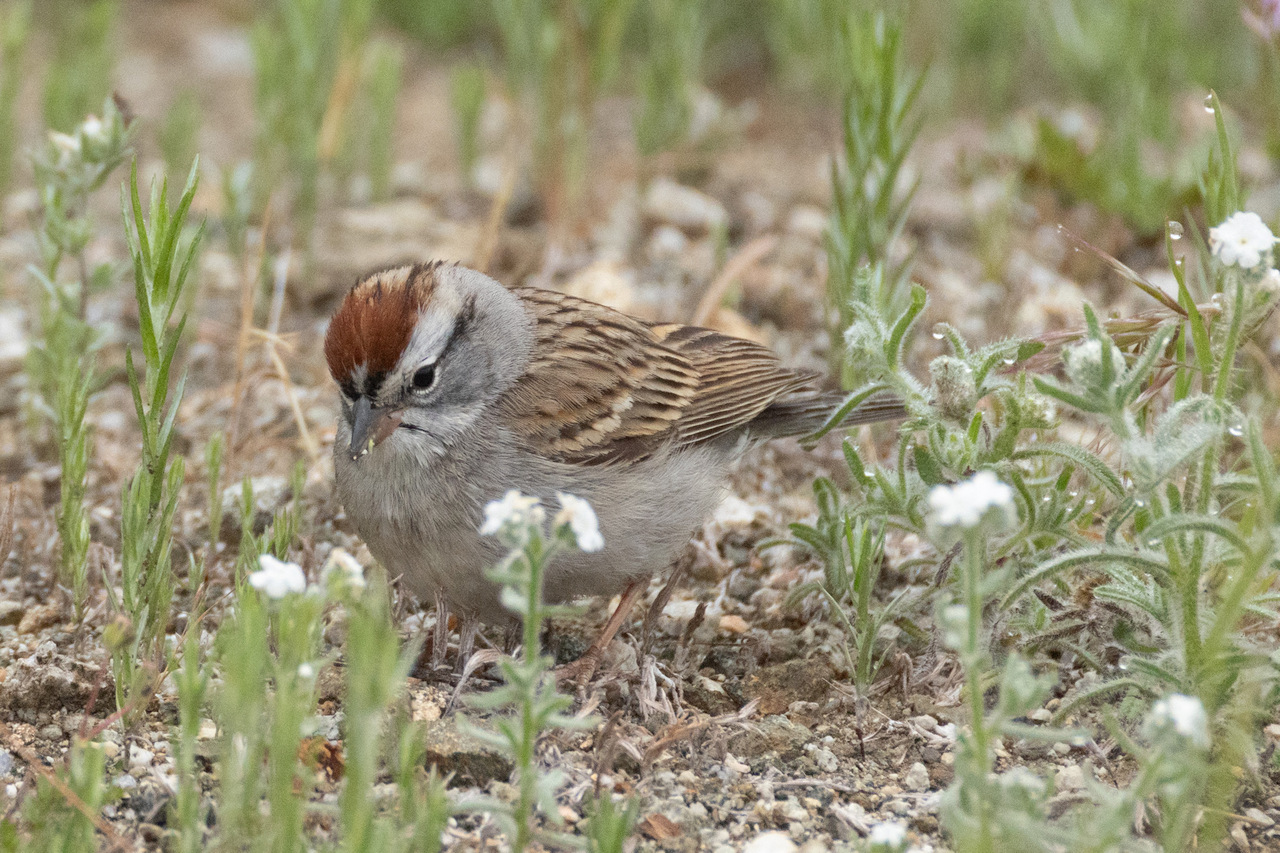
Amazingly enough, the most common species of the day were Chipping Sparrows, which discretely patrolled the grassy verge of the road and sipped most delicately from small cracks in the pavement where the foggy foggy dew collected. Sparrows are (you’ll be shocked to learn!) small birds, and the Chipping at 5.5″ is among the smallest of the bunch. As a result, they’re easy to overlook, looking as they do like small, nearly immobile clods of dirt or clumps of rustling leaves.
We saw several groups of California Quail (or the same group twice, moving in the interim across the ravine). Perhaps it’s just me, but I don’t see them as often as I used to, making me think they are declining in numbers. They used to be just about everywhere, popping in and out of the bushes, calling from the hillsides and bushtops. Shortly before we left a coyote came strolling up the road by the fire station. He or she looked a lot like Wiley Coyote – long legged, a bit skinny and looking hungry, his fur somewhat disheveled, as if he’d slept in it all night.
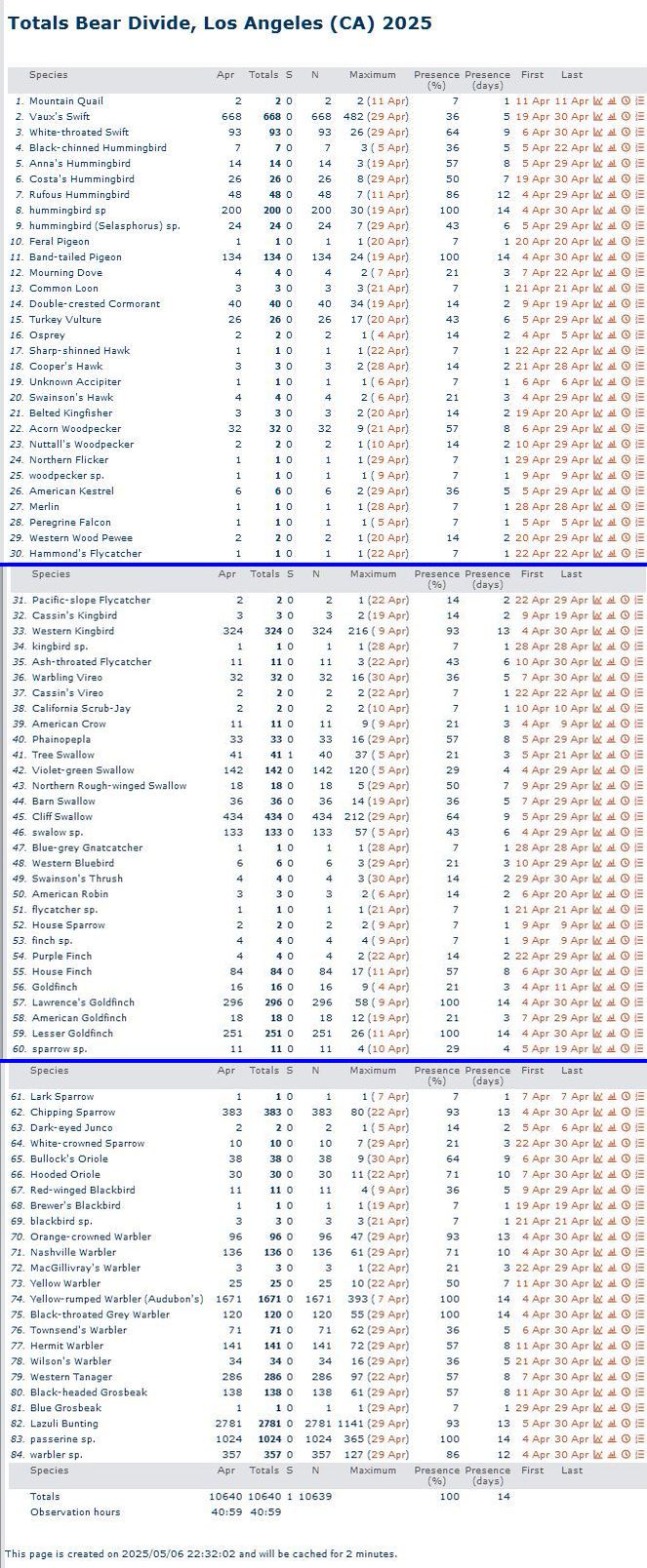
Bear Divide Banding Station of course keeps track of all the birds. Here’s their list for April 2025. For foggy May they have only one day so far. [Link to data page]
Onward to Walker Ranch
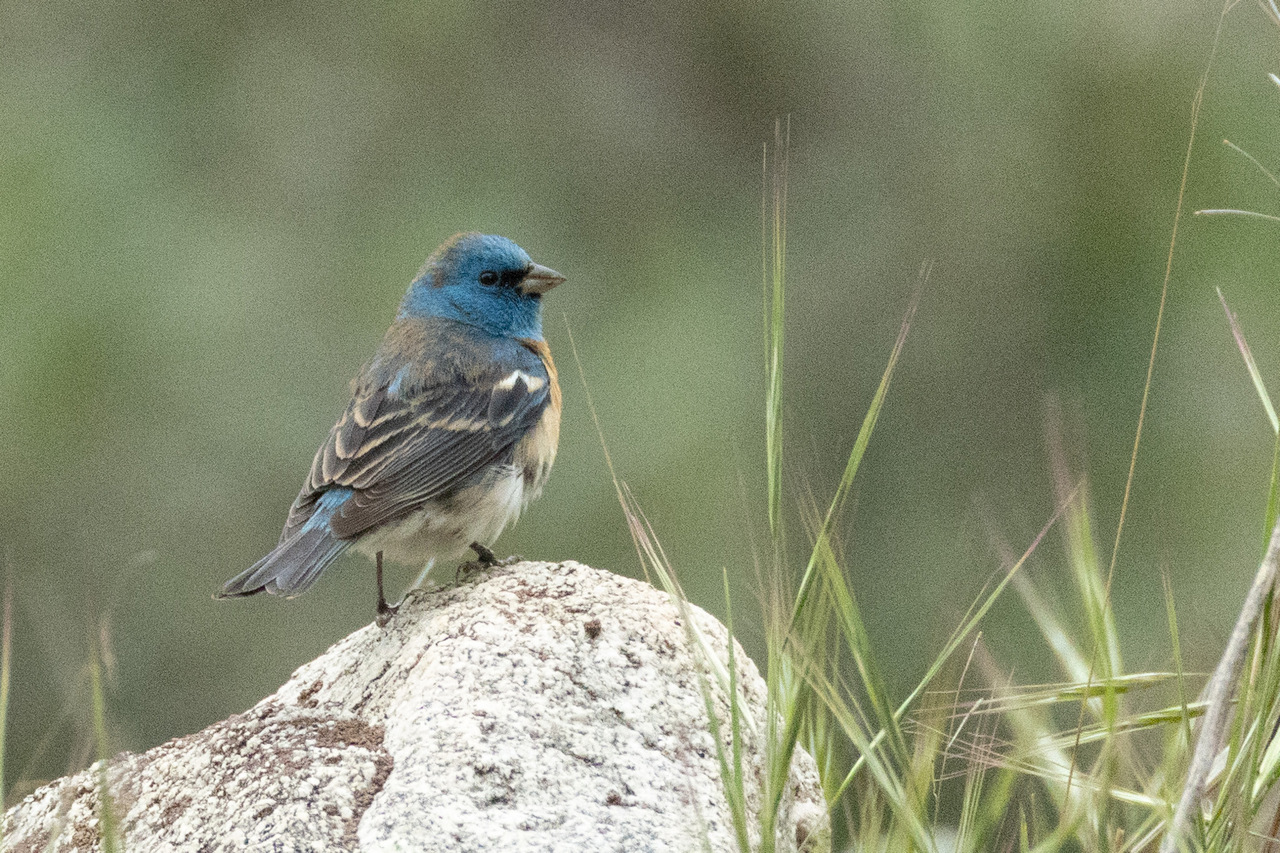
About 9:30 we piled into our cars and rolled back down the hill to Walker Ranch, part of Placerita Canyon Park, then strolled down the hill to the group campground, which was full of some sort of scouting activity and lots of noise. We had barely squeezed our cars into the roadside parking area, but someone left, leaving room. Above us on the hillside were two Lazuli Buntings. For decades they’ve been moderately reliable within 100 yds. of this particular spot. They like recently burned areas – I’m guessing because of food plants that spring up when everything else has been burned away, or the insects that live on such plants, but I don’t know for sure – so their frequent presence says something about Placerita’s burnability rating. “Lazuli” refers to the beautiful shade of blue on their face.
We avoided the campground noise by heading up the path to the “waterfall” which is closer to a very large streamside rock with water flowing along one side than a “fall.” It can be very good for birds sometimes, passing through and down the hillside, but not so much today. What we saw most of was Poison Oak which those who are allergic to it (not everyone is) had to bob and twist while walking to avoid. This section of the path is nice and shady and used to be reliable for California Quail (“chi-CA-go”) and less often Mountain Quail (“perp!”) who occasionally need to drink.
Poison Oak Newsbreak

Western Poison Oak (Toxicodendron (formerly Rhus) diversilobum), Eastern Poison Oak (T. pubescens), Poison Ivy (a complex of three species: T. radicans, T. rydbergii, and T. orientale), and Poison Sumac (T. vernix), as their generic name suggests (toxicodendron = toxic tree), are all poisonous to human touch because they contain the oil urushiol. The Cleveland Clinic writes “…almost everyone is allergic to [urushiol]. Rashes from these plants usually go away within two weeks.” They are in the sumac family, Anacardiaceae. Other plants in this family may also contain urushiol, as do Pistachio (Pistacia vera), Cashew (Anacardium occidentale) and Mango (Mangifera indica), but fewer people react to it in these foods. In the early 1900s Japanese chemists determined that the irritation was caused by the chemical urushiol, a type of alkyl catechol which, due to its structure, was able to penetrate the skin and survive on surfaces for months to years. Urushiol’s ability to polymerise into a hard glossy coating is the chemical basis for traditional lacquerware in many Asian countries. After urushiol comes in contact with oxygen, under certain conditions it becomes a black lacquer and has been named urushi lacquer. [I included this newsbite because I don’t have this allergy and also love pistachios, cashews and mangoes, especially the last two, and was curious about their toxic connection.]

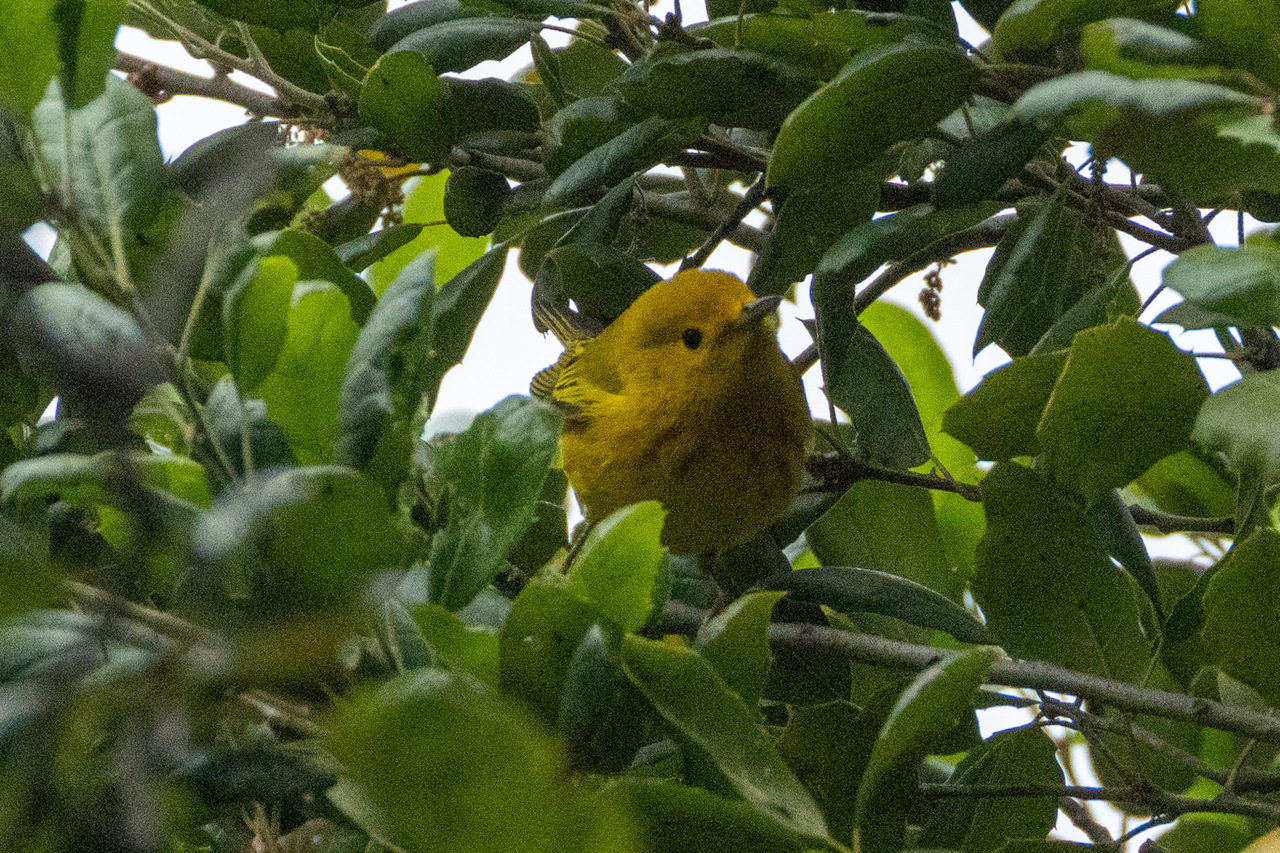
Back to the birds. We found the above bird on the underside of the foliage of an oak tree. Again, a difficult view as it kept flitting around, but again we thought it to be a Western Flycatcher. By the time we reached the group campground everyone had left, so we strolled through the tall grass, which looks like oats to me with seeds drooping from the stems. We walked down-canyon until we encountered an oak tree with several warblers in it. I think everyone got looks at both birds although both were quite busy gleaning in the foliage.

If you look very closely at the above photo you can see the tiny yellow spot in the lores, diagnostic for this species. The male Yellow Warbler had his red breast streaks and was quite lovely.
On the way out of Walker Ranch we spotted this pair high overhead. A nice way to end the day.

eBird trip lists below
Angeles NF–Bear Divide, Los Angeles, California, US
You might want to take a look at their website: https://beardividebanding.com/visit/
May 3, 2025 7:30 AM – 9:30 AM
Protocol: Stationary
Checklist Comments: Very foggy morning, banding station canceled for the day. Temps low 50s °F. No wind. Altitude ~1700 ft. About 20 other birders around. Low counts due to lack of visibility & migrants flying above the fog.
19 species
California Quail 5
Band-tailed Pigeon 4
Mourning Dove 2
Anna’s Hummingbird 2
Acorn Woodpecker 1
Western Flycatcher 1
California Scrub-Jay 1
Common Raven 8
Wrentit 4 Heard only
European Starling 1
Western Bluebird 3
House Finch 10
Chipping Sparrow 15 In grassy verges of road & on road sipping water from pavement cracks.
Lark Sparrow 1
California Towhee 6
Spotted Towhee 2
Bullock’s Oriole 1
Yellow-rumped Warbler 10
Black-headed Grosbeak 2
View this checklist online at https://ebird.org/checklist/S233526603
Placerita Canyon SP–Walker Ranch, Los Angeles, California, US
May 3, 2025 10:00 AM – 11:30 AM
Protocol: Traveling
1.5 mile(s)
Checklist Comments: Temps hi 50s-low 60s °F. Below the fog. Walked to waterfall & down canyon a bit. Low water in stream. Lots of poison oak, few insects.
32 species
Band-tailed Pigeon 3
Mourning Dove 4
Vaux’s Swift 20
Anna’s Hummingbird 3
Turkey Vulture 2
Cooper’s Hawk 2 A pair soaring overhead heading down canyon (NW). Initially ID’d as Merlin, later changed due to protest from eBird.
Red-shouldered Hawk 1 Heard near group campground.
Red-tailed Hawk 1
Acorn Woodpecker 20
Nuttall’s Woodpecker 1 Male
American Kestrel 1
Western Flycatcher 1 On underside of leafy tree up canyon 0.1 mile from campground.
California Scrub-Jay 6
American Crow 4
Common Raven 2
Oak Titmouse 1
Bushtit 1
Wrentit 6 Heard
Ruby-crowned Kinglet 1
Northern House Wren 5 4 heard only
European Starling 6
House Finch 15
Lesser Goldfinch 1 Heard
Song Sparrow 2 Heard
California Towhee 8
Spotted Towhee 4
Bullock’s Oriole 1
Yellow Warbler 1
Black-throated Gray Warbler 1
Townsend’s Warbler 1
Western Tanager 2
Lazuli Bunting 4 Pair above parking place on road. Two others up-canyon from campground.
View this checklist online at https://ebird.org/checklist/S233538100


Birds on the move: Malibu Lagoon, 27 April 2025

[By Chuck Almdale; Photos by Chris Tosdevin]
Giant Coreopsis Leptosyne gigantea (Link) is endemic to the Channel Islands and a very few locations on the nearby mainland. They were introduced to the lagoon during the 2012 reconfiguration – and as far as I’m concerned they are a welcome addition to the flora – but I wouldn’t be surprised to learn they lived here in the past before all the houses appeared. They’re grow quite large on diminutive Santa Barbara Island.
A dozen people showed up for the unofficial lagoon bird walk. We hope PCH will finally reopen to all comers and goers before May 25, the date set for our next walk, but as a very recent mudslide closed the highway yet again, I’m not holding my breath for that. As it was, we had more people than sandpipers and plovers (nine!) and almost as many as there were gulls and terns (twenty-six!). We even outnumbered the eleven coots.
Here’s a news flash: Female Whimbrels are larger than the males, especially in the bill.
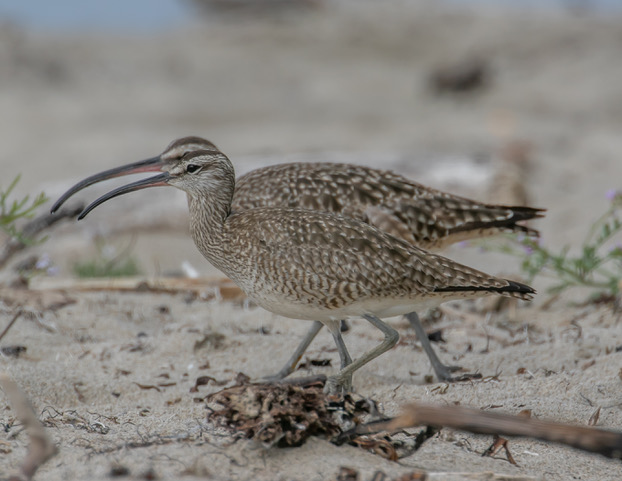
The female’s bill averages 9.4% longer. So when you see them on the beach and one looks bigger and you wonder what’s going on, sexual dimorphism is what’s going on. [Measurements below in millimeters.]

Birds were singing everywhere, or more like loudly buzzing in the case of the Spotted Towhee. Ages ago when I began birding, this bird was known as the Rufous-sided Towhee and included what are now considered two distinct species, our Spotted and the eastern Eastern Towhee. For years I found laughably erroneous the bird book description of the bird’s song as “Drink, drink, drink your tea.” Our bird’s buzzing cannot be rendered into that pattern. Maybe the Rufous-sided Towhees of the east, but not ours. The idea was ludicrous. So when the species was split, I was not shocked (although I was sorry to see the name “Rufous-sided Towhee” disappear as it held a special, personal meaning for me). They had two very different songs for a very good reason — they were two species! As it turns out, different songs can be a very strong hint that you may be dealing with different species, even when they seem to look exactly alike. Biogeography has a lot to do with it.

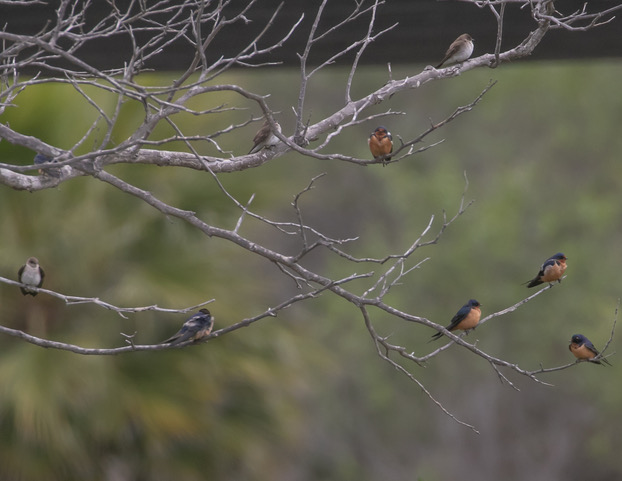
The swallows have definitely arrived. One of their favorite perches is this medium-sized leafless tree by the west end of the PCH bridge, and nine are in this photo. Barn Swallows are the rusty ones, Northern Rough-winged Swallow are the dull brown-back, pale-belly ones, “distinguished by their lack of distinguishing characteristics” among the swallows. The five Violet-green Swallows were confining themselves to the north side of the bridge over the deeper pools of water, and the Cliff Swallows were scattered hither and yon. I discovered that the Barn Swallows were using the bird outlines carved into the cement bridge supports as safe and secluded resting shelves.
The Song Sparrows were busy singing. I counted eight, but there could have been more. Their song territories tend to overlap and it becomes difficult to know if this singer is the same as the previous singer or not.

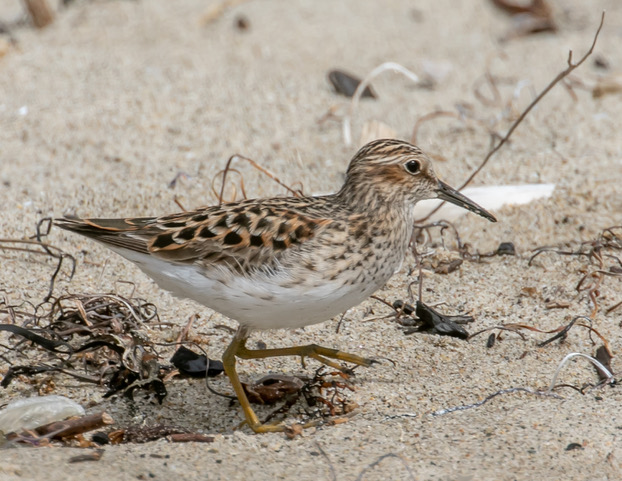
The Least Sandpiper below comprised 100% of the “peeps” and 25% of the sandpipers.
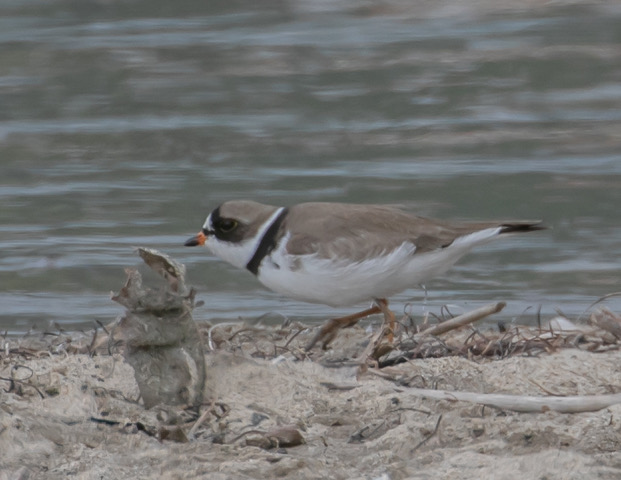
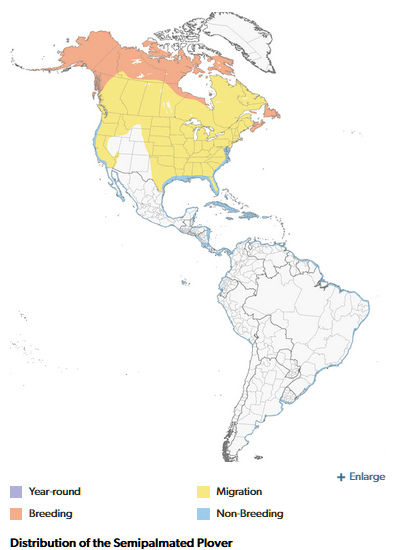
Semipalmated Plovers (below) are a regular spring and fall migrant stopover at the lagoon. My first record of them was 13 birds on 7 Sep 1980. Since then I’ve counted 523 birds on 86 occasions, averaging 6 birds per visit. They’ve appeared in all months except June, but the numbers are clearly skewed. 52 (9.9%) showed up in the nine months of October through March and May through July. April has 291 birds (55.6%), August 102 (19.5%) , and September 78 (14.9%). As I said…a spring and fall migrant. They are “semipalmated” for the same reason that Semipalmated Sandpipers (and Western Sandpipers as well) are semipalmated, and you can see the toe webbing just about equally poorly on all three species.
The distribution map below is from Birds of the World (Link). Once the southbound migrants get to South America their range gets a bit difficult to see, but they can winter along both coasts (slightly thicker blue line) all the way down to the southern tip. When you see them at the lagoon, refueling or resting, consider that they still have a long, long way to go.
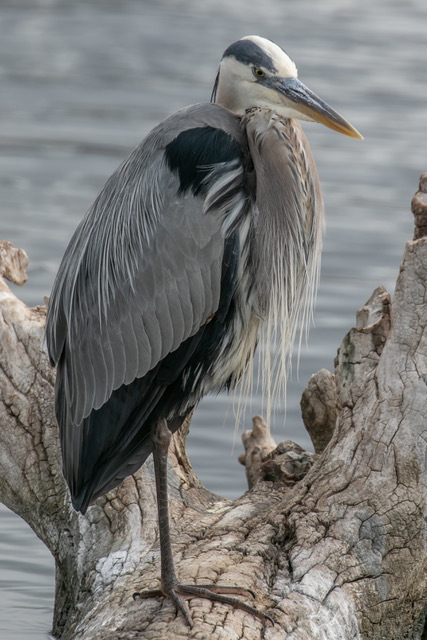
It was actually easy to miss this 4-foot-tall bird standing on a log, it blended in so well, gray on gray.
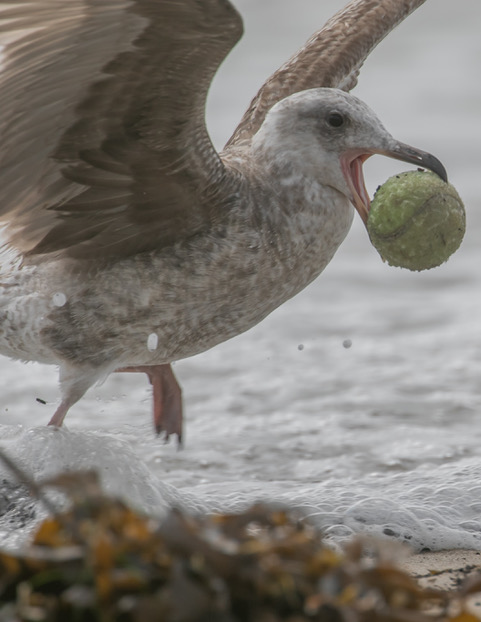
If you live in Malibu Colony and your tennis balls keep disappearing, it’s one of your neighbors sneaking off with them, perhaps to see if anything edible is within.
On our way back to our cars, we had a bit of excitement among the Ardeidae (herons & egrets). First, look closely at the photo below.
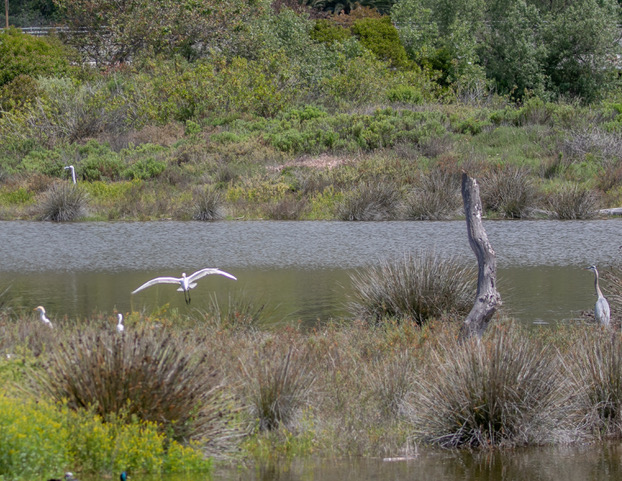
One them is this fellow. Recognize it before you scroll down?
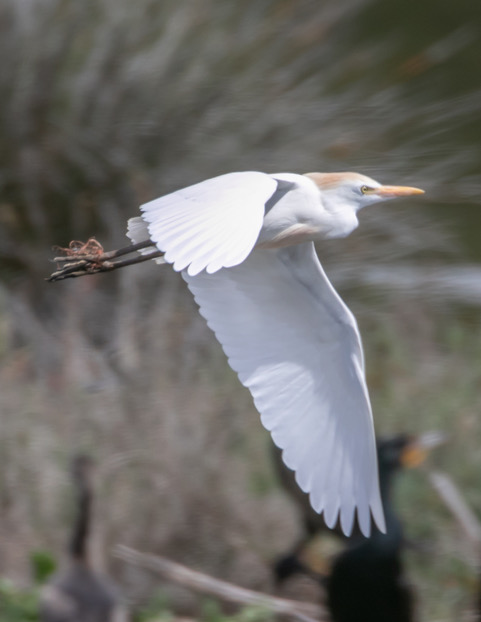
Besides the shortish yellow bill and the dark legs and feet and the relatively small overall size, they have these rusty areas on head and breast in breeding plumage. The excitement began when a Snowy Egret began chasing the Cattle Egret all around the lagoon. It looked pretty aggressive about it and this went on for perhaps five minutes with lots of swooping, hairpin turns and twists, and diving.
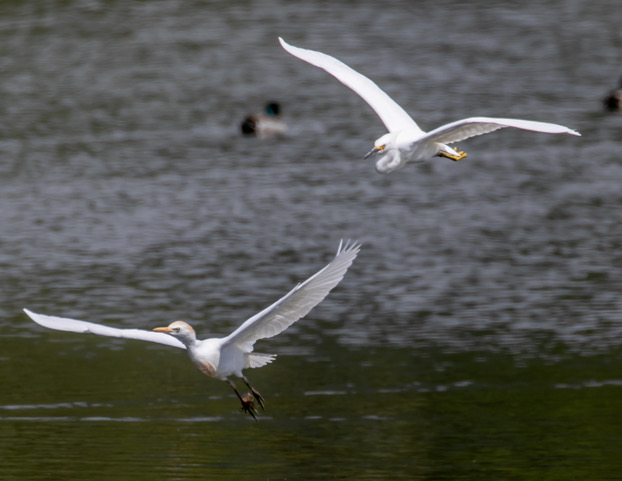
Finally one or the other of them landed near the “Osprey Pole” on the westernmost sand island, and the other landed next to it. Until we left they stayed very close to one another, neither even slightly aggressive to the other. Were they really pals just having some fun, or what?
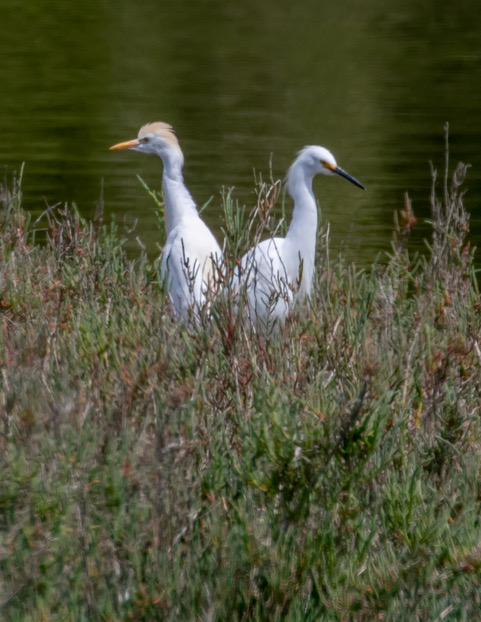
Unlike most of the other herons, egrets and bitterns, Cattle Egrets prefer fields, especially when they support hoofed mammals who walk around and stir up insects. [They’re Cattle Egrets, right?] In Africa they follow antelope, elephants, buffalo or rhinoceros, often riding on their backs. In 2023 they were split into two species: Western Cattle-Egret (Ardea ibis) in Africa, Europe and the Americas, and Eastern Cattle-Egret (Ardea coromanda) from Pakistan to Japan, Australia and New Zealand. There are morphological differences between them which Google will be glad to tell you about.
We don’t get many at the lagoon, but if you go to the fields of Imperial County south of the Salton Sea around sundown, you can see thousands of them overhead, flying to their nighttime roosts. At the lagoon, since 17 Nov 1979 when I spotted 13 birds, I’ve recorded only 65 total birds in 27 appearances. From Nov 2004 to Apr 2006 they appeared almost monthly, mostly as singletons, but on Christmas Day 2005 there were 21 birds. Prior to today, my most recent sighting at the lagoon was of 5 birds on 26 Nov 2017, over seven years ago.
Just how this species appears among us may be unique in the annals of avifauna. [Note: unique ≠ unusual.] Here’s a very short history:
Sub-Saharan Africa: very long term resident, whence they spread.
South America: Suriname 1877, Guyana 1911, Tierra del Fuego 1977.
Antarctica: South Shetlands 1985.
Caribbean: Nicaragua islands 1933; Aruba 1944; Puerto Rico & Jamaica 1948; Bahamas 1953, Cuba & St. Croix 1957; by 1988 on over 50 islands.
Central America: Panama & Costa Rica 1954; Belize 1956; Honduras & Guatemala 1958; Cocos and Clipperton Islands 1961; Nicaragua 1962; El Salvador 1969.
Mexico: Quintana Roo 1956; Veracruz 1958; Tabasco 1959; Tamaulipas 1961; Campeche, Chiapas, Puebla & Yucatan 1963; Guerrero, Sinaloa, Sonora & southern Baja California 1964; northwestern Baja California 1967; Durango & Coahuila 1971; Chihuahua, San Luis Potosí, & Nuevo León 1972; Colima and central Baja California 1973.
Continental United States. South Florida 1941, New Jersey 1951, Massachusetts 1952, Texas 1959, Minnesota 1970, Southern California 1962, Vancouver Island 1969, Montana 1979, southern Alaska 1981; breeding in California 1970.
Canadian provinces. Newfoundland 1952; all other provinces by 1974; Northwest Territories 1971 at Fort Smith south of Great Slave Lake near 60°N latitude; not recorded from Yukon Territory.
Hawaiian Islands. Introduced on the main islands. Reports from Midway may be of Eastern Cattle-Egret.
I haven’t heard of such a rapid spread by any other avian species, although the Eurasian Collard-Dove might be a contender.
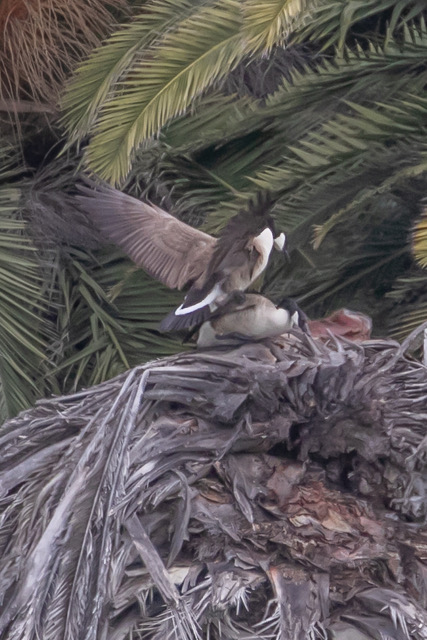
I left this to last. I’ve never heard of Canada Geese nesting in trees, but take a look at this, taking place on Adamson House property in full view of the public.
Malibu Lagoon on eBird as of 5-2-25: 8552 lists, 2744 eBirders, 321 species
Most recent new species seen: Nelson’s Sparrow, 11/29/24 by Femi Faminu (SMBAS member). When the newest species added to the list was seen on a date prior to the most recently seen new species, there is no way I can find to easily determine what that bird is. Another minor nit to pick about eBird.
Birds new for the season: Western Cattle-Egret, Semipalmated Plover, Turkey Vulture, Violet-green Swallow, Hooded Oriole, Brown-headed Cowbird. “New for the season” means it has been three or more months since last recorded on our trips.
Many, many thanks to photographer Chris Tosdevin.
Upcoming SMBAS scheduled field trips; no reservations or Covid card necessary unless specifically mentioned:
- Bear Divide & Walker Ranch, Sat. May 3, 7:30 am
- Malibu Lagoon, Sun. May 25, 8:30 (adults) & 10 am (parents & kids)
- Malibu Creek State Park, Sat, June 14, 8 am
- Malibu Lagoon, Sun. June 22, 8:30 (adults) & 10 am (parents & kids)
- These and any other trips we announce for the foreseeable future will depend upon expected status of the Covid/flu/etc. pandemic, not to mention landslides, at trip time. Any trip announced may be canceled shortly before trip date if it seems necessary. By now any other comments should be superfluous.
- Link to Programs & Field Trip schedule.
The next SMBAS Zoom program: Changing Behavior in Changing Cities: Shifting Trends in Urban Bird Behavior Across Seasons and Cityscapes, with Joey Di Liberto & Suu Zhou. Tuesday, 6 May, 7:30 p.m., Zoom waiting room opens 7:15 p.m.
The SMBAS 10 a.m. Parent’s & Kids Birdwalk will resume when we can again schedule official monthly walks. Reservations not necessary for families, but for groups (scouts, etc.), call Jean (213-522-0062).
Links: Unusual birds at Malibu Lagoon
9/23/02 Aerial photo of Malibu Lagoon
More recent aerial photo
Prior checklists:
2023: Jan-June, July-Dec 2024: Jan-June, July-Dec
2021: Jan-July, July-Dec 2022: Jan-June, July-Dec
2020: Jan-July, July-Dec 2019: Jan-June, July-Dec
2018: Jan-June, July-Dec 2017: Jan-June, July-Dec
2016: Jan-June, July-Dec 2015: Jan-May, July-Dec
2014: Jan-July, July-Dec 2013: Jan-June, July-Dec
2012: Jan-June, July-Dec 2011: Jan-June, July-Dec
2010: Jan-June, July-Dec 2009: Jan-June, July-Dec
The 10-year comparison summaries created during the Lagoon Reconfiguration Project period, remain available—despite numerous complaints—on our Lagoon Project Bird Census Page. Very briefly summarized, the results unexpectedly indicate that avian species diversification and numbers improved slightly during the restoration period June’12-June’14.
Many thanks to Marie Barnidge-McIntyre, Femi Faminu, Lillian Johnson and Chris Tosdevin for contributions made to this month’s census counts.
The species list below was re-sequenced as of 12/31/24 to agree with the California Bird Records Committee Official California Checklist. If part of the right side of the chart below is hidden, there’s a slider button inconveniently located at the bottom end of the list. The numbers 1-9 left of the species names are keyed to the nine categories of birds at the bottom. Updated lagoon bird check lists can be downloaded here.
[Chuck Almdale]
| Malibu Census 2024-25 | 11/24 | 12/22 | 1/30 | 2/23 | 3/23 | 4/27 | |
| Temp °F. | 54-59 | 56-62 | 57-59 | 57-70 | 54-64 | 56-64 | |
| Tide Lo/Hi ft. | L+2.06 | L+2.47 | H+6.14 | H+4.79 | H+4.15 | H+4.29 | |
| Tide Time | 1139 | 0939 | 0913 | 0526 | 0433 | 0957 | |
| 1 | Canada Goose | 2 | 2 | 8 | |||
| 1 | Cinnamon Teal | 5 | 6 | ||||
| 1 | Northern Shoveler | 6 | |||||
| 1 | Gadwall | 26 | 32 | 89 | 9 | 35 | 10 |
| 1 | American Wigeon | 12 | 35 | ||||
| 1 | Mallard | 10 | 20 | 22 | 6 | 22 | 21 |
| 1 | Green-winged Teal | 1 | 10 | 5 | 16 | 6 | |
| 1 | Ring-necked Duck | 3 | |||||
| 1 | Lesser Scaup | 2 | |||||
| 1 | Surf Scoter | 2 | 15 | 6 | |||
| 1 | Bufflehead | 9 | 10 | 23 | |||
| 1 | Red-breasted Merganser | 10 | 13 | 12 | 8 | 3 | 1 |
| 1 | Ruddy Duck | 22 | 35 | 37 | 17 | 11 | 10 |
| 2 | Pied-billed Grebe | 8 | 5 | 4 | 7 | 8 | 4 |
| 2 | Eared Grebe | 1 | 1 | ||||
| 2 | Western Grebe | 1 | 34 | 30 | 30 | 25 | |
| 7 | Feral Pigeon | 4 | 6 | 5 | 1 | ||
| 7 | Mourning Dove | 1 | 2 | ||||
| 8 | Anna’s Hummingbird | 1 | 3 | 3 | 3 | ||
| 8 | Allen’s Hummingbird | 1 | 3 | 1 | 5 | 6 | 5 |
| 2 | Sora | 2 | |||||
| 2 | American Coot | 560 | 705 | 797 | 45 | 55 | 11 |
| 5 | Black Oystercatcher | 2 | 2 | ||||
| 5 | Black-bellied Plover | 75 | 50 | 30 | 30 | ||
| 5 | Killdeer | 1 | 30 | 2 | 4 | 4 | 3 |
| 5 | Semipalmated Plover | 2 | |||||
| 5 | Snowy Plover | 34 | 27 | 2 | 2 | 3 | |
| 5 | Whimbrel | 15 | 4 | 8 | 5 | 8 | 3 |
| 5 | Marbled Godwit | 12 | 25 | 3 | 2 | 8 | |
| 5 | Ruddy Turnstone | 6 | 4 | 2 | 4 | ||
| 5 | Sanderling | 200 | 100 | 22 | |||
| 5 | Dunlin | 1 | |||||
| 5 | Least Sandpiper | 8 | 27 | 7 | 14 | 5 | 1 |
| 5 | Western Sandpiper | 16 | 34 | ||||
| 5 | Spotted Sandpiper | 1 | 1 | 1 | 1 | ||
| 5 | Willet | 51 | 20 | 15 | 8 | 10 | |
| 5 | Greater Yellowlegs | 2 | |||||
| 6 | Heermann’s Gull | 29 | 2 | 7 | 1 | ||
| 6 | Ring-billed Gull | 15 | 19 | 12 | 12 | 6 | 2 |
| 6 | Western Gull | 65 | 35 | 90 | 55 | 20 | 20 |
| 6 | California Gull | 525 | 60 | 575 | 105 | 1 | 2 |
| 6 | American Herring Gull | 1 | 1 | 1 | 2 | 1 | |
| 6 | Glaucous-winged Gull | 3 | 1 | ||||
| 6 | Caspian Tern | 11 | 2 | ||||
| 6 | Royal Tern | 2 | 5 | 10 | |||
| 6 | Elegant Tern | 2 | |||||
| 2 | Red-throated Loon | 1 | |||||
| 2 | Pacific Loon | 1 | 1 | 1 | |||
| 2 | Common Loon | 4 | 10 | ||||
| 2 | Brandt’s Cormorant | 5 | 7 | 1 | 5 | 12 | |
| 2 | Pelagic Cormorant | 2 | 2 | 1 | |||
| 2 | Double-crested Cormorant | 44 | 23 | 55 | 25 | 25 | 25 |
| 2 | American White Pelican | 5 | |||||
| 2 | Brown Pelican | 260 | 35 | 23 | 29 | 200 | 25 |
| 3 | Snowy Egret | 5 | 5 | 5 | 6 | 5 | 1 |
| 3 | Black-crowned Night-Heron | 1 | 2 | 1 | |||
| 3 | Green Heron | 1 | |||||
| 3 | Great Egret | 3 | 1 | 1 | 2 | 2 | 1 |
| 3 | Western Cattle-Egret | 1 | |||||
| 3 | Great Blue Heron | 4 | 4 | 1 | 2 | 1 | |
| 4 | Turkey Vulture | 1 | 2 | ||||
| 4 | Osprey | 1 | 1 | 2 | 1 | 1 | |
| 4 | Cooper’s Hawk | 1 | 1 | ||||
| 4 | Bald Eagle | 1 | |||||
| 4 | Red-tailed Hawk | 1 | 1 | 1 | 1 | ||
| 8 | Belted Kingfisher | 1 | 1 | 1 | 1 | ||
| 8 | Nuttall’s Woodpecker | 1 | |||||
| 8 | Nanday Parakeet | 4 | 4 | 2 | |||
| 9 | Cassin’s Kingbird | 1 | 1 | ||||
| 9 | Black Phoebe | 6 | 1 | 1 | 3 | 3 | 1 |
| 9 | Say’s Phoebe | 1 | 1 | ||||
| 9 | California Scrub-Jay | 1 | 1 | ||||
| 9 | American Crow | 22 | 8 | 9 | 26 | 6 | 5 |
| 9 | Common Raven | 1 | 2 | 9 | 2 | ||
| 9 | Oak Titmouse | 1 | |||||
| 9 | Tree Swallow | 12 | 5 | ||||
| 9 | Violet-green Swallow | 5 | |||||
| 9 | No. Rough-winged Swallow | 17 | 20 | ||||
| 9 | Barn Swallow | 1 | 10 | 20 | |||
| 9 | Cliff Swallow | 3 | 7 | ||||
| 9 | Bushtit | 12 | 50 | 4 | 5 | 25 | 2 |
| 9 | Wrentit | 2 | 1 | 1 | 4 | 2 | |
| 9 | Ruby-crowned Kinglet | 3 | 1 | 1 | |||
| 9 | Blue-gray Gnatcatcher | 1 | 1 | ||||
| 9 | Bewick’s Wren | 2 | 1 | 1 | |||
| 9 | Northern House Wren | 1 | |||||
| 9 | Northern Mockingbird | 1 | 1 | 1 | |||
| 9 | European Starling | 7 | 1 | 10 | 10 | ||
| 9 | Western Bluebird | 1 | |||||
| 9 | Hermit Thrush | 1 | |||||
| 9 | House Finch | 4 | 6 | 8 | 9 | 26 | 15 |
| 9 | Lesser Goldfinch | 6 | 2 | 10 | 4 | ||
| 9 | Dark-eyed Junco | 2 | 1 | 1 | 1 | ||
| 9 | White-crowned Sparrow | 15 | 20 | 8 | 7 | 5 | 1 |
| 9 | Song Sparrow | 8 | 6 | 12 | 8 | 10 | 8 |
| 9 | California Towhee | 2 | 2 | 3 | 3 | 3 | |
| 9 | Spotted Towhee | 1 | 1 | 1 | |||
| 9 | Western Meadowlark | 1 | |||||
| 9 | Hooded Oriole | 1 | |||||
| 9 | Red-winged Blackbird | 1 | 2 | ||||
| 9 | Brown-headed Cowbird | 2 | |||||
| 9 | Great-tailed Grackle | 15 | 22 | 2 | 3 | ||
| 9 | Orange-crowned Warbler | 2 | 1 | 1 | 3 | 1 | |
| 9 | Common Yellowthroat | 8 | 6 | 2 | 2 | 6 | 4 |
| 9 | Yellow-rumped Warbler | 15 | 14 | 6 | 8 | 3 | |
| 9 | Wilson’s Warbler | 1 | |||||
| Totals Birds by Type | Nov | Dec | Jan | Feb | Mar | Apr | |
| 1 | Waterfowl | 93 | 157 | 196 | 78 | 91 | 50 |
| 2 | Water Birds – Other | 882 | 769 | 922 | 144 | 339 | 104 |
| 3 | Herons, Egrets & Ibis | 14 | 12 | 7 | 8 | 10 | 4 |
| 4 | Quail & Raptors | 2 | 2 | 0 | 5 | 3 | 4 |
| 5 | Shorebirds | 404 | 290 | 92 | 86 | 76 | 9 |
| 6 | Gulls & Terns | 635 | 119 | 685 | 183 | 52 | 26 |
| 7 | Doves | 4 | 0 | 6 | 5 | 1 | 3 |
| 8 | Other Non-Passerines | 3 | 8 | 1 | 14 | 10 | 10 |
| 9 | Passerines | 142 | 150 | 57 | 92 | 160 | 115 |
| Totals Birds by Type | 2179 | 1507 | 1966 | 615 | 742 | 325 | |
| Total Species by Group | Nov | Dec | Jan | Feb | Mar | Apr | |
| 1 | Waterfowl | 8 | 8 | 8 | 8 | 8 | 5 |
| 2 | Water Birds – Other | 8 | 5 | 8 | 9 | 9 | 8 |
| 3 | Herons, Egrets & Ibis | 5 | 4 | 3 | 2 | 4 | 4 |
| 4 | Quail & Raptors | 2 | 2 | 0 | 4 | 3 | 3 |
| 5 | Shorebirds | 10 | 11 | 10 | 10 | 10 | 4 |
| 6 | Gulls & Terns | 5 | 6 | 5 | 7 | 8 | 4 |
| 7 | Doves | 1 | 0 | 1 | 1 | 1 | 2 |
| 8 | Other Non-Passerines | 3 | 3 | 1 | 5 | 3 | 3 |
| 9 | Passerines | 24 | 17 | 14 | 20 | 25 | 22 |
| Totals Species by Group – 106 | 66 | 56 | 50 | 66 | 71 | 55 |
The closer you look, the more you see | video series
[Posted by Chuck Almdale]
Anyone interested in birds, biology, or human existence, should find this series fascinating. It consists of 12 short films, from three to seventeen minutes each, averaging about six minutes. They’re free, on vimeo. If you have gmail or a google account, log on with that. Watch them in sequence.
“Natural History… presents problems as vast, as intricate, as interesting as any to which the human mind can be directed, whose objects are as infinite as the stars of heaven, and infinitely diversified, and whose field of research extends over the whole earth, not only as it now exists, but also during the countless changes it has undergone from the earliest geological epochs.” — Alfred Russel Wallace
From the website: https://www.thecloseryoulook.com/
Evolution is the most powerful, revealing, transformative, inevitable truth that humans have ever discovered. Andrew Berry, Lecturer in Organismic and Evolutionary Biology at Harvard, takes you behind the scenes to explore groundbreaking research in evolutionary biology at the Museum of Comparative Zoology, a renowned research center not open to the public. Harvard scientists reveal the inner workings of the evolutionary process and ponder challenging questions about who we are and where we came from. The film demonstrates the rewards of patient, rigorous, detailed observation. The closer you look, the more you see.
The film’s twelve captivating episodes give a clear understanding of how evolution works and why we know it’s true.
“There is grandeur in this view of life… from so simple a beginning endless forms most beautiful and most wonderful have been, and are being, evolved.”
— Charles Darwin
Their chapter guide is below. https://www.thecloseryoulook.com/chapterguide

“Nothing in biology makes sense unless in the light of evolution.”
— Theodosius Dobzhansky, Geneticist and Evolutionary Biologist



 SANTA MONICA BAY AUDUBON SOCIETY BLOG