Free email delivery
Please sign up for email delivery in the subscription area to the right.
No salesman will call, at least not from us. Maybe from someone else.
Migration continues at Malibu Lagoon, 24 Nov. 2024
[Text by Chuck Almdale; photos by Lillian Johnson, Ray Juncosa, Ted S. & Chris Tosdevin. Trip list at the end.]
We had almost 2200 birds in 66 species, with four species accounting for 70% of the total, and I’m certain this is an undercount. The numerous culprits were American Coots (560), Sanderlings (200 but always in motion), California Gulls (525) and Brown Pelicans (260). Farther down you’ll get a chance to count some birds yourself. It’s almost like being there! Weather was great: cool, but feeling warmer than the 54-59° we recorded (a thermal t-shirt helps).

I think WordPress has again changed their blogsite appearance. I never know from month to month what these postings will look like or how the emails will appear, and I accept little credit or blame for what you get. It is what it is.
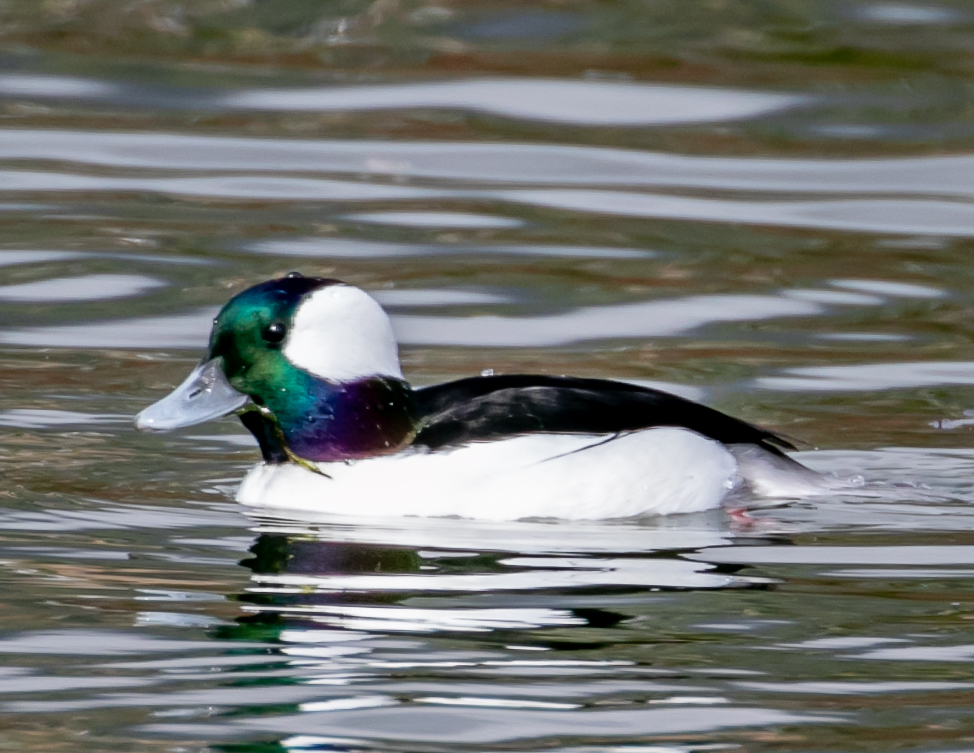
Wintering Buffleheads finally showed up – nine of them including this lovely iridescent male.
The usual Double-crested Cormorants occupied the usual snags. Was this a staring contest below?


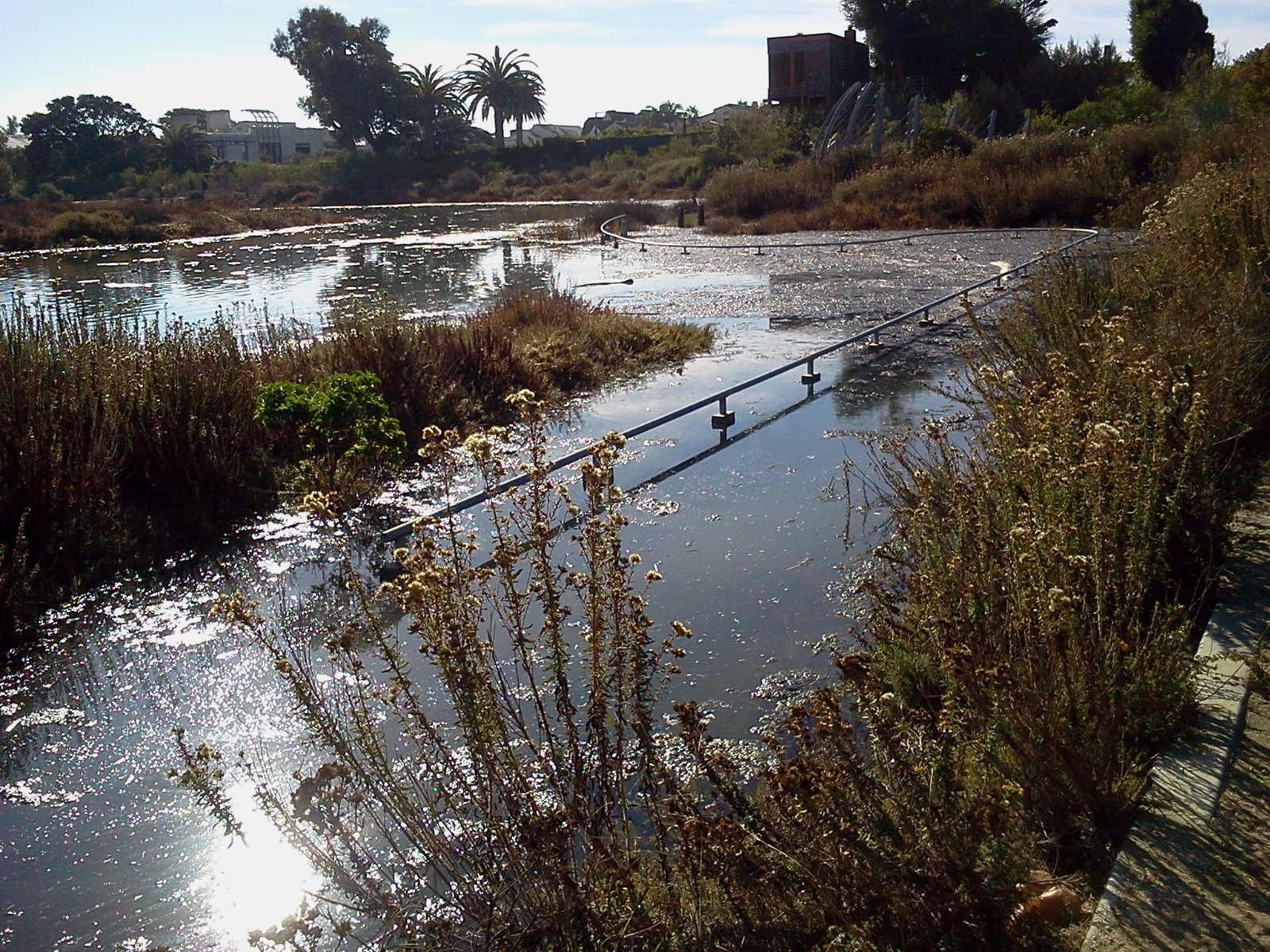
Edges of the channels seemed rather lush as the photo below demonstrates. That’s the back of Malibu Colony in the distance, stuffed to the brim with movie stars and moguls all no doubt sound asleep. The white railing of the tidal clock sidewalk emerges from the depths.

You’ll be glad to know the photographer escaped with his face intact after taking the shot below.
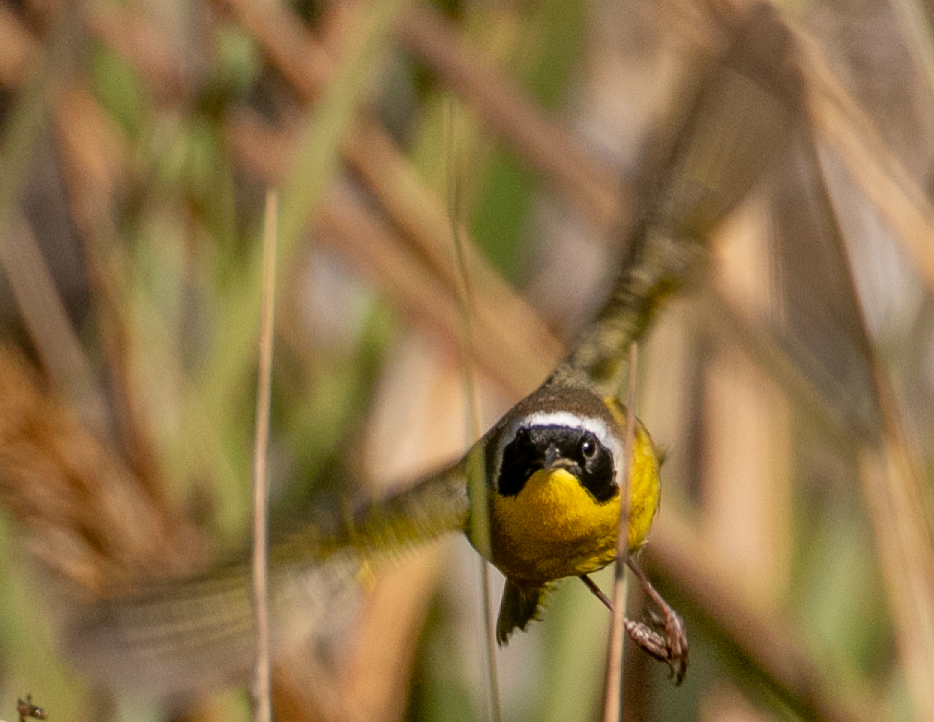
That’s a pretty fierce 5 inch, 1/3 ounce, 6-7.5 inch wingspan bird. It’s risky taking these big game photos, but someone has to do it.
I maintain that the male Gadwall, when well-seen, close up and in good light, is among the most beautiful and elegant of ducks.

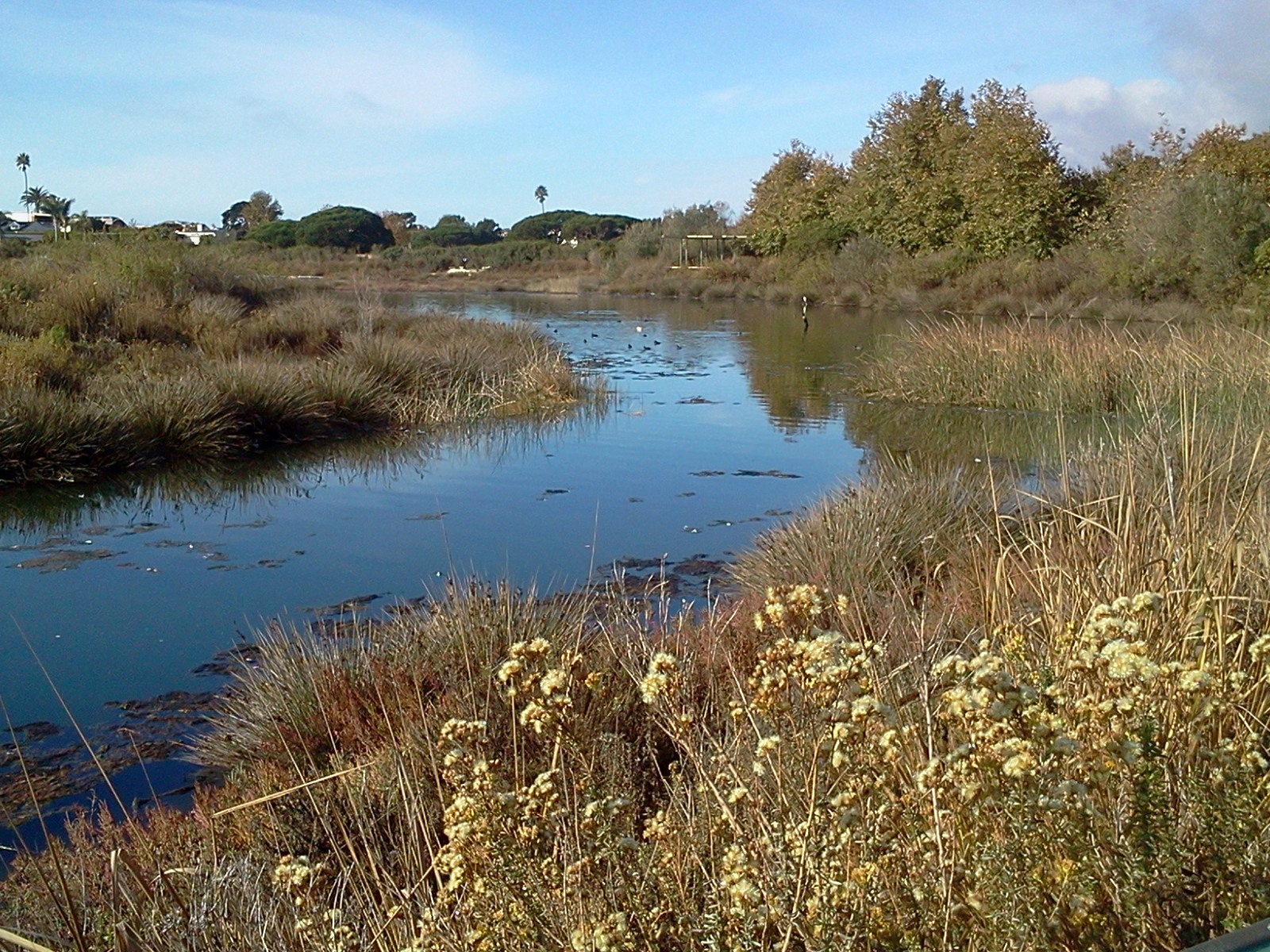
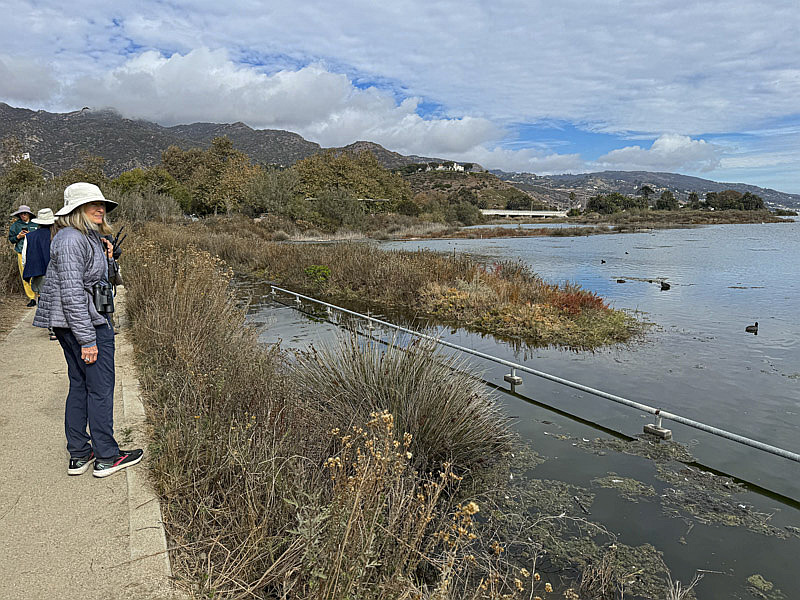
Below is the north channel as seen from “1st viewpoint” near the PCH bridge, with one of the brushy sand islands on the left. This is where we spotted the next bird.
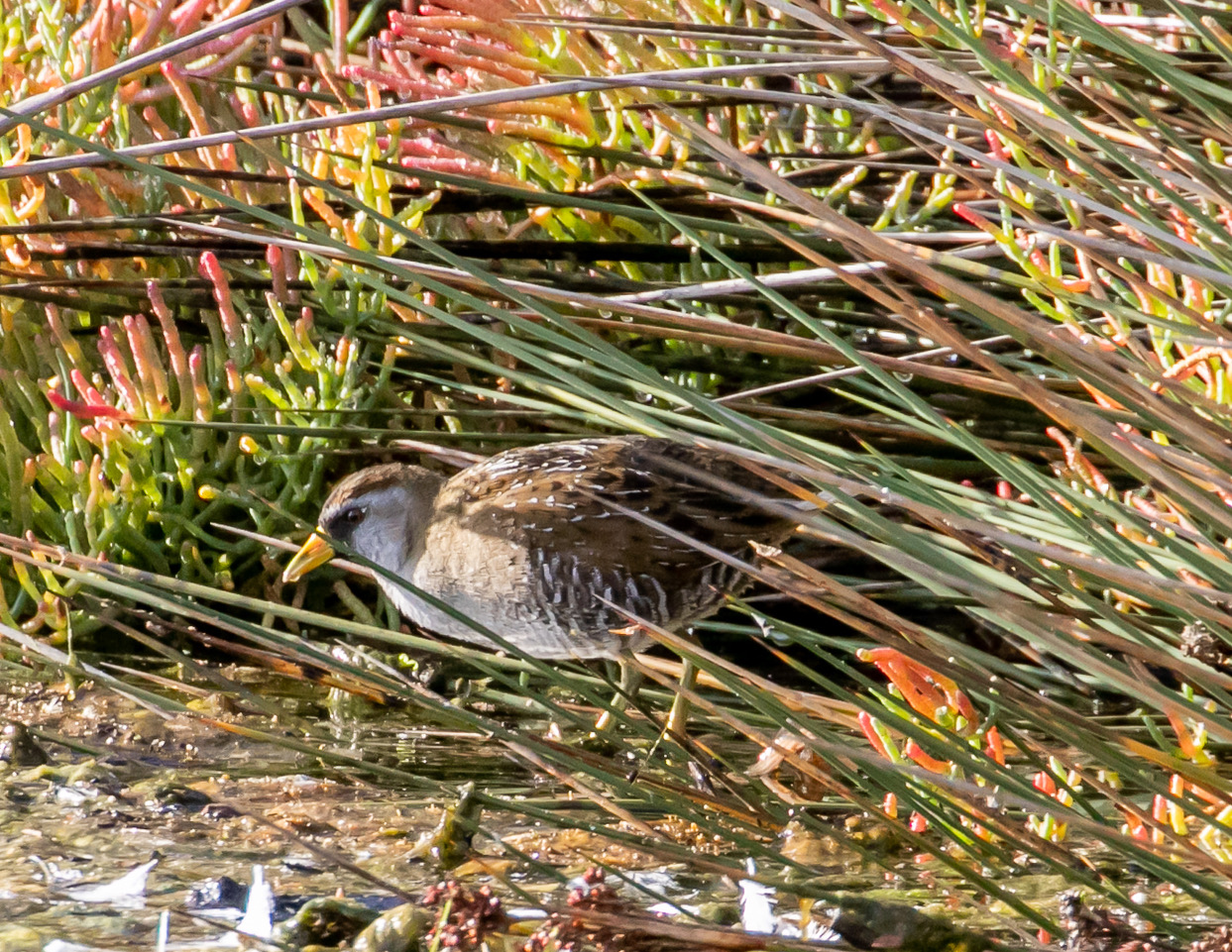
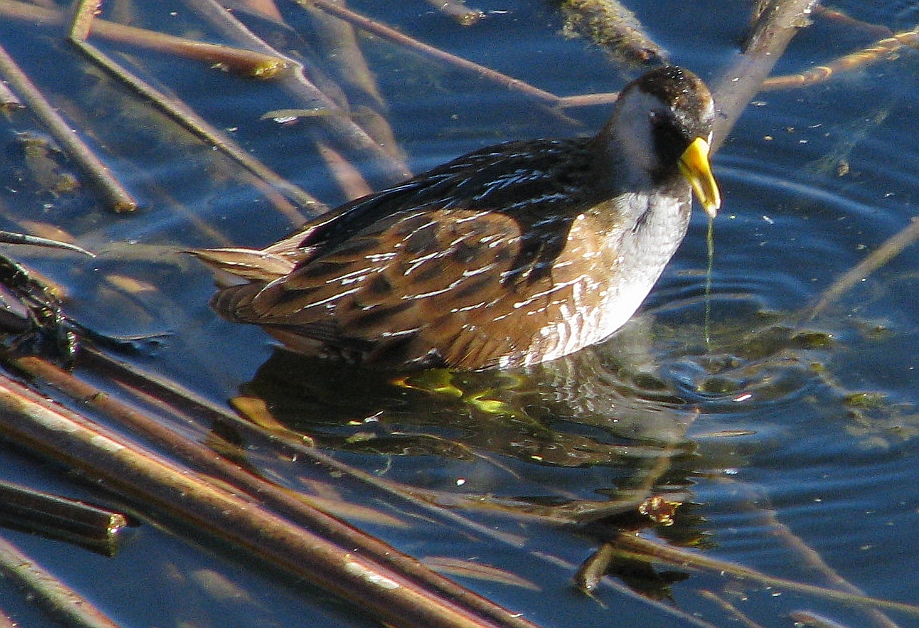
Below, among the spikey bushes and red-tipped pickleweed we found a Sora. These 8.75″ birds used to breed at the lagoon in small numbers, as did Virginia Rail, but since the extensive reedbeds were removed, they show up only during migration.
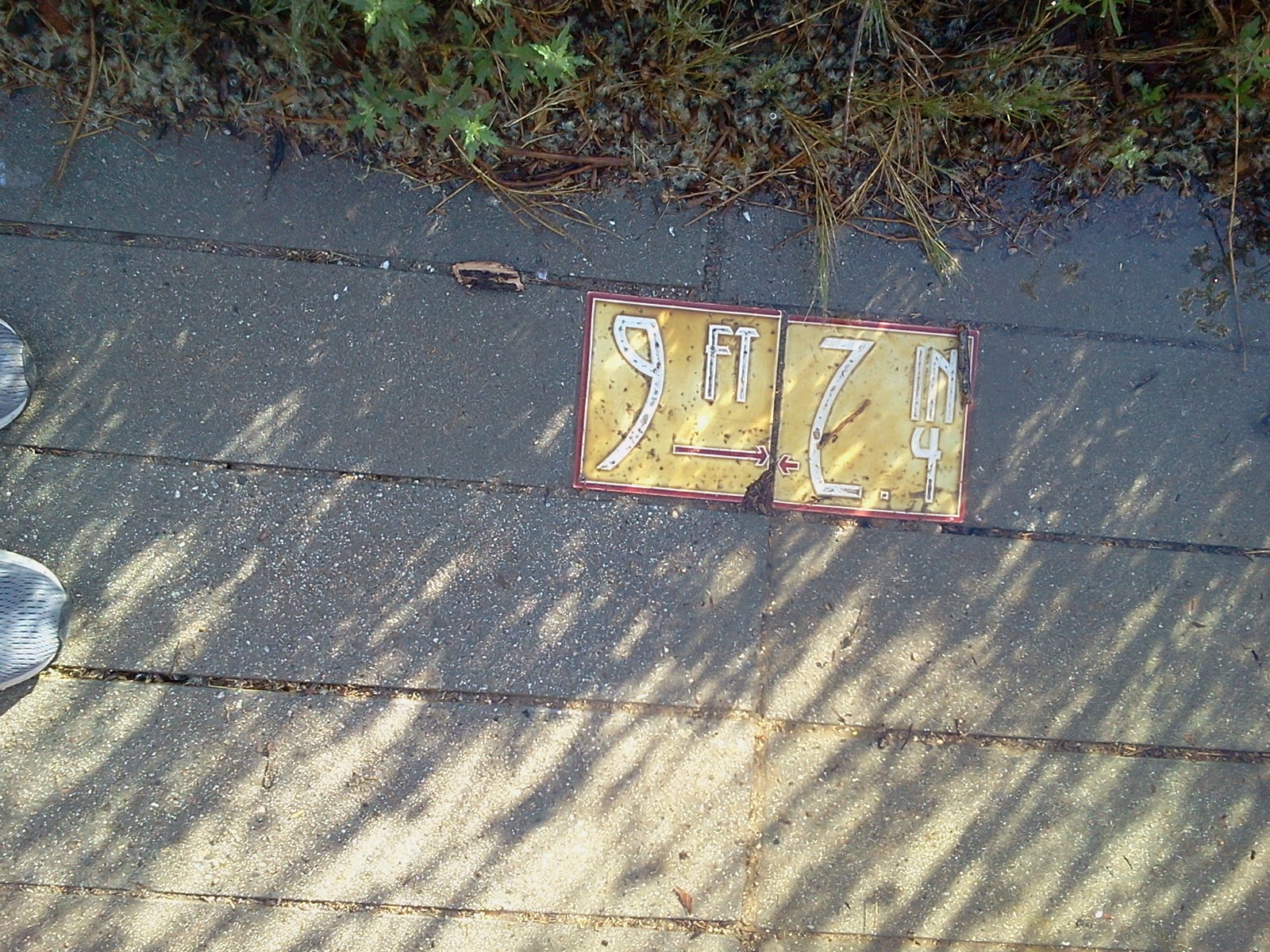
As alluded to earlier, the lagoon has a “winter ramp – tidal clock” sidewalk (read about it) which occasionally is inundated, at which time we can read the lagoon height. Here we approach the ramp which looks much like a sidewalk that someone installed too low.
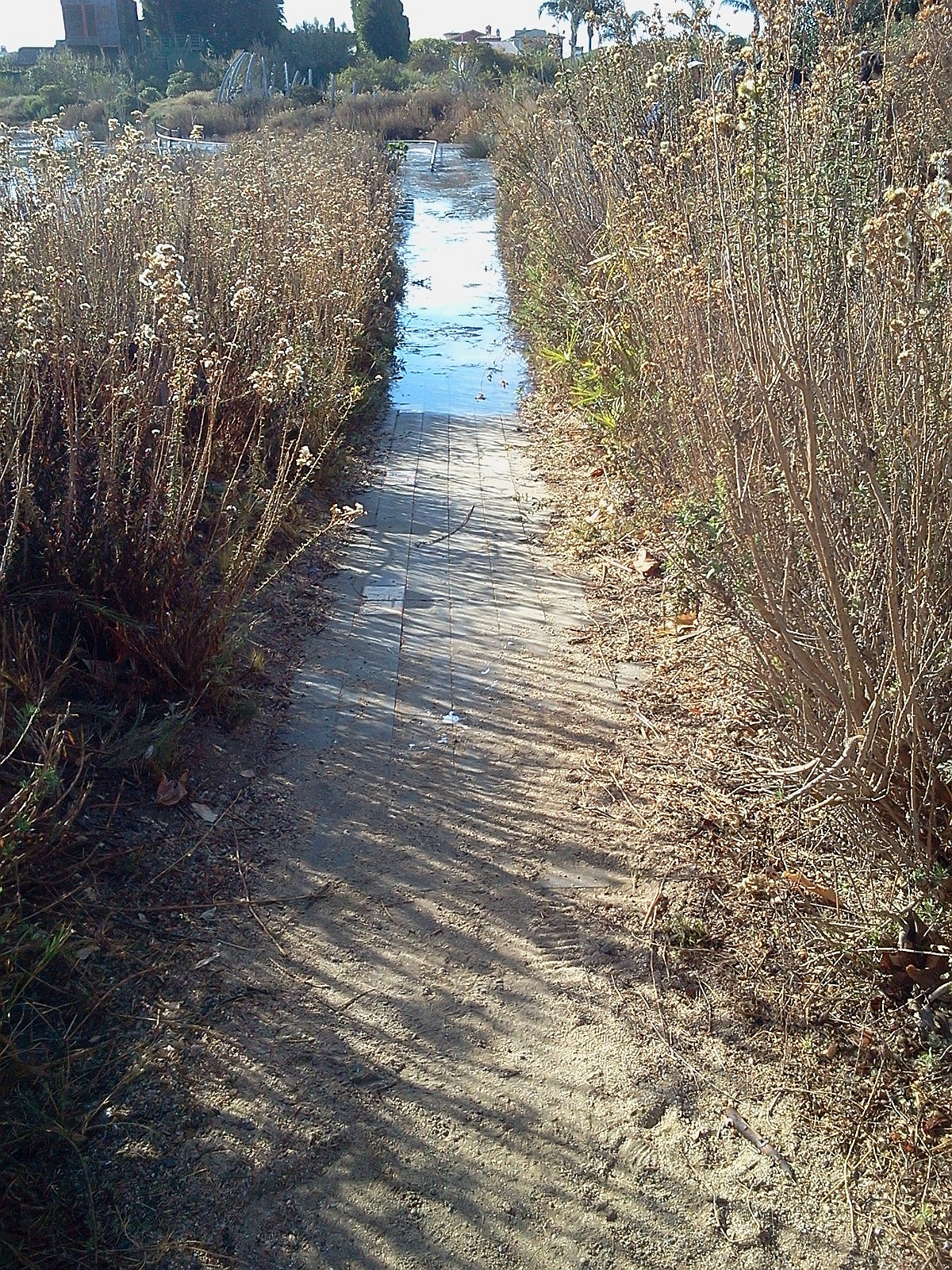
The tidal clock sidewalk emerges from the water. Note slightly-lighter tile water level markers on left. (Lillian Johnson 11/24/24)
Above the pathway to the beach, the Osprey perched, waiting.
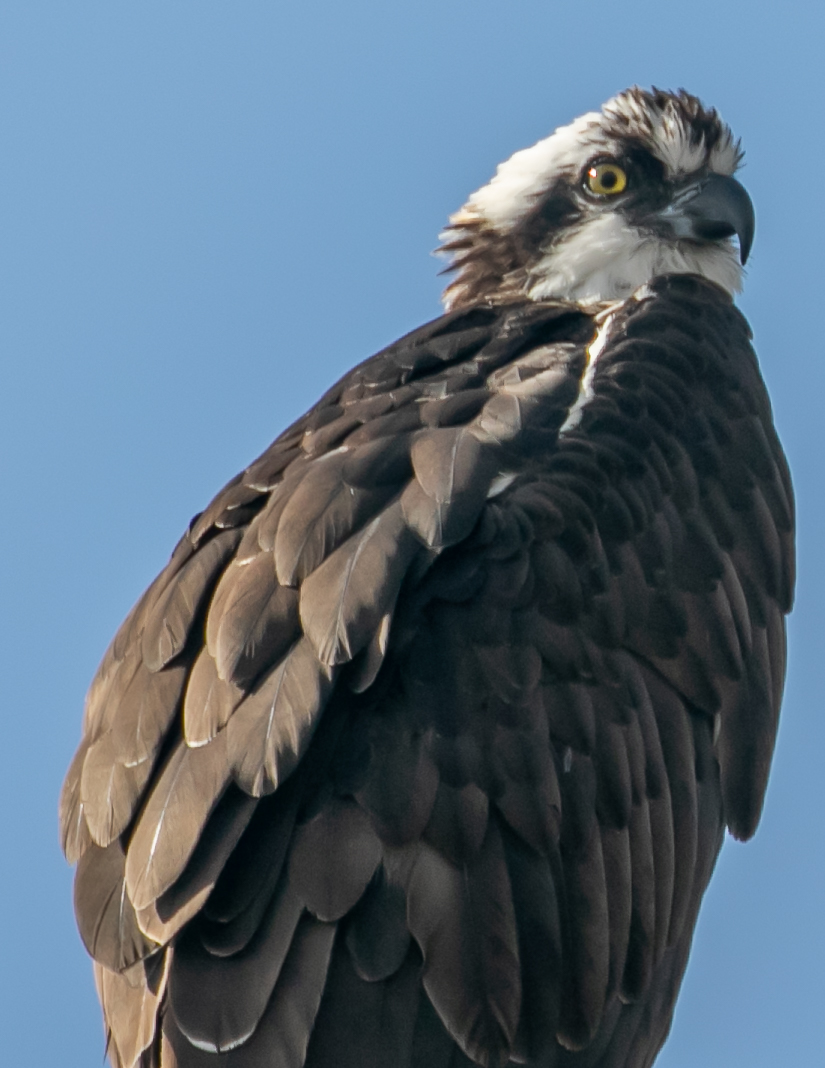
It looks huge here but it’s only 22-25″ from bill to tail-tip.
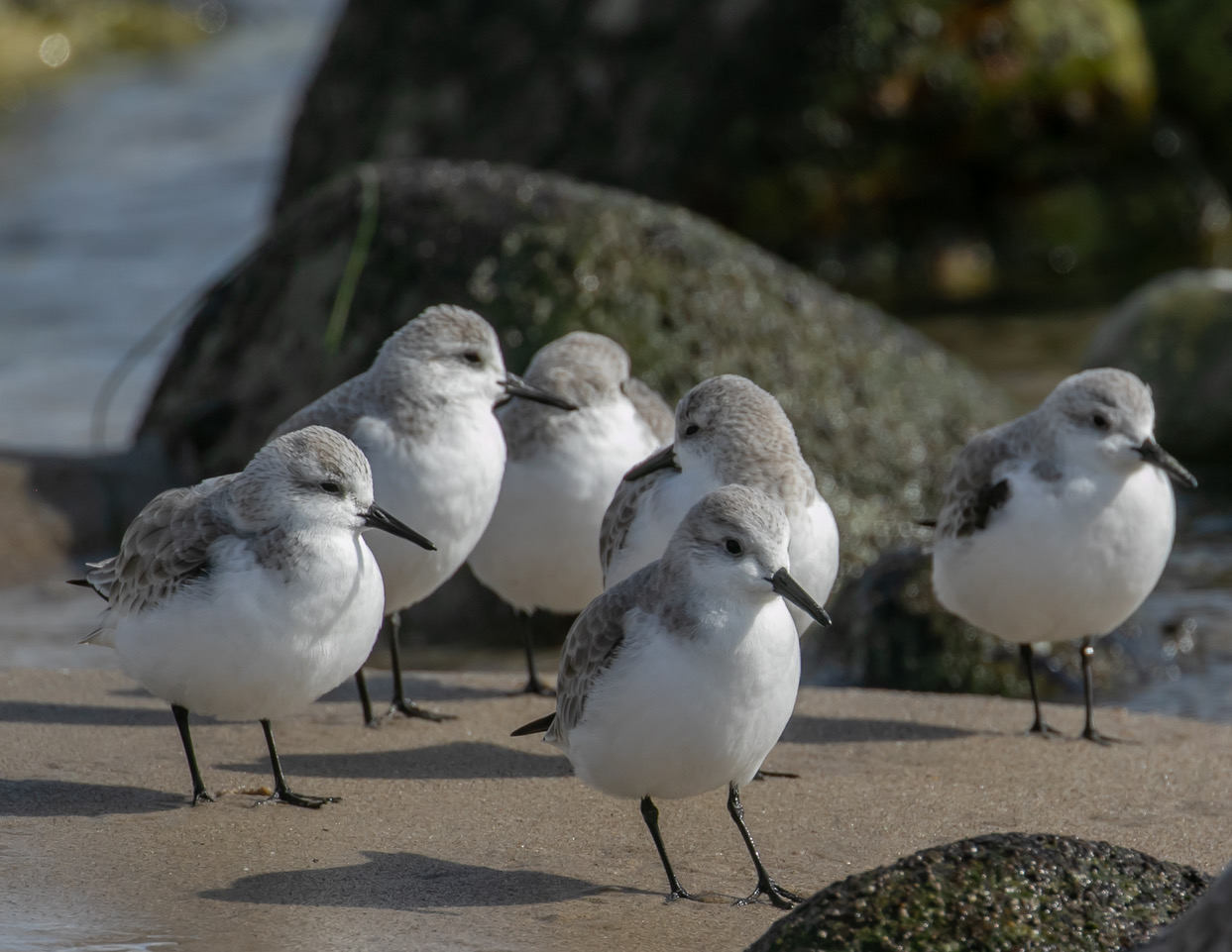
Down at the edge of the sea were Sanderlings. They are the little “peeps” that run up and down the sandy slope with the sloshing waves, and for many beach-goers are the archetypal sandpiper.
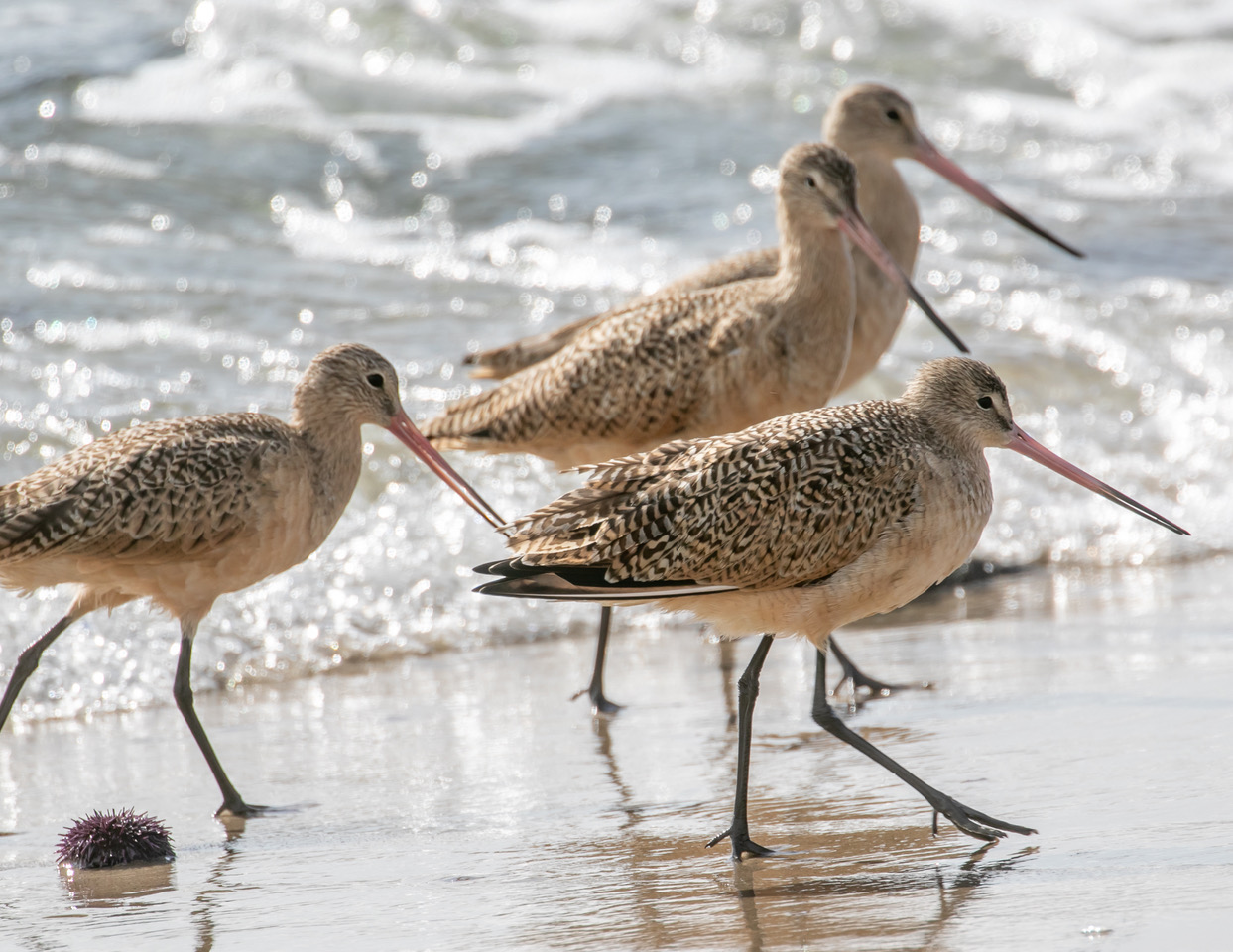
Nearby were the much larger Marbled Godwits with the upcurved bill.
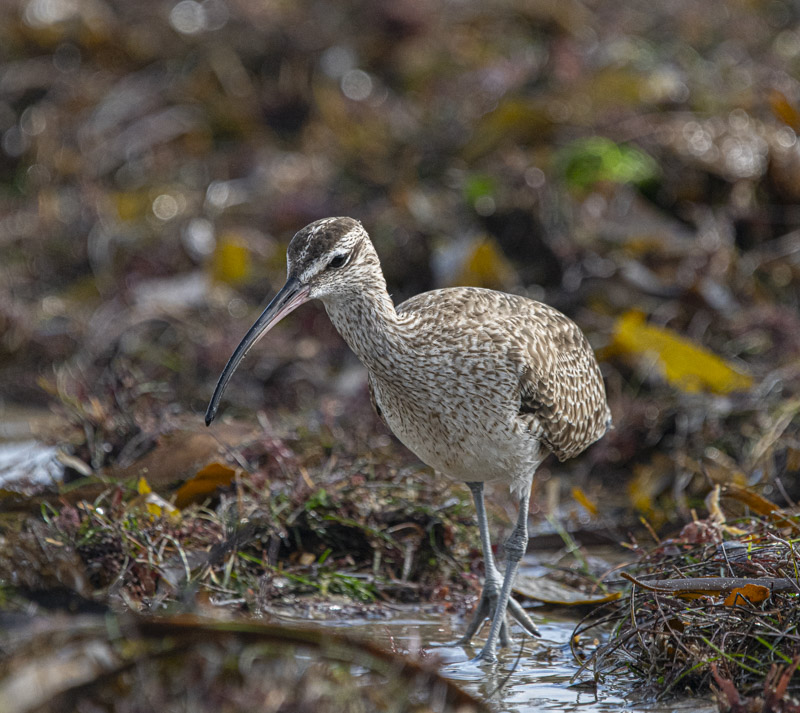
And among the washed-up seaweed we found a Whimbrel. Another fifty Whimbrel rested among the gulls along the edge of the lagoon.
Below is a closer view of the “bird hide.” I am convinced this was built because of a miscommunication of mine. When asked about the desirability of a bird hide at the lagoon, I immediately thought of those wooden shacks dotting every marsh across England, dark on the inside with windows one carefully raises to closely view unsuspecting birds, the paragon of bird hides of the world, and replied, “Sure. Build it with a concrete floor so it doesn’t shake and bounce when we walk.” [This drives photographers crazy.] The structure below, to my great surprise, was the result.
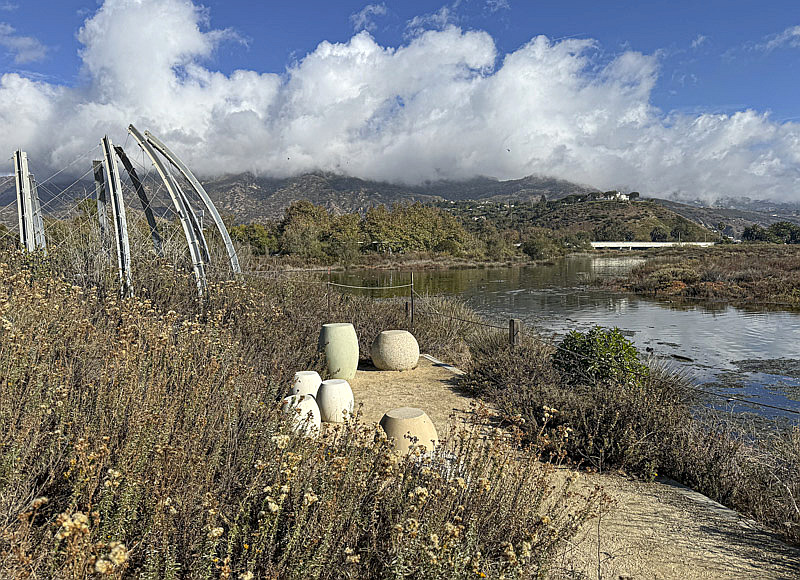
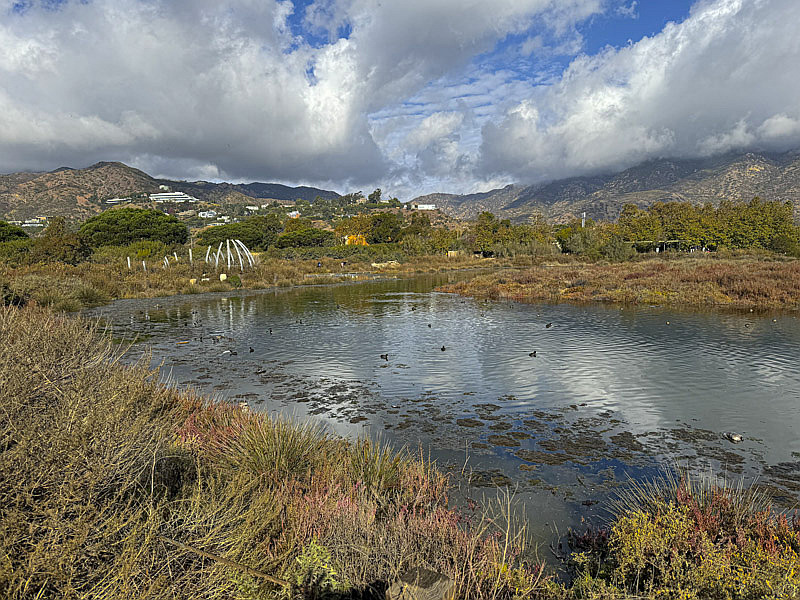
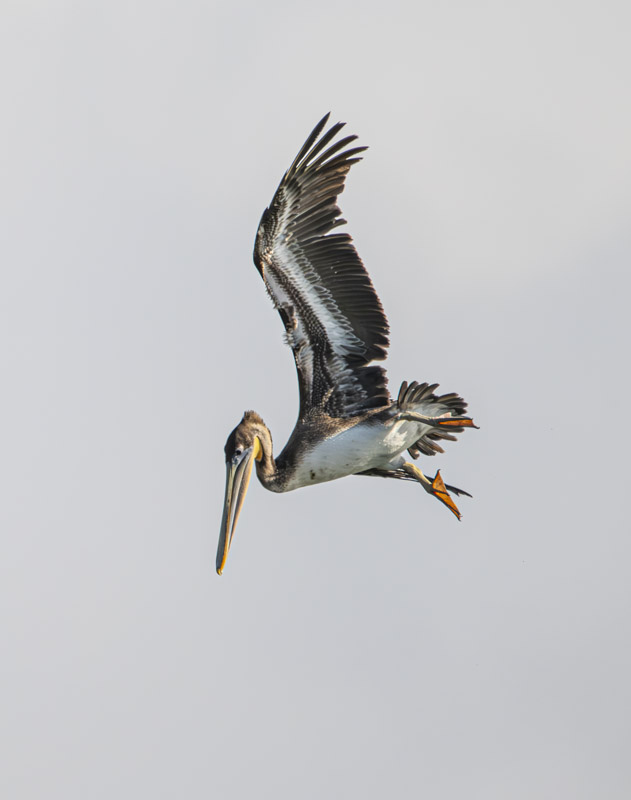
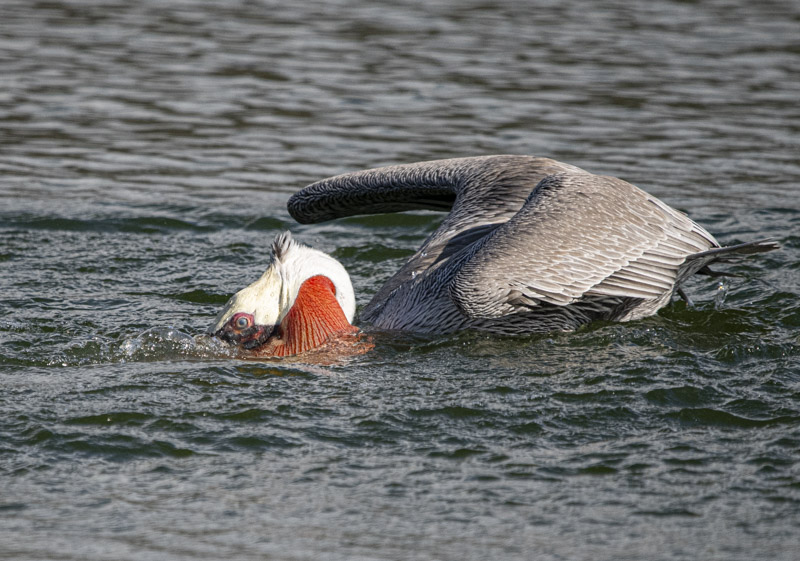
Among the many pelicans we found this bird busily fishing. Look closely to find the fish.

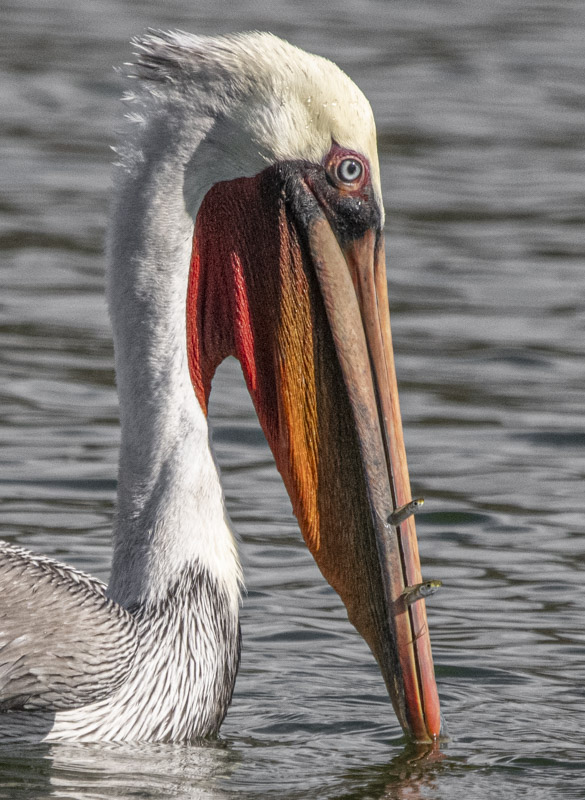
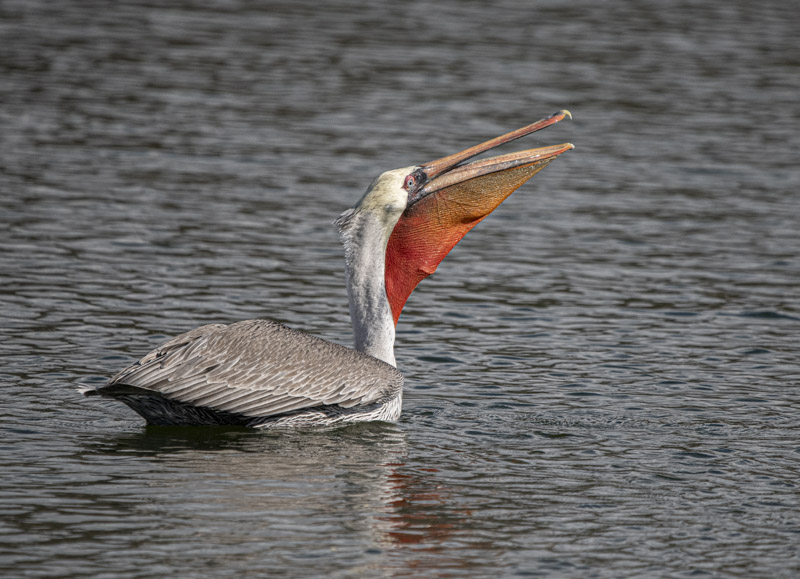
The Franklin fire burned through Malibu a week after these photos were taken, including some of the hills in the distance. Check here to see the fire map.
A week after this trip, chapter member and frequent Malibu Lagoon birder Femi Faminu discovered a Nelson’s Sparrow (formerly Sharp-tailed Sparrow, then Nelson’s Sharp-tailed Sparrow) at the lagoon. There will be a separate posting on this. If we’re lucky this bird will stay at the lagoon for a while.
Quiz Time!
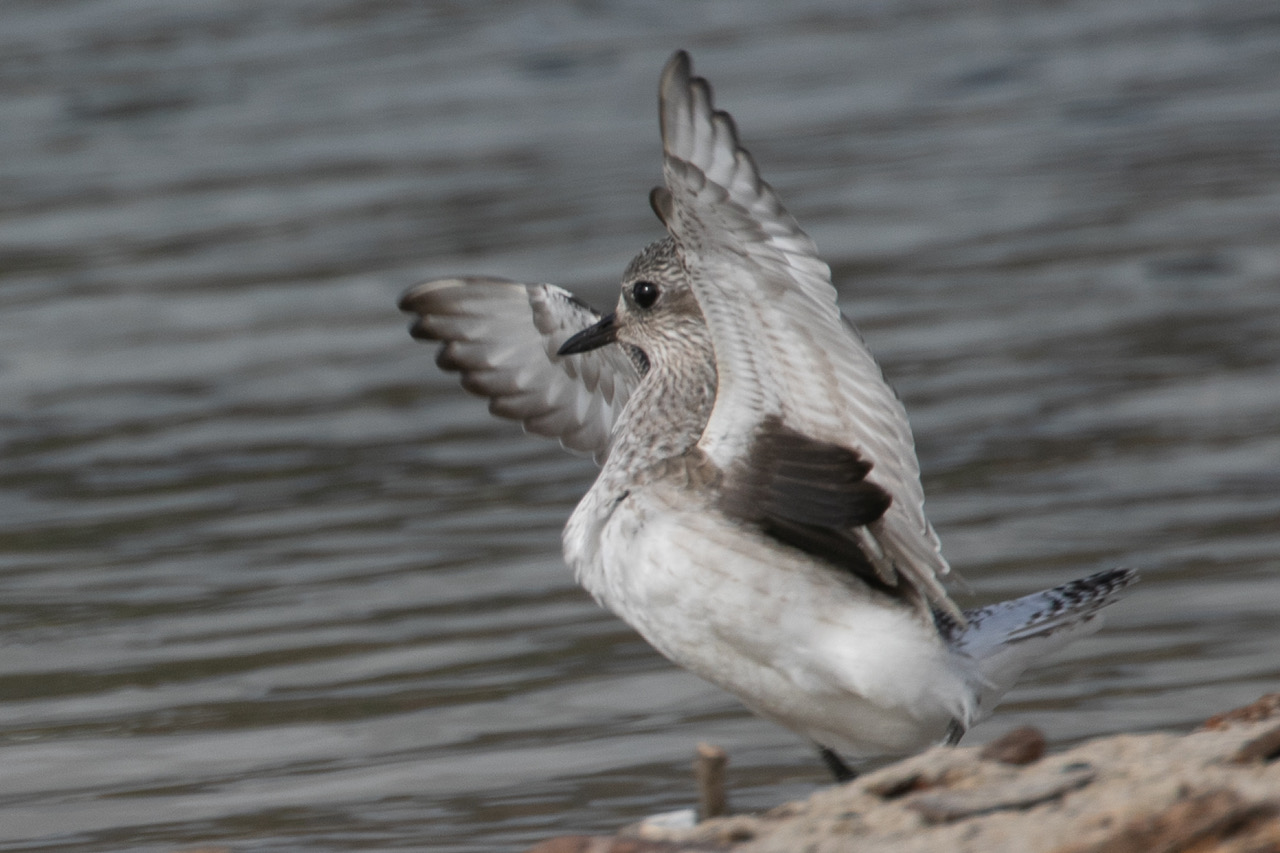
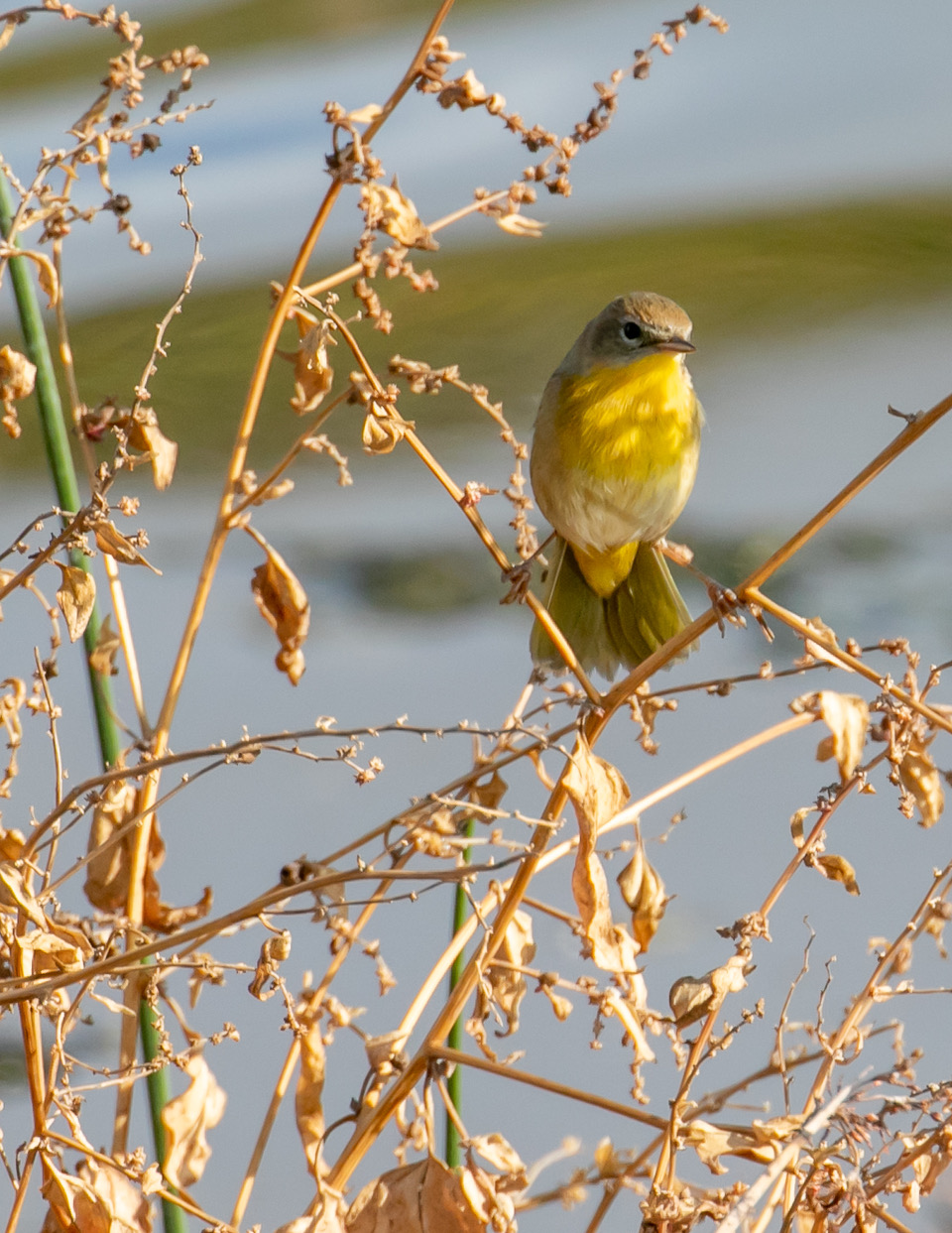
All these photos were taken 11-24-24 at the lagoon and many of the birds are in plumage transition.

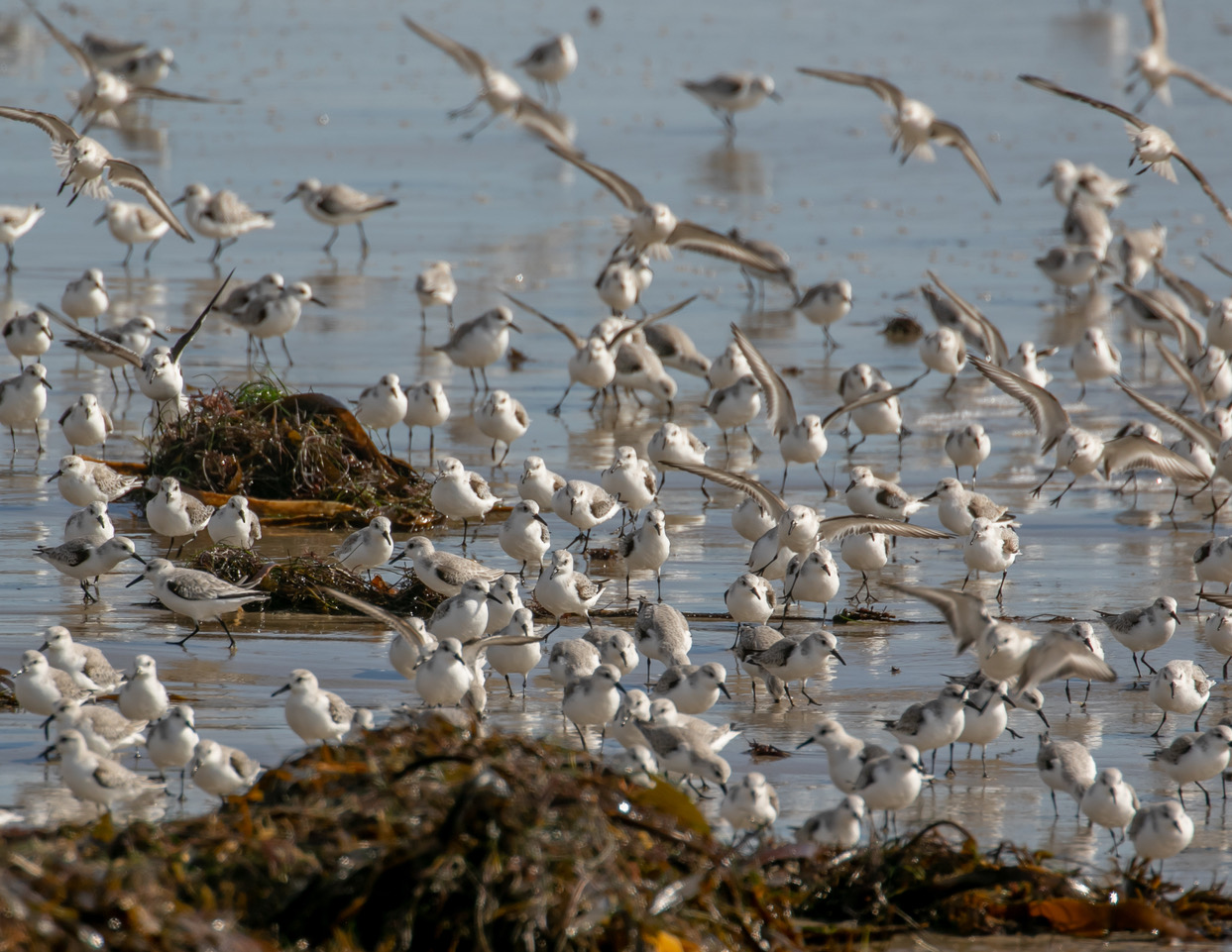
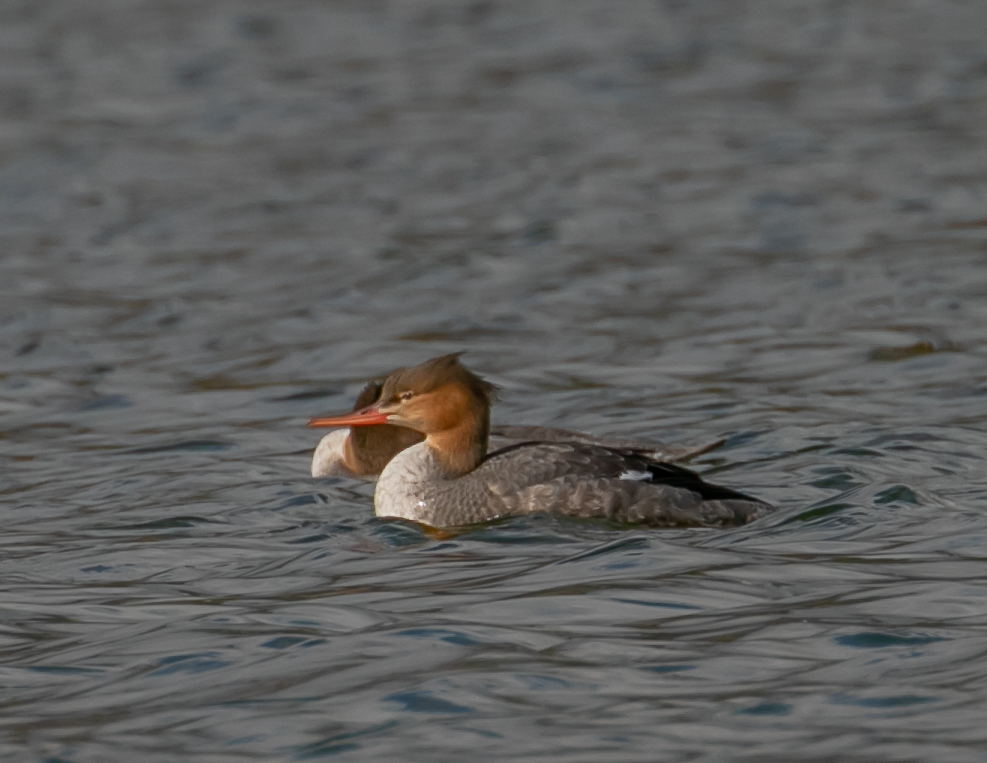
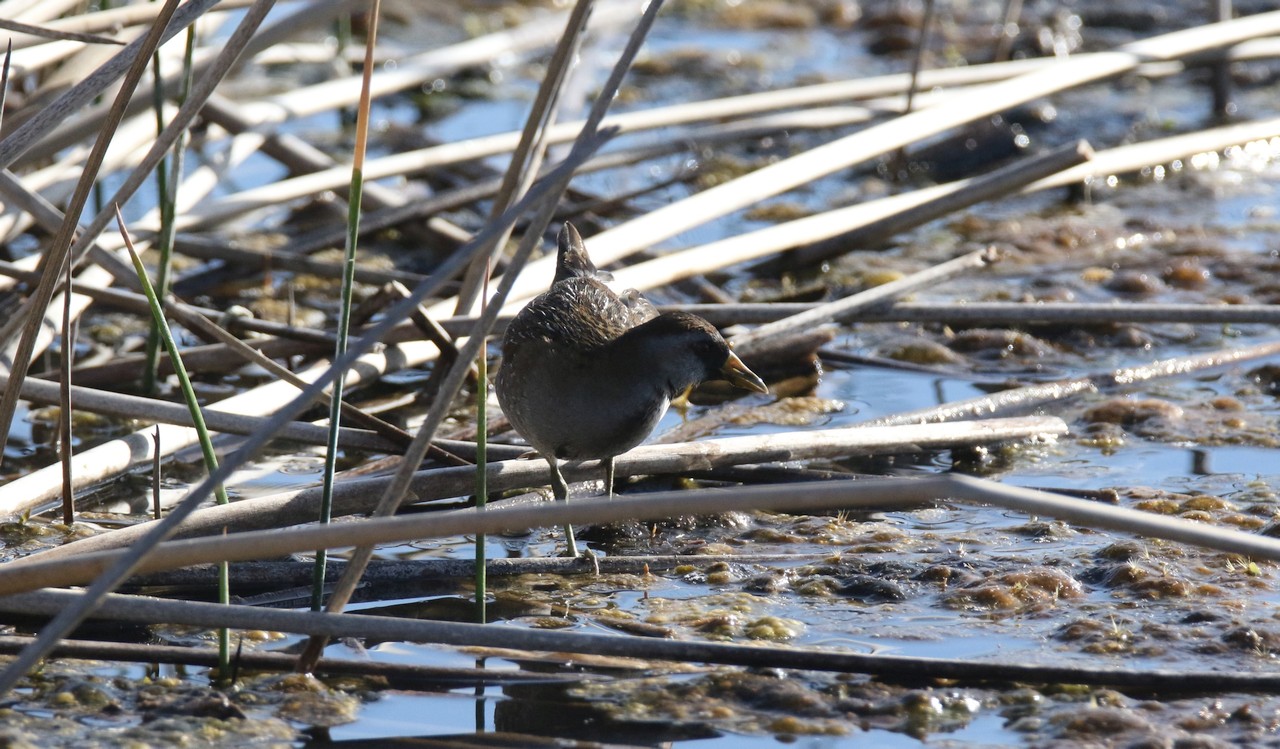
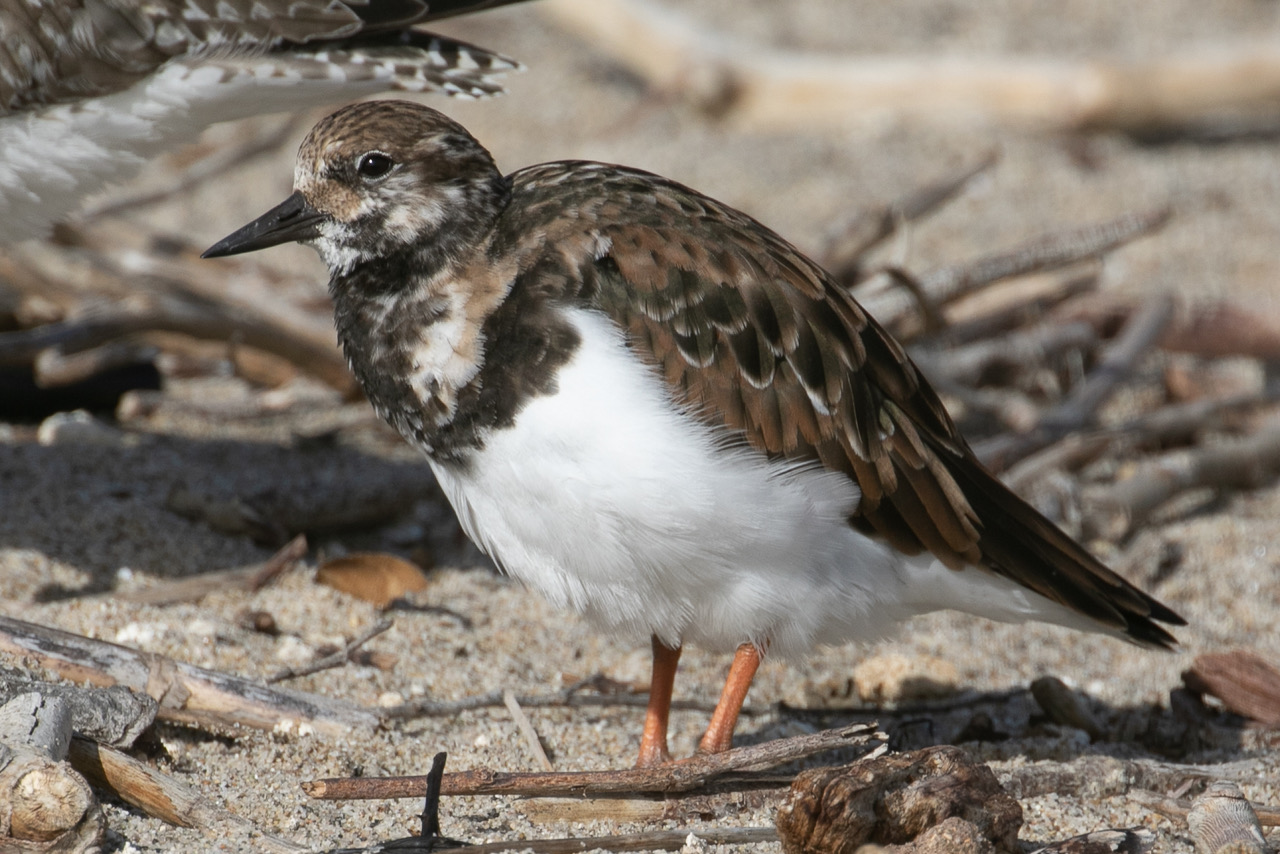
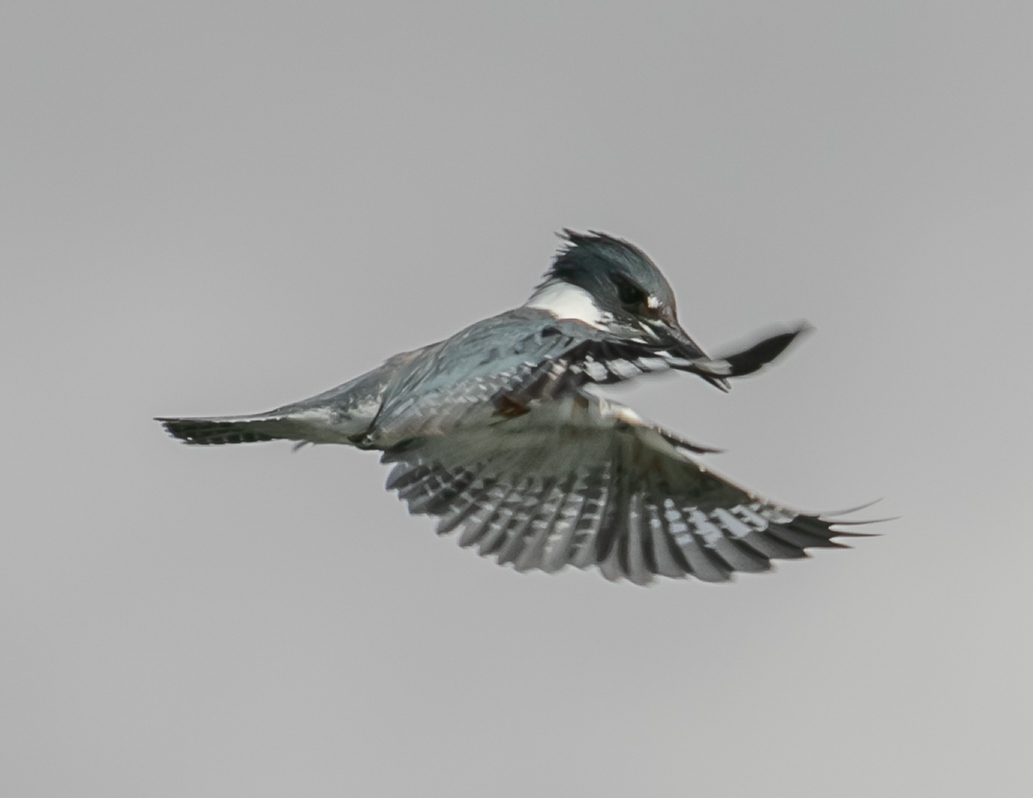
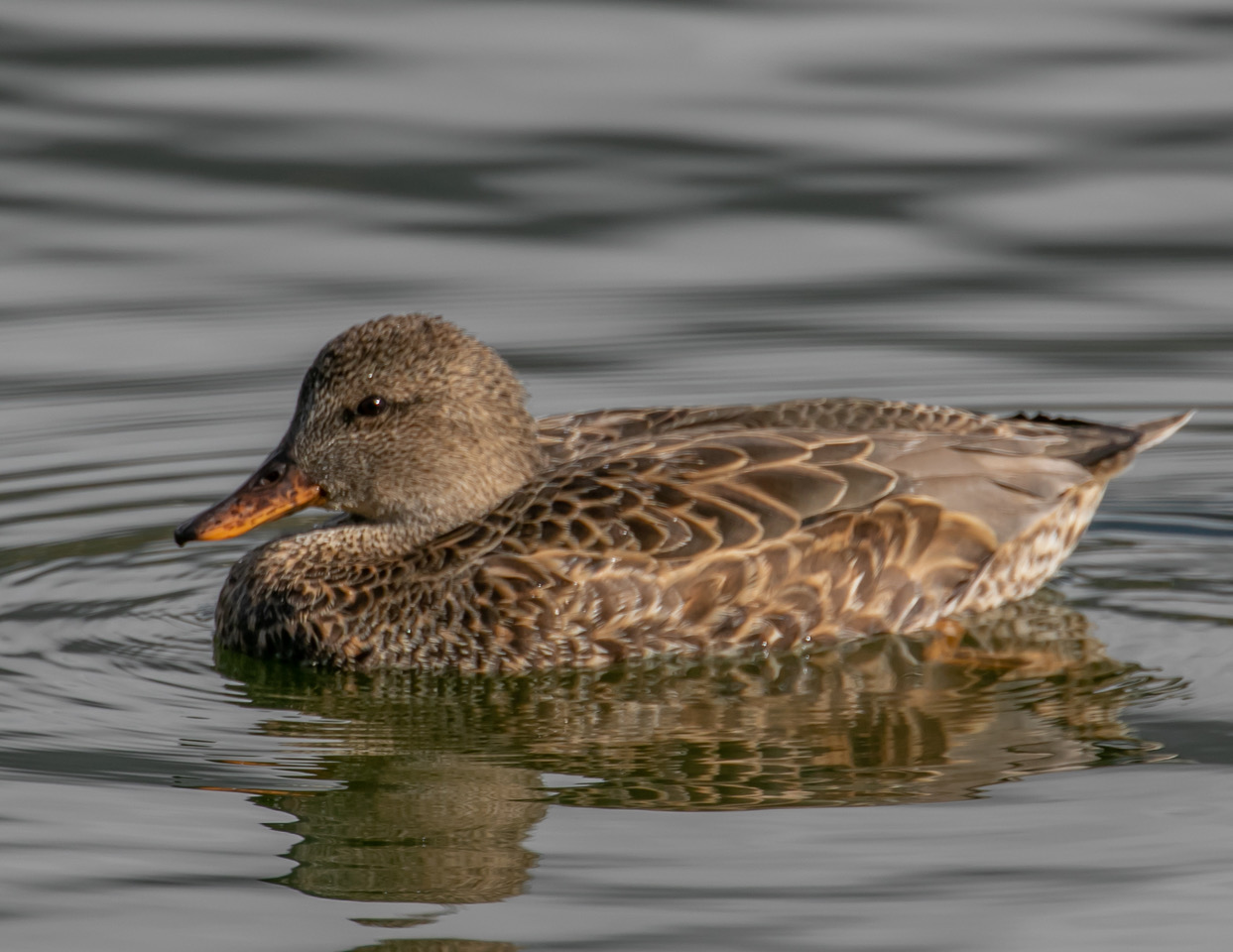
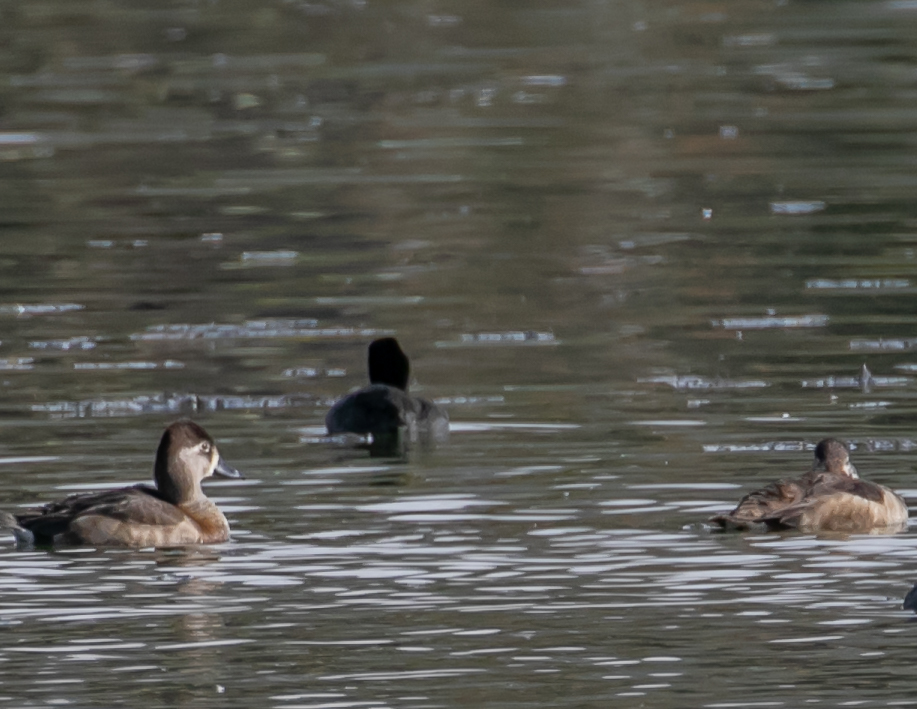
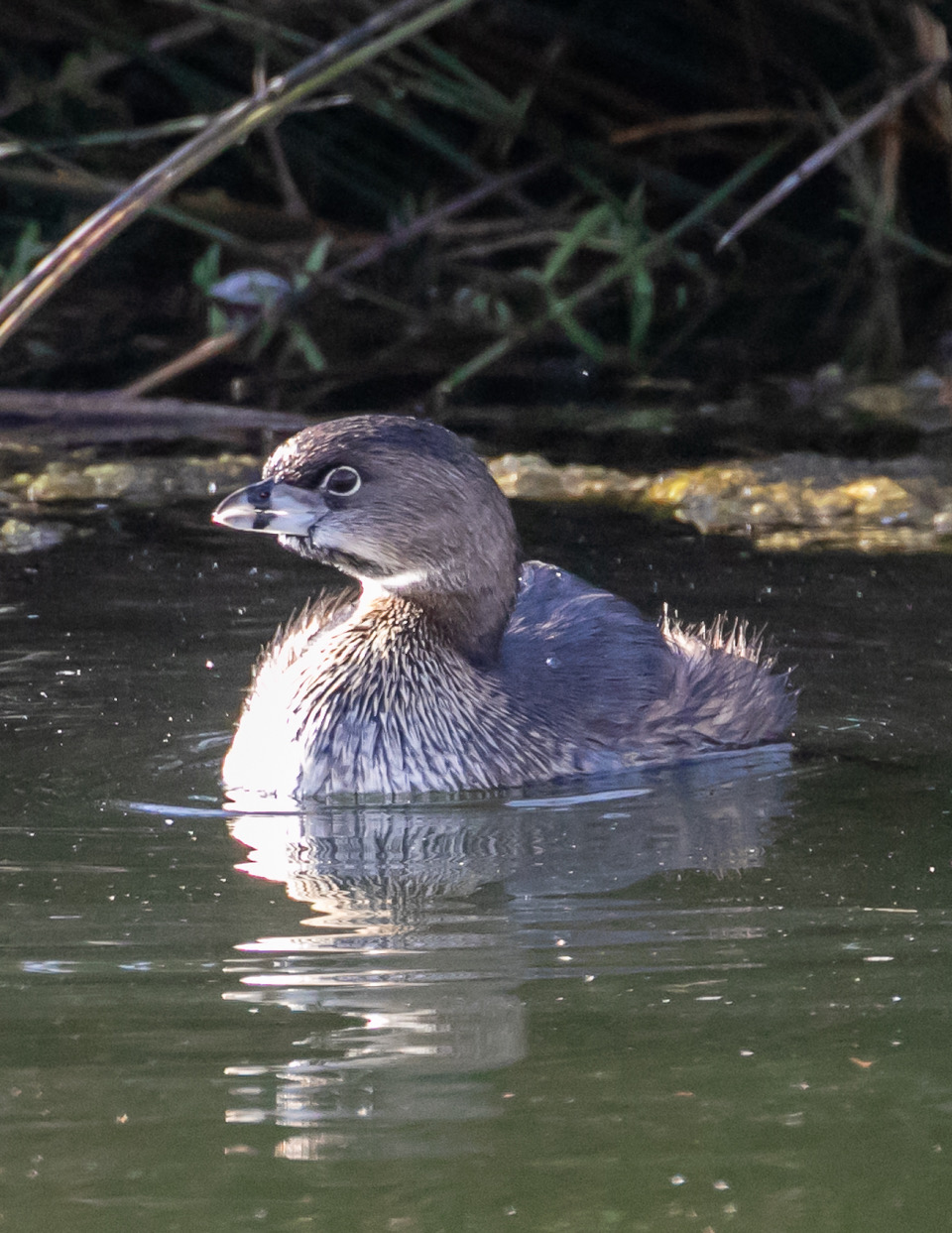
Quiz Answers & credits
#1. Black-bellied Plover; stubby dark bill, black axillaries. (Chris Tosdevin 11/24/24)
#2. Black Oystercatcher eats very few oysters. (Chris Tosdevin 11/24/24)
#3. Common Yellowthroat female has sharp gray-brown outline around yellow throat. (Chris Tosdevin 11/24/24)
#4. Whimbrel; striped head, downcurved bill. (Ray Juncosa 11-24-24)
#5. Sanderling flock portion; I counted 148 (probably +-10). (Chris Tosdevin 11/24/24)
#6. Red-breasted Merganser; wings are supposedly different, but I can’t tell from this photo. (Chris Tosdevin 11/24/24)
#7. Sora likes reed beds. Look for their chunky shape and short thick bill. (Ted S. 11/24/24)
#8. Ruddy Turnstone (Chris Tosdevin 11/24/24)
#9. Belted Kingfisher female has barely visible cinnamon flanks. (Chris Tosdevin 11/24/24)
#10. Gadwall female often has yellow/orange “lips” & mostly-dark upper bill. (Chris Tosdevin 11/24/24)
#11. Two Ring-necked Ducks with peaked heads, white streak behind white eyering & white “ring” around the bill, plus a coot. (Chris Tosdevin 11/24/24)
#12. Pied-billed Grebes aren’t particularly closely related to ducks. (Chris Tosdevin 11/24/24)
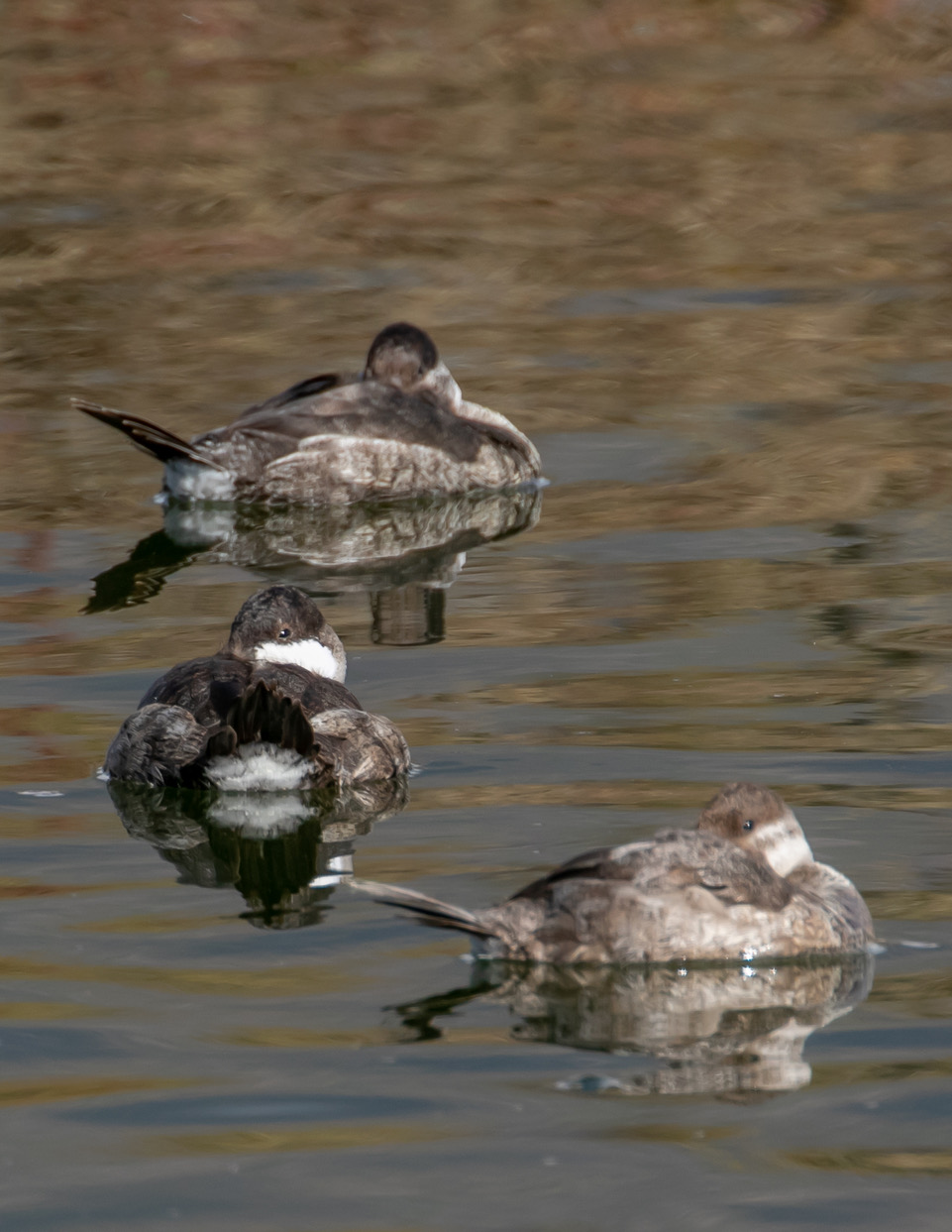
#13. Snoozing Ruddy Ducks are known as “Stifftails” by hunters. (Chris Tosdevin 11/24/24)
Malibu Lagoon on eBird as of 11-25-24: 8219 lists, 2640 eBirders, 319 species.
Most recent species added: Cassin’s Vireo, 9/23/24 by Colin Drummond.
I checked the eBird “total Malibu Lagoon birds” for the past year as it mysteriously hops around, even while the “most recent new species” rarely changes: Oct’23 – 319 species, Dec’23-320, Jan-May’24-319, May-Aug’24-320, Sep’24-318, Oct’24-319; bird counts apparently arriving from bizarroland.
Birds new for the season: Bufflehead, Red-breasted Merganser, Sora, Black Oystercatcher, Marbled Godwit, Herring Gull, Hermit Thrush, Spotted Towhee. “New for the season” means it has been three or more months since last recorded on our trips.
Many, many thanks to photographers: Ray Juncosa, Lillian Johnson, Ted S. & Chris Tosdevin.
Upcoming SMBAS scheduled field trips; no reservations or Covid card necessary unless specifically mentioned:
- Newport Back Bay Sun. Dec 15, 8:00 am Chuck Almdale
- Butterbredt Christmas Count Sat. Dec 21, 8:30 am? Chuck Bragg Reservation
- Malibu Lagoon, Sun. Dec 22, 8:30 (adults) & 10 am (parents & kids)
- These and any other trips we announce for the foreseeable future will depend upon expected status of the Covid/flu/etc. pandemic at trip time. Any trip announced may be canceled shortly before trip date if it seems necessary. By now any other comments should be superfluous.
- Link to Programs & Field Trip schedule.
The next SMBAS Zoom program: TBA, Evening Meeting, Tuesday, February 4, 2025, 7:30 p.m.
The SMBAS 10 a.m. Parent’s & Kids Birdwalk is again running. Reservations not necessary for families, but for groups (scouts, etc.), call Jean (213-522-0062).
Links: Unusual birds at Malibu Lagoon
9/23/02 Aerial photo of Malibu Lagoon
More recent aerial photo
Prior checklists:
2023: Jan-June, July-Dec 2024: Jan-June
2021: Jan-July, July-Dec 2022: Jan-June, July-Dec
2020: Jan-July, July-Dec 2019: Jan-June, July-Dec
2018: Jan-June, July-Dec 2017: Jan-June, July-Dec
2016: Jan-June, July-Dec 2015: Jan-May, July-Dec
2014: Jan-July, July-Dec 2013: Jan-June, July-Dec
2012: Jan-June, July-Dec 2011: Jan-June, July-Dec
2010: Jan-June, July-Dec 2009: Jan-June, July-Dec
The 10-year comparison summaries created during the Lagoon Reconfiguration Project period, remain available—despite numerous complaints—on our Lagoon Project Bird Census Page. Very briefly summarized, the results unexpectedly indicate that avian species diversification and numbers improved slightly during the restoration period June’12-June’14.
Many thanks to Marie Barnidge-McIntyre, Lillian Johnson, Chris & Ruth Tosdevin and others for their contributions to this month’s checklist.
The species lists below is intermittently re-sequenced to agree with the California Bird Records Committee Official California Checklist. If part of the right side of the chart below is hidden, there’s a slider button inconveniently located at the bottom end of the list. The numbers 1-9 left of the species names are keyed to the nine categories of birds at the bottom.
[Chuck Almdale]
| Malibu Census 2024 | 6/23 | 7/28 | 8/25 | 9/22 | 10/27 | 11/24 | |
| Temperature | 62-72 | 63-72 | 64-78 | 67-75 | 64-68 | 54-59 | |
| Tide Lo/Hi Height | L-1.17 | L+1.81 | L+2.00 | L+2.09 | H+4.75 | L+2.06 | |
| Tide Time | 0537 | 0916 | 0735 | 0611 | 0742 | 1139 | |
| 1 | Canada Goose | 9 | 4 | ||||
| 1 | Gadwall | 35 | 27 | 12 | 30 | 38 | 26 |
| 1 | American Wigeon | 1 | 13 | 12 | |||
| 1 | Mallard | 15 | 6 | 2 | 8 | 28 | 10 |
| 1 | Green-winged Teal | 4 | 1 | ||||
| 1 | Ring-necked Duck | 4 | 3 | ||||
| 1 | Bufflehead | 9 | |||||
| 1 | Hooded Merganser | 1 | |||||
| 1 | Red-breasted Merganser | 10 | |||||
| 1 | Ruddy Duck | 28 | 22 | ||||
| 2 | Pied-billed Grebe | 1 | 1 | 1 | 5 | 10 | 8 |
| 2 | Eared Grebe | 4 | 1 | ||||
| 2 | Western Grebe | 1 | 28 | ||||
| 7 | Feral Pigeon | 3 | 6 | 9 | 1 | 4 | 4 |
| 7 | Mourning Dove | 5 | 2 | 3 | 1 | 1 | |
| 8 | Anna’s Hummingbird | 1 | 2 | 2 | 1 | ||
| 8 | Allen’s Hummingbird | 1 | 2 | 3 | 4 | 2 | 1 |
| 2 | Sora | 2 | |||||
| 2 | American Coot | 2 | 72 | 340 | 560 | ||
| 5 | Black-necked Stilt | 2 | |||||
| 5 | Black Oystercatcher | 2 | |||||
| 5 | Black-bellied Plover | 1 | 51 | 70 | 67 | 136 | 75 |
| 5 | Killdeer | 3 | 12 | 4 | 12 | 20 | 1 |
| 5 | Semipalmated Plover | 13 | 3 | ||||
| 5 | Snowy Plover | 6 | 22 | 42 | 18 | 34 | |
| 5 | Whimbrel | 52 | 2 | 2 | 7 | 15 | |
| 5 | Long-billed Curlew | 1 | 1 | ||||
| 5 | Marbled Godwit | 12 | |||||
| 5 | Wilson’s Phalarope | 1 | |||||
| 5 | Spotted Sandpiper | 2 | 1 | ||||
| 5 | Willet | 2 | 9 | 5 | 5 | 3 | 51 |
| 5 | Greater Yellowlegs | 1 | 1 | ||||
| 5 | Ruddy Turnstone | 1 | 3 | 4 | 6 | ||
| 5 | Sanderling | 2 | 1 | 5 | 200 | ||
| 5 | Least Sandpiper | 23 | 3 | 4 | 8 | ||
| 5 | Western Sandpiper | 6 | 13 | 2 | |||
| 6 | Heermann’s Gull | 65 | 42 | 5 | 24 | 79 | 29 |
| 6 | Ring-billed Gull | 2 | 2 | 12 | 15 | ||
| 6 | Western Gull | 160 | 220 | 113 | 55 | 27 | 65 |
| 6 | Herring Gull | 1 | |||||
| 6 | California Gull | 3 | 10 | 23 | 75 | 440 | 525 |
| 6 | Glaucous-winged Gull | 1 | 1 | ||||
| 6 | Caspian Tern | 14 | 4 | 1 | |||
| 6 | Forster’s Tern | 1 | 2 | ||||
| 6 | Elegant Tern | 25 | 240 | 10 | |||
| 6 | Royal Tern | 5 | 5 | 6 | |||
| 2 | Common Loon | 2 | |||||
| 2 | Brandt’s Cormorant | 2 | 5 | ||||
| 2 | Pelagic Cormorant | 4 | 1 | 2 | 2 | ||
| 2 | Double-crested Cormorant | 24 | 28 | 37 | 54 | 51 | 44 |
| 2 | Brown Pelican | 125 | 163 | 27 | 24 | 30 | 260 |
| 3 | Black-crowned Night-Heron | 2 | 1 | 1 | 1 | 1 | 1 |
| 3 | Snowy Egret | 7 | 4 | 3 | 4 | 10 | 5 |
| 3 | Green Heron | 1 | 1 | 1 | 2 | 1 | 1 |
| 3 | Great Egret | 9 | 3 | 3 | 2 | 3 | 3 |
| 3 | Great Blue Heron | 3 | 3 | 4 | 2 | 5 | 4 |
| 3 | White-faced Ibis | 3 | |||||
| 4 | Turkey Vulture | 4 | 1 | 7 | 1 | ||
| 4 | Osprey | 1 | 1 | ||||
| 4 | Red-shouldered Hawk | 1 | |||||
| 4 | Red-tailed Hawk | 2 | 1 | ||||
| 8 | Belted Kingfisher | 1 | 1 | 1 | 1 | ||
| 8 | Nuttall’s Woodpecker | 1 | |||||
| 8 | Hairy Woodpecker | 1 | |||||
| 4 | American Kestrel | 1 | |||||
| 8 | Nanday Parakeet | 25 | |||||
| 9 | Black Phoebe | 3 | 6 | 3 | 2 | 4 | 6 |
| 9 | Say’s Phoebe | 1 | 1 | 1 | |||
| 9 | Ash-throated Flycatcher | 1 | |||||
| 9 | Cassin’s Kingbird | 1 | 1 | ||||
| 9 | Western Kingbird | 8 | |||||
| 9 | Loggerhead Shrike | 1 | |||||
| 9 | California Scrub-Jay | 2 | |||||
| 9 | American Crow | 6 | 4 | 4 | 8 | 6 | 22 |
| 9 | Common Raven | 4 | 1 | ||||
| 9 | Oak Titmouse | 1 | |||||
| 9 | Tree Swallow | 3 | 1 | 12 | |||
| 9 | No. Rough-winged Swallow | 5 | 2 | ||||
| 9 | Barn Swallow | 20 | 20 | 20 | 1 | ||
| 9 | Cliff Swallow | 6 | 4 | ||||
| 9 | Bushtit | 9 | 19 | 5 | 20 | 30 | 12 |
| 9 | Wrentit | 1 | 4 | 1 | |||
| 9 | Ruby-crowned Kinglet | 1 | 1 | 3 | |||
| 9 | Blue-gray Gnatcatcher | 1 | 4 | 1 | |||
| 9 | House Wren | 2 | 3 | 6 | 1 | ||
| 9 | Marsh Wren | 2 | 1 | ||||
| 9 | Bewick’s Wren | 2 | 2 | 2 | |||
| 9 | European Starling | 1 | 10 | 12 | |||
| 9 | Northern Mockingbird | 1 | 1 | 1 | |||
| 9 | Western Bluebird | 5 | |||||
| 9 | Hermit Thrush | 1 | |||||
| 9 | Scaly-breasted Munia | 1 | |||||
| 9 | House Finch | 11 | 12 | 5 | 4 | 8 | 4 |
| 9 | Lesser Goldfinch | 2 | 3 | 6 | |||
| 9 | Lark Sparrow | 1 | |||||
| 9 | Dark-eyed Junco | 1 | 2 | 1 | 2 | ||
| 9 | White-crowned Sparrow | 16 | 15 | ||||
| 9 | Savannah Sparrow | 1 | |||||
| 9 | Song Sparrow | 5 | 4 | 10 | 10 | 5 | 8 |
| 9 | California Towhee | 4 | 1 | 1 | 3 | 2 | |
| 9 | Spotted Towhee | 1 | 1 | ||||
| 9 | Western Meadowlark | 15 | |||||
| 9 | Hooded Oriole | 1 | 1 | 1 | |||
| 9 | Red-winged Blackbird | 11 | 11 | 1 | |||
| 9 | Brown-headed Cowbird | 18 | |||||
| 9 | Great-tailed Grackle | 3 | 3 | 1 | 4 | 15 | |
| 9 | Orange-crowned Warbler | 1 | 2 | 1 | 2 | ||
| 9 | Common Yellowthroat | 1 | 5 | 7 | 8 | ||
| 9 | Yellow Warbler | 1 | |||||
| 9 | Yellow-rumped Warbler (Aud) | 15 | 15 | ||||
| 9 | Townsend’s Warbler | 2 | |||||
| Totals by Type | Jun | Jul | Aug | Sep | Oct | Nov | |
| 1 | Waterfowl | 59 | 37 | 14 | 43 | 112 | 93 |
| 2 | Water Birds – Other | 155 | 192 | 68 | 155 | 469 | 882 |
| 3 | Herons, Egrets & Ibis | 22 | 12 | 12 | 14 | 20 | 14 |
| 4 | Quail & Raptors | 0 | 4 | 1 | 10 | 3 | 2 |
| 5 | Shorebirds | 9 | 139 | 157 | 142 | 197 | 404 |
| 6 | Gulls & Terns | 254 | 527 | 165 | 162 | 564 | 635 |
| 7 | Doves | 8 | 8 | 12 | 2 | 5 | 4 |
| 8 | Other Non-Passerines | 2 | 2 | 7 | 31 | 5 | 3 |
| 9 | Passerines | 92 | 70 | 92 | 119 | 136 | 142 |
| Totals Birds | 601 | 991 | 528 | 678 | 1511 | 2179 | |
| Total Species | Jun | Jul | Aug | Sep | Oct | Nov | |
| 1 | Waterfowl | 3 | 3 | 2 | 4 | 6 | 8 |
| 2 | Water Birds – Other | 5 | 3 | 5 | 4 | 9 | 8 |
| 3 | Herons, Egrets & Ibis | 5 | 5 | 5 | 6 | 5 | 5 |
| 4 | Quail & Raptors | 0 | 1 | 1 | 3 | 3 | 2 |
| 5 | Shorebirds | 5 | 8 | 12 | 12 | 8 | 10 |
| 6 | Gulls & Terns | 5 | 6 | 9 | 6 | 5 | 5 |
| 7 | Doves | 2 | 2 | 2 | 2 | 2 | 1 |
| 8 | Other Non-Passerines | 2 | 1 | 4 | 4 | 3 | 3 |
| 9 | Passerines | 17 | 9 | 22 | 27 | 24 | 24 |
| Totals Species – 111 | 44 | 38 | 62 | 68 | 65 | 66 |
Back Bay Newport: Sat. 15 December, 8:00 AM
Send me a sign-up email if you want to come.
That way I’ll know to expect you.
Email Chuck before Thursday 5 PM, 12 Dec:
misclists [AT] verizon [DOT] net
Starting location is same as last year (see below)
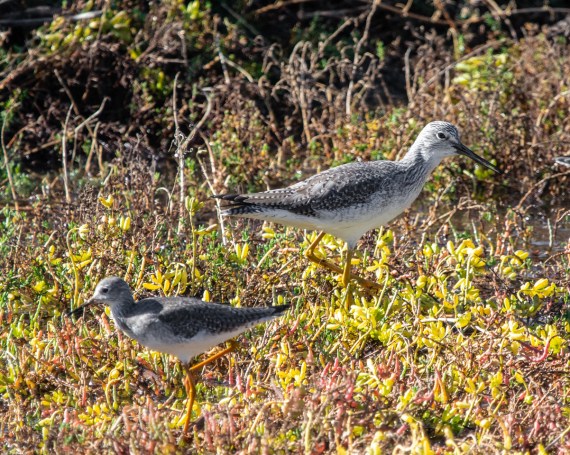
Lesser (L) & Greater (R) Yellowlegs on the pickleweed
(R. Juncosa, Upper Newport Bay 12-8-18)
Back Bay Newport (Upper Newport Bay) can provide great birding when the tides are right. It’s a bit of a drive for us (see below) and the difficulty of finding a weekend day with a super-high tide has occasionally kept us from going in the past. This year, on Sunday Dec. 15 the high tide will be 6.91 ft @ 0810 and low of -1.6 ft @ 1538. [For comparison, last year it was 5.55 ft. @ 0612, and low of 0.18 ft. @ 1318. Highest tide this season is +7.0 ft. on Nov. 16.] Water level will falling during our trip so don’t be late. This isn’t optimal for flushing rails from the reeds, but good for shorebirds and ducks. By the time we get to the upper end of the bay, the tide will have receded and shorebirds should be plentiful. [No promises!]
We will of course search for Sora, Virginia and Ridgway’s Rails, and during that process we will see waterbirds, shorebirds, bushbirds, treebirds, pondbirds, reedbirds, mudflatbirds, sandislandbirds, skybirds and the always-to-be-desired whatnots. [AKA ducks, grebes, waders, sandpipers, gulls, terns and skimmers on the bay and shore, raptors overhead and things in the brush, not necessarily in that order.] I saw my lifer Short-eared Owl here, decades ago, standing on a post among the reeds, and thereafter made the common newbee mistake of expecting to see it on the same post year after year. We had a Bald Eagle the last two years, albeat at a distance. You never know what will be around. We will also search for the endangered California Gnatcatcher at a particular location along the route.

We’ll have lunch (so bring one!) probably at nearby birdy San Joaquin freshwater marsh, and those who wish can do some more birding there. In 2017 we saw a Red-throated Pipit here, a Very Good Bird, and Virginia Rails show up, plus White Pelicans and more whatnots. However, energy remaining, we also make sure to look for anything around; they usually keep a nice stock of interesting birds on hand, scattered around the many birder-sized ponds. They keep a list of sightings outside the bookshop door, AND if you’re looking for a particular bird book (say…Field Guide to Galapagos Birds) they might have it. You could call them: 949-378-6501.
Family guide: We mostly stand around near our cars gawking at the birds, then drive to the next spot. We don’t walk a whole lot. At San Joaquin Marsh, after lunch, it’s all walking. Morning temps. start cool. Dress in layers, weather may be cool.
For future reference: Link to tide chart
Link to December 2023 report.
Driving Time: 50-60 minutes – 48 miles. While there are gas stations in the area (primarily right where you get off the freeway) you could get hung up there while everyone else drives on to the next birding spot to find that über-rarity (or even a mega-tick) which then flies away before you arrive. Don’t let this happen to you! Gas up in advance.
Carpooling Drivers & Riders: If you’re willing to drive others or ride with others, include your contact info, approx. location and drive/ride preference in your reservation to me, and I’ll circulate it to any others similarly interested. If you’re riding, the polite thing is to get yourself to the driver’s starting location rather than try to get them to drive to your house to pick you up. They’re already in for a 2-4 hour drive time for the trip. And riders should inquire of drivers about their face-masking requirements, if any.
Meeting time: 8 am, 15 December, 2024. Get there early and find the rails and snipes!
Sign-up Requested: No fee, but the leader wants to know who is coming. The drive is long: no signups, no trip.
Contact: Chuck, no later than Thursday 5 PM 12 December. email misclists [AT] verizon [DOT] net
Food: Bring munchies & liquids and/or lunch. No services next to the bay.
Directions: From the Santa Monica Fwy (I-10)Take San Diego Fwy (I-405) 43 miles south to CA-73. CA-73 south for 2.3 miles [Do not get onto I-55 Costa Mesa Fwy], take exit 15 for JAMBOREE RD and continue on SE BRISTOL ST. about 0.5 mile to JAMBOREE RD. and turn right. Continue south on JAMBOREE 3.1 miles to BACK BAY DR., turn right and continue on BACK BAY Dr. 0.4 miles to the start of MOUNTAINS TO SEA TRAIL HEAD ride/bike one-way road. Continue about 0.1 mile on the ride/bike road to first dirt parking area on left next to the bay. We’ll meet here. Write down these directions and look at the map linked to below!!! Don’t get lost. If you’re significantly late and we’re not at the meeting spot, continue on the ride/bike 15 MPH road. It’s one-way for miles and we’ll be somewhere along it.
If you get there early, there’s good birding right where you’re parked. It doesn’t hurt to get there early and find all the birds for the rest of us, not to mention the one’s that will disappear before we arrive.
For coffee or snacks: There are several fast food places along one-way Bristol St. after you exit from CA-73. Allow at least 60 minutes travel time from Santa Monica.
Bathrooms: if you see a restaurant on Bristol road when you get off CA-73, use their bathroom & maybe buy a cup of coffee. There are porta-potties on the ride/bike road, but not right at the beginning.
Meet at 8:00 a.m. in the parking lot. Leader: Chuck Almdale.
Map to Meeting Place: Back Bay Newport – SE meeting area
Use + and – to zoom in or out, left click and mouse drag to reposition the map.
Directions to lunch @ San Joaquin Marsh
We’ll finish birding Back Bay near the corner of the Mountains-to-the-Sea Trail and EASTBLUFF DRIVE. East on EASTBLUFF DR. and cross JAMBOREE RD. where the road becomes UNIVERSITY DR. Continue under Fwy. #73 and about 1 mile more to CAMPUS DR. Turn left on Campus Dr. & across the creek to the first right, RIPARIAN DRIVE. Turn right & continue north about 1/2 mile to the entrance of SAN JOAQUIN Marsh (home of Sea & Sage Audubon). Turn left and down the little hill to the parking lot. You’ll pass the bookstore on your right and the picnic tables are just beyond the bathroom block. If the parking lot is full, go back up the little hill and park in the large dirt lot below you on the other side, then schlep your lunch over to the picnic tables.
[Chuck Almdale]

Malibu Lagoon Monthly Field Trip: Sunday, 24 Nov. 2024
[Posted by Chuck Almdale]

It’s ALWAYS the 4th (not the last!) Sunday of the month.
Same as last month: No reservations, no Covid card checks, no fuss, no muss.
Rules for Malibu Lagoon trip
- Masks not required; feel free to wear one whenever you want.
- Bring your own binoculars & telescope if you have them.
- We do have loaner binos but they don’t always show up in time to hand out.
- Participation in social activities, such as field trips, comes with an inherent risk of exposure to infectious disease. Prospective participants should self-evaluate or discuss with their doctor if their participation merits this risk. If you’re sick or experiencing any symptoms that indicate you might be sick, STAY HOME.
- The 10am Children & Parents Walk is reinstated. Call Jean Garrett (213)-522-0062
- For general questions contact Chuck: misclists[AT]verizon.net
Weather: Cool. Temp: 53>60°F, Wind: SW 7>8 mph, Clouds: 86>69%, rain: 38>27%
Tide: Falling: High: +4.51 ft.@ 5:25am; Low: +2.06 ft.@ 11:39am
Lots of migrants and wintering birds and dwindling crowds of humans make it a great day for the lagoon. Usually sunny, sometimes cool, with dolphins dancing in the waves. Forget those Thanksgiving table birds: see your birds here with us.

Some of the great birds we’ve had in November are:
Green-winged Teal, Lesser Scaup, Surf Scoter, Bufflehead, Red-breasted Merganser, Pacific & Common Loons, Horned & Western Grebes, Osprey, American Kestrel, Merlin, Snowy Plover, American Avocet, Spotted Sandpiper, Marbled Godwit, Boneparte’s & Glaucous-winged Gulls, Belted Kingfisher, Common Raven, Bushtit, Bewick’s, House & Marsh Wrens, California Towhee, Great-tailed Grackle, Lesser Goldfinch.
If you arrive early you may chance to see a walk of snites.
Adult Walk 8:30 a.m., 4th Sunday of every month. Beginner and experienced, 2-3 hours. Species range from 35 in June to 60-75 during migrations and winter. We move slowly and check everything as we move along. When lagoon outlet is closed we may continue east around the lagoon to Adamson House. We put out special effort to make our monthly Malibu Lagoon walks attractive to first-time and beginning birdwatchers. So please, if you are at all worried about coming on a trip and embarrassing yourself because of all the experts, we remember our first trips too. Someone showed us the birds; now it’s our turn. Bring your birding questions.
Children and Parents Walk, 10:00 a.m., 4th Sunday of every month: One hour session, meeting at the metal-shaded viewing area between parking lot and channel. We start at 10:00 for a shorter walk and to allow time for families to get it together on a sleepy Sunday morning. Our leaders are experienced with kids so please bring them to the beach! We have an ample supply of binoculars that children can use without striking terror into their parents. We want to see families enjoying nature. (If you have a Scout Troop or other group of more than seven people, you must call Jean (213-522-0062) to make sure we have enough binoculars, docents and sand.)

Directions: Malibu Lagoon is at the intersection of Pacific Coast Highway (PCH) and Cross Creek Road, west of Malibu Pier and the bridge, 15 miles west of Santa Monica via PCH. We gather in the metal-shaded area near the parking lot. Look around for people wearing binoculars. Neither Google Maps nor the State Park website supply a street address for the parking lot. The address they DO supply is for Adamson House which is just east of the Malibu Creek bridge.
Parking: Parking machine installed in the lagoon lot: 1 hr $3; 2 hrs $6; 3 hrs $9, all day $12 ($11 seniors); credit cards accepted. Annual passes accepted. You may also park (read signs carefully) on either of PCH west of Cross Creek Road, on Cross Creek Road, or on Civic Center Way north (inland) of the shopping center. Lagoon parking in shopping center lots is not permitted (i.e. they tow cars).
Link to last year’s trip report: 26 November 2023.
Prior checklists:
2023: Jan-June, July-Dec 2024: Jan-June
2021: Jan-July, July-Dec 2022: Jan-June, July-Dec
2020: Jan-July, July-Dec 2019: Jan-June, July-Dec
2018: Jan-June, July-Dec 2017: Jan-June, July-Dec
2016: Jan-June, July-Dec 2015: Jan-May, July-Dec
2014: Jan-July, July-Dec 2013: Jan-June, July-Dec
2012: Jan-June, July-Dec 2011: Jan-June, July-Dec
2010: Jan-June, July-Dec 2009: Jan-June, July-Dec
[Written & posted by Chuck Almdale]
Listening to Climate Change: Building Student Advocacy Webinar, today 20 Nov. 2 pm western
[Posted by Chuck Almdale, submitted by Edna Alvarez]

| Listening to Climate Change: Building Student Advocacy WEBINAR Wednesday, November 20 5:00 pm eastern Presented by, Judith Lichtman ’96 PhD and Matthew Suttor In this session, Judith Lichtman ’96 PhD and Matthew Suttor will present their “Addressing Climate Change Through the Music of Bird Murmuration” work in progress. Supported by the Yale Planetary Solutions (YPS) Seed Grant project, their research explores how sound, combined with technologies like artificial intelligence and environmental data mapping, can convey complex information about the physical world. The project engages New Haven Public School students through Music Haven in translating environmental data, such as the flocking patterns of birds and shifting ecosystems, into dynamic musical compositions, offering a novel approach to understanding and communicating climate change. This interdisciplinary collaboration between scientists, musicians, and educators empowers students to become Science and Climate Change Communicators, fostering environmental stewardship. Drawing on humanity’s long fascination with the collective movement of animals, such as bird murmuration, the project highlights the potential for performance to enhance our understanding of the environment and inspire environmentally conscious actions. Register for free __________________ __________________ Upcoming Conversations: Environmental, Social and Governance Impact Enters its Adolescence Thursday, November 21, 1 pm eastern Register now The Burning Earth: A History Friday, November 22, 12 pm eastern Register now Climate Change in the American Mind Monday, November 25, 12 pm eastern Register now Yale Alumni Academy Book online or call us at 203-432-1952 Monday through Friday 9 AM to 5 PM ET alumniacademy@yale.edu | alumniacademy.yale.edu View this email online. 232 York Street | New Haven, CT 06511 US |
Malibu Lagoon Monthly Field Trip: Sunday, 24 Nov. 2024
[Posted by Chuck Almdale]
It’s ALWAYS the 4th (not the last!) Sunday of the month.
Same as last month: No reservations, no Covid card checks, no fuss, no muss.
Rules for Malibu Lagoon trip
- Masks not required; feel free to wear one whenever you want.
- Bring your own binoculars & telescope if you have them.
- We do have loaner binos but they don’t always show up in time to hand out.
- Participation in social activities, such as field trips, comes with an inherent risk of exposure to infectious disease. Prospective participants should self-evaluate or discuss with their doctor if their participation merits this risk. If you’re sick or experiencing any symptoms that indicate you might be sick, STAY HOME.
- The 10am Children & Parents Walk is reinstated. Call Jean Garrett (213)-522-0062
- For general questions contact Chuck: misclists[AT]verizon.net
Weather: Cool. Temp: 53>60°F, Wind: SW 7>8 mph, Clouds: 86>69%, rain: 38>27%
Tide: Falling: High: +4.51 ft.@ 5:25am; Low: +2.06 ft.@ 11:39am
Lots of migrants and wintering birds and dwindling crowds of humans make it a great day for the lagoon. Usually sunny, sometimes cool, with dolphins dancing in the waves. Forget those Thanksgiving table birds: see your birds here with us.
Some of the great birds we’ve had in November are:
Green-winged Teal, Lesser Scaup, Surf Scoter, Bufflehead, Red-breasted Merganser, Pacific & Common Loons, Horned & Western Grebes, Osprey, American Kestrel, Merlin, Snowy Plover, American Avocet, Spotted Sandpiper, Marbled Godwit, Boneparte’s & Glaucous-winged Gulls, Belted Kingfisher, Common Raven, Bushtit, Bewick’s, House & Marsh Wrens, California Towhee, Great-tailed Grackle, Lesser Goldfinch.
If you arrive early you may chance to see a walk of snites.
Adult Walk 8:30 a.m., 4th Sunday of every month. Beginner and experienced, 2-3 hours. Species range from 35 in June to 60-75 during migrations and winter. We move slowly and check everything as we move along. When lagoon outlet is closed we may continue east around the lagoon to Adamson House. We put out special effort to make our monthly Malibu Lagoon walks attractive to first-time and beginning birdwatchers. So please, if you are at all worried about coming on a trip and embarrassing yourself because of all the experts, we remember our first trips too. Someone showed us the birds; now it’s our turn. Bring your birding questions.
Children and Parents Walk, 10:00 a.m., 4th Sunday of every month: One hour session, meeting at the metal-shaded viewing area between parking lot and channel. We start at 10:00 for a shorter walk and to allow time for families to get it together on a sleepy Sunday morning. Our leaders are experienced with kids so please bring them to the beach! We have an ample supply of binoculars that children can use without striking terror into their parents. We want to see families enjoying nature. (If you have a Scout Troop or other group of more than seven people, you must call Jean (213-522-0062) to make sure we have enough binoculars, docents and sand.)
Directions: Malibu Lagoon is at the intersection of Pacific Coast Highway (PCH) and Cross Creek Road, west of Malibu Pier and the bridge, 15 miles west of Santa Monica via PCH. We gather in the metal-shaded area near the parking lot. Look around for people wearing binoculars. Neither Google Maps nor the State Park website supply a street address for the parking lot. The address they DO supply is for Adamson House which is just east of the Malibu Creek bridge.
Parking: Parking machine installed in the lagoon lot: 1 hr $3; 2 hrs $6; 3 hrs $9, all day $12 ($11 seniors); credit cards accepted. Annual passes accepted. You may also park (read signs carefully) on either of PCH west of Cross Creek Road, on Cross Creek Road, or on Civic Center Way north (inland) of the shopping center. Lagoon parking in shopping center lots is not permitted (i.e. they tow cars).
Link to last year’s trip report: 26 November 2023.
Prior checklists:
2023: Jan-June, July-Dec 2024: Jan-June
2021: Jan-July, July-Dec 2022: Jan-June, July-Dec
2020: Jan-July, July-Dec 2019: Jan-June, July-Dec
2018: Jan-June, July-Dec 2017: Jan-June, July-Dec
2016: Jan-June, July-Dec 2015: Jan-May, July-Dec
2014: Jan-July, July-Dec 2013: Jan-June, July-Dec
2012: Jan-June, July-Dec 2011: Jan-June, July-Dec
2010: Jan-June, July-Dec 2009: Jan-June, July-Dec
[Written & posted by Chuck Almdale]



 SANTA MONICA BAY AUDUBON SOCIETY BLOG