Free email delivery
Please sign up for email delivery in the subscription area to the right.
No salesman will call, at least not from us. Maybe from someone else.
Lakeside birding at Huntington Beach Central Park, 12 Oct. 2024
[Written by Liz Galton; Photos by Elyse Jankowski, Ray Juncosa & Chris Tosdevin; comments & editing by Chuck Almdale]
The quiz at the end has many of the best photos. Don’t miss it.
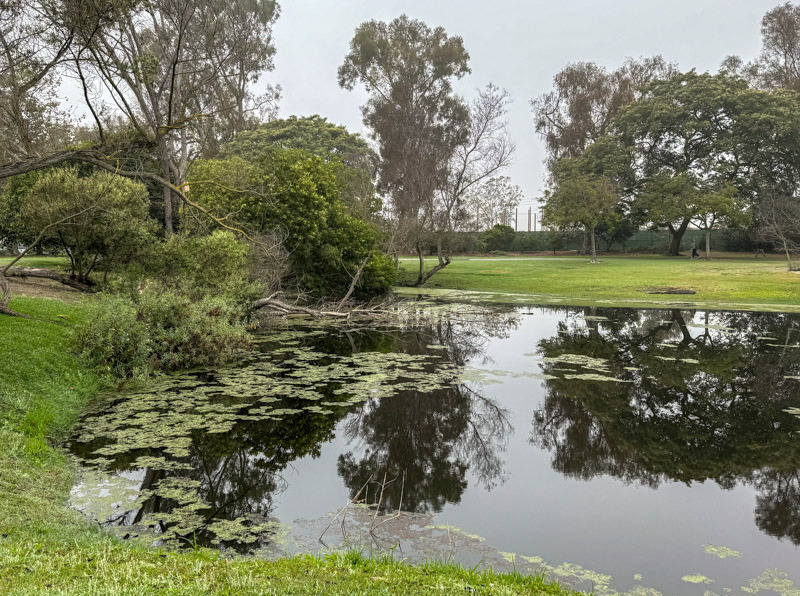
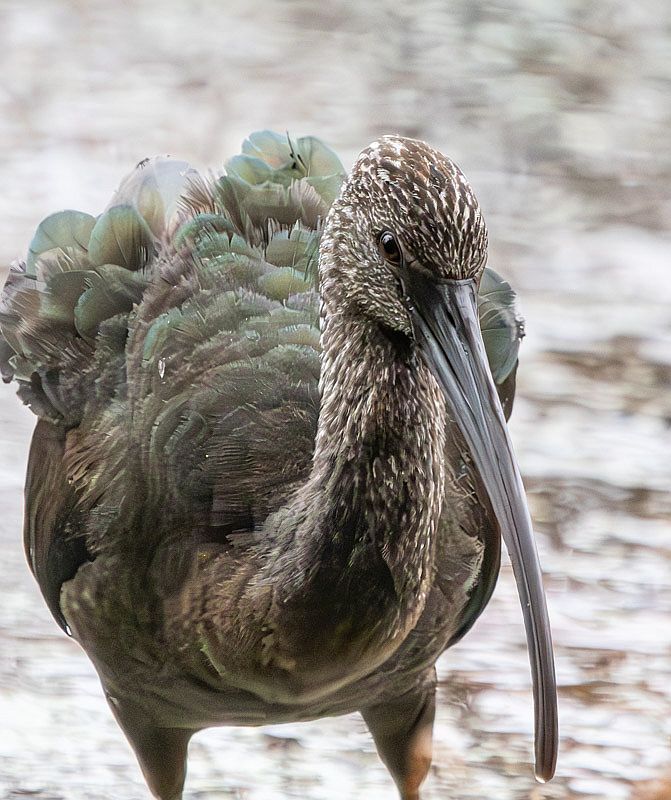
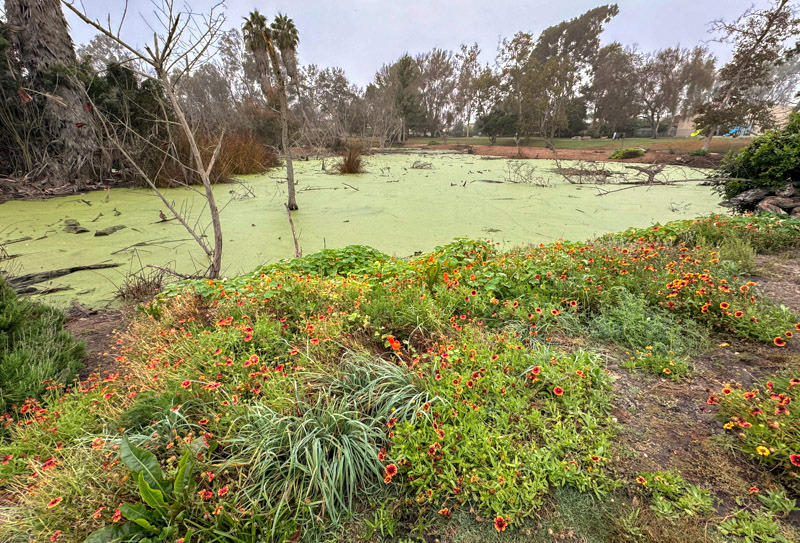
A total of 15 birders came to the Huntington Central Park birding trip, in very cool misty weather. We had to identify birds by outline, because color was hard to tell. Things were gray, black or white only. The lake was surrounded by far fewer trees, which made the lake easier to see, but there were fewer trees for birds to perch on. New trees are being planted, but unfortunately not native ones. The lake was mostly covered by the usual duckweed, but now there were more clear places than I’ve seen before. The edges of the lake boasted more Coots, Mallards, and yes, White-faced Ibises than usual, poking around in the mud at the edge. The usual Green Heron was present to greet us.

As we walked around the lake, we were pleased to see our usual migrants: brilliant Townsend’s Warblers, and a Black-and-White Warbler flitting high in the trees.

The Black-and-white Warbler is an eastern U.S. warbler with a range extending westward to the Rocky Mountains. Although they don’t nest west of the mountains they regularly appear in small numbers in the fall. These strays are quite likely the northwesternmost breeders from the Alberta-British Columbian border, occasionally straying westward across the mountains during their southern migration.
Townsend’s Warbler on the other hand, has a western range and barely crosses the southern Rockies eastward. They nest in the northern mixed coniferous forests and are common – but not abundant – spring and fall migrants in SoCal. It’s always a treat to see them in their bright yellow and black plumage.
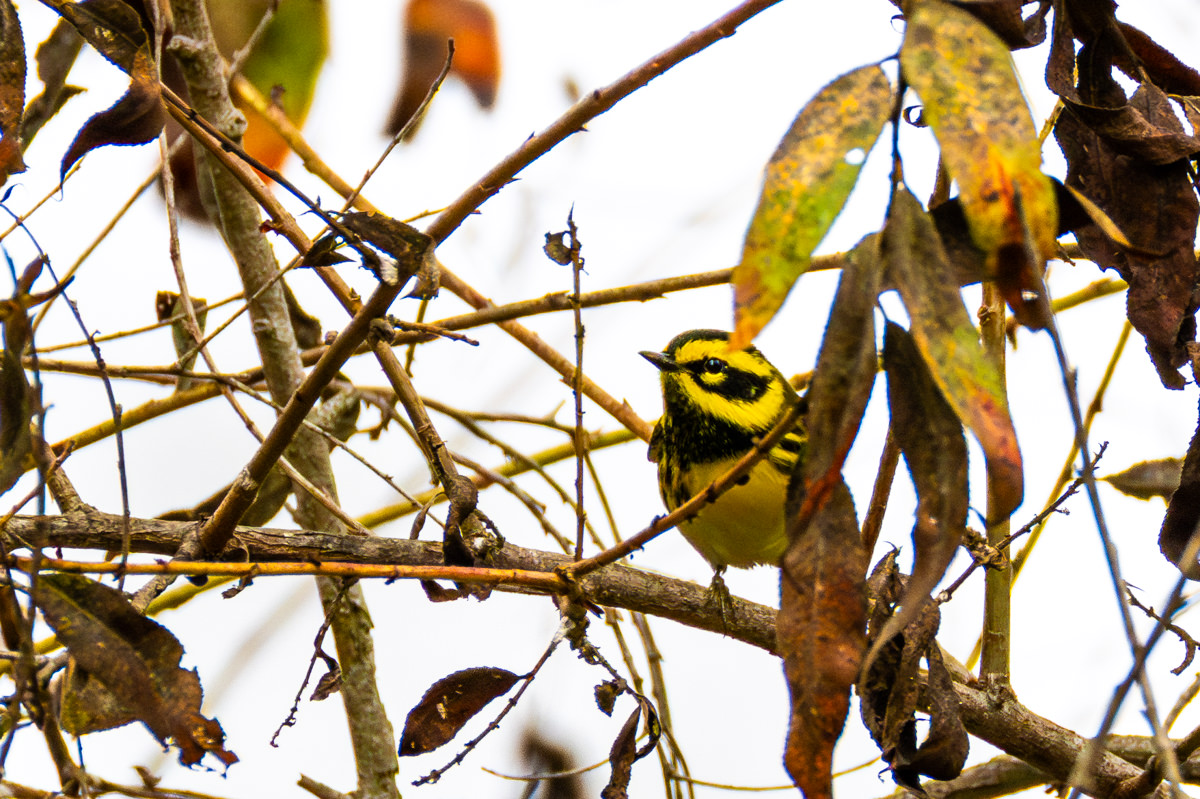
By then the fog was lifting, fortunately, and we could see their colors. A mysterious mammal slept in a tree, variously described as a gray raccoon or a long-haired opossum. The head was hidden, but we could see five toes jutting upward. Unfortunately for identification purposes, both raccoons and opossums have five toes per foot. Other cute bushy-tailed mammals checked us out for hand-outs.
The Great Horned Owl, although reportedly in his station at his nest, could not be found, although earnestly searched for. Chuck later grew suspicious of the passerby’s report of “one over by the library poking his head over the edge of the nest,” when he recalled that these owls generally don’t start nesting until February, so the likelihood of one in a nest in October was quite slim. More likely the informant saw an owl-head-shaped bunch of dead leaves caught on a limb.

After checking the UofC-Irvine web page on Spiders of Orange County, we submitted Elyse’s spider photo below to iNaturalist. Chuck decided it was likely a Spotted Orbweaver, probably Neoscona crucifera, based both upon the above web page and a few iNat photos. One commentator agreed on Neoscona sp. but not N. crucifera, unhelpfully without explaining why. Whatever it was, it was apparently in the midst of enjoying its meal.

Some birders spotted a Hutton’s Vireo. The two photos below, possibly of the same individual bird, demonstrate how varied a bird can be depending on light or distance, and how photographs can vary when displaying them. The white broken eyering and bill shape/color are good marks for Hutton’s, and especially so is the darkish “bar” between the two white wing-bars. The very similar Ruby-crowned Kinglet (also seen today) has a similar dark “bar” but it is below the lower wing-bar. But Hutton’s is typically a grayish-olive bird, not bright yellow below.

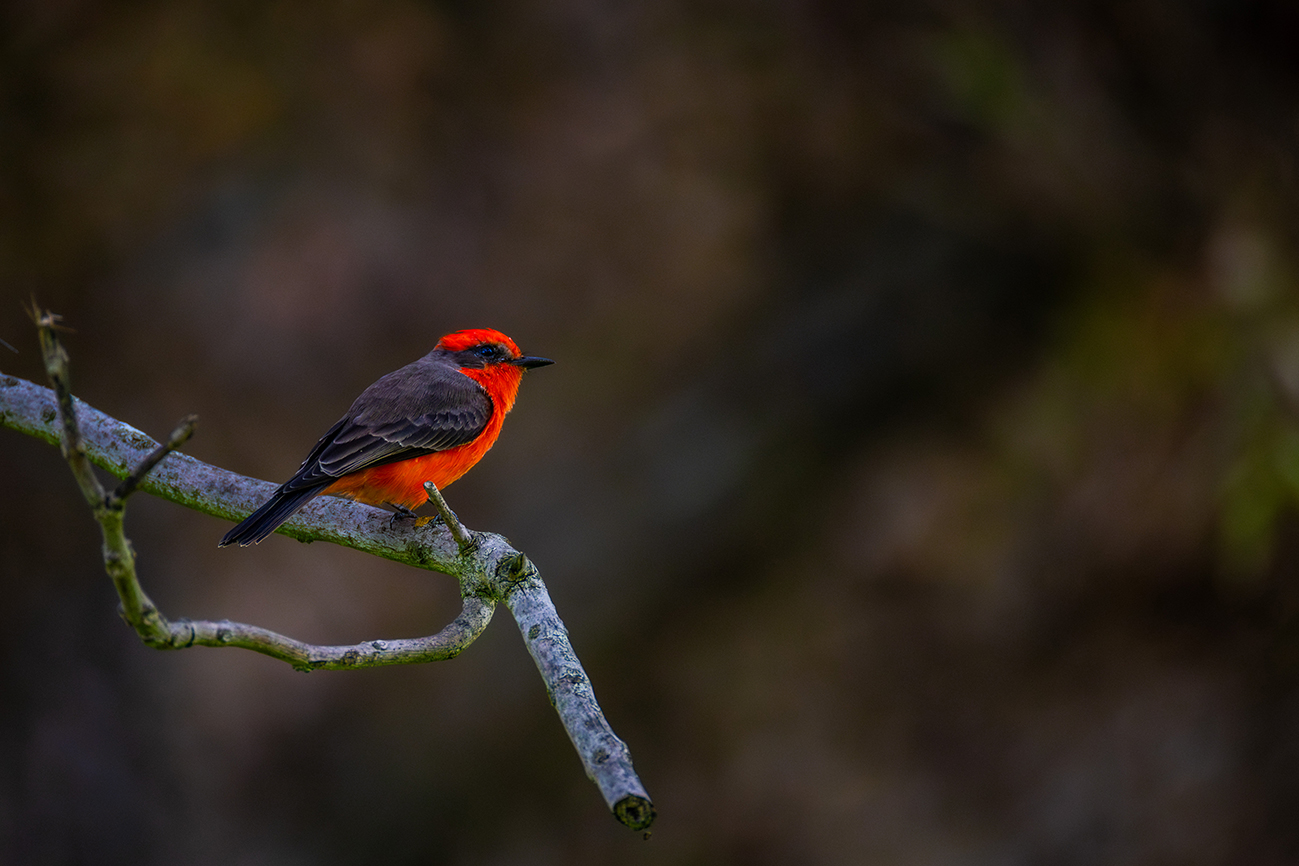

We delighted in seeing both Mr. and Mrs. Vermilion Flycatcher, as well as male and female Pin-tailed Whydah, the male spectacular with his long tail.

The female of this sub-Saharan species is small, only 4.75″ and has a bright red bill. The male at 12.5″ is almost three times as long, all of it in the tail. The male was perched in a tree adjacent to the lake near the Secret Garden a bit north of the library.
This area also hosted most of the turtles we saw. By this time the clouds had cleared and the sun was out, and it was sun-basking time for turtles. They all seemed to be Red-eared Sliders, native to eastern U.S. People buy them as pets at the store when they’re small, cute and cuddly, then unload them at the nearest pond when they get old, grumpy and picky about what they’re willing to eat.

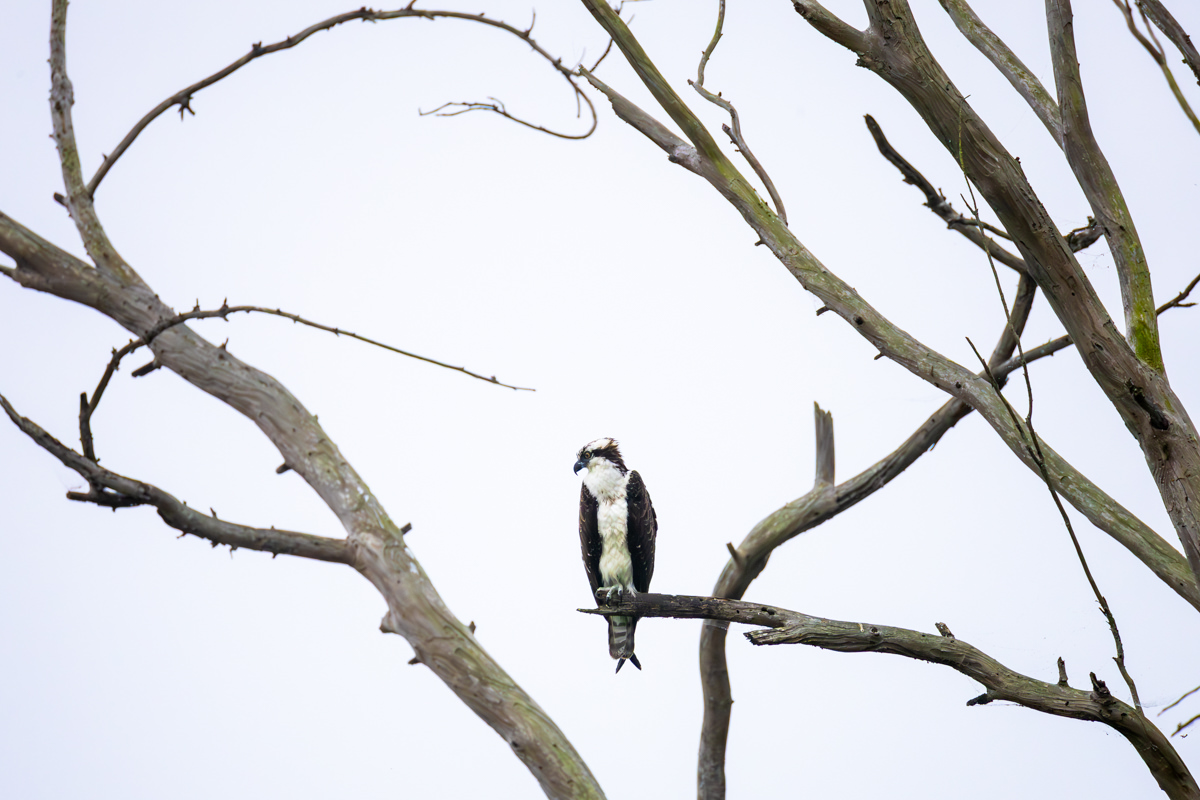
Raptors flew overhead: both Red-tailed and Red-shouldered Hawks, Turkey Vultures and an Osprey, parked over the water. A Belted Kingfisher darted across the lake.
After several hours of birding, there was the welcome sight of a restaurant, right there in the park, where we gratefully partook of the offerings.
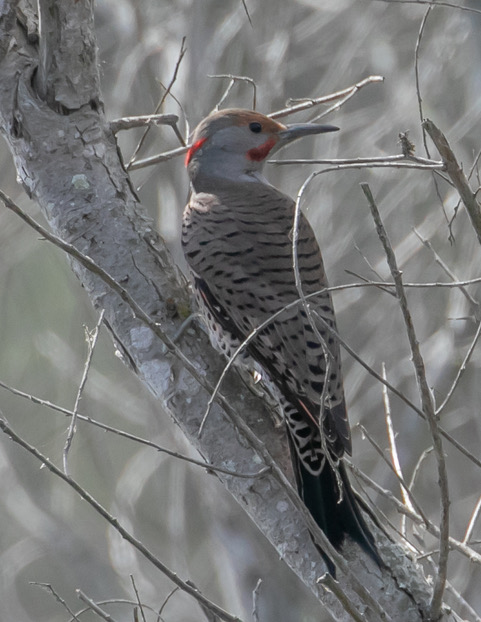
When a large bird flew in to land in the lakeside trees next to our lunch table, we immediately recognized it as a flicker, but not just any flicker. Judging by the head markings it was an intergrade. The western Red-shafted Flicker has a red “whisker” while the eastern Yellow-shafted has a black whisker and a red nape. This bird has both whisker and nape of red, not something you see every day. Judging by the very slim streak of lightness along the end of the lower edge of the wing, visible in the photo below, it may have had yellow feather shafts.
A few more birds were added to the list and off we drove, after a lovely birding day.
Quiz Time!
Identify all species. Some photos have additional questions.
All photos taken Huntington Beach Central Park East, 12 October 2024.








Quiz answers, credits & comments
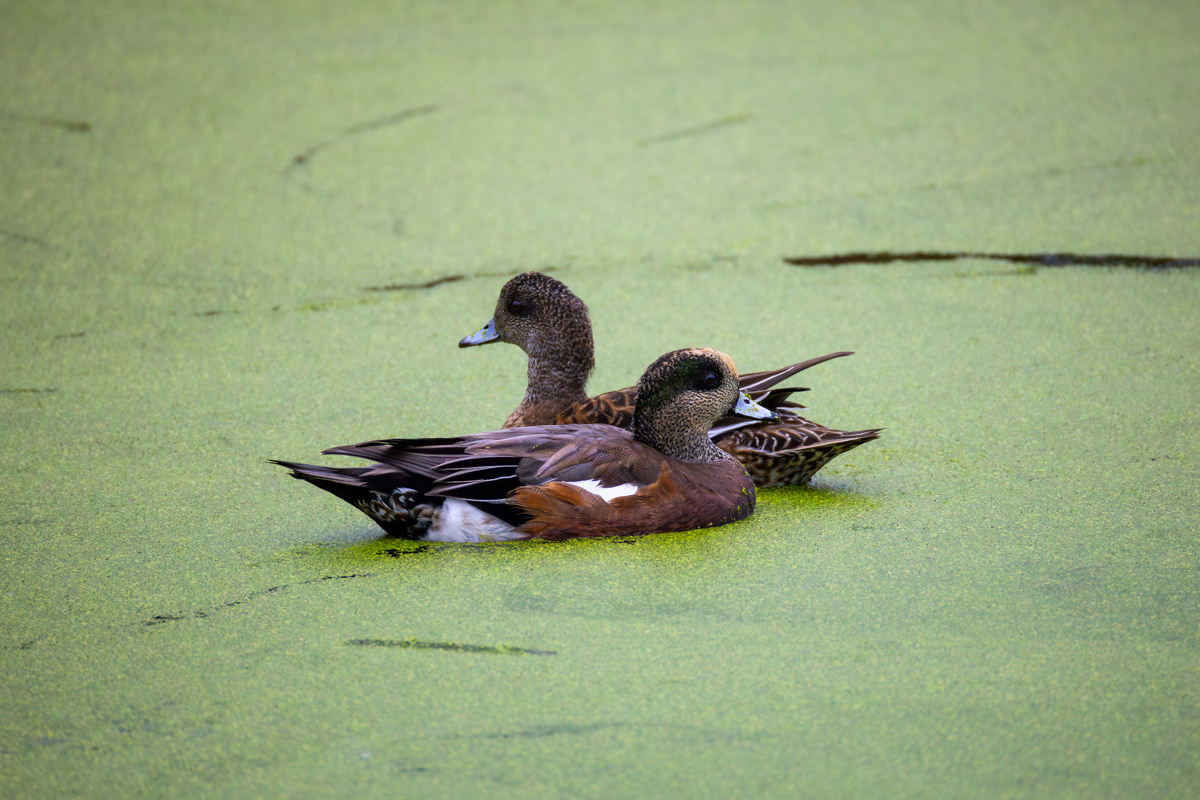
#1. American Wigeon female, stretching her wings. (Elyse Jankowski 10-12-24)
#2. Female Mallard has a blue speculum and a saddle of black on the orange bill. (Elyse Jankowski 10-12-24)
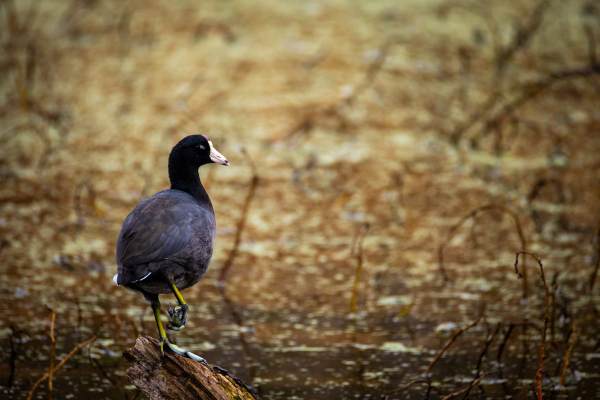
#3. American Coots are closely related to cranes, not ducks. Flexible lobes on their toes enable them to both swim and walk well, unlike birds with webbed feet. (Elyse Jankowski 10-12-24)
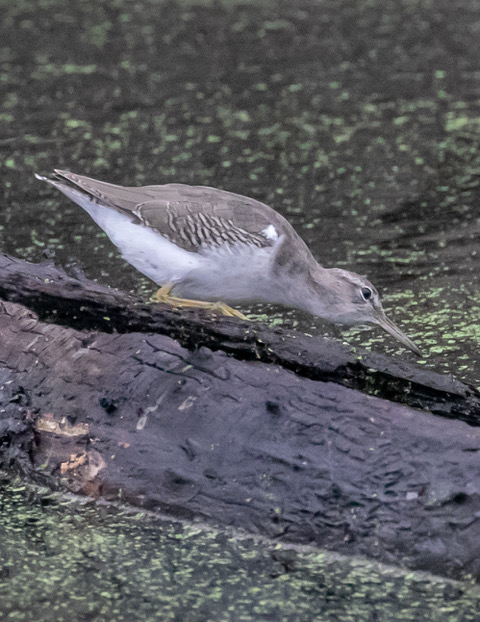
#4. Spotted Sandpiper has no spots. (Chris Tosdevin 10-12-24)
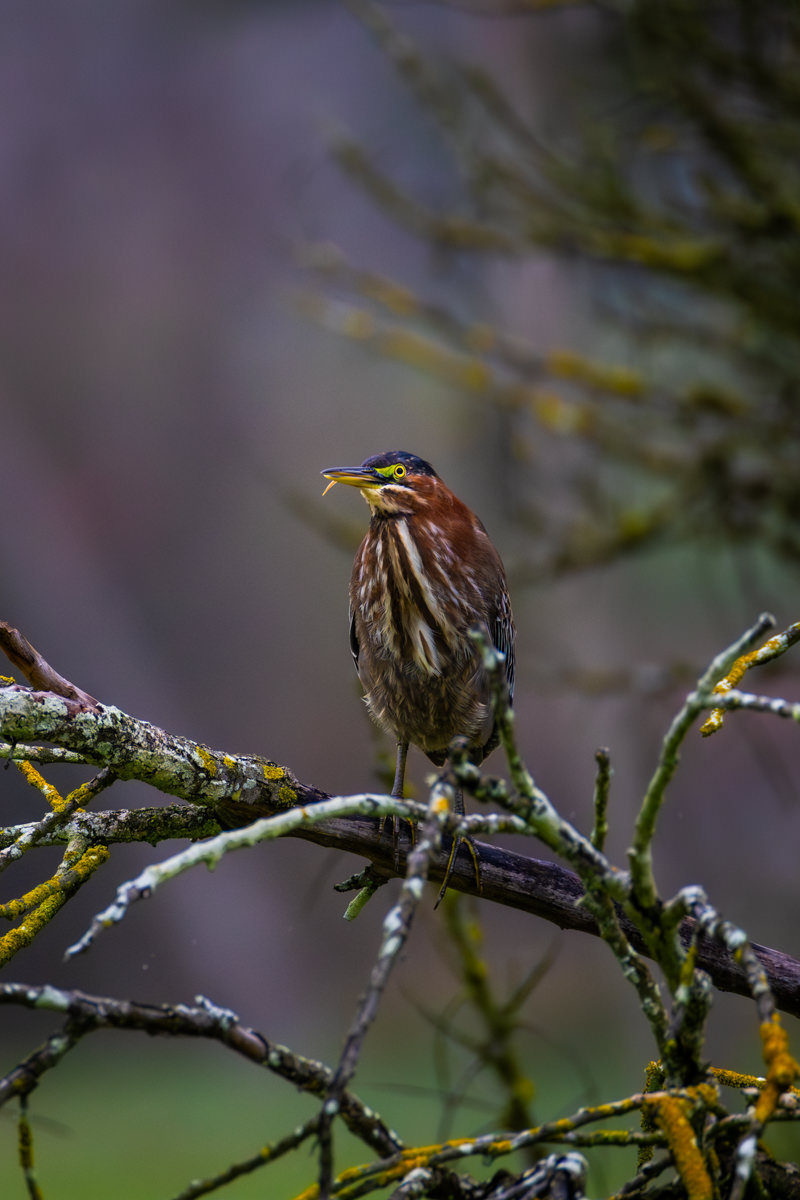
#5. Green Heron juvenile, sticking out its tongue. (Elyse Jankowski 10-12-24)
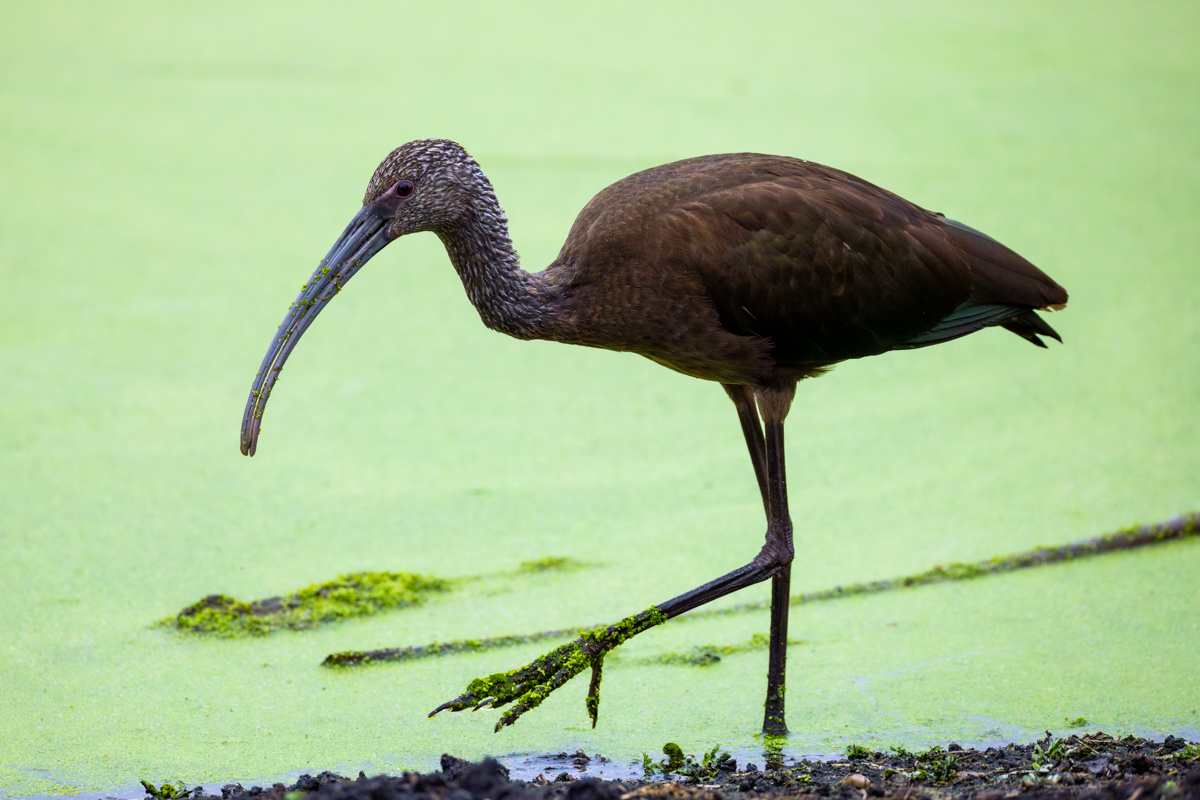
#6. White-faced Ibis has algae or duckweed on its foot and no white on the face. (Elyse Jankowski 10-12-24)
#7. Osprey preys on fish, not bones. (Elyse Jankowski 10-12-24)
#8. Belted Kingfisher female has cinnamon flanks and is scratching her head with her foot. (Chris Tosdevin 10-12-24)
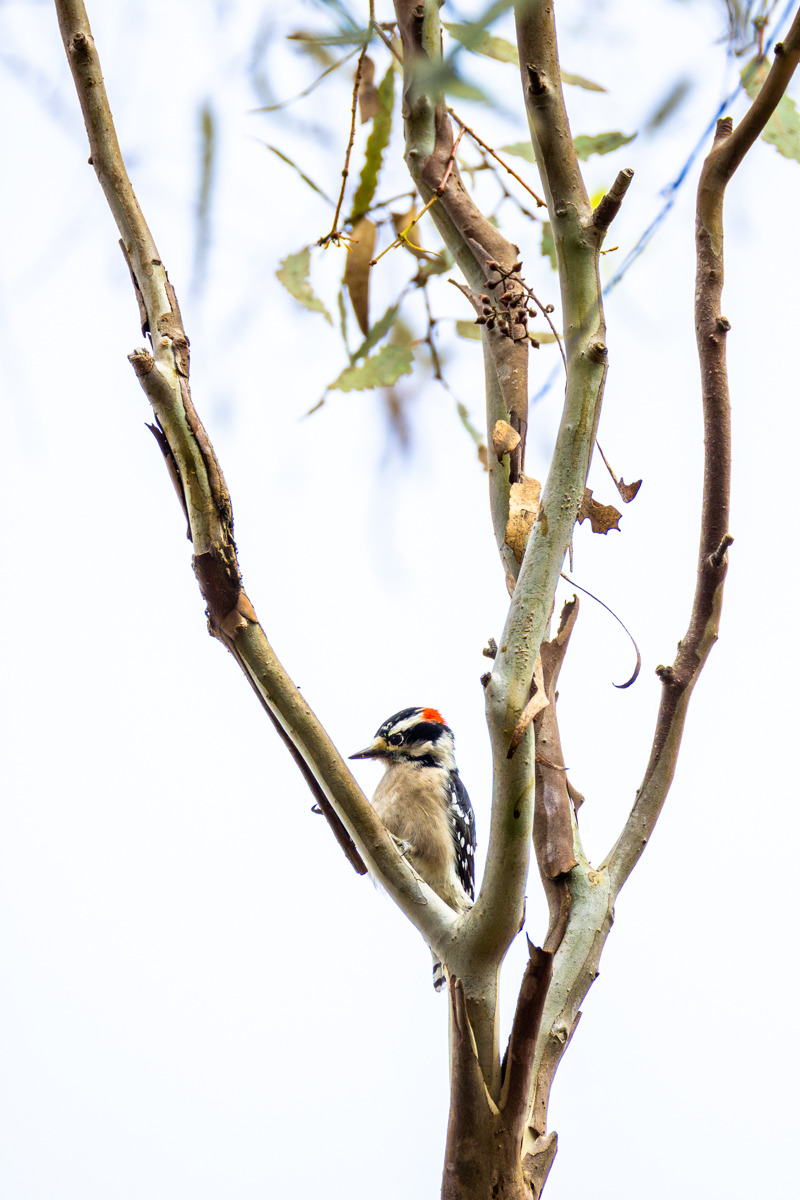
#9. Downy Woodpecker’s bill is much shorter than the similar Hairy Woodpecker. (Elyse Jankowski 10-12-24)
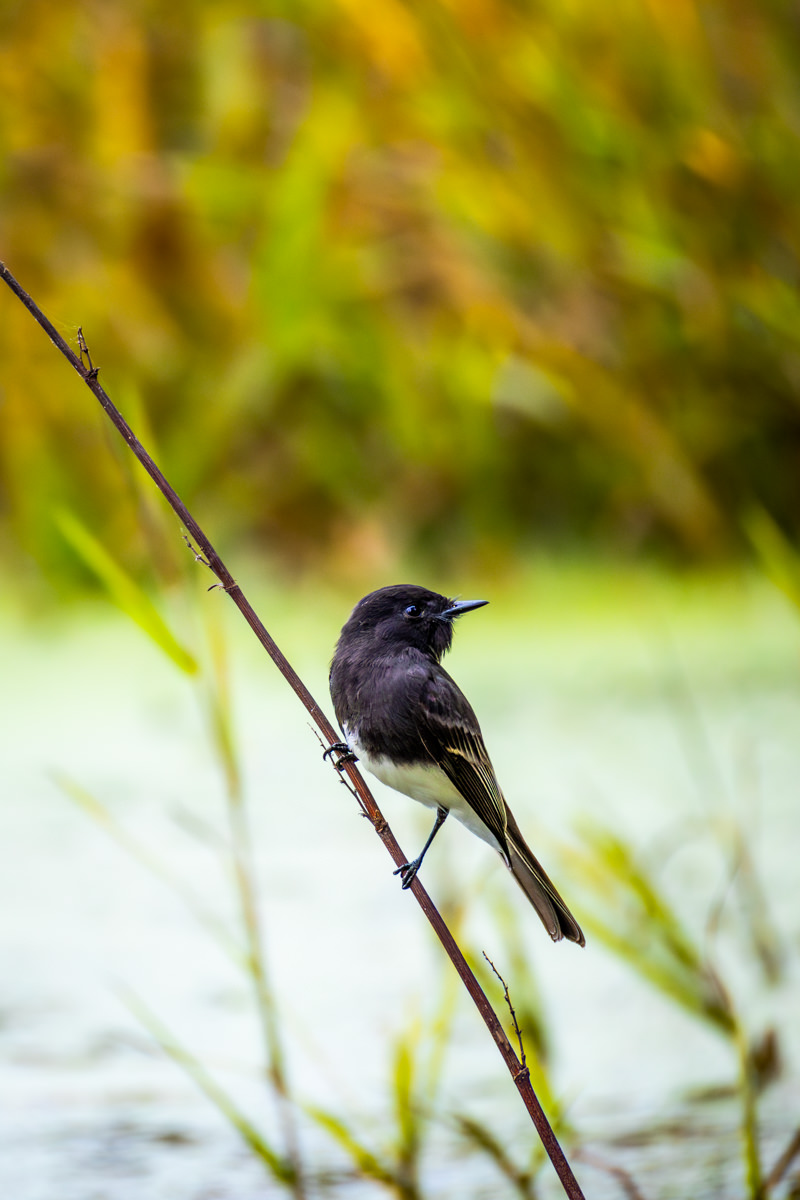
#10. Black Phoebe (Elyse Jankowski 10-12-24) Order Passeriformes/passerines, Family Tyrannidae/tyrant flycatchers.
#11. Cassin’s Kingbird white chin contrast with dark gray breast. (Elyse Jankowski 10-12-24)
#12. Vermilion Flycatcher female. (Chris Tosdevin 10-12-24)
#13. House Wren is a New World species, but Eurasian Wren occurs from Iceland to Siberia. (Chris Tosdevin 10-12-24)
#14. Western Bluebird. (Elyse Jankowski 10-12-24) Many bird species can see into infra-red or ultra-violet, plus have four-color retinas able to detect ripening fruit color changes invisible to human eyes.
#15. Male Scaly-breasted Munia Lonchura punctulata. (Elyse Jankowski 10-12-24) This common cage-bird’s native range is Pakistan to east China and Indonesia. Family Estrildidae Waxbills & allies. They have many, many common names (written about previously here).
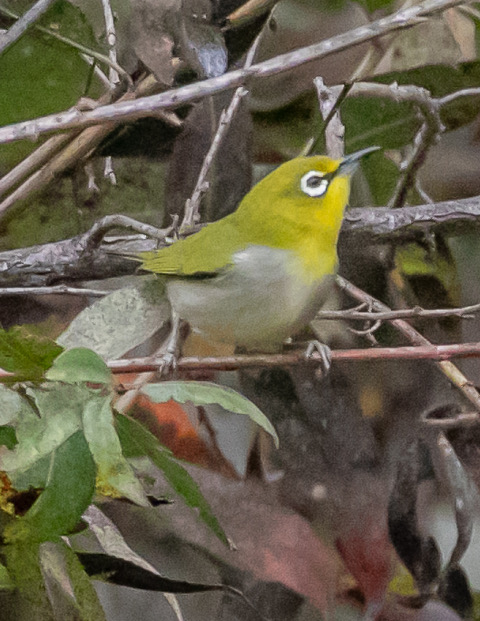
#16. Swinhoe’s White-eye Zosterops simplex (Chris Tosdevin 10-12-24), was formerly considered a subspecies of Japanese White-eye Zosterops japonicus, widespread across east Asia and Indonesia. Elevated to full species status in 2018, and “Japanese White-eye” was changed to Warbling White-eye. Thelatter bird is widely pictured in Japanese art. As a whole, the white-eye family is naturally widespread, ranging from southern Africa to east Asia. As cage birds, they are found world wide, sometimes escaping and becoming locally established as in this park.
#17. Song Sparrow (Ray Juncosa 10-12-24) likes to be near water.
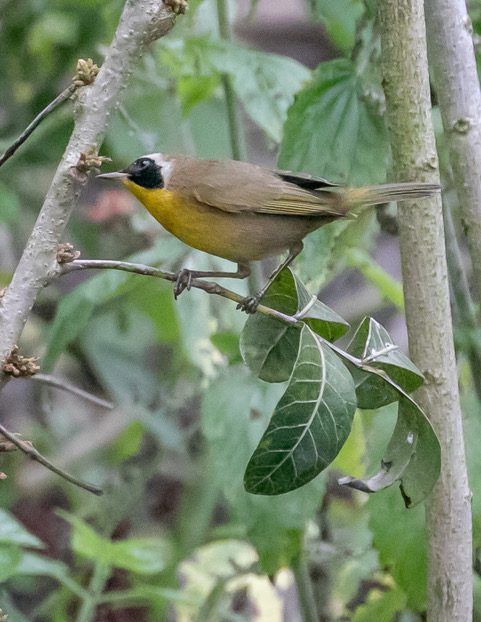
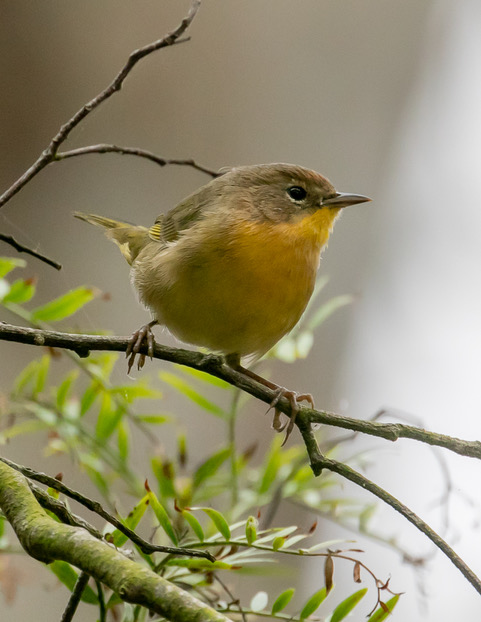
#18. Common Yellowthroat female (Chris Tosdevin 10-12-24). The pattern of yellow throat bordered by brown replicates the male pattern where the black mask replaces the brown. See the male above, not in the quiz but in the 7th picture from the top.
#19. Orange-crowned Warbler (Chris Tosdevin 10-12-24) rarely displays it’s erectable orange crown.
#20. Yellow Warbler (Elyse Jankowski 10-12-24) male has bold red streaks when breeding.
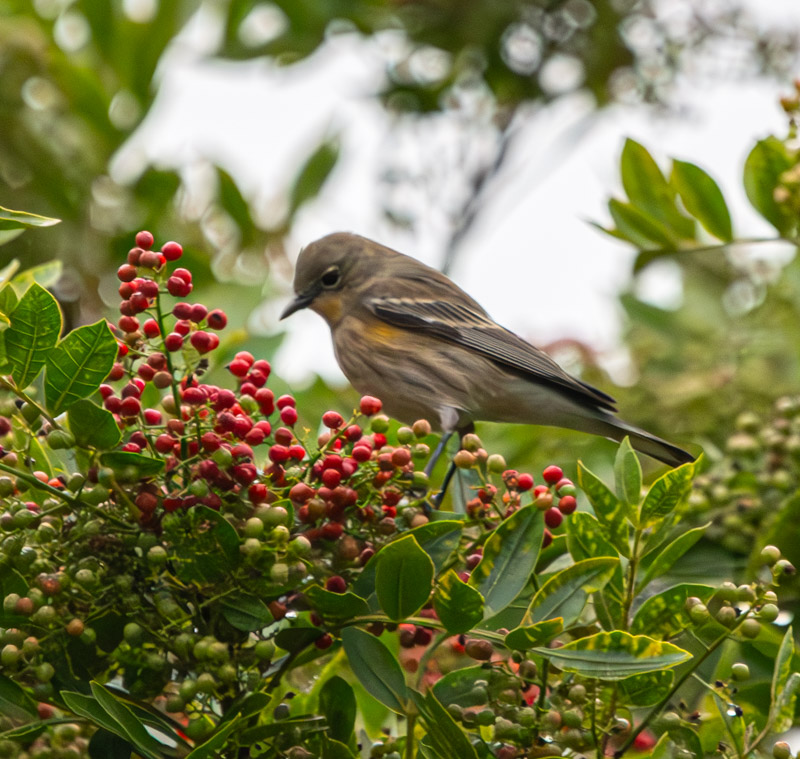
#21. Yellow-rumped Warbler (Ray Juncosa 10-12-24) western auduboni form has broken eye-ring, eastern coronata has white line (supercilium) above eye.
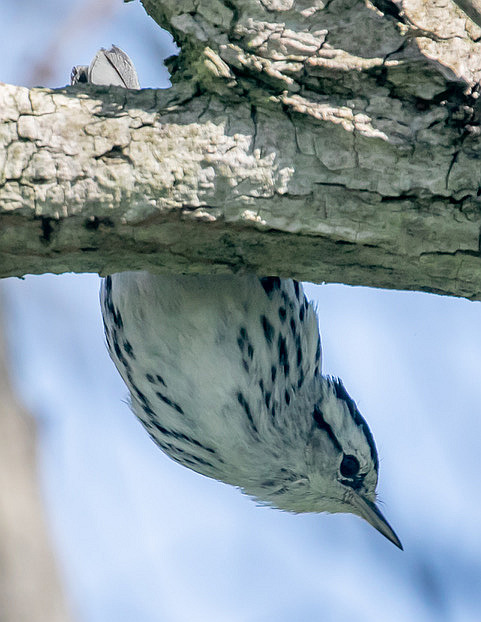
#22. Black-and-White Warbler female lacks black throat & cheek. (Chris Tosdevin 10-12-24)
There! Wasn’t that fun? It’s (almost) just like you were there!
Huntington Beach Central Park on eBird as of 10-19-24: 8607 lists, 1670 eBirders, 305 species.
Most recent species added: Wrentit, 11 Aug 2024 by James Davison.
Key: X – present; Bold – recent exotics; sub 1– heard; sub 2 – species intergrade; sub 3 – Eastern U.S. species.
| Huntington Beach Central Park | |||||||
| Year | 2024 | 2023 | 2022 | 2019 | 2018 | ||
| Date | 10/12 | 10/14 | 10/15 | 10/12 | 10/13 | ||
| 1 | Canada Goose | 40 | |||||
| 1 | Egyptian Goose | 2 | 4 | X | X | ||
| 1 | Cinnamon Teal | 1 | 1 | ||||
| 1 | Gadwall | X | |||||
| 1 | Eurasian Wigeon | X | |||||
| 1 | American Wigeon | 16 | 1 | 5 | X | ||
| 1 | Mallard | 40 | 16 | 37 | X | ||
| 1 | Green-winged Teal | 2 | |||||
| 2 | Pied-billed Grebe | 4 | |||||
| 7 | Feral Pigeon | 1 | |||||
| 7 | Mourning Dove | 2 | 5 | X | |||
| 8 | Anna’s Hummingbird | 1 | 2 | X | X | ||
| 8 | Allen’s Hummingbird | 3 | 2 | 7 | X | X | |
| 2 | Virginia Rail1 | 1 | |||||
| 2 | American Coot | 50 | 11 | 30 | X | X | |
| 5 | Long-billed Dowitcher | 18 | |||||
| 5 | Spotted Sandpiper | 2 | 2 | ||||
| 5 | Greater Yellowlegs | 1 | |||||
| 6 | Western Gull | 1 | |||||
| 6 | Gull (species) | 1 | |||||
| 2 | Double-crested Cormorant | 1 | 1 | X | |||
| 3 | Great Blue Heron | 4 | 2 | 1 | X | ||
| 3 | Great Egret | 2 | 1 | 2 | X | X | |
| 3 | Snowy Egret | 12 | 1 | 3 | X | X | |
| 3 | Green Heron | 4 | 1 | 1 | X | ||
| 3 | Black-crowned Night-Heron | 3 | 1 | 3 | X | X | |
| 3 | White-faced Ibis | 30 | 4 | 1 | X | X | |
| 4 | Turkey Vulture | 1 | 1 | ||||
| 4 | Osprey | 1 | 2 | 1 | |||
| 4 | Cooper’s Hawk | 1 | 2 | X | |||
| 4 | Red-shouldered Hawk | 1 | 1 | 3 | X | X | |
| 4 | Red-tailed Hawk | 1 | 1 | ||||
| 8 | Belted Kingfisher | 1 | 1 | 1 | X | ||
| 8 | Downy Woodpecker | 2 | 1 | 2 | X | X | |
| 8 | Nuttall’s Woodpecker | 3 | 2 | X | |||
| 8 | Northern Flicker 2 | 1 | 1 | 2 | X | X | |
| 4 | American Kestrel | 1 | 1 | X | X | ||
| 4 | Peregrine Falcon | 1 | |||||
| 9 | Cassin’s Kingbird | 4 | 1 | ||||
| 9 | Western Wood-Pewee | X | |||||
| 9 | Pacific-slope Flycatcher | X | |||||
| 9 | Black Phoebe | 15 | 5 | 8 | X | X | |
| 9 | Say’s Phoebe | 1 | 2 | ||||
| 9 | Vermilion Flycatcher | 3 | |||||
| 9 | Hutton’s Vireo | 1 | |||||
| 9 | Warbling Vireo | 1 | |||||
| 9 | California Scrub-Jay | 1 | |||||
| 9 | American Crow | 6 | 1 | 10 | X | X | |
| 9 | Common Raven | X | |||||
| 9 | Bushtit | 12 | 30 | X | X | ||
| 9 | Swinhoe’s White-eye | 7 | 4 | 10 | X | ||
| 9 | Ruby-crowned Kinglet | 2 | 1 | ||||
| 9 | Blue-gray Gnatcatcher | 2 | 1 | 1 | X | X | |
| 9 | House Wren | 4 | 2 | 2 | X | X | |
| 9 | Western Bluebird | 4 | 10 | 25 | |||
| 9 | Hermit Thrush | 2 | X | ||||
| 9 | American Robin | 2 | X | ||||
| 9 | Bronze Mannikin | X | |||||
| 9 | Scaly-breasted Munia | 5 | X | X | |||
| 9 | Pin-tailed Whydah | 5 | X | ||||
| 9 | House Finch | 10 | 6 | 12 | X | X | |
| 9 | Lesser Goldfinch | 4 | 2 | 4 | X | X | |
| 9 | American Goldfinch | 2 | X | ||||
| 9 | Dark-eyed Junco | 1 | |||||
| 9 | White-crowned Sparrow | 3 | X | X | |||
| 9 | Song Sparrow | 8 | 2 | 1 | X | X | |
| 9 | California Towhee | X | X | ||||
| 9 | Hooded Oriole | X | |||||
| 9 | Red-winged Blackbird | 2 | |||||
| 9 | Brewer’s Blackbird | X | |||||
| 9 | Black-and-white Warbler3 | 1 | 1 | ||||
| 9 | Orange-crowned Warbler | 4 | 1 | 4 | X | X | |
| 9 | Nashville Warbler | X | |||||
| 9 | MacGillivray’s Warbler | 1 | |||||
| 9 | Common Yellowthroat | 12 | 1 | 7 | X | X | |
| 9 | Yellow Warbler | 1 | X | ||||
| 9 | Yellow-rumped Warbler | 14 | 16 | 14 | X | X | |
| 9 | Black-throated Gray Warbler | X | |||||
| 9 | Townsend’s Warbler | 4 | 4 | 1 | X | X | |
| 9 | Wilson’s Warbler | X | |||||
| 9 | Western Tanager | X | |||||
| Totals by Type | 2024 | 2023 | 2022 | 2019 | 2018 | ||
| 1 | Waterfowl | 101 | 21 | 43 | |||
| 2 | Water Birds – Other | 55 | 12 | 31 | |||
| 3 | Herons, Egrets & Ibis | 55 | 10 | 11 | |||
| 4 | Quail & Raptors | 7 | 5 | 7 | |||
| 5 | Shorebirds | 2 | 3 | 18 | |||
| 6 | Gulls & Terns | 1 | 0 | 0 | |||
| 7 | Doves | 2 | 5 | 1 | |||
| 8 | Other Non-Passerines | 11 | 9 | 12 | |||
| 9 | Passerines | 130 | 98 | 77 | |||
| Totals Birds | 364 | 163 | 200 | 42 | 41 | ||
| Total Species | 2024 | 2023 | 2022 | 2019 | 2018 | ||
| 1 | Waterfowl | 6 | 3 | 3 | 3 | 3 | |
| 2 | Water Birds – Other | 3 | 2 | 2 | 1 | 2 | |
| 3 | Herons, Egrets & Ibis | 6 | 6 | 6 | 4 | 6 | |
| 4 | Quail & Raptors | 7 | 4 | 4 | 2 | 3 | |
| 5 | Shorebirds | 1 | 2 | 1 | 0 | 0 | |
| 6 | Gulls & Terns | 1 | 0 | 1 | 0 | 0 | |
| 7 | Doves | 1 | 1 | 1 | 1 | 0 | |
| 8 | Other Non-Passerines | 6 | 6 | 4 | 5 | 5 | |
| 9 | Passerines | 24 | 24 | 13 | 26 | 22 | |
| Totals Species – 71 | 55 | 48 | 35 | 42 | 41 | ||
Manakins, with UCLA Prof. Dr. Barney Schlinger: Zoom Evening Meeting Reminder, Tuesday, 8 October, 7:30 p.m.
You are all invited to the next ZOOM meeting
of Santa Monica Bay Audubon Society
|
Manakins, with UCLA Prof. Dr. Barney Schlinger
Zoom Evening Meeting, Tuesday, 8 October, 7:30 p.m.
Zoom waiting room opens 7:15 p.m.
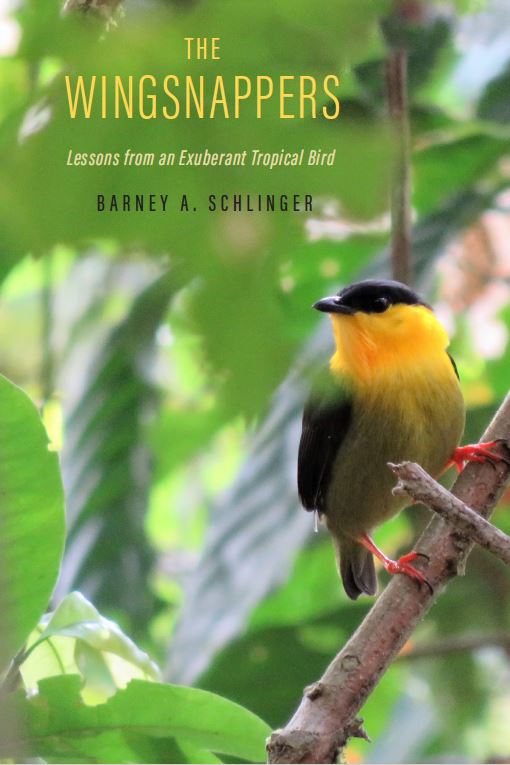
Manakins are an extraordinary group of neotropical birds with amazing social systems and courtship behaviors. Dr. Schlinger has studied one manakin in particular, the Golden-collared Manakin of Panama. As with most manakin species, the males gather in groups to attract females through dance and song. But with the Golden-collared Manakin, each male performs an elaborate, noisy and acrobatic courtship display. Dr. Schlinger will discuss his recent book entitled “The Wingsnappers: Lessons from an Exuberant Tropical Bird” and explore why manakins have evolved such complex behaviors and how they have also developed neural, hormonal and muscular specializations to allow these athletic performances.
Dr. Barney Schlinger is Associate Dean of Life Science and Distinguished Professor of Integrative Biology & Physiology. He has previously been an Associate Researcher at the Smithsonian Tropical Research Institute in Panama, a Humboldt Award winner, a visiting scientist at the Max Planck Institute for Ornithology in Germany as well as a resident ornithologist at the Bernheim Forest in Kentucky. He has published over 175 research papers and book chapters, mostly on birds, and is an avid bird watcher. He has done extensive studies of Golden-collared Manakins – an exuberant tropical bird. His fascination with bird behavior and its neurological and chemical underpinnings has led to his many studies of birds in the field as well as undertaking laboratory studies of the avian brain and the hormonal control of the bird’s brain and muscle function.
|
(If this button isn’t working for you, see detailed zoom invitation below.)
Meeting ID: 823 1094 2527
Passcode: 389357
One tap mobile
+16699009128,,82310942527#,,,,389357# US (San Jose)
+16694449171,,82310942527#,,,,389357# US
Dial by your location:
+1 669 900 9128 US (San Jose)
+1 669 444 9171 US
+1 253 215 8782 US (Tacoma)
+1 346 248 7799 US (Houston)
+1 719 359 4580 US
+1 253 205 0468 US
+1 301 715 8592 US (Washington DC)
+1 305 224 1968 US
+1 309 205 3325 US
+1 312 626 6799 US (Chicago)
+1 360 209 5623 US
+1 386 347 5053 US
+1 507 473 4847 US
+1 564 217 2000 US
+1 646 558 8656 US (New York)
+1 646 931 3860 US
+1 689 278 1000 US
Meeting ID: 823 1094 2527
Passcode: 389357
Number: https://us02web.zoom.us/u/k7g2Bt3CC
The Sly Fox of Sandy Santa Monica
[Posted by Chuck Almdale, photography by Ray Juncosa]
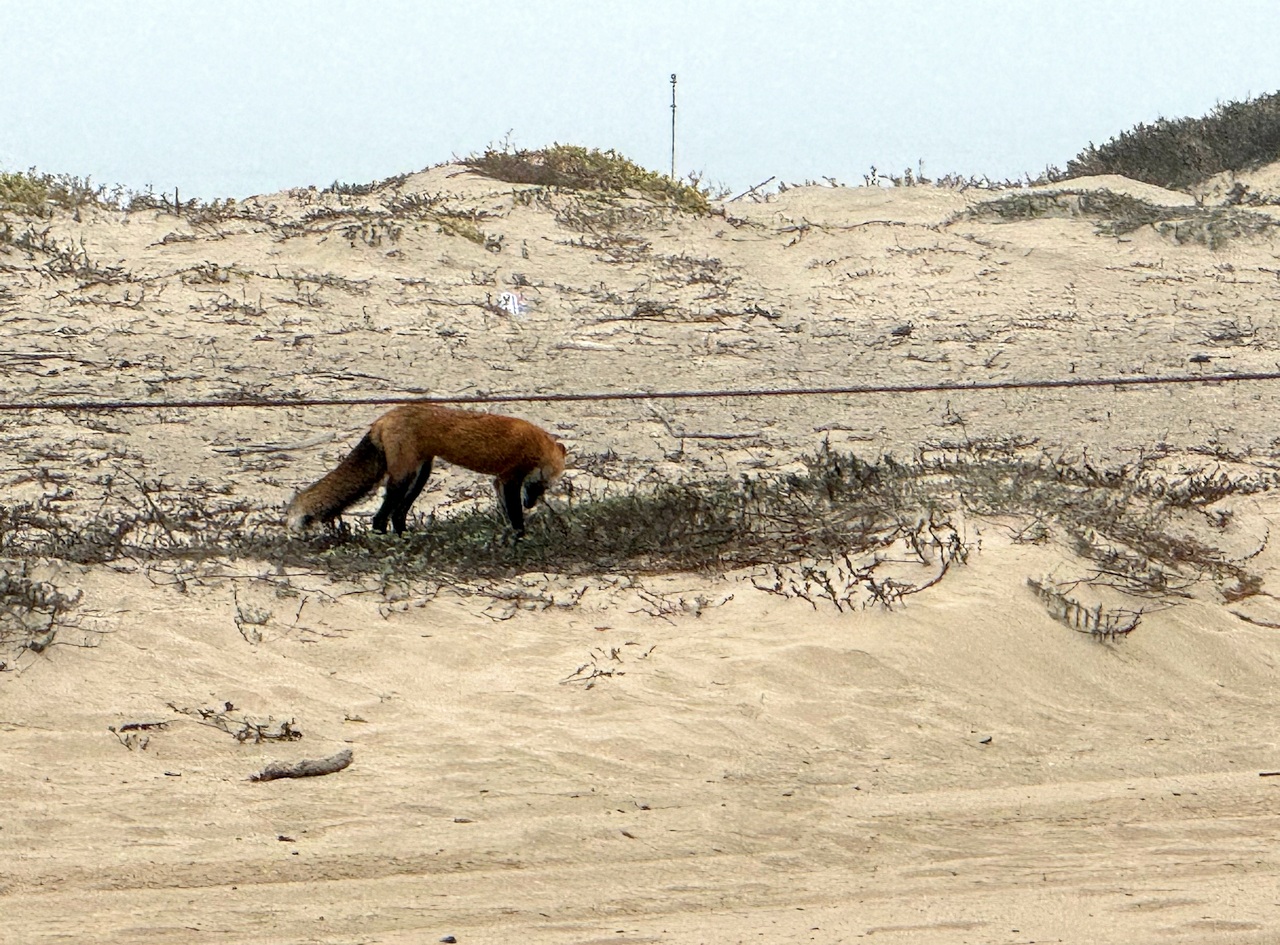
A fox prowls the dunes of Santa Monica. (Santa Monica Beach, Ray Juncosa, 10/2/24, 6:18 pm)
Unleashed dogs are a common (and illegal) presence on Santa Monica Beach, but not foxes.
According to photographer Ray Juncosa, the photo was taken on a cellphone north of Annenberg [Annenberg Community Beach House, 415 Pacific Coast Hwy] and south of the Palisades Beach Club [267 Pacific Coast Hwy, both in Santa Monica]. He writes:
My conjecture is that the wily fox is familiar with the Will Rogers creek that flows from the wooded and “wild” parts of the canyon [Santa Monica Canyon] where it would normally live. It could follow the creek under PCH and the bike path, and then out to the beach. If the past few years of drought conditions have reduced the assortment of small rodents, sadly shorebirds might be on the menu.
This area is near the Western Snowy Plover roosting area on the beach. Upon seeing the photograph, Snowy Plover warden Lucien Plauzoles commented:
Equally surprised. Coyote, common, but fox? Never seen one at lower elevations except Channel Islands and 25 years ago at Nojoqui [Nojoqui Falls County Park, Santa Barbara County north of Santa Barbara].
On the Los Angeles County mainland we have the native Gray Fox and the introduced Red Fox, as well as the San Joaquin Kit Fox, half the size of the other two. The diminutive Island Fox lives on the Channel Islands, oddly enough. The above looks red to me.
Theodore Payne Upcoming Classes & Plant Sales
[Posted by Chuck Almdale]

It’s that time of year again, when people again say “It’s that time of year again.”
It’s also the time for fall planting of drought-tolerant (not necessarily drought-loving) California native plants. Theodore Payne has a boodle of them, in pots, ready to go. Plus seed packets seeds, books, T-shirts, and the all-important howto and whatnot.
Theodore Payne Foundation for Wild Flowers and Native Plants has a fall sale coming up on October 29 – November 9.
They also have a host of classes and walks coming up in November.
Locals who already have native plants in their yards know that TP is the place to go. But if you’re new to the L.A. area, this is your heads-up. They’ve got it all at excellent prices.
Find it all HERE on their website.
Short but true story: When we took out our front lawn in 2009 and put in California native plants, changing nothing else, our water usage immediately dropped 75%.
Sandpipers & Other Goodies: Malibu Lagoon, 22 Sept. 2024
[Text by Chuck Almdale; photos by Elyse Jankowski, Lillian Johnson, Armando Martinez & Chris Tosdevin]
Don’t miss the quiz at the end which has some of the best photos.

The early arrivers to the lagoon got to see the ibis pair. I saw them fly away, but another one dropped in later. That’s migration – birds fly in, birds fly out, some stay and feed, some sleep. Our Greater Yellowlegs from last month was there, or more likely a new one. They show up only 4% of our visits but with two months in a row, they cranked it all the way up to a whopping 6.1%. Ibis are even rarer – just under 2%.

The lagoon outlet – open last month – had filled with sand. As a result the lagoon water level was quite high and didn’t fluctuate during our visit. One male Great-tailed Grackle strutted the sand. They’re 18″ long bill-tip to tail-tip, a half-inch longer than the American Crow, believe it or not. (It’s all in the tail.) The females are 3″ shorter; again, all in the tail. These birds nest somewhere in the general lagoon area, I’m not sure where. Perhaps up the creek, perhaps in the reed-bed across the lagoon by Adamson House.

Photographer Elyse Jankowski had to leave early but sent me some very nice photos. This Snowy Egret appears to have some Cattle Egret-like faint reddish highlights at the nape and lower back. I don’t know why, unless it was just a hint of mud.

The Snowy Plovers have definitely returned! We had 42 birds, up from 22 in August and 6 in July. Two were banded, as photographed by Plover Wardens Larry Loeher and Grace Murayama three days earlier.


We had some tricky times with several sandpipers, Least and Western (or Semipalmated).
The Western Below has a bill a bit shorter than usual, and close observation revealed semipalmated feet (check its right foot in 1st picture, left foot in 2nd picture). So – as its migration and just about anything can show up anywhere (within reason) – the possibility of an eastern Semipalmated Sandpiper reared its delicious head. We studied and scoped and discussed. We later studied the photos, even sending one or more to iNaturalist and waiting to see what the eBird people had to say. But, alas, it was not to be.
A Short Treatise on Sandpiper Toes
Birds have two toes (Ostrich), three toes (emus, bustards, the two species of Three-toed Woodpecker & quails), or four toes (everything else). Sandpipers have four toes arranged anisodactylly: three point forward, one points to the rear. They are numbered: #1 – back toe, #2 inner front, #3 middle front, #4 outer front. In photographs its often hard or impossible to see the #1 rear toe. Birds that spend their time in or near water often have webbing between their toes. Ducks, for example. Both the Semipalmated and Western Sandpipers have semipalmated feet – the webbing between their 4th and 3rd toes is larger than between the 3rd and 2nd toes.

So the word “semipalmated” does describe the foot of Calidris pusilla, the Semipalmated Sandpiper, but it does not exclude Calidris mauri, the Western Sandpiper. And this can easily confuse the billions of people who expect descriptive animal names to a) exist, b) work, c) exclude, d) be useful, and e) not confuse. [A fool’s errand if ever there was one.] My understanding is that the Semipalmated Sandpipers were described first. When someone decided that the longer-billed and slightly-differently plumaged and shaped birds among them were actually a different species, the new birds were named “Western” as they were more numerous the farther west you went. [I wrote about this here in August 2022. Someday I hope to get all the facts, dates and name changes absolutely straight.] Just to confuse the issue, both species have variable bill lengths, with the Western a bit longer, but the westerly Semipalmated bill is a bit longer than the easterly Semipalmated bill.

But that was not the end of confusion and debate! The first bird disappeared, but we then thought we rediscovered it resting on the ground among the small pieces of driftwood.

Armando Martinez got a photo of it rising.
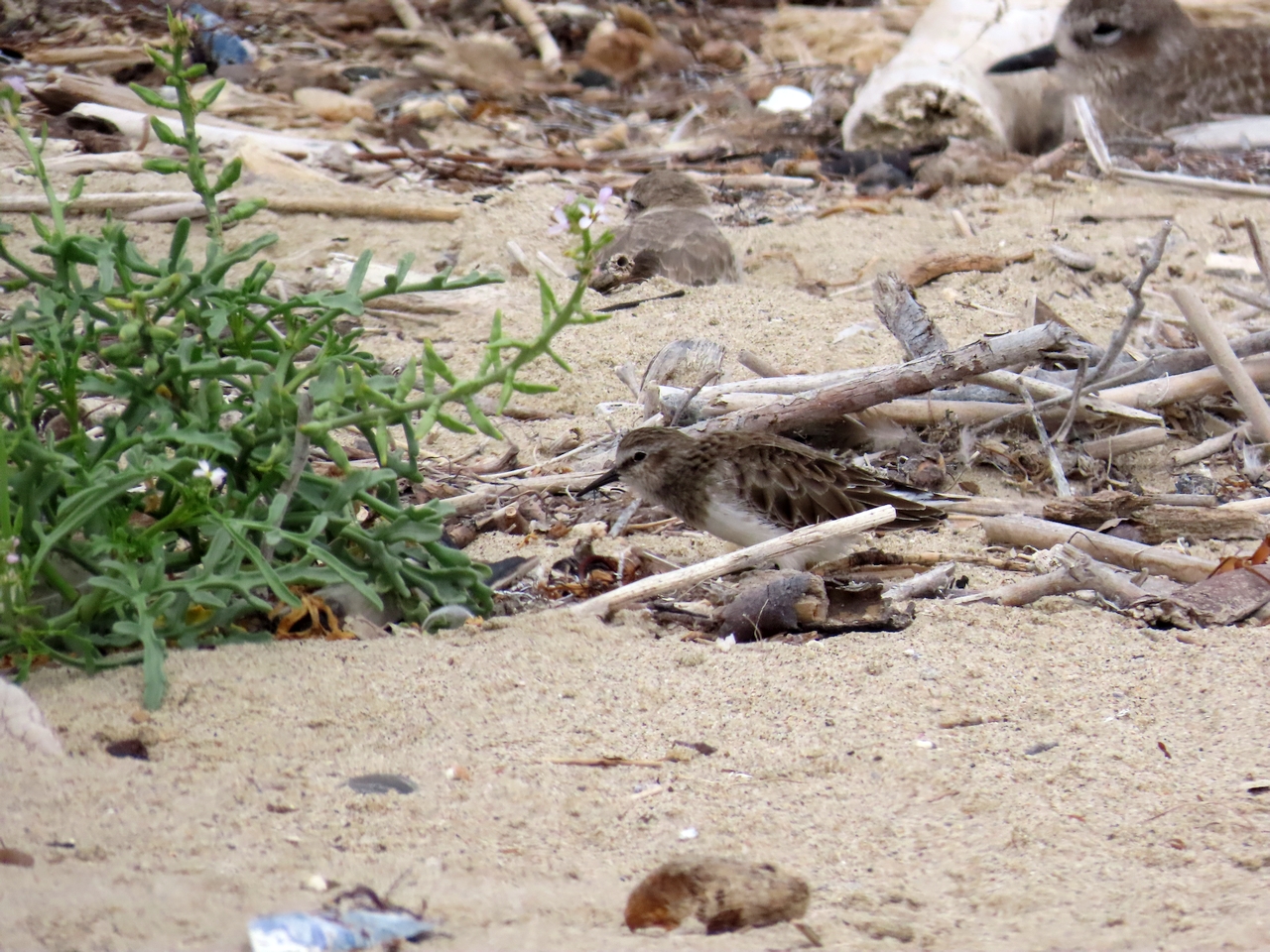
He then stretches his wings and staggers off. Not the back of the Snowy Plover and the head of the Black-bellied Plover behind him, providing some size comparison.

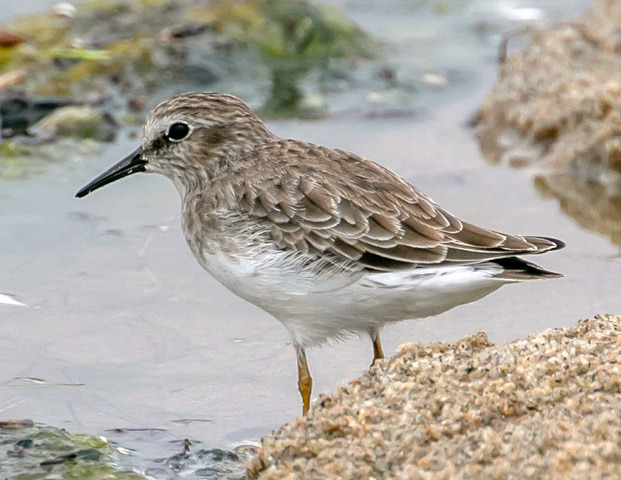


Flowers are still blooming, or blooming again, in late September.

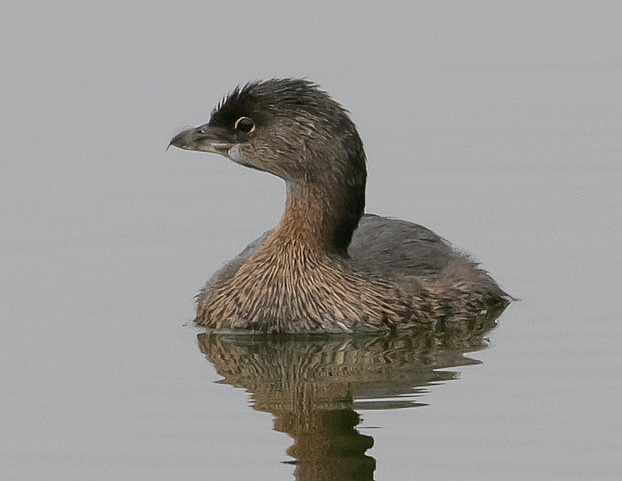
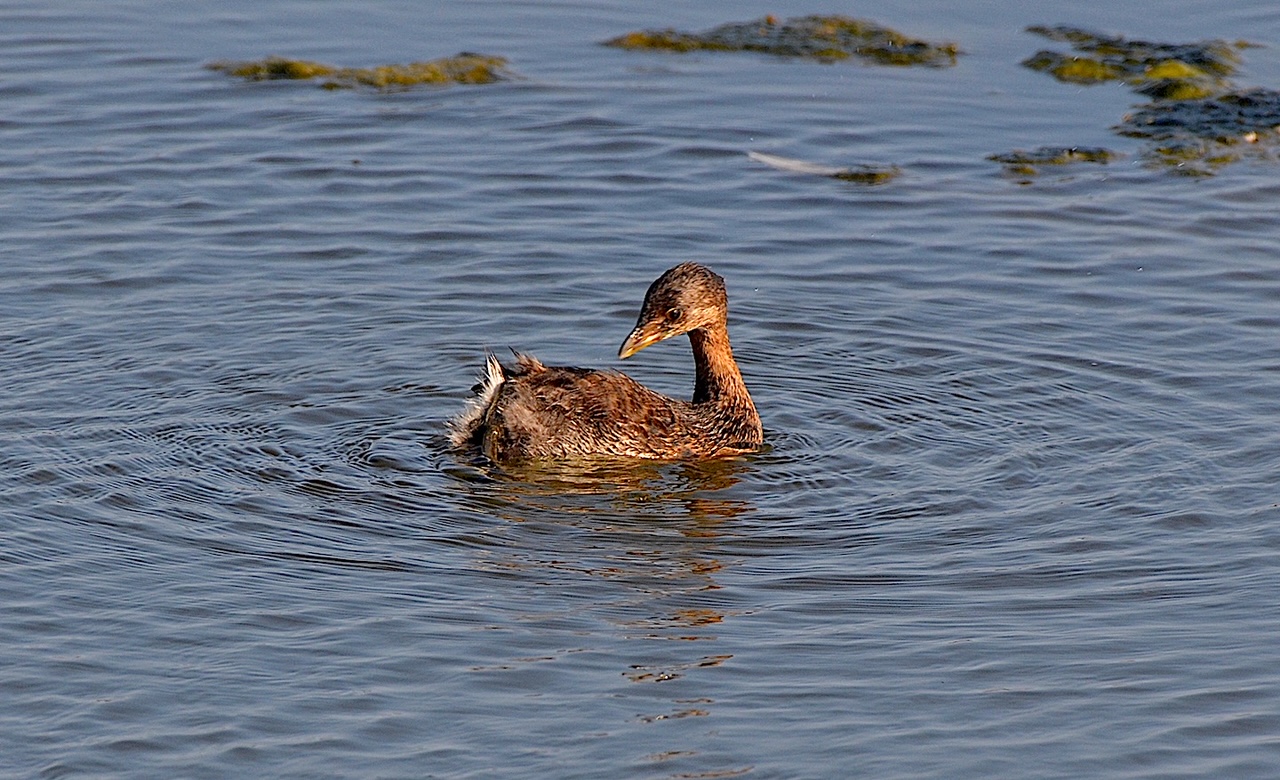
This Pied-billed Grebe’s bill is not at all pied and it seems to have a wicked-looking thorny tip.
Last but not least, but without photo, we had a Lark Sparrow Chondestes grammacus in a very messy molting plumage, flitting around between the beach plants. I was very surprised to see it, as our only prior sighting of this species at the lagoon was on April 26, 1999, well back into the “before-times.”
Quiz Time!
As these photos are all taken this September at the lagoon, many of the birds are in plumage transition.






Quiz Answers & credits
#1. Say’s Phoebe, first appearance since last November. (Chris Tosdevin 9-22-24)
#2. An exceptionally fierce-looking Wrentit (Elyse Jankowski 9-22-24)
#3. Blue-gray Gnatcatcher, increasingly common since 2015 (Chris Tosdevin 9-22-24)
#4. Savannah Sparrow, only the 4th sighting in the past 6 years. (Chris Tosdevin 9-22-24)
#5. Red-winged Blackbird: first year male, red not visible, brown bars on back. (Chris Tosdevin 9-22-24)
#6. Common Yellowthroat, male; breeds around the lagoon. (Chris Tosdevin 9-22-24)
#7. Great-tailed Grackle, male, whose tail has vanished (temporarily, we hope). (Grace Murayama 9-19-24)
#8. Ring-necked Ducks, 1 female, 3 males. Our 7th sighting at the lagoon. (Chris Tosdevin 9-22-24)
#9. American Wigeon, male, common winter visitor. (Chris Tosdevin 9-22-24)
#10. Pied-billed Grebe, a different view. (Larry Loeher 9-19-24)
#11. All-black Mallard. Not a male as no curly tail. If I’m wrong and this is not a mallard, let me know why. (Elyse Jankowski 9-22-24)
#12. Pygmy Blue Butterfly (Brephidium exilis), our lagoon specialty. (Chris Tosdevin 9-22-24)
#13. Great-blue Heron. (Chris Tosdevin 9-22-24)
#14. Whimbrel & 2 Willets. (Chris Tosdevin 9-22-24)
#15. Ruddy Turnstone, molting. (Chris Tosdevin 9-22-24)
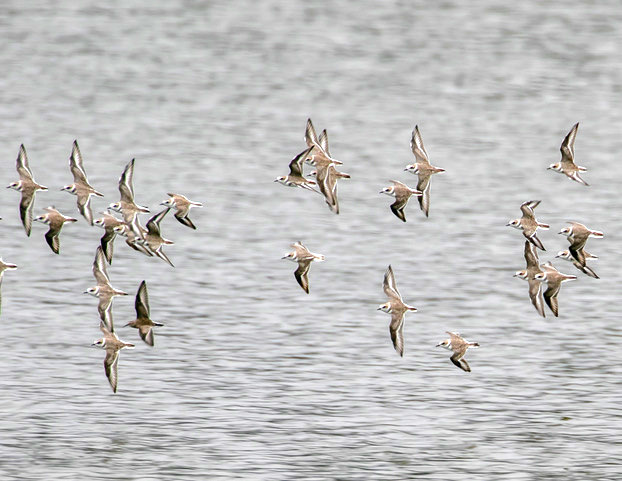
#16. 27 Western Snowy Plovers (Chris Tosdevin 9-22-24)
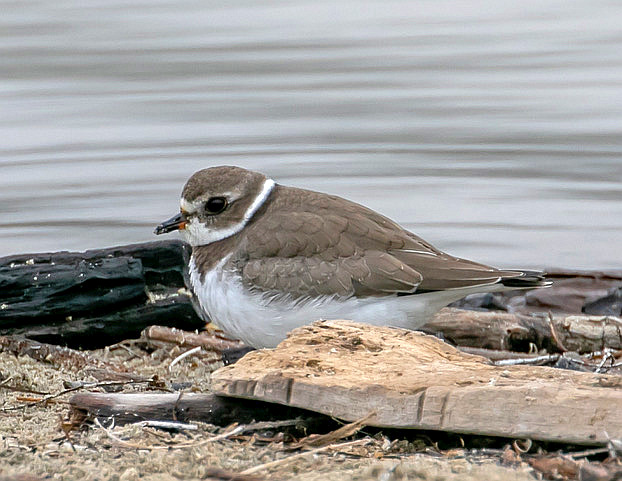
#17. Semipalmated Plover (Chris Tosdevin 9-22-24)
#18. Black-bellied Plover (Elyse Jankowski 9-22-24)
#19. Greater Yellowlegs (Chris Tosdevin 9-22-24)
#20. Willet, molting. (Elyse Jankowski 9-22-24)
#21. Whimbrel (Elyse Jankowski 9-22-24)
Malibu Lagoon on eBird as of 9-27-24: 8053 lists, 2582 eBirders, 318 species.
Most recent species added: Cassin’s Vireo, 9/23/24 by Colin Drummond.
Birds new for the season: American Wigeon, Ring-necked Duck, White-faced Ibis, Red-shouldered Hawk, Red-tailed Hawk, Nuttall’s Woodpecker, Nanday Parakeet, Say’s Phoebe, California Scrub-Jay, Tree Swallow, Wrentit, Ruby-crowned Kinglet, Marsh Wren, Bewick’s Wren, Lesser Goldfinch, Lark Sparrow, Savannah Sparrow, Western Meadowlark, Red-winged Blackbird, Yellow Warbler, Townsend’s Warbler. “New for the season” means it has been three or more months since last recorded on our trips.
Many, many thanks to photographers: Elyse Jankowski, Lillian Johnson, Armando Martinez, Chris Tosdevin.
Upcoming SMBAS scheduled field trips; no reservations or Covid card necessary unless specifically mentioned:
- Huntington Central Park, Sat. Oct 12, 8 am, contact leader Liz Galton (424-832-3504)
- Malibu Lagoon, Sun. Oct 27, 8:30 (adults) & 10 am (parents & kids)
- Franklin Canyon, Weds. Nov 13, 8:30 am. Our first mid-week walk, enter at south end.
- These and any other trips we announce for the foreseeable future will depend upon expected status of the Covid/flu/etc. pandemic at trip time. Any trip announced may be canceled shortly before trip date if it seems necessary. By now any other comments should be superfluous.
- Link to Programs & Field Trip schedule.
The next SMBAS Zoom program: Professor Barney Schlinger, UCLA Dept. of Ecology & Evolutionary Biology; Manakins, Evening Meeting, Tuesday, October 8, 2024, 7:30 p.m.
The SMBAS 10 a.m. Parent’s & Kids Birdwalk is again running. Reservations not necessary for families, but for groups (scouts, etc.), call Jean (213-522-0062).
Links: Unusual birds at Malibu Lagoon
9/23/02 Aerial photo of Malibu Lagoon
More recent aerial photo
Prior checklists:
2023: Jan-June, July-Dec 2024: Jan-June
2021: Jan-July, July-Dec 2022: Jan-June, July-Dec
2020: Jan-July, July-Dec 2019: Jan-June, July-Dec
2018: Jan-June, July-Dec 2017: Jan-June, July-Dec
2016: Jan-June, July-Dec 2015: Jan-May, July-Dec
2014: Jan-July, July-Dec 2013: Jan-June, July-Dec
2012: Jan-June, July-Dec 2011: Jan-June, July-Dec
2010: Jan-June, July-Dec 2009: Jan-June, July-Dec
The 10-year comparison summaries created during the Lagoon Reconfiguration Project period, remain available—despite numerous complaints—on our Lagoon Project Bird Census Page. Very briefly summarized, the results unexpectedly indicate that avian species diversification and numbers improved slightly during the restoration period June’12-June’14.
Many thanks to Marie Barnidge-McIntyre, Femi Faminu, Elyse Jankowski, Lillian Johnson, Ruth & Chris Tosdevin & others for their contributions to this month’s checklist.
The species lists below is irregularly re-sequenced to agree with the California Bird Records Committee Official California Checklist. If part of the right side of the chart below is hidden, there’s a slider button inconveniently located at the bottom end of the list. The numbers 1-9 left of the species names are keyed to the nine categories of birds at the bottom.
[Chuck Almdale]
| Malibu Census 2024 | 4/28 | 5/26 | 6/23 | 7/28 | 8/25 | 9/22 | |
| Temperature | 62-72 | 57-64 | 62-72 | 63-72 | 64-78 | 67-75 | |
| Tide Lo/Hi Height | L-0.14 | L-0.77 | L-1.17 | L+1.81 | L+2.00 | L+2.09 | |
| Tide Time | 0738 | 0635 | 0537 | 0916 | 0735 | 0611 | |
| 1 | Brant (Black) | 2 | |||||
| 1 | Canada Goose | 6 | 8 | 9 | 4 | ||
| 1 | Northern Shoveler | 2 | |||||
| 1 | Gadwall | 20 | 22 | 35 | 27 | 12 | 30 |
| 1 | American Wigeon | 1 | |||||
| 1 | Mallard | 10 | 14 | 15 | 6 | 2 | 8 |
| 1 | Ring-necked Duck | 4 | |||||
| 1 | Surf Scoter | 4 | |||||
| 1 | Long-tailed Duck | 1 | |||||
| 1 | Red-breasted Merganser | 4 | 2 | ||||
| 2 | Pied-billed Grebe | 1 | 1 | 1 | 1 | 5 | |
| 2 | Western Grebe | 9 | 1 | ||||
| 7 | Feral Pigeon | 5 | 3 | 6 | 9 | 1 | |
| 7 | Mourning Dove | 2 | 5 | 2 | 3 | 1 | |
| 8 | Anna’s Hummingbird | 2 | 2 | 1 | 2 | ||
| 8 | Allen’s Hummingbird | 1 | 5 | 1 | 2 | 3 | 4 |
| 2 | American Coot | 1 | 2 | 72 | |||
| 5 | Black-necked Stilt | 2 | |||||
| 5 | Black Oystercatcher | 4 | |||||
| 5 | Black-bellied Plover | 1 | 51 | 70 | 67 | ||
| 5 | Killdeer | 6 | 4 | 3 | 12 | 4 | 12 |
| 5 | Semipalmated Plover | 9 | 13 | 3 | |||
| 5 | Snowy Plover | 6 | 22 | 42 | |||
| 5 | Whimbrel | 4 | 2 | 52 | 2 | 2 | |
| 5 | Long-billed Curlew | 1 | 1 | ||||
| 5 | Wilson’s Phalarope | 1 | |||||
| 5 | Spotted Sandpiper | 1 | 2 | 1 | |||
| 5 | Willet | 2 | 2 | 9 | 5 | 5 | |
| 5 | Greater Yellowlegs | 1 | 1 | 1 | |||
| 5 | Ruddy Turnstone | 1 | 3 | ||||
| 5 | Sanderling | 2 | 1 | ||||
| 5 | Least Sandpiper | 2 | 23 | 3 | |||
| 5 | Western Sandpiper | 6 | 13 | 2 | |||
| 6 | Bonaparte’s Gull | 2 | 10 | ||||
| 6 | Heermann’s Gull | 6 | 65 | 42 | 5 | 24 | |
| 6 | Ring-billed Gull | 4 | 3 | 2 | 2 | ||
| 6 | Western Gull | 16 | 45 | 160 | 220 | 113 | 55 |
| 6 | California Gull | 60 | 38 | 3 | 10 | 23 | 75 |
| 6 | Glaucous-winged Gull | 1 | 1 | ||||
| 6 | Caspian Tern | 20 | 8 | 14 | 4 | 1 | |
| 6 | Forster’s Tern | 1 | 2 | ||||
| 6 | Elegant Tern | 200 | 190 | 25 | 240 | 10 | |
| 6 | Royal Tern | 60 | 2 | 5 | 5 | ||
| 2 | Red-throated Loon | 2 | |||||
| 2 | Common Loon | 1 | |||||
| 2 | Brandt’s Cormorant | 35 | |||||
| 2 | Pelagic Cormorant | 1 | 4 | 1 | |||
| 2 | Double-crested Cormorant | 26 | 120 | 24 | 28 | 37 | 54 |
| 2 | Brown Pelican | 235 | 348 | 125 | 163 | 27 | 24 |
| 3 | Black-crowned Night-Heron | 1 | 1 | 2 | 1 | 1 | 1 |
| 3 | Snowy Egret | 3 | 2 | 7 | 4 | 3 | 4 |
| 3 | Green Heron | 1 | 1 | 1 | 2 | ||
| 3 | Great Egret | 5 | 4 | 9 | 3 | 3 | 2 |
| 3 | Great Blue Heron | 4 | 3 | 3 | 4 | 2 | |
| 3 | White-faced Ibis | 3 | |||||
| 4 | Turkey Vulture | 1 | 4 | 1 | 7 | ||
| 4 | Osprey | 1 | |||||
| 4 | Red-shouldered Hawk | 1 | |||||
| 4 | Red-tailed Hawk | 2 | |||||
| 8 | Belted Kingfisher | 1 | 1 | ||||
| 8 | Nuttall’s Woodpecker | 1 | 1 | ||||
| 8 | Hairy Woodpecker | 1 | |||||
| 8 | Nanday Parakeet | 25 | |||||
| 9 | Black Phoebe | 4 | 7 | 3 | 6 | 3 | 2 |
| 9 | Say’s Phoebe | 1 | |||||
| 9 | Ash-throated Flycatcher | 1 | |||||
| 9 | Cassin’s Kingbird | 4 | 1 | ||||
| 9 | Western Kingbird | 8 | |||||
| 9 | Warbling Vireo | 1 | |||||
| 9 | California Scrub-Jay | 1 | 2 | ||||
| 9 | American Crow | 3 | 4 | 6 | 4 | 4 | 8 |
| 9 | Common Raven | 2 | 3 | ||||
| 9 | Oak Titmouse | 1 | |||||
| 9 | Tree Swallow | 3 | 1 | ||||
| 9 | Violet-green Swallow | 2 | 8 | ||||
| 9 | No. Rough-winged Swallow | 5 | 2 | 5 | 2 | ||
| 9 | Barn Swallow | 10 | 20 | 20 | 20 | 20 | 1 |
| 9 | Cliff Swallow | 30 | 6 | 4 | |||
| 9 | Bushtit | 2 | 5 | 9 | 19 | 5 | 20 |
| 9 | Wrentit | 2 | 1 | 4 | |||
| 9 | Ruby-crowned Kinglet | 1 | |||||
| 9 | Blue-gray Gnatcatcher | 1 | 4 | ||||
| 9 | House Wren | 1 | 2 | 3 | |||
| 9 | Marsh Wren | 2 | |||||
| 9 | Bewick’s Wren | 2 | |||||
| 9 | European Starling | 1 | 10 | ||||
| 9 | Northern Mockingbird | 1 | |||||
| 9 | Scaly-breasted Munia | 1 | |||||
| 9 | House Finch | 10 | 15 | 11 | 12 | 5 | 4 |
| 9 | Lesser Goldfinch | 2 | 5 | 2 | 3 | ||
| 9 | Lark Sparrow | 1 | |||||
| 9 | Dark-eyed Junco | 2 | 1 | 2 | |||
| 9 | Savannah Sparrow | 1 | |||||
| 9 | Song Sparrow | 10 | 5 | 5 | 4 | 10 | 10 |
| 9 | California Towhee | 1 | 4 | 4 | 1 | 1 | |
| 9 | Spotted Towhee | 1 | |||||
| 9 | Western Meadowlark | 15 | |||||
| 9 | Hooded Oriole | 1 | 1 | 1 | |||
| 9 | Red-winged Blackbird | 11 | 11 | ||||
| 9 | Brown-headed Cowbird | 18 | |||||
| 9 | Great-tailed Grackle | 2 | 3 | 3 | 1 | ||
| 9 | Orange-crowned Warbler | 1 | 1 | 1 | 2 | ||
| 9 | Common Yellowthroat | 1 | 1 | 5 | |||
| 9 | Yellow Warbler | 1 | |||||
| 9 | Townsend’s Warbler | 2 | |||||
| Totals by Type | Apr | May | Jun | Jul | Aug | Sep | |
| 1 | Waterfowl | 45 | 50 | 59 | 37 | 14 | 43 |
| 2 | Water Birds – Other | 263 | 516 | 155 | 192 | 68 | 155 |
| 3 | Herons, Egrets & Ibis | 13 | 7 | 22 | 12 | 12 | 14 |
| 4 | Quail & Raptors | 1 | 1 | 0 | 4 | 1 | 10 |
| 5 | Shorebirds | 29 | 6 | 9 | 139 | 157 | 142 |
| 6 | Gulls & Terns | 362 | 302 | 254 | 527 | 165 | 162 |
| 7 | Doves | 0 | 7 | 8 | 8 | 12 | 2 |
| 8 | Other Non-Passerines | 3 | 8 | 2 | 2 | 7 | 31 |
| 9 | Passerines | 57 | 118 | 92 | 70 | 92 | 119 |
| Totals Birds | 773 | 1015 | 601 | 991 | 528 | 678 | |
| Total Species | Apr | May | Jun | Jul | Aug | Sep | |
| 1 | Waterfowl | 6 | 6 | 3 | 3 | 2 | 4 |
| 2 | Water Birds – Other | 3 | 8 | 5 | 3 | 5 | 4 |
| 3 | Herons, Egrets & Ibis | 4 | 3 | 5 | 5 | 5 | 6 |
| 4 | Quail & Raptors | 1 | 1 | 0 | 1 | 1 | 3 |
| 5 | Shorebirds | 8 | 2 | 5 | 8 | 12 | 12 |
| 6 | Gulls & Terns | 7 | 8 | 5 | 6 | 9 | 6 |
| 7 | Doves | 0 | 2 | 2 | 2 | 2 | 2 |
| 8 | Other Non-Passerines | 2 | 3 | 2 | 1 | 4 | 4 |
| 9 | Passerines | 14 | 19 | 17 | 9 | 22 | 27 |
| Totals Species | 45 | 52 | 44 | 38 | 62 | 68 |



 SANTA MONICA BAY AUDUBON SOCIETY BLOG