Free email delivery
Please sign up for email delivery in the subscription area to the right.
No salesman will call, at least not from us. Maybe from someone else.
Mt. Piños midsummer birding: 20 July 2024
[By Chuck Almdale]

Northeastern view of Mt. Piños, 8,843 ft. high; 109 miles to horizon (Shuttle Radar Topography Mission 2-16-00)
We had some difficulty finding a date to do this trip and July 20 was the earliest available. This is the latest we’ve ever been there, and it is a bit too late. There were still Irises blooming in Iris Meadow, but most had lost their blossoms and their seed pods were a-swellin,’ a la Sweet William and Barbry Allen.

Wallflowers roadside (Roxy Seidner 6-10-18)
The day began quite warm and instead of birding around the parking triangle at the bottom of the hill, (intersection of Cuddy Valley Rd. and Mt. Piños Rd., twelve miles west of I-5, elevation 5500 ft.), we drove almost to the top where we stopped at a roadside pullout overlooking a small stream. Here’ we spotted a few birds coming in for a drink and bath, among them Mountain Chickadees, Dark-eyed Juncos and Orange-crowned Warblers. A pair of Ravens perched on the snaggy top of a nearby conifer.

Mountain Chickadee (Roxy Seidner 6-10-18)
We’ve noticed in past years in this area that when there’s a lot of rain during the preceding spring, the birds don’t concentrate as much at the known, easy-to-get-to-and-see-birds water spots, as there are plenty of other water spots not so easy-to-get-to for humans. I think this was the case this year.
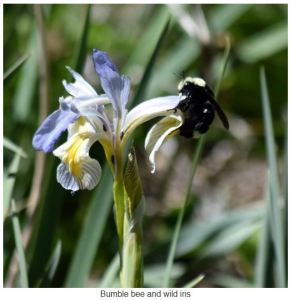
Wild Iris & Bumble Bee in Iris Meadow, Mt. Piños Photo: BAGSC
At road’s end next to Iris Meadow several dozen cars were parked. We wandered over to the meadow and found a small number of blooming Irises scattered over the meadow. Most had gone to seed but bees and bumblebees were still as busy as…well, you know what. There were not a lot of birds around despite the relatively early 8:30 am hour. The first bird we spotted was a Townsend’s Solitaire at meadow’s edge in a conifer, a rear view which kept us stumped for a while as the important field marks are visible only from the side or front. Still, there was something solitaire-ish about it – mostly that long tail and innocent bluebird-like facial expression. Then we all finally saw the eye-ring and orangish wing patch.
Solitaires are aptly named, as you rarely see more than one at a time. They’re one of those species that makes you wonder how they reproduce – binary fission, perhaps.
After that we had a group of four identical brown-gray birds busily gleaning small gray-winged insects from the cracks in a conifer’s gray bark. They turned out to be a group of young Brown-headed Cowbirds with nary a head of brown. As cowbirds are hatched and raised by birds of other species (aka obligate nest-parasitism), their parents never show them how to “make their way in the world.” Obviously they figure it all out themselves quite quickly.
This was followed by more Dark-eyed Juncos, which prompted a discussion of the many subspecies and ranges of this bird. These were all “Oregon” Juncos, the breeding subspecies in our area. It’s almost entirely during winter that other subspecies might drop in. If you ever want to while away a few hours sorting out 5-6-7?…however many subspecies of DE Junco there are – I highly recommend the bottom of Cave Creek Canyon in SE Arizona in January. There’s a fine lodge with good food there and lots of birds and I’m fairly confident that every subspecies of DE Junco is there, plus the special bonus of the Yellow-eyed Junco, a Mexican bird at the north end of its range. [Now we return you to our regularly scheduled field trip report.]

Liz saw a Green-tailed Towhee near the meadow. (J. Waterman 6-10-17)
House Wrens popped out of the bushes. We headed past the campground (bathrooms!) which was full of a camping contingent of Bakersfieldians, where we were buttonholed by a girl who looked about 10 or 13 who wondered if we were “birdwatchers,” which we admitted was true. We discussed birds likely to be seen around the meadow and I showed her pictures in my field guide (one of the main reasons I carry one).
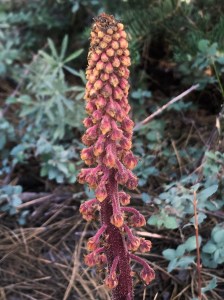
Woodland Pinedrops (Pterospora andromedea). Photo: Leptonia Source: iNaturalist
One of the most interesting things we saw was a plant called Pinedrops. Although some people think it a chlorophyll-lacking saphrophyte which gets its sustenance from sucking the nutrients out of dead matter, it’s actually a chlorophyll-lacking mycoheterotroph which feeds on the fungi that grow intertwined with the roots of a conifer. It’s in subfamily Monotropoideae of the heath (or heather) family Ericaceae. It’s widespread across Canada and the western and northeastern U.S. to Mexico.
I <snipped> the map below from iNaturalist–Alister Caddy for the plant Woodland Pinedrops Pterospora andromedea. This is closely related to the Snow Plant Sarcodes sanguinea which we’ve also seen on Mt. Piños and nearby Mt. Abel and another member of the Heath family Ericaceae. The plant, which had two or three tall stems, each looking very much like this photograph, was within 100 yds. of the two red spots just north of Mt. Piños Nordic Base on the map below.


Snow Plant for comparison, Mt. Piños (Roxy Seidner 6-9-18)
We continued downhill on this trail looking for blooming flowers upon which Calliope Hummingbirds might feed. Alas, the currents where – when I find Calliopes at all, which is not often – they are usually feeding, were no longer in bloom.

Lodgepole Chipmunk, Mt. Piños (Dan Seidner 6-9-18)
Finding a chipmunk but few birds, we returned to the meadow, crossed through the dark green flower leaves and went to the trail on the other side. At the juncture where you either go uphill, go downhill or back to the parking lot, we discovered none of us wanted to go uphill, so downhill we went. I pointed out that when hiking in the mountains, “what goes down must come up,” but we continued anyway. Here we added a few birds and found some butterflies patronizing the flowers, a few whites too lively to view, a Sulphur which Trevor identified and a Checkerspot, unidentified. By this time lunch sounded good. We decided to drive halfway back downhill to McGill Campground, as the meadowside Chula Vista walk-in campground picnic tables were fully occupied.

Variable or Chalcedon Checkerspot male, Euphydryas chalcedona; flower probably Eriodictyon crassifolia, Mt. Piños (Grace Murayama 6-9-18)
At McGill we commandeered a reserved campsite nicely shaded by trees and surrounded by bushes and needle-covered ground, calculating (correctly, we learned) that the reserverer would not appear within the hour it might take us to eat (shoots and leaves). McGill is often birdier than the environs of Iris Meadow, and I think that remained true. While we ate and discussed odds and ends and in-betweens a few more birds came and went: more Townsend’s Solitaires, all looking a bit youngish, equally young-looking Cassin’s Finches and one Purple Finch, An adult male White-headed Woodpecker, a Western Wood-Pewee, Anna’s Hummingbird, Western Bluebird, Steller’s Jays, More Juncos, a few youngish Fox Sparrows, Yellow-rumped and Orange-crowned Warblers, and some Ravens cruising by.
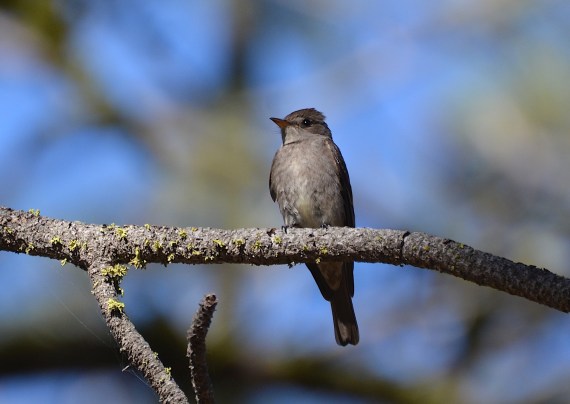
Western Wood-Pewee, partially vested. Mt. Piños (Grace Murayama 6-9-18)
When we got back to the bottom of the mountain we found the temperature had risen well into the 90’s.
In case you’re wondering why all the different dates for photographs, I didn’t receive any usable photos this trip so I substituted a few from prior trips. Thanks to those photographers.
The following birds were seen on Mt. Piños on the listed trips, not including the parking triangle and Mt. Abel locations. “X” records presence, number not counted.
| Trip List | 2011 | 2016 | 2017 | 2018 | 2024 |
| Species | Jun 18 | Jun 11 | Jun 10 | Jun 9 | Jul 20 |
| Mountain Quail | 2 | ||||
| California Quail | 2 | ||||
| Band-tailed Pigeon | 12 | X | 2 | 1 | |
| Eurasian Collared-Dove | 1 | ||||
| Mourning Dove | 8 | 2 | 2 | ||
| Black-chinned Hummingbird | 1 | ||||
| Anna’s Hummingbird | 1 | ||||
| Black-chinned Hummingbird | |||||
| Red-tailed Hawk | X | 1 | |||
| Downy Woodpecker | 1 | ||||
| Hairy Woodpecker | 1 | ||||
| White-headed Woodpecker | 2 | X | 1 | 3 | 1 |
| Northern Flicker | 2 | ||||
| Olive-sided Flycatcher | 1 | ||||
| Western Wood-Pewee | 10 | X | 5 | 4 | 1 |
| Steller’s Jay | 12 | X | 8 | 4 | 6 |
| Clark’s Nutcracker | X | 1 | |||
| Common Raven | 4 | 37 | 5 | 5 | |
| Violet-green Swallow | 30 | X | 26 | 18 | 1 |
| Mountain Chickadee | 7 | 19 | 2 | 5 | |
| Red-breasted Nuthatch | 4 | 1 | 1 | ||
| White-breasted Nuthatch | 4 | 4 | 1 | ||
| Pygmy Nuthatch | 15 | X | 7 | 15 | 1 |
| Brown Creeper | 1 | 1 | 1 | ||
| Bewick’s Wren | 1 | ||||
| House Wren | 15 | ||||
| Western Bluebird | 2 | X | 12 | 12 | 3 |
| Townsend’s Solitaire | 5 | ||||
| American Robin | 1 | X | 5 | 1 | |
| Purple Finch | 4 | X | 2 | 3 | 2 |
| Cassin’s Finch | 10 | 4 | 12 | ||
| Green-tailed Towhee | 4 | X | 7 | 2 | 1 |
| Spotted Towhee | 2 | 1 | |||
| Chipping Sparrow | 18 | X | 6 | 16 | |
| Fox Sparrow | 6 | X | 10 | 5 | 3 |
| Dark-eyed Junco | 2 | X | 5 | 8 | 15 |
| Brown-headed Cowbird | 1 | 10 | |||
| Orange-crowned Warbler | 2 | 1 | 6 | ||
| Yellow-rumped Warbler | 1 | 1 | 2 | ||
| Lazuli Bunting | X | 2 | |||
| Totals – 40 | 23 | 16 | 28 | 24 | 22 |
Shorebirds are returning: Malibu Lagoon, 28 July 2024
[Text by Chuck Almdale; photos by Marie Barnidge-McIntyre, Marsha Collins & Grace Murayama]
Don’t miss the quiz at the bottom.
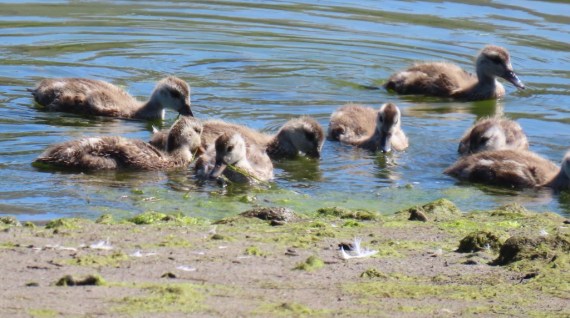
I find it difficult telling duckling Gadwalls from Mallards. Adult females are easier, so when I see a batch of ducklings I assign them to the species of the accompanying female(s). There’s no adult female in this picture but a close look at the bills makes me think they’re Gadwall, as the bills seem dark with a hint of orange/yellow around the edges, which the adult females tend to have. I’ve been sorting them on this theory for quite a while. My records show that up until 2017 Mallards outnumbered Gadwalls as summer breeders, in 2018-2019 they were about even, and since then the Gadwall have become relatively more numerous. This year Gadwall outnumbered Mallard two-to-one.
The photo below was taken on Thursday, but the weather looked the same on Sunday, loads of blue sky. The weather report claimed there would be 90% cloud cover, keeping the temperature down into the high 60s. What we had was blue sky and nice waves. It was also hot.
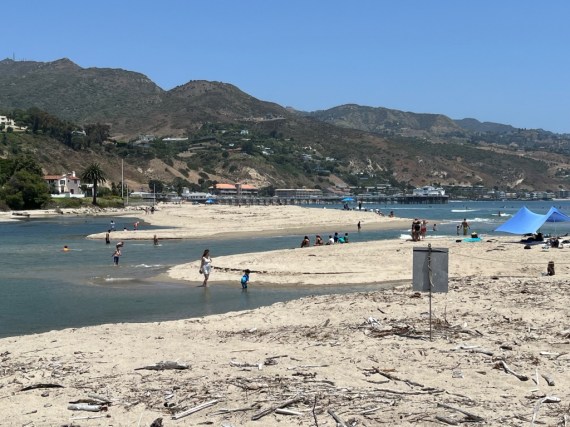
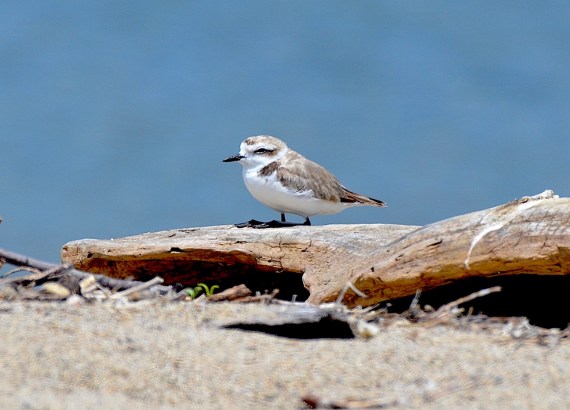
In the foreground is the back of a Snowy Plover “virtual enclosure” sign. People mostly pay attention to this encouragement to stay out of the area which borders the lagoon. Unfortunately the Snowy Plovers can’t read so they can be anywhere and usually are. But this time – to our great surprise – the six we found were well within the rope “fence,” running around through the abundant driftwood. I think the beach looks a lot better with driftwood on it.
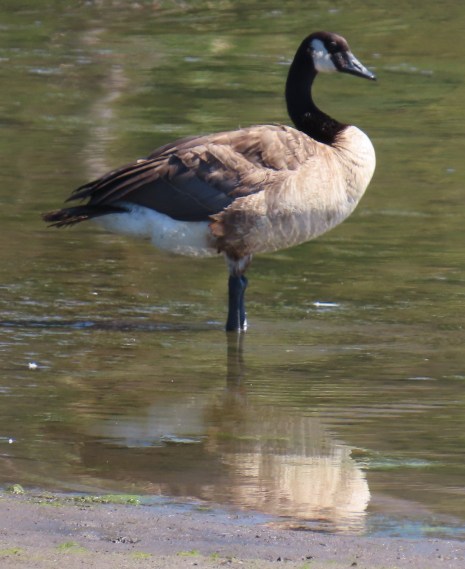
The Canada Geese nested again this year at the lagoon, perhaps two pair. One pair now remain with two young. Everyone was flying.
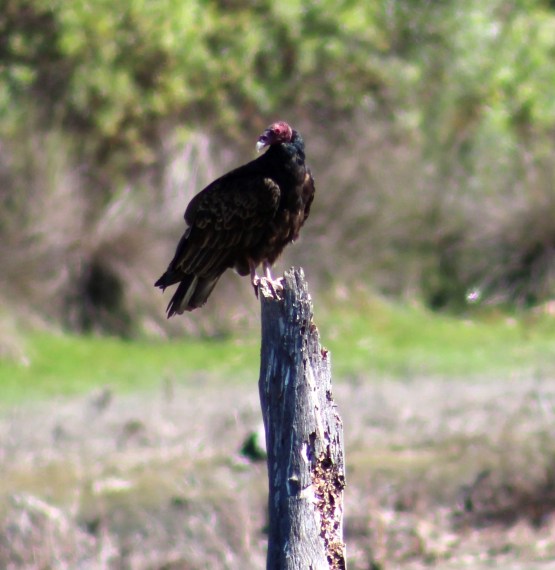
When this Turkey Vulture perched on the “Osprey Pole” someone commented, “I’ve heard that you can see right through their nose-holes side-to-side.” That’s correct and we proved it with the scope. “Why are the nostrils so large?” “Well…” I mused, “large nostrils aid in breathing, always a useful activity, but perhaps it also makes it easier to blow the dead meat out of their nose after they’ve stuck their head into a rotting corpse.” It could be true; seems reasonable to me, anyway.
There were also three additional TV’s floating over and around the lagoon. Perhaps it was due to this particular animal lying on the sand across the narrow south channel from the vulture on the pole.
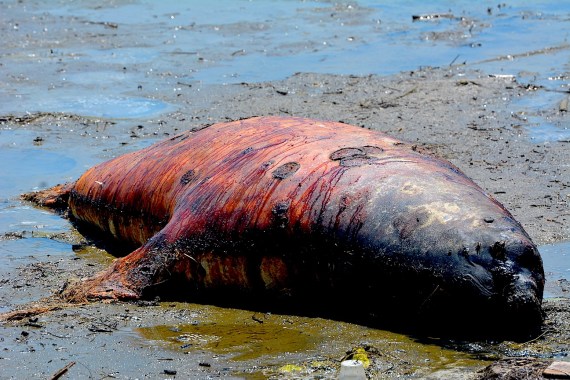
It didn’t look very good, but there was also no detectable odor which was surprising as I know it had been there for at least three days. I can’t see any ears on it in this photo, but from 30 feet away it seemed very large. California Sea Lions, which have external ear flaps, are 7-8 ft. long and weight 700-800 lbs. Harbor Seals, our other common pinniped, which have ear holes but no external ears, are much smaller, up to 6 ft. long and 300 lbs. No one knew why the back half was so red. Sunburn? Subcutaneous bleeding? Anyone care to express an opinion?
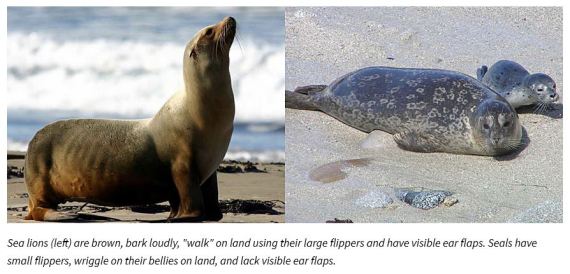
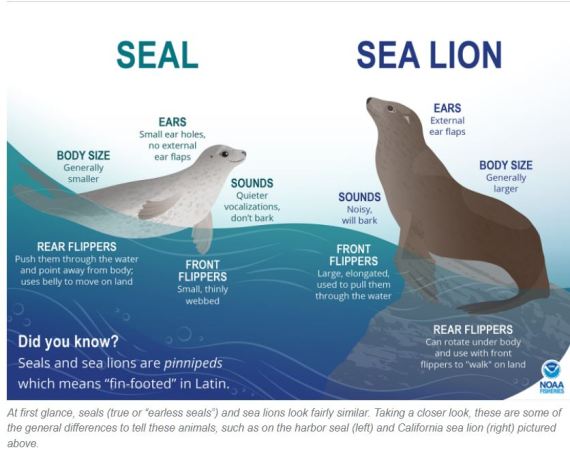
When we were there the lagoon water level was very low due to the 9:16 am low tide. It’s higher in this photo, three days earlier.

Salps must be everyone’s favorite non-human member of phylum chordata. They don’t have a backbone but otherwise are just like us! [Not really.] Wikipedia explains:
A salp (plural salps, also known colloquially as “sea grape”) is a barrel-shaped, planktonic tunicate in the family Salpidae. It moves by contracting, thereby pumping water through its gelatinous body; it is one of the most efficient examples of jet propulsion in the animal kingdom. The salp strains the pumped water through its internal feeding filters, feeding on phytoplankton.
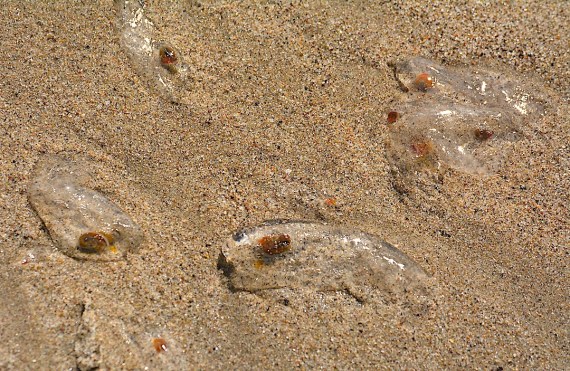
They look a lot different when they’re in the water where they belong.
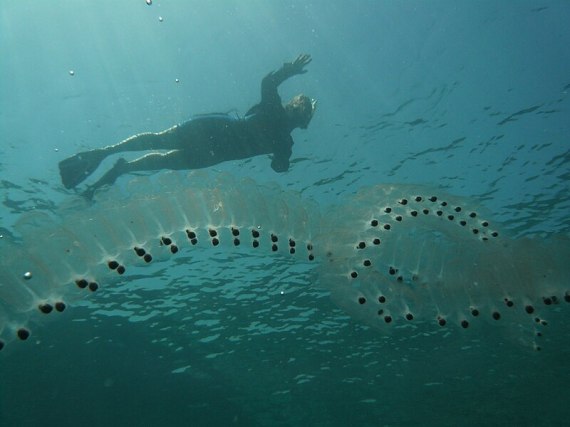
Photo: Lars Plougmann Wikipedia – Salp

Photo: Oregon Department of Fish & Wildlife Wikipedia – Salp
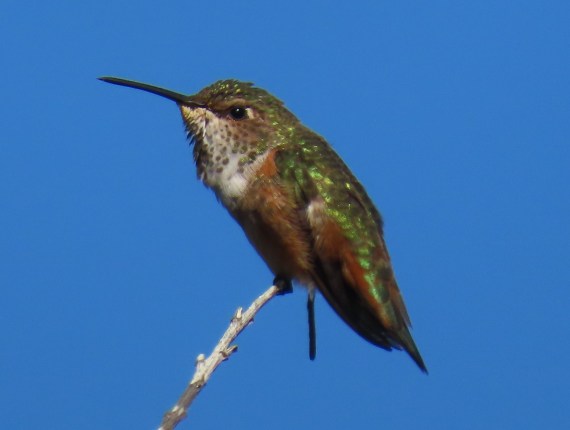
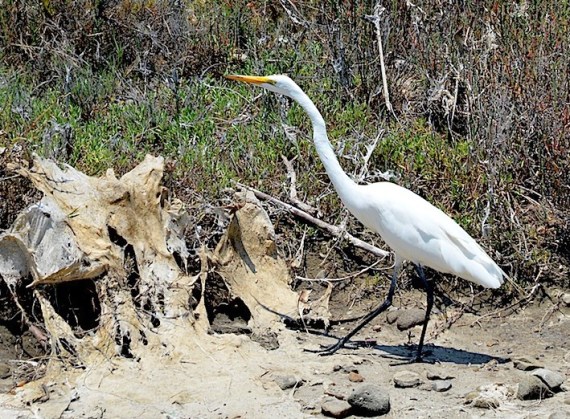
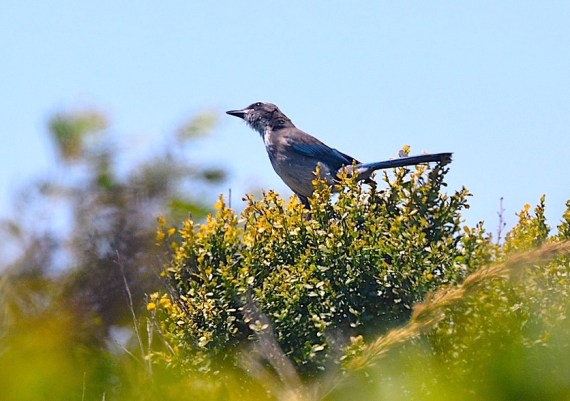
Quiz Time!


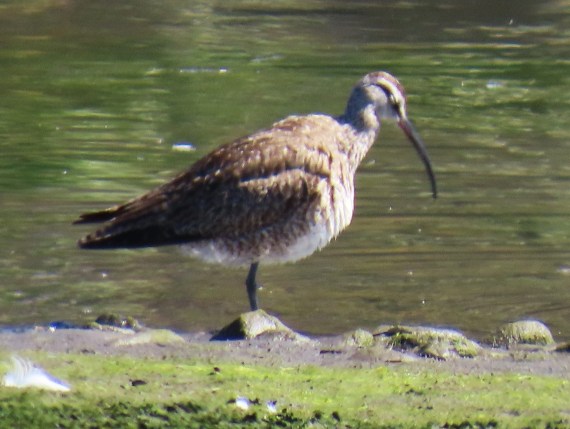
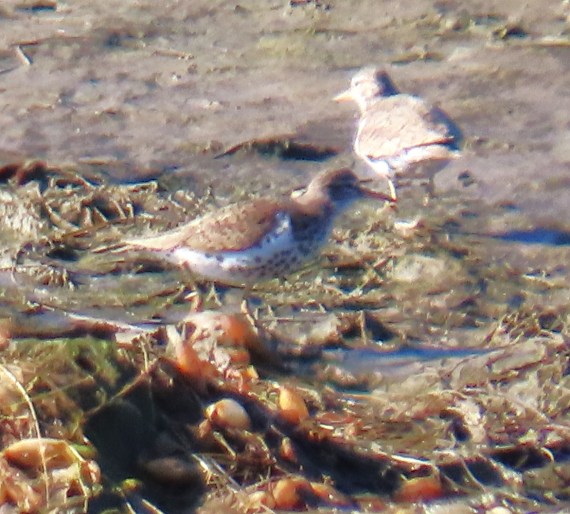

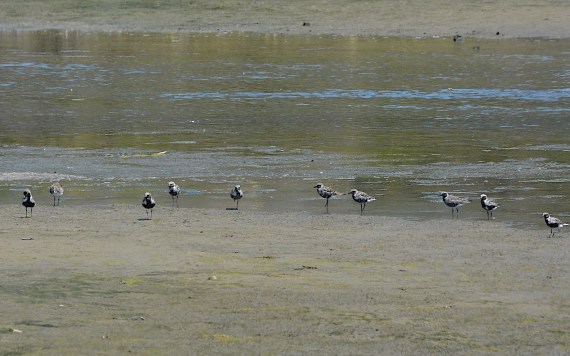
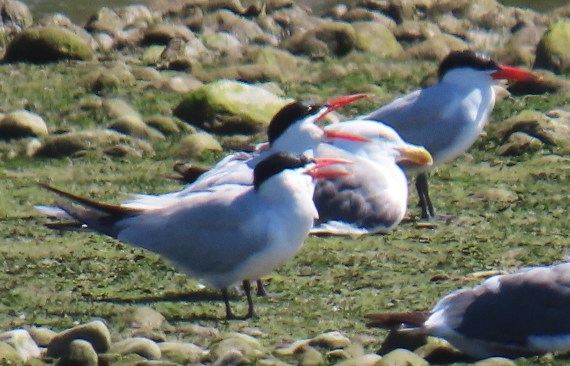
Quiz Answers & credits
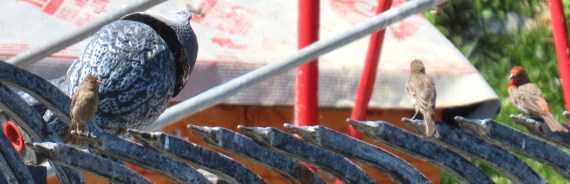
#1. American Crow (Marie Barnidge-McIntyre 7/28/24)
#2. Allen’s Hummingbird (Marie Barnidge-McIntyre 7/28/24)
#3. Great Egret (Grace Murayama 7/25/24)
#4. California Scrub-Jay (Grace Murayama 7/25/24)
#5. House Finches (Marie Barnidge-McIntyre 7/28/24)
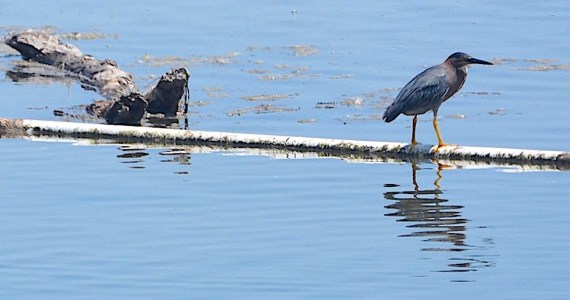
#6. Green Heron (Grace Murayama 7/25/24)
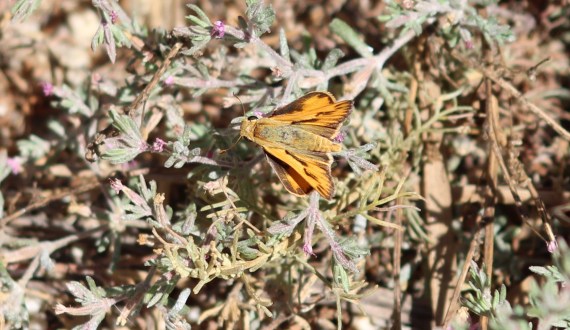
#7. Fiery Skipper Hylephila phyleus (Marsha Collins 7/28/24). Skippers have a “bulge” at the end of their antennae.
#8. Brown Pelican juveniles apparently playing (Marie Barnidge-McIntyre 7/28/24)
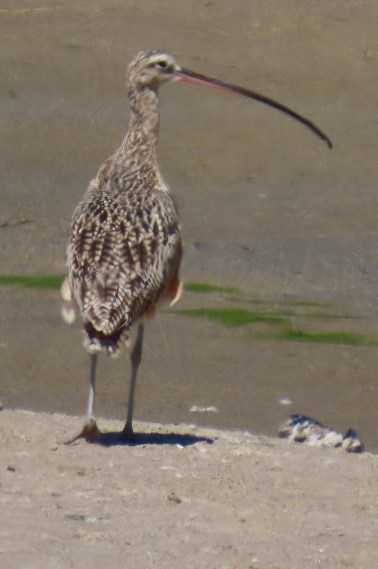
#9. Long-billed Curlew (Marie Barnidge-McIntyre 7/28/24)
#10. Whimbrel (Marie Barnidge-McIntyre 7/28/24)
#11. Spotted Sandpiper, with spots! (Marie Barnidge-McIntyre 7/28/24)
#12. Western Snowy Plover (Larry Loeher 7/25/24)
#13. Black-bellied Plovers (Grace Murayama 7/25/24)
#14. Caspian Terns & Western Gull (Marie Barnidge-McIntyre 7/28/24)
Malibu Lagoon on eBird as of 7-30-24: 7938 lists, 2545 eBirders, 320 species
Most recent species added: Red-breasted Nuthatch (31 October 2023, Kyle Te Poel).
Birds new for the season: Snowy Plover, Long-billed Curlew, Spotted Sandpiper, Western Sandpiper, Glaucous-winged Gull. “New for the season” means it has been three or more months since last recorded on our trips.
Many, many thanks to photographers: Marie Barnidge-McIntyre Marsha Collins, Larry Loeher and Grace Murayama.
Upcoming SMBAS scheduled field trips; no reservations or Covid card necessary unless specifically mentioned:
- Malibu Lagoon, Sun. Aug 25, 8:30 (adults) & 10 am (parents & kids)
- Coastal Cleanup Day Sat. Sep 21, 9 am – Noon
- Malibu Lagoon, Sun. Sep 22, 8:30 (adults) & 10 am (parents & kids)
- These and any other trips we announce for the foreseeable future will depend upon expected status of the Covid/flu/etc. pandemic at trip time. Any trip announced may be canceled shortly before trip date if it seems necessary. By now any other comments should be superfluous.
- Link to Programs & Field Trip schedule.
The next SMBAS Zoom program: To be announced, Evening Meeting, Tuesday, October 8, 2024, 7:30 p.m.
The SMBAS 10 a.m. Parent’s & Kids Birdwalk is again running. Reservations not necessary for families, but for groups (scouts, etc.), call Jean (213-522-0062).
Links: Unusual birds at Malibu Lagoon
9/23/02 Aerial photo of Malibu Lagoon
More recent aerial photo
Prior checklists:
2023: Jan-June, July-Dec 2024: Jan-June
2021: Jan-July, July-Dec 2022: Jan-June, July-Dec
2020: Jan-July, July-Dec 2019: Jan-June, July-Dec
2018: Jan-June, July-Dec 2017: Jan-June, July-Dec
2016: Jan-June, July-Dec 2015: Jan-May, July-Dec
2014: Jan-July, July-Dec 2013: Jan-June, July-Dec
2012: Jan-June, July-Dec 2011: Jan-June, July-Dec
2010: Jan-June, July-Dec 2009: Jan-June, July-Dec
The 10-year comparison summaries created during the Lagoon Reconfiguration Project period, remain available—despite numerous complaints—on our Lagoon Project Bird Census Page. Very briefly summarized, the results unexpectedly indicate that avian species diversification and numbers improved slightly during the restoration period June’12-June’14.
Many thanks to Marie Barnidge-McIntyre, Femi Faminu, Lillian Johnson & others for their contributions to this month’s checklist.
The species lists below is irregularly re-sequenced to agree with the California Bird Records Committee Official California Checklist. If part of the right side of the chart below is hidden, there’s a slider button inconveniently located at the bottom end of the list. The numbers 1-9 left of the species names are keyed to the nine categories of birds at the bottom.
[Chuck Almdale]
| Malibu Census 2024 | 2/25 | 3/24 | 4/28 | 5/26 | 6/23 | 7/28 | |
| Temperature | 51-62 | 46-54 | 62-72 | 57-64 | 62-72 | 63-72 | |
| Tide Lo/Hi Height | H+5.06 | H+4.71 | L-0.14 | L-0.77 | L-1.17 | L+1.81 | |
| Tide Time | 0921 | 0936 | 0738 | 0635 | 0537 | 0916 | |
| 1 | Brant (Black) | 2 | |||||
| 1 | Canada Goose | 9 | 7 | 6 | 8 | 9 | 4 |
| 1 | Cinnamon Teal | 2 | |||||
| 1 | Northern Shoveler | 4 | 2 | ||||
| 1 | Gadwall | 40 | 24 | 20 | 22 | 35 | 27 |
| 1 | American Wigeon | 4 | |||||
| 1 | Mallard | 35 | 12 | 10 | 14 | 15 | 6 |
| 1 | Green-winged Teal | 25 | 4 | ||||
| 1 | Surf Scoter | 32 | 6 | 4 | |||
| 1 | Long-tailed Duck | 1 | |||||
| 1 | Red-breasted Merganser | 2 | 9 | 4 | 2 | ||
| 1 | Ruddy Duck | 1 | |||||
| 2 | Pied-billed Grebe | 1 | 1 | 1 | |||
| 2 | Western Grebe | 240 | 9 | 1 | |||
| 7 | Feral Pigeon | 4 | 2 | 5 | 3 | 6 | |
| 7 | Eurasian Collared-Dove | 1 | |||||
| 7 | Mourning Dove | 4 | 2 | 5 | 2 | ||
| 8 | Anna’s Hummingbird | 1 | 2 | 2 | 2 | 1 | |
| 8 | Allen’s Hummingbird | 5 | 5 | 1 | 5 | 1 | 2 |
| 2 | American Coot | 46 | 63 | 1 | |||
| 5 | Black-necked Stilt | 2 | |||||
| 5 | Black Oystercatcher | 4 | |||||
| 5 | Black-bellied Plover | 42 | 3 | 1 | 51 | ||
| 5 | Killdeer | 12 | 3 | 6 | 4 | 3 | 12 |
| 5 | Semipalmated Plover | 9 | |||||
| 5 | Snowy Plover | 21 | 20 | 6 | |||
| 5 | Whimbrel | 6 | 39 | 4 | 2 | 52 | |
| 5 | Long-billed Curlew | 1 | |||||
| 5 | Marbled Godwit | 20 | 20 | ||||
| 5 | Wilson’s Phalarope | 1 | |||||
| 5 | Spotted Sandpiper | 1 | 2 | ||||
| 5 | Willet | 15 | 4 | 2 | 2 | 9 | |
| 5 | Greater Yellowlegs | 1 | |||||
| 5 | Ruddy Turnstone | 2 | |||||
| 5 | Sanderling | 10 | |||||
| 5 | Least Sandpiper | 20 | 12 | 2 | |||
| 5 | Western Sandpiper | 8 | 20 | 6 | |||
| 6 | Bonaparte’s Gull | 2 | 10 | ||||
| 6 | Heermann’s Gull | 60 | 16 | 6 | 65 | 42 | |
| 6 | Ring-billed Gull | 200 | 18 | 4 | 3 | ||
| 6 | Western Gull | 85 | 58 | 16 | 45 | 160 | 220 |
| 6 | Herring Gull | 3 | |||||
| 6 | California Gull | 400 | 170 | 60 | 38 | 3 | 10 |
| 6 | Glaucous-winged Gull | 3 | 1 | 1 | |||
| 6 | Caspian Tern | 2 | 20 | 8 | 14 | ||
| 6 | Forster’s Tern | 1 | |||||
| 6 | Elegant Tern | 200 | 190 | 25 | 240 | ||
| 6 | Royal Tern | 4 | 60 | 2 | |||
| 2 | Red-throated Loon | 1 | 2 | ||||
| 2 | Pacific Loon | 1 | |||||
| 2 | Common Loon | 1 | |||||
| 2 | Brandt’s Cormorant | 1 | 1 | 35 | |||
| 2 | Pelagic Cormorant | 4 | 1 | 1 | 4 | ||
| 2 | Double-crested Cormorant | 28 | 32 | 26 | 120 | 24 | 28 |
| 2 | Brown Pelican | 300 | 171 | 235 | 348 | 125 | 163 |
| 3 | Black-crowned Night Heron | 1 | 1 | 2 | 1 | ||
| 3 | Snowy Egret | 6 | 3 | 3 | 2 | 7 | 4 |
| 3 | Green Heron | 1 | 1 | ||||
| 3 | Great Egret | 5 | 4 | 9 | 3 | ||
| 3 | Great Blue Heron | 3 | 1 | 4 | 3 | 3 | |
| 4 | Turkey Vulture | 1 | 4 | ||||
| 4 | Osprey | 1 | |||||
| 4 | Red-shouldered Hawk | 1 | |||||
| 8 | Belted Kingfisher | 2 | |||||
| 8 | Nuttall’s Woodpecker | 1 | |||||
| 9 | Black Phoebe | 4 | 2 | 4 | 7 | 3 | 6 |
| 9 | Cassin’s Kingbird | 1 | 4 | ||||
| 9 | Warbling Vireo | 1 | |||||
| 9 | California Scrub-Jay | 2 | 2 | 1 | |||
| 9 | American Crow | 10 | 4 | 3 | 4 | 6 | 4 |
| 9 | Common Raven | 1 | 2 | 3 | |||
| 9 | Tree Swallow | 1 | 3 | ||||
| 9 | Violet-green Swallow | 2 | 8 | ||||
| 9 | No. Rough-winged Swallow | 5 | 5 | 2 | 5 | ||
| 9 | Barn Swallow | 10 | 10 | 20 | 20 | 20 | |
| 9 | Cliff Swallow | 30 | 6 | ||||
| 9 | Bushtit | 12 | 2 | 2 | 5 | 9 | 19 |
| 9 | Wrentit | 2 | 2 | 1 | |||
| 9 | Blue-gray Gnatcatcher | 1 | 1 | ||||
| 9 | House Wren | 1 | 1 | ||||
| 9 | European Starling | 19 | 5 | ||||
| 9 | Scaly-breasted Munia | 1 | |||||
| 9 | House Finch | 12 | 15 | 10 | 15 | 11 | 12 |
| 9 | Lesser Goldfinch | 20 | 20 | 2 | 5 | 2 | |
| 9 | Dark-eyed Junco | 2 | |||||
| 9 | White-crowned Sparrow | 12 | 15 | ||||
| 9 | Song Sparrow | 10 | 14 | 10 | 5 | 5 | 4 |
| 9 | California Towhee | 2 | 1 | 1 | 4 | 4 | 1 |
| 9 | Spotted Towhee | 1 | 1 | ||||
| 9 | Hooded Oriole | 1 | 1 | ||||
| 9 | Red-winged Blackbird | 35 | 4 | 11 | |||
| 9 | Brown-headed Cowbird | 2 | |||||
| 9 | Great-tailed Grackle | 1 | 3 | 2 | 3 | 3 | |
| 9 | Orange-crowned Warbler | 2 | 1 | 1 | 1 | ||
| 9 | Common Yellowthroat | 2 | 2 | 1 | |||
| 9 | Yellow-rumped Warbler (Aud) | 10 | 4 | ||||
| Totals by Type | Feb | Mar | Apr | May | Jun | Jul | |
| 1 | Waterfowl | 144 | 72 | 45 | 50 | 59 | 37 |
| 2 | Water Birds – Other | 621 | 268 | 263 | 516 | 155 | 192 |
| 3 | Herons, Egrets & Ibis | 9 | 4 | 13 | 7 | 22 | 12 |
| 4 | Quail & Raptors | 0 | 1 | 1 | 1 | 0 | 4 |
| 5 | Shorebirds | 156 | 123 | 29 | 6 | 9 | 139 |
| 6 | Gulls & Terns | 748 | 272 | 362 | 302 | 254 | 527 |
| 7 | Doves | 9 | 2 | 0 | 7 | 8 | 8 |
| 8 | Other Non-Passerines | 8 | 7 | 3 | 8 | 2 | 2 |
| 9 | Passerines | 158 | 115 | 57 | 118 | 92 | 70 |
| Totals Birds | 1853 | 864 | 773 | 1015 | 601 | 991 | |
| Total Species | Feb | Mar | Apr | May | Jun | Jul | |
| 1 | Waterfowl | 7 | 9 | 6 | 6 | 3 | 3 |
| 2 | Water Birds – Other | 8 | 5 | 3 | 8 | 5 | 3 |
| 3 | Herons, Egrets & Ibis | 2 | 2 | 4 | 3 | 5 | 5 |
| 4 | Quail & Raptors | 0 | 1 | 1 | 1 | 0 | 1 |
| 5 | Shorebirds | 10 | 8 | 8 | 2 | 5 | 8 |
| 6 | Gulls & Terns | 5 | 8 | 7 | 8 | 5 | 6 |
| 7 | Doves | 3 | 1 | 0 | 2 | 2 | 2 |
| 8 | Other Non-Passerines | 3 | 2 | 2 | 3 | 2 | 1 |
| 9 | Passerines | 19 | 22 | 14 | 19 | 17 | 9 |
| Totals Species – 96 | 57 | 58 | 45 | 52 | 44 | 38 |
Checklist Changes | AOS 65th Supplement
[Posted by Chuck Almdale]
The annual August American Ornithological Society (AOS) list of checklist changes is out. If you bird in North America (which still includes both California and Los Angeles) and keep a bird list of any sort, you should check out the checklist. Here’s a few of the pertinent-to-us changes, thanks to Greg Schechter:
- Brown Booby split into Cocos Booby and Brown Booby
- Cattle Egret split New World and Old World
- Audubon’s Shearwater split into 4 species
- Night-Herons lose the hyphen
- Barn Owl Split New World and Old World
- House Wren split into 7 species, but USA has only one of them
- Three Redpolls are now one species
- Scientific name changes in genus
- Wilson’s, Mountain and Snowy Plovers
- Least Bittern
- Cattle Egret
- Brown Jay
Bird guide Greg Schechter (his natural history channel) does a great 4-minute YouTube video, complete with pictures and range maps, on the USA changes.
Link to the entire 65th supplement journal article.
Boom! | NASA

Tricolored Heron at Malibu Lagoon
[Posted by Chuck Almdale, Photos by Femi Faminu & Chris Tosdevin]
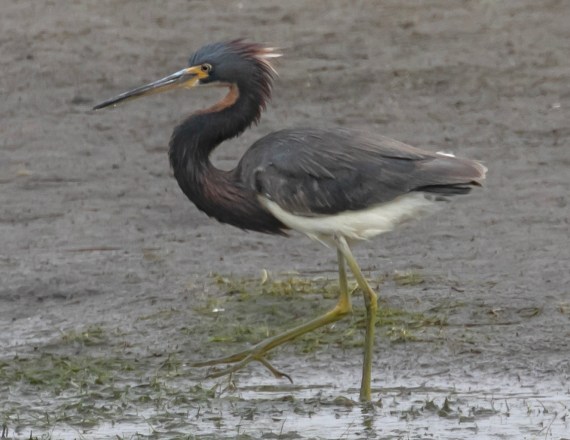
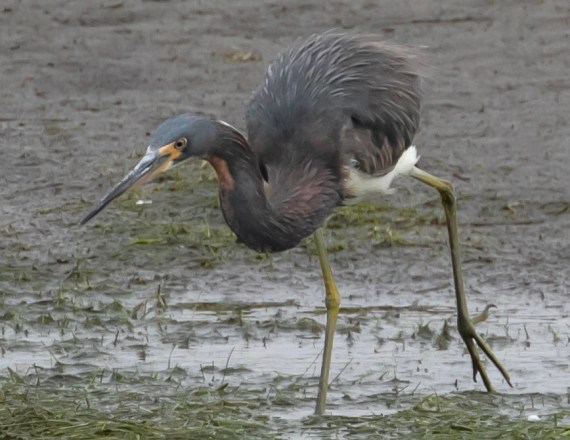
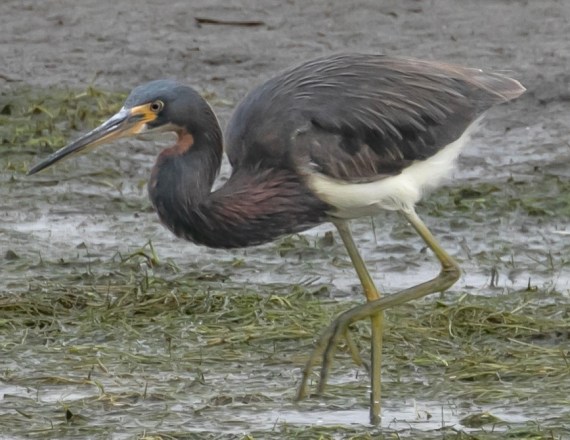
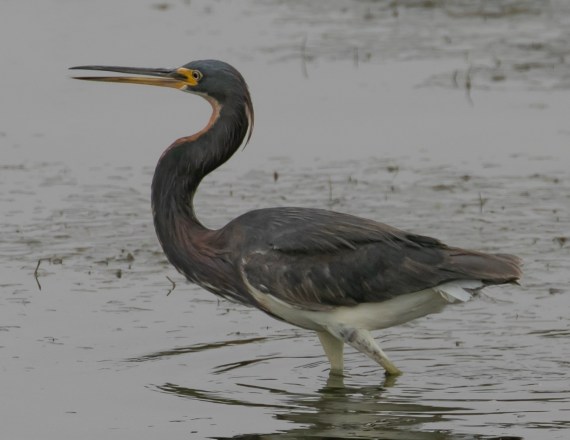
You don’t see these very often in SoCal. I’ve never had one at the Lagoon. This Tricolored Heron (Egretta tricolor) has been at the lagoon July 11-12. So far. It used to be called the Louisiana Heron. I’ve read that the name was changed for being misleading: as the bird’s range along coastal marshes goes well down into northern South America, north to New Jersey and west to Baja California. Guess where this one probably came from.
As you look at these photos, see if you can develop a feeling for what this bird’s size is: small, medium, large, 46″, 39″, 30″, 26″, 24″, 20″ (heron/egret sizes from National Geographic Field Guide to Birds of North America.)


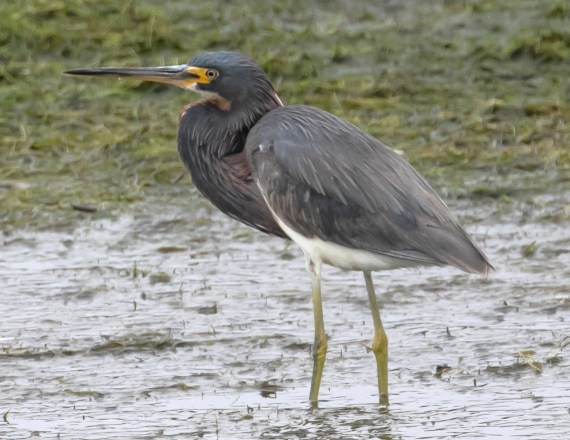


OK, before you continue downward, what size, if any, did you decide?
Below you’ll see a comparison to Great Egret.
X
X
X
X
X
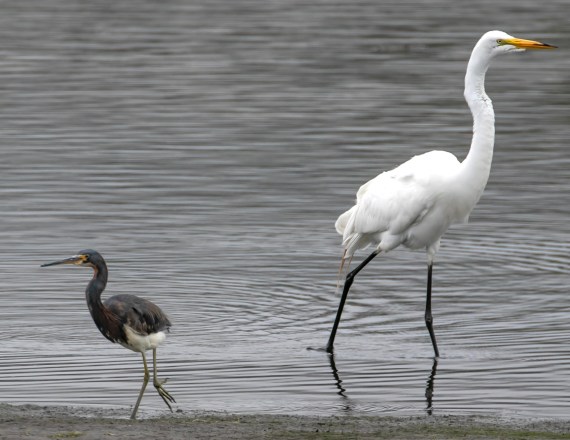
If you were far wrong on your guess, congratulations!
You’ve just experienced first-hand how easy it is to misjudge the size of a solitary bird.
Never forget that.



 SANTA MONICA BAY AUDUBON SOCIETY BLOG