Free email delivery
Please sign up for email delivery in the subscription area to the right.
No salesman will call, at least not from us. Maybe from someone else.
Ducks, Loons & Terns: Malibu Lagoon, 28 Apr. 2024
[Text by Chuck Almdale; photos by Femi Faminu, Ray Juncosa & Grace Murayama]
Don’t miss the quiz at the bottom.
Brought low by a species of Coronavirus (aka common cold) I decided to stay home in bed. In my stead, Lucien Plauzoles led, and kindly showed the gathered birders several good birds (see below). I received comments of appreciation from various attendees for Lu’s guidance. Many thanks, Lu!
Banded Caspian Tern
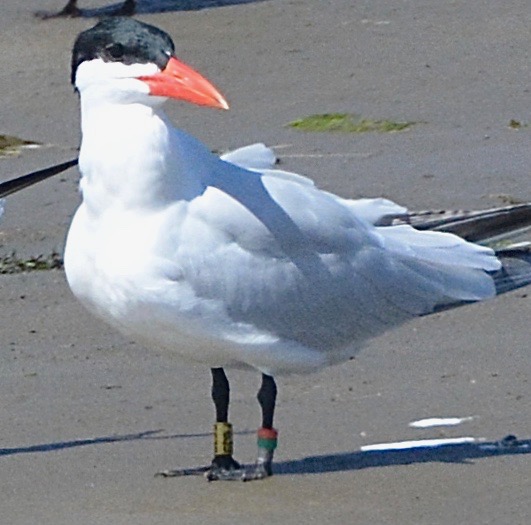
[UPDATE NOTE: On 16 May, 2024 Grace Murayama sent me what she’d discovered on the bird above. This bird (or birds, as more than one was banded) was from the Columbia River (Wash-Ore border) estuary area, apparently the largest Caspian Tern nesting site in world. The band scheme on one bird indicates it was banded in 2012 on East Sand Island. The study was performed by an Oregon State University researcher who is no longer there. The Bird Banding Lab people had no information, so Grace had to “sleuth around.” She found a retired guy at Long Beach State, who referred her to an OSU contact; both people kindly answered her many questions!]
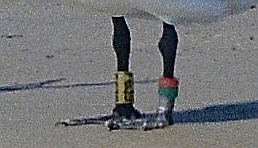
Anyone know the bird above? It’s loaded down with leg bands: left leg has orange-red over blue-green, plus something silvery below that; right leg has a large coded band that looks like it might read “CC”-something. Here’s an almost useless close-up.
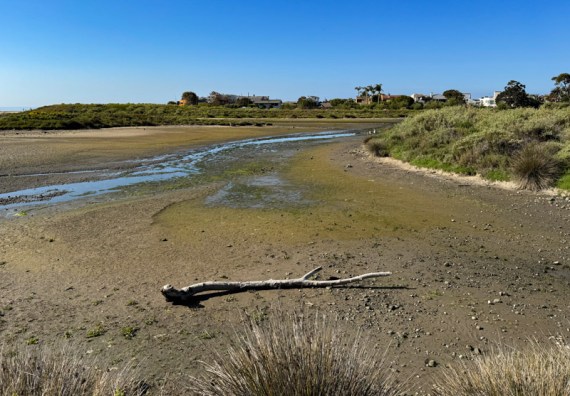
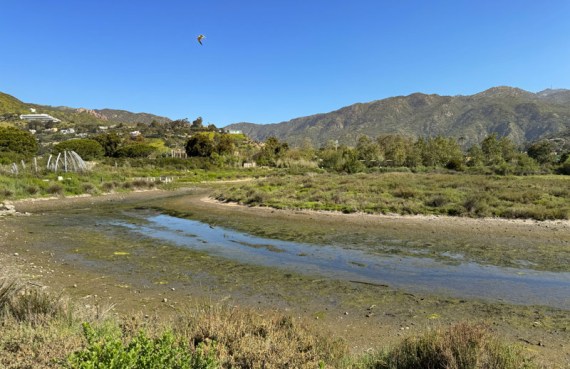
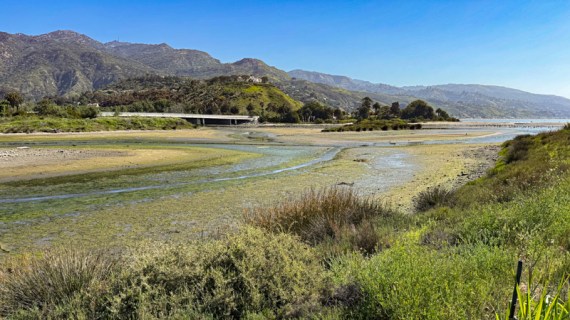
The tide was low, quite low: -0.14 ft. at 7 :38 am, with the high of +2.69 ft. at 3:02 pm. [Anything negative is really low for Malibu.] Obviously the lagoon is open to the sea or the water wouldn’t disappear like this.
Long-tailed Duck
The bird of the day and the biggest treat was the Long-tailed Duck. [Dang! I missed it!] This visitor from the far north nests primarily north of the Canadian prairie provinces and well up into the assorted Arctic islands like Baffin and around most of the coast of Greenland. The first one I ever saw was in March of 1981 flying along Ballona Creek and over the salt marsh. The next one was swimming through the melting ice in a pond near Churchill on Hudson Bay, nine years later. So you treasure the few sighting you get. It’s plumage is the color of dirty ice. 16″ long, the male’s tail (when he has it, unlike the bird below) adds another 6″. SoCal gets them regularly in the winter in very small numbers, I’d guess less than a half-dozen per winter. Has anyone ever seen two of them at the same time in SoCal? We have seen Long-tailed Duck previously in Malibu Lagoon, way back on 12/27/09 and on 1/24/10; almost certainly the same individual. When they find a place they like during the winter, they often stay a while.
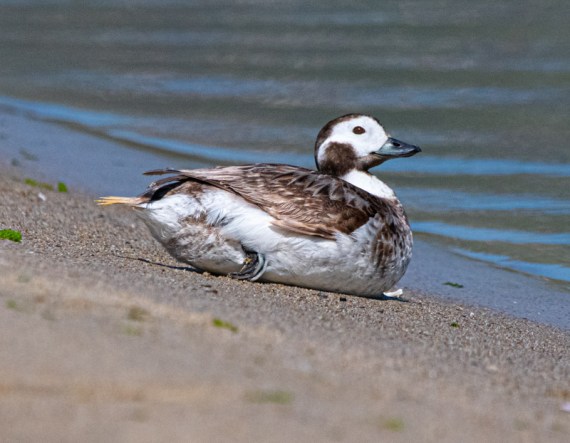
Long-tailed Duck is the only species in the genus Clangula, *from the Greek klange for “a noise or sound.” It’s prior official English name, Oldsquaw, also referred to its noisy call, apparently reminiscent of an angry old woman to many human ears. Most of its many other colloquial names also refer to its call: cockawee, coal, candlelight, old injun, old wife, noisy duck, hound, long-tailed hareld, swallow-tailed duck, south-southerly, south southerland, old granny, old molly, old Billy, John Connally, Uncle Huldy, my Aunt Huldy, cowhen, calaw, calloo, scoldenore, scolder, quandy. [Such a cacophony of common names is not uncommon, and the assortment above is a good example of why birders & ornithologists decided to standardize the English names of birds.] The Cree called it Hah-ha-way. By any name it’s a treat to see.
The Elegant Terns have returned from their wintering quarters all around Baja California. When they get up and fly around as in the photo below, it may be because one of them sighted a raptor and alerted the others. Just as likely they felt like flying for a minute or two. They’ve returned north (that’s here!) for their breeding season and they’re pretty jumpy. You would be too if your gonads suddenly swelled up to ten or twenty times their non-breeding size and started cranking out large quantities of hormones.
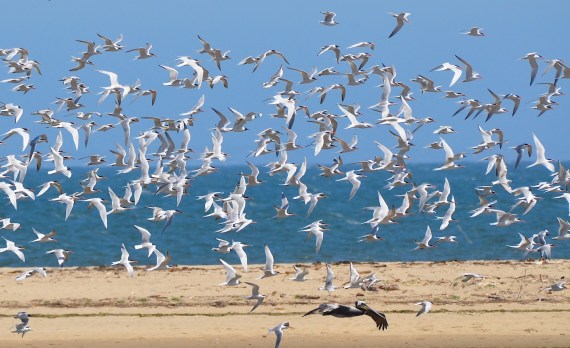
Oddly enough, when the water level goes down in one part of the lagoon or channels, it goes down in all the other channels as well. ‘Tis a mystery, having something to do with gravity.
Red-throated Loon
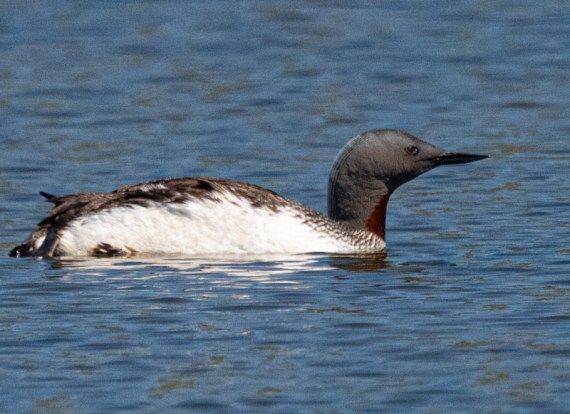
Our last special bird in a Red-throated Loon in alternate (breeding) plumage, another bird we don’t see often, at least not in breeding plumage. Since Oct 1979 we’ve seen only 40 appearances and 66 birds. They show up October – April with 65% of the birds in December, February and March. They are totally absent May – September. My first sighting at the lagoon was on 3 Mar 1980, about 4 1/2 months after I began censusing the lagoon. A bird that appeared 22 Dec 2019 mostly rested on the western lagoon shore, as did the bird below. Unfortunately I didn’t keep notes on their plumage status, but the six birds in four April appearances were likely in alternate plumage.
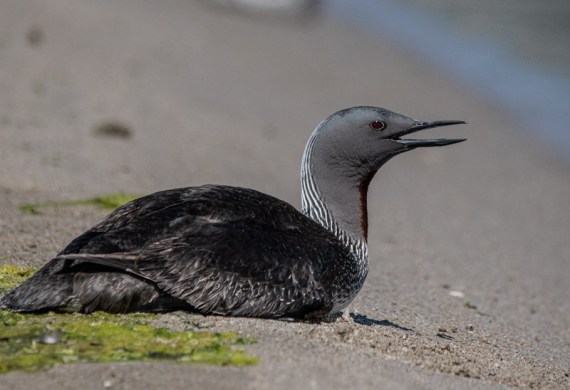
Loon legs are placed far back on their bodies, likely to maximize their ability to efficiently swim and dive, and they are very good fish chasers and catchers. As a result it is impossible (or nearly so) for them to actually walk or even waddle on land (short film), and they fall forward onto their breast more than actually walk. They typically **nest near the water’s edge, or in a small scrape on a mound built in shallow water near the shore or in a marsh. This difficulty in moving on land makes them easy prey for any fox, cat or wolf hanging around. All of this means they don’t like to go onto land and if you see one lying down on the ground other than near the nest during breeding season, it may be ill, or wounded, or exhausted.
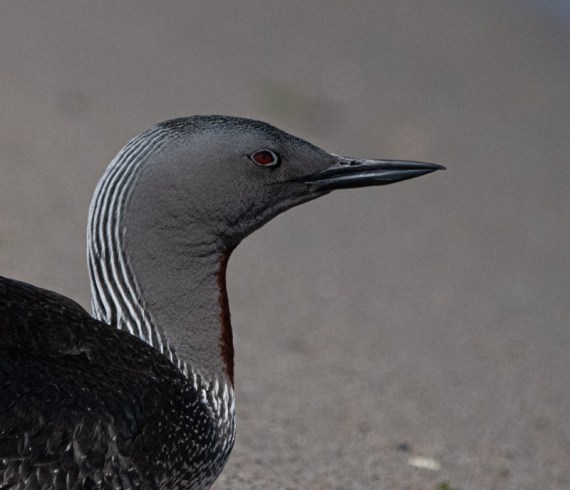
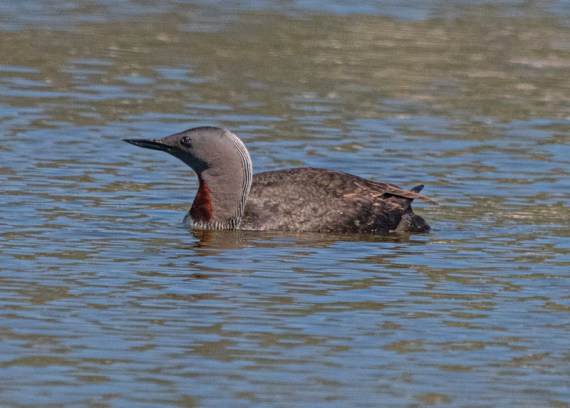
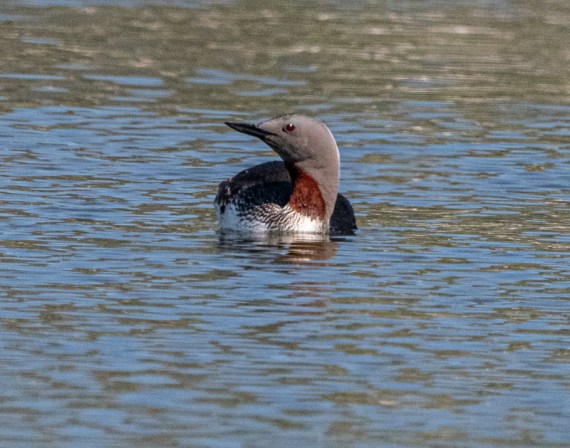
I did a color search, found this site and decided that “Barn Red” (RGB 124, 10, 2) was the named shade of red closest to the bird’s throat color. So I suggest that this bird’s name – as long as we’re busily changing bird names to reflect our most up-to-date and ephemeral judgements of descriptive nomenclature – should be changed to Barn Red (RGB124,10,2)-throated Loon. Just a suggestion, American Ornithological Society.
The Quiz
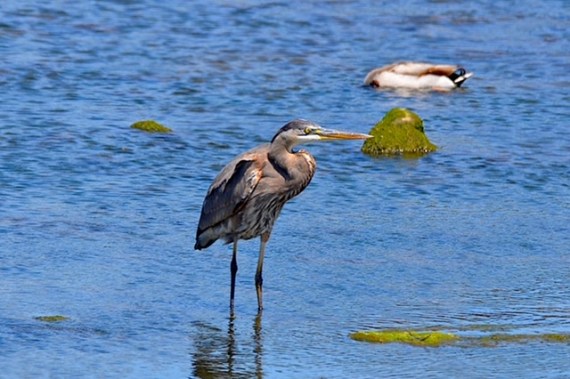
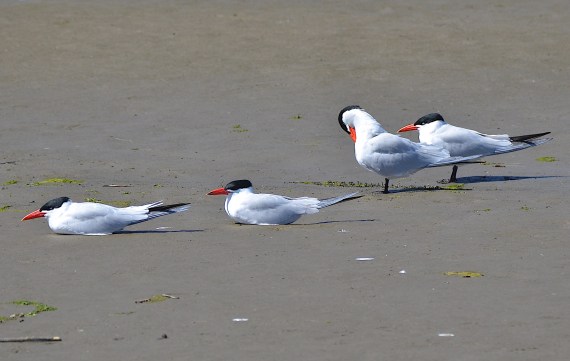
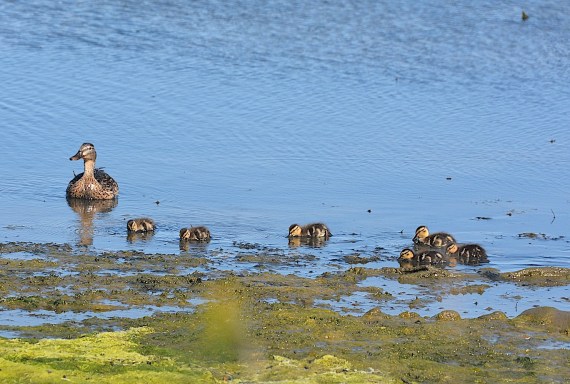
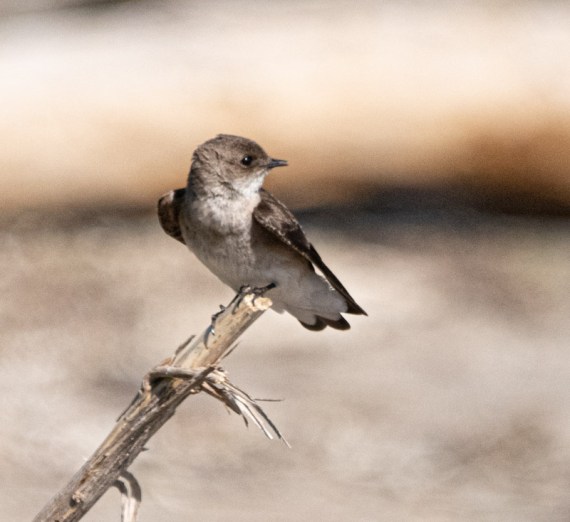
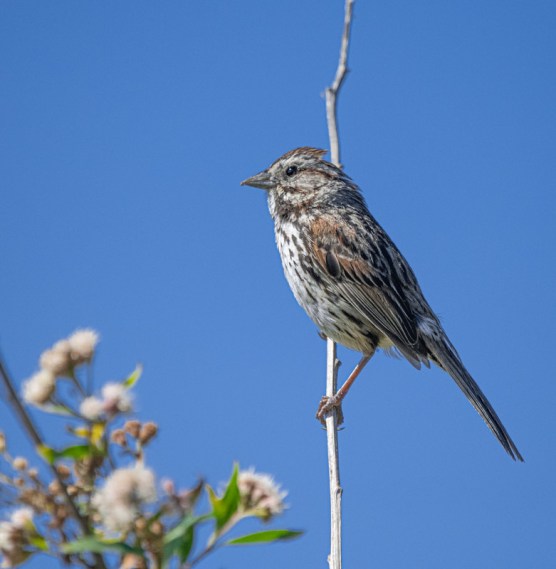
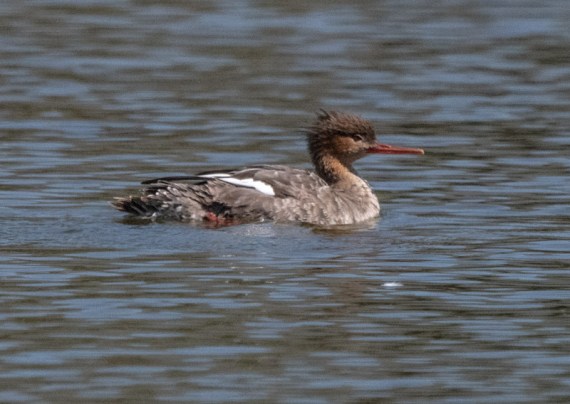
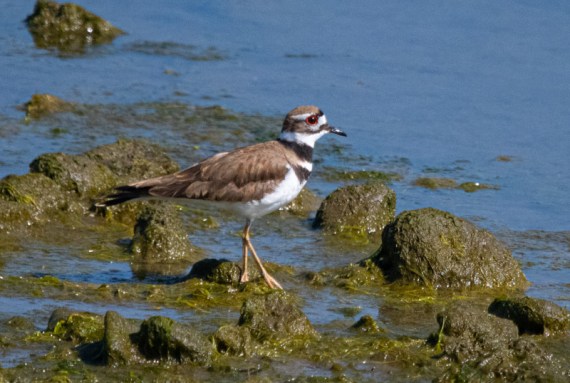
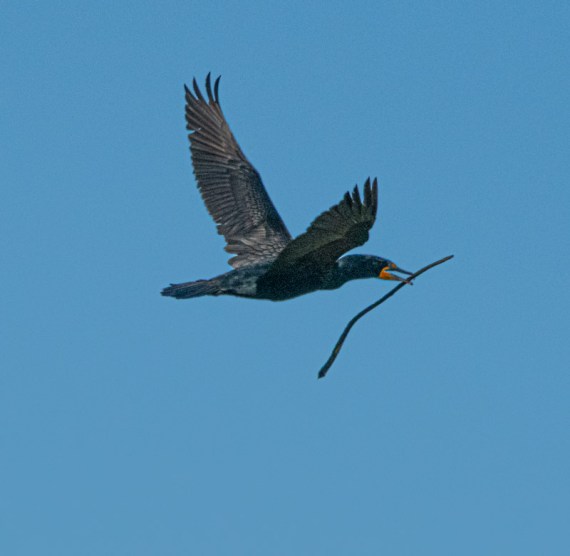
Back by popular demand! Not everything is as may first appear. In some species males look different than females. One bird is carrying a stick? Why?






Quiz Answers & credits
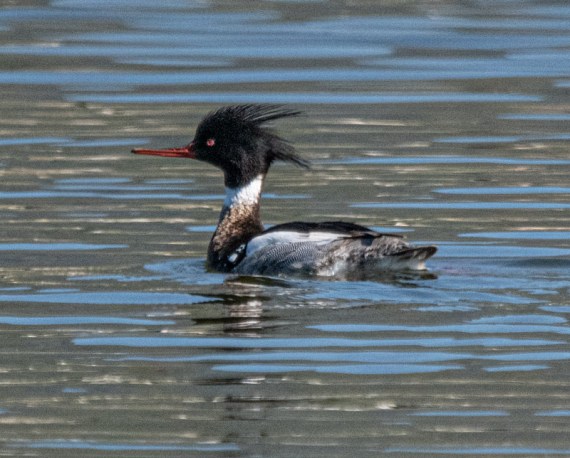
#1. Red-breasted Merganser, male (Ray Juncosa 4-28-24)
#2. Great Blue Heron (Grace Murayama 4-26-24)
#3. By-the-wind sailor, sea raft, purple sail, little sail, or simply Vellela. Velella velella is the only species in the Velella genus in the Porpitidae family of colonial hydrozoa, found worldwide. (Grace Murayama 4-26-24)
#4. Caspian Terns (Grace Murayama 4-26-24)
#5. Mallard hen & ducklings (Grace Murayama 4-26-24)
#6. Ducks flying o’er the brine, possibly Surf Scoters (Femi Faminu 4-28-24)
#7. Black Oystercatchers (Femi Faminu 4-28-24)
#8. 4 Elegant Terns & 1 Bonaparte’s Gull (Femi Faminu 4-28-24)
#9. Rough-winged Swallow (Ray Juncosa 4-28-24)
#10. Ochre-bellied Flycatcher Mionectes oleagineus, but once upon a time was called the Oleaginous Pipromorpha [one of my favorite bird names] Pipromorpha oleagineus. A movement is afoot to reinstate three Mionectes species to their Pipromorpha genus status to differentiate them from the two highland Mionectes species. (photographer unknown, Venezuela)
#11. Song Sparrow (Ray Juncosa 4-28-24)
#12. Bushtit, female has pale eye (Ray Juncosa 4-28-24)
#13. Red-breasted Merganser female (Ray Juncosa 4-28-24)
#14. Red-throated Loon has a white belly (Ray Juncosa 4-28-24)
#15. Killdeer nest on this beach (Ray Juncosa 4-28-24)
#16. Snowy Egret (Ray Juncosa 4-28-24)
#17. Double-crested Cormorant, stick is for nest (Ray Juncosa 4-28-24)
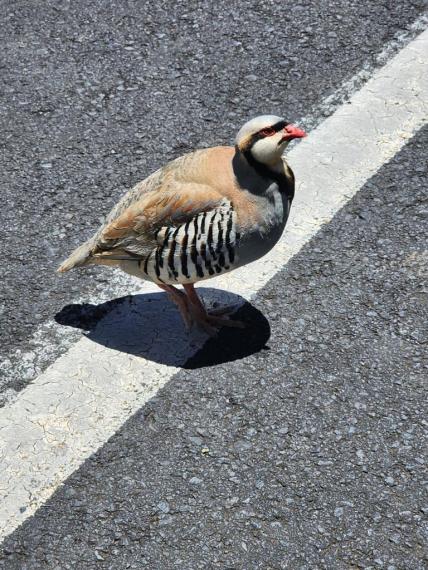
#18. Chukar in Maui, Hawaii; introduced to U.S. from Asia (Grace Murayama’s daughter), apparently stopping to contemplate just exactly why the chicken did cross the road.
Reference notes:
*Long-tailed Duck names: Choate, Ernest A.; Dictionary of American Bird Names, 1985, Harvard Common Press.
**Loon nests: Baicich, Paul J. & Harrison, Colin J.O.; Guide to the Nests, Eggs and Nestlings of North American Birds, 2nd. Ed.; 1997, AP Natural World – Academic Press.
Malibu Lagoon on eBird as of 5-03-24: 7698 lists, 319 species
Most recent species added: Red-breasted Nuthatch (31 October 2023, Kyle Te Poel).
Birds new for the season: Long-tailed Duck, Black Oystercatcher, Semipalmated Plover, Spotted Sandpiper, Greater Yellowlegs, Bonaparte’s Gull, Elegant Tern, Black-crowned Night-Heron, Great Egret, Osprey, Violet-green Swallow. “New for the season” means it has been three or more months since last recorded on our trips.
Many, many thanks to photographers: Femi Faminu, Ray Juncosa & Grace Murayama
Upcoming SMBAS scheduled field trips; no reservations or covid card necessary unless specifically mentioned:
- Malibu Creek State Park Sat May 11, 8 or 8:30 am, unless we decided creek level too high & relocate
- Malibu Lagoon, Sun. May 26, 8:30 (adults) & 10 am (parents & kids)
- Mt. Pinos Birds & Butterflies Sat 15 June 8am
- These and any other trips we announce for the foreseeable future will depend upon expected status of the Covid/flu/etc. pandemic at trip time. Any trip announced may be canceled shortly before trip date if it seems necessary. By now any other comments should be superfluous.
- Link to Programs & Field Trip schedule.
The next SMBAS Zoom program: “Red and Lilac-crowned Parrots in SoCal,” with Brenda Ramirez, Evening Meeting, Tuesday, May 7, 2024, 7:30 p.m.
The SMBAS 10 a.m. Parent’s & Kids Birdwalk is again running. Reservations not necessary for families, but for groups (scouts, etc.), call Jean (213-522-0062).
Links: Unusual birds at Malibu Lagoon
9/23/02 Aerial photo of Malibu Lagoon
More recent aerial photo
Prior checklists:
2023: Jan-June, July-Dec
2021: Jan-July, July-Dec 2022: Jan-June, July-Dec
2020: Jan-July, July-Dec 2019: Jan-June, July-Dec
2018: Jan-June, July-Dec 2017: Jan-June, July-Dec
2016: Jan-June, July-Dec 2015: Jan-May, July-Dec
2014: Jan-July, July-Dec 2013: Jan-June, July-Dec
2012: Jan-June, July-Dec 2011: Jan-June, July-Dec
2010: Jan-June, July-Dec 2009: Jan-June, July-Dec
The 10-year comparison summaries created during the Lagoon Reconfiguration Project period, remain available—despite numerous complaints—on our Lagoon Project Bird Census Page. Very briefly summarized, the results unexpectedly indicate that avian species diversification and numbers improved slightly during the restoration period June’12-June’14.
Many thanks to Lucien Plauzoles & persons unknown for their contributions to this month’s checklist.
The species lists below is irregularly re-sequenced to agree with the California Bird Records Committee Official California Checklist. If part of the right side of the chart below is hidden, there’s a slider button conveniently located at the far end of the list. The numbers 1-9 left of the species names are keyed to the nine categories of birds at the bottom.
[Chuck Almdale]
| Malibu Census 2023-24 | 11/26 | 12/24 | 1/28 | 2/25 | 3/24 | 4/28 | |
| Temperature | 62-68 | 53-64 | 53-64 | 51-62 | 46-54 | 62-72 | |
| Tide Lo/Hi Height | H+6.53 | H+6.20 | H+5.06 | H+5.06 | H+4.71 | L-0.14 | |
| Tide Time | 0740 | 0644 | 1008 | 0921 | 0936 | 0738 | |
| 1 | Canada Goose | 21 | 8 | 9 | 7 | 6 | |
| 1 | Cinnamon Teal | 3 | 1 | 3 | 2 | ||
| 1 | Northern Shoveler | 13 | 10 | 4 | |||
| 1 | Gadwall | 30 | 27 | 54 | 40 | 24 | 20 |
| 1 | American Wigeon | 5 | 14 | 4 | |||
| 1 | Mallard | 9 | 8 | 7 | 35 | 12 | 10 |
| 1 | Green-winged Teal | 31 | 8 | 17 | 25 | 4 | |
| 1 | Lesser Scaup | 1 | |||||
| 1 | Surf Scoter | 8 | 3 | 4 | 32 | 6 | 4 |
| 1 | Long-tailed Duck | 1 | |||||
| 1 | Bufflehead | 5 | 18 | 12 | |||
| 1 | Red-breasted Merganser | 20 | 5 | 4 | 2 | 9 | 4 |
| 1 | Ruddy Duck | 22 | 37 | 30 | 1 | ||
| 2 | Pied-billed Grebe | 6 | 2 | 2 | |||
| 2 | Horned Grebe | 1 | |||||
| 2 | Eared Grebe | 1 | 1 | ||||
| 2 | Western Grebe | 13 | 18 | 14 | 240 | ||
| 7 | Feral Pigeon | 4 | 4 | 4 | 4 | 2 | |
| 7 | Eurasian Collared-Dove | 1 | |||||
| 7 | Mourning Dove | 4 | |||||
| 8 | Anna’s Hummingbird | 2 | 1 | 2 | 2 | ||
| 8 | Allen’s Hummingbird | 1 | 3 | 5 | 5 | 5 | 1 |
| 2 | American Coot | 230 | 280 | 148 | 46 | 63 | |
| 5 | Black Oystercatcher | 1 | 4 | ||||
| 5 | Black-bellied Plover | 7 | 52 | 45 | 42 | 3 | |
| 5 | Killdeer | 5 | 20 | 18 | 12 | 3 | 6 |
| 5 | Semipalmated Plover | 9 | |||||
| 5 | Snowy Plover | 1 | 21 | 20 | |||
| 5 | Whimbrel | 4 | 8 | 4 | 6 | 39 | 4 |
| 5 | Marbled Godwit | 5 | 11 | 5 | 20 | 20 | |
| 5 | Spotted Sandpiper | 1 | |||||
| 5 | Willet | 12 | 22 | 3 | 15 | 4 | 2 |
| 5 | Greater Yellowlegs | 1 | |||||
| 5 | Ruddy Turnstone | 1 | 10 | 5 | 2 | ||
| 5 | Sanderling | 69 | 10 | 7 | 10 | ||
| 5 | Least Sandpiper | 35 | 28 | 16 | 20 | 12 | 2 |
| 5 | Western Sandpiper | 8 | 20 | ||||
| 6 | Bonaparte’s Gull | 3 | 2 | ||||
| 6 | Heermann’s Gull | 71 | 22 | 12 | 60 | 16 | |
| 6 | Ring-billed Gull | 42 | 34 | 25 | 200 | 18 | 4 |
| 6 | Western Gull | 68 | 64 | 30 | 85 | 58 | 16 |
| 6 | Herring Gull | 1 | 1 | 2 | 3 | ||
| 7 | Lesser Black-backed Gull | 1 | |||||
| 6 | California Gull | 220 | 425 | 270 | 400 | 170 | 60 |
| 6 | Glaucous-winged Gull | 1 | 5 | 3 | 3 | 1 | |
| 6 | Caspian Tern | 2 | 20 | ||||
| 6 | Elegant Tern | 1 | 200 | ||||
| 6 | Royal Tern | 12 | 7 | 3 | 4 | 60 | |
| 2 | Red-throated Loon | 1 | 2 | ||||
| 2 | Pacific Loon | 1 | 1 | 1 | |||
| 2 | Brandt’s Cormorant | 1 | 1 | 1 | |||
| 2 | Pelagic Cormorant | 5 | 1 | 4 | 1 | ||
| 2 | Double-crested Cormorant | 37 | 47 | 18 | 28 | 32 | 26 |
| 2 | Brown Pelican | 26 | 72 | 26 | 300 | 171 | 235 |
| 3 | Black-crowned Night-Heron | 1 | 1 | 1 | |||
| 3 | Snowy Egret | 20 | 18 | 7 | 6 | 3 | 3 |
| 3 | Great Egret | 4 | 2 | 5 | |||
| 3 | Great Blue Heron | 4 | 2 | 1 | 3 | 1 | 4 |
| 4 | Turkey Vulture | 2 | 2 | ||||
| 4 | Osprey | 2 | 1 | 1 | 1 | ||
| 4 | Red-shouldered Hawk | 1 | 1 | ||||
| 4 | Red-tailed Hawk | 1 | |||||
| 8 | Belted Kingfisher | 1 | 1 | 2 | |||
| 8 | Downy Woodpecker | 1 | |||||
| 8 | Nuttall’s Woodpecker | 1 | |||||
| 8 | Hairy Woodpecker | 1 | |||||
| 4 | Peregrine Falcon | 1 | |||||
| 9 | Black Phoebe | 2 | 4 | 1 | 4 | 2 | 4 |
| 9 | Say’s Phoebe | 1 | |||||
| 9 | Cassin’s Kingbird | 1 | 4 | ||||
| 9 | California Scrub-Jay | 1 | 2 | 2 | 2 | 1 | |
| 9 | American Crow | 3 | 5 | 10 | 10 | 4 | 3 |
| 9 | Common Raven | 1 | 1 | 2 | |||
| 9 | Oak Titmouse | 1 | |||||
| 9 | Tree Swallow | 1 | |||||
| 9 | Violet-green Swallow | 2 | |||||
| 9 | Northern Rough-winged Swallow | 5 | 5 | ||||
| 9 | Barn Swallow | 10 | 10 | ||||
| 9 | Bushtit | 50 | 12 | 12 | 2 | 2 | |
| 9 | Wrentit | 4 | 3 | 1 | 2 | ||
| 9 | Ruby-crowned Kinglet | 1 | |||||
| 9 | Blue-gray Gnatcatcher | 2 | 1 | 1 | |||
| 9 | House Wren | 3 | 2 | 1 | |||
| 9 | Marsh Wren | 1 | |||||
| 9 | Bewick’s Wren | 1 | |||||
| 9 | European Starling | 22 | 28 | 2 | 19 | 5 | |
| 9 | Hermit Thrush | 1 | |||||
| 9 | House Finch | 6 | 9 | 12 | 12 | 15 | 10 |
| 9 | Lesser Goldfinch | 2 | 6 | 20 | 20 | 2 | |
| 9 | Dark-eyed Junco | 2 | |||||
| 9 | White-crowned Sparrow | 20 | 27 | 15 | 12 | 15 | |
| 9 | Song Sparrow | 6 | 7 | 10 | 10 | 14 | 10 |
| 9 | California Towhee | 2 | 1 | 1 | 2 | 1 | 1 |
| 9 | Spotted Towhee | 1 | |||||
| 9 | Red-winged Blackbird | 16 | 2 | 35 | 4 | ||
| 9 | Brown-headed Cowbird | 2 | |||||
| 9 | Great-tailed Grackle | 1 | 1 | 3 | |||
| 9 | Orange-crowned Warbler | 2 | 2 | 1 | 1 | ||
| 9 | Common Yellowthroat | 8 | 5 | 5 | 2 | 2 | |
| 9 | Yellow-rumped Warbler (Audubon’s) | 12 | 6 | 6 | 10 | 4 | |
| Totals by Type | Nov | Dec | Jan | Feb | Mar | Apr | |
| 1 | Waterfowl | 134 | 155 | 149 | 144 | 72 | 45 |
| 2 | Water Birds – Other | 314 | 426 | 211 | 621 | 268 | 263 |
| 3 | Herons, Egrets & Ibis | 28 | 23 | 9 | 9 | 4 | 13 |
| 4 | Quail & Raptors | 5 | 4 | 2 | 0 | 1 | 1 |
| 5 | Shorebirds | 139 | 162 | 103 | 156 | 123 | 29 |
| 6 | Gulls & Terns | 416 | 562 | 345 | 748 | 272 | 362 |
| 7 | Doves | 4 | 4 | 4 | 9 | 2 | 0 |
| 8 | Other Non-Passerines | 1 | 9 | 6 | 8 | 7 | 3 |
| 9 | Passerines | 146 | 119 | 88 | 158 | 115 | 57 |
| Totals Birds | 1187 | 1464 | 917 | 1853 | 864 | 773 | |
| Total Species | Nov | Dec | Jan | Feb | Mar | Apr | |
| 1 | Waterfowl | 10 | 11 | 10 | 7 | 9 | 6 |
| 2 | Water Birds – Other | 7 | 8 | 8 | 8 | 5 | 3 |
| 3 | Herons, Egrets & Ibis | 3 | 4 | 3 | 2 | 2 | 4 |
| 4 | Quail & Raptors | 3 | 3 | 2 | 0 | 1 | 1 |
| 5 | Shorebirds | 9 | 9 | 8 | 10 | 8 | 8 |
| 6 | Gulls & Terns | 8 | 9 | 7 | 5 | 8 | 7 |
| 7 | Doves | 1 | 1 | 1 | 3 | 1 | 0 |
| 8 | Other Non-Passerines | 1 | 6 | 2 | 3 | 2 | 2 |
| 9 | Passerines | 18 | 17 | 16 | 19 | 22 | 14 |
| Totals Species – 100 | 60 | 68 | 57 | 57 | 58 | 45 |
A Comment on Binos
[Posted by Chuck Almdale]
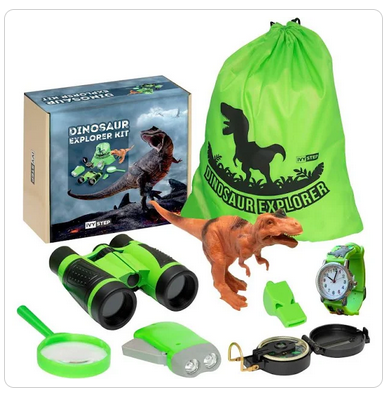
As we’re a bunch of hot-shot, know-it-all birders, we’re always getting questions about binoculars, telescopes and whatnot when we’re out and about prying rarities out of the bushes. We don’t mind, really.
I was renewing my (free, I think) subscription to Cornell Labs What About Birds? newsletter and they were giving away a couple of prizes for re-subscribing, one of them being a new (to me) Zeiss binocular, their Terra ED line, which comes in six versions from pocket-sized 10×25 to 10×42. Zeiss has long made great optical equipment so I googled for reviews on it and found Optics4Birding review of the 42mm version. It’s an excellent (in the sense of very informative) review, a paragon of reviews, in my opinion. I recommend anyone to it, especially people who write binocular reviews, as it mentions just about everything that anyone would like to know about a binocular before buying it, and it’s (IMHO) fair and objective.
My own best advice for anyone who is in the market for a binocular has been the same for about 30 years: go on a couple of bird walks and when you see a binocular that looks interesting, ask the owner if you may look through it. Your own comfort is of paramount importance and there really isn’t any way to know that without hands-on use. Birders are [generally] helpful, friendly sorts. Follow whatever instructions/suggestions/requests they offer. They’ll also tell you what they like/dislike about their binocular while you try it. If they don’t, ask. But don’t hog it and give it back immediately if a “good bird” comes along. Don’t forget to ask the price.
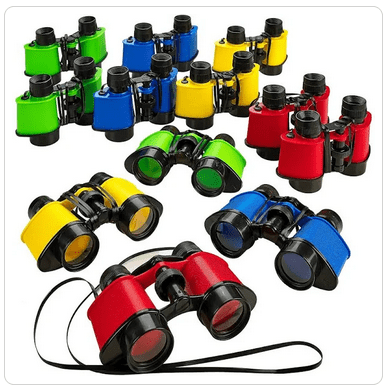
What you should be willing to pay depends: the vast range of possible cost ($25 to $2000), how long you’ve been birding, how certain you are that you wish to continue, the size of your wallet, your comfort level. Avoid “fixed focus” or “fast focus” which are suitable for football games and little else. Binoculars are a bit like cars: you get what you pay for but on a hyperbolic curve, i.e. lower end = big improvements for little bucks, upper end = little improvements for big bucks.
That said, if you read the review linked to above, you’ll have an excellent idea of what to look for in a binocular while you’re holding it in your very own hands.
We have four prior postings about binoculars & their use:
My New Binoculars June 2014
Binoculars: What Are All the New Features and What Do They Mean to Me? July 2019
Everything You Wanted to Know About Using Binoculars (But Were Afraid to Ask) Dec 2019
Advice on Binoculars June 2023
The recording of this program from 2 Apr 2024 is now available online

|
You are what you eat: Stable isotopes reveal dietary variation in Great Black-backed Gulls, with Dr. Kristen Covino
The presentation argues for the need to study diet in gulls and presents current and ongoing research on the diet of Great Black-backed Gulls. In this research we include the use of stable isotope analyses of the feathers to investigate variations in adults and chicks. We will review recent findings which indicate that adult gulls may differ in what they feed their chicks, and may preferentially feed the first-to-hatch chick higher quality food items.

Dr. Kristen Covino earned her B.S. degree in Biology from Canisius College in Buffalo, NY, her M.S. in Biology/Zoology from the University of Maine, Orono, and her Ph.D. from the University of Southern Mississippi where she investigated physiological breeding development in migrating songbirds. She is currently an Associate Professor of Biology at Loyola Marymount University. Her research ranges from in depth studies of avian physiology and endocrinology to continental-scale migratory movements. Professor Covino’s pedagogical interests include integrating active and team-learning activities into traditional lectures, incorporating science communication into her courses, and mentoring undergraduate researchers. She teaches a summer Field Ornithology course at the Shoals Marine Laboratory (Cornell University) on Appledore Island, Maine, where she also co-manages the Appledore Island Bird Banding Station and collaborates with the Gulls of Appledore Research Group. Dr. Covino also partners with the Friends of Ballona Wetlands and the Bear Divide Banding Station group on several LA-based research projects. Professor Covino’s research has been published in numerous professional journals including Hormones and Behavior, General and Comparative Endocrinology, AUK: Ornithological Advances, and The Journal of Ornithology. Dr. Covino receives funding from the Foster (SMBAS) endowment at Loyola.

Correct Announcement Morongo Valley & Black Rock Field Trip: Sat. & Sun, 4-5 May, 2024
If you’re interested in this trip, we suggest you get your motel reservation (or Joshua Tree National Park campsite) as soon as possible. Rooms do fill up this time of year.
The leaders will be staying Saturday night at the Best Western Motel (Sure Stay Plus) in Yucca Valley (56525 29 Palms Highway, Yucca Valley, California 92284-2863; 760-365-3555) or national Best Western 800-780-2734.
Nearby Yucca Valley has several motels and Joshua Tree National Monument has several campgrounds. Campsites at Mission Creek Preserve, several miles south of Morongo Valley, must be reserved at least a week in advance. (60550 Mission Creek Road, Desert Hot Springs, CA. 760-369-7105)
Joshua Tree National Park Camping
Black Rock Campground: LINK 877-444-6777, www.recreation.gov
— We bird at Black Rock on Sat. afternoon; 16 miles from Morongo Valley Reserve.
Indian Cove Campground: LINK 877-444-6777, www.recreation.gov
— Between Joshua Tree town and 29 Palms; 29 miles from Morongo Valley Reserve.
Our long-term go-to restaurant (La Casita) closed and we haven’t yet figured out where to eat dinner Saturday night. Someplace that serves beer (desert birding can be hot work!). Call Jean if you have a recommendation.
Map of motels in Yucca Valley, the nearest town to Morongo Valley: [prices are from Google map. They may be wildly inaccurate but also may reflect typical price difference between motels.] America’s Best Value Inn ($94), Bungalows Homestead ($304), Super 8 Wyndham ($84), Sure Stay Plus Best Western ($127). Map also shows motels for Desert Hot Springs (17), Joshua Tree (4), 29 Palms (9).

(taken before the June, 2005 fire)
Big Morongo Canyon Preserve is one of the finest birding spots in southern California. It is best-known as a springtime migrant trap, frequently catching rare eastern migrants, hummers and orioles at the feeders, but also has regular local specialties such as Vermilion Flycatcher, Brown-crested Flycatcher, Summer Tanager and Yellow-breasted Chat. On a busy day, the trees and bushes are filled with migrating birds, especially warblers. Many local desert species are also seen such as Gambel’s Quail, Costa’s Hummingbird and Verdin. Reserve hours are 8:00 a.m.-sunset.

Saturday, 3pm – Black Rock Campground near Yucca Valley: For those staying overnight Saturday, we meet at the Campground Visitor Center and bird in and near the campground, looking for Gambel’s Quail, White-winged Dove, Roadrunner, Ladder-backed Woodpecker, Pinyon Jay, Verdin, Scott’s Oriole and whatever else is around. If you’re late, just drive around until you spot some birders. The campground is nearly always fully occupied Saturday night. Know how to get there as local signs are not well marked. Allow at least 2.5 hours – better yet, three hours, for the 140-mile trip from Santa Monica.
Google Map to Black Rock Campground
Brief Directions: I-10 or I-10/I-60/I-10 for about 2 hours to Exit 117, Hwy 62 North. [Do NOT go south to Palm Springs on Hwy 111.] North on #62 (Twenty-Nine Palms Hwy) about 30 minutes through small Yucca Valley business area to intersection with Old Woman Springs Rd (#247) to left / Joshua Lane to right, and turn RIGHT (south) onto Joshua Lane. Follow signs about 5 miles to Black Rock Campground (unit of Joshua Tree Nat. Park). Meet at campground HQ. If you’re late, drive around the campground and South Park Rd. (to NW past the ranger buildings – see map closeup) until you find us.
Leader: Jean Garrett (213-522-0062) Please call Jean if you are going. It helps to know whom to expect.

(L. Johnson 5/3/08)
Sunday, 7:30 am – Big Morongo Canyon Preserve: We officially start at 8am in the Preserve’s parking lot. If you arrive early, birding at Covington Park just south of the Preserve is also great. Some neighbors put out feeders and water, especially the corner house across from Covington Park and the house just past that, so a short stroll is a good idea. After the preserve opens, we’ll walk around the large reserve until we’re too hot, tired, thirsty, hungry or all of the above to continue, then have lunch. Allow a minimum of 2 1/4 hours for the 125-mile trip from Santa Monica. Special birds of the area are Brown-crested Flycatcher, Vermilion Flycatcher and Summer Tanager, plus Yellow-breasted Chat, MacGillivray’s Warbler and most of the local desert birds, plus whatever migrant passerines happen to be arriving or stayed overnight. It can be very birdy, but it’s the luck of the draw and the local winds.
Google Map to Morongo Reserve
Brief Directions: I-10 or I-10/I-60/I-10 for about 2 hours to Exit 117, Hwy 62 North. [Do NOT go south to Palm Springs on Hwy 111.] North on #62 (Twenty-Nine Palms Hwy) about 11.5 miles into Morongo Valley and passing partway through small Morongo Valley town. Angle right onto Park Ave. Turn left on Vale St., passing Covington Park on your right, then bear right through several turns until you reach Covington Dr., the entrance to the preserve. If the preserve is not yet open (7:30am), retrace your path back to Covington Park where the birding is great. [Chuck Almdale]
Leaders: Jean Garrett (213)-522-0062
Family Guide: Can get quite hot; not for younger children. 1-2 miles of boardwalk, cinder and hard dirt paths. Dress in layers & hat. Bring water. Lunch near the cars.
[Chuck Almdale]

Pelican & Plover, Over & Over*: Malibu Lagoon, 24 Mar. 2024
[Text by Chuck Almdale; photos by Ray Juncosa, Grace Murayama & Chris Tosdevin]
*Guess the inspiration for this title & win a prize. When you give up, read this.

The Crotch’s Bumblebee above, an uncommon visitor to the lagoon, is a near-endemic of California, with a few reports from Nevada and Mexico, and is declining in numbers. The California Dept. of Fish & Wildlife (CDFW) is seeking data and comments on this insect as they are currently deciding whether it should be listed as California Endangered. Grace Murayama took this photo on one of her & Larry’s regular expeditions to the lagoon to check up on the Western Snowy Plovers.
Moving beyond bumblebees, we had 58 bird species on our bird walk. The weather was nippy (46-54°F), windy (7-10 mph with gusts to 22 mph) and cloudy (~50%) but fortunately without rain. Some people were plumped up in faux down. I didn’t see any Uggs boots.
There’ll be a bird ID quiz following a closer look at two of our regular lagoon visitors, plus some humans.
Brown Pelicans

The Brown Pelicans are the early portion of their nesting season, and many of the adults were developing their bright breeding colors. It takes them 3-5 years to reach breeding age and they go through half-a-dozen or more molts before their definitive (alternate) plumage of breeding. According to the National Park Service their breeding season extends from January into October and their only west coast breeding areas are on West Anacapa and Santa Barbara Islands., I’ve never visited the latter nesting area, but the Anacapa site consists of steep grassy slopes which they share with Western Gulls and no rats or other nest-robbing rodents.
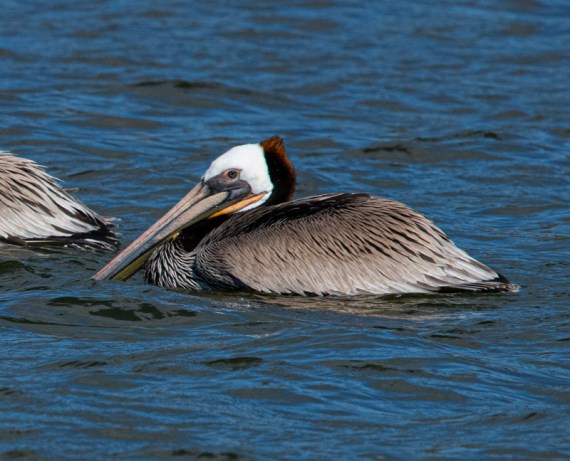
Their nest building takes 4-10 days, egg incubation takes 29-32 days, and fledging occurs 11-13 weeks after hatching, depending on which expert you consult. Add that up and it can take 133 days or 4.5 months from the first nest stick to the last flight from the nest. Thus the long breeding season. Compare that to the Anna’s Hummingbird which spends about one-third that time (48 days) from start to finish. Size matters, and the Brown Pelican (48″ long, wingspan 84″, 5.9-11 lbs) is among our largest birds. The photos below display a variety of plumages and skin colors. The young are largely brown, but by the time they reach breeding age, their body plumage is really more silvery and the chocolate-brown is on their neck. The white forehead can become quite golden.
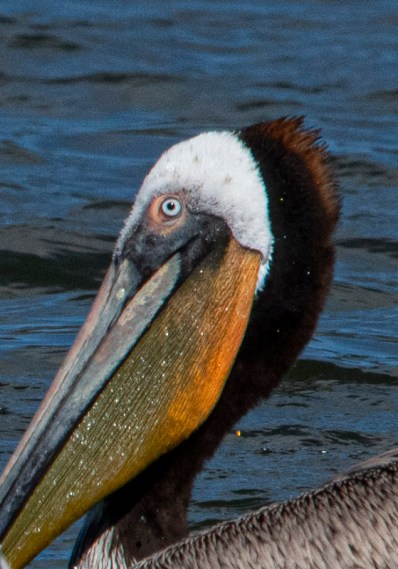

The leftmost bird below is probably one year old. The yellow-brown patch at the base of the adults’ necks appears as breeding season approaches.


Sometimes they get up just to fly and “stretch their wings,” but it might also be that one spotted a raptor in the distance. None of the birders present saw a raptor.
Western Snowy Plovers
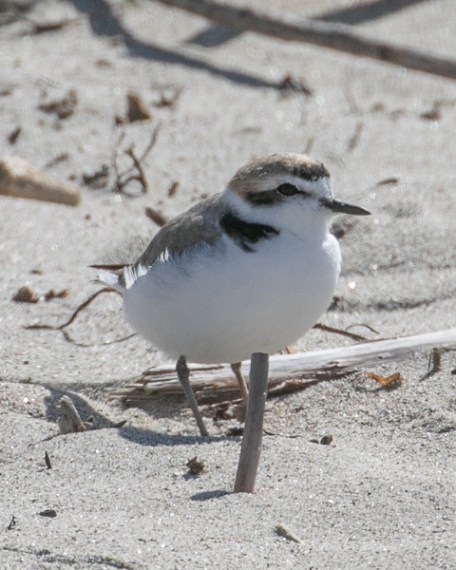
Almost at the other end of the size spectrum at 6.25″ long are our Western Snowy Plovers. They’ve recently suffered name-changes (no, not for that reason) from Charadrius alexandrinus to Charadrius nivosus when they were split from the Kentish Plover, then changed again to Anarhynchus nivosus. Research in recent decades resulted in genus Charadrius becoming restricted to a small group of plovers (including Killdeer, Piping Plover & a few others). The remaining plovers ( including Wilson’s Plover, Snowy Plover and a bunch of Old World plovers), were transferred to genus Anarhynchus (“backwards bill”). This genus name was previously used monotypically only for the weird Wrybill (Anarhynchus frontalis) of New Zealand, but when Wrybill was actually found to be a part of this diverse clade of plovers, Anarhynchus was the oldest generic name and by the rules of nomenclature, the name that must be used.

Technically (I suppose) they’re still Snowy Plovers, but out here on the west end of the world near where the ocean plunges into the great abyss we prefer Western Snowy Plovers to distinguish them from the inland sort who nest in places like Utah, Texas and Kansas, before retiring for the winter to the balmy shores of the Gulf of Mexico. Our Western SP’s breed right here on our western beaches and winter here as well. There is a possibility (a good one, I think) they are actually sufficiently geographically separated from the inland version to be considered a separate species, I have read that the western & inland forms neither visit each other’s breeding areas or wintering areas. If they don’t share breeding areas or wintering areas and don’t interbreed, that’s allopatry (physical isolation from similar species) as far as I can see. But that’s not yet settled science either way, as far as I know.
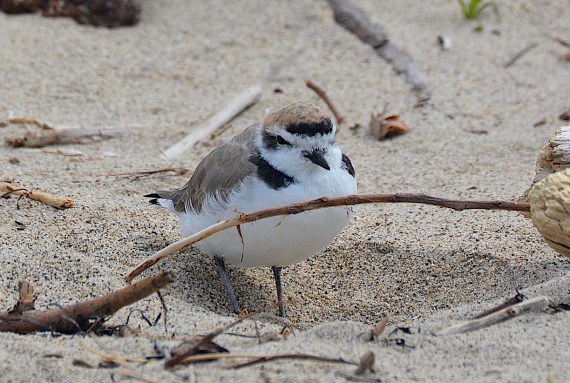
I searched through dozens of photos online and checked Birds Of The World (BOTW) to find any mention of the faint reddish cap shown on this bird. Nothing. The closest (and not really close) comment was from (BOTW): “Sexes show similar aspects in juvenile and formative plumages, slight dimorphism in definitive basic plumage, and moderate dimorphism in alternate plumages.” So…who knows?…maybe Grace captured something that is distinctive of the Western Snowy Plover. Maybe this is a genetic hangover from the WSPs close relative Red-capped Plover (see cladogram above)?
Generally speaking, the more black on the forehead, ear patch and shoulder, the more “mature” the bird. It seems that the breeding male may have a bit more (or darker) black than the female. However, this species is at least semi-polyandrous (females take multiple mates in a single breeding season): female & male both tend the nest and eggs, but the female leaves within a few days after hatching to find another mate, while the male keeps an eye on their precocial young. There is a correlation between sexual dimorphism reversal [read this] in plumage (not in size) and polyandry. If it’s true that the breeding males are always a bit darker than the females, then this is the only example I’m aware of where a species is polyandrous but the males are more “colorful” than the females.


We had altogether 20 WSPs, and 21 in February, after missing them altogether in December and January. I think they were actually hiding among the driftwood on the east side of the lagoon. We didn’t go over there then because the lagoon exit channel was too wide with frigid rushing water and we were too lazy to walk all the way around via the PCH bridge. Now all the driftwood is on the south side of the lagoon, and it’s still very easy to completely overlook these birds even when they’re only 15 feet away, staring at you with their beady black eyes..
Fish Researchers
About 10am a few researchers arrived with nets. When I inquired as to what they were looking for, they replied “Whatever’s there.” An answer I can appreciate as I’ve used it many times myself. They proceeded to unfurl their nets and drag them around the edges of the south channel (very likely too deep in channel centers). I didn’t see what they were collecting, but if anyone who knows anything about this particular operation can put me in touch with them, I’d like to put something on the blog about it. Your chance for fame and glory, folks!


The Quiz
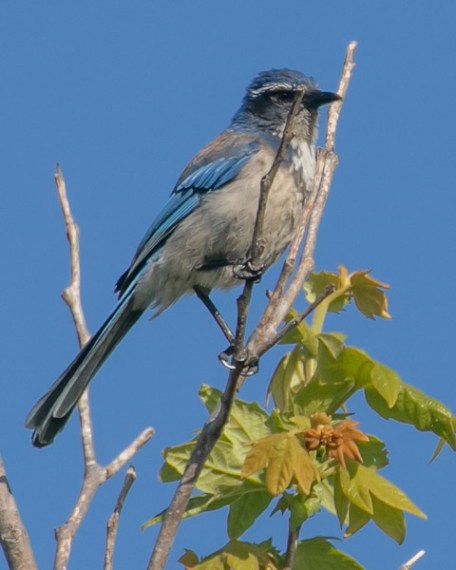
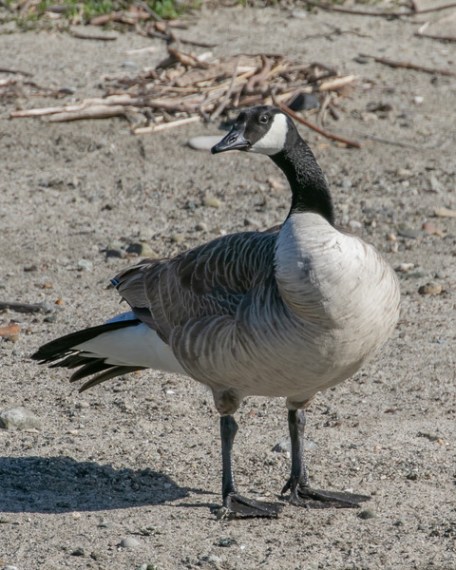
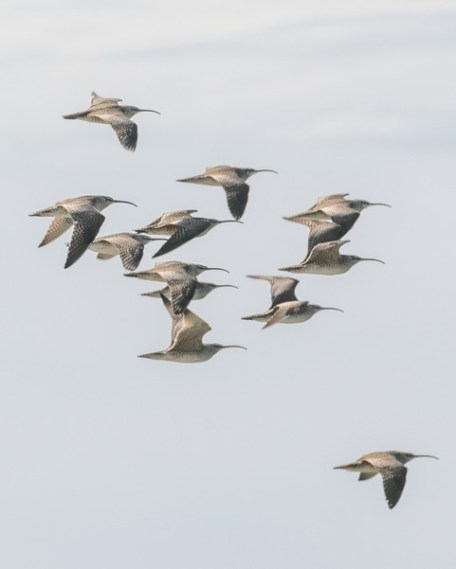
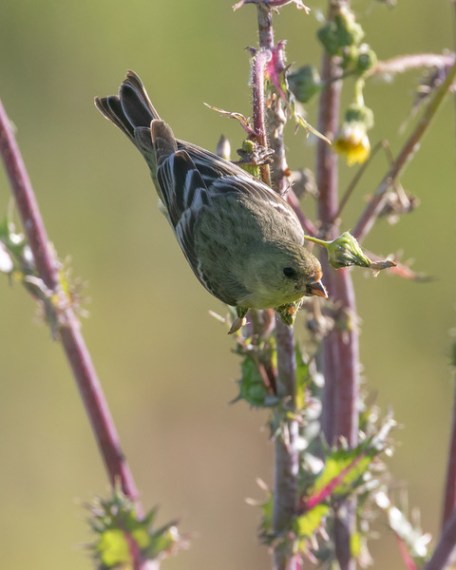
I liked doing the “quiz” on our last posting of Sepulveda Basin, so we’re doing it again. Now. If you don’t like these quizzes, let me know. I may include another ringer, like that Antpitta, so watch out.






Quiz Answers & credits
#1. Marbled Godwit (Grace Murayama 17 Mar 2024)
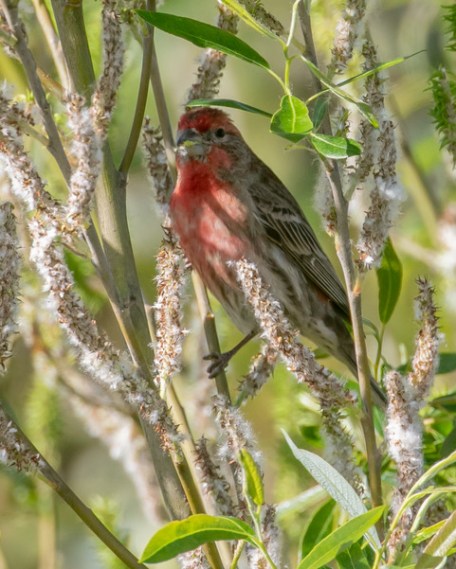
#2. House Finch male Grace Murayama 17 Mar 2024)
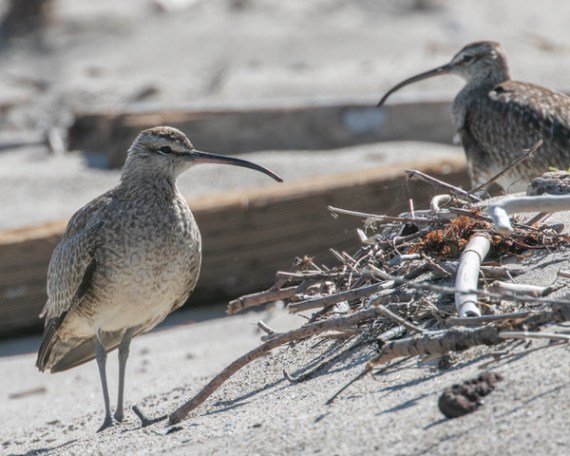
#3. Whimbrels (Grace Murayama 17 Mar 2024)
#4. Song Sparrow (Chris Tosdevin 24 Mar 2024)
#5. Caspian Tern (Chris Tosdevin 24 Mar 2024)
#6. Allen’s Hummingbird male (Chris Tosdevin 24 Mar 2024)
#7. Red-capped Plover [The Ringer] (JJ Harrison 25 Dec 2010, via Wikipedia)
#8. Green-winged Teal female (Chris Tosdevin 24 Mar 2024)
#9. California Scrub-Jay (Chris Tosdevin 24 Mar 2024)
#10. Canada Goose (Chris Tosdevin 24 Mar 2024)
#11. Bushtit (Chris Tosdevin 24 Mar 2024)
#12. Green-winged Teal male (Chris Tosdevin 24 Mar 2024)
#13. Whimbrels (Chris Tosdevin 24 Mar 2024)
#14. Lesser Goldfinch female or imm. male (Chris Tosdevin 24 Mar 2024)
#15. Black-bellied Plovers (Chris Tosdevin 24 Mar 2024)
Malibu Lagoon on eBird as of 3-25-24: 7585 lists, 319 species
Most recent species added: Red-breasted Nuthatch (31 October 2023, Kyle Te Poel).
Birds new for the season: American Wigeon, Caspian Tern, Red-shouldered Hawk, Common Raven, Tree Swallow, Rough-winged Swallow, Barn Swallow, Spotted Towhee, Brown-headed Cowbird. “New for the season” means it has been three or more months since last recorded on our trips.
Many, many thanks to photographers: Ray Juncosa, Grace Murayama & Chris Tosdevin
Upcoming SMBAS scheduled field trips; no reservations or covid card necessary unless specifically mentioned:
- Sycamore Canyon Sat Apr 6, 8:00 am, unless we decided creek level too high & relocate
- Malibu Lagoon, Sun. Apr 28, 8:30 (adults) & 10 am (parents & kids)
- Morongo Valley Sat 4 May 3pm; Sun 5 May 7:30am
- These and any other trips we announce for the foreseeable future will depend upon expected status of the Covid/flu/etc. pandemic at trip time. Any trip announced may be canceled shortly before trip date if it seems necessary. By now any other comments should be superfluous.
- Link to Programs & Field Trip schedule.
The next SMBAS Zoom program: “Great Black-backed Gulls, their food, and stable isotope analysis,” with Dr. Kristen Covino of LMU, Evening Meeting, Tuesday, Apr 2, 2023, 7:30 p.m.
The SMBAS 10 a.m. Parent’s & Kids Birdwalk is again running. Reservations not necessary for families, but for groups (scouts, etc.), call Jean (213-522-0062).
Links: Unusual birds at Malibu Lagoon
9/23/02 Aerial photo of Malibu Lagoon
More recent aerial photo
Prior checklists:
2023: Jan-June, July-Dec
2021: Jan-July, July-Dec 2022: Jan-June, July-Dec
2020: Jan-July, July-Dec 2019: Jan-June, July-Dec
2018: Jan-June, July-Dec 2017: Jan-June, July-Dec
2016: Jan-June, July-Dec 2015: Jan-May, July-Dec
2014: Jan-July, July-Dec 2013: Jan-June, July-Dec
2012: Jan-June, July-Dec 2011: Jan-June, July-Dec
2010: Jan-June, July-Dec 2009: Jan-June, July-Dec
The 10-year comparison summaries created during the Lagoon Reconfiguration Project period, remain available—despite numerous complaints—on our Lagoon Project Bird Census Page. Very briefly summarized, the results unexpectedly indicate that avian species diversification and numbers improved slightly during the restoration period June’12-June’14.
Many thanks to Marie Barnidge-McIntyre, Femi Faminu, Lillian Johnson, Chris & Ruth Tosdevin and others for their contributions to this month’s checklist.
The species lists below is irregularly re-sequenced to agree with the California Bird Records Committee Official California Checklist. If part of the right side of the chart below is hidden, there’s a slider button inconveniently located at the bottom of the list. The numbers 1-9 left of the species names are keyed to the nine categories of birds at the bottom.
[Chuck Almdale]
| Malibu Census 2023-24 | 10/22 | 11/26 | 12/24 | 1/28 | 2/25 | 3/24 | |
| Temperature | 62-70 | 62-68 | 53-64 | 53-64 | 51-62 | 46-54 | |
| Tide Lo/Hi Height | L+3.34 | H+6.53 | H+6.20 | H+5.06 | H+5.06 | H+4.71 | |
| Tide Time | 1029 | 0740 | 0644 | 1008 | 0921 | 0936 | |
| 1 | Canada Goose | 21 | 8 | 9 | 7 | ||
| 1 | Cinnamon Teal | 3 | 1 | 3 | 2 | ||
| 1 | Northern Shoveler | 1 | 13 | 10 | 4 | ||
| 1 | Gadwall | 23 | 30 | 27 | 54 | 40 | 24 |
| 1 | American Wigeon | 5 | 14 | 4 | |||
| 1 | Mallard | 9 | 8 | 7 | 35 | 12 | |
| 1 | Green-winged Teal | 31 | 8 | 17 | 25 | 4 | |
| 1 | Lesser Scaup | 1 | |||||
| 1 | Surf Scoter | 15 | 8 | 3 | 4 | 32 | 6 |
| 1 | Bufflehead | 5 | 18 | 12 | |||
| 1 | Red-breasted Merganser | 20 | 5 | 4 | 2 | 9 | |
| 1 | Ruddy Duck | 12 | 22 | 37 | 30 | 1 | |
| 2 | Pied-billed Grebe | 4 | 6 | 2 | 2 | ||
| 2 | Horned Grebe | 1 | |||||
| 2 | Eared Grebe | 1 | 1 | ||||
| 2 | Western Grebe | 28 | 13 | 18 | 14 | 240 | |
| 7 | Feral Pigeon | 3 | 4 | 4 | 4 | 4 | 2 |
| 7 | Eurasian Collared-Dove | 1 | |||||
| 7 | Mourning Dove | 1 | 4 | ||||
| 8 | Anna’s Hummingbird | 2 | 2 | 1 | 2 | ||
| 8 | Allen’s Hummingbird | 4 | 1 | 3 | 5 | 5 | 5 |
| 2 | American Coot | 157 | 230 | 280 | 148 | 46 | 63 |
| 5 | Black Oystercatcher | 1 | |||||
| 5 | Black-bellied Plover | 79 | 7 | 52 | 45 | 42 | 3 |
| 5 | Killdeer | 1 | 5 | 20 | 18 | 12 | 3 |
| 5 | Snowy Plover | 18 | 1 | 21 | 20 | ||
| 5 | Whimbrel | 23 | 4 | 8 | 4 | 6 | 39 |
| 5 | Marbled Godwit | 45 | 5 | 11 | 5 | 20 | 20 |
| 5 | Willet | 56 | 12 | 22 | 3 | 15 | 4 |
| 5 | Ruddy Turnstone | 10 | 1 | 10 | 5 | 2 | |
| 5 | Sanderling | 27 | 69 | 10 | 7 | 10 | |
| 5 | Least Sandpiper | 6 | 35 | 28 | 16 | 20 | 12 |
| 5 | Western Sandpiper | 8 | 20 | ||||
| 6 | Bonaparte’s Gull | 3 | |||||
| 6 | Heermann’s Gull | 55 | 71 | 22 | 12 | 60 | 16 |
| 6 | Ring-billed Gull | 4 | 42 | 34 | 25 | 200 | 18 |
| 6 | Western Gull | 45 | 68 | 64 | 30 | 85 | 58 |
| 6 | Herring Gull | 1 | 1 | 2 | 3 | ||
| 7 | Lesser Black-backed Gull | 1 | |||||
| 6 | California Gull | 7 | 220 | 425 | 270 | 400 | 170 |
| 6 | Glaucous-winged Gull | 1 | 5 | 3 | 3 | 1 | |
| 6 | Caspian Tern | 2 | |||||
| 6 | Elegant Tern | 2 | 1 | ||||
| 6 | Royal Tern | 5 | 12 | 7 | 3 | 4 | |
| 2 | Red-throated Loon | 1 | |||||
| 2 | Pacific Loon | 1 | 1 | 1 | |||
| 2 | Common Loon | 1 | |||||
| 2 | Black-vented Shearwater | 28 | |||||
| 2 | Brandt’s Cormorant | 1 | 1 | 1 | |||
| 2 | Pelagic Cormorant | 2 | 5 | 1 | 4 | 1 | |
| 2 | Double-crested Cormorant | 48 | 37 | 47 | 18 | 28 | 32 |
| 2 | Brown Pelican | 12 | 26 | 72 | 26 | 300 | 171 |
| 3 | Black-crowned Night-Heron | 1 | 1 | ||||
| 3 | Snowy Egret | 2 | 20 | 18 | 7 | 6 | 3 |
| 3 | Green Heron | 1 | |||||
| 3 | Great Egret | 6 | 4 | 2 | |||
| 3 | Great Blue Heron | 2 | 4 | 2 | 1 | 3 | 1 |
| 4 | Turkey Vulture | 1 | 2 | 2 | |||
| 4 | Osprey | 1 | 2 | 1 | 1 | ||
| 4 | Red-shouldered Hawk | 1 | 1 | ||||
| 4 | Red-tailed Hawk | 2 | 1 | ||||
| 8 | Belted Kingfisher | 1 | 1 | 1 | 2 | ||
| 8 | Downy Woodpecker | 1 | |||||
| 8 | Nuttall’s Woodpecker | 1 | |||||
| 8 | Hairy Woodpecker | 1 | |||||
| 8 | Northern Flicker (Red-shafted) | 1 | |||||
| 4 | Peregrine Falcon | 1 | |||||
| 8 | Nanday Parakeet | 2 | |||||
| 9 | Black Phoebe | 4 | 2 | 4 | 1 | 4 | 2 |
| 9 | Say’s Phoebe | 1 | |||||
| 9 | Cassin’s Kingbird | 1 | |||||
| 9 | California Scrub-Jay | 1 | 2 | 2 | 2 | ||
| 9 | American Crow | 44 | 3 | 5 | 10 | 10 | 4 |
| 9 | Common Raven | 1 | 1 | ||||
| 9 | Oak Titmouse | 1 | 1 | ||||
| 9 | Tree Swallow | 1 | |||||
| 9 | Northern Rough-winged Swallow | 5 | |||||
| 9 | Barn Swallow | 10 | |||||
| 9 | Bushtit | 22 | 50 | 12 | 12 | 2 | |
| 9 | Wrentit | 1 | 4 | 3 | 1 | 2 | |
| 9 | Ruby-crowned Kinglet | 1 | |||||
| 9 | Blue-gray Gnatcatcher | 2 | 1 | 1 | |||
| 9 | House Wren | 2 | 3 | 2 | 1 | ||
| 9 | Marsh Wren | 1 | |||||
| 9 | Bewick’s Wren | 1 | |||||
| 9 | European Starling | 12 | 22 | 28 | 2 | 19 | 5 |
| 9 | Hermit Thrush | 1 | |||||
| 9 | House Finch | 5 | 6 | 9 | 12 | 12 | 15 |
| 9 | Lesser Goldfinch | 2 | 6 | 20 | 20 | ||
| 9 | Dark-eyed Junco | 2 | |||||
| 9 | White-crowned Sparrow | 10 | 20 | 27 | 15 | 12 | 15 |
| 9 | Song Sparrow | 5 | 6 | 7 | 10 | 10 | 14 |
| 9 | California Towhee | 1 | 2 | 1 | 1 | 2 | 1 |
| 9 | Spotted Towhee | 1 | |||||
| 9 | Red-winged Blackbird | 15 | 16 | 2 | 35 | 4 | |
| 9 | Brown-headed Cowbird | 2 | |||||
| 9 | Great-tailed Grackle | 20 | 1 | 1 | 3 | ||
| 9 | Orange-crowned Warbler | 2 | 2 | 2 | 1 | ||
| 9 | Common Yellowthroat | 4 | 8 | 5 | 5 | 2 | 2 |
| 9 | Yellow-rumped Warbler (Audubon’s) | 5 | 12 | 6 | 6 | 10 | 4 |
| 9 | Townsend’s Warbler | 1 | |||||
| Totals by Type | Oct | Nov | Dec | Jan | Feb | Mar | |
| 1 | Waterfowl | 51 | 134 | 155 | 149 | 144 | 72 |
| 2 | Water Birds – Other | 280 | 314 | 426 | 211 | 621 | 268 |
| 3 | Herons, Egrets & Ibis | 11 | 28 | 23 | 9 | 9 | 4 |
| 4 | Quail & Raptors | 4 | 5 | 4 | 2 | 0 | 1 |
| 5 | Shorebirds | 265 | 139 | 162 | 103 | 156 | 121 |
| 6 | Gulls & Terns | 118 | 416 | 562 | 345 | 748 | 272 |
| 7 | Doves | 4 | 4 | 4 | 4 | 9 | 2 |
| 8 | Other Non-Passerines | 10 | 1 | 9 | 6 | 8 | 7 |
| 9 | Passerines | 154 | 146 | 119 | 88 | 158 | 115 |
| Totals Birds | 897 | 1187 | 1464 | 917 | 1853 | 862 | |
| Total Species | Oct | Nov | Dec | Jan | Feb | Mar | |
| 1 | Waterfowl | 4 | 10 | 11 | 10 | 7 | 9 |
| 2 | Water Birds – Other | 8 | 7 | 8 | 8 | 8 | 5 |
| 3 | Herons, Egrets & Ibis | 4 | 3 | 4 | 3 | 2 | 2 |
| 4 | Quail & Raptors | 3 | 3 | 3 | 2 | 0 | 1 |
| 5 | Shorebirds | 9 | 9 | 9 | 8 | 10 | 8 |
| 6 | Gulls & Terns | 6 | 8 | 9 | 7 | 5 | 8 |
| 7 | Doves | 2 | 1 | 1 | 1 | 3 | 1 |
| 8 | Other Non-Passerines | 5 | 1 | 6 | 2 | 3 | 2 |
| 9 | Passerines | 17 | 18 | 17 | 16 | 19 | 22 |
| Totals Species – 101 | 58 | 60 | 68 | 57 | 57 | 58 |



 SANTA MONICA BAY AUDUBON SOCIETY BLOG