Free email delivery
Please sign up for email delivery in the subscription area to the right.
No salesman will call, at least not from us. Maybe from someone else.
Whydah heck not? Madrona Marsh: 10 February 2024
[Text by Chuck Almdale, photos by Ray Juncosa, Chris Tosdevin & Karen Woo]

A large group of people waited at the entrance gate to Madrona Marsh at 8:30am, but they weren’t birders. Most were Eagle Scouts, there to build some sort of wooden structure. They were still at it when we left at 11:30, and I still couldn’t tell what it was. A lot of other people had shown up: trail-workers, weed-pullers, tree-fanciers, docents. Even the number of birders for our walk was sizable — seventeen.
The nine vernal pools were full of water, and there were plenty of waterfowl and Red-winged Blackbirds there to celebrate.

The male red-wings seemed eager to get on with breeding, as everywhere in and near the reed beds they were prominently displaying their red & yellow epaulets.

Once upon a time some meddling research scientists decided to see how important bright red epaulets were to the males. They captured a few, colored their epaulets black, and released them back into their marsh. They immediately lost their territories and the females ignored their courting maneuvers. No breeding for them! Upon hearing this woeful tale, one birder asked me if the scientists restored the red to the epaulets so the males could regain their territories and all would again be right with the world. Sorry to say, I don’t know for sure, but knowing how these things went decades ago, I suspect not.
One of the male Red-winged Blackbirds had a white head, what is frequently called partially leucistic (rather than albino). Leucism doesn’t seem to be an inherited trait and appears uncommonly in many different species. [I’ve seen leucistic robins and hummingbirds elsewhere.] Another bird had a light speckling of white (right photo below, look very closely).

Also in the reeds, and rather annoyingly well-hidden were the Scaly-breasted Munias, a very pretty little bird which I always enjoy seeing. They’re colorful and have a nice song, which is why they’ve been domesticated as cage birds for many decades – perhaps centuries – with the inevitable escaping from confinement and flight to the local wildlands. People who keep birds in cages or around their homes like to give their feathered companions names, and I suspect this species Lonchura punctulata has the most English names of any species I’ve ever heard of: Spice Finch, Spice Munia, Nutmeg Finch, Nutmeg Mannikin, Nutmeg Munia, Ricebird, Spotted Manikin, Spotted Munia, Checkered Munia, Scaled Munia, Scaly-breasted Mannikin, Scaly-breasted Munia. That’s twelve and I probably missed some. It also has names in at least 62 other languages, from Asturian to Esperanto to Ukrainian. [Esperanto! Imagine that.] Definitely a world-traveler.
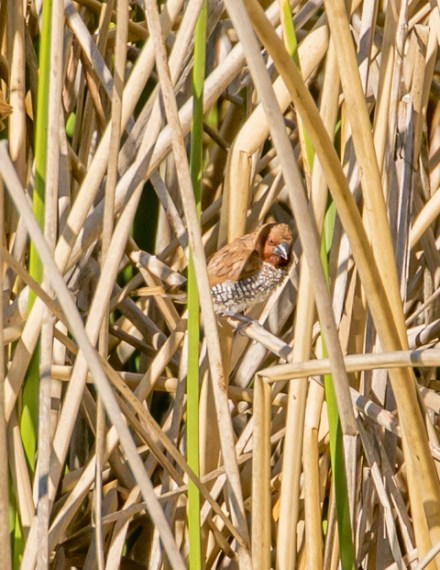
Scaly-breasted Munia (info link), by whatever name, naturally range from eastern Afghanistan to eastern China and south through Indonesia to east of the Wallace Line. With human help, they’re just about everywhere, and have been in SoCal since the 1980’s. We’ve seen them on trips to Huntington Beach Central Park for several decades.
We didn’t have many warbler species (two), but we had a lot of Yellow-rumped Warblers in every plumage variation you might expect (or fear). When I began birding, I remember Roger Tory Peterson making many useful comments in the introduction to his ground-breaking field guides: e.g. keep a life list, the first 300 species you see are “trash birds,” learn well your common local birds so when something unusual appears, you’ll know it’s unusual and will mutter to yourself, “My, my, that looks different! I’d better get a good look.” All sound advice.
And that’s why I tell birders that the Yellow-rumped Warbler is about as variable as any of the warblers you’ll ever see. You can see a group of ten and they could easily all like potentially different species. And in another month or 500 miles away, they’ll all look different from today and here. A good bird to learn. This one below had an unusual amount of black on the face. Photographer Chris Tosdevin thought it might be a “possible juvenile side molt.”


Chris thought the bird below to be a Yellow Warbler when he photographed it. They can look quite unlike their summer selves in the winter. It also seems to have an eye-ring, which is usually subdued in this species.
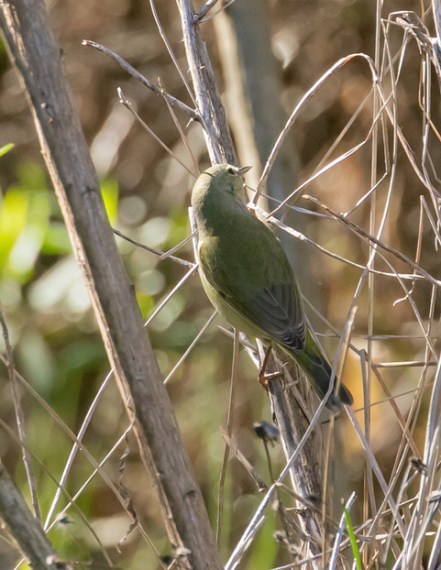
We couldn’t tell if there were twenty Cassin’s Kingbirds or only one who got around. A lot. I never saw more than one at a time. It certainly was everywhere, forcing everyone to keep re-identifying it over and over (and over) again. White chin, dark gray neck and breast, no white outer tail-feathers.

Blue-gray Gnatcatchers seem to love Madrona. We had at least eight, and I see that in 2016 we had thirteen, which seems a lot for an area completely surrounded by suburbia and no hilly chaparral in sight. This turned out to be a lifer for one of the birders.

I was looking forward to seeing the Pin-tailed Whydahs, another escaped cage bird that’s been expanding its SoCal range for at least the past few years, but which I had somehow missed. I’d seen them in Sub-Saharan Africa, where they range widely, but that was thirty years ago. All the ones we saw today – the best count was 18 – looked like the two pictured below with thick bright red bill, streaky head and back and mostly white chest & belly. They’re too recent an escapee to be in my NGS field guide (2011) 6th edition, but a few people found them on their phone app, once we figured out how to spell it (that extra “h”). We narrowed them down to male or female, non-breeding, which isn’t particularly narrow.

In breeding plumage the males have red bills and females usually have “blackish” bills. In non-breeding plumage the male bills are still red, but females can have red or blackish-red. All the birds I saw had bright solid-red bills, but they could be of either sex.
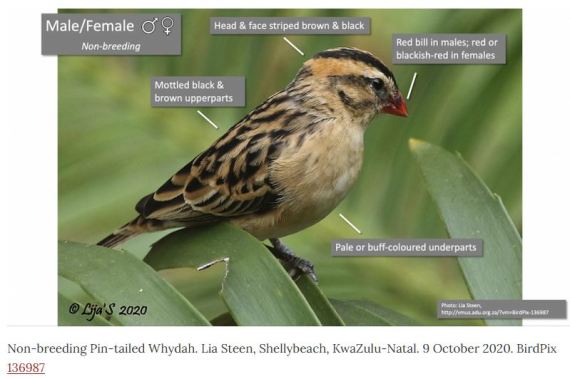
They hail from sub-Saharan Africa where, once the desert stops, they start, almost all the way to Cape Town. The site linked to below this photo has lots of info, plus song recordings.
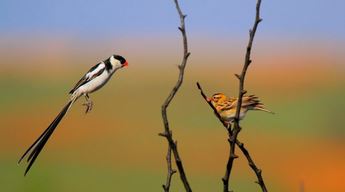
The link above has lots of photos, including ones from around SoCal.
We certainly did not see any males like the one above, who – in addition to his long pin-tail – appears to be standing in mid-air, which is a good trick, sure to impress any female watching.
But that was not the end of the oddities. There were Northern Flickers of two persuasions. Most were of the expected western Red-shafted subspecies, but at least one (quite possibly two) were of the eastern Yellow-shafted subspecies. Sometime you get only a hint, as in the photo below, where all you get indicating Yellow-shafted is the brownish face and the tiny tiny glimpse of red on the nape. There seems to be no black whisker-mark (aka moustachial stripe).

However, in the photo below, the yellow shouts at you, unmistakably.
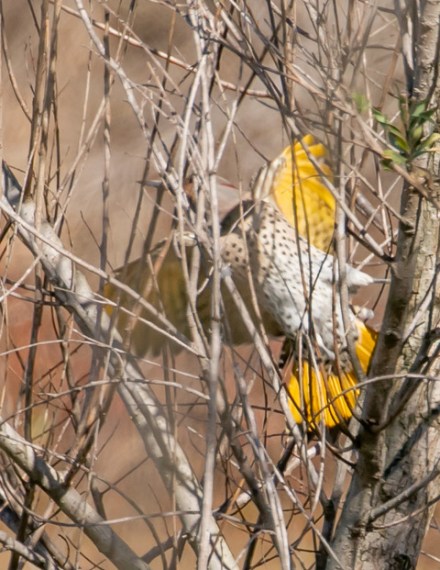
These two species were considered separate species until roughly 30 years ago when they were discovered interbreeding in (I believe) Nebraska. Apparently the two populations became widely separated at some point in geological time (perhaps during or following an ice-age) and their plumages diverged. When Europeans arrived, spread across the Great Plains and began planting trees around their homes, the eastern and western woodpeckers spread towards each other across the otherwise-treeless plain, eventually meeting each other mid-continent. Although they looked different, it wasn’t enough of a difference to inhibit their mating with one another. Following the widely-accepted “biological concept of speciation,” if two forms of an animal mate and bear fertile offspring, they’re the same species, whatever their appearance. Charles Darwin considered subspecies to indicate a species in the process of diverging into two but not quite there, and the only diagram in his book On the Origin of Species illustrates this. Given sufficient time and continued geographical separation, the Yellow-shafted and Red-shafted could well have each become “good species.”
Hummers of two species were scattered about the grounds, conveniently perching on bare twig-ends, easy to spot.

And sparrows of various persuasions were out and about. Near the vernal pools the chorus of Song Sparrows was nearly deafening at the start of our walk.

It may look like a saddle-without-a-horse, but the photo below is of a tree (or shelf) fungus. Note the fence lizard considerately situating itself for size comparison.

When we returned to our cars, we found a large lunch-tent in the middle of the parking lot serving plates of pizza. We assumed this was for the benefit of the work crews and boy scouts who were doing actual useful work in the marsh, and not for birders loafing their way around the grounds, so we restrained ourselves (so far as I know) from helping ourselves.
As always, many thanks to our photographers: Ray Juncosa, Chris Tosdevin and Karen Woo.
| Madrona Marsh Trip List | 12/10/16 | 2/11/23 | 2/10/24 |
| Canada Goose | X | 8 | |
| Cinnamon Teal | X | ||
| Northern Shoveler | X | 40 | |
| Gadwall | X | 2 | |
| American Wigeon | 6 | X | 2 |
| Mallard | 6 | X | 50 |
| Green-winged Teal | X | ||
| Ring-necked Duck | 1 | ||
| Hooded Merganser | X | ||
| Rock Pigeon | 8 | X | 8 |
| Eurasian Collared-Dove | X | ||
| Mourning Dove | 50 | X | 12 |
| Anna’s Hummingbird | 3 | X | 3 |
| Allen’s Hummingbird | 9 | X | 4 |
| American Coot | 5 | X | 2 |
| Killdeer | X | ||
| Greater Yellowlegs | X | ||
| Ring-billed Gull | 2 | ||
| Western Gull | 4 | ||
| California Gull | 2 | X | |
| Great Egret | 1 | ||
| Green Heron | X | ||
| Black-crowned Night-Heron | X | ||
| Sharp-shinned Hawk | 1 | ||
| Red-shouldered Hawk | 1 | ||
| Red-tailed Hawk | 2 | X | 2 |
| Downy Woodpecker | 1 | 1 | |
| Northern Flicker (Red-shafted) | 2 | X | 10 |
| No. Flicker (prob. Red x Yellow) | (1) | ||
| American Kestrel | 3 | X | 1 |
| Ash-throated Flycatcher | 1 | ||
| Cassin’s Kingbird | 6 | X | 2 |
| Black Phoebe | 6 | X | 5 |
| Say’s Phoebe | 1 | X | 1 |
| California Scrub Jay | 1 | ||
| American Crow | 4 | X | 12 |
| Common Raven | 2 | X | 2 |
| No. Rough-winged Swallow | 2 | ||
| Bushtit | 50 | X | 18 |
| Ruby-crowned Kinglet | 12 | ||
| Cedar Waxwing | 20 | X | |
| Blue-gray Gnatcatcher | 13 | X | 8 |
| House Wren | 1 Heard | ||
| Northern Mockingbird | 1 | ||
| European Starling | 8 | X | 5 |
| Hermit Thrush | 1 Heard | ||
| Scaly-breasted Munia | 45 | 20 | |
| Pin-tailed Whydah | 18 | ||
| House Finch | 20 | X | 5 |
| Lesser Goldfinch | 3 | X | |
| American Goldfinch | 45 | X | 8 |
| Chipping Sparrow | 6 | 4 | |
| Brewer’s Sparrow | 2 | ||
| Fox Sparrow | 1 | ||
| White-crowned Sparrow | 60 | X | 15 |
| Golden-crowned Sparrow | 2 | X | |
| Savannah Sparrow | 4 | X | |
| Song Sparrow | 2 | X | 8 |
| Lincoln’s Sparrow | 3 | X | 1 |
| California Towhee | 2 | X | 1 |
| Western Meadowlark | 10 | X | 1 |
| Red-winged Blackbird | 2 | X | 31 |
| Great-tailed Grackle | X | 1 | |
| Black-and-White Warbler | 1 | ||
| Orange-crowned Warbler | 6 | X | |
| Common Yellowthroat | 3 | 1 | |
| Yellow-rumped Warbler | 10 | X | 40 |
| Black-throated Gray Warbler | 1 | X | |
| Townsend’s Warbler | 1 | ||
| House Sparrow | 1 | ||
| Total Species – 69 (forms – 70) | 51 | 46 | 41 (42) |
Zoom Recording: Singing Feathers, Humming of Hummingbirds and the Quiet Flight of Owls and other Birds, with Dr. Christopher Clark.
The recording of this program from 6 Feb 2024 is now available online

Great Gray Owl (photo courtesy of Christopher Clark)
|
Recording Glitch: There are two programs recorded here. The first (18 seconds long) is useless; click the forward button >| at lower left of screen to go past it. When the second recording appear, click the usual run button at lower left. Dr. Clark begins speaking about 20 seconds in.
Singing Feathers, Humming of Hummingbirds and the Quiet Flight of Owls and other Birds with Dr. Christopher J. Clark
Dr. Christopher J. Clark, Professor of Biology at UCR uses wind tunnels, high-speed video and other technology to study bioacoustics and biomechanics of flight and courtship. In what was originally a side project of his Ph.D., he figured out that Anna’s Hummingbirds produce loud sounds with their tail-feathers. This result was so interesting that sounds produced in flight became a major part of his research program. He will spend the first part of his presentation discussing how hummingbirds make both vocal and nonvocal sounds. Then he will pivot to discussing a more recent interest: quiet flight. Owls such as Great Gray Owl perform an especially amazing feat: they take prey such as voles that they locate by ear alone. Dr. Clark will discuss ongoing research on quiet flight, as well as unanswered questions such as: why do nightbirds (such as Common Poorwill) also have quiet flight?
Dr. Clark grew up in Seattle, received his undergraduate degree in Zoology from Washington State University in 2001, his Ph.D. from the Museum of Vertebrate Zoology at UC Berkeley in 2009, then worked in the Peabody Museum at Yale University until 2013, and has been a professor in the Evolution, Ecology, and Organismal Biology department at UC Riverside from 2013-present.
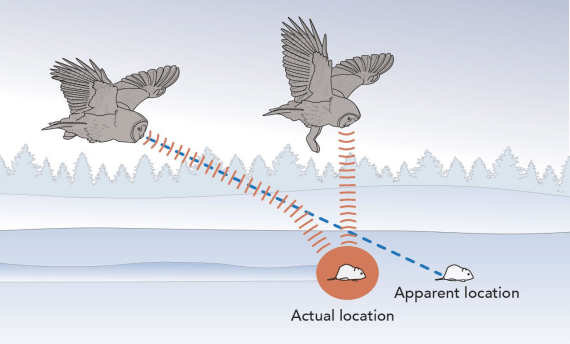
Great Gray Owl locating prey under the snow. (photo courtesy of Christopher Clark)
Golden-crowned Kinglet
[By Chuck Almdale, photos by Chuck Gates]
There are only six species in the small passerine family (of small passerines) of Regulidae (Birds of the World Family Link). Five species, including the Golden-crowned Kinglet, are in genus Regulus; Ruby-crowned is in genus Corthylio. The genus and family name “Regulus” is Latin for “little king.” The species name “satrapa” is from Greek “satrapes” for “a ruler” [yes, it’s a bit redundant]. All six species are quite small (3.75-4.5″) and all have a brightly colored crown, often concealed, which led to the allusion to “king.” The information below is adapted from Birds of the World.
We do get a few Golden-crowned Kinglets in SoCal, particularly in the higher mountain conifers, but they are vastly outnumbered by the Ruby-crowned, a species remarkable for having the largest clutch – up to 12 eggs – for its size of any North American passerine.
Photographer Chuck Gates lives in the Prineville region of Eastern Oregon, 25 miles northeast of Bend in the high desert, and has birded the area for decades. A few years ago he formed Prineville Bird Club which attracted the area’s avid birders. The four photos below – sent to me by a relative and which I thought especially nice – came from a recent trip he led over to the Pacific Coast of Southern Oregon. I’ve never seen the crest so brightly displayed. He is happy to share them with us.
Golden-crowned Kinglet Regulus satrapa: 3.25-4.25″ Photo link
Subspecies: 6
Range: So. Alaska to Newfoundland to No. Florida to No. Mexico.

Breeding: Breeds primarily north of Canadian border and the high mountain ranges extending south into the U.S., migrates for winter as far south as northeastern Mexico. Nest building begins as early as early May. Nest site probably chosen by the female, often high up in dense foliage. Nests average 3″ in diameter and may be suspended from stems, in twigs in the fork of a conifer tree or under foliage near end of a branch, height is 2-18 m, averaging 15 m. Overhanging foliage protects it from the elements and hides it from view from the side or above, but it can sometimes be partially seen from below. Clutches can be large (5-11 eggs) and most pairs lay two clutches per year. Eggs are 0.4″ x 0.5″. Eggs hatch on the same day, usually day 14-15, and the young fledge from the nest 18-19 days later.

Did you notice the feet?
Habitat: Breeds in boreal & spruce-fir forest, pines, aspens; prefers old-growth & mature forest between 250-3500m depending on region.
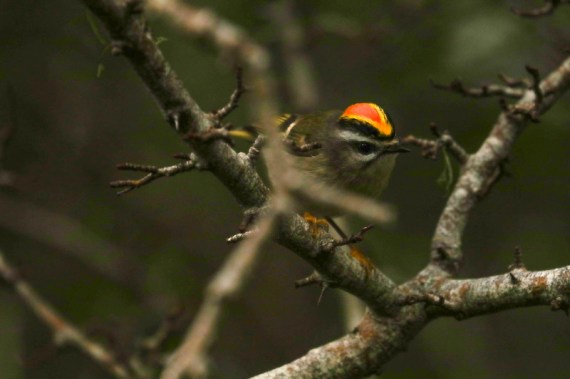
Diet: Arthropods, some vegetation & fruit; forages on branches, leaves, bark, mosses, lichens, also on ground. Frequently hovers and gleans in canopy from 2–10 m height.

In the not-too-distant future we’ll take a look at this small and interesting family in an installment of our Family Focus series, yet to be written.
You are all invited to the next ZOOM meeting
of Santa Monica Bay Audubon Society
Great Gray Owl (photo courtesy of Christopher Clark)
|
Singing Feathers, Humming of Hummingbirds and the Quiet Flight of Owls and other Birds with Dr. Christopher J. Clark
Zoom Evening Meeting, Tuesday, 6 February, 7:30 p.m.
Zoom waiting room opens 7:15 p.m.
Dr. Christopher J. Clark, Professor of Biology at UCR uses wind tunnels, high-speed video and other technology to study bioacoustics and biomechanics of flight and courtship. In what was originally a side project of his Ph.D., he figured out that Anna’s Hummingbirds produce loud sounds with their tail-feathers. This result was so interesting that sounds produced in flight became a major part of his research program. He will spend the first part of his presentation discussing how hummingbirds make both vocal and nonvocal sounds. Then he will pivot to discussing a more recent interest: quiet flight. Owls such as Great Gray Owl perform an especially amazing feat: they take prey such as voles that they locate by ear alone. Dr. Clark will discuss ongoing research on quiet flight, as well as unanswered questions such as: why do nightbirds (such as Common Poorwill) also have quiet flight?
Dr. Clark grew up in Seattle, received his undergraduate degree in Zoology from Washington State University in 2001, his Ph.D. from the Museum of Vertebrate Zoology at UC Berkeley in 2009, then worked in the Peabody Museum at Yale University until 2013, and has been a professor in the Evolution, Ecology, and Organismal Biology department at UC Riverside from 2013-present.
Great Gray Owl locating prey under the snow. (photo courtesy of Christopher Clark)
|
(If this button isn’t working for you, see detailed zoom invitation below.)
Meeting ID: 835 0878 2803
Passcode: 287048
One tap mobile
+16699009128,,83508782803#,,,,287048# US (San Jose)
+16694449171,,83508782803#,,,,287048# US
Dial by your location
+1 669 900 9128 US (San Jose)
+1 669 444 9171 US
+1 253 215 8782 US (Tacoma)
+1 346 248 7799 US (Houston)
+1 719 359 4580 US
+1 253 205 0468 US
+1 386 347 5053 US
+1 507 473 4847 US
+1 564 217 2000 US
+1 646 558 8656 US (New York)
+1 646 931 3860 US
+1 689 278 1000 US
+1 301 715 8592 US (Washington DC)
+1 305 224 1968 US
+1 309 205 3325 US
+1 312 626 6799 US (Chicago)
+1 360 209 5623 US
Meeting ID: 835 0878 2803
Passcode: 287048
Find your local number: https://us02web.zoom.us/u/kkdUibpC0
Breakfast at Ospreys’: Malibu Lagoon, 28 Jan. 2024
[Text by Chuck Almdale; photos by Ray Juncosa & Chris Tosdevin]

Bill length accounts for most of the size difference, and they don’t seem to be serious competitors for food.
The day started warm – 70°F at 8am – and got warmer. Of course – it’s January! Winter was over weeks ago! [Completely untrue.] The day started and stayed breezy, with gusts up to 17mph according to NOAA.
The best sighting of the day was our wintering Osprey. It had been absent in the early morning, but as we were making our way beachward from the meeting area, it flew by, scanning the channels for a breakfast fish.
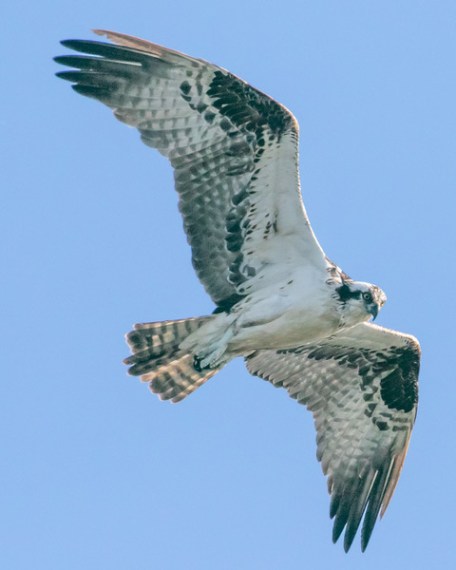
It spotted one and plunged, but came up empty-taloned. It rose, flew around so more, then dove again. This time it didn’t immediately leap up out of the water. [Captioned comments below are by photographer Ray Juncosa.]

In fact, it seemed to be having a tough time just keeping its head above water.

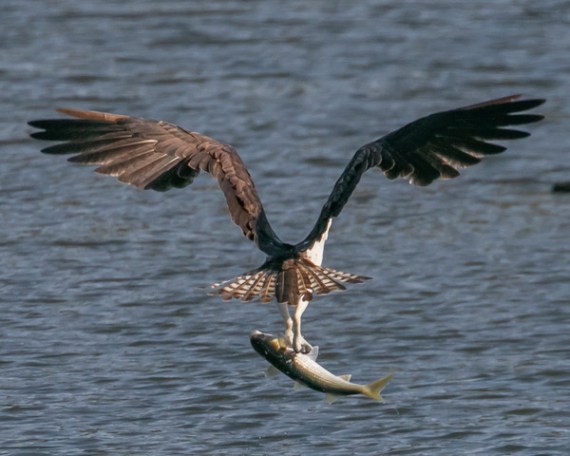
Finally it was able to rise out of the water, hoisting a large mullet. They can lift up to 90% of their own weight. An adult Osprey weighs about 3 lbs., and I suspect this fish weighed pretty close to that. The bird looks much larger, of course, with that wingspan of 58-72,” but it’s built mostly of air. That fish is solid meat.

The Osprey is taking very deep wing strokes. It continues working hard to gain altitude.
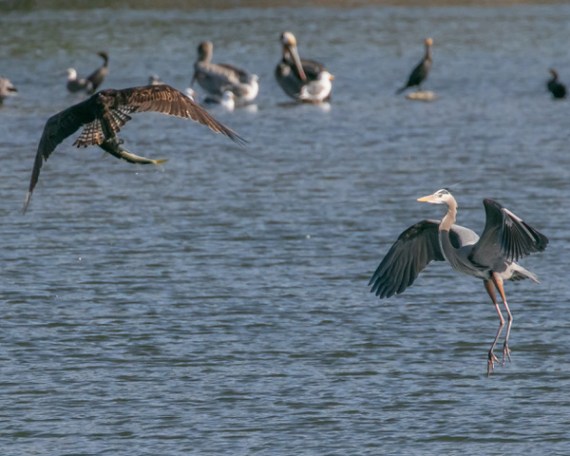
The Great Blue Heron below made an attempt to scare the Osprey off its fish and gain a free meal for itself. It failed as the Osprey headed for the beach and the sea beyond to gain some more altitude away from the thieves in the lagoon.
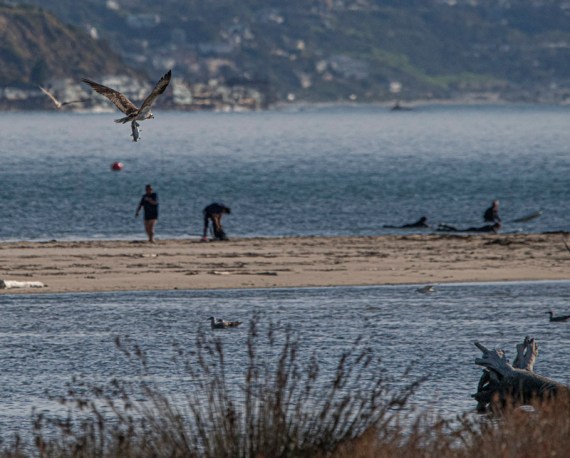
Off it goes. We weren’t sure where it was heading, but I suggested that it would circle back and head for the cypress trees or its favorite electric pole at the corner of Malibu Colony where the Mockingbird used to sit and sing.
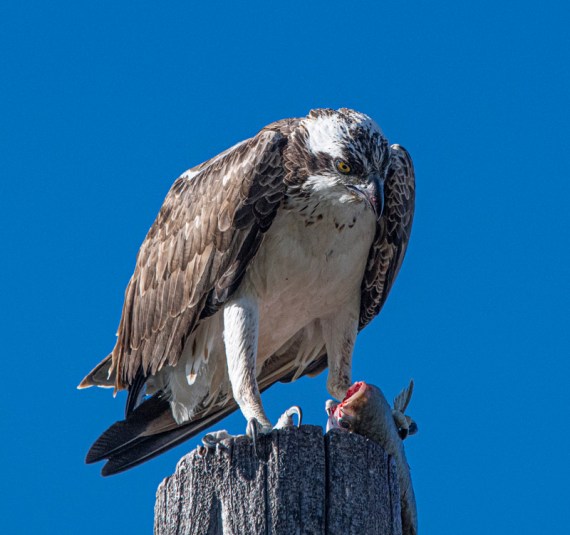
Soon it returned from seaward and landed on the pole. It seemed like 20 minutes passed before the doomed fish ran out of energy, ceased struggling, and died.
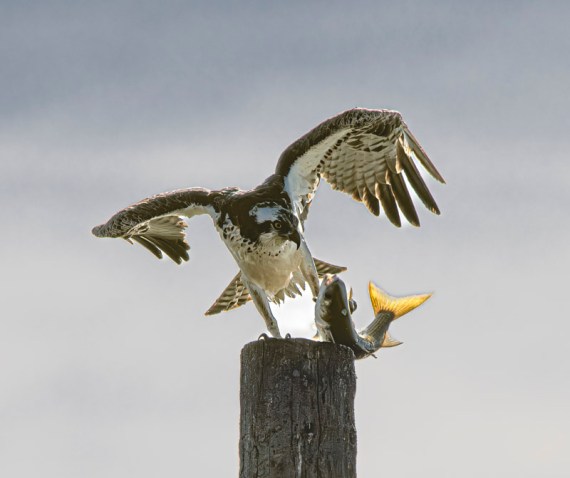
The mullet finally became still. Meanwhile the Osprey stayed on the alert for interlopers. It had been spotted by crows.


When one foot is hanging onto your fish, and the wind is gusting, and thieves are lurking, it can be hard to manipulate your meal into eating position and maintain your balance on the other. This next photo gives you the best comparison of bird to fish body size.

It now seems safe to eat breakfast. Head first, of course.
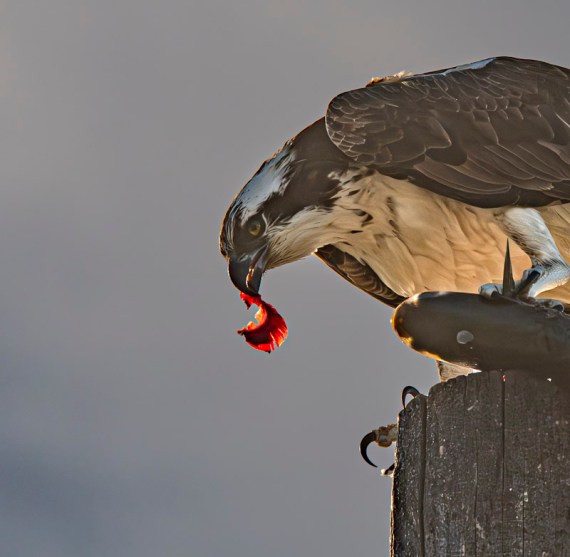
Very little is wasted. Note the talons. They’re why a fish, once caught, rarely escapes.

The discards consist of the gills and those stiff fins and tail.
On our way back from the beach, we ran into our “Parents & Kids Trip” leaders with a group of 19 girl scouts and parents, all watching the Osprey working its way through the fish. Including those 19, we had a total of 48 birders, probably a record.
We had a total of 57 species of birds, which is a hair over our average of 55.6 for 26 years worth of January censuses. Here are some of the more interesting sightings.
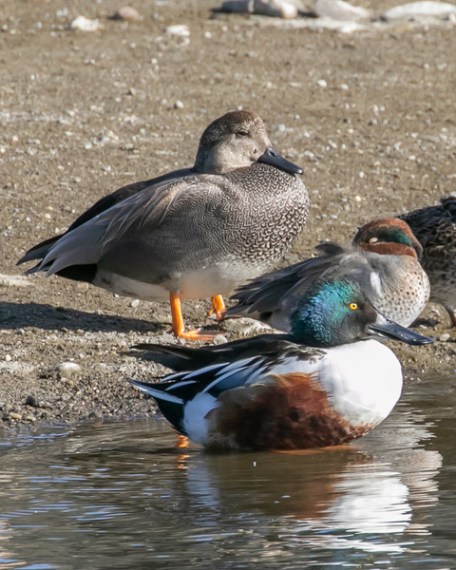
Their bodies and bills appear differently-sized, bu they’re both Least Sandpipers.

Royal Terns, three views. The black eye stands out from the black fringe behind it. Bill is thicker and less curved than that of the confusingly similar Elegant Tern, and has a slight gonydeal “bump” on the lower mandible, absent on the Elegant.

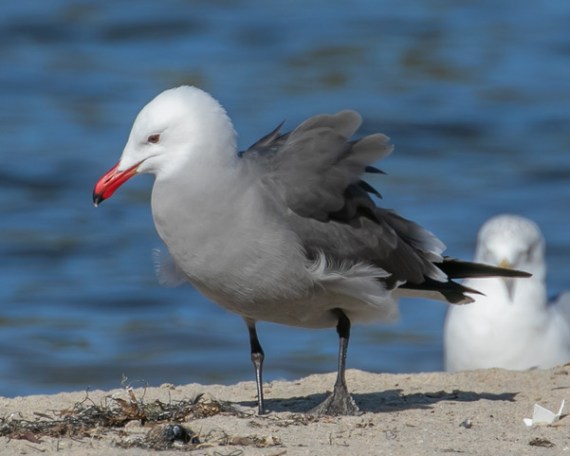
This Heermann’s Gull with it’s unblemished white head and black-tipped red bill is about ready to fly south to breed in the Sea of Cortez.
You rarely get this close a look at the Ring-billed to easily see the pale eye and the vertical black ring.

The Herring Gull also has a light eye and pale gray back, but has pink legs, black primaries with white “windows,” a thick yellow bill, streaking on the head, neck and (often) upper breast, and is the same size as the Western Gull. The somewhat similar California Gull is 4″ shorter, has a dark eye, a red and black gonydeal spot and when adult has greenish yellow legs.

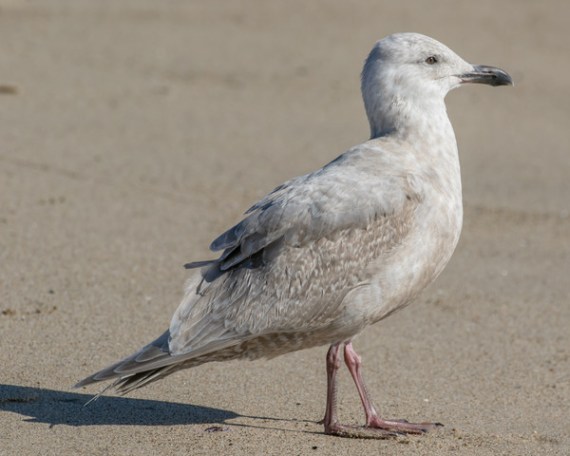
Most of the Glaucous-winged Gulls we get in SoCal are first-winter or second-winter (like the bird below) birds. “Glaucous” means “waxy” and – in my opinion – refers to the overall oddly gray plumage of the first winter birds. It really does look like its been rubbed all over with pale candle wax. Their legs are always pink and they never have black in their primaries. The one below has worn secondary feathers, giving it a bit of a “shredded” look.
Last but not least, one of our most common winter passerines, a Yellow-rumped (Audubon’s) Warbler, which strikes me as exceptionally brightly plumaged for the middle of winter. The yellow plumage is well in, but the black breast has a way to go.

Malibu Lagoon on eBird as of 2-01-24: 7447 lists, 319 species
Most recent species added: Red-breasted Nuthatch (31 October 2023, Kyle Te Poel).
Birds new for the season: Red-tailed Hawk, Hermit Thrush, Orange-crowned Warbler. “New for the season” means its been three or more months since last seen on our trips. Only three “new” species is probably a record low. Red-tailed Hawk nests in the general area and are almost certainly always close by, but aren’t always seen. Both the Hermit Thrush and Orange-crowned Warbler were mentioned to me only by Chris Lord who often wanders off from the group, listening closely, and thus sees or hears birds the rest of us miss.
Many, many thanks to photographers: Ray Juncosa, Chris Tosdevin
Upcoming SMBAS scheduled field trips; no reservations or covid card necessary unless specifically mentioned:
- Madrona Marsh Sat Feb 10, 8:30 am.
- Malibu Lagoon, Sun. Feb 25, 8:30 (adults) & 10 am (parents & kids)
- Sepulveda Basin Sat. Mar 9, 8:00 am
- These and any other trips we announce for the foreseeable future will depend upon expected status of the Covid/flu/etc. pandemic at trip time. Any trip announced may be canceled shortly before trip date if it seems necessary. By now any other comments should be superfluous.
- Link to Programs & Field Trip schedule.
The next SMBAS Zoom program: “Aeroacoustics Lab at UCR” with Dr. Chris J. Clark, Evening Meeting, Tuesday, Feb 6, 2023, 7:30 p.m.
The SMBAS 10 a.m. Parent’s & Kids Birdwalk restarted almost a year ago on April 23. Reservations for groups (scouts, etc.) necessary, call Jean (213-522-0062); not necessary for families.
Links: Unusual birds at Malibu Lagoon
9/23/02 Aerial photo of Malibu Lagoon
More recent aerial photo
Prior checklists:
2023: Jan-June, July-Dec
2021: Jan-July, July-Dec 2022: Jan-June, July-Dec
2020: Jan-July, July-Dec 2019: Jan-June, July-Dec
2018: Jan-June, July-Dec 2017: Jan-June, July-Dec
2016: Jan-June, July-Dec 2015: Jan-May, July-Dec
2014: Jan-July, July-Dec 2013: Jan-June, July-Dec
2012: Jan-June, July-Dec 2011: Jan-June, July-Dec
2010: Jan-June, July-Dec 2009: Jan-June, July-Dec
The 10-year comparison summaries created during the Lagoon Reconfiguration Project period, remain available—despite numerous complaints—on our Lagoon Project Bird Census Page. Very briefly summarized, the results unexpectedly indicate that avian species diversification and numbers improved slightly during the restoration period June’12-June’14.
Many thanks to Femi Faminu, Chris Lord, Marie Nosurname, Chris Tosdevin and others for their contributions to this month’s checklist.
The species lists below is irregularly re-sequenced to agree with the California Bird Records Committee Official California Checklist. If part of the chart’s right side is hidden, there’s a slider button inconveniently located at the bottom of the list. The numbers 1-9 left of the species names are keyed to the nine categories of birds at the bottom.
[Chuck Almdale]
| Malibu Census 2023-24 | 8/27 | 9/24 | 10/22 | 11/26 | 12/24 | 1/28 | |
| Temperature | 69-73 | 56-74 | 62-70 | 62-68 | 53-64 | 53-64 | |
| Tide Lo/Hi Height | H+3.68 | H+3.77 | L+3.34 | H+6.53 | H+6.20 | H+5.06 | |
| Tide Time | 0832 | 0739 | 1029 | 0740 | 0644 | 1008 | |
| 1 | Canada Goose | 21 | 8 | ||||
| 1 | Cinnamon Teal | 3 | 1 | 3 | |||
| 1 | Northern Shoveler | 1 | 13 | 10 | |||
| 1 | Gadwall | 45 | 40 | 23 | 30 | 27 | 54 |
| 1 | American Wigeon | 5 | 14 | ||||
| 1 | Mallard | 20 | 12 | 9 | 8 | 7 | |
| 1 | Green-winged Teal | 1 | 31 | 8 | 17 | ||
| 1 | Lesser Scaup | 1 | |||||
| 1 | Surf Scoter | 15 | 8 | 3 | 4 | ||
| 1 | Bufflehead | 5 | 18 | 12 | |||
| 1 | Red-breasted Merganser | 20 | 5 | 4 | |||
| 1 | Ruddy Duck | 12 | 22 | 37 | 30 | ||
| 2 | Pied-billed Grebe | 2 | 1 | 4 | 6 | 2 | 2 |
| 2 | Horned Grebe | 1 | |||||
| 2 | Eared Grebe | 1 | 1 | ||||
| 2 | Western Grebe | 28 | 13 | 18 | 14 | ||
| 7 | Feral Pigeon | 3 | 4 | 3 | 4 | 4 | 4 |
| 7 | Mourning Dove | 2 | 5 | 1 | |||
| 8 | Anna’s Hummingbird | 2 | 2 | 2 | |||
| 8 | Allen’s Hummingbird | 1 | 4 | 1 | 3 | 5 | |
| 2 | Sora | 1 | |||||
| 2 | American Coot | 6 | 49 | 157 | 230 | 280 | 148 |
| 5 | Black Oystercatcher | 1 | |||||
| 5 | Black-bellied Plover | 39 | 82 | 79 | 7 | 52 | 45 |
| 5 | Killdeer | 13 | 6 | 1 | 5 | 20 | 18 |
| 5 | Semipalmated Plover | 7 | 3 | ||||
| 5 | Snowy Plover | 13 | 22 | 18 | 1 | ||
| 5 | Whimbrel | 38 | 32 | 23 | 4 | 8 | 4 |
| 5 | Long-billed Curlew | 4 | 3 | ||||
| 5 | Marbled Godwit | 1 | 48 | 45 | 5 | 11 | 5 |
| 5 | Short-billed Dowitcher | 1 | 2 | ||||
| 5 | Red-necked Phalarope | 2 | |||||
| 5 | Spotted Sandpiper | 3 | 3 | ||||
| 5 | Willet | 9 | 29 | 56 | 12 | 22 | 3 |
| 5 | Ruddy Turnstone | 2 | 4 | 10 | 1 | 10 | 5 |
| 5 | Sanderling | 2 | 32 | 27 | 69 | 10 | 7 |
| 5 | Least Sandpiper | 8 | 18 | 6 | 35 | 28 | 16 |
| 5 | Western Sandpiper | 3 | 15 | ||||
| 6 | Bonaparte’s Gull | 3 | |||||
| 6 | Heermann’s Gull | 90 | 51 | 55 | 71 | 22 | 12 |
| 6 | Ring-billed Gull | 4 | 42 | 34 | 25 | ||
| 6 | Western Gull | 85 | 65 | 45 | 68 | 64 | 30 |
| 6 | Herring Gull | 1 | 1 | 1 | 2 | ||
| 7 | Lesser Black-backed Gull | 1 | |||||
| 6 | California Gull | 3 | 7 | 7 | 220 | 425 | 270 |
| 6 | Glaucous-winged Gull | 1 | 5 | 3 | |||
| 6 | Caspian Tern | 1 | |||||
| 6 | Forster’s Tern | 1 | |||||
| 6 | Elegant Tern | 40 | 24 | 2 | 1 | ||
| 6 | Royal Tern | 10 | 4 | 5 | 12 | 7 | 3 |
| 2 | Pacific Loon | 1 | 1 | ||||
| 2 | Common Loon | 1 | |||||
| 2 | Black-vented Shearwater | 20 | 28 | ||||
| 2 | Brandt’s Cormorant | 1 | |||||
| 2 | Pelagic Cormorant | 1 | 2 | 5 | 1 | ||
| 2 | Double-crested Cormorant | 23 | 30 | 48 | 37 | 47 | 18 |
| 2 | Brown Pelican | 56 | 27 | 12 | 26 | 72 | 26 |
| 3 | Black-crowned Night-Heron | 5 | 2 | 1 | 1 | ||
| 3 | Snowy Egret | 8 | 5 | 2 | 20 | 18 | 7 |
| 3 | Green Heron | 1 | 3 | 1 | |||
| 3 | Great Egret | 5 | 6 | 4 | 2 | ||
| 3 | Great Blue Heron | 5 | 3 | 2 | 4 | 2 | 1 |
| 4 | Turkey Vulture | 1 | 2 | 2 | |||
| 4 | Osprey | 1 | 1 | 1 | 2 | 1 | 1 |
| 4 | Red-shouldered Hawk | 1 | 1 | ||||
| 4 | Red-tailed Hawk | 1 | 1 | 2 | 1 | ||
| 8 | Belted Kingfisher | 2 | 1 | 1 | 1 | ||
| 8 | Downy Woodpecker | 1 | |||||
| 8 | Nuttall’s Woodpecker | 1 | 1 | ||||
| 8 | Hairy Woodpecker | 1 | |||||
| 8 | Northern Flicker (Red-shafted) | 1 | |||||
| 4 | American Kestrel | 1 | |||||
| 4 | Peregrine Falcon | 1 | |||||
| 8 | Nanday Parakeet | 2 | |||||
| 9 | Black Phoebe | 2 | 4 | 4 | 2 | 4 | 1 |
| 9 | Say’s Phoebe | 1 | |||||
| 9 | California Scrub-Jay | 2 | 1 | 2 | |||
| 9 | American Crow | 9 | 6 | 44 | 3 | 5 | 10 |
| 9 | Common Raven | 1 | 2 | 1 | |||
| 9 | Oak Titmouse | 3 | 1 | 1 | |||
| 9 | Northern Rough-winged Swallow | 2 | |||||
| 9 | Barn Swallow | 35 | 4 | ||||
| 9 | Bushtit | 8 | 22 | 50 | 12 | ||
| 9 | Wrentit | 1 | 4 | 1 | 4 | 3 | 1 |
| 9 | Ruby-crowned Kinglet | 1 | |||||
| 9 | Blue-gray Gnatcatcher | 2 | |||||
| 9 | House Wren | 2 | 2 | 3 | 2 | ||
| 9 | Marsh Wren | 1 | |||||
| 9 | Bewick’s Wren | 1 | 1 | ||||
| 9 | European Starling | 15 | 12 | 22 | 28 | 2 | |
| 9 | Hermit Thrush | 1 | |||||
| 9 | House Finch | 5 | 6 | 5 | 6 | 9 | 12 |
| 9 | Lesser Goldfinch | 2 | 6 | ||||
| 9 | Dark-eyed Junco | 2 | |||||
| 9 | White-crowned Sparrow | 10 | 20 | 27 | 15 | ||
| 9 | Savannah Sparrow | 1 | |||||
| 9 | Song Sparrow | 4 | 5 | 5 | 6 | 7 | 10 |
| 9 | California Towhee | 3 | 1 | 2 | 1 | 1 | |
| 9 | Red-winged Blackbird | 7 | 15 | 16 | 2 | ||
| 9 | Great-tailed Grackle | 1 | 1 | 20 | 1 | ||
| 9 | Orange-crowned Warbler | 1 | 2 | 2 | |||
| 9 | Common Yellowthroat | 2 | 4 | 8 | 5 | 5 | |
| 9 | Yellow Warbler | 1 | |||||
| 9 | Yellow-rumped Warbler (Audubon’s) | 5 | 12 | 6 | 6 | ||
| 9 | Townsend’s Warbler | 1 | |||||
| 9 | Wilson’s Warbler | 1 | |||||
| 9 | Western Tanager | 1 | |||||
| 9 | Black-headed Grosbeak | 1 | |||||
| Totals by Type | Aug | Sep | Oct | Nov | Dec | Jan | |
| 1 | Waterfowl | 65 | 53 | 51 | 134 | 155 | 149 |
| 2 | Water Birds – Other | 87 | 129 | 280 | 314 | 426 | 211 |
| 3 | Herons, Egrets & Ibis | 24 | 13 | 11 | 28 | 23 | 9 |
| 4 | Quail & Raptors | 2 | 4 | 4 | 5 | 4 | 2 |
| 5 | Shorebirds | 145 | 299 | 265 | 139 | 162 | 103 |
| 6 | Gulls & Terns | 230 | 152 | 118 | 416 | 562 | 345 |
| 7 | Doves | 5 | 9 | 4 | 4 | 4 | 4 |
| 8 | Other Non-Passerines | 0 | 6 | 10 | 1 | 9 | 6 |
| 9 | Passerines | 59 | 82 | 154 | 146 | 119 | 88 |
| Totals Birds | 617 | 747 | 897 | 1187 | 1464 | 917 | |
| Total Species | Aug | Sep | Oct | Nov | Dec | Jan | |
| 1 | Waterfowl | 2 | 3 | 4 | 10 | 11 | 10 |
| 2 | Water Birds – Other | 4 | 7 | 8 | 7 | 8 | 8 |
| 3 | Herons, Egrets & Ibis | 5 | 4 | 4 | 3 | 4 | 3 |
| 4 | Quail & Raptors | 2 | 4 | 3 | 3 | 3 | 2 |
| 5 | Shorebirds | 15 | 14 | 9 | 9 | 9 | 8 |
| 6 | Gulls & Terns | 7 | 6 | 6 | 8 | 9 | 7 |
| 7 | Doves | 2 | 2 | 2 | 1 | 1 | 1 |
| 8 | Other Non-Passerines | 0 | 4 | 5 | 1 | 6 | 2 |
| 9 | Passerines | 9 | 23 | 17 | 18 | 17 | 16 |
| Totals Species – 108 | 46 | 67 | 58 | 60 | 68 | 57 |



 SANTA MONICA BAY AUDUBON SOCIETY BLOG