Free email delivery
Please sign up for email delivery in the subscription area to the right.
No salesman will call, at least not from us. Maybe from someone else.
An Immense World | Book Review
[by Chuck Almdale]

AN IMMENSE WORLD
How Animal Senses Reveal the Hidden Realms Around Us
By Ed Yong
Random House, 2022. $30, 355 pages plus notes, bibliography, index
This is an excellent and fascinating book which I recommend to everyone, everywhere. If you love science, biology, psychology, philosophy, sensory awareness, fish, birds, bats, whales, insects, slugs & snails or any of 1,000 other creatures, oddities and ordinarities of earthly life, you will love this book. If you don’t love and aren’t fascinated any of these things, this book is likely to spark an interest which may bloom into love. It’s just that good.
If that’s enough for you, skip the rest of this review, go to your library, bookstore or online source and get a copy. The Los Angeles Public Library has the following copies: books 10, e-books 90, e-audio books 104. If you need a little more persuasion, read on. Book excerpts are at the end.
There are parenthetical footnotes on nearly every page. They are far too interesting to skip. Here’s two:
Footnote pg 286: If you set a clock by a black ghost knifefish’s electric field, the device would lose an hour every year.
Footnote pg 306: Robins can also be sent off course by artificial magnetic fields that simulate the effects of solar storms.
From author Ed Yong’s website
An Instant New York Times Bestseller * Winner of the Carnegie Medal for Excellence in Nonfiction * Longlisted for the PEN/E.O. Wilson Literary Science Writing Award * Finalist for the National Book Critics Circle Award in Nonfiction * Finalist for the Kirkus Prize in Nonfiction
One of the Ten Best Books of 2022 according to the New York Times, the Wall Street Journal, Slate, People, Publisher’s Weekly, Philadelphia Inquirer, Outside, Bookpage, and more.
One of the Best Books of 2022 according to Barnes and Noble, the New Yorker, Oprah Daily, the Guardian, Time, the Economist, Amazon, Kirkus, Esquire, New Statesman, the Globe & Mail, Mental Floss, Reader’s Digest, Barack Obama, and more.
Enter a new dimension—the world as it is truly perceived by other animals—from the Pulitzer Prize-winning, New York Times bestselling author of I Contain Multitudes.
The Earth teems with sights and textures, sounds and vibrations, smells and tastes, electric and magnetic fields. But every kind of animal, including humans, is enclosed within its own unique sensory bubble, perceiving but a tiny sliver of our immense world.
In An Immense World, author and Pulitzer Prize–winning science journalist Ed Yong coaxes us beyond the confines of our own senses, allowing us to perceive the skeins of scent, waves of electromagnetism, and pulses of pressure that surround us. We encounter beetles that are drawn to fires, turtles that can track the Earth’s magnetic fields, fish that fill rivers with electrical messages, and even humans who wield sonar like bats. We discover that a crocodile’s scaly face is as sensitive as a lover’s fingertips, that the eyes of a giant squid evolved to see sparkling whales, that plants thrum with the inaudible songs of courting bugs, and that even simple scallops have complex vision. We learn what bees see in flowers, what songbirds hear in their tunes, and what dogs smell on the street. We listen to stories of pivotal discoveries in the field, while looking ahead at the many mysteries that remain unsolved.
Funny, rigorous, and suffused with the joy of discovery, An Immense World takes us on what Marcel Proust called “the only true voyage . . . not to visit strange lands, but to possess other eyes.”
Excerpts from the book (some are paraphrased)
Birds
[Pgs 69-70] Rising high on columns of warm air, griffon vultures soar over rolling landscapes in search of food. Since they can spot carcasses on the ground, they should easily be able to see large obstacles ahead of them. And yet vultures, eagles, and other large raptors often fatally crash into wind turbines. In one Spanish province alone, 342 griffon vultures collided with wind turbines over a 10-year period. How could birds that fly by day and have some of the planet’s sharpest eyes fail to avoid structures so large and conspicuous? Graham Martin, who studies bird vision, answered this question by addressing another: Where exactly do vultures look?
In 2012, Martin and his colleagues measured the griffon vulture’s visual field—the space around its head that its eyes can cover. They got each bird to rest its beak on a specially fitted holder, and then looked into its eyes from all directions with a visual perimeter. “It’s the same device that an optician would use when you get an eye test,” Martin told me at the time. “It’s just a question of sitting the bird down for half an hour. One tried to grab at me and I did lose a bit of my thumb.”
The perimeter revealed that a vulture’s visual field covers the space on either side of its head but has large blind spots above and below. When it flies, it tilts its head downward, so its blind spot is now directly ahead of it. This why vultures crash into wind turbines: While soaring, they aren’t looking at what is right in front of them. For most of their history, they never had to. “Vultures would never have encountered an object so high and large in their flight path,” Martin says. It might work to turn off the turbines if the birds are near, or to lure the vultures away using ground-based markers. But visual cues on the blades themselves won’t work.” (In North America, bald eagles also crash into wind turbines for the same reasons.)
When I think about Martin’s study, I’m suddenly and acutely aware of the large space behind my head that I cannot see and that I seldom think about. Humans and other primates are rather odd in having two eyes that point straight ahead. The left eye gets a very similar view to the right, and their visual fields overlap a lot. This arrangement gives us excellent depth perception. It also means we can barely see things to our sides, and we can’t see what’s behind us without turning our heads. For us, seeing is synonymous with facing, and exploration is achieved through gazing and turning. But most birds (except for owl) tend to have side-facing eyes and don’t need to point their heads at something to look at it.
[Pgs 165-166] Bird beaks are made of bone, sheathed in hard fingernail-like keratin. In many species the tip of the bill contains a smattering of mechanoreceptors, sensitive to vibrations and movements. In chickens, which rely heavily on vision to forage, those mechanoreceptors are relatively rare, concentrated in a few small clusters on the lower beak. But in some ducks like mallards and shovelers, they’re spread all over the bill, upper and lower, inside and out. In some places, these mechanoreceptors are as densely packed as they are in our digits. They use this sense to find food in murky water. With head submerged and tail aloft, they swirl, strain, and dabble, rapidly opening and closing their bills. They can grab fast-swimming tadpoles in the dark, and filter edible morsels from the inedible mud. ‘Imagine being given a bowl of muesli and mild to which has been added a handful of fine gravel. How good would you be at swallowing only the edible bits. Hopeless, I suggest, yet this is precisely what ducks can do.’
[Pgs 166-167] How does a shorebird know where to stick its bill into the sand. It’s not haphazard. It’s “remote touch.” Red Knots find shell fish up to eight times more frequently than would be expected if they were doing random searches. They can detect clams buried beyond the reach of their bills. They can sense stones. It’s touch that works at a distance. As the bill descends into the sand, it pushes on the thin rivulets of water between the grains, creating a pressure wave that radiates outward. If there’s a hard object in the way — say, a clam or a rock — the water must flow around it, which distorts the pattern of pressure. The pits on the knot’s bill can sense those distortions, detecting surrounding objects without having to make contact with them. By poking the same area several times a second, pressure from the bill forces the sand grains into a denser configuration, and clarifying the picture of locations of solids.
[Pg 183] Birds in flight, to stay aloft, must continuously adjust their wing’s shape and angle. When right, air flows continuously over the wing, producing lift. If too steep an angle, turbulent vortices form and they stall, possibly drop right out of the sky. Filoplumes — small companion feather attached at the base of a feather — provide the information necessary to correct wing angle and shape. They read the air around them.
[Pgs 225-227] The fine structure of bird song: Birds can hear complexities that are imperceptibly fast to humans. Some birds can discriminate detail so fine that electronics can’t handle.
Experiment: An analog. Bird 1 hears a series of brief chunks of sound. The chunks first rise in pitch over a few milliseconds, then falls back to start. Bird 2 hears the series fall over same pitch ranged & same period. The very brief series’ average out to the same pitch and seem identical to a “slow ear” like a humans. We could distinguish between them only if each chunk was longer than 3-4 milliseconds. Canaries & budgerigars hit their limit at 1-2 milliseconds. Zebra Finches are not bothered by the shortest 1-millisecond chunks.
Zebra Finch songs consist of several distinct syllables always sung in same sequence. If one syllable is reversed (rises vs falls), humans cannot discern it but the finch can. If a gap between syllable was doubled in length, humans easily discerned but finches were oblivious. If the syllables were shuffled in order, the finches didn’t care. They care about the internal structure of each syllable, and disregard the order of syllables, even though they always sing them in the same sequence, learned from birth.
Colors: Rurple, Grurple, Yurple
[Pgs 96-98] Most birds have four types of cone cells, with opsins that are most sensitive to red, green, blue and either violet or UV. That makes them tetrachromats. Theoretically, they should be able to distinguish a multitude of colors that are imperceptible to us.
Broad-tailed Hummingbirds attracted to feeders near special lights: green and ultraviolet vs green. Not just a wider spectrum but a new dimension of colors. Dichromats see approximately 1 percent of what trichromats [e.g. humans] can see. If we see only 1 percent of what tetrachromats can see, they can discriminate 100s of millions of colors. A pyramid of colors vs a triangle. If our red and blue cones are stimulated together, we see purple, a non-spectral color not in the rainbow spectrum. Hummers with 4 cones see a lot more non-spectral colors. A bright magenta gorget looks ultra-purple. Do they see a non-spectral rurple as a blend of red & UV or as an entirely different hue?
Contact and Flow: A Rough Sense
[Pgs 140-141] Houseflies love air that’s 25°C (77°F), but avoid 30° (86°F) and 40°C (104°F) kills them. They can immediately sense temperature changes and make fast U-turns to avoid them. The chitin that makes up a fly’s antennae is very good at conducting head and the antennae themselves are tiny. They can so quickly equilibrate with their surroundings that a fly can instantly tell if it has blundered into air that’s too hot or cold. It can even us its antennae as stereo thermometers to track gradients of heat, much as a dog uses its paired nostrils for odors. It can tell if one antennae is just 0.1°C hotter than the other, and uses those comparisons to steer towards the more comfortable temperature. A fly’s weaving path may not be random at all, it may be threading its way through an obstacle course of hot and cold that we can’t perceive, don’t care about, and simply wade through.
Echoes: A Silent World Shouts Back
[Pgs 245-249] Bat sonar: In the 1790s Lazzaro Spallanzani realized bats could orient when blinded, but would blunder into objects when deafened or gagged. Other scientists scoffed. “Do they hear with their eyes?” In 1938 Donald Griffin brought a cage of little brown bats to a local physicists with a device that could detect ultrasonic sounds. They were very noisy. A year later they confirmed they make ultrasonic noises as they fly, that their ears can detect them and they need both skills to avoid obstacles. In 1944 he named it echolocation. In 1951 he learned they used it not just to avoid obstacles but to hunt prey. Their steady put-put-puts would quicken and fuse into a staccato buzz when they swooped after an insect. “No one had even speculated this possibility.” Small and delicate bat skeletons don’t fossilize well. DNA analysis recently moved echolocating Horseshoe and false Vampire Bats from the small echolocating bat branch over to the non-echolocating Fruit Bat branch. This means that either echolocation originated once and was later lost by the fruit bats, or echolocation evolved twice.
Electric Fields: Living Batteries
[Pg 286] Some electric knifefishes produce electric pulses in such quick succession that they blend into a single, continuous wave, like an endless violin note. The frequencies of these waves differ between species (and sometimes sexes), and the fish control their timing with unbelievable precision. The black ghost’s electric field usually oscillates once every 0.001 seconds, with an error of just 0.00000014 seconds. This was almost too precise for the scientist’s instruments to measure.
Magnetic Fields: They Know the Way
[Pg 306] Whales navigate geomagnetically. Solar storms send streams of radiation and charged particles at us and affect the Earth’s magnetic field. This can potentially mess us the compasses of magnetically sensitive whales. If they are close to a shoreline, even a small navigational error might send them aground. To test this idea, Jesse Granger collated 33 years’ worth of records of healthy, uninjured gray whales inexplicably stranding themselves. She compared the timing of these incidents to data on solar activity from astronomer Lucianne Salkowicz. On days with the most intense solar storms, gray whales were four times more likely to beach themselves.
Self-awareness Systems Underlie Sentience
[Pgs 325-328] All animals must be able to differentiate exafference signals (produced by others, stuff happening in the world) from reafference signals (self-produced, caused by our own actions). An earthworm must be able to different pressure on its head caused by its crawling through the soil from pressure caused by another animal poking at it. Otherwise, its totality of perceptions would be a hopeless jumble.
“This problem is so fundamental that very different creatures have solved it in the same way. When an animal decides to move, its nervous system issues a motor command—a set of neural signals that tell its muscles what to do. But on its way to the muscles, this command is duplicated. The copy heads to the sensory systems, which use it to simulate the consequences of the intended movement. When the movement actually occurs, the senses have already predicted the self-produced signals that they are about to experience. And by comparing that prediction against reality, they can work out which signals are actually coming from the outside world and react to them appropriately.** All of this happens unconsciously, and while it isn’t intuitive, it is central to our experience of the world. The information detected by the senses is always a mix of self-produced (reafference) and other-produced (exafference), and animals can tell the two apart because their nervous systems are constantly stimulating the former.
**Footnote: It’s frankly astonishing that this works. Look to your left. Your brain just sent a simple signal that told some of the muscles around your eyeball to contract. How did your nervous system then use that signal to predict how the scene around would change? We know that it did, but the actual computations that occurred are still a mystery. “How do you go from a motor command to a signal that a sensory structure can work with?” Nate Sawtell, who works with electric fish, asks me. “That’s the core problem.”
These feats [of sorting exafference signals from reafference signals] are so profound that they don’t feel like feats at all. It feels self-evident that we own our bodies, that we exist within the world, and that we can tell the former from the latter. But these are not axiomatic properties. Distinguishing self from other isn’t a given; it’s a difficult problem that nervous systems have to solve. “This is largely what sentience is,” neuroscientist Michael Hendricks tells me. “And perhaps it’s why sentience is: It’s the process of sorting perceptual experiences into self-generated and other-generated.”
[By Chuck Almdale]

Orange-crowned Warbler showing its rarely seen orange crown.
(Chris Tosdevin 4/23/23)
The tide was really low today at -0.41 ft. — any negative tide here is exceptionally low. That came at 6:37am and by 8:30 water was beginning to rise. As the pictures below show it remained low for most of the walk.

North channel nearly dry (Ray Juncosa 4/23/23)
From the first view point we could see a lot of terns and pelicans, mostly on the lagoon far (east) side. All the pelicans were brown. We searched through the terns repeatedly but could not for certain find a Royal, and there were no Caspian. We wound up with 655 Brown Pelicans and 630 Elegant Terns. Fortunately for me I had arrived early, saw the large flock and had time to count them before the birders arrived.

2.06% of the Elegant Terns (Chris Tosdevin 4/23/23)
For me the star of the day was the Orange-crowned Warbler whose photo begins this blog. This is one of SoCal’s more common warblers, with the Yellow-rumped (Audubon’s) Warbler leading the pack, although Wilson’s Warbler can be quite abundant during spring migration. We may see Orange-crowned any time of year and I’ve quite possibly seen them thousands of times. [I’m not going to estimate closer than that.] But I can count on one hand — aka two-thumbs-and-a-finger — how many times I’ve seen the orange crown on the Orange-crowned. We managed to get one of the telescopes on it despite the fact that it was almost directly overhead — a tough angle for a scope — singing for all it was worth. It was also frequently leaning forward and down, allowing us a glimpse of the spread feathers of the crown. I told everyone to take a good look as they might never see this again during this particular lifetime. Fortunately Chris Tosdevin got a photo that shows the crown.

Barn Swallows gathering mud by the mouthful and apparently falling all over each other. (Chris Tosdevin 4/23/23)
Another fun sighting but not nearly as rare as we see it every year at this time: Barn Swallows gathering mud. Mouthful by mouthful they build their cup-shaped nests by sticking mouth-sized globs (a technical ornithological term) of mud onto a stony (or cement or brick) wall. They used to nest under the PCH bridge, but now it’s further away, the other side of the shopping center. Someone in the group asked why they all had their wings constantly waving in the air. I didn’t (and still don’t) really know for certain, but I can conjecture two reasons: 1) the mud is sticky and by waving their arms…er, wings…around they get a little bit of extra wiggly jiggly leverage to pry a bite-sized mud glob loose from the sticky mass; 2) all the while they’re struggling with this mud they’re in the open, on a mud flat, fair game for any predator flying by or skulking in the bushes; perhaps they can escape slightly more quickly should a Peregrine Falcon choose to stoop on them. This is not totally idle speculation as there was a Peregrine Falcon present today. [Later Note] I was advised by Chris Lord that female swallows wave their wings to keep males from trying to mate with them. If this is true and applies here, then the mud-gatherers were all female.]
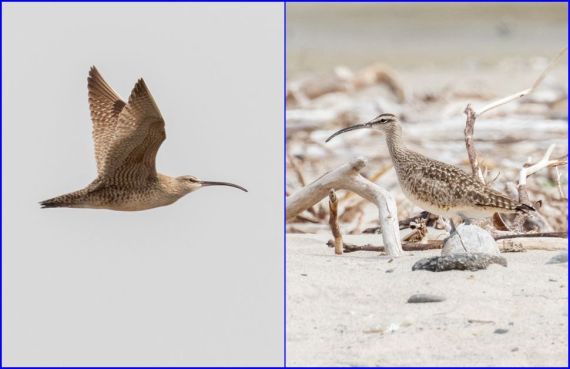
Whimbrel(s) (Chris Tosdevin 4/23/23)
Shorebirds were short of numerous: 88 birds in 8 species, among them 16 Whimbrel. There is a huge amount of driftwood on the sand east of the lagoon. Chris Tosdevin and/or Lu Plauzoles searched painstakingly through it by telescope and managed to find a single solitary Snowy Plover, and very little else. Anyone who has walked on Surfrider Beach during Snowy Plover roosting season (July-April) and nearly stepped on one they didn’t see because these birds look exactly like sand on a sandy beach, will have some appreciation as to how difficult it can be to find one among a large mass of driftwood, 50-150 yards away.

Cormorants, mostly beige-chinned Brandt’s. Look very closely and you see a bit of blue just below the base of the bill on a few. Find the Pelagic singleton. (Chris Tosdevin 4/23/23)
The Osprey was present and quite busy. We watched it make several passes at the lagoon during which it made serious dives over the few pools deep enough to hold a fish larger than a minnow. This involves dropping nearly straight down and pulling up at the last fraction of a second. On the third pass it plunged in feet-first-wings-upraised and came up with a Striped Mullet, then flew off to it’s favorite telephone pole/dining area and went to work on it. We debated how many fish it ate per day: did it eat every day or could it wait a day or two between meals? How big were these fish? Do they like tartar sauce? And so on. We were there on the 23rd of April, and Grace Murayama and Larry Loeher — ace Snowy Plover watcher/wardens — sent me a photo of the bird eating a fish (Mullet, of course!) taken on April 21, two days earlier. So there you have it! There is now at least one record of (almost certainly) the same Osprey eating two Mullet two days apart.
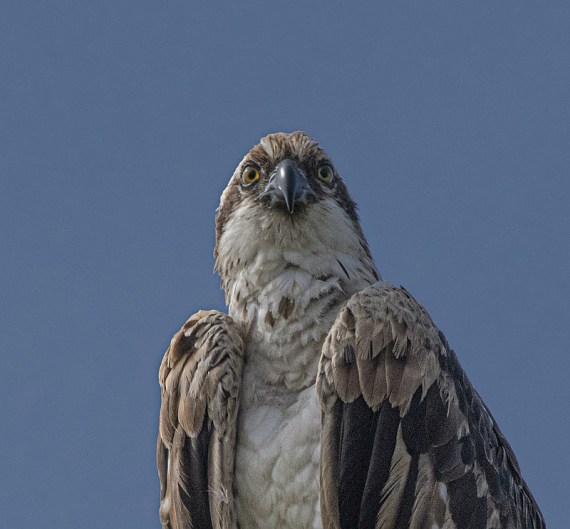
Osprey on his pole. Be thankful you’re not a Mullet! (Ray Juncosa 4/23/23)
According to that bottomless font of all knowledge — Google — an adult Osprey weigh 3 lbs. or 1.4 kg. They’re also 22-25″ long. Using a ruler to compare fish and bird lengths in the photo below, I get a fish that’s ~54% as long as the bird, or 13″.

Osprey #1 and Mullet (Chris Tosdevin 4/23/23)
I found a very handy length-weight chart for fish and dialed in Striped Mullet Mugil cephalus.
- 10 inch – 6 oz, 0.375 lb
- 13 inch – 13 oz, 0.8125 lb
- 15 inch – 19 oz, 1.1875 lb
- 18 inch – 32 oz, 2.00 lb
- 20 inch – 44 oz, 2.75 lb
- 25 inch – 85 oz, 5.31 lb
- 30 inch – 145 oz, 9.06 lb
- And so on
If the fish in the photo is 13″ (I thought longer), it weights 13oz or .8125 lb. Ospreys eat nearly all of the fish — they might skip the nearly fleshless fins and tail — so a fish like this one is ~0.8 lb / 3.0 lb. or = 27% of the bird’s body weight, roughly speaking.
Well, catching your food by flying around and diving repeatedly until you’re successful can take a lot of energy, particular when it comes to hauling a meal that weighs 27% of your total body weigh (they’re capable of hoisting up to 90% of their body weight) out of the water while it’s still mightily resisting, well up into the air and onto a perch where no one is going to come and try to steal it from you. So perhaps eating 27% of your total body weight every other day (or 14% per day on average) is not unreasonable. How much food does a human eat per day? Three pounds, five, eight pounds? If so, for a 150 lb. person, that works out to 2-5% of body weight per day. That’s — as statisticians say in their technical mumbojumbo — a heckova difference, 14% versus 2-5% of body weight. I’d hate to see what would happen to any 150 lb. person who sat down to eat a 21 lb. meal once, let alone every other day.

Osprey #2 over the lagoon (Grace Murayama 4/21/23)
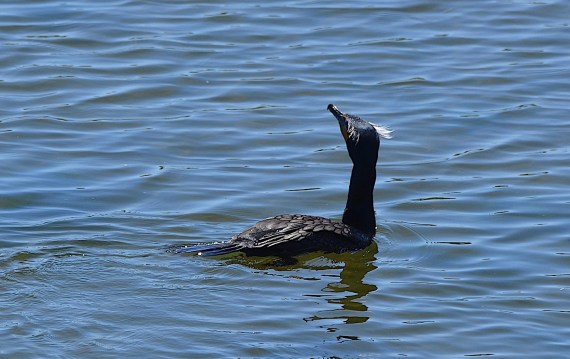
Double-crested Cormorant with white eyebrows (crests), perhaps eyeballing Osprey #2. (Larry Loeher 4/21/23)

Three Mallards flying in close formation. (Ray Juncosa 4/23/23)

Male Mallard & domestic duck (Ray Juncosa 4/23/23)
The above Male Mallard and domestic duck kept very close company the entire time we were there. Grace Murayama photo’d the same pair two days earlier and they were just as close. Domestic ducks are descended from Mallards subjected to many generations of careful breeding by humans [unless they’re carbuncle-faced Muscovy Ducks].
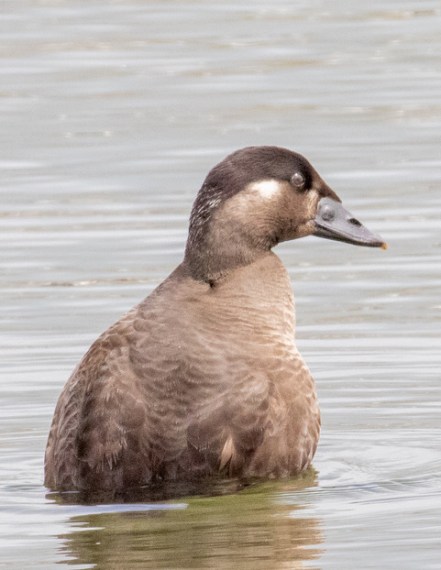
Surf Scoter female (dark cap, some white on nape), slightly oiled.
(Chris Tosdevin 4/23/23)
Surf Scoters are really uncommon within the lagoon, but regular in winter in small numbers offshore, where they can freely dive for mollusks, crustaceans and small fish. This one was sitting on the lagoon shore near some rocks, busily preening her breast. The left side of her breast had a black spot, so she was apparently a bit oiled. The spot was not large, she was ambulatory and would easily evade capture, so we didn’t alert anyone. She was swimming in the lagoon when we left.
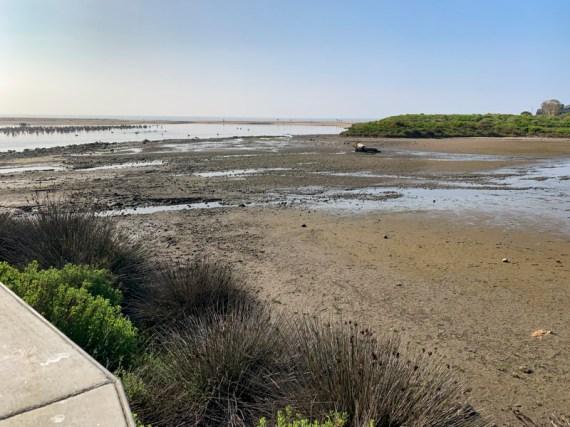
A Mostly dry lagoon, pelicans and terns in left distance. (Ray Juncosa 4/23/23)
Birds new for the Season: Anna’s Hummingbird, Semipalmated Plover, Dunlin, Western Sandpiper, Peregrine Falcon, Pacific-Slope Flycatcher, Wrentit, House Wren, Northern Mockingbird, Hooded Oriole, Brown-headed Cowbird.

American Crow gathering fluff for a nest (Ray Juncosa 4/23/23)
Malibu Lagoon on eBird as of 4-17-23: 6785 lists, 318 species
Many thanks to photographers: Ray Juncosa, Larry Loeher, Grace Murayama & Chris Tosdevin
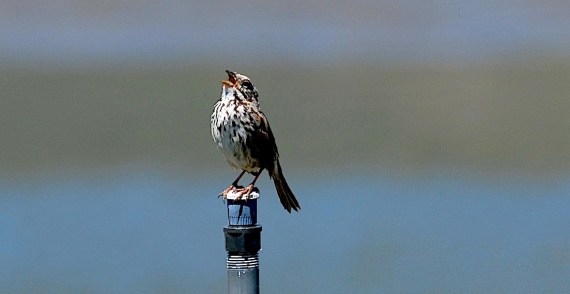
Song Sparrow on the rainbird. They sing a lot; hence the name.
(Grace Murayama 4/21/23)
Upcoming SMBAS scheduled field trips:
- Morongo Valley & Black Rock Campground Sat. May 6, 3pm; Sun May 7, 7:30am. If you want to stay overnight Sat. May 6, reserve a Yucca Valley motel room or Black Rock campsite.
- Malibu Lagoon, Sun May 28, 8:30 am No reservations or Covid card required for this trip.
- Mt. Piños Birds & Butterflies, Sat Jun 17, 8am. Call the leader to let them know you’re coming.
- Malibu Lagoon, Sun Jun 25, 8:30 am No reservations or Covid card required for this trip.
- These and any other trips we announce for the foreseeable future will depend upon expected status of the Covid/flu/etc. pandemic at trip time. Any trip announced may be canceled shortly before trip date if it seems necessary. By now any other comments should be superfluous.
- Link to Programs & Field Trip schedule.
The next SMBAS Zoom program: TBA. Tuesday, 3 Oct. 2023, 7:30 p.m.
The SMBAS 10 a.m. Parent’s & Kids Birdwalk restarted April 23. Reservations for groups (scouts, etc.) necessary, but not for families.

Links: Unusual birds at Malibu Lagoon
9/23/02 Aerial photo of Malibu Lagoon
More recent aerial photo
Prior checklists:
2021: Jan-July, July-Dec 2022: Jan-June, July-Dec
2020: Jan-July, July-Dec 2019: Jan-June, July-Dec
2018: Jan-June, July-Dec 2017: Jan-June, July-Dec
2016: Jan-June, July-Dec 2015: Jan-May, July-Dec
2014: Jan-July, July-Dec 2013: Jan-June, July-Dec
2012: Jan-June, July-Dec 2011: Jan-June, July-Dec
2010: Jan-June, July-Dec 2009: Jan-June, July-Dec
The 10-year comparison summaries created during the Lagoon Reconfiguration Project period, remain available—despite numerous complaints—on our Lagoon Project Bird Census Page. Very briefly summarized, the results unexpectedly indicate that avian species diversification and numbers improved slightly during the restoration period June’12-June’14.
Many thanks to Chris Lord, Chris & Ruth Tosdevin, Ray Juncosa and others for their contributions to this month’s checklist.
The species lists below is irregularly re-sequenced to agree with the California Bird Records Committee Official California Checklist as updated 4 Feb 2023. If part of the chart’s right side is hidden, there’s a slider button at the bottom of the list.
[Chuck Almdale]
| Malibu Census 2022-23 | 11/27 | 12/25 | 1/22 | 2/26 | 3/26 | 4/23 | |
| Temperature | 54-62 | 65-72 | 49-57 | 53-55 | 57-60 | 57-66 | |
| Tide Lo/Hi Height | H+6.04 | H+6.59 | H+6.81 | L+0.81 | L+0.28 | L-.041 | |
| Tide Time | 1045 | 0950 | 0858 | 0911 | 0800 | 0637 | |
| 1 | Canada Goose | 4 | 2 | 6 | 4 | ||
| 1 | Cinnamon Teal | 1 | |||||
| 1 | Northern Shoveler | 7 | |||||
| 1 | Gadwall | 8 | 16 | 26 | 58 | 42 | 24 |
| 1 | American Wigeon | 14 | 8 | 4 | |||
| 1 | Mallard | 16 | 6 | 20 | 32 | 12 | 15 |
| 1 | Green-winged Teal | 6 | 38 | 15 | 26 | 5 | |
| 1 | Redhead | 3 | |||||
| 1 | Lesser Scaup | 1 | |||||
| 1 | Surf Scoter | 12 | 3 | 1 | 6 | 22 | 3 |
| 1 | Bufflehead | 11 | 11 | 10 | 5 | ||
| 1 | Common Goldeneye | 2 | |||||
| 1 | Hooded Merganser | 5 | 1 | ||||
| 1 | Red-breasted Merganser | 25 | 7 | 6 | 3 | 2 | |
| 1 | Ruddy Duck | 32 | 42 | 8 | |||
| 2 | Pied-billed Grebe | 4 | 5 | 2 | 1 | 1 | 2 |
| 2 | Horned Grebe | 1 | |||||
| 2 | Eared Grebe | 8 | 5 | ||||
| 2 | Western Grebe | 4 | 1 | 8 | 40 | 80 | 6 |
| 7 | Feral Pigeon | 4 | 6 | 16 | 5 | 6 | 1 |
| 7 | Mourning Dove | 2 | 2 | 1 | 2 | ||
| 8 | White-throated Swift | 5 | |||||
| 8 | Anna’s Hummingbird | 1 | 2 | 1 | 1 | ||
| 8 | Allen’s Hummingbird | 2 | 2 | 3 | 3 | 2 | |
| 2 | American Coot | 85 | 130 | 38 | 73 | 37 | 6 |
| 5 | Black-bellied Plover | 83 | 51 | 43 | 62 | 3 | |
| 5 | Killdeer | 31 | 11 | 4 | 12 | 5 | 4 |
| 5 | Semipalmated Plover | 14 | |||||
| 5 | Snowy Plover | 18 | 16 | 16 | 1 | ||
| 5 | Whimbrel | 35 | 9 | 7 | 2 | 25 | 16 |
| 5 | Marbled Godwit | 38 | 23 | 18 | 17 | 2 | |
| 5 | Ruddy Turnstone | 4 | 2 | 6 | 3 | ||
| 5 | Sanderling | 45 | 27 | 35 | 32 | 2 | |
| 5 | Dunlin | 2 | |||||
| 5 | Least Sandpiper | 62 | 19 | 22 | 27 | 19 | |
| 5 | Western Sandpiper | 8 | 4 | 30 | |||
| 5 | Willet | 43 | 15 | 15 | 9 | 7 | 2 |
| 6 | Heermann’s Gull | 16 | 85 | 27 | 3 | 3 | 80 |
| 6 | Short-billed Gull | 1 | 1 | ||||
| 6 | Ring-billed Gull | 28 | 55 | 36 | 40 | 46 | 120 |
| 6 | Western Gull | 105 | 68 | 49 | 38 | 26 | 50 |
| 6 | California Gull | 390 | 450 | 1330 | 237 | 95 | 60 |
| 6 | Herring Gull | 2 | 1 | 2 | |||
| 6 | Glaucous-winged Gull | 3 | 7 | 4 | |||
| 6 | Caspian Tern | 2 | |||||
| 6 | Royal Tern | 3 | 2 | 14 | 13 | ||
| 6 | Elegant Tern | 90 | 630 | ||||
| 6 | Black Skimmer | 3 | |||||
| 2 | Red-throated Loon | 1 | 1 | ||||
| 2 | Pacific Loon | 1 | 1 | ||||
| 2 | Common Loon | 1 | 2 | 1 | |||
| 2 | Black-vented Shearwater | 100 | |||||
| 2 | Brandt’s Cormorant | 1 | 12 | ||||
| 2 | Pelagic Cormorant | 4 | 1 | 6 | 1 | 2 | 3 |
| 2 | Double-crested Cormorant | 45 | 62 | 36 | 67 | 26 | 53 |
| 2 | American White Pelican | 1 | |||||
| 2 | Brown Pelican | 220 | 158 | 343 | 159 | 62 | 655 |
| 3 | Great Blue Heron | 3 | 5 | 2 | 2 | ||
| 3 | Great Egret | 5 | 3 | 2 | 2 | 2 | 1 |
| 3 | Snowy Egret | 31 | 35 | 16 | 6 | 2 | 1 |
| 3 | Black-crowned Night-Heron | 1 | 1 | ||||
| 3 | White-faced Ibis | 1 | |||||
| 4 | Turkey Vulture | 1 | 1 | 1 | 5 | 5 | 1 |
| 4 | Osprey | 1 | 1 | ||||
| 4 | Cooper’s Hawk | 1 | |||||
| 4 | Red-tailed Hawk | 3 | 1 | 2 | 2 | ||
| 8 | Belted Kingfisher | 2 | 1 | ||||
| 8 | Nuttall’s Woodpecker | 1 | |||||
| 4 | American Kestrel | 1 | |||||
| 4 | Merlin | 1 | |||||
| 4 | Peregrine Falcon | 1 | |||||
| 9 | Cassin’s Kingbird | 1 | 1 | 1 | 1 | ||
| 9 | Pacific-slope Flycatcher | 1 | |||||
| 9 | Black Phoebe | 3 | 2 | 3 | 3 | 2 | 1 |
| 9 | Say’s Phoebe | 1 | |||||
| 9 | California Scrub-Jay | 1 | 1 | 1 | |||
| 9 | American Crow | 12 | 3 | 11 | 27 | 6 | 4 |
| 9 | Common Raven | 2 | 1 | 2 | |||
| 9 | Northern Rough-winged Swallow | 2 | 6 | 6 | |||
| 9 | Barn Swallow | 14 | 15 | ||||
| 9 | Cliff Swallow | 24 | 3 | 25 | |||
| 9 | Bushtit | 2 | 15 | 14 | 3 | 3 | 2 |
| 9 | Wrentit | 2 | 1 | 1 | |||
| 9 | Ruby-crowned Kinglet | 2 | 1 | 2 | 1 | ||
| 9 | Cedar Waxwing | 12 | |||||
| 9 | Blue-gray Gnatcatcher | 2 | 1 | ||||
| 9 | House Wren | 2 | 1 | 2 | |||
| 9 | Marsh Wren | 1 | |||||
| 9 | Bewick’s Wren | 2 | 1 | ||||
| 9 | Northern Mockingbird | 1 | |||||
| 9 | European Starling | 6 | 9 | 2 | |||
| 9 | Hermit Thrush | 3 | 1 | ||||
| 9 | House Finch | 18 | 16 | 9 | 6 | 5 | 7 |
| 9 | Lesser Goldfinch | 6 | 4 | 10 | 5 | 2 | |
| 9 | White-crowned Sparrow | 40 | 16 | 12 | 25 | 12 | |
| 9 | Song Sparrow | 6 | 4 | 5 | 5 | 7 | |
| 9 | California Towhee | 6 | 1 | 3 | 3 | 1 | 5 |
| 9 | Spotted Towhee | 1 | |||||
| 9 | Hooded Oriole | 1 | |||||
| 9 | Red-winged Blackbird | 3 | 8 | 12 | 2 | ||
| 9 | Brown-headed Cowbird | 1 | |||||
| 9 | Great-tailed Grackle | 1 | 6 | 4 | |||
| 9 | Orange-crowned Warbler | 1 | 1 | 3 | 1 | ||
| 9 | Common Yellowthroat | 2 | 1 | 2 | 4 | 3 | 1 |
| 9 | Yellow-rumped Warbler (Audubon’s) | 16 | 15 | 6 | 2 | 7 | |
| 9 | Townsend’s Warbler | 1 | |||||
| Totals by Type | Nov | Dec | Jan | Feb | Mar | Apr | |
| 1 | Waterfowl | 125 | 136 | 85 | 152 | 92 | 46 |
| 2 | Water Birds – Other | 471 | 363 | 434 | 343 | 212 | 739 |
| 3 | Herons, Egrets & Ibis | 40 | 44 | 20 | 9 | 6 | 2 |
| 4 | Quail & Raptors | 1 | 6 | 1 | 7 | 8 | 5 |
| 5 | Shorebirds | 367 | 161 | 166 | 180 | 44 | 88 |
| 6 | Gulls & Terns | 546 | 658 | 1453 | 341 | 277 | 940 |
| 7 | Doves | 6 | 6 | 16 | 7 | 7 | 3 |
| 8 | Other Non-Passerines | 5 | 2 | 5 | 3 | 8 | 3 |
| 9 | Passerines | 129 | 84 | 96 | 128 | 99 | 89 |
| Totals Birds | 1690 | 1460 | 2276 | 1170 | 753 | 1915 | |
| Total Species | Nov | Dec | Jan | Feb | Mar | Apr | |
| 1 | Waterfowl | 9 | 9 | 9 | 11 | 7 | 4 |
| 2 | Water Birds – Other | 9 | 8 | 7 | 8 | 9 | 9 |
| 3 | Herons, Egrets & Ibis | 4 | 4 | 3 | 3 | 3 | 2 |
| 4 | Quail & Raptors | 1 | 4 | 1 | 3 | 3 | 4 |
| 5 | Shorebirds | 10 | 9 | 9 | 9 | 6 | 8 |
| 6 | Gulls & Terns | 7 | 4 | 7 | 9 | 8 | 5 |
| 7 | Doves | 2 | 1 | 1 | 2 | 2 | 2 |
| 8 | Other Non-Passerines | 3 | 1 | 4 | 1 | 2 | 2 |
| 9 | Passerines | 20 | 15 | 20 | 18 | 20 | 20 |
| Totals Species – 106 | 65 | 55 | 61 | 64 | 60 | 56 |
Why poison ivy is an unlikely climate change winner
[Posted by Chuck Almdale]
[Note: This is in honor of LP who showed up at the lagoon today with a bad poison ivy rash. And, of course, for anyone else allergic to this plant, which means most of us.]
[Additional Note: Let me know if you are blocked from accessing the full article.]

In springtime, poison ivy (seen here growing in Ontario, Canada) is often shiny and light green, but it can proceed to becoming matte, or dark green, with reddish or bronze tinges.
Why poison ivy is an unlikely climate change winner
National Geographic | Douglas Main | 18 Apr 2023
From the article:
This plant stands to benefit immensely from climate change. In a six-year study conducted at Duke University in the early 2000s, scientists raised ambient levels of carbon dioxide in a forest plot to 570 ppm over the course of the experiment, roughly the concentrations expected by the end of the 21st century. They found that poison ivy increased its biomass by 67 percent more than poison ivy without elevated levels of the greenhouse gas.
The plant also produced a more allergenic form of urushiol in the future-climate scenario, with an altered amount of saturated carbon-carbon bonds that make it more likely to cause rashes, Ziska says.
An old-time saying warns that if a plant has leaves of three, let it be. This bit of folk wisdom is meant to warn people about poison ivy, a noxious vine in the genus Toxicodendron found throughout much of North America. Poison ivy contains a chemical that can cause a vicious allergic reaction when it comes into contact with skin. This rash consists of oozing blisters that itch and hurt. Luckily, if within a couple hours of exposure you wash off the oil with soap—and, ideally, a washcloth—you can spare yourself the whole ordeal.
Sycamore Canyon Field Trip April 8, 2023
It’s been a few years since we last visited Sycamore Canyon, and what with all the rain we expected a very green trip. Which we got. We also put to rest the saying from that old joker Heraclitus that you can never step in the same river twice. Nonsense. Those of us who insisted on visiting Serrano Canyon crossed the same creek 12 times, 10 of which were wet crossings.
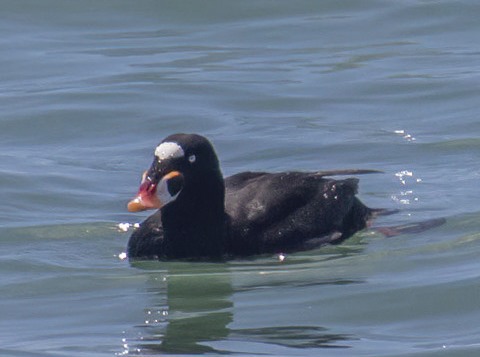
Surf Scoter (Chris Tosdevin)
Sharp-eyed Chris spotted through the PCH underpass and saw this Surf Scoter in the ocean. We weren’t really here for seabirds but whatever. Cliff Swallows were building nests under the eaves of the restroom in the parking lot. There were about 20 of us and we moved inland through the campgrounds (full). Lots of grass from all the rain. The sycamores were not leafed out, surprisingly, so at least the birds were easy to spot.
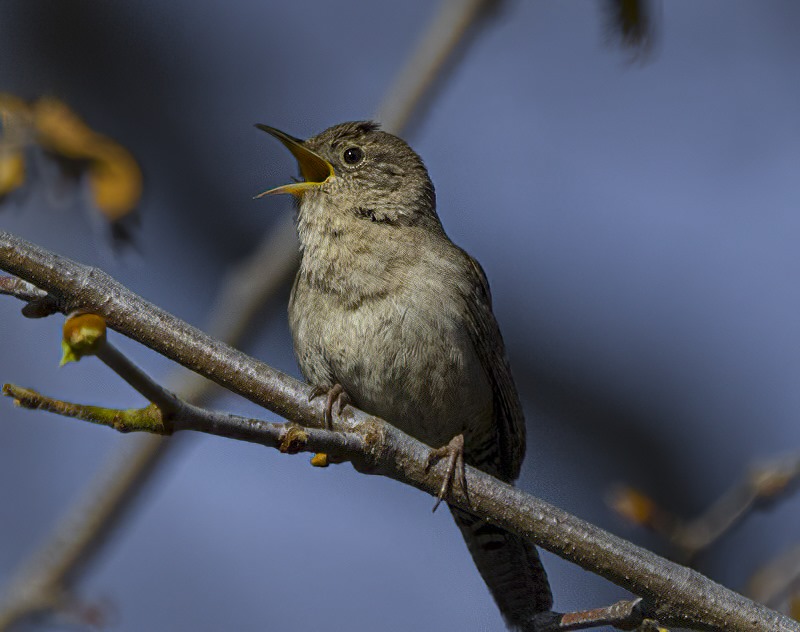
House Wren (Ray Juncosa)
The first really obvious bird was the House Wren. There turned out to be several, singing and posing near the trail. Warblers? Frequent views of Yellow-rumps and a few lucky people saw the Black-throated Gray.

Yellow-rumped Warbler (Ray Juncosa)

Black-throated Gray Warbler (Chris Tosdevin)
The perils of warbler photography – the little devils are always moving.
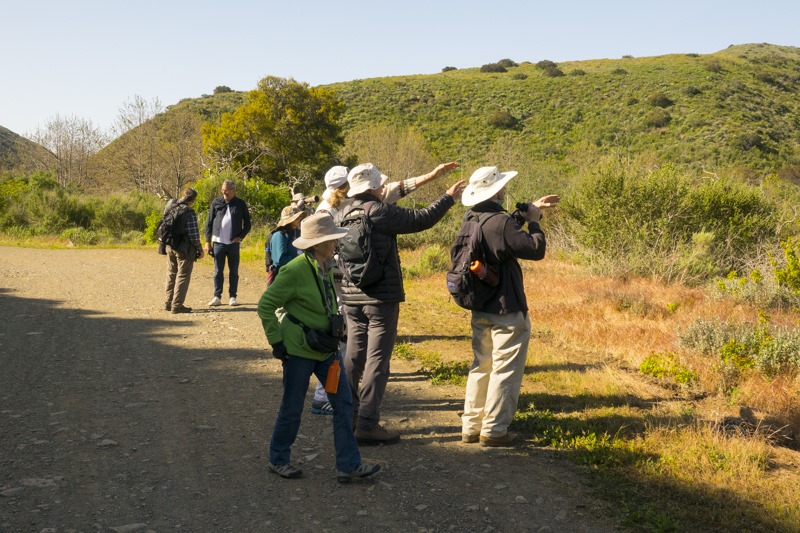
Perhaps the most colorful birds showed up next.

Bullock’s Oriole (Annie Flower)

Hooded Oriole (Annie Flower)
Both oriole species were in full breeding plumage. We spent a little time deciding which species the females were but the males were unmistakable.
The most common bird in the canyon was probably the Nanday Parakeet. We can remember when seeing one was special; now they are in the hundreds if not thousands up and down the coast from Mugu to Santa Monica. They are native to the central interior of South America from Brazil to Argentina. A few caged birds escaped and have joined the immense population of exotic parrots in Southern California. Nandays are noisy (surprise – they are parrots) and they are cavity nesters. We wondered how they are affecting the native cavity nesters but don’t really know.

Nanday Parakeet (Ray Juncosa)

Nanday Parakeet (Annie Flower)
Most of the time the Nandays just look like green birds with black heads, but in this fabulous photo you can see, well, just count the colors. Plus, not visible here, they have red knickers.
We made the first creek crossing relatively dry because there was a helpful log already there. Hikers who knew what they were doing were wearing quality sandals and they just marched across.
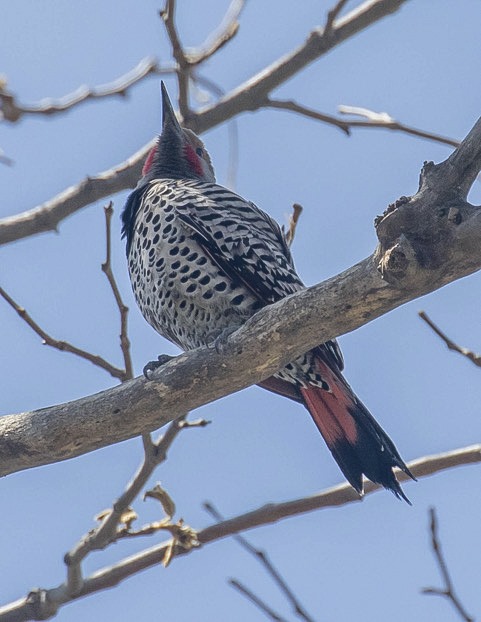
Northern Flicker (Chris Tosdevin)
Several flickers flew about and called. It’s Spring.

American Kestrel (Annie Flower)
A pair of kestrels were courting. Until I looked closely at this photo I did not realize that this kestrel has been hunting.
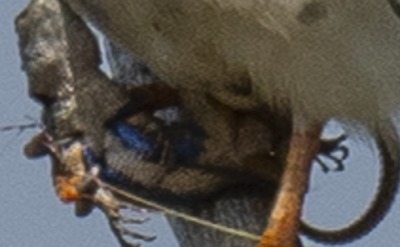
If you look carefully you will see a blue mark and some extra feet. I think it’s a Western Fence Lizard that has become lunch.
When we reached the second creek crossing there was no log. We knew there would be more crossings and so a few decided to turn back instead of soaking their shoes for the long trek back. The rest of us forged on to the turnoff for Serrano Canyon.

Serrano Canyon
Since I had not been getting any bird images I decided to become the official Vegetation Photographer of the trip. This is a typical view of Serrano Canyon from its trail.

The was the last of four crossings in Serrano – the only dry one.

Big-pod Ceanothus (Ceanothus megacarpus) [probably]
There were lots of these white ceanothus bushes in the canyon. Much more impressive than the photo.

Parry’s Phacelia (Phacelia parryi)
One of our prettiest native flowers, the Parry’s Phacelia is also called the Fire Follower, often found on bare or disturbed ground. It’s common here in the western Santa Monica Mountains, but not so much to the east. The flowers are a half to one inch across.
But we digress. The reason we forded so many treacherous and mighty rivers was to find the Canyon Wren and the surprisingly less common Rock Wren.
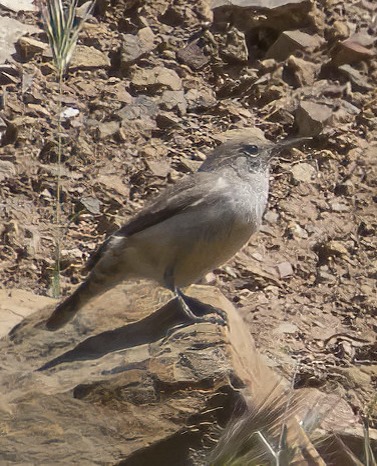
Rock Wren (Chris Tosdevin)
We finally got a glimpse of the Rock Wren, waaaaay up the rocky slope. That Chris got any kind of photo is amazing.
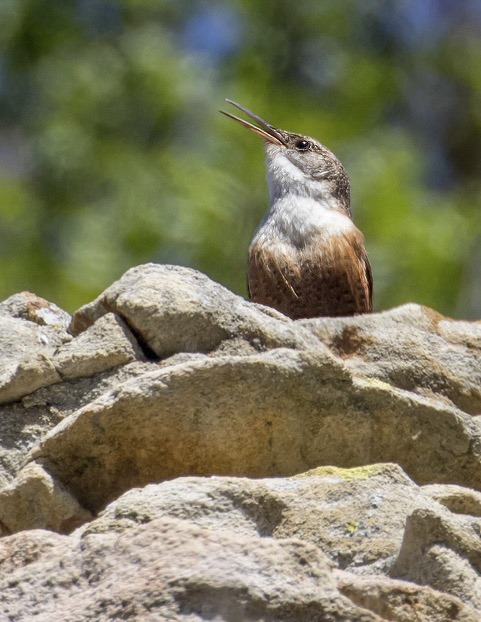
Guaranteed Canyon Wren (Catherpes mexicanus youbetcha) [Chris Tosdevin]
And yes, on this trip we guarantee the Canyon Wren for those intrepid enough to make it up Serrano Canyon. We heard it singing long before seeing it, but the song is pretty nice too.
After we made it back, wet shoes and all, we totalled a list of 55 species for the day. It was a beautiful day for a three-mile round trip in the Spring. Many thanks to the photographers: Annie Flower, Ray Juncosa and Chris Tosdevin.
Mallard
Surf Scoter
California Quail
Mourning Dove
White-throated Swift
Anna’s Hummingbird
Allen’s Hummingbird
Spotted Sandpiper
Western Gull
Brown Pelican
Turkey Vulture
Red-shouldered Hawk
Red-tailed Hawk
Acorn Woodpecker
Nuttall’s Woodpecker
Northern Flicker
American Kestrel
Nanday Parakeet
Pacific-slope Flycatcher
Black Phoebe
Cassin’s Kingbird
California Scrub-Jay
American Crow
Common Raven
Oak Titmouse
Northern Rough-winged Swallow
Violet-green Swallow
Cliff Swallow
Wrentit
White-breasted Nuthatch
Blue-gray Gnatcatcher
Rock Wren
Canyon Wren
House Wren
Bewick’s Wren
European Starling
California Thrasher
Western Bluebird
Hermit Thrush
House Finch
Lesser Goldfinch
Dark-eyed Junco
White-crowned Sparrow
Golden-crowned Sparrow
Song Sparrow
California Towhee
Spotted Towhee
Hooded Oriole
Bullock’s Oriole
Brown-headed Cowbird
Orange-crowned Warbler
Common Yellowthroat
Yellow-rumped Warbler
Black-throated Gray Warbler
Black-headed Grosbeak
The recording of this program is now available

|
Gifts of the Crow, with Dr. John Marzluff.
Crows are mischievous, playful, social, passionate, and eloquent, with brains huge for their body size. They mate for life and associate with relatives and neighbors for years. And they know us. They live in our gardens, parks, and cities, they recognize our peculiarities, they avoid those who scold or threaten, they approach those who care for and feed them. They give us gifts. Humans and corvids have culturally co-evolved and we share the seven traits of language, delinquency, frolic, passion, wrath, risk-taking, and awareness.
With his extraordinary research on the intelligence and startling abilities of corvids—crows, ravens, and jays—scientist John Marzluff tells amazing stories of these brilliant birds and offer us an in-depth look at these complex creatures and our shared behaviors.
Dr. John Marzluff is a Professor of Wildlife Science at the University of Washington School of Environmental and Forest Studies. He earned his B.Sc. in Wildlife Biology, at the University of Montana, his M.Sc. Biology and his Ph.D. in Zoology, both at Northern Arizona University, Flagstaff. He did Postdoctoral Studies at the University of Vermont.
Among his published materials he has written a book entitled Gifts of the Crow: How Perception, Emotion, and Thought Allow Smart Birds to Behave Like Humans. He is, in his own words, “an enthusiastic teacher who thrives on the intellectual challenge of keeping a step ahead of highly motivated students.”
Dr. John’s Other Offers
International Collegiate Ornithological Network – Facebook
Crow Scientist: The real-world science app for kids — at your App store
Avian Conservation Lab Website



 SANTA MONICA BAY AUDUBON SOCIETY BLOG