Free email delivery
Please sign up for email delivery in the subscription area to the right.
No salesman will call, at least not from us. Maybe from someone else.
[By Chuck Almdale]

Orange-crowned Warbler showing its rarely seen orange crown.
(Chris Tosdevin 4/23/23)
The tide was really low today at -0.41 ft. — any negative tide here is exceptionally low. That came at 6:37am and by 8:30 water was beginning to rise. As the pictures below show it remained low for most of the walk.

North channel nearly dry (Ray Juncosa 4/23/23)
From the first view point we could see a lot of terns and pelicans, mostly on the lagoon far (east) side. All the pelicans were brown. We searched through the terns repeatedly but could not for certain find a Royal, and there were no Caspian. We wound up with 655 Brown Pelicans and 630 Elegant Terns. Fortunately for me I had arrived early, saw the large flock and had time to count them before the birders arrived.

2.06% of the Elegant Terns (Chris Tosdevin 4/23/23)
For me the star of the day was the Orange-crowned Warbler whose photo begins this blog. This is one of SoCal’s more common warblers, with the Yellow-rumped (Audubon’s) Warbler leading the pack, although Wilson’s Warbler can be quite abundant during spring migration. We may see Orange-crowned any time of year and I’ve quite possibly seen them thousands of times. [I’m not going to estimate closer than that.] But I can count on one hand — aka two-thumbs-and-a-finger — how many times I’ve seen the orange crown on the Orange-crowned. We managed to get one of the telescopes on it despite the fact that it was almost directly overhead — a tough angle for a scope — singing for all it was worth. It was also frequently leaning forward and down, allowing us a glimpse of the spread feathers of the crown. I told everyone to take a good look as they might never see this again during this particular lifetime. Fortunately Chris Tosdevin got a photo that shows the crown.

Barn Swallows gathering mud by the mouthful and apparently falling all over each other. (Chris Tosdevin 4/23/23)
Another fun sighting but not nearly as rare as we see it every year at this time: Barn Swallows gathering mud. Mouthful by mouthful they build their cup-shaped nests by sticking mouth-sized globs (a technical ornithological term) of mud onto a stony (or cement or brick) wall. They used to nest under the PCH bridge, but now it’s further away, the other side of the shopping center. Someone in the group asked why they all had their wings constantly waving in the air. I didn’t (and still don’t) really know for certain, but I can conjecture two reasons: 1) the mud is sticky and by waving their arms…er, wings…around they get a little bit of extra wiggly jiggly leverage to pry a bite-sized mud glob loose from the sticky mass; 2) all the while they’re struggling with this mud they’re in the open, on a mud flat, fair game for any predator flying by or skulking in the bushes; perhaps they can escape slightly more quickly should a Peregrine Falcon choose to stoop on them. This is not totally idle speculation as there was a Peregrine Falcon present today. [Later Note] I was advised by Chris Lord that female swallows wave their wings to keep males from trying to mate with them. If this is true and applies here, then the mud-gatherers were all female.]
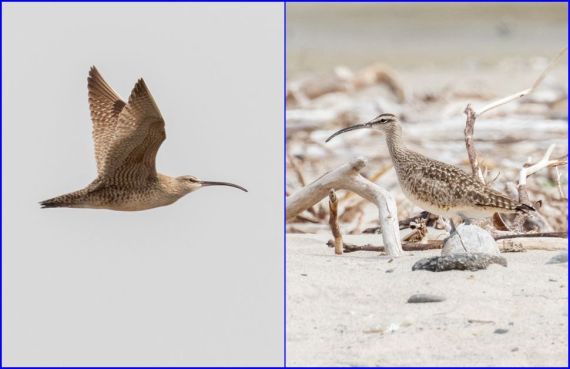
Whimbrel(s) (Chris Tosdevin 4/23/23)
Shorebirds were short of numerous: 88 birds in 8 species, among them 16 Whimbrel. There is a huge amount of driftwood on the sand east of the lagoon. Chris Tosdevin and/or Lu Plauzoles searched painstakingly through it by telescope and managed to find a single solitary Snowy Plover, and very little else. Anyone who has walked on Surfrider Beach during Snowy Plover roosting season (July-April) and nearly stepped on one they didn’t see because these birds look exactly like sand on a sandy beach, will have some appreciation as to how difficult it can be to find one among a large mass of driftwood, 50-150 yards away.

Cormorants, mostly beige-chinned Brandt’s. Look very closely and you see a bit of blue just below the base of the bill on a few. Find the Pelagic singleton. (Chris Tosdevin 4/23/23)
The Osprey was present and quite busy. We watched it make several passes at the lagoon during which it made serious dives over the few pools deep enough to hold a fish larger than a minnow. This involves dropping nearly straight down and pulling up at the last fraction of a second. On the third pass it plunged in feet-first-wings-upraised and came up with a Striped Mullet, then flew off to it’s favorite telephone pole/dining area and went to work on it. We debated how many fish it ate per day: did it eat every day or could it wait a day or two between meals? How big were these fish? Do they like tartar sauce? And so on. We were there on the 23rd of April, and Grace Murayama and Larry Loeher — ace Snowy Plover watcher/wardens — sent me a photo of the bird eating a fish (Mullet, of course!) taken on April 21, two days earlier. So there you have it! There is now at least one record of (almost certainly) the same Osprey eating two Mullet two days apart.
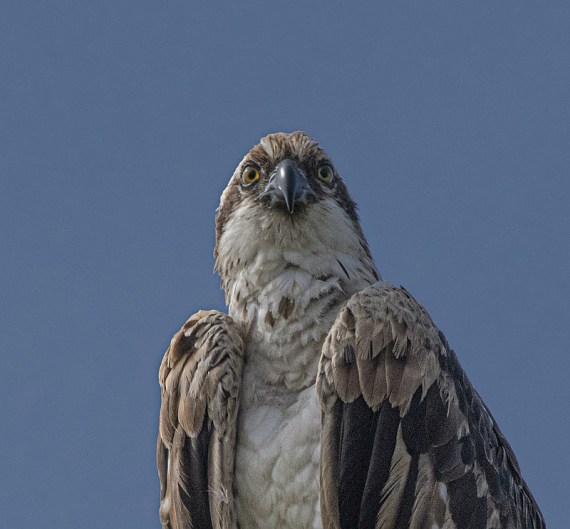
Osprey on his pole. Be thankful you’re not a Mullet! (Ray Juncosa 4/23/23)
According to that bottomless font of all knowledge — Google — an adult Osprey weigh 3 lbs. or 1.4 kg. They’re also 22-25″ long. Using a ruler to compare fish and bird lengths in the photo below, I get a fish that’s ~54% as long as the bird, or 13″.

Osprey #1 and Mullet (Chris Tosdevin 4/23/23)
I found a very handy length-weight chart for fish and dialed in Striped Mullet Mugil cephalus.
- 10 inch – 6 oz, 0.375 lb
- 13 inch – 13 oz, 0.8125 lb
- 15 inch – 19 oz, 1.1875 lb
- 18 inch – 32 oz, 2.00 lb
- 20 inch – 44 oz, 2.75 lb
- 25 inch – 85 oz, 5.31 lb
- 30 inch – 145 oz, 9.06 lb
- And so on
If the fish in the photo is 13″ (I thought longer), it weights 13oz or .8125 lb. Ospreys eat nearly all of the fish — they might skip the nearly fleshless fins and tail — so a fish like this one is ~0.8 lb / 3.0 lb. or = 27% of the bird’s body weight, roughly speaking.
Well, catching your food by flying around and diving repeatedly until you’re successful can take a lot of energy, particular when it comes to hauling a meal that weighs 27% of your total body weigh (they’re capable of hoisting up to 90% of their body weight) out of the water while it’s still mightily resisting, well up into the air and onto a perch where no one is going to come and try to steal it from you. So perhaps eating 27% of your total body weight every other day (or 14% per day on average) is not unreasonable. How much food does a human eat per day? Three pounds, five, eight pounds? If so, for a 150 lb. person, that works out to 2-5% of body weight per day. That’s — as statisticians say in their technical mumbojumbo — a heckova difference, 14% versus 2-5% of body weight. I’d hate to see what would happen to any 150 lb. person who sat down to eat a 21 lb. meal once, let alone every other day.

Osprey #2 over the lagoon (Grace Murayama 4/21/23)
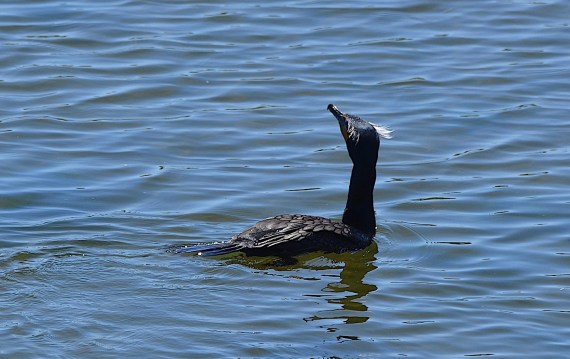
Double-crested Cormorant with white eyebrows (crests), perhaps eyeballing Osprey #2. (Larry Loeher 4/21/23)

Three Mallards flying in close formation. (Ray Juncosa 4/23/23)

Male Mallard & domestic duck (Ray Juncosa 4/23/23)
The above Male Mallard and domestic duck kept very close company the entire time we were there. Grace Murayama photo’d the same pair two days earlier and they were just as close. Domestic ducks are descended from Mallards subjected to many generations of careful breeding by humans [unless they’re carbuncle-faced Muscovy Ducks].
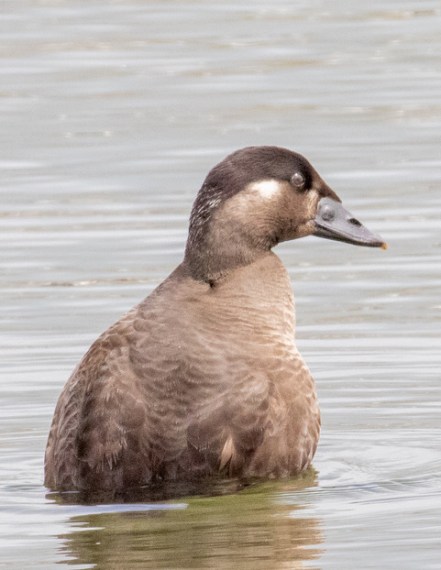
Surf Scoter female (dark cap, some white on nape), slightly oiled.
(Chris Tosdevin 4/23/23)
Surf Scoters are really uncommon within the lagoon, but regular in winter in small numbers offshore, where they can freely dive for mollusks, crustaceans and small fish. This one was sitting on the lagoon shore near some rocks, busily preening her breast. The left side of her breast had a black spot, so she was apparently a bit oiled. The spot was not large, she was ambulatory and would easily evade capture, so we didn’t alert anyone. She was swimming in the lagoon when we left.
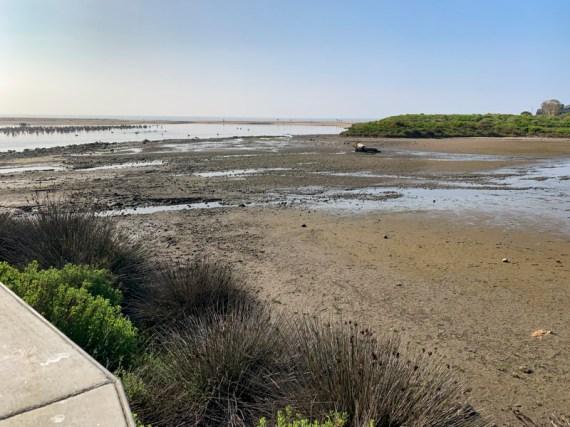
A Mostly dry lagoon, pelicans and terns in left distance. (Ray Juncosa 4/23/23)
Birds new for the Season: Anna’s Hummingbird, Semipalmated Plover, Dunlin, Western Sandpiper, Peregrine Falcon, Pacific-Slope Flycatcher, Wrentit, House Wren, Northern Mockingbird, Hooded Oriole, Brown-headed Cowbird.

American Crow gathering fluff for a nest (Ray Juncosa 4/23/23)
Malibu Lagoon on eBird as of 4-17-23: 6785 lists, 318 species
Many thanks to photographers: Ray Juncosa, Larry Loeher, Grace Murayama & Chris Tosdevin
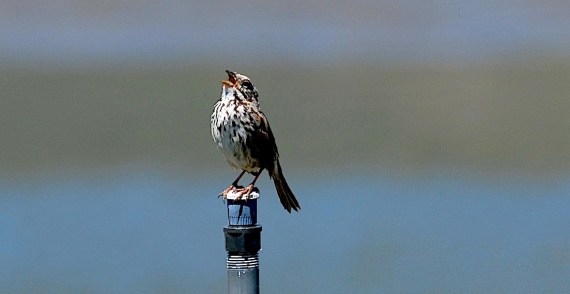
Song Sparrow on the rainbird. They sing a lot; hence the name.
(Grace Murayama 4/21/23)
Upcoming SMBAS scheduled field trips:
- Morongo Valley & Black Rock Campground Sat. May 6, 3pm; Sun May 7, 7:30am. If you want to stay overnight Sat. May 6, reserve a Yucca Valley motel room or Black Rock campsite.
- Malibu Lagoon, Sun May 28, 8:30 am No reservations or Covid card required for this trip.
- Mt. Piños Birds & Butterflies, Sat Jun 17, 8am. Call the leader to let them know you’re coming.
- Malibu Lagoon, Sun Jun 25, 8:30 am No reservations or Covid card required for this trip.
- These and any other trips we announce for the foreseeable future will depend upon expected status of the Covid/flu/etc. pandemic at trip time. Any trip announced may be canceled shortly before trip date if it seems necessary. By now any other comments should be superfluous.
- Link to Programs & Field Trip schedule.
The next SMBAS Zoom program: TBA. Tuesday, 3 Oct. 2023, 7:30 p.m.
The SMBAS 10 a.m. Parent’s & Kids Birdwalk restarted April 23. Reservations for groups (scouts, etc.) necessary, but not for families.

Links: Unusual birds at Malibu Lagoon
9/23/02 Aerial photo of Malibu Lagoon
More recent aerial photo
Prior checklists:
2021: Jan-July, July-Dec 2022: Jan-June, July-Dec
2020: Jan-July, July-Dec 2019: Jan-June, July-Dec
2018: Jan-June, July-Dec 2017: Jan-June, July-Dec
2016: Jan-June, July-Dec 2015: Jan-May, July-Dec
2014: Jan-July, July-Dec 2013: Jan-June, July-Dec
2012: Jan-June, July-Dec 2011: Jan-June, July-Dec
2010: Jan-June, July-Dec 2009: Jan-June, July-Dec
The 10-year comparison summaries created during the Lagoon Reconfiguration Project period, remain available—despite numerous complaints—on our Lagoon Project Bird Census Page. Very briefly summarized, the results unexpectedly indicate that avian species diversification and numbers improved slightly during the restoration period June’12-June’14.
Many thanks to Chris Lord, Chris & Ruth Tosdevin, Ray Juncosa and others for their contributions to this month’s checklist.
The species lists below is irregularly re-sequenced to agree with the California Bird Records Committee Official California Checklist as updated 4 Feb 2023. If part of the chart’s right side is hidden, there’s a slider button at the bottom of the list.
[Chuck Almdale]
| Malibu Census 2022-23 | 11/27 | 12/25 | 1/22 | 2/26 | 3/26 | 4/23 | |
| Temperature | 54-62 | 65-72 | 49-57 | 53-55 | 57-60 | 57-66 | |
| Tide Lo/Hi Height | H+6.04 | H+6.59 | H+6.81 | L+0.81 | L+0.28 | L-.041 | |
| Tide Time | 1045 | 0950 | 0858 | 0911 | 0800 | 0637 | |
| 1 | Canada Goose | 4 | 2 | 6 | 4 | ||
| 1 | Cinnamon Teal | 1 | |||||
| 1 | Northern Shoveler | 7 | |||||
| 1 | Gadwall | 8 | 16 | 26 | 58 | 42 | 24 |
| 1 | American Wigeon | 14 | 8 | 4 | |||
| 1 | Mallard | 16 | 6 | 20 | 32 | 12 | 15 |
| 1 | Green-winged Teal | 6 | 38 | 15 | 26 | 5 | |
| 1 | Redhead | 3 | |||||
| 1 | Lesser Scaup | 1 | |||||
| 1 | Surf Scoter | 12 | 3 | 1 | 6 | 22 | 3 |
| 1 | Bufflehead | 11 | 11 | 10 | 5 | ||
| 1 | Common Goldeneye | 2 | |||||
| 1 | Hooded Merganser | 5 | 1 | ||||
| 1 | Red-breasted Merganser | 25 | 7 | 6 | 3 | 2 | |
| 1 | Ruddy Duck | 32 | 42 | 8 | |||
| 2 | Pied-billed Grebe | 4 | 5 | 2 | 1 | 1 | 2 |
| 2 | Horned Grebe | 1 | |||||
| 2 | Eared Grebe | 8 | 5 | ||||
| 2 | Western Grebe | 4 | 1 | 8 | 40 | 80 | 6 |
| 7 | Feral Pigeon | 4 | 6 | 16 | 5 | 6 | 1 |
| 7 | Mourning Dove | 2 | 2 | 1 | 2 | ||
| 8 | White-throated Swift | 5 | |||||
| 8 | Anna’s Hummingbird | 1 | 2 | 1 | 1 | ||
| 8 | Allen’s Hummingbird | 2 | 2 | 3 | 3 | 2 | |
| 2 | American Coot | 85 | 130 | 38 | 73 | 37 | 6 |
| 5 | Black-bellied Plover | 83 | 51 | 43 | 62 | 3 | |
| 5 | Killdeer | 31 | 11 | 4 | 12 | 5 | 4 |
| 5 | Semipalmated Plover | 14 | |||||
| 5 | Snowy Plover | 18 | 16 | 16 | 1 | ||
| 5 | Whimbrel | 35 | 9 | 7 | 2 | 25 | 16 |
| 5 | Marbled Godwit | 38 | 23 | 18 | 17 | 2 | |
| 5 | Ruddy Turnstone | 4 | 2 | 6 | 3 | ||
| 5 | Sanderling | 45 | 27 | 35 | 32 | 2 | |
| 5 | Dunlin | 2 | |||||
| 5 | Least Sandpiper | 62 | 19 | 22 | 27 | 19 | |
| 5 | Western Sandpiper | 8 | 4 | 30 | |||
| 5 | Willet | 43 | 15 | 15 | 9 | 7 | 2 |
| 6 | Heermann’s Gull | 16 | 85 | 27 | 3 | 3 | 80 |
| 6 | Short-billed Gull | 1 | 1 | ||||
| 6 | Ring-billed Gull | 28 | 55 | 36 | 40 | 46 | 120 |
| 6 | Western Gull | 105 | 68 | 49 | 38 | 26 | 50 |
| 6 | California Gull | 390 | 450 | 1330 | 237 | 95 | 60 |
| 6 | Herring Gull | 2 | 1 | 2 | |||
| 6 | Glaucous-winged Gull | 3 | 7 | 4 | |||
| 6 | Caspian Tern | 2 | |||||
| 6 | Royal Tern | 3 | 2 | 14 | 13 | ||
| 6 | Elegant Tern | 90 | 630 | ||||
| 6 | Black Skimmer | 3 | |||||
| 2 | Red-throated Loon | 1 | 1 | ||||
| 2 | Pacific Loon | 1 | 1 | ||||
| 2 | Common Loon | 1 | 2 | 1 | |||
| 2 | Black-vented Shearwater | 100 | |||||
| 2 | Brandt’s Cormorant | 1 | 12 | ||||
| 2 | Pelagic Cormorant | 4 | 1 | 6 | 1 | 2 | 3 |
| 2 | Double-crested Cormorant | 45 | 62 | 36 | 67 | 26 | 53 |
| 2 | American White Pelican | 1 | |||||
| 2 | Brown Pelican | 220 | 158 | 343 | 159 | 62 | 655 |
| 3 | Great Blue Heron | 3 | 5 | 2 | 2 | ||
| 3 | Great Egret | 5 | 3 | 2 | 2 | 2 | 1 |
| 3 | Snowy Egret | 31 | 35 | 16 | 6 | 2 | 1 |
| 3 | Black-crowned Night-Heron | 1 | 1 | ||||
| 3 | White-faced Ibis | 1 | |||||
| 4 | Turkey Vulture | 1 | 1 | 1 | 5 | 5 | 1 |
| 4 | Osprey | 1 | 1 | ||||
| 4 | Cooper’s Hawk | 1 | |||||
| 4 | Red-tailed Hawk | 3 | 1 | 2 | 2 | ||
| 8 | Belted Kingfisher | 2 | 1 | ||||
| 8 | Nuttall’s Woodpecker | 1 | |||||
| 4 | American Kestrel | 1 | |||||
| 4 | Merlin | 1 | |||||
| 4 | Peregrine Falcon | 1 | |||||
| 9 | Cassin’s Kingbird | 1 | 1 | 1 | 1 | ||
| 9 | Pacific-slope Flycatcher | 1 | |||||
| 9 | Black Phoebe | 3 | 2 | 3 | 3 | 2 | 1 |
| 9 | Say’s Phoebe | 1 | |||||
| 9 | California Scrub-Jay | 1 | 1 | 1 | |||
| 9 | American Crow | 12 | 3 | 11 | 27 | 6 | 4 |
| 9 | Common Raven | 2 | 1 | 2 | |||
| 9 | Northern Rough-winged Swallow | 2 | 6 | 6 | |||
| 9 | Barn Swallow | 14 | 15 | ||||
| 9 | Cliff Swallow | 24 | 3 | 25 | |||
| 9 | Bushtit | 2 | 15 | 14 | 3 | 3 | 2 |
| 9 | Wrentit | 2 | 1 | 1 | |||
| 9 | Ruby-crowned Kinglet | 2 | 1 | 2 | 1 | ||
| 9 | Cedar Waxwing | 12 | |||||
| 9 | Blue-gray Gnatcatcher | 2 | 1 | ||||
| 9 | House Wren | 2 | 1 | 2 | |||
| 9 | Marsh Wren | 1 | |||||
| 9 | Bewick’s Wren | 2 | 1 | ||||
| 9 | Northern Mockingbird | 1 | |||||
| 9 | European Starling | 6 | 9 | 2 | |||
| 9 | Hermit Thrush | 3 | 1 | ||||
| 9 | House Finch | 18 | 16 | 9 | 6 | 5 | 7 |
| 9 | Lesser Goldfinch | 6 | 4 | 10 | 5 | 2 | |
| 9 | White-crowned Sparrow | 40 | 16 | 12 | 25 | 12 | |
| 9 | Song Sparrow | 6 | 4 | 5 | 5 | 7 | |
| 9 | California Towhee | 6 | 1 | 3 | 3 | 1 | 5 |
| 9 | Spotted Towhee | 1 | |||||
| 9 | Hooded Oriole | 1 | |||||
| 9 | Red-winged Blackbird | 3 | 8 | 12 | 2 | ||
| 9 | Brown-headed Cowbird | 1 | |||||
| 9 | Great-tailed Grackle | 1 | 6 | 4 | |||
| 9 | Orange-crowned Warbler | 1 | 1 | 3 | 1 | ||
| 9 | Common Yellowthroat | 2 | 1 | 2 | 4 | 3 | 1 |
| 9 | Yellow-rumped Warbler (Audubon’s) | 16 | 15 | 6 | 2 | 7 | |
| 9 | Townsend’s Warbler | 1 | |||||
| Totals by Type | Nov | Dec | Jan | Feb | Mar | Apr | |
| 1 | Waterfowl | 125 | 136 | 85 | 152 | 92 | 46 |
| 2 | Water Birds – Other | 471 | 363 | 434 | 343 | 212 | 739 |
| 3 | Herons, Egrets & Ibis | 40 | 44 | 20 | 9 | 6 | 2 |
| 4 | Quail & Raptors | 1 | 6 | 1 | 7 | 8 | 5 |
| 5 | Shorebirds | 367 | 161 | 166 | 180 | 44 | 88 |
| 6 | Gulls & Terns | 546 | 658 | 1453 | 341 | 277 | 940 |
| 7 | Doves | 6 | 6 | 16 | 7 | 7 | 3 |
| 8 | Other Non-Passerines | 5 | 2 | 5 | 3 | 8 | 3 |
| 9 | Passerines | 129 | 84 | 96 | 128 | 99 | 89 |
| Totals Birds | 1690 | 1460 | 2276 | 1170 | 753 | 1915 | |
| Total Species | Nov | Dec | Jan | Feb | Mar | Apr | |
| 1 | Waterfowl | 9 | 9 | 9 | 11 | 7 | 4 |
| 2 | Water Birds – Other | 9 | 8 | 7 | 8 | 9 | 9 |
| 3 | Herons, Egrets & Ibis | 4 | 4 | 3 | 3 | 3 | 2 |
| 4 | Quail & Raptors | 1 | 4 | 1 | 3 | 3 | 4 |
| 5 | Shorebirds | 10 | 9 | 9 | 9 | 6 | 8 |
| 6 | Gulls & Terns | 7 | 4 | 7 | 9 | 8 | 5 |
| 7 | Doves | 2 | 1 | 1 | 2 | 2 | 2 |
| 8 | Other Non-Passerines | 3 | 1 | 4 | 1 | 2 | 2 |
| 9 | Passerines | 20 | 15 | 20 | 18 | 20 | 20 |
| Totals Species – 106 | 65 | 55 | 61 | 64 | 60 | 56 |
Why poison ivy is an unlikely climate change winner
[Posted by Chuck Almdale]
[Note: This is in honor of LP who showed up at the lagoon today with a bad poison ivy rash. And, of course, for anyone else allergic to this plant, which means most of us.]
[Additional Note: Let me know if you are blocked from accessing the full article.]

In springtime, poison ivy (seen here growing in Ontario, Canada) is often shiny and light green, but it can proceed to becoming matte, or dark green, with reddish or bronze tinges.
Why poison ivy is an unlikely climate change winner
National Geographic | Douglas Main | 18 Apr 2023
From the article:
This plant stands to benefit immensely from climate change. In a six-year study conducted at Duke University in the early 2000s, scientists raised ambient levels of carbon dioxide in a forest plot to 570 ppm over the course of the experiment, roughly the concentrations expected by the end of the 21st century. They found that poison ivy increased its biomass by 67 percent more than poison ivy without elevated levels of the greenhouse gas.
The plant also produced a more allergenic form of urushiol in the future-climate scenario, with an altered amount of saturated carbon-carbon bonds that make it more likely to cause rashes, Ziska says.
An old-time saying warns that if a plant has leaves of three, let it be. This bit of folk wisdom is meant to warn people about poison ivy, a noxious vine in the genus Toxicodendron found throughout much of North America. Poison ivy contains a chemical that can cause a vicious allergic reaction when it comes into contact with skin. This rash consists of oozing blisters that itch and hurt. Luckily, if within a couple hours of exposure you wash off the oil with soap—and, ideally, a washcloth—you can spare yourself the whole ordeal.
Sycamore Canyon Field Trip April 8, 2023
It’s been a few years since we last visited Sycamore Canyon, and what with all the rain we expected a very green trip. Which we got. We also put to rest the saying from that old joker Heraclitus that you can never step in the same river twice. Nonsense. Those of us who insisted on visiting Serrano Canyon crossed the same creek 12 times, 10 of which were wet crossings.
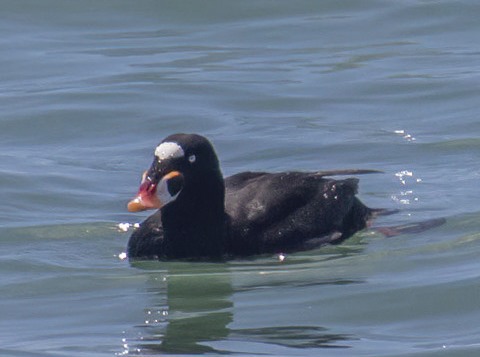
Surf Scoter (Chris Tosdevin)
Sharp-eyed Chris spotted through the PCH underpass and saw this Surf Scoter in the ocean. We weren’t really here for seabirds but whatever. Cliff Swallows were building nests under the eaves of the restroom in the parking lot. There were about 20 of us and we moved inland through the campgrounds (full). Lots of grass from all the rain. The sycamores were not leafed out, surprisingly, so at least the birds were easy to spot.
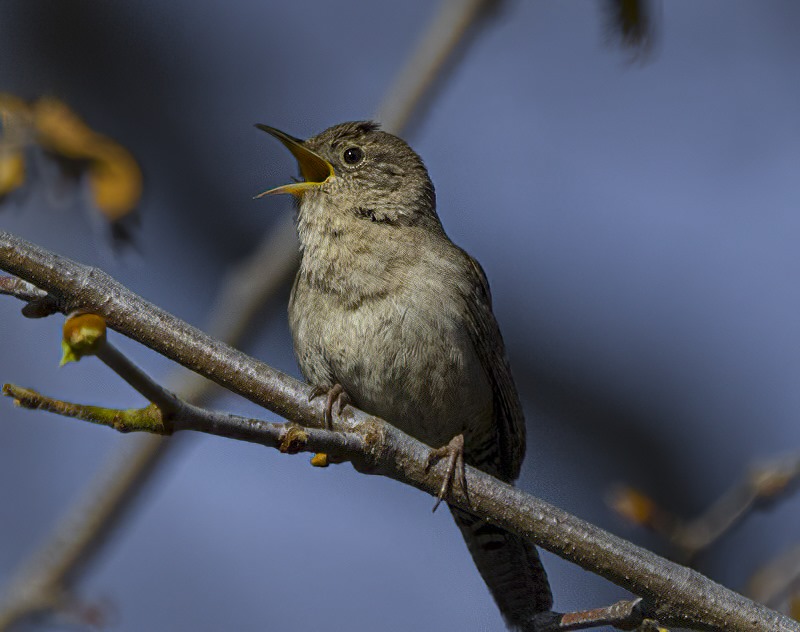
House Wren (Ray Juncosa)
The first really obvious bird was the House Wren. There turned out to be several, singing and posing near the trail. Warblers? Frequent views of Yellow-rumps and a few lucky people saw the Black-throated Gray.

Yellow-rumped Warbler (Ray Juncosa)

Black-throated Gray Warbler (Chris Tosdevin)
The perils of warbler photography – the little devils are always moving.
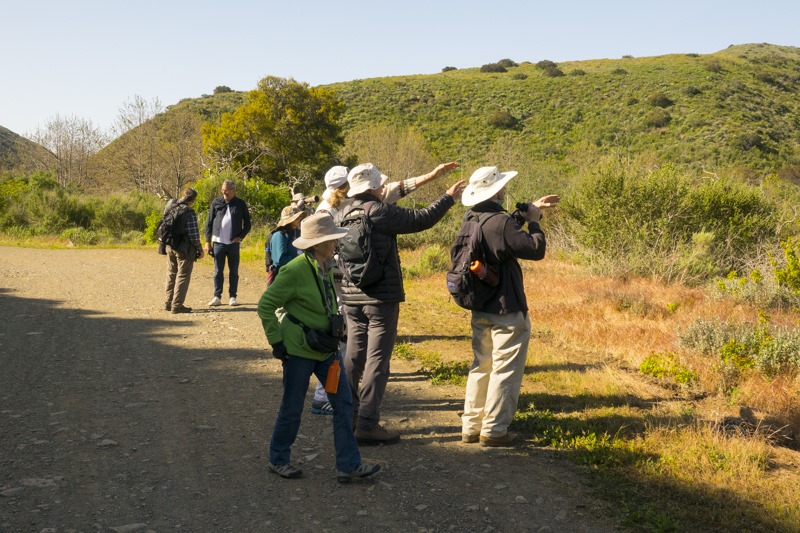
Perhaps the most colorful birds showed up next.

Bullock’s Oriole (Annie Flower)

Hooded Oriole (Annie Flower)
Both oriole species were in full breeding plumage. We spent a little time deciding which species the females were but the males were unmistakable.
The most common bird in the canyon was probably the Nanday Parakeet. We can remember when seeing one was special; now they are in the hundreds if not thousands up and down the coast from Mugu to Santa Monica. They are native to the central interior of South America from Brazil to Argentina. A few caged birds escaped and have joined the immense population of exotic parrots in Southern California. Nandays are noisy (surprise – they are parrots) and they are cavity nesters. We wondered how they are affecting the native cavity nesters but don’t really know.

Nanday Parakeet (Ray Juncosa)

Nanday Parakeet (Annie Flower)
Most of the time the Nandays just look like green birds with black heads, but in this fabulous photo you can see, well, just count the colors. Plus, not visible here, they have red knickers.
We made the first creek crossing relatively dry because there was a helpful log already there. Hikers who knew what they were doing were wearing quality sandals and they just marched across.
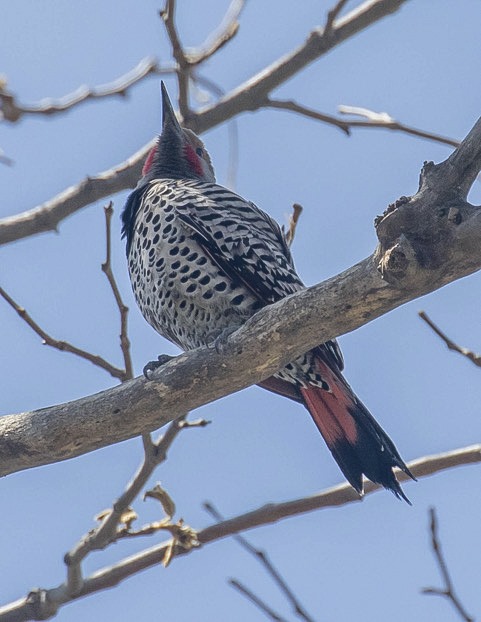
Northern Flicker (Chris Tosdevin)
Several flickers flew about and called. It’s Spring.

American Kestrel (Annie Flower)
A pair of kestrels were courting. Until I looked closely at this photo I did not realize that this kestrel has been hunting.
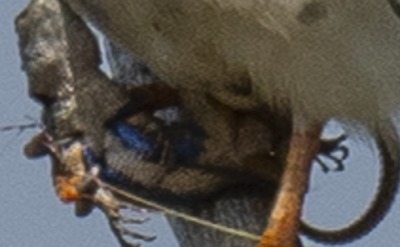
If you look carefully you will see a blue mark and some extra feet. I think it’s a Western Fence Lizard that has become lunch.
When we reached the second creek crossing there was no log. We knew there would be more crossings and so a few decided to turn back instead of soaking their shoes for the long trek back. The rest of us forged on to the turnoff for Serrano Canyon.

Serrano Canyon
Since I had not been getting any bird images I decided to become the official Vegetation Photographer of the trip. This is a typical view of Serrano Canyon from its trail.

The was the last of four crossings in Serrano – the only dry one.

Big-pod Ceanothus (Ceanothus megacarpus) [probably]
There were lots of these white ceanothus bushes in the canyon. Much more impressive than the photo.

Parry’s Phacelia (Phacelia parryi)
One of our prettiest native flowers, the Parry’s Phacelia is also called the Fire Follower, often found on bare or disturbed ground. It’s common here in the western Santa Monica Mountains, but not so much to the east. The flowers are a half to one inch across.
But we digress. The reason we forded so many treacherous and mighty rivers was to find the Canyon Wren and the surprisingly less common Rock Wren.
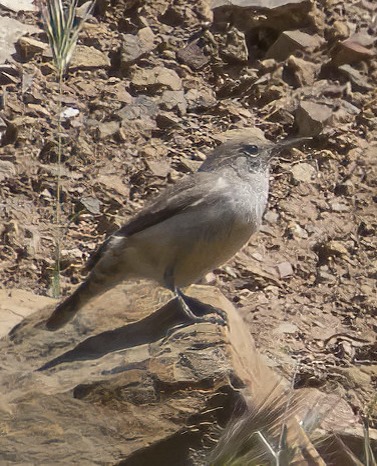
Rock Wren (Chris Tosdevin)
We finally got a glimpse of the Rock Wren, waaaaay up the rocky slope. That Chris got any kind of photo is amazing.
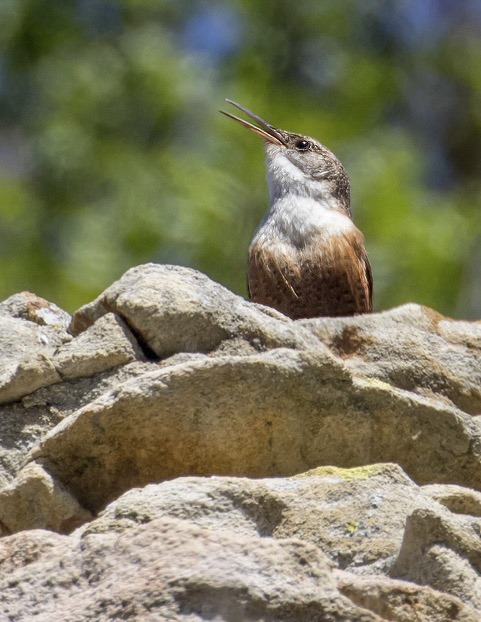
Guaranteed Canyon Wren (Catherpes mexicanus youbetcha) [Chris Tosdevin]
And yes, on this trip we guarantee the Canyon Wren for those intrepid enough to make it up Serrano Canyon. We heard it singing long before seeing it, but the song is pretty nice too.
After we made it back, wet shoes and all, we totalled a list of 55 species for the day. It was a beautiful day for a three-mile round trip in the Spring. Many thanks to the photographers: Annie Flower, Ray Juncosa and Chris Tosdevin.
Mallard
Surf Scoter
California Quail
Mourning Dove
White-throated Swift
Anna’s Hummingbird
Allen’s Hummingbird
Spotted Sandpiper
Western Gull
Brown Pelican
Turkey Vulture
Red-shouldered Hawk
Red-tailed Hawk
Acorn Woodpecker
Nuttall’s Woodpecker
Northern Flicker
American Kestrel
Nanday Parakeet
Pacific-slope Flycatcher
Black Phoebe
Cassin’s Kingbird
California Scrub-Jay
American Crow
Common Raven
Oak Titmouse
Northern Rough-winged Swallow
Violet-green Swallow
Cliff Swallow
Wrentit
White-breasted Nuthatch
Blue-gray Gnatcatcher
Rock Wren
Canyon Wren
House Wren
Bewick’s Wren
European Starling
California Thrasher
Western Bluebird
Hermit Thrush
House Finch
Lesser Goldfinch
Dark-eyed Junco
White-crowned Sparrow
Golden-crowned Sparrow
Song Sparrow
California Towhee
Spotted Towhee
Hooded Oriole
Bullock’s Oriole
Brown-headed Cowbird
Orange-crowned Warbler
Common Yellowthroat
Yellow-rumped Warbler
Black-throated Gray Warbler
Black-headed Grosbeak
The recording of this program is now available

|
Gifts of the Crow, with Dr. John Marzluff.
Crows are mischievous, playful, social, passionate, and eloquent, with brains huge for their body size. They mate for life and associate with relatives and neighbors for years. And they know us. They live in our gardens, parks, and cities, they recognize our peculiarities, they avoid those who scold or threaten, they approach those who care for and feed them. They give us gifts. Humans and corvids have culturally co-evolved and we share the seven traits of language, delinquency, frolic, passion, wrath, risk-taking, and awareness.
With his extraordinary research on the intelligence and startling abilities of corvids—crows, ravens, and jays—scientist John Marzluff tells amazing stories of these brilliant birds and offer us an in-depth look at these complex creatures and our shared behaviors.
Dr. John Marzluff is a Professor of Wildlife Science at the University of Washington School of Environmental and Forest Studies. He earned his B.Sc. in Wildlife Biology, at the University of Montana, his M.Sc. Biology and his Ph.D. in Zoology, both at Northern Arizona University, Flagstaff. He did Postdoctoral Studies at the University of Vermont.
Among his published materials he has written a book entitled Gifts of the Crow: How Perception, Emotion, and Thought Allow Smart Birds to Behave Like Humans. He is, in his own words, “an enthusiastic teacher who thrives on the intellectual challenge of keeping a step ahead of highly motivated students.”
Dr. John’s Other Offers
International Collegiate Ornithological Network – Facebook
Crow Scientist: The real-world science app for kids — at your App store
Avian Conservation Lab Website
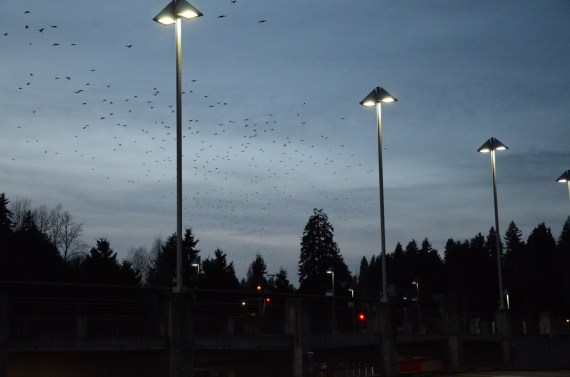
Three of a Kind?: Malibu Lagoon, 26 March 2023
[By Chuck Almdale]
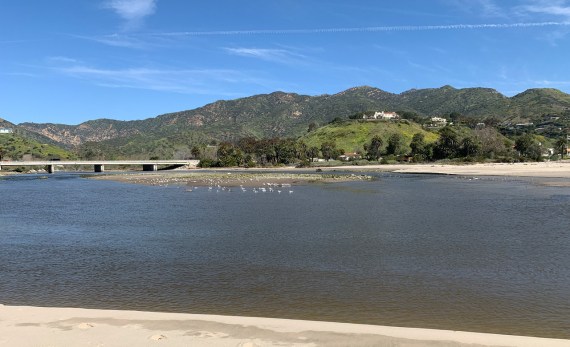
Malibu Lagoon, PCH bridge, Tunney house, Adamson house, Santa Monica Mtns. A small white cross in the far distance above right end of bridge marks Serra Retreat. (Ray Juncosa 3/26/23)
We’ve had a cool wet March, with 9.3″ of rain at our house, more than we’ve had over some recent full years. Today was dry and sunny, but still cool (57-60°F) for March. That, combined with poor waves meant few surfers and sand-sitters toiling on their tans. Low tide often means lots of shorebirds around the lagoon but not today, as most of the six shorebird species we saw were among the rocks or on the damp sandy beach.
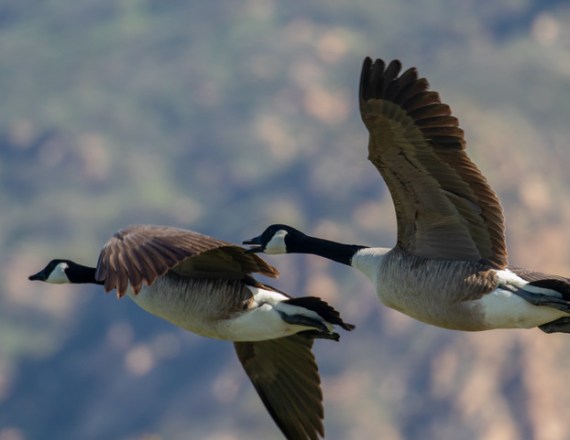
Canada Geese, perhaps heading north, honking as they go
(Chris Tosdevin 3/26/23)
Peering into the sun from the viewpoint near the Pacific Coast Hwy (PCH) bridge, we spotted among the Coots a duck not often seen at the lagoon.

Male Redhead (Ray Juncosa 3/26/23)
Redheads are regular in small numbers in SoCal, but mostly on freshwater, such as the various reservoirs in the San Gabriel Valley, and less often on brackish water like Malibu Lagoon. Perhaps the very low tide meant that all the water in the lagoon was fresh creek water and more to their liking.

Three Redheads, three Coots (Ray Juncosa 3/26/23)
Out of 309 visits from 10/21/79 to 3/26/23, we’ve had Redheads only 12 times with a total of 29 individuals. The record shows:
11/17/79 -2, 10/19/80 – 4, 11/2/80 – 1, 12/20/80 – 2, 1/3/81 – 3, 1/18/81 – 1,
2/14/82 – 6, 9/25/05 – 1, 11/24/13 – 4, 1/26/14 – 1, 11/24/19 – 1, 3/26/23 – 3.
When I see close clusters of a few uncommon birds such as the 5 sightings 10/19/80-1/18/81, I tend to think they’re likely the same birds staying for a while.

Male Redhead and the weird female (Chris Tosdevin 3/26/23)
But if you look at the two female Redheads, they don’t quite look the same. In the photo below, the left bird looks about like you’d expect for a female Redhead, but the right bird has a lot of white at the base of the bill, a bit of streak behind the eye, the head seems browner and the head shape is a bit different. The bill and body are basically the same.
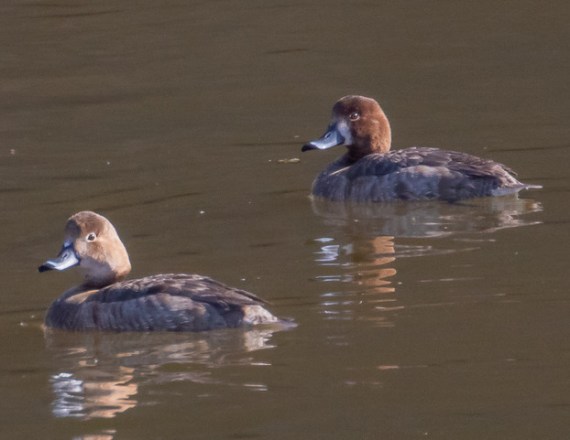
Both female Redheads (Chris Tosdevin 3/26/23)
This drove a few of us quite crazy for quite a while (and probably the rest of the group who had to put us with our interminable dawdling). We kicked around Lesser Scaup, Ring-neck, perhaps a hybrid. Nothing quite seemed to fit. Even the two sides of the weird female’s head differed slightly, as the amount of white at the base of the bill and in the line behind the eye were different.

Weird female Redhead, R & L sides of head. (Chris Tosdevin 3/26/23)
But the three birds stayed very close to one another, unusual behavior if one of them was a different species. We finally decided to move on and study the photos when we got home. Chris Tosdevin reported that he was advised by Someone More Knowledgeable Than We (perhaps at eBird) that: “the 3rd duck with the extensive white patch around the beak is also ‘likely’ a redhead. Her bill coloration and head shape match the male’s. The pale throat can wrap around the base of the bill in varying amounts.“
“These are the birds that try men’s souls,” as famously beleaguered birder Thomas Paine once observed, and he should know. He didn’t even have a field guide or telescope to help out. He had to shoot them.

The lagoon (and Santa Catalina Is., I believe) from near the PCH bridge. (Ray Juncosa 3/26/23)
Well, of course that wasn’t all we had. The next photo proves that Osprey really do catch sizable fish in the lagoon, even in really low water like this.

Osprey with a yellow-tailed fish, properly transported head forward.
(Chris Tosdevin 3/26/23)
By far the most common fish in the lagoon the size of the above pictured fish is the Striped (aka Jumping and at least 8 other names) Mullet. I could not find any pictures anywhere showing this widespread and variable species having a yellow tail, and it certainly was not a Tuna, so I sent it off to local ichthyologist Rosi Dagit. After conferring with her colleague Camm Swift, they decided that although it wasn’t the greatest view possible of a fish it indeed was a Striped Mullet. As Smith put it: “The mullet often have a yellowish tail and this one is not that yellow. Too robust for a large topsmelt or a trout/steelhead.” There you have it.

Some of the 25 Whimbrels. (Chris Tosdevin 3/26/23)
And of course we had terns, in increasing size order, as we again approach nesting season.
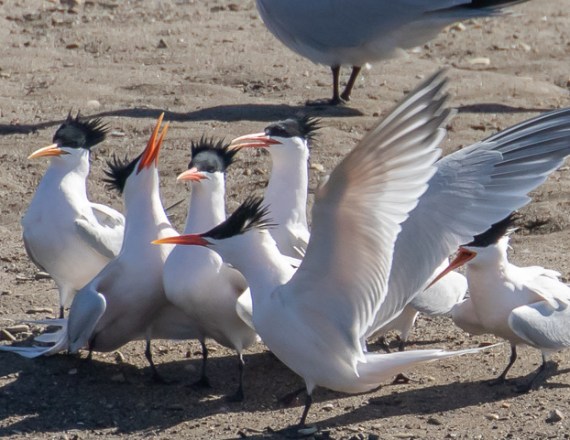
Elegant Terns 17″ long. (Chris Tosdevin 3/26/23)
At morning’s start there were no Elegant Terns at all. By the time we left there were a very noisy ninety of them.

Royal Terns 20″ long. (Chris Tosdevin 3/26/23)
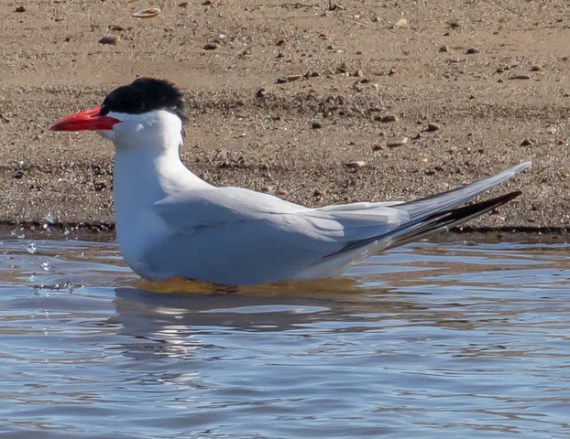
Caspian Tern 21″ long. (Chris Tosdevin 3/26/23)
Passerines were far from absent: 20 species albeit only 99 birds. Most were regular attendees.
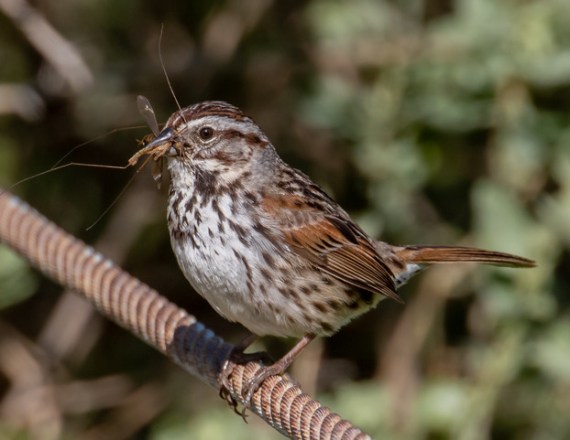
Song Sparrow & a very leggy insect. (Chris Tosdevin, 3/26/23)
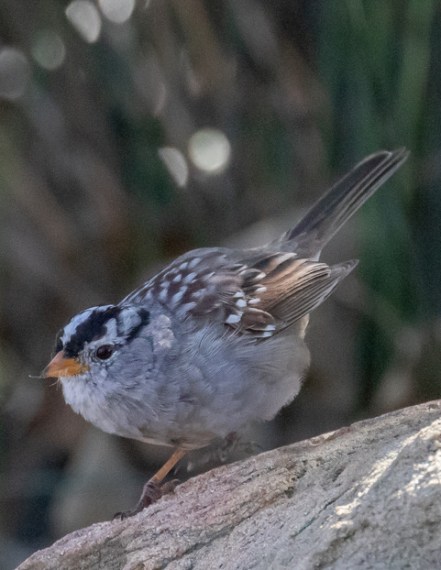
White-crowned Sparrow keeps a low profile. (Chris Tosdevin, 3/26/23)
This may be the last of the White-crowned Sparrows at the lagoon until next fall.

A very glossy male Great-tailed Grackle. (Ray Juncosa 3/26/23)
Our last bird of the day dropped in while we were tailgating in the parking lot. A small, speedy and very coordinated flock shot into a sycamore tree above us in a manner typical of Cedar Waxwings, which they turned out to be. These birds are so infrequent at the lagoon they make the Redheads almost look common: 7 visits from 10/21/79 to 3/26/23, totalling 125 birds. I won’t bother you with the dates.

One of a dozen very elegant Cedar Waxwings. (Chris Tosdevin 3/26/23)
Birds new for the Season: Redhead, White-throated Swift, Caspian Tern, Elegant Tern, Pacific Loon, Common Loon, Osprey, Barn Swallow, Cedar Waxwing, Bewick’s Wren, Great-tailed Grackle.

Malibu Lagoon south channel, the red roofs of Pepperdine University in the far distance left. (Ray Juncosa 3/26/23)
Malibu Lagoon on eBird as of 4-17-23: 6785 lists, 318 species
Many thanks to photographers: Ray Juncosa, Chris Tosdevin
Upcoming SMBAS scheduled field trips:
- Malibu Lagoon, Sun Apr 23, 8:30 am No reservations or Covid card required for this trip.
- Morongo Valley & Black Rock Campground Sat. May 6, 3pm; Sun 7:30am. If you want to stay overnight Sat. May 6, you’ll need to reserve a Yucca Valley motel room or Black Rock campsite.
- Malibu Lagoon, Sun May 28, 8:30 am No reservations or Covid card required for this trip.
- These and any other trips we announce for the foreseeable future will depend upon expected status of the Covid/flu/etc. pandemic at trip time. Any trip announced may be canceled shortly before trip date if it seems necessary. By now any other comments should be superfluous.
- Link to Programs & Field Trip schedule.
The next SMBAS Zoom program: Alvaro Jaramillo. Tuesday, 2 May 2023, 7:30 p.m.
The SMBAS 10 a.m. Parent’s & Kids Birdwalk restarts this April 23. Reservations for groups (scouts, etc.) necessary, but not for families.

(Chris Tosdevin 3/26/23)
Links: Unusual birds at Malibu Lagoon
9/23/02 Aerial photo of Malibu Lagoon
More recent aerial photo
Prior checklists:
2021: Jan-July, July-Dec 2022: Jan-June, July-Dec
2020: Jan-July, July-Dec 2019: Jan-June, July-Dec
2018: Jan-June, July-Dec 2017: Jan-June, July-Dec
2016: Jan-June, July-Dec 2015: Jan-May, July-Dec
2014: Jan-July, July-Dec 2013: Jan-June, July-Dec
2012: Jan-June, July-Dec 2011: Jan-June, July-Dec
2010: Jan-June, July-Dec 2009: Jan-June, July-Dec
The 10-year comparison summaries created during the Lagoon Reconfiguration Project period, remain available—despite numerous complaints—on our Lagoon Project Bird Census Page. Very briefly summarized, the results unexpectedly indicate that avian species diversification and numbers improved slightly during the restoration period June’12-June’14.
Many thanks to Chris & Ruth Tosdevin, Ray Juncosa and others for their contributions to this month’s checklist.
The species lists below is irregularly re-sequenced to agree with the California Bird Records Committee Official California Checklist, which was updated 4 Feb 2023. If part of the chart’s right side is hidden, there’s a slider button at the bottom.
[Chuck Almdale]
| Malibu Census 2022-23 | 10/23 | 11/27 | 12/25 | 1/22 | 2/26 | 3/26 | |
| Temperature | 61-73 | 54-62 | 65-72 | 49-57 | 53-55 | 57-60 | |
| Tide Lo/Hi Height | H+5.33 | H+6.04 | H+6.59 | H+6.81 | L+0.81 | L+0.28 | |
| Tide Time | 0839 | 1045 | 0950 | 0858 | 0911 | 0800 | |
| 1 | Canada Goose | 4 | 2 | 6 | |||
| 1 | Cinnamon Teal | 1 | |||||
| 1 | Northern Shoveler | 7 | |||||
| 1 | Gadwall | 18 | 8 | 16 | 26 | 58 | 42 |
| 1 | American Wigeon | 14 | 8 | 4 | |||
| 1 | Mallard | 12 | 16 | 6 | 20 | 32 | 12 |
| 1 | Northern Pintail | 1 | |||||
| 1 | Green-winged Teal | 2 | 6 | 38 | 15 | 26 | 5 |
| 1 | Redhead | 3 | |||||
| 1 | Lesser Scaup | 1 | |||||
| 1 | Surf Scoter | 12 | 3 | 1 | 6 | 22 | |
| 1 | Bufflehead | 11 | 11 | 10 | 5 | ||
| 1 | Common Goldeneye | 2 | |||||
| 1 | Hooded Merganser | 5 | 1 | ||||
| 1 | Red-breasted Merganser | 25 | 7 | 6 | 3 | 2 | |
| 1 | Ruddy Duck | 35 | 32 | 42 | 8 | ||
| 2 | Pied-billed Grebe | 8 | 4 | 5 | 2 | 1 | 1 |
| 2 | Horned Grebe | 1 | |||||
| 2 | Eared Grebe | 2 | 8 | 5 | |||
| 2 | Western Grebe | 2 | 4 | 1 | 8 | 40 | 80 |
| 7 | Feral Pigeon | 15 | 4 | 6 | 16 | 5 | 6 |
| 7 | Mourning Dove | 4 | 2 | 2 | 1 | ||
| 8 | White-throated Swift | 5 | |||||
| 8 | Anna’s Hummingbird | 1 | 2 | 1 | |||
| 8 | Allen’s Hummingbird | 2 | 2 | 3 | 3 | ||
| 2 | Sora | 1 | |||||
| 2 | American Coot | 145 | 85 | 130 | 38 | 73 | 37 |
| 5 | Black-bellied Plover | 64 | 83 | 51 | 43 | 62 | 3 |
| 5 | Killdeer | 2 | 31 | 11 | 4 | 12 | 5 |
| 5 | Semipalmated Plover | 2 | |||||
| 5 | Snowy Plover | 39 | 18 | 16 | 16 | ||
| 5 | Whimbrel | 5 | 35 | 9 | 7 | 2 | 25 |
| 5 | Marbled Godwit | 6 | 38 | 23 | 18 | 17 | 2 |
| 5 | Ruddy Turnstone | 4 | 4 | 2 | 6 | 3 | |
| 5 | Sanderling | 33 | 45 | 27 | 35 | 32 | 2 |
| 5 | Least Sandpiper | 15 | 62 | 19 | 22 | 27 | |
| 5 | Western Sandpiper | 4 | 8 | 4 | |||
| 5 | Willet | 9 | 43 | 15 | 15 | 9 | 7 |
| 6 | Heermann’s Gull | 8 | 16 | 85 | 27 | 3 | 3 |
| 6 | Short-billed Gull | 1 | 1 | ||||
| 6 | Ring-billed Gull | 22 | 28 | 55 | 36 | 40 | 46 |
| 6 | Western Gull | 64 | 105 | 68 | 49 | 38 | 26 |
| 6 | California Gull | 155 | 390 | 450 | 1330 | 237 | 95 |
| 6 | Herring Gull | 2 | 1 | 2 | |||
| 6 | Glaucous-winged Gull | 3 | 7 | 4 | |||
| 6 | Caspian Tern | 2 | |||||
| 6 | Forster’s Tern | 1 | |||||
| 6 | Royal Tern | 12 | 3 | 2 | 14 | 13 | |
| 6 | Elegant Tern | 15 | 90 | ||||
| 6 | Black Skimmer | 3 | |||||
| 2 | Red-throated Loon | 1 | 1 | ||||
| 2 | Pacific Loon | 1 | |||||
| 2 | Common Loon | 1 | 2 | ||||
| 2 | Black-vented Shearwater | 100 | |||||
| 2 | Brandt’s Cormorant | 1 | |||||
| 2 | Pelagic Cormorant | 1 | 4 | 1 | 6 | 1 | 2 |
| 2 | Double-crested Cormorant | 51 | 45 | 62 | 36 | 67 | 26 |
| 2 | American White Pelican | 1 | |||||
| 2 | Brown Pelican | 65 | 220 | 158 | 343 | 159 | 62 |
| 3 | Great Blue Heron | 3 | 3 | 5 | 2 | 2 | |
| 3 | Great Egret | 2 | 5 | 3 | 2 | 2 | 2 |
| 3 | Snowy Egret | 9 | 31 | 35 | 16 | 6 | 2 |
| 3 | Green Heron | 1 | |||||
| 3 | Black-crowned Night-Heron | 1 | 1 | ||||
| 3 | White-faced Ibis | 1 | |||||
| 4 | Turkey Vulture | 1 | 1 | 1 | 1 | 5 | 5 |
| 4 | Osprey | 1 | |||||
| 4 | Cooper’s Hawk | 1 | |||||
| 4 | Red-tailed Hawk | 3 | 1 | 2 | |||
| 8 | Belted Kingfisher | 2 | 1 | ||||
| 8 | Nuttall’s Woodpecker | 1 | |||||
| 4 | American Kestrel | 1 | |||||
| 4 | Merlin | 1 | |||||
| 9 | Cassin’s Kingbird | 1 | 1 | 1 | 1 | ||
| 9 | Black Phoebe | 3 | 3 | 2 | 3 | 3 | 2 |
| 9 | Say’s Phoebe | 1 | |||||
| 9 | California Scrub-Jay | 1 | 1 | 1 | 1 | ||
| 9 | American Crow | 8 | 12 | 3 | 11 | 27 | 6 |
| 9 | Common Raven | 2 | 1 | 2 | |||
| 9 | Oak Titmouse | 2 | |||||
| 9 | Northern Rough-winged Swallow | 2 | 6 | ||||
| 9 | Barn Swallow | 14 | |||||
| 9 | Cliff Swallow | 24 | 3 | ||||
| 9 | Bushtit | 10 | 2 | 15 | 14 | 3 | 3 |
| 9 | Wrentit | 2 | 1 | ||||
| 9 | Ruby-crowned Kinglet | 2 | 1 | 2 | 1 | ||
| 9 | Cedar Waxwing | 12 | |||||
| 9 | Blue-gray Gnatcatcher | 2 | 1 | ||||
| 9 | House Wren | 1 | 2 | 1 | |||
| 9 | Marsh Wren | 1 | 1 | ||||
| 9 | Bewick’s Wren | 2 | 1 | ||||
| 9 | European Starling | 6 | 9 | ||||
| 9 | Hermit Thrush | 3 | 1 | ||||
| 9 | House Finch | 15 | 18 | 16 | 9 | 6 | 5 |
| 9 | Lesser Goldfinch | 1 | 6 | 4 | 10 | 5 | |
| 9 | White-crowned Sparrow | 12 | 40 | 16 | 12 | 25 | 12 |
| 9 | Song Sparrow | 3 | 6 | 4 | 5 | 5 | |
| 9 | California Towhee | 3 | 6 | 1 | 3 | 3 | 1 |
| 9 | Spotted Towhee | 1 | |||||
| 9 | Red-winged Blackbird | 4 | 3 | 8 | 12 | 2 | |
| 9 | Great-tailed Grackle | 5 | 1 | 6 | |||
| 9 | Orange-crowned Warbler | 1 | 1 | 3 | |||
| 9 | Common Yellowthroat | 3 | 2 | 1 | 2 | 4 | 3 |
| 9 | Yellow-rumped Warbler (Audubon’s) | 4 | 16 | 15 | 6 | 2 | 7 |
| 9 | Townsend’s Warbler | 1 | |||||
| Totals by Type | Oct | Nov | Dec | Jan | Feb | Mar | |
| 1 | Waterfowl | 68 | 125 | 136 | 85 | 152 | 92 |
| 2 | Water Birds – Other | 275 | 471 | 363 | 434 | 343 | 212 |
| 3 | Herons, Egrets & Ibis | 15 | 40 | 44 | 20 | 9 | 6 |
| 4 | Quail & Raptors | 1 | 1 | 6 | 1 | 7 | 8 |
| 5 | Shorebirds | 183 | 367 | 161 | 166 | 180 | 44 |
| 6 | Gulls & Terns | 277 | 546 | 658 | 1453 | 341 | 277 |
| 7 | Doves | 19 | 6 | 6 | 16 | 7 | 7 |
| 8 | Other Non-Passerines | 0 | 5 | 2 | 5 | 3 | 8 |
| 9 | Passerines | 76 | 129 | 84 | 96 | 128 | 99 |
| Totals Birds | 914 | 1690 | 1460 | 2276 | 1170 | 753 | |
| Total Species | Oct | Nov | Dec | Jan | Feb | Mar | |
| 1 | Waterfowl | 5 | 9 | 9 | 9 | 11 | 7 |
| 2 | Water Birds – Other | 8 | 9 | 8 | 7 | 8 | 9 |
| 3 | Herons, Egrets & Ibis | 4 | 4 | 4 | 3 | 3 | 3 |
| 4 | Quail & Raptors | 1 | 1 | 4 | 1 | 3 | 3 |
| 5 | Shorebirds | 11 | 10 | 9 | 9 | 9 | 6 |
| 6 | Gulls & Terns | 7 | 7 | 4 | 7 | 9 | 8 |
| 7 | Doves | 2 | 2 | 1 | 1 | 2 | 2 |
| 8 | Other Non-Passerines | 0 | 3 | 1 | 4 | 1 | 2 |
| 9 | Passerines | 16 | 20 | 15 | 20 | 18 | 20 |
| Totals Species – 105 | 54 | 65 | 55 | 61 | 64 | 60 |



 SANTA MONICA BAY AUDUBON SOCIETY BLOG