Free email delivery
Please sign up for email delivery in the subscription area to the right.
No salesman will call, at least not from us. Maybe from someone else.
Atmospheric Rivers | Los Angeles Times
[Posted by Chuck Almdale]
If it seems to you that “atmospheric river” is a term you didn’t hear a decade ago, you’re right. It’s usage began around 2004 when scientists discovered that moisture was frequently carried in the atmosphere in long, relatively narrow ribbons. These ribbons can be 100-500 miles wide, 2,000 miles long, 10,000 feet above us, and contain more water than the Amazon River. They’re whats responsible for the short-term heavy heavy downpours the west coast has been battered by over the past month. As our atmosphere heats up due to climate change, we can expect more and probably larger such rivers, interspersed with — here it comes — periods of drought.
The Los Angeles Times publishes too few science articles, so when they do a good one, a trumpet should be blown.
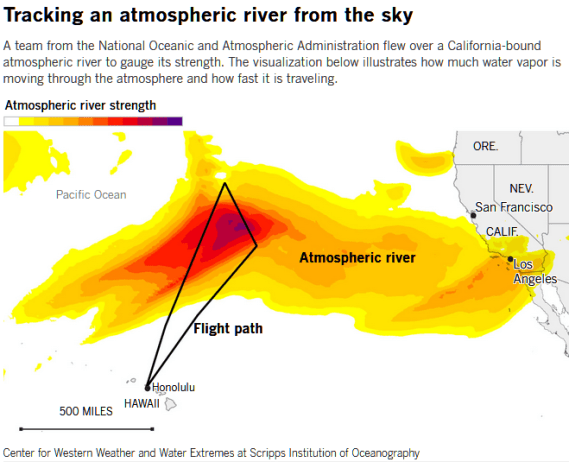
From high above an atmospheric river, a deep dive for data:
Los Angeles Times | Ian James (somewhere over the north Pacific Ocean | 2 Feb 2023
Article contains a 5 1/2 minute video.
From the article:
The science of atmospheric rivers has come a long way since [meteorologist Marty] Ralph and his colleagues published a 2004 study drawing on data from satellites and reconnaissance flights. Since then, Ralph said, more than 500 articles have been published in scientific journals with titles focusing on atmospheric rivers.
The concept of atmospheric rivers began to emerge in the 1970s, when research in the U.K. showed tha a low-level jet stream ahead of a cold front was connected to heavy rains in Britain.
January High Tide, Malibu Lagoon, 22 January 2023
[By Chuck Almdale]
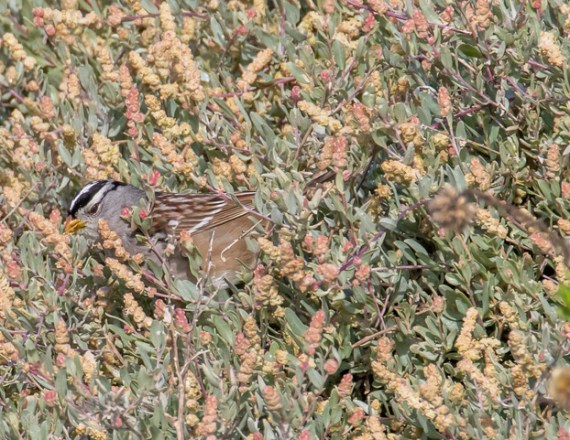
The highest tide of winter was 21 Jan., the day before our visit, when it peaked at 6.84 feet. On 22 Jan., the highest point was a whole 1/3rd (0.03 ft.) inch lower. The channels were very full with no sand or mud visible.
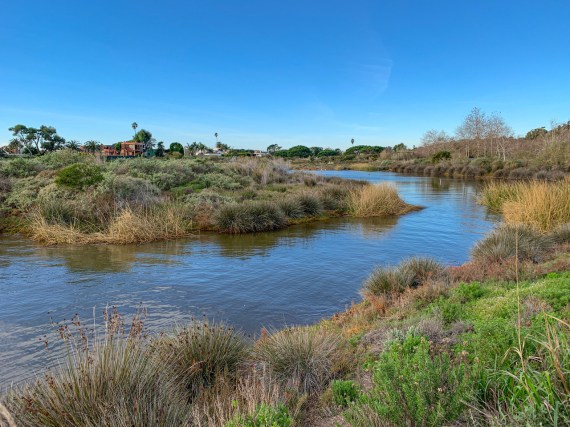
Two-and-a-half hours later the tide had dropped a couple of feet. Mud and sand were plentiful.
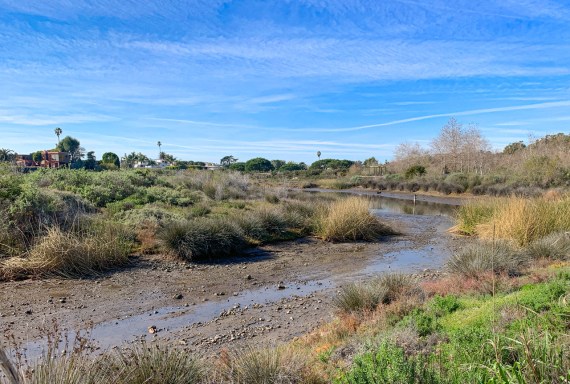
What little sand showed was on the other side of the outlet channel, where it was so crowded with birds that not all the cormorants could comfortably fit.
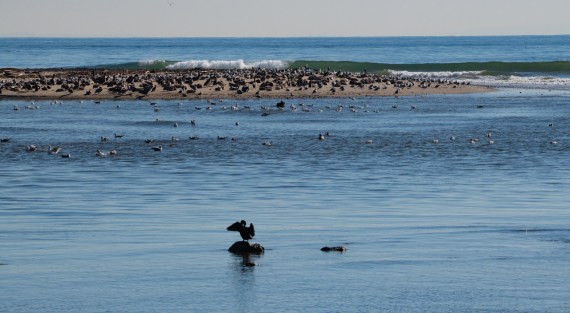
There was sand on our side, but there were also people, too many for birds to feel safe. Amongst the numerous Brown Pelicans (343) and Double-crested Cormorants (36) there were a lot of gulls. I counted over 1450 gulls— not including the ones that earlier flew away — in six species; 92% of them were California Gull. Here’s three of the other species, all of them large 4-year gulls,
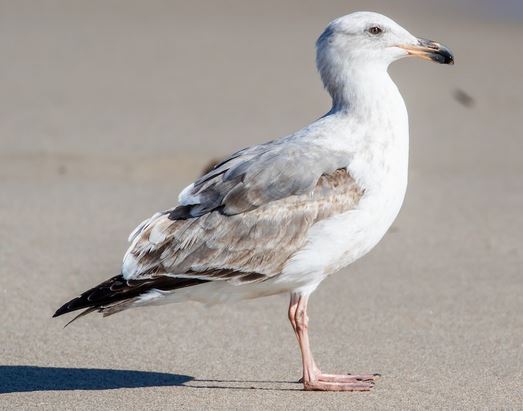
We’ll start with the most frequent and reliable species, Western Gull. Many of them nest on nearby offshore islands such as Anacapa, where predation of nests by rats is low or absent. Their nesting range runs from the southern tip of Baja California to NW Washington. Present at the lagoon every month, averaging 75 birds/visit, but least abundant March-May during breeding season. They average 25″ long, wingspan 58″. It has a darker back than the other two species, its primary difference, but north of Monterey Ca. they have paler backs and darker eyes than southern birds. The wingtips are black with a few white “mirrors.” Both forms appear at the lagoon.
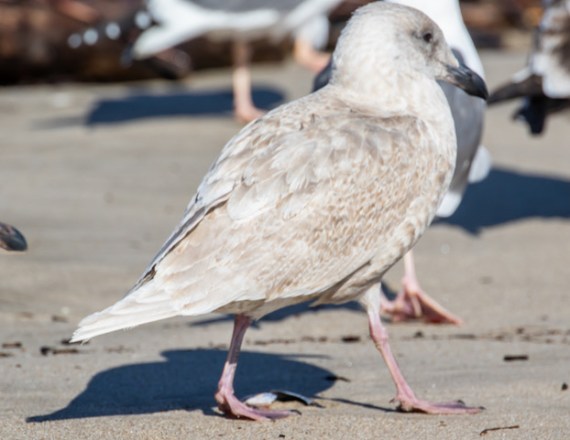
Far less numerous and more infrequent is our next species, Glaucous-winged Gull. Their nesting range runs from NW Oregon to NW Alaska, thus beginning just about where the Western’s breeding range ends. They’re slightly larger, averaging 26″ long, wingspan 58″. The back is a much paler gray, with same-gray wingtips with a few white “mirrors.” Most of those at the lagoon are 1st-winter birds like the bird below, no black anywhere, with an off-white waxy-looking plumage. “Glaucous” means waxy. We see them 44% as often as the Western, mostly January-April, but their numbers are only 1.6% of the Western’s, averaging 2.6 birds/visit. Just to additionally confuse the issue, Westerns and Glaucous-winged hybridize. As their barely-overlapping breeding ranges, similar appearance and ability to hybridize suggests, one might assume they are close relatives, probably (I think) with the darker Westerns splitting off from a paler Glaucous-winged ancestral population.
The third species is the Herring Gull, an abundant world-wide species with many forms, very common on the east coast where they frequent garbage dumps, but are regular in small numbers in SoCal. Same size as the Western at 25″ long, 58″ wingspan. The mantle is intermediate between Glaucous-winged and Western in darkness, with black wingtips and white “mirrors.” They breed in inland Alaska and northern Canada and along the Atlantic coast to South Carolina. Of these three species they’re the least common at the lagoon, appearing 22% as often as the Western and 0.8% as abundant, averaging 3 birds/visit. Most sighting are November-April, and they’re absent in July-August.

Adults of all three species have large yellow bills with a single red spot on the lower mandible, pink legs at most ages and varying amounts of head/neck streaking in the winter. As 4-year gulls, they all go through 7 plumage stages, very roughly every six months, with a mind-bogglingly huge and depressing amount of variability in molting times and colors. The Western and Herring have pale eyes, but the Glaucous-winged eyes are dark.
There! That information and these photos, plus an additional couple of decades of study and looking at actual living birds will put you solidly on the first few steps of being able to distinguish one gull from another. I know one or two people who are fairly good at doing this.


I think it was July 2022 that we first saw a Pelagic Cormorant sitting on this roof. There’s been at least one monthly since then, except September when Pelagic’s were absent. There’s a camera sticking out of the house side just to the right of these birds (see below), but out-of-frame. I like to think the birds are on “cormorant-cam.” This is good safe spot with a wide view for them when tide is high and they cannot sit on the offshore rocky reef, and they really don’t like going so far inland as the lagoon, which must be at least all of 25 feet from the ocean. Plus it’s out of the way of humans and dogs and screaming youngsters running up and down the beach waving their arms.
There were lots of other birds at the lagoon, not just gulls.




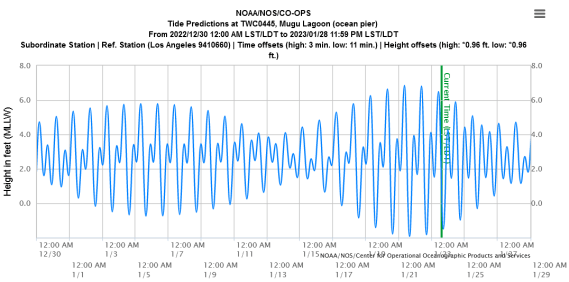
If you missed our prior “Moon News” blog, you missed this tide prediction chart below. [I love it’s combination of symmetry and asymmetry.] Look closely and see that Jan 21 had the highest & lowest tides of the winter.
The chart is interactive here: Tide table for period: 30 Dec 2022 to 28 Jan 2023.
Full Moon: 6 Jan 2023 6:09 PM High tide: 5.78 feet on both 5 Jan 7:38am, 6 Jan 8:11am
New Moon: 21 Jan 2023 12:53 PM High tide: 6.84 feet 21 Jan 8:11am
The new moon high tide was 16 days farther from perihelion than was full moon high tide, yet was more than a foot higher. Thus perigee + new moon outweighed perihelion + full moon.
Birds new for the Season: Canada Goose, Common Goldeneye, Herring Gull, Red-throated Loon, Nuttall’s Woodpecker, Common Raven, Marsh Wren, European Starling.

Throughout the fall and much of the winter, the 1st-year male bird has brownish edges to many of his black feathers.
Malibu Lagoon on eBird as of 1-27-23: 6566 lists, 317 species
Many thanks to photographers: Ray Juncosa, Grace Murayama, Chris Tosdevin
Upcoming SMBAS scheduled field trips:
Madrona Marsh, Sat. Feb 11, 8 am; Malibu Lagoon, Sun Feb. 26 8:30 am; Sepulveda Basin Sat. Mar. 11 8 am; Malibu Lagoon, Sun Mar 26 8:30 am. These and any other trips we announce for the foreseeable future will be dependent upon the expected status of the Covid/flu/etc. pandemic at trip time. Any trip announced may be canceled shortly before trip date if it seems necessary. By now any other comments should be superfluous. Link to Programs & Field Trip schedule.
The next SMBAS Zoom program: The migrating birds of Bear Divide, with Ryan Terrill. Tuesday, 7 March 2023, 7:30 p.m.
The SMBAS 10 a.m. Parent’s & Kids Birdwalk may begin in April, reservations necessary.

(Chris Tosdevin 1-22-23)
Links: Unusual birds at Malibu Lagoon
9/23/02 Aerial photo of Malibu Lagoon
More recent aerial photo
Prior checklists:
2021: Jan-July, July-Dec 2022: Jan-June, July-Dec
2020: Jan-July, July-Dec 2019: Jan-June, July-Dec
2018: Jan-June, July-Dec 2017: Jan-June, July-Dec
2016: Jan-June, July-Dec 2015: Jan-May, July-Dec
2014: Jan-July, July-Dec 2013: Jan-June, July-Dec
2012: Jan-June, July-Dec 2011: Jan-June, July-Dec
2010: Jan-June, July-Dec 2009: Jan-June, July-Dec
The 10-year comparison summaries created during the Lagoon Reconfiguration Project period, remain available—despite numerous complaints—on our Lagoon Project Bird Census Page. Very briefly summarized, the results unexpectedly indicate that avian species diversification and numbers improved slightly during the restoration period June’12-June’14.
Many thanks to Chris & Ruth Tosdevin, Ray Juncosa, Chris Lord and others for their contributions to this month’s checklist.
The species lists below is irregularly re-sequenced to agree with the California Bird Records Committee Official California Checklist, which was updated 4 Feb 2023. If part of the chart’s right side is hidden, there’s a slider button at the bottom.
[Chuck Almdale]
| Malibu Census 2022-23 | 8/28 | 9/25 | 10/23 | 11/27 | 12/25 | 1/22 | |
| Temperature | 72-79 | 72-79 | 61-73 | 54-62 | 65-72 | 49-57 | |
| Tide Lo/Hi Height | H+4.49 | H+5.01 | H+5.33 | H+6.04 | H+6.59 | H+6.81 | |
| Tide Time | 1102 | 0949 | 0839 | 1045 | 0950 | 0858 | |
| 1 | Canada Goose | 4 | |||||
| 1 | Gadwall | 22 | 26 | 18 | 8 | 16 | 26 |
| 1 | American Wigeon | 14 | 8 | ||||
| 1 | Mallard | 65 | 28 | 12 | 16 | 6 | 20 |
| 1 | Northern Pintail | 1 | |||||
| 1 | Green-winged Teal | 2 | 6 | 38 | 15 | ||
| 1 | Lesser Scaup | 1 | |||||
| 1 | Surf Scoter | 12 | 3 | 1 | |||
| 1 | Bufflehead | 11 | 11 | 10 | |||
| 1 | Common Goldeneye | 2 | |||||
| 1 | Hooded Merganser | 5 | 1 | ||||
| 1 | Red-breasted Merganser | 25 | 7 | 6 | |||
| 1 | Ruddy Duck | 3 | 35 | 32 | 42 | ||
| 2 | Pied-billed Grebe | 4 | 6 | 8 | 4 | 5 | 2 |
| 2 | Horned Grebe | 1 | |||||
| 2 | Eared Grebe | 2 | 8 | 5 | |||
| 2 | Western Grebe | 2 | 4 | 1 | 8 | ||
| 7 | Feral Pigeon | 10 | 6 | 15 | 4 | 6 | 16 |
| 7 | Mourning Dove | 5 | 4 | 2 | |||
| 8 | Anna’s Hummingbird | 1 | 1 | 2 | 1 | ||
| 8 | Allen’s Hummingbird | 3 | 2 | 2 | |||
| 2 | Sora | 1 | 1 | ||||
| 2 | American Coot | 12 | 47 | 145 | 85 | 130 | 38 |
| 5 | Black-bellied Plover | 79 | 67 | 64 | 83 | 51 | 43 |
| 5 | Killdeer | 5 | 7 | 2 | 31 | 11 | 4 |
| 5 | Semipalmated Plover | 15 | 3 | 2 | |||
| 5 | Snowy Plover | 20 | 25 | 39 | 18 | 16 | |
| 5 | Whimbrel | 37 | 15 | 5 | 35 | 9 | 7 |
| 5 | Long-billed Curlew | 1 | |||||
| 5 | Marbled Godwit | 6 | 21 | 6 | 38 | 23 | 18 |
| 5 | Ruddy Turnstone | 4 | 3 | 4 | 4 | 2 | 6 |
| 5 | Black Turnstone | 2 | |||||
| 5 | Sanderling | 25 | 14 | 33 | 45 | 27 | 35 |
| 5 | Dunlin | 1 | |||||
| 5 | Least Sandpiper | 10 | 23 | 15 | 62 | 19 | 22 |
| 5 | Western Sandpiper | 25 | 8 | 4 | 8 | 4 | |
| 5 | Short-billed Dowitcher | 2 | |||||
| 5 | Spotted Sandpiper | 1 | 1 | ||||
| 5 | Willet | 48 | 73 | 9 | 43 | 15 | 15 |
| 5 | Red-necked Phalarope | 1 | 2 | ||||
| 6 | Heermann’s Gull | 2 | 9 | 8 | 16 | 85 | 27 |
| 6 | Short-billed Gull | 1 | |||||
| 6 | Ring-billed Gull | 2 | 22 | 28 | 55 | 36 | |
| 6 | Western Gull | 53 | 72 | 64 | 105 | 68 | 49 |
| 6 | California Gull | 21 | 57 | 155 | 390 | 450 | 1330 |
| 6 | Herring Gull | 2 | |||||
| 6 | Glaucous-winged Gull | 3 | 7 | ||||
| 6 | Forster’s Tern | 1 | |||||
| 6 | Royal Tern | 6 | 1 | 12 | 3 | 2 | |
| 6 | Elegant Tern | 255 | 15 | ||||
| 6 | Black Skimmer | 3 | |||||
| 2 | Red-throated Loon | 1 | |||||
| 2 | Common Loon | 1 | |||||
| 2 | Black-vented Shearwater | 100 | |||||
| 2 | Pelagic Cormorant | 1 | 1 | 4 | 1 | 6 | |
| 2 | Double-crested Cormorant | 68 | 56 | 51 | 45 | 62 | 36 |
| 2 | Brown Pelican | 112 | 64 | 65 | 220 | 158 | 343 |
| 3 | Great Blue Heron | 2 | 3 | 3 | 3 | 5 | 2 |
| 3 | Great Egret | 3 | 1 | 2 | 5 | 3 | 2 |
| 3 | Snowy Egret | 14 | 9 | 9 | 31 | 35 | 16 |
| 3 | Green Heron | 1 | |||||
| 3 | Black-crowned Night-Heron | 2 | 1 | 1 | |||
| 4 | Yellow-crowned Night-Heron | 1 | |||||
| 4 | Turkey Vulture | 1 | 1 | 1 | 1 | 1 | |
| 4 | Red-shouldered Hawk | 1 | |||||
| 4 | Red-tailed Hawk | 3 | |||||
| 8 | Belted Kingfisher | 1 | 2 | 1 | |||
| 8 | Nuttall’s Woodpecker | 1 | |||||
| 4 | American Kestrel | 1 | |||||
| 4 | Merlin | 1 | |||||
| 4 | Peregrine Falcon | 1 | |||||
| 9 | Cassin’s Kingbird | 3 | 1 | 1 | |||
| 9 | Black Phoebe | 5 | 5 | 3 | 3 | 2 | 3 |
| 9 | Say’s Phoebe | 1 | |||||
| 9 | California Scrub-Jay | 2 | 2 | 1 | 1 | 1 | 1 |
| 9 | American Crow | 17 | 3 | 8 | 12 | 3 | 11 |
| 9 | Common Raven | 2 | |||||
| 9 | Oak Titmouse | 2 | |||||
| 9 | Violet-green Swallow | 1 | |||||
| 9 | Northern Rough-winged Swallow | 4 | |||||
| 9 | Barn Swallow | 28 | |||||
| 9 | Cliff Swallow | 1 | |||||
| 9 | Bushtit | 15 | 8 | 10 | 2 | 15 | 14 |
| 9 | Wrentit | 1 | 2 | 1 | |||
| 9 | Ruby-crowned Kinglet | 2 | 1 | 2 | |||
| 9 | Blue-gray Gnatcatcher | 2 | 1 | ||||
| 9 | House Wren | 1 | 2 | 1 | 2 | 1 | |
| 9 | Marsh Wren | 1 | 1 | ||||
| 9 | Bewick’s Wren | 1 | 1 | 2 | |||
| 9 | Northern Mockingbird | 1 | |||||
| 9 | European Starling | 8 | 6 | ||||
| 9 | Hermit Thrush | 3 | 1 | ||||
| 9 | House Finch | 8 | 4 | 15 | 18 | 16 | 9 |
| 9 | Lesser Goldfinch | 3 | 6 | 1 | 6 | 4 | |
| 9 | White-crowned Sparrow | 12 | 40 | 16 | 12 | ||
| 9 | Song Sparrow | 6 | 3 | 3 | 6 | 4 | |
| 9 | California Towhee | 1 | 3 | 6 | 1 | 3 | |
| 9 | Spotted Towhee | 1 | 1 | ||||
| 9 | Red-winged Blackbird | 25 | 4 | 3 | 8 | 12 | |
| 9 | Great-tailed Grackle | 4 | 5 | 1 | |||
| 9 | Orange-crowned Warbler | 1 | 2 | 1 | |||
| 9 | Common Yellowthroat | 4 | 5 | 3 | 2 | 1 | 2 |
| 9 | Yellow-rumped Warbler (Audubon’s) | 4 | 16 | 15 | 6 | ||
| 9 | Townsend’s Warbler | 1 | |||||
| Totals by Type | Aug | Sep | Oct | Nov | Dec | Jan | |
| 1 | Waterfowl | 87 | 57 | 68 | 125 | 136 | 85 |
| 2 | Water Birds – Other | 197 | 174 | 275 | 471 | 363 | 434 |
| 3 | Herons, Egrets & Ibis | 22 | 13 | 15 | 40 | 44 | 20 |
| 4 | Quail & Raptors | 1 | 2 | 1 | 1 | 6 | 1 |
| 5 | Shorebirds | 281 | 263 | 183 | 367 | 161 | 166 |
| 6 | Gulls & Terns | 340 | 141 | 277 | 546 | 658 | 1453 |
| 7 | Doves | 15 | 6 | 19 | 6 | 6 | 16 |
| 8 | Other Non-Passerines | 3 | 2 | 0 | 5 | 2 | 5 |
| 9 | Passerines | 127 | 56 | 76 | 129 | 84 | 96 |
| Totals Birds | 1073 | 714 | 914 | 1690 | 1460 | 2276 | |
| Total Species | Aug | Sep | Oct | Nov | Dec | Jan | |
| 1 | Waterfowl | 2 | 3 | 5 | 9 | 9 | 9 |
| 2 | Water Birds – Other | 5 | 5 | 8 | 9 | 8 | 7 |
| 3 | Herons, Egrets & Ibis | 5 | 3 | 4 | 4 | 4 | 3 |
| 4 | Quail & Raptors | 1 | 2 | 1 | 1 | 4 | 1 |
| 5 | Shorebirds | 16 | 14 | 11 | 10 | 9 | 9 |
| 6 | Gulls & Terns | 6 | 5 | 7 | 7 | 4 | 7 |
| 7 | Doves | 2 | 1 | 2 | 2 | 1 | 1 |
| 8 | Other Non-Passerines | 1 | 2 | 0 | 3 | 1 | 4 |
| 9 | Passerines | 18 | 17 | 16 | 20 | 15 | 20 |
| Totals Species – 104 | 56 | 52 | 54 | 65 | 55 | 61 |
Moon News
[Posted by Chuck Almdale]
At our Malibu Lagoon field trip yesterday, Paula jumped into the introductory announcements with some news of her own: the new moon was currently at its closest to the earth in 990 years. This was news to me, so I checked a few sources. Here’s the lowdown.
A few fundamentals:
The moon’s orbit around the earth is an oval; so is the earth’s orbit around the sun.
The moon’s closest point to the earth is the perigee, farthest is the apogee.
The earth’s closest point to the sun is the perihelion, farthest is the aphelion.
The moon’s perigee can occur at any point in its phase cycle, so it rarely occurs when the moon is either full or new.
The earth’s perihelion slowly shifts 1 day every 58 years. It’s currently Jan 4/5. King tides fall at new moon closest to the perihelion, so our king tide season will slowly shift forward. In 6340, perihelion will fall on the March equinox (currently approximately Mar 21).
A full moon at or near perigee is a supermoon.
When the moon’s perigee occurs close to or at the earth’s perihelion, the annual perihelion-caused King Tides are very high.
Here’s some articles on the recent “super-new-moon,” followed by some tidal info.
The new moon is the closest in nearly 1,000 years tonight
Space.com | Stephanie Waldek | 21 Jan 2023
It’s the closest new moon to Earth since the year 1030. At 3:54 p.m. EST (2054 GMT), the moon will be exactly 221,561 miles (356,568 km) away from our planet, according to Timeanddate.com (opens in new tab), which sifted through data from NASA’s Jet Propulsion Laboratory to determine the distances of every Earth-moon distance for hundreds of years.
On Saturday … Closest new moon in 1,337 years
EarthSky | Graham Jones | 19 Jan 2023

Why The Moon Is Suddenly Closer To Earth Than For 992 Years—And What It Means
Forbes | Jamie Carter 18 Jan 2023
On Saturday, January 21, 2023, the New Moon will be precisely 221,561 miles/356,568 km from Earth. As reported by Timeanddate.com, that’s the closest it will come to our planet since the year 1030—a time of the Crusades, the Norman Conquest of Britain and early Vikings settlements in North America, a century ironically sometimes called the “Dark Ages.” This “ultimate supermoon” also signals the beginning of Chinese Lunar New Year and comes during a rare conjunction between Venus and Saturn that will be best viewed just after sunset in the southwest on Sunday, January 22, 2022.
Why is the Moon suddenly so close?
Tide table below for period: 30 Dec 2022 to 28 Jan 2023
Full Moon: 6 Jan 2023 6:09 PM High tide: 5.78 feet on both 5 Jan 7:38am, 6 Jan 8:11am
New Moon: 21 Jan 2023 12:53 PM High tide: 6.84 feet 21 Jan 8:11am
The new moon high tide was 16 days farther from perihelion than was full moon high tide, yet was more than a foot higher. Thus perigee + new moon outweighed perihelion + full moon.
Snowy Owl Program Thurs. 19 Jan 7 PM | Sea & Sage Audubon
[Posted by Chuck Almdale]
As most local birders now know, a Snowy Owl showed up a few weeks ago in Cypress in northwest Orange County. It sat on the rooftops of various houses, and every so often would disappear, probably to go catch ground squirrels on one of the local military bases, although we don’t know that for sure. When the big storms arrived the other day and buckets poured down, the bird disappeared. It may have moved farther south in Orange County, or perhaps even perched in a tree (not many of those on the tundra).
Sea & Sage Audubon is doing a Zoom presentation on Snowy Owls (in general, not this particular Snowy Owl), presented by Denver Holt, inspired by the extremely uncommon appearance of the species this far south.
When: Tomorrow, Thursday, 19 January 2003, 7 PM Pacific Standard Time
Link to Webinar: https://wildlife-ca-gov.zoom.us/j/87304541902
If that doesn’t work:
Sea & Sage Zoom Page: https://wp.seaandsageaudubon.org/home-sas/whats-new/#header
On this page scroll down a little bit and click on the “Join Webinar” button.
I hope that works, because that’s all I know about it.
Here’s the bird itself, photographed by Lynzie Flynn a few weeks ago. For those who have seen this bird afar across the tundra, a tiny dot in a telescope, seeing it 25 yards away is a real treat. Those “mustache” feathers on both sides of the bill are stranger to see than you might think. [More below.]

Snowy Owl in Cypress, Orange County, December 2022.
Photo by Lynzie Flynn
There are evil rumors afoot that this bird is related to the mysterious Western Roof Owl, but I’m certain that’s not true. I saw it myself and it has nothing in common with that bird, save for the roof-perching. And you could watch it breathe. Try doing that with the Western Roof Owl.
I just picked this comment off the <OrangeCountyBirding@groups.io> bird alert.
From: “Ryan Winkleman” <rswinkleman[AT]gmail.com>
Date: Wed, 18 Jan 2023 16:20:50 -0800
Subject: Re: [OrangeCountyBirding] Snowy Owl
While it’s probably unlikely that the bird will be refound unless it happens to show up back in the same place or in one of the major OC birding locations, I also want to recognize that some people may not want the manic attention should it show up in a residential area again. As of last night there were 1,011 eBird reports of this one single bird over the last three weeks, and my understanding is that at least on some days police had to be present for safety purposes with the crowds. What I do want to say, though, is that should the bird randomly show up alive somewhere else in Orange County on private or restricted property or in an area where mobs would otherwise be unwelcome, I would urge the finder(s) to please still notify me for our county records as well as Tom Benson for the CBRC records (secretary@californiabirds.org).
Thanks!
[Posted by Chuck Almdale]
Those of you who — unlike me — have something better than a box camera or a Kodak Kwiki-Shoot should find this inspiring. Something to do before we’re all washed away.
Camera Traps are Like Candid Camera for your Backyard Birds
The Living Bird | Carla Rhodes | 22 Dec 2022
It’s a fun new avenue for bird photography: using a “camera trap” to shoot images whenever a bird appears in your backyard—like an avian selfie photo booth.

Carla Rhodes, from the article: “Juncos, hands down to me, were the most entertaining. It was almost like they were trolling me, teasing me, and showing personality and different perspectives.”
Quick! Which subspecies of Dark-eyed Junco is this?
Text from the article:
If you purchased your digital camera within the last 10 years, chances are you already have some basic tools for remote photography. The simplest options include setting your camera on time-lapse or using an interval timer, then setting your camera out at your feeder and hoping the birds are there when the timer goes off.
Many modern cameras can also be fired via handheld wireless remote control, or operated remotely with a smartphone app. Canon’s Camera Connect and the Nikon WirelessMobileUtility apps enable simple remote-control, timer-controlled, and time-lapse series shooting on a connected camera.
If you want to take the next step, you can build (or buy) a proper camera-trap system. A bare minimum camera-trap setup includes a camera with a port for connecting remote shutter-release equipment, a wide-angle lens that allows a broader field of view in the surrounding environment, and a passive infrared (or PIR) sensor that will trigger the camera’s shutter when it detects the body heat from an animal’s presence. There are several off-the-shelf camera-trap systems available; two of the most popular are made by Cognisys and Camtraptions.

Carla Rhodes, from the article.
This is a mouse I could live with.



 SANTA MONICA BAY AUDUBON SOCIETY BLOG