Free email delivery
Please sign up for email delivery in the subscription area to the right.
No salesman will call, at least not from us. Maybe from someone else.
Christmas Day, Malibu Lagoon, 25 December 2022
[Chuck Almdale]
Oddly enough, no one seemed to mind that it was Christmas Day.

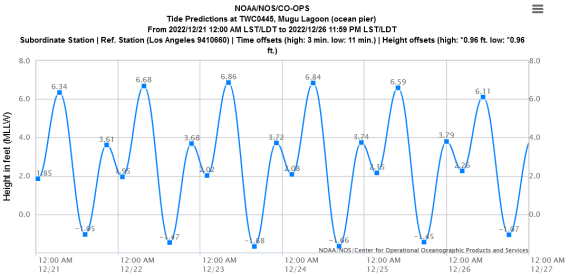
The temperatures were exceptionally nice for Christmas Day: 65°F when we got there, 72° when we left. [A week later they were 20° lower.] Tide was high, +6.59 ft. at 9:50 am., dropping from the King Tide highs of 6.84 ft. the day before, and 6.86 ft. the day before that. In case anyone is wondering and as you can see by the chart below, the “King Low Tides” (to coin a phrase) of the year occur right after the highs.
The total species count was not especially high — only 55 species, 10 less than last month, with most of the drop in the passerines and the gull/tern groups. I should mention that the gull count could easily have been triple the 658 you’ll see below. Before we got to the disappearing beach and as the tide was rising, large flocks of California Gulls — at least 1,000 birds — kept lifting off the beach and heading inland.
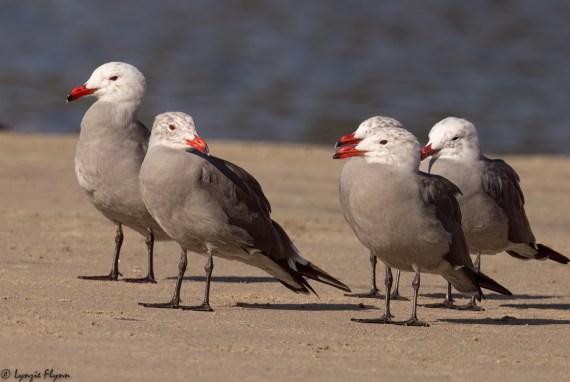
The 85 birds today were among the 4% highest counts for this species.
The highlight of the day was the five Hooded Mergansers Chris Lord spotted on the inland side of PCH bridge and waved at us to come and see. The water is a bit deeper in this spot and diving ducks — Mergansers, Ruddys and Buffleheads tend to prefer it, particularly the Hooded Mergansers. They don’t show up often — 18 times out of 306 count days over 40+ years — and when they do, they often never swim south into the main lagoon.


The water level hit 7’4.8″ on the sidewalk tidal clock. Most of the time we were there, water flowed oceanward. Lack of sand and mud around the channel and lagoon edges didn’t leave much for the sandpipers to do, and they huddled together in various places. In the driftwood pile around the “Osprey Pole” there were a dozen each of Killdeer and Least Sandpipers.

The apparent size difference may be partially a photographic optical illusion.
On the west end of one sand island over 30 Snowy Egrets gathered, plus some Great Egrets and Great Blue Herons. You wouldn’t know from the photos below that the Great Blue Heron was 22″ taller than the Snowy Egret. Some people have wondered aloud to me how the Snowy Egret changes its leg color while they’re watching it. Answer is, he doesn’t! Black on the front and yellow on the rear is common much of the year.


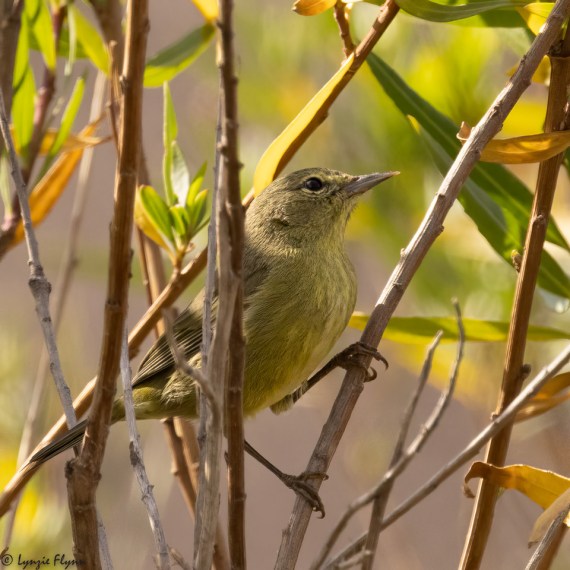
You can see Orange-crowned Warblers every year for 40 years and never see their orange crown, which they use as a signal to rival males and potential mates. I think I’ve seen it once, but it was so long ago that I’m no longer certain. A few of these birds hang around all winter in SoCal.

The Brown Pelican above is far along into its breeding plumage (male & female look the same), but it has not yet developed a bright-red gular pouch. The first-year Double-crested Cormorant above has a white border at the base of its lower mandible and a short section of white along the upper. The Neotropic Cormorant also has white edging with a bit more white between the gape and the back of the eye. But it is dark above/in front of the eye, whereas the Double-crested, like the one above, has yellow skin. The Neotropic’ gular pouch is a duller yellow, the back feathers are more pointed and the tail is proportionally longer. The Neotropic also has a more acute angle at gape, whereas the DC has a rounded gape. A fine distinction – check your field guide. If you lucky enough to find them standing side-by-side, the 26″ Neotropic is 20% smaller than the 32″ Double-crested. I mention all this because Neotropics are spreading northward through SoCal and it’s easy to confuse the two.
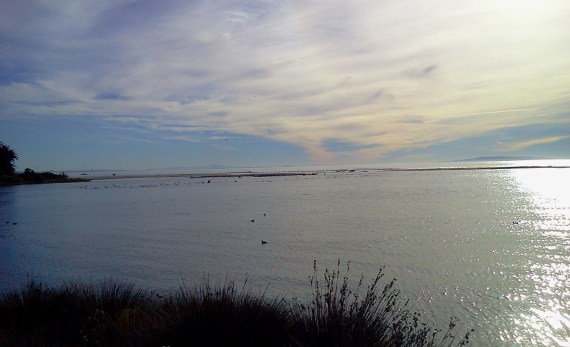
Palos Verdes Peninsula (center left) is 23 miles away; Santa Catalina Island on right is 40 miles. (Lillian Johnson 12-22-22)

From a distance the male Gadwall is a rather boring gray-brown-black bird. Up close you can see the fine vermiculations that make it one of the most beautiful of ducks. Red-breasted Mergansers are common at the lagoon in winter. Most look like the above as the young look like the females until their alternate (breeding) plumage grows out in the spring. The much-less-common (at the lagoon) Common Merganser female & young differ primarily in the chin and neck.

Song Sparrows were singing up a storm. Two were having a rattle-battle in the brush — something I’d never heard before.

This is a nice example of a winter adult Ring-billed Gull. The dark bill-ring is obvious — not always true as the bill starts dark in the juvenile and by 1st winter has shrunk to the entire tip. They have a gonys (that bump on the lower bill) but it’s not big; sometimes it’s nearly absent, at which point you begin to wonder if you have a Small-billed Gull (formerly Mew). The mantle is pale gray, like the 20% larger California Gull (CaGu), and the black wing-tips have white mirrors, also like the CaGu. The eye is dark for a year, then becomes light, whereas the CaGu eye stays dark. The legs can be bright yellow in breeding, dull yellow in winter. The crown and nape are lightly streaked & spotted with brown, whereas the CaGu has a heavier brown wash. Despite all these theoretically-obvious differences, I still have difficulty telling Ring-billed from California Gull.

Birds new for the season: Hooded Merganser, Horned Grebe, Red-tailed Hawk, American Kestrel, Merlin, Wrentit, Orange-crowned Warbler, Townsend’s Warbler.
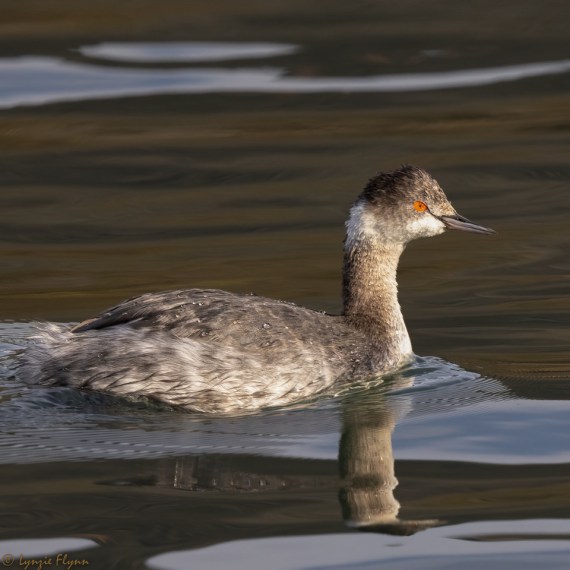
Eared Grebes have a dingier neck-front than Horned Grebes. Also a pointier crown, an often slightly-fluffed tail than doesn’t slope gently down to the water (thanks to Chris Lord for that point), the bill is slightly upturned, and the white patch on the side/back of the neck is usually disconnected to a quite variable degree from any white on the chin or throat. They are also a whopping 7.4% smaller! And a lot more common in SoCal! Nevertheless, the two are often confused.
Malibu Lagoon on eBird as of 1-4-23: 6941 lists, 317 species
Many thanks to photographers: Lynzie Flynn & Lillian Johnson
Upcoming SMBAS scheduled field trips:
THE ANTELOPE VALLEY TRIP 14 JAN WILL ALMOST CERTAINLY BE CANCELED DUE TO RAIN-SODDEN ROAD EDGES!
Antelope Valley Raptor Search, Sat. Jan 14, 7 am departure time; Malibu Lagoon, Sun Jan. 22 8:30 am; Madrona Marsh, Sat. Feb 11, 8 am; Malibu Lagoon, Sun Feb 26 8:30 am These and any other trips we announce for the foreseeable future will be dependent upon the expected status of the Covid/flu/etc. pandemic at trip time. Any trip announced may be canceled shortly before trip date if it seems necessary. By now any other comments should be superfluous. Link to Programs & Field Trip schedule.
The next SMBAS program: To-be-announced, Evening Meeting, Tuesday, 7 February 2023, 7:30 p.m.. This program will probably be on Zoom.
The SMBAS 10 a.m. Parent’s & Kids Birdwalk is currently under discussion concerning its resumption.

Links: Unusual birds at Malibu Lagoon
9/23/02 Aerial photo of Malibu Lagoon
More recent aerial photo
Prior checklists:
2021: Jan-July, July-Dec 2022: Jan-June
2020: Jan-July, July-Dec 2019: Jan-June, July-Dec
2018: Jan-June, July-Dec 2017: Jan-June, July-Dec
2016: Jan-June, July-Dec 2015: Jan-May, July-Dec
2014: Jan-July, July-Dec 2013: Jan-June, July-Dec
2012: Jan-June, July-Dec 2011: Jan-June, July-Dec
2010: Jan-June, July-Dec 2009: Jan-June, July-Dec
The 10-year comparison summaries created during the Lagoon Reconfiguration Project period, remain available—despite numerous complaints—on our Lagoon Project Bird Census Page. Very briefly summarized, the results unexpectedly indicate that avian species diversification and numbers improved slightly during the restoration period June’12-June’14.
Many thanks to Lynzie Flynn, Lillian Johnson, Chris Lord and others for their contributions to this month’s checklist.
The species are re-sequenced to agree with the California Bird Records Committee Official California Checklist, updated 15 Jan 2022. I generally do this sequence update at the start of each year.
[Chuck Almdale]
| Malibu Census 2022 | 7/24 | 8/28 | 9/25 | 10/23 | 11/27 | 12/25 | |
| Temperature | 70-73 | 72-79 | 72-79 | 61-73 | 54-62 | 65-72 | |
| Tide Lo/Hi Height | H+3.35 | H+4.49 | H+5.01 | H+5.33 | H+6.04 | H+6.59 | |
| Tide Time | 0909 | 1102 | 0949 | 0839 | 1045 | 0950 | |
| 1 | Gadwall | 25 | 22 | 26 | 18 | 8 | 16 |
| 1 | American Wigeon | 14 | 8 | ||||
| 1 | Mallard | 80 | 65 | 28 | 12 | 16 | 6 |
| 1 | Northern Pintail | 1 | |||||
| 1 | Green-winged Teal | 2 | 6 | 38 | |||
| 1 | Lesser Scaup | 1 | |||||
| 1 | Surf Scoter | 12 | 3 | ||||
| 1 | Bufflehead | 11 | 11 | ||||
| 1 | Hooded Merganser | 5 | |||||
| 1 | Red-breasted Merganser | 25 | 7 | ||||
| 1 | Ruddy Duck | 3 | 35 | 32 | 42 | ||
| 2 | Pied-billed Grebe | 2 | 4 | 6 | 8 | 4 | 5 |
| 2 | Horned Grebe | 1 | |||||
| 2 | Eared Grebe | 2 | 8 | 5 | |||
| 2 | Western Grebe | 2 | 4 | 1 | |||
| 7 | Feral Pigeon | 17 | 10 | 6 | 15 | 4 | 6 |
| 7 | Mourning Dove | 2 | 5 | 4 | 2 | ||
| 8 | Anna’s Hummingbird | 1 | 1 | 2 | |||
| 8 | Allen’s Hummingbird | 3 | 3 | 2 | |||
| 2 | Sora | 1 | 1 | ||||
| 2 | American Coot | 8 | 12 | 47 | 145 | 85 | 130 |
| 5 | Black-bellied Plover | 17 | 79 | 67 | 64 | 83 | 51 |
| 5 | Killdeer | 6 | 5 | 7 | 2 | 31 | 11 |
| 5 | Semipalmated Plover | 1 | 15 | 3 | 2 | ||
| 5 | Snowy Plover | 13 | 20 | 25 | 39 | 18 | |
| 5 | Whimbrel | 88 | 37 | 15 | 5 | 35 | 9 |
| 5 | Long-billed Curlew | 1 | |||||
| 5 | Marbled Godwit | 1 | 6 | 21 | 6 | 38 | 23 |
| 5 | Ruddy Turnstone | 3 | 4 | 3 | 4 | 4 | 2 |
| 5 | Black Turnstone | 2 | |||||
| 5 | Sanderling | 25 | 14 | 33 | 45 | 27 | |
| 5 | Dunlin | 1 | |||||
| 5 | Least Sandpiper | 8 | 10 | 23 | 15 | 62 | 19 |
| 5 | Western Sandpiper | 1 | 25 | 8 | 4 | 8 | 4 |
| 5 | Short-billed Dowitcher | 2 | |||||
| 5 | Long-billed Dowitcher | 1 | |||||
| 5 | Spotted Sandpiper | 1 | 1 | ||||
| 5 | Willet | 7 | 48 | 73 | 9 | 43 | 15 |
| 5 | Red-necked Phalarope | 1 | 2 | ||||
| 6 | Heermann’s Gull | 5 | 2 | 9 | 8 | 16 | 85 |
| 6 | Short-billed Gull | 1 | |||||
| 6 | Ring-billed Gull | 2 | 22 | 28 | 55 | ||
| 6 | Western Gull | 145 | 53 | 72 | 64 | 105 | 68 |
| 6 | California Gull | 3 | 21 | 57 | 155 | 390 | 450 |
| 6 | Glaucous-winged Gull | 1 | 3 | ||||
| 6 | Caspian Tern | 18 | |||||
| 6 | Forster’s Tern | 1 | 1 | ||||
| 6 | Royal Tern | 25 | 6 | 1 | 12 | 3 | |
| 6 | Elegant Tern | 475 | 255 | 15 | |||
| 6 | Black Skimmer | 3 | |||||
| 2 | Common Loon | 1 | |||||
| 2 | Black-vented Shearwater | 100 | |||||
| 2 | Pelagic Cormorant | 2 | 1 | 1 | 4 | 1 | |
| 2 | Double-crested Cormorant | 62 | 68 | 56 | 51 | 45 | 62 |
| 2 | Brown Pelican | 85 | 112 | 64 | 65 | 220 | 158 |
| 3 | Great Blue Heron | 5 | 2 | 3 | 3 | 3 | 5 |
| 3 | Great Egret | 3 | 3 | 1 | 2 | 5 | 3 |
| 3 | Snowy Egret | 12 | 14 | 9 | 9 | 31 | 35 |
| 3 | Reddish Egret | 1 | |||||
| 3 | Green Heron | 1 | |||||
| 3 | Black-crowned Night-Heron | 8 | 2 | 1 | 1 | ||
| 4 | Yellow-crowned Night-Heron | 1 | |||||
| 4 | Turkey Vulture | 1 | 1 | 1 | 1 | ||
| 4 | Osprey | 1 | |||||
| 4 | Red-shouldered Hawk | 1 | |||||
| 4 | Red-tailed Hawk | 3 | |||||
| 8 | Belted Kingfisher | 1 | 2 | ||||
| 4 | American Kestrel | 1 | |||||
| 4 | Merlin | 1 | |||||
| 4 | Peregrine Falcon | 1 | |||||
| 9 | Cassin’s Kingbird | 3 | 1 | 1 | |||
| 9 | Black Phoebe | 4 | 5 | 5 | 3 | 3 | 2 |
| 9 | Say’s Phoebe | 1 | |||||
| 9 | California Scrub-Jay | 3 | 2 | 2 | 1 | 1 | 1 |
| 9 | American Crow | 1 | 17 | 3 | 8 | 12 | 3 |
| 9 | Oak Titmouse | 2 | 2 | ||||
| 9 | Violet-green Swallow | 1 | |||||
| 9 | Northern Rough-winged Swallow | 1 | 4 | ||||
| 9 | Barn Swallow | 30 | 28 | ||||
| 9 | Cliff Swallow | 3 | 1 | ||||
| 9 | Bushtit | 10 | 15 | 8 | 10 | 2 | 15 |
| 9 | Wrentit | 1 | 1 | 2 | |||
| 9 | Ruby-crowned Kinglet | 2 | 1 | ||||
| 9 | Blue-gray Gnatcatcher | 2 | |||||
| 9 | House Wren | 1 | 1 | 2 | 1 | 2 | |
| 9 | Marsh Wren | 1 | |||||
| 9 | Bewick’s Wren | 1 | 1 | 2 | |||
| 9 | Northern Mockingbird | 3 | 1 | ||||
| 9 | European Starling | 8 | |||||
| 9 | Hermit Thrush | 3 | |||||
| 9 | House Finch | 12 | 8 | 4 | 15 | 18 | 16 |
| 9 | Lesser Goldfinch | 3 | 6 | 1 | 6 | ||
| 9 | White-crowned Sparrow | 12 | 40 | 16 | |||
| 9 | Song Sparrow | 2 | 6 | 3 | 3 | 6 | |
| 9 | California Towhee | 1 | 3 | 6 | 1 | ||
| 9 | Spotted Towhee | 1 | 1 | ||||
| 9 | Red-winged Blackbird | 6 | 25 | 4 | 3 | 8 | |
| 9 | Great-tailed Grackle | 6 | 4 | 5 | 1 | ||
| 9 | Orange-crowned Warbler | 1 | 2 | 1 | |||
| 9 | Common Yellowthroat | 2 | 4 | 5 | 3 | 2 | 1 |
| 9 | Yellow-rumped Warbler (Audubon’s) | 4 | 16 | 15 | |||
| 9 | Townsend’s Warbler | 1 | |||||
| Totals by Type | Jul | Aug | Sep | Oct | Nov | Dec | |
| 1 | Waterfowl | 105 | 87 | 57 | 68 | 125 | 136 |
| 2 | Water Birds – Other | 159 | 197 | 174 | 275 | 471 | 363 |
| 3 | Herons, Egrets & Ibis | 29 | 22 | 13 | 15 | 40 | 44 |
| 4 | Quail & Raptors | 1 | 1 | 2 | 1 | 1 | 6 |
| 5 | Shorebirds | 146 | 281 | 263 | 183 | 367 | 161 |
| 6 | Gulls & Terns | 673 | 340 | 141 | 277 | 546 | 658 |
| 7 | Doves | 19 | 15 | 6 | 19 | 6 | 6 |
| 8 | Other Non-Passerines | 3 | 3 | 2 | 0 | 5 | 2 |
| 9 | Passerines | 87 | 127 | 56 | 76 | 129 | 84 |
| Totals Birds | 1222 | 1073 | 714 | 914 | 1690 | 1460 | |
| Total Species | Jul | Aug | Sep | Oct | Nov | Dec | |
| 1 | Waterfowl | 2 | 2 | 3 | 5 | 9 | 9 |
| 2 | Water Birds – Other | 5 | 5 | 5 | 8 | 9 | 8 |
| 3 | Herons, Egrets & Ibis | 5 | 5 | 3 | 4 | 4 | 4 |
| 4 | Quail & Raptors | 1 | 1 | 2 | 1 | 1 | 4 |
| 5 | Shorebirds | 11 | 16 | 14 | 11 | 10 | 9 |
| 6 | Gulls & Terns | 8 | 6 | 5 | 7 | 7 | 4 |
| 7 | Doves | 2 | 2 | 1 | 2 | 2 | 1 |
| 8 | Other Non-Passerines | 1 | 1 | 2 | 0 | 3 | 1 |
| 9 | Passerines | 16 | 18 | 17 | 16 | 20 | 15 |
| Totals Species – 102 | 51 | 56 | 52 | 54 | 65 | 55 |
[Posted by Chuck Almdale]
This article is from Scientific American. It’s currently open to non-subscribers, but I can’t predict for how long. There is a link at the end of this article to a related article about terns following typhoons because they churn up food.
Storm-Chasing Seabirds Ride Out Hurricanes from Inside
Scientific American | Jesse Greenspan | 1 Jan 2023
(Getting the jump on tomorrow’s news today!)
Streaked shearwaters head deep into hurricanes to avoid crash landings
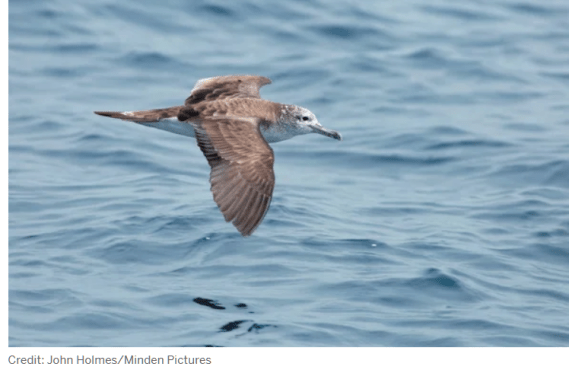
Photo from Scientific American.
Lyrebird mimics construction sounds | New Scientist
[Posted by Chuck Almdale, submitted by Ray Juncosa]
This YouTube video is about exactly what the title says it is. The Lyrebirds of Australia – there are two species, this video doesn’t say which one – are incredible mimics, probably the best in the world of birds. See how many power and hand tool sounds you can identify in this two minute video.
Scroll farther down for a bonus video!
YouTube videos are like potato chips: you can’t watch just one. Here’s another. Lyrebirds don’t do just power tools.
Back Bay Newport: 10 December 2022
[By Chuck Almdale]

Lots and lots of marsh grass before the open water. (Lillian Johnson 12-10-22)
We couldn’t get the highest tide of the year as it didn’t fall on a weekend, but we got one about 6″ lower, enough to get some rails up and out of the reeds. The sky was clear and the temperatures were mid-50’s to mid-60’s.
We started at the Upper Newport Bay Nature Preserve on Irving Ave. & University Dr., located on the west side of the bay. This spot has its advantages: a large parking lot, the Muth Interpretive Center has open and spotless bathrooms, a resident population of endemic California Gnatcatchers, a long walk/bicycle/horse trail alongside the marsh, reliable locations for the rails to appear.

This location also has some disadvantages: that bike trail I mentioned with whizzing bikes and riders shouting unhelpful things, a high wall/fence that some vertically challenged birders will have difficulty seeing over, unreliable California Gnatcatchers, and middle-distance Ridgeway Rails located right into the morning sun.

Nevertheless, we found about a dozen rails within about 100 yds. of each other. The largest gathering was four birds. But we were looking into the sun and the wall was too high for easy viewing for some of us. We had Virginia’s Rail on our last visit here, but not this time.
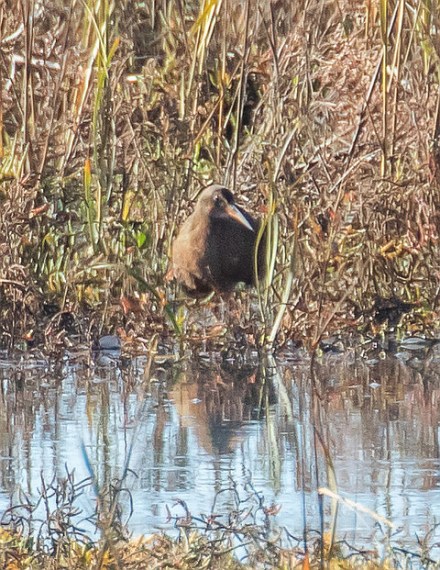
One of the closest birds. Photo slightly sharpened.
Most of the rails were out by the “S-bend” channel in the photo below. We later found a few a bit closer. Of course we looked and looked, but we couldn’t turn any of the rails into Virginia’s Rail.

Our 2019 trip to Back Bay Newport had a nice little chart of Virginia’s vs. Ridgley’s Rail’s head and bill sizes, with some discussion, created by moi. Here it is again!
Just to be obsessively safe, I did the same measurements using the Handbook of Birds of the World (HBW, 1996) and Sibley’s Field Guide to Birds of Western North America (2003). Unfortunately, while the Ridgley’s bill was consistently longer than the Virginia bill, the relative bill-lengths and relative species difference varied. See the chart below.
| NGS | HBW | Sibley | Average | |
| % Length | % Length | % Length | % Length | |
| Bill > Head | Bill > Head | Bill > Head | Bill > Head | |
| Virginia Rail | 33% | 14% | 31% | 26% |
| Ridgway’s Rail | 43% | 48% | 54% | 48% |
| Difference | 10% | 33% | 23% | 22% |
Figure 1. Comparison of bill-length vs. head-length in Virginia and Ridgley’s Rails.
The Virginia relative bill-length varied from 14-33% and the Ridgway’s from 43-54%, with the species difference varying from 10-33%. If you take the average difference of 22% (Ridgway’s relatively bill-length exceeding Virginia bill-length), this might be visible to a good birder with good eyesight and good binoculars in good light with good angle at a reasonable distance. We didn’t have all those conditions, and I’m not sure I see well enough to discern this difference anyway except at a very close distance.
We did see some shorebirds, but not a lot of them. Most of the “peeps” were too far away to differentiate well. On the east side of the bay we passed a pickleweed/grass field full of Whimbrel, Marbled Godwit, Willet and this Long-billed Dowitcher.
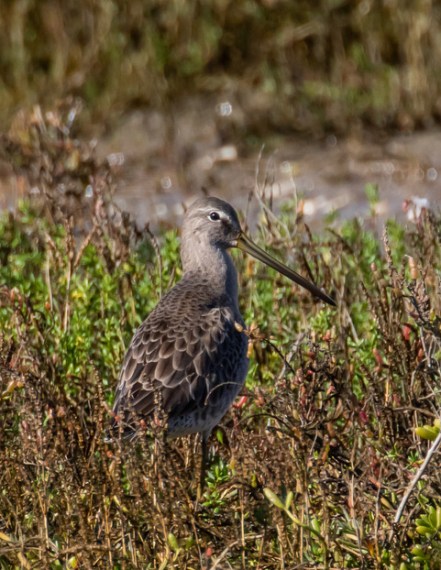
(Chris Tosdevin 12/10/22, Back Bay Newport)
Also on the east side near the permanent porta-potty parking lot was the usual small group of Long-billed Curlews, resting from their labors of the day.

We had quite a few hummingbirds, all of them either Anna’s* or Allan’s (no relation; they’re not even in the same genus). Lynzie caught this male Anna’s doing wing-tricks.

*Anna’s Hummingbird was named for Anna, Duchess of Rivoli. John James Audubon was much “impressed by her beauty and charm” when he met her in Paris in 1828, where he was probably trying to hawk some of his paintings. The type specimen was acquired in 1846 by the Academy of Natural Sciences in Philadelphia. Rivoli’s Hummingbird is named for her husband. (Dict. of Am. Bird Names, Ernest A. Choate, 1985)
Among the seven raptors seen was this Northern Harrier, close enough to photo if you have a steady hand.

Their owlish face is an excellent field mark at great distance.
The inevitable Osprey was also present. We watched it dive feet-first on a fish, but came up empty-handed, so to speak. There was also – much to our surprise – a Bald Eagle, determined (by others) to likely be three years old, thus not yet in adult plumage with full white head and tail. We did see it fly low over the bay, scaring the coots and ducks, but too far away for a good photograph.

Most numerous and noticeable were the many species of ducks – fifteen of them! In addition to the six pictured below, we had: Canada Goose (OK, it’s an honorary duck), Northern Shoveler, Gadwall, Mallard, Lesser Scaup, Surf Scoter, Bufflehead, Red-breasted Merganser and Ruddy Duck.
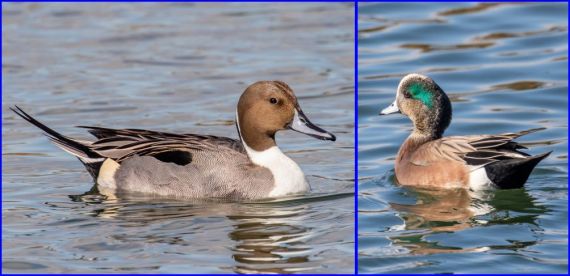


Pintail used to be common at Malibu Lagoon decades back, but have become less frequently seen and in fewer numbers. Blue-winged Teal are uncommon on the west coast, but are amazingly abundant in the east. We were astonished to see the numbers of Redhead at the upper portion of the bay just south of Jamboree Road – somewhere about 500. The Canvasback female was the sole representative of her species, hiding among some drowned bushes near the flotillas of Redhead and Lesser Scaup.
Passerines were well represented with sixteen species, but not abundant in numbers. A dozen or two of Savannah Sparrows were nice to see, but the oddest passerine was a Black Phoebe flitting and perching in the marsh below the bike/walk way.

(Chris Tosdevin 12/10/22, Back Bay Newport)
Black Phoebes normally have white on the belly and vent, but not on the rump and wings.

If I lead this trip again, I think I’ll start on the southeast end where the water comes in much closer. The odds aren’t as good for actually seeing rails, but if they’re there, they’re closer and the sun isn’t in your eyes. I have seen Ridgley’s, Virginia’s and Sora along the east side many times in the past, and the Mountains-to-the-Sea Trailway is very pleasant to drive and bird from the road, with many good stopping locations. There are cyclers zooming along but they have more room to maneuver and rarely shout distracting insults.
Check this map, which leads you to the Muth Interpretive Center on the northwest side of the bay. Back Bay Newport – NW meeting area
The starting place I’m referring to is on the SE corner of the bay where Back Bay Drive meets Mountains-to-the-Sea Trail & Bikeway, near the Back Bay Science Center. Here the high tides come up almost to your feet.
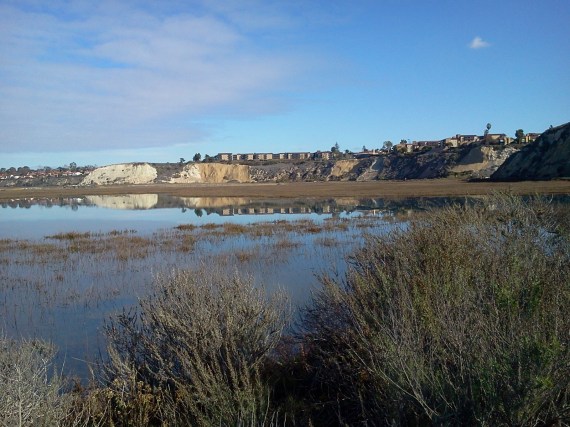
The drive home was horrible, as always, stop and go all the way, taking about twice as long as did the morning drive.
Many thanks to our photographers Lynzie Flynn, Lillian Johnson & Chris Tosdevin.
| Trip List – Back Bay Newport | 12/10/22 | 12/14/19 | 12/8/18 | 11/4/17 |
| Canada Goose | X | X | X | X |
| Gadwall | X | X | X | |
| American Wigeon | X | X | X | X |
| Mallard | X | X | X | X |
| Blue-winged Teal | X | X | ||
| Cinnamon Teal | X | X | ||
| Northern Shoveler | X | X | ||
| Northern Pintail | X | X | X | X |
| Green-winged Teal | X | X | X | X |
| Canvasback | X | X | ||
| Redhead | X | X | X | |
| Greater Scaup | X | |||
| Lesser Scaup | X | X | X | |
| Surf Scoter | X | |||
| Bufflehead | X | X | X | X |
| Hooded Merganser | X | |||
| Red-Breasted Merganser | X | |||
| Ruddy Duck | X | X | X | X |
| Pied-billed Grebe | X | X | X | X |
| Eared Grebe | X | X | ||
| Western Grebe | X | X | X | |
| Clark’s Grebe | X | X | ||
| Rock Pigeon | X | X | X | |
| Mourning Dove | X | X | X | X |
| Anna’s Hummingbird | X | X | X | X |
| Allen’s Hummingbird | X | X | X | |
| White-throated Swift | X | |||
| Virginia’s Rail | 10 | |||
| Ridgway’s Rail | 12 | 1 | 15 | |
| Sora | 1 | X | ||
| American Coot | X | X | X | X |
| American Avocet | X | X | X | |
| Black-bellied Plover | X | |||
| Killdeer | X | |||
| Whimbrel | X | X | ||
| Long-billed Curlew | X | X | X | |
| Marbled Godwit | X | X | X | X |
| Sanderling | X | |||
| Least Sandpiper | X | X | X | |
| Western Sandpiper | X | |||
| Long-billed Dowitcher | X | |||
| Spotted Sandpiper | X | X | ||
| Lesser Yellowlegs | X | |||
| Willet | X | X | X | X |
| Greater Yellowlegs | X | X | X | |
| Ring-billed Gull | X | X | X | X |
| Western Gull | X | X | X | X |
| California Gull | X | X | ||
| Double-crested Cormorant | X | X | X | X |
| American White Pelican | X | |||
| Brown Pelican | X | X | X | |
| Great Blue Heron | X | X | X | X |
| Great Egret | X | X | X | X |
| Snowy Egret | X | X | X | X |
| Little Blue Heron | X | |||
| Tricolored Heron | X | |||
| Green Heron | X | |||
| Turkey Vulture | X | X | X | X |
| Osprey | X | X | X | |
| Northern Harrier | X | X | X | X |
| Cooper’s Hawk | X | X | ||
| Bald Eagle | X | |||
| Red-shouldered Hawk | X | |||
| Red-tailed Hawk | X | X | X | X |
| Belted Kingfisher | X | X | X | X |
| Northern Flicker | X | |||
| American Kestrel | X | X | X | X |
| Peregrine Falcon | X | |||
| Black Phoebe | X | X | X | X |
| Say’s Phoebe | X | X | X | X |
| Cassin’s Kingbird | X | X | X | |
| California Scrub-Jay | X | |||
| American Crow | X | X | X | X |
| Common Raven | X | |||
| Northern Rough-winged Swallow | X | |||
| Bushtit | X | |||
| House Wren | X | |||
| Marsh Wren | H | X | X | |
| Bewick’s Wren | X | X | ||
| Blue-gray Gnatcatcher | X | X | X | |
| California Gnatcatcher | H | X | ||
| Ruby-crowned Kinglet | X | |||
| Wrentit | H | |||
| California Thrasher | X | H | ||
| Northern Mockingbird | X | X | X | X |
| House Finch | X | X | X | X |
| California Towhee | X | X | X | |
| Savannah Sparrow | X | X | X | X |
| Song Sparrow | X | X | X | X |
| Lincoln’s Sparrow | X | |||
| White-crowned Sparrow | X | X | X | X |
| Orange-crowned Warbler | X | |||
| Common Yellowthroat | X | X | X | |
| Yellow-rumped Warbler | X | X | ||
| Western Meadowlark | X | |||
| Lesser Goldfinch | X | X | ||
| Total Species – 80 | 68 | 59 | 65 | 52 |
| X – Seen | ||||
| H – Heard only | ||||
| 1, 15 – Number seen | ||||
Hear Birds Again | Apple Phone App
[Posted by Chuck Almdale]
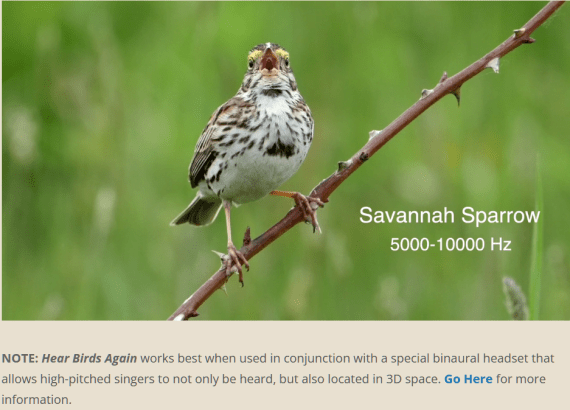
This looks like a potentially very useful phone app if you have high-frequency hearing loss and have – or are willing to buy – an Apple phone. It reduces the frequency of the bird’s song – dividing by two, three or four – but doesn’t seem to slow it down, so a 3-second bird song still takes 3 seconds, but the pitch is lower. They’ll probably develop an app for a non-Apple phone as well.
There’s a video on the site with a half-dozen birds singing before and after the app reduces the frequency. Go to the site and watch the video and you’ll know everything I know about it. If anyone gets one of these apps (binaural headphones recommended) and wants to write a review, I’ll be happy to post it here.
Link to Hear Birds Again.



 SANTA MONICA BAY AUDUBON SOCIETY BLOG