Free email delivery
Please sign up for email delivery in the subscription area to the right.
No salesman will call, at least not from us. Maybe from someone else.
You are all invited to the next ZOOM meeting
of Santa Monica Bay Audubon Society

|
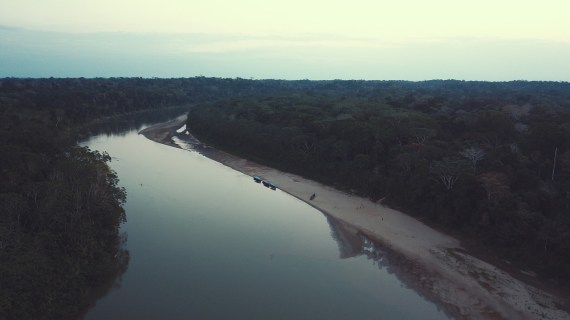
How has a remote Amazonian bird community changed after three decades? with Dr. Ari Martinez.
Zoom Evening Meeting, Tuesday, 6 December, 7:30 p.m.
Zoom waiting room opens 7:15 p.m.

Dr. Martinez and a royal friend.
Dr. Ari Martinez is an ecologist whose research interest lies at the intersection of behavioral and community ecology. For example, how does inter-species sociality influence the organization of animal communities? To answer this and other research questions he has spent over 10 years living and working in Latin America, using birds of the Amazon rainforest as a study system. In order to do so, he slept anywhere available — bed, tent, hammock, village sidewalk — and traveled on oxcarts, dugout canoes, motorcycles and logging trucks. In 2018, with funding from National Geographic Society, he organized a research team to re-census an entire Amazonian bird community 35 years after the initial census, and included three of the original team members. He will tell us about the challenges of surveying Amazonian bird communities and the results of this particular re-census. He is currently an Assistant Professor at California State Long Beach, where his research program focuses on the influence of social information on animal communities, using Amazonian mixed-species flocks as a model system.
|
(If this button isn’t working for you, see detailed zoom invitation below.)
Meeting ID: 861 8486 3384
Passcode: 214836
One tap mobile:
+16694449171,,86184863384#,,,,*214836# US
+16699009128,,86184863384#,,,,*214836# US (San Jose)
Dial by your location
+1 669 444 9171 US
+1 669 900 9128 US (San Jose)
+1 253 205 0468 US
+1 253 215 8782 US (Tacoma)
+1 346 248 7799 US (Houston)
+1 719 359 4580 US
+1 564 217 2000 US
+1 646 558 8656 US (New York)
+1 646 931 3860 US
+1 689 278 1000 US
+1 301 715 8592 US (Washington DC)
+1 305 224 1968 US
+1 309 205 3325 US
+1 312 626 6799 US (Chicago)
+1 360 209 5623 US
+1 386 347 5053 US
+1 507 473 4847 US
Meeting ID: 861 8486 3384
Passcode: 214836
Find your local number: https://us02web.zoom.us/u/kfby8Ol9A
Almost Winter, Malibu Lagoon, 27 November 2022
[Chuck Almdale]

A month ago the beach was quite wide. Then the first winter king tide came along and washed over the beach into the lagoon and left an outlet at its west end. The outflow channel was quite deep and swift and really cold. After watching two people in wet suits struggle through it, I advised the next couple in pants and shirts to forget it unless they wanted to be washed out to sea.
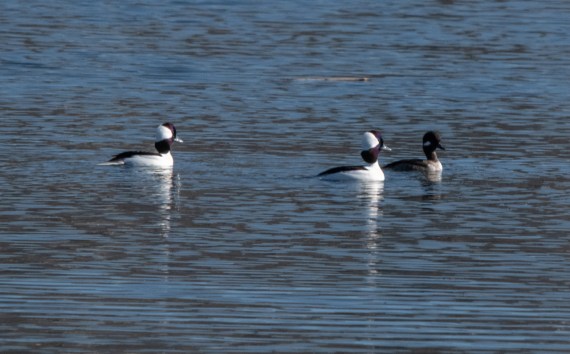
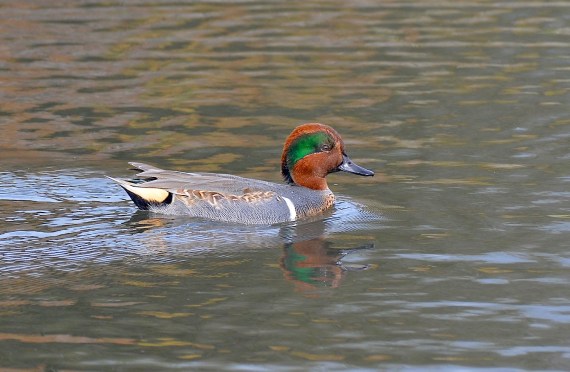
We had nine species of ducks of which four were new for the season, including the Bufflehead above. Someone once thought this head looked blocky like the head of a buffalo.

As usual, the late autumn sun was in our eyes at the start, busily washing out bird colors and leaving them in shades of gray, as with the pelicans above.
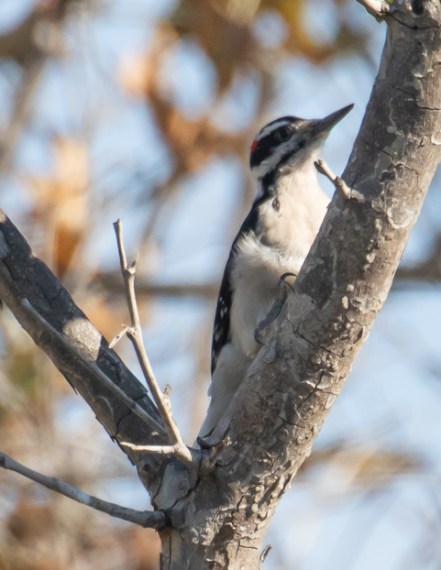
I keep getting reports of a Hairy Woodpecker hanging out in the trees around the parking lot and paralleling PCH, and I keep missing the bird. Femi Faminu has some sort of weird affinity to woodpeckers and was always hearing and seeing them at the lagoon, so most of their appearances in my list for the last two years are due to her. However, Chris & Ruth Tosdevin were here a few days earlier spotting the American Golden Plover (see report), a new bird for the lagoon, and got a photo of the woodpecker.
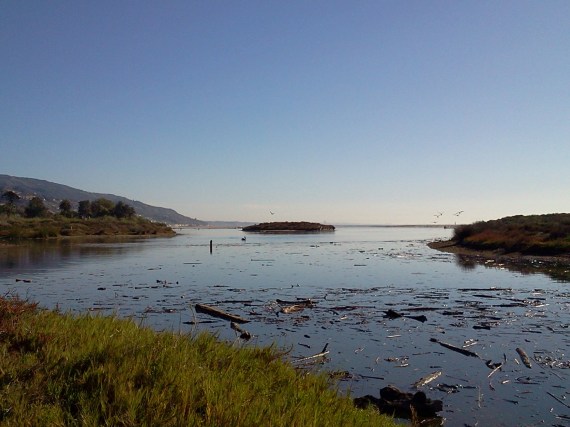
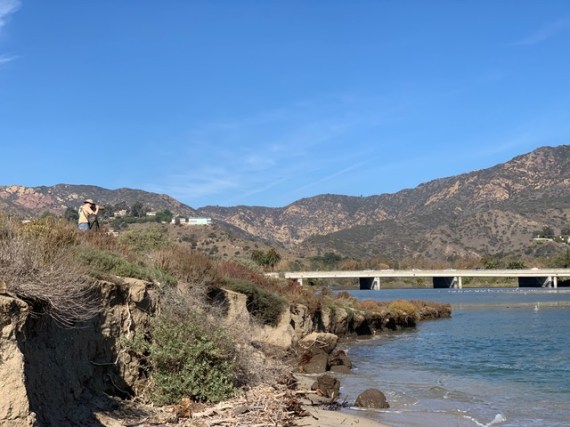
We could see from the meeting place and the viewing platform near the PCH bridge that the high tides and/or rain had caused the lagoon water to break through the beach. The channel was also full of logs and bark and the ubiquitous “whatnot.” That usually signifies lots of rain bringing timber down the creek. But the coots and ducks didn’t seem to mind.

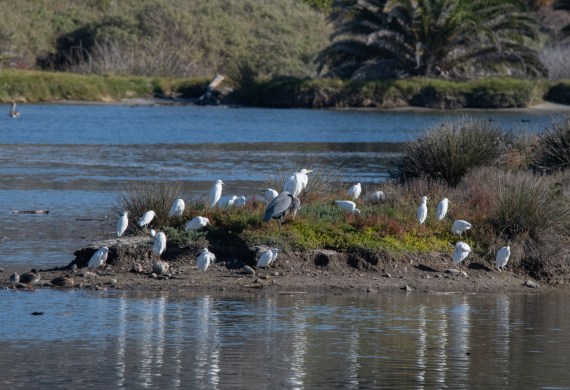
For a while a channel sandy island west end hosted most of the egrets and herons.
The easternmost home in Malibu Colony has a camera on the edge of the roof. A Pelagic Cormorant has been hanging out next to it off and on for months, so I call it the “cormorant-cam.” I suppose the bird likes this lofty perch and good view, and it’s a safe (from dogs and annoying humans) spot when the offshore rocks are wave-smashed. For all I know, the camera is actually live with a permanent presence on the web and you can watch this bird 24/7, should you so desire, although it doesn’t do much other than stand there. However, this time it was joined by two friends whom I suppose know a good thing when they see it. The camera and one friend are a millimeter to the left of this view.

Grace and Larry did their Western Snowy Plover census a few days later, and photo’d many of the same birds we saw. Here’s a small portfolio of them, beginning with this very chunky-looking fluffed up Western Snowy Plover.

I think (but could be wrong) this is a different individual, standing up, giving us a view of his leg-rings, which we record as ga:gy, translated as (L)green over aqua:(R)green over yellow.


This winter Ruddy Turnstone (The Turnstone, in Europe) seems to be distracted by that photographer slowly creeping up.
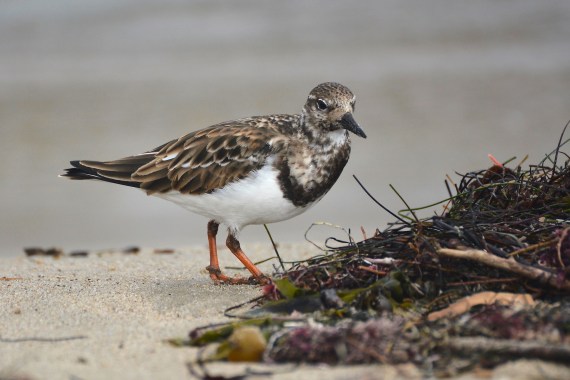
The turnstones are named for what they do, which oddly enough is turning over stones. Sometimes something edible is hiding under there; you never know until you look. They have an unusual bill, stout at the base, medium length, slightly upturned with a thicker lower bill. A good solid lever with which to…turn stones. Natural selection strikes again!
And here’s two full-frontal portraits one rarely sees. This Willet definitely has binocular vision.


I’d say the gull above also has binocular vision, but just barely. That steely gaze shows that he means business.

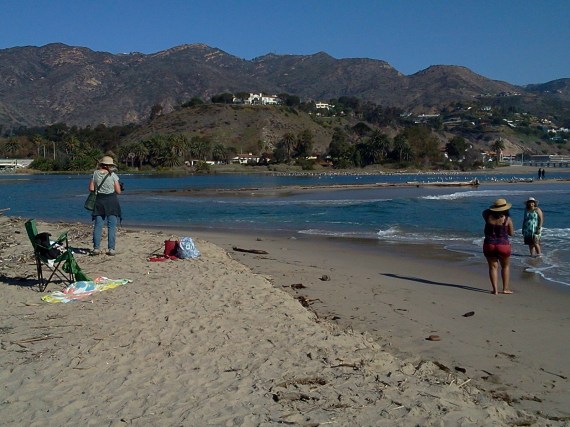
The outlet channel was about 5 ft. deep and moving swiftly an hour after high tide. Between the distance and a high-enough sand berm between us and the main flock, it was tough to see what’s what.
Sometimes you just have to climb to see who’s hiding behind the berm.
Birds new for the season: American Wigeon, Lesser Scaup, Surf Scoter, Bufflehead, Red-breasted Merganser, Allen’s Hummingbird, Short-billed (aka Mew) Gull, Common Loon, Black-vented Shearwater, Black-crowned Night-Heron, Ruby-crowned Kinglet, Blue-gray Gnatcatcher, Hermit Thrush.
Malibu Lagoon on eBird as of 10-30-22: 6340 lists, 316 species
Many thanks to photographers: Lillian Johnson, Ray Juncosa, Larry Loeher, Grace Murayama, Chris Tosdevin.
Upcoming SMBAS scheduled field trips: Malibu Lagoon, Sun Dec. 25 8:30 am; Antelope Valley Raptor Search, Sat. Jan 14, 7 am departure time; Malibu Lagoon, Sun Jan. 22 8:30 am These and any other trips we announce for the foreseeable future will be dependent upon the expected status of the Covid/flu/etc. pandemic at trip time. Any trip announced may be canceled shortly before trip date if it seems necessary. By now any other comments should be superfluous.
The next SMBAS program: To-be-announced, Evening Meeting, Tuesday, 7 February 2023, 7:30 p.m.. This program will probably be on Zoom.
The SMBAS 10 a.m. Parent’s & Kids Birdwalk is currently under discussion concerning its resumption.
Links: Unusual birds at Malibu Lagoon
9/23/02 Aerial photo of Malibu Lagoon
More recent aerial photo
Prior checklists:
2021: Jan-July, July-Dec 2022: Jan-June
2020: Jan-July, July-Dec 2019: Jan-June, July-Dec
2018: Jan-June, July-Dec 2017: Jan-June, July-Dec
2016: Jan-June, July-Dec 2015: Jan-May, July-Dec
2014: Jan-July, July-Dec 2013: Jan-June, July-Dec
2012: Jan-June, July-Dec 2011: Jan-June, July-Dec
2010: Jan-June, July-Dec 2009: Jan-June, July-Dec
The 10-year comparison summaries created during the Lagoon Reconfiguration Project period, remain available—despite numerous complaints—on our Lagoon Project Bird Census Page. Very briefly summarized, the results unexpectedly indicate that avian species diversification and numbers improved slightly during the restoration period June’12-June’14.
Many thanks to Lillian Johnson, Chris Lord, Chris & Ruth Tosdevin, Ray Juncosa and others for their contributions to this month’s checklist.
The species are re-sequenced to agree with the California Bird Records Committee Official California Checklist, updated 15 Jan 2022. I generally do this sequence update at the start of each year.
[Chuck Almdale]
| Malibu Census 2022 | 6/26 | 7/24 | 8/28 | 9/25 | 10/23 | 11/27 | |
| Temperature | 65-70 | 70-73 | 72-79 | 72-79 | 61-73 | 54-62 | |
| Tide Lo/Hi Height | H+3.33 | H+3.35 | H+4.49 | H+5.01 | H+5.33 | H+6.04 | |
| Tide Time | 0943 | 0909 | 1102 | 0949 | 0839 | 1045 | |
| 1 | Gadwall | 15 | 25 | 22 | 26 | 18 | 8 |
| 1 | American Wigeon | 14 | |||||
| 1 | Mallard | 35 | 80 | 65 | 28 | 12 | 16 |
| 1 | Northern Pintail | 1 | |||||
| 1 | Green-winged Teal | 2 | 6 | ||||
| 1 | Lesser Scaup | 1 | |||||
| 1 | Surf Scoter | 12 | |||||
| 1 | Bufflehead | 11 | |||||
| 1 | Red-breasted Merganser | 25 | |||||
| 1 | Ruddy Duck | 3 | 35 | 32 | |||
| 2 | Pied-billed Grebe | 1 | 2 | 4 | 6 | 8 | 4 |
| 2 | Eared Grebe | 2 | 8 | ||||
| 2 | Western Grebe | 2 | 4 | ||||
| 7 | Feral Pigeon | 8 | 17 | 10 | 6 | 15 | 4 |
| 7 | Band-tailed Pigeon | 1 | |||||
| 7 | Mourning Dove | 2 | 2 | 5 | 4 | 2 | |
| 8 | Anna’s Hummingbird | 1 | 1 | ||||
| 8 | Allen’s Hummingbird | 2 | 3 | 3 | 2 | ||
| 2 | Sora | 1 | 1 | ||||
| 2 | American Coot | 4 | 8 | 12 | 47 | 145 | 85 |
| 5 | Black-bellied Plover | 17 | 79 | 67 | 64 | 83 | |
| 5 | Killdeer | 3 | 6 | 5 | 7 | 2 | 31 |
| 5 | Semipalmated Plover | 1 | 15 | 3 | 2 | ||
| 5 | Snowy Plover | 13 | 20 | 25 | 39 | 18 | |
| 5 | Whimbrel | 3 | 88 | 37 | 15 | 5 | 35 |
| 5 | Long-billed Curlew | 1 | |||||
| 5 | Marbled Godwit | 1 | 6 | 21 | 6 | 38 | |
| 5 | Ruddy Turnstone | 3 | 4 | 3 | 4 | 4 | |
| 5 | Black Turnstone | 2 | |||||
| 5 | Sanderling | 25 | 14 | 33 | 45 | ||
| 5 | Dunlin | 1 | |||||
| 5 | Least Sandpiper | 8 | 10 | 23 | 15 | 62 | |
| 5 | Western Sandpiper | 1 | 25 | 8 | 4 | 8 | |
| 5 | Short-billed Dowitcher | 2 | |||||
| 5 | Long-billed Dowitcher | 1 | |||||
| 5 | Spotted Sandpiper | 1 | 1 | ||||
| 5 | Willet | 7 | 48 | 73 | 9 | 43 | |
| 5 | Red-necked Phalarope | 1 | 2 | ||||
| 6 | Heermann’s Gull | 27 | 5 | 2 | 9 | 8 | 16 |
| 6 | Short-billed Gull | 1 | |||||
| 6 | Ring-billed Gull | 2 | 22 | 28 | |||
| 6 | Western Gull | 55 | 145 | 53 | 72 | 64 | 105 |
| 6 | California Gull | 3 | 3 | 21 | 57 | 155 | 390 |
| 6 | Glaucous-winged Gull | 1 | 3 | ||||
| 6 | Caspian Tern | 22 | 18 | ||||
| 6 | Forster’s Tern | 1 | 1 | ||||
| 6 | Royal Tern | 3 | 25 | 6 | 1 | 12 | 3 |
| 6 | Elegant Tern | 475 | 255 | 15 | |||
| 6 | Black Skimmer | 3 | |||||
| 2 | Common Loon | 1 | |||||
| 2 | Black-vented Shearwater | 100 | |||||
| 2 | Pelagic Cormorant | 2 | 1 | 1 | 4 | ||
| 2 | Double-crested Cormorant | 46 | 62 | 68 | 56 | 51 | 45 |
| 2 | Brown Pelican | 126 | 85 | 112 | 64 | 65 | 220 |
| 3 | Great Blue Heron | 3 | 5 | 2 | 3 | 3 | 3 |
| 3 | Great Egret | 4 | 3 | 3 | 1 | 2 | 5 |
| 3 | Snowy Egret | 2 | 12 | 14 | 9 | 9 | 31 |
| 3 | Reddish Egret | 1 | |||||
| 3 | Green Heron | 1 | |||||
| 3 | Black-crowned Night-Heron | 4 | 8 | 2 | 1 | ||
| 4 | Yellow-crowned Night-Heron | 1 | |||||
| 4 | Turkey Vulture | 4 | 1 | 1 | 1 | ||
| 4 | Osprey | 1 | 1 | ||||
| 4 | Red-shouldered Hawk | 1 | |||||
| 8 | Belted Kingfisher | 1 | 2 | ||||
| 4 | Peregrine Falcon | 1 | |||||
| 9 | Cassin’s Kingbird | 3 | 1 | ||||
| 9 | Black Phoebe | 5 | 4 | 5 | 5 | 3 | 3 |
| 9 | Say’s Phoebe | 1 | |||||
| 9 | California Scrub-Jay | 1 | 3 | 2 | 2 | 1 | 1 |
| 9 | American Crow | 5 | 1 | 17 | 3 | 8 | 12 |
| 9 | Oak Titmouse | 2 | 2 | ||||
| 9 | Violet-green Swallow | 1 | |||||
| 9 | Northern Rough-winged Swallow | 1 | 4 | ||||
| 9 | Barn Swallow | 20 | 30 | 28 | |||
| 9 | Cliff Swallow | 3 | 1 | ||||
| 9 | Bushtit | 8 | 10 | 15 | 8 | 10 | 2 |
| 9 | Wrentit | 1 | 1 | ||||
| 9 | Ruby-crowned Kinglet | 2 | |||||
| 9 | Blue-gray Gnatcatcher | 2 | |||||
| 9 | House Wren | 1 | 1 | 1 | 2 | 1 | 2 |
| 9 | Marsh Wren | 1 | |||||
| 9 | Bewick’s Wren | 1 | 1 | 2 | |||
| 9 | Northern Mockingbird | 1 | 3 | 1 | |||
| 9 | European Starling | 8 | |||||
| 9 | Hermit Thrush | 3 | |||||
| 9 | House Finch | 10 | 12 | 8 | 4 | 15 | 18 |
| 9 | Lesser Goldfinch | 1 | 3 | 6 | 1 | 6 | |
| 9 | White-crowned Sparrow | 12 | 40 | ||||
| 9 | Song Sparrow | 4 | 2 | 6 | 3 | 3 | 6 |
| 9 | California Towhee | 1 | 1 | 3 | 6 | ||
| 9 | Spotted Towhee | 1 | 1 | ||||
| 9 | Red-winged Blackbird | 6 | 25 | 4 | 3 | ||
| 9 | Great-tailed Grackle | 6 | 6 | 4 | 5 | 1 | |
| 9 | Orange-crowned Warbler | 1 | 2 | ||||
| 9 | Common Yellowthroat | 2 | 4 | 5 | 3 | 2 | |
| 9 | Yellow-rumped Warbler (Audubon’s) | 4 | 16 | ||||
| Totals by Type | Jun | Jul | Aug | Sep | Oct | Nov | |
| 1 | Waterfowl | 50 | 105 | 87 | 57 | 68 | 125 |
| 2 | Water Birds – Other | 177 | 159 | 197 | 174 | 275 | 471 |
| 3 | Herons, Egrets & Ibis | 13 | 29 | 22 | 13 | 15 | 40 |
| 4 | Quail & Raptors | 5 | 1 | 1 | 2 | 1 | 1 |
| 5 | Shorebirds | 6 | 146 | 281 | 263 | 183 | 367 |
| 6 | Gulls & Terns | 110 | 673 | 340 | 141 | 277 | 546 |
| 7 | Doves | 11 | 19 | 15 | 6 | 19 | 6 |
| 8 | Other Non-Passerines | 2 | 3 | 3 | 2 | 0 | 5 |
| 9 | Passerines | 63 | 87 | 127 | 56 | 76 | 129 |
| Totals Birds | 437 | 1222 | 1073 | 714 | 914 | 1690 | |
| Total Species | Jun | Jul | Aug | Sep | Oct | Nov | |
| 1 | Waterfowl | 2 | 2 | 2 | 3 | 5 | 9 |
| 2 | Water Birds – Other | 4 | 5 | 5 | 5 | 8 | 9 |
| 3 | Herons, Egrets & Ibis | 4 | 5 | 5 | 3 | 4 | 4 |
| 4 | Quail & Raptors | 2 | 1 | 1 | 2 | 1 | 1 |
| 5 | Shorebirds | 2 | 11 | 16 | 14 | 11 | 10 |
| 6 | Gulls & Terns | 5 | 8 | 6 | 5 | 7 | 7 |
| 7 | Doves | 3 | 2 | 2 | 1 | 2 | 2 |
| 8 | Other Non-Passerines | 1 | 1 | 1 | 2 | 0 | 3 |
| 9 | Passerines | 12 | 16 | 18 | 17 | 16 | 20 |
| Totals Species – 97 | 35 | 51 | 56 | 52 | 54 | 65 |
Back Bay Newport Trip: Sat. 10 December, 8:00 AM
THIS IS A SIGN-UP TRIP.
THE DRIVE IS ONE HOUR.
THE LEADER WANTS TO KNOW WHO IS COMING.
Despite what you may have read elsewhere, start time is 8 am.
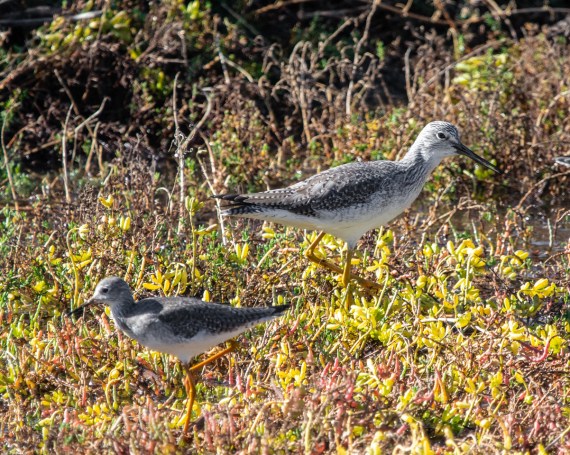
Lesser (L) & Greater (R) Yellowlegs on the pickleweed
(R. Juncosa, Upper Newport Bay 12-8-18)
Back Bay Newport (or Upper Newport Bay) can provide great birding when the tides are right. It’s a bit of a drive for us (see below) and the difficulty of finding a Saturday with a high tide often keeps us from going. This year, the full moon falls on Dec. 7, and the monthly high tide(s) are 6.6 ft. on both Dec. 6th & 7th. Our Saturday trip three days later gets a good high tide of +5.74 feet at 9:22 AM, giving us a good 90 minutes of rising tide. The rising tide will (we hope) bring shorebirds close to shore and flush the rails up out of the inundated reeds.
We hope to see Sora, Virginia Rail and Ridgway’s Rail, but we will of course keep our eyes open for Black Rail, which some of our chapter members swear on a stack of bibles (an as-yet-unverified claim) they have seen there. There should be plenty of ducks, grebes, waders, sandpipers, gulls, terns and skimmers on the bay and shore, raptors overhead and things in the brush. I saw my life Short-eared Owl here, decades ago, standing on a post among the reeds, so you never know what will be around. We will also search for the endangered California Gnatcatcher at one or two particular locations along the route.

Ridgway’s Rail (Kirsten Wahlquist 10/11/14)
We’ll have lunch (so bring one!) probably at nearby & birdy San Joaquin freshwater marsh, and those who wish can do some more birding there. In 2017 we saw a Red-throated Pipit here, a Very Good Bird, and a Virginia Rail showed up recently. However, we will also make sure to look for anything around; they usually keep a nice stock of interesting birds on hand, scattered around the many birder-sized ponds. They keep a list of sightings outside the bookshop door, AND if you’re looking for a particular bird book (say…Field Guide to Galapagos Birds) they might have it. You could call them: 949-378-6501.
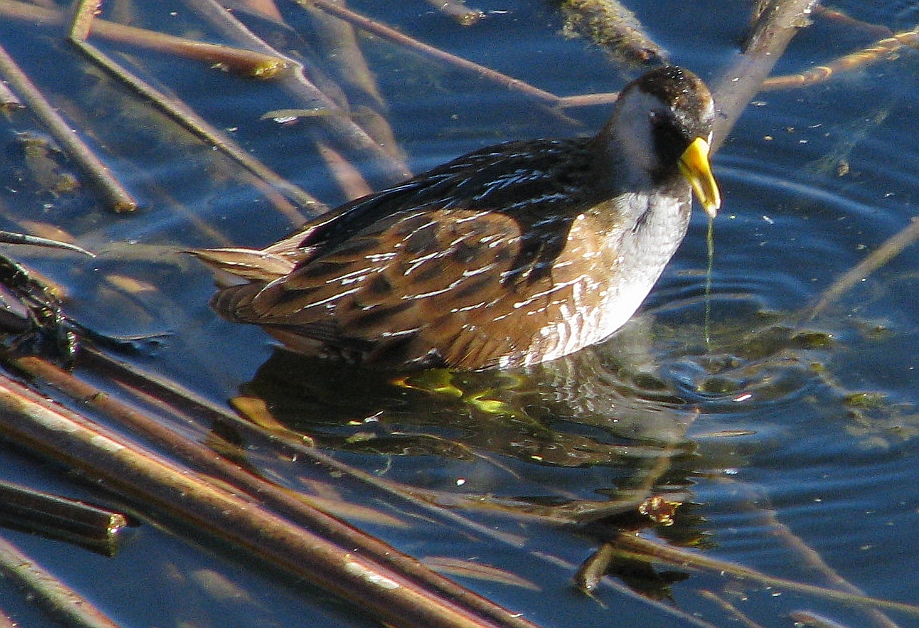
Sora (C. Almdale 11/09)
Family guide: We begin with a half-mile round-trip stroll on a bay-side bike path. After that we drive to a few more spots near Jamboree Rd., then to lunch. Morning temps. start cool. Dress in layers, weather may be cool.
For future reference: Link to tide chart.
Link to December 2019 report.
Driving Time: 50-60 minutes – 48 miles. While there are gas stations in the area (especially right where you get off the freeway) you could get hung up there while everyone else drives on the the next birding spot to find that uber-rariety. Don’t let this happen to you! Gas up in advance.
Carpooling Drivers & Riders: If you’re willing to drive others or ride with others, send me a reply including your contact info and approx. location and I’ll circulate it to any others similarly interested. If you’re riding, the polite thing is to get yourself to the driver’s starting location rather than try to get them to drive to your house to pick you up. They’re already in for a 2-4 hour drive time for the trip – don’t add to it. And riders should inquire of drivers about their masking requirements, if any.
Meeting time: 8 am, 10 December, 2022. Get there early and find California Gnatcatchers!
Sign-up Requested: No fee, but the leader wants to know who is coming. The drive is long: no signups, no trip.
Contact: Chuck, no later than Thursday 8 PM 8 December. email misclists [AT] verizon [DOT] net
Food: Bring munchies & liquids and/or lunch. No services next to the bay.
Directions: From the Santa Monica Fwy (I-10)Take San Diego Fwy (I-405) 46 miles south to CA-73. CA-73 south for 2.5 miles [Do not get onto I-55 Costa Mesa Fwy] and exit at CAMPUS DR / IRVINE AVE. Right on IRVINE AVE., drive southwest 1.1 miles, turn left onto not-terrifically-well-marked UNIVERSITY DRIVE (NOT Campus Drive or University Drive alongside the UC-Irvine campus, NOT, NOT!!!), and then turn right at the first driveway into the Upper Newport Bay Ecological Reserve parking lot. Write down these directions and look at the map linked to below!!! There are certain people who get themselves lost every year! You know who you are!
There’s good birding around the parking lot where you can walk around or use the bathroom in the nature center (accessible from outside on the bay side bottom floor). It doesn’t hurt to get there early.
Link to December 2019 report.
For coffee or snacks: There are several fast food places along one-way Bristol St. just past Irvine Ave. To get back to IRVINE AVE. go right on Birch or Cypress St, south to Orchard Dr., right on Orchard and back to Irvine Ave. where you turn left and drive about 1 mile southwest as described above Meet there. Allow at least 60 minutes travel time from Santa Monica.
Bathrooms in the interpretive Center open at 6am (entrance from outside, bayside, bottom floor).
Meet at 8:00 a.m. in the parking lot. Leaders: Chuck & Lillian Almdale.
Map to Meeting Place: Back Bay Newport – NW meeting area
Use + and – to zoom in or out, left click and mouse drag to reposition the map.
[Chuck Almdale]

Black Skimmer with the giant schnozzola. (Grace Murayama)
Black-naped Pheasant-Pigeon Rediscovered after 140 years
[Posted by Chuck Almdale]
From American Bird Conservancy (ABC):
A team of scientists and conservationists has rediscovered the elusive Black-naped Pheasant-Pigeon, a large, ground-dwelling pigeon that only lives on Fergusson Island, a rugged island in the D’Entrecasteaux Archipelago off of eastern Papua New Guinea. Like other pheasant-pigeons, the Black-naped Pheasant-Pigeon has a broad and laterally compressed tail, which, along with its size, makes it closely resemble a pheasant. The bird has been observed several times over the years by local hunters, but the newly taken photographs and video are the first time the bird has been documented by scientists since 1882, when it was first described. Ornithologists know very little about the species, but believe that the population on Fergusson is very small and decreasing.
Voice: A loud. far-carrying “wu-huwoooooa” rising and falling in pitch before trailing off at the end.
Video from ABC
Link to ABC text report.
Link to IUCN Red List Edge of Extinction report on Black-naped Pheasant-Pigeon Otidiphaps insularis.
Link to Re:Wild Search for lost birds report on 10 missing species.
Other Text Reports
Audubon Society News
CNN Report
CBS News
BBC News
Nearshore flocks on Santa Monica Bay
[Posted by Chuck Almdale]
Winter is the season for nearshore flocks on Santa Monica Bay. By “nearshore” I mean 25-500 yards from the shore. While there are flocks of gulls, I’m primarily talking about sea ducks and grebes. There can be many flocks of either, numbering from a dozen to many thousands of birds. Many of these birds also occur in and near lagoons, channels, bays, harbors and rivers, where they’re usually closer and easier to see. A telescope is not absolutely essential for the (much) closer birds — only 98% essential. The information below is a very rough guide.
If you’ve never seen some of the birds listed below, the time to get out out and look for them begins now. The several western capes/points (e.g. Point Dume, Mugu Rock) can be good and whales occasionally pop up there, plus dolphins and seals. The several miles of beach around Dockweiler Beach often has the largest nearshore flocks, but parking is tricky. The beach directly in front of the Hyperion water treatment can have large beach flocks of many species, including Mew Gulls, which seem attracted to sewage facilities.
The impetus for this posting was the following comment from LACoBirds chatline, which linked to a couple of photos. Richard Barth is a very well-known and long-time LA area birder who frequently checks the nearshore flocks in season:
Thurs 17 Nov
This morning a Surf Scoter flock south of Grand Ave (El Segundo Beach) had a White-winged Scoter and two Black Scoters. Poor photos on my eBird post, I scrambled to get some grainy long shots. https://ebird.org/view/checklist/S122581435
Richard Barth, West Hollywood
Richard’s Photos below:
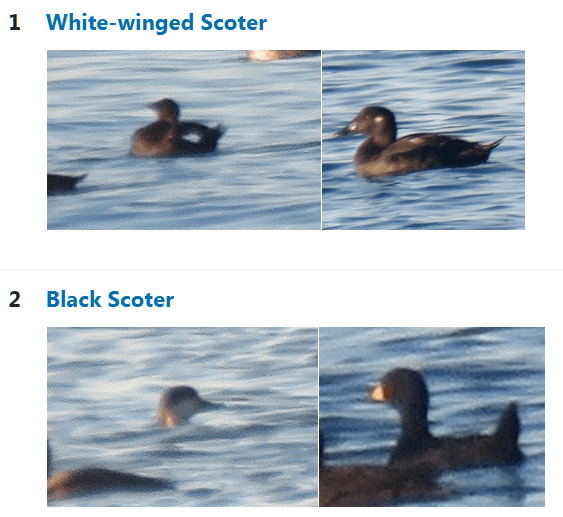
Scoter Ducks
As 99% of scoters will be Surf, what you’re really doing is scanning for those that aren’t. Learn their field marks ahead of time and/or carry a field guide.
Surf Scoter: The most common sea duck
Black Scoter: Roughly 0.1-3.0% of scoter flocks
White-winged Scoter: About the same as Black
Other Ducks
The few eiders & Long-tailed I’ve seen were in small “harbors”, such as Redondo Beach and Ventura.
Common Eider: Accidental on West Coast
King Eider: Accidental on West Coast
Long-tailed Duck: Rare
Harlequin Duck: Rare
Grebes
They can stay underwater for several minutes. Be prepared for them to suddenly pop up.
Western Grebe: Most common species by far in nearshore grebe flocks
Clark’s Grebe: About 1% of a Western Grebe flock will be Clark’s
Eared Grebe: On fresh & salt water; previously super-abundant on Salton Sea
Horned Grebe: Less common than Eared on fresh and salt water
Red-necked Grebe: Rare on SoCal coast, among westerns, likes bays, harbors, etc.
Pied-billed Grebe: Seen more often on brackish or salt water
Loons
Loons appear in small numbers nearshore. At Malibu they can be near the surf zone, very rarely in the lagoon. When feeding they dive a lot, can stay down several minutes, and may swim far underwater. Percentages below are for Surfrider Beach nearshore. They fly low to the water and constantly flap because they’re relatively heavy for their wing surface area.
Common Loon: 25%
Pacific: 60%
Red-throated Loon: 15%
Yellow-billed Loon: Rare; usually seen in bays or lakes.
Arctic Loon: Rare
Alcids
These tend to be farther offshore, where some flocks may be large, but they occasionally show up nearshore or in bays and harbors. All of them dive a lot and stay down for minutes, except when resting. You’re not likely to see any of them from the shore, but they are listed here in rough order of probability. They also fly low and constantly flap.
Common Murre
Pigeon Guillemot
Cassin’s Auklet
Rhinoceros Auklet
Marbled Murrelet
Scripp’s Murrelet
Guadalupe Murrelet
Shearwaters
All shearwaters “shear” the water, long glides between rows of waves, wingtips almost touching the water, rarely flapping; similarly-sized and shaped gulls flap a lot & fly higher.
Black-vented Shearwater: The most common close enough to shore to be at all visible; seasonal.
There are of course many other species out there flying around, diving and resting. This list is not intended to mention all possible birds.



 SANTA MONICA BAY AUDUBON SOCIETY BLOG