Free email delivery
Please sign up for email delivery in the subscription area to the right.
No salesman will call, at least not from us. Maybe from someone else.
Black Skimmers & Night-Herons: Malibu Lagoon, 28 August 2022
[Chuck Almdale]

Double-crested Cormorant, getting a grip (Chris Tosdevin 8/28/22)
It’s easy to tell when surf is high: the Pacific Coast Highway free parking areas are jampacked with cars and surfers are waxing boards in the paid-parking lot. Waves packed with surfers is the secondary sign.

Lagoon, low beach, birds & clouds. What looks like rain in the distance is likely an illusion. It never rains in August. (Lillian Johnson 8/28/22)
It began with overcast and a comfortable 72°. By 10:30 it was 79°. But that’s the beach. It went above 100° in the valley over the hill. Definitely warm.

Allen’s Hummingbird (Blair Lord 8/28/22)
Migrating shorebirds are still arriving. Six new-for-the-season species (see list below) in addition to last month’s five newbies. Best of the lot was the single Red-necked Phalarope who was not too late whatever some might say, and two Black Turnstones. The latter species generally prefer rocky shorelines, but Malibu Lagoon lacks those, so they make do with the sand, alongside the Ruddy Turnstones (or “The Turnstone” for you Europeans). When the tide is low, the Black Turnstones may go to the outer rocks, but as the tide was approaching its 11:02am high, waves were washing over their tops.
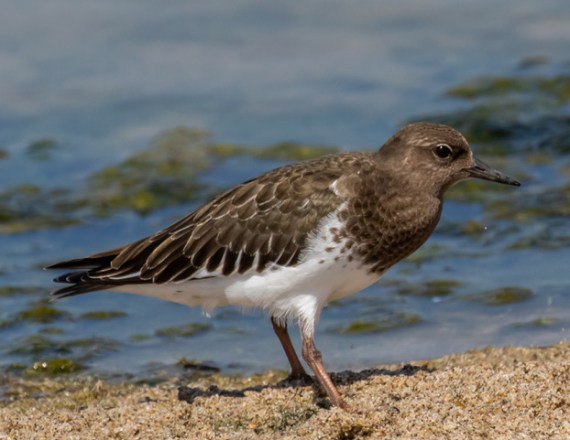
Lagoonside Black Turnstone (Chris Tosdevin 8/28/22)
Here’s a little story** for those who’ve birded in England.
Thomas Hewitt-Frothingfield Edwardson was one of the greatest ornithologists/birders England was ever to witness and in the 17th century — birding without benefit of binoculars or telescope — he found first specimens of many of the sceptered isle’s limited avifauna. For this diligent work, the British birding community repeatedly honored him by utilizing his name in a great many of their English (non-scientific) bird names. But the name was long and cumbersome and the locals quickly shortened it to his initials. Thus in England we find T.H.E.’s Oystercatcher, T.H.E.’s Turnstone, T.H.E.’s Night-Heron, T.H.E.’s Kestrel, T.H.E.’s Night-Heron, T.H.E.’s Puffin, T.H.E.’s Cuckoo, T.H.E.’s Nightjar, T.H.E.’s Swift, T.H.E.’s Kingfisher, T.H.E.’s Nuthatch, T.H.E.’s Wren, and a few others. Over the decades and through the morphological changes languages typically undergo, British birdos compacted the initials and dropped the “‘s,” arriving at today’s “The.” That’s why they say “The Night-Heron,” “The Oystercatcher,” The Wren” and so on all the time. But the remarkable frequency of this honorific is due to Thomas Hewitt-Frothingfield Edwardson, birder extraordinaire, now almost entirely forgotten.
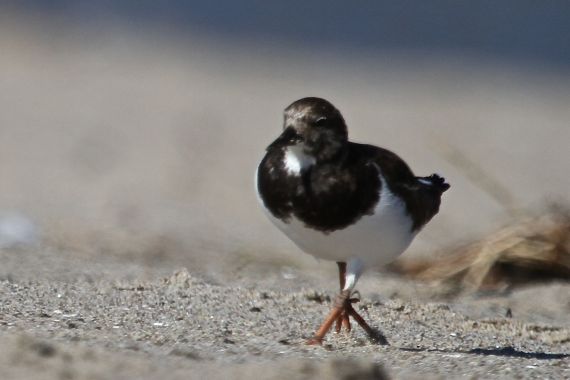

Dark Ruddy Turnstone (“The” Turnstone), above two photos (Joyce Waterman 11/22/15)
Some juvenile Ruddy Turnstones (above) can look like a Black Turnstone. Very dark juvenile Ruddy Turnstones have turned up at the lagoon for years. Uncertain as to what they were, we contacted an authority who advised us they were indeed Ruddys, and they were relatively common along the Arctic coast of Alaska.

Cloudy morning start (Lillian Johnson 8/28/22)
Back to real life.

Another Pelagic Cormorant is ready for her close-up (Blair Lord 8/28/22)
For many months last year a Pelagic Cormorant sat at this exact spot, seemingly staring at the camera. Most likely this is the same one, still waiting for a call from her agent.
Baby American Coots are surprisingly colorful. (Larry Loeher 8/26/22). Here’s a thesis waiting to be written. Why are they colorful, when most precocial young are cryptic?
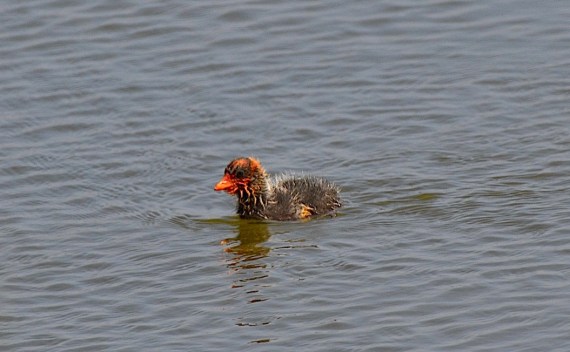
American Coot numbers are still in their summer lows and will probably pop up over 100 next month. But just to prove that they do breed at the lagoon — along with Gadwall, Mallard, Killdeer and assorted passerines — here’s one family, out and about with the kids.
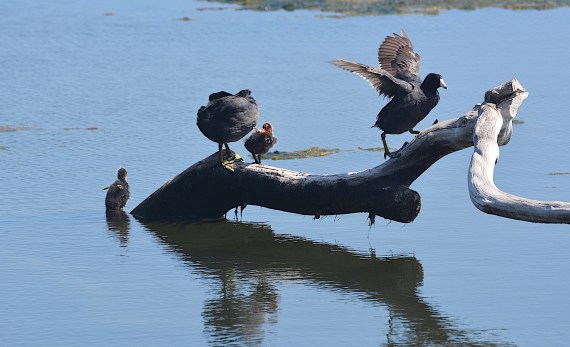
The coot family. (Larry Loeher 8/26/22) While feeding, each adult had one chick. Notice the stubby little wings on the chicks.
Pied-billed Grebes don’t breed here, but might if there were more reeds. They build floating nests of reeds, but the various reed beds in the channels are too small and insufficiently dense for them.
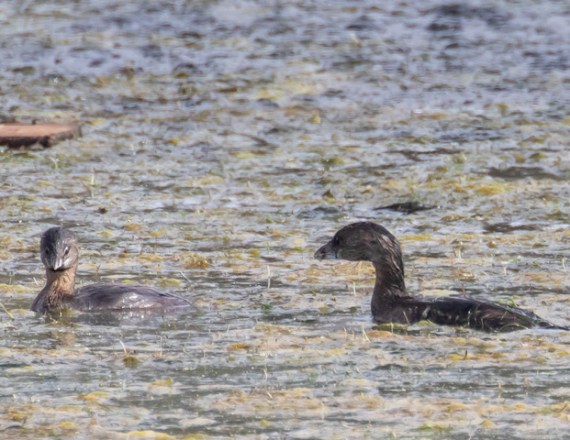
Pied-billed Grebes (Chris Tosdevin 8/28/22)
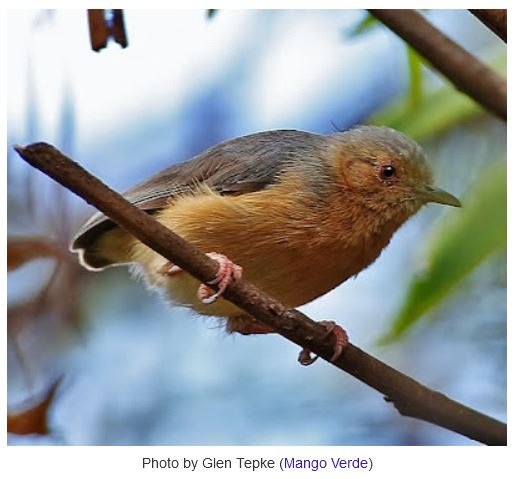
Not so for the Common Yellowthroat, who have nested among the reeds and bushes for decades. I hereby nominate the name “Tosdevin’s Crombec-Warbler” for our local, tail-less version.

Common Yellowthroat (Chris Tosdevin 8/28/22)
Here’s a Red-faced Crombec from Africa for comparison. Again, no tail.
We get Black Skimmers more often that one might expect (12% of the most recent 147 visits), and a few more dropped in today. They feed by skimming just above the water, with their elongated lower mandible cutting through the surface. When they sense something worth eating, the quickly (very quickly!) snap it up. I keep waiting for one of them to hit something solid and flip end-over-end, but I’ve never seen it happen.
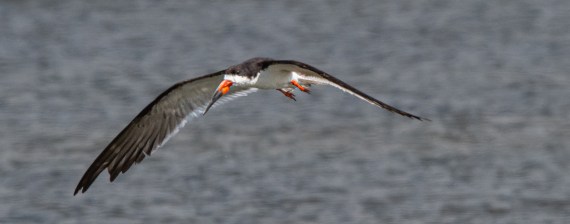
Our chapter’s first record of skimmers at the lagoon was a single bird on 12/22/02. Since then we’ve seen them 25 times with a total of 224 birds. 138 of those were in July & August 2010. Most sightings are in Feb-Mar and Jul-Aug, just before and just after their breeding season. Some of them — perhaps most of our local birds — nest down at Bolsa Chica in Orange County. If you go there during the spring to see them breeding, along with many thousands of terns, be aware that there’s been a rash of car break-ins there.

Today we had a total of three. Most sightings at the lagoon are of 1-3 birds. One of them was a juvenile born this year. Because of their feeding style, they need calm water. You may see them flying over the ocean, but I doubt they’ll be trying to catch something there. Too many waves.

Skimmer photos from prior trips: 8-22-10, 9-1-10 (egg update), 3-2-14 (Knobby), 8-23-15, 3-26-17

A lovely puffed-up Mourning Dove (Chris Tosdevin 8/28/22)

Semipalmated Plover (Grace Murayama 8/26/22). 89% of our Semipalmated Plover sightings are in April and July-September. They breed in the Arctic and winter in Mexico. Here, they’re just passing through.

Our Western Snowy Plovers — one cooling his/her feet above on wet wood (Larry Loeher 8/26/22) — are almost the opposite. They’re reliably here late June to late April, and breed elsewhere. We had 20 today.
Look carefully at the photo below. There are two birds in it. Are the the same species? What are they?
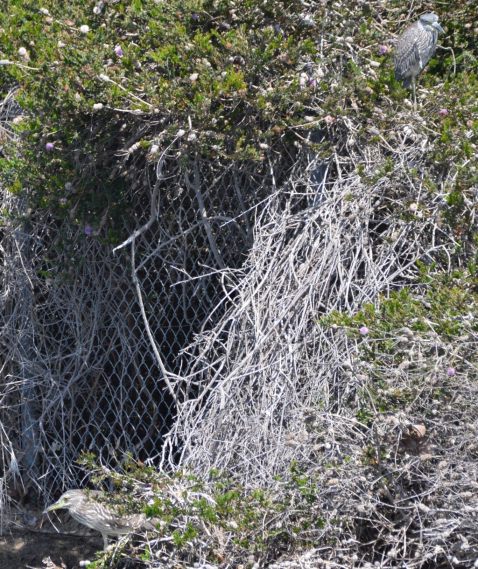
Here’s a close-up of the upper bird. What is it?
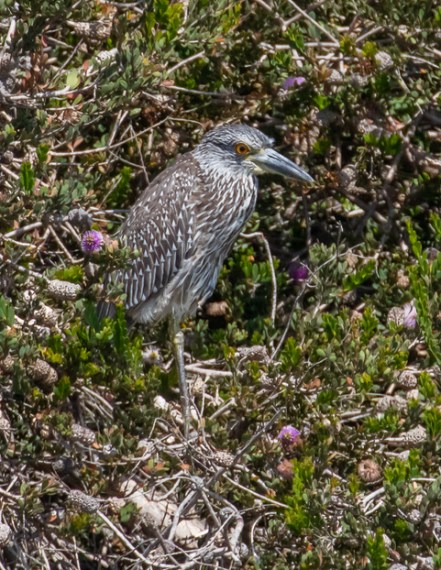
If you said Night-Heron, you’re right. But they are two species of Night-Heron.
Yes…after many months of people reporting sightings NOT during our field trips, we finally had a juvenile Yellow-crowned Night-Heron show up for us. It’s in the bottom photo, and the top bird in the top photo. The other bird is of course a juvenile Black-crowned Night Heron. I’ll let you work out the differences with the help of your field guide.
Well…it showed up for a few of us, anyway. Most of us, including me, did not go all the way around the lagoon to the Adamson House fence where the YCNH has previously been sighted, where it was today, and where I searched diligently for it last month but to no avail. (Cue: great gnashing of teeth) Last month, from across the lagoon, I could swear I had the bird, but when I reached the fence, alas, only a Black-crowned was to be seen. Now we find the two species in the same blasted bush! that I was looking at last month. Pretty sneaky, I say. Anyway…kudos to Chris Tosdevin and Blair Lord (on loan to us from Pasadena Audubon) for making the extra effort and getting these photos.
(Photos: Top – Blair Lord 8/28/22; bottom – Chris Tosdevin 8/28/22)
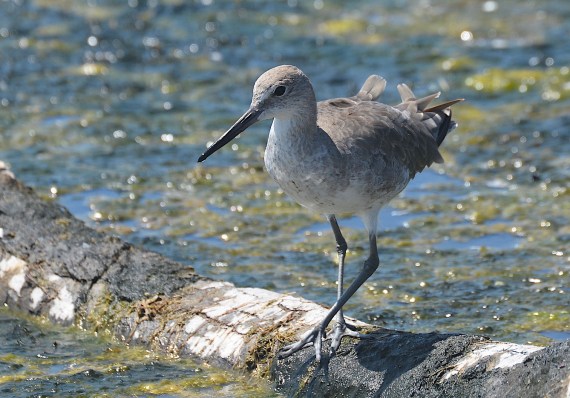
Willet (Grace Murayama 8/26/22)
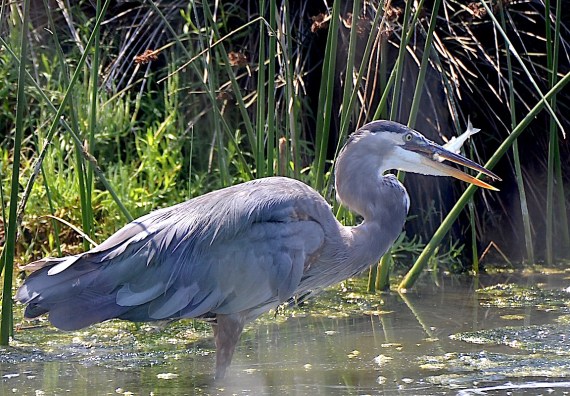
Great Blue Heron & fish (Larry Loeher 8/26/22)
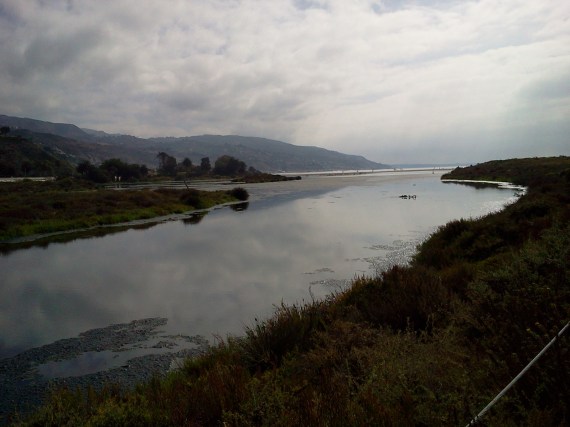
South Channel (Lillian Johnson 8/28/22)
**NOTE: The above story about Thomas Hewitt-Frothingfield Edwardson is completely fictitious. But you knew that.
Birds new for the season: Long-billed Curlew, Black Turnstone, Sanderling, Short-billed Dowitcher, Spotted Sandpiper, Red-necked Phalarope, Black Skimmer, Violet-green Swallow, Bewick’s Wren, Orange-crowned Warbler.
Malibu Lagoon on eBird as of 8-31-22: 6206 lists, 314 species
Many thanks to photographers: Lillian Johnson, Ray Juncosa, Larry Loeher, Blair Lord, Grace Murayama, Chris Tosdevin
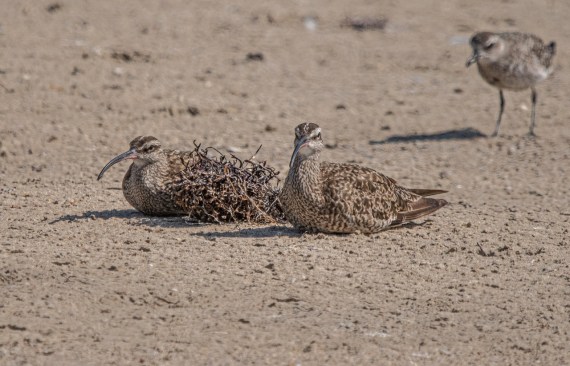
Whimbrels in repose (Ray Juncosa 8/28/22)
Upcoming SMBAS scheduled field trips: Our next trip will be Malibu Lagoon on September 25. This, and any other trip we announce for the foreseeable future will be dependent upon the expected status of the Covid pandemic at trip time. Any trip announced may be canceled shortly before trip date if it seems necessary. By now any other comments should be superfluous.
The next SMBAS program: Zoom Evening Meeting, Tuesday, 4 October 2022, 7:30 p.m. We will continue to Zoom our programs for a while.

The SMBAS 10 a.m. Parent’s & Kids Birdwalk is currently under discussion concerning resumption.
Links: Unusual birds at Malibu Lagoon
9/23/02 Aerial photo of Malibu Lagoon
More recent aerial photo
Prior checklists:
2021: Jan-July, July-Dec 2022: Jan-June
2020: Jan-July, July-Dec 2019: Jan-June, July-Dec
2018: Jan-June, July-Dec 2017: Jan-June, July-Dec
2016: Jan-June, July-Dec 2015: Jan-May, July-Dec
2014: Jan-July, July-Dec 2013: Jan-June, July-Dec
2012: Jan-June, July-Dec 2011: Jan-June, July-Dec
2010: Jan-June, July-Dec 2009: Jan-June, July-Dec
The 10-year comparison summaries created during the Lagoon Reconfiguration Project period, remain available—despite numerous complaints—on our Lagoon Project Bird Census Page. Very briefly summarized, the results unexpectedly indicate that avian species diversification and numbers improved slightly during the restoration period June’12-June’14.
Many thanks to Lillian Johnson, Chris Lord, Chris Tosdevin and others for their contributions to this month’s checklist.
The list below now includes a column on the left side with numbers 1-9, keyed to the nine categories of birds at the bottom. The species are re-sequenced to agree with the California Bird Records Committee Official California Checklist, updated 15 Jan 2022. I generally do this sequence update at the start of each year.
[Chuck Almdale]
| Malibu Census 2022 | 3/27 | 4/24 | 5/22 | 6/26 | 7/24 | 8/28 | |
| Temperature | 57-65 | 72-75 | 61-66 | 65-70 | 70-73 | 72-79 | |
| Tide Lo/Hi Height | H+5.00 | H+4.50 | L-0.32 | H+3.33 | H+3.35 | H+4.49 | |
| Tide Time | 0615 | 0442 | 1029 | 0943 | 0909 | 1102 | |
| 1 | (Black) Brant | 6 | |||||
| 1 | Canada Goose | 6 | 3 | ||||
| 1 | Gadwall | 47 | 26 | 25 | 15 | 25 | 22 |
| 1 | American Wigeon | 6 | 1 | 2 | |||
| 1 | Mallard | 30 | 14 | 15 | 35 | 80 | 65 |
| 1 | Green-winged Teal | 15 | 2 | ||||
| 1 | Surf Scoter | 15 | 3 | ||||
| 1 | Common Goldeneye | 2 | |||||
| 1 | Red-breasted Merganser | 5 | |||||
| 1 | Ruddy Duck | 1 | |||||
| 2 | Pied-billed Grebe | 3 | 1 | 1 | 2 | 4 | |
| 2 | Eared Grebe | 1 | |||||
| 2 | Western Grebe | 16 | |||||
| 7 | Feral Pigeon | 8 | 4 | 6 | 8 | 17 | 10 |
| 7 | Band-tailed Pigeon | 1 | |||||
| 7 | Mourning Dove | 2 | 4 | 2 | 2 | 5 | |
| 8 | Anna’s Hummingbird | 1 | 1 | ||||
| 8 | Allen’s Hummingbird | 3 | 3 | 1 | 2 | 3 | 3 |
| 2 | American Coot | 65 | 1 | 4 | 4 | 8 | 12 |
| 5 | Black-bellied Plover | 28 | 2 | 1 | 17 | 79 | |
| 5 | Killdeer | 4 | 2 | 3 | 3 | 6 | 5 |
| 5 | Semipalmated Plover | 15 | 1 | 15 | |||
| 5 | Snowy Plover | 10 | 13 | 20 | |||
| 5 | Whimbrel | 8 | 2 | 3 | 88 | 37 | |
| 5 | Long-billed Curlew | 1 | |||||
| 5 | Marbled Godwit | 2 | 1 | 6 | |||
| 5 | Ruddy Turnstone | 3 | 4 | ||||
| 5 | Black Turnstone | 2 | |||||
| 5 | Sanderling | 45 | 2 | 25 | |||
| 5 | Dunlin | 1 | |||||
| 5 | Least Sandpiper | 10 | 50 | 8 | 10 | ||
| 5 | Western Sandpiper | 35 | 30 | 1 | 25 | ||
| 5 | Short-billed Dowitcher | 2 | |||||
| 5 | Long-billed Dowitcher | 1 | |||||
| 5 | Spotted Sandpiper | 6 | 1 | 1 | |||
| 5 | Willet | 6 | 2 | 7 | 48 | ||
| 5 | Red-necked Phalarope | 1 | 1 | ||||
| 6 | Heermann’s Gull | 8 | 15 | 4 | 27 | 5 | 2 |
| 6 | Ring-billed Gull | 16 | 65 | ||||
| 6 | Western Gull | 95 | 57 | 95 | 55 | 145 | 53 |
| 6 | California Gull | 185 | 35 | 33 | 3 | 3 | 21 |
| 6 | Herring Gull | 2 | |||||
| 6 | Glaucous-winged Gull | 8 | 6 | 1 | |||
| 6 | Caspian Tern | 8 | 12 | 15 | 22 | 18 | |
| 6 | Forster’s Tern | 1 | |||||
| 6 | Royal Tern | 35 | 18 | 3 | 3 | 25 | 6 |
| 6 | Elegant Tern | 6 | 220 | 24 | 475 | 255 | |
| 6 | Black Skimmer | 3 | |||||
| 2 | Brandt’s Cormorant | 5 | 1 | 50 | |||
| 2 | Pelagic Cormorant | 1 | 1 | 2 | 2 | 1 | |
| 2 | Double-crested Cormorant | 33 | 26 | 22 | 46 | 62 | 68 |
| 2 | Brown Pelican | 23 | 68 | 65 | 126 | 85 | 112 |
| 3 | Great Blue Heron | 1 | 1 | 2 | 3 | 5 | 2 |
| 3 | Great Egret | 5 | 3 | 2 | 4 | 3 | 3 |
| 3 | Snowy Egret | 4 | 1 | 1 | 2 | 12 | 14 |
| 3 | Reddish Egret | 1 | |||||
| 3 | Black-crowned Night-Heron | 4 | 8 | 2 | |||
| 4 | Yellow-crowned Night-Heron | 1 | |||||
| 4 | Turkey Vulture | 5 | 3 | 4 | 4 | 1 | |
| 4 | Osprey | 1 | 1 | 1 | |||
| 8 | Belted Kingfisher | 1 | 1 | ||||
| 9 | Black Phoebe | 3 | 2 | 5 | 4 | 5 | |
| 9 | California Scrub-Jay | 2 | 1 | 1 | 3 | 2 | |
| 9 | American Crow | 6 | 4 | 4 | 5 | 1 | 17 |
| 9 | Common Raven | 2 | |||||
| 9 | Oak Titmouse | 2 | |||||
| 9 | Violet-green Swallow | 1 | |||||
| 9 | No. Rough-winged Swallow | 2 | 4 | 8 | 1 | 4 | |
| 9 | Barn Swallow | 4 | 8 | 15 | 20 | 30 | 28 |
| 9 | Cliff Swallow | 8 | 4 | 3 | 1 | ||
| 9 | Bushtit | 4 | 10 | 8 | 10 | 15 | |
| 9 | Wrentit | 2 | 2 | 1 | |||
| 9 | House Wren | 2 | 1 | 1 | 1 | ||
| 9 | Bewick’s Wren | 1 | |||||
| 9 | Northern Mockingbird | 1 | 1 | 1 | 3 | ||
| 9 | European Starling | 3 | 2 | 1 | |||
| 9 | House Finch | 15 | 6 | 12 | 10 | 12 | 8 |
| 9 | Lesser Goldfinch | 2 | 1 | 3 | |||
| 9 | White-crowned Sparrow | 20 | 2 | ||||
| 9 | Song Sparrow | 10 | 7 | 10 | 4 | 2 | 6 |
| 9 | California Towhee | 2 | 2 | 2 | 1 | 1 | |
| 9 | Red-winged Blackbird | 1 | 6 | 25 | |||
| 9 | Brown-headed Cowbird | 2 | 1 | ||||
| 9 | Great-tailed Grackle | 5 | 2 | 1 | 6 | 6 | 4 |
| 9 | Orange-crowned Warbler | 1 | |||||
| 9 | Common Yellowthroat | 1 | 2 | 4 | |||
| 9 | Yellow-rumped Warbler | 1 | |||||
| Totals by Type | Mar | Apr | May | Jun | Jul | Aug | |
| 1 | Waterfowl | 127 | 49 | 48 | 50 | 105 | 87 |
| 2 | Water Birds – Other | 146 | 99 | 143 | 177 | 159 | 197 |
| 3 | Herons, Egrets & Ibis | 10 | 5 | 5 | 13 | 29 | 22 |
| 4 | Quail & Raptors | 6 | 3 | 4 | 5 | 1 | 1 |
| 5 | Shorebirds | 146 | 114 | 6 | 6 | 146 | 281 |
| 6 | Gulls & Terns | 363 | 428 | 174 | 110 | 673 | 340 |
| 7 | Doves | 10 | 8 | 6 | 11 | 19 | 15 |
| 8 | Other Non-Passerines | 5 | 4 | 2 | 2 | 3 | 3 |
| 9 | Passerines | 81 | 64 | 64 | 63 | 87 | 127 |
| Totals Birds | 894 | 774 | 452 | 437 | 1222 | 1073 | |
| Total Species | Mar | Apr | May | Jun | Jul | Aug | |
| 1 | Waterfowl | 9 | 6 | 4 | 2 | 2 | 2 |
| 2 | Water Birds – Other | 7 | 7 | 5 | 4 | 5 | 5 |
| 3 | Herons, Egrets & Ibis | 3 | 3 | 3 | 4 | 5 | 5 |
| 4 | Quail & Raptors | 2 | 1 | 1 | 2 | 1 | 1 |
| 5 | Shorebirds | 8 | 11 | 4 | 2 | 11 | 16 |
| 6 | Gulls & Terns | 9 | 8 | 6 | 5 | 8 | 6 |
| 7 | Doves | 2 | 2 | 1 | 3 | 2 | 2 |
| 8 | Other Non-Passerines | 3 | 2 | 2 | 1 | 1 | 1 |
| 9 | Passerines | 16 | 17 | 13 | 12 | 16 | 18 |
| Totals Species | 59 | 57 | 39 | 35 | 51 | 56 |
Volunteers needed at Audubon Ballona Wetlands Education Program
[Posted by Chuck Almdale, submitted by Cindy Hardin]
Nature Nexus Institute has taken over the operation of some of Los Angeles Audubon’s school outreach programs, including the school field trips to the Ballona Wetlands and the Baldwin Hills Scenic Overlook (Kenneth Hahn Recreation Area). The following announcement is from them.

One of the Ballona Salt Marsh channels (Leslie Davidson ’07)
We are looking for Volunteers!
Nature Nexus Institute is all about sharing and teaching local school children about the special habitats found right here in Los Angeles. We will soon be starting our Fall Training to get ready for school field trips to the Ballona Wetlands and the Baldwin Hills Scenic Overlook.
Our tours take place on Tuesdays and Thursdays at Ballona, and on Fridays at the Overlook. All you need to be a volunteer is a love of the outdoors and the enthusiasm to work with some school age aspiring nature lovers. Training will begin in mid-September. Please contact Cindy Hardin at chardin@naturenexusinstitute.org or give a call at 310-301-0050 if you are interested.
Thanks so much.Cindy Hardin
Semipalmated Sandpiper at Malibu Lagoon
[Posted by Chuck Almdale, photo by Chris Tosdevin]
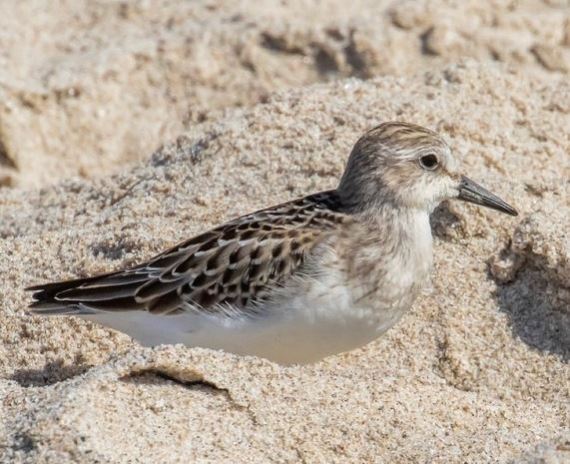
Semipalmated Sandpiper (Chris Tosdevin, 8-15-22)
Semipalmated Sandpipers show up every year in SoCal, but not in many locations or in big numbers. A half-dozen of them would be a big number. I’ve never recorded one at the lagoon. This one has been hanging out with Western Sandpipers. Chris calls it a “continuing bird” so it might stick around for a while, unless it becomes a discontinued bird.
Distinguishing them from Western Sandpipers can be difficult if you’re not familiar with them. The bill is shorter, straighter and more tubular than Western, and stouter than Least Sandpiper. They have less rufous colors on back and crown than Western, a thicker, whiter supercilium, and the juvenile has darker ear coverts. They both have black bills, black legs and are both “semipalmated,” meaning they have short webs between their 1st & 2nd toes (counting from the inside). Don’t spend a lot of time trying to see this particular field mark. Best thing is to check your field guide.
The eastern Semipalmated were discovered and named before the Western were discovered. When they determined that some of those “Semis” were a different species, they couldn’t change the original name for the first species (Semipalmated) – a custom people followed for centuries – and they had to call the 2nd species something, so “Western Sandpiper” was chosen. It’s certainly more of a western than an eastern bird, although many spend the winter along the gulf coast and well up the east coast to about Delaware.
Semipalmated Sandpipers, on the other hand, although they breed all across the North American arctic to the northwest Alaskan coast, migrate south by passing east of the Rockies and only a few odd birds wander off course into California.
We will, of course, look for this bird on our next lagoon field trip, along with that Yellow-crowned Night-Heron that keeps coming and going at inconvenient times.
Cormorant Identification | David Bell & L.A. Birders
[Posted by Chuck Almdale]
During the Covid pandemic Los Angeles Birders popped up as a non-Audubon group for local birders. They have a lot of Zoom programs under their belt, many dealing with the grindingly-difficult niceties of bird identification. The most recent of these was about our four North American cormorants, presented by David Bell, and was very good. Loads and loads of useful photos. I see Double-crested, Brandt’s and Pelagic Cormorants nearly every time I go to Malibu Lagoon, and David presented information new and useful to me. So I recommend it to one and all.
L.A. Birders YouTube page link
How Bird Collecting Evolved into Bird Watching | Smithsonian
[Posted by Chuck Almdale]
How Bird Collecting Evolved into Bird Watching
The Smithsonian Magazine | Tim Birkhead | 8 Aug 2022 | 5 min read
In the early 1900s, newfound empathy for avian creatures helped wildlife observation displace dispassionate killing.
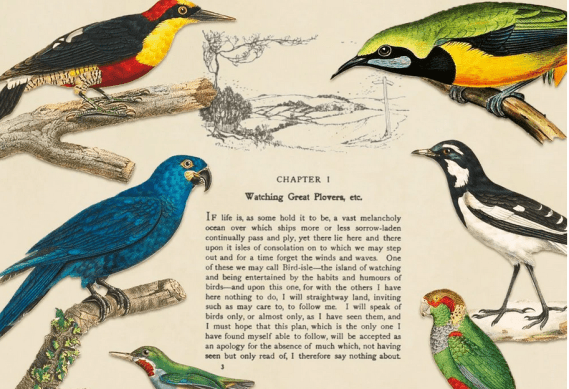
From the article:
As the interest in watching birds rather than shooting them increased, a view espoused by ornithologist Max Nicholson came to dominate the field. Nicholson believed that bird-watching should be “useful,” and he wanted bird-watchers to direct their energies toward an even greater understanding of birds’ behaviors, especially in terms of their numbers—and so started the practice of monitoring bird populations.
In the 1800s and early 1900s, only the wealthy could afford a serious interest in birds. Even in the 1950s, bird-watching continued to be dominated by those “that held sway in most departments of cultural life” in Britain—that is, mainly upper-class white males, as Mark Cocker writes in Birders: Tales of a Tribe. But by the 1970s and ’80s, as interest in birds continued to expand, most birders “came from the same broad social background—the working and middle classes.”
Worldwide, tens of millions of people have an interest in birds. Because there’s no precise definition of what a birder is, there’s no precise figure. It is telling, however, that the Royal Society for the Protection of Birds in the United Kingdom has more members than all U.K. political parties combined.



 SANTA MONICA BAY AUDUBON SOCIETY BLOG