Free email delivery
Please sign up for email delivery in the subscription area to the right.
No salesman will call, at least not from us. Maybe from someone else.
[Posted by Chuck Almdale]

I’m a big fan of birding guide books. In lieu of a paid guide and a whole lot cheaper, they can get you to the right places to find birds, rather than driving aimlessly around crashing into things while looking around for birds instead of watching the road. Not all good birding spots can be easily found on the web, not all web sites give you succinct directions and descriptions, and not all areas have great web reception. A book in hand is worth two on the web. Or maybe four. Our neighbor chapter Pasadena Audubon Society (PAS) lives in a birdy area where the migrants pass through in aerial rivers, with valleys and rivers and parks and reservoirs and mountain forests and meadows. A book to birding this area would be very useful to residents and visitors alike, and voilà! now one exists.
According to one local birder: “I just bought a copy yesterday at the California Botanical Garden in Claremont and did not realize it was hot off the press. Quite a bit pricier ($35) at the garden than online ($20).”
If you’re a die-hard “if it’s not on the web it doesn’t exist” person, here’s a link to SMBAS’ on-line bird-finding guide for Los Angeles County with 81 sites spread over seven pages. It’s getting a bit out-of-date.
Here’s the PAS message:
Pasadena Audubon is pleased to announce the publication of their all-new Birding Guide to the Greater Pasadena Area. The Guide gives detailed descriptions of 30 of the region’s top birding hotspots, along with background on the area’s ecology, seasonal species distribution charts, birdability access ratings of the locations, profiles of the notable introduced species, and much more.
For more info about the book, as well as a list of stores in the Pasadena/Los Angeles area that stock the book, visit https://www.pasadenaaudubon.org/birding-guide .
The Guide is also available online from Buteo Books, at https://www.buteobooks.com/mm5/merchant.mvc?Screen=PROD&Product_Code=15274 .
Chapter Elections, June 7th
Yes, on the same day as our California Primaries there will be Voting at our June 7th Evening Meeting. The Nominating Committee has the following slate for the three officer positions open this year:
- Vice-president: Ted Winterer
- Treasurer: Cindy Schotté
- Secretary: Darwin Mendinueto
Voting is limited to SMBAS members in good standing. A member may make a nomination for these positions from the floor on June 7th.
We will also be voting to accept a set of revised chapter bylaws. The last revisions were made in March 2012 and we need to get up-to-date. Again, voting is limited to SMBAS members in good standing. A PDF of the proposed bylaws is available by clicking HERE.
If you have any questions about the elections, please email Chuck Bragg. Click on “Contacts” at the top of this page for the email address.
[Written and posted by Chuck Almdale, submitted by Lu Plauzoles]
The Santa Monica Sand Dune Restoration Project, subject of the two articles linked to below, just happens to be adjacent to the Western Snowy Plover (WSP) winter roosting site. The birds don’t nest at either location (with one exception, discussed below), but live there during the non-breeding season, returning from the north between early July to mid-September, and leaving around the end of April, or eight to ten months of the year. A few comments and corrections to the official published statements are in order.
Google Map below: Dune Restoration Project and Western Snowy Plover roost sites on North Santa Monica Beach near Annenberg House. Fan icon marks the dunes project, binocular icon the plover roost. Scrolling navigation enabled.
The Western Snowy Plover winter roosting site on Santa Monica Beach (SMB) just south of Annenberg Beach House was initially recognized as such in 1987 by a member of a research team from Point Reyes Bird Observatory (now Point Blue). Local birders have known about it ever since. In January, 2001, I organized the first ‘Winter Window Census’ for Los Angeles County, our local section of the WSP census of the entire Pacific coast of Calif-Ore-Wash. We found seven active WSP winter roost sites within the county. One of these seven sites was this site near Annenberg Beach House. This site was censused at that time by SMBAS member Lucien Plauzoles, who has monitored and lobbied on behalf of the site since then, a period of more than twenty years.
At some point after 2005, a seasonal protective fencing around the roost site was installed each year from approximately Labor Day until Memorial Day. Since the City received very few (if any) complaints about the fencing, it was left up year-round beginning in 2014 and has remained as such (ungroomed) since then, thus unintentionally creating a potential dune restoration site. Keep people, dogs and beach grooming equipment away from the roosting birds, and dunes and dune plants begin to appear. Who could have guessed?
The dunes restoration project was dedicated in December, 2016. Around April 17, 2017, a WSP nest was discovered by Dan Cooper at the SMB roost location, the first nesting there in at least 70 years. When a sandstorm on April 26 covered the eggs, the nest was abandoned.
Members of SMBAS monitor two other WSP winter roosting sites at Malibu Lagoon and Zuma Beach. WSPs are extremely faithful to their roosting sites, very rarely straying more than 100-200 yards from them during the roosting season and returning to them each year. This fact makes them easy to census. According to Lu Plauzoles, during the winter roosting season there are nearly always roosting WSPs at the winter roosting site near Annenberg House, but rarely are they at the dunes project site. Even a few hundred yards is too much a stretch for their site faithfulness to encompass.
Nestings in 2017 also occurred at the Malibu Lagoon and Dockweiler Beach roost site locations. Most of these nestings failed. The Malibu Lagoon nest hatched three chicks; one survived and eventually flew away.
Considering the above, It’s a bit of overstatement on the city’s part to say, as they do in their blog, that “Endangered species such as the Western Snowy Plover were seen on Santa Monica Beach for the first time in over 70 years.” A more accurate statement would be:
“The presence of Western Snowy Plovers roosting on the beach over many decades, and the natural process of dune restoration which occurred within the WSP roosting site once it was permanently surrounded with exclusion fencing, encouraged the creation of an nearby additional larger dune restoration project, which has proved a success.”
Lu Plauzoles adds that if additional work is to be done to increase the size of the dune project, it should be done during the summer when the birds aren’t there. This may inconvenience a few beachgoers, but they are not driven by instinct to be intensely site-faithful, as are the birds.
Links below to newspaper article and Santa Monica City blog announcement.

Successful project to restore beach dunes looks to expand
Santa Monica Daily Press | Emily Sawicki | 27 Apr 2022 | 3 min read
The Santa Monica Sand Dune Restoration Project has officially been deemed a success; now, The Bay Foundation wants to make it a permanent fixture on the beach just north of the Annenberg Beach House, while also expanding from three to eight acres of protected beach habitat in the area.
With the ecological nonprofit Bay Foundation’s five-year report stating the dune restoration pilot achieved its goals, it will soon be up to the California Coastal Commission to decide whether it can stay in place permanently.
“We’re pretty staggered at some of the results,” The Bay Foundation’s Chris Enyart said Tuesday. “We saw the site, year after year, continue to be covered in more and more native dune vegetation. We saw the site continue to build topography, build elevation, accumulate sand. And yeah, it’s a pretty staggering development over a short five years. And this is all passive. This is all just letting these native dune species that are specially adapted to dune habitats, just letting them do their thing.”
The Bay Foundation and its partners — the City of Santa Monica, local landowners, California Department of Parks and Recreation and the Santa Monica chapter of the Audubon Society — will soon be seeking to add an additional five acres of protected dunes, about 1,000 yards south of the current project area.
Santa Monica Brings a Second Dune Restoration Project to the Beach
santamonica.gov/blog | Nico Predock | 25 Apr 2022
From the lead paragraph of the posting:
Over the last 5 years, The Bay Foundation has been working in conjunction with the City of Santa Monica to restore approximately three acres of coastal strand habitat on the north end of the Santa Monica Beach. By restricting beach grooming activities, seeding native plants and using fencing to build dunes, a rare coastal habitat was successfully brought back to Santa Monica. Endangered species such as the Western Snowy Plover were seen on Santa Monica Beach for the first time in over 70 years. From start to finish, the project positively engaged the public and provided comprehensive monitoring data to inform other projects across SoCal. The Bay Foundation recently released its Year 5 Report, which summarizes results from the start of the project (Dec 2015) to completion (Oct 2021).
[By Chuck Almdale]
Springtime is definitely here. It was very breezy; at least 5 mph with gusts to 20. “We’re probably not going to see a lot of passerines today…it’s tough to see birds moving through moving leaves.” The variety of passerine species—17—turned out to be higher than I expected, but total passerine count of 64 was only 60% of our average over 25 years of April count days.
The temperature started at 72°F at 8:30 am, a bad place to start, as it can end well (not well) into the 80° by 11:30. We were lucky and it was only 75° when we stopped, although the breeze had died by then. Warm, but not hot. Quite pleasant, in fact, with a clear blue sky. Another you-know-what day in paradise.
We changed the attendance format slightly this month. We still took reservations, raising it from 25 to 30, and the trip was sold out due to the low, low cost of admission (because we pass the savings on to you!), although there are always a few no-shows. Lu Plauzoles was again the co-leader, and this time he came equipped with a microphone connected to a small speaker near his solar plexus. “Saves my voice,” he said, the sound issuing disconcertingly from his stomach instead of his mouth, like some sort of ventriloquist. “Otherwise, I’ll be croaking by eleven.” It looked odd but worked well.
I don’t know what changes—if any—we’ll make for the May 22 field trip. Look for a trip announcement with details around May 10, and a go/no go announcement two days prior to the trip.
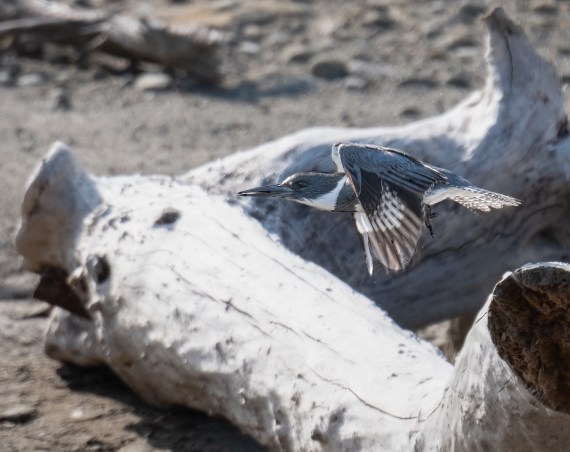
We had a few avian surprises. The coot population had dropped from 65 last month to one whole bird, but we had six waterfowl species, with Gadwalls amounting to half of the totals. There were eleven species of sandpiper and plover, more than I expected. I also hoped for an oriole, whether Bullock’s or Hooded, but none appeared nor announced their presence.
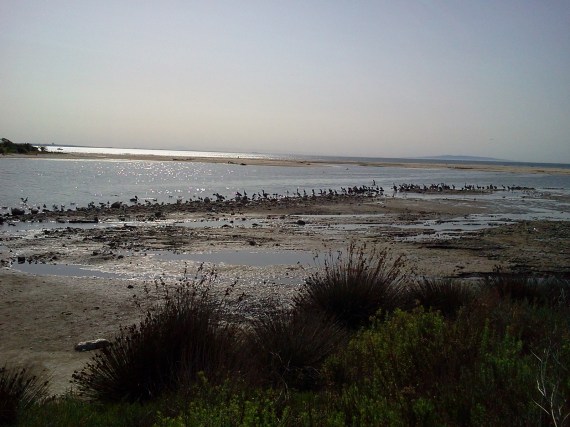
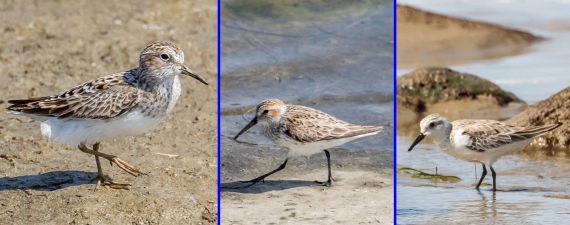
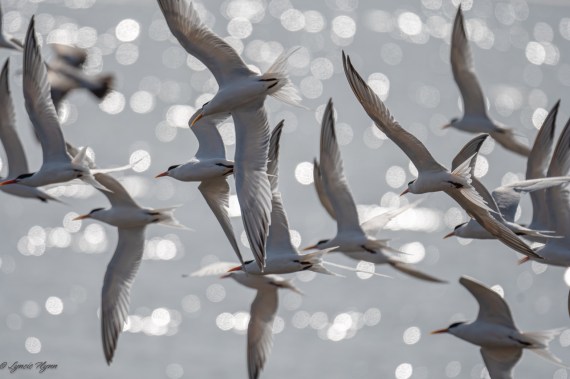
Does the forward leg of the middle bird look weird to you?
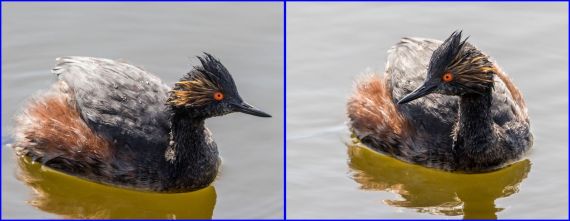
It was really nice to see an Eared Grebe in breeding (alternate) plumage. You can see their ears, for instance, those bushy reddish-brown feather-sprays sprouting from behind their eyes. Most of the time when they’re here they’re in their basic (non-breeding) plumage, but sometimes, just before they leave for the north, they grace us with their finery.
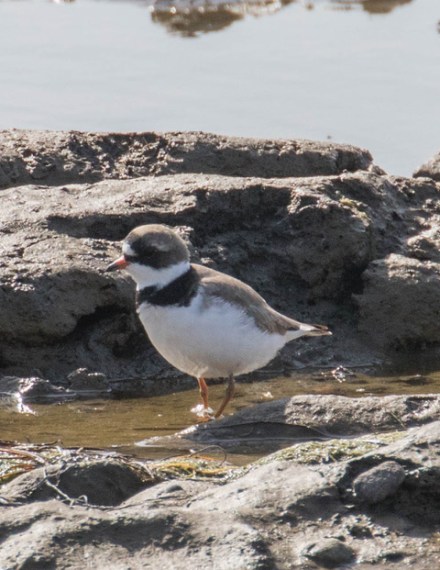
Semipalmated Plovers are passing through again, this time on their way north. April is their most reliable month. I looked at the past 12 years and if we’re there (I missed two Aprils), they’re there. I strongly suspect that they’re there in April whether or not we’re there to observe them. [Take that!, Schrödinger wave function collapse fans!] Fifteen birds is a good count for this species, but by no means their highest.
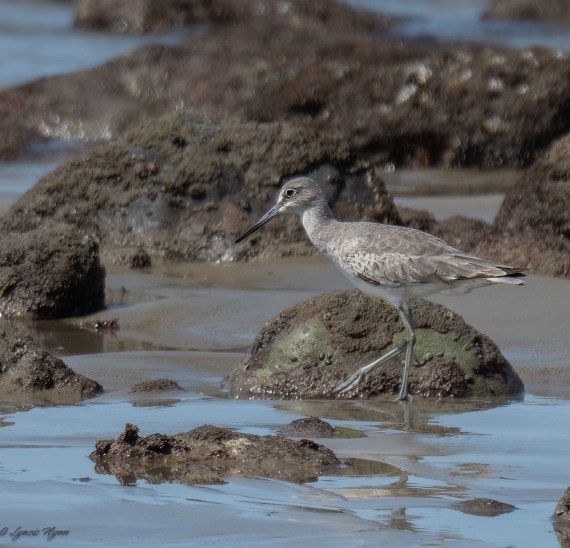
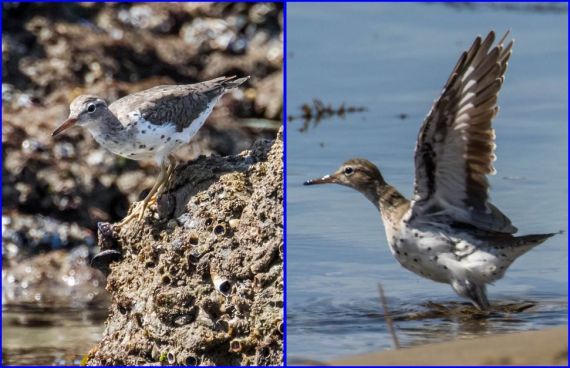
The other unexpected sighting was six Spotted Sandpipers. All had spots, unlike the fall and winter birds which are inconveniently spotless. We usually have 1-3 birds spend the whole winter at the lagoon, but not this year; we hadn’t seen one since last August and September. We never have many: the highest count for 168 sighting-days was ten birds on 25 Oct 2015, but we usually have one or two prowling the edge of the lagoon during non-breeding season. The first one we saw (see left bird below) was happily resting on top of a large boulder among the low-tide-exposed rocky tidepools in front of Malibu Colony. I don’t think I’ve ever seen one on the ocean side of the beach before; they really prefer the edges of the lagoon and channels, or even inland of the PCH bridge along the edge of the creek.
(Lillian Johnson 4-24-22)
Unlike Western and Least Sandpipers (and the occasional Dunlin and Red-necked Stint), they don’t freely associate with other species of small sandpipers (aka ‘Peeps’), and just barely associate with other Spotted Sandpipers. When we have 2-4 at the lagoon, a typical number range, they’re all in different places, not hanging out with each other. This is reminiscent of the very-well-named Solitary Sandpiper. I’ve never seen more than one ‘Solitary’ at a time, anywhere, ever. Perhaps they reproduce by parthenogenesis, or budding off clones of themselves like coral polyps.
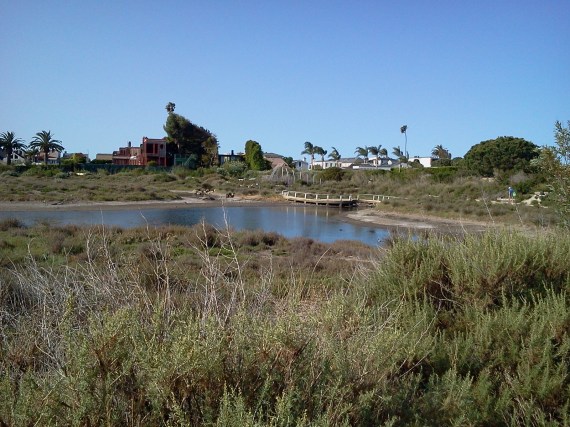
Water was lowish in the lagoon; the tidal sidewalk clock was completely dry and mud-free, and the west end of the channels was dry mud.

Song Sparrows were singing from the brush in numerous locations. We managed to spot a few. White-crowned Sparrows—unlike Song Sparrows—don’t nest at the lagoon, and have mostly fled. California Towhees were calling. Two male Brown-headed Cowbirds were present; we didn’t see any females. This prompted me to give the group a brief discussion of Cowbirds, Buffalo-birds, Cuckoos and nest parasitism. Fascinating stuff (cue eye-roll).
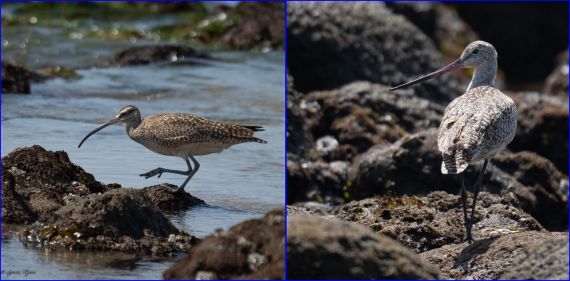
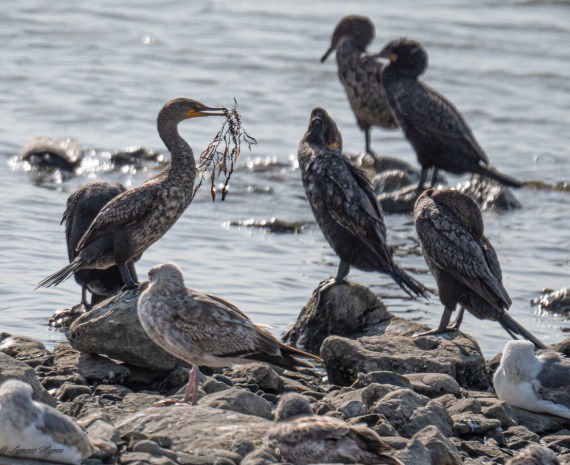
Killdeer are probably nesting somewhere on the beach or sandy islands, but we didn’t see any signs of them. Double-crested Cormorants are also up their old tricks with sticks and strands of kelp streaming from their bills, from the beach to their several nesting trees in the shopping center.
There was one group of ten Bushtits, which may still be hanging on as a group since last fall, or may be the result of several new families already fledged and prowling the bushes together. We couldn’t see them well enough to try and tell if they were a mixture of adult and fledglings.
We looked and looked but found no Western Snowy Plovers. Presumably they have all left for their usual nesting grounds farther north. Five days earlier, on 19 April, Grace & Larry had only one WSP at Malibu Lagoon and none at all at Zuma.
(Lynzie Flynn 4-24-22)
Malibu Lagoon on eBird: as of 5-1-22: 5781 lists, 315 species
Birds new for the season: Semipalmated Plover, Dunlin, Spotted Sandpiper, Cliff Swallow, House Wren, Brown-headed Cowbird.
Many thanks to photographers: Lynzie Flynn, Lillian Johnson & Chris Tosdevin
Upcoming SMBAS scheduled field trips: We may do this again on May 22, depending on the oncoming Omikron Ba.2…whateva infection wave. Watch for blog announcements. Reservations will be taken starting May 10. Limit 30 people by reservation only, vaccine card, bring your own equipment. No 10am Children & Parents walk. Maybe we will have some other, different trips if anyone is interested.
Watch the blog for announcements AND for cancellation by 20 May if warranted. Same deal for 26 June lagoon trip; June 10 and 24 will be announcement dates.
The next SMBAS program: Bird Migration at the Bear Divide, San Gabriel Mtns., with Ryan Terrill of Occidental College. Zoom Evening Meeting, Tuesday, 7 June 2022, 7:30 p.m.
The SMBAS 10 a.m. Parent’s & Kids Birdwalk remains canceled until further notice due to the near-impossibility of maintained proper masked social distancing with parents and small children.
Links: Unusual birds at Malibu Lagoon
9/23/02 Aerial photo of Malibu Lagoon
More recent aerial photo
Prior checklists:
2021: Jan-July, July-Dec
2020: Jan-July, July-Dec 2019: Jan-June, July-Dec
2018: Jan-June, July-Dec 2017: Jan-June, July-Dec
2016: Jan-June, July-Dec 2015: Jan-May, July-Dec
2014: Jan-July, July-Dec 2013: Jan-June, July-Dec
2012: Jan-June, July-Dec 2011: Jan-June, July-Dec
2010: Jan-June, July-Dec 2009: Jan-June, July-Dec
The 10-year comparison summaries created during the Lagoon Reconfiguration Project period, remain available—despite numerous complaints—on our Lagoon Project Bird Census Page. Very briefly summarized, the results unexpectedly indicate that avian species diversification and numbers improved slightly during the restoration period June’12-June’14.
Many thanks to Lillian Johnson, Chris Tosdevin and others for their contributions to this month’s checklist.
The list below now includes a column on the left side with numbers 1-9, keyed to the nine categories of birds at the bottom. The species are re-sequenced to agree to the California Bird Records Committee Official California Checklist, updated 15 Jan 2022. I generally do this sequence update at the start of each year.
[Chuck Almdale]
| Malibu Census 2021-22 | 11/28 | 12/26 | 1/23 | 2/27 | 3/27 | 4/24 | |
| Temperature | 57-70 | 54-62 | 61-73 | 61-70 | 57-65 | 72-75 | |
| Tide Lo/Hi Height | L+2.35 | L+2.58 | L+2.04 | H+5.76 | H+5.00 | H+4.50 | |
| Tide Time | 1104 | 0900 | 0645 | 0621 | 0615 | 0442 | |
| 1 | Canada Goose | 10 | 4 | 2 | 2 | 6 | 3 |
| 1 | Egyptian Goose | 1 | |||||
| 1 | Cinnamon Teal | 2 | |||||
| 1 | Gadwall | 2 | 20 | 29 | 8 | 47 | 26 |
| 1 | American Wigeon | 2 | 10 | 4 | 6 | 1 | |
| 1 | Mallard | 2 | 12 | 20 | 12 | 30 | 14 |
| 1 | Northern Pintail | 2 | 1 | 1 | |||
| 1 | Green-winged Teal | 5 | 15 | 11 | 12 | 15 | 2 |
| 1 | Surf Scoter | 10 | 15 | 3 | |||
| 1 | Bufflehead | 1 | 10 | 2 | 5 | ||
| 1 | Common Goldeneye | 2 | |||||
| 1 | Hooded Merganser | 13 | |||||
| 1 | Red-breasted Merganser | 17 | 15 | 9 | 6 | 5 | |
| 1 | Ruddy Duck | 8 | 13 | 4 | 1 | ||
| 2 | Pied-billed Grebe | 3 | 5 | 3 | 3 | 3 | 1 |
| 2 | Horned Grebe | 1 | |||||
| 2 | Eared Grebe | 1 | 1 | 1 | |||
| 2 | Western Grebe | 30 | 12 | 16 | |||
| 7 | Feral Pigeon | 52 | 3 | 20 | 10 | 8 | 4 |
| 7 | Band-tailed Pigeon | 3 | |||||
| 7 | Eurasian Collared-Dove | 1 | |||||
| 7 | Mourning Dove | 1 | 1 | 4 | 2 | 4 | |
| 8 | Anna’s Hummingbird | 1 | 2 | 2 | 2 | 1 | |
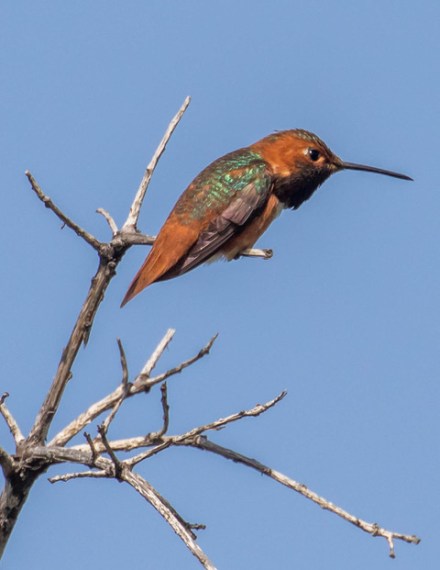
| 8 | Allen’s Hummingbird | 1 | 4 | 3 | 3 | 3 | 3 |
| 2 | American Coot | 245 | 360 | 49 | 73 | 65 | 1 |
| 5 | Black-bellied Plover | 166 | 104 | 58 | 25 | 28 | 2 |
| 5 | Killdeer | 20 | 10 | 2 | 10 | 4 | 2 |
| 5 | Semipalmated Plover | 15 | |||||
| 5 | Snowy Plover | 40 | 34 | 15 | 10 | ||
| 5 | Whimbrel | 12 | 9 | 8 | 2 | 8 | 2 |
| 5 | Marbled Godwit | 9 | 71 | 32 | 1 | 2 | |
| 5 | Ruddy Turnstone | 1 | 6 | 5 | |||
| 5 | Sanderling | 22 | 22 | 1 | 45 | 2 | |
| 5 | Dunlin | 1 | |||||
| 5 | Least Sandpiper | 3 | 35 | 12 | 20 | 10 | 50 |
| 5 | Western Sandpiper | 1 | 1 | 11 | 35 | 30 | |
| 5 | Spotted Sandpiper | 6 | |||||
| 5 | Willet | 34 | 13 | 15 | 8 | 6 | 2 |
| 6 | Bonaparte’s Gull | 2 | 1 | ||||
| 6 | Heermann’s Gull | 53 | 26 | 45 | 1 | 8 | 15 |
| 6 | Ring-billed Gull | 28 | 170 | 40 | 175 | 16 | 65 |
| 6 | Western Gull | 92 | 85 | 95 | 88 | 95 | 57 |
| 6 | California Gull | 515 | 370 | 925 | 510 | 185 | 35 |
| 6 | Herring Gull | 1 | 2 | 1 | 2 | ||
| 6 | Glaucous-winged Gull | 2 | 5 | 5 | 8 | 6 | |
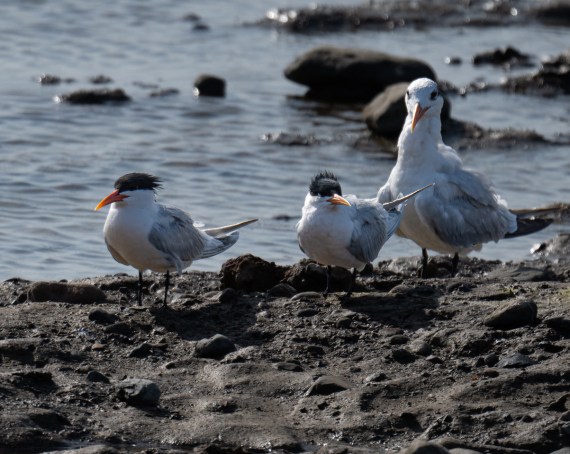
| 6 | Caspian Tern | 1 | 8 | 12 | |||
| 6 | Royal Tern | 5 | 2 | 35 | 18 | ||
| 6 | Elegant Tern | 6 | 220 | ||||
| 2 | Red-throated Loon | 1 | 1 | 2 | |||
| 2 | Pacific Loon | 1 | 2 | ||||
| 2 | Common Loon | 2 | 1 | ||||
| 2 | Black-vented Shearwater | 1000 | |||||
| 2 | Brandt’s Cormorant | 10 | 1 | 6 | 1 | 5 | 1 |
| 2 | Pelagic Cormorant | 4 | 1 | 12 | 3 | 1 | 1 |
| 2 | Double-crested Cormorant | 52 | 39 | 45 | 51 | 33 | 26 |
| 2 | Brown Pelican | 99 | 44 | 110 | 15 | 23 | 68 |
| 3 | Great Blue Heron | 3 | 4 | 4 | 2 | 1 | 1 |
| 3 | Great Egret | 1 | 7 | 2 | 5 | 3 | |
| 3 | Snowy Egret | 4 | 24 | 6 | 3 | 4 | 1 |
| 3 | Green Heron | 2 | 1 | ||||
| 3 | Black-crowned Night-Heron | 1 | 5 | ||||
| 4 | Turkey Vulture | 1 | 1 | 5 | 3 | ||
| 4 | Osprey | 1 | 1 | 1 | 1 | 1 | |
| 4 | Cooper’s Hawk | 1 | 2 | 1 | 1 | ||
| 4 | Red-shouldered Hawk | 1 | 1 | 1 | |||
| 4 | Red-tailed Hawk | 1 | 1 | 1 | 1 | ||
| 8 | Belted Kingfisher | 1 | 1 | 1 | 1 | ||
| 8 | Downy Woodpecker | 1 | |||||
| 8 | Nuttall’s Woodpecker | 1 | |||||
| 8 | Hairy Woodpecker | 1 | |||||
| 4 | Merlin | 1 | |||||
| 9 | Black Phoebe | 4 | 4 | 4 | 3 | 3 | |
| 9 | Say’s Phoebe | 1 | |||||
| 9 | California Scrub-Jay | 2 | 2 | 3 | 2 | 1 | |
| 9 | American Crow | 1 | 7 | 4 | 20 | 6 | 4 |
| 9 | Common Raven | 1 | |||||
| 9 | Oak Titmouse | 1 | |||||
| 9 | Tree Swallow | 2 | |||||
| 9 | No. Rough-winged Swallow | 2 | 4 | ||||
| 9 | Barn Swallow | 2 | 4 | 8 | |||
| 9 | Cliff Swallow | 8 | |||||
| 9 | Bushtit | 48 | 12 | 4 | 4 | 10 | |
| 9 | Wrentit | 1 | 2 | ||||
| 9 | Ruby-crowned Kinglet | 1 | |||||
| 9 | Blue-gray Gnatcatcher | 4 | 1 | 2 | |||
| 9 | House Wren | 1 | 2 | ||||
| 9 | Bewick’s Wren | 4 | |||||
| 9 | Northern Mockingbird | 1 | 1 | 1 | 1 | ||
| 9 | European Starling | 31 | 9 | 15 | 30 | 3 | 2 |
| 9 | Hermit Thrush | 1 | 1 | ||||
| 9 | House Finch | 18 | 8 | 8 | 5 | 15 | 6 |
| 9 | Lesser Goldfinch | 2 | 2 | 4 | 2 | 2 | |
| 9 | Dark-eyed Junco | 2 | 4 | 3 | |||
| 9 | White-crowned Sparrow | 15 | 17 | 35 | 25 | 20 | 2 |
| 9 | Savannah Sparrow | 1 | |||||
| 9 | Song Sparrow | 7 | 8 | 6 | 6 | 10 | 7 |
| 9 | California Towhee | 2 | 4 | 2 | 2 | 2 | 2 |
| 9 | Red-winged Blackbird | 2 | 1 | ||||
| 9 | Brown-headed Cowbird | 2 | |||||
| 9 | Great-tailed Grackle | 3 | 7 | 1 | 3 | 5 | 2 |
| 9 | Orange-crowned Warbler | 2 | 1 | ||||
| 9 | Common Yellowthroat | 5 | 6 | 3 | 1 | 1 | |
| 9 | Yellow-rumped Warbler | 19 | 20 | 10 | 6 | 1 | |
| Totals by Type | Nov | Dec | Jan | Feb | Mar | Apr | |
| 1 | Waterfowl | 49 | 113 | 88 | 52 | 127 | 49 |
| 2 | Water Birds – Other | 414 | 452 | 1259 | 164 | 146 | 99 |
| 3 | Herons, Egrets & Ibis | 8 | 38 | 18 | 5 | 10 | 5 |
| 4 | Quail & Raptors | 3 | 6 | 5 | 5 | 6 | 3 |
| 5 | Shorebirds | 307 | 299 | 135 | 97 | 146 | 114 |
| 6 | Gulls & Terns | 689 | 655 | 1118 | 783 | 363 | 428 |
| 7 | Doves | 53 | 4 | 21 | 17 | 10 | 8 |
| 8 | Other Non-Passerines | 3 | 8 | 6 | 6 | 5 | 4 |
| 9 | Passerines | 163 | 107 | 117 | 118 | 81 | 64 |
| Totals Birds | 1689 | 1682 | 2767 | 1247 | 894 | 774 | |
| Total Species | Nov | Dec | Jan | Feb | Mar | Apr | |
| 1 | Waterfowl | 9 | 10 | 9 | 9 | 9 | 6 |
| 2 | Water Birds – Other | 7 | 8 | 11 | 11 | 7 | 7 |
| 3 | Herons, Egrets & Ibis | 3 | 5 | 5 | 2 | 3 | 3 |
| 4 | Quail & Raptors | 3 | 5 | 5 | 5 | 2 | 1 |
| 5 | Shorebirds | 9 | 9 | 9 | 9 | 8 | 11 |
| 6 | Gulls & Terns | 5 | 6 | 8 | 8 | 9 | 8 |
| 7 | Doves | 2 | 2 | 2 | 3 | 2 | 2 |
| 8 | Other Non-Passerines | 3 | 4 | 3 | 3 | 3 | 2 |
| 9 | Passerines | 16 | 20 | 20 | 17 | 16 | 17 |
| Totals Species – 103 | 57 | 69 | 72 | 67 | 59 | 57 |
Mission Ivorybilled | IBWO #2
[Posted by Chuck Almdale]
There’s more information out there than I (and it seems most other people as well) was aware of that there really may be some Ivory-billed Woodpeckers (IBWO) alive and kicking. One scientist-blogger recently put it like this: “my Bayesian priors have bumped up a notch.”
Link to IBWO #1.
I really liked the discussion below. It’s by people who live in the area, have been out there tromping through the woods and paddling up the creeks, heard rapping and caught glimpses. Their descriptions of their experiences pass my BS-test with flying colors. They have details, are careful, are experienced, yet are not eager to convince anyone. One “sat on his sighting” for years to avoid harassment – of the birds and of himself. This Zoom video is part of a series to raise awareness of IBWO, primarily because if the IBWO is officially and prematurely declared extinct, survival of any remaining birds could suddenly get a lot tougher. My only adverse criticism is they could take a bit more care with their dates. Watching it after-the-fact by months or years one can lose track of which year they’re talking about. Definitely worth your viewing time.
They make several references to Dr. Michael Collins and a “flyunder” video. I think they’re talking about this video, which is definitely worth your viewing.
Here’s a link to Michael Collins’s paper discussing IBWO flight behavior.
One of the speakers in the first video, a man with at least 30 years experience in investigative work, mentioned the “Dunning-Kruger effect” when it come to people’s ability to accept new information or change their opinion.
The Dunning-Kruger effect is a type of cognitive bias that causes people
to overestimate their knowledge or ability, particularly in areas
with which they have little to no experience.
Dunning-Kruger effect, in psychology, a cognitive bias whereby people with limited knowledge or competence in a given intellectual or social domain greatly overestimate their own knowledge or competence in that domain relative to objective criteria or to the performance of their peers or of people in general.

According to the researchers for whom it is named, psychologists David Dunning and Justin Kruger, the effect is explained by the fact that the metacognitive ability to recognize deficiencies in one’s own knowledge or competence requires that one possess at least a minimum level of the same kind of knowledge or competence, which those who exhibit the effect have not attained. Because they are unaware of their deficiencies, such people generally assume that they are not deficient, in keeping with the tendency of most people to “choose what they think is the most reasonable and optimal option.” Although not scientifically explored until the late 20th century, the phenomenon is familiar from ordinary life, and it has long been attested in common sayings—e.g., “A little knowledge is a dangerous thing”—and in observations by writers and wits through the ages—e.g., “Ignorance more frequently begets confidence than does knowledge” (Charles Darwin).
In my opinion: Doubt Certainty.



 SANTA MONICA BAY AUDUBON SOCIETY BLOG