Free email delivery
Please sign up for email delivery in the subscription area to the right.
No salesman will call, at least not from us. Maybe from someone else.
Birds & Dinosaurs – Joined at the Hip | Yale News
[Posted by Chuck Almdale, suggested by Edna Alvarez]
More evidence that those friendly feathered animals living around, above, even below us, are the direct descendants of those toothy cold-blooded killers who used to rule the world (not counting bacteria).
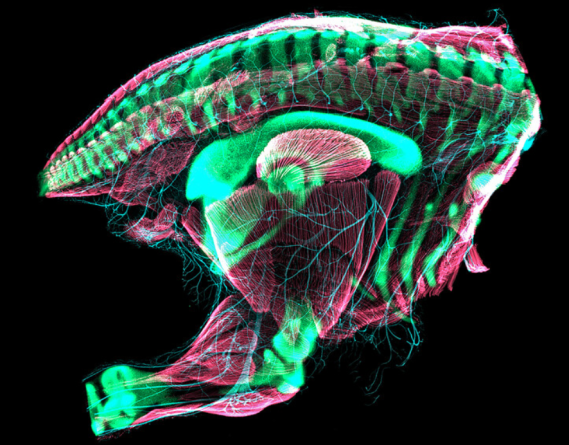
Birds & Dinosaurs — Joined at the Hip
Yale News | Jim Shelton | July 27, 2022 | 5 minute read
From the article:
All baby birds have a moment prior to hatching when their hip bone is a tiny replica of a dinosaur’s pelvis. That’s one of the findings in a new, Yale-led study in the journal Nature that explores the evolutionary underpinnings of the avian hip bone. It is also a modern-day nod to the dramatic transformation that led from dinosaurs to birds over tens of millions of years.
Link to list of publications by co-author and lab director Bhart-Anjan S. Bhullar
Sample title: The early origin of a birdlike inner ear and the evolution of dinosaurian movement and vocalization. Science 372(6542): 601-609. Hanson M*, Hoffman EA, Norell MA, Bhullar B-AS. (2021).
Link to the paper: The developing bird pelvis passes through ancestral dinosaurian conditions
Abstract:
Living birds (Aves) have bodies substantially modified from the ancestral reptilian condition. The avian pelvis in particular experienced major changes during the transition from early archosaurs to living birds. This stepwise transformation is well documented by an excellent fossil record; however, the ontogenetic alterations that underly it are less well understood. We used embryological imaging techniques to examine the morphogenesis of avian pelvic tissues in three dimensions, allowing direct comparison with the fossil record. Many ancestral dinosaurian features (for example, a forward-facing pubis, short ilium and pubic ‘boot’) are transiently present in the early morphogenesis of birds and arrive at their typical ‘avian’ form after transitioning through a prenatal developmental sequence that mirrors the phylogenetic sequence of character acquisition. We demonstrate quantitatively that avian pelvic ontogeny parallels the non-avian dinosaur-to-bird transition and provide evidence for phenotypic covariance within the pelvis that is conserved across Archosauria. The presence of ancestral states in avian embryos may stem from this conserved covariant relationship. In sum, our data provide evidence that the avian pelvis, whose early development has been little studied, evolved through terminal addition—a mechanism whereby new apomorphic states are added to the end of a developmental sequence, resulting in expression of ancestral character states earlier in that sequence. The phenotypic integration we detected suggests a previously unrecognized mechanism for terminal addition and hints that retention of ancestral states in development is common during evolutionary transitions.
Three more articles on this paper: Xeniasday, Wiley Analytical Science, Hartford Courant.
Where Song Began | The Bowerbird Collective
[Posted by Chuck Almdale]
This is an interesting and unusual item and it looks legitimate, so I’m posting this upcoming concert in the Los Angeles west side area. The two videos (links at bottom) are nice to listen to and a good introduction to their work. The performers are on a tour around the western U.S. and Canada, and the venue where they are performing — Monk Space — is a real place.
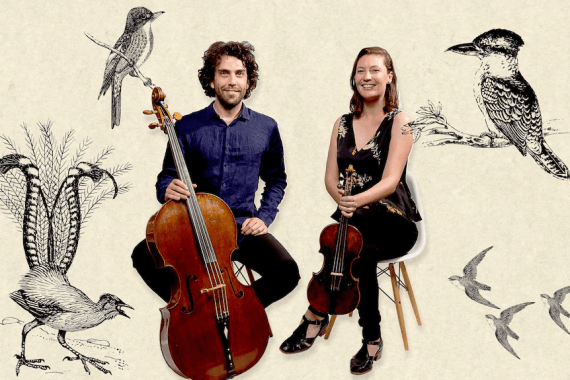
Where Song Began – Los Angeles
Monk Space, 4414 W 2nd St, Los Angeles, CA 90004
Saturday, 6th of August, 3:00pm
Adults $25, Students $15, U18 $5
Tickets: www.bowerbirdcollective.us/la
Facebook event
Description
‘Where Song Began’ is a musical celebration of songbirds, a cinematic concert experience not to be missed.
Join two of Australia’s most adventurous musicians, Simone Slattery (violin, vocals, PhD, Churchill Fellow) and Anthony Albrecht (cello, The Juilliard School), for an event described as “Spectacular” by Limelight Magazine.
Performed more than 80 times in sold out halls and accessible for all ages, this work encourages the audience to contemplate the avian origins of song. The program includes music spanning 300 years, from Johann Heinrich Schmelzer and J.S. Bach to Arvo Pärt and new compositions, enhanced by a film of evocative visual projections and an immersive soundscape.
About the performers: Simone Slattery was a 2018 Churchill Fellow, received a Ph.D. in Music Performance from the University of Adelaide and performs regularly with Australia’s finest ensembles. Anthony Albrecht is an Australian graduate of The Juilliard School’s Historical Performance program and enjoys an international career.
Performance length: 60 minutes without interval, including a Q&A. For more information about this program visit www.wheresongbegan.com and www.bowerbirdcollective.org
Tickets: Adults $25, Students $15, U18 $5 at the door and online.
Program:
Arvo Pärt – Fratres for solo violin, 1977
Sarah Hopkins – Reclaiming the Spirit, 1993
Vaughan Williams – The Lark Ascending, 1917
Chris Williams – bird, songs, seas, 2017
Ross Edwards – Ecstatic Dance No.2, 1990
Johann Heinrich Schmelzer – Cucu Sonata, 1664
J.S. Bach – Prelude from Cello Suite No.1, c.1720
David Lang – Anthochaera carunculata (Red Wattle Bird), 2017
Ngarra Burra Ferra – Yorta Yorta hymn
Presented by the Bowerbird Collective, with kind assistance from Monk Space
Spotify Album Link here .
Promotional videos here and here.
ABC (Australian Broadcasting Corp) Radio National feature interview here.
Rebound for bird on edge of extinction | Phys.org
[Posted by Chuck Almdale]
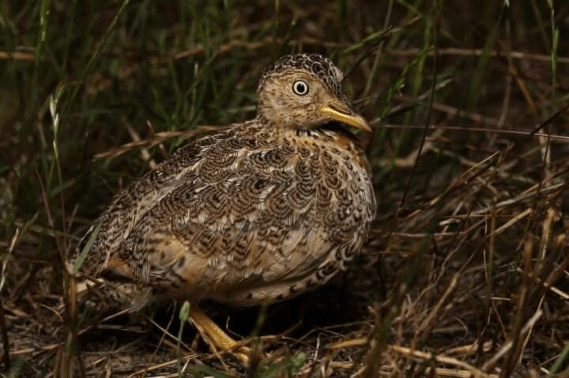
A recent survey in northern Victoria uncovered a record number of Plains Wanderers—small, quail-like birds that live only in eastern Australia grasslands, and represent an ancient lineage of birds that evolved in Gondwana more than 100 million years ago.
At the end of the linked article, you’ll see an area that says “Explore Further.”
Click the link there to go to “New Zealand fossils reveal new bird species.”
And at the end of that article, click the link to go to “Ancient seabird discovery suggests Paleogene bird diversification.”
Do this again for “Scientists get first full look at prehistoric New Zealand penguin” – a six foot tall bird.
Fascinating stuff.
Sex on the beach | Grunion, of course
[Posted by Chuck Almdale, submitted by Karen Martin]
It’s that time of the year….

Sex on the beach: A beloved California wriggles ashore to spawn
Grunion run has fascinated scientists and locals for decades, but their future is threatened by the climate crisis.
The Guardian | Katharine Gammon in Santa Monica | 3 Jul 2022 |
Martin, who has been studying grunion for years and is considered a foremost expert on their behavior, sets some rules.
- Don’t touch the fish.
- Don’t shine lights on them until the frenzy has started.
- Don’t wander too far away on the darkened beach, which is a critical fish habitat.
She then solemnly intones: “May the fish be with us.”
This year, the state has prohibited people from taking any fish in April, May and June, the peak time of the grunion run – adding June to the prohibition for the first time since 1949. “We’re trying to curtail that activity to protect the species and hopefully they will recover,” says Armand Barilotti, an environmental scientist with the California department of fish and wildlife.
Direct link to Grunion Greeters organization.
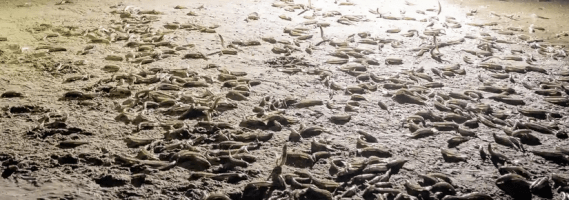
Glorious Lagoon June Gloom: Malibu Lagoon, 26 June 2022
[By Chuck Almdale]
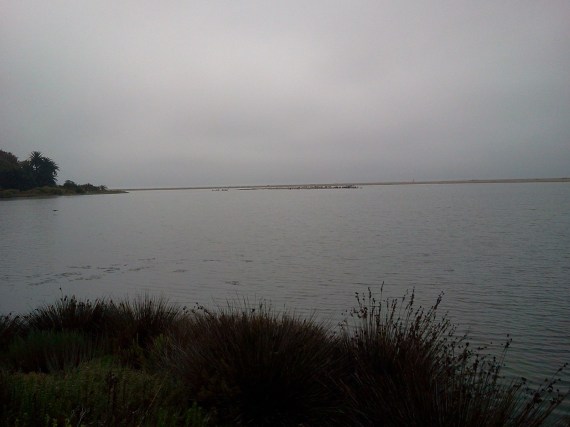
Once again the June Gloom fog came to our rescue. The fog kept the temperature comfortably between 65-70°F. The waves came in sets, so the surfers were mostly sitting on the water…make that sitting on their boards on the water. Twenty-two birders showed up — almost as many birders as there were species of birds.
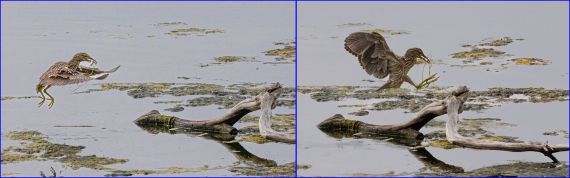

At 0830 at our starting point by the weird semi-shaded pavilion, the sun is always in our eyes when we look at the channel immediately in front of us. Common birds can become mysterious gray-brown objects. I got there a little late and most people were looking at a perched wading bird and wondering, “What is that thing?”

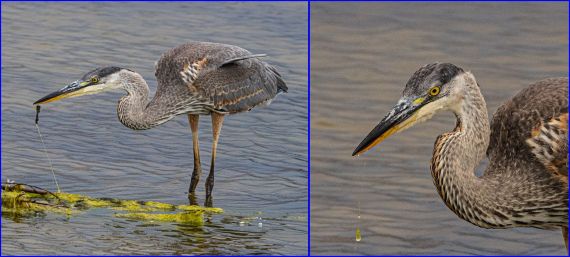
Well, it was a Black-crowned Night-Heron. There were two of them: one in streaky juvenile plumage, the other in a plumage between juvenile (born this year) and adult (usually three years old). They can be a bit confusing even in good light. Lots of people misidentify the juveniles as an American Bittern because of all the streaks.

Lagoon water level was quite high. Checking the summer clock sidewalk we found that the level had recently gotten up to 7′ 8.4″.
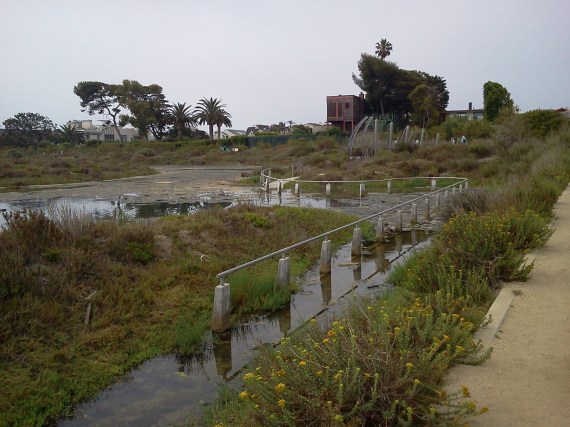

The only ducks present were Gadwall and Mallard, some with chicks in tow. Some of the adult-sized birds didn’t look like adults, so I assume they’re the product of hatchings earlier this year.
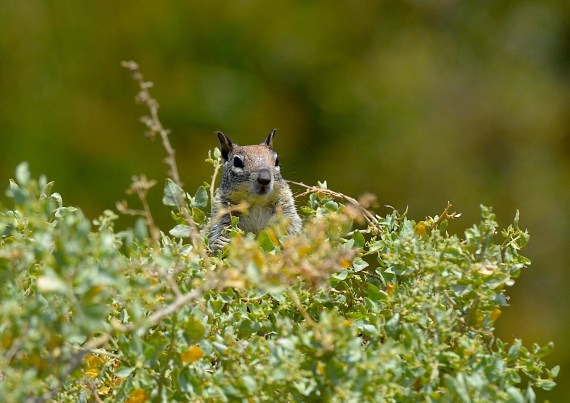
The Osprey was present, whom we had not seen since March.
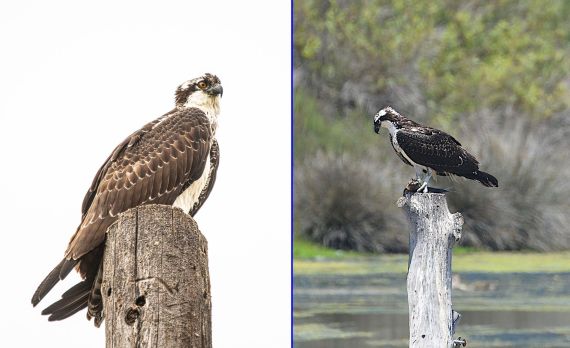
There were plenty of Jumping Mullet in the lagoon. It’s easy to tell they’re Jumping Mullet, due to their persistent habit of jumping. I probably saw fifty jumps over the course of several hours. They come in all sizes, some quite large, so the Osprey has his pick. I’m still waiting for some Ph.D. candidate to crank out a thesis narrowing the reasons why they jump down to somewhere under five.

The number of sandpiper species was exceptionally close to none: three Killdeer and three Whimbrel. The Killdeer are present 97% of the time, and nest at the lagoon. I looked at our most recent ten Junes (2011-2021, no count in June 2015):
Ave. total species: 40 (range 33-48), ave. sandpiper species: 4 (2-6), June 2022: 35 and 2.
Species: Ave. all: 40 (range 33-48); ave. sandpipers: 4 (2-6), June’22: 35 and 2.
Counts: Ave. all: 472 (range 248-863), ave. ‘pipers; 21 (6-41), June’22: 437 and 6.
This year is definitely lower than average, confirming — for a change — my vague suspicion.
There were quite a few Brown Pelicans on the sand island, and they kept coming and going all morning long. Towards the end of our walk all the birds on the island — gulls, terns, cormorants and pelicans — suddenly rose up into the air. This usually signals a hawk or falcon in flight, but none were to be seen.

A few minutes later I spotted a Turkey Vulture on the other side of the sand island whom we had not seen land, ripping at something out–of-sight from us. Most likely it was feeding on one of the several Brown Pelican corpses lying about, and someone commented, “That’s probably what put the birds up.” Quite likely. They hadn’t stirred when the vultures first appeared high in the sky, but one dropping down among them was enough to set them off. The vulture of course paid them no attention as they were pointlessly (to him) alive, and the birds quickly returned and settled back down.
We didn’t see any Western Snowy Plovers, but Grace and Larry came by three days later and found a male and a female on the eastern edge of the lagoon.

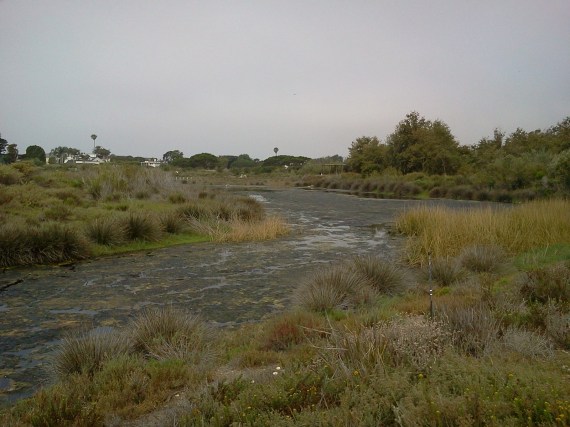
The photos show a darker day than I thought it to be. When you looked up at the sky it seemed quite blue, yet there were small white wisps of fog everywhere. As I was leaving around 11:30, I saw tiny patches of fog moving a few inches above the lagoon surface and drifting into the pickleweed. Yet the sky seemed bright. It’s probably aliens tinkering with our weather, yet again.

On his way back to the parking lot, Chris Lord spotted a Band-tailed Pigeon, a bird we’ve seen on only (now) three occasions, with a total of nine birds. They’re usually up in the hills, eating acorns.
Birds new for the season: Band-tailed Pigeon, Black-crowned Night-Heron, Osprey.
Malibu Lagoon on eBird as of 6-27-22: 5873 lists, 313 species
Many thanks to photographers: Lillian Johnson, Grace Murayama, Ray Juncosa

Upcoming SMBAS scheduled field trips: Our next trip will be Malibu Lagoon on July 24. This, and any other trip we announce for the foreseeable future will be dependent upon the expected status of the Covid pandemic at trip time. Any trip announced may be canceled shortly before trip date if it seems necessary. By now any other comments along this line should be superfluous.
The next SMBAS program: Zoom Evening Meeting, Tuesday, 4 October 2022, 7:30 p.m.
The SMBAS 10 a.m. Parent’s & Kids Birdwalk is currently under discussion concerning resumption.
Links: Unusual birds at Malibu Lagoon
9/23/02 Aerial photo of Malibu Lagoon
More recent aerial photo
Prior checklists:
2021: Jan-July, July-Dec
2020: Jan-July, July-Dec 2019: Jan-June, July-Dec
2018: Jan-June, July-Dec 2017: Jan-June, July-Dec
2016: Jan-June, July-Dec 2015: Jan-May, July-Dec
2014: Jan-July, July-Dec 2013: Jan-June, July-Dec
2012: Jan-June, July-Dec 2011: Jan-June, July-Dec
2010: Jan-June, July-Dec 2009: Jan-June, July-Dec
The 10-year comparison summaries created during the Lagoon Reconfiguration Project period, remain available—despite numerous complaints—on our Lagoon Project Bird Census Page. Very briefly summarized, the results unexpectedly indicate that avian species diversification and numbers improved slightly during the restoration period June’12-June’14.
Many thanks to Lillian Johnson, Chris Lord and others for their contributions to this month’s checklist.
The list below now includes a column on the left side with numbers 1-9, keyed to the nine categories of birds at the bottom. The species are re-sequenced to agree with the California Bird Records Committee Official California Checklist, updated 15 Jan 2022. I generally do this sequence update at the start of each year.
[Chuck Almdale]
| Malibu Census 2022 | 1/23 | 2/27 | 3/27 | 4/24 | 5/22 | 6/26 | |
| Temperature | 61-73 | 61-70 | 57-65 | 72-75 | 61-66 | 65-70 | |
| Tide Lo/Hi Height | L+2.04 | H+5.76 | H+5.00 | H+4.50 | L-0.32 | H+3.33 | |
| Tide Time | 0645 | 0621 | 0615 | 0442 | 1029 | 0943 | |
| 1 | (Black) Brant | 6 | |||||
| 1 | Canada Goose | 2 | 2 | 6 | 3 | ||
| 1 | Egyptian Goose | 1 | |||||
| 1 | Cinnamon Teal | 2 | |||||
| 1 | Gadwall | 29 | 8 | 47 | 26 | 25 | 15 |
| 1 | American Wigeon | 4 | 6 | 1 | 2 | ||
| 1 | Mallard | 20 | 12 | 30 | 14 | 15 | 35 |
| 1 | Northern Pintail | 1 | |||||
| 1 | Green-winged Teal | 11 | 12 | 15 | 2 | ||
| 1 | Surf Scoter | 10 | 15 | 3 | |||
| 1 | Bufflehead | 2 | 5 | ||||
| 1 | Common Goldeneye | 2 | |||||
| 1 | Red-breasted Merganser | 9 | 6 | 5 | |||
| 1 | Ruddy Duck | 4 | 1 | ||||
| 2 | Pied-billed Grebe | 3 | 3 | 3 | 1 | 1 | |
| 2 | Eared Grebe | 1 | 1 | ||||
| 2 | Western Grebe | 30 | 12 | 16 | |||
| 7 | Feral Pigeon | 20 | 10 | 8 | 4 | 6 | 8 |
| 7 | Band-tailed Pigeon | 3 | 1 | ||||
| 7 | Eurasian Collared-Dove | 1 | |||||
| 7 | Mourning Dove | 4 | 2 | 4 | 2 | ||
| 8 | Anna’s Hummingbird | 2 | 2 | 1 | 1 | ||
| 8 | Allen’s Hummingbird | 3 | 3 | 3 | 3 | 1 | 2 |
| 2 | American Coot | 49 | 73 | 65 | 1 | 4 | 4 |
| 5 | Black-bellied Plover | 58 | 25 | 28 | 2 | 1 | |
| 5 | Killdeer | 2 | 10 | 4 | 2 | 3 | 3 |
| 5 | Semipalmated Plover | 15 | |||||
| 5 | Snowy Plover | 15 | 10 | ||||
| 5 | Whimbrel | 8 | 2 | 8 | 2 | 3 | |
| 5 | Marbled Godwit | 32 | 1 | 2 | |||
| 5 | Ruddy Turnstone | 6 | 5 | ||||
| 5 | Sanderling | 1 | 45 | 2 | |||
| 5 | Dunlin | 1 | |||||
| 5 | Least Sandpiper | 12 | 20 | 10 | 50 | ||
| 5 | Western Sandpiper | 1 | 11 | 35 | 30 | ||
| 5 | Spotted Sandpiper | 6 | 1 | ||||
| 5 | Willet | 15 | 8 | 6 | 2 | ||
| 5 | Red-necked Phalarope | 1 | |||||
| 6 | Bonaparte’s Gull | 1 | |||||
| 6 | Heermann’s Gull | 45 | 1 | 8 | 15 | 4 | 27 |
| 6 | Ring-billed Gull | 40 | 175 | 16 | 65 | ||
| 6 | Western Gull | 95 | 88 | 95 | 57 | 95 | 55 |
| 6 | California Gull | 925 | 510 | 185 | 35 | 33 | 3 |
| 6 | Herring Gull | 2 | 1 | 2 | |||
| 6 | Glaucous-winged Gull | 5 | 5 | 8 | 6 | ||
| 6 | Caspian Tern | 1 | 8 | 12 | 15 | 22 | |
| 6 | Royal Tern | 5 | 2 | 35 | 18 | 3 | 3 |
| 6 | Elegant Tern | 6 | 220 | 24 | |||
| 2 | Red-throated Loon | 1 | 2 | ||||
| 2 | Pacific Loon | 1 | 2 | ||||
| 2 | Common Loon | 2 | 1 | ||||
| 2 | Black-vented Shearwater | 1000 | |||||
| 2 | Brandt’s Cormorant | 6 | 1 | 5 | 1 | 50 | |
| 2 | Pelagic Cormorant | 12 | 3 | 1 | 1 | 2 | |
| 2 | Double-crested Cormorant | 45 | 51 | 33 | 26 | 22 | 46 |
| 2 | Brown Pelican | 110 | 15 | 23 | 68 | 65 | 126 |
| 3 | Great Blue Heron | 4 | 2 | 1 | 1 | 2 | 3 |
| 3 | Great Egret | 2 | 5 | 3 | 2 | 4 | |
| 3 | Snowy Egret | 6 | 3 | 4 | 1 | 1 | 2 |
| 3 | Green Heron | 1 | |||||
| 3 | Black-crowned Night-Heron | 5 | 4 | ||||
| 4 | Turkey Vulture | 1 | 5 | 3 | 4 | 4 | |
| 4 | Osprey | 1 | 1 | 1 | 1 | ||
| 4 | Cooper’s Hawk | 1 | 1 | ||||
| 4 | Red-shouldered Hawk | 1 | 1 | ||||
| 4 | Red-tailed Hawk | 1 | 1 | ||||
| 8 | Belted Kingfisher | 1 | 1 | 1 | 1 | ||
| 4 | Merlin | 1 | |||||
| 9 | Black Phoebe | 4 | 3 | 3 | 2 | 5 | |
| 9 | Say’s Phoebe | 1 | |||||
| 9 | California Scrub-Jay | 2 | 3 | 2 | 1 | 1 | |
| 9 | American Crow | 4 | 20 | 6 | 4 | 4 | 5 |
| 9 | Common Raven | 1 | 2 | ||||
| 9 | Oak Titmouse | 1 | |||||
| 9 | Tree Swallow | 2 | |||||
| 9 | No. Rough-winged Swallow | 2 | 4 | 8 | |||
| 9 | Barn Swallow | 4 | 8 | 15 | 20 | ||
| 9 | Cliff Swallow | 8 | 4 | ||||
| 9 | Bushtit | 12 | 4 | 4 | 10 | 8 | |
| 9 | Wrentit | 2 | 2 | ||||
| 9 | Blue-gray Gnatcatcher | 2 | |||||
| 9 | House Wren | 2 | 1 | ||||
| 9 | Northern Mockingbird | 1 | 1 | 1 | 1 | ||
| 9 | European Starling | 15 | 30 | 3 | 2 | 1 | |
| 9 | Hermit Thrush | 1 | |||||
| 9 | House Finch | 8 | 5 | 15 | 6 | 12 | 10 |
| 9 | Lesser Goldfinch | 4 | 2 | 2 | 1 | ||
| 9 | Dark-eyed Junco | 4 | 3 | ||||
| 9 | White-crowned Sparrow | 35 | 25 | 20 | 2 | ||
| 9 | Song Sparrow | 6 | 6 | 10 | 7 | 10 | 4 |
| 9 | California Towhee | 2 | 2 | 2 | 2 | 2 | 1 |
| 9 | Red-winged Blackbird | 2 | 1 | ||||
| 9 | Brown-headed Cowbird | 2 | 1 | ||||
| 9 | Great-tailed Grackle | 1 | 3 | 5 | 2 | 1 | 6 |
| 9 | Orange-crowned Warbler | 1 | |||||
| 9 | Common Yellowthroat | 3 | 1 | 1 | |||
| 9 | Yellow-rumped Warbler | 10 | 6 | 1 | |||
| Totals by Type | Jan | Feb | Mar | Apr | May | Jun | |
| 1 | Waterfowl | 88 | 52 | 127 | 49 | 48 | 50 |
| 2 | Water Birds – Other | 1259 | 164 | 146 | 99 | 143 | 177 |
| 3 | Herons, Egrets & Ibis | 18 | 5 | 10 | 5 | 5 | 13 |
| 4 | Quail & Raptors | 5 | 5 | 6 | 3 | 4 | 5 |
| 5 | Shorebirds | 135 | 97 | 146 | 114 | 6 | 6 |
| 6 | Gulls & Terns | 1118 | 783 | 363 | 428 | 174 | 110 |
| 7 | Doves | 21 | 17 | 10 | 8 | 6 | 11 |
| 8 | Other Non-Passerines | 6 | 6 | 5 | 4 | 2 | 2 |
| 9 | Passerines | 117 | 118 | 81 | 64 | 64 | 63 |
| Totals Birds | 2767 | 1247 | 894 | 774 | 452 | 437 | |
| Total Species | Jan | Feb | Mar | Apr | May | Jun | |
| 1 | Waterfowl | 9 | 9 | 9 | 6 | 4 | 2 |
| 2 | Water Birds – Other | 11 | 11 | 7 | 7 | 5 | 4 |
| 3 | Herons, Egrets & Ibis | 5 | 2 | 3 | 3 | 3 | 4 |
| 4 | Quail & Raptors | 5 | 5 | 2 | 1 | 1 | 2 |
| 5 | Shorebirds | 9 | 9 | 8 | 11 | 4 | 2 |
| 6 | Gulls & Terns | 8 | 8 | 9 | 8 | 6 | 5 |
| 7 | Doves | 2 | 3 | 2 | 2 | 1 | 3 |
| 8 | Other Non-Passerines | 3 | 3 | 3 | 2 | 2 | 1 |
| 9 | Passerines | 20 | 17 | 16 | 17 | 13 | 12 |
| Totals Species – 97 | 72 | 67 | 59 | 57 | 39 | 35 |



 SANTA MONICA BAY AUDUBON SOCIETY BLOG