Free email delivery
Please sign up for email delivery in the subscription area to the right.
No salesman will call, at least not from us. Maybe from someone else.
Old coots visit Malibu Lagoon, 26 September 2021
[Posted by Chuck Almdale]

It was unseasonably cool from morning fog, still hanging low by the time we left. [Of course there is no such thing as unseasonably hot anymore.] Temperature was 63-70°F and I never took off my fleece. It’s SoCal, remember? At 65° in Beverly Hills, they’re bundling up in furry boots, getting ready for the Great Freeze of January, when it plunges down to 60° above.

No stints this morning, not even a Long-toed Stint. But the large crowd of American Coots more than made up for their absence, 130 strong, their black bodies and white forehead shields checkerboarding the lagoon.

Ah…the lagoon! Never have I seen so much algae. Not just the channels where the current is slow, but about half or more of the lagoon itself is algae-covered. Most of the peeps were strolling on it, finding invertebrates. The water level has dropped about 6 inches.

A great deal of sandy beach up to about 6” above lagoon water level is now covered with a continuous, unbroken, dark brown-to-black blanket of deadish algae. It really does resemble a wrinkled blanket. You expect to see a head poke out from under it, wondering why you’re walking on their bed and rudely awakening them.

Speaking of checkerboarding, the next most common species at the lagoon were surfers on the waves. We knew there’d be a lot of them—jam-packed cars along the no-cost edges of Pacific Coast Highway, and surfers pay to park only as a last resort—but I didn’t expect to see this many. I had to count them, of course. (That’s rule #1 in The Compulsive’s Handbook.) I got to 110 surfers in the water waiting for a wave, on a wave, or paddling back out to catch another wave. They vanished from view around the curvature of the beach. More were on the beach, suiting up or resting.

The surf was very good. (No surprise there. If it wasn’t good, there would be no surfers. There is a clear causal relationship there.) They always check the surf reports which must be remarkably accurate. The waves were not windblown and ragged from a breeze. The big ones came in sets, nicely cresting, some even forming tubes. Every time the first one of a set arrived, the surfers who weren’t far enough out to catch it would paddle furiously to catch the next one. I used to body surf—a lot—so I know the frustration of deciding where to wait for a worthwhile ride, yet not missing them all by being out too far.
Pieces of dead birds lay all along the edge of the lagoon and the sand bar: lone wings, pairs of wings, tail, a pile of feathers, bones & feathers, a neck, a head, a neck & head and so on. The Merlin and Peregrine Falcon (perhaps several of each) had evidently found their happy hunting ground. Maybe that was why there were so few birds.

Especially the gulls and terns. The small flocklet of five Royal Terns ballooned to thirteen birds by the time we left, and the initial five gulls mushroomed to twelve. Four species. Back home, I checked my records and found that this was indeed a Very Low Number of gulls & terns. In fact, in 291 visits since October, 1979, the only lower count of gulls & terns was last year, October 21, 2020, when we had a walloping 22 birds in two species—21 Western Gulls and 1 California Gull. One can only hope they were all out to sea, stuffing themselves on vast schools of delicious mouth-watering fish. It’s either that or they got sick and tired of being dive-bombed by falcons and left for a more peaceful stretch of sand.

I spoke briefly to a young couple looking at the flock of shorebirds on the sandy island. They turned out to be volunteers—or maybe employees, I didn’t get that detail nailed down—for International Bird Rescue (IBR). They’d just spent a lot of time down at Long Beach Harbor, helping the Elegant Terns with their (the terns) wild & crazy idea of nesting on two (momentarily) unused barges. Nesting, I should add, over the objections of the owner who had previously made other plans for his barges, plans in which terns played no part. But he cooperated, so kudos to him.

If you recall (from prior blogs here), the Elegant Terns had been frightened off their nests down at Bolsa Chica Wildlife Reserve in Orange County. They relocated en masse to Long Beach Harbor. It was a decent spot to nest, until the chicks hatched and began wandering around the nesting area, as they tend to do. Normally Elegant Terns nest on sand flats where the chicks can’t get into too much trouble. But the barge edges were shear drop-offs to the water with no retaining walls, so the chicks continually fell off the edges into the harbor water, with absolutely no way to clamber back up to the barge deck and their parents, much less leap out of the water and fly up.

IBR to the rescue! Using small boats they’d pluck the floundering chicks from the water, take them to a safe place, and feed them. Some they banded, some they returned to the barge. About 6,000-8,000 Elegant Terns nested on the barges, and IBR rescued about 2,000 chicks from the water. Nesting season is now over and done. We hope that next year they return to Bolsa Chica and that the drone-flyers stay away. But Elegant Terns have a history of abandoning areas from which they’ve been frightened. We’ll see.
Link to a IBR 9-28-21 posting about Long Beach Harbor and Elegant Terns.


(L) Whimbrel (Ray Juncosa 9-26-21) (R) Marbled Godwit (Chris Tosdevin 9-26-21)

So this couple had a few hours or days off, and decided to visit Malibu Lagoon and see if any of “their” birds were around, and if they could find any with bands. Unfortunately—not just very unfortunately but astonishingly unfortunately—for them, they picked the second worse day in over 40 years to look for gulls and terns at Malibu Lagoon.
So it—as Kurt Vonnegut often wrote—goes.
We had an interesting Great-tailed Grackle at the lagoon, a shiny blue-black male. It looked a lot like a member of a small family of African Warblers known as Crombecs. If it’s a new species, I suggest it be named Black-faced Crombec-Grackle.

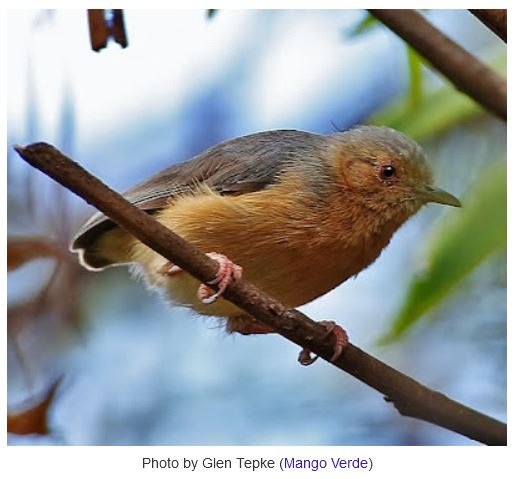
Long-tailed [Black-faced] [Crombec]-Grackle (Ray Juncosa 9-26-21)
Red-faced Crombec (Glen Tepke Birds of the World)
We had yet one more of the Long-billed Curlews that have been recently dropping by the lagoon. Sandy beach or lagoon edges are really not their preferred habitat, so their presence is infrequent and of short-duration. 60 birds on 17 occasions, including this one, is the grand total since October 1979, and 39 of them were on 8/16/80.

The Snowy Plover count was 34 birds. No bands were seen, but then we didn’t make them all stand up for inspection. This seemed to me to be a higher-than-usual number of birds for September, but when I got home and counted them up for the ten year period 2011-2020, the average was 41 birds. So much for memory! That’s why we (humans) invented writing.


Birds new for the season: American Wigeon, Green-winged Teal, Long-billed Curlew, Long-billed Dowitcher, Ring-billed Gull, Osprey, Merlin, Peregrine Falcon, Say’s Phoebe, House Wren, American Pipit, Western Meadowlark, Orange-crowned Warbler.
Many thanks to photographers: Lillian Johnson, Ray Juncosa, Grace Murayama & Chris Tosdevin
The next SMBAS scheduled field trips: Maybe January 2022. Wear your masks, get your shots, and maybe someday we can have organized trips again.
The next SMBAS program: Zoom Evening Meeting, Birds of Northeast Brazil & the Atlantic Forest, with Chuck Bragg, 5 October 2021, 7:30 p.m.
The SMBAS 10 a.m. Parent’s & Kids Birdwalk remains canceled until further notice due to the near-impossibility of maintained proper masked social distancing with parents and small children.

Links: Unusual birds at Malibu Lagoon
9/23/02 Aerial photo of Malibu Lagoon
Prior checklists:
2021: Jan-July
2020: Jan-July, July-Dec 2019: Jan-June, July-Dec
2018: Jan-June, July-Dec 2017: Jan-June, July-Dec
2016: Jan-June, July-Dec 2015: Jan-May, July-Dec
2014: Jan-July, July-Dec 2013: Jan-June, July-Dec
2012: Jan-June, July -Dec 2011: Jan-June, July-Dec
2010: Jan-June, July-Dec 2009: Jan-June, July-Dec.
The 10-year comparison summaries created during the Lagoon Reconfiguration Project period, remain available—despite numerous complaints—on our Lagoon Project Bird Census Page. Very briefly summarized, the results unexpectedly indicate that avian species diversification and numbers improved slightly during the restoration period June’12-June’14.

Many thanks to Lillian Johnson, Ray Juncosa, Chris Tosdevin and others for their contributions to this month’s checklist.
The appearance of the list below has changed slightly. I’ve added a column on the left side with numbers 1-9, keyed to the nine categories of birds at the bottom.
[Chuck Almdale]
| Malibu Census 2021 | 4/25 | 5/22 | 6/20 | 7/25 | 8/22 | 9/26 | |
| Temperature | 58-63 | 59-68 | 63-69 | 66-74 | 68-73 | 63-70 | |
| Tide Lo/Hi Height | H+4.83 | L+1.57 | H+4.89 | H+4.20 | H+4.55 | L+2.52 | |
| Tide Time | 0843 | 0736 | 0627 | 1148 | 1034 | 0556 | |
| 1 | (Black) Brant | 1 | |||||
| 1 | Canada Goose | 8 | 6 | 10 | |||
| 1 | Gadwall | 25 | 18 | 65 | 48 | 12 | |
| 1 | American Wigeon | 7 | |||||
| 1 | Mallard | 18 | 22 | 40 | 37 | 9 | 18 |
| 1 | Green-winged Teal | 1 | |||||
| 1 | Red-breasted Merganser | 3 | 1 | 1 | 1 | ||
| 1 | Ruddy Duck | 2 | 1 | ||||
| 2 | Pied-billed Grebe | 1 | 1 | 2 | 1 | 3 | |
| 2 | Western Grebe | 4 | |||||
| 7 | Feral Pigeon | 9 | 15 | 9 | 15 | 6 | 8 |
| 7 | Mourning Dove | 2 | 4 | 3 | |||
| 8 | Anna’s Hummingbird | 1 | 1 | 1 | 1 | 1 | |
| 8 | Allen’s Hummingbird | 4 | 2 | 1 | 3 | 1 | |
| 2 | American Coot | 75 | 6 | 9 | 8 | 2 | 130 |
| 5 | Black-bellied Plover | 22 | 5 | 13 | 43 | 90 | 103 |
| 5 | Snowy Plover | 9 | 29 | 34 | |||
| 5 | Semipalmated Plover | 29 | 1 | 4 | 3 | ||
| 5 | Killdeer | 1 | 6 | 4 | 9 | 20 | 10 |
| 5 | Whimbrel | 3 | 19 | 9 | 51 | 17 | 8 |
| 5 | Long-billed Curlew | 1 | |||||
| 5 | Marbled Godwit | 4 | 30 | ||||
| 5 | Ruddy Turnstone | 2 | 2 | 8 | 3 | ||
| 5 | Red-necked Stint | 1 | |||||
| 5 | Sanderling | 12 | 20 | ||||
| 5 | Dunlin | 1 | 2 | ||||
| 5 | Baird’s Sandpiper | 5 | |||||
| 5 | Least Sandpiper | 1 | 8 | 35 | 12 | ||
| 5 | Western Sandpiper | 20 | 12 | 65 | 2 | ||
| 5 | Short-billed Dowitcher | 3 | |||||
| 5 | Long-billed Dowitcher | 1 | |||||
| 5 | Spotted Sandpiper | 1 | 2 | 1 | |||
| 5 | Willet | 2 | 1 | 40 | 14 | ||
| 5 | Red-necked Phalarope | 1 | 4 | ||||
| 6 | Heermann’s Gull | 28 | 280 | 2 | 1 | 1 | |
| 6 | Ring-billed Gull | 6 | 1 | ||||
| 6 | Western Gull | 40 | 35 | 45 | 52 | 55 | 10 |
| 6 | California Gull | 35 | 10 | 4 | 1 | 4 | |
| 6 | Glaucous-winged Gull | 1 | 1 | 1 | |||
| 6 | Least Tern | 1 | |||||
| 6 | Caspian Tern | 20 | 13 | 3 | 2 | ||
| 6 | Royal Tern | 6 | 2 | 5 | 13 | ||
| 6 | Elegant Tern | 395 | 107 | 1 | 240 | 1 | |
| 2 | Double-crested Cormorant | 12 | 26 | 26 | 52 | 27 | 35 |
| 2 | Pelagic Cormorant | 1 | 1 | 2 | |||
| 2 | Brown Pelican | 105 | 235 | 27 | 58 | 30 | 11 |
| 3 | Great Blue Heron | 3 | 2 | 5 | 4 | 3 | |
| 3 | Great Egret | 1 | 1 | 4 | 11 | 4 | 1 |
| 3 | Snowy Egret | 2 | 1 | 6 | 22 | 24 | 14 |
| 3 | Green Heron | 1 | |||||
| 3 | Black-crowned Night-Heron | 9 | 3 | 3 | |||
| 4 | Turkey Vulture | 1 | |||||
| 4 | Osprey | 2 | 1 | 2 | |||
| 4 | Cooper’s Hawk | 1 | 1 | ||||
| 4 | Red-shouldered Hawk | 2 | 1 | ||||
| 8 | Belted Kingfisher | 1 | |||||
| 4 | Merlin | 1 | |||||
| 4 | Peregrine Falcon | 1 | 1 | ||||
| 9 | Black Phoebe | 8 | 6 | 3 | 4 | 5 | |
| 9 | Say’s Phoebe | 1 | |||||
| 9 | Western Kingbird | 1 | |||||
| 9 | California Scrub-Jay | 1 | 1 | ||||
| 9 | American Crow | 4 | 4 | 3 | 4 | 4 | 4 |
| 9 | Violet-green Swallow | 2 | |||||
| 9 | No. Rough-winged Swallow | 2 | 3 | 2 | |||
| 9 | Cliff Swallow | 8 | 4 | 4 | |||
| 9 | Barn Swallow | 25 | 30 | 18 | 40 | 25 | 3 |
| 9 | Oak Titmouse | 2 | 1 | 2 | |||
| 9 | Bushtit | 1 | 8 | 4 | 1 | 20 | |
| 9 | House Wren | 1 | |||||
| 9 | Wrentit | 1 | |||||
| 9 | Northern Mockingbird | 4 | 5 | 2 | 1 | 1 | |
| 9 | European Starling | 5 | 8 | 30 | 40 | ||
| 9 | American Pipit | 1 | |||||
| 9 | House Finch | 6 | 6 | 6 | 6 | 18 | 7 |
| 9 | Lesser Goldfinch | 2 | 2 | ||||
| 9 | Spotted Towhee | 1 | 1 | ||||
| 9 | California Towhee | 3 | 1 | ||||
| 9 | Song Sparrow | 7 | 8 | 4 | 5 | 3 | 5 |
| 9 | White-crowned Sparrow | 2 | |||||
| 9 | Western Meadowlark | 1 | |||||
| 9 | Hooded Oriole | 1 | 1 | ||||
| 9 | Red-winged Blackbird | 2 | 4 | 25 | |||
| 9 | Brown-headed Cowbird | 1 | 1 | ||||
| 9 | Great-tailed Grackle | 6 | 6 | 8 | 20 | 5 | 1 |
| 9 | Orange-crowned Warbler | 1 | |||||
| 9 | Common Yellowthroat | 4 | 2 | 5 | |||
| 9 | Yellow Warbler | 2 | |||||
| 9 | Yellow-rumped Warbler | 1 | |||||
| Totals by Type | Apr | May | Jun | Jul | Aug | Sep | |
| 1 | Waterfowl | 55 | 46 | 116 | 86 | 24 | 27 |
| 2 | Water Birds – Other | 198 | 268 | 62 | 120 | 61 | 181 |
| 3 | Herons, Egrets & Ibis | 3 | 6 | 12 | 47 | 35 | 21 |
| 4 | Quail & Raptors | 3 | 4 | 0 | 1 | 2 | 4 |
| 5 | Shorebirds | 80 | 31 | 28 | 136 | 341 | 242 |
| 6 | Gulls & Terns | 531 | 446 | 55 | 300 | 65 | 25 |
| 7 | Doves | 9 | 15 | 11 | 19 | 9 | 8 |
| 8 | Other Non-Passerines | 5 | 3 | 2 | 1 | 5 | 1 |
| 9 | Passerines | 78 | 99 | 62 | 107 | 126 | 75 |
| Totals Birds | 962 | 918 | 348 | 817 | 668 | 584 | |
| Total Species | Apr | May | Jun | Jul | Aug | Sep | |
| 1 | Waterfowl | 5 | 3 | 4 | 3 | 4 | 4 |
| 2 | Water Birds – Other | 6 | 4 | 3 | 4 | 5 | 5 |
| 3 | Herons, Egrets & Ibis | 2 | 4 | 3 | 4 | 4 | 4 |
| 4 | Quail & Raptors | 2 | 3 | 0 | 1 | 2 | 3 |
| 5 | Shorebirds | 9 | 4 | 4 | 9 | 17 | 14 |
| 6 | Gulls & Terns | 8 | 6 | 5 | 5 | 7 | 4 |
| 7 | Doves | 1 | 1 | 2 | 2 | 2 | 1 |
| 8 | Other Non-Passerines | 2 | 2 | 2 | 1 | 3 | 1 |
| 9 | Passerines | 17 | 17 | 11 | 11 | 18 | 13 |
| Totals Species – 89 | 52 | 44 | 34 | 40 | 62 | 49 |
Audubon Top Ten Videos of 2021 | NAS
[Posted by Chuck Almdale]
As part of our continuing effort to bring Art To The Toiling Masses, here are the 10 best short videos of the year, brought to you by National Audubon Society. They’re short – 10 to 30 seconds each. Don’t blink while watching #5, Sandhill Crane by Sonja Pederson, or you’ll miss it.

The James Webb Telescope | The Planetary Society
[Posted by Chuck Almdale, submitted by Jane Beseda]
What has one gold-coated eye 21.3 feet across, sees in the infra-red, comes with its own sunshade the size of a tennis court, and will soon move to its new home at Lagrangian Point Two, 932,000 miles away? Betcha can’t guess!
I’m not telling. You’ll have to go to the linked article to find out.

From the article:
Six months of terror
After Webb launches, it will take roughly 180 days for the telescope to travel to its new home in space, unfold its sunshield and mirror, deploy its solar arrays, position its antenna and run through a long list of commissioning tasks before the science starts. In homage to trepidation felt by Mars rover landing teams, Webb’s team has referred to this process as “six months of terror.”
For Stiavelli, launch day will be nerve-racking as he watches his life’s work blast into space atop what’s essentially a controlled explosion. But what really keeps him up at night is thinking about the thruster burns Webb must execute to arrive safely at L2. Hammel says her most terrifying moment will be the deployment of Webb’s secondary mirror.
“If the sunshield doesn’t fully deploy, it will really wreck our midinfrared observations, but maybe we can still do near-infrared. If the mirror doesn’t fully open and you only have the center section, you lose sensitivity, but it could still function,” she says. “However, if the secondary mirror doesn’t deploy, you have no light through the telescope, and the mission is over. To me, that will be the most frightening moment.”

MassAudubon Photo Contests | 10 years
[Posted by Chuck Almdale]
Massachusetts Audubon Society, founded in 1896, steward of 38,000 acres, 20 wildlife centers and 35 sanctuaries, independent of National Audubon Society since inception, has run photo contests since 2011. They’ve received untold numbers of submissions, and you can view the best ones here.
Photographers of all ages and levels of skill! Know what you’re up against!
This year’s contest for photos taken within Massachusetts, closes 30 Sep, 2021.
This page also has photography tips and resources:
- How to take a winning photo
- The subtle art of image composition
Contest winners for 2020
Contest winners for 2011-2019

What is a “Stint”?
[Posted by Chuck Almdale]
After we found the Red-necked Stint last month and posted about it, a few readers asked why some sandpipers are called “stints” and others in the same genus of Calidris are not. Good question, for which I had no certain answer.
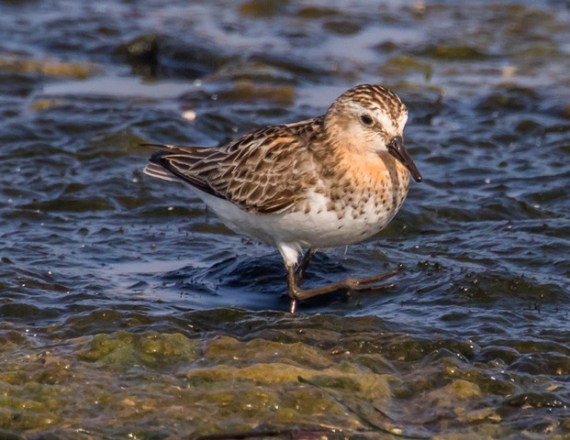
It seemed likely to be because all four species of “stints”—Little, Long-toed, Temminck’s and Red-necked—at 6.0-6.25” long, are among the very smallest of sandpipers. “Stint” probably shares etymological roots with “stinting,” “stunted,” “stingy,” all of which relate to being short, small, scant, limited, confined, underdeveloped, frugal or penny-pinchingly miserly.
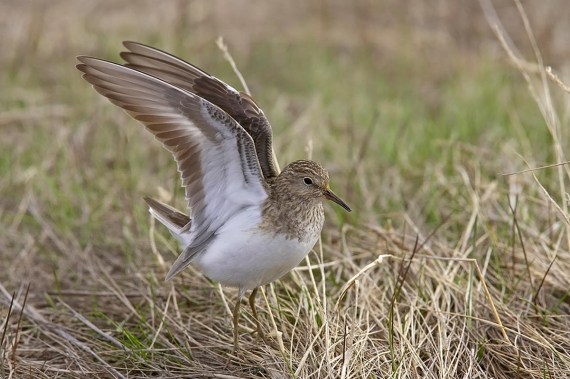
Our Least Sandpiper, Calidris minutilla, at 13-15 cm. long, and 17-33 grams, is supposedly the smallest of the sandpipers, hence the name “Least.” But the Little Stint Calidris minuta, at 12-14 cm. long, is overlappingly shorter, although they weigh 17-44 grams, ranging slightly bulkier. It’s almost a toss-up whether the Least or the Little is the least of the lot.
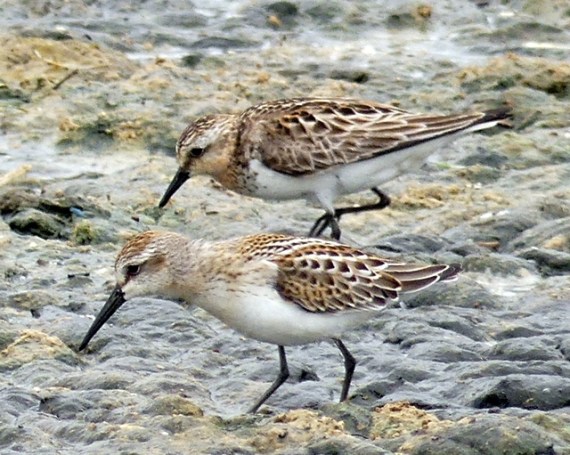
So why isn’t the “Least Sandpiper” the “Least Stint?” A few of the other calidrids could also qualify as stints, the 6.25″ Semipalmated Sandpiper for certain and possibly the 6.5″ Western Sandpiper. But they’re called sandpipers, not stints. Why?
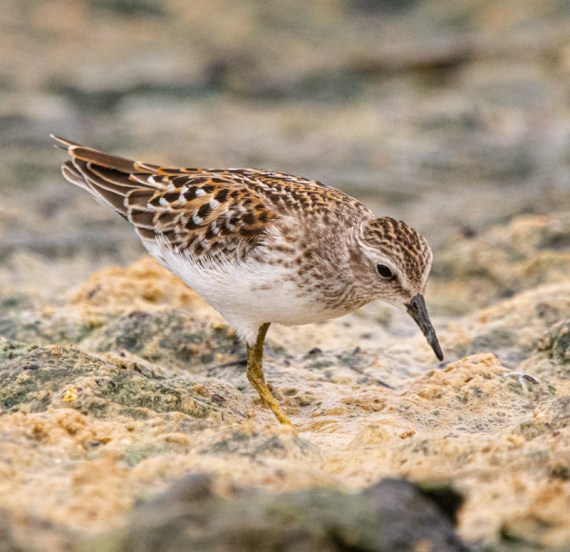
It’s due to range, really. The four stints are all Eurasian birds. Only the Red-necked Stint regularly breeds in North America, in far far far northwestern Alaska, on the Seward Peninsula and at Pt. Barrow. No one knew about that little detail centuries ago when these names were being concocted.
The Least, Semipalmated and Western Sandpipers are all New World birds, very rarely seen anywhere in Eurasia. Presumably, by the time explorers and biologists got around to naming New World birds, the then-centuries-old British name “stint” seemed inappropriate, old-fashioned, perhaps archaic, perhaps too “generic,” so they stuck with sandpiper as the generic name. They’re all sandpipers, including the stints.
The Red-necked Stints breeding in Alaska occasionally get their geomagnetic wires crossed and fly southeast for the winter, passing through California and—once, at least—Malibu Lagoon. Normally they fly southwest and spend the winter in Australasia, alongside a million other stints.
In case you’re wondering, besides the seven stint/sandpipers I’ve named so far, there are eleven more species in the genus Calidris: Great Knot C. tenuirostris, Red Knot C. canutus, Sanderling C. alba, White-rumped Sandpiper C. fuscicollis, Baird’s Sanpiper C. bairdii, Pectoral Sandpiper C. melanotos, Sharp-tailed Sandpiper C. acuminata, Curlew Sandpiper, C. Ferruginea, Purple Sandpiper C. maritima, Rock Sandpiper C. ptilocnemis, Dunlin C. alpina.
I discovered there is an Oxford Dictionary of British Bird Names, written by W.B. Lockwood, first published in 1984, and ordered a copy. My paperback version arrived ending at page 174 at the entry for Yowlring, with the following four pages ripped out. They may have been blank. Or not.
Request to all: If anyone has this book, are there additional entries following Yowlring? If so, could you send me a copy of them? Or if anyone knows any British birders, will you ask them about it? I’d greatly appreciate it.

I’ll end with the fascinating entry for Stint, fresh from my new book.
A rather widespread term for the Dunlin, also for the Sanderling and, indiscriminately, for any Sandpiper. It occurs along the east coast from Northumberland to Suffolk, as well as in Sussex, making its debut in 1472 ‘Styntis’, the present spelling first in 1622. A corruption is seen in STENT, recorded in 1579, and apparently also in the peculiar form SNENT quoted as a name used in Berwicks. Etymologically, stint is allied to stunt, giving a basic sense of small or stunted creature.
The name STINT has passed into the standard nomenclature in the term LITTLE STINT.
Reference to cognates in related languages helps us to understand more clearly the semantic evolution of this name. In Danish and Swedish dialects, stint is a term loosely applied to various species of small fish. In (originally Low) German Stint this general sense has been narrowed to a point whee it has come to denote one small species only, namely the Smelt. In English, this very old word evidently developed in such a way that it became associated with birds, to be later restricted to small waders and sometimes to an individual species, as Dunlin or Sanderling.
The birds in question with their long, strong bills bear a close resemblance to the Snipes, hence such local Dunlin names as SEA SNIPE, common in the north and in Scotland, or LITTLE SNIPE, heard in Yorkshire (Swaledale), further Gloucestershire SAND SNIPE, with which compare the [Common] Sandpiper named SUMMER SNIPE.
So “stint” was a generic term for the really small sandpipers. For everyday use for everyone except the most persnickety proto-biologist, all those little sandpipers were interchangeable and of little use to anyone. “Stint” was sufficient, much like LBJ (Little Brown Job) is sufficient today—even for birders who are supposed to care about these matters—for any unidentified small brown bird ducking into a bush.
Note: Handbook of the Birds of the World, Vol. 3 came in handy for the above information pertaining to size, weight, etc.
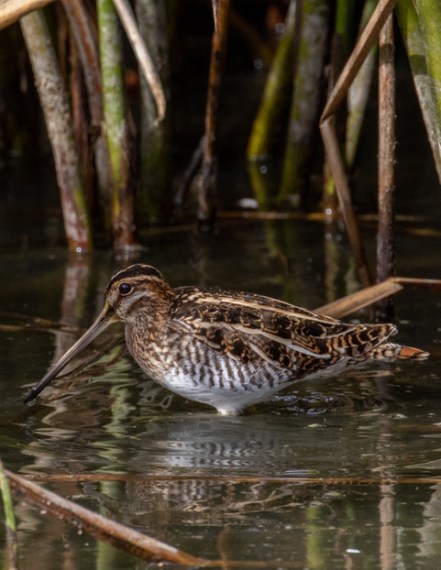
Definitely not a stint, although technically a sandpiper



 SANTA MONICA BAY AUDUBON SOCIETY BLOG