Breakfast at Ospreys’: Malibu Lagoon, 28 Jan. 2024
[Text by Chuck Almdale; photos by Ray Juncosa & Chris Tosdevin]

Bill length accounts for most of the size difference, and they don’t seem to be serious competitors for food.
The day started warm – 70°F at 8am – and got warmer. Of course – it’s January! Winter was over weeks ago! [Completely untrue.] The day started and stayed breezy, with gusts up to 17mph according to NOAA.
The best sighting of the day was our wintering Osprey. It had been absent in the early morning, but as we were making our way beachward from the meeting area, it flew by, scanning the channels for a breakfast fish.
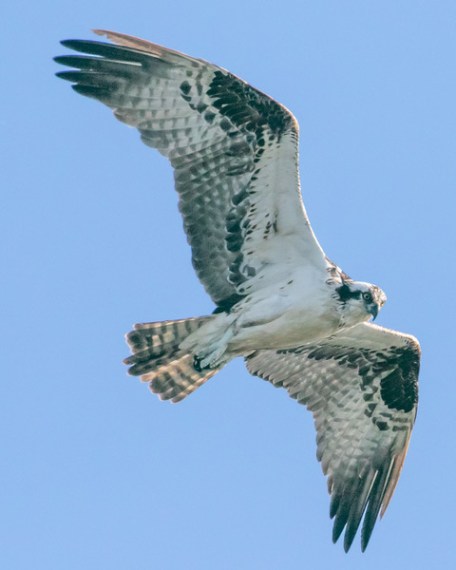
It spotted one and plunged, but came up empty-taloned. It rose, flew around so more, then dove again. This time it didn’t immediately leap up out of the water. [Captioned comments below are by photographer Ray Juncosa.]

In fact, it seemed to be having a tough time just keeping its head above water.

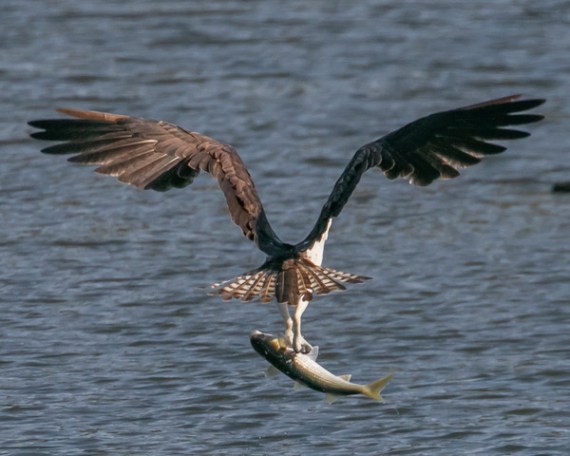
Finally it was able to rise out of the water, hoisting a large mullet. They can lift up to 90% of their own weight. An adult Osprey weighs about 3 lbs., and I suspect this fish weighed pretty close to that. The bird looks much larger, of course, with that wingspan of 58-72,” but it’s built mostly of air. That fish is solid meat.

The Osprey is taking very deep wing strokes. It continues working hard to gain altitude.
The Great Blue Heron below made an attempt to scare the Osprey off its fish and gain a free meal for itself. It failed as the Osprey headed for the beach and the sea beyond to gain some more altitude away from the thieves in the lagoon.
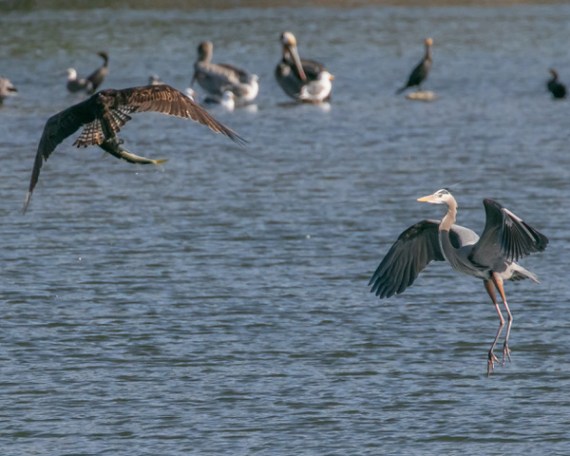
Off it goes. We weren’t sure where it was heading, but I suggested that it would circle back and head for the cypress trees or its favorite electric pole at the corner of Malibu Colony where the Mockingbird used to sit and sing.
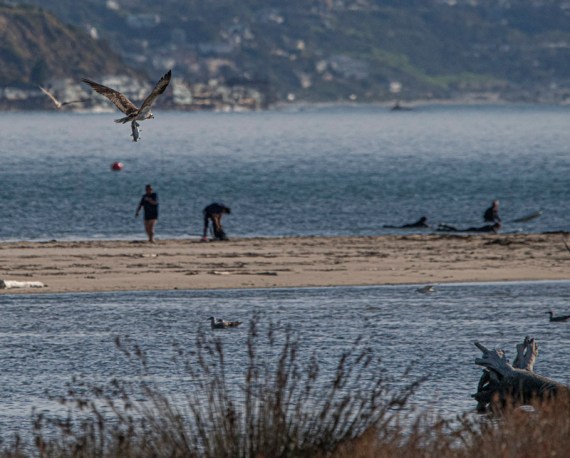
Soon it returned from seaward and landed on the pole. It seemed like 20 minutes passed before the doomed fish ran out of energy, ceased struggling, and died.
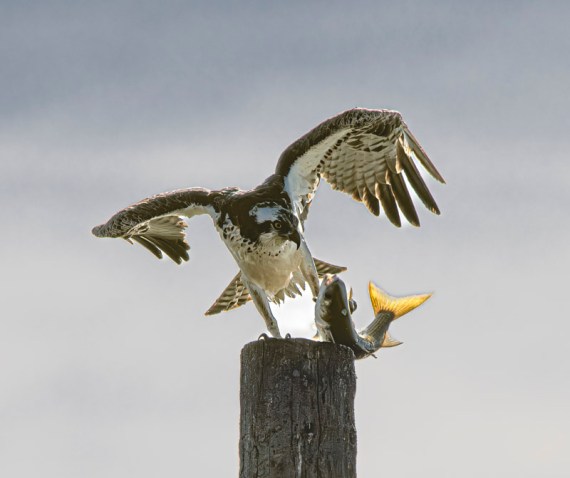
The mullet finally became still. Meanwhile the Osprey stayed on the alert for interlopers. It had been spotted by crows.


When one foot is hanging onto your fish, and the wind is gusting, and thieves are lurking, it can be hard to manipulate your meal into eating position and maintain your balance on the other. This next photo gives you the best comparison of bird to fish body size.

It now seems safe to eat breakfast. Head first, of course.
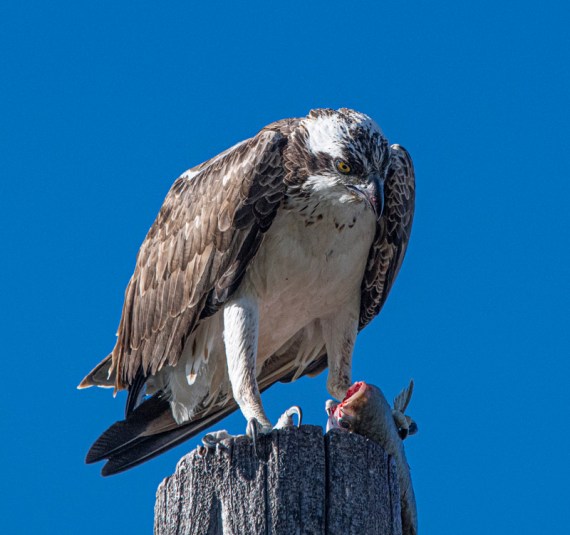
Very little is wasted. Note the talons. They’re why a fish, once caught, rarely escapes.

The discards consist of the gills and those stiff fins and tail.
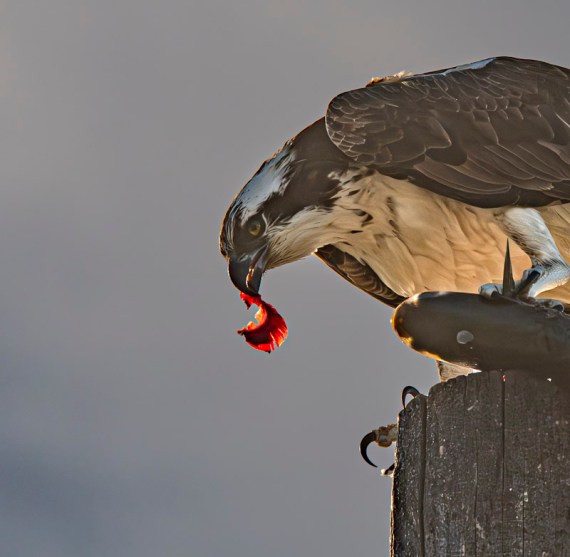
On our way back from the beach, we ran into our “Parents & Kids Trip” leaders with a group of 19 girl scouts and parents, all watching the Osprey working its way through the fish. Including those 19, we had a total of 48 birders, probably a record.
We had a total of 57 species of birds, which is a hair over our average of 55.6 for 26 years worth of January censuses. Here are some of the more interesting sightings.
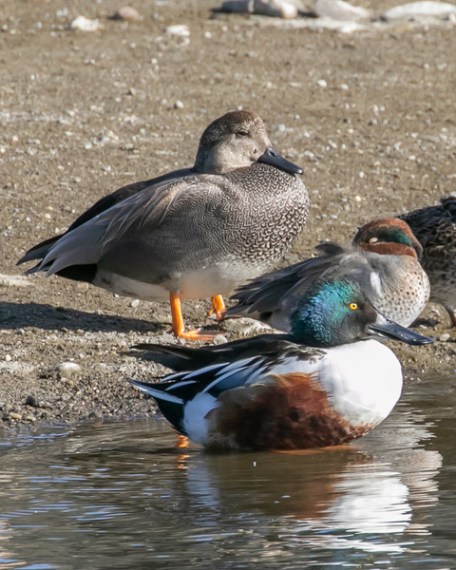
Their bodies and bills appear differently-sized, bu they’re both Least Sandpipers.

Royal Terns, three views. The black eye stands out from the black fringe behind it. Bill is thicker and less curved than that of the confusingly similar Elegant Tern, and has a slight gonydeal “bump” on the lower mandible, absent on the Elegant.

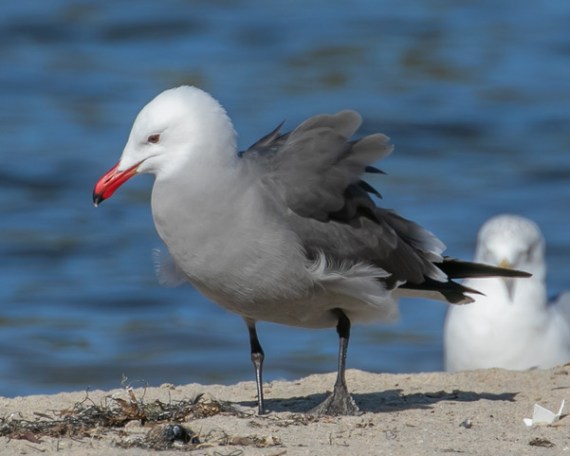
This Heermann’s Gull with it’s unblemished white head and black-tipped red bill is about ready to fly south to breed in the Sea of Cortez.
You rarely get this close a look at the Ring-billed to easily see the pale eye and the vertical black ring.

The Herring Gull also has a light eye and pale gray back, but has pink legs, black primaries with white “windows,” a thick yellow bill, streaking on the head, neck and (often) upper breast, and is the same size as the Western Gull. The somewhat similar California Gull is 4″ shorter, has a dark eye, a red and black gonydeal spot and when adult has greenish yellow legs.

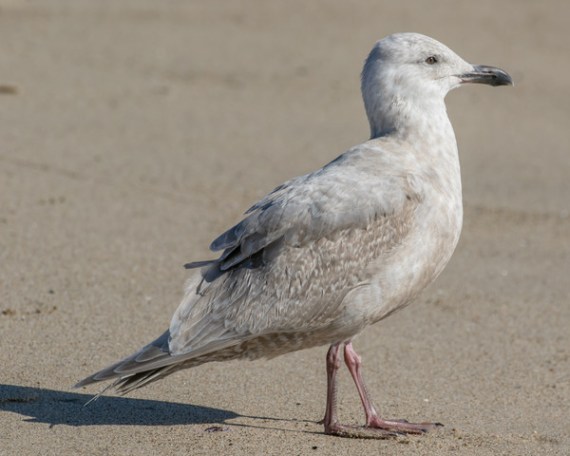
Most of the Glaucous-winged Gulls we get in SoCal are first-winter or second-winter (like the bird below) birds. “Glaucous” means “waxy” and – in my opinion – refers to the overall oddly gray plumage of the first winter birds. It really does look like its been rubbed all over with pale candle wax. Their legs are always pink and they never have black in their primaries. The one below has worn secondary feathers, giving it a bit of a “shredded” look.
Last but not least, one of our most common winter passerines, a Yellow-rumped (Audubon’s) Warbler, which strikes me as exceptionally brightly plumaged for the middle of winter. The yellow plumage is well in, but the black breast has a way to go.

Malibu Lagoon on eBird as of 2-01-24: 7447 lists, 319 species
Most recent species added: Red-breasted Nuthatch (31 October 2023, Kyle Te Poel).
Birds new for the season: Red-tailed Hawk, Hermit Thrush, Orange-crowned Warbler. “New for the season” means its been three or more months since last seen on our trips. Only three “new” species is probably a record low. Red-tailed Hawk nests in the general area and are almost certainly always close by, but aren’t always seen. Both the Hermit Thrush and Orange-crowned Warbler were mentioned to me only by Chris Lord who often wanders off from the group, listening closely, and thus sees or hears birds the rest of us miss.
Many, many thanks to photographers: Ray Juncosa, Chris Tosdevin
Upcoming SMBAS scheduled field trips; no reservations or covid card necessary unless specifically mentioned:
- Madrona Marsh Sat Feb 10, 8:30 am.
- Malibu Lagoon, Sun. Feb 25, 8:30 (adults) & 10 am (parents & kids)
- Sepulveda Basin Sat. Mar 9, 8:00 am
- These and any other trips we announce for the foreseeable future will depend upon expected status of the Covid/flu/etc. pandemic at trip time. Any trip announced may be canceled shortly before trip date if it seems necessary. By now any other comments should be superfluous.
- Link to Programs & Field Trip schedule.
The next SMBAS Zoom program: “Aeroacoustics Lab at UCR” with Dr. Chris J. Clark, Evening Meeting, Tuesday, Feb 6, 2023, 7:30 p.m.
The SMBAS 10 a.m. Parent’s & Kids Birdwalk restarted almost a year ago on April 23. Reservations for groups (scouts, etc.) necessary, call Jean (213-522-0062); not necessary for families.
Links: Unusual birds at Malibu Lagoon
9/23/02 Aerial photo of Malibu Lagoon
More recent aerial photo
Prior checklists:
2023: Jan-June, July-Dec
2021: Jan-July, July-Dec 2022: Jan-June, July-Dec
2020: Jan-July, July-Dec 2019: Jan-June, July-Dec
2018: Jan-June, July-Dec 2017: Jan-June, July-Dec
2016: Jan-June, July-Dec 2015: Jan-May, July-Dec
2014: Jan-July, July-Dec 2013: Jan-June, July-Dec
2012: Jan-June, July-Dec 2011: Jan-June, July-Dec
2010: Jan-June, July-Dec 2009: Jan-June, July-Dec
The 10-year comparison summaries created during the Lagoon Reconfiguration Project period, remain available—despite numerous complaints—on our Lagoon Project Bird Census Page. Very briefly summarized, the results unexpectedly indicate that avian species diversification and numbers improved slightly during the restoration period June’12-June’14.
Many thanks to Femi Faminu, Chris Lord, Marie Nosurname, Chris Tosdevin and others for their contributions to this month’s checklist.
The species lists below is irregularly re-sequenced to agree with the California Bird Records Committee Official California Checklist. If part of the chart’s right side is hidden, there’s a slider button inconveniently located at the bottom of the list. The numbers 1-9 left of the species names are keyed to the nine categories of birds at the bottom.
[Chuck Almdale]
| Malibu Census 2023-24 | 8/27 | 9/24 | 10/22 | 11/26 | 12/24 | 1/28 | |
| Temperature | 69-73 | 56-74 | 62-70 | 62-68 | 53-64 | 53-64 | |
| Tide Lo/Hi Height | H+3.68 | H+3.77 | L+3.34 | H+6.53 | H+6.20 | H+5.06 | |
| Tide Time | 0832 | 0739 | 1029 | 0740 | 0644 | 1008 | |
| 1 | Canada Goose | 21 | 8 | ||||
| 1 | Cinnamon Teal | 3 | 1 | 3 | |||
| 1 | Northern Shoveler | 1 | 13 | 10 | |||
| 1 | Gadwall | 45 | 40 | 23 | 30 | 27 | 54 |
| 1 | American Wigeon | 5 | 14 | ||||
| 1 | Mallard | 20 | 12 | 9 | 8 | 7 | |
| 1 | Green-winged Teal | 1 | 31 | 8 | 17 | ||
| 1 | Lesser Scaup | 1 | |||||
| 1 | Surf Scoter | 15 | 8 | 3 | 4 | ||
| 1 | Bufflehead | 5 | 18 | 12 | |||
| 1 | Red-breasted Merganser | 20 | 5 | 4 | |||
| 1 | Ruddy Duck | 12 | 22 | 37 | 30 | ||
| 2 | Pied-billed Grebe | 2 | 1 | 4 | 6 | 2 | 2 |
| 2 | Horned Grebe | 1 | |||||
| 2 | Eared Grebe | 1 | 1 | ||||
| 2 | Western Grebe | 28 | 13 | 18 | 14 | ||
| 7 | Feral Pigeon | 3 | 4 | 3 | 4 | 4 | 4 |
| 7 | Mourning Dove | 2 | 5 | 1 | |||
| 8 | Anna’s Hummingbird | 2 | 2 | 2 | |||
| 8 | Allen’s Hummingbird | 1 | 4 | 1 | 3 | 5 | |
| 2 | Sora | 1 | |||||
| 2 | American Coot | 6 | 49 | 157 | 230 | 280 | 148 |
| 5 | Black Oystercatcher | 1 | |||||
| 5 | Black-bellied Plover | 39 | 82 | 79 | 7 | 52 | 45 |
| 5 | Killdeer | 13 | 6 | 1 | 5 | 20 | 18 |
| 5 | Semipalmated Plover | 7 | 3 | ||||
| 5 | Snowy Plover | 13 | 22 | 18 | 1 | ||
| 5 | Whimbrel | 38 | 32 | 23 | 4 | 8 | 4 |
| 5 | Long-billed Curlew | 4 | 3 | ||||
| 5 | Marbled Godwit | 1 | 48 | 45 | 5 | 11 | 5 |
| 5 | Short-billed Dowitcher | 1 | 2 | ||||
| 5 | Red-necked Phalarope | 2 | |||||
| 5 | Spotted Sandpiper | 3 | 3 | ||||
| 5 | Willet | 9 | 29 | 56 | 12 | 22 | 3 |
| 5 | Ruddy Turnstone | 2 | 4 | 10 | 1 | 10 | 5 |
| 5 | Sanderling | 2 | 32 | 27 | 69 | 10 | 7 |
| 5 | Least Sandpiper | 8 | 18 | 6 | 35 | 28 | 16 |
| 5 | Western Sandpiper | 3 | 15 | ||||
| 6 | Bonaparte’s Gull | 3 | |||||
| 6 | Heermann’s Gull | 90 | 51 | 55 | 71 | 22 | 12 |
| 6 | Ring-billed Gull | 4 | 42 | 34 | 25 | ||
| 6 | Western Gull | 85 | 65 | 45 | 68 | 64 | 30 |
| 6 | Herring Gull | 1 | 1 | 1 | 2 | ||
| 7 | Lesser Black-backed Gull | 1 | |||||
| 6 | California Gull | 3 | 7 | 7 | 220 | 425 | 270 |
| 6 | Glaucous-winged Gull | 1 | 5 | 3 | |||
| 6 | Caspian Tern | 1 | |||||
| 6 | Forster’s Tern | 1 | |||||
| 6 | Elegant Tern | 40 | 24 | 2 | 1 | ||
| 6 | Royal Tern | 10 | 4 | 5 | 12 | 7 | 3 |
| 2 | Pacific Loon | 1 | 1 | ||||
| 2 | Common Loon | 1 | |||||
| 2 | Black-vented Shearwater | 20 | 28 | ||||
| 2 | Brandt’s Cormorant | 1 | |||||
| 2 | Pelagic Cormorant | 1 | 2 | 5 | 1 | ||
| 2 | Double-crested Cormorant | 23 | 30 | 48 | 37 | 47 | 18 |
| 2 | Brown Pelican | 56 | 27 | 12 | 26 | 72 | 26 |
| 3 | Black-crowned Night-Heron | 5 | 2 | 1 | 1 | ||
| 3 | Snowy Egret | 8 | 5 | 2 | 20 | 18 | 7 |
| 3 | Green Heron | 1 | 3 | 1 | |||
| 3 | Great Egret | 5 | 6 | 4 | 2 | ||
| 3 | Great Blue Heron | 5 | 3 | 2 | 4 | 2 | 1 |
| 4 | Turkey Vulture | 1 | 2 | 2 | |||
| 4 | Osprey | 1 | 1 | 1 | 2 | 1 | 1 |
| 4 | Red-shouldered Hawk | 1 | 1 | ||||
| 4 | Red-tailed Hawk | 1 | 1 | 2 | 1 | ||
| 8 | Belted Kingfisher | 2 | 1 | 1 | 1 | ||
| 8 | Downy Woodpecker | 1 | |||||
| 8 | Nuttall’s Woodpecker | 1 | 1 | ||||
| 8 | Hairy Woodpecker | 1 | |||||
| 8 | Northern Flicker (Red-shafted) | 1 | |||||
| 4 | American Kestrel | 1 | |||||
| 4 | Peregrine Falcon | 1 | |||||
| 8 | Nanday Parakeet | 2 | |||||
| 9 | Black Phoebe | 2 | 4 | 4 | 2 | 4 | 1 |
| 9 | Say’s Phoebe | 1 | |||||
| 9 | California Scrub-Jay | 2 | 1 | 2 | |||
| 9 | American Crow | 9 | 6 | 44 | 3 | 5 | 10 |
| 9 | Common Raven | 1 | 2 | 1 | |||
| 9 | Oak Titmouse | 3 | 1 | 1 | |||
| 9 | Northern Rough-winged Swallow | 2 | |||||
| 9 | Barn Swallow | 35 | 4 | ||||
| 9 | Bushtit | 8 | 22 | 50 | 12 | ||
| 9 | Wrentit | 1 | 4 | 1 | 4 | 3 | 1 |
| 9 | Ruby-crowned Kinglet | 1 | |||||
| 9 | Blue-gray Gnatcatcher | 2 | |||||
| 9 | House Wren | 2 | 2 | 3 | 2 | ||
| 9 | Marsh Wren | 1 | |||||
| 9 | Bewick’s Wren | 1 | 1 | ||||
| 9 | European Starling | 15 | 12 | 22 | 28 | 2 | |
| 9 | Hermit Thrush | 1 | |||||
| 9 | House Finch | 5 | 6 | 5 | 6 | 9 | 12 |
| 9 | Lesser Goldfinch | 2 | 6 | ||||
| 9 | Dark-eyed Junco | 2 | |||||
| 9 | White-crowned Sparrow | 10 | 20 | 27 | 15 | ||
| 9 | Savannah Sparrow | 1 | |||||
| 9 | Song Sparrow | 4 | 5 | 5 | 6 | 7 | 10 |
| 9 | California Towhee | 3 | 1 | 2 | 1 | 1 | |
| 9 | Red-winged Blackbird | 7 | 15 | 16 | 2 | ||
| 9 | Great-tailed Grackle | 1 | 1 | 20 | 1 | ||
| 9 | Orange-crowned Warbler | 1 | 2 | 2 | |||
| 9 | Common Yellowthroat | 2 | 4 | 8 | 5 | 5 | |
| 9 | Yellow Warbler | 1 | |||||
| 9 | Yellow-rumped Warbler (Audubon’s) | 5 | 12 | 6 | 6 | ||
| 9 | Townsend’s Warbler | 1 | |||||
| 9 | Wilson’s Warbler | 1 | |||||
| 9 | Western Tanager | 1 | |||||
| 9 | Black-headed Grosbeak | 1 | |||||
| Totals by Type | Aug | Sep | Oct | Nov | Dec | Jan | |
| 1 | Waterfowl | 65 | 53 | 51 | 134 | 155 | 149 |
| 2 | Water Birds – Other | 87 | 129 | 280 | 314 | 426 | 211 |
| 3 | Herons, Egrets & Ibis | 24 | 13 | 11 | 28 | 23 | 9 |
| 4 | Quail & Raptors | 2 | 4 | 4 | 5 | 4 | 2 |
| 5 | Shorebirds | 145 | 299 | 265 | 139 | 162 | 103 |
| 6 | Gulls & Terns | 230 | 152 | 118 | 416 | 562 | 345 |
| 7 | Doves | 5 | 9 | 4 | 4 | 4 | 4 |
| 8 | Other Non-Passerines | 0 | 6 | 10 | 1 | 9 | 6 |
| 9 | Passerines | 59 | 82 | 154 | 146 | 119 | 88 |
| Totals Birds | 617 | 747 | 897 | 1187 | 1464 | 917 | |
| Total Species | Aug | Sep | Oct | Nov | Dec | Jan | |
| 1 | Waterfowl | 2 | 3 | 4 | 10 | 11 | 10 |
| 2 | Water Birds – Other | 4 | 7 | 8 | 7 | 8 | 8 |
| 3 | Herons, Egrets & Ibis | 5 | 4 | 4 | 3 | 4 | 3 |
| 4 | Quail & Raptors | 2 | 4 | 3 | 3 | 3 | 2 |
| 5 | Shorebirds | 15 | 14 | 9 | 9 | 9 | 8 |
| 6 | Gulls & Terns | 7 | 6 | 6 | 8 | 9 | 7 |
| 7 | Doves | 2 | 2 | 2 | 1 | 1 | 1 |
| 8 | Other Non-Passerines | 0 | 4 | 5 | 1 | 6 | 2 |
| 9 | Passerines | 9 | 23 | 17 | 18 | 17 | 16 |
| Totals Species – 108 | 46 | 67 | 58 | 60 | 68 | 57 |
Discover more from SANTA MONICA BAY AUDUBON SOCIETY BLOG
Subscribe to get the latest posts sent to your email.



 SANTA MONICA BAY AUDUBON SOCIETY BLOG
Loved the osprey series! Great photography!
LikeLike
Wonderful trip report Chuck! Amazing sequence captured of Osprey’s breakfast challenge—with fabulous photographs.
LikeLike
Chuck, thanks for this very interesting report. The osprey photos are fabulous.
Your descriptions of the different gulls observed might help me finally learn to identify them.
Best,
Enid Hayflick
Newport Beach
LikeLike