Free email delivery
Please sign up for email delivery in the subscription area to the right.
No salesman will call, at least not from us. Maybe from someone else.
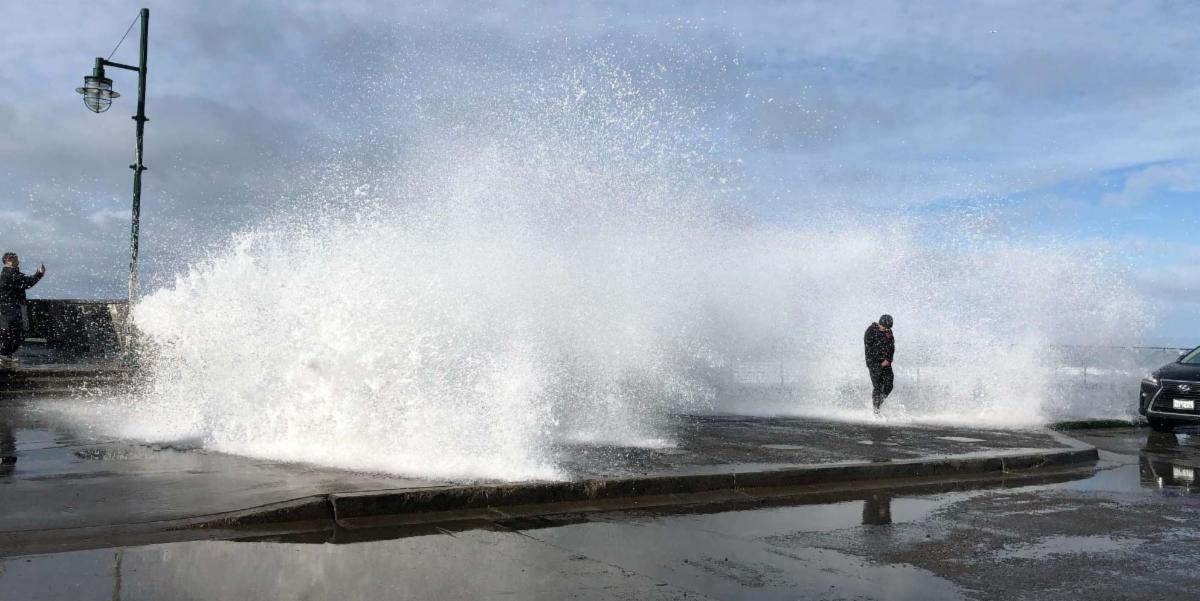
King tides again January 11-13, 2021
[Posted by Chuck Almdale]
We are posting this yet again as a public service.

Not much dry beach during the 11-16-20 king tide. (Larry Loeher)

Even less during the 12-15-20 king tide. (Larry Loeher)
I don’t know if this actually qualifies as an actual “King Tide” but these are the highest tides of January, as they coincide with the New Moon.
High Tides: Jan 11 6.48 ft. @ 7:13am | Jan 12 6.55 ft @ 7:58am | Jan 13 6.46 ft @ 8:42am
Low Tides: Jan 11 -1.50 ft. @ 2:42pm | Jan 12 -1.60 ft @ 3:24pm | Jan 13 1.50 ft @ 4:05pm
The next really high tides will be May 25-27 with the high of 6.67 ft. @ 9:24pm, May 26.
All these numbers come from here for the ocean pier at Mugu Lagoon.
Just for the sake of comparison, here’s the numbers for the previous two King Tides:
High Tides: Dec 13 6.74 ft. @ 7:27am | Dec 14 6.85 ft @ 8:08am | Dec 15 6.74 ft @ 8:50am
High Tides: Nov 14 6.60 ft. @ 7:51am | Nov 15 6.79 ft @ 8:28am | Nov 16 6.75 ft @ 9:06am
Not much difference. Jan 12 is only 0.3 ft. (3.6″) lower than Dec 14.

You never know what might show up. Here’s a beautiful male Hooded Merganser
during the 12-15-20 King Tide (Grace Murayama)
The King Tide alert below wants photos from you if you live north of Vandenberg/Point Conception.
| The highest high tides of the year are on their way |
 Look out for King Tides! Look out for King Tides! For locations North of Vandenberg/Point Conception, Jan. 11-12, 2021 The California King Tides Project is calling on you to photograph our highest high tides of the year. Documenting these tides helps us preview the impacts of sea level rise and understand how our shoreline is affected by high water today. If you’re able to safely take photos at the coast or Delta during King Tides you will be contributing to an important community science effort. Find your local King Tide times and learn how to upload your photos on our website or with a free app. You can check out a selection of photos from each coastal county and access a map of all the King Tides photos from the last few years. Educators and parents can find ways to incorporate King Tides into student learning, including with an elementary-level science journal downloadable in English or Spanish. Middle and high school students may want to use King Tides images and concepts as they enter the Climate Video Challenge. We can’t wait to see your photos! In the meantime, please join us on social media for #KingTides: What causes sea level rise, and what do King Tides have to do with it? The sea level rise we’re experiencing now and will experience in the future is caused by burning fossil fuels like coal, oil, and natural gas. Carbon dioxide in our atmosphere acts like a blanket, trapping in heat that would otherwise escape. When we burn fossil fuels, we’re adding more carbon dioxide, “thickening the blanket” and warming the planet and ocean. Sea level is rising because land-based glaciers and ice sheets are melting into the ocean and also because water expands in volume when it warms. The amount of sea level rise we will ultimately experience will depend on how quickly we stop burning fossil fuels. King Tides themselves are not caused by sea level rise, but allow us to experience what higher sea level will be like. King Tides are the highest high tides of the year, about a foot or two higher than average tides, which corresponds to the one to two foot rise in sea level expected during the next few decades. When you observe the King Tides, imagine seeing these tides (and the flooded streets, beaches, and wetlands) every day. Understanding what a King Tide looks like today will help us plan for sea level rise in the future. Sharing your photos and talking about what you’ve noticed helps others understand that they’re part of a community that cares about climate change. Why are there different dates for northern and southern California? Southern California will experience King Tides in November and December. There is an additional January King Tide in northern California, north of Point Conception/Vandenberg AFB, due to a combination of astronomical influences such as the relative tilt of the Earth’s rotation with respect to the Sun and seasonal influences on water level such as temperature and wind that differ in southern California as compared to northern California over the course of the year. Thank you for your help! We look forward to seeing your photos! california.kingtides.net |
| California Coastal Commission 455 Market Street, Suite 228, San Francisco, CA 94105 |
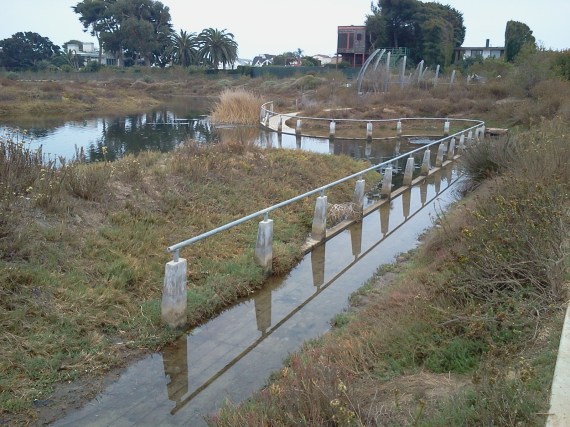
An inundated tidal clock sidewalk measured 6′ 9.6″ lagoon water
level a week after the king tide. (L. Johnson 11-23-20)
A quiet pre-Christmas: Malibu Lagoon, 22 December 2020
[Posted by Chuck Almdale]

For no good reason that I know of, the Mockingbirds have been hard to find at the lagoon the past few months. For Jan’10 – Aug’20, they were present 90% of the time (114 out of 127 visits). For Sep – Dec’20, they’ve been missing two out of four months. There’s nearly always one on the top of the telephone pole at the east end of the colony, often singing away. If you see a bird up there and it’s not a crow, it’s probably the mocker. Say hi.

The breech had opened up during the Dec 13-15 king tide, and the lagoon was mostly empty. Despite that, there was a good selection of ducks ( and one Snow Goose) and a heckova* lot of coots – I counted (roughly) exactly 445.
*Heckova: An obscure and now archaic mathematical term meaning “more than many.”

Only five of us made it to the lagoon today. Everyone is feeling quite wary of being out and about as Covid-19 is resurging after people enjoyed Thanksgiving with wild abandon. According to the various Covid-19 statistical sites I follow, we had the following Covid-19 new cases and deaths for 22 December:
Los Angeles County: 16,412 new cases, 137 deaths
California: 39,069 new cases, 361 deaths
U.S. A.: 195,860 new cases, 3,165 deaths,
World (rounded): 650,000 new cases, 20,000 deaths
I hope everyone enjoyed Thanksgiving. The case and death rates have risen since then.

We don’t get many Dark-eyed Juncos at the lagoon as they generally prefer trees and park lawns where they can find insects. We’ve had only 8 birds over forty years, all within the past three years. This one was on the back wall of the Malibu Colony.


When we got down to the beach, the tide was getting towards its 10:52 AM low point. Chris got a photo of a line of Surf Scoters heading west.

The low tide had exposed many offshore rocks where all of the pelicans and most of the cormorants and gulls were resting. We also found three of the rock-loving Black Oystercatchers. Two of them are pictured below.

Although the tide was quite low, water was still flowing out of the water. It was very cold, as I discovered when I waded across to find the roosting flock of Snowy Plovers, who prefer the southeast corner of the lagoon.
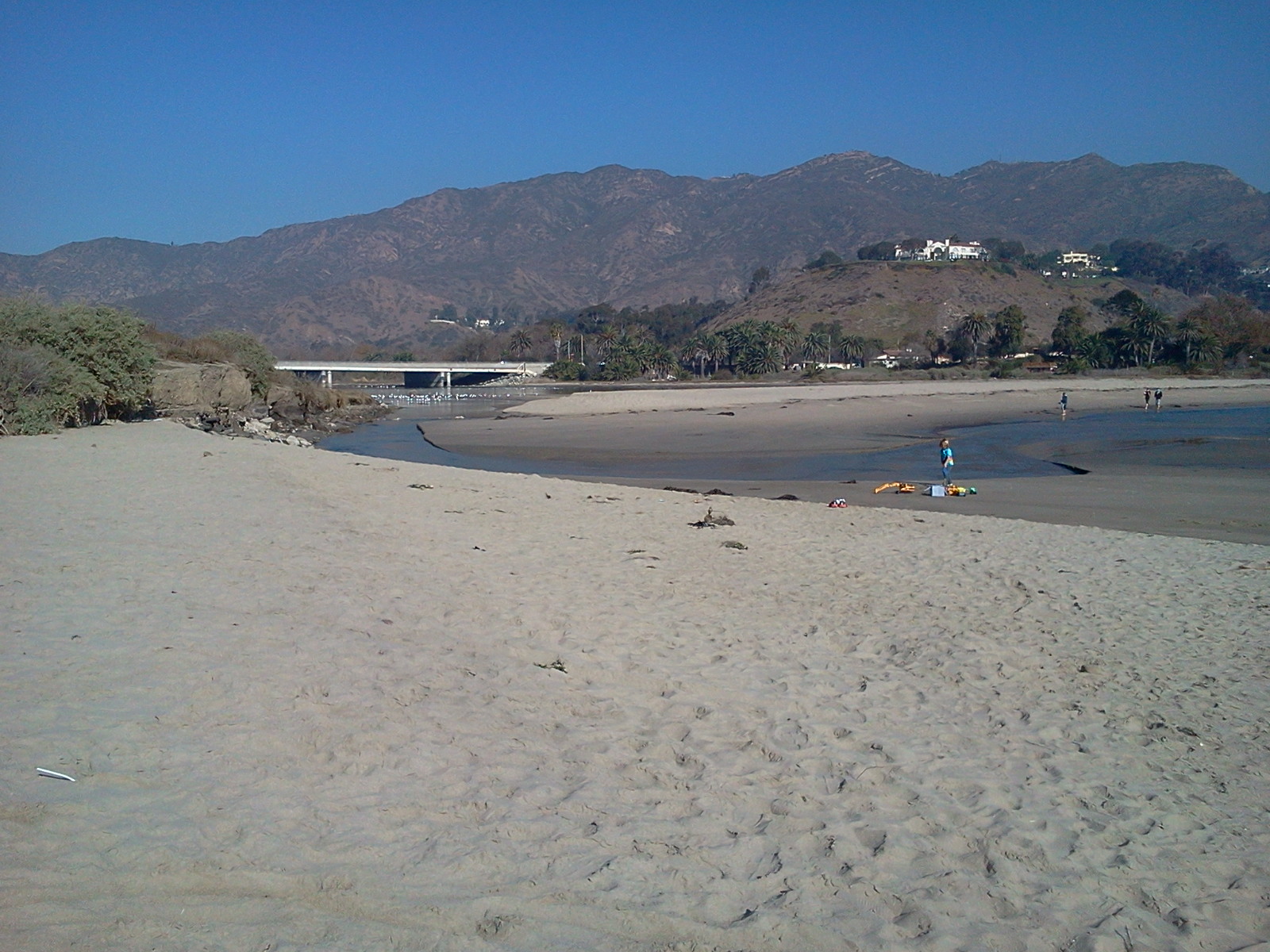

The outlet makes a large S-bend (L. Johnson 12/22/20)
The S-bend you see above is absolutely typical for the lagoon. When rainstorms send a lot of water down the creek, it blows straight through the beach. But because of the eastward flow of the long-shore current, the outlet mouth begins moving east almost immediately. Over the course of 2 – 4 months, the entire outlet will move to the east, as if the outlet “body” was being dragged by the mouth. By springtime, the outlet is usually as far east as it can go and abuts the Adamson House property so closely that it often undermines the fence. Large rocks in a “rip-rap” wall keep it from moving any farther towards the house.
I did manage to find 22 Snowy Plovers on the other side, some resting in their little pockets in the sand, some poking around by the lagoon edge.

We saw the Red-tailed Hawk soaring overhead, but we certainly didn’t see it as well as did Larry and Grace on 12/31/20.

All together, we had eight species of sandpipers, including a group of 13 Least Sandpipers such as this one below.

Birds new for the season: Snow Goose, Mallard, Northern Pintail, Sora, Black Oystercatcher, Semipalmated Plover, Greater Yellowlegs, Royal Tern, Downy Woodpecker, Dark-eyed Junco.
Many thanks to photographers: Lillian Johnson, Larry Loeher, Grace Murayama and Chris Tosdevin
The next three SMBAS scheduled field trips: Who knows? Not I.
The next SMBAS program: February 2, Mono Lake: A simple ecosystem with a complex history; with Nora Livingston, on ZOOM, 7:30 PM.
The SMBAS 10 a.m. Parent’s & Kids Birdwalk is canceled until further notice due to the near-impossibility of maintained proper masked social distancing with parents and small children.
Links: Unusual birds at Malibu Lagoon
9/23/02 Aerial photo of Malibu Lagoon
Prior checklists:
2019: Jan-June, July-Dec 2020: Jan-July,
2018: Jan-June, July-Dec 2017: Jan-June, July-Dec
2016: Jan-June, July-Dec 2015: Jan-May, July-Dec
2014: Jan-July, July-Dec 2013: Jan-June, July-Dec
2012: Jan-June, July -Dec 2011: Jan-June, July-Dec
2010: Jan-June, July-Dec 2009: Jan-June, July-Dec.
The 10-year comparison summaries created during the Lagoon Reconfiguration Project period, despite numerous complaints, remain available on our Lagoon Project Bird Census Page. Very briefly summarized, the results unexpectedly indicate that avian species diversification and numbers improved slightly during the restoration period June’12-June’14.
[Chuck Almdale]
| Malibu Census 2020 | 7/22 | 8/26 | 9/24 | 10/21 | 11/23 | 12/22 |
| Temperature | 60-66 | 70-77 | 66-77 | 64-68 | 52-64 | 57-64 |
| Tide Lo/Hi Height | L+0.71 | L+2.52 | L+3.05 | L+2.70 | L+2.17 | L+2.15 |
| Tide Time | 0819 | 0958 | 1004 | 0634 | 1135 | 1052 |
| Snow Goose | 2 | |||||
| (Black) Brant | 1 | |||||
| Canada Goose | 8 | |||||
| Gadwall | 40 | 5 | 2 | 2 | 28 | 6 |
| American Wigeon | 3 | 30 | 26 | |||
| Mallard | 27 | 16 | 14 | 14 | ||
| Northern Pintail | 2 | 1 | ||||
| Green-winged Teal | 1 | 12 | 8 | |||
| Surf Scoter | 3 | 13 | ||||
| Bufflehead | 10 | 5 | ||||
| Red-breasted Merganser | 9 | 12 | ||||
| Ruddy Duck | 9 | 35 | 19 | |||
| Pied-billed Grebe | 3 | 3 | 2 | 2 | 3 | 3 |
| Eared Grebe | 1 | 1 | 5 | |||
| Western Grebe | 6 | 2 | ||||
| Rock Pigeon | 10 | 4 | 6 | 10 | 9 | 14 |
| Mourning Dove | 3 | 5 | 4 | 2 | 9 | 2 |
| Vaux’s Swift | 8 | |||||
| Anna’s Hummingbird | 1 | 1 | 2 | |||
| Allen’s Hummingbird | 3 | 1 | 1 | 2 | 2 | |
| Sora | 1 | |||||
| American Coot | 2 | 48 | 118 | 287 | 445 | |
| Black Oystercatcher | 4 | |||||
| Black-bellied Plover | 15 | 66 | 102 | 91 | 30 | 10 |
| Snowy Plover | 8 | 26 | 27 | 42 | 28 | 22 |
| Semipalmated Plover | 4 | 8 | 4 | |||
| Killdeer | 2 | 7 | 12 | 1 | 8 | 14 |
| Whimbrel | 15 | 14 | 1 | 3 | 5 | 8 |
| Marbled Godwit | 3 | 5 | 4 | 8 | ||
| Ruddy Turnstone | 2 | 2 | 1 | 6 | 2 | 6 |
| Sanderling | 39 | 75 | 78 | 25 | ||
| Least Sandpiper | 2 | 21 | 12 | 4 | 13 | |
| Western Sandpiper | 1 | 8 | 1 | |||
| Short-billed Dowitcher | 2 | |||||
| Long-billed Dowitcher | 4 | |||||
| Spotted Sandpiper | 2 | 1 | 2 | 2 | ||
| Wandering Tattler | 1 | |||||
| Willet | 8 | 47 | 40 | 5 | 14 | 10 |
| Greater Yellowlegs | 1 | |||||
| Heermann’s Gull | 65 | 10 | 14 | 85 | 43 | |
| Mew Gull | 2 | |||||
| Ring-billed Gull | 10 | 65 | ||||
| Western Gull | 90 | 98 | 90 | 21 | 53 | 34 |
| California Gull | 4 | 17 | 12 | 1 | 535 | 485 |
| Herring Gull | 1 | 1 | ||||
| Glaucous-winged Gull | 1 | 3 | ||||
| Least Tern | 2 | |||||
| Caspian Tern | 4 | 1 | ||||
| Forster’s Tern | 4 | 1 | ||||
| Royal Tern | 11 | 12 | 3 | |||
| Elegant Tern | 195 | 221 | 1 | |||
| Red-throated Loon | 1 | |||||
| Pacific Loon | 1 | 1 | ||||
| Brandt’s Cormorant | 1 | |||||
| Double-crested Cormorant | 16 | 18 | 43 | 16 | 108 | 28 |
| Pelagic Cormorant | 1 | 1 | 3 | 4 | 1 | |
| Brown Pelican | 19 | 8 | 5 | 5 | 206 | 32 |
| Great Blue Heron | 2 | 4 | 3 | 3 | 3 | 3 |
| Great Egret | 3 | 4 | 20 | 1 | 1 | |
| Snowy Egret | 8 | 4 | 2 | 5 | 4 | 23 |
| Black-crowned Night-Heron | 2 | |||||
| Turkey Vulture | 2 | 2 | ||||
| Osprey | 1 | 1 | 1 | 1 | ||
| Cooper’s Hawk | 1 | |||||
| Red-tailed Hawk | 1 | |||||
| Belted Kingfisher | 1 | 2 | 1 | 1 | ||
| Downy Woodpecker | 1 | |||||
| Black Phoebe | 5 | 5 | 4 | 5 | 4 | 6 |
| Say’s Phoebe | 1 | 2 | 2 | 5 | ||
| Vermilion Flycatcher | 1 | |||||
| Loggerhead Shrike | 1 | |||||
| California Scrub-Jay | 1 | 1 | 2 | |||
| American Crow | 4 | 3 | 3 | 4 | 11 | 14 |
| Tree Swallow | 3 | |||||
| Rough-winged Swallow | 1 | |||||
| Barn Swallow | 22 | 20 | ||||
| Bushtit | 16 | 50 | 16 | 75 | 30 | |
| House Wren | 1 | 2 | 1 | |||
| Marsh Wren | 5 | 3 | ||||
| Bewick’s Wren | 2 | |||||
| Blue-gray Gnatcatcher | 5 | 2 | 2 | |||
| Ruby-crowned Kinglet | 2 | |||||
| Wrentit | 1 | 1 | ||||
| Western Bluebird | 4 | |||||
| Northern Mockingbird | 2 | 1 | 2 | 1 | ||
| European Starling | 12 | 27 | 2 | 5 | 85 | 30 |
| House Finch | 5 | 4 | 8 | 4 | 4 | 6 |
| Lesser Goldfinch | 2 | 2 | 2 | 5 | ||
| Lawrence’s Goldfinch | 15 | |||||
| California Towhee | 1 | 1 | 1 | |||
| Song Sparrow | 3 | 4 | 3 | 7 | 12 | 3 |
| White-crowned Sparrow | 4 | 12 | ||||
| Dark-eyed Junco | 1 | |||||
| Western Meadowlark | 25 | |||||
| Hooded Oriole | 7 | |||||
| Red-winged Blackbird | 1 | |||||
| Great-tailed Grackle | 20 | 2 | 2 | 8 | 3 | |
| Orange-crowned Warbler | 4 | 2 | 1 | |||
| Common Yellowthroat | 4 | 4 | 5 | 8 | 5 | |
| Yellow Warbler | 2 | |||||
| Yellow-rumped(Aud) Warbler | 10 | 8 | 16 | |||
| Totals by Type | Jul | Aug | Sep | Oct | Nov | Dec |
| Waterfowl | 75 | 22 | 18 | 17 | 125 | 106 |
| Water Birds – Other | 40 | 30 | 99 | 146 | 617 | 518 |
| Herons, Egrets & Ibis | 13 | 14 | 25 | 9 | 7 | 27 |
| Quail & Raptors | 0 | 1 | 0 | 1 | 5 | 3 |
| Shorebirds | 58 | 197 | 248 | 229 | 175 | 127 |
| Gulls & Terns | 358 | 364 | 129 | 22 | 688 | 634 |
| Doves | 13 | 9 | 10 | 12 | 18 | 16 |
| Other Non-Passerines | 4 | 1 | 11 | 2 | 3 | 6 |
| Passerines | 99 | 152 | 79 | 135 | 170 | 126 |
| Totals Birds | 660 | 790 | 619 | 573 | 1808 | 1563 |
| Total Species | Jul | Aug | Sep | Oct | Nov | Dec |
| Waterfowl | 3 | 3 | 3 | 4 | 7 | 10 |
| Water Birds – Other | 4 | 4 | 5 | 7 | 9 | 9 |
| Herons, Egrets & Ibis | 3 | 4 | 3 | 3 | 2 | 3 |
| Quail & Raptors | 0 | 1 | 0 | 1 | 4 | 2 |
| Shorebirds | 10 | 10 | 12 | 9 | 10 | 13 |
| Gulls & Terns | 5 | 8 | 5 | 2 | 8 | 7 |
| Doves | 2 | 2 | 2 | 2 | 2 | 2 |
| Other Non-Passerines | 2 | 1 | 3 | 2 | 2 | 4 |
| Passerines | 13 | 15 | 18 | 18 | 18 | 14 |
| Totals Species – 101 | 42 | 48 | 51 | 48 | 62 | 64 |
Has your car been broken into at Bolsa Chica? If so, please tell Sea & Sage Audubon | Survey
[Posted by Chuck Almdale]
When I first heard about this a few weeks ago, I inquired of Sea & Sage as to where – if anywhere – one could park safely at Bolsa Chica. I just inquired (12-23-20) of Sea & Sage as to where to park safely. Unfortunately, the answer was: Nowhere, not even the Brightwater residential neighborhood where one local birder recently found his car broken into and his scope stolen. Let the Birder Beware. Meanwhile, if you’ve had any problems there, they’d really love you to fill out their survey. Here’s a message from Vic Leipzig of Sea and Sage Audubon in Orange County.
Dear SoCal chapter leaders:
There has been a long sad history of thefts from cars in the parking lots at Bolsa Chica Ecological Reserve here in Orange County. Valuable cameras and other optics have been stolen and expensive damage done to the cars. Birders and photographers from all over have been crime victims, probably including some members of your chapter.
To deal with the problem, Sea and Sage has assembled a coalition of local law enforcement agencies, the Calif. Dept. of Fish & Wildlife and the dedicated Bolsa Chica citizens groups. Our first step is to gather good information about just how extensive the problem is. We created a survey and posted it at our website and got 30 responses in just a few days.
https://docs.google.com/forms/d/e/1FAIpQLSenQMBHUreXscFNn3eMQNyY-exEnaf4DlhUVrvQ7U5HVhxAIg/viewform
Octopus in a cup | Lembeh Video
[Posted by Chuck Almdale]
I have a special affection for octopuses, dating back to my SCUBA days and encounters with them down at White’s Point, south of San Pedro on the Palos Verdes Peninsula. They are curious little creatures, quite beautiful in their native habitats where they change colors and patterns in a fraction of a second. Their “brain” has about 500 million neurons – as many neurons as your family dog. About two thirds are located in its arms, and the rest is wrapped around the esophagus in the head. They can get prey out of glass bottles by uncorking them or from glass jars by unscrewing – or even pulling off – the lids. They can also escape from aquariums and walk hundreds of yards of dry land to get back to the sea. It greatly pains me to see people catch them to cut them up for fish bait.
From Pall Sigurdsson:
We spent a whole dive and most of our air saving this octopus from what was bound to be a cruel fate.
The coconut octopus, also known as veined octopus, is born with the instinct to protect itself by creating a mobile home out of coconut or clam shells. This particular individual however has been trapped by their instincts and have made a home out of a plastic cup they found underwater.
While a shell is a sturdy protection, a passing eel or flounder would probably swallow the cup with the octopus in it, most likely also killing the predator or weakening it to a point where it will be soon eaten by an even bigger fish.
We found this particular octopus at about 20 meters under the water, we tried for a long time to give it shells hoping that it would trade the shell. Coconut octopus are famous for being very picky about which shells they keep so we had to try with many different shells before it found one to be acceptable. Filmed in: – Lembeh, Indonesia – December 2018
This Lembeh YouTube page has many more films of octopuses, fish, nudibranchs and much more. Check it out!
Now watch this PMS Nature video of a Coconut (or Veined) Octopus with a shelter of real coconut shells.
Gentoo Penguins: one species or four?
[Chuck Almdale | 19 December 2020]
You can’t take for granted that the “popular press” is telling you all the facts, or analyzing them correctly, or not analyzing them at all and just quoting other sources. I’m not implying that they lie and that it’s absolutely true that lizardmen from Betelgeuse 5 really are running the show here; that’s jumping off the deep end. Just that they’re not being as exacting and knowledgeable you might wish them to be. Here’s an example.
There was a recently published story on how the Gentoo Penguin, currently considered to be a single species with various colonies on Antarctica and the near-Antarctic island groups, might actually be four species as there seems to be no interbreeding between colonies and there are size differences and genetic differences between colonies. That sounds reasonable: not way out of line.
Here’s a link to the paper itself, published in Ecology and Evolution: Morphometric and genetic evidence for four species of gentoo penguin.
Here’s a typical story on this from the Daily Mail of England. It was very similar to five other write-ups I looked at. They were, if you want to compare them for yourself: BBC News, Discover Wildlife, Science Alert, Bird Watching Daily, and Science Daily.
Gentoo penguins should be split into FOUR species because populations have evolved differently to adapt to their various habitats, scientists claim.
Dailymail.co.uk | Ryan Morrison | 3 November 2020
- Experts studied the genome of Gentoo penguin populations around the world
- The bird colonies have been separated for hundreds of thousands of years
- Researchers say they haven’t interbred and have developed differences
- While the changes aren’t obvious they include things like longer skeletons or altered beaks invisible to the untrained eye but enough to distinguish them
Now compare it to this write-up by my favorite science blogger, Jerry Coyne, Biology Professor Emeritus of University of Chicago, expert on evolution and best selling author. He digs into the details, and lets you know that things aren’t as straightforward as they might seem at first glance. There are tremendous differences in the two write-ups, but I won’t spoil it for you. Read it for yourself. Click the link below.



 SANTA MONICA BAY AUDUBON SOCIETY BLOG