Free email delivery
Please sign up for email delivery in the subscription area to the right.
No salesman will call, at least not from us. Maybe from someone else.
Walking Sticks Stop, Drop and Clone to Survive | Deep Look Video
Indian walking sticks are more than just twig impersonators. They even clone themselves into a surprising variety of colors to stay hidden in plain sight from predators.
There’s that old cheesy joke: What’s brown and sticky? A stick.
But sometimes it’s not just a stick — but a walking stick. This non-native insect, originally from India, relies on clever camouflage to hide from predators. They’re so skilled at remaining undercover, you may not have noticed that they’ve made themselves right at home in your local park. Some Bay Area researchers are studying the insects’ genetics to learn more about how they are such masters of camouflage.
“I can’t think of any other insect as effective as they are in remaining hidden in plain sight,” said Edward Ramirez, an undergraduate researcher at the University of California, Berkeley who is currently studying the genetics of Indian walking sticks.
“How is this possible? was always the question that came to mind, so I wanted to search for a more clear answer.”
This is another installment of the PBS Deep Look series. If no film or link appears in this email, go to the blog to view it by clicking on the blog title above. If the film stops & starts in an annoying manner, press pause (lower left double bars ||) to let it buffer and get ahead of you. [Chuck Almdale]
Interesting events at Malibu Lagoon: 21 October, 2020
Small, controlled field trips in open spaces still seem feasible.
We had ten people this time.
[By Chuck Almdale]

Malibu beach-birder-lagoon-pier (R. Juncosa 10-21-20)
We had ten masked and equidistant birders this time, including Mary Prismon and daughter Roxie, neither of whom we’d seen in at least six months. The lagoon breach had closed up and water was quite high, reaching about 6 ½ ft. on the tidal clock sidewalk. (It’s hard to be certain as the marker tiles are covered by dirt and plants.) Temperatures were good – 64 to 68° – a semi-sunny day, no breeze at all and the waves were middlin’ to good and dotted with surfers. A nice day.

Inundated tidal clock sidewalk (L Johnson 10-21-20)
Despite all the water, there were surprisingly few ducks, although there were over 100 coots. Seventeen ducks, nine of which were Ruddy Duck, which is very unusual. Not even a Mallard! The White Wagtail which had been present on 5 October when the low water left a sandy rim around lagoon and channel, was gone.
[Later note: Jimy Tallal send in a note on 11/3/20 that all the Mallards and a lot of egrets were across PCH at Legacy Park on Civic Center Way. That’s also where Chris Tosdevin saw the immature Yellow-crowned Night-Heron.]

Vermilion Flycatcher (C. Tosdevin 10-19-20)
But it was replaced by another rarity for the lagoon – a Vermilion Flycatcher. The bird had been there for at least two days, as Chris Tosdevin photographed it on the 19th. This was the first sighting at the lagoon for him and for all of us, and was a life bird for one of our group. It looked like a first year male as the vermilion on the center of the breast was incomplete. This bird’s breeding range extends from SoCal (Morongo Valley) to central Texas and south all the way to Argentina, but the birds that winter along the SoCal coast must come from nearby. He was madly flying and flitting and flycatching all over the west end of the channel, making the taking of photographs quite a challenge.


Left – Vermilion Flycatcher (C. Tosdevin 10-19-20)
Right – Vermilion Flycatcher U.S. Range | BirdFellow_com

Common Yellowthroat male at home (R. Juncosa 10-21-20)
We beat our way along the path to the beach, but other than several large bands of Bushtits, there weren’t many birds. Yellow-rumped Warblers were scattered in ones and twos, the Common Yellowthroats were in bushes and reeds around the edges of the channels, and the two Orange-crowned Warblers were gleaning tiny ants – Argentinian, I suppose – from leafy bushes.

Yellow-rumped Warbler (R. Juncosa 10-21-20)
The eminently surfable waves were washing over the offshore rocks, so no birds there, but several Pelagic Cormorants dove and swam in the surf zone, looking like snake birds. Far offshore a loon flew by. It looked like a Red-throated, slender, with head and tail lower than back and mostly pale underneath, although October is a bit early for them.

Cormorants & Egret in a reflective mood (R. Juncosa 10-21-20)
Several groups of Sanderlings, totaling 75 birds, ran back and forth with the lapping waves. Ray commented that they were feeding only on the wet sand. As the water retreated, they’d run down to the wettest portion they could reach, quickly poke around, then run back up to avoid getting knocked down by the next incoming wavelet. Here’s what Terres’ Audubon Society Encyclopedia of North American Birds says about this behavior:

Sanderling scatter to avoid a wave (C. Bragg 10-21-20)
…on wet beaches of coasts, probes vigorously with partly opened bill, making series of small holes in straight or curving lines to catch minute crustaceans (beach “fleas,” hippa crabs, shrimps, etc.), also eats small mollusks (mussels, for example), marine worms (Bent, 1927)…

Sanderling on foam (R. Juncosa 10-21-20)
I’ve never heard of a “hippa crab,” so I looked them up. They’re crustaceans, ten-legged (order: Decapoda), known as Sand Crabs (family Hippidae), and they fall into three genera Emerita, Hippa and Mastigochirus. At this point, confusion takes over. Around here, it may be the Pacific Mole Crab (Hippa pacifica), or it may be the Pacific Mole Crab (Emerita analoga). [Not a typo]. Or these two may be the exact same animal. Wikipedia on Hippa says Hippa “is closely related to the genus Emerita, and species have often been transferred between the two genera.” Wikipedia on Emerita says ” the related genus Hippa is found across the Indo-Pacific, including Australia.” So it’s Emerita analoga (I concluded) who live in our SoCal “swash zones,” the area of the sandy beach constantly washed over by incoming waves. This site says Emerita analoga ranges from Baja’s Magdalena Bay to Alaska, and grow to 1.4” long and 1” wide.

Female Pacific Mole Crab Emerita analoga (Wikipedia)
It turned out I’ve caught-and-released many of these creatures. It’s easy and fun and they wriggle in your hands, trying to burrow backwards between your fingers to hide, just as they do in the wave-washed sand. Unfortunately for them, it’s also easy for gulls, sandpipers and surf fishermen to catch them, only they don’t “release.”
Link to a very nice PBS Deep Look film on Pacific Mole Crabs and some discussion.
Link to an autobiography by a Pacific Mole (or Sand) Crab.

Beach, waves & pier (L. Johnson 10-21-20)
Sanderlings are only 8” long and there’s no way (on God’s Green Earth!!) they’ll be swallowing a 1.4” x 1” crab. Whatever they were catching was invisible to our naked human eyes. My guess is that they were catching really really small crabs – crabs have to start really really small, before they reach 1.4” long, right? – or eggs; perhaps mole crab eggs, perhaps grunion eggs, perhaps any number of invertebrate eggs. I have seen Marbled Godwits and Whimbrels snagging the larger 1.4” Mole Crabs from the “swash zone.” I welcome enlightenment from any of our readers on what they might have been eating.

Ray photographs the sandpipers (L. Johnson 10-21-20)
That mystery now unsolved, we wandered over to the lagoon edge where the sandpipers and plovers, such as they were, were spread out along the water’s edge. Leaving out the 75 Sanderlings in the swash zone, of the 154 sandpipers and plovers, 91 were Black-bellied Plover, 42 were Snowy Plover, and the few remaining birds were in five species. They were mostly snoozing, or trying to snooze. About 10 of the 42 Snowy Plovers were busily running around; the rest sat in their little dimples in the sand, soaking up the sun. I saw no banded birds.

Snowy Plover (R. Juncosa 10-21-20)
The Ruddy Turnstones and the other plovers and ‘pipers were all well into their winter (or basic) plumages.

Ruddy Turnstone steps lightly (R. Juncosa 10-21-20)
Birds new for the season: Surf Scoter, Ruddy Duck, Eared Grebe, Anna’s Hummingbird, Red-throated Loon, Vermilion Flycatcher, White-crowned Sparrow, Yellow-rumped Warbler.

South channel to lagoon (L. Johnson 10-21-20)
Birds new for the season: Northern Pintail, Vaux’s Swift, Marbled Godwit, Sanderling, Spotted Sandpiper, Say’s Phoebe, Loggerhead Shrike, Marsh Wren, Blue-gray Gnatcatcher, Lesser Goldfinch, Lawrence’s Goldfinch, California Towhee, Orange-crowned Warbler, Yellow Warbler.
Many thanks to photographers: Chuck Bragg, Lillian Johnson, Ray Juncosa, and Chris Tosdevin.
The next three SMBAS scheduled field trips: Who knows? Not I.
The next SMBAS program: November 3, Seaweed Faceoff! with Lauren Smith, on ZOOM, 7:30 PM.
The SMBAS 10 a.m. Parent’s & Kids Birdwalk is canceled until further notice due to the near-impossibility of maintained proper masked social distancing with parents and small children.
Links: Unusual birds at Malibu Lagoon
9/23/02 Aerial photo of Malibu Lagoon
Prior checklists:
2019: Jan-June, July-Dec 2020: Jan-July,
2018: Jan-June, July-Dec 2017: Jan-June, July-Dec
2016: Jan-June, July-Dec 2015: Jan-May, July-Dec
2014: Jan-July, July-Dec 2013: Jan-June, July-Dec
2012: Jan-June, July -Dec 2011: Jan-June, July-Dec
2010: Jan-June, July-Dec 2009: Jan-June, July-Dec.
The 10-year comparison summaries created during the Lagoon Reconfiguration Project period, despite numerous complaints, remain available on our Lagoon Project Bird Census Page. Very briefly summarized, the results unexpectedly indicate that avian species diversification and numbers improved slightly during the restoration period June’12-June’14.
[Chuck Almdale]
| Malibu Census 2020 | 5/22 | 6/25 | 7/22 | 8/26 | 9/24 | 10/21 |
| Temperature | 68-73 | 64-70 | 60-66 | 70-77 | 66-77 | 64-68 |
| Tide Lo/Hi Height | H+3.53 | L-0.52 | L+0.71 | L+2.52 | L+3.05 | L+2.70 |
| Tide Time | 1031 | 0733 | 0819 | 0958 | 1004 | 0634 |
| Canada Goose | 14 | 8 | 8 | |||
| Gadwall | 34 | 31 | 40 | 5 | 2 | 2 |
| American Wigeon | 3 | |||||
| Mallard | 12 | 23 | 27 | 16 | 14 | |
| Northern Pintail | 2 | |||||
| Green-winged Teal | 1 | |||||
| Surf Scoter | 3 | |||||
| Ruddy Duck | 9 | |||||
| Pied-billed Grebe | 3 | 3 | 2 | 2 | ||
| Eared Grebe | 1 | |||||
| Western Grebe | 1 | |||||
| Rock Pigeon | 7 | 10 | 4 | 6 | 10 | |
| Mourning Dove | 4 | 3 | 5 | 4 | 2 | |
| Vaux’s Swift | 8 | |||||
| Anna’s Hummingbird | 1 | 1 | ||||
| Allen’s Hummingbird | 4 | 3 | 3 | 1 | 1 | |
| American Coot | 4 | 2 | 48 | 118 | ||
| Black-bellied Plover | 14 | 10 | 15 | 66 | 102 | 91 |
| Snowy Plover | 8 | 26 | 27 | 42 | ||
| Semipalmated Plover | 4 | 8 | ||||
| Killdeer | 2 | 6 | 2 | 7 | 12 | 1 |
| Whimbrel | 18 | 5 | 15 | 14 | 1 | 3 |
| Marbled Godwit | 4 | 1 | 3 | 5 | ||
| Ruddy Turnstone | 2 | 2 | 1 | 6 | ||
| Sanderling | 39 | 75 | ||||
| Least Sandpiper | 2 | 21 | 12 | |||
| Western Sandpiper | 2 | 1 | 8 | 1 | ||
| Short-billed Dowitcher | 2 | |||||
| Long-billed Dowitcher | 4 | |||||
| Spotted Sandpiper | 2 | 1 | ||||
| Wandering Tattler | 1 | |||||
| Willet | 1 | 6 | 8 | 47 | 40 | 5 |
| Heermann’s Gull | 4 | 9 | 65 | 10 | 14 | |
| Western Gull | 210 | 120 | 90 | 98 | 90 | 21 |
| California Gull | 4 | 17 | 12 | 1 | ||
| Glaucous-winged Gull | 3 | |||||
| Least Tern | 2 | 2 | ||||
| Caspian Tern | 60 | 15 | 4 | 1 | ||
| Forster’s Tern | 4 | |||||
| Royal Tern | 55 | 11 | 12 | |||
| Elegant Tern | 195 | 221 | 1 | |||
| Red-throated Loon | 1 | |||||
| Brandt’s Cormorant | 1 | |||||
| Double-crested Cormorant | 14 | 15 | 16 | 18 | 43 | 16 |
| Pelagic Cormorant | 1 | 1 | 1 | 3 | ||
| Brown Pelican | 94 | 30 | 19 | 8 | 5 | 5 |
| Great Blue Heron | 3 | 2 | 4 | 3 | 3 | |
| Great Egret | 1 | 3 | 4 | 20 | 1 | |
| Snowy Egret | 3 | 2 | 8 | 4 | 2 | 5 |
| Black-crowned Night-Heron | 1 | 2 | ||||
| Osprey | 1 | 1 | 1 | |||
| Cooper’s Hawk | 1 | |||||
| Belted Kingfisher | 1 | 2 | ||||
| Black Phoebe | 1 | 5 | 5 | 4 | 5 | |
| Say’s Phoebe | 1 | 2 | ||||
| Vermilion Flycatcher | 1 | |||||
| Loggerhead Shrike | 1 | |||||
| California Scrub-Jay | 1 | 1 | 2 | |||
| American Crow | 2 | 2 | 4 | 3 | 3 | 4 |
| Rough-winged Swallow | 1 | |||||
| Cliff Swallow | 1 | |||||
| Barn Swallow | 10 | 18 | 22 | 20 | ||
| Bushtit | 6 | 22 | 16 | 50 | 16 | 75 |
| House Wren | 1 | 2 | ||||
| Marsh Wren | 5 | |||||
| Blue-gray Gnatcatcher | 5 | 2 | ||||
| Wrentit | 1 | 1 | ||||
| Western Bluebird | 4 | |||||
| Northern Mockingbird | 2 | 2 | 2 | 1 | 2 | |
| European Starling | 9 | 60 | 12 | 27 | 2 | 5 |
| House Finch | 16 | 24 | 5 | 4 | 8 | 4 |
| Lesser Goldfinch | 2 | 2 | ||||
| Lawrence’s Goldfinch | 15 | |||||
| California Towhee | 1 | 1 | 1 | |||
| Song Sparrow | 12 | 3 | 3 | 4 | 3 | 7 |
| White-crowned Sparrow | 4 | |||||
| Western Meadowlark | 25 | |||||
| Hooded Oriole | 7 | |||||
| Red-winged Blackbird | 1 | |||||
| Great-tailed Grackle | 4 | 3 | 20 | 2 | 2 | |
| Orange-crowned Warbler | 4 | 2 | ||||
| Common Yellowthroat | 1 | 4 | 4 | 5 | ||
| Yellow Warbler | 2 | |||||
| Yellow-rumped(Aud) Warbler | 10 | |||||
| Totals by Type | May | Jun | Jul | Aug | Sep | Oct |
| Waterfowl | 60 | 62 | 75 | 22 | 18 | 17 |
| Water Birds – Other | 113 | 47 | 40 | 30 | 99 | 146 |
| Herons, Egrets & Ibis | 4 | 6 | 13 | 14 | 25 | 9 |
| Quail & Raptors | 2 | 0 | 0 | 1 | 0 | 1 |
| Shorebirds | 39 | 30 | 58 | 197 | 248 | 229 |
| Gulls & Terns | 334 | 144 | 358 | 364 | 129 | 22 |
| Doves | 0 | 11 | 13 | 9 | 10 | 12 |
| Other Non-Passerines | 4 | 3 | 4 | 1 | 11 | 2 |
| Passerines | 62 | 137 | 99 | 152 | 79 | 135 |
| Totals Birds | 618 | 440 | 660 | 790 | 619 | 573 |
| Total Species | May | Jun | Jul | Aug | Sep | Oct |
| Waterfowl | 3 | 3 | 3 | 3 | 3 | 4 |
| Water Birds – Other | 4 | 4 | 4 | 4 | 5 | 7 |
| Herons, Egrets & Ibis | 2 | 3 | 3 | 4 | 3 | 3 |
| Quail & Raptors | 2 | 0 | 0 | 1 | 0 | 1 |
| Shorebirds | 5 | 6 | 10 | 10 | 12 | 9 |
| Gulls & Terns | 6 | 3 | 5 | 8 | 5 | 2 |
| Doves | 0 | 2 | 2 | 2 | 2 | 2 |
| Other Non-Passerines | 1 | 1 | 2 | 1 | 3 | 2 |
| Passerines | 9 | 11 | 13 | 15 | 18 | 18 |
| Totals Species – 84 | 32 | 33 | 42 | 48 | 51 | 48 |
Where is She Now?
[Posted by Chuck Almdale]
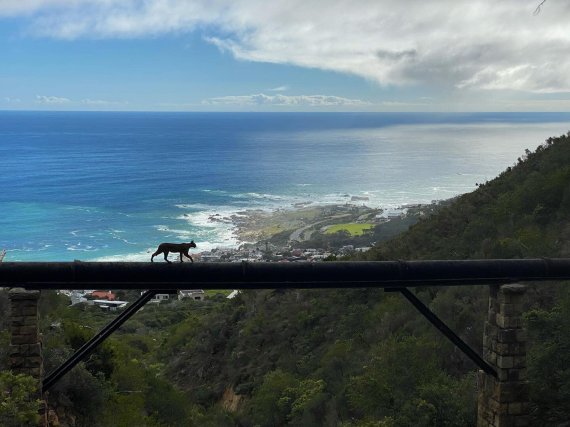
Dr. Laurel Klein Serieys is familiar to most members of Santa Monica Bay Audubon Society. We help support her research on urban bobcats from 2008 to 2014 while she was working on her Ph.D. at UCLA on the deleterious effect of rodenticides on bobcat and mountain lion health. In return, Laurel gave short presentations about her work at our evening meetings, culminating in a full program after she received her Ph.D. It was rewarding to watch her grow in confidence and skill. Afterwards, she moved to South Africa to work on their local cats, particularly the Caracal. The following is from her website biography.

Her introduction to the world of wild cat research was a National Park Service internship in Los Angeles, California, USA in 2006. There she worked on an urban bobcat and mountain lion study. She carried the work into her PhD research at the University of California, Los Angeles graduate program in Ecology and Evolutionary Biology. Her Ph.D. research focused on how urbanization and pesticides drives genetic change and disease susceptibility in urban bobcats. Amongst the achievements she is most proud of– data from her bobcat work was used to enact new legislation across California to reduce consumer availability of rat poisons. The Environmental Protection Agency has requested the data as they review national policy on the use of those pesticides. Her collaborative work on the genetics of urban mountain lions has led to a movement to build a wildlife corridor across one of the busiest freeways in the U.S.
The Urban Caracal Project is a project of the Institute for Communities and Wildlife in Africa (iCWild) at the University of Cape Town. Key collaborators also include South Africa National Parks, Universities of California (Santa Cruz and Los Angeles), the City of Cape Town, and private landowners in Cape Town.

Urban Caracal Project CapeTalk Podcast interview: 15 min
Caracals are shy by nature and avoid contact with humans. But the Urban Caracal Project keeps track of the numbers and distribution of these beautiful wild animals and have tagged several of them. Joining us on the line is Dr Laurel Serieys from the Urban Caracal Project.
Caracals face wipe-out in Cape Town: 6:30 min
The CapeTalk midday talk with Mandy Weiner, interview with Dr. Laurel Serieys of the Urban Caracal Project.
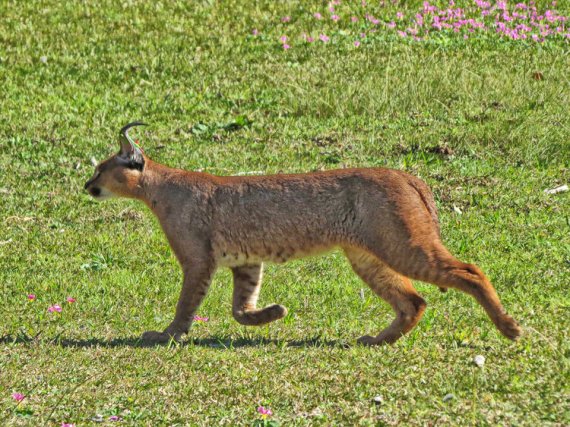
Fun Caracal Facts. Due to similar distinctive ear tufts and short tail, the caracal is often called a ‘desert lynx’ though it is not closely related to the lynxes of the northern hemisphere. Caracal comes from the Turkish name ‘Karakulak’, meaning ‘black ear’. Egyptians portrayed caracals in wall paintings and in bronze as elegant hieratic figures sitting upright or as guardians of tombs; they also embalmed their bodies and placed them in tombs. In Persia and India, the caracal was trained to hunt birds as well as hares, foxes and small antelope.
Theodore Paine Poppy Hour, Thurs. 10/29 5:30 PM
[Posted by Chuck Almdale]
Note: If this email does not display well for you, go to the blog by clicking on the title above. It came to me with a great deal of underlying HTML formatting which it could take a couple of hours for me to reconfigure. So I pasted it in and hoped for the best.
| OCTOBER POPPY HOUR Join us this Thursday (10/29) at 5:30PM PST for an episode of Poppy Hour dedicated to California wildfire and its relationship to our native plants. Poppy Hour: Wildfire Thursday, October 29 5:30 PM -7:00 PM Via ZOOM or YouTube, Free Wildfire is a complicated force in Southern California, being simultaneously dangerous, destructive and regenerative. During this episode of Poppy Hour we’ll be joined by two wildfire experts to shed light on this issue: Dr. Jon Keeley, a fire ecologist with the U.S. Geological Survey, and Henry Herrera, a Forester with California Department of Forestry and Fire Protection (CAL FIRE). We’ll take a close look at our local fire ecology, discuss what it’s like on the ground as a fire-fighter, and learn about actions we can all take to create wildfire resilient communities. TPF Nursery Manager, Flora Ito will start the show by sharing a few of her favorite fire adapted plant selections. Poppy Hour is our California native plant internet mashup. Part interviews, part garden tour, part happy hour, we explore the amazing diversity of people and ideas that connect to Southern California plants and landscapes. Join us!  Henry Herrera began his forestry career with the Forest Service in the San Bernardino National Forest working as a wildland firefighter while attending forestry school at Cal Poly, San Luis Obispo. He’s worked in several National Forests as a firefighter, forester, and lands/special uses officer. Since May of 2019, Henry has worked as CAL FIRE’s Regional Urban Forester for Los Angeles and Ventura counties. Henry’s main experience is with fuels/vegetation management, prescribed fire and reforestation.  Dr. Keeley is currently a research scientist with the U.S. Geological Survey. Prior to this appointment, he served one year in Washington, D.C. as director of the ecology program for the National Science Foundation. He was professor of biology at Occidental College for 20 years. His research has focused on ecological impacts of wildfires as well as other aspects of plant ecology, including rare plants, rare habitats such as vernal pools, and plant physiology. We would like to thank an anonymous donor for making Poppy Hour season 2 possible. Theodore Payne Foundation for Wild Flowers & Native Plants 10459 Tuxford Street Sun Valley, CA 91352 |
Golden Eagle “Sky-Dancing” | Cornell Lab of Ornithology
A film from the Cornell Lab of Ornithology. If no film or link appears in this email, go to the blog to view it by clicking on the blog title above. If the film stops & starts in an annoying manner, press pause (lower left double bars ||) to let it buffer and get ahead of you. The Lab is a member-supported organization; they welcome your membership and support. [Chuck Almdale]



 SANTA MONICA BAY AUDUBON SOCIETY BLOG