Free email delivery
Please sign up for email delivery in the subscription area to the right.
No salesman will call, at least not from us. Maybe from someone else.
[DISCLAIMER: The following is the work and opinion of the author and does not reflect the opinions of any other member of SMBAS either individually or SMBAS as a whole.]
I received fourteen negative and nine positive comments to my essay: The Attack: Common names of birds, eponyms, and the woke. None of the negative criticisms maintained that McCown was a proven racist and/or pro-slaver beyond the uncontested fact that McCown was a Confederate soldier. Most of the criticisms were of my writing style: my inclusion of asides, references to films, links to songs and exploration into philosophy and biology. You can’t please everyone. One critic made a statement which I think is representative of all the critics, and perhaps of all the woke:
Yes, it is an attack on the man and not his work. He was a Confederate soldier. He chose the pro-slavery side. There is no gray area although it is clear to you that there is a gray area and that fighting for the Confederates was a coin toss a man had to make.
I do not agree with that assessment which – to me – uses the informal fallacy of false dilemma and arrives at guilt by association. He discovered three species of birds and documented many others. We have no evidence that he was racist, pro-slavery, or ever owned slaves as did Presidents Washington and Jefferson. Most people agree the war was started about slavery although I know people who still call it the “War of Northern Aggression.” It was declared by the usual political sorts who are always with us, but Southerners joined for many reasons and up to 75% of them did not come from slave-owning households.
The only quote we have from McCown on the war is highly critical of the Confederacy. The Confederate flag he owned was the one he carried as an officer throughout the war, and he gave it away before he died. Why did he join? Family honor? Pressure from relatives? Anti-Union feelings? Tired of soldiering out west and in Florida? We don’t know his mind and it is biased and uninformed to leap to the conclusion he was racist and pro-slavery simply because he was a Confederate soldier.
There are no plans afoot – as far as I can tell – to change the scientific name Rhynchophanes mccownii to anything else. Changing scientific names is a much more rule-bound process than changing common names.
McCown was not just a soldier, and not just a Confederate soldier, he was a multi-faceted human being. From Early Southwest Ornithologists 1528-1900, Dan L Fischer. 2001. The University of Arizona Press, Tuscon. Pages 36-37.
Most of McCown’s specimens were sent to George N. Lawrence (1851), who published his discoveries and observations in the Annals of the Lyceum of Natural History of New York. Among those were seven birds McCown added to our fauna north of the border: Black-bellied Whistling-Duck, Green Kingfisher, Vermilion Flycatcher, Verdin, Cactus Wren, Pyrrhuloxia, and Great-tailed Grackle. McCown also discovered three new species, which Lawrence described in the same paper. Two of them were the plain Olive Sparrow, which was collected in the scrubby thickets near Fort Brown, and the Ash-throated Flycatcher, which was secured between San Antonio and the Rio Grande.
The third discovery, McCown’s Longspur (Calcarius mccownii), an inconspicuous flocking bird of open country that winters south into the central portions of the borderland region, is named in honor of this soldier-ornithologist. Lawrence, in writing its description, included a brief account of McCown’s discovery. “Two specimens were obtained by Capt. McCown on the high prairies of western Texas….they were feeding in company with Shore [Horned] Larks. Although procured late in the spring, they still appear to be in their winter dress; in summer, I have no doubt they assume the gay and ornamented plumage of their congeners.”
McCown’s (1853) only paper written on Texas birds included habits of the Greater Roadrunner. “Often in my wanderings through the chaparrals on the Rio Grande, I observed piles of broken snail shells, and always near some hard substance, such as a bone or hard piece of wood….I made many conjectures as to the probable animal. I never suspected a bird….I heard at times…a sound very similar to that made by some woodpeckers by a rapid beating of their bill upon an old dry tree. This was also a mystery, as I could find no woodpeckers near the place the sound came from. Upon inquiry of a Mexican, I was told that it was the Paisano breaking the snail shells to get at the snail…I was afterwards so fortunate as to see a bird so occupied.
McCown graduated from West Point Military Academy in 1840 and served in the army across the western territories, Texas and Florida until 1861, when he resigned his United States commission and entered Confederate military service. Following the end of the Civil War his life significantly changed. (From Encyclopedia of Arkansas)
Shortly after the end of the war, he moved to Knoxville, Tennessee, where he obtained work as a school teacher. After traveling to Arkansas to visit with his brother George in 1868 at his home in Magnolia, McCown purchased a house in the southeastern section of the town, moving there soon afterward. He quickly became a respected citizen known for his farming and generosity. The former general was known for displaying a number of historic war relics in his home. Over time, he gave away many of these items, including his personal flag carried during the war.
I initially wrote out a point-by-critical point reply to the criticisms, but it became overlong, tedious to write, boring to read, and of little interest to anyone, even the critics. It will not appear anywhere.
Thank you for your attention. Should you wish to write to the American Ornithological Society (AOS) to comment on their decision, their website is here.
I’ll leave you with two quotations I think apropos for our modern times. The first is ancient, yet strangely familiar.
Judge not, that you be not judged. For with what judgment you judge, you will be judged; and with the same measure you use, it will be measured back to you. And why do you look at the speck in your brother’s eye, but do not consider the plank in your own eye? Or how can you say to your brother, ‘Let me remove the speck out of your eye’; and look, a plank is in your own eye? Hypocrite! First remove the plank from your own eye, and then you will see clearly to remove the speck out of your brother’s eye. Matthew 7:1-5 New King James Version
The second is recent, yet springs from the same source.
As far as I can see, cancel culture is mercy’s antithesis. Political correctness has grown to become the unhappiest religion in the world. Its once honourable attempt to reimagine our society in a more equitable way now embodies all the worst aspects that religion has to offer (and none of the beauty) — moral certainty and self-righteousness shorn even of the capacity for redemption. It has become quite literally, bad religion run amuck. The Red Hand Files
[Chuck Almdale]
It again seemed like a good time to see if field trips were feasible.

“Nobody on the road, nobody on the beach…” (L. Johnson 08-26-20)
Another socially distanced masked walk at the lagoon. Again, seven showed, neither magnificent nor the same as last month. Fog was thick and low – atypical for late August. Temperatures until noon were pleasant between 70° and 76°F.
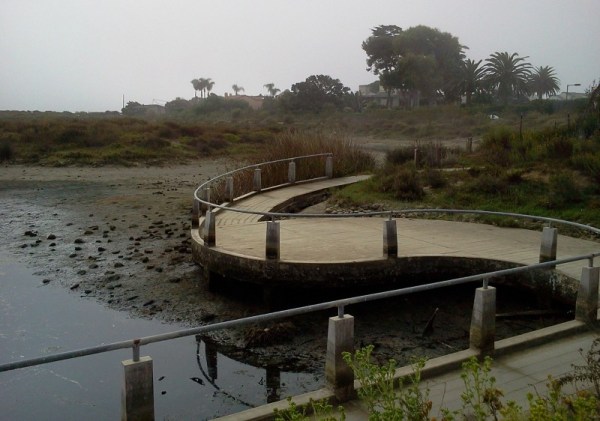
Tidal clock high and dry (L. Johnson 08-26-20)
Fourteen birds were “new for the season,” the lagoon berm breach had opened up a week earlier, all the water drained out to the ocean, small pools of shallow water dotted the sand and mud. Snowy Plovers now numbered 26, up from July’s 8. No orioles or hummingbirds were seen. Beyond that, everything was exactly the same as in July.
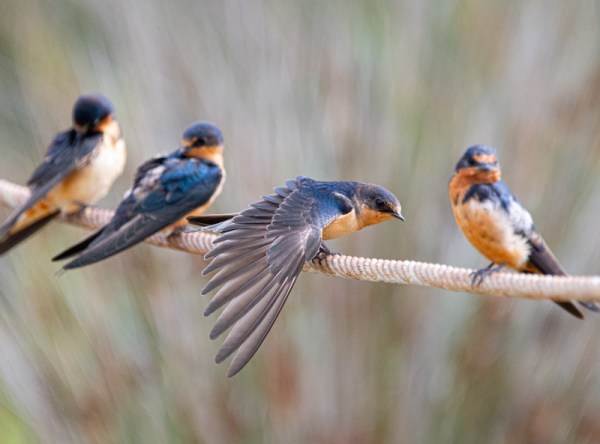
Several of 16 Barn Swallows on the railing (R. Jucosa 8-26-20)
So what was “exactly the same?,” you say. Why, I’m glad you asked. Relatively few people on the beach, well spaced apart in groups, family groups perhaps, very few wearing masks when within their groups or down at the wave zone. Suited surfers on nicely shaped waves.
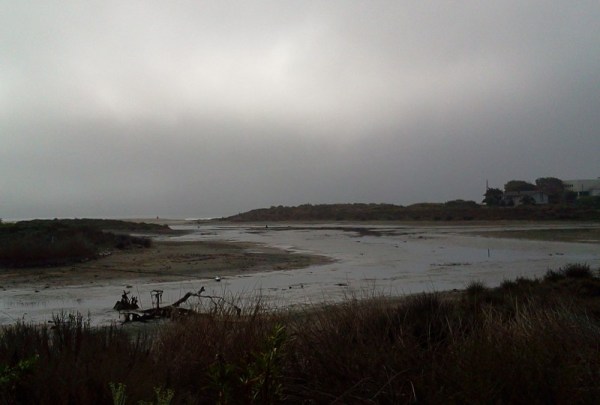
Down the channel to the beach (L. Johnson 08-26-20)
The berm breach ran through the west end of the beach. People coming on the path from the west end parking lot, as we do, had little room in which to spread out. Anyone coming from the east end entrance near the pier would find it a long walk to get to the edge of the lagoon. Of course you could wade across the breach, as I did, and dampen your toes with lagoon water; not always the best of ideas.

Western Sandpiper (R. Jucosa 8-26-20)
Overall I’d say the business of wearing masks when appropriate and not when you don’t need it seems to be catching on. Most people coming down the path wore theirs, then likely removed them once they’d planted themselves on a sequestered patch of sand. This seems acceptable to me. Praise the lord and pass the bananas.

Some juvenile Ruddy Turnstones can look like an odd Black Turnstone
(L. Loeher 8-27-20)

Two Black Turnstones for comparison (L. Loeher 8-27-20)
The very first birds I saw were 25 Western Meadowlarks overhead at the channel’s west end, near the acceptably clean port-a-potties. Few ducks and no coots were on the water, probably due to lack of water. (Duh.) A lone male Green-winged Teal was a surprise; they usually don’t show up until September, or later.

Semipalmated Plovers appear for a while when migrating south
(L. Loeher 8-27-20)
Almost all shorebirds, gulls and terns were clustered onto an exposed sand island located midway across the lagoon east-west, near the southern shore. It was a difficult seeing them well through the fog. A few peeps were closer along the channel edge, where we found the photographed birds, plus what we thought were two Pectoral Sandpipers. Later examination of fuzzy photographs did not support that identification. Complete absence of hummingbirds was surprising; historically we have Anna’s 69% and Allen’s 94% of the time. But plenty of Bushtits were present in two groups of 20 birds and 30 birds.
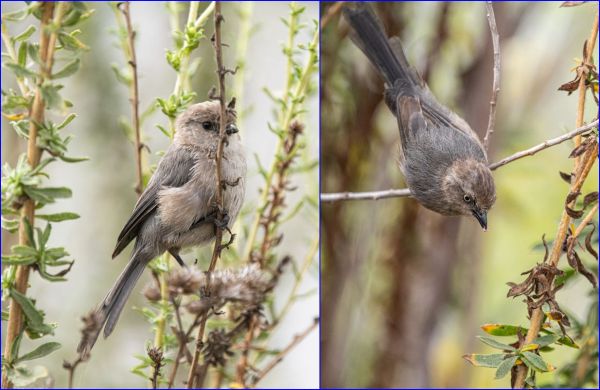
Bushtit male (dark eye) & female (light eye) (R. Jucosa 8-26-20)
We solved the problem of mask-wearing fogging your glasses and binoculars. Well…an alert reader sent us the solution after my bitter complaint last month. Fold up repeatedly a tissue or section(s) of toilet paper into a strip, lay it over your nose and cheeks just under the upper edge of your mask. Voilà! The rising steam is diverted elsewhere. It works! Try it. The reader (Joyce, I believe) learned it from a surgeon.
Here’s a wistful song for a gloomy day at summer’s end: Don Henley’s The Boys of Summer. Cue it up, return here, and let it run while you finish reading.

Western Roof-Cormorant, Pelagic morph (R. Jucosa 8-26-20)
Nothing on the ocean, nothing on the outer rocks, only one of the rarely-sighted Western Roof Cormorant (Pelagic morph) comfortably ensconced in its favored habitat. The Pelagic Cormorant (for that is truly what it was) really do not like to come inland and the edge of this roof must have been at least 10 ft. inland of the edge of the ocean. A courageous and adventurous bird!
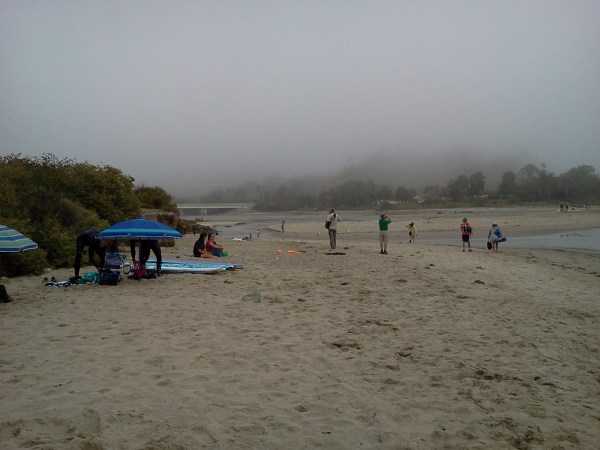
Beach & breach (L. Johnson 08-26-20)
When we got to the berm breach, I – in my sockless Crocs – was the only one to ford the outlet stream. Perhaps hereafter we should call it “Crocford” Creek. Everyone else had shoes and long pants.

1st year Heermann’s Gull (L. Loeher 8-27-20)
There were very few humans here on the beach, which left plenty of room for Willets, Whimbrels and Snowy Plovers. I was also able to do some re-counts and get better numbers on the gulls and terns.
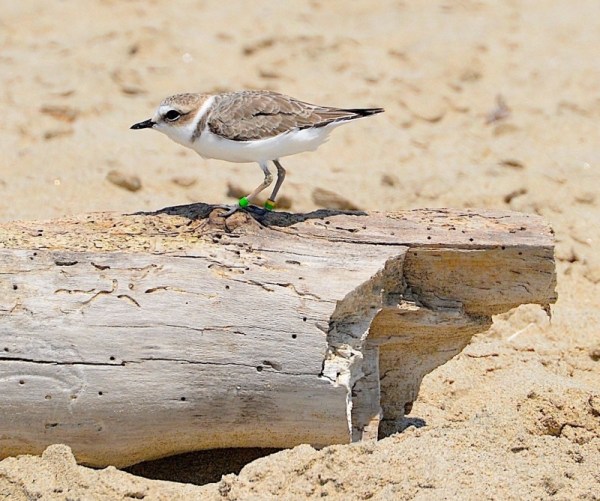
New bird on the beach – Western Snowy Plover G:yg (G. Murayama 8-27-20)
When I returned, those who hadn’t waded Crocford intermittent Creek had gone. While walking back along the path from the beach I spotted a piece of trash fluttering nearby, and picked it up to toss into the next bin. It was the front page of a newspaper, not the L.A. Times. A headline read “There is still time.” A bit mysterious, I thought, but I was in a hurry to get back to the car and binned it.
Birds new for the season: Green-winged Teal, Semipalmated Plover, Pectoral Sandpiper, Short-billed Dowitcher, Lease Tern, Forster’s Tern, Royal Tern, Black-crowned Night-Heron, Osprey, Belted Kingfisher, Rough-winged Swallow, House Wren, Western Bluebird, Western Meadowlark. [Some of these species may have been present in March & April, but we weren’t there to see.]
Many thanks to photographers: Lillian Johnson, Ray Juncosa, Larry Loeher, and Grace Murayama.
Our next three scheduled field trips: Who knows? Not I.
Our next program: We plan on doing a Zoom program in October. Watch for announcements.
NOTE: Our 10 a.m. Parent’s & Kids Birdwalk is canceled until further notice due to the near-impossibility of maintaining proper masked social distancing with parents and small children.
Links: Unusual birds at Malibu Lagoon
9/23/02 Aerial photo of Malibu Lagoon
Prior checklists:
2019: Jan-June, July-Dec 2020: Jan-July,
2018: Jan-June, July-Dec 2017: Jan-June, July-Dec
2016: Jan-June, July-Dec 2015: Jan-May, July-Dec
2014: Jan-July, July-Dec 2013: Jan-June, July-Dec
2012: Jan-June, July -Dec 2011: Jan-June, July-Dec
2010: Jan-June, July-Dec 2009: Jan-June, July-Dec.
The 10-year comparison summaries created during the Lagoon Reconfiguration Project period, despite numerous complaints, remain available on our Lagoon Project Bird Census Page. Very briefly summarized, the results unexpectedly indicate that avian species diversification and numbers improved slightly during the restoration period June’12-June’14.
[Chuck Almdale]
| Malibu Census 2020 | 1/26 | 2/23 | 5/22 | 6/25 | 7/22 | 8/26 |
| Temperature | 56-58 | 56-62 | 68-73 | 64-70 | 60-66 | 70-77 |
| Tide Lo/Hi Height | H+6.43 | H+5.70 | H+3.53 | L-0.52 | L+0.71 | L+2.52 |
| Tide Time | 0705 | 0934 | 1031 | 0733 | 0819 | 0958 |
| Canada Goose | 6 | 14 | 8 | 8 | ||
| Cinnamon Teal | 19 | |||||
| Northern Shoveler | 13 | 12 | ||||
| Gadwall | 29 | 39 | 34 | 31 | 40 | 5 |
| American Wigeon | 14 | 7 | ||||
| Mallard | 13 | 10 | 12 | 23 | 27 | 16 |
| Northern Pintail | 1 | |||||
| Green-winged Teal | 36 | 35 | 1 | |||
| Surf Scoter | 34 | 5 | ||||
| White-winged Scoter | 1 | |||||
| Bufflehead | 8 | 4 | ||||
| Hooded Merganser | 2 | |||||
| Red-breasted Merganser | 2 | 6 | ||||
| Ruddy Duck | 35 | |||||
| Pied-billed Grebe | 1 | 1 | 3 | 3 | ||
| Western Grebe | 6 | 1 | ||||
| Rock Pigeon | 8 | 15 | 7 | 10 | 4 | |
| Mourning Dove | 2 | 4 | 4 | 3 | 5 | |
| Anna’s Hummingbird | 1 | 1 | 1 | |||
| Allen’s Hummingbird | 3 | 3 | 4 | 3 | 3 | |
| American Coot | 12 | 40 | 4 | 2 | ||
| Black-bellied Plover | 43 | 57 | 14 | 10 | 15 | 66 |
| Snowy Plover | 14 | 4 | 8 | 26 | ||
| Semipalmated Plover | 4 | |||||
| Killdeer | 16 | 12 | 2 | 6 | 2 | 7 |
| Whimbrel | 4 | 3 | 18 | 5 | 15 | 14 |
| Marbled Godwit | 12 | 52 | 4 | 1 | ||
| Ruddy Turnstone | 5 | 8 | 2 | 2 | ||
| Sanderling | 12 | 14 | ||||
| Least Sandpiper | 2 | 2 | 19 | |||
| Western Sandpiper | 5 | 2 | 1 | 8 | ||
| Short-billed Dowitcher | 2 | |||||
| Long-billed Dowitcher | 4 | |||||
| Wandering Tattler | 1 | |||||
| Willet | 20 | 6 | 1 | 6 | 8 | 47 |
| Heermann’s Gull | 8 | 3 | 4 | 9 | 65 | 10 |
| Ring-billed Gull | 6 | 44 | ||||
| Western Gull | 11 | 82 | 210 | 120 | 90 | 98 |
| California Gull | 110 | 215 | 4 | 17 | ||
| Herring Gull | 2 | |||||
| Glaucous-winged Gull | 2 | 3 | 3 | |||
| Least Tern | 2 | 2 | ||||
| Caspian Tern | 60 | 15 | 4 | 1 | ||
| Forster’s Tern | 4 | |||||
| Royal Tern | 1 | 6 | 55 | 11 | ||
| Elegant Tern | 195 | 221 | ||||
| Brandt’s Cormorant | 2 | 1 | ||||
| Double-crested Cormorant | 18 | 35 | 14 | 15 | 16 | 18 |
| Pelagic Cormorant | 1 | 1 | 1 | |||
| Brown Pelican | 32 | 38 | 94 | 30 | 19 | 8 |
| Great Blue Heron | 2 | 2 | 3 | 2 | 4 | |
| Great Egret | 1 | 3 | 4 | |||
| Snowy Egret | 1 | 6 | 3 | 2 | 8 | 4 |
| Black-crowned Night-Heron | 1 | 2 | ||||
| Turkey Vulture | 1 | 5 | ||||
| Osprey | 1 | 1 | ||||
| Cooper’s Hawk | 1 | |||||
| Red-tailed Hawk | 3 | |||||
| Belted Kingfisher | 1 | 1 | 1 | |||
| Nuttall’s Woodpecker | 1 | |||||
| Peregrine Falcon | 1 | |||||
| Nanday Parakeet | 7 | |||||
| Black Phoebe | 3 | 4 | 1 | 5 | 5 | |
| Say’s Phoebe | 3 | 2 | ||||
| California Scrub-Jay | 1 | 1 | 1 | |||
| American Crow | 2 | 6 | 2 | 2 | 4 | 3 |
| Tree Swallow | 2 | |||||
| Rough-winged Swallow | 1 | |||||
| Cliff Swallow | 1 | |||||
| Barn Swallow | 10 | 18 | 22 | 20 | ||
| Oak Titmouse | 1 | |||||
| Bushtit | 10 | 20 | 6 | 22 | 16 | 50 |
| House Wren | 2 | 1 | ||||
| Marsh Wren | 2 | |||||
| Bewick’s Wren | 1 | 2 | ||||
| Blue-gray Gnatcatcher | 2 | |||||
| Ruby-crowned Kinglet | 1 | 1 | ||||
| Wrentit | 1 | 1 | ||||
| Western Bluebird | 4 | |||||
| Hermit Thrush | 1 | |||||
| Northern Mockingbird | 2 | 2 | 2 | 2 | 2 | 1 |
| European Starling | 3 | 9 | 60 | 12 | 27 | |
| House Finch | 8 | 16 | 24 | 5 | 4 | |
| Lesser Goldfinch | 1 | 3 | ||||
| Spotted Towhee | 1 | |||||
| California Towhee | 1 | 1 | ||||
| Song Sparrow | 1 | 16 | 12 | 3 | 3 | 4 |
| White-crowned Sparrow | 4 | 6 | ||||
| Golden-crowned Sparrow | 1 | |||||
| Western Meadowlark | 1 | 25 | ||||
| Hooded Oriole | 7 | |||||
| Red-winged Blackbird | 6 | 1 | ||||
| Great-tailed Grackle | 3 | 4 | 3 | 20 | 2 | |
| Common Yellowthroat | 2 | 3 | 1 | 4 | ||
| Yellow-rumped Warbler | 8 | 6 | ||||
| Totals by Type | Jan | Feb | May | Jun | Jul | Aug |
| Waterfowl | 157 | 174 | 60 | 62 | 75 | 22 |
| Water Birds – Other | 66 | 120 | 113 | 47 | 40 | 30 |
| Herons, Egrets & Ibis | 3 | 8 | 4 | 6 | 13 | 14 |
| Quail & Raptors | 2 | 8 | 2 | 0 | 0 | 1 |
| Shorebirds | 128 | 161 | 39 | 30 | 58 | 197 |
| Gulls & Terns | 140 | 353 | 334 | 144 | 358 | 364 |
| Doves | 10 | 19 | 0 | 11 | 13 | 9 |
| Other Non-Passerines | 5 | 13 | 4 | 3 | 4 | 1 |
| Passerines | 43 | 102 | 62 | 137 | 99 | 152 |
| Totals Birds | 554 | 958 | 618 | 440 | 660 | 790 |
| Total Species | Jan | Feb | May | Jun | Jul | Aug |
| Waterfowl | 10 | 12 | 3 | 3 | 3 | 3 |
| Water Birds – Other | 6 | 5 | 4 | 4 | 4 | 4 |
| Herons, Egrets & Ibis | 2 | 2 | 2 | 3 | 3 | 4 |
| Quail & Raptors | 2 | 2 | 2 | 0 | 0 | 1 |
| Shorebirds | 9 | 9 | 5 | 6 | 10 | 10 |
| Gulls & Terns | 7 | 6 | 6 | 3 | 5 | 8 |
| Doves | 2 | 2 | 0 | 2 | 2 | 2 |
| Other Non-Passerines | 3 | 5 | 1 | 1 | 2 | 1 |
| Passerines | 15 | 25 | 9 | 11 | 13 | 15 |
| Totals Species – 95 | 56 | 68 | 32 | 33 | 42 | 48 |
Identify this Mystery Owl
Owls are seen in many unusual places: roof tops, antennas, flagpoles, Joshua Trees, low mounds, tree tops, deep inside tree foliage next to the trunk, out on a limb, holes, rafters of barns and abandoned houses, low bushes, deep grass. This one was spotted on a window ledge air-conditioning unit.
Debate raged on-line about what it was.
Could it be one of the Masked-Owls, as suggested by the distinct facial pattern? There are eight species of Masked-owls in the Barn Owl family (Tytonidae), all living in the Australasian area, of which the best known is the Australian Masked-Owl (Tyto novaehollandiae), with six subspecies. Could it be one of those? Unfortunately no one seemed to know where the photo was from, so we couldn’t rule anything out due to it’s being too far out of range.
Of the other seven Masked-Owl species, they collectively have nine subspecies, of which four are “vulnerable” and three “data deficient” according to bird listing program Scythebill. The two subspecies of Sulawesi Masked-Owl (Tyto rosenbergii) seem to be surviving OK – at least there were no red flags.
Tough to decide, as we didn’t know the source of the photo. However, the existence of the two prominent ear-tuffs make it unlikely that it is one of the Masked-Owls. This group is part of the Barn-Owl family, none of which (as far as I know) have any sort of ear-tuffs. We had to look elsewhere.

Masked-Owl or Roof-Owl?
(photographer unknown)
Then someone suggested our North American Roof-Owl group. This oft-seen but little-understood species, the Western Roof-Owl (Bubo pneumatikus) to be specific, is common in suburban Southern California (in the event that the photo was taken locally) and air-conditioning units are certainly well within their habitat requirements.
The problem is that we hadn’t ever seen them with these particular facial patterns before. It may be a subspecies of B. pneumatikus; it may also be an entirely new, previously well-hidden species heretofore unsuspected.
It should be noted that Roof-Owl come in two behavioral morphs, straight-ahead and right-looking. This bird appears to be of the straight-ahead morph. (Link to monograph on Bubo pneumatikus.)
Getting a DNA sample of the bird would be helpful. As we don’t know the source of the photo or where it was taken, we are asking the public for help. If you see this bird or a similarly masked owl, please contact your local birding authorities as soon as possible.
Thank you for your attention.
[Chuck Almdale]
Cornell Lab of Ornithology photographer Gerrit Vyn takes us to New York’s Montezuma National Wildlife Refuge to experience this yearly event.
A film from the Cornell Lab of Ornithology. If no film or link appears in this email, go to the blog to view it by clicking on the blog title above. If the film stops & starts in an annoying manner, press pause (lower left double bars ||) to let it buffer and get ahead of you. The Lab is a member-supported organization; they welcome your membership and support. [Chuck Almdale]
Los Angeles Birders Website & Webinars
Los Angeles Birders – A Birders’ Organization for the 21st Century

Los Angeles Birders (LAB) is a nonprofit public benefit all volunteer organization, working cooperatively to provide a variety of bird and birding-related programming and activities to Southern California birders interested in birding and citizen science. In the future LAB will have field trips, educational seminars and classes, and citizen science projects. They soon will have memberships available to all birders so you can help support their mission and projects, and help guide their direction. They are improving their website and soon will have the ability to sign-up for notices (like webinars, classes, etc.) and to actually join LAB as a member. Stay tuned!
Link to their website with either labirders.org or losangelesbirders.org
Their Mission Statement
The mission of Los Angeles Birders is to bring birding, knowledge, and field experience together to encourage, educate, and empower birders. Though our focus is on birding in the greater Los Angeles area, we welcome all birders who share the same passion, regardless of where they may live. We are a volunteer organization that promotes birding, study, and education for birders of all levels. In addition, the organization strives to increase the appreciation of birds and their habitats, foster new birders, develop camaraderie among birders, promote citizen science, and support other like-minded organizations.
Webinars
They currently have monthly webinars, which are recorded and on their website. They now have three programs in their live monthly webinar series, which they announce on LACoBirds listserve and are sent out by invitation while they get the hang of live streaming. Each is about 1 hour long, appear on the website within a day or two and you can access them here. Current titles are:
- Dowitchers with Jon Dunn; Tue. Aug 11, 2020
- White-crowned Sparrows with Jon Dunn & Kimball Garrett; Tue. July 14
- Vermilion Flycatchers with Kimball Garrett; Tue. June 9, 2020
They also have quizzes! Tricky local birds only.
Los Angeles Birders – Students (LAB-S) provides community, friendship, fun, and learning opportunities for young people who have a passion for wild birds and their habitats. Join an exciting and rewarding group, geared specifically for student birders. [Link to Students]
- Discover and study the amazing birds found in LA County and sometimes beyond, through monthly meetings.
- Join in field trips (currently postponed due to covid-19) and other special events.
- Network with other student birders and professional ornithologists.
Membership in Los Angeles Birders – Students (LAB-S)
Open a whole new world of birding, birds and birder friendships for student birders. At LAB-S you will have the opportunity to bird the best birding spots with like-minded friends and experts. You will also get connected in a safe online community where you can share birding stories, questions, photos, and support where you can advance your birding skills and knowledge. LAB-S holds separate monthly webinars, has a newsletter, and some very enthusiastic members! (LAB-S members range in age from 8 to 18. The only requirement is that they are a student. If you know of a young person who may enjoy this experience, send them our way!) In the future LAB will have field trips, educational seminars and classes, and citizen science projects.
[Posted by Chuck Almdale]



 SANTA MONICA BAY AUDUBON SOCIETY BLOG