Free email delivery
Please sign up for email delivery in the subscription area to the right.
No salesman will call, at least not from us. Maybe from someone else.
Through the Lens: Birds of Australia’s Northern Territory | Cornell Lab of Ornithology
Join wildlife photographer Marie Read as she documents the bird life in Kakadu National Park in Australia’s Northern Territory.
A film from the Cornell Lab of Ornithology. If no film or link appears in this email, go to the blog to view it by clicking on the blog title above. If the film stops & starts in an annoying manner, press pause (lower left double bars ||) to let it buffer and get ahead of you. The Lab is a member-supported organization; they welcome your membership and support. [Chuck Almdale]
Feeling stuck at Home? It’s better than being on Mars.

Hah! Think you’ve got it tough? Man or woman up, wussies. At least you’re not stuck on Red Planet Mars, where the air pressure outside your dome is like the top of a 100,000-foot-high mountaintop, the temperature is waaaay below whatever you happen to call zero, your only method of communication with Earth is by time-delayed email, you’re getting a little tired of mission control endlessly micromanaging your days, you have to wear an increasingly smelly space suit all the time and things are getting ever more tense between you and your five roommates.
That’s how Kate Green spent four months in 2013. Well, almost.
From St. Martin’s Press publisher’s blurb.
When it comes to Mars, the focus is often on how to get there: the rockets, the engines, the fuel. But upon arrival, what will it actually be like?
In 2013, Kate Greene moved to Mars. That is, along with five fellow crew members, she embarked on NASA’s first HI-SEAS mission, a simulated Martian environment located on the slopes of Mauna Loa in Hawai’i. For four months she lived, worked, and slept in an isolated geodesic dome, conducting a sleep study on her crew mates and gaining incredible insight into human behavior in tight quarters, as well as the nature of boredom, dreams, and isolation that arise amidst the promise of scientific progress and glory.In Once Upon a Time I Lived on Mars, Greene draws on her experience to contemplate humanity’s broader impulse to explore. The result is a twined story of space and life, of the standard, able-bodied astronaut and Greene’s brother’s disability, of the lag time of interplanetary correspondences and the challenges of a long-distance marriage, of freeze-dried egg powder and fresh pineapple, of departure and return.
By asking what kind of wisdom humanity might take to Mars and elsewhere in the Universe, Greene has written a remarkable, wide-ranging examination of our time in space right now, as a pre-Mars species, poised on the edge, readying for launch.
[Posted by Chuck Almdale]
Social distance birding at Malibu Lagoon, 22 July, 2020
It seemed like a good time for a test to see if field trips were feasible.

Snowy Egrets vie for dominance (A. Douglas 7-22-20)
To maximize safety and compliance with local laws, I set rules: SMBAS board members only, masks and social distancing required, bring your own scope. A group of seven gathered, and off we went.

View from the pavilion (L. Johnson 7-22-20)
Overall it went fairly well. But we were a small group of civic-minded birders, and the only infraction was one person who couldn’t keep their proboscis covered. No rants, no foaming at the mouth, no summer soldier shouts of “Give me liberty, or give me death! Unmasked I arrived into this world, unmasked I shall take my leave!”

Great Blue Heron, neck entended
(G. Murayama 7-31-20)
A question arose. Where does the heron’s neck go when flying?
Adrian, our physician/anatomist-in-residence, replied: “To begin with, the heron’s cervical vertebrae (that’s the neck bones) have a unique structure allowing them to hinge over an adjacent vertebra. That is why they have that curious kink in the neck and how they can strike so swiftly to catch prey. This enables them to fold their necks in an”S” shape, hence they can lengthen or shorten the neck.”

Great Blue Heron, neck contracted for flight (G. Murayama 7-31-20)
I thought it just telescoped down into it’s torso, like a tripod leg, or perhaps the neck inverted itself like a snake swallowing its tail from the inside, or it compressed and stretched like the hose of a vacuum cleaner, or it Möbius-stripped itself into a parallel dimension, but then I don’t have the medical degrees requisite for this exacting a physiological analysis.
Lillian and I had arrived early, and while checking the parking lot area, found a group of seven – SEVEN! – Hooded Orioles, moving through the sycamore trees. We’ve seen Hooded Orioles many times before at the lagoon, as they’ve nested there for years in various trees, both deciduous and palm. We’ve seen both adults, year-old birds and juveniles. But rarely this many, all at the same time. Later perusal of A Guide to the Nests, Eggs and Nestlings of North American Birds, Baicich & Harrison, 1991, told me the following:
Begin nesting early April to early May. Two or sometimes 3 broods. Usually four eggs, sometimes 3-5. Eggs are long subelliptical to long oval. Smooth and glossy. Very pale blue, sometimes with a slight pink or purple wash. Finely scribbled and scrawled or with a few elongated blotches or specks of black, usually with the markings concentrated at the larger end. Sometimes almost unmarked. 22 X 15 mm. Eggs laid at daily intervals. Incubation by female alone. 13 days. Nestlings are altricial and downy. Down sparse; on head and back. Young tended by both parents. Leave nest at 14 days.
So this could have been a single family group – two adults and five young, from a recent hatching. But I thought one or two of the birds looked a bit older than recently-fledged. So perhaps it was a second hatching and one or two young from an earlier hatching accompanied the new group. Sort of an extended family. But the latter possibility is just conjecture.
Back home, I checked my spreadsheet and found that we’ve sighted Hooded Orioles at the lagoon 36 times with a total of 85 birds, including this sighting. Our all-time high count was eight on 7/22/01, followed by six on 7/24/11. Most of the sightings were of undoubtedly the same individuals in consecutive summer months, such as the one to four birds sighted over five months, 4/24/19 – 8/28/19.
We were certainly not the only people at the lagoon and on the beach. Perhaps half, probably less, were masked. Social distancing was practiced, generally, except for what appeared to be a surfing class for kids; they were shoulder-to-shoulder and unmasked on the sand, including their accompanying adults. Surfers, of course, keep their gear to a minimum and avoid masks. Once they’re on the waves, this seems sensible, but less so while they walk to the beach on the often-crowded path.

Malibu Colony and picnic corner in the distance (L. Johnson 7-22-20)
Birding while masked is not great. If it’s only you or your family unit, you can skip the mask when the contagious and obviously rabid “others” are not near. But in a group such as ours, with people clustered and milling about, you have to keep the mask on nearly all the time. I found that for at least the first hour, when temperatures were cool, my binocular eyepieces would fog up within seconds and I was constantly wiping them. After too many wipes, I just stepped farther away from the group and pulled down my mask when I wanted to stare at a bird. That solved the fogging problem.** By the time we reached the beach, the day had warmed and fogging while masked didn’t seem to be as much a problem.
** Later Note: We now have two methods of conquering the mask/fogging problem without dropping your mask. Both easy and cheap.

High water over the summer clock sidewalk (G. Murayama 7-31-20)

Water height tile 7′ 8.4″ Summer Tidal Clock was wet (L. Johnson 7-22-20)
So if you go a-birding in a mask, keep your microfiber lens cloth close at hand, and maybe a handkerchief as well to sop up excess moisture.
The Canada Geese were still there, all eight of them, two adults and six near-full-size young. They were resting near a group of gulls, shorebirds and Western Snowy Plovers on the beach near the east side of the lagoon, the area right above the log full of Double-crested Cormorants in the photo below. I don’t think any of them moved a muscle the entire time we were nearby, admiring the shorebirds and checking the eight plovers for leg bands (none found).

Southern lagoon, Surfrider Beach & Malibu Pier (L. Johnson 7-22-20)
Birding was pretty good, but then after months of infrequent-to-never birding, it was nice just to get out in the sun and breeze and watch a few feathered friends flinging themselves about.

Western Gull or Western Lammergeier? A tough call. You decide. (G. Murayama 7-31-20)
As usual more than half the birds were gulls and terns, primarily Western Gulls and Elegant Terns. The latter were there in all plumage stages, from begging juveniles with stubby pale yellow bills to fully decked-out adults. Same goes for the Western Gulls, our most local gull, as many of them nest on Acacapa Island, about forty miles away, along with the Brown Pelicans.

Juvenile Elegant Terns with stubby bills & adult Western Gull
(G. Murayama 7-17-20)
This is the time of year the Heermann’s Gulls return from their nesting grounds on Isla Rasa in the middle of the Sea of Cortez, a tiny uninhabited island where about 95% of the world’s Heermann’s Gulls and Elegant Terns nest. We generally get them in all plumages, but in recent years there have been massive breeding failures due to lack of proper sized prey fish. So it’s nice to see juveniles.
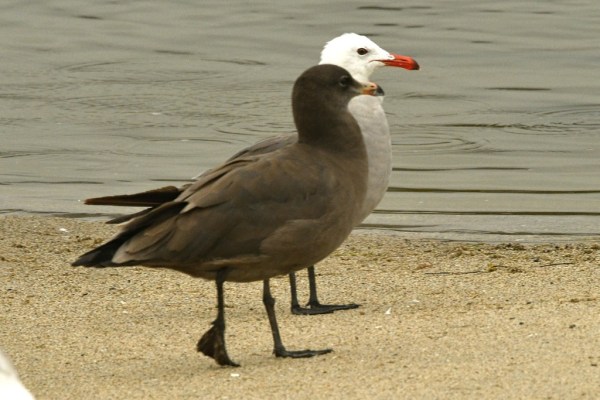
Juvenile & breeding Adult Heermann’s Gulls back from Sea of Cortez
(A. Douglas 7-22-20)
There doesn’t have to be a “bird of the day” but it’s nice when there is. We were staring at the outer rocks near the Malibu Colony of humans.
Adrian alerted me to it. “I think there’s a small bird out there.”
Me: “There are small knobs on those rocks which look just like birds. Sure it’s not one of those?”
“I think it’s a bird, not a rock.”
“Which rock is in on?”
“The big rock, on top, about in the middle.”
Scanning, then finding. “Hey, it really is a bird!…Jumping Jehoshaphat, I think it’s a Wandering Tattler! That’s a good bird for here. They like rocks, not sand, so we don’t get many.”
Someone asked, “Aren’t they down at Marina del Rey, on the jetties?”
“Yeah, but they’re not terrifically common even there. You’re always lucky to find one.”

Wandering Tattler on the outer rocks (A. Douglas 7-22-20)
So we admired the bird as best we could. A couple of hundred yards away, only 11” long, mostly gray, on a gray-brown rock, above a blue-gray sea and against a cloudy gray sky. I’ve seen tattlers only seven times at the lagoon, the first on 11/17/19, each one a solitary bird.

Wandering Tattler avoiding a breaking wave (A. Douglas 7-22-20)
You may have noticed that some of the photos, taken by Grace Murayama, have a different date. Grace and Larry regularly census the Snowy Plovers and Least Terns (if any) at both Malibu Lagoon and Zuma Beach. They couldn’t join us, so I included some of her photos from other dates. Here’s another.

Sanderling (L) back from breeding and Western Snowy Plover (R)
(G. Murayama 7-31-20)
Western Snowy Plovers, Sanderlings and Western Sandpipers often roost together on the beach. They’re all small birds with predators, for whom the more eyes the better, and they don’t compete with each other (well, a little, maybe) when searching for food. So they get along about as well as might be expected.
Birds new for the season: Pied-billed Grebe, Anna’s Hummingbird, Snowy Plover, Ruddy Turnstone, Least Sandpiper, Long-billed Dowitcher, Wandering Tattler, California Gull, Elegant Tern, California Scrub-Jay, Wrentit, Hooded Oriole, Red-winged Blackbird. [Some of these species may have been present in March & April, but we weren’t there to see.]
Many thanks to photographers: Adrian Douglas, Lillian Johnson, Grace Murayama.
Our next three scheduled field trips: Who knows? Not I.
Our next program: We may carry something on Zoom near the end of August. Watch for announcements.
NOTE: Our 10 a.m. Parent’s & Kids Birdwalk is canceled until further notice due to the near-impossibility of maintaining proper masked social distancing with parents and small children.
Links: Unusual birds at Malibu Lagoon
9/23/02 Aerial photo of Malibu Lagoon
Prior checklists:
2019: Jan-June, July-Dec
2018: Jan-June, July-Dec 2017: Jan-June, July-Dec
2016: Jan-June, July-Dec 2015: Jan-May, July-Dec
2014: Jan-July, July-Dec 2013: Jan-June, July-Dec
2012: Jan-June, July -Dec 2011: Jan-June, July-Dec
2010: Jan-June, July-Dec 2009: Jan-June, July-Dec.
The 10-year comparison summaries created during the Lagoon Reconfiguration Project period, despite numerous complaints, remain available on our Lagoon Project Bird Census Page. Very briefly summarized, the results unexpectedly indicate that avian species diversification and numbers improved slightly during the restoration period June’12-June’14.
[Chuck Almdale]
| Malibu Census 2019-20 | 12/22/19 | 1/26/20 | 2/23 | 5/22 | 6/25 | 7/22 |
| Temperature | 54-64 | 56-58 | 56-62 | 68-73 | 64-70 | 60-66 |
| Tide Lo/Hi Height | H+6.08 | H+6.43 | H+5.70 | H+3.53 | L-0.52 | L+0.71 |
| Tide Time | 0603 | 0705 | 0934 | 1031 | 0733 | 0819 |
| Canada Goose | 6 | 14 | 8 | 8 | ||
| Cinnamon Teal | 19 | |||||
| Northern Shoveler | 13 | 12 | ||||
| Gadwall | 14 | 29 | 39 | 34 | 31 | 40 |
| American Wigeon | 14 | 7 | ||||
| Mallard | 22 | 13 | 10 | 12 | 23 | 27 |
| Northern Pintail | 2 | 1 | ||||
| Green-winged Teal | 20 | 36 | 35 | |||
| Surf Scoter | 34 | 5 | ||||
| White-winged Scoter | 1 | |||||
| Bufflehead | 8 | 4 | ||||
| Hooded Merganser | 2 | |||||
| Red-breasted Merganser | 13 | 2 | 6 | |||
| Ruddy Duck | 22 | 35 | ||||
| Pied-billed Grebe | 6 | 1 | 1 | 3 | ||
| Eared Grebe | 2 | |||||
| Western Grebe | 6 | 1 | ||||
| Rock Pigeon | 6 | 8 | 15 | 7 | 10 | |
| Mourning Dove | 2 | 2 | 4 | 4 | 3 | |
| Anna’s Hummingbird | 1 | 1 | 1 | 1 | ||
| Allen’s Hummingbird | 5 | 3 | 3 | 4 | 3 | 3 |
| American Coot | 45 | 12 | 40 | 4 | 2 | |
| Black-bellied Plover | 35 | 43 | 57 | 14 | 10 | 15 |
| Snowy Plover | 39 | 14 | 4 | 8 | ||
| Killdeer | 17 | 16 | 12 | 2 | 6 | 2 |
| Whimbrel | 3 | 4 | 3 | 18 | 5 | 15 |
| Marbled Godwit | 12 | 12 | 52 | 4 | 1 | |
| Ruddy Turnstone | 10 | 5 | 8 | 2 | ||
| Sanderling | 28 | 12 | 14 | |||
| Least Sandpiper | 2 | 2 | ||||
| Western Sandpiper | 1 | 5 | 2 | 1 | ||
| Long-billed Dowitcher | 4 | |||||
| Wandering Tattler | 1 | |||||
| Willet | 4 | 20 | 6 | 1 | 6 | 8 |
| Heermann’s Gull | 4 | 8 | 3 | 4 | 9 | 65 |
| Ring-billed Gull | 50 | 6 | 44 | |||
| Western Gull | 120 | 11 | 82 | 210 | 120 | 90 |
| California Gull | 1100 | 110 | 215 | 4 | ||
| Herring Gull | 1 | 2 | ||||
| Glaucous-winged Gull | 3 | 2 | 3 | 3 | ||
| Least Tern | 2 | |||||
| Caspian Tern | 60 | 15 | 4 | |||
| Royal Tern | 4 | 1 | 6 | 55 | ||
| Elegant Tern | 195 | |||||
| Red-throated Loon | 1 | |||||
| Brandt’s Cormorant | 2 | 1 | ||||
| Double-crested Cormorant | 37 | 18 | 35 | 14 | 15 | 16 |
| Pelagic Cormorant | 2 | 1 | 1 | |||
| Brown Pelican | 26 | 32 | 38 | 94 | 30 | 19 |
| Great Blue Heron | 4 | 2 | 2 | 3 | 2 | |
| Great Egret | 1 | 3 | ||||
| Snowy Egret | 24 | 1 | 6 | 3 | 2 | 8 |
| Black-crowned Night-Heron | 1 | |||||
| Turkey Vulture | 2 | 1 | 5 | |||
| Osprey | 1 | |||||
| Cooper’s Hawk | 1 | |||||
| Red-tailed Hawk | 1 | 3 | ||||
| Belted Kingfisher | 1 | 1 | 1 | |||
| Nuttall’s Woodpecker | 1 | 1 | ||||
| Peregrine Falcon | 1 | |||||
| Nanday Parakeet | 7 | |||||
| Black Phoebe | 2 | 3 | 4 | 1 | 5 | |
| Say’s Phoebe | 2 | 3 | 2 | |||
| California Scrub-Jay | 1 | 1 | ||||
| American Crow | 4 | 2 | 6 | 2 | 2 | 4 |
| Tree Swallow | 2 | |||||
| Cliff Swallow | 1 | |||||
| Barn Swallow | 10 | 18 | 22 | |||
| Oak Titmouse | 1 | |||||
| Bushtit | 10 | 20 | 6 | 22 | 16 | |
| House Wren | 2 | |||||
| Marsh Wren | 2 | 2 | ||||
| Bewick’s Wren | 1 | 1 | 2 | |||
| Blue-gray Gnatcatcher | 2 | |||||
| Ruby-crowned Kinglet | 1 | 1 | ||||
| Wrentit | 1 | 1 | ||||
| Hermit Thrush | 1 | |||||
| Northern Mockingbird | 1 | 2 | 2 | 2 | 2 | 2 |
| European Starling | 3 | 9 | 60 | 12 | ||
| American Pipit | 1 | |||||
| House Finch | 6 | 8 | 16 | 24 | 5 | |
| Lesser Goldfinch | 1 | 3 | ||||
| Spotted Towhee | 1 | |||||
| California Towhee | 1 | 1 | ||||
| Song Sparrow | 5 | 1 | 16 | 12 | 3 | 3 |
| White-crowned Sparrow | 5 | 4 | 6 | |||
| Golden-crowned Sparrow | 1 | 1 | ||||
| Western Meadowlark | 1 | |||||
| Hooded Oriole | 7 | |||||
| Red-winged Blackbird | 6 | 1 | ||||
| Great-tailed Grackle | 2 | 3 | 4 | 3 | 20 | |
| Common Yellowthroat | 2 | 3 | 1 | |||
| Yellow-rumped(Aud) Warbler | 11 | 8 | 6 | |||
| Totals by Type | Dec | Jan | Feb | May | Jun | Jul |
| Waterfowl | 93 | 157 | 174 | 60 | 62 | 75 |
| Water Birds – Other | 119 | 66 | 120 | 113 | 47 | 40 |
| Herons, Egrets & Ibis | 28 | 3 | 8 | 4 | 6 | 13 |
| Quail & Raptors | 3 | 2 | 8 | 2 | 0 | 0 |
| Shorebirds | 149 | 128 | 161 | 39 | 30 | 58 |
| Gulls & Terns | 1282 | 140 | 353 | 334 | 144 | 358 |
| Doves | 8 | 10 | 19 | 0 | 11 | 13 |
| Other Non-Passerines | 8 | 5 | 13 | 4 | 3 | 4 |
| Passerines | 43 | 43 | 102 | 62 | 137 | 99 |
| Totals Birds | 1733 | 554 | 958 | 618 | 440 | 660 |
| Total Species | Dec | Jan | Feb | May | Jun | Jul |
| Waterfowl | 6 | 10 | 12 | 3 | 3 | 3 |
| Water Birds – Other | 7 | 6 | 5 | 4 | 4 | 4 |
| Herons, Egrets & Ibis | 2 | 2 | 2 | 2 | 3 | 3 |
| Quail & Raptors | 2 | 2 | 2 | 2 | 0 | 0 |
| Shorebirds | 9 | 9 | 9 | 5 | 6 | 10 |
| Gulls & Terns | 7 | 7 | 6 | 6 | 3 | 5 |
| Doves | 2 | 2 | 2 | 0 | 2 | 2 |
| Other Non-Passerines | 4 | 3 | 5 | 1 | 1 | 2 |
| Passerines | 13 | 15 | 25 | 9 | 11 | 13 |
| Totals Species – 93 | 52 | 56 | 68 | 32 | 33 | 42 |
The view from outside
Stuck inside, mulling things over, trying to see the Big Picture? Me too. You’ve probably been wondering lately, “I wonder what the universe looks like from outside the universe.” I know I have. Well, here you go, satisfy that itch.
[Chuck Almdale]
The eBOSS 3D map of the Universe – Time: 4:40
This film comes with an narration about what you’re looking at and how and why it came about. Watch this one first.
The film below has no narration and the 3-D rotation is different. Time: 0:57
Cosmos magazine gives a good explanation which you ought to read.
The ultimate map of the Universe
Two decades of work fills an 11-billion-year gap.
The beginning of the article:
Astrophysicists have created the largest and most complete 3D map of the Universe.
It includes measurements of more than two million galaxies and quasars covering 11 billion years of cosmic time and involved 20 years of watching the skies and subsequent analysis by an international collaboration of more than a hundred researchers.
It is based on the latest observations of the Sloan Digital Sky Survey (SDSS), titled the extended Baryon Oscillation Spectroscopic Survey (eBOSS). The results and data have been released in more than 20 scientific papers running to 500+ pages.
Prior to eBOSS, scientists only knew where objects such as galaxies and quasars were as viewed from Earth. The new survey provides the distance to each object, allowing them to build a 3D model.
And that adds significantly to our understanding of the expansion of the Universe.
“We know both the ancient history of the Universe and its recent expansion history fairly well, but there’s a troublesome gap in the middle 11 billion years,” says Kyle Dawson, from the University of Utah, US.
“For five years, we have worked to fill in that gap, and we are using that information to provide some of the most substantial advances in cosmology in the last decade.”
The map has been published as a still image and as a 3D animation (below). A close look at the image reveals the filaments and voids that define the structure in the Universe, the researchers say, starting from when it was only about 300,000 years old.
From this, they can measure patterns in the distribution of galaxies, which give several key parameters of the Universe to better than 1% accuracy. The signals of these patterns are shown in the insets in the image.
The map shows that about six billion years ago the expansion of the Universe began to accelerate and has continued to get faster ever since.
Results of random Covid-19 testing in Indiana
In response to the unending complaints** that we just aren’t carrying enough Covid-19 pandemic information to suit your unquenchable thirst for the grim truth, we offer this synopsis of a recent study, the subject of an article in The Conversation (motto: Academic rigor, journalistic flair), which frequently has well-written articles of great interest (to me, anyway).
[Chuck Almdale]
** (I wish.)
Random testing in Indiana shows COVID-19 is 6 times deadlier than flu, and 2.8% of the state has been infected
By Nir Menachemi, Professor of Health Policy and Management, IUPUI
The Conversation | July 21, 2000
The beginning of the article:
Since day one of the coronavirus pandemic, the U.S. has not had enough tests. Faced with this shortage, medical professionals used what tests they had on people with the worst symptoms or whose occupations put them at high risk for infection. People who were less sick or asymptomatic did not get tested. Because of this, many infected people in the U.S. have not been tested, and much of the information public health officials have about the spread and deadliness of the virus does not provide a complete picture.
Short of testing every person in the U.S., the best way to get accurate data on who and how many people have been infected with the coronavirus is to test randomly.
I am a professor of health policy and management at Indiana University, and random testing is exactly what we did in my state. From April 25 to May 1, our team randomly selected and tested thousands of Indiana residents, no matter if they’d been sick or not. From this testing we were able to get some of the first truly representative data on coronavirus infection rates at a state level.
We found that 2.8% of the state’s population had been infected with SARS–CoV–2. We also found that minority communities – especially Hispanic communities – have been hit much harder by the virus. With this representative data, we were also able to calculate out just how deadly the virus really is.
A summary of the findings:
- Date of Study: April 25 – May 1, 2020
- Study Size: 3600 randomly selected, 900 open testing volunteers
- Population of Indiana, 2020, estimated: 6,732,329
- Test sites: 70 testing stations in cities and towns across Indiana
- Tested with: PCR swabs for current infections, antibody blood test for past infections
- Infections found: 1.7% had active viral infection, 1.1% had antibodies from past infections
- Infection rate: 2.8% with 95% confidence actual rate is between 2% and 3.7%
- Known Indiana Covid-19 cases & deaths 4/29/20: 17,756 cases, 1109 deaths. (Wikipedia)
- Estimated 4/29/20 actual cases vs. known cases: 188,000 vs 17,756, or 10.6 times higher
- Death rate of known cases: 1,109 / 17,756 = 6.25%
- Death rate of estimated cases: 1,109 / 188,000 = 0.58%, or 9% of above death rate
- Death rate of 0.58% is approximately 6 times higher than 0.1% typical flu death rate
- 44% of those who tested positive for active viral infection reported no symptoms
- Infection rates in minority communities are higher; the rate for Hispanics is about 8%. This is likely because Hispanics are more likely to be essential workers and live in extended family structures
- People living with an infected person are 12 times more likely to have the virus than people not living with an infected person
- The low 2.8% overall infection rate combined with the much higher rates for those living with infected people or in extended families indicate that social distancing actually does work.
Some conclusions:
- When authorities focus on testing the symptomatic and don’t do random testing, the actual rate of infection is likely to be 10 times higher than the confirmed (known) rate.
- As of Sunday, 7/26/20, Los Angeles County reported 176,028 cases and 4,375 deaths, for deaths per known case rate of 2.5%. If the deaths per actual cases rate found in the Indiana study of 0.58% is accurate, we have 754,000 cases of infection, but we don’t know who 578,000 of them are.
- Similarly, for 7/26/20, California reported 460,550 cases and 8,445 deaths, for deaths per confirmed case rate of 1.8%. Using the Indiana study death rate of 0.58%, we have 1,456,000 cases of infection and we don’t know who 996,000 of them are.
- 44% of the currently Covid-19 infected have no symptoms. This agrees with the 40% – 50% range reported in many other areas.
- The good news is that Covid-19 is 1/2 to 1/12th as lethal than previously thought. The bad news is that if you are old with preexisting conditions, an essential worker, live in an extended family structure, or avoid masks and social distancing, you’re more likely to sicken and/or die.
- When 2.8% of the population was infected (3 months ago), 97.2% were not, thus there was an enormous pool of waiting-to-be-infected. This pool has shrunk, but it’s still huge. Wave 2.0 could be huge (we’re still in wave 1.5).
- If you don’t live in Los Angeles or California, find out your area numbers and apply the percentages found in the study. The key numbers are: 2.8% overall infection rate, 0.58% actual case death rate, 44% of infected (thus potentially infectious) have no symptoms. Also: read the article.



 SANTA MONICA BAY AUDUBON SOCIETY BLOG