Free email delivery
Please sign up for email delivery in the subscription area to the right.
No salesman will call, at least not from us. Maybe from someone else.
The California Science Center, located next door to the Museum of Natural History of Los Angeles County, now has an online tour of Space Shuttle Endeavour.
Tour One takes your around the flight deck, including a sit in the commander’s seat, the middeck and the payload bay. Use your mouse to move your vision around the area. Just click the big arrow and off you go! See if you can find the warp drive switch. More tours to come! [Posted by Chuck Almdale]

Endeavour flight deck forward view
Tour Two: Stand on the wings and explore the aft compartment!
Hey—you’re “standing” on the NASA meatball logo on the left (or port) wing of the ship! There’s another meatball in front of you, on the side of Endeavour. Like all the graphics on Endeavour’s skin, the meatballs are hand-painted! Zoom out to take in the entire view of Endeavour. First, look at the row of black hinges along the bottom of the payload bay door. You’ll count 13 of them starting with the one just above and to the left of the NASA meatball. The hinges toward the front are bigger because the front half of the payload bay doors have deployable radiators that need stronger hinges for support.
From the website:
Right now, space shuttle Endeavour is on exhibit in the Samuel Oschin Pavilion, preparing for its future installation in launch position in the Science Center’s upcoming expansion, the Samuel Oschin Air and Space Center. But while you’re staying safe at home, you can take a peek inside Endeavour‘s flight deck, middeck and payload bay through this unique tour, created by photographer Jon Brack and narrated by Perry Roth-Johnson, PhD, assistant curator of aerospace science here at the California Science Center.
Released to commemorate the anniversary of Endeavour‘s final launch, this is the first of a series of four Inside Endeavour tours that will be released throughout the spring and early summer. You don’t need a VR headset to enjoy these tours, but if you have one, hook it up and try it out. Stay tuned for more views Inside Endeavour!
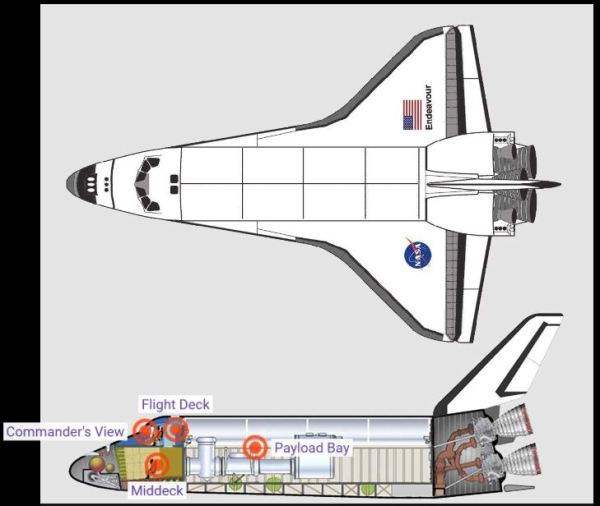
Map of Endeavour tour
Special SpaceX Bonus Videos
Tour from Space: Inside the SpaceX Crew Dragon Spacecraft on Its Way to the Space Station
NASA astronauts Robert Behnken and Douglas Hurley take viewers on a tour of the SpaceX Crew Dragon spacecraft that will take them on a 19-hour-journey to their new home in orbit. 5-30-20. 8:26
Watch Dragon capsule dock to the International Space Station
See NASA Astronauts Robert Behnken and Douglas Hurley dock the Dragon capsule to the International Space Station. 5-31-20. 7:20
SpaceX Crew Dragon ‘Endeavour’ tour: View of Earth and astronaut comforts
See Earth from SpaceX Crew Dragon’s window as NASA astronauts Doug Hurley and Bob Behnken give a 2nd on-orbit tour of the spaceship. Hurley and Behnken also show where some of the cargo, spacesuits and sleepwear is stowed. 5-31-20. 9:08
Steelhead return to Washington Rivers
Outside Online, a production of Outside Magazine, has a large file of short films. Longtime blog reader, Carol Prismon-Reed recently brought to our attention one in particular.
What Dam Removals Can Do for a River
Rising from the Ashes, from Trout Unlimited, follows the scientists studying the summer steelhead resurgence in Washington’s Elwha River. Since the removal of the Elwha Dam in 2011 and the Glines Canyon Dam in 2014, these fish are now free to run from the Pacific Ocean up into the Olympic Peninsula. May 24, 2020.
More videos are listed further down the page.

|
Nature Finds a Way
|
There is more purple to be seen on the peninsula!
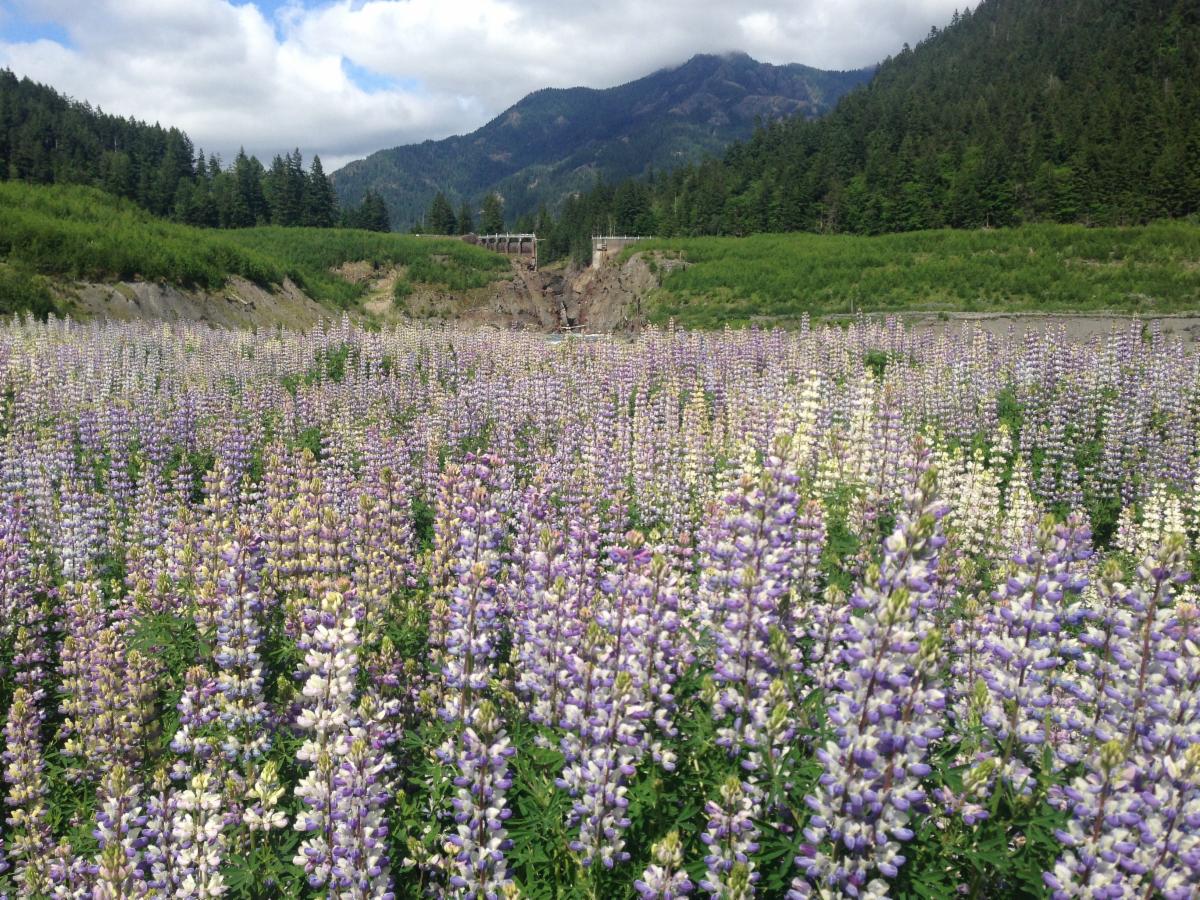
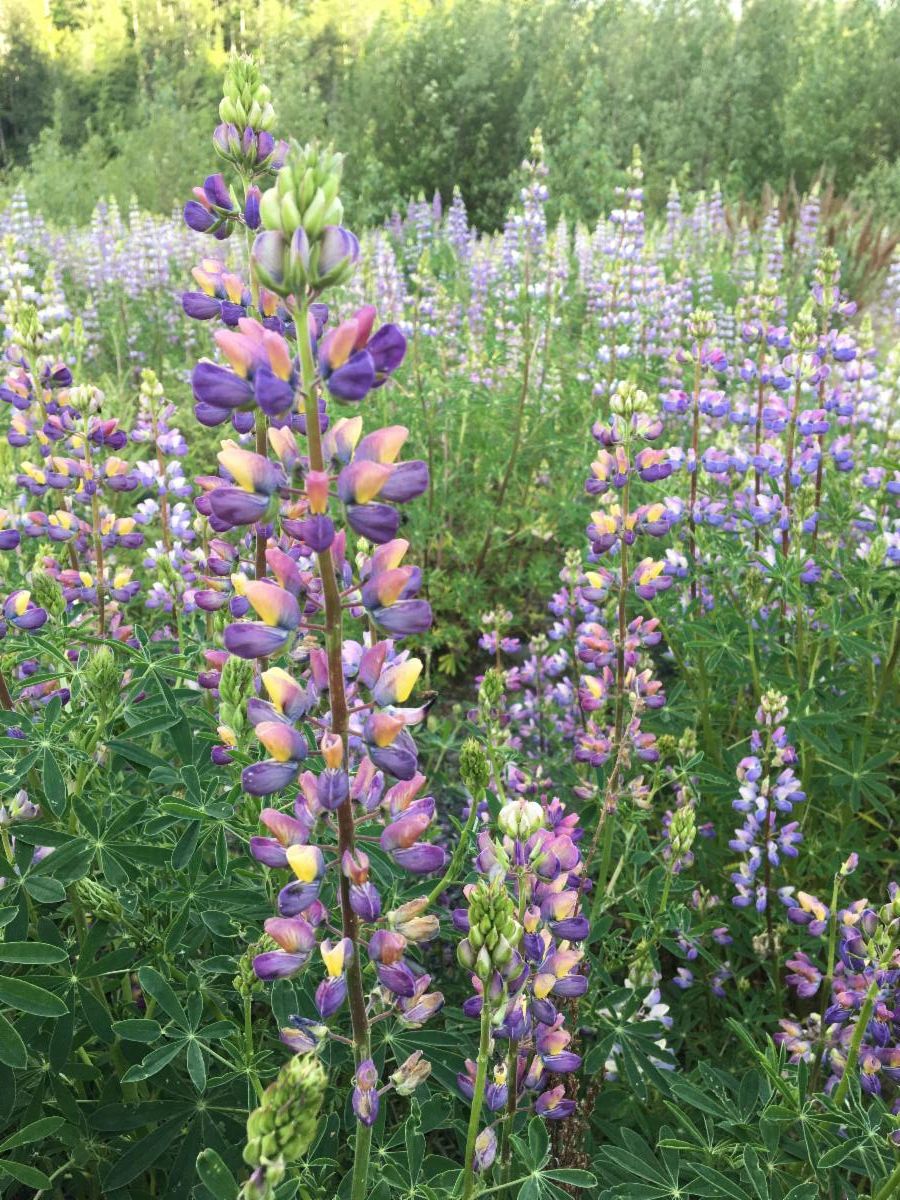
Riverbank lupine (Lupinus rivularis) is in full bloom around the Elwha watershed right now, and its delightful scent and beauty, aren’t even the best parts about it!
As many of you probably know, the Elwha River is the site of the largest dam removal project in the history of the world. The dams were removed (project completed in 2014) because they created a barrier for migrating fish, blocking them from over 70 miles of their historic habitat.
The dams, built in 1911 and 1927, created reservoirs on land that was previously old-growth forest. Removing the dams drained and exposed the gravelly and sediment-filled lakebeds. The land that was underwater for about 100 years, is now on the path to becoming old-growth forest again. Riverbank lupine is a crucial element to that succession.
Riverbank lupine thrives in areas where many other plants struggle. It can colonize disturbed, nutrient-poor soils due to its nitrogen-fixing abilities. Once the plant dies, the nitrogen is released, nourishing and improving the soil for plants to come.
Finding the right species to revegetate the area after draining the lakes was important not only for improving soil quality, but for preventing erosion, lending shade, and creating habitat for birds and small mammals to facilitate seed dispersal.
The National Park Service Elwha Revegetation team sowed riverbank lupine (seeds collected from the Dungeness River watershed), along with many other native species after Lake Mills was drained. Not sure what to expect, they found the riverbank lupine to be the key in the revegetation effort, helping to set the stage for the remarkable resurgence of life in the resilient Elwha watershed.
If you ever get a chance to visit with these plants, give them a big sniff, enjoy their vibrant colors, and remember the role they are playing in one of the greatest conservation success stories of our time.
(Please note: access to the upper lake-bed in the National Park is still closed due to corona virus restrictions. Lower-lake bed is open and also has fabulous lupine blooms!)
Photo Credit: Deanna Butcher
Upper photo (Former Lake Mills May 2017)
Lower photo (Former Lake Aldwell May 2020)
Support the Dungeness River Audubon Center by clicking below!
Dungeness River Audubon Center
 Face
Face  Instagram
 Other video titles on this page include:
Meet California’s Big Tree Hunter
In 1940, the American Forestry Association launched a campaign to locate the largest specimens of American trees. Since then, big-tree enthusiasts like Californian Carl Casey have been on the lookout for what’s defined as champion trees. In this film from director Brian Kelley, alongside the Gathering Growth Foundation, Casey explains what a champion tree is and some strategies he used to find the world’s largest pine tree.
One Man’s Battle Against the Russian Olive
The Russian olive tree is a notorious invasive species around Bears Ears and Grand Staircase–Escalante National Monuments. Since 1999, working along the Escalante River in southern Utah, aging park ranger Bill Wolverton has hacked and chainsawed his way through more than 40 miles of Russian olive trees. Love of Place, from DFS Films, documents his journey to restore his beloved river.
Paragliders Protecting Bearded Vultures
For aerial athletes, it’s not unusual to come across birds while in flight, like the threatened Bearded Vulture (Lammergeier). That’s why French freeflier Pierre Naville and the conservation organization Asters have teamed up with filmmaker Mathieu Le Lay to create this piece and raise awareness about proper flying techniques to mitigate the impact of aerial sports.
Outside’s Adventure page includes titles such as:
The Loneliest Everest Expedition
Amid the COVID-19 pandemic, three Chinese teams reached the top of the world.
We Are in the Middle of an Unprecedented Climate Experiment
The pandemic has shut down the most polluting industries around the world and turned us all into more adaptable consumers. That still isn’t enough.
Poke around on Outside Online. There’s lots of other interesting and useful stuff.
[Chuck Almdale]
Birding while black in NYC Central Park

Photo by David George Haskell
From Forbes article by GrrlScientist (see below)
You’ve probably read about this elsewhere. An Audubon member, Christian Cooper, a man who is black, is birding in New York City’s Central Park Ramble, an area beloved by local birders and where any dog must – by law – be on leash. He encounters a woman who is white with her dog who is not on leash. Problems ensue, to put it mildly.
You don’t to be a member of FaceBook or Twitter to view the next three items items.
The text of conversation preceding video.
The Cooper Central Park video.
May 28 interview with Christian & Melody Cooper on The View.
Following are three discussions of this event you probably haven’t seen. All three stories deserve to be read through to their ends. LZ Granderson’s is – for white birders (for whites in general, really) – merely a harrowing read; for him, it’s his life. [Chuck Almdale]
“How Am I Going to Be Perceived as a Black Man With Binoculars?”: J. Drew Lanham on Christian Cooper and Rules for the Black Birdwatcher
Vanity Fair. By Dan Adler, May 27, 2020
The ecologist and writer discusses the viral Central Park video, and how the hobby is only an escape for some.
In 2013, the writer, ecologist, and birder J. Drew Lanham published his “9 Rules for the Black Birdwatcher” in Orion magazine. “You’ll need the binoculars to pick that tufted duck out of the flock of scaup and ring-necks,” he wrote. “You’ll need the photo ID to convince the cops, FBI, Homeland Security, and the flashlight-toting security guard that you’re not a terrorist or escaped convict.”
Not Everyone Experiences The Joys Of Birding Like Me—A White Woman
Forbes. May 27, 2020
GrrlScientist: Senior Contributor. Evolutionary & behavioural ecologist, ornithologist & science writer
Birding is a wonderful way to get out into nature, to get some exercise and to experience wild birds, but there is a very good reason that few African-Americans engage in this activity. As a former resident of New York City, I birded Central Park for many years. The Ramble was always a highlight; peaceful, serene and often filled with amazing birds if one just sat still long enough to allow them to come to you or to sing.
George Floyd, Central Park, and the familiar terror they inspire
Los Angeles Times, May 28, 2020
LZ Granderson, Columnist
I didn’t feel well Tuesday. My body was tense, my stomach unsettled, the headache I was trying to push past kept pushing back. On most days I choose to be numb. Tuesday, I decided to feel. I recognize for some the video of George Floyd’s fatal encounter with four Minneapolis police officers is shocking. For me, it was not. I may not always choose to feel, but I am always aware. I learned early on that I didn’t have the luxury of not being aware.
Most DANGEROUS Birds On Earth | Secret Truths Video
The scariest, most dangerous birds in the world! From the brutal spurs of graceful waterfowl to the bone-dropping tactics of vultures. We won’t ruin the suspense and tell you who they are. The excited narrator will count you down from number ten to number one.
This is an installment of the Secret Truths series. If no film or link appears in this email, go to the blog to view it by clicking on the blog title above. If the film stops & starts in an annoying manner, press pause (lower left double bars ||) to let it buffer and get ahead of you. [Chuck Almdale]
The Masked Birders at Malibu Lagoon, 22 May, 2020

North across lagoon to PCH bridge, Serra Retreat Center on distant hill
(L. Johnson 5-22-20)
The sun was warm despite the scudding clouds, and a brisk breeze riffled the water. Typically for late May, there were few birds on the water, but the distant beach had a sizable flock of gulls, Brown Pelicans, and terns. People were few and mostly scattered, and the first we saw were three homeless people, two in animated maskless conversation and one resting at a picnic table.
We decided that birding qualifies as “active” rather than “passive” behavior – thus now legal on our SoCal beaches – so Lillian and I ventured to Malibu for the first time in three months. The parking lot was closed and the south side of Pacific Coast Highway was jammed with cars belonging to surfers, a surmise later supported by the numbers of surfers thrashing in the wind-blown waves. Plenty of parking was still available on the north side of PCH. It felt a little strange to be out and about and back at the lagoon, wearing mask and carrying scope. The Masked Birders ride again!
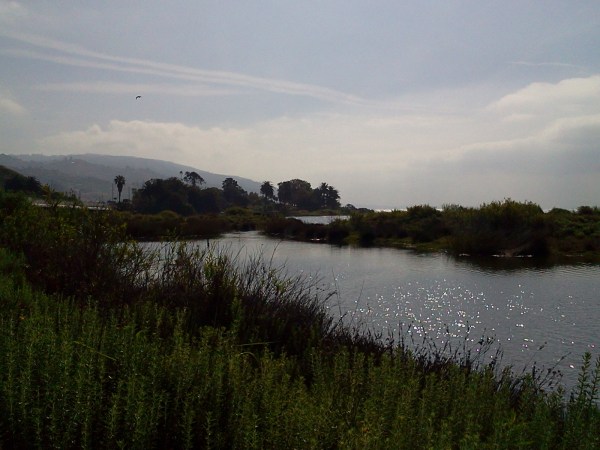
Eastward down the north channel, Adamson House in the distance
(L. Johnson 5-22-20)
Sure enough, duck and coots were few, and many of them were ducklings in various sizes. Eight Canada Geese rested on the west most sand island near the “Osprey snag.” They roused themselves a bit later, floated about for a few minutes, then flew off past Adamson House. On the long sand island paralleling the beach, just east of the large mixed flock, were two more adult geese, tending their troop of fluffy goslings. We counted four goslings, but there may have been an additional two. [Followup report.]
A solitary Western Grebe snoozed in mid-lagoon. Two pairs of American Coots were all that remained of February’s forty birds and October’s record count of 870.

SW across channel towards picnic corner and Malibu Colony
(L. Johnson 5-22-20)
Passerines were remarkably absent, except for Song Sparrows and House Finches in the brush, Barn Swallows in the sky, and one family of six Bushtits near the picnic corner, foraging in their usual rolling wave manner. We checked that corner for signs of Hooded Orioles, but found none. Neither were there any oriole nests visibly suspended from fronds of the nearby palms.

The sand spit points towards the sand island with bird flock
(L. Johnson 5-22-20)
The beach has become remarkably narrow in places, so narrow that it would be difficult to maintain social distancing should people plop themselves down on the sand and others tried to walk past them.

Searching for height markers on the tidal clock (L. Johnson 5-22-20)
The beach breech from lagoon to ocean is closed, as it always is by late May, and nearly all of the sea- and shorebirds were on a long and narrow island of sand, paralleling the beach. This gave them some safety from the encroachment of humans who – if they know “what’s what” (not all do) – stay out of the lagoon as the water can be polluted this time of year.
When the breach closes water collects in the lagoon; the water now is relatively high, about 7 feet above sea level. We couldn’t be certain about the exact elevation as the tiles indicating height along the Winter Ramp / Summer Clock are covered with mud and we couldn’t find them. Next time we go I’ll try to remember to take a trowel.

Looking west towards Malibu Colony & south portion of the lagoon
(L. Johnson 5-22-20)
We counted, recounted and re-re-re-recounted the few species there were. 94 Brown Pelicans was a fairly good number. The pelicans nest on the Channel Islands, particularly Anacapa, the smallest and closest of them, and the lagoon is a handy resting spot for them when they’re out and about searching for schools of fish. In addition to the 14 Double-crested Cormorants among the pelicans, there were another 10 in their two nesting trees in the shopping center across the street. Don’t park under them! – cormorants are famous for their guano-producing skills.

Not a lot of people on the beach (L. Johnson 5-22-20)
The terns in the flock were almost evenly divided between Caspian and Royal, and we were surprised to find not a single Elegant among them. The two Least Terns were quite busy diving on small lagoon fish although the breeze was riffling the water’s surface. The weather website later said the wind was 6mph, it seemed a bit stiffer than that to me. Traffic to and from Malibu was light, thanks to the pandemic, and what could have been a 2 ½ hour trip each way was under an hour.

A different angle on the sandy bird island, Adamson House and Malibu Pier
(L. Johnson 5-22-20)
We couldn’t do the usual six-consecutive-months census report as we missed March and April. Instead, you will find below a comparison of May trips for the past six years.
Birds new for the season: Least Tern, Caspian Tern, Black-crowned Night-Heron, Cooper’s Hawk, Barn Swallow. [Some of these species may have been present in March & April, but we weren’t there to see.]
Many thanks to photographer Lillian Johnson.
Our next three scheduled field trips: Who knows? Not I.
Our next program: We’ll have to wait and see.
NOTE: Our 10 a.m. Parent’s & Kids Birdwalk is canceled until further notice due to the near-impossibility of maintaining proper masked social distancing with parents and small children.
Links: Unusual birds at Malibu Lagoon
9/23/02 Aerial photo of Malibu Lagoon
Prior checklists:
2019: Jan-June, July-Dec
2018: Jan-June, July-Dec 2017: Jan-June, July-Dec
2016: Jan-June, July-Dec 2015: Jan-May, July-Dec
2014: Jan-July, July-Dec 2013: Jan-June, July-Dec
2012: Jan-June, July -Dec 2011: Jan-June, July-Dec
2010: Jan-June, July-Dec 2009: Jan-June, July-Dec.
The 10-year comparison summaries created during the Lagoon Reconfiguration Project period, despite numerous complaints, remain available on our Lagoon Project Bird Census Page. Very briefly summarized, the results unexpectedly indicate that avian species diversification and numbers improved slightly during the restoration period June’12-June’14.
[Chuck Almdale]
| Malibu Census | 2015 | 2016 | 2017 | 2018 | 2019 | 2020 |
| May 2015-2020 | 5/24 | 5/22 | 5/28 | 5/27 | 5/26 | 5/22 |
| Temperature | 59-70 | 61-66 | 63-68 | 61-66 | 57-59 | 61-65 |
| Tide Lo/Hi Height | L+0.54 | H+3.69 | L+1.32 | H+3.86 | L+0.66 | H+3.53 |
| Tide Time | 1139 | 1101 | 0627 | 0912 | 1040 | 1031 |
| Snow Goose | 3 | |||||
| (Black) Brant | 7 | 1 | ||||
| Canada Goose | 6 | 14 | ||||
| Gadwall | 22 | 8 | 15 | 12 | 13 | 34 |
| Mallard | 8 | 4 | 25 | 15 | 22 | 12 |
| Red-breasted Merganser | 1 | 4 | ||||
| Pied-billed Grebe | 1 | 1 | ||||
| Western Grebe | 1 | 1 | ||||
| Rock Pigeon | 9 | 1 | 13 | 3 | 18 | |
| Mourning Dove | 2 | 2 | 4 | 1 | 2 | |
| Anna’s Hummingbird | 2 | 1 | ||||
| Allen’s Hummingbird | 6 | 2 | 3 | 3 | 4 | |
| American Coot | 1 | 1 | 4 | 4 | ||
| Black-bellied Plover | 6 | 5 | 9 | 14 | ||
| Snowy Plover | 2 | 3 | ||||
| Killdeer | 6 | 6 | 14 | 4 | 4 | 2 |
| Whimbrel | 1 | 6 | 18 | |||
| Marbled Godwit | 30 | 4 | ||||
| Willet | 1 | 16 | 4 | 1 | ||
| Bonaparte’s Gull | 1 | 2 | ||||
| Heermann’s Gull | 45 | 8 | 1 | 2 | 4 | |
| Ring-billed Gull | 8 | 26 | 15 | |||
| Western Gull | 135 | 23 | 45 | 112 | 125 | 210 |
| California Gull | 6 | 3 | ||||
| Glaucous-winged Gull | 1 | 3 | ||||
| Least Tern | 3 | 9 | 12 | 2 | ||
| Caspian Tern | 11 | 9 | 4 | 11 | 13 | 60 |
| Forster’s Tern | 2 | |||||
| Royal Tern | 2 | 48 | 2 | 2 | 55 | |
| Elegant Tern | 85 | 10 | 45 | 130 | 165 | |
| Pacific Loon | 1 | |||||
| Brandt’s Cormorant | 1 | 1 | 1 | |||
| Double-crested Cormorant | 55 | 7 | 12 | 15 | 27 | 14 |
| Pelagic Cormorant | 4 | 2 | ||||
| Brown Pelican | 70 | 14 | 18 | 68 | 108 | 94 |
| Great Blue Heron | 2 | 2 | 3 | 1 | ||
| Great Egret | 5 | 1 | 3 | 2 | ||
| Snowy Egret | 4 | 2 | 2 | 4 | 8 | 3 |
| Green Heron | 1 | |||||
| Black-crowned Night-Heron | 1 | 1 | 1 | |||
| Turkey Vulture | 4 | |||||
| Osprey | 1 | 1 | ||||
| Cooper’s Hawk | 1 | |||||
| Red-tailed Hawk | 1 | |||||
| Peregrine Falcon | 1 | |||||
| Nanday Parakeet | 3 | |||||
| Black Phoebe | 2 | 1 | 5 | 5 | ||
| California Scrub-Jay | 2 | |||||
| American Crow | 5 | 4 | 5 | 2 | 6 | 2 |
| Violet-green Swallow | 2 | 1 | ||||
| Rough-winged Swallow | 6 | 6 | 3 | 5 | ||
| Cliff Swallow | 10 | 4 | 3 | 8 | 6 | |
| Barn Swallow | 12 | 4 | 10 | 10 | 14 | 10 |
| Bushtit | 2 | 2 | 20 | 1 | 6 | |
| Bewick’s Wren | 1 | |||||
| Western Bluebird | 1 | |||||
| American Robin | 1 | |||||
| Northern Mockingbird | 3 | 2 | 8 | 2 | 3 | 2 |
| European Starling | 3 | 2 | 12 | 12 | 9 | |
| House Sparrow | 3 | |||||
| House Finch | 20 | 7 | 30 | 5 | 8 | 16 |
| Spotted Towhee | 1 | |||||
| California Towhee | 2 | 2 | 1 | |||
| Song Sparrow | 9 | 2 | 12 | 5 | 5 | 12 |
| Hooded Oriole | 3 | 2 | ||||
| Red-winged Blackbird | 2 | 4 | ||||
| Brewer’s Blackbird | 2 | 12 | ||||
| Great-tailed Grackle | 3 | 3 | 4 | 4 | ||
| Common Yellowthroat | 1 | 4 | ||||
| Totals by Type | 5/24 | 5/22 | 5/28 | 5/27 | 5/26 | 5/22 |
| Waterfowl | 37 | 14 | 47 | 27 | 41 | 60 |
| Water Birds – Other | 134 | 22 | 31 | 88 | 138 | 113 |
| Herons, Egrets & Ibis | 11 | 5 | 6 | 9 | 11 | 4 |
| Quail & Raptors | 1 | 1 | 0 | 5 | 0 | 2 |
| Shorebirds | 8 | 28 | 21 | 56 | 4 | 39 |
| Gulls & Terns | 294 | 127 | 97 | 269 | 334 | 334 |
| Doves | 11 | 3 | 17 | 4 | 20 | 0 |
| Other Non-Passerines | 8 | 2 | 3 | 1 | 6 | 4 |
| Passerines | 86 | 60 | 92 | 66 | 63 | 62 |
| Totals Birds | 590 | 262 | 314 | 525 | 617 | 618 |
| Year | 2015 | 2016 | 2017 | 2018 | 2019 | 2020 |
| Total Species | 5/24 | 5/22 | 5/28 | 5/27 | 5/26 | 5/22 |
| Waterfowl | 3 | 4 | 4 | 2 | 3 | 3 |
| Water Birds – Other | 8 | 3 | 3 | 4 | 4 | 4 |
| Herons, Egrets & Ibis | 3 | 3 | 3 | 4 | 3 | 2 |
| Quail & Raptors | 1 | 1 | 0 | 2 | 0 | 2 |
| Shorebirds | 3 | 3 | 3 | 6 | 1 | 5 |
| Gulls & Terns | 9 | 7 | 4 | 8 | 7 | 6 |
| Doves | 2 | 2 | 2 | 2 | 2 | 0 |
| Other Non-Passerines | 2 | 1 | 1 | 1 | 2 | 1 |
| Passerines | 17 | 17 | 10 | 12 | 11 | 9 |
| Totals Species – 69 | 48 | 41 | 30 | 41 | 33 | 32 |



 SANTA MONICA BAY AUDUBON SOCIETY BLOG