Free email delivery
Please sign up for email delivery in the subscription area to the right.
No salesman will call, at least not from us. Maybe from someone else.
The Scientific Names of Birds
If you’ve ever wondered about the meaning, origin, or language of origin of a bird name, you need this book. If you write about birds and use their scientific names, you need this book. If you have an inquiring mind and the National Inquirer just isn’t doing it for you any more, you need this book.
 The Details: The Helm Dictionary of Scientific Bird Names: From Aalge to Zusii. Jobling, James A., London, 2010. Christopher Helm, an imprint of A&C Black Publishers Ltd. 432 pages.

Reduced by 41% from the perfectly clear and legible PDF file.
I’ve had this book for at least ten years, maybe twenty, which is possible as my copy was published in 1991 by Oxford University Press. I’ve referred to it hundreds of times. This newer edition is 432 pages, 47% longer than the 293 pages of my edition, so a lot was added.
The introductory section was expanded and now contains a short glossary in addition to comments on codes of nomenclature, priority of names, homonyms, gender, grammar, abbreviations and symbols. The bibliography is seven pages longer.
The actual dictionary section is 132 pages (52%) longer. I won’t even attempt to figure out what was added, but I know that a lot of new species and name changes occurred in the twenty years between these two editions.
The book is available at the usual on-line places. You know their names. Price ranges from $50-75, depending on bookstore and condition of the book.
Now here’s the mysterious part to me. You can also download a PDF copy of the book, all 432 pages plus title pages and the colorful cover for nothing. That’s right. Nothing. The link above leads you to a PDF file on a website called Cite Seer X, which may (or may not) be a product of the Pennsylvania State University College of Information Services and Technology. Whatever. Perhaps the author decided to make the book available for free as it was out-of-print and he didn’t feel like writing a new edition.
The address is: http://citeseerx.ist.psu.edu/viewdoc/download?doi=10.1.1.695.7104&rep=rep1&type=pdf

Reduced by 41% from the perfectly clear and legible PDF file.
Or you can click the link in the paragraph above.
Same difference.
A great companion to this book focuses exclusively on American birds, and is aptly titled: The Dictionary of American Bird Names, Revised Edition. Choate, Ernest A. Harvard and Boston, MA, 1985. The Harvard Common Press. 226 pages.
The dictionary of this book is divided into two sections: Common (English) Names and Scientific Names. The other book gives you only the Scientific name information.
From The Dictionary of American Bird Names:
Dunlin. AS dunn, “dark”; -lin (having dropped a terminal g), the diminutive suffix, giving us “the little dark one” for the bird in the breeding plumage. Formerly Red-backed Sandpiper. [Note: AS = Anglo-Saxon, circa 450-1200.]
Calidris. Merrem. Gr. calidris, “a gray speckled sandpiper.” The genera Crocethia, Eurentes, and Erolia are now merged in Calidris (1973). C. alpina (Linnaeus): DUNLIN or RED-BACKED SANDPIPER; L. alpina, “alpine,” for its breeding in an alpine-like climate which may be on the Arctic tundra as well as in the mountains. [Note: Merrem and Linnaeus created the scientific names to which they are attached. Gr. = Greek. L. = Latin.]
An Appendix gives short biographies of all the people for whom birds were named. For example, Anna’s Hummingbird was named for Anna, Duchess of Rivoli (1806-1896); wife of Prince Victor Massena, son of Marshal André Massena, Duc de Rivoli and Prince d’Essling, a marshal of France under Napoleon. John James Audubon met her in Paris in 1828 and was impressed by her beauty and charm. The type specimen of this bird was in the Duc’s collection, but in 1846 was acquired by the Academy of Natural Sciences of Philadelphia in 1846.
Now, don’t you feel better for knowing that?
There’s also a bibliography and a glossary of English bird names with their associated scientific names.
The American book is now 35 years old and may be hard to find. Buy one if you see it.
[Chuck Almdale]
California’s flightless duck Chendytes and our coastal lagoons, with Professor David Jacobs – Evening Meeting Reminder: Tuesday, 3 March, 7:30 p.m.
What is natural on our California Coast? How did the human-caused extinction of the flightless duck Chendytes lawi* change the ecology of our coast? What is the history of our small coastal lagoons, such as Malibu Lagoon: their hydrologic function, their endangered species, their potential for restoration?
It is well-known from the La Brea Tar Pits that not very long ago there were many different organisms in Los Angeles that are now gone, and consequently that there was a very different ecology. What is less well-known is that human activity significantly impacted the marine realm over these last few millennia, changing the players in our local Marine fauna. David will develop arguments relating to this theme centered around the extinction – about three thousand years ago – of California’s large flightless marine duck, Chendytes lawi.
We will then focus on the intriguing nature and function of our understudied coastal lagoons, which provide critical habitat for local endangered species. Even the smallest of these systems provide services and merit our attention, and there are many opportunities to mitigate human impacts on these systems.
David Jacobs is a UCLA professor with a background in biology and geology. He and members of his lab are interested in recent geologic, climate and anthropogenic processes and their influence on coastal landscape and biological evolution. Much of this work seeks to understand the past in order to better preserve our environment and biodiversity. At UCLA Dave is a member of the Ecology and Evolutionary Biology Department, the Earth Planetary and Space Science Department, and The Institute of the Environment and Sustainability.
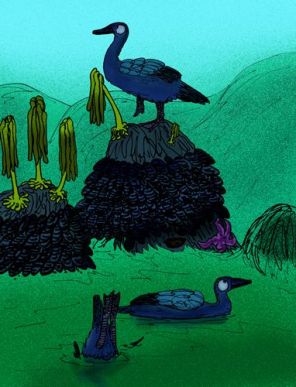
Flightless Sea Duck Chendytes lawi
(Apokryltaros at English Wikipedia)
*The flightless sea duck Chendytes lawi, originally thought to be related to mergansers but now recognized as related to the Anas genus of dabbling ducks (Mallard, etc.), disappeared about 2500 years ago. The duck had lived on the channel islands as early as 11,000 years ago and on the mainland 8,500 years ago. Humans exploited it for over 8000 years and eventually caused its extinction. This lengthy period of human exploitation has important implications concerning other North American Pleistocene megafauna extinctions. (From the abstract of a PNAS 2008 paper.) Also: Wikipedia article.
Article: Mitogenomics supports an unexpected taxonomic relationship for the extinct diving duck Chendytes lawi and definitively places the extinct Labrador Duck. Buckner, J.C.; Ellingson, R.; Gold, D.A.; Jones, T.L.; Jacobs, D.K.
Our meetings are at Christine Emerson Reed Park, 1133 7th Street. (between 7th St. & Lincoln Blvd., California Ave. & Wilshire Blvd.), Santa Monica. Previously known as Lincoln Park. If coming from outside Santa Monica, exit the #10 Fwy at Lincoln Blvd., turn north and drive 5 blocks north to Wilshire Blvd.
Meeting Room: Mid-park in Joslyn Hall, accessible from Lincoln Blvd, California Ave. and 7th St. Its glass wall faces north towards St. Monica Church on California St. If you’re walking from Lincoln Blvd., it’s located directly behind (west) of the large Miles Playhouse building. Not accessible directly from Wilshire Blvd.
Meetings begin at 7:30 sharp with a little business, and then our main presentation. Refreshments are served afterward. Please leave your coyote at home, however much they whine to come.
Parking: The entire block between Wilshire Blvd. and California Ave, 7th St. and Lincoln Blvd., on the sides closest to the park, is metered. $2/hour meter enforcement (except on Wilshire) ends at 6PM, so free parking for the meeting! However, the local natives are engaged in a survival-of-the-fittest scramble for free parking, so the after-6pm free parking spaces disappear quickly. We suggest that you arrive no later than 7:15 pm.
If all those spaces are filled, we found free parking as follows:
California Ave. between 6th and 7th
9th St. north of Wilshire Blvd.
10th St. north of California Ave.
Washington Ave. (next street north of and parallel to California)
If that fails, go south of Wilshire, not north of the park, as resident-only permit parking zones abound to the north. The east side of Lincoln Blvd. across from the park is by permit parking only. Spaces are more available on 7th St. or Lincoln south of Wilshire. Some of those are “until 9PM” meters also. You may need a flashlight to read & operate the meter. Wherever you park, please read parking signs carefully and avoid a big fat $40+ parking ticket. [Chuck Almdale]
Ducks Galore at Malibu Lagoon, 23 February, 2020
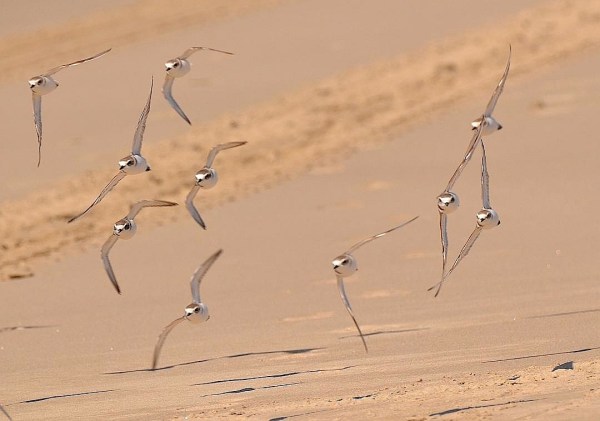
Western Snowy Plovers in flight (L. Loeher 2-14-20 Malibu Lagoon)
Good weather and moderate temperatures made for a fine day, and thirty birders showed up to enjoy it. The 9:34 am high tide was dropping by the time we reached the beach, and no one got their feet wet. Lagoon water level was moderately high but was emptying into the ocean. The lagoon end of the breach is far to the west while the ocean end is far to the east, leaving a long channel lying diagonally across the beach, with water too fast and deep for anyone to want to cross it. Many birds were hiding on the other side of the berm north of this channel, including most of the Western Snowy Plovers and the peeps (small sandpipers like Least and Western Sandpipers and Sanderling). Larry & Grace, our Snowy Plover warden/counters, found 23 birds on Friday, 21 Feb., but we found only four when they intermittently poked their heads above the berm.

Western Snowy Plovers (L. Loeher 2-21-20 Malibu Lagoon)
The bird of the day was the female White-winged Scoter. This species is outnumbered at least 100-to-1, perhaps even 500-to-1, by Surf Scoters along our SoCal shore, and they’re most often sighted among the large rafts of Surf Scoters and Western Grebes wintering off Dockweiler Beach, south of Marina del Rey, about 20 miles southeast of Malibu. They’re very uncommon at Malibu and this is the only the third sighting and fourth bird on our walks since 1979. Even more unusual, this bird was swimming and diving within the lagoon rather than beyond the surf zone. Scoters are sea-ducks, diving birds, and we rarely see them in the lagoon. Unfortunately, the bird stayed well away from us, across the lagoon, and no one got a photograph.

Cinnamon Teal have a baby-blue forewing, mostly hidden in the folded wing.
(L. Loeher 2-21-20 Malibu Lagoon)
Other than the scoter, none of today’s twelve species of duck are uncommon at the lagoon. Cinnamon Teal appear less often and usually in smaller numbers than they did thirty years ago, so it’s always nice to see these beautiful birds.
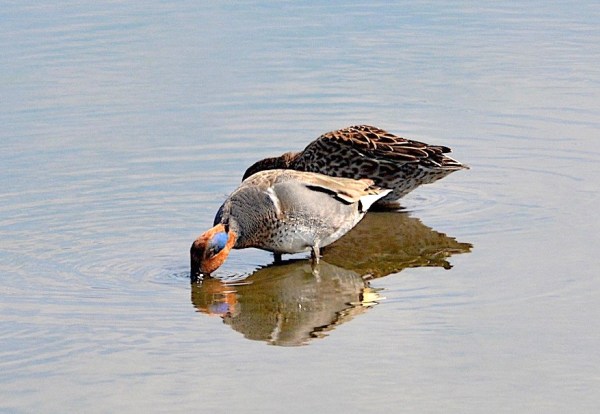
The male of this Green-winged Teal pair has an iridescent green eye patch
(G. Murayama 2-21-20 Malibu Lagoon)
Grebes numbers have been low this winter, and February continues this trend. A mere six Western Grebes – not seen since November – were offshore, just beyond the rocks, and a single Pied-billed Grebe dove in the lagoon below the PCH bridge.

The Pied-billed Grebe has a whitish bill with a dark band around it
(L. Loeher 2-21-20 Malibu Lagoon)
Red-breasted Mergansers are with us every winter. Most of them are females and female-appearing young males. The males will soon start to develop their alternate (breeding) plumage. These diving ducks can be anywhere in the lagoon, channel, breach channel, surf zone and outside the surf zone.
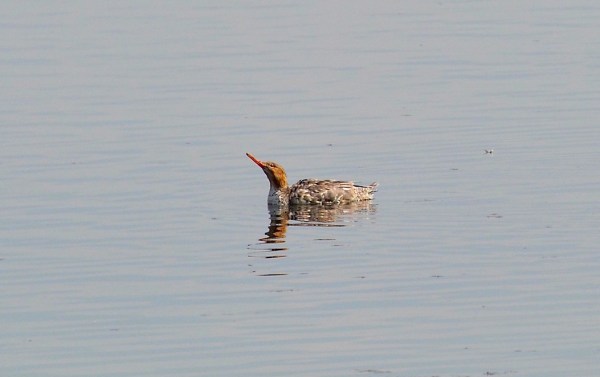
The serrated bill-edge of the Red-breasted Merganser grips its slippery fishy prey
(G. Murayama 2-21-20 Malibu Lagoon)
We have two species of hummingbirds at the lagoon. The traditional resident hummer is the Anna’s and they have been with us year-round as far back as records go. All other hummer species, save one, either migrate through (e.g. Rufous) or (mostly) breed and return south (e.g. Costa’s, Black-chinned). Beginning about twenty years, the Allen’s subspecies (Selasphorus sasin sedentarius) resident on the channel islands began appearing in greater numbers along the mainland coast. The chart below shows this major shift occurring in 2001. The identical numbers for Allen’s in the first two columns (5 times, 13 total) are not a typo, but are what we counted. This shift appears to precede the wider area change. According to Compiler Dan Cooper, the January 5, 2020 edition of the Los Angeles Christmas Count yielded 225 Anna’s and 366 Allen’s, with the shift occurring in 2013. There is no evidence that this population shift has anything to do with climate change, but there’s no evidence showing that it doesn’t, either.
| Lagoon Hummingbirds |
Period | Period | Period | Period |
| Dates | 1979-2000 | 2001 | 2002-10 | 2011-19 |
| Total Trips |
63 | 8 | 98 | 107 |
| Anna’s Hummingbird | ||||
| Times Sighted | 25 | 6 | 89 | 69 |
| Total Birds | 35 | 17 | 224 | 115 |
| Allen’s Hummingbird | ||||
| Times Sighted | 5 | 5 | 79 | 99 |
| Total Birds | 13 | 13 | 244 | 368 |

Alan’s Hummingbird male (R. Juncosa 2-23-20 Malibu Lagoon)
Our Brown Pelicans are beginning to get colorful again ans will soon fly off to breed. With the Western Gulls, many nest on Anacapa Island, the small, most northeasterly of the Channel Islands. Supposedly (I have read) the rats were cleared off this island decades ago so these birds could safely nest there again. I haven’t been on the island for about 30 years, but if I recall correctly, you could not touch the shore with a boat. This keeps the ship rats from getting back onto the island. Although the birds nest on the island, they still need to forage and rest elsewhere, so we have both species daily at the lagoon, resting from their labors.

Brown Pelican gular pouches becomes colorful as they approach breeding season
(R. Juncosa 2-23-20 Malibu Lagoon)
This time of year most of our gulls are California Gulls, which nest in large numbers at Mono Lake. But we also have the 3.5″ shorter but similar Ring-billed Gull. This species takes three years to reach adult plumage. Here’s a nice comparison of the first-winter bird to an adult bird in winter.

Ring-billed Gulls: 1st winter (L) & winter adult (R) (R. Juncosa 2-23-20 Malibu Lagoon)
Although Red-winged Blackbirds, along with Brewer’s Blackbirds, Great-tailed Grackles and European Starlings, frequent the food court at the mall across the street, scarfing up scraps from tables and ground – sometimes right from your hands – the Red-winged Blackbirds haven’t shown up a lot at the lagoon in recent years. It’s probably because all the reed beds were removed in the 2012-13 lagoon reconfiguration. The beds are regrowing, and perhaps the birds will become more regular. We are already seeing (and hearing!) Marsh Wrens and – less frequently – Soras in the reeds. While it’s nice that these birds are returning, I hope that the reeds don’t completely overgrow the channels as they did before 2012. Young male Red-wings typically have rusty margins, as shown in the photo below. I suspect that some of the Rusty Blackbirds which are reported locally in the fall are actually these young birds. The lack of a yellow eye helps identify this as a Red-wing.

Red-winged Blackbird, young male with rusty feather margins
(R. Juncosa 2-23-20 Malibu Lagoon)
Red-tailed Hawks are regular visitors at the lagoon. They rarely, if ever, actually nest here, preferring to nest on snags and cliffs not far away in Malibu Canyon and the Santa Monica Mountains. This young bird (note lack of red tail) was very intent on keeping an eye on this crow, who was probably trying to drive the hawk away through persistent annoyance.
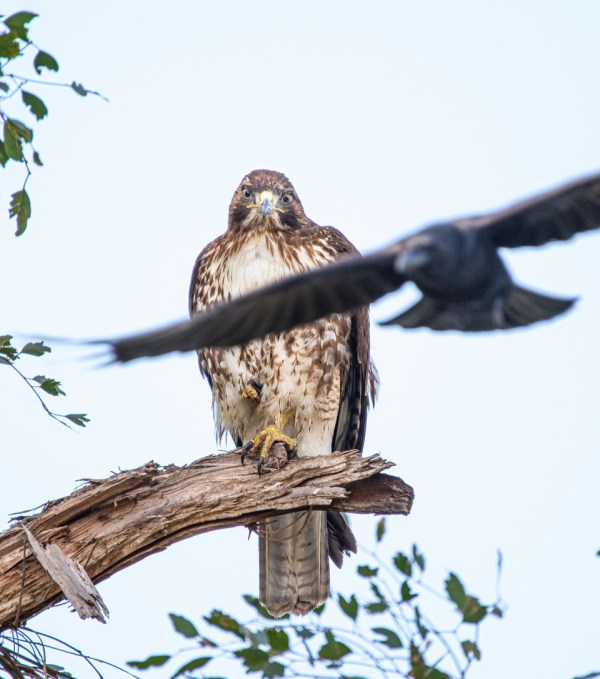
Young Red-tailed Hawk keeps his eyes on an annoying crow
(R. Juncosa 2-23-20 Malibu Lagoon)

Double-crested Cormorant, leg-banded EN3 (G. Murayama 2-21-20)
Birds new for the season: Cinnamon Teal, White-winged Scoter, Western Grebe, Nanday Parakeet, California Scrub-Jay, Tree Swallow, Oak Titmouse, House Wren, Blue-gray Gnatcatcher, Wrentit, Hermit Thrush, European Starling, California Towhee, Western Meadowlark, Red-winged Blackbird.
Many thanks to our photographers: Ray Juncosa, Larry Loeher and Grace Murayama.

Bushtit foraging on Mulefat (Baccharis sp)
(L. Loeher 2-21-20 Malibu Lagoon)
Our next three scheduled field trips: Sepulveda Basin 8am, Sat. 14 March; Malibu Lagoon 8:30 & 10am, Sun. 22 March; Sycamore Canyon 8am, Sat. 11 April.
Our next program: California’s flightless duck Chendytes and our coastal lagoons, with Professor David Jacobs. Tuesday, 3 March, 7:30 p.m., Chris Reed Park, 1133 7th St., NE corner of 7th and Wilshire Blvd. in Santa Monica.
NOTE: Our 10 a.m. Parent’s & Kids Birdwalk meets at the shaded viewpoint just south (towards the water) of the parking area. Watch out for Willie the Weasel. He’ll be watching for you and your big floppy feet.
Links: Unusual birds at Malibu Lagoon
9/23/02 Aerial photo of Malibu Lagoon
Prior checklists:
2019: Jan-June, July-Dec
2018: Jan-June, July-Dec 2017: Jan-June, July-Dec
2016: Jan-June, July-Dec 2015: Jan-May, July-Dec
2014: Jan-July, July-Dec 2013: Jan-June, July-Dec
2012: Jan-June, July -Dec 2011: Jan-June, July-Dec
2010: Jan-June, July-Dec 2009: Jan-June, July-Dec.
The 10-year comparison summaries created during the Lagoon Reconfiguration Project period, despite numerous complaints, remain available on our Lagoon Project Bird Census Page. Very briefly summarized, the results unexpectedly indicate that avian species diversification and numbers improved slightly during the restoration period June’12-June’14.
Many thanks to Chris Lord, Chris Tosdevin and others for contributions to this month’s checklist. [Chuck Almdale]
| Malibu Census 2019-20 | 9/22 | 10/27 | 11/24 | 12/22 | 1/26 | 2/23 |
| Temperature | 70-77 | 61-71 | 62-72 | 54-64 | 56-58 | 56-62 |
| Tide Lo/Hi Height | L+3.21 | H+6.41 | H+6.43 | H+6.08 | H+6.43 | H+5.70 |
| Tide Time | 0930 | 0907 | 0705 | 0603 | 0705 | 0934 |
| Snow Goose | 1 | |||||
| Gr. White-fronted Goose | 2 | |||||
| Canada Goose | 6 | |||||
| Cinnamon Teal | 19 | |||||
| Northern Shoveler | 13 | 12 | ||||
| Gadwall | 20 | 8 | 14 | 29 | 39 | |
| American Wigeon | 6 | 14 | 7 | |||
| Mallard | 40 | 35 | 15 | 22 | 13 | 10 |
| Northern Pintail | 2 | 1 | ||||
| Green-winged Teal | 2 | 4 | 20 | 36 | 35 | |
| Redhead | 1 | |||||
| Ring-necked Duck | 4 | 1 | ||||
| Greater Scaup | 1 | |||||
| Surf Scoter | 34 | 5 | ||||
| White-winged Scoter | 1 | |||||
| Bufflehead | 8 | 4 | ||||
| Hooded Merganser | 2 | |||||
| Red-breasted Merganser | 5 | 13 | 2 | 6 | ||
| Ruddy Duck | 3 | 10 | 22 | 35 | ||
| Pied-billed Grebe | 8 | 6 | 7 | 6 | 1 | 1 |
| Horned Grebe | 1 | 1 | ||||
| Eared Grebe | 4 | 8 | 2 | |||
| Western Grebe | 14 | 6 | ||||
| Rock Pigeon | 6 | 8 | 8 | 6 | 8 | 15 |
| Eurasian Collared-Dove | 2 | |||||
| Mourning Dove | 1 | 2 | 2 | 2 | 2 | 4 |
| Anna’s Hummingbird | 2 | 1 | 1 | 1 | 1 | |
| Allen’s Hummingbird | 5 | 4 | 3 | 5 | 3 | 3 |
| Sora | 1 | |||||
| American Coot | 84 | 870 | 210 | 45 | 12 | 40 |
| Black-bellied Plover | 78 | 74 | 85 | 35 | 43 | 57 |
| Snowy Plover | 42 | 40 | 43 | 39 | 14 | 4 |
| Semipalmated Plover | 3 | |||||
| Killdeer | 5 | 10 | 17 | 17 | 16 | 12 |
| Whimbrel | 20 | 3 | 3 | 3 | 4 | 3 |
| Long-billed Curlew | 1 | |||||
| Marbled Godwit | 24 | 24 | 10 | 12 | 12 | 52 |
| Ruddy Turnstone | 4 | 8 | 12 | 10 | 5 | 8 |
| Black Turnstone | 2 | 3 | ||||
| Sanderling | 57 | 35 | 24 | 28 | 12 | 14 |
| Least Sandpiper | 5 | 3 | 1 | 2 | ||
| Pectoral Sandpiper | 1 | |||||
| Western Sandpiper | 1 | 1 | 5 | |||
| Short-billed Dowitcher | 1 | |||||
| Spotted Sandpiper | 3 | 1 | 1 | |||
| Willet | 52 | 13 | 6 | 4 | 20 | 6 |
| Red-necked Phalarope | 8 | |||||
| Heermann’s Gull | 14 | 16 | 22 | 4 | 8 | 3 |
| Ring-billed Gull | 45 | 25 | 50 | 6 | 44 | |
| Western Gull | 29 | 85 | 110 | 120 | 11 | 82 |
| California Gull | 93 | 115 | 420 | 1100 | 110 | 215 |
| Herring Gull | 2 | 1 | 2 | |||
| Glaucous-winged Gull | 1 | 3 | 2 | 3 | ||
| Royal Tern | 1 | 5 | 9 | 4 | 1 | 6 |
| Red-throated Loon | 1 | |||||
| Pacific Loon | 1 | |||||
| Brandt’s Cormorant | 1 | 1 | 2 | |||
| Double-crested Cormorant | 39 | 35 | 35 | 37 | 18 | 35 |
| Pelagic Cormorant | 1 | 2 | 1 | |||
| Brown Pelican | 30 | 52 | 12 | 26 | 32 | 38 |
| Great Blue Heron | 3 | 7 | 6 | 4 | 2 | 2 |
| Great Egret | 4 | |||||
| Snowy Egret | 18 | 8 | 3 | 24 | 1 | 6 |
| Green Heron | 1 | 1 | 1 | |||
| Black-crowned Night-Heron | 3 | 1 | ||||
| Turkey Vulture | 2 | 2 | 1 | 5 | ||
| Osprey | 1 | 1 | ||||
| Cooper’s Hawk | 1 | |||||
| Red-tailed Hawk | 1 | 3 | ||||
| Belted Kingfisher | 1 | 2 | 1 | 1 | 1 | 1 |
| Nuttall’s Woodpecker | 1 | 1 | 1 | |||
| American Kestrel | 1 | |||||
| Peregrine Falcon | 1 | |||||
| Nanday Parakeet | 7 | |||||
| Black Phoebe | 8 | 5 | 8 | 2 | 3 | 4 |
| Say’s Phoebe | 1 | 2 | 2 | 2 | 3 | 2 |
| Cassin’s Kingbird | 1 | |||||
| Western Kingbird | 3 | |||||
| California Scrub-Jay | 1 | 1 | 1 | |||
| American Crow | 6 | 8 | 5 | 4 | 2 | 6 |
| Common Raven | 1 | |||||
| Tree Swallow | 2 | |||||
| Rough-wingllow | 1 | |||||
| Barn Swallow | 2 | |||||
| Oak Titmouse | 1 | |||||
| Bushtit | 5 | 8 | 40 | 10 | 20 | |
| House Wren | 4 | 1 | 1 | 2 | ||
| Marsh Wren | 1 | 5 | 3 | 2 | 2 | |
| Bewick’s Wren | 2 | 1 | 1 | 1 | 2 | |
| Blue-gray Gnatcatcher | 4 | 3 | 11 | 2 | ||
| Ruby-crowned Kinglet | 1 | 1 | 1 | |||
| Wrentit | 3 | 2 | 1 | |||
| Western Bluebird | 7 | |||||
| Hermit Thrush | 1 | |||||
| Northern Mockingbird | 2 | 2 | 2 | 1 | 2 | 2 |
| European Starling | 23 | 50 | 18 | 3 | ||
| Cedar Waxwing | 18 | |||||
| American Pipit | 1 | |||||
| House Finch | 5 | 5 | 6 | 6 | 8 | |
| Lesser Goldfinch | 2 | 1 | 3 | |||
| Spotted Towhee | 1 | |||||
| California Towhee | 3 | 1 | ||||
| Song Sparrow | 8 | 8 | 6 | 5 | 1 | 16 |
| White-crowned Sparrow | 2 | 10 | 4 | 5 | 4 | 6 |
| Golden-crowned Sparrow | 1 | 1 | ||||
| Western Meadowlark | 1 | 2 | 1 | |||
| Red-winged Blackbird | 6 | |||||
| Brown-headed Cowbird | 1 | |||||
| Brewer’s Blackbird | 34 | |||||
| Great-tailed Grackle | 1 | 7 | 4 | 2 | 3 | |
| Orange-crowned Warbler | 3 | |||||
| Common Yellowthroat | 7 | 3 | 8 | 2 | 3 | |
| Yellow Warbler | 5 | |||||
| Yellow-rumped(Aud) Warbler | 15 | 5 | 11 | 8 | 6 | |
| Totals by Type | Sep | Oct | Nov | Dec | Jan | Dec |
| Waterfowl | 40 | 73 | 45 | 93 | 157 | 174 |
| Water Birds – Other | 162 | 969 | 290 | 119 | 66 | 120 |
| Herons, Egrets & Ibis | 29 | 16 | 11 | 28 | 3 | 8 |
| Quail & Raptors | 2 | 2 | 2 | 3 | 2 | 8 |
| Shorebirds | 305 | 213 | 205 | 149 | 128 | 161 |
| Gulls & Terns | 137 | 268 | 587 | 1282 | 140 | 353 |
| Doves | 9 | 10 | 10 | 8 | 10 | 19 |
| Other Non-Passerines | 6 | 8 | 6 | 8 | 5 | 13 |
| Passerines | 143 | 152 | 132 | 43 | 43 | 102 |
| Totals Birds | 833 | 1711 | 1288 | 1733 | 554 | 958 |
| Total Species | Sep | Oct | Nov | Dec | Jan | Dec |
| Waterfowl | 1 | 8 | 8 | 6 | 10 | 12 |
| Water Birds – Other | 5 | 7 | 10 | 7 | 6 | 5 |
| Herons, Egrets & Ibis | 5 | 3 | 4 | 2 | 2 | 2 |
| Quail & Raptors | 2 | 1 | 2 | 2 | 2 | 2 |
| Shorebirds | 16 | 11 | 11 | 9 | 9 | 9 |
| Gulls & Terns | 4 | 6 | 6 | 7 | 7 | 6 |
| Doves | 3 | 2 | 2 | 2 | 2 | 2 |
| Other Non-Passerines | 2 | 3 | 4 | 4 | 3 | 5 |
| Passerines | 27 | 18 | 21 | 13 | 15 | 25 |
| Totals Species – 114 | 65 | 59 | 68 | 52 | 56 | 68 |
The World’s Most Beautiful Bird Songs – Part Two | Bird Kind
Birds are arguably the most talented singers in the natural world. Part two presents a medley of 18 more favourites, including: Western Meadowlark, Canyon Wren, Thrush Nightingale, Song Thrush, Rufous Songlark, White-browed Robin-Chat, Rufous Wren, Suburb Lyrebird & 9 more. Time: 18:40
Part One was posted on 1/15/20.
This sound/film comes from Bird Kind, about whom we know nothing whatsoever, other than they appreciate a good bird song. You can link to their You Tube channel here. If no film or link appears in this email, go to the blog to view it by clicking on the blog title above. If the film stops & starts in an annoying manner, press pause (lower left double bars ||) to let it buffer and get ahead of you. [Chuck Almdale]
Interesting Birds at Ballona Fresh Water Marsh
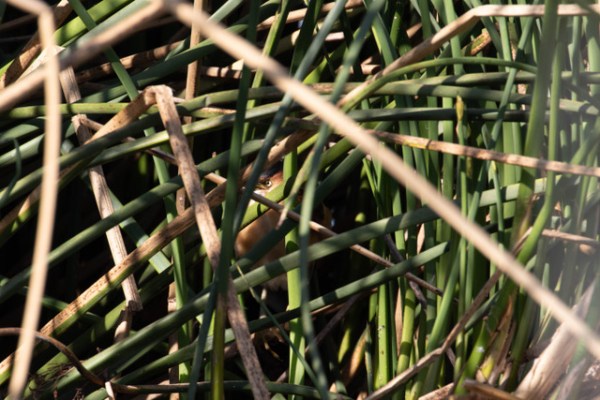
Reed skulker (Chris Tosdevin Feb. 8, 2020; Ballona Fresh Water Marsh, Playa del Rey, CA)
It’s a denizen of the reeds, rarely venturing out into the sunlight. They have been at Ballona Fresh Water Marsh for many years, almost as long as there have been sufficiently dense and extensive reed beds, but are seen by relatively few people. Look closely and see if you know, or can figure out, what it is. Feel free to use your field guide, which – but of course! – you always keep close at hand.
The history of the Ballona Salt Water (SWM) and Fresh Water Marshes (FWM) is a long and checkered one, and includes many arguments and battles between governmental agencies, property owners, developers and local citizens. After many years the SWM was protected and restored, and the FWM was designed and constructed and finally dedicated in 2003. (Please see Friends of Ballona Wetlands History of Ballona.) A few local birders, including several members of our Santa Monica Bay Audubon Society, were immediately enlisted to do a monthly bird census at the FWM. A checklist of the birds of the FWM and adjacent riparian corridor eventually was compiled and currently lists 259 species, including 18 introduced species. as of January 2019. The total list from 2003 through Feb. 1, 2020, stands at 260 native species, according to the Mistresses of the Marsh. I suppose the 18 introduced species (including six parrots!) would be additional. This area has become one of the best birding areas around. For birders visiting from out-of-town, it is located at the corner of Lincoln and Jefferson Blvds. about 10 minutes north of Los Angeles Airport and just south of Marina del Rey.
The above and following pictures were taken on February 8, 2020, at the Ballona Fresh Water Marsh in Playa del Rey, from approximately 10:30am to 11am.
Meanwhile…while you think about that skulker in the reeds, we’ll look at a few other species.
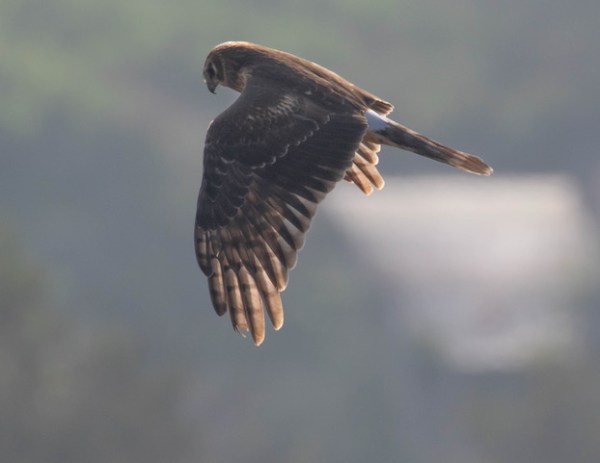
Female Northern Harrier
(Chris Tosdevin Feb. 8, 2020; Ballona Fresh Water Marsh, Playa del Rey, CA)
Well, it is a marsh, so one might reasonably expect to see what was formerly known as the Marsh Hawk or Marsh Harrier. Females, like the bird above, are brown, while the adult male is gray above and white below. Both have the white rump (aka uppertail coverts; not the undertail coverts also known for obvious reasons as the vent), and both have long wing and a peculiar owl-like face. When resting on a tree limb and their features other than the face are difficult or impossible to see, they are often mistaken for owls. They catch their prey by flying low over a field, often hovering or “kiting” with or without a wind, then swooping down to snatch a small mammal or lizard. This is known as “harrying one’s prey;” hence the name of “harrier.”
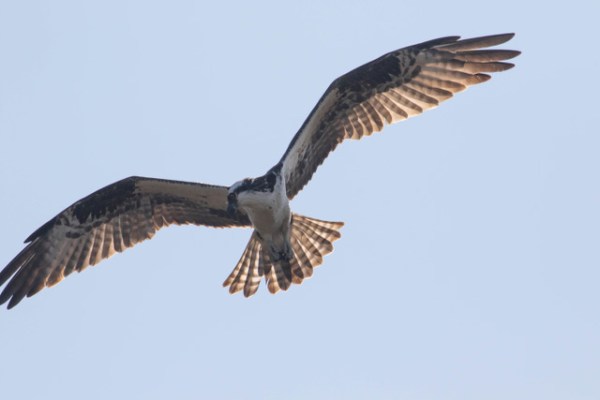
Osprey (Chris Tosdevin Feb. 8, 2020; Ballona Fresh Water Marsh, Playa del Rey, CA)
Ospreys can be seen near any large body of water, although if they can’t catch fish there, they won’t stay long. They are often mistaken by non-birders for Bald Eagles, another fish-eater with a white tail and head, but the Osprey has a black band through the eyes. They catch fish by diving on them head and talons first. With fish in talon, they lift themselves out of the water by briskly flapping their long wings. They then quickly grasp the fish with both feet, one in front of the other, and carry it head forward in a very aerodynamic manner. Lunch is eaten on a nearby tree limb.
The name “osprey” has an interesting origin. It means “bone-predator,” from the Latin os “bone” + frangere “to break.” This name was originally applied to the Lammergeier or Bearded Vulture, widespread but uncommon in mountain ranges from South Africa to east Asia, which superficially looks like the Osprey. The Lammergeier has the unusual habit of swallowing large bones, which it drops onto rocks from a great height before flying down to eat the exposed marrow or swallow the bone. The Osprey doesn’t do anything remotely similar to this. In Tibet, the “bonebreakers,” practicing a trade equivalent to our undertakers, leave out human corpses for the vultures to pick apart, and for the Lammergeiers to eat the bones.

Female Lesser Scaup
(Chris Tosdevin Feb. 8, 2020; Ballona Fresh Water Marsh, Playa del Rey, CA)
In Southern California, Lesser Scaup greatly outnumber Greater in their winter range and numbers. Both can be found at the Fresh Water Marsh, and they are difficult to tell apart. Greater are slightly larger (18.5″ versus 16″) and their white wing-stripe extends past the secondary wing feathers into the primaries, but the size difference is useless and the wing-stripe is visible only on a flying bird. The head of the male of both species is glossy and – depending on angle to the sun – can look black, green or purple. Both females have white patches around the bill. So you’re left with head and bill shape when you’re trying to tell them apart. The Greater has a rounder head with a bit of a bulge at the front, whereas the head of the Lesser bulges at the back. I can’t tell from this photo which this bird has. But it does has a relatively wide black tip to what appears to be an ample bill, which makes me think it might be a Greater Scaup. But I wasn’t there and Chris had better and longer views.
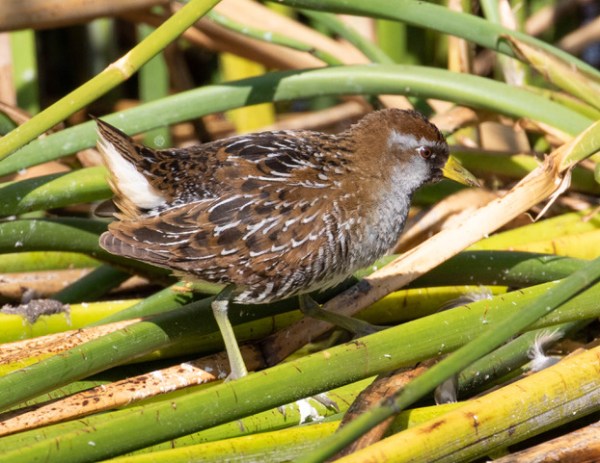
Sora (Chris Tosdevin Feb. 8, 2020; Ballona Fresh Water Marsh, Playa del Rey, CA)
Lastly we come to the Sora, the least shy of the seven species of rails in the U.S. At 8.75″ it’s not a large bird, but birders are usually surprised and pleased when one emerges from the dark depths of the reed bed out into the open. The diminutive Black Rail (6″) and Yellow Rail (7.25″) rarely leave the safety of the reeds, are notoriously difficult to see, and are often among the very last of the North American breeding birds to be found by an American birder. Soras are fairly common in SoCal reed beds, and have been recorded at the Ballona FWM and Malibu Lagoon almost as long as these locations have had reed beds.
The inclusion of this photo of the Sora is a clue to the reader that our reed skulker is not a Sora.
Here is the skulker more out in the open.

Skulker in the reeds. Check the toes.
(Chris Tosdevin Feb. 8, 2020; Ballona Fresh Water Marsh, Playa del Rey, CA)
This should give it away.
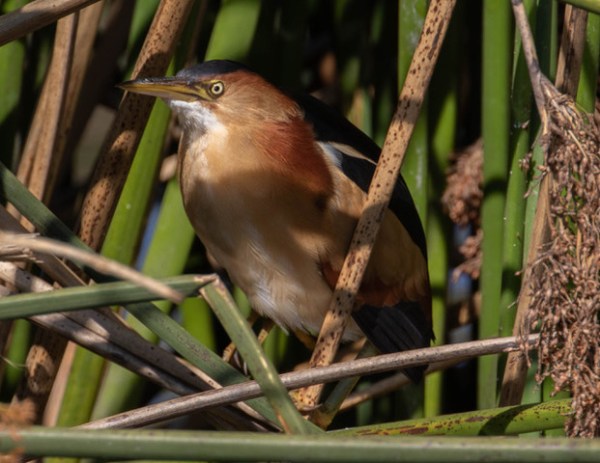
Out in the open! Only 13 inches tall.
(Chris Tosdevin Feb. 8, 2020; Ballona Fresh Water Marsh, Playa del Rey, CA)
Photographer Chris Tosdevin supplied the following commentary.
“The last time I had seen a Least Bittern was back in 1998, long before the 2012 restoration of Malibu Lagoon…”

Least Bittern (Chris Tosdevin Feb. 8, 2020; Ballona Fresh Water Marsh, Playa del Rey, CA)
“I met a local birder at Ballona Fresh Water Marsh and got chatting about what was around…he mentioned that he had had some close encounters with a Least Bittern the week previously…”
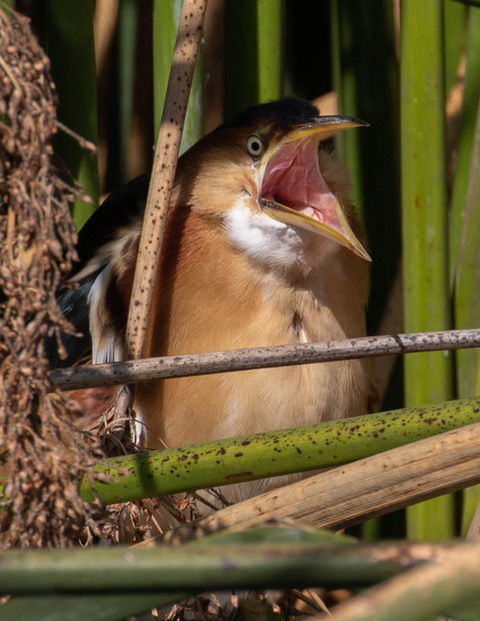
Least Bittern, agape
(Chris Tosdevin Feb. 8, 2020; Ballona FWM, Playa del Rey, CA)
“He later alerted us that he had briefly seen a female on one of the reed islands, and whilst waiting for it to reappear, we heard a second Least Bittern calling off to our left…we stalked the reed bed close to the shore and caught some sulking movement.”

Least Bitterns often cling to two different reeds, suspending between them
(Chris Tosdevin Feb. 8, 2020; Ballona Fresh Water Marsh, Playa del Rey, CA)
“We just waited for 15-20 minutes and the bittern came into view…”

Least Bittern up close and personal
(Chris Tosdevin Feb. 8, 2020; Ballona Fresh Water Marsh, Playa del Rey, CA)
“It’s always good to chat with other birders/photographers to see what’s been around.”
[Chris Tosdevin]
Many thanks to Chris for sending me these great photos of this very elusive and difficult-to-photograph bird. [Chuck Almdale]



 SANTA MONICA BAY AUDUBON SOCIETY BLOG