Free email delivery
Please sign up for email delivery in the subscription area to the right.
No salesman will call, at least not from us. Maybe from someone else.
Malibu Lagoon Monthly Field Trips: Sunday, 23 February, 8:30 & 10am.

At low tides, both Black (above) and American Oystercatchers have been appearing on the musseled rocks (L. Loeher 1-30-19)
Still more birds than you can shake a stick at. What can I say? Birds you’ve never dreamed of! Garbled Modwit, Club-sandwich Tern, Faque’s Tourniquet, Delicious Gull, Fraculated Wigulet, Desert Island Diskette, Insignificant Sandpiper, Plaid Oysterroaster, the inimitable Glink, Western Roof-Owl (see our monograph), maybe 65 other species. A quiet beach on a quiet day. Who can complain about that? Dress in layers.
Most of January’s birds will still be with us, including: up to 22 species of passerines, 12 species of gulls & terns, 11 ducks, 8 sandpipers, 4 grebes, 4 herons & egrets, 4 raptors, 4 plovers, 3 loons, 3 doves, 3 cormorants, 2 hummingbirds and the inevitable partridge in a persimmon tree. Come and meet them all.
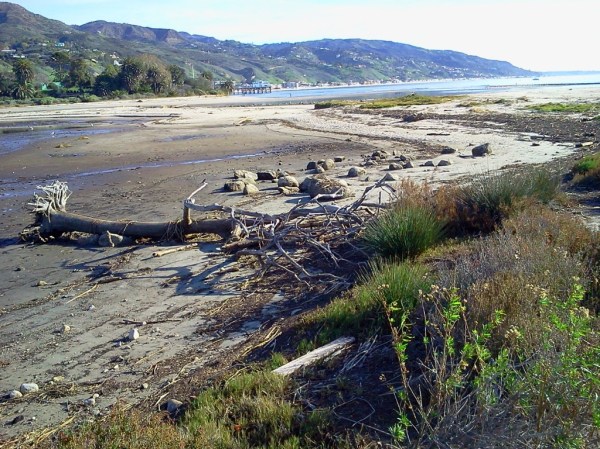
South lagoon, find the Black Phoebe! (L. Johnson 1-27-19)
Adult Walk 8:30 a.m., 4th Sunday of every month. Beginner and experienced, 2-3 hours. Species range from 40 in June to 60-75 during migrations and winter. We meet at the metal-shaded viewing area (see photo below) next to the parking lot and begin walking east towards the lagoon. We always check the offshore rocks and the ocean. When lagoon outlet is closed we continue east around the lagoon to Adamson House. We put out special effort to make our monthly Malibu Lagoon walks attractive to first-time and beginning birdwatchers. So please, if you are at all worried about coming on a trip and embarrassing yourself because of all the experts, we remember our first trips too. Someone showed us the birds; now it’s our turn.
Children and Parents Walk 10:00 a.m., 4th Sunday of every month. One hour session, meeting at the metal-shaded viewing area between parking lot and channel. We start at 10:00 for a shorter walk and to allow time for families to get it together on a sleepy Sunday morning. Our leaders are experienced with kids so please bring them to the beach! We have an ample supply of binoculars that children can use without striking terror into their parents. We want to see families enjoying nature. (If you have a Scout Troop or other group of more than seven people, you must call Jean (310-472-7209) to make sure we have enough binoculars and docents.)
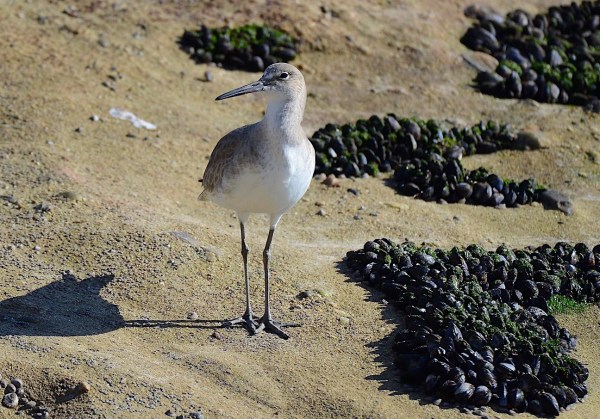
Willet (L. Loeher 1-30-19) Uh oh! I forgot which way it was.
Map to Meeting Place
Directions: Malibu Lagoon is at the intersection of Pacific Coast Highway and Cross Creek Road, west of Malibu Pier and the bridge. Look around for people wearing binoculars.
Parking: Parking machine recently installed in the lagoon lot: 1 hr $3; 2 hrs $6; 3 hrs $9, all day $12 ($11 seniors); credit cards accepted. Annual passes accepted. You may also park (read the signs carefully) either along PCH west of Cross Creek Road, on Cross Creek Road, or on Civic Center Way north (inland) of the shopping center. Lagoon parking in shopping center lots is not permitted.
Prior checklists:
2019: Jan-June, July-Dec
2018: Jan-June, July-Dec 2017: Jan-June, July-Dec
2016: Jan-June, July-Dec 2015: Jan-May, July-Dec
2014: Jan-July, July-Dec 2013: Jan-June, July-Dec
2012: Jan-June, July -Dec 2011: Jan-June, July-Dec
2010: Jan-June, July-Dec 2009: Jan-June, July-Dec.
[Chuck Almdale]
Your Brain on Mars ft. Physics Girl! | PBS BrainCraft Video
Things are different, including how your brain would function.
This is an installment of the PBS – BrainCraft series created by Vanessa Hill. If no film or link appears in this email, go to the blog to view it by clicking on the blog title above. If the film stops & starts in an annoying manner, press pause (lower left double bars ||) to let it buffer and get ahead of you. [Chuck Almdale]
Look Inside a Rattlesnake’s Rattle | Deep Look Video
A rattlesnake’s rattle isn’t like a maraca, with little bits shaking around inside. So how exactly does it make that sound?
This is another installment of the PBS Deep Look series. If no film or link appears in this email, go to the blog to view it by clicking on the blog title above. If the film stops & starts in an annoying manner, press pause (lower left double bars ||) to let it buffer and get ahead of you. [Chuck Almdale]
Voices: American Bittern | Cornell Lab of Ornithology
Experience the song of an American Bittern emanating from a cattail marsh in spring, as narrated by the Cornell Lab’s Laura Erickson.
Learn more about American Bitterns at All About Birds: https://www.allaboutbirds.org/guide/American_Bittern/id
A film from the Cornell Lab of Ornithology. If no film or link appears in this email, go to the blog to view it by clicking on the blog title above. If the film stops & starts in an annoying manner, press pause (lower left double bars ||) to let it buffer and get ahead of you. The Lab is a member-supported organization; they welcome your membership and support. [Chuck Almdale]
Myles breaks down why deepfakes can cause so much damage, and talks to Jabril, the host of YouTube channel Jabrils, about how to spot them.
Today’s internet meme culture thrives on Photoshopping images for comic effect. But there is a newer form of image manipulation using AI technology to create hyper realistic alterations to video. These so-called ”deepfakes” can be very difficult to detect or debunk.
What are deepfakes?
Deepfakes are videos that have been manipulated using AI technology. This tech can scale, rotate or splice videos and images together to alter videos so that they can be very different from the original and tough to spot as fakes.
How do deepfakes spread?
As AI becomes cheaper and more accessible to more people, deepfakes are more difficult to detect. Social media platforms like Youtube, Facebook and Twitter help to spread them, partially because of the ease and speed of sharing.
ABOVE THE NOISE is a show that cuts through the hype and takes a deeper look at the science behind controversial and trending topics in the news. Hosted by Myles Bess and Shirin Ghaffary.
This series is aimed at teens, but after viewing a few episodes, I’m sure that most adults will benefit from it as well. Let us know what you think.
This is another installment of KQED’s Above the Noise series. If no film or link appears in this email, go to the blog to view it by clicking on the blog title above. If the film stops & starts in an annoying manner, press pause (lower left double bars ||) to let it buffer and get ahead of you. [Chuck Almdale]



 SANTA MONICA BAY AUDUBON SOCIETY BLOG