Free email delivery
Please sign up for email delivery in the subscription area to the right.
No salesman will call, at least not from us. Maybe from someone else.
The Upside of Forgetting | PBS BrainCraft Video
Why we forget things and how there’s a silver lining. What was I talking about?
This is an installment of the PBS – BrainCraft series created by Vanessa Hill. If no film or link appears in this email, go to the blog to view it by clicking on the blog title above. If the film stops & starts in an annoying manner, press pause (lower left double bars ||) to let it buffer and get ahead of you. [Chuck Almdale]
Wind and waves whittle a narrow beach, 26 January, 2020
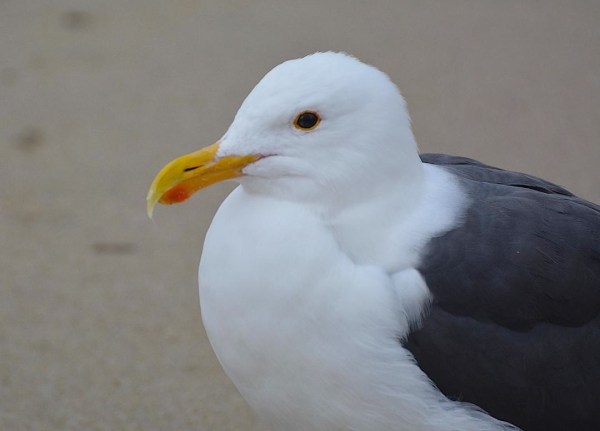
The rare Scythe-billed Gull? No, a Western Gull with an unusually long hook
(G. Murayama 1-20-20 Malibu Lagoon)
We began a blustery morning of birding with eighteen participants, including a few new faces willing to brave the elements. The predicted high tide of +6.43 feet at 7:02 am was considerably boosted by winds. Surf warnings on the beach were not joking and we found the high seas and surf a bit threatening out on the “spit” – all that remained of the beach.

Western Snowy Plovers on wet sand (G. Murayama 1-20-20 Malibu Lagoon)

Western Snowy Plover looks a bit mournful on the damp sand
(G. Murayama 1-20-20 Malibu Lagoon)

Western Snowy Plover banded Yy:ob at Moss Landing, Monterey Bay, 7/18/18
(G. Murayama 1-24-20 Malibu Lagoon)
The Snowy Plovers were far across the lagoon. In order to count them we had to circle back around, cross the Pacific Coast Highway bridge, and go through the Adamson House property. From the stairs of the boat house & dock on the east side of the lagoon, behind a wall of wind-blown reeds, we managed to count fourteen. Better views from the beach side of the house were impossible, as the lagoon breach and the waves lapped up to the rip-rap at the edge of the lawn and at our feet. [Text by Lucian Plauzoles, slightly modified]
The rest of this posting consists primarily of recent lagoon photos, not all from the day of the bird walk, with a few comments.

We usually find Say’s Phoebes sitting on a sprinkler spigot.
(L. Loeher 1-24-20 Malibu Lagoon)
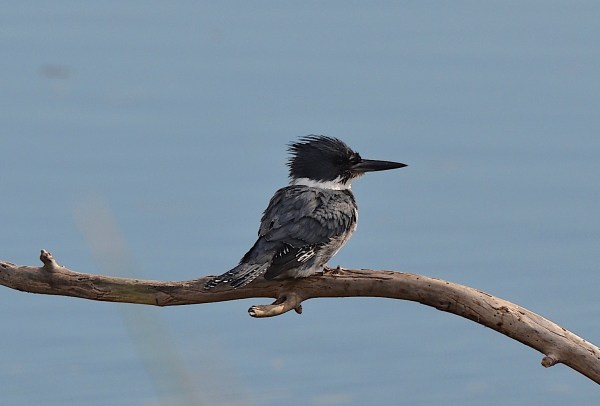
This Belted Kingfisher really enjoys this particular snag
(L. Loeher 1-24-20 Malibu Lagoon)

A male Pintail points, but the American Wigeons seem oblivious
(G. Murayama 1-24-20 Malibu Lagoon)
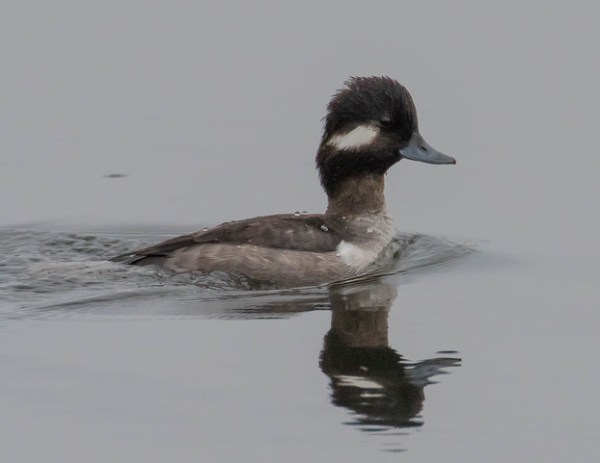
Bufflehead female chugging along (C. Tosdevin 1-26-20 Malibu Lagoon)
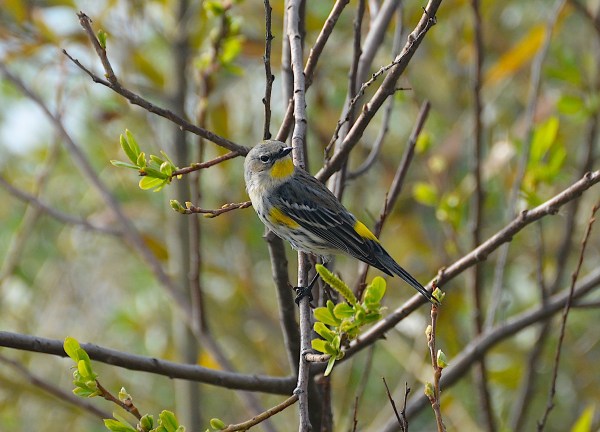
Yellow-rumped Warbler are common, even abundant, winter residents all over SoCal (G. Murayama 1-24-20 Malibu Lagoon)
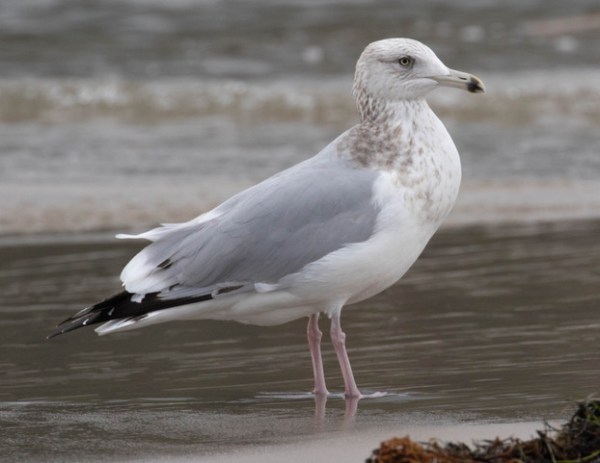
Herring Gull (C. Tosdevin 1-26-20 Malibu Lagoon)
Herring Gulls are common winter visitors at the lagoon, but always in very low numbers (out of 60 total visits, 42 were of single birds). They are the size of a Western Gull (25″ long) with similar pink legs, dark wing tips, white tail, pale eye, and large yellow bill with a single red spot, or a darkish tip as in this bird. But the head and neck are streaked and the mantle is pale gray like that of a California Gull (compare to the Western Gull in lead photo). On the east coast they are far more abundant and are literally trash birds, as they now utilize human dumps as a major source of food.

Egyptian Goose, a long way from home. Actually they’ve been common on our golf courses for at least 30 years, but recently they seem to be expanding their habitat choices. (L. Loeher 1-20-20 Malibu Lagoon)
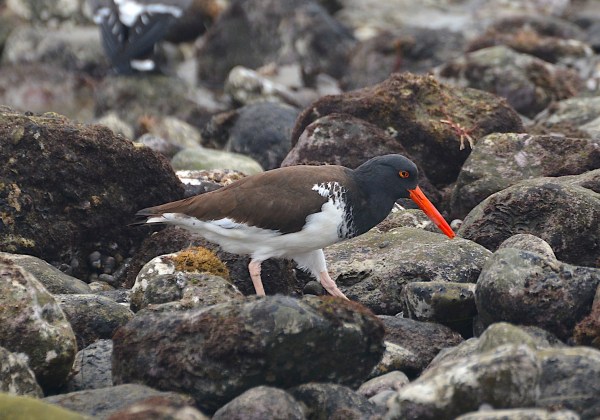
This American Oystercatcher, or perhaps more than one, has been a regular visitor on Malibu rocks at low tide for the past few months. (G. Murayama 1-20-20 Malibu Lagoon)
We get all three western cormorants quite regularly. They don’t always show up at the same time, and we rarely have the opportunity to photograph them together, as Chris Tosdevin did with this fortunate photo below. At Malibu, this conjunction is only possible on the offshore rocks. The tide must also be sufficiently low that the waves won’t right over the rocks, as cormorants won’t put up with that. Double-cresteds can be found inland from Malibu Lagoon, just inside the sandy beach, all the way to Cheyenne Bottoms in the middle of Kansas, and onward across eastern America and the Great Lakes to the Atlantic shore. The Brandt’s and Pelagic Cormorants are salt-water birds, rarely daring to cross the beach to the lagoon. We see them resting on offshore rocks and swimming in the ocean, patrolling for fish. In 40 years, I’ve seen a Pelagic in the lagoon perhaps 6 times, and can’t recall ever seeing any Brandt’s there. But my notes are poor on this point, so I could be slightly off. (You can forget about Red-faced Cormorants south of Alaska.)

Cormorants left to right: Brandt’s (probably), Double-crested, Brandt’s, Pelagic (C. Tosdevin 1-4-20 Malibu Lagoon)
The Double-crested Cormorant has a large gular pouch colored yellow-to-orange. The colored area on the Brandt’s pouch is smaller and of a less colorful beige. When breeding the forward part of the pouch is blue. The Pelagic Cormorant is smaller and slimmer than the other two, with a slimmer bill, and has no noticeable color on it’s pouch. In breeding the skin around the eyes is red and it has a white lower flank patch. But these breeding colors don’t stay around for long.

Pelagic Cormorant in flight. Note total lack of beige, yellow or orange chin (gular pouch) (C. Tosdevin 1-26-20 Malibu Lagoon)
In the above photo, you can see some of the primary feathers are growing in. Primary feathers grow from the bird’s equivalent of the human hand – the carpometacarpus and phalanges (roughly equivalent to human metacarpals and phalanges – hand and finger bones); secondary feathers grow from the ulna, equivalent to the human ulna (rearward of our two forearm bones). [Chuck Almdale]

Golden-crowned Sparrow, uncommon winterer at the lagoon
(C. Tosdevin 1-26-20 Malibu Lagoon)
Many thanks to our photographers: Larry Loeher, Grace Murayama, Lu Plauzoles, & Chris Tosdevin. Note: A few of Chris Tosdevin’s photos were featured in the Malibu Times on January 20.

Bushtit (L. Loeher 1-24-20 Malibu Lagoon)
Our next three scheduled field trips: Madrona Marsh 8am, Sat. 8 February; Malibu Lagoon 8:30 & 10am, Sun. 23 February; Sepulveda Basin 8am, Sat. 14 March.
Our next program: Cuban Birds & Island Biogeography, with Tom Hinnebusch. Tuesday, 4 February, 7:30 p.m., Chris Reed Park, 1133 7th St., NE corner of 7th and Wilshire Blvd. in Santa Monica.
NOTE: Our 10 a.m. Parent’s & Kids Birdwalk meets at the shaded viewpoint just south (towards the water) of the parking area. Watch out for Willie the Weasel. He’ll be watching for you and your big floppy feet.
Links: Unusual birds at Malibu Lagoon
9/23/02 Aerial photo of Malibu Lagoon
Prior checklists:
2019: Jan-June, July-Dec
2018: Jan-June, July-Dec 2017: Jan-June, July-Dec
2016: Jan-June, July-Dec 2015: Jan-May, July-Dec
2014: Jan-July, July-Dec 2013: Jan-June, July-Dec
2012: Jan-June, July -Dec 2011: Jan-June, July-Dec
2010: Jan-June, July-Dec 2009: Jan-June, July-Dec.
The 10-year comparison summaries created during the Lagoon Reconfiguration Project period, despite numerous complaints, remain available on our Lagoon Project Bird Census Page. Very briefly summarized, the results unexpectedly indicate that avian species diversification and numbers improved slightly during the restoration period June’12-June’14.
Many thanks to Lucien Plauzoles with assistance from Chris Lord & Chris Tosdevin for this month’s checklist. [Chuck Almdale]
| Malibu Census 2019-20 | 8/28 | 9/22 | 10/27 | 11/24 | 12/22 | 1/26 |
| Temperature | 72-78 | 70-77 | 61-71 | 62-72 | 54-64 | 56-58 |
| Tide Lo/Hi Height | H+3.39 | L+3.21 | H+6.41 | H+6.43 | H+6.08 | H+6.43 |
| Tide Time | 0725 | 0930 | 0907 | 0705 | 0603 | 0705 |
| Snow Goose | 1 | |||||
| Gr. White-fronted Goose | 2 | |||||
| Canada Goose | 6 | |||||
| Northern Shoveler | 13 | |||||
| Gadwall | 20 | 8 | 14 | 29 | ||
| American Wigeon | 6 | 14 | ||||
| Mallard | 18 | 40 | 35 | 15 | 22 | 13 |
| Northern Pintail | 2 | |||||
| Green-winged Teal | 2 | 4 | 20 | 36 | ||
| Redhead | 1 | |||||
| Ring-necked Duck | 4 | 1 | ||||
| Greater Scaup | 1 | |||||
| Surf Scoter | 34 | |||||
| Bufflehead | 8 | |||||
| Hooded Merganser | 2 | |||||
| Red-breasted Merganser | 5 | 13 | 2 | |||
| Ruddy Duck | 3 | 10 | 22 | |||
| Pied-billed Grebe | 2 | 8 | 6 | 7 | 6 | 1 |
| Horned Grebe | 1 | 1 | ||||
| Eared Grebe | 4 | 8 | 2 | |||
| Western Grebe | 14 | |||||
| Rock Pigeon | 5 | 6 | 8 | 8 | 6 | 8 |
| Eurasian Collared-Dove | 2 | |||||
| Mourning Dove | 2 | 1 | 2 | 2 | 2 | 2 |
| Anna’s Hummingbird | 1 | 2 | 1 | 1 | 1 | |
| Allen’s Hummingbird | 1 | 5 | 4 | 3 | 5 | 3 |
| Sora | 1 | |||||
| American Coot | 4 | 84 | 870 | 210 | 45 | 12 |
| Black-bellied Plover | 72 | 78 | 74 | 85 | 35 | 43 |
| Snowy Plover | 14 | 42 | 40 | 43 | 39 | 14 |
| Semipalmated Plover | 2 | 3 | ||||
| Killdeer | 4 | 5 | 10 | 17 | 17 | 16 |
| Whimbrel | 15 | 20 | 3 | 3 | 3 | 4 |
| Long-billed Curlew | 1 | 1 | ||||
| Marbled Godwit | 17 | 24 | 24 | 10 | 12 | 12 |
| Ruddy Turnstone | 2 | 4 | 8 | 12 | 10 | 5 |
| Black Turnstone | 2 | 3 | ||||
| Sanderling | 57 | 35 | 24 | 28 | 12 | |
| Least Sandpiper | 3 | 5 | 3 | 1 | 2 | |
| Pectoral Sandpiper | 1 | |||||
| Western Sandpiper | 17 | 1 | 1 | |||
| Short-billed Dowitcher | 3 | 1 | ||||
| Spotted Sandpiper | 1 | 3 | 1 | 1 | ||
| Willet | 16 | 52 | 13 | 6 | 4 | 20 |
| Red-necked Phalarope | 5 | 8 | ||||
| Heermann’s Gull | 2 | 14 | 16 | 22 | 4 | 8 |
| Ring-billed Gull | 45 | 25 | 50 | 6 | ||
| Western Gull | 18 | 29 | 85 | 110 | 120 | 11 |
| California Gull | 2 | 93 | 115 | 420 | 1100 | 110 |
| Herring Gull | 2 | 1 | 2 | |||
| Glaucous-winged Gull | 1 | 3 | 2 | |||
| Least Tern | 5 | |||||
| Caspian Tern | 12 | |||||
| Royal Tern | 4 | 1 | 5 | 9 | 4 | 1 |
| Elegant Tern | 64 | |||||
| Red-throated Loon | 1 | |||||
| Pacific Loon | 1 | |||||
| Brandt’s Cormorant | 1 | 1 | 2 | |||
| Double-crested Cormorant | 20 | 39 | 35 | 35 | 37 | 18 |
| Pelagic Cormorant | 1 | 2 | 1 | |||
| Brown Pelican | 6 | 30 | 52 | 12 | 26 | 32 |
| Great Blue Heron | 3 | 3 | 7 | 6 | 4 | 2 |
| Great Egret | 4 | 4 | ||||
| Snowy Egret | 11 | 18 | 8 | 3 | 24 | 1 |
| Green Heron | 1 | 1 | 1 | |||
| Black-crowned Night-Heron | 3 | 3 | 1 | |||
| Turkey Vulture | 2 | 2 | 1 | |||
| Osprey | 1 | 1 | ||||
| Cooper’s Hawk | 1 | |||||
| Red-tailed Hawk | 1 | 1 | ||||
| Belted Kingfisher | 1 | 2 | 1 | 1 | 1 | |
| Nuttall’s Woodpecker | 1 | 1 | ||||
| American Kestrel | 1 | |||||
| Peregrine Falcon | 1 | |||||
| Black Phoebe | 2 | 8 | 5 | 8 | 2 | 3 |
| Say’s Phoebe | 1 | 2 | 2 | 2 | 3 | |
| Cassin’s Kingbird | 1 | |||||
| Western Kingbird | 3 | |||||
| California Scrub-Jay | 1 | 1 | ||||
| American Crow | 4 | 6 | 8 | 5 | 4 | 2 |
| Common Raven | 1 | |||||
| Rough-winged Swallow | 1 | |||||
| Cliff Swallow | 11 | |||||
| Barn Swallow | 7 | 2 | ||||
| Bushtit | 20 | 5 | 8 | 40 | 10 | |
| House Wren | 4 | 1 | 1 | |||
| Marsh Wren | 1 | 5 | 3 | 2 | ||
| Bewick’s Wren | 1 | 2 | 1 | 1 | 1 | |
| Blue-gray Gnatcatcher | 4 | 3 | 11 | |||
| Ruby-crowned Kinglet | 1 | 1 | ||||
| Wrentit | 1 | 3 | 2 | |||
| Western Bluebird | 7 | |||||
| Northern Mockingbird | 2 | 2 | 2 | 2 | 1 | 2 |
| European Starling | 8 | 23 | 50 | 18 | ||
| Cedar Waxwing | 18 | |||||
| American Pipit | 1 | |||||
| House Finch | 3 | 5 | 5 | 6 | 6 | |
| Lesser Goldfinch | 2 | 1 | ||||
| Spotted Towhee | 1 | |||||
| California Towhee | 1 | 3 | ||||
| Song Sparrow | 3 | 8 | 8 | 6 | 5 | 1 |
| White-crowned Sparrow | 2 | 10 | 4 | 5 | 4 | |
| Golden-crowned Sparrow | 1 | 1 | ||||
| Western Meadowlark | 1 | 2 | ||||
| Hooded Oriole | 2 | |||||
| Brown-headed Cowbird | 15 | 1 | ||||
| Brewer’s Blackbird | 34 | |||||
| Great-tailed Grackle | 2 | 1 | 7 | 4 | 2 | 3 |
| Orange-crowned Warbler | 1 | 3 | ||||
| Common Yellowthroat | 1 | 7 | 3 | 8 | 2 | |
| Yellow Warbler | 5 | |||||
| Yellow-rumped(Aud) Warbler | 15 | 5 | 11 | 8 | ||
| Totals by Type | Aug | Sep | Oct | Nov | Dec | Jan |
| Waterfowl | 18 | 40 | 73 | 45 | 93 | 157 |
| Water Birds – Other | 32 | 162 | 969 | 290 | 119 | 66 |
| Herons, Egrets & Ibis | 21 | 29 | 16 | 11 | 28 | 3 |
| Quail & Raptors | 1 | 2 | 2 | 2 | 3 | 2 |
| Shorebirds | 172 | 305 | 213 | 205 | 149 | 128 |
| Gulls & Terns | 107 | 137 | 268 | 587 | 1282 | 140 |
| Doves | 7 | 9 | 10 | 10 | 8 | 10 |
| Other Non-Passerines | 2 | 6 | 8 | 6 | 8 | 5 |
| Passerines | 84 | 143 | 152 | 132 | 43 | 43 |
| Totals Birds | 444 | 833 | 1711 | 1288 | 1733 | 554 |
| Total Species | Aug | Sep | Oct | Nov | Dec | Jan |
| Waterfowl | 1 | 1 | 8 | 8 | 6 | 10 |
| Water Birds – Other | 4 | 5 | 7 | 10 | 7 | 6 |
| Herons, Egrets & Ibis | 4 | 5 | 3 | 4 | 2 | 2 |
| Quail & Raptors | 1 | 2 | 1 | 2 | 2 | 2 |
| Shorebirds | 14 | 16 | 11 | 11 | 9 | 9 |
| Gulls & Terns | 7 | 4 | 6 | 6 | 7 | 7 |
| Doves | 2 | 3 | 2 | 2 | 2 | 2 |
| Other Non-Passerines | 2 | 2 | 3 | 4 | 4 | 3 |
| Passerines | 17 | 27 | 18 | 21 | 13 | 15 |
| Totals Species – 112 | 52 | 65 | 59 | 68 | 52 | 56 |
About five weeks ago we mentioned that Gary Larson was posting old cartoons on his new Far Side website.
That’s still true, and I for one check it daily for old favorites and ones I somehow missed when they first appeared decades ago.
As part of the website he has created small collections of themed cartoons: Horses are hard to draw, Anthropomorphism, Pets and other animals, and so on. Today (Tues. 1-28-20) there appeared a new one: Odd Ducks, Common Loons. Created espressly (as some say) for we birders. We few! We brave, beleaguered and obsessed few!
He gives you two theme collections every day, but irregularly changes the choice.
Check it out.
[Chuck Almdale]
Ten new bird species from Wallacean Islands
A lot of people don’t know that Alfred Russel Wallace was the co-formulator of the theory of evolution by means of natural selection. It popped into his head one night, reportedly while he was bed-ridden with malarial fever as often happened during his years-long exploration of Indonesia, then known as The Malay Archipelago. He documents this journey in his fascinating book of the same name. He dashed off a letter to Charles Darwin, a man whom he greatly admired, briefly describing his idea.
Upon reading Wallace’s letter from Borneo, Darwin almost died on the spot (using literary license here), as for twenty years he had been diligently gathering evidence to support his nearly identical theory before presenting it to a hostile world still firmly in the grip of religious belief. He hurriedly finished his paper upon which he was working and presented it and Wallace’s letter to the Linnaean Society in July, 1858.
Hardly anyone noticed. The big mess hit the fan the following year when Darwin published an “abstract” of his work, a modest book entitled On the Origin of Species by Means of Natural Selection. The resulting mess has still not settled. It’s interesting to note that the word “evolution” appears only once in the book, on the very last page.
Wallacea is the name given to the area between the large islands of Indonesia on the west and Australia-New Guinea and adjacent islands (Austronesia) on the east. (maps) Wallace discovered that it was a blend zone between the flora & fauna of Eurasia and Austronesia, with Eurasian life disappearing as you moved eastward and Austronesian life gradually increasing. He didn’t know why this was so, only that it was so. 160 years later, we now know the explanation to be plate tectonics. Austronesia, moving north over tens of millions of years with its biota evolving in isolation from the rest of the world, begins to crash (at geologic speed) into Asia. The Indonesian islands are raised, life forms spread east and west, and the two biomes begin to mix. This continental crashing and biological mixing continue today. That’s why Indonesia is a major volcanic and earthquake region.
Wallacea, named in honor of Wallace, is one of the few remaining land areas on Earth not fully explored, and new species are still being found there. This New York Times article describes the finding of ten new bird species, including the interestingly named Sula Mountain Leaftoiler.
The article includes this comment from Wallace, written in 1863, but even more pertinent today:
Future ages will certainly look back upon us as a people so immersed in the pursuit of wealth as to be blind to higher considerations. They will charge us with having culpably allowed the destruction of some of those records of Creation which we had it in our power to preserve; and while professing to regard every living thing as the direct handiwork and best evidence of a Creator, yet, with a strange inconsistency, seeing many of them perish irrecoverably from the face of the earth, uncared for and unknown.
Read the entire New York Times article. The original article was published in Science on 10 Jan 2020, and is hiding behind a paywall.
[Chuck Almdale]
Thanks to Ray Juncosa for sending me this link.
Watch Bed Bugs Get Stopped in Their Tracks | Deep Look Video
At night, these parasites crawl onto your bed, bite you and suck your blood. Then they find a nearby hideout where they leave disgusting telltale signs. But these pests have an Achilles’ heel that stops them cold.
This is another installment of the PBS Deep Look series. If no film or link appears in this email, go to the blog to view it by clicking on the blog title above. If the film stops & starts in an annoying manner, press pause (lower left double bars ||) to let it buffer and get ahead of you. [Chuck Almdale]



 SANTA MONICA BAY AUDUBON SOCIETY BLOG