Free email delivery
Please sign up for email delivery in the subscription area to the right.
No salesman will call, at least not from us. Maybe from someone else.
Real Angry Birds: Sharp-tailed Grouse Battle | Cornell Lab of Ornithology
Sharp-tailed Grouse square off in intense battles for territory and breeding rights. These grouse form leks, mating arenas where males meet to compete for territory and attract females. This leads to continual fighting as they strive to outdo each other.
Learn more about Sharp-tailed Grouse on All About Birds: https://www.allaboutbirds.org/guide/Sharp-tailed_Grouse/id
A film from the Cornell Lab of Ornithology. If no film or link appears in this email, go to the blog to view it by clicking on the blog title above. If the film stops & starts in an annoying manner, press pause (lower left double bars ||) to let it buffer and get ahead of you. The Lab is a member-supported organization; they welcome your membership and support. [Chuck Almdale]
Fall migration grows at Malibu Lagoon, 22 September, 2019

Double-crested Cormorants vying for the stick (L. Loeher 9-14-19)

Most likely your friend, the European Honey Bee
(C. Bragg 9-22-19)
The summer birding season was slow, ranging from 33 species in May to 52 in August, so the excitement level bumped up a notch when 65 species appeared today, including 20 species we hadn’t seen in at least three months. Some of these “new for the season” (see below) species are always in the area but we just don’t happen to see them that day: Eurasian Collared-Doves have successfully colonized Los Angeles County, as with seemingly everywhere else in the world, and you can hear or see at least one nearly any day, anywhere. Cooper’s Hawks are sparse residents, but California Scrub-Jays are common everywhere, usually up to no good, although they can be affectionate if you put out peanuts for them. House Wrens are year-round although far less common in winter. Blue-gray Gnatcatchers are resident, especially in or near chaparral, but they’re small and easily missed. Brewer’s Blackbirds are resident and locally abundant, especially in parks. In Malibu they love the eating areas in the mall across the street where they’ll steal your fries if you turn your head. No fresh french fries at the lagoon, so they’re rarely here.
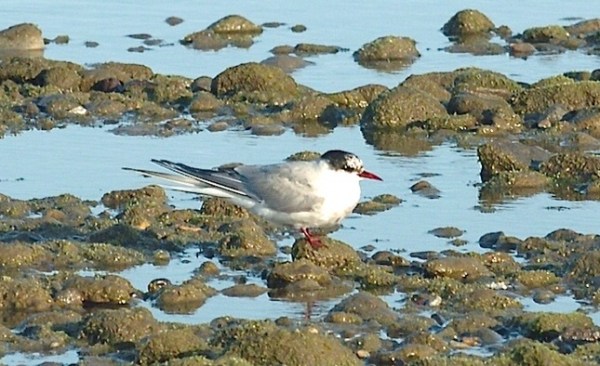
Arctic Terns rarely stop at Malibu Lagoon (G. Murayama 9/17/19)
The Arctic Tern which Grace & Larry had found while doing their lagoon Snowy Plover & Least Tern census, had left. Arctic and Common Terns are very similar and neither are at all common on SoCal shores, which leaves me relatively unfamiliar with both of them and uncertain about this bird, which seemed to have a mix of characteristics. Fortunately, our local expert, Kimball Garrett of the L.A. County Museum of Natural History, came to our rescue with a strong lean towards Arctic Tern.
The shape does seem to argue for Arctic (very short legs, small bill); tail length not as helpful for non-adults; this seems to be a second-summer bird — I don’t think one-year olds (first-summer) get bright red bills. Also, something about the shape of the dark on the head (irregular below, not extending as far back on the crown) seems wrong for Common. The hundreds of Arctics that were inshore (and even on the beach) at Pismo Beach have all departed. Yes, many moving well offshore, but it is very unusual to see one on the beach in L. A. (I’ve seen more in the Antelope Valley than on or from shore).

Likely Arctic Tern: short legs, red/black bill (G. Murayama 9/17/19)
Common Terns have been present of 18 of our 357 recorded walks, whereas the Arctic Tern has never been present. It still isn’t.
Snowy Plovers are back in force. We found 42 birds scattered over the sand east of the lagoon, including one banded bird nr:no. (left: neutral or light brown over red; right: neutral over orange). We didn’t get a photo of this bird, but Grace took one of nr:bo five days earlier. As their bands are so similar, one wonders if the birds are related.

Western Snowy Plover NR:BO at Malibu (G. Murayama 9-17-19)
The relatively warmth (70-77°F, 21-25°C), after notable fog earlier in the season, brought out insects who were especially drawn to the California Golden Bush (Ericameria ericoides), or maybe it’s Sawtooth Goldenbush Hazardia squarrosa (our experts differ), now abundant around the lagoon. The insect species were various, primarily in shades of white, yellow, orange and black.

Gray Hairstreak (Strymon melinus) wingspan 7/8″ to 1 3/8″ (C. Bragg 9-22-19)
The lead yoganista of the beach asana association has accessorized her operation with a gong. Not a small one either, but one about 20” in diameter, suspended from a frame and whacked with a soft-tipped mallet. When exercises ended, she began playing. I couldn’t hear it, and circled their group until I could, learning in the process that gongs radiate most of their sound perpendicular to their face, not their edge. She was quite good – not just a bang-crash but a slow rhythmic tapping, building in volume, and I gave her a thumbs-up. Meanwhile, one of her students decided to do a headstand, which was unsettling to view. I used to do these, but stopped decades ago. Unless you’re an anorexic ascetic with strong neck muscles, which this person was not, you might want to avoid this asana as damage to cervical vertebrae can result.
“Confiding” is the term British birders use when encountering a seemingly unafraid, yet gentle and friendly bird. It evokes the image of the bird sitting on your shoulder, whispering shyly into your ear, like a songbird out of an animated Disney film. We had such a bird.

The confiding Pectoral Sandpiper (C. Tosdevin 9-22-19)
We don’t get them often or in flocks, so Pectoral Sandpipers are always a treat to see. This one, a juvenile, was first spotted about fifteen feet away, walking over the floating nearshore algae. I pulled everyone out of their various conversations and onto the bird, and for about ten minutes we watched it as it foraged for tiny, too-small-to-see, insects in the algae mats at lagoon’s edge. It eventually got within three feet. Someone said, “It’s walking under your tripod, Chuck,” but I didn’t want to startle it by moving my head too quickly and so missed that event.
This is the history of the Pectoral Sandpipers’ fourteen appearances on our field trips; “U” means unknown which means no one was counting numbers that day, only presence.
10/25/87-U, 12/20/87-U, 9/25/88-U, 9/24/89-U, 9/23/90-U, 9/26/99-U, 7/23/00-U, 8/27/06–1, 10/22/06–1, 9/27/09–2, 9/26/10–1, 8/26/12–1, 10/27/13-1, 9/22/19-1.
Obviously they appear only as fall migrants, especially in September, and nearly always alone. When heading north in springtime they use the Mississippi and Eastern flyways, so we don’t see them at all.

View down Surfrider’s beach from west end lifeguard station to Malibu Pier and the Santa Monica Mtns. It’s bad juju to cross the circle of stone. (L. Johnson 9-22-19)
Down on the beach, right where the gulls roost and the Snowy Plovers relax, we saw a group of people marking out large rectangles in the sand, laying electric cables and driving stakes into the sand. They’d flushed all the birds which relocated farther down the beach, so as we passed by I inquired as to what they were up to. They turned out to be students from Cal Poly Pomona (I think), and they were doing research on the movement of ground water under the beach back and forth between the lagoon and the ocean. The cable and stakes were measuring electrical conductivity and the rectangles would be used when using sub-surface radar. (I think I got that right.) They was following up on past research at the lagoon, and they referred me to the following paper:
Dimova, N., et al., Hydrogeologic controls on chemical transport at Malibu Lagoon, CA: Implications for land to sea exchange in coastal lagoon systems. J. Hydrol.: Reg. Stud. (2016), http://dx.doi.org/10.1016/j.ejrh.2016.08.003
From the abstract of the full online paper, I gleaned the following:
- Nearshore lagoons that are seasonally disconnected from the coastal ocean occupy about 10% of coastal areas worldwide. Lagoon systems often are poorly flushed and thus sensitive to nutrient over-enrichment that can lead to eutrophication, oxygen depletion, and/or pervasive algal blooms. This sensitivity is exacerbated in lagoons that are intermittently closed to surface water exchange with the sea and occur in populous coastal areas.
- Such estuarine systems are disconnected from the sea during most of the year by wave-built barriers, but during the rainy season these berms can breach, enabling direct water exchange.
- Based on studies at Malibu Lagoon in 2009 and 2010, the estimate that groundwater discharge to Malibu Lagoon during open berm conditions was one order of magnitude higher (21±17 cm/day) than during closed berm conditions (1.8±1.4 cm/day). The submarine groundwater discharge into nearshore coastal waters at SurfRider Beach and Colony Malibu was 4.2 cm/day on average.
- The status of the berm breach (whether open or closed to the ocean) plays an important role in the seasonality and geochemical impact of land/sea exchange, and highlights the sensitivity of such systems to future impacts such as sea level rise and increasing coastal populations.
- In their conclusions they state: During the rainy season when Malibu Lagoon was open to the coastal ocean, groundwater discharge at the mouth of the lagoon was one order of magnitude (10 times) higher compared to the dry season, when the beach barrier separated the lagoon from the coastal ocean.
If you are insufficiently confused by the above, please go to the online paper for the complete story.
Birds new for the season: Eurasian Collared-Dove, Sanderling, Pectoral Sandpiper, Brandt’s Cormorant, Green Heron, Osprey, Cooper’s Hawk, Belted Kingfisher, Say’s Phoebe, Cassin’s Kingbird, Western Kingbird, California Scrub-Jay, House Wren, Marsh Wren, Blue-gray Gnatcatcher, Western Bluebird, White-crowned Sparrow, Western Meadowlark, Brewer’s Blackbird, Yellow Warbler.

Fiery Skipper (Hylephila phyleus per Chris Tosdevin) about 1″ long (C. Bragg 9-22-19)
Many thanks to our photographers: Chuck Bragg, Lillian Johnson, Larry Loeher, Grace Murayama & Chris Tosdevin.

A tiny (10mm) sweat bee, the Four-banded Nomia (Nomia tetrazonata) (C. Bragg 9-22-19)
Our next three scheduled field trips: Huntington Beach Central Park 8am SIGNUP REQUIRED, Sat 12 October; Malibu Lagoon 8:30 & 10am, 27 October; Ballona Freshwater Marsh 8am, Sat 9 November.
Our next program: Birds, Bees and Butterflies: Native Planting in Your Yard, presented by Connie Day & Lili Singer. Tuesday, 1 October, 7:30 p.m., Chris Reed Park, 1133 7th St., NE corner of 7th and Wilshire Blvd. in Santa Monica.
NOTE: Our 10 a.m. Parent’s & Kids Birdwalk meets at the shaded viewpoint just south (towards the water) of the parking area. Watch for Willie the Weasel. He’ll be watching for you and your big floppy feet.
Links: Unusual birds at Malibu Lagoon recently updated with new photos
9/23/02 Aerial photo of Malibu Lagoon
Prior checklists:
2019: Jan-June
2017: Jan-June, July-Dec 2018: Jan-June, July-Dec
2016: Jan-June, July-Dec 2015: Jan-May, July-Dec
2014: Jan-July, July-Dec 2013: Jan-June, July-Dec
2012: Jan-June, July -Dec 2011: Jan-June, July-Dec
2010: Jan-June, July-Dec 2009: Jan-June, July-Dec.
The 10-year comparison summaries created during the Lagoon Reconfiguration Project period, despite numerous complaints, remain available on our Lagoon Project Bird Census Page. Very briefly summarized, the results unexpectedly indicate that avian species diversification and numbers improved slightly during the restoration period June’12-June’14.
Many thanks to Chuck Bragg, Lillian Johnson, Chris Lord, Lu Plauzoles, Chris Tosdevin and Ellen Vahan for their contributions to this month’s checklist. [Chuck Almdale]
| Malibu Census 2019 | 4/28 | 5/26 | 6/23 | 7/28 | 8/28 | 9/22 |
| Temperature | 62-66 | 57-59 | 63-68 | 62-66 | 72-78 | 70-77 |
| Tide Lo/Hi Height | H+3.86 | L+0.66 | L+0.55 | H+3.46 | H+3.39 | L+3.21 |
| Tide Time | 0546 | 1040 | 0835 | 0817 | 0725 | 0930 |
| Canada Goose | 1 | 6 | 6 | 6 | ||
| Gadwall | 8 | 13 | 20 | 18 | ||
| Mallard | 30 | 22 | 18 | 18 | 18 | 40 |
| Red-breasted Merganser | 1 | |||||
| Pied-billed Grebe | 1 | 2 | 8 | |||
| Eared Grebe | 1 | |||||
| Rock Pigeon | 15 | 18 | 15 | 18 | 5 | 6 |
| Eurasian Collared-Dove | 2 | 4 | 2 | |||
| Mourning Dove | 3 | 2 | 4 | 8 | 2 | 1 |
| Anna’s Hummingbird | 1 | 1 | 1 | |||
| Allen’s Hummingbird | 3 | 3 | 6 | 9 | 1 | 5 |
| American Coot | 5 | 4 | 4 | 84 | ||
| Black-necked Stilt | 2 | |||||
| Black-bellied Plover | 36 | 72 | 78 | |||
| Snowy Plover | 2 | 11 | 14 | 42 | ||
| Semipalmated Plover | 9 | 2 | 2 | 3 | ||
| Killdeer | 6 | 4 | 5 | 8 | 4 | 5 |
| Whimbrel | 4 | 85 | 15 | 20 | ||
| Long-billed Curlew | 1 | 2 | 1 | 1 | ||
| Marbled Godwit | 20 | 1 | 17 | 24 | ||
| Ruddy Turnstone | 2 | 4 | ||||
| Sanderling | 4 | 57 | ||||
| Least Sandpiper | 3 | 5 | ||||
| Pectoral Sandpiper | 1 | |||||
| Western Sandpiper | 4 | 1 | 17 | 1 | ||
| Short-billed Dowitcher | 3 | 1 | ||||
| Spotted Sandpiper | 1 | 1 | 1 | 3 | ||
| Willet | 4 | 15 | 16 | 52 | ||
| Red-necked Phalarope | 5 | 8 | ||||
| Common Murre | 2 | |||||
| Heermann’s Gull | 2 | 2 | 15 | 2 | 14 | |
| Ring-billed Gull | 10 | 15 | 8 | |||
| Western Gull | 95 | 125 | 70 | 80 | 18 | 29 |
| California Gull | 45 | 7 | 2 | 93 | ||
| Glaucous-winged Gull | 1 | |||||
| Least Tern | 2 | 12 | 2 | 5 | ||
| Caspian Tern | 12 | 13 | 5 | 3 | 12 | |
| Royal Tern | 6 | 2 | 1 | 2 | 4 | 1 |
| Elegant Tern | 230 | 165 | 64 | |||
| Brandt’s Cormorant | 1 | 1 | ||||
| Double-crested Cormorant | 23 | 27 | 24 | 22 | 20 | 39 |
| Pelagic Cormorant | 1 | 2 | ||||
| Brown Pelican | 58 | 108 | 74 | 34 | 6 | 30 |
| Great Blue Heron | 1 | 4 | 3 | 3 | ||
| Great Egret | 3 | 2 | 6 | 2 | 4 | 4 |
| Snowy Egret | 3 | 8 | 6 | 19 | 11 | 18 |
| Green Heron | 1 | |||||
| Black-crowned Night-Heron | 1 | 1 | 2 | 3 | 3 | |
| Turkey Vulture | 1 | 2 | ||||
| Osprey | 1 | |||||
| Cooper’s Hawk | 1 | |||||
| Red-tailed Hawk | 1 | 1 | ||||
| Belted Kingfisher | 1 | 1 | ||||
| Nuttall’s Woodpecker | 1 | 1 | ||||
| Peregrine Falcon | 2 | |||||
| Nanday Parakeet | 2 | 3 | 4 | |||
| Black Phoebe | 3 | 5 | 3 | 3 | 2 | 8 |
| Say’s Phoebe | 1 | |||||
| Cassin’s Kingbird | 1 | |||||
| Western Kingbird | 3 | |||||
| California Scrub-Jay | 1 | 1 | ||||
| American Crow | 5 | 6 | 5 | 5 | 4 | 6 |
| Violet-green Swallow | 1 | |||||
| Rough-winged Swallow | 2 | 4 | ||||
| Cliff Swallow | 1 | 6 | 8 | 11 | ||
| Barn Swallow | 15 | 14 | 30 | 21 | 7 | 2 |
| Bushtit | 2 | 1 | 5 | 30 | 20 | 5 |
| House Wren | 4 | |||||
| Marsh Wren | 1 | |||||
| Bewick’s Wren | 1 | 2 | ||||
| Blue-gray Gnatcatcher | 4 | |||||
| Wrentit | 1 | 1 | 1 | 1 | 3 | |
| Western Bluebird | 7 | |||||
| American Robin | 1 | |||||
| Northern Mockingbird | 2 | 3 | 6 | 4 | 2 | 2 |
| European Starling | 15 | 12 | 8 | 25 | 8 | 23 |
| House Finch | 18 | 8 | 22 | 25 | 3 | 5 |
| California Towhee | 1 | 3 | 2 | 1 | 3 | |
| Song Sparrow | 12 | 5 | 5 | 4 | 3 | 8 |
| White-crowned Sparrow | 2 | |||||
| Western Meadowlark | 1 | |||||
| Hooded Oriole | 1 | 2 | 2 | 4 | 2 | |
| Brown-headed Cowbird | 2 | 15 | 1 | |||
| Brewer’s Blackbird | 34 | |||||
| Great-tailed Grackle | 6 | 3 | 4 | 2 | 1 | |
| Orange-crowned Warbler | 1 | 1 | 3 | |||
| Common Yellowthroat | 1 | 2 | 1 | 7 | ||
| Yellow Warbler | 5 | |||||
| Totals by Type | Apr | May | Jun | Jul | Aug | Sep |
| Waterfowl | 40 | 41 | 44 | 42 | 18 | 40 |
| Water Birds – Other | 83 | 138 | 103 | 61 | 32 | 162 |
| Herons, Egrets & Ibis | 6 | 11 | 14 | 27 | 21 | 29 |
| Quail & Raptors | 3 | 0 | 3 | 0 | 1 | 2 |
| Shorebirds | 56 | 4 | 6 | 162 | 172 | 305 |
| Gulls & Terns | 400 | 334 | 87 | 111 | 107 | 137 |
| Doves | 20 | 20 | 23 | 26 | 7 | 9 |
| Other Non-Passerines | 7 | 6 | 11 | 11 | 2 | 6 |
| Passerines | 88 | 63 | 107 | 130 | 84 | 143 |
| Totals Birds | 703 | 617 | 398 | 570 | 444 | 833 |
| Total Species | Apr | May | Jun | Jul | Aug | Sep |
| Waterfowl | 4 | 3 | 3 | 3 | 1 | 1 |
| Water Birds – Other | 4 | 4 | 3 | 4 | 4 | 5 |
| Herons, Egrets & Ibis | 2 | 3 | 4 | 4 | 4 | 5 |
| Quail & Raptors | 2 | 0 | 2 | 0 | 1 | 2 |
| Shorebirds | 10 | 1 | 2 | 10 | 14 | 16 |
| Gulls & Terns | 7 | 7 | 6 | 7 | 7 | 4 |
| Doves | 3 | 2 | 3 | 2 | 2 | 3 |
| Other Non-Passerines | 4 | 2 | 3 | 3 | 2 | 2 |
| Passerines | 18 | 11 | 15 | 13 | 17 | 27 |
| Totals Species – 88 | 54 | 33 | 41 | 46 | 52 | 65 |
How Computers Work: Hardware and Software | Video
Take a peak into the relationship between software and the hardware it controls.
Now you can learn what you didn’t learn in school because computers didn’t exist back then, your school couldn’t afford them, you cut class to steal hubcaps, or you were already living in La La Land.
Part V (5 minutes) of the video series produced by Code.com explaining computers in terms anyone can understand. I know it’s not about birds, and this is supposed to be a website devoted to birds, but as computers in their numerous forms now inhabit 95% – perhaps more – of our waking life, it would be handy for us to know something about them beyond how to start your car, download a book or movie, post sightings to eBird, google migration data or I.D. a bird by recording its song. Like…how the things actually work. We’ll post a new installment approximately every ten days until we run out.
If you like this series and want to go through it at your own rate, the 17 videos listed HERE include the 12 which I have scheduled so far. Having some familiarity with the topics, I watched the first 12 in about an hour. It’s time well spent.
[Chuck Almdale]
How Lice Turn Your Hair Into Their Jungle Gym | Deep Look Video
Why are itchy lice so tough to get rid of and how do they spread like wildfire? They have huge claws that hook on hair perfectly, as they crawl quickly from head to head.
This is another installment of the PBS Deep Look series; this installment is adapted from the “It’s OK to be Smart” series. If no film or link appears in this email, go to the blog to view it by clicking on the blog title above. If the film stops & starts in an annoying manner, press pause (lower left double bars ||) to let it buffer and get ahead of you. [Chuck Almdale]
Coastal Cleanup Day Reminder – Sat. Sept. 21 – 9am to noon – Malibu Lagoon
Saturday, Sept. 21, 2019: Annual International Coastal Cleanup Day, from 9:00 A.M. to Noon at the Malibu Lagoon. Help us clear the trash around the lagoon! Last year, over 500,000 people participated world-wide on a single day, and in three hours picked up over 400 tons of trash from California’s coast and inland waterways. In Los Angeles County 13,464 individuals picked up over 29.8 tons of trash from 78 cleanup sites in 3 hours. Ninety percent of all floating marine debris is plastic. As we know, bright colored plastics or small micro-plastics can be confused for food. A 2012 study by the Convention on Biological Diversity found that 663 marine species have been impacted by plastic litter through ingestion or entanglement. It is important that we clean the lagoon area before the first rains come and carry everything out to the ocean.

Chris deals with weighty matters (L.Johnson 9/20/14)
Registration begins at 8:30 a.m. We encourage you to get waivers and registration forms on-line at http://healthebay.org/event/coastal-cleanup-day-2019/ (click the “Register” button, then and choose the “English Waiver” or “Spanish Waiver”), print it and fill it out before you come. Waivers will be also be available at the site. Our chapter concentrates its efforts at Malibu Lagoon, but you can call 1-800-HEALBAY for information and other places to volunteer. Parking will probably be free at the lagoon on this day – it has been before. If possible, bring your own gloves, bucket for trash, and sunscreen. Don’t worry if you forget because from 9:00 a.m. until noon, volunteers will be given supplies and instructions on how to carry out a beach cleanup.
Family Guide: Suitable for everyone but toddlers. Small children, already close to the ground, are great at picking up those tiny pieces of plastic.
Information Contact: Ellen Vahan (310-476-3359)
[Directions] Malibu Lagoon is at the intersection of Pacific Coast Highway and Cross Creek Road in Malibu. Parking in the official lagoon lot is $12+ or by annual pass. You may also park either along PCH north of Cross Creek Road or on Cross Creek Road itself but be careful – some parts of PCH are off-limits (read the signs carefully.) Lagoon parking in the shopping center lot is not permitted.

Hey! Look guys! You can see the bottom! (J Kenney)



 SANTA MONICA BAY AUDUBON SOCIETY BLOG