Free email delivery
Please sign up for email delivery in the subscription area to the right.
No salesman will call, at least not from us. Maybe from someone else.

Whimbrel assortment (L. Loeher 7-22-18)
The migrating shorebirds are already starting to return in their bright colors. And the mullet may be jumping!
Some of the great birds we’ve had in July are: Gadwall, Pied-billed and Eared Grebe, Brown Pelican, Great Blue Heron, Red-shouldered Hawk, Snowy Plover, Spotted Sandpiper, Willet, Whimbrel, Ruddy Turnstone, Western Sandpiper, Heermann’s & Western Gulls, Least, Caspian, Royal & Elegant Terns, Black Skimmer, Anna’s & Allen’s Hummingbirds, Belted Kingfisher, Rough-winged, Barn and Cliff Swallows, Oak Titmouse, American Robin, Northern Mockingbird, Common Yellowthroat, California Towhee, Savannah & Song Sparrow, Red-winged Blackbird, Hooded Oriole, House Finch, American Goldfinch.
Adult Walk 8:30 a.m., 4th Sunday of every month. Beginner and experienced, 2-3 hours. Species range from 40 in June to 60-75 during migrations and winter. We meet at the metal-shaded viewing area (see photo below) next to the parking lot and begin walking east towards the lagoon. We always check the offshore rocks and the ocean. When lagoon outlet is closed we continue east around the lagoon to Adamson House. We put out special effort to make our monthly Malibu Lagoon walks attractive to first-time and beginning birdwatchers. So please, if you are at all worried about coming on a trip and embarrassing yourself because of all the experts, we remember our first trips too. Someone showed us the birds; now it’s our turn.

Western Gull with starfish-snack (G. Murayama 7-23-17)
Children and Parents Walk 10:00 a.m., 4th Sunday of every month. One hour session, meeting at the metal-shaded viewing area between parking lot and channel. We start at 10:00 for a shorter walk and to allow time for families to get it together on a sleepy Sunday morning. Our leaders are experienced with kids so please bring them to the beach! We have an ample supply of binoculars that children can use without striking terror into their parents. We want to see families enjoying nature. (If you have a Scout Troop or other group of more than seven people, you must call Jean (310-472-7209) to make sure we have enough binoculars and docents.)
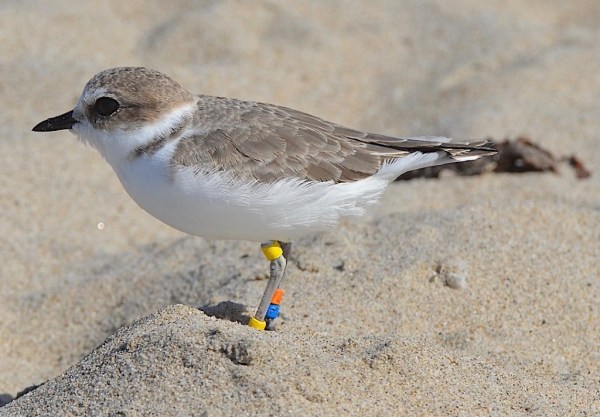
Snowy Plovers are beginning to return from nesting up north (Larry Loeher 10-12-18)
Directions: Malibu Lagoon is at the intersection of Pacific Coast Highway and Cross Creek Road, west of Malibu Pier and the bridge. Look around for people wearing binoculars.
Parking: Parking machine recently installed in the lagoon lot: 1 hr $3; 2 hrs $6; 3 hrs $9, all day $12 ($11 seniors); credit cards accepted. Annual passes accepted. You may also park (read the signs carefully) either along PCH west of Cross Creek Road, on Cross Creek Road, or on Civic Center Way north (inland) of the shopping center. Lagoon parking in shopping center lots is not permitted.
Prior checklists:
2018: Jan-June, July-Dec 2017: Jan-June, July-Dec
2016: Jan-June, July-Dec 2015: Jan-May, July-Dec
2014: Jan-July, July-Dec 2013: Jan-June, July-Dec
2012: Jan-June, July -Dec 2011: Jan-June, July-Dec
2010: Jan-June, July-Dec 2009: Jan-June, July-Dec.
[Chuck Almdale]
Can You Solve This Dilemma? | PBS BrainCraft Video
The old problem of the trolley, the fat man and the innocent people standing on the tracks. A new look.
This is an installment of the PBS – BrainCraft series created by Vanessa Hill. If no film or link appears in this email, go to the blog to view it by clicking on the blog title above. If the film stops & starts in an annoying manner, press pause (lower left double bars ||) to let it buffer and get ahead of you. [Chuck Almdale]
A baby hairworm hitches a ride inside a cricket, feasting on its fat until the coiled-up parasite is ready to burst out. Then it hijacks the cricket’s mind and compels it to head to water for a gruesome little swim.
This is another installment of the PBS Deep Look series; this installment is adapted from the “It’s OK to be Smart” series. If no film or link appears in this email, go to the blog to view it by clicking on the blog title above. If the film stops & starts in an annoying manner, press pause (lower left double bars ||) to let it buffer and get ahead of you. [Chuck Almdale]
Free Thayer Birding Software for Young Birders!
Are you a young birder? Do you know a young birder?
Peter Thayer, President of Thayer Birding Software, turned 70 this fall and he is celebrating in a spectacular way: by giving away free copies of his incredible birding software to young birders, no strings attached!

Happy 70th Birthday, Peter Thayer!
His ambitious goal is to have one million kids download the FREE birding program and use it to get excited about nature and conservation.
Downloading the software is straightforward. Just go to the Thayer Birding website and follow these easy steps:
1. Select your desired software version – Windows (7 or higher) Download or Mac (OSX 10.9 through macOS 10.13) Download (this program will not work on Apple’s Mojave 10.14).
2. Click the “Add Promo” button when it appears.
3. Enter the code: SMBASYoungBirder into the Promo Code box and click “Apply.”
4. The total will change to 0.00 USD. Click the “Free Checkout” button.
5. Fill out your email information so they can send you links, then click the “Free Checkout” button.
6. The download screen will appear. You will also get an email (see #5 above) allowing you to download anytime within the next five days. Be sure to read the instructions and watch the how-to video before downloading. There are 6 files to download. Each file is 0.9 – 1.3 Gigabyte (gB) in size (total 7 gB). If your internet speed is less than 20 Mb/second, this may not work for you. In that case you can get the program on a flash drive.
Check your computer download speed: http://speedtest.xfinity.com
7. If you need to get the flash drive, go back to step 1 and start again by selecting the proper Flash Drive option and using our SMBASYoungBirder code as before. The program is still free but you’ll need to pay $5 – 6 for sales tax and postage.
That’s it!

If you haven’t ever used the software before, you’re in for a treat. From identification help to quizzes to natural history information, it is a comprehensive tool for improving birding skills for beginners and experts alike. See the images below to learn more about what the software can do, and if you are a young birder, head on over to the Thayer Birding Website to get your free copy now.
***(Special note for college students and teachers: Thayer is offering a 50% discount with the codes Student or Teacher, respectively).***
Additional information on the offer is here: http://www.thayerbirding.com/Home/Free-Software-For-Kids
They also have a YouTube ordering & downloading instructional video.
(You’ll have to listen closely to hear.)
Here’s a few of the program’s screens.

Use the Identification Wizard to figure out what birds you saw.

Compare species side-by-side.

Use pre-made quizzes or create your own to improve your bird identification skills by sight and sound.

The entire contents of The Birder’s Handbook are included as part of the software, full of all kinds of valuable natural history facts.
Want more information on the features before ordering? Here’s a YouTube video.
[Thanks to blogger & birder Jennie Duberstein for her permission to use much of the text and screen shots above, previously posted on the American Birding Association blogsite.]
[Chuck Almdale]
Tracking Backyard Birds | Cornell Lab of Ornithology
The same technology used to locate lost pets is now being used to track common backyard birds. Scientists and students at the Cornell Lab have collected data on hundreds of thousands of feeder visits so far by Black-capped Chickadees and other birds. Tiny tags weighing less than one-tenth of a gram are attached to the birds’ legs and are detected each time the birds visit specially-rigged feeders. Watch this in which David Bonter describes the radio frequency identification (RFID) technique and what we can learn by keeping track of who’s coming to dinner.
A film from the Cornell Lab of Ornithology. If no film or link appears in this email, go to the blog to view it by clicking on the blog title above. If the film stops & starts in an annoying manner, press pause (lower left double bars ||) to let it buffer and get ahead of you. The Lab is a member-supported organization; they welcome your membership and support. [Chuck Almdale]



 SANTA MONICA BAY AUDUBON SOCIETY BLOG