Free email delivery
Please sign up for email delivery in the subscription area to the right.
No salesman will call, at least not from us. Maybe from someone else.
Voices: Common Nighthawk | Cornell Lab of Ornithology
Macaulay Library Curator Greg Budney shares a close encounter he had with a Common Nighthawk as it called and produced sizzling wing sounds just over his head.
A film from the Cornell Lab of Ornithology. If no film or link appears in this email, go to the blog to view it by clicking on the blog title above. If the film stops & starts in an annoying manner, press pause (lower left double bars ||) to let it buffer and get ahead of you. The Lab is a member-supported organization; they welcome your membership and support. [Chuck Almdale]
Poo-Poo Project – The Penultimate Report
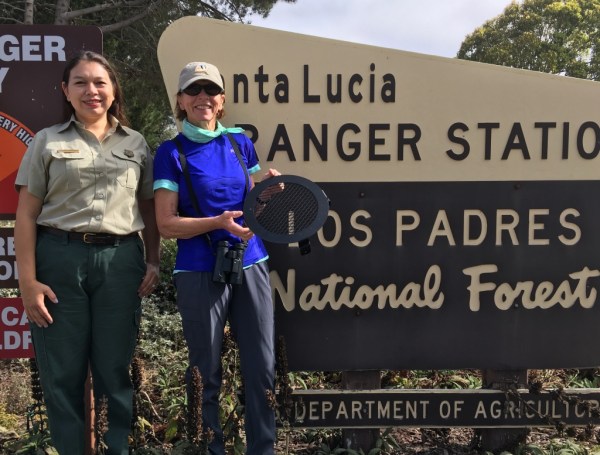
Alicia Sanchez Scott, activist Jeri Edwards and poo-poo screen (L-R)
You remember the Poo-Poo Project? Of course you do!
Their $2400 GoFundMe goal was met
All the pit toilet vent pipes in Los Padres National Forest will be screened
Here’s a heartwarming update from Jeri Edwards:
Here’s a really neat story of how the final amount of money was donated to reach my goal. Because of your enthusiasm and willingness to post my campaign, someone in your chapter [SMBAS] who loves owls forwarded the posts to the president of the Pomona Valley Audubon chapter. I didn’t even think to contact that chapter because they aren’t in close proximity to Los Padres National Forest. But, when the president of the chapter saw the campaign, she recognized me because we met up here along the Central Coast and went on a short informal birding walk.
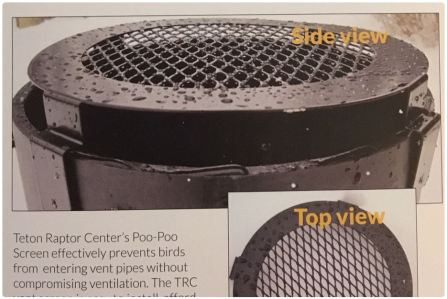
This solid beastie from the Teton Raptor Project keeps any and all birds out of the pit toilet vents.
She also thought the campaign was a great way to raise awareness among the chapter members as to the vulnerability of pipes to cavity-nesters and a worthy cause. So she approached the board with my campaign and right on the spot they elected to send a sizable donation, and my goal was reached!
But there’s more. Since becoming aware of the problem in our national forests and public lands, they are in contact with The Teton Raptor Center because they want to make sure all the pit toilets in all their neighboring national forests are covered. That’s wildlife advocate passion in action!!
So see what spark you lit when you posted? I hope you don’t get tired of me saying thank you.
I’m meeting with the screen installation coordinator once he receives the screens and I’ll get back to you as to the timeline of completion of installation.
Jeri
Note: A few days later Jeri updated me that she met with Alicia Sanchez Scott of the Santa Lucia LPNF district office, and Alicia indicated all the screens will be installed by September.
I think kudos and a big thank-you to Pomona Valley Audubon Society are definitely in order. And another thank-you and the Very Sharp Thinking Award of the Month to our owl-loving unknown chapter-member. Should any person or organization agree that this is a worthy cause, the Teton Raptor Center will probably accept additional donations.
[Chuck Almdale]

(Northern Pygmy Owl, photo taken in Los Padres National Forest, by Jeri Edwards)
Fog migration at Malibu Lagoon, 28 July, 2019

Black-bellied Plover dancing with delight and a piece of algae (R. Juncosa 7-28-19)
Our popular Los Angeles County Birding Spots page advises visitors that we really do have four seasons, despite persistent erroneous rumors to the contrary. They are:
Fog: along the coast April – June, often into July, occasionally well into August
Smog: April – November
Fire: June – December, especially August to November;
Mudslide (aka Rain): November – April.
You’ll notice that totals to 24-26 months per year. Everything is better in California.

A very foggy morning in color – not black & white (L. Johnson 7-28-19)
We had fog in June (see last month’s photos) and now in late July it’s still foggy. Fog season is no flight of fancy. Absent in June, migrants are now returning from the north, and you can never be sure when or what will suddenly drop out of the fog, unannounced. I’d already counted 25 Whimbrels when a large flock of large sandpipers swooped from the sky, adding 60 Whimbrels, two Long-billed Curlews and a Marbled Godwit. Long-billed sandpipers apparently like to travel together.
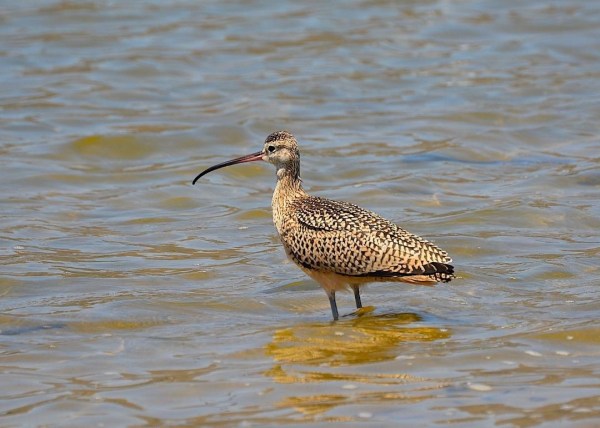
The “warm” browns of a Long-billed Curlew (G. Murayama 7-19-19)
Summer tidal clock, partially flooded (L. Johnson 7-28-19)
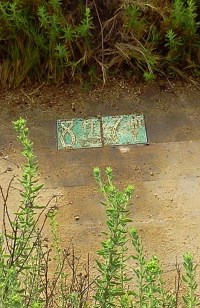
Summer tidal clock depth marker (L. Johnson 7-28-19)
Water was high in the lagoon. Mud and detritus covered the lower tidal clock marker-tiles and the lowest clean tile was 8′ 7.7″. We estimated the water level to be 7.5 – 8 ft above mean low low tide. This is typical during the summer lagoon closures.
Ducks begin arriving in October. Currently we have only our locally breeding Mallard and Gadwall, with a half-dozen small families paddling about. The males are either in hiding or off doing whatever male ducks do this time of year. The Canada Goose family remains at six, and the four young are nearly full-grown, black necks with white chin-patches. Snowy Egrets have finished breeding across the street and the 19 birds foraging in the lagoon are likely from that location. Two adult Black-crowned Night-Herons – one in the west channel and one on the east side – were hunting in daylight. These crepuscular (twilight-preferring) large-eyed birds usually roost during daytime, but fog or heavy clouds often make it dim enough for them to be active.
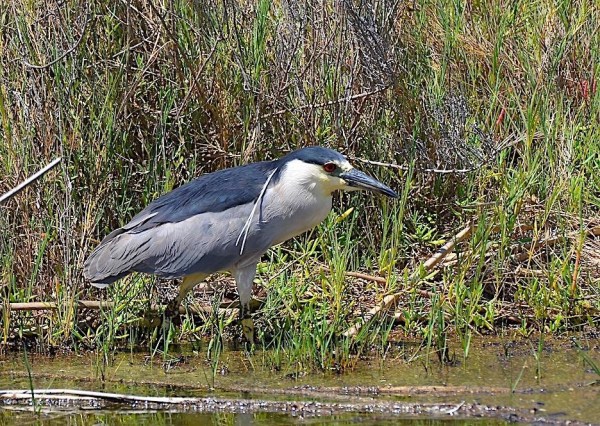
Black-crowned Night-Heron stalks the shallows (G. Murayama 7-19-19)
No Nanday Parakeets were seen, but for the second month in a row a Nuttall’s Woodpecker was heard, as was a Wrentit by ever-alert birders Femi Faminu and Chris Tosdevin. That’s six months out of the last nine for the Wrentit. I’m beginning to think that last fall’s fire pushed at least one of these chaparrals-lovers into permanent residence in the dense brush edging the park. At the picnic spot Chris T. also spotted an immature Hooded Oriole high in the bougainvillea, which few others saw, and then nailed an adult male Hooded in a golf course conifer, which everyone saw. Thanks, Chris! Later on, while returning from the beach, that other sharp-eyed & eared Chris Lord spotted what was probably the whole family – four Hooded Orioles. It was Chris-mass in July (cue the chorus of groans).

Narrow beach looking east towards Malibu Pier, almost lost in fog (L. Johnson 7-28-19)

High tide & big waves means narrow beach. Right side of virtual fence is the Snowy Plover exclusion area.
(G. Murayama 7-19-19)
Most of the rest of the birds were down on the south edge of the lagoon. Recent high tides had eaten away the beach until barely anything was left outside the Snowy Plover exclosure virtual fence, and the beachblanket crowd complained for lack of sand. The beach was wide and unpopulated closer to Adamson House, all of 40 yards away, but closer to the pier it narrowed again and was almost standing-room-only with people.
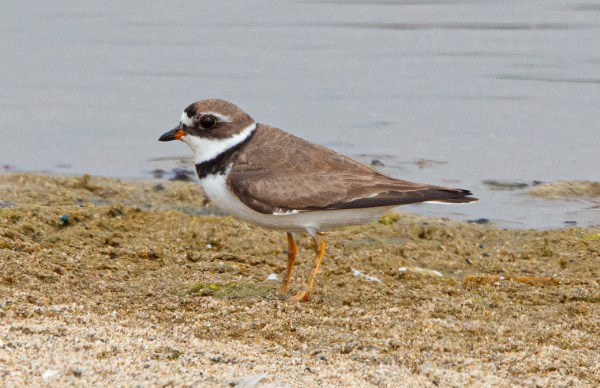
Semipalmated Plovers stopover briefly every spring and fall (R. Juncosa 7-28-19)
Surfers of all ages from all over had shown up for a Memorial Paddle-Out for SoCal board-shaper and surf legend, Glen Kennedy. Read about Glen and the paddle-out event in the links to the Shacked Mag website supplied above. You’ll see some amazing photos.

Brown Pelican diving (C. Bragg 7-28-19)

This Royal Tern has slightly more dark in the underwing primary tips than do Elegant Terns (G. Murayama 7-19-19)
We checked the offshore rocks by the west end of the beach adjacent to Malibu Colony, but the tide hadn’t dropped much from the 8:17am high of +3.46 ft. and waves washed over the rocks every 20 seconds, far too often for birds to want to perch there. The only bird on the sea was a lone Double-crested Cormorant. Visibility was still limited by the fog. Several dozen Yoganistas were on their towels in their usual spot next to the colony, led by the Asana Queen. I always have to fight the temptation to holler something annoying, like “Work it out. Work it. Go for the burn!” as they proceed languidly through their gentle stretches.
After young Great-tailed Grackles fledge from the nest, their parents take them around the neighborhood to show them where and how to find food. For a while the parents do all the work, with the young finding it only when the parent opens their bill to reveal it. But they soon catch on, foraging alongside their parents. Our grackles are now resident year-round, after arriving in the Los Angeles area about 20 years ago. I first recorded them at the lagoon on 8/26/01. They typically remain together as a family unit until the following spring, when the adults again begin breeding and the young leave to find mates and nests of their own.

Great-tailed Grackle mother feeds her noisy child (C. Bragg 7-28-19)
Plovers were abundant: 8 Killdeer, 2 Semipalmated, 36 Black-bellied, most still with the black bellies of breeding, and 11 Snowy Plovers, none with bands. The only “peep” (small sandpipers that go “peep peep,” hence the nickname) was a lone Western Sandpiper at lagoon edge. We sorted through the collection of waders and gulls for a while, discussing plumages, migration and oddities of bird life.
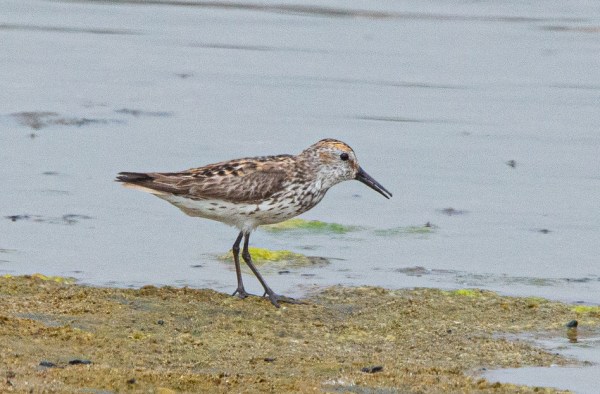
Western Sandpiper with arrowhead breast spots (R. Juncosa 7-28-19)
One of the three Caspian Terns had an odd growth, the same orange-red color as it’s bill, and protruding from the throat feathers just below the bill. Once, when it moved it’s head quickly, the growth seemed to wiggle as if it were not solidly attached to the bird, but only stuck to the feathers. One person thought it might be its tongue, protruding through a chin-hole, but the curvature of the protrusion never changed.
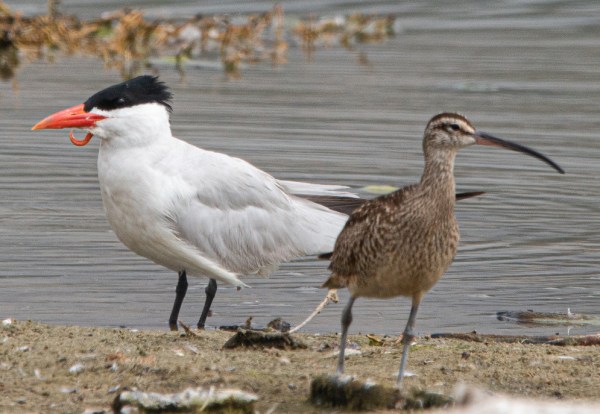
Caspian Tern with weird facial growth (or tongue?), and a Whimbrel (R. Juncosa 7-28-19)
The lagoon is now closed to the ocean and a few of us plowed our way through the paddle-out crowd on Surfrider Beach and on to Adamson House. There, as always, they were getting ready for a wedding, but among the bushes and flowers we found an assortment of Allen’s Hummingbirds, Black Phoebes, Mockingbirds, House Finches, California Towhees, Song Sparrows and – in the small marshy pond by the boat house – a dozing Mallard and a busy Spotted Sandpiper, teetering on a log.

Mmmmmm…swiming through your lunch (C. Bragg 7-28-19)

Snowy plover, in for the winter
(G. Murayama 7-19-19)
Birds new for the season: Pied-billed Grebe, Anna’s Hummingbird, Black-bellied Plover, Snowy Plover, Semipalmated Plover, Whimbrel, Marbled Godwit, Western Sandpiper, Spotted Sandpiper, Willet, Glaucous-winged Gull, Common Yellowthroat.
Many thanks to our photographers: Chuck Bragg, Lillian Johnson, Ray Juncosa, Larry Loeher & Grace Murayama.
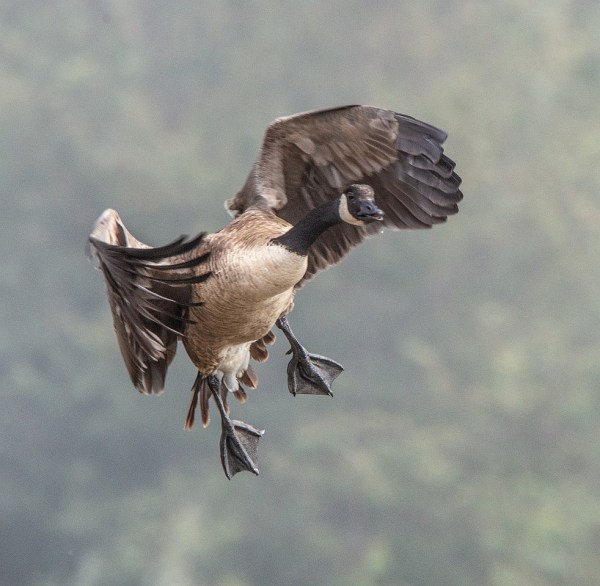
Canada Goose landing wrecklessly
(R. Juncosa 7-28-19)
Our next three scheduled field trips: Malibu Lagoon 8:30 & 10am, 25 August; Coastal Cleanup Day at Malibu Lagoon 9am – Noon, Sat. 21 September; Malibu Lagoon 8:30 & 10am, 22 September.
Our next program: Birds, Bees and Butterflies: Native Planting in Your Yard, presented by Connie Day. Tuesday, 1 October, 7:30 p.m., Chris Reed Park, 1133 7th St., NE corner of 7th and Wilshire Blvd. in Santa Monica.
NOTE: Our 10 a.m. Parent’s & Kids Birdwalk meets at the shaded viewpoint just south (towards the water) of the parking area. Watch for Willie the Weasel. He’ll be watching for you and your big floppy feet.
Links: Unusual birds at Malibu Lagoon recently updated with new photos
9/23/02 Aerial photo of Malibu Lagoon
Prior checklists:
2019: Jan-June
2017: Jan-June, July-Dec 2018: Jan-June, July-Dec
2016: Jan-June, July-Dec 2015: Jan-May, July-Dec
2014: Jan-July, July-Dec 2013: Jan-June, July-Dec
2012: Jan-June, July -Dec 2011: Jan-June, July-Dec
2010: Jan-June, July-Dec 2009: Jan-June, July-Dec.
The 10-year comparison summaries created during the Lagoon Reconfiguration Project period, despite numerous complaints, remain available on our Lagoon Project Bird Census Page. Very briefly summarized, the results unexpectedly indicate that avian species diversification and numbers improved slightly during the restoration period June’12-June’14.
Many thanks to Chuck Bragg, Adrian Douglas, Femi Faminu, Lillian Johnson, Chris Lord, Lu Plauzoles, and Chris Tosdevin for their contributions to this month’s checklist. [Chuck Almdale]
| Malibu Census 2019 | 2/24 | 3/24 | 4/28 | 5/26 | 6/23 | 7/28 |
| Temperature | 54-60 | 55-64 | 62-66 | 57-59 | 63-68 | 62-66 |
| Tide Lo/Hi Height | L+0.84 | L-0.05 | H+3.86 | L+0.66 | L+0.55 | H+3.46 |
| Tide Time | 0708 | 0638 | 0546 | 1040 | 0835 | 0817 |
| Canada Goose | 2 | 1 | 6 | 6 | 6 | |
| Cinnamon Teal | 2 | 2 | ||||
| Northern Shoveler | 1 | |||||
| Gadwall | 12 | 18 | 8 | 13 | 20 | 18 |
| American Wigeon | 8 | 15 | ||||
| Mallard | 18 | 14 | 30 | 22 | 18 | 18 |
| Green-winged Teal | 2 | |||||
| Red-breasted Merganser | 1 | 1 | 1 | |||
| Ruddy Duck | 5 | |||||
| Pied-billed Grebe | 1 | 1 | ||||
| Eared Grebe | 1 | |||||
| Western Grebe | 22 | |||||
| Clark’s Grebe | 1 | |||||
| Rock Pigeon | 17 | 15 | 15 | 18 | 15 | 18 |
| Eurasian Collared-Dove | 2 | 4 | ||||
| Mourning Dove | 2 | 6 | 3 | 2 | 4 | 8 |
| Anna’s Hummingbird | 4 | 1 | 1 | |||
| Allen’s Hummingbird | 2 | 2 | 3 | 3 | 6 | 9 |
| American Coot | 36 | 55 | 5 | 4 | ||
| Black-necked Stilt | 2 | |||||
| Black-bellied Plover | 35 | 14 | 36 | |||
| Snowy Plover | 31 | 14 | 2 | 11 | ||
| Semipalmated Plover | 9 | 2 | ||||
| Killdeer | 10 | 10 | 6 | 4 | 5 | 8 |
| Whimbrel | 4 | 55 | 4 | 85 | ||
| Long-billed Curlew | 1 | 2 | ||||
| Marbled Godwit | 23 | 15 | 20 | 1 | ||
| Ruddy Turnstone | 3 | |||||
| Sanderling | 32 | 4 | ||||
| Least Sandpiper | 16 | 3 | ||||
| Western Sandpiper | 4 | 1 | ||||
| Spotted Sandpiper | 2 | 2 | 1 | 1 | ||
| Willet | 12 | 9 | 4 | 15 | ||
| Common Murre | 2 | |||||
| Bonaparte’s Gull | 1 | |||||
| Heermann’s Gull | 5 | 2 | 2 | 15 | ||
| Ring-billed Gull | 85 | 25 | 10 | 15 | 8 | |
| Western Gull | 98 | 30 | 95 | 125 | 70 | 80 |
| California Gull | 140 | 22 | 45 | 7 | ||
| Herring Gull | 1 | |||||
| Glaucous-winged Gull | 1 | 1 | ||||
| Least Tern | 2 | 12 | 2 | |||
| Caspian Tern | 2 | 12 | 13 | 5 | 3 | |
| Royal Tern | 12 | 65 | 6 | 2 | 1 | 2 |
| Elegant Tern | 43 | 230 | 165 | |||
| Pacific Loon | 1 | |||||
| Common Loon | 2 | |||||
| Brandt’s Cormorant | 20 | 2 | 1 | |||
| Double-crested Cormorant | 24 | 60 | 23 | 27 | 24 | 22 |
| Pelagic Cormorant | 2 | 2 | 1 | 2 | ||
| Brown Pelican | 37 | 65 | 58 | 108 | 74 | 34 |
| Great Blue Heron | 1 | 2 | 1 | 4 | ||
| Great Egret | 5 | 3 | 2 | 6 | 2 | |
| Snowy Egret | 5 | 2 | 3 | 8 | 6 | 19 |
| Black-crowned Night-Heron | 1 | 1 | 2 | |||
| Turkey Vulture | 1 | 1 | 2 | |||
| Red-tailed Hawk | 2 | 1 | 1 | |||
| Belted Kingfisher | 1 | 1 | 1 | |||
| Nuttall’s Woodpecker | 1 | 1 | ||||
| American Kestrel | 1 | |||||
| Peregrine Falcon | 2 | |||||
| Nanday Parakeet | 3 | 2 | 3 | 4 | ||
| Black Phoebe | 6 | 2 | 3 | 5 | 3 | 3 |
| California Scrub-Jay | 1 | 1 | ||||
| American Crow | 6 | 6 | 5 | 6 | 5 | 5 |
| Violet-green Swallow | 1 | |||||
| Rough-winged Swallow | 2 | 2 | 4 | |||
| Cliff Swallow | 1 | 6 | 8 | |||
| Barn Swallow | 3 | 15 | 14 | 30 | 21 | |
| Bushtit | 2 | 8 | 2 | 1 | 5 | 30 |
| Marsh Wren | 1 | 1 | ||||
| Bewick’s Wren | 1 | |||||
| Blue-gray Gnatcatcher | 2 | |||||
| Ruby-crowned Kinglet | 2 | 1 | ||||
| Wrentit | 2 | 1 | 1 | 1 | ||
| American Robin | 1 | |||||
| Northern Mockingbird | 2 | 3 | 2 | 3 | 6 | 4 |
| European Starling | 3 | 15 | 12 | 8 | 25 | |
| House Finch | 15 | 8 | 18 | 8 | 22 | 25 |
| Spotted Towhee | 2 | |||||
| California Towhee | 1 | 1 | 3 | 2 | ||
| Song Sparrow | 15 | 10 | 12 | 5 | 5 | 4 |
| White-crowned Sparrow | 18 | 9 | ||||
| Dark-eyed Junco | 2 | |||||
| Western Meadowlark | 2 | |||||
| Hooded Oriole | 1 | 2 | 2 | 4 | ||
| Red-winged Blackbird | 4 | |||||
| Brown-headed Cowbird | 2 | |||||
| Great-tailed Grackle | 3 | 3 | 6 | 3 | 4 | |
| Orange-crowned Warbler | 1 | |||||
| Common Yellowthroat | 5 | 1 | 1 | 2 | ||
| Yellow-rumped (Aud) Warbler | 16 | 2 | ||||
| Totals by Type | Feb | Mar | Apr | May | Jun | Jul |
| Waterfowl | 48 | 53 | 40 | 41 | 44 | 42 |
| Water Birds – Other | 146 | 184 | 83 | 138 | 103 | 61 |
| Herons, Egrets & Ibis | 6 | 9 | 6 | 11 | 14 | 27 |
| Quail & Raptors | 3 | 2 | 3 | 0 | 3 | 0 |
| Shorebirds | 168 | 122 | 56 | 4 | 6 | 162 |
| Gulls & Terns | 341 | 189 | 400 | 334 | 87 | 111 |
| Doves | 19 | 21 | 20 | 20 | 23 | 26 |
| Other Non-Passerines | 6 | 7 | 7 | 6 | 11 | 11 |
| Passerines | 107 | 63 | 88 | 63 | 107 | 130 |
| Totals Birds | 844 | 650 | 703 | 617 | 398 | 570 |
| Total Species | Feb | Mar | Apr | May | Jun | Jul |
| Waterfowl | 7 | 7 | 4 | 3 | 3 | 3 |
| Water Birds – Other | 10 | 5 | 4 | 4 | 3 | 4 |
| Herons, Egrets & Ibis | 2 | 3 | 2 | 3 | 4 | 4 |
| Quail & Raptors | 2 | 2 | 2 | 0 | 2 | 0 |
| Shorebirds | 10 | 8 | 10 | 1 | 2 | 10 |
| Gulls & Terns | 6 | 8 | 7 | 7 | 6 | 7 |
| Doves | 2 | 2 | 3 | 2 | 3 | 2 |
| Other Non-Passerines | 3 | 3 | 4 | 2 | 3 | 3 |
| Passerines | 19 | 17 | 18 | 11 | 15 | 13 |
| Totals Species – 92 | 61 | 55 | 54 | 33 | 41 | 46 |
Who Invented the Meter? | PBS Science Video
Why is a meter a meter? The meter is the world’s ultimate measure, but how did it become “the” meter? What is this measurement based on? The story of this revolution in measurement traces its roots to the French Revolution. Scientists decided that an equal and united people should have equal and united measures. So they sent a pair of young astronomers out to measure the world, and invent the meter. Little did they know they’d find nothing but war, deception, and strife along the way. As a result of this ill-fated mission, the meter carries an error that still persists today. Still think the metric system is so perfect?
This is an installment of the PBS – It’s OK to be Smart series. If no film or link appears in this email, go to the blog to view it by clicking on the blog title above. If the film stops & starts in an annoying manner, press pause (lower left double bars ||) to let it buffer and get ahead of you. [Chuck Almdale]
Back in the 1990s, binoculars were very simple to understand. There were Porro prism binoculars (below top) and roof prism binoculars (below bottom).

Figure 1. Porro Prism
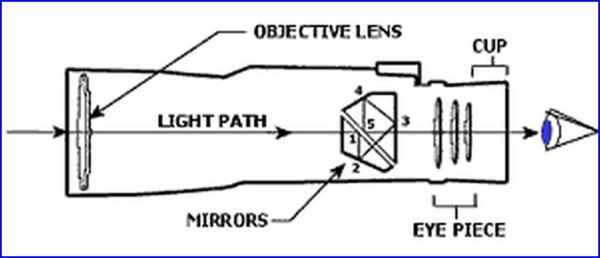
Figure 2. Roof Prism
The general rule was at the same price, you got a better image with the Porros, and as the price went up, so did the quality. The problem was that roof prism binoculars were much more durable and once waterproofed, they tended to stay that way. So, binocular manufacturers began dealing with the issues.
Phase-Corrected Coatings
The first solution was the addition of phase-corrected coatings on the prisms. In a roof prism, when light hits the first diagonal face, it is split into two beams which both get circularly polarized. The lengths of the paths of the two beams are different by less than a wavelength, so when the two beams recombine, their polarization axes are out of phase. You’ve probably seen the effect of polaroid sunglasses or a polarizing filter used on a camera, which results in a reduction of brightness. A phase-correction coating is used on the shorter of the two paths to equalize the distance, so when the beams recombine, they reinforce rather than interfere. In the late ‘90s, phase correction was found on only the more expensive binoculars. Now, every binocular over $100 has it.
Extra-Low Dispersion Glass
The next major upgrade was extra-low dispersion (ED) glass used to reduce chromatic aberration (CA). If you’ve ever seen a band of color along a high contrast interface, you’ve experienced chromatic aberration. CA is caused by the edges of an objective lens acting like a triangular prism, splitting the light into its component colors. When the light emerges from the eyepieces, the colors focus at distances from the lenses and your eyes and brain try to eliminate the problem by constantly refocusing. If you get eye fatigue using your binoculars for extended periods of time, this is why. ED glass reduces the spread of the prism effect. It is made with a variety of materials in a wide range of costs and success at fixing the problem. Glass or crystal containing fluorite compounds do the best job.

Normal lens – Chromatic aberration & blurry eagle

Fluorite lens – No chromatic aberration & sharp eagle
So-called High-Definition (HD) Binoculars
What about binoculars called “HD”? The term “HD” is a marketing term. It says nothing about the quality of the glass, as no glass has the term in its name. Some manufacturers use “HD” for products with ED glass, while others use it for improved versions of lower quality binoculars. Whenever you see this term, be sure to read the description carefully, and if you’re still not sure, call for the answer.
Newer Coatings
Finally, there are a wealth of new coatings, both internal and external. The most important internal coating is another one applied to the prisms. Made of aluminum (good), silver (better), or dielectric material (best), these coatings improve the amount of light reflected through the prisms. The most important external coatings have a different name from every manufacturer, but all do essentially the same thing. They resist scratching and repel water, dirt, and oil, helping to keep your lenses clean and water-free, even in the rain.
Each of these features raise the price of a binocular, and top of the line binoculars have them all. If you have a problem with your current binocular, look for a binocular which addresses that issue. Read descriptions to discover which binoculars fit your needs and your budget. If you still have questions, we’re here to help.
[Steve Sosensky]
www.optics4birding.com
Editor’s Note: I first birded with Steve in the mid-1990s, most likely at Malibu Lagoon, when he lived locally. Eventually he decided to make a career of his hobby and moved to southern Orange County to work with the Optics4Birding team. Several members of SMBAS have trekked to southern Orange County and purchased optics from Steve. All were very satisfied. When Steve offered to write some articles on birding equipment for our blog, I knew I’d never find anyone more knowledgeable and jumped at the chance. Here’s the first of what I hope will be a very interesting and helpful series.
Optics4Birding brings a variety optics for tryout and sales to Sea & Sage Audubon’s Pancake Breakfast on Saturday Oct. 26. The breakfast also features used bird books at low prices. This is a good opportunity for you to check out the latest in binoculars or scopes and ask questions. If you want breakfast, make an advance reservation as seats sell out.
[Chuck Almdale]



 SANTA MONICA BAY AUDUBON SOCIETY BLOG