Free email delivery
Please sign up for email delivery in the subscription area to the right.
No salesman will call, at least not from us. Maybe from someone else.
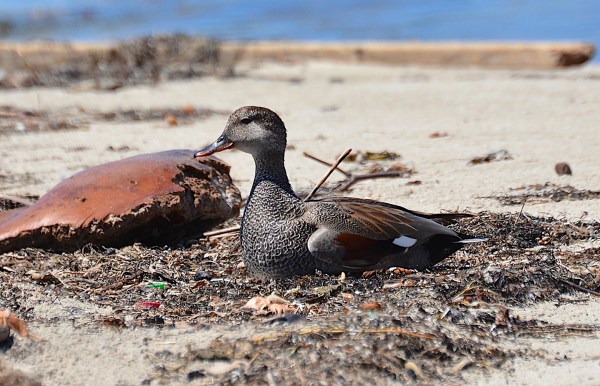
This male Gadwall seems quite satisfied to simply sit. (G. Murayama 5-26-19)
People who don’t live here tend to think we don’t have seasons. Wrong! For supporting evidence, I offer this week’s weather. Temperatures never rose above 65°F (18°C), and for our birdwalk they barely made 59°F (15°C) Brrrr! And it rained. That violated at least one local ordinance, I believe, because it does not rain in May in SoCal. That’s the law. Authorities are reported to be on the lookout for someone to blame and arrest. So far they’ve rounded up only the usual suspects.

Brown Pelicans in breeding plumage, probably resting before flying back to their Anacapa Island nests (G. Murayama 5-26-19)
The birds knew something was wrong, and they were mostly somewhere else, with only 617 birds in 33 species. Western Gulls, Elegant Terns and Brown Pelicans made up 65% of total birds.

A pair of Canada Geese, goslings in tow, stepping gingerly across soft mud. (L. Loeher 5-24-19)
The Canada Geese apparently decided they liked the area, and about a week ago they showed up with four goslings in tow. They trundled all around the lagoon and channels. Sometimes they’d disappear into the vegetation on the southside sandy peninsula. That’s probably where they nested, as we had occasionally seen their heads poking up out of the flowers and grass.
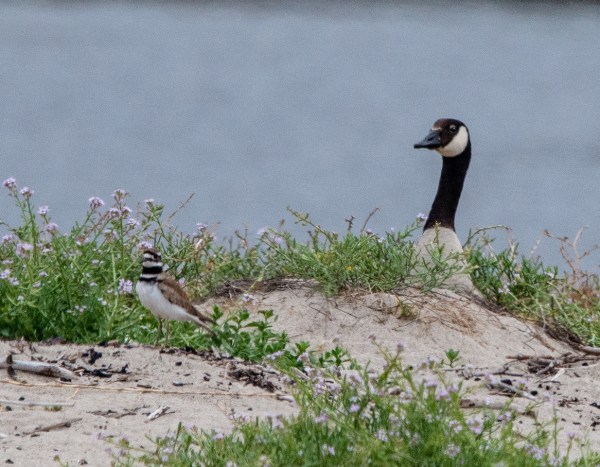
Canada Goose keeps a steely eye on that Killdeer (R. Juncosa 5-26-19)
People sometimes ask, “What do gulls eat?” Answer: Just about anything. Photographer Grace Murayama said the item of cuisine below was a Sea Hare, a kind of slug and definitely not mammalian. I’ve read that most species of birds have little sense of taste. If true, that’s probably a Very Good Thing if they’re going to eat this sort of creature. And – lacking teeth – they don’t even attempt to chew it. I suspect it has the consistency of a goo-filled tennis ball.
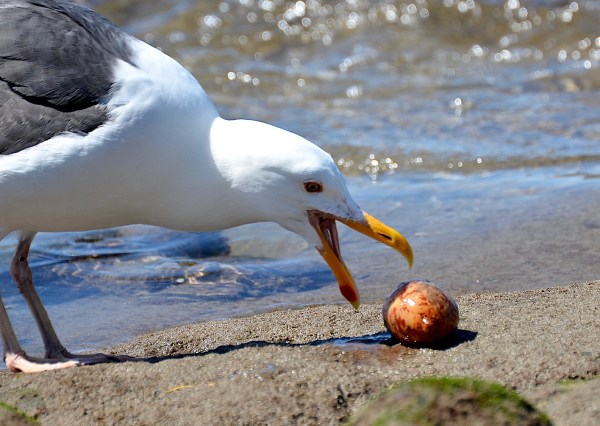
Western Gull joyfully goes for something – anything! – edible. (G. Murayama 5-24-19)
Two Heermann’s Gulls were on the beach among the many Western Gulls. They looked like year-old birds, dark brown, not mottled like juveniles or beginning to turn grayish on their backs like 2nd-year birds.
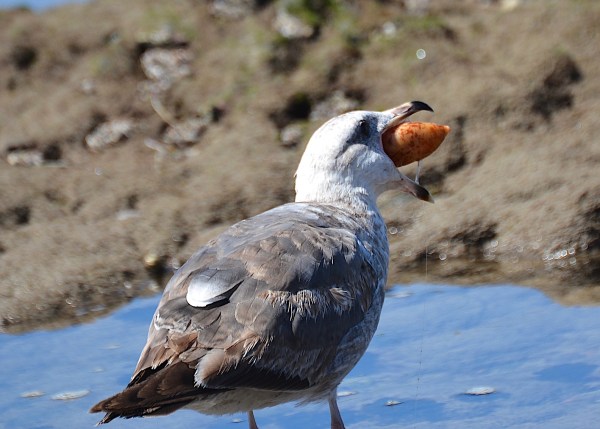
Down goes the Sea Hare, definitely ruining its plans for the day. (G. Murayama 5-24-19)
All the Snowy Plovers have gone. For the past two years, a pair lingered and nested and produced chick(s). But no lingerers this year, so it seems to me that none will attempt to nest.

A cotillion of Elegant Terns (R. Juncosa 5-26-19)
On the other hand, we had a dozen Least Terns performing aerial acrobatics, walking around in circles on the sand, investigating small depressions among the driftwood, waving fish at each other and one pair even did a “fish exchange.” I was asked if such a fish exchange always meant that they would then pair up and breed. Answer: I don’t know about that, but I’m pretty sure they won’t pair up lacking the fish exchange element in their courting behavior. This crucial element is how one of them (the female, I believe) makes certain that the other knows how to: 1) catch a fish, 2) catch the right size of fish, 3) bring it to someone else (the female or eventual chick), 4) actually give it to the other bird and not just wave it around, and maybe 5) do the whole thing again, repeatedly. She, of course, probably doesn’t consciously realize that’s what she’s doing. It’s very likely entirely hard-wired behavior, as is much of similar human behavior. (Don’t tell any humans that – it’s supposed to be a secret. Keep letting them believe that they think up all their bone-headed behaviors on their own.) There’s more to being a good mate and parent than tight pants and necklaces of gold chain.

Least Terns with a courting-fish (R. Juncosa 5-26-19)
I ran into a volunteer Least Tern warden, by the name of Jess (I believe), patrolling the perimeter of the orange plastic fence, binoculars in hand. He is new to the job, trained and sent out on his own by our Los Angeles County official Least Tern & Snowy Plover maven and comptroller, Stacey Vigallon. If he’s lucky, the terns will stick around and nest, which will give him plenty to look at for a couple of months.
Nanday Parakeets perched on bare vertical snags on the Adamson House property, making it three out of the past four months they were there. It’s possible, I suppose, they are nesting somewhere closer that far up the canyon, perhaps on the property itself or across the street in the large semi-forested area. They nest in holes in trees which are provided when high winds break off limbs, or by the thoughtful and considerate behavior of our local woodpeckers.

View across the channel towards the beach, east end of Malibu Colony on right
(L. Johnson 5-26-19)
On the way back to the car, I stopped at the small path-side picnic area adjacent to the Malibu Colony to see if I could find any Hooded Orioles. Last year they liked this area and were often seen near it. I got very lucky and spotted two of them in the leafy tree above the house roof and 2nd-floor deck. The small trees (or large bushes) around the house are very thick and leafy with Bougainvillea growing all over them, and would make a very nice place to nest. One bird was a female, the other looked like a young male with some black feathering on its throat. I thought I saw a brighter orange-&-black male scooting about, but the glimpse was obstructed by foliage and so brief that I couldn’t be sure.

One birder walks a barren Surfrider Beach (L. Johnson 5-26-19)
Birds new for the season: Heermann’s Gull, Black-crowned Night-Heron, Violet-green Swallow.
Many thanks to our photographers: Lillian Johnson, Ray Juncosa, Larry Loeher & Grace Murayama.

Northern Mockingbird knows it’s spring
(L. Loeher 3-24-19 Malibu Lagoon)
Our next three scheduled field trips: Mt. Piños 8am 8-9 June; Malibu Lagoon 8:30 & 10am, 24 June; Malibu Lagoon 8:30 & 10am, 22 July.
Our next program: Planting Native Gardens, presented by Connie Day. Tuesday, 1 October, 7:30 p.m., Chris Reed Park, 1133 7th St., NE corner of 7th and Wilshire Blvd. in Santa Monica.
NOTE: Our 10 a.m. Parent’s & Kids Birdwalk meets at the shaded viewpoint just south (towards the water) of the parking area. Watch for Willie the Weasel. He’ll be watching for you and your big floppy feet.
Links: Unusual birds at Malibu Lagoon recently updated with new photos
9/23/02 Aerial photo of Malibu Lagoon
Prior checklists:
2017: Jan-June, July-Dec 2018: Jan-June, July-Dec
2016: Jan-June, July-Dec 2015: Jan-May, July-Dec
2014: Jan-July, July-Dec 2013: Jan-June, July-Dec
2012: Jan-June, July -Dec 2011: Jan-June, July-Dec
2010: Jan-June, July-Dec 2009: Jan-June, July-Dec.
The 10-year comparison summaries created during the Lagoon Reconfiguration Project period, despite numerous complaints, remain available on our Lagoon Project Bird Census Page. Very briefly summarized, the results unexpectedly indicate that avian species diversification and numbers improved slightly during the restoration period June’12-June’14.
Many thanks to Adrian Douglas, Liz Galton, Lillian Johnson, Lu Plauzoles and Chris Tosdevin for their contributions to the checklist below. [Chuck Almdale]
| Malibu Census 2018-19 | 12/23 | 1/27 | 2/24 | 3/24 | 4/28 | 5/26 |
| Temperature | 55-62 | 65-75 | 54-60 | 55-64 | 62-66 | 57-59 |
| Tide Lo/Hi Height | H+6.87 | L+1.36 | L+0.84 | L-0.05 | H+3.86 | L+0.66 |
| Tide Time | 0850 | 0913 | 0708 | 0638 | 0546 | 1040 |
| Canada Goose | 2 | 1 | 6 | |||
| Cinnamon Teal | 2 | 2 | ||||
| Northern Shoveler | 1 | |||||
| Gadwall | 8 | 6 | 12 | 18 | 8 | 13 |
| American Wigeon | 5 | 4 | 8 | 15 | ||
| Mallard | 12 | 27 | 18 | 14 | 30 | 22 |
| Green-winged Teal | 4 | 2 | 2 | |||
| Surf Scoter | 14 | |||||
| Red-breasted Merganser | 2 | 3 | 1 | 1 | 1 | |
| Ruddy Duck | 2 | 3 | 5 | |||
| Pied-billed Grebe | 2 | 1 | ||||
| Eared Grebe | 1 | |||||
| Western Grebe | 2 | 2 | 22 | |||
| Clark’s Grebe | 1 | |||||
| Rock Pigeon | 22 | 13 | 17 | 15 | 15 | 18 |
| Eurasian Collared-Dove | 2 | |||||
| Mourning Dove | 2 | 2 | 2 | 6 | 3 | 2 |
| Anna’s Hummingbird | 4 | 1 | ||||
| Allen’s Hummingbird | 2 | 4 | 2 | 2 | 3 | 3 |
| American Coot | 58 | 38 | 36 | 55 | ||
| Black-necked Stilt | 2 | |||||
| Black-bellied Plover | 70 | 99 | 35 | 14 | ||
| Snowy Plover | 32 | 31 | 14 | 2 | ||
| Semipalmated Plover | 9 | |||||
| Killdeer | 14 | 17 | 10 | 10 | 6 | 4 |
| Whimbrel | 2 | 7 | 4 | 55 | 4 | |
| Marbled Godwit | 14 | 17 | 23 | 15 | 20 | |
| Ruddy Turnstone | 3 | 4 | 3 | |||
| Sanderling | 60 | 72 | 32 | 4 | ||
| Least Sandpiper | 17 | 23 | 16 | 3 | ||
| Western Sandpiper | 2 | 4 | ||||
| Spotted Sandpiper | 1 | 1 | 2 | 2 | 1 | |
| Willet | 12 | 20 | 12 | 9 | 4 | |
| Bonaparte’s Gull | 1 | |||||
| Heermann’s Gull | 14 | 13 | 5 | 2 | ||
| Ring-billed Gull | 95 | 50 | 85 | 25 | 10 | 15 |
| Western Gull | 75 | 127 | 98 | 30 | 95 | 125 |
| California Gull | 700 | 460 | 140 | 22 | 45 | |
| Herring Gull | 1 | 2 | 1 | |||
| Glaucous-winged Gull | 1 | 1 | ||||
| Least Tern | 2 | 12 | ||||
| Caspian Tern | 2 | 12 | 13 | |||
| Royal Tern | 1 | 4 | 12 | 65 | 6 | 2 |
| Elegant Tern | 43 | 230 | 165 | |||
| Red-throated Loon | 1 | |||||
| Pacific Loon | 2 | 1 | 1 | |||
| Common Loon | 2 | 2 | ||||
| Brandt’s Cormorant | 1 | 1 | 20 | 2 | 1 | |
| Double-crested Cormorant | 42 | 31 | 24 | 60 | 23 | 27 |
| Pelagic Cormorant | 2 | 2 | 2 | 1 | 2 | |
| Brown Pelican | 29 | 15 | 37 | 65 | 58 | 108 |
| Great Blue Heron | 2 | 2 | 1 | 2 | ||
| Great Egret | 2 | 1 | 5 | 3 | 2 | |
| Snowy Egret | 11 | 7 | 5 | 2 | 3 | 8 |
| Black-crowned Night-Heron | 1 | |||||
| Turkey Vulture | 1 | 1 | ||||
| Cooper’s Hawk | 1 | |||||
| Red-tailed Hawk | 1 | 1 | 2 | 1 | ||
| Belted Kingfisher | 1 | 1 | 1 | 1 | ||
| American Kestrel | 1 | |||||
| Peregrine Falcon | 1 | 2 | ||||
| Nanday Parakeet | 3 | 2 | 3 | |||
| Black Phoebe | 6 | 4 | 6 | 2 | 3 | 5 |
| Say’s Phoebe | 1 | 1 | ||||
| California Scrub-Jay | 1 | 1 | ||||
| American Crow | 6 | 9 | 6 | 6 | 5 | 6 |
| Violet-green Swallow | 1 | |||||
| Rough-winged Swallow | 2 | 2 | ||||
| Cliff Swallow | 1 | 6 | ||||
| Barn Swallow | 3 | 15 | 14 | |||
| Oak Titmouse | 1 | |||||
| Bushtit | 6 | 8 | 2 | 8 | 2 | 1 |
| House Wren | 1 | 1 | ||||
| Marsh Wren | 3 | 1 | 1 | |||
| Bewick’s Wren | 3 | 1 | 1 | |||
| Blue-gray Gnatcatcher | 10 | 1 | 2 | |||
| Ruby-crowned Kinglet | 3 | 2 | 1 | |||
| Wrentit | 3 | 2 | 1 | |||
| Hermit Thrush | 3 | 2 | ||||
| American Robin | 1 | |||||
| Northern Mockingbird | 1 | 2 | 3 | 2 | 3 | |
| European Starling | 35 | 3 | 15 | 12 | ||
| American Pipit | 1 | |||||
| House Finch | 30 | 28 | 15 | 8 | 18 | 8 |
| Lesser Goldfinch | 5 | |||||
| Spotted Towhee | 1 | 2 | ||||
| California Towhee | 1 | 1 | ||||
| Song Sparrow | 4 | 5 | 15 | 10 | 12 | 5 |
| White-crowned Sparrow | 27 | 15 | 18 | 9 | ||
| Golden-crowned Sparrow | 1 | 1 | ||||
| Dark-eyed Junco | 2 | |||||
| Western Meadowlark | 2 | 2 | ||||
| Hooded Oriole | 1 | 2 | ||||
| Red-winged Blackbird | 4 | |||||
| Great-tailed Grackle | 2 | 6 | 3 | 3 | 6 | |
| Orange-crowned Warbler | 1 | |||||
| Common Yellowthroat | 10 | 5 | 5 | 1 | 1 | |
| Yellow-rumped(Aud) Warbler | 27 | 20 | 16 | 2 | ||
| Totals by Type | Dec | Jan | Feb | Mar | Apr | May |
| Waterfowl | 47 | 45 | 48 | 53 | 40 | 41 |
| Water Birds – Other | 139 | 90 | 146 | 184 | 83 | 138 |
| Herons, Egrets & Ibis | 15 | 10 | 6 | 9 | 6 | 11 |
| Quail & Raptors | 3 | 1 | 3 | 2 | 3 | 0 |
| Shorebirds | 193 | 294 | 168 | 122 | 56 | 4 |
| Gulls & Terns | 886 | 657 | 341 | 189 | 400 | 334 |
| Doves | 24 | 15 | 19 | 21 | 20 | 20 |
| Other Non-Passerines | 3 | 4 | 6 | 7 | 7 | 6 |
| Passerines | 149 | 150 | 107 | 63 | 88 | 63 |
| Totals Birds | 1459 | 1266 | 844 | 650 | 703 | 617 |
| Total Species | Dec | Jan | Feb | Mar | Apr | May |
| Waterfowl | 7 | 6 | 7 | 7 | 4 | 3 |
| Water Birds – Other | 9 | 7 | 10 | 5 | 4 | 4 |
| Herons, Egrets & Ibis | 3 | 3 | 2 | 3 | 2 | 3 |
| Quail & Raptors | 3 | 1 | 2 | 2 | 2 | 0 |
| Shorebirds | 9 | 11 | 10 | 8 | 10 | 1 |
| Gulls & Terns | 6 | 7 | 6 | 8 | 7 | 7 |
| Doves | 2 | 2 | 2 | 2 | 3 | 2 |
| Other Non-Passerines | 2 | 1 | 3 | 3 | 4 | 2 |
| Passerines | 20 | 20 | 19 | 17 | 18 | 11 |
| Totals Species | 61 | 58 | 61 | 55 | 54 | 33 |
Could Bigfoot REALLY Exist? | PBS Science Video
A realistic look at whether this creature could actually exist. Not that it does.
This is an installment of the PBS – It’s OK to be Smart series. If no film or link appears in this email, go to the blog to view it by clicking on the blog title above. If the film stops & starts in an annoying manner, press pause (lower left double bars ||) to let it buffer and get ahead of you. [Chuck Almdale]
Can artificial intelligence tell the difference between labradoodles and fried chicken? …probably. But they can also see things that… aren’t there.
This is an installment of the PBS – BrainCraft series created by Vanessa Hill. If no film or link appears in this email, go to the blog to view it by clicking on the blog title above. If the film stops & starts in an annoying manner, press pause (lower left double bars ||) to let it buffer and get ahead of you. [Chuck Almdale]

Optical illusion – this yawning Brown Pelican isn’t really trying to swallow that passing gull (G. Murayama)
A few wintering birds remain, the migrants continue to come through and our nesting birds will be so busy they’ll hardly notice you.
Some of the great birds we’ve had in May: Brant, Pelagic Cormorant, Green Heron, Whimbrel, Bonaparte’s Gull, Royal, Least, Forster’s, Royal & Elegant Terns, White-throated Swift, Anna’s & Allen’s Hummingbirds, Pacific Slope Flycatcher, Common Raven, Violet-Green, Barn and Cliff Swallows, Bushtit, Bewick’s Wren, Cedar Waxwing, Spotted Towhee, Red-winged Blackbird, Hooded and Bullock’s Orioles.
Adult Walk 8:30 a.m., 4th Sunday of every month. Beginner and experienced, 2-3 hours. Species range from 40 in June to 60-75 during migrations and winter. We meet at the metal-shaded viewing area (see photo below) next to the parking lot and begin walking east towards the lagoon. We always check the offshore rocks and the ocean. When lagoon outlet is closed we continue east around the lagoon to Adamson House. We put out special effort to make our monthly Malibu Lagoon walks attractive to first-time and beginning birdwatchers. So please, if you are at all worried about coming on a trip and embarrassing yourself because of all the experts, we remember our first trips too. Someone showed us the birds; now it’s our turn.

Killdeer probably doing a distraction display (G Murayama 5-26-17)
Children and Parents Walk 10:00 a.m., 4th Sunday of every month. One hour session, meeting at the metal-shaded viewing area between parking lot and channel. We start at 10:00 for a shorter walk and to allow time for families to get it together on a sleepy Sunday morning. Our leaders are experienced with kids so please bring them to the beach! We have an ample supply of binoculars that children can use without striking terror into their parents. We want to see families enjoying nature. (If you have a Scout Troop or other group of more than seven people, you must call Jean (310-472-7209) to make sure we have enough binoculars and docents.)

Killdeer chick, not far away (G Murayama 5-26-17)
Directions: Malibu Lagoon is at the intersection of Pacific Coast Highway and Cross Creek Road, west of Malibu Pier and the bridge. Look around for people wearing binoculars.
Parking: Parking machine recently installed in the lagoon lot: 1 hr $3; 2 hrs $6; 3 hrs $9, all day $12 ($11 seniors); credit cards accepted. Annual passes accepted. You may also park (read the signs carefully) either along PCH west of Cross Creek Road, on Cross Creek Road, or on Civic Center Way north (inland) of the shopping center. Lagoon parking in shopping center lots is not permitted.
Prior checklists:
2018: Jan-June, July-Dec 2017: Jan-June, July-Dec
2016: Jan-June, July-Dec 2015: Jan-May, July-Dec
2014: Jan-July, July-Dec 2013: Jan-June, July-Dec
2012: Jan-June, July -Dec 2011: Jan-June, July-Dec
2010: Jan-June, July-Dec 2009: Jan-June, July-Dec.
[Chuck Almdale]
It’s an all-out brawl for prime beach real estate! These Caribbean crabs will tear each other limb from limb to get the best burrow. Luckily, they molt and regrow lost legs in a matter of weeks, and live to fight another day.
This is another installment of the PBS Deep Look series. If no film or link appears in this email, go to the blog to view it by clicking on the blog title above. If the film stops & starts in an annoying manner, press pause (lower left double bars ||) to let it buffer and get ahead of you. [Chuck Almdale]



 SANTA MONICA BAY AUDUBON SOCIETY BLOG