Free email delivery
Please sign up for email delivery in the subscription area to the right.
No salesman will call, at least not from us. Maybe from someone else.
Breeding Begins: Malibu Lagoon, 28 April, 2019

Double-crested Cormorant with nesting material heads to the small cormorant colony high in a shopping center tree. (R. Juncosa 4-28-19 Malibu Lagoon)
It was cool, overcast and the surf was almost non-existent. For birders, this means few surfers on the water, few people on the beach and lots of parking spots in the lot and on Pacific Coast Highway. All positives. Cool temperatures means 62-66°F, which is cool compared to near-90° in “the valley” a few days earlier. Tide was dropping from the high at 5:46am, so the lagoon and channel bottoms were mostly exposed.
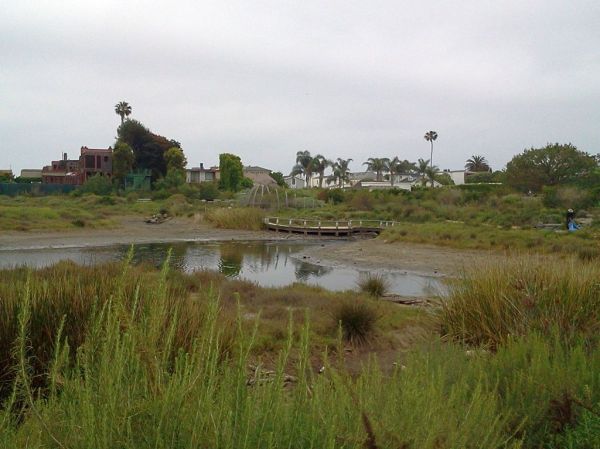
View across shallow water towards west end of channel & Malibu Colony
(L. Johnson 4-28-19 Malibu Lagoon)
Migration continues with birds coming and going, and breeding has begun. One Mallard pair was tooling around the lagoon trailing twelve fluffball ducklings. Class is in session and the curriculum is: Where to Go, Where Not to Go, What to Eat, and Sticking Close to Mom.

Mallard duckling class begins for the day (L. Loeher 4-28-19 Malibu Lagoon)
One Belted Kingfisher has appeared four out of the last five months. Oddly enough, the March bird was a male but the April bird is the more brightly-colored female. With a cinnamon breast-band which the male lacks, she is considered one of the few dozen avian examples of “reverse sexual diorphism.” For more on that, read THIS.
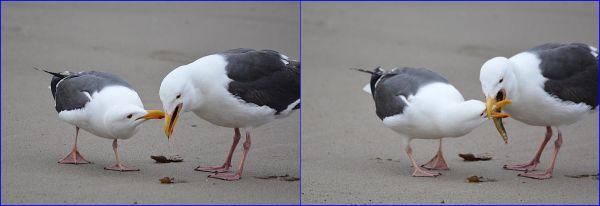
Giving a fish to a prospective mate proves to them that you know what you’re doing.
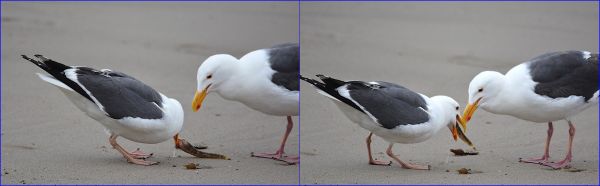
Western Gull fish swapping #3(L) + 4(R) (All photos G. Murayama 4-26-19 Zuma)
These photos were originally incorrectly credited by your tired editor.
The article about our birdwalk by journalist Barbara and photographer Susie from the Malibu Surfside News was published April 4. It’s always interesting reading about oneself. Apparently I was a font of interesting information, saying many more fascinating things than I remember or even believe I said. I learned a lot by reading my own words.

Black-necked Stilt jumps for joy (R. Juncosa 4-28-19 Malibu Lagoon)
The Elegant Terns have definitely returned from their winter in Mexico, many of them with rosy breasts. I counted 230 of them, but they came and went all morning and could have numbered many more. We found a few Caspian and Royal Terns among them – they’re a little stand-offish and tend to cluster with their own species. Two Least Terns stopped by but didn’t stay long. Gull numbers were down and most of them were Western Gulls.
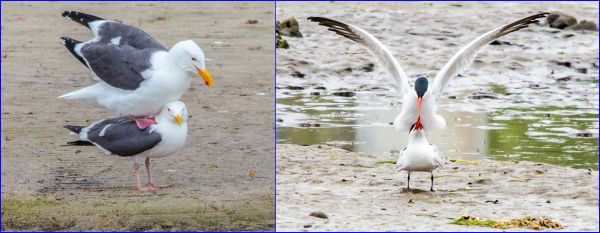
Piggyback ride time for the Western Gulls and Elegant Terns (R. Juncosa 4-28-19 Malibu Lagoon)
Two Nanday Parakeets perched in a large aracaria tree at Adamson House, where they were two months ago. They usually stay up in the Santa Monica Mtns. canyons where they eat whatever’s handy and nest in old woodpecker holes, but they occasionally stray down to the beach. We’ve recorded them 14 times since they first appeared in Oct. 2001. Speaking of introduced species, almost all the large pigeons we get are feral Rock Pigeons, scrounging the sand for snacks, but very infrequently we’ll see Band-tailed Pigeon, largest of the three big pigeons. These acorn-eaters also stay well up the canyons among the trees and we’ve recorded them on our walks only twice in 40 years. Eurasian Collared-Dove first appeared in May 2007 and has dropped in nine times since then, including today. We’ve also had White-winged Dove three times, Spotted Dove twice, and Mourning Dove 219 times.

Mourning Dove, cryptic against a brown background, not so much against white.
(G Murayama 4-28-19 Malibu Lagoon)
The lone Eared Grebe was in breeding plumage and continually diving just past the surf zone. The lone Pelagic Cormorant was in the same area, doing the same thing, but not in breeding plumage. A pod of at least six dolphins was about 50-100 yards further out. They did a lot of diving, and there was a flock of pelicans, gulls and terns in the vicinity, so there was probably a school of small fish in the area, unintentionally attracting their attention.

One Marbled Godwit seems to have problems with his landing gear
(G Murayama 4-28-19 Malibu Lagoon)
On her way back out, Femi Faminu spotted a male Hooded Oriole in one of the Malibu Colony cypress trees next to the fence. It sang a bit and then flew across the lagoon towards the parking lot. In past years it has often been seen and heard in both locations, and we’ve found their nest in one or other of the larger palms. It’s nice to know they’re back.

Marbled Godwits and a Western Snowy Plover (L. Loeher 4-28-19 Malibu Lagoon)

Pepperdine Bell Tower (DougandRhonda Blogspot)
Shortly before we left, just as I was about to do a third count of the terns, all the terns and gulls flew up into the air, squawking madly. This usually indicates that they spotted a raptor, but I could not find one overhead. Then a Peregrine Falcon shot by, 30-50 feet up, flew out over the waves, turned around and came back across the beach, slightly higher. All the remaining birders got a pretty good look at it, an adult in bright plumage. I then noticed another raptor, much higher, almost out of eyesight, which proved to be another Peregrine. I followed this bird in my binos for at least a minute until it disappeared behind a house near Pepperdine University halfway up the hill. It probably perched in a tree, out of sight.. In the past, we’ve seen Peregrines perching in the crossbar of the Pepperdine bell tower, waiting for their lunch to fly by.
Not a bad way to end an outing.
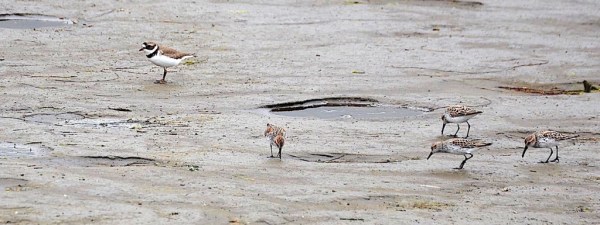
Semipalmated Plover and Western Sandpipers (G. Murayama 4-28-19 Malibu Lagoon) Both species have partial webbing on their toes, enabling them to walk easily in soft mud, yet avoid clumsy waddling like the fully-webbed duck.
Birds new for the season: Eared Grebe, Eurasian Collared-Dove, Black-necked Stilt, Semipalmated Plover, Western Sandpiper, Least Tern, Peregrine Falcon, Cliff Swallow, American Robin, Hooded Oriole, Orange-crowned Warbler.

View across shallow water channel towards beach (L. Johnson 4-28-19 Malibu Lagoon)
Many thanks to our photographers: Lillian Johnson, Ray Juncosa, Larry Loeher & Grace Murayama.
Our next three scheduled field trips: Black Rock Campground & Morongo Valley, 3pm Sat. 4 May, 7:30 Sun. 5 May; Malibu Lagoon 8:30 & 10am, 26 May; Mt. Piños 8am 8-9 June.
Our next program: Birds of Trinidad & Tobago, presented by Martyn Kenefick. Tuesday, 7 May, 7:30 p.m., Chris Reed Park, 1133 7th St., NE corner of 7th and Wilshire Blvd. in Santa Monica.
NOTE: Our 10 a.m. Parent’s & Kids Birdwalk meets at the shaded viewpoint just south of the parking area. Watch for Willie the Weasel. He’ll be watching for you and your big floppy feet.
Links: Unusual birds at Malibu Lagoon recently updated with new photos
9/23/02 Aerial photo of Malibu Lagoon
Prior checklists:
2017: Jan-June, July-Dec 2018: Jan-June, July-Dec
2016: Jan-June, July-Dec 2015: Jan-May, July-Dec
2014: Jan-July, July-Dec 2013: Jan-June, July-Dec
2012: Jan-June, July -Dec 2011: Jan-June, July-Dec
2010: Jan-June, July-Dec 2009: Jan-June, July-Dec.
The 10-year comparison summaries created during the Lagoon Reconfiguration Project period, despite numerous complaints, remain available on our Lagoon Project Bird Census Page. Very briefly summarized, the results unexpectedly indicate that avian species diversification and numbers improved slightly during the restoration period June’12-June’14.
Many thanks to Adrian Douglas, Femi Faminu, Lillian Johnson and Lu Plauzoles for their contributions to the checklist below.
[Chuck Almdale]
| Malibu Census 2018-19 | 11/25 | 12/23 | 1/27 | 2/24 | 3/24 | 4/28 |
| Temperature | 64-75 | 55-62 | 65-75 | 54-60 | 55-64 | 62-66 |
| Tide Lo/Hi Height | H+6.46 | H+6.87 | L+1.36 | L+0.84 | L-0.05 | H+3.86 |
| Tide Time | 0944 | 0850 | 0913 | 0708 | 0638 | 0546 |
| Cackling Goose | 1 | |||||
| Canada Goose | 2 | 1 | ||||
| Cinnamon Teal | 2 | 2 | ||||
| Northern Shoveler | 2 | 1 | ||||
| Gadwall | 4 | 8 | 6 | 12 | 18 | 8 |
| American Wigeon | 12 | 5 | 4 | 8 | 15 | |
| Mallard | 14 | 12 | 27 | 18 | 14 | 30 |
| Northern Pintail | 2 | |||||
| Green-winged Teal | 2 | 4 | 2 | 2 | ||
| Greater Scaup | 2 | |||||
| Lesser Scaup | 2 | |||||
| Surf Scoter | 14 | |||||
| Bufflehead | 6 | |||||
| Red-breasted Merganser | 4 | 2 | 3 | 1 | 1 | 1 |
| Ruddy Duck | 95 | 2 | 3 | 5 | ||
| Pied-billed Grebe | 1 | 2 | 1 | |||
| Horned Grebe | 1 | |||||
| Eared Grebe | 4 | 1 | ||||
| Western Grebe | 4 | 2 | 2 | 22 | ||
| Clark’s Grebe | 1 | 1 | ||||
| Rock Pigeon | 12 | 22 | 13 | 17 | 15 | 15 |
| Eurasian Collared-Dove | 2 | |||||
| Mourning Dove | 2 | 2 | 2 | 6 | 3 | |
| Anna’s Hummingbird | 4 | 1 | ||||
| Allen’s Hummingbird | 2 | 2 | 4 | 2 | 2 | 3 |
| American Coot | 85 | 58 | 38 | 36 | 55 | |
| Black-necked Stilt | 2 | 2 | ||||
| Black-bellied Plover | 79 | 70 | 99 | 35 | 14 | |
| Snowy Plover | 7 | 32 | 31 | 14 | 2 | |
| Semipalmated Plover | 9 | |||||
| Killdeer | 7 | 14 | 17 | 10 | 10 | 6 |
| Whimbrel | 9 | 2 | 7 | 4 | 55 | 4 |
| Marbled Godwit | 15 | 14 | 17 | 23 | 15 | 20 |
| Ruddy Turnstone | 2 | 3 | 4 | 3 | ||
| Sanderling | 110 | 60 | 72 | 32 | 4 | |
| Least Sandpiper | 15 | 17 | 23 | 16 | 3 | |
| Western Sandpiper | 2 | 4 | ||||
| Spotted Sandpiper | 2 | 1 | 1 | 2 | 2 | 1 |
| Willet | 13 | 12 | 20 | 12 | 9 | 4 |
| Bonaparte’s Gull | 1 | |||||
| Heermann’s Gull | 14 | 14 | 13 | 5 | ||
| Ring-billed Gull | 30 | 95 | 50 | 85 | 25 | 10 |
| Western Gull | 45 | 75 | 127 | 98 | 30 | 95 |
| California Gull | 90 | 700 | 460 | 140 | 22 | 45 |
| Herring Gull | 1 | 2 | 1 | |||
| Glaucous-winged Gull | 1 | 1 | ||||
| Least Tern | 2 | |||||
| Caspian Tern | 2 | 12 | ||||
| Royal Tern | 7 | 1 | 4 | 12 | 65 | 6 |
| Elegant Tern | 43 | 230 | ||||
| Red-throated Loon | 1 | |||||
| Pacific Loon | 2 | 1 | 1 | |||
| Common Loon | 2 | 2 | ||||
| Brandt’s Cormorant | 1 | 1 | 20 | 2 | ||
| Double-crested Cormorant | 34 | 42 | 31 | 24 | 60 | 23 |
| Pelagic Cormorant | 1 | 2 | 2 | 2 | 1 | |
| Brown Pelican | 8 | 29 | 15 | 37 | 65 | 58 |
| Great Blue Heron | 2 | 2 | 2 | 1 | 2 | |
| Great Egret | 2 | 2 | 1 | 5 | 3 | |
| Snowy Egret | 12 | 11 | 7 | 5 | 2 | 3 |
| Black-crowned Night-Heron | 2 | |||||
| Turkey Vulture | 1 | 1 | ||||
| Cooper’s Hawk | 1 | |||||
| Red-shouldered Hawk | 1 | |||||
| Red-tailed Hawk | 1 | 1 | 1 | 2 | 1 | |
| Belted Kingfisher | 1 | 1 | 1 | 1 | ||
| American Kestrel | 1 | |||||
| Peregrine Falcon | 1 | 2 | ||||
| Nanday Parakeet | 3 | 2 | ||||
| Black Phoebe | 3 | 6 | 4 | 6 | 2 | 3 |
| Say’s Phoebe | 2 | 1 | 1 | |||
| Cassin’s Kingbird | 1 | |||||
| California Scrub-Jay | 1 | 1 | 1 | |||
| American Crow | 2 | 6 | 9 | 6 | 6 | 5 |
| Rough-winged Swallow | 2 | 2 | ||||
| Cliff Swallow | 1 | |||||
| Barn Swallow | 3 | 15 | ||||
| Oak Titmouse | 1 | |||||
| Bushtit | 6 | 8 | 2 | 8 | 2 | |
| Rock Wren | 1 | |||||
| House Wren | 2 | 1 | 1 | |||
| Marsh Wren | 1 | 3 | 1 | 1 | ||
| Bewick’s Wren | 3 | 3 | 1 | 1 | ||
| Blue-gray Gnatcatcher | 12 | 10 | 1 | 2 | ||
| Ruby-crowned Kinglet | 5 | 3 | 2 | 1 | ||
| Wrentit | 4 | 3 | 2 | 1 | ||
| Hermit Thrush | 1 | 3 | 2 | |||
| American Robin | 1 | |||||
| Northern Mockingbird | 1 | 1 | 2 | 3 | 2 | |
| European Starling | 8 | 35 | 3 | 15 | ||
| American Pipit | 1 | 1 | ||||
| House Finch | 10 | 30 | 28 | 15 | 8 | 18 |
| Lesser Goldfinch | 5 | |||||
| Spotted Towhee | 1 | 2 | ||||
| California Towhee | 1 | 1 | ||||
| Savannah Sparrow | 1 | |||||
| Song Sparrow | 3 | 4 | 5 | 15 | 10 | 12 |
| White-crowned Sparrow | 4 | 27 | 15 | 18 | 9 | |
| Golden-crowned Sparrow | 1 | 1 | ||||
| Dark-eyed Junco | 2 | |||||
| Western Meadowlark | 3 | 2 | 2 | |||
| Hooded Oriole | 1 | |||||
| Red-winged Blackbird | 3 | 4 | ||||
| Great-tailed Grackle | 3 | 2 | 6 | 3 | 3 | 6 |
| Orange-crowned Warbler | 1 | |||||
| Common Yellowthroat | 3 | 10 | 5 | 5 | 1 | 1 |
| Yellow-rumped(Aud) Warbler | 18 | 27 | 20 | 16 | 2 | |
| Totals by Type | Nov | Dec | Jan | Feb | Mar | Apr |
| Waterfowl | 146 | 47 | 45 | 48 | 53 | 40 |
| Water Birds – Other | 139 | 139 | 90 | 146 | 184 | 83 |
| Herons, Egrets & Ibis | 18 | 15 | 10 | 6 | 9 | 6 |
| Quail & Raptors | 2 | 3 | 1 | 3 | 2 | 3 |
| Shorebirds | 261 | 193 | 294 | 168 | 122 | 56 |
| Gulls & Terns | 186 | 886 | 657 | 341 | 189 | 400 |
| Doves | 12 | 24 | 15 | 19 | 21 | 20 |
| Other Non-Passerines | 2 | 3 | 4 | 6 | 7 | 7 |
| Passerines | 96 | 149 | 150 | 107 | 63 | 88 |
| Totals Birds | 862 | 1459 | 1266 | 844 | 650 | 703 |
| Total Species | Nov | Dec | Jan | Feb | Mar | Apr |
| Waterfowl | 12 | 7 | 6 | 7 | 7 | 4 |
| Water Birds – Other | 9 | 9 | 7 | 10 | 5 | 4 |
| Herons, Egrets & Ibis | 4 | 3 | 3 | 2 | 3 | 2 |
| Quail & Raptors | 2 | 3 | 1 | 2 | 2 | 2 |
| Shorebirds | 11 | 9 | 11 | 10 | 8 | 10 |
| Gulls & Terns | 5 | 6 | 7 | 6 | 8 | 7 |
| Doves | 1 | 2 | 2 | 2 | 2 | 3 |
| Other Non-Passerines | 1 | 2 | 1 | 3 | 3 | 4 |
| Passerines | 25 | 20 | 20 | 19 | 17 | 18 |
| Totals Species – 107 | 70 | 61 | 58 | 61 | 55 | 54 |
Here’s an important message from long-time member of SMBAS, Jeri Edwards.
Your blog editor thinks this is an interesting and worthwhile project.
This message is a repeat as the email text may have been illegible.

(Northern Pygmy Owl, photo taken in Los Padres National Forest, by Jeri Edwards)
Then please join me (Jeri Edwards) in participating in my GoFundMe campaign to save cavity-nesting birds nesters from a horrible death in the Los Padres National Forest (LPNF). All funds received through this GoFundMe campaign go directly to the Los Padres Poo-Poo Project and bypass me. I’m just spearheading this project. The funds will be used to purchase and place screens (see photo below) on the tops of vault toilet vent pipes in Los Padres National Forest.
https://www.gofundme.com/los-padres-NF-Cavity-Nester-Poo-Poo-Project
13 screens needed for the Mt. Pinos, Ojai and Santa Barbara districts will cost under $550. 44 screens for all the LPNF campgrounds which include the Santa Lucia and Monterey districts will cost under $1800.
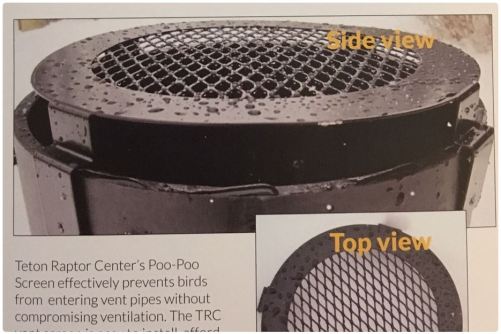
This solid beastie from the Teton Raptor Project keeps any and all birds out of the pit toilet rooftop vents.
Alternatively, if you make a personal donation or donate from a charitable trust directly to the Teton Raptor Center and earmark it for the LPNF Poo-Poo Project it will go directly to this effort. The Teton Raptor Center is a non-profit organization advancing raptor conservation through education, research, and rehabilitation.
Many thanks to all for your interest and for your donations.
Bio Blitz at Malibu Lagoon this Sunday 11am – 1pm, April 28
There will be a Bio Blitz at Malibu Lagoon this Sunday
immediately following our lagoon birdwalks (8:30am & 10am)
The Resource Conservation District of the Santa Monica Mountains is hosting this incredible citizen science project and they hope that many (or all!) of our birdwalkers will join them. They will have people at the lagoon on Sunday to help with iNaturalist and with linking to the challenge.
If you would like to participate in the City Nature Challenge: Malibu Lagoon Bioblitz with the RCD on April 28th from 11am – 1pm:
1. Load the iNaturalist app to your smartphone
2. Bring your phone with you ready to take pictures.
3. Load pictures to iNaturalist and make sure the location feature is on or that you are noting the location.
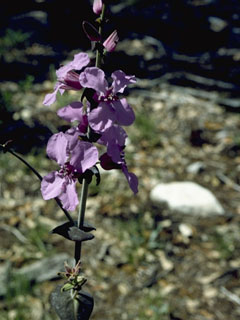
Bracted Twistflower -Streptanthus bracteatus. See text in press release below.
(Bransford, W.D. and Dolphia – Lady Bird Johnson Wildflower Center at University of Texas)
If you need help with any of these steps RCD educators will be at the lagoon to walk you through the process. It is a great way to learn about citizen science! You don’t even need to know the species. The Natural History Museum of LA is going to be having a species ID party to make sure as many identifications as possible are research grade.
You are welcome to take pictures during your walk and load them during the Bio Blitz or on your own.
If you do not have a smart phone and would like to still participate you can bring a camera and submit your photos in the way that works best for you.
email – nature@nhm.org
social media – #NatureinLA
Text – 213 663-6632
iNaturalist.org: website or apps
City Nature Challenge General Rules.
Take photos: 12:00 am April 26 to 11:59 pm April 29
Upload photos/make IDs: April 30 to May 5
Photos of: Wild plants and animals (no pets or humans)
Geographic Boundary: Los Angeles County
Here’s their announcement/press release. [Chuck Almdale]
CITIZEN AND COMMUNITY SCIENTISTS THROUGHOUT THE WORLD
COMPETE IN ‘CITY NATURE CHALLENGE’ APRIL 26-29, 2019
Fourth annual challenge grows to over 150 participating cities on six continents and over 600 partnering organizations; results announced on May 6.
As citizen and community science initiatives continue to increase in popularity, this year’s fourth annual City Nature Challenge will expand to more than 150 cities across the globe. Kicking off April 26 at 12:01 am in each time zone, the Challenge runs through April 29, 11:59 pm. The multi-city, global event calls on current and aspiring citizen scientists, nature and science fans, and people of all ages and science backgrounds to observe and submit pictures of wild plants, animals, and fungi using the free app iNaturalist. Identification of photographed species will be crowdsourced through the online community April 30-May 5 and results will be announced on May 6.
There is nature in every city, and the best way to study it is by connecting community and scientists through citizen science. With human populations worldwide increasingly concentrated in cities, the study of urban biodiversity is quickly becoming integral to the future of plants and wildlife on Earth. Large pools of data, including those built through iNaturalist, natural history museums, and science organizations, help authorities make informed conservation decisions that allow humans to coexist sustainably with the plants and animals in their neighborhoods.
After launching the first-ever City Nature Challenge in 2016, the Natural History Museum of Los Angeles County (NHM) and San Francisco’s California Academy of Sciences (CAS) are hosting their fourth—and much larger—effort. Last year’s five-day challenge invited U.S. participants in over 60 cities to observe and submit pictures of wildlife they encountered using iNaturalist. Participants added over 440,000 observations of nature to iNaturalist, and scientists can use these pools of data to understand and conserve urban wildlife.
This year, the Challenge is expanding, and organizers estimate that 750,000 observations will be made by over 25,000 people in over 160 participating cities. The data collected gives scientists, educators, urban planners, and policymakers insight into the biodiversity of urban locales throughout the world, including in Los Angeles.
“Urbanization is one of the greatest global threats to biodiversity. What better place to study it than right here in Los Angeles, one of the largest mega-cities on the planet,” says Dr. Lori Bettison-Varga, president and director of NHM says. “We want to use our experience with engaging the public to help make cities more appealing to wildlife and humans alike.”
For both budding and veteran citizen scientists, participating is easy:
- Find wildlife. It can be any plant, animal, fungi, slime mold, or any other evidence of life (scat, fur, tracks, shells, carcasses!) found in your participating city.
- Take a picture of what you find, and be sure to note the location of the critter or plant.
- Share your observations by uploading your findings through iNaturalist or your city’s chosen platform.
Scientists can’t be everywhere at once, so without community observations, they’d miss some incredible finds. During the 2018 City Nature Challenge, an observation of a hammerhead worm in the San Francisco Bay Area marked the first-ever recording of this species, which is native to Asia, in the U.S. In central Texas, the Bracted Twistflower—a candidate for federal protection—bloomed in deep purple hues across its only known home in the Edwards Plateau.
In Hong Kong, observations of an incense tree that inspired the city’s name (Hong Kong translates to “scented harbor”) helped document how the once-abundant tree has declined across its native range. And the observation of an endangered songbird flitting through swamps outside of Bogotá, Colombia renewed hope for the future of this rare bird. Many other endangered, endemic, or data deficient species were recorded during the City Nature Challenge: This influx of information gives scientists, educators, urban planners, and policymakers insight into the biodiversity of urban locales throughout the world.
More Information and Education Toolkit
Visit citynaturechallenge.com
iNaturalist
Signing up is easy and free. Visit inaturalist.org from your browser, or download iNaturalist from the Apple App Store or Google Play store.
Social Media
#CityNatureChallenge
Twitter handle: @citnatchallenge
City Nature Challenge YouTube video overview
Want to Learn More? iNaturalist video tutorials

…there is a season! Tern, Tern, Tern (L. Loeher Malibu Lagoon 04-19-19)
Some of the wintering birds have left, but many remain, and our breeding birds are arriving. The air may be filled with swallows. Grebes, loons, pelicans, ducks, egrets, hawks, shorebirds, flycatchers, orioles, finches, ad infinitum.
Some of the great birds we’ve had in April are: Brant, Clark’s Grebe, Osprey, American Kestrel, Virginia Rail, Sora, Snowy Plover, Greater Yellowlegs, Black Turnstone, Surfbird, Dunlin, Bonaparte’s Gull, Royal, Elegant & Forster’s Terns, Eurasian Collared & White-winged Doves, Tree & Violet-Green Swallows, American Pipit, Cedar Waxwing, Orange-crowned & Wilson’s Warblers, Lazuli Bunting and Lesser Goldfinch.
NOTE: There will be a Bio Blitz at Malibu Lagoon, 11am – 1pm, this Sunday immediately following our 8:30am & 10am lagoon birdwalks. This national event will be hosted locally at the lagoon by the Resource Conservation District of the Santa Monica Mountains. Look for our separate announcement on this event.
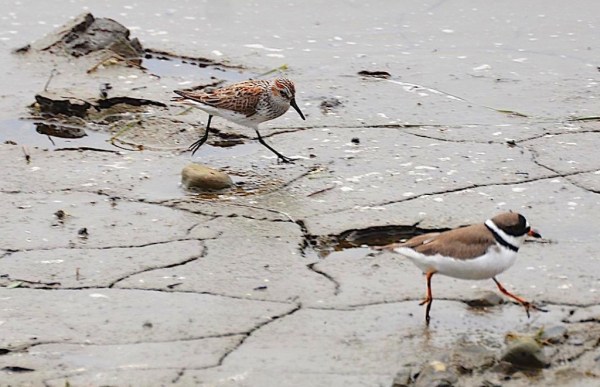
Western Sandpiper and Semipalmated Plover on their way north to breed.
Yes, it’s a very long walk. (G. Murayama Malibu Lagoon 04-19-19)
Adult Walk 8:30 a.m., 4th Sunday of every month. Beginner and experienced, 2-3 hours. Species range from 40 in June to 60-75 during migrations and winter. We meet at the metal-shaded viewing area (see photo below) next to the parking lot and begin walking east towards the lagoon. We always check the offshore rocks and the ocean. When lagoon outlet is closed we continue east around the lagoon to Adamson House. We put out special effort to make our monthly Malibu Lagoon walks attractive to first-time and beginning birdwatchers. So please, if you are at all worried about coming on a trip and embarrassing yourself because of all the experts, we remember our first trips too. Someone showed us the birds; now it’s our turn.
Children and Parents Walk 10:00 a.m., 4th Sunday of every month. One hour session, meeting at the metal-shaded viewing area between parking lot and channel. We start at 10:00 for a shorter walk and to allow time for families to get it together on a sleepy Sunday morning. Our leaders are experienced with kids so please bring them to the beach! We have an ample supply of binoculars that children can use without striking terror into their parents. We want to see families enjoying nature. (If you have a Scout Troop or other group of more than seven people, you must call Jean (310-472-7209) to make sure we have enough binoculars and docents.)
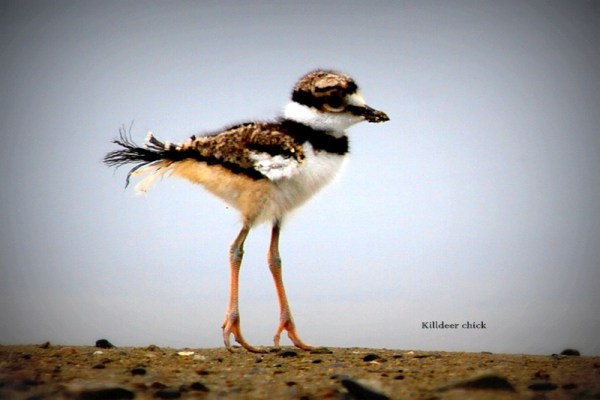
Killdeer chick, as leggy as a Secretary-Bird (J.Waterman 4/21/12)

Great Egret stalks a lizard in the parking lot (Grace Murayama 2-25-18)
IGNORE previous Special Travel Alert: The editor forgot to delete March’s alert about the L.A. Marathon. NO marathon this month!
Directions: Malibu Lagoon is at the intersection of Pacific Coast Highway and Cross Creek Road, west of Malibu Pier and the bridge. Look around for people wearing binoculars.
Parking: Parking machine recently installed in the lagoon lot: 1 hr $3; 2 hrs $6; 3 hrs $9, all day $12 ($11 seniors); credit cards accepted. Annual passes accepted. You may also park (read the signs carefully) either along PCH west of Cross Creek Road, on Cross Creek Road, or on Civic Center Way north (inland) of the shopping center. Lagoon parking in shopping center lots is not permitted.
Prior checklists:
2018: Jan-June, July-Dec 2017: Jan-June, July-Dec
2016: Jan-June, July-Dec 2015: Jan-May, July-Dec
2014: Jan-July, July-Dec 2013: Jan-June, July-Dec
2012: Jan-June, July -Dec 2011: Jan-June, July-Dec
2010: Jan-June, July-Dec 2009: Jan-June, July-Dec.
[Chuck Almdale]
Adam Savage was co-host of science television program Mythbusters for 14 seasons, and now runs tested.com. He chats with Above the Noise host Shirin Ghaffary about why scientific inquiry is more important than ever.
ABOVE THE NOISE is a show that cuts through the hype and takes a deeper look at the science behind controversial and trending topics in the news. Hosted by Myles Bess and Shirin Ghaffary.
This series is aimed at teens, but after viewing a few episodes, I’m sure that most adults will benefit from it as well. Let us know what you think.
This is another installment of KQED’s Above the Noise series. If no film or link appears in this email, go to the blog to view it by clicking on the blog title above. If the film stops & starts in an annoying manner, press pause (lower left double bars ||) to let it buffer and get ahead of you. [Chuck Almdale]



 SANTA MONICA BAY AUDUBON SOCIETY BLOG