Free email delivery
Please sign up for email delivery in the subscription area to the right.
No salesman will call, at least not from us. Maybe from someone else.
NGS Bird field guide followup
[By Chuck Almdale]
We received our copies of the National Geographic Field Guide to the Birds of the United States and Canada, both books autographed by the author on adhesive paper, one by “Ted Floyd” and the other apparently by “Ted Flogel”, so we know they weren’t printed signatures cranked out by the millions. I like it. It’s very well put together, I’m happy I bought it, and I think it will survive the unwarranted beating I give my hapless field guides. This is a very brief & incomplete comment/description.
Link to prior posting.
Uh…you may have heard rumors that this will be the last printed NGS bird field guide ever. I checked out some online comments to that effect and they were talking about the 7th. ed. being the last by Dunn and Alderfer. That’s true; this one is by Ted Floyd (or Flogel). However, I’d estimate that “most” (an exacting statistical term) of the material and artwork is unchanged.
My only warning. This is a larger book. If your current NGS fits very snugly into whatever you carry it in, you may be SOOL (look it up). This one is 6″ x 9″ x 1″ thick; my NGS 6th ed. is 5 3/8″ x 7 15/16″ x 1 3/8″ thick. Edition #8 is 26.6% larger. I gulped when I saw it, as I really like my book bag and wasn’t at all certain it would fit and then what would I do! [Cue copious tears.] But it fits, so no problemo.
Likes: This is in comparison to my 6th edition. Some of this is due to the larger size allowing for more info. per page.
- Most of it looks the same
- Front-flap quick-find index: 30% more alphabetized names, separated by lines
- Tough plasticized cover
- Colors and details seem slightly brighter and finer; perhaps due to wear on my 6th ed.
- Follows1 the new phylogenetic order
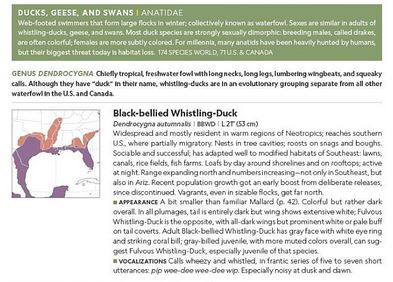
- Each family and genus gets an introduction3; in sparrows and warblers which have many genera with few species, a few genera are grouped
- Allen’s and Rufous Hummingbirds more extensively covered
- Glossary: About 120 terms, including rectrices & remiges
Meh…not-so-much:
- The pages seem slightly more flimsy, perhaps less plasticizer or waterproofing?
- Subspecies range maps at the back disappeared, just gone. Now that hurts.
- Range maps slightly smaller
- Some rarer birds (e.g. Baikal Teal, Key West Quail-Dove) were banished to the rearward 27-page “Rare Bird” collection
- Many small notes2 next to illustrations disappeared, another needless pain
Notes.
1. I didn’t come even close to checking all possible changes, but parrots and falcons are in the right place (between woodpeckers and flycatchers); and these thirteen are now next to each other in sequence as they should be: ducks, chickens, flamingos, grebes, doves, cuckoos, nightjars, swifts, hummers, rails, limpkin, cranes, stilts (yes, you read that right). I did a complete and up-to-that-date phylogenetic checklist last year of all 41 orders and 251 families (link) which you can check. If you didn’t read that posting, you will find surprises.
2. As the pages are larger, it’s not that there wasn’t room for these little comment/notes, and in many (perhaps most) cases they were not replaced by anything, just blank paper. Unless these comments were wrong, they should have remained, fer cryin’ out loud!
3. The page copied (very poorly) below is far clearer in the book, have no fear. Every family and nearly every genus gets a short description, which helps build bridges between the book layout and the recent changes in phylogenetic order. The more birders know about the latter, the better will be their understanding of the evolution of birds and their relationships, which is both fascinating and useful.
NGS 8th Edition North American Bird Field Guide
[Posted by Chuck Almdale]
Finally! Gasp! Now all of you birders who have been toiling under the burden of being forced to suffer with that annoying electronic field guide — yeah, the one with the tiny photos, indecipherable text, poorly-lit screens in broad daylight, and near-total-inability to easily scan through 81 sandpipers, 66 waterfowl, 65 warblers, 46 sparrows, or 42 flycatchers, not to mention 2 to 6 illustrations per species — yeah, that one — can breathe a sign of relief. Help is on its way.

The immensely valuable National Geographic Field Guide to the Birds of North America is now out in its 8th edition. You can put it in your pocket or pouch, next to that 64-oz. bottle of water and the granola bar the size and chewability of a cinder block. You can write in it, use it as a lap-table, compare birds on the same page!, pass it to someone else and the pages won’t inexplicably disappear or even get stuck upside down, and everyone can see the colors and read the words and study the maps without shading it with an umbrella, instead of simply pretending to be able to see it as they do now so you won’t feel bad. It won’t even die on you out in the field, miles or days from the nearest electric socket. It’s your true friend in need, quietly waiting until you take it in hand. And it won’t beep, squawk or ring at you or try to sell you something.
Sounds perfect, doesn’t it?
This appeared in my desktop inbox, from Scott Weidensaul, author of Living on the Wind, via those friendly folks at Buteo Books:
In its eighth edition, this venerable guide is a reborn marvel — new range maps, changes to avian taxonomy, the addition of Hawaii’s incredible birdlife, and perhaps best of all, all-new and deeply instructive text by Ted Floyd, one of the giants of the field. I’m not sure how this book could be any better.
Buteo Books [Link] added:
| Combining exciting new features with tried-and-true traditions, this beloved field guide will satisfy birders young and old, experienced life-listers and backyard birdwatchers alike. This new edition of the trusted National Geographic field guide combines fresh new text, updated taxonomy, expanded art including 240 new illustrations, and authoritative, data-derived maps, organized in the user-friendly format for which their field guides are known. |
| We have a limited number of copies signed by author Ted Floyd! Place your order today to ensure you snag a signed copy. |
Ted’s been around for about a million years, looking at birds and writing about birds. I’ve never [knowingly] met him but I’m quite sure he isn’t some sort of AI program which we all [should] know by now are loaded with errors and nonsense and highly reluctant to retract them when caught.
Anyways…the book is out, check your local bookseller if one still exists in your area, or order it from Buteo Books (guess what they specialize in) — 33 bucks & shipping — and maybe you can get one signed. My autographed (by all the authors!) and heavily annotated by me 2nd-edition decided one day to stay on the roadside wall at Parker Dam on the Colorado River, so now I make do with a 6th-edition, now 14 years old. Maybe it’s time to get a new one.
No, we don’t get any freebies for mentioning Buteo. I’ve bought books from them in the past, they’re OK and they haven’t cheated me.
Volunteers needed at Audubon Ballona Wetlands Education Program
[Posted by Chuck Almdale, submitted by Cindy Hardin]
Nature Nexus Institute has taken over the operation of Los Angeles Audubon’s school outreach program of school field trips to the Ballona Wetlands. Santa Monica Bay Audubon Society has helped support this organization for several decades.
Nature Nexus Institute is all about sharing and teaching local school children about the special habitats found right here in Los Angeles. They will be starting their six-week Fall Training on 16 September to get ready for school field trips to the Ballona Wetlands. Their tours take place on Tuesdays and Thursdays. All you need to be a volunteer is a love of the outdoors and the enthusiasm to work with school age aspiring nature lovers. Please contact Cindy Hardin at chardin@naturenexusinstitute.org or give her a call at 310-745-2118 if you are interested.
The following announcement is from them.

We are looking for Volunteers!
The sun is shining, August is starting to feel like a real August (not Fogust!) and the calls are starting to come in from teachers requesting field trip dates. We are rolling!! In order to prepare, our Fall Training will commence on Tuesday, September 16th. We have also had a change in our speaker schedule. The fabulous Tracy Drake, formerly of the Madrona Marsh and the City of Torrance, will be available to speak to our group. Tracy is one of the best interpreters of Nature that I have ever known, and as she is now in retirement, she has the time to come down and inspire the team. The new schedule is as follows:
Time: 9 am to noon, unless otherwise noted (see below)
Contact: Cindy Hardin, Ph/Text 310-745-2118, <chardin@naturenexusinstitute.org>
September 16th –Introductions and Wetland Ecology with Dr. John Dorsey
September 23rd – Birds and Birding with Ace Birder Walter Lamb
September 30th – Inspiring joy and Interpretation of Nature with Tracy Drake.
October 7th – Indigenous Knowledge and Practices with Matt Teutimez of the Kizh Gabrielino Nation
October 14th – Ecological Restoration and a Hopeful Future with Dr. Margot Griswold
October 21st – Bringing it all Together and Practical Considerations when Conducting School Field Trips
In addition, on our last day of Training, October 21st, we will have the folks from LiveScan on site at Ballona. A recently passed California Assembly Bill now requires that all personnel that work with children go through a process known as LiveScan. This is a background check, and if you have already gone through the process there is no need to do it again. However, if you have not (as some of you did come in mid-year and missed the first round) you will be able to do this on the 21st. The service is provided at no cost to you, and is a relatively quick procedure that will be done at the end of training on that day.
There is also an online training about being a Mandated Reporter, which is also required. NNI Staff Member Emily Cobar will be on site on 21st to assist in implementing LiveScan, and to help set you up for the Mandated Reporter training.
All sessions will go from 9 am to Noon, and take place at the Ballona Wetlands Ecological Reserve. The Reserve has no actual address. We use 303 Culver Blvd., Playa del Rey, 90293. This is a Local Market and Deli (it’s actual name!) that is currently being renovated. There is a driveway immediately after the building that opens up into a large parking lot. The gate to the Reserve is located in the northeast corner of the lot. Please feel free to call me at 310-745-2118 if you have any suggestions, ideas, questions, or schools you might have in mind that could participate in one of our fabulous field trips.
Looking forward to working with all of you and the school children of Los Angeles — who are in dire need of some time in Nature!
Thanks,
Cindy
Two Newish Birds: Malibu Lagoon, 24 August 2025
[By Chuck Almdale]
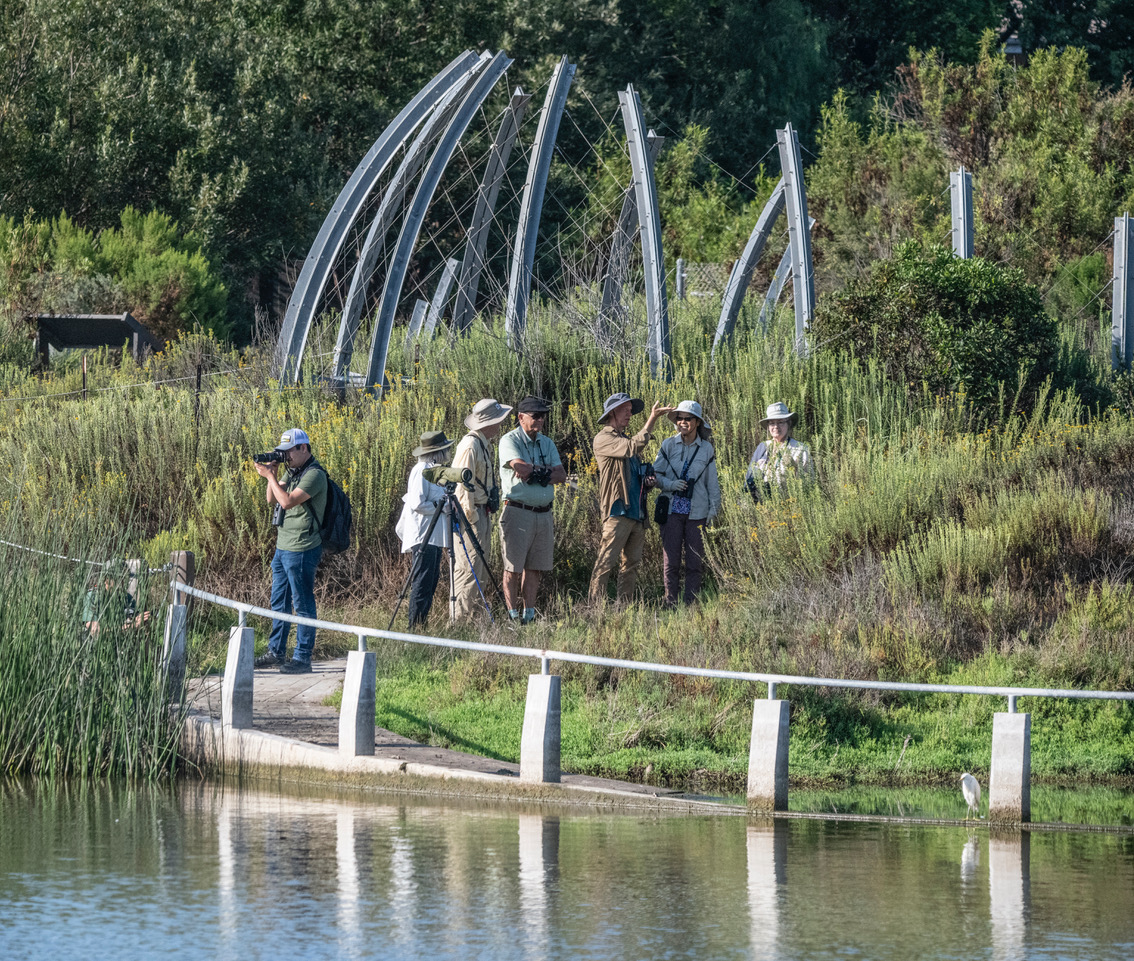
A couple of the early birders had already spotted the bird, perched on a sidewalk railing slightly west of our gathering area, the metal pavilion. It was a poor angle and the bird was facing away, so we trooped over towards that odd-looking structure of bent, cabled girders to get a full-frontal view.
Black-crowned Night Herons are regular at the lagoon. Out of of 338 censuses since October 1979, we’ve recorded them 161 times with a total of 490 birds. So…they show up 48% of the time, averaging three birds per visit. Singletons are common, single digits are the rule, double digits quite uncommon, and the high count was 15 birds on 26 Aug 2007. Before March 2001 we had only seven sightings, total, when they quickly became more common. That was when I began leading the trips and perhaps I checked the trees more thoroughly than my predecessors. After all, they are Night Herons – note the relatively large eyes – and we mostly see them out walking around only on cloudy days or during morning and evening twilight. On sunny days they’re hiding in a tree or thick brush, and they’re excellent at hiding and not moving.
However, this bird below is not a Black-crowned Night Heron, but a Yellow-crowned Night Heron. Notice the bright yellow crown? What…you missed it, it’s right there!
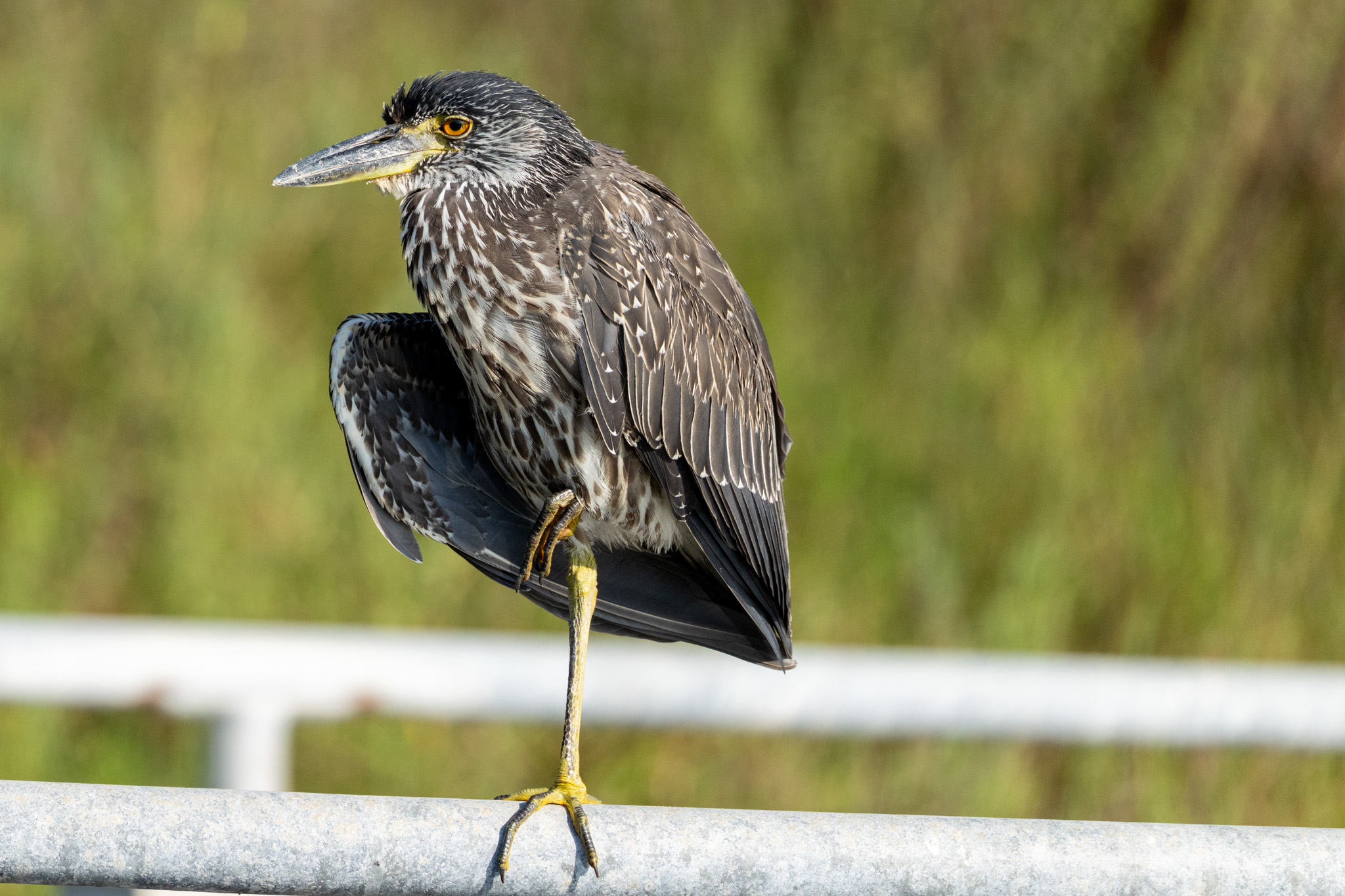
Yeah, that’s right, they don’t get their yellow crown until their second spring (not counting their birth year), when they’re old enough to breed. The bird below is either a juvenile, born this year, or a year old. This species is in the process of spreading generally northward through SoCal. About 30-40 years if you wanted to see one, you drove down to Scripps Lab near San Diego where one – one! – roosted reliably in a particular tree. Some 10-20 years ago they appeared in a marsh on Pt. Mugu Naval Air Station where they outnumbered the Black-crowns the last time I was there. Maybe 5 years ago they began appearing regularly in Ballona Fresh Water Marsh. So it goes…range extensions. The same thing happened with Great-tailed Grackles and Neotropic Cormorants during my SoCal birding lifetime. Other terns and gulls and now boobies on the Channel Islands. Whether global warming has anything to do with this, I don’t know. It’s probably been going on since the last time the ice cap retreated north.

(Ray Juncosa 8-24-25).
Sub-adult Yellow-crowns run grayer than the brownish Black-crowns. Their white spots are smaller and the dark on their bills is black rather than gray. Considering the amount of yellow on this one’s bill, I can’t help but wonder if their isn’t a Black-crown in it’s ancestry. They do hybridize, and we had a hybrid juvenile some 15-20 years ago at the lagoon, before the last reconfiguration.
They’ve been reported at the lagoon before, and a few of the group saw a juvenile by Adamson House a year or two back which we put on the trip report; Chris & Ruth Tosdevin saw it, but I missed it. According to eBird this is the 33rd date on which a YCNH has been seen at Malibu Lagoon. This particular bird has been reported to eBird 27 times (soon to be 28) between 10 August and 24 August. Word gets around.
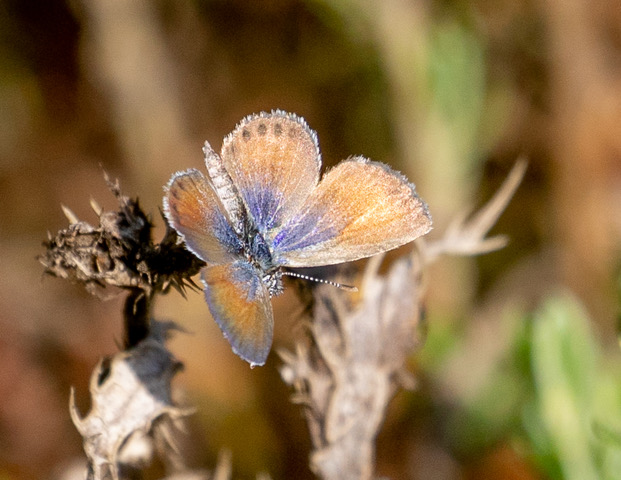
The Western Pygmy Blue Butterfly Brephidium exilis is the smallest butterfly in California and (reportedly) one of, if not the smallest butterfly in the world, and they’re regular at Malibu Lagoon, if you can find them. With wingspan 1/2-3/4th inch, about the same as the tip of your little finger and always very low to the ground, if you spot one it’s hard to be sure what it is, if it’s even alive and not some dead leaf-part blowing around, and when it stops, just exactly where it landed, blending in perfectly. If you’re diligent and lucky and back off a bit, you may find them with your binoculars. They’re native from California to Florida, with subspecies as far away as the Bahamas, Hispaniola, and Yucatan Peninsula. Somehow they’ve even managed to get to Hawaii and the Persian Gulf, flapping away across the stormy sea, I suppose, or inside-by-accident someone’s luggage.
Dark-eyed Juncos (previously Oregon Junco) aren’t what we think of when think about lagoon birds, but they’re become fairly regular in recent years. First recorded on our walks in September 2017, we’ve now recorded them 22 times, and in 10 of the past 13 months, probably mostly by Femi, Chris and Ruth. Usually one or two birds; once there were four. They’re fairly common in our local parks on the lawns during the winter, gathering insects and whatnots. There are a lot of distinguishable subspecies, and I think all of them gather at the mouth of Cave Creek Canyon in SE Arizona by New Year’s Day, should you be so inclined to visit.
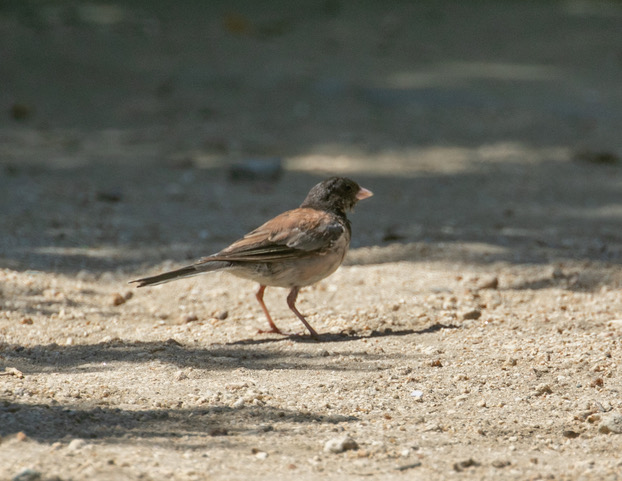
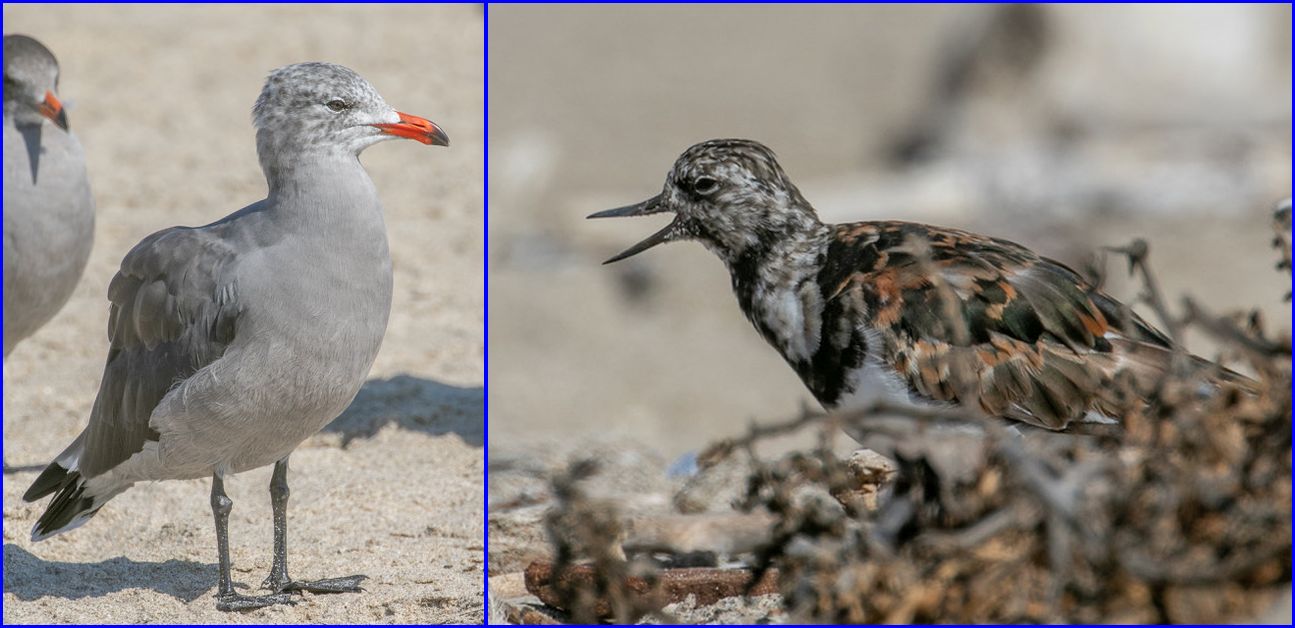
I include these two photos below to show how plumages are changing from spring/summer breeding. Take a look at last months lagoon report to see them, one month younger.
The two following species are easily and often confused, so I put them side-by-side. Song Sparrow, on the right, is common across the U.S., a SoCal resident and breeds at the lagoon. We see them on 98% of visits; they’re always there, I’m sure, but they don’t always pop out of the brush and sit on the trail, staring at you, or sing loudly as you saunter by. They like to live near water.
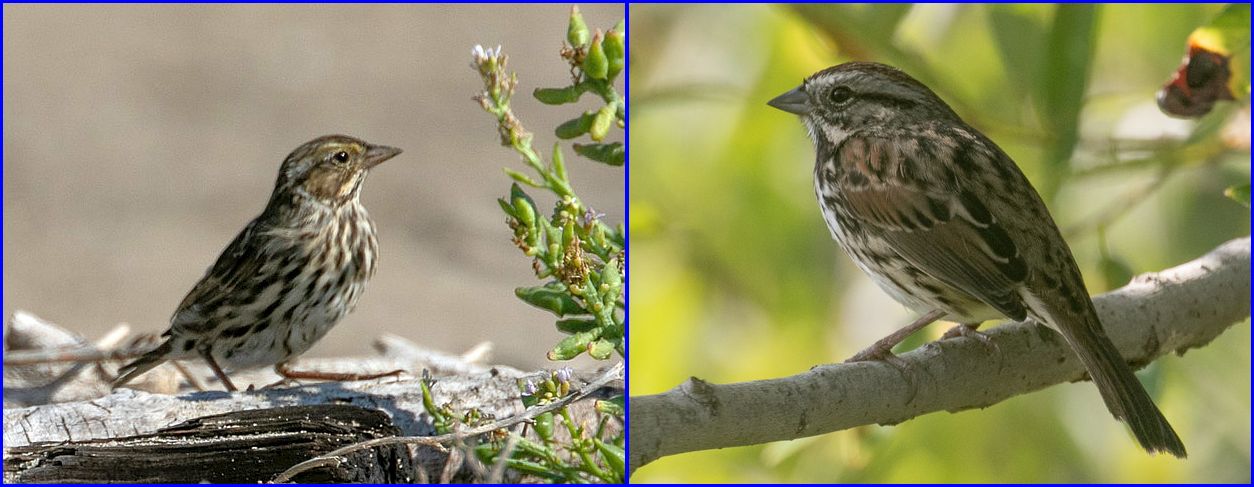
Savannah Sparrow. on the left, breeds from southern Mexico (at least!) to high arctic Alaska, and across the USA, but I don’t think they breed at the lagoon. We see them 1/6th as often as the Song, and never in May and June. Their central breast spot – if any – is less noticeable than the Song’s, the breast streaks usually a bit thinner, the bill slightly thinner and more pointed and they usually have some dull yellow in the lores/eyebrow. When we see them at the lagoon, it’s usually around the edges of the channels or lagoon.
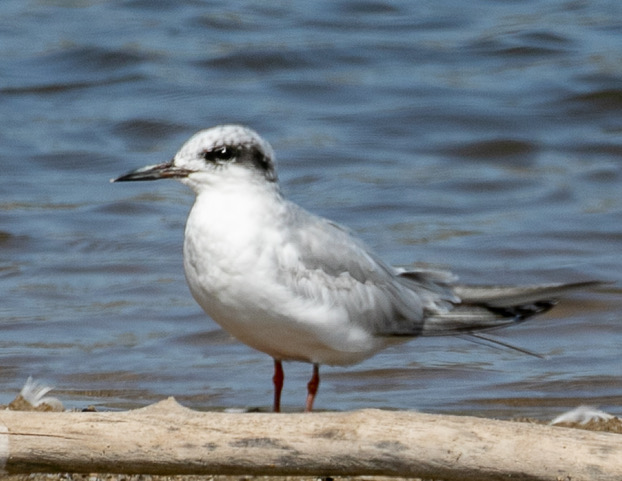
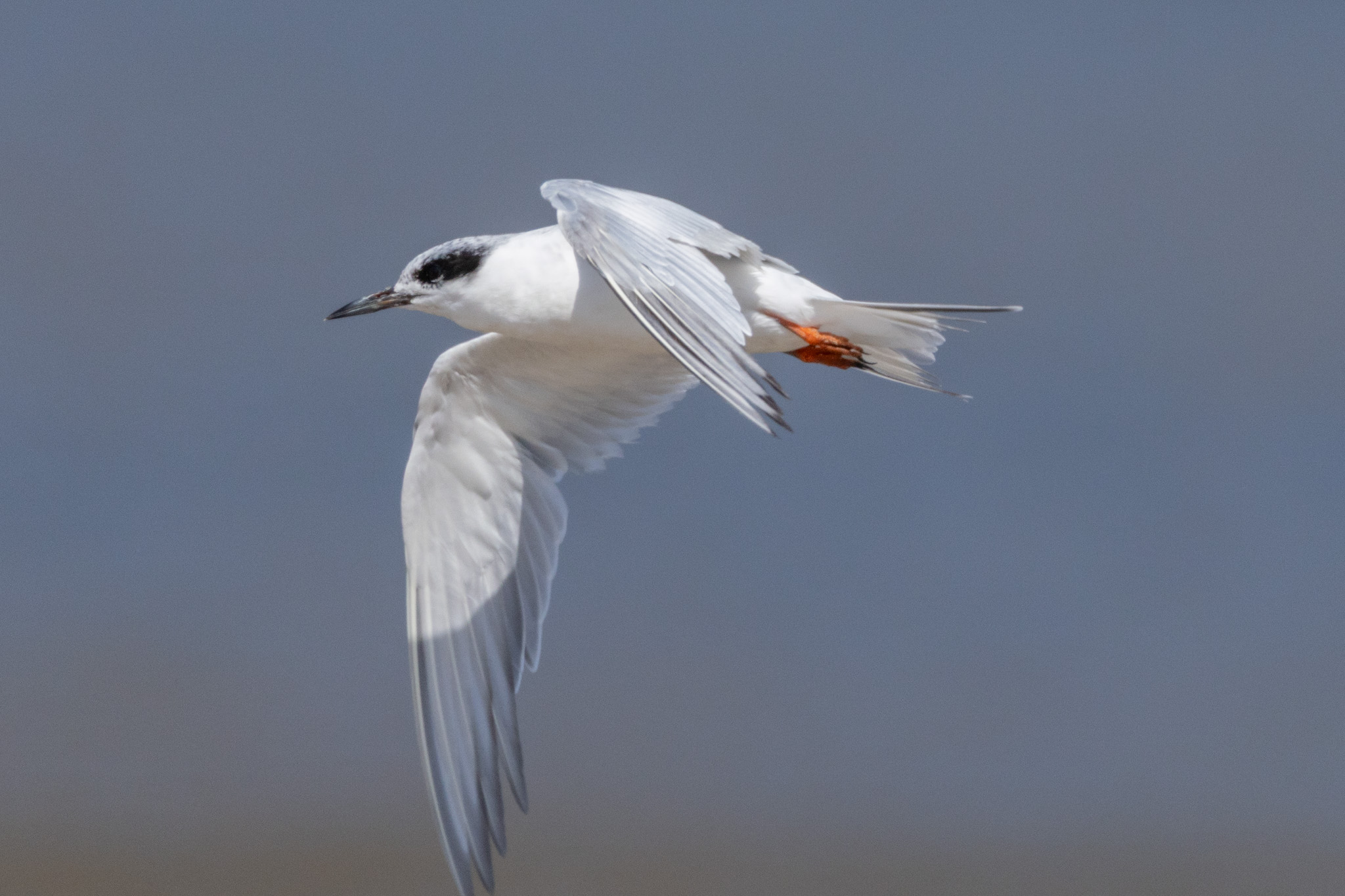
Forester’s Tern used to be a lot more common at the lagoon. Their historical presence peaks Nov-Apr and are nearly absent June-July, when they’re elsewhere breeding. Of 130 sightings at the lagoon since 1979 (892 birds total), we’ve seen them only 10 times (17 birds) since Christmas Day, 2016; that woefully averages to one visit per year. Compare that to my first 11 visits over a 5-month period Oct 1979 – Mar 1980: present 10 out of 11 times for a total of 181 birds. They’re similar to the not-at-all-Common Tern, but it would be tough to confuse them with Royal or Elegant, so sheer ignorance on my part isn’t the explanation. The last time we had more than 100 Forster’s Terns in a single year was 1982, and we haven’t seen them more than six times per year since 2008. Definitely dwindling. Seeing this one standing and flying at the lagoon, pictured just above and in the first photo, was a treat. Compare it to the Royal and Elegant Terns below; not greatly confusable with either of them. Elegants have the more pointy, slender and curved bill and there are at least four of them pictured below. The rest are Royals.

Somewhere along the trail Femi, Ruth and Chris spotted a Swinhoe’s White-eye. They didn’t get a great look at it, but they felt it was sufficient and Femi also recorded it with Merlin. [I’ve previously expressed my doubts about Merlin ID’s when it comes to chip notes and very low volume songs after it ID’d an Osprey and Northern Cardinal in the back yard bushes – then filled with House Sparrows and House Finches – of my north San Fernando Valley home.] The White-eye family Zosteropidae is an old-world family, widespread from sub-Saharan Africa to Australasia, and the Swinhoe’s Zosterops simplex range is from west Indonesia to central China. It is far more widespread as an escaped cagebird, gone feral, which is how they got to SoCal and why they’re becoming more widespread. Our local population extends from northern Baja to Sonoma, with possible outlying populations in Redding and Seattle. The highest concentration of sightings is in the Anaheim – Irvine area. See the link above for a map. We’ve seen them on several field trips.
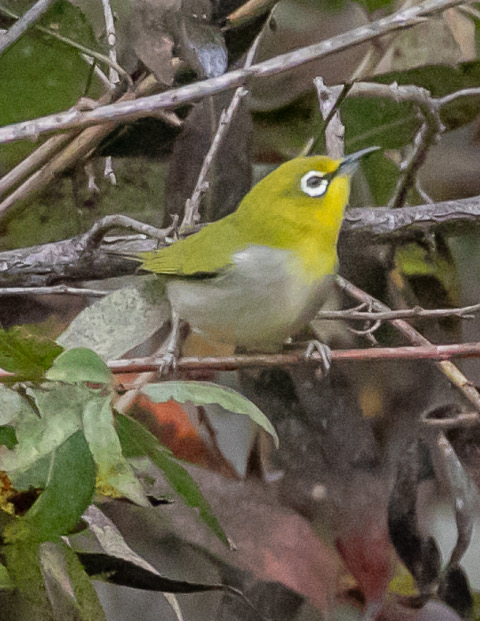
Huntington Beach Central Park)
They’ve been sighted at the lagoon before and there are 19 sightings*** at the lagoon on ebird, many of them for the same six dates (thus probably same bird); most likely six different actual White-eye visits. First sighting was by Dan Cooper on 5-19-24. On the lagoon list they appear as bird #319, an “Exotic-Provisional” species.
I always like seeing White-eyes in SoCal even if we can’t “count” them. I’ve seen 28 White-eye species scattered around the old world, including the Swinhoe’s on Taiwan, and they are always lovely, friendly, bouncy little birds.
***Note: I’ve often wondered how to find out about a particular species at a particular location on eBird. Femi clued me in on this and I’m passing it on to you and preserving it for posterity.
1. Go to eBird https://ebird.org/home Select Explore.
2. Scroll down to and select Species Maps. You’ll need to sign in or create an account. It’s free!
3. Enter the species name, e.g. Swinhoe’s White-eye.
4. When map appears, zoom in to part of the world you want until little red and blue markers appears.
5. These markers are “hot spots.” Click on the one you want.
6. A list of sightings and the hot spot name opens up. Click on the name or sighting to see more detail.
Malibu Lagoon on eBird as of 8-29-25: 8693 lists, 2796 eBirders, 321 species
Most recent new species seen: Nelson’s Sparrow, 11/29/24 by Femi Faminu (SMBAS member). When the newest species added to the list was seen on a date prior to the most recently seen new species, there is no way I can find to easily determine what that bird is. Another minor nit to pick about eBird.
Birds new for the season: Forster’sTern, Elegant Tern, Yellow-crowned Night Heron, White-faced Ibis, Red-tailed Hawk, California Scrub-Jay, Swinhoe’s White-eye, Northern House Wren, Savannah Sparrow. “New for the season” means it has been three or more months since last recorded on our trips.
Many, many thanks to photographers Ray Juncosa, Armando Martinez & Chris Tosdevin.
Upcoming SMBAS scheduled field trips; no reservations or Covid card necessary unless specifically mentioned:
- Coastal Cleanup at the Lagoon, Sat. Sept. 20, 9-12
- Malibu Lagoon, Sun. Sept. 28, 8:30 (adults) & 10 am (parents & kids)
- Huntington Beach Central Park Sat, Oct. 11, 8:00 Leader: Liz Galton egalton687[AT]gmail.com Reservation required
- Malibu Lagoon, Sun. Oct. 26, 8:30 (adults) & 10 am (parents & kids)
- These and any other trips we announce for the foreseeable future will depend upon expected status of the Covid/flu/etc. pandemic, not to mention landslides, at trip time. Any trip announced may be canceled shortly before trip date if it seems necessary. By now any other comments should be superfluous.
- Link to Programs & Field Trip schedule.
The next SMBAS Zoom program: October 7, to be announced.
The SMBAS 10 a.m. Parent’s & Kids Birdwalk has again resumed. Reservations not necessary for families, but for groups (scouts, etc.), call Jean (213-522-0062).
Links: Unusual birds at Malibu Lagoon
9/23/02 Aerial photo of Malibu Lagoon
More recent aerial photo
Prior checklists:
2025: Jan-June
2023: Jan-June, July-Dec 2024: Jan-June, July-Dec
2021: Jan-July, July-Dec 2022: Jan-June, July-Dec
2020: Jan-July, July-Dec 2019: Jan-June, July-Dec
2018: Jan-June, July-Dec 2017: Jan-June, July-Dec
2016: Jan-June, July-Dec 2015: Jan-May, July-Dec
2014: Jan-July, July-Dec 2013: Jan-June, July-Dec
2012: Jan-June, July-Dec 2011: Jan-June, July-Dec
2010: Jan-June, July-Dec 2009: Jan-June, July-Dec
The 10-year comparison summaries created during the Lagoon Reconfiguration Project period, remain available—despite numerous complaints—on our Lagoon Project Bird Census Page. Very briefly summarized, the results unexpectedly indicate that avian species diversification and numbers improved slightly during the restoration period June’12-June’14.
Many thanks to Marie Barnidge-McIntyre, Femi Faminu, Ruth & Chris Tosdevin and others for contributions made to this month’s census counts.
The species list below was re-sequenced as of 12/31/24 to agree with the California Bird Records Committee Official California Checklist, mostly. If part of the right side of the chart below is hidden, there’s a slider button inconveniently located at the bottom end of the list. The numbers 1-9 left of the species names are keyed to the nine categories of birds at the bottom. Updated lagoon bird check lists can be downloaded here.
[Chuck Almdale]
| Malibu Census 2025 | 3/23 | 4/27 | 5/25 | 6/22 | 7/27 | 8/24 | |
| Temperature | 54-64 | 56-64 | 63-68 | 66-73 | 64-70 | 68-75 | |
| Tide Lo/Hi Height | H+4.15 | H+4.29 | H+3.78 | H+3.31 | L-0.46 | H+4.74 | |
| Tide Time | 0433 | 0957 | 0909 | 0824 | 0605 | 1102 | |
| 1 | Brant (Black) | 1 | |||||
| 1 | Canada Goose | 2 | 8 | 1 | 5 | 1 | |
| 1 | Cinnamon Teal | 6 | |||||
| 1 | Gadwall | 35 | 10 | 24 | 25 | 20 | 19 |
| 1 | Mallard | 22 | 21 | 26 | 20 | 40 | 14 |
| 1 | Green-winged Teal | 6 | |||||
| 1 | Surf Scoter | 6 | |||||
| 1 | Red-breasted Merganser | 3 | 1 | 1 | |||
| 1 | Ruddy Duck | 11 | 10 | 4 | 3 | 19 | |
| 2 | Pied-billed Grebe | 8 | 4 | 4 | 4 | 3 | 4 |
| 2 | Western Grebe | 30 | 25 | 4 | 2 | ||
| 7 | Feral Pigeon | 1 | 6 | 5 | 5 | 4 | |
| 7 | Mourning Dove | 1 | 2 | 2 | 1 | 2 | 2 |
| 8 | Anna’s Hummingbird | 3 | 3 | 1 | 1 | 1 | |
| 8 | Allen’s Hummingbird | 6 | 5 | 2 | 2 | 4 | 4 |
| 2 | American Coot | 55 | 11 | 4 | 1 | 6 | 4 |
| 5 | Black-bellied Plover | 21 | 49 | ||||
| 5 | Killdeer | 4 | 3 | 2 | 5 | 4 | 9 |
| 5 | Semipalmated Plover | 2 | 4 | 1 | |||
| 5 | Snowy Plover | 3 | 13 | 17 | |||
| 5 | Whimbrel | 8 | 3 | 1 | 12 | ||
| 5 | Marbled Godwit | 8 | |||||
| 5 | Ruddy Turnstone | 3 | 1 | ||||
| 5 | Dunlin | 1 | |||||
| 5 | Least Sandpiper | 5 | 1 | 10 | 4 | ||
| 5 | Western Sandpiper | 34 | 4 | ||||
| 5 | Spotted Sandpiper | 1 | |||||
| 5 | Willet | 10 | 1 | ||||
| 5 | Greater Yellowlegs | 2 | |||||
| 5 | Wilson’s Phalarope | 1 | |||||
| 6 | Heermann’s Gull | 13 | 36 | 10 | |||
| 6 | Ring-billed Gull | 6 | 2 | 3 | 5 | 2 | 4 |
| 6 | Western Gull | 20 | 20 | 70 | 79 | 52 | 115 |
| 6 | California Gull | 1 | 2 | 82 | 5 | 1 | 4 |
| 6 | American Herring Gull | 1 | |||||
| 6 | Glaucous-winged Gull | 1 | |||||
| 6 | Caspian Tern | 11 | 2 | 6 | 4 | 4 | 2 |
| 6 | Forster’s Tern | 1 | |||||
| 6 | Royal Tern | 10 | 21 | 135 | |||
| 6 | Elegant Tern | 2 | 70 | ||||
| 2 | Pacific Loon | 1 | 1 | ||||
| 2 | Common Loon | 10 | |||||
| 2 | Brandt’s Cormorant | 5 | 12 | 1 | 1 | ||
| 2 | Pelagic Cormorant | 1 | 1 | 2 | |||
| 2 | Double-crested Cormorant | 25 | 25 | 7 | 18 | 98 | 74 |
| 2 | American White Pelican | 5 | |||||
| 2 | Brown Pelican | 200 | 25 | 157 | 138 | 118 | 32 |
| 3 | Snowy Egret | 5 | 1 | 2 | 1 | 10 | 10 |
| 4 | Yellow-crownd Night-Heron | 1 | |||||
| 3 | Black-crownd Night-Heron | 1 | 4 | 1 | 1 | ||
| 3 | Green Heron | 1 | 2 | ||||
| 3 | Great Egret | 2 | 1 | 1 | 3 | 4 | 2 |
| 3 | Western Cattle-Egret | 1 | |||||
| 3 | Great Blue Heron | 2 | 1 | 1 | 9 | 5 | 5 |
| 3 | White-faced Ibis | 1 | |||||
| 4 | Turkey Vulture | 2 | |||||
| 4 | Osprey | 1 | 1 | 1 | 1 | ||
| 4 | Cooper’s Hawk | 1 | |||||
| 4 | Red-shouldered Hawk | 1 | 1 | 1 | |||
| 4 | Red-tailed Hawk | 1 | 1 | 1 | 1 | ||
| 8 | Belted Kingfisher | 1 | 1 | ||||
| 8 | Nuttall’s Woodpecker | 1 | 1 | ||||
| 4 | Peregrine Falcon | 1 | |||||
| 8 | Nanday Parakeet | 2 | 2 | ||||
| 9 | Cassin’s Kingbird | 1 | 1 | 1 | |||
| 9 | Black Phoebe | 3 | 1 | 2 | 2 | 2 | 2 |
| 9 | California Scrub-Jay | 1 | 1 | 1 | |||
| 9 | American Crow | 6 | 5 | 6 | 6 | 9 | 8 |
| 9 | Common Raven | 9 | 2 | 1 | |||
| 9 | Oak Titmouse | 1 | |||||
| 9 | Tree Swallow | 5 | 1 | ||||
| 9 | Violet-green Swallow | 5 | |||||
| 9 | No. Rough-winged Swallow | 17 | 20 | 7 | 1 | 5 | 2 |
| 9 | Barn Swallow | 10 | 20 | 18 | 22 | 20 | 40 |
| 9 | Cliff Swallow | 3 | 7 | 24 | 24 | 12 | |
| 9 | Bushtit | 25 | 2 | 3 | 12 | 20 | 20 |
| 9 | Wrentit | 4 | 2 | 2 | 2 | 2 | 1 |
| 9 | Swinhoe’s White-eye | 1 | |||||
| 9 | Northern House Wren | 1 | |||||
| 9 | Northern Mockingbird | 1 | |||||
| 9 | European Starling | 10 | 10 | 10 | 6 | 25 | 35 |
| 9 | House Finch | 26 | 15 | 5 | 4 | 5 | 12 |
| 9 | Lesser Goldfinch | 4 | 2 | 2 | |||
| 9 | Dark-eyed Junco | 1 | 1 | 2 | 1 | 6 | |
| 9 | White-crowned Sparrow | 5 | 1 | ||||
| 9 | Savannah Sparrow | 1 | |||||
| 9 | Song Sparrow | 10 | 8 | 6 | 5 | 3 | 6 |
| 9 | California Towhee | 3 | 3 | 2 | 1 | 1 | |
| 9 | Spotted Towhee | 1 | 1 | 2 | |||
| 9 | Hooded Oriole | 1 | 1 | 1 | 2 | ||
| 9 | Brown-headed Cowbird | 2 | |||||
| 9 | Great-tailed Grackle | 2 | 3 | 6 | 8 | 1 | |
| 9 | Orange-crowned Warbler | 3 | 1 | 2 | 1 | 1 | |
| 9 | Common Yellowthroat | 6 | 4 | 5 | 1 | 4 | |
| 9 | Yellow-rumped Warbler | 3 | |||||
| 9 | Wilson’s Warbler | 1 | |||||
| Totals Birds by Type | Mar | Apr | May | Jun | Jul | Aug | |
| 1 | Waterfowl | 91 | 50 | 55 | 54 | 81 | 33 |
| 2 | Water Birds – Other | 339 | 104 | 176 | 163 | 227 | 117 |
| 3 | Herons, Egrets & Ibis | 10 | 4 | 4 | 17 | 21 | 22 |
| 4 | Quail & Raptors | 3 | 4 | 3 | 1 | 2 | 2 |
| 5 | Shorebirds | 76 | 9 | 2 | 6 | 61 | 93 |
| 6 | Gulls & Terns | 52 | 26 | 161 | 106 | 116 | 341 |
| 7 | Doves | 1 | 3 | 8 | 6 | 7 | 6 |
| 8 | Other Non-Passerines | 10 | 10 | 5 | 3 | 6 | 6 |
| 9 | Passerines | 160 | 115 | 103 | 103 | 110 | 141 |
| Totals Birds | 742 | 325 | 517 | 459 | 631 | 761 | |
| Total Species by Group | Mar | Apr | May | Jun | Jul | Aug | |
| 1 | Waterfowl | 8 | 5 | 4 | 5 | 5 | 2 |
| 2 | Water Birds – Other | 9 | 8 | 5 | 5 | 6 | 6 |
| 3 | Herons, Egrets & Ibis | 4 | 4 | 3 | 4 | 5 | 7 |
| 4 | Quail & Raptors | 3 | 3 | 3 | 1 | 2 | 2 |
| 5 | Shorebirds | 10 | 4 | 1 | 2 | 9 | 7 |
| 6 | Gulls & Terns | 8 | 4 | 4 | 5 | 6 | 8 |
| 7 | Doves | 1 | 2 | 2 | 2 | 2 | 2 |
| 8 | Other Non-Passerines | 3 | 3 | 3 | 2 | 3 | 3 |
| 9 | Passerines | 25 | 22 | 21 | 16 | 16 | 16 |
| Totals Species – 94 | 71 | 55 | 46 | 42 | 54 | 53 |



 SANTA MONICA BAY AUDUBON SOCIETY BLOG