Free email delivery
Please sign up for email delivery in the subscription area to the right.
No salesman will call, at least not from us. Maybe from someone else.
Terns and Swallows Return to Malibu Lagoon, 23 April, 2017

Male Red-breasted Merganser with his punk hairdo (G. Murayama 4-23-17)
Weather was balmy and beautiful, and about thirty birders showed up to admire the birds. Unfortunately, numbers and species were a bit on the light side. Virtually no gulls and few migrant passerines. The lagoon outlet was closed, although if lagoon water rose by about 1/64th of an inch, out it would flow. Some of us walked around the lagoon to Adamson House which was hosting some party, as usual, but we didn’t add many birds to the list. As yet, no orioles in their palms.

Optical illusion – this yawning Brown Pelican isn’t really trying to swallow that passing gull (G. Murayama 2-16-17)
I checked prior years to see if my impression of numbers was correct. It was.
| April | 2017 | 2016 | 2015 | 2013 | 2012 |
| Species | 46 | 51 | 53 | 56 | 58 |
| Total Birds | 534 | 2221 | 6009 | 666 | 733 |
| Gulls/Terns | 160 | 1903 | 4213 | 297 | 272 |
| Gull/Tern % | 30% | 86% | 70% | 45% | 37% |
I don’t know if this signifies a trend, but April species diversity seems to be dwindling. As shown above, the number of gulls and terns present is always a significant factor.

Common Murre beaches itself at Zuma, perhaps due to domoic acid poisoning (G. Murayama 4-19-17)
There is a domoic acid outbreak, which may be what’s causing solid-ground-avoiders like murres, loons and grebes to beach themselves, and Brown Pelicans to collapse and die. We saw at least four pelicans dead on the lagoon shore or at water’s edge today. There was also a significant amount of very green algae on the surface of the lagoon. The mullet didn’t seem to mind, as they were still jumping – for joy, one presumes.
The Marine Mammal Center has this to say on domoic acid:
Domoic acid is produced by algae and accumulates in shellfish, sardines, and anchovies which are then eaten by sea lions, otters, cetaceans, and humans, among others. Exposure to the biotoxin affects the brain, causing them to become lethargic, disoriented, and have seizures that sometimes result in death.
Ventura Audubon Society put out this advisory:
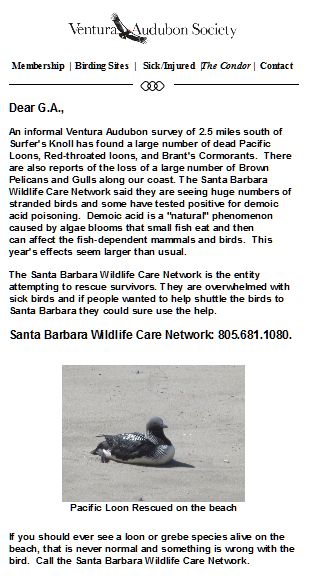
Ventura Audubon Society alert on domoic acid
So you’d better watch what you eat.
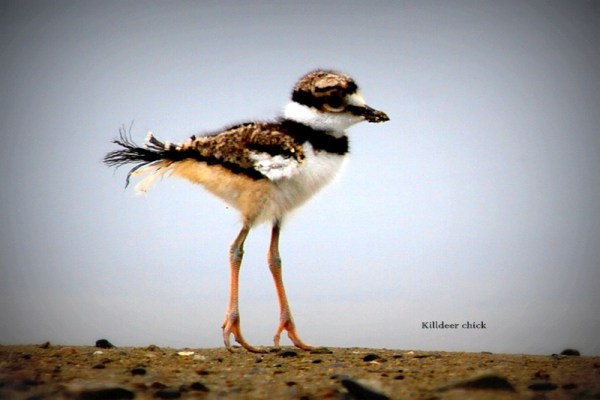
Killdeer chick, as leggy as a Secretary-Bird (J.Waterman 4/21/12)
Killdeer are again nesting on the beach, as they have for decades. [I found my first Killdeer nest there in 1995. Actually the Killdeer parent found it for me. It started screaming and flopping around like a bird with a broken-wing; I looked down at my feet and found a nest-scrape with four spotted pebble-like eggs nearly under my toes.] Sharp-eyed observers may see the very long-legged chicks teetering around in the fenced area. Song Sparrows and Common Yellowthroats – judging by the number of them loudly singing – are also courting and nesting. Along the east side of the lagoon, a female Mallard led a small flotilla of nine ducklings. Four species of swallows cut through the air, including one uncommon-at-the-beach migrating Violet-green Swallow. Barn Swallows prefer swooping low over the sandy beach where they find those tiny flies so beloved by sunbathers.

Caspian Tern group, Elegant in foreground (J. Waterman 4/24/16)
Elegant Terns continued to arrive and depart all morning, all in beautiful breeding plumage. They don’t nest at the lagoon, but they do like to rest there. They were joined by seventeen of their larger cousins with the blood-red bill, the Caspian Tern.

Black-bellied Plover just before he flies north to breed. The largest of the plovers frequenting our beaches (G. Murayama 4-23-17)
Caspian Terns are a world-wide species, found on every continent except Antarctica. The “type specimen” – the individual used centuries ago to originally describe the species – came from the Caspian Sea in central Asia, hence the name. Yet they frequent our humble little lagoon – imagine that.
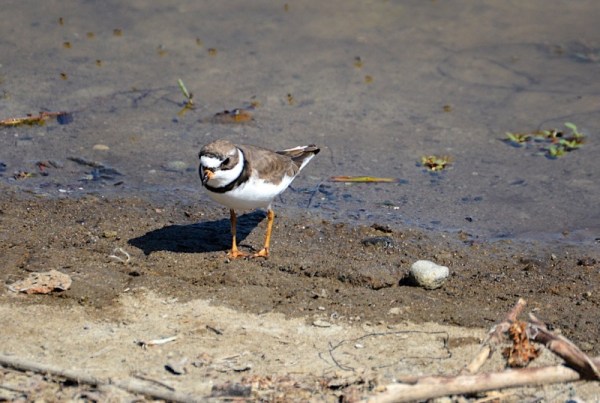
Semipalmated Plover looks right back. These migrants visit twice a year.
(G. Murayama 4-23-17)
The Pacific Loons were all flybys, out past the offshore rocks, heading west (and north). It took us a while to figure out that they were Pacific and not Red-throated. The small sandpipers were mostly scattered along the north side of the channel, or east end of the lagoon. Most were Least Sandpiper, with a few Westerns and one elusive Dunlin among them.

At last! Indisputable proof that all two legs of a running Snowy Plover simultaneously leave the ground. (G. Murayama 4-23-17)
Larry Loeher managed – through shear doggedness – to find three Snowy Plovers among the wrack on the sandy berm; one male and two females, one of whom was rr:bb, who has been a habitué of the beach for many months.

Banded Snowy Plover rr-bb (G. Murayama 4-23-17)
Birds new for the season were: Red-tailed Hawk, Semipalmated Plover, Dunlin, Mew Gull, Elegant Tern, Violet-green Swallow, Cliff Swallow, Red-winged Blackbird.
Many thanks to our photographer: Grace Murayama, Joyce Waterman, Chuck Bragg
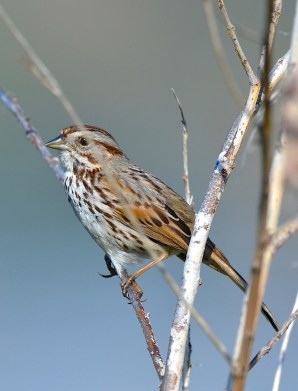
Song Sparrows sing all year around
(Grace Murayama 3-26-17)
Our next three scheduled field trips: Butterbredt Spring Campout Sat/Sun 29-30 Apr. 8:30am; Black Rock Canyon (Sat. 3pm) and Morongo Valley (Sun 8am), 6-7 May; Malibu Lagoon 8:30 & 10am, 28 May.
Our next program: What a Fish Knows with Jonathan Balcombe, Tuesday, 2 May, 7:30 pm; Chris Reed Park, 1133 7th St., NE corner of 7th and Wilshire Blvd. in Santa Monica.
NOTE: Our 10 a.m. Parent’s & Kids Birdwalk meets at the shaded viewpoint just south of the parking area. Watch for Willie the Weasel. He’ll be watching for you and your big floppy feet.
Links: Unusual birds at Malibu Lagoon
9/23/02 Aerial photo of Malibu Lagoon
Prior checklists:
2016: Jan-June, July-Dec 2015: Jan-May, July-Dec
2014: Jan-July, July-Dec 2013: Jan-June, July-Dec
2012: Jan-June, July -Dec 2011: Jan-June, July-Dec
2010: Jan-June, July-Dec 2009: Jan-June, July-Dec.
The 10-year comparison summaries created during the project period, despite numerous complaints, remain available on our Lagoon Project Bird Census Page. Very briefly summarized, the results unexpectedly indicate that avian species diversification and numbers improved slightly during the period Jun’12-June’14. [Chuck Almdale]

Surf log (C. Bragg 2-26-17)
| Malibu Census 2016-17 | 10/23 | 11/27 | 12/25 | 2/26 | 3/26 | 4/23 |
| Temperature | 63-70 | 53-58 | 48-54 | 46-52 | 55-68 | 63-70 |
| Tide Lo/Hi Height | L+2.63 | H+5.79 | H+5.49 | H+5.6 | H+5.21 | H+4.54 |
| Tide Time | 1108 | 0729 | 0634 | 0845 | 0851 | 0749 |
| Brant | 1 | |||||
| Canada Goose | 2 | |||||
| Gadwall | 6 | 4 | 18 | 10 | 12 | 10 |
| American Wigeon | 10 | 7 | 30 | 6 | 18 | |
| Mallard | 23 | 22 | 14 | 24 | 14 | 20 |
| Northern Shoveler | 2 | 1 | ||||
| Northern Pintail | 3 | 1 | ||||
| Green-winged Teal | 6 | 12 | 2 | |||
| Ring-necked Duck | 1 | |||||
| Surf Scoter | 8 | 30 | ||||
| Bufflehead | 4 | 6 | 1 | |||
| Hooded Merganser | 1 | 5 | 2 | |||
| Red-breasted Merganser | 5 | 4 | 1 | 2 | ||
| Ruddy Duck | 7 | 26 | 30 | 10 | ||
| Red-throated Loon | 1 | |||||
| Pacific Loon | 1 | 2 | 80 | |||
| Pied-billed Grebe | 18 | 8 | 1 | |||
| Horned Grebe | 1 | |||||
| Eared Grebe | 3 | 6 | 10 | 1 | 3 | |
| Western Grebe | 10 | 10 | 50 | 3 | 1 | |
| Clark’s Grebe | 2 | 1 | ||||
| Black-vented Shearwater | 50 | |||||
| Brandt’s Cormorant | 3 | 2 | ||||
| Double-crested Cormorant | 37 | 23 | 32 | 42 | 41 | 19 |
| Pelagic Cormorant | 1 | 2 | 6 | 1 | ||
| Brown Pelican | 30 | 37 | 24 | 30 | 8 | 28 |
| Great Blue Heron | 3 | 3 | 2 | 4 | 2 | |
| Great Egret | 2 | 1 | 2 | 3 | 1 | |
| Snowy Egret | 8 | 5 | 12 | 9 | 5 | 4 |
| Turkey Vulture | 1 | |||||
| Osprey | 2 | 1 | 1 | 1 | ||
| Red-tailed Hawk | 1 | 1 | ||||
| Sora | 1 | |||||
| American Coot | 280 | 240 | 210 | 85 | 32 | |
| Blk-bellied Plover | 75 | 73 | 22 | 35 | 14 | 15 |
| Snowy Plover | 29 | 12 | 32 | 8 | 8 | 3 |
| Semipalmated Plover | 20 | |||||
| Killdeer | 1 | 2 | 1 | 4 | 8 | 12 |
| Mountain Plover | 1 | |||||
| Spotted Sandpiper | 1 | |||||
| Willet | 20 | 3 | 15 | 12 | 13 | 4 |
| Whimbrel | 2 | 2 | 1 | 5 | 4 | 4 |
| Marbled Godwit | 7 | 10 | 5 | 8 | 23 | 1 |
| Ruddy Turnstone | 7 | 14 | 12 | 10 | 1 | 3 |
| Sanderling | 72 | 45 | ||||
| Dunlin | 1 | |||||
| Least Sandpiper | 12 | 4 | 2 | 30 | ||
| Western Sandpiper | 3 | 3 | ||||
| Bonaparte’s Gull | 1 | 1 | 1 | |||
| Heermann’s Gull | 15 | 12 | 11 | 3 | 1 | |
| Mew Gull | 1 | 1 | ||||
| Ring-billed Gull | 5 | 35 | 30 | 2 | 1 | |
| Western Gull | 48 | 85 | 90 | 45 | 39 | 75 |
| California Gull | 27 | 1200 | 940 | 1350 | 6 | |
| Herring Gull | 1 | 1 | 1 | 1 | ||
| Glaucous-winged Gull | 2 | |||||
| Caspian Tern | 2 | 17 | ||||
| Forster’s Tern | 2 | 1 | ||||
| Royal Tern | 19 | 16 | 45 | 14 | 5 | |
| Elegant Tern | 5 | 1 | 65 | |||
| Black Skimmer | 1 | |||||
| Rock Pigeon | 15 | 5 | 5 | 10 | 6 | 18 |
| Mourning Dove | 1 | 4 | 1 | 1 | 2 | |
| Anna’s Hummingbird | 1 | 1 | ||||
| Allen’s Hummingbird | 1 | 1 | 2 | 2 | 2 | 1 |
| Belted Kingfisher | 1 | 1 | 1 | 1 | ||
| Merlin | 1 | |||||
| Nanday Parakeet | 3 | 30 | ||||
| Black Phoebe | 5 | 5 | 3 | 2 | 6 | 4 |
| Say’s Phoebe | 1 | 1 | ||||
| Cassin’s Kingbird | 1 | |||||
| California Scrub-Jay | 2 | 4 | 1 | 1 | ||
| American Crow | 7 | 4 | 5 | 4 | 3 | 3 |
| Common Raven | 1 | |||||
| Tree Swallow | 12 | |||||
| Violet-green Swallow | 1 | |||||
| Rough-winged Swallow | 20 | 4 | ||||
| Cliff Swallow | 16 | |||||
| Barn Swallow | 1 | 5 | 10 | |||
| Bushtit | 30 | 35 | 10 | 8 | 3 | 1 |
| House Wren | 1 | 2 | 1 | 1 | 1 | |
| Marsh Wren | 1 | 1 | ||||
| Ruby-crowned Kinglet | 2 | 8 | 1 | |||
| Western Bluebird | 2 | |||||
| Hermit Thrush | 1 | 1 | ||||
| Northern Mockingbird | 1 | 3 | 1 | 2 | 4 | |
| European Starling | 45 | 30 | 1 | 1 | 1 | |
| Orange-crowned Warbler | 3 | 4 | 2 | |||
| Common Yellowthroat | 5 | 5 | 3 | 3 | 4 | 3 |
| Yellow-rumped Warbler | 10 | 28 | 3 | 8 | ||
| Spotted Towhee | 1 | 1 | ||||
| California Towhee | 1 | 1 | 1 | |||
| Savannah Sparrow | 4 | 1 | ||||
| Song Sparrow | 4 | 8 | 6 | 8 | 8 | 15 |
| Lincoln’s Sparrow | 1 | |||||
| White-crowned Sparrow | 25 | 45 | 15 | 20 | 10 | |
| Red-winged Blackbird | 1 | 1 | ||||
| Western Meadowlark | 3 | 2 | 1 | |||
| Great-tailed Grackle | 17 | 5 | 3 | 2 | 3 | 8 |
| Brown-headed Cowbird | 3 | |||||
| House Finch | 18 | 9 | 17 | 10 | 6 | 16 |
| Totals by Type | Oct | Nov | Dec | Feb | Mar | Apr |
| Waterfowl | 50 | 70 | 114 | 75 | 80 | 32 |
| Water Birds – Other | 382 | 332 | 335 | 165 | 132 | 130 |
| Herons, Egrets & Ibis | 13 | 9 | 16 | 16 | 8 | 4 |
| Quail & Raptors | 1 | 1 | 2 | 2 | 1 | 2 |
| Shorebirds | 215 | 161 | 100 | 86 | 76 | 96 |
| Gulls & Terns | 118 | 1321 | 1122 | 1445 | 58 | 160 |
| Doves | 16 | 5 | 9 | 11 | 7 | 20 |
| Other Non-Passerines | 6 | 3 | 33 | 3 | 2 | 1 |
| Passerines | 183 | 186 | 107 | 94 | 53 | 89 |
| Totals Birds | 984 | 2088 | 1838 | 1897 | 417 | 534 |
| Total Species | Oct | Nov | Dec | Feb | Mar | Apr |
| Waterfowl | 6 | 8 | 9 | 9 | 8 | 3 |
| Water Birds – Other | 9 | 11 | 8 | 8 | 5 | 4 |
| Herons, Egrets & Ibis | 3 | 3 | 3 | 3 | 3 | 1 |
| Quail & Raptors | 1 | 1 | 1 | 2 | 1 | 2 |
| Shorebirds | 10 | 8 | 8 | 8 | 9 | 11 |
| Gulls & Terns | 8 | 8 | 6 | 7 | 9 | 6 |
| Doves | 2 | 1 | 2 | 2 | 2 | 2 |
| Other Non-Passerines | 4 | 3 | 3 | 2 | 1 | 1 |
| Passerines | 21 | 21 | 18 | 18 | 13 | 16 |
| Totals Species – 101 | 64 | 64 | 58 | 59 | 51 | 46 |
Beyond what we can touch, taste, smell, and hear, we experience the universe through light. But how did we come to discover light, and how did we learn light’s true nature, as the fastest thing in the universe, an electromagnetic spectrum, a wave and particle capable of the most amazing things? Here is the history of light, according to physics.
This is an installment of the PBS – It’s OK to be Smart series. If no film or link appears in this email, go to the blog to view it by clicking on the blog title above. If the film stops & starts in an annoying manner, press pause (lower left double bars ||) to let it buffer and get ahead of you. [Chuck Almdale]
Argentine ants are spreading across the globe, eliminating local ants with their take-no-prisoners tactics: invade, dismember, repeat. But this ruthless killer seems to have met its match in the winter ant, a California native with a formidable secret weapon.
This is another installment of the PBS Deep Look series. If no film or link appears in this email, go to the blog to view it by clicking on the blog title above. If the film stops & starts in an annoying manner, press pause (lower left double bars ||) to let it buffer and get ahead of you. [Chuck Almdale]
Chris Thacker and Kimball Garrett take us on a tour of our local birds, some in the skies, some in trays: resident, migrant and introduce (especially all those parrots).
This comes from the Natural History Museum of Los Angeles County. If no film or link appears in this email, go to the blog to view it by clicking on the blog title above. If the film stops & starts in an annoying manner, press pause (lower left double bars ||) to let it buffer and get ahead of you. [Chuck Almdale]
Be a Better Birder: How to Identify Bird Songs
You’ve just stepped outside and there’s an unfamiliar chirping nearby. A quick look around and there is no bird in sight, but the song keeps coming. Frustratingly, you have no idea who is singing. On top of that, you hear a bunch of other birds in the distance.
That’s why The Cornell Lab of Ornithology is offering this unique self-paced course on how to listen to bird songs in their natural soundscapes, with tips and tricks for learning to identify them. You’ll watch field clips of birds singing, and then learn to recognize them in context with the Bird Song Spotlight tool. Try a free sample lesson to learn how it works. Also included for free with the price of the course is the Cornell Guide to Bird Sounds, featuring the most common songs and calls of 729 North American species — sent to you as 1,379 mp3 files to play in the car or at home.
Early bird pricing is $49.99 if you sign up before the course starts on April 24. Regular price is $59.99
If you’ve ever wanted to keep your brain young by learning a “foreign language,” this is your chance!
[Jane Beseda]



 SANTA MONICA BAY AUDUBON SOCIETY BLOG