Free email delivery
Please sign up for email delivery in the subscription area to the right.
No salesman will call, at least not from us. Maybe from someone else.
Charles Darwin knew there was a lot that was special about pigeons, and a lot that was common. Perhaps that’s why he used them to introduce the world to his new theory of evolution by means of natural selection.
This is an installment of the PBS – It’s OK to be Smart series. If no film or link appears in this email, go to the blog to view it by clicking on the blog title above. If the film stops & starts in an annoying manner, press pause (lower left double bars ||) to let it buffer and get ahead of you. [Chuck Almdale]
Just in time! Saturday’s hike and bird!
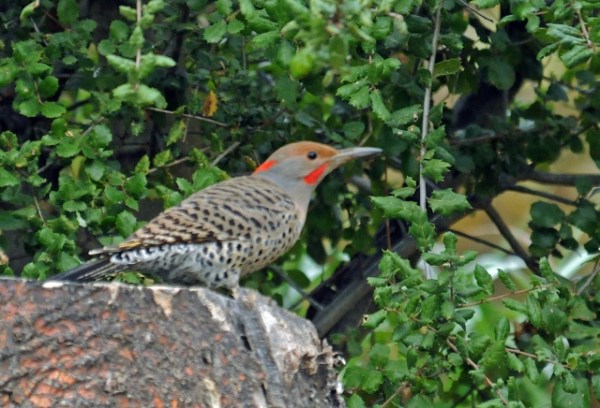
Northern Flicker Red-shafted x Yellow-shafted (J. Kenney 11/26/12)
Hikers All! What better place in the Santa Monica Mountains than L.A.’s backyard wilderness? Trippet Ranch in Topanga State Park!
We will explore there this Saturday March 11th.

Trippet Ranch in Topanga S.P. (L. Plauzoles 2/20/14)
Meet at the Trippet Ranch parking lot in Topanga State Park at 8:00 AM! (Early, since Daylight Savings Time only begins the following night.) Our weather has encouraged many bird species to decide to breed here. However, what makes me optimistic is the first fill of the Trippet Ranch Pond in more than eight years.
Let’s see what a few days’ rain does for this environment. We can’t expect to see blooming spring flowers yet, but we should have a good chance to spot at least 3 woodpecker species.
Our walk will be about 2 miles, with up to a 300-foot elevation gain/loss and plenty of opportunities to cut back for a shorter hike. Wear solid walking shoes and long pants to protect against ticks. Bring water, a proper, birder-like floppy-style hat, and bathe in sunscreen. Since some of the trails are going to be moist, walking sticks are recommended–I will bring at least 5 extras. Weather report says it will top 75 F before noon, so dress in layers.
Directions: To reach the Trippet Ranch parking lot (State Parks pass or $10 fee) turn off Topanga Canyon Road on to Entrada Road, 4.7 mi. from PCH. This is about a hundred meters pas the Old School Road signal light. As you climb up Entrada, bear left twice and make a hard left to enter the park (a little over 1 mile total). Keep an eye out for signage. Desperate to not pay the parks for parking? Do a careful U-turn before the last left and park on the downward side of the road, then walk in to the park (approx. 20 minutes).
Weather: Looks promising for ideal walking weather; keep checking for blog updates or call Lu at 310.395.6235.
Ladybugs spend most of their lives alone, gorging themselves on aphids. But every winter they take to the wind, soaring over cities and fields to assemble for a ladybug bash. In these huge gatherings, they’ll do more than hibernate-it’s their best chance to find a mate.
This is another installment of the PBS Deep Look series. If no film or link appears in this email, go to the blog to view it by clicking on the blog title above. If the film stops & starts in an annoying manner, press pause (lower left double bars ||) to let it buffer and get ahead of you. [Chuck Almdale]
Bugs and beetles can’t hold their breath underwater like we do. But some aquatic insects can spend their whole adult lives underwater. How do they do it? Meet nature’s Scuba divers. They carry their air with them—in some cases, for a lifetime.
This is another installment of the PBS Deep Look series. If no film or link appears in this email, go to the blog to view it by clicking on the blog title above. If the film stops & starts in an annoying manner, press pause (lower left double bars ||) to let it buffer and get ahead of you. [Chuck Almdale]
Loons and Gulls: Malibu Lagoon, 26 February, 2017
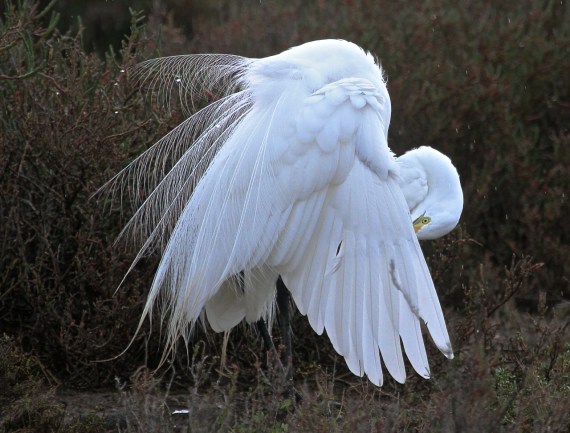
A very plumy Great Egret (J. Waterman 2-26-17)
The big treat of the day were the two Adult Glaucous-winged Gulls at the end of the beach. But we’ll get to that later.
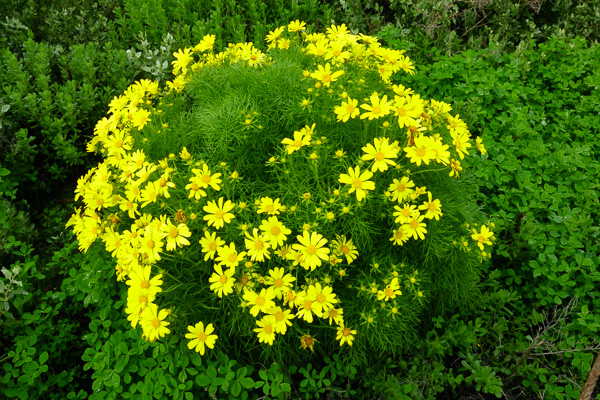
Giant Coreopsis in full bloom (C. Bragg 2-26-17)
The rain which was supposed to be over by 9 AM, hung on a bit longer, yet didn’t really present a problem, and I never raised my jacket hood over my head. The wind began blowing, yet the clouds remained. The day started cool and remained cool. Very pleasant, actually; a welcome respite from the blistering heat to which we have not yet acclimated but to which I fear we must. A female Belted Kingfisher called as she flew over our group in the middle of announcements.
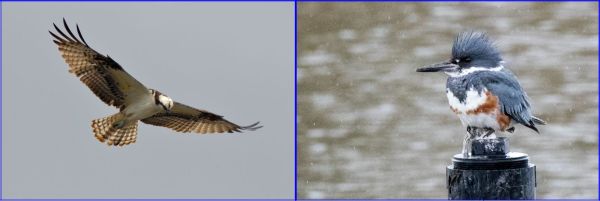
Fish hunters: Osprey (G. Murayama)
& Belted Kingfisher female (R. Ehler) 2-26-17
The tide hit its high of +5.6 feet at 0845, and wavelets washed into the lagoon through the 100-yard breach in the beach. Such gaps always appear during winter rain events. This one kept us from walking on to Adamson House to add a few more birds to the list. By the time we reached the beach, the tide had dropped and wet sand glistened. Unfortunately, most of the enormous gull flock had lifted off. Altogether I counted almost 1,500 gulls, with an additional 2,000-4,000 circling high overhead.
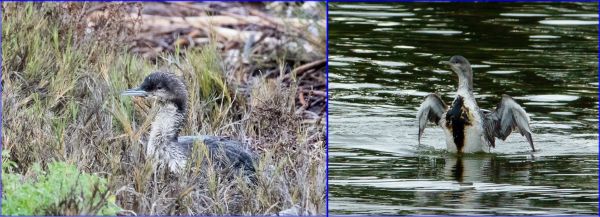
Pacific Loons: In salt grass (R. Ehler) & badly oiled (C. Bragg) 2-26-17
A loon hid among the shore shrubs near the lagoon edge. It was folded up and was either exhausted or ill, so we did not approach. Loons, like grebes, rarely come to land unless they’ve a problem; their legs are set so far back on their body that they cannot walk and move more by a series of forward flops. I decided it was probably a Pacific Loon simply because there was another of that species swimming in the lagoon, and no other loons around. The swimming bird was quite oiled; perhaps that was the grounded bird’s problem as well.
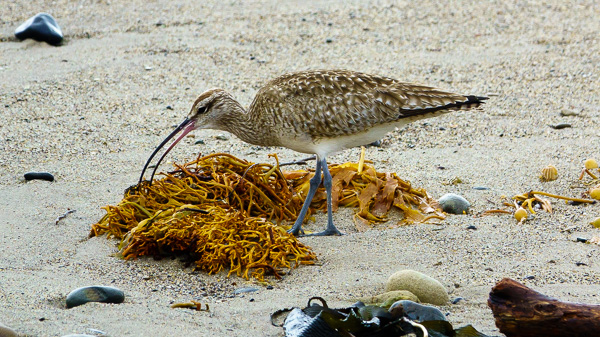
Whimbrel checking the seaweed wrack (C. Bragg 2-26-17)
The Snowy Plovers were well hidden in the large quantity of driftwood at the high-tide wrack line, but Chris Lord managed to find eight birds, none banded.
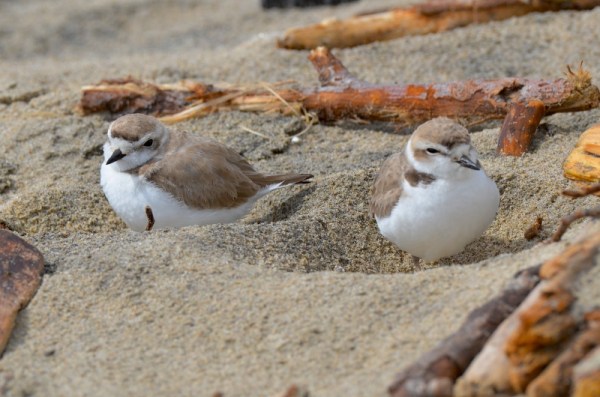
Two Snowy Plovers hide in human footprints (G. Murayama 2-26-17)
Driftwood, in fact, was so abundant along the edges of the channels and lagoon that several birders thought someone ought to come and carry it away. It seemed likely to me that while rains continue, Malibu Creek would continue carrying down wood, but while the lagoon is open, the tide will rise and fall and carry some of the wood out to sea. We’ll see. In my experience, driftwood, once you dry it out, burns in your fireplace in a cheery colorful way. But that was in Oregon, when shore-found wood was my primary source of heat.
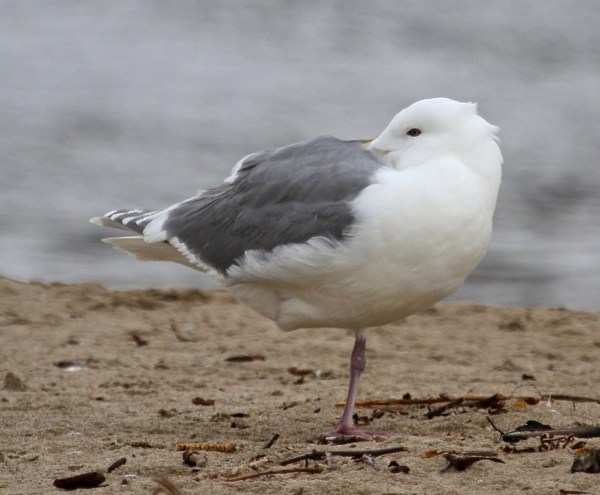
Glaucous-winged Gull #1; look closely to see the red orbital ring of flesh around the eye; note this photo angle make the back and wings look darker than in next three photos, the often-noted “artifact of lighting.” (J. Waterman 2-26-17)
We found the first Glaucous-winged Gull (GWGU) among the 300-500 gulls – who they kept arriving and leaving – remaining on the sand spit’s eastern end. Irwin Woldman, who always heads directly to the beach, had alerted us to its presence. It’s an understatement to say that we don’t get many GWGU at Malibu Lagoon; of almost 99,000 gulls seen over the years I’ve been counting, 283 were GWGU (0.28%). But of 1149 sightings of a gull species, 107 were GWGU (9.31%).
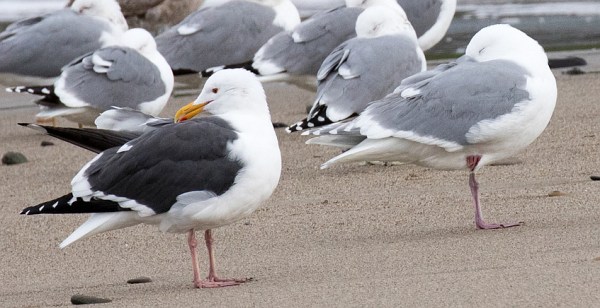
GWGU #1 right foreground, 1″ larger than Western Gull on left; Western’s wings are darker gray-black than is the back. (R. Ehler 2-26-17)
So it’s not unusual to see them; it’s just that there are never many of them, as they average 2.6 birds per visit. They can be hard to pick out when you’re looking at a flock of 2,000 gulls. Their numbers have hit double-digits twice, with a high count of 12 on 2/22/09. And they are nearly always first-winter birds (i.e. 6-9 months old). In fact, my records mention only one prior non-first-winter bird. So now it’s three.
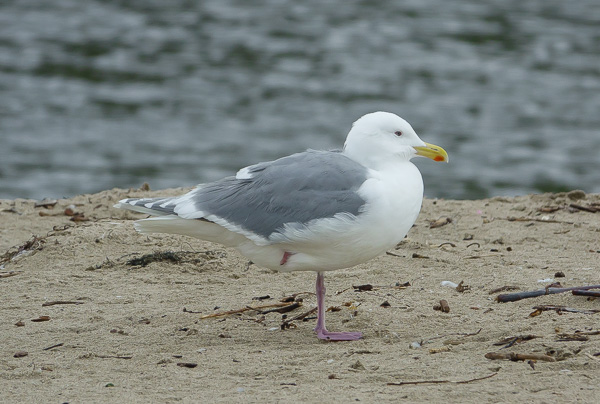
GWGU #1 alert (C. Bragg 2-26-17)
Outstanding characteristics of this bird were the large size (1” larger than Western); gray back paler than a California Gull; same shade of gray on the primaries between the large white primary tips, clean white head, large yellow bill with a single red spot on lower bill, bubble-gum colored legs, and (for a GWGU) an uncommonly pale eye. Reportedly only 1% of adult birds have a pale eye.
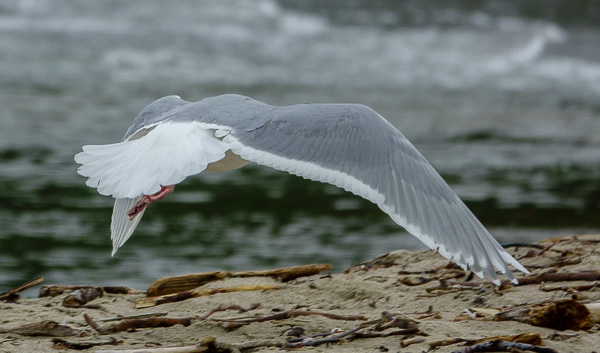
GWGU #1 flying away; note white trailing edge is wider on secondaries than on primaries (C. Bragg 2-26-17)
We’d been watching it for a long time, when we notice elsewhere among the gulls another adult GWGU. This one seemed slightly behind the first bird in developing its adult basic (breeding) plumage. The gray in the primaries might have been ever-so-slightly darker than the gray on the back, or it might have been an artifact of the light. The eye seemed darker, but we were not able to see it as well as the eye on the first bird. There was a faint darkness on the forehead. A tiny area of black was on the bill next to the red spot, so small that some birders swore it wasn’t there until they got a better view through the scope. Other than that, they appeared the same. It’s possible that this second bird is a Glaucous-winged x Western Gull hybrid. If so, I’d guess it’s about 15/16ths or 31/32nds GWGU.
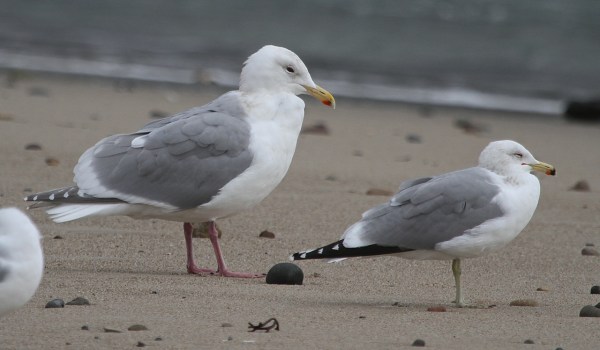
GWGU #2 left, 5″ longer than California Gull on right. California Gull wings are darker than the back. (J. Waterman 2-26-17)
So! Two-thirds of our lifetime Malibu sightings of Adult Glaucous-winged Gulls just occurred. GWGU breeds from SW Washington up to western Alaska, and they (according to range maps) winter as far south as the tip of Baja California. But the farther you are from their breeding range, the fewer you see. They also hybridize with Western Gulls, and perhaps 10-20% of the one we see at Malibu are actually hybrids. You can pick them out from the non-hybrids by their darker primaries.
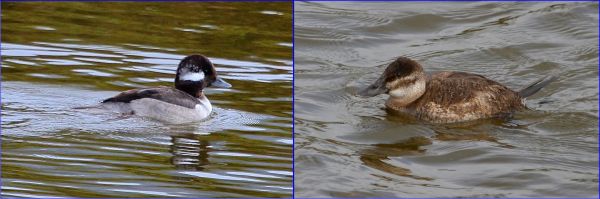
Ducks: 1st winter male Bufflehead and female Ruddy (J. Waterman 2-26-17)
Birding: It’s a dirty grueling thankless task in freezing and broiling conditions, but someone has to do it.
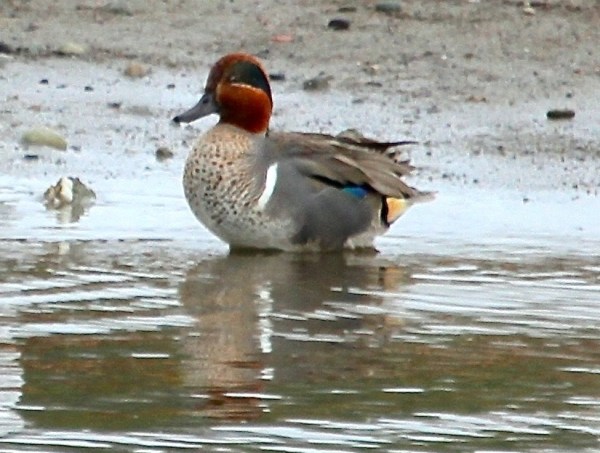
Male Green-winged Teal (J. Waterman 2-26-17)
Birds new for the season were: Northern Shoveler, Surf Scoter, Turkey Vulture, Bonaparte’s Gull, Glaucous-winged Gull, Rough-winged Swallow, Hermit Thrush.
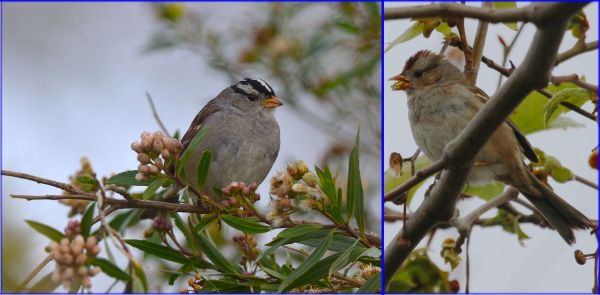
White-crowned Sparrow: Adult (G. Murayama) & immature (J. Waterman) 2-26-17
Many thanks to our photographers: Chuck Bragg, Randy Ehlers, Grace Murayama, Joyce Waterman
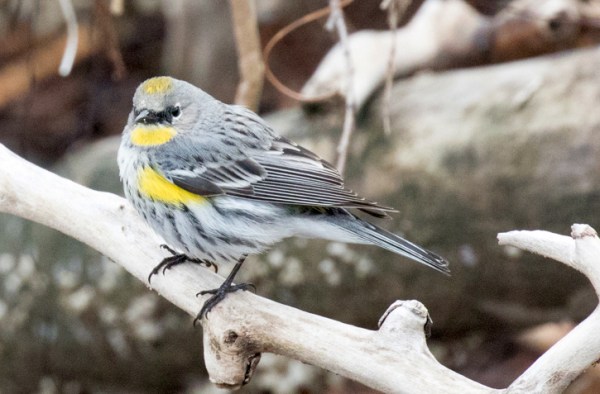
Yellow-rumped Warbler working his way into breeding (alternate) plumage (R. Ehler 2-26-17)
Our next three scheduled field trips: Santa Monica Mtns. with Lu Plauzoles, 11 Mar. Time TBD; Malibu Lagoon 8:30 & 10am, 26 Mar.; Rancho Sierra Vista, 8 Mar., 8am.
Our next program: Wolves with Frank Capolupo, Tuesday, 7 Mar., 7:30 pm; Chris Reed Park, 1133 7th St., NE corner of 7th and Wilshire Blvd. in Santa Monica.
NOTE: Our 10 a.m. Parent’s & Kids Birdwalk meets at the shaded viewpoint just south of the parking area. Watch for Willie the Weasel. He’ll be watching for you and your big floppy feet.
Links: Unusual birds at Malibu Lagoon
9/23/02 Aerial photo of Malibu Lagoon
Prior checklists:
2016: Jan-June, July-Dec 2015: Jan-May, July-Dec
2014: Jan-July, July-Dec 2013: Jan-June, July-Dec
2012: Jan-June, July-Dec 2011: Jan-June, July-Dec
2010: Jan-June, July-Dec 2009: Jan-June, July-Dec
The 10-year comparison summaries created during the project period, despite numerous complaints, remain available on our Lagoon Project Bird Census Page. Very briefly summarized, the results unexpectedly indicate that avian species diversification and numbers improved slightly during the period Jun’12-June’14. [Chuck Almdale]

Surf log (C. Bragg 2-26-17)
Many thanks to those who contributed to the checklist below, especially Randy Ehlers and Chris Lord.
| Malibu Census 2016-17 | 8/28 | 9/25 | 10/23 | 11/27 | 12/25 | 2/26 |
| Temperature | 65-73 | 70-96 | 63-70 | 53-58 | 48-54 | 46-52 |
| Tide Lo/Hi Height | H+4.28 | H+4.39 | L+2.63 | H+5.79 | H+5.49 | H+5.6 |
| Tide Time | 0810 | 0708 | 1108 | 0729 | 0634 | 0845 |
| Brant | 1 | 1 | 1 | |||
| Gadwall | 10 | 6 | 6 | 4 | 18 | 10 |
| American Wigeon | 1 | 10 | 7 | 30 | 6 | |
| Mallard | 24 | 35 | 23 | 22 | 14 | 24 |
| Northern Shoveler | 6 | 2 | ||||
| Northern Pintail | 4 | 3 | 1 | |||
| Green-winged Teal | 2 | 6 | 12 | |||
| Ring-necked Duck | 1 | |||||
| Surf Scoter | 8 | |||||
| Bufflehead | 4 | 6 | 1 | |||
| Hooded Merganser | 1 | 5 | 2 | |||
| Red-brstd Merganser | 5 | 4 | ||||
| Ruddy Duck | 7 | 26 | 30 | 10 | ||
| Red-throated Loon | 1 | |||||
| Pacific Loon | 1 | 2 | ||||
| Pied-billed Grebe | 4 | 15 | 18 | 8 | 1 | |
| Horned Grebe | 1 | |||||
| Eared Grebe | 3 | 6 | 10 | 1 | ||
| Western Grebe | 10 | 10 | 50 | 3 | ||
| Clark’s Grebe | 2 | 1 | ||||
| Brandt’s Cormorant | 3 | 3 | 2 | |||
| Double-crested Cormorant | 34 | 38 | 37 | 23 | 32 | 42 |
| Pelagic Cormorant | 2 | 1 | 2 | 6 | 1 | |
| Brown Pelican | 9 | 1 | 30 | 37 | 24 | 30 |
| Great Blue Heron | 3 | 6 | 3 | 3 | 2 | 4 |
| Great Egret | 1 | 1 | 2 | 1 | 2 | 3 |
| Snowy Egret | 3 | 8 | 8 | 5 | 12 | 9 |
| Turkey Vulture | 1 | |||||
| Osprey | 1 | 2 | 2 | 1 | ||
| Red-tailed Hawk | 1 | |||||
| Sora | 1 | |||||
| American Coot | 10 | 95 | 280 | 240 | 210 | 85 |
| Blk-bellied Plover | 70 | 75 | 75 | 73 | 22 | 35 |
| Snowy Plover | 24 | 35 | 29 | 12 | 32 | 8 |
| Semipalmated Plover | 8 | 5 | ||||
| Killdeer | 9 | 29 | 1 | 2 | 1 | 4 |
| Mountain Plover | 1 | |||||
| Spotted Sandpiper | 5 | 2 | 1 | |||
| Greater Yellowlegs | 1 | |||||
| Willet | 2 | 10 | 20 | 3 | 15 | 12 |
| Whimbrel | 2 | 1 | 2 | 2 | 1 | 5 |
| Marbled Godwit | 1 | 4 | 7 | 10 | 5 | 8 |
| Ruddy Turnstone | 9 | 3 | 7 | 14 | 12 | 10 |
| Sanderling | 5 | 22 | 72 | 45 | ||
| Dunlin | 1 | |||||
| Baird’s Sandpiper | 5 | |||||
| Least Sandpiper | 2 | 4 | 12 | 4 | ||
| Western Sandpiper | 6 | 3 | ||||
| Long-billed Dowitcher | 1 | |||||
| Bonaparte’s Gull | 1 | |||||
| Heermann’s Gull | 4 | 6 | 15 | 12 | 11 | 3 |
| Mew Gull | 1 | |||||
| Ring-billed Gull | 5 | 35 | 30 | |||
| Western Gull | 118 | 45 | 48 | 85 | 90 | 45 |
| California Gull | 1 | 27 | 1200 | 940 | 1350 | |
| Herring Gull | 1 | 1 | 1 | |||
| Glaucous-winged Gull | 2 | |||||
| Caspian Tern | 2 | |||||
| Common Tern | 1 | |||||
| Forster’s Tern | 3 | 2 | 1 | |||
| Royal Tern | 10 | 1 | 19 | 16 | 45 | 14 |
| Elegant Tern | 67 | 2 | 5 | 1 | ||
| Rock Pigeon | 8 | 17 | 15 | 5 | 5 | 10 |
| Mourning Dove | 2 | 2 | 1 | 4 | 1 | |
| Anna’s Hummingbird | 1 | 1 | 1 | |||
| Allen’s Hummingbird | 5 | 1 | 1 | 1 | 2 | 2 |
| Belted Kingfisher | 2 | 2 | 1 | 1 | 1 | 1 |
| American Kestrel | 1 | 1 | ||||
| Merlin | 1 | |||||
| Peregrine Falcon | 1 | |||||
| Nanday Parakeet | 3 | 30 | ||||
| Pacific-slope Flycatcher | 1 | |||||
| Black Phoebe | 3 | 9 | 5 | 5 | 3 | 2 |
| Say’s Phoebe | 2 | 1 | 1 | |||
| Ash-throated Flycatcher | 2 | |||||
| Cassin’s Kingbird | 1 | |||||
| Western Kingbird | 1 | |||||
| California Scrub-Jay | 3 | 2 | 2 | 4 | 1 | 1 |
| American Crow | 5 | 7 | 7 | 4 | 5 | 4 |
| Tree Swallow | 12 | |||||
| Rough-wingd Swallow | 4 | 20 | ||||
| Cliff Swallow | 4 | |||||
| Barn Swallow | 20 | 1 | ||||
| Bushtit | 5 | 27 | 30 | 35 | 10 | 8 |
| House Wren | 1 | 2 | 1 | 1 | ||
| Marsh Wren | 1 | 1 | ||||
| Bewick’s Wren | 1 | |||||
| Ruby-crowned Kinglet | 2 | 8 | 1 | |||
| Western Bluebird | 2 | |||||
| Hermit Thrush | 1 | 1 | ||||
| Northern Mockingbird | 2 | 3 | 1 | 3 | 1 | |
| European Starling | 20 | 17 | 45 | 30 | 1 | |
| Orange-crowned Warbler | 1 | 3 | 4 | 2 | ||
| Common Yellowthroat | 3 | 6 | 5 | 5 | 3 | 3 |
| Yellow-rumped Warbler | 10 | 28 | 3 | 8 | ||
| Wilson’s Warbler | 1 | |||||
| Spotted Towhee | 1 | 1 | 1 | |||
| California Towhee | 1 | 2 | 1 | 1 | ||
| Savannah Sparrow | 2 | 4 | ||||
| Song Sparrow | 2 | 6 | 4 | 8 | 6 | 8 |
| Lincoln’s Sparrow | 1 | |||||
| White-crwnd Sparrow | 2 | 25 | 45 | 15 | 20 | |
| Red-winged Blackbird | 30 | 1 | 1 | |||
| Western Meadowlark | 16 | 3 | 2 | 1 | ||
| Great-tailed Grackle | 3 | 2 | 17 | 5 | 3 | 2 |
| Brown-headed Cowbird | 3 | |||||
| Hooded Oriole | 3 | |||||
| House Finch | 6 | 30 | 18 | 9 | 17 | 10 |
| Lesser Goldfinch | 2 | |||||
| Totals by Type | Aug | Sep | Oct | Nov | Dec | Jan |
| Waterfowl | 35 | 55 | 50 | 70 | 114 | 75 |
| Water Birds – Other | 62 | 149 | 382 | 332 | 335 | 165 |
| Herons, Egrets & Ibis | 7 | 15 | 13 | 9 | 16 | 16 |
| Quail & Raptors | 2 | 4 | 1 | 1 | 2 | 2 |
| Shorebirds | 149 | 195 | 215 | 161 | 100 | 86 |
| Gulls & Terns | 206 | 54 | 118 | 1321 | 1122 | 1445 |
| Doves | 10 | 19 | 16 | 5 | 9 | 11 |
| Other Non-Passerines | 7 | 4 | 6 | 3 | 33 | 3 |
| Passerines | 118 | 140 | 183 | 186 | 107 | 94 |
| Totals Birds | 596 | 635 | 984 | 2088 | 1838 | 1897 |
| Total Species | 118 | Sep | Oct | Nov | Dec | Jan |
| Waterfowl | 3 | 7 | 6 | 8 | 9 | 9 |
| Water Birds – Other | 6 | 4 | 9 | 11 | 8 | 8 |
| Herons, Egrets & Ibis | 3 | 3 | 3 | 3 | 3 | 3 |
| Quail & Raptors | 2 | 3 | 1 | 1 | 1 | 2 |
| Shorebirds | 14 | 14 | 10 | 8 | 8 | 8 |
| Gulls & Terns | 8 | 4 | 8 | 8 | 6 | 7 |
| Doves | 2 | 2 | 2 | 1 | 2 | 2 |
| Other Non-Passerines | 2 | 3 | 4 | 3 | 3 | 2 |
| Passerines | 19 | 21 | 21 | 21 | 18 | 18 |
| Totals Species – 109 | 59 | 61 | 64 | 64 | 58 | 59 |
a



 SANTA MONICA BAY AUDUBON SOCIETY BLOG