Free email delivery
Please sign up for email delivery in the subscription area to the right.
No salesman will call, at least not from us. Maybe from someone else.
This Pulsating Slime Mold Comes in Peace | Deep Look Video
Flip over a rotting log and chances are you’ll see a goopy streak stuck to the wood. If you were to film this goop and play the video back in high speed, you’d see something that might remind you of the 1950s sci-fi classic “The Blob:” a jelly-like creature pulsating in a strange way, a little bit forward, a little bit back, spreading and searching for something to devour.
This is another installment of the PBS Deep Look series; this installment is adapted from the “It’s OK to be Smart” series. If no film or link appears in this email, go to the blog to view it by clicking on the blog title above. If the film stops & starts in an annoying manner, press pause (lower left double bars ||) to let it buffer and get ahead of you.
After viewing this video, follow the new link which will appear over to “It’s OK to be Smart” for even more fascinating information on slime molds. [Chuck Almdale]
Black Skimmer: Malibu Lagoon, 26 March, 2017
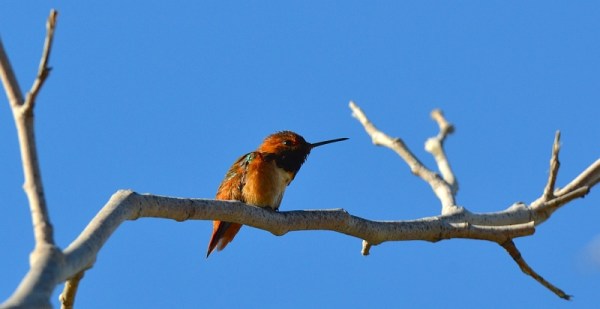
Male Allen’s Hummingbird (Grace Murayama 3-26-17)
As seems usual this year, the weather turned out to be surprisingly unpredictable, or is that unpredictably surprising? We were told to expect rain. No rain. We were told to expect cool temperatures in the 45-60° range. I birded in my T-shirt. Both San Fernando Valley and the Santa Monica Mountains were fog-filled and gray with clouds. The beach was sunny and windless. So it goes.

Killdeer foursome making a heckova racket (Grace Murayama 3-26-17)
Despite the fine weather, or perhaps because of it, we had few birds and a low species count. Fifty-eight total count for gulls and terns seemed extraordinarily low, so I checked when I got home, and found: 2012 – 53 birds, 2013 – 94, 2014 – 643, 2015 – 107, 2016 – 219. So…OK, low, but not supernaturally low. So much for the accuracy of one’s unsubstantiated impressions of history.
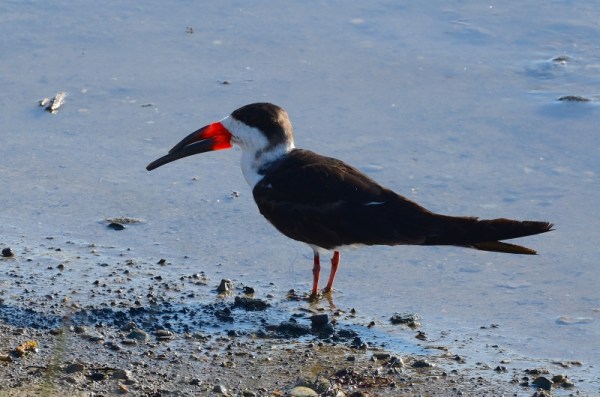
Black Skimmer with the giant schnozz (Grace Murayama 3-26-17)
Our best bird of the day was the single breeding-plumage Black Skimmer. This bird looks like an oversized tern, with a huge red and black bill, lower bill longer than the upper bill. Aptly named, this largely black bird feeds by skimming just above the calm waters of lagoons and inshore waters, lower bill-tip slightly immersed in the water as it flies. When it encounters something edible – SNAP! goes the bill. I always expect them to hit a hidden stick and go flying head over heels, summersaulting across the water, but I’ve never seen this happen. Over the past 38 years, we’ve recorded Black Skimmer at the lagoon on only 23 occasions, for a total of 220 birds. They show up Dec-Mar and May-Aug. On only three appearances did their numbers rise above single digits: 30 on 1/29/09, 35 on 7/25/10 and a whopping 103 the following month on 8/22/10.
Skimmers are one of those groups whose classification is regularly bounced around, and they’ve been in and out of the Tern family of Sternidae (when terns were in a family separate from gulls), or their own family of Rynchopidae. Gulls, Terns and Skimmers are currently all classified into the single family of Laridae. The Black Skimmer is fairly common on ponds, rivers, lagoons and calm waters from the southern U.S. to northern Argentina. The African Skimmer is common in similar habitat throughout sub-Saharan Africa. The third species, Indian Skimmer, is far less common on lakes and rivers of the Indian subcontinent and the delta of the Mekong River. For ‘World Birders,’ it’s a big deal to see one. And that’s it; only three species of skimmer.
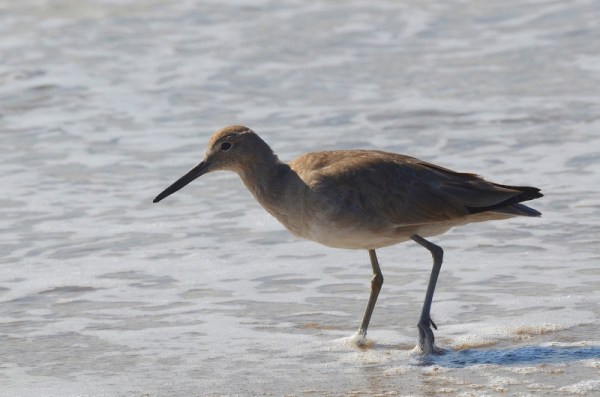
Willet (Grace Murayama 3-26-17)
No Glaucous-winged Gulls this month, but a fine example of a winter (probably 3rd winter) Herring Gull. On the Atlantic Coast, where they are far more common, people want to rename them the Dump Gull, as they feast and thrive on America’s most abundant product – garbage, to the detriment of many of the terns who have to contend with harassment from this large and aggressive gull.

El muerte Brown Pelican (Grace Murayama 3-26-17)
The Black-bellied Plovers were beginning to molt from their winter gray uniforms into their patterned breeding plumage. The warblers – save for the resident breeder Common Yellowthroat – and most of the sparrows seem to have fled, and the spring migrants aren’t yet arriving, so our passerine count was quite low.

Osprey before his escapade with the mullet (Grace Murayama 3-26-17)
The ‘parents and kids bird walk’ participants were greatly entertained by the misfortunes of our Osprey. The bird had snagged a large mullet and then was mobbed by several gulls while still aloft. After the Osprey landed and dropped the fish on the shore, a Great Blue Heron landed a yard away, which startled the Osprey off the fish. A Western Gull then jumped on the fish, but couldn’t make a dent in it before the Osprey returned to reclaim his prize. This altercation attracted the heron, which then flew over and took a swipe at the Osprey. Imagine a fight between a knife-wielder and a swordsman. Not much of a match, and the Osprey left. The heron dragged the fish over to the water, gave it a good rinse, and then seemed to try to swallow the fish sideways. That failed and the fish was finally oriented properly – head down – and the heron slowly forced it down it’s gullet. The mullet was larger in diameter than the heron’s head, but herons have a flexible gape and throat, and eventually the fish disappeared down the gullet. Herons weigh about 5 ½ pounds fully grown, and I’d guess the fish was 2 pounds. Imagine a 150-pound man swallowing a fifty-pound beef roast. I didn’t see the bird fly away and I wonder if it could get off the ground.
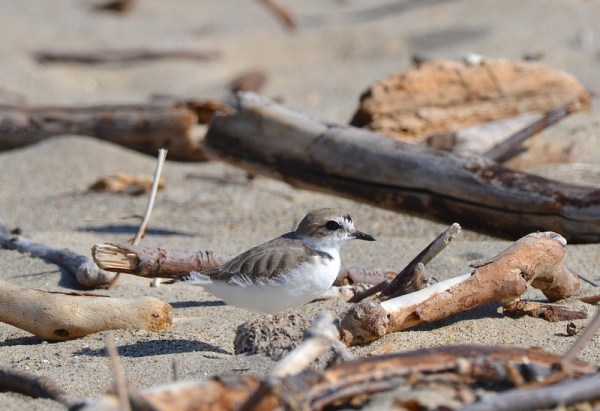
Snowy Plover in the wrack (Grace Murayama 3-26-17)
The Snowy Plovers were still on the beach, scattered through the wrack on the sandy berm, divided into three groups of two, four and two. They seemed to be pairing up into male and female. None had bands.
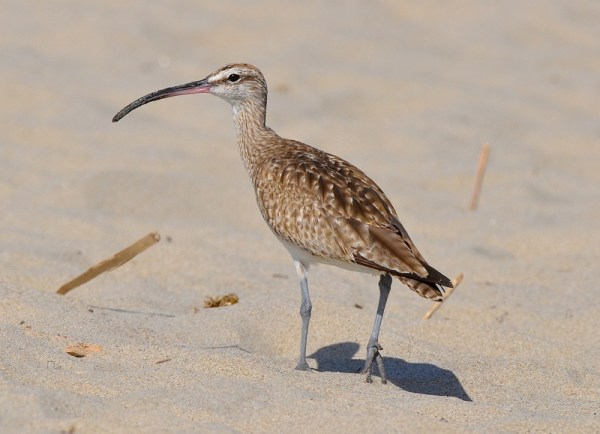
Whimbrel with the decurved bill (Grace Murayama 3-26-17)
Birds new for the season were: Canada Goose, Black-vented Shearwater, Western Sandpiper, Caspian Tern, Black Skimmer, Common Raven, Barn Swallow.

The Lone Killdeer (Grace Murayama 3-26-17)
Many thanks to our photographer: Grace Murayama
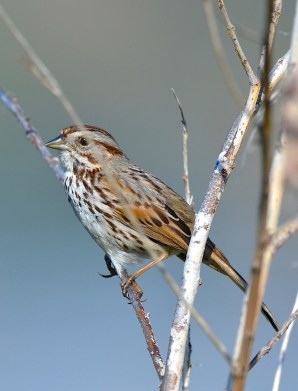
Song Sparrows sing all year around
(Grace Murayama 3-26-17)
Our next three scheduled field trips: Rancho Sierra Vista, 8 Apr., 8am; Malibu Lagoon 8:30 & 10am, 23 Apr.; Butterbredt Spring Campout Sat/Sun 29-30 Apr. 8:30am.
Our next program: Finding and Photographing Birds in the Andes with Chuck Bragg, Tuesday, 4 Apr., 7:30 pm; Chris Reed Park, 1133 7th St., NE corner of 7th and Wilshire Blvd. in Santa Monica.
NOTE: Our 10 a.m. Parent’s & Kids Birdwalk meets at the shaded viewpoint just south of the parking area. Watch for Willie the Weasel. He’ll be watching for you and your big floppy feet.
Links: Unusual birds at Malibu Lagoon
9/23/02 Aerial photo of Malibu Lagoon
Prior checklists:
2016: Jan-June, July-Dec 2015: Jan-May, July-Dec
2014: Jan-July, July-Dec 2013: Jan-June, July-Dec
2012: Jan-June, July -Dec 2011: Jan-June, July-Dec
2010: Jan-June, July-Dec 2009: Jan-June, July-Dec.
The 10-year comparison summaries created during the project period, despite numerous complaints, remain available on our Lagoon Project Bird Census Page. Very briefly summarized, the results unexpectedly indicate that avian species diversification and numbers improved slightly during the period Jun’12-June’14. [Chuck Almdale]

Surf log (C. Bragg 2-26-17)
| Malibu Census 2016-17 | 9/25 | 10/23 | 11/27 | 12/25 | 2/26 | 3/26 |
| Temperature | 70-96 | 63-70 | 53-58 | 48-54 | 46-52 | 55-68 |
| Tide Lo/Hi Height | H+4.39 | L+2.63 | H+5.79 | H+5.49 | H+5.6 | H+5.21 |
| Tide Time | 0708 | 1108 | 0729 | 0634 | 0845 | 0851 |
| Brant | 1 | 1 | ||||
| Canada Goose | 2 | |||||
| Gadwall | 6 | 6 | 4 | 18 | 10 | 12 |
| American Wigeon | 1 | 10 | 7 | 30 | 6 | 18 |
| Mallard | 35 | 23 | 22 | 14 | 24 | 14 |
| Northern Shoveler | 6 | 2 | 1 | |||
| Northern Pintail | 4 | 3 | 1 | |||
| Green-winged Teal | 2 | 6 | 12 | 2 | ||
| Ring-necked Duck | 1 | |||||
| Surf Scoter | 8 | 30 | ||||
| Bufflehead | 4 | 6 | 1 | |||
| Hooded Merganser | 1 | 5 | 2 | |||
| Red-brstd Merganser | 5 | 4 | 1 | |||
| Ruddy Duck | 7 | 26 | 30 | 10 | ||
| Red-throated Loon | 1 | |||||
| Pacific Loon | 1 | 2 | ||||
| Pied-billed Grebe | 15 | 18 | 8 | 1 | ||
| Horned Grebe | 1 | |||||
| Eared Grebe | 3 | 6 | 10 | 1 | ||
| Western Grebe | 10 | 10 | 50 | 3 | 1 | |
| Clark’s Grebe | 2 | 1 | ||||
| Blk-vented Shearwater | 50 | |||||
| Brandt’s Cormorant | 3 | 2 | ||||
| Dble-crstd Cormorant | 38 | 37 | 23 | 32 | 42 | 41 |
| Pelagic Cormorant | 1 | 2 | 6 | 1 | ||
| Brown Pelican | 1 | 30 | 37 | 24 | 30 | 8 |
| Great Blue Heron | 6 | 3 | 3 | 2 | 4 | 2 |
| Great Egret | 1 | 2 | 1 | 2 | 3 | 1 |
| Snowy Egret | 8 | 8 | 5 | 12 | 9 | 5 |
| Turkey Vulture | 1 | |||||
| Osprey | 2 | 2 | 1 | 1 | ||
| Red-tailed Hawk | 1 | |||||
| Sora | 1 | |||||
| American Coot | 95 | 280 | 240 | 210 | 85 | 32 |
| Blk-bellied Plover | 75 | 75 | 73 | 22 | 35 | 14 |
| Snowy Plover | 35 | 29 | 12 | 32 | 8 | 8 |
| Semipalmated Plover | 5 | |||||
| Killdeer | 29 | 1 | 2 | 1 | 4 | 8 |
| Mountain Plover | 1 | |||||
| Spotted Sandpiper | 2 | 1 | ||||
| Willet | 10 | 20 | 3 | 15 | 12 | 13 |
| Whimbrel | 1 | 2 | 2 | 1 | 5 | 4 |
| Marbled Godwit | 4 | 7 | 10 | 5 | 8 | 23 |
| Ruddy Turnstone | 3 | 7 | 14 | 12 | 10 | 1 |
| Sanderling | 22 | 72 | 45 | |||
| Dunlin | 1 | |||||
| Least Sandpiper | 4 | 12 | 4 | 2 | ||
| Western Sandpiper | 3 | 3 | ||||
| Long-billed Dowitcher | 1 | |||||
| Bonaparte’s Gull | 1 | 1 | ||||
| Heermann’s Gull | 6 | 15 | 12 | 11 | 3 | 1 |
| Mew Gull | 1 | |||||
| Ring-billed Gull | 5 | 35 | 30 | 2 | ||
| Western Gull | 45 | 48 | 85 | 90 | 45 | 39 |
| California Gull | 27 | 1200 | 940 | 1350 | 6 | |
| Herring Gull | 1 | 1 | 1 | 1 | ||
| Glaucous-wingd Gull | 2 | |||||
| Caspian Tern | 2 | |||||
| Forster’s Tern | 2 | 1 | ||||
| Royal Tern | 1 | 19 | 16 | 45 | 14 | 5 |
| Elegant Tern | 2 | 5 | 1 | |||
| Black Skimmer | 1 | |||||
| Rock Pigeon | 17 | 15 | 5 | 5 | 10 | 6 |
| Mourning Dove | 2 | 1 | 4 | 1 | 1 | |
| Anna’s Hummingbird | 1 | 1 | 1 | |||
| Allen’s Hummingbird | 1 | 1 | 1 | 2 | 2 | 2 |
| Belted Kingfisher | 2 | 1 | 1 | 1 | 1 | |
| American Kestrel | 1 | |||||
| Merlin | 1 | |||||
| Peregrine Falcon | 1 | |||||
| Nanday Parakeet | 3 | 30 | ||||
| Pac.-slope Flycatcher | 1 | |||||
| Black Phoebe | 9 | 5 | 5 | 3 | 2 | 6 |
| Say’s Phoebe | 2 | 1 | 1 | |||
| Cassin’s Kingbird | 1 | |||||
| California Scrub-Jay | 2 | 2 | 4 | 1 | 1 | |
| American Crow | 7 | 7 | 4 | 5 | 4 | 3 |
| Common Raven | 1 | |||||
| Tree Swallow | 12 | |||||
| Rough-wingd Swallow | 20 | |||||
| Barn Swallow | 1 | 5 | ||||
| Bushtit | 27 | 30 | 35 | 10 | 8 | 3 |
| House Wren | 1 | 2 | 1 | 1 | ||
| Marsh Wren | 1 | 1 | ||||
| Bewick’s Wren | 1 | |||||
| Ruby-crowned Kinglet | 2 | 8 | 1 | |||
| Western Bluebird | 2 | |||||
| Hermit Thrush | 1 | 1 | ||||
| Northern Mockingbird | 3 | 1 | 3 | 1 | 2 | |
| European Starling | 17 | 45 | 30 | 1 | 1 | |
| Ornge-crwnd Warbler | 3 | 4 | 2 | |||
| Common Yellowthroat | 6 | 5 | 5 | 3 | 3 | 4 |
| Yellow-rumpd Warbler | 10 | 28 | 3 | 8 | ||
| Wilson’s Warbler | 1 | |||||
| Spotted Towhee | 1 | 1 | 1 | |||
| California Towhee | 2 | 1 | 1 | |||
| Savannah Sparrow | 2 | 4 | 1 | |||
| Song Sparrow | 6 | 4 | 8 | 6 | 8 | 8 |
| Lincoln’s Sparrow | 1 | |||||
| White-crwnd Sparrow | 2 | 25 | 45 | 15 | 20 | 10 |
| Red-winged Blackbird | 1 | 1 | ||||
| Western Meadowlark | 16 | 3 | 2 | 1 | ||
| Great-tailed Grackle | 2 | 17 | 5 | 3 | 2 | 3 |
| Brwn-headed Cowbird | 3 | |||||
| House Finch | 30 | 18 | 9 | 17 | 10 | 6 |
| Lesser Goldfinch | 2 | |||||
| Totals by Type | Sep | Oct | Nov | Dec | Jan | Feb |
| Waterfowl | 55 | 50 | 70 | 114 | 75 | 80 |
| Water Birds – Other | 149 | 382 | 332 | 335 | 165 | 132 |
| Herons, Egrets & Ibis | 15 | 13 | 9 | 16 | 16 | 8 |
| Quail & Raptors | 4 | 1 | 1 | 2 | 2 | 1 |
| Shorebirds | 195 | 215 | 161 | 100 | 86 | 76 |
| Gulls & Terns | 54 | 118 | 1321 | 1122 | 1445 | 58 |
| Doves | 19 | 16 | 5 | 9 | 11 | 7 |
| Other Non-Passerines | 4 | 6 | 3 | 33 | 3 | 2 |
| Passerines | 140 | 183 | 186 | 107 | 94 | 53 |
| Totals Birds | 635 | 984 | 2088 | 1838 | 1897 | 417 |
| Total Species | Sep | Oct | Nov | Dec | Jan | Feb |
| Waterfowl | 7 | 6 | 8 | 9 | 9 | 8 |
| Water Birds – Other | 4 | 9 | 11 | 8 | 8 | 5 |
| Herons, Egrets & Ibis | 3 | 3 | 3 | 3 | 3 | 3 |
| Quail & Raptors | 3 | 1 | 1 | 1 | 2 | 1 |
| Shorebirds | 14 | 10 | 8 | 8 | 8 | 9 |
| Gulls & Terns | 4 | 8 | 8 | 6 | 7 | 9 |
| Doves | 2 | 2 | 1 | 2 | 2 | 2 |
| Other Non-Passerines | 3 | 4 | 3 | 3 | 2 | 1 |
| Passerines | 21 | 21 | 21 | 18 | 18 | 13 |
| Totals Species | 61 | 64 | 64 | 58 | 59 | 51 |
What is Déjà Vu?! | PBS Science Video
Most of us have felt it before, that strange sensation that you’ve been somewhere or seen something before, as if you already remembered what’s happening. Are you psychic? Nope, that’s just déjà vu. Why does déjà vu happen? Well, scientists aren’t completely sure, but they’ve got a few good theories about it.
This is an installment of the PBS – It’s OK to be Smart series. If no film or link appears in this email, go to the blog to view it by clicking on the blog title above. If the film stops & starts in an annoying manner, press pause (lower left double bars ||) to let it buffer and get ahead of you. [Chuck Almdale]
You may think that you’ve got the house to yourself, but chances are you have about 100 different types of animals living with you. Many of them are harmless, but a few can be dangerous in ways you wouldn’t expect. New research explores exactly whom you share your home with and how they got there.
This is another installment of the PBS Deep Look series. If no film or link appears in this email, go to the blog to view it by clicking on the blog title above. If the film stops & starts in an annoying manner, press pause (lower left double bars ||) to let it buffer and get ahead of you. [Chuck Almdale]
This year we report on that other large object in the sky,
known as the sun.
Vernal Festivals
The vernal equinox, by any name, has been a major cultural event around the world for millennia. Of course, the farther one lives from the equator, the more noticeable are seasonal variations in daylight and warmth, and the more important these events become. Cultures from around the world – including Japan, China, Iran, Russia, Egypt, Scandinavia, Scotland and throughout the Americas – developed their own festivals celebrating the vernal equinox and the onset of springtime.
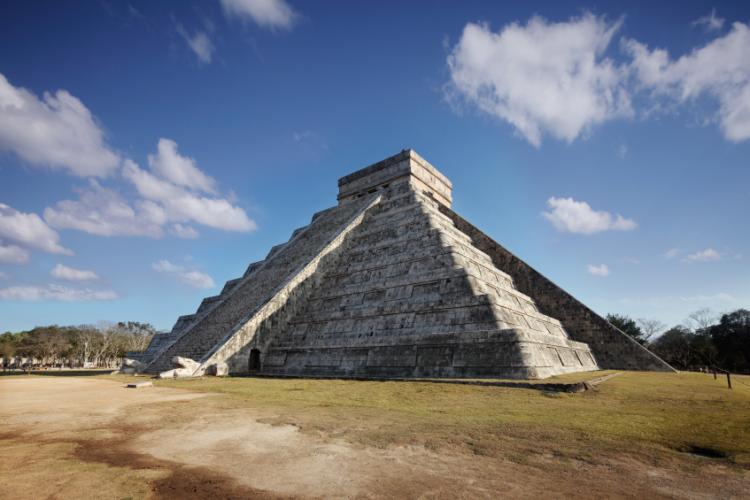
The Snake of Sunlight — Main pyramid at Chichen Itza, Yucatan, Mexico
(CostinT from Timeanddate.com)
Easter is the best known vernal festival in the western world.
Goddess of the Dawn to the Greeks was Eos (Aurora to the Romans), born of Titan parents, sister to sun-god Helios (Roman Sol Invictus) and moon-goddess Selene (Roman Luna), and mother of the four winds. The name originates in the ancient Indo-European language, predecessor to nearly all European, Indian and Persian languages, and was Ostara (later Ostern) to the Germans, and Eastre in Old English and Ester in Middle English, from whence we get both East and Easter. The early Christian church was good at co-opting festivals from other religions and peoples. So, the spring festival of Eos (by whatever local name variation) became Easter, re-configured to memorialize the death and resurrection of Jesus. Spring festivals typically mark the end of the wintery season of death and the rebirth into spring, when plants bloom and animals bear their young. The origin of the
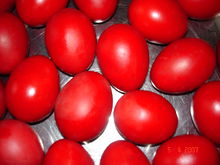
Red Easter Eggs symbolize the blood of Jesus
(Wikipedia – Easter Eggs)
Easter Egg custom is complex: part obvious fertility symbol, part recognition of the end of Christian Lent (during which eggs were forbidden), part early Mesopotamian Christian symbol for the death of Jesus, and part empty-shell symbol of the empty tomb of Jesus. Easter is scheduled for the first Sunday after the first full moon on or after the vernal equinox, a formula which indirectly led to Western Europe’s replacement of the Julian Calendar with the Gregorian calendar in 1752.
Sunspot Cycles
The sunspot cycle is driven by cyclic fluctuations in both polarity and strength of the solar magnetic field. On average, these magnetic poles reverse polarity – north magnetic pole becomes south magnetic pole and vice versa – every 11.1 years, then does it again, for an average total of 22.2 years. The Sunspot minimum period surrounds this polar flip: for example, current Cycle 24 began 1/4/2008 when at solar 30° north a sunspot appeared with polarity magnetically reversed from existing sunspots, the sign of a polar flip. That year was later ‘voted’ the “blankest year of the space age” – 266 days without a single sunspot, exceeding 1954’s 241 spotless days. However, solar minima in the late 19th-early 20th centuries often had 200-300 spotless days per year. Farther back, during the ‘Maunder Minimum’ (cause of Europe’s ‘Little Ice Age”of 1645-1715), only 30 sunspots appeared during one 30-year period. Sunspot maximums occur roughly midway between minimums. Current Cycle 24, expected to end in 2019, experienced a ‘double peak’ of spot maximum – 67 sunspots in Sep. 2012, then dropping, only to again peak at 82 spots in Apr. 2014.
For comparison, the earth’s magnetic field flips – not just slide around, but flips north to south – over a wildly varying cycle ranging from 10,000 to 25 million years according to current knowledge. It takes an estimated 5000 years for the magnetic field to wane, flip, and wax, and – we are told – we may be in such a period right now. So keep an eye on your compass – if the needle point suddenly shifts to ‘south,’ or if your car’s GPS system suddenly becomes unreliable, well…don’t say you weren’t warned. And stay out of that ensuing influx of cosmic rays.
Just in case you thought you might escape this without seeing a chart, here’s your chart.
| Sunspots – Last 10 cycles | |||||
| Solar | Start at | Spots at | Years of | Date of | Spots at |
| Cycle No. | Minimum | Minimum | Cycle | Maximum | Maximum |
| 15 | Dec 1913 | 5.6 | 10.0 | Aug 1917 | 105.4 |
| 16 | May 1923 | 3.5 | 10.1 | Apr 1928 | 78.1 |
| 17 | Sep 1933 | 7.7 | 10.4 | Apr 1937 | 119.2 |
| 18 | Jan 1944 | 3.4 | 10.2 | May 1947 | 151.8 |
| 19 | Feb 1954 | 9.6 | 10.5 | Mar 1958 | 201.3 |
| 20 | Oct 1964 | 12.2 | 11.7 | Nov 1968 | 110.6 |
| 21 | May 1976 | 12.3 | 10.3 | Dec 1979 | 164.5 |
| 22 | Mar 1986 | 8.0 | 9.7 | Jul 1989 | 158.5 |
| 23 | Jun 1996 | 1.7 | 11.7 | Mar 2000 | 120.8 |
| 24 | Jan 2008 | Apr 2014 | 81.9 | ||
| All 24 Cycles | |||||
| 1755-2014 Mean | 5.8 | 11.1 | 114.1 | ||
A total eclipse of the sun, visible over all of North America, occurs August 21, 2017. Partial eclipse on the center line begins on the mainland in Oregon at 16:04 universal time (UT) (9:04 AM PDT) and begins on the South Carolina coast at 17:17 UT (1:17 PM EDT). It takes about 2 hours, 50 minutes from beginning to end, with a maximum of 2 minutes, 40.2 seconds of total eclipse in the middle of two periods of partial eclipse. Length of totality at the Oregon coast is short at 1:58, longest at Carbondale, Ill at 2:40, and is 2:33 when it leaves the South Carolina coast.
Eclipse Links:
NASA
Eclipse2017.org
Astronomy.com – 25 Facts you should know
Earth & Sky – Solar Eclipse Path
Space.com – Where, when & how to see the eclipse
A total solar eclipse is something everyone should see at least once in their lifetime. It’s not often that you can see the Moon Dragon swallow and disgorge the Sun God. I’ve seen it four times. In my book, a partial eclipse is barely worth the effort of getting out of bed. Go for the centerline of shadow, where totality is maximized, or forget it. If you miss this one, another will be along on April 8, 2024, ranging from 3:22 on the east coast of Maine to 4:27 in southwestern Texas. The next one after that eclipse is on August 23, 2044. [Chuck Almdale]
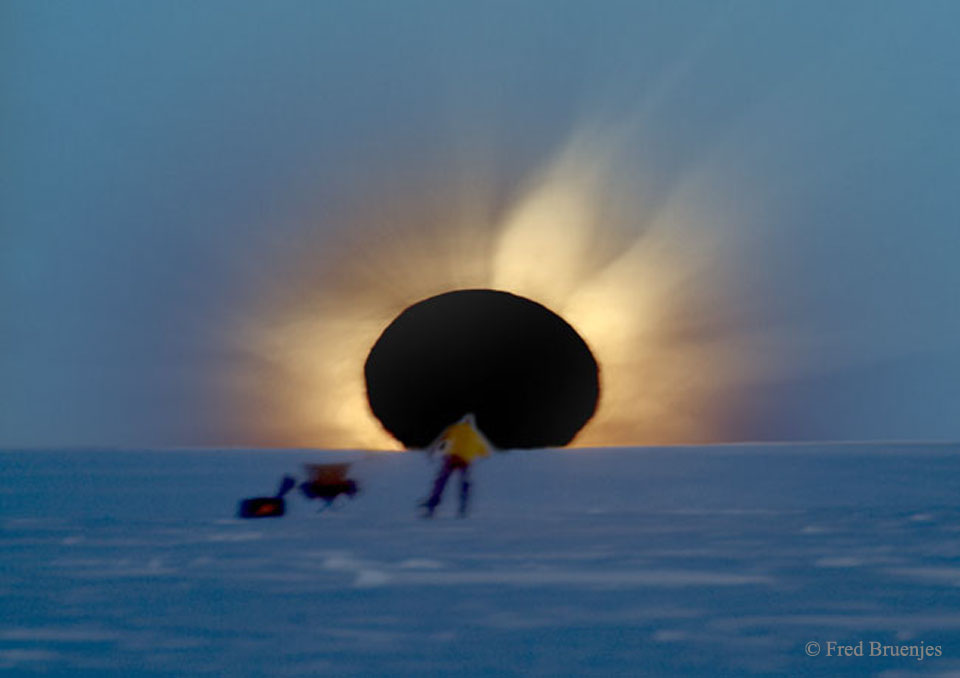
Total Solar Eclipse in Antarctica (Fred Bruenjes 11/23/03)



 SANTA MONICA BAY AUDUBON SOCIETY BLOG