Free email delivery
Please sign up for email delivery in the subscription area to the right.
No salesman will call, at least not from us. Maybe from someone else.
How do I love(bird) thee…let me count the ways.
[By Chuck Almdale]
It’s Valentine’s season again and here’s a posting you may love. Or like. It answers the question indirectly posed above: how many lovebirds are there? Species of lovebirds, that is…not those people seated on park benches, heads tilted together, smiling, talking and (of course) throwing seed to the park birds at their feet.
Here are the lovebirds of the world, <snipped> from Birds of the World.


They’re all in genus Agapornis of Old World Parrot family Psittaculidae and are found primarily in sub-Saharan Africa save for the Gray-headed which resides in nearby Madagascar, and they are all quite lovely. Perhaps it’s those big eye rings that gaze at you like limpid pools, or the soft muted colors of red, orange, yellow and green. Here’s a link to their Wikipedia Agapornis (lovebird) page.
Bird tour company Rockjumper alerted me to lovebird season (link to their message) and the purely incidental fact that that have tours to see lovebirds (plus many 100’s of other birds, of course, such as the ho-hum-common-as-dirt Picathartes). They had comments on all the lovebirds including this one on Lilian’s Lovebird (Agapornis Lilianae), a species of special interest to me.
Most of us are aware of Sclater from bird names across the globe, with father and son both avid collectors during their time. Lilian however, daughter and sister, was also an ardent naturalist and this gorgeous species was named after her. Lilian’s Lovebird is however the only species bearing her name. It is a beauty, and one needs to go to very specific locations to see this gem. It favours the Zambezi Valley and adjacent lowlands where it is mostly confined to Mopane woodland. Places like Liwonde National Park in Malawi, South Luangwa National Park in Zambia and Mana Pools National Park in Zimbabwe offer very good chances of seeing this beautiful species.
And thank you to Elizabeth Barrett Browning (1806-1861) and her lovely and timeless poetry, and to those Portuguese who may or may not have had something to do with inspiring her poems, but in fact did not write any of them, despite rumors to the contrary.
Goldfinches Galore, Madrona Marsh: 8 February 2025
[Text by Chuck Almdale, photos by Ray Juncosa & Chris Tosdevin]
In the upside down map below, north is at the bottom, so no…you haven’t lost your mind.
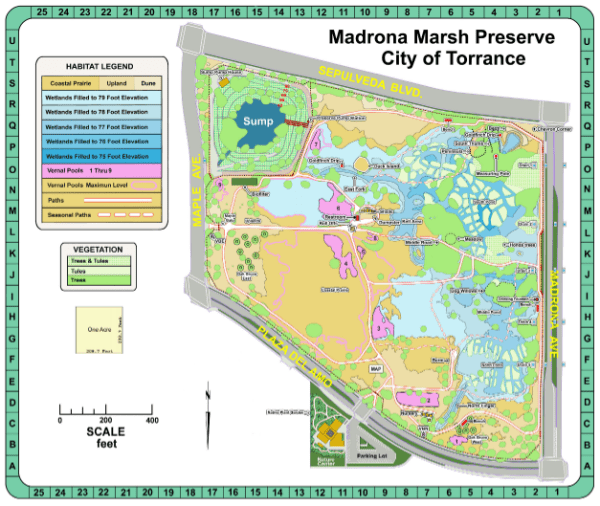
We almost had the preserve to ourselves as we encountered few volunteers mucking about and a few birders looking for the annually reoccurring Black-and-white Warbler. Our leader Jean Garrett was a little under the weather so I led the trip.
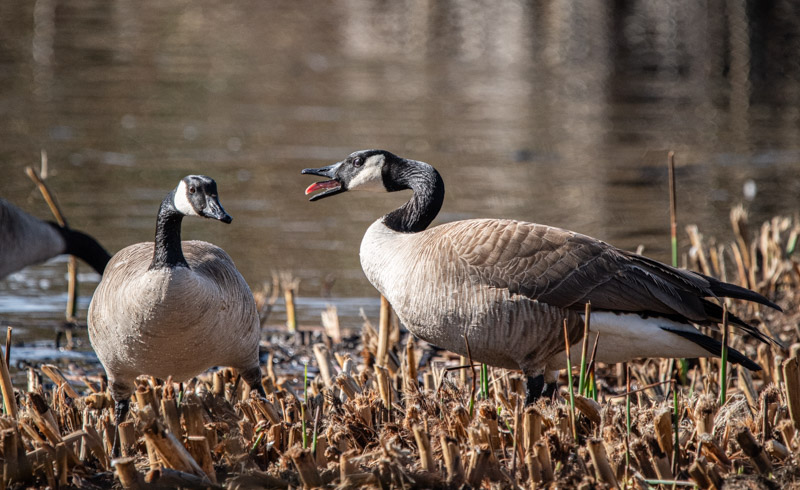
There was far, far less water than last year, not at all surprising considering the rain we have not received. I’d estimate that vernal pool surface was 75% less, seeing as several large previous-pools were – at best – perhaps slightly soft, perhaps. Oddly enough this had virtually no effect upon the number of waterfowl species or individuals — they just occupied a smaller area. This led to occasional bickering, nothing new for commonly quarrelsome ducks and geese.
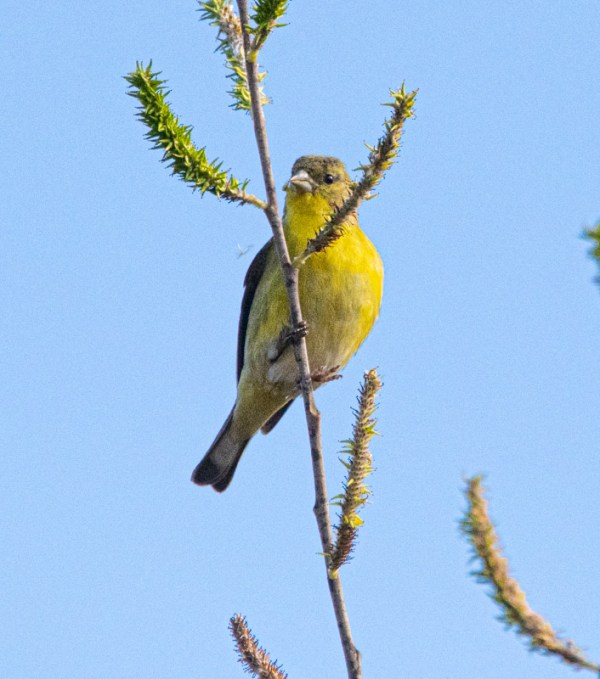
Perhaps most noteworthy were the numerous goldfinches – both Lesser and American. We couldn’t find any Lawrence’s or the once-upon-a-time European Goldfinch that lived here. Goldfinches were in the trees, the brush, the grass, on the bare ground.


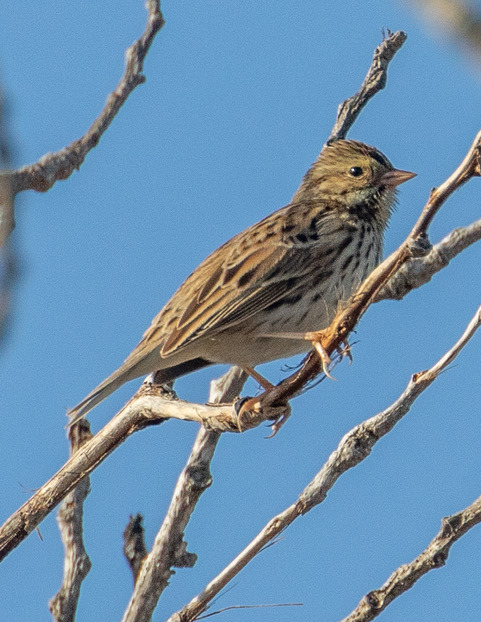
Mixed in with the goldfinches were various sparrows, mostly White-crowned, but also Savannah, Lark, Golden-crowned and California Townees, plus House Finches.
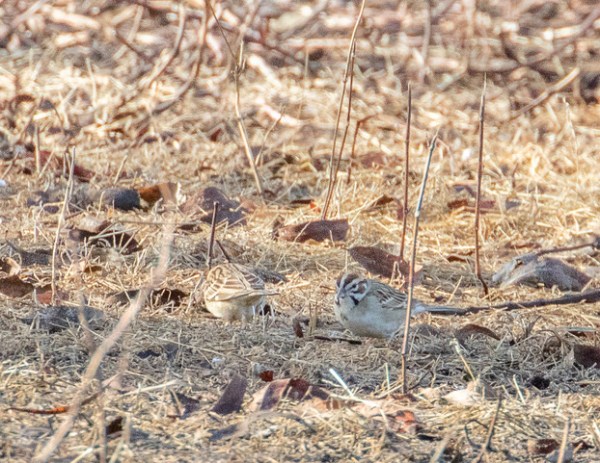
Here’s two sparrow names not currently used, available to those addicted to changing bird names for no discernible reason: Variable Sparrow, In-between Sparrow. You’re welcome.
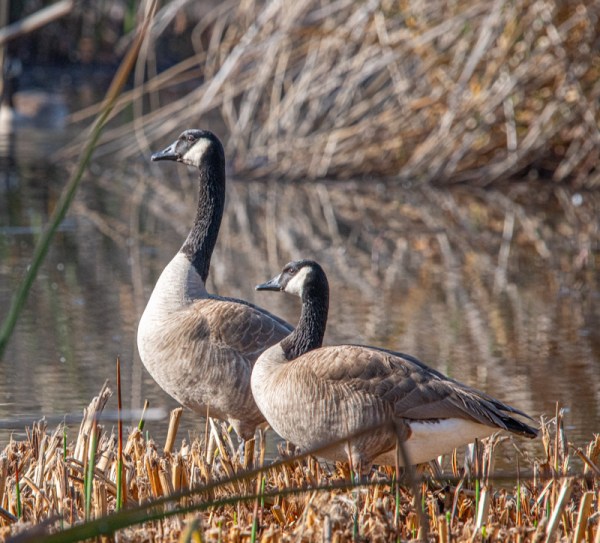
One of these two Canada Geese is obviously a lot larger than the other. Could the right-hand bird be the look-alike by relatively diminutive Cackling Goose, formerly considered as subspecies of the Canada?
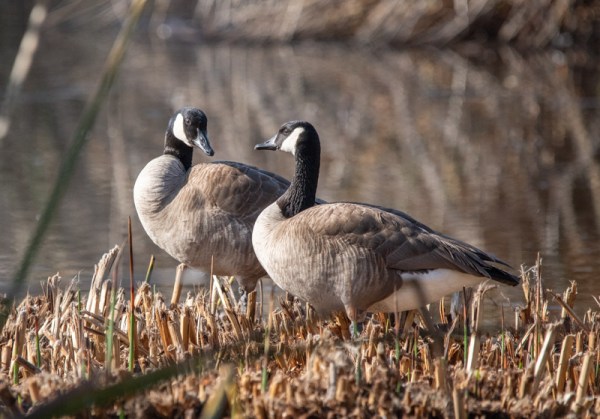
Hmmm…not so different after all; apparently an optical postural illusion. If you’re not certain these are the same two individuals in the same location in both pictures, check the surrounding grass stalks.
Green-winged Teal were the least common, as well as the smallest, waterfowl on the vernal pools. Last year there were none at all despite all the water.

Even less common were the Hooded Mergansers, of whom we found only these two females in the sump at the southeast corner of the preserve. They like deep water, and I’ve never seen them in the vernal pools, only in the sump. We couldn’t find a male, but as we were peering through the chain link fence over the edge of the sump-hole, we couldn’t see the entire pool. I suspect that the wooden raft was intentionally placed there to give these birds a safe place to rest out of the water.

Lots of birds were in the trees and bushes. Sometimes they seemed to be the same individuals moving around, making our total count for several species a bit uncertain.
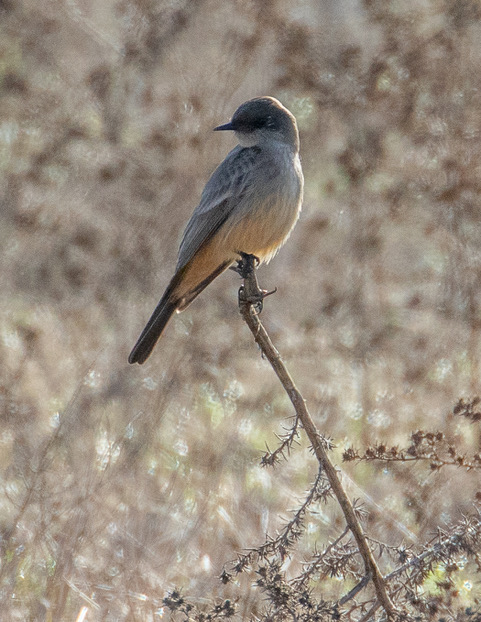
We had the same problem with Cassin’s Kingbird as we did last year: were there twenty of them or just two moving around a lot? We conservatively counted two.
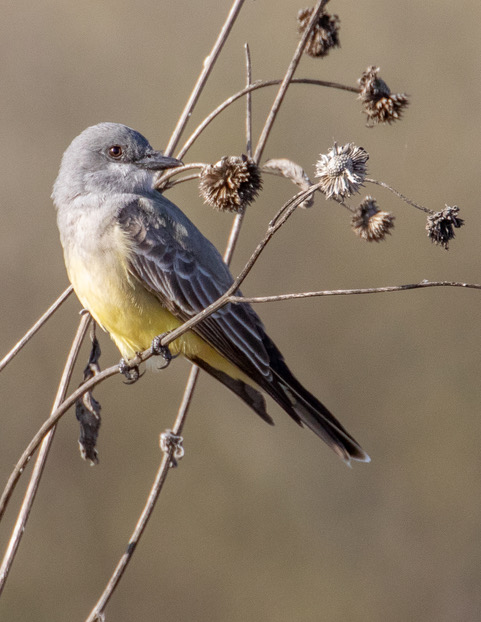
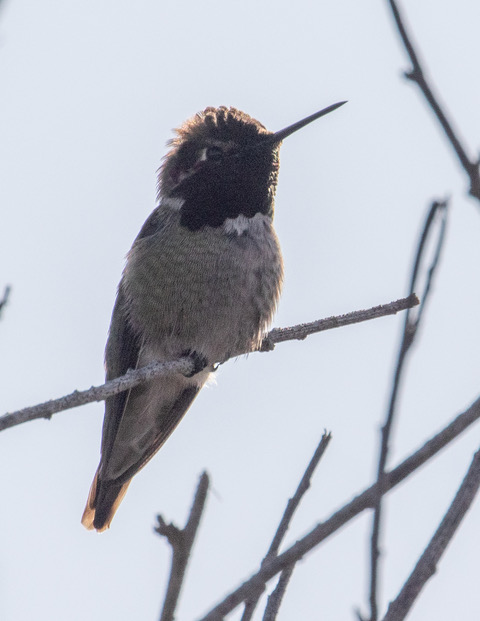
There seemed to be a Ruby-crowned Kinglet in every bush and leafy tree.

Our group became separated while walking west on the “central road.” Four people – Cynthia, Ellena, Emily and Ray – continued ahead while the rest of us went back to look for Cedar Waxwings at the northeast corner where we failed to find them. Meanwhile the Gang of Four came upon a mixed feeding flock which included the sought-for Black-and-white Warbler, a species that breeds east of the Rocky Mtns. and usually flies south for the winter, but a few come west and winter with us. One has frequently wintered at the marsh since at least 2016. As usual, this one was busily gleaning invertebrates from the trunk and branches of the trees. Later the four – now dwindled to three – led the rest of the group back to the sighting spot but the birds had moved on. So it goes.
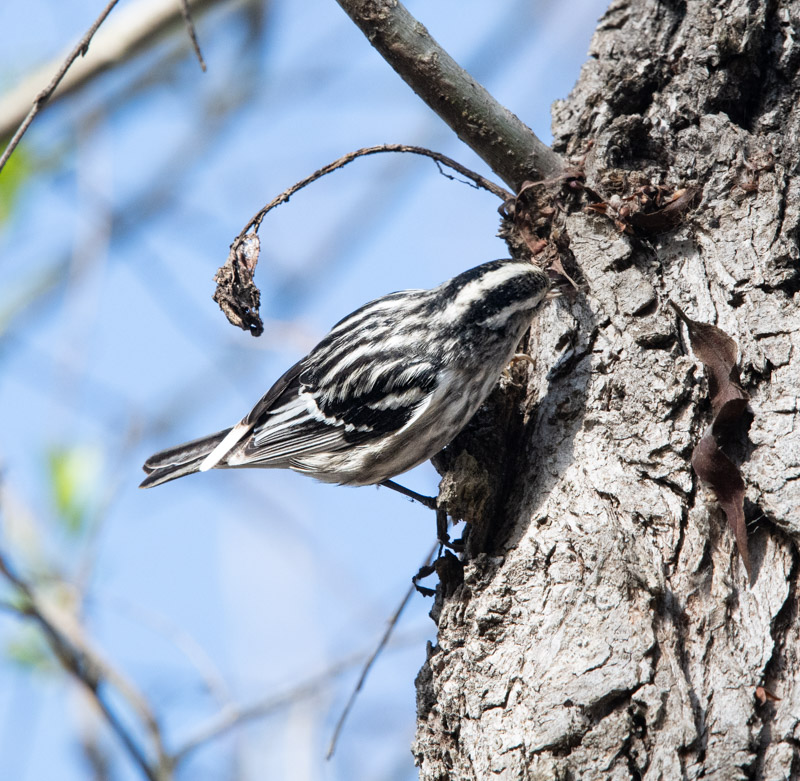
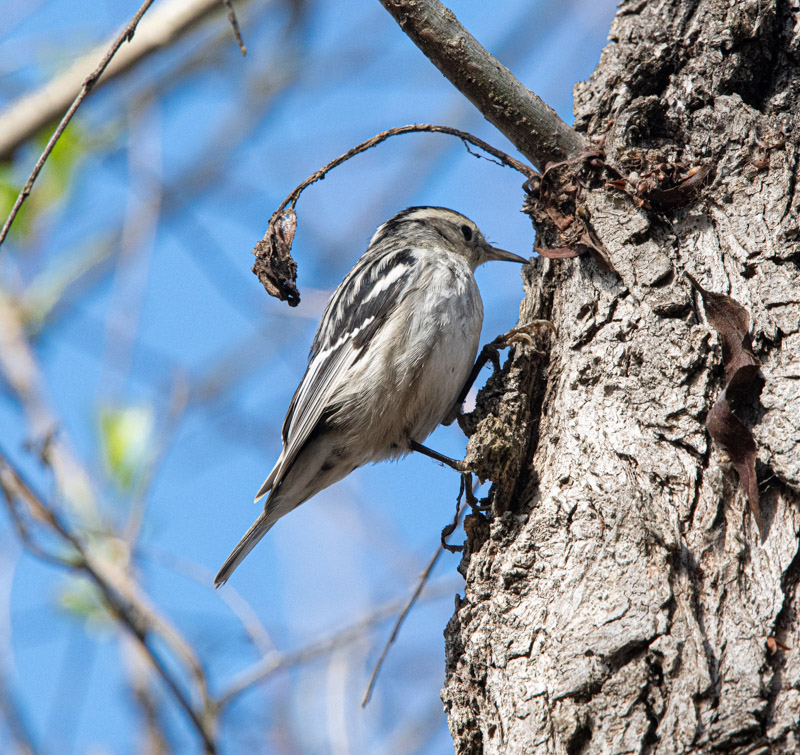
Black-and-white Warbler, gleaning from the bark, their typical behavior. (Ray Juncosa 2/8/25)
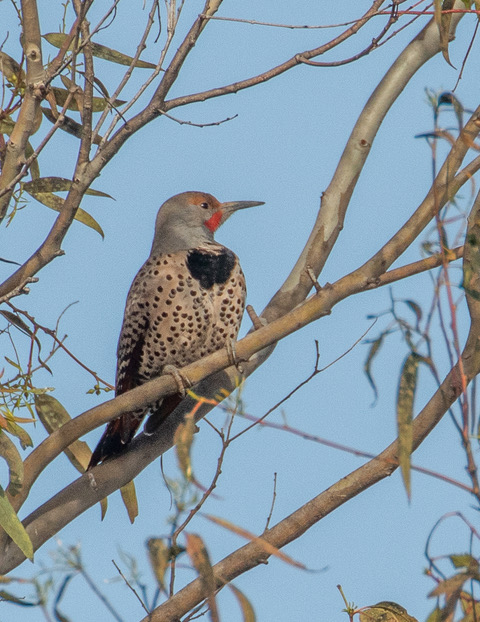
As with last year we found a Northern (Red-shafted) Flicker in one of the trees. This western form has the red whiskers and a brown nape. Last year we had both the Red-shafted and an intergrade form.
We had four species of raptors: the Red-tailed Hawk was high overhead and far away, the Merlin was far away and seen only through a lattice of branches, but the American Kestrel was cooperative as were a pair of Cooper’s Hawks.
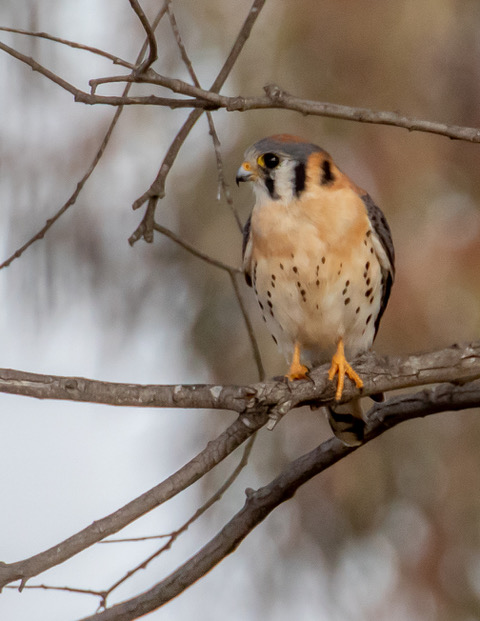
I suspect that this bird below was a bit chilled as it was extremely fluffy.

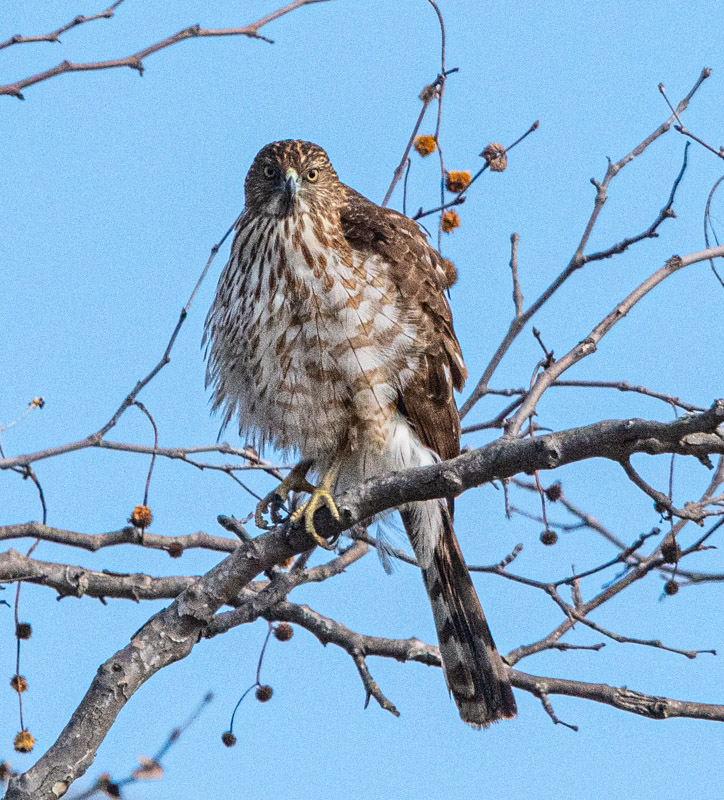
Cooper’s Hawk 2/8/25. Left: Chris Tosdevin, Right: Ray Juncosa.
A few birds, especially an Orange-crowned Warbler, had black on their face, mostly on their chin but some above the bill or above the eyes, which threw us for a bit of a loop. Back home I mentioned this to Lillian who recalled that Kimball Garrett, birder extraordinaire, had once told us that some birds get this from feeding on the eucalyptus flowers which can be a bit sticky. Here’s a photo from last year.

Google AI commented on this:
AI Overview
When a bird has black residue on its face after feeding on a eucalyptus tree, it’s usually due to a sticky, gummy substance called “eucalyptus oil” present in the flowers and leaves, which can accumulate on their beaks and faces while they forage for nectar or insects, appearing as a dark stain.
This led me to the interesting paper Birds and Eucalyptus on the Central California Coast: A Love – Hate Relationship by David L. Suddjian, dated June 3. 2004. [Link]
Eucalyptus stands may offer several special features. Large specimens growing at lower densities develop large and complex limb structures that may provide key nest sites for raptors and colonial waterbirds. With age, the large specimens may also develop snag features, such as dead limbs, and over time older stands include standing dead trees. However, snag resources and tree cavities are generally much less available in eucalyptus stands than in oak or riparian woodland. The loose bark of blue gum eucalyptus, and crevices and cracks in the bark provide foraging substrate and nest sites for some species. The flowers of blue gum, red gum, and other species provide a bounty for many different birds during the winter and spring. Birds visit the flowers for the copious nectar, and to eat insects that are attracted to the flowers. This nectar resource may not be without its downside, however…
As the birds spend time feeding amid the flowers, the feathers on their faces become matted with a black pitch-like residue (or gum) from the nectar. This affects their ability to maintain those feathers, and in some cases the gum may plug their nostrils or bills, and prevent breathing or feeding. Australian birds that regularly feed at Eucalyptus flowers in native settings have longer bills than North American species that feed at eucalyptus flowers, apparently permitting them to feed there without being affected by the gum.
Articles published in the Point Reyes Bird Observatory newsletter (Stallcup 1997) and in Audubon magazine (Williams 2001) have suggested that the effects of this black pitch cause substantial mortality among the North American species that feed at eucalyptus flowers. It seems to be a reasonable conclusion, and Stallcup (1997) cites some instances of mortality. But in my experience, and the experience of a number of other long time field ornithologists, we have seen very little evidence of such mortality. It has been argued that the bird carcasses do not last long on the ground before they are scavenged. However, when observers spend hundreds of hours under these trees over many years but find hardly any evidence of such mortality, then it seems fair to question whether the incidence of mortality is as high as has been suggested. Not all bird carcasses are scavenged rapidly, and large amounts of time under the trees should produces observations of dead birds, if such mortality were a frequent event. I’m not making a judgment either way, but I just think more evidence is needed. Pgs: 2-3, 5
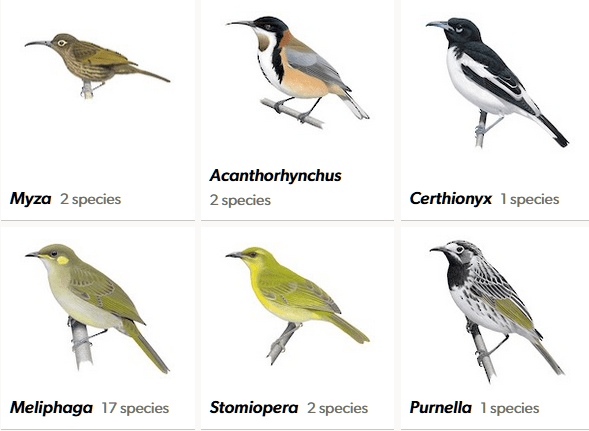
Among the many Australian birds that co-evolved with eucalyptus over tens of millions of years are the Honeyeaters, family Meliphagidae. They generally have long slender slightly decurved bills which aid while digging into the depths of eucalyptus blossoms as well as keeping the gum from getting onto their facial plumage.
Tasmanian Blue Gum, Eucalyptus globulus, is the eucalyptus tree most common introduced into the United States and has lovely, sticky flowers. Photo below from Trees of Stanford University.

As always, many thanks to our photographers: Ray Juncosa & Chris Tosdevin
| Madrona Marsh Trip List | 12/10/16 | 2/11/23 | 2/10/24 | 2/8/25 |
| Canada Goose | X | 8 | 32 | |
| Cinnamon Teal | X | |||
| Northern Shoveler | X | 40 | ||
| Gadwall | X | 2 | ||
| American Wigeon | 6 | X | 2 | 35 |
| Mallard | 6 | X | 50 | 15 |
| Green-winged Teal | X | 5 | ||
| Ring-necked Duck | 1 | |||
| Hooded Merganser | X | 2 | ||
| Rock Pigeon | 8 | X | 8 | 6 |
| Eurasian Collared-Dove | X | |||
| Mourning Dove | 50 | X | 12 | 6 |
| White-throated Swift | 12 | |||
| Anna’s Hummingbird | 3 | X | 3 | 2 |
| Allen’s Hummingbird | 9 | X | 4 | 3 |
| American Coot | 5 | X | 2 | |
| Killdeer | X | 1 | ||
| Greater Yellowlegs | X | |||
| Ring-billed Gull | 2 | |||
| Western Gull | 4 | |||
| California Gull | 2 | X | ||
| Gull sp. | (2) | |||
| Great Egret | 1 | |||
| Green Heron | X | |||
| Black-crowned Night-Heron | X | |||
| Sharp-shinned Hawk | 1 | |||
| Cooper’s Hawk | 2 | |||
| Red-shouldered Hawk | 1 | 1 | ||
| Red-tailed Hawk | 2 | X | 2 | 1 |
| Downy Woodpecker | 1 | 1 | ||
| Northern Flicker (Red-shaft) | 2 | X | 10 | 1 |
| No. Flicker (prob. Red x Yellow) | (1) | |||
| American Kestrel | 3 | X | 1 | 1 |
| Merlin | 1 | |||
| Ash-throated Flycatcher | 1 | |||
| Cassin’s Kingbird | 6 | X | 2 | 4 |
| Black Phoebe | 6 | X | 5 | 3 |
| Say’s Phoebe | 1 | X | 1 | 2 |
| California Scrub Jay | 1 | |||
| American Crow | 4 | X | 12 | 6 |
| Common Raven | 2 | X | 2 | 2 |
| No. Rough-winged Swallow | 2 | |||
| Bushtit | 50 | X | 18 | 8 |
| Ruby-crowned Kinglet | 12 | 8 | ||
| Cedar Waxwing | 20 | X | ||
| Blue-gray Gnatcatcher | 13 | X | 8 | 6 |
| House Wren | 1 Heard | |||
| Northern Mockingbird | 1 | |||
| European Starling | 8 | X | 5 | 30 |
| Hermit Thrush | 1 Heard | |||
| Scaly-breasted Munia | 45 | 20 | 20 | |
| Pin-tailed Whydah | 18 | |||
| House Finch | 20 | X | 5 | 20 |
| Lesser Goldfinch | 3 | X | 50 | |
| American Goldfinch | 45 | X | 8 | 60 |
| Lark Sparrow | 2 | |||
| Chipping Sparrow | 6 | 4 | ||
| Brewer’s Sparrow | 2 | |||
| Fox Sparrow | 1 | |||
| White-crowned Sparrow | 60 | X | 15 | 30 |
| Golden-crowned Sparrow | 2 | X | 2 | |
| Savannah Sparrow | 4 | X | 4 | |
| Song Sparrow | 2 | X | 8 | |
| Lincoln’s Sparrow | 3 | X | 1 | |
| California Towhee | 2 | X | 1 | 4 |
| Western Meadowlark | 10 | X | 1 | |
| Red-winged Blackbird | 2 | X | 31 | 40 |
| Brewer’s Blackbird | 5 | |||
| Great-tailed Grackle | X | 1 | 3 | |
| Black-and-White Warbler | 1 | 1 | ||
| Orange-crowned Warbler | 6 | X | 2 | |
| Common Yellowthroat | 3 | 1 | ||
| Yellow-rumped Warbler | 10 | X | 40 | 8 |
| Black-throated Gray Warbler | 1 | X | 1 | |
| Townsend’s Warbler | 1 | |||
| House Sparrow | 1 | 6 | ||
| Total Species – 74 (forms-76) | 51 | 46 | 41 (42) | 43 (44) |
The recording of this program from 4 February 2025 is now available online.
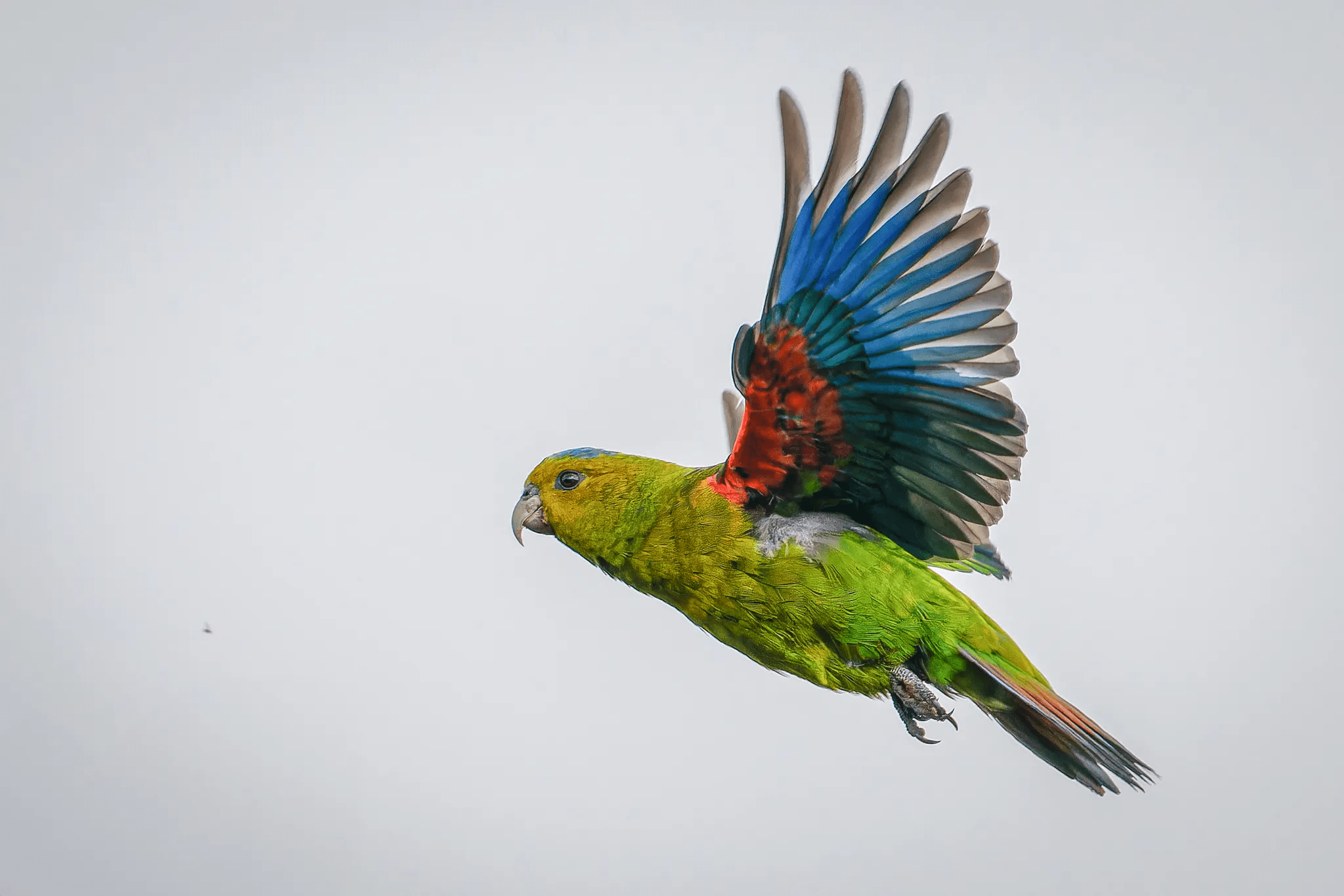
Colombia: Home of rare and fancy birds, with John Sterling.
John will discuss some of the factors for the high number of rare and endemic birds illustrating the talk with his photos of some of the rarest and fanciest species found in Colombia. The Central and Western Andes of Colombia stand as a compelling destination for birders. With their extensive biodiversity, abundance of endemic species, and thoughtfully crafted birding lodges and feeders, the region has become an unforgettable birding experience. John’s visits included exploring both cloud forest and rainforest, vibrant tanagers everywhere and aquatic birds in the marshes of the Cauca River valley.
Link to John Sterling’ Website, upcoming tours:
https://sterlingbirds.com/index.php/tours/

John Sterling has been a hard core birder in California since he was shown a Pileated Woodpecker in 5th grade camp in 1971. He is a professional ornithologist and has worked for the Smithsonian Institution, US Forest Service research stations, HT Harvey & Associates, Arizona and Oregon state universities among other organizations since 1981. John has traveled extensively throughout California learning about local bird distribution and is an authority on that state’s avifauna. In 2015 he set the California’s new big year record with 501 species and has many big day records as well. He has traveled internationally as a guide and ornithologist for many institutions including projects as a Smithsonian ornithologist to Mexico, Ecuador, Peru, The Philippines, Sumatra, Canada and Russia. John currently has his own company, Sterling Wildlife Biology (www.sterlingbirds.com), specializing in tours, birding classes, research and environmental consulting for The Nature Conservancy, the Kern Water Bank, the California Rice Commission, the Smithsonian Migratory Bird Center, National Audubon’s International Alliance Program, CA Dept. of Water Resources among other organizations.
Link to all SMBAS Zoom Recordings.

A Windblown Malibu Lagoon, Jan. 30, 2025
[Text by Chuck Almdale; photos by Lillian Johnson. Trip list at the end.]
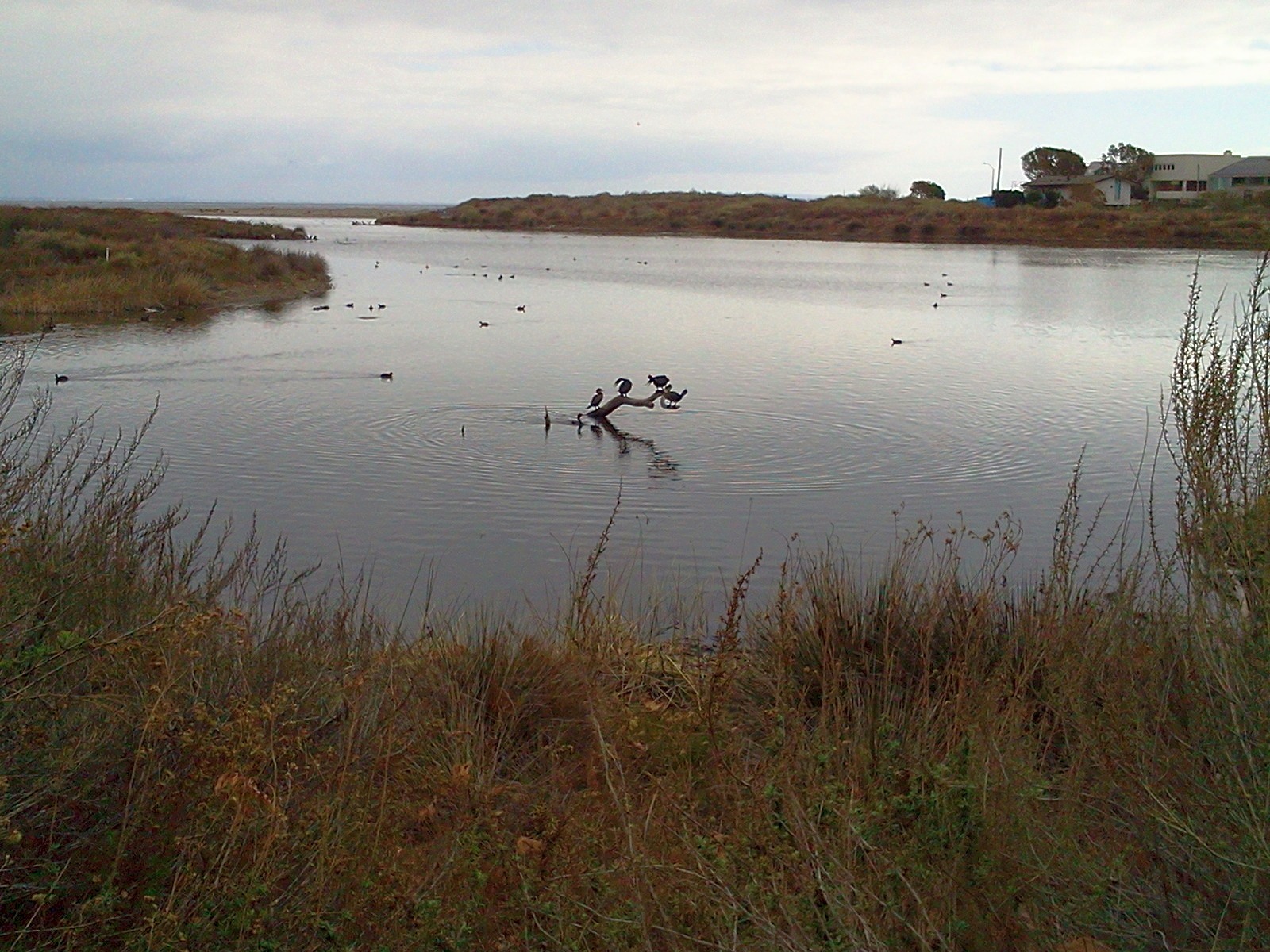
As you’ve probably noticed, it’s been quite difficult of late to reach the lagoon, so we canceled the 26 Jan. trip. Heavy rain at our house Sunday morning convinced me to skip a personal visit and crawl back into bed. But by Thursday Jan. 30 Las Virgenes Rd. was open all the way from the #101 to Malibu and the Golden Bear Senior parking passes ($20!) were finally in stock at Malibu Creek State Park, so we stopped at the park to get our pass and continued to the lagoon. The only problem driving was excessive traffic. We found that PCH was officially closed with a barrier across the west end of the Malibu Creek bridge right next to the lagoon parking entrance. Lagoon parking was open and there was even an attendant in the booth. His was the only car in the parking lot.
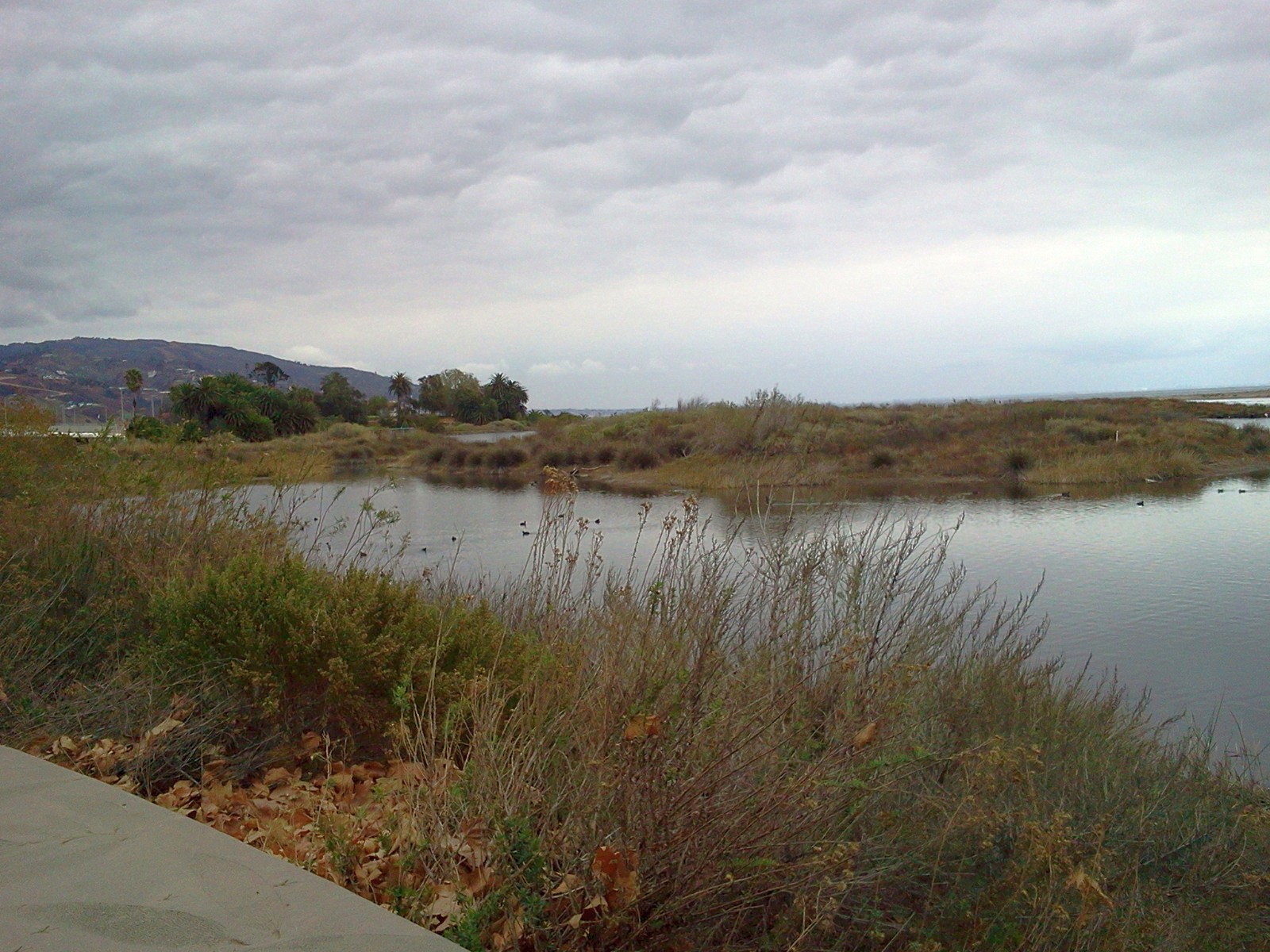
We soon discovered that the birds enjoyed the absence of humans. More sparrows than ever bounced along the paths and one Bewick’s Wren didn’t even feel it necessary to retreat into the bushes as I passed. The lagoon was covered with American Coots – 797 of them, a close count – which was nearly a new record, not quite up to the 870 recorded on Oct. 27 2019. I sometimes wonder if anyone else ever counts coots, as they’re not high on most birder’s lists of most-wanted birds. On the salt lakes of the Bolivian altiplano you’ll discover that coots are a very desirable bird.
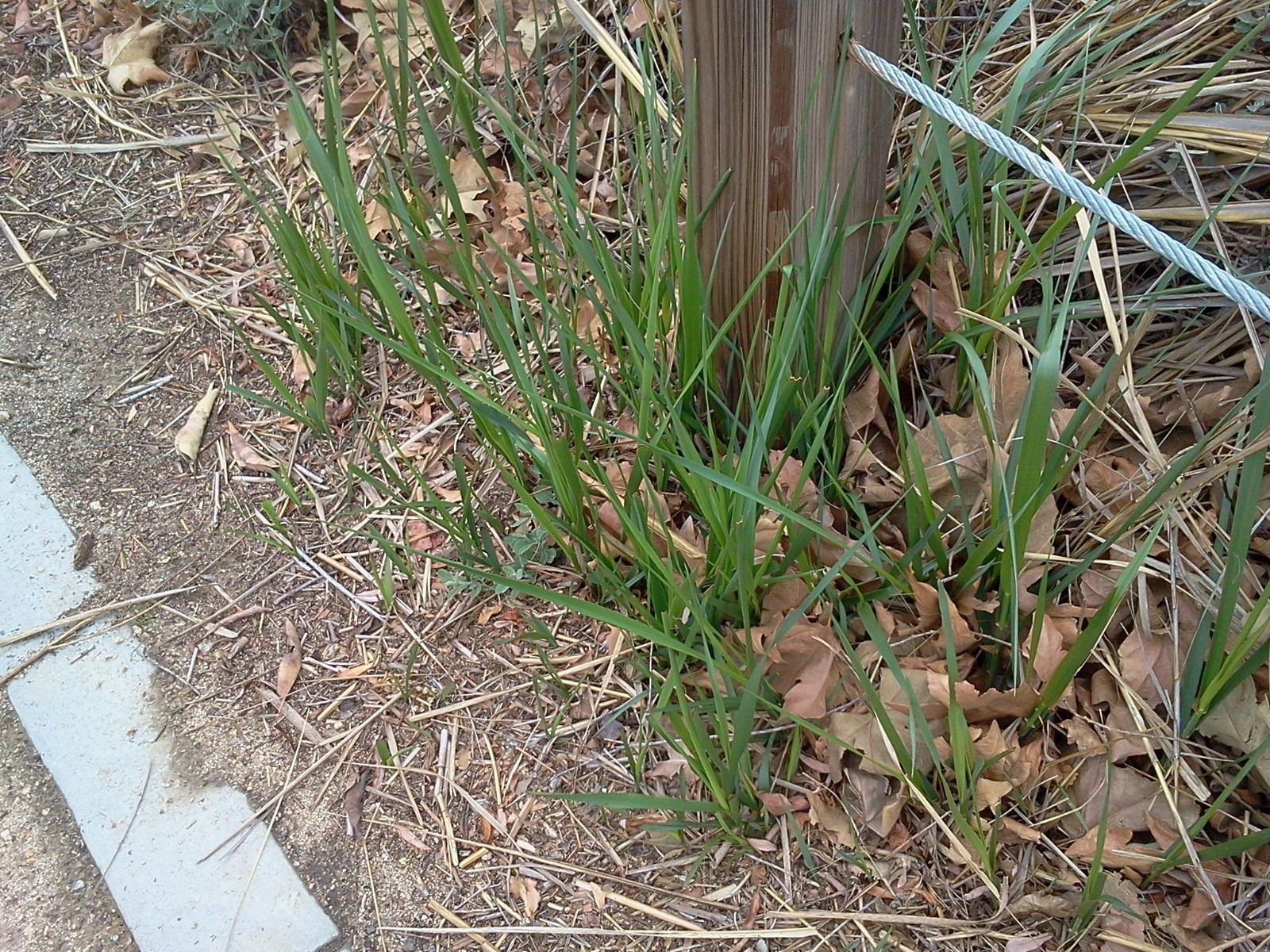
The lagoon and surrounding vegetation were, as far as I could tell, untouched by fire. Neither was the surrounding Malibu Village, although some of the western edges of the residential area were burned in the Franklin fire of mid-December.
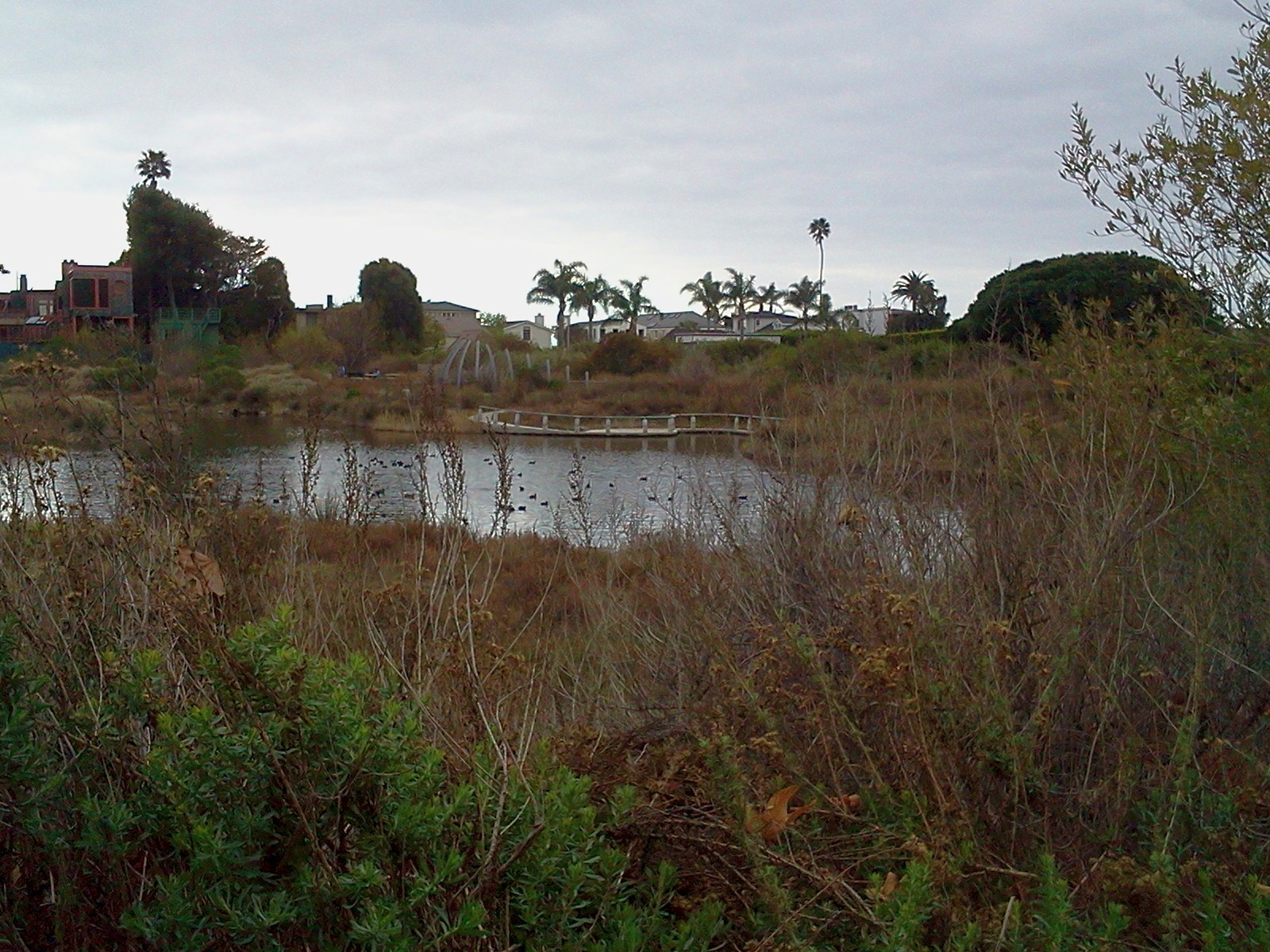
You can tell that lagoon level in the photo above is not particularly high because you can see the tidal clock sidewalk.
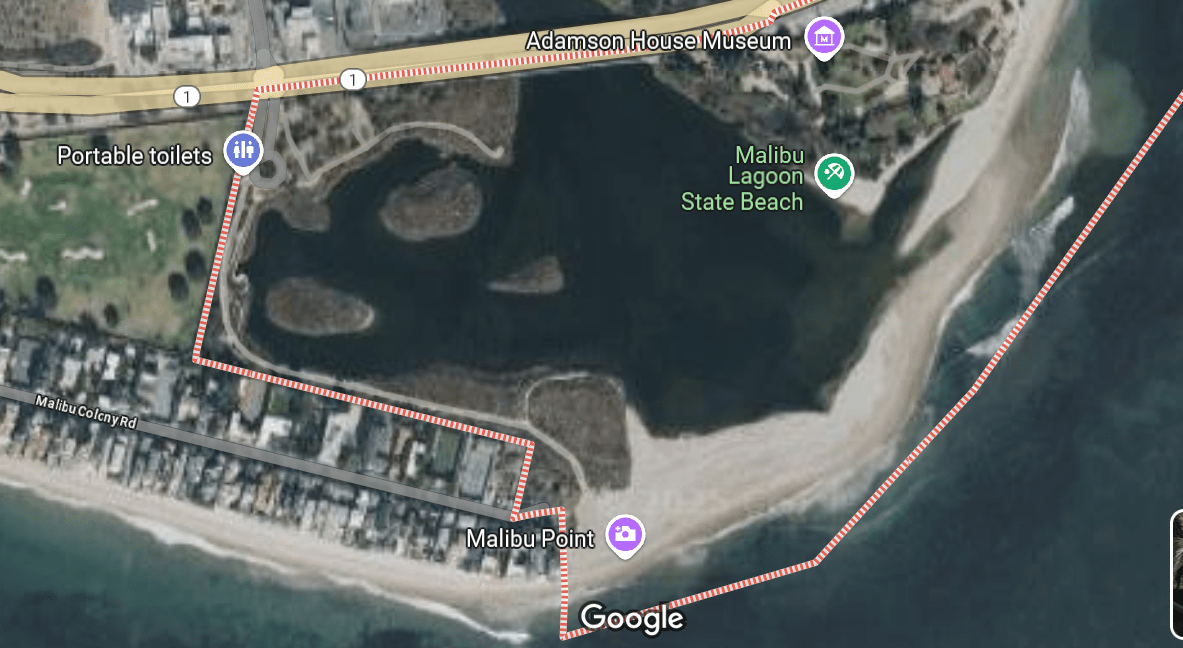
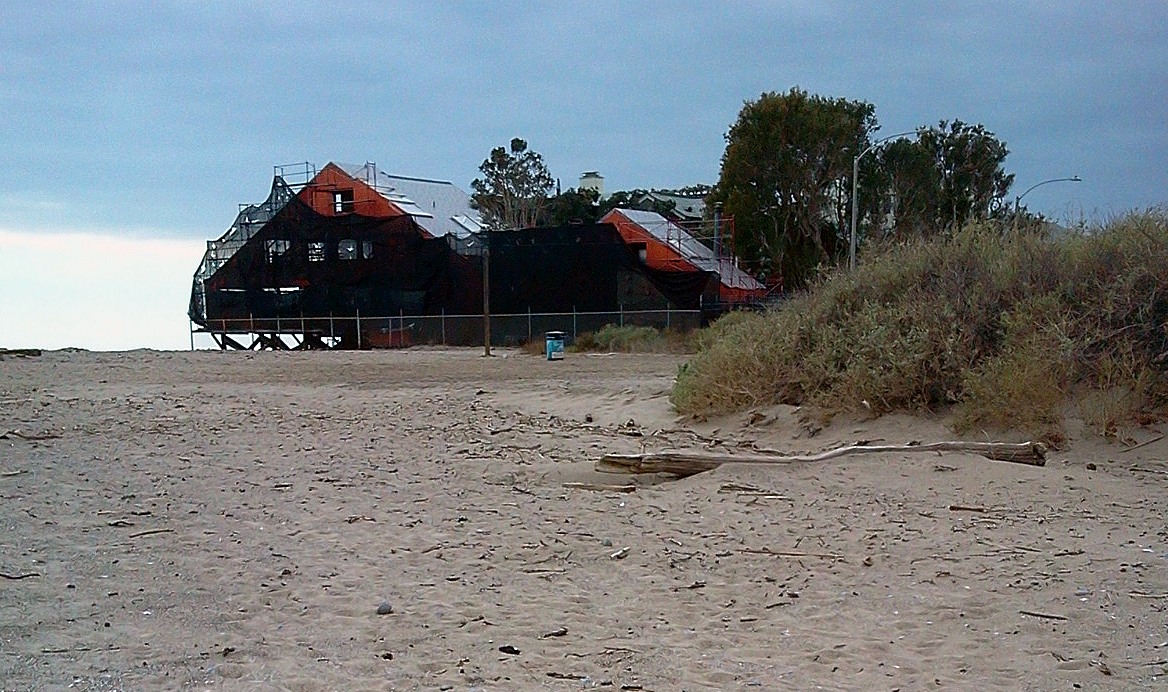
What was noticeable was that a hard wind had blown. Many of the taller bushes were leaning westward with their multiple stems pushed together. Some trees looked a bit bare of leaves. One tree on park land near the eastern end of Malibu Colony was completely gone. I didn’t clamber through the bushes to see if anything remained of the trunk. The house at the east end of the colony was wrapped in tarps and undergoing repairs (reasons unknown to us). A colony roof adjacent to the beach path was prickly with bent, upturned and missing shingles. These were thick shingles and bending them would take a very stiff wind.
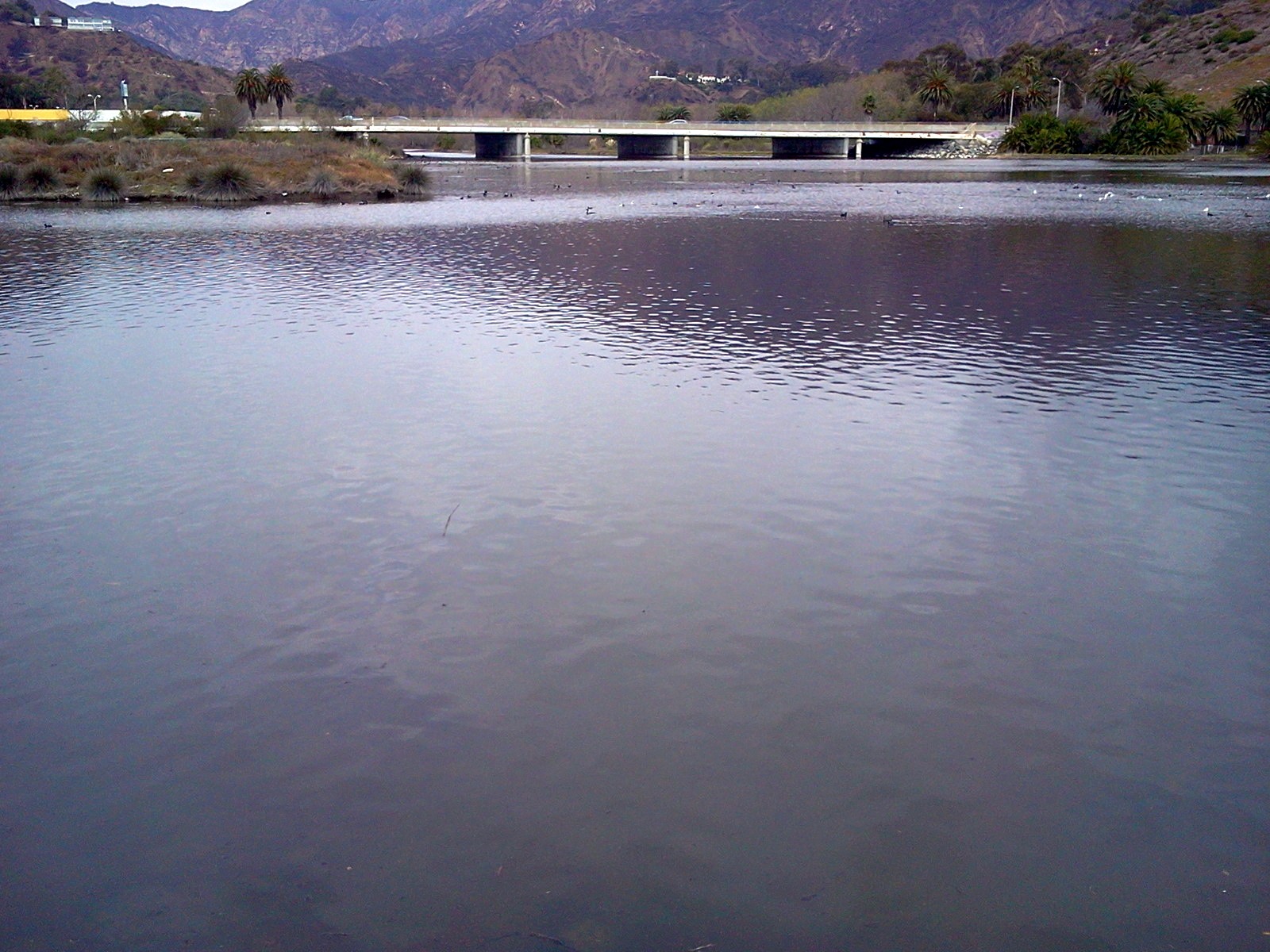
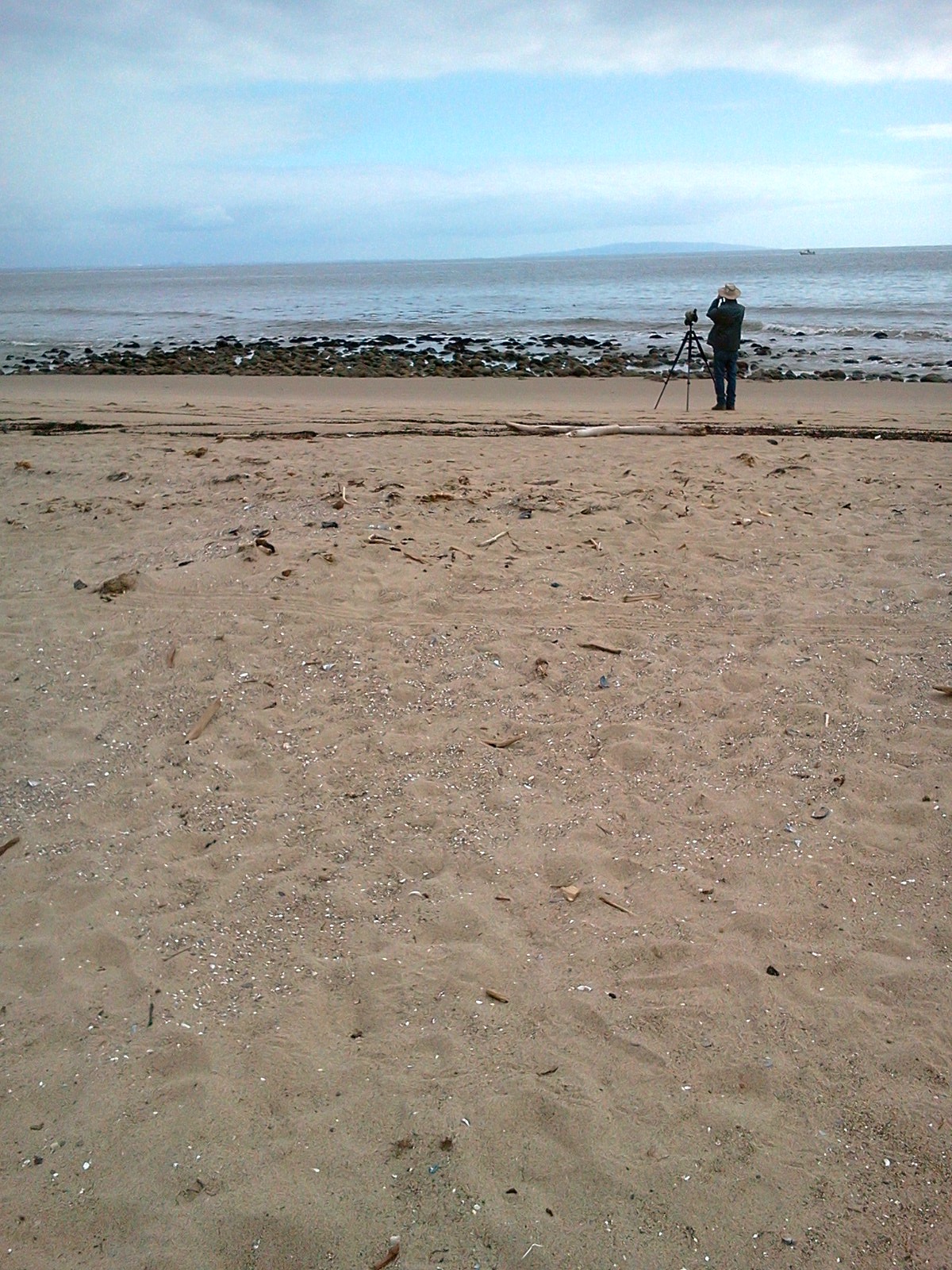
The tide had been fairly high, 6.14 ft. at 9:13am, dropping to -1.20 ft at 4:23pm. We got there at a dropping mid-tide, around 12:15. By the time we got to the beach, the usually submerged rocks were partially exposed.
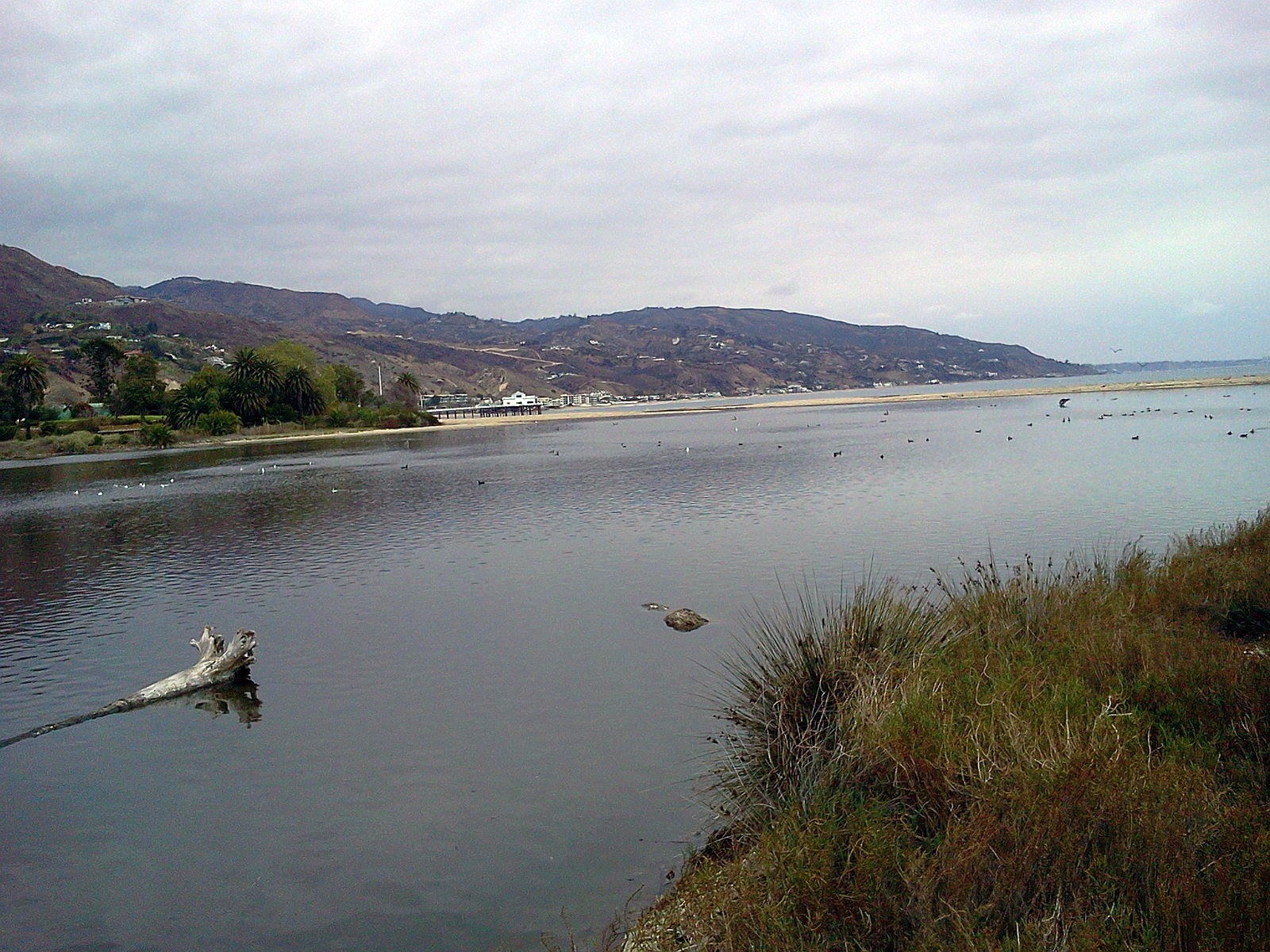
Most of the shorebirds were poking about in the exposed rocks. I was surprised to see two Western Snowy Plovers with them, as they usually prefer getting their insects from the high-tide wrack on the beach. I was also somewhat surprised to not find a Black Oystercatcher among them. A single Herring Gull was again on the beach, 3rd month in a row. So far the bird looks exactly the same month-to-month, and I’m reasonably certain it actually is the same individual, spending the winter with us.
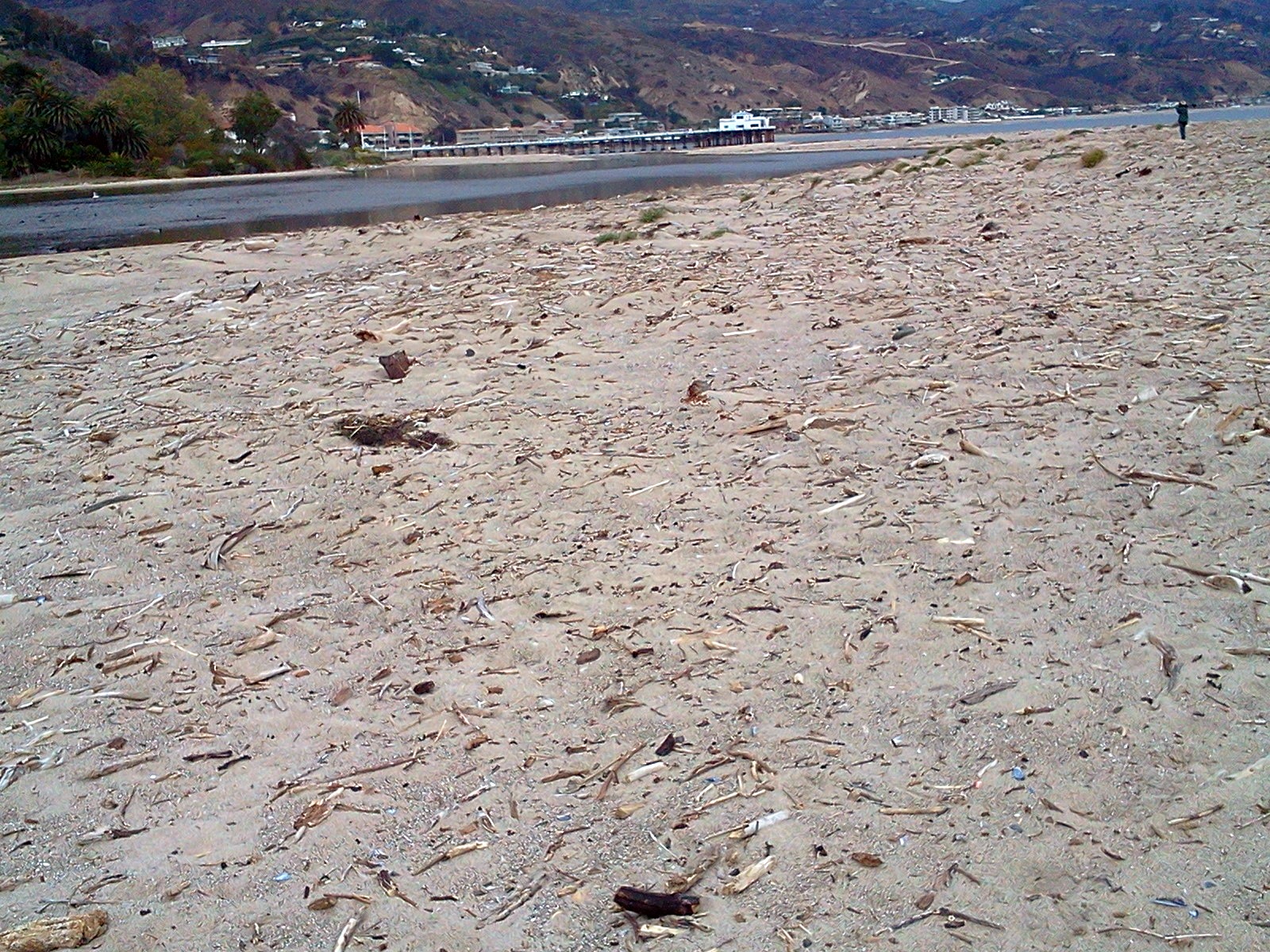
It was quite amazing just how much driftwood had covered the beach. In the photo below, you can see the lagoon opening to the sea with Malibu pier directly behind it. Although the opening usually appears along the southern stretch in the fall with the first rains, it always moves eastward over the following months.
The large permanently exposed offshore rocks are in front of this house. Cormorants like to sit on these rocks when waves aren’t crashing over them. 90% of all cormorants at the lagoon are Double-crested, but these rocks are the best place to look for Brandt’s and Pelagic Cormorants when they’re around. On this particular day there were 7 Brandt’s and 1 Double-crested perched there. One of the Brandt’s was molting into breeding plumage with little white “whisker”-streaks on the side of its neck. The rest of the Double-crested were scattered around the lagoon.
The day was cool – starting at 57°F at noon and rising all the way to 59° by 2 PM – and there were no particularly unusual birds around, but it was quiet and peaceful unlike the surrounding city, still reeling from the fires.
Malibu Lagoon on eBird as of of 2-01-25: 8423 lists, 2661 eBirders, 320 species.
Most recent species added: Nelson’s Sparrow, 11/29/24 by Femi Faminu (SMBAS member).
Birds new for the season: Northern Shoveler, Lesser Scaup, Pacific Loon, California Scrub-Jay.. “New for the season” means it has been three or more months since last recorded on our trips.
Many, many thanks to photographer: Lillian Johnson.
Upcoming SMBAS scheduled field trips; no reservations or Covid card necessary unless specifically mentioned:
- Madrona Marsh Sat Feb 8, 8:30 am.
- Malibu Lagoon, Sun. Feb 23, 8:30 (adults) & 10 am (parents & kids)
- Sepulveda Basin, Sat. Mar 15, 8 am.
- Malibu Lagoon, Sun. Mar 23, 8:30 (adults) & 10 am (parents & kids)
- These and any other trips we announce for the foreseeable future will depend upon expected status of the Covid/flu/etc. pandemic at trip time. Any trip announced may be canceled shortly before trip date if it seems necessary. By now any other comments should be superfluous.
- Link to Programs & Field Trip schedule.
The next SMBAS Zoom program: Colombia: Home of rare and fancy birds, with John Sterling, Evening Meeting, Tuesday, February 4, 2025, 7:30 p.m.
The SMBAS 10 a.m. Parent’s & Kids Birdwalk is again running. Reservations not necessary for families, but for groups (scouts, etc.), call Jean (213-522-0062).
Links: Unusual birds at Malibu Lagoon
9/23/02 Aerial photo of Malibu Lagoon
More recent aerial photo
Prior checklists:
2023: Jan-June, July-Dec 2024: Jan-June, July-Dec
2021: Jan-July, July-Dec 2022: Jan-June, July-Dec
2020: Jan-July, July-Dec 2019: Jan-June, July-Dec
2018: Jan-June, July-Dec 2017: Jan-June, July-Dec
2016: Jan-June, July-Dec 2015: Jan-May, July-Dec
2014: Jan-July, July-Dec 2013: Jan-June, July-Dec
2012: Jan-June, July-Dec 2011: Jan-June, July-Dec
2010: Jan-June, July-Dec 2009: Jan-June, July-Dec
The 10-year comparison summaries created during the Lagoon Reconfiguration Project period, remain available—despite numerous complaints—on our Lagoon Project Bird Census Page. Very briefly summarized, the results unexpectedly indicate that avian species diversification and numbers improved slightly during the restoration period June’12-June’14.
Many thanks to Lillian Johnson for contributions made to this month’s census counts.
The species lists below was re-sequenced as of 12/31/24 to agree with the California Bird Records Committee Official California Checklist. If part of the right side of the chart below is hidden, there’s a slider button inconveniently located at the bottom end of the list. The numbers 1-9 left of the species names are keyed to the nine categories of birds at the bottom. Updated lagoon bird check lists can be downloaded here.
[Chuck Almdale]
| Malibu Census 2024-25 | 8/25 | 9/22 | 10/27 | 11/24 | 12/22 | 1/30 | |
| Temperature | 64-78 | 67-75 | 64-68 | 54-59 | 56-62 | 57-59 | |
| Tide Lo/Hi Height | L+2.00 | L+2.09 | H+4.75 | L+2.06 | L+2.47 | H+5.49 | |
| Tide Time | 0735 | 0611 | 0742 | 1139 | 0939 | 0634 | |
| 1 | Northern Shoveler | 6 | |||||
| 1 | Gadwall | 12 | 30 | 38 | 26 | 32 | 89 |
| 1 | American Wigeon | 1 | 13 | 12 | 35 | ||
| 1 | Mallard | 2 | 8 | 28 | 10 | 20 | 22 |
| 1 | Green-winged Teal | 4 | 1 | 10 | 5 | ||
| 1 | Ring-necked Duck | 4 | 3 | ||||
| 1 | Lesser Scaup | 2 | |||||
| 1 | Surf Scoter | 2 | |||||
| 1 | Bufflehead | 9 | 10 | 23 | |||
| 1 | Hooded Merganser | 1 | |||||
| 1 | Red-breasted Merganser | 10 | 13 | 12 | |||
| 1 | Ruddy Duck | 28 | 22 | 35 | 37 | ||
| 2 | Pied-billed Grebe | 1 | 5 | 10 | 8 | 5 | 4 |
| 2 | Eared Grebe | 4 | 1 | 1 | |||
| 2 | Western Grebe | 28 | 1 | 34 | |||
| 7 | Feral Pigeon | 9 | 1 | 4 | 4 | 6 | |
| 7 | Mourning Dove | 3 | 1 | 1 | |||
| 8 | Anna’s Hummingbird | 2 | 2 | 1 | |||
| 8 | Allen’s Hummingbird | 3 | 4 | 2 | 1 | 3 | 1 |
| 2 | Sora | 2 | |||||
| 2 | American Coot | 2 | 72 | 340 | 560 | 705 | 797 |
| 5 | Black Oystercatcher | 2 | 2 | ||||
| 5 | Black-bellied Plover | 70 | 67 | 136 | 75 | 50 | 30 |
| 5 | Killdeer | 4 | 12 | 20 | 1 | 30 | 2 |
| 5 | Semipalmated Plover | 13 | 3 | ||||
| 5 | Snowy Plover | 22 | 42 | 18 | 34 | 27 | 2 |
| 5 | Whimbrel | 2 | 2 | 7 | 15 | 4 | 8 |
| 5 | Long-billed Curlew | 1 | |||||
| 5 | Marbled Godwit | 12 | 25 | 3 | |||
| 5 | Ruddy Turnstone | 1 | 3 | 4 | 6 | 4 | 2 |
| 5 | Sanderling | 2 | 1 | 5 | 200 | 100 | 22 |
| 5 | Least Sandpiper | 23 | 3 | 4 | 8 | 27 | 7 |
| 5 | Western Sandpiper | 13 | 2 | ||||
| 5 | Spotted Sandpiper | 1 | 1 | 1 | |||
| 5 | Willet | 5 | 5 | 3 | 51 | 20 | 15 |
| 5 | Greater Yellowlegs | 1 | 1 | ||||
| 6 | Heermann’s Gull | 5 | 24 | 79 | 29 | 2 | 7 |
| 6 | Ring-billed Gull | 2 | 2 | 12 | 15 | 19 | 12 |
| 6 | Western Gull | 113 | 55 | 27 | 65 | 35 | 90 |
| 6 | California Gull | 23 | 75 | 440 | 525 | 60 | 575 |
| 6 | American Herring Gull | 1 | 1 | 1 | |||
| 6 | Glaucous-winged Gull | 1 | |||||
| 6 | Caspian Tern | 4 | 1 | ||||
| 6 | Forster’s Tern | 2 | |||||
| 6 | Royal Tern | 5 | 5 | 6 | 2 | ||
| 6 | Elegant Tern | 10 | |||||
| 2 | Pacific Loon | 1 | |||||
| 2 | Common Loon | 2 | |||||
| 2 | Brandt’s Cormorant | 2 | 5 | 7 | |||
| 2 | Pelagic Cormorant | 1 | 2 | 2 | |||
| 2 | Double-crested Cormorant | 37 | 54 | 51 | 44 | 23 | 55 |
| 2 | Brown Pelican | 27 | 24 | 30 | 260 | 35 | 23 |
| 3 | Snowy Egret | 3 | 4 | 10 | 5 | 5 | 5 |
| 3 | Black-crowned Night-Heron | 1 | 1 | 1 | 1 | 2 | |
| 3 | Green Heron | 1 | 2 | 1 | 1 | ||
| 3 | Great Egret | 3 | 2 | 3 | 3 | 1 | 1 |
| 3 | Great Blue Heron | 4 | 2 | 5 | 4 | 4 | 1 |
| 3 | White-faced Ibis | 3 | |||||
| 4 | Turkey Vulture | 1 | 7 | 1 | |||
| 4 | Osprey | 1 | 1 | 1 | |||
| 4 | Red-shouldered Hawk | 1 | |||||
| 4 | Red-tailed Hawk | 2 | 1 | 1 | |||
| 8 | Belted Kingfisher | 1 | 1 | 1 | 1 | 1 | |
| 8 | Nuttall’s Woodpecker | 1 | |||||
| 8 | Hairy Woodpecker | 1 | |||||
| 4 | American Kestrel | 1 | |||||
| 8 | Nanday Parakeet | 25 | 4 | ||||
| 9 | Ash-throated Flycatcher | 1 | |||||
| 9 | Cassin’s Kingbird | 1 | 1 | ||||
| 9 | Western Kingbird | 8 | |||||
| 9 | Black Phoebe | 3 | 2 | 4 | 6 | 1 | 1 |
| 9 | Say’s Phoebe | 1 | 1 | 1 | |||
| 9 | Loggerhead Shrike | 1 | |||||
| 9 | California Scrub-Jay | 2 | 1 | ||||
| 9 | American Crow | 4 | 8 | 6 | 22 | 8 | 9 |
| 9 | Common Raven | 4 | 1 | ||||
| 9 | Oak Titmouse | 1 | |||||
| 9 | Tree Swallow | 1 | 12 | ||||
| 9 | No. Rough-winged Swallow | 2 | |||||
| 9 | Barn Swallow | 20 | 1 | 1 | |||
| 9 | Cliff Swallow | 4 | |||||
| 9 | Bushtit | 5 | 20 | 30 | 12 | 50 | 4 |
| 9 | Wrentit | 4 | 1 | 2 | 1 | ||
| 9 | Ruby-crowned Kinglet | 1 | 1 | 3 | 1 | ||
| 9 | Blue-gray Gnatcatcher | 1 | 4 | 1 | |||
| 9 | Bewick’s Wren | 2 | 2 | 2 | 1 | 1 | |
| 9 | Northern House Wren | 2 | 3 | 6 | 1 | ||
| 9 | Marsh Wren | 2 | 1 | ||||
| 9 | Northern Mockingbird | 1 | 1 | 1 | 1 | ||
| 9 | European Starling | 1 | 10 | 12 | 7 | ||
| 9 | Western Bluebird | 5 | |||||
| 9 | Hermit Thrush | 1 | |||||
| 9 | House Finch | 5 | 4 | 8 | 4 | 6 | 8 |
| 9 | Lesser Goldfinch | 3 | 6 | 2 | |||
| 9 | Lark Sparrow | 1 | |||||
| 9 | Dark-eyed Junco | 1 | 2 | 1 | 2 | ||
| 9 | White-crowned Sparrow | 16 | 15 | 20 | 8 | ||
| 9 | Savannah Sparrow | 1 | |||||
| 9 | Song Sparrow | 10 | 10 | 5 | 8 | 6 | 12 |
| 9 | California Towhee | 1 | 3 | 2 | 2 | ||
| 9 | Spotted Towhee | 1 | |||||
| 9 | Western Meadowlark | 15 | 1 | ||||
| 9 | Hooded Oriole | 1 | |||||
| 9 | Red-winged Blackbird | 11 | 1 | 2 | |||
| 9 | Brown-headed Cowbird | 18 | |||||
| 9 | Great-tailed Grackle | 1 | 4 | 15 | 22 | ||
| 9 | Orange-crowned Warbler | 1 | 2 | 1 | 2 | 1 | |
| 9 | Common Yellowthroat | 1 | 5 | 7 | 8 | 6 | 2 |
| 9 | Yellow Warbler | 1 | |||||
| 9 | Yellow-rumped Warbler | 15 | 15 | 14 | 6 | ||
| 9 | Townsend’s Warbler | 2 | |||||
| Totals Birds by Type | Aug | Sep | Oct | Nov | Dec | Dec | |
| 1 | Waterfowl | 14 | 43 | 112 | 93 | 157 | 196 |
| 2 | Water Birds – Other | 68 | 155 | 469 | 882 | 769 | 922 |
| 3 | Herons, Egrets & Ibis | 12 | 14 | 20 | 14 | 12 | 7 |
| 4 | Quail & Raptors | 1 | 10 | 3 | 2 | 2 | 0 |
| 5 | Shorebirds | 157 | 142 | 197 | 404 | 290 | 92 |
| 6 | Gulls & Terns | 165 | 162 | 564 | 635 | 119 | 685 |
| 7 | Doves | 12 | 2 | 5 | 4 | 0 | 6 |
| 8 | Other Non-Passerines | 7 | 31 | 5 | 3 | 8 | 1 |
| 9 | Passerines | 92 | 119 | 136 | 142 | 150 | 57 |
| Totals Birds | 528 | 678 | 1511 | 2179 | 1507 | 1966 | |
| Total Species by Group | Aug | Sep | Oct | Nov | Dec | Dec | |
| 1 | Waterfowl | 2 | 4 | 6 | 8 | 8 | 8 |
| 2 | Water Birds – Other | 5 | 4 | 9 | 8 | 5 | 8 |
| 3 | Herons, Egrets & Ibis | 5 | 6 | 5 | 5 | 4 | 3 |
| 4 | Quail & Raptors | 1 | 3 | 3 | 2 | 2 | 0 |
| 5 | Shorebirds | 12 | 12 | 8 | 10 | 11 | 10 |
| 6 | Gulls & Terns | 9 | 6 | 5 | 5 | 6 | 5 |
| 7 | Doves | 2 | 2 | 2 | 1 | 0 | 1 |
| 8 | Other Non-Passerines | 4 | 4 | 3 | 3 | 3 | 1 |
| 9 | Passerines | 22 | 27 | 24 | 24 | 17 | 14 |
| Totals Species – 111 | 62 | 68 | 65 | 66 | 56 | 50 |
Sepulveda Basin Fires – Take Action Now
[Posted by Chuck Almdale]
Our neighboring Audubon Chapter, San Fernando Valley Audubon Society (SFVAS), is circulating a letter to it’s membership, friends and fellow birders including Santa Monica Bay Audubon Society. Many of us have enjoyed the year-round birding opportunities offered by the Sepulveda Basin, and concur with their view as stated below. We encourage you to sign on.
Over the past several years, the SFVAS community has faced an ongoing threat to our safety due to the numerous, almost daily fires in the Sepulveda Basin, which are alarmingly close to many of our homes and are often in precious wildlife habitat. Despite sounding the alert early last summer, there have been hundreds of fires in the basin since then. Approximately 50% of the Sepulveda Basin Wildlife Reserve has been burned. It is time for action!

Contact Mayor Bass and express your demand
that this situation not be ignored.
Text of a sample email follows which may be copied and pasted
into an email and modified as you see fit.
It should be emailed to : elliott.layne@lacity.org
cc: info@sfvaudubon.org,info@encinopoa.com
Email to: elliott.layne@lacity.org
cc: info@sfvaudubon.org, info@encinopoa.com
Dear Mayor Bass,
Over the past several years, our community has faced an ongoing threat to our safety due to the numerous, almost daily fires in the Sepulveda Basin, which are alarmingly close to many of our homes and are often in precious wildlife habitat. Since the summer of 2024, over 218 fires have occurred in this area.
Even though many of these fires have involved small amounts of trash and have been quickly contained by firefighters, they are far from harmless. Ordinary household items can explode or release toxic substances when heated, as happened in June 2024 when 11 LA City firefighters were injured. As evidenced by the Palisades and Eaton fires, we are painfully aware that a small fire can, in an instant, become a massive destructive and deadly fire.
These incidents pose a serious and escalating risk to the safety of nearby residents, park users and the environment. On Wednesday, January 8, Encino residents woke to find smoke filling their homes from a fire in the Basin. On January 5 a group of birdwatchers in the Basin was terrified by a fire deliberately set within a few feet of them. At least 50% of the designated wildlife reserve areas have been incinerated since mid-2024 including nesting sites of the endangered Least Bell’s Vireo. These are just examples of a growing and unacceptable pattern. We are frustrated and disheartened by the City’s continued inaction.
The majority of these fires have originated in or as a result of homeless encampments, which, despite being illegal, are allowed to persist. The City’s current policy of “Hands Off the Homeless” is putting adjacent neighborhoods, our park and its habitat, and our entire community at grave risk. Unless immediate action is taken, we fear it’s only a matter of time before a catastrophic wildfire spreads from this wild-urban interface area to devastate entire communities..
We are demanding the following actions without delay:
1. Strict enforcement of no camping laws in the Sepulveda Basin. This includes the removal of all encampments, with zero tolerance for trespassing, enforced by City Park Rangers or LAPD. Because encampments can be very well hidden, consideration should be given to using forward-looking infrared (FLIER) thermal cameras to locate and facilitate removal of encampments. The LAFD has this technology in their arsenal.
2. Immediate enforcement of no overnight parking in the entire Balboa/Sepulveda Dam/Woodley Park area by the City Department of Transportation (DOT).
3. Increased Park Ranger patrols within the Basin to ensure public safety and enforcement of existing laws, with assistance from LAPD as warranted.
4. Regular vegetative management by the appropriate City or other agency in accordance with best conservation practices with an emphasis on fire prevention and discouraging encampments.
In the wake of the worst fire devastation in the City’s history, the safety of our community must be the City’s top priority. Mayor Bass, we urge you to take swift, decisive action to protect the lives and homes of those who live here. We refuse to continue to live in fear and we know these demands can be met with immediate and effective action to ensure the safety of our neighborhoods and our park.
Sincerely,
[Your Name]
[Your Address]
Link to SFVAS posting:
https://mailchi.mp/98ad683b99ec/sepulveda-basin-fires-take-action-now?e=2cc2c6c758



 SANTA MONICA BAY AUDUBON SOCIETY BLOG