Free email delivery
Please sign up for email delivery in the subscription area to the right.
No salesman will call, at least not from us. Maybe from someone else.
Gray Vireos in Baja, with Dr. Phil Unitt. Zoom Evening Meeting reminder, Tuesday, 7 November, 7:30 p.m.
You are all invited to the next ZOOM meeting
of Santa Monica Bay Audubon Society
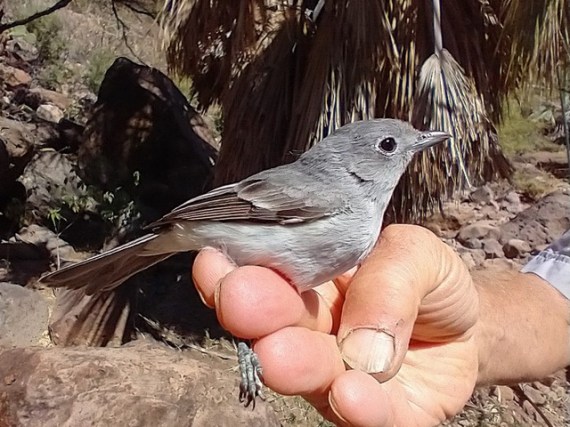
Gray Vireo (photo supplied by Dr. Phil Unitt)
|
Gray Vireos in Baja with Dr. Phil Unitt
Zoom Evening Meeting, Tuesday, 7 November, 7:30 p.m.
Zoom waiting room opens 7:15 p.m.

Gray Vireo on nest (photo supplied by Dr. Phil Unitt)
Most of the breeding range of the Gray Vireo lies within the southwestern United States, where the population is sparse, patchy, and declining. But the species also breeds in Baja California, where its status had not been assessed until 2021 and 2022 when we surveyed four mountain ranges where it was known or might be expected. In the sierras Juárez and Sierra San Pedro Mártir we found the Gray Vireo strikingly more common than just across the border in Upper California. Most territories were treeless chaparral dominated by chamise and redshank. Isolated stands of chaparral grow south of the Gray Vireo’s previously reported breeding range, on the Sierra La Asamblea, but our reconnaissance there revealed no Gray Vireos. In the Sierra San Francisco in the center of the peninsula, the Gray Vireo is a winter visitor only. Although Baja California represents only a small part of the Gray Vireo’s breeding range spatially, it contributes disproportionately to the species’ population and therefore conservation.

Gray Vireo eggs in nest (photo supplied by Dr. Phil Unitt)
Dr. Philip Unitt, native of San Diego County, has spent his entire career at San Diego Museum of Natural History where he is the Dennis and Carol Wilson Endowed Chair of Ornithology and Curator of Birds and Mammals. He studies the distribution, ecology, history, identification, and conservation of California birds. He is a specialist in subspecies identification, distribution, and history of distributional change of California birds. He has led extensive survey projects, organizing hundreds of volunteers; analyzing very large data sets; and has prepared more than 4,000 bird specimens for the museum reference collections. He is the lead author of the San Diego Bird Atlas and a major contributor to Birds of San Diego County and the coauthor of the Birds of the Salton Sea. Dr. Unitt is also the editor of Western Birds, the regional journal of ornithology for western North America.

Gray Vireo habitat (photo supplied by Dr. Phil Unitt)
|
(If this button isn’t working for you, see detailed zoom invitation below.)
Meeting ID: 813 4824 7304
Passcode: 030207
One tap mobile
+16694449171,,81348247304#,,,,*030207# US
+16699009128,,81348247304#,,,,*030207# US (San Jose)
Dial by your location
+1 669 444 9171 US
+1 669 900 9128 US (San Jose)
+1 253 205 0468 US
+1 253 215 8782 US (Tacoma)
+1 346 248 7799 US (Houston)
+1 719 359 4580 US
+1 507 473 4847 US
+1 564 217 2000 US
+1 646 558 8656 US (New York)
+1 646 931 3860 US
+1 689 278 1000 US
+1 301 715 8592 US (Washington DC)
+1 305 224 1968 US
+1 309 205 3325 US
+1 312 626 6799 US (Chicago)
+1 360 209 5623 US
+1 386 347 5053 US
Meeting ID: 813 4824 7304
Passcode: 030207
Find your local number: https://us02web.zoom.us/u/kOtV2H4tw
2023 Photo Contest Winners || California Coastal Commission
[Posted by Chuck Almdale]
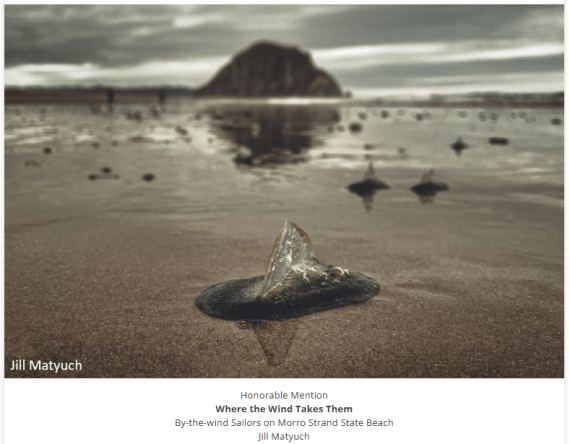
The more photo contests the better, I say, as there are a lot of people out there snapping away with their cameras and phones. Most of the results should never go any further than SnapChat where the postings disappear and are forever erased after about 30 seconds (or so I hear). I’d never heard of this particular contest before, but they let me know they were there.
The results are a great group of photos. I take lousy photos, unsuitable even for SnapChat, but in the process of editing this blog I’ve received at least 10,000 photos, and I’m getting better at spotting the good ones. I will add, however, I think many of the photos sent to me for our blog are as good as these. Anyone aspiring to produce admirable photographs should study as many prize-winning photos as possible, and get a good feeling for the elements of a top-notch photo. So follow the link below to some examples.
2023 California Ocean & Coastal Amateur Photography Contest
California Coastal Commission
Peeps on parade, Malibu Lagoon, 22 Oct. 2023
[By Chuck Almdale]

The only Northern Shoveler in the lagoon, a female, looks a little grumpy (Chris Tosdevin 10/24/23)

West end of north channel, picnic corner and Malibu Colony in the background (Ray Juncosa 10/22/23)
There was a bit of excitement at the cypress trees behind Malibu Colony. A crow took exception to a Red-tailed Hawk sitting on a limb.

The American Crow comes for the Red-tailed Hawk (Chris Tosdevin 10/24/23)

The Red-tailed Hawk flies off, the crow making sure he keeps moving (Ray Juncosa 10/24/23)
We had a good array of shorebirds from the smallest to nearly the largest. These are all in the order Charadriiformes, and except for two they are all in the family Scolopacidae. Figure out which two. All sizes are per National Geographic Field Guide to the Birds of North America.
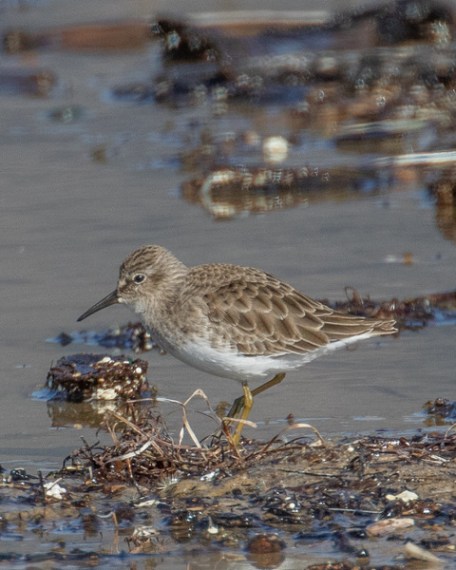
Least Sandpiper in his winter drabs, the smallest “peep” in the world at 6″. (Chris Tosdevin 10/22/23)

Western Snowy Plover, this one a juvenile, resting in his sand-pocket; 6.25″. (Chris Tosdevin 10/22/23)
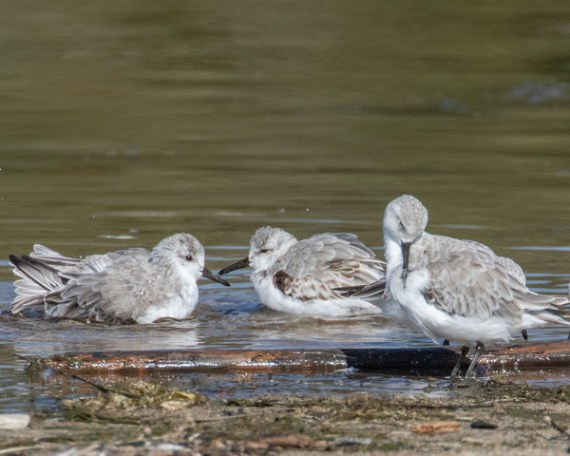
Sanderlings in their winter white & blacks; 8″ long. (Chris Tosdevin 10/22/23)

Ruddy Turnstone winter plumage can be quite “messy”; 9.25″. (Chris Tosdevin 10/22/23)
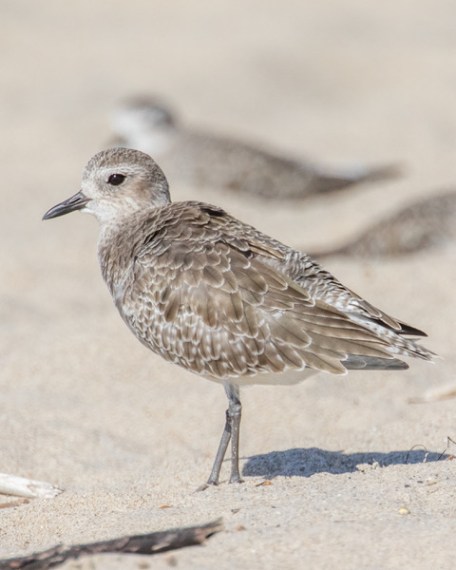
Black-bellied Plover, chunky with a short bill, lose their black bellies in the winter, for which reason the Europeans call them Gray Plover; 11.5″. (Chris Tosdevin 10/22/23)

The gray Willet (L) and the mottled-brown Whimbrel (R), nearly the same size, both still sandpipers; 15″ and 17.5″, respectively. (Ray Juncosa 10/22/23)
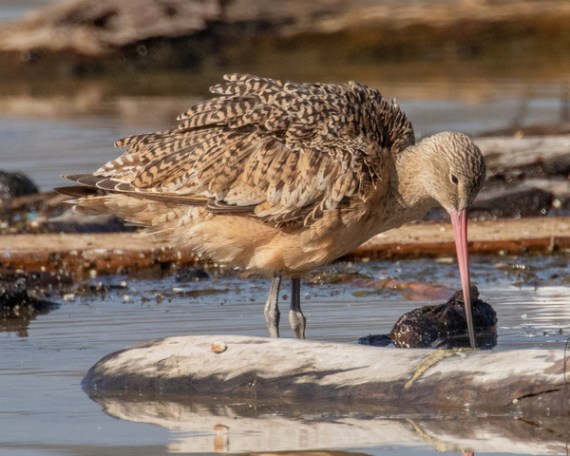
Marbled Godwit, warm brown plumage and a two-toned upturned bill, 18″ long and every inch a sandpiper. (Chris Tosdevin 10/22/23)
The next two birds are also in the order Charadriiformes, but are in the family Laridae (aka Larids).
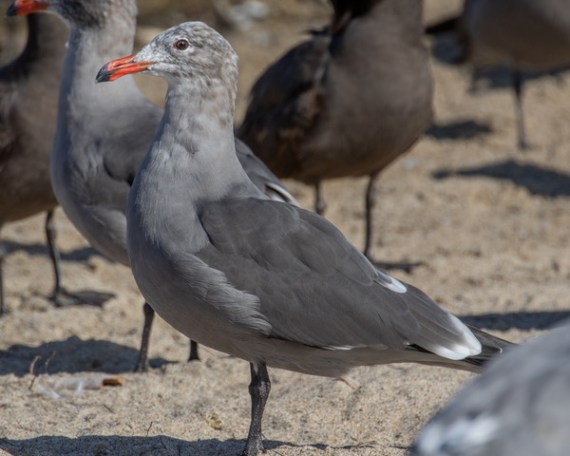
Heermann’s Gulls, a 4-year gull, nest on Isla Rasa in the Sea of Cortez. Named for Adolphus Heermann (1818-1865) collector and surgeon-naturalist for the Pacific Railroad surveys in 1853-1854 and coiner of the term “oology.” 19″ long. (Chris Tosdevin 10/22/23)

This Royal Tern still retains a bit of it’s crown and the dark eye can stand out a bit more. This bill is on the reddish end of orange, but color can be dull yellow as well; 20″ long. (Chris Tosdevin 10/22/23)

High water in the south channel, looking north-northwest towards the pass. (Ray Juncosa 10/22/23)
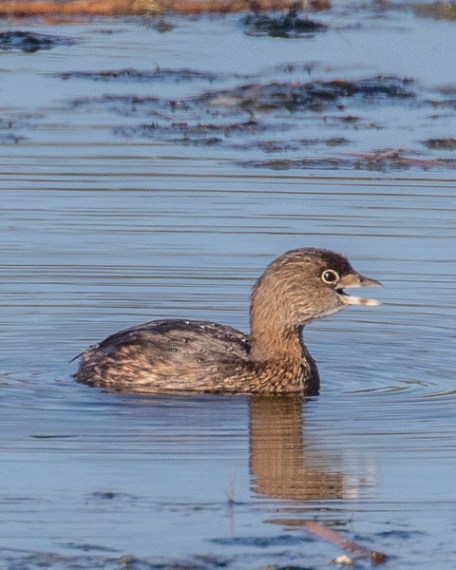
This Pied-billed Grebe looks positively thrilled to be here. They look tiny in the water, but at 13.5″ long they are larger than most sandpipers. Their feet are well to their rear which helps them swim and dive but makes walking on land very difficult, so they build floating nests of reeds. If you see a grebe on land, it’s probably sick or wounded. (Chris Tosdevin 10/22/23

Belted Kingfisher, female (cinnamon on the breast), one of the few species where the female is more colorful than the male. (Chris Tosdevin 10/22/23)

Great Egret snags a fish (Chris Tosdevin 10/22/23)
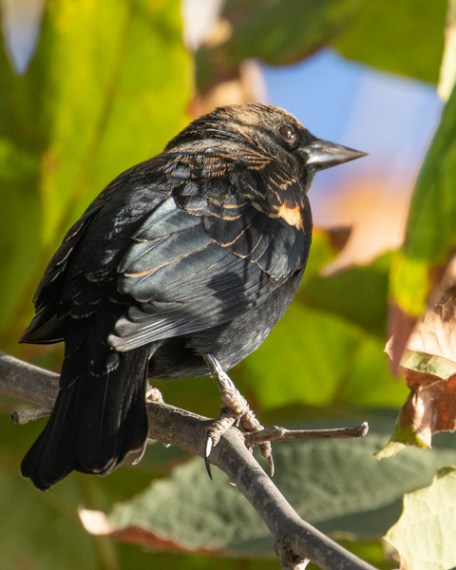
Red-winged Blackbirds juvenile male with rusty feather edges. (Chris Tosdevin 10/22/23)
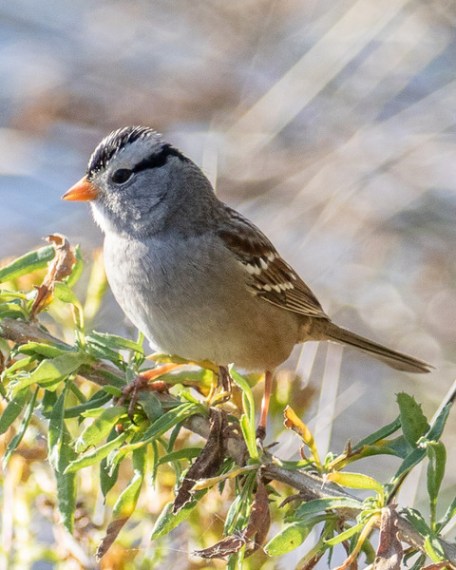
Birds new for the Season: Northern Shoveler, Surf Scoter, Ruddy Duck, Western Grebe, Ring-billed Gull, Common Loon, Turkey Vulture, Northern Flicker, Nanday Parakeet, White-crowned Sparrow, Yellow-rumped Warbler, Townsend’s Warbler.
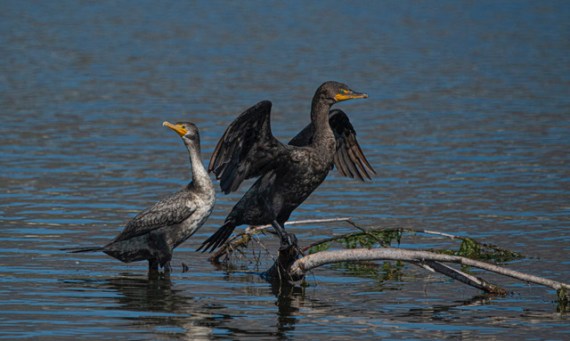
Double-crested Cormorants, now without their crests, juvenile and adult. Orange flesh above the eye rules out Neotropic Cormorant which are becoming more common in SoCal. (Ray Juncosa 10/22/23)
Malibu Lagoon on eBird as of 10-25-23: 7174 lists, 319 species
Most recent species added: Lilac-crowned Parrot (13 May 2023, Nick Diaco).
Many, many thanks to photographers: Ray Juncosa, Chris Tosdevin
Upcoming SMBAS scheduled field trips; no reservations or covid card necessary unless specifically mentioned:
- Ballona Fresh Water Marsh, Sat. Nov. 11, 8am. Please reserve with leader when announced.
- Malibu Lagoon, Sun. Nov 26, 8:30 & 10 am.
- Newport Back Bay Sat. Dec 09 8.00 am. Please reserve with leader when announced.
- Malibu Lagoon, Sun. Dec 24, 8:30 & 10 am.
- These and any other trips we announce for the foreseeable future will depend upon expected status of the Covid/flu/etc. pandemic at trip time. Any trip announced may be canceled shortly before trip date if it seems necessary. By now any other comments should be superfluous.
- Link to Programs & Field Trip schedule.
The next SMBAS Zoom program: ““Gray Vireos in Baja” with Dr. Phil Unitt, Tuesday, 7 Nov. 2023, 7:30 p.m. A recording of our 3 Oct. program, “Birds of Cuba” with Alvaro Jaramillo, is now on the blog.
The SMBAS 10 a.m. Parent’s & Kids Birdwalk restarted April 23. Reservations for groups (scouts, etc.) necessary; not necessary for families.
Links: Unusual birds at Malibu Lagoon
9/23/02 Aerial photo of Malibu Lagoon
More recent aerial photo
Prior checklists:
2023: Jan-June
2021: Jan-July, July-Dec 2022: Jan-June, July-Dec
2020: Jan-July, July-Dec 2019: Jan-June, July-Dec
2018: Jan-June, July-Dec 2017: Jan-June, July-Dec
2016: Jan-June, July-Dec 2015: Jan-May, July-Dec
2014: Jan-July, July-Dec 2013: Jan-June, July-Dec
2012: Jan-June, July-Dec 2011: Jan-June, July-Dec
2010: Jan-June, July-Dec 2009: Jan-June, July-Dec
The 10-year comparison summaries created during the Lagoon Reconfiguration Project period, remain available—despite numerous complaints—on our Lagoon Project Bird Census Page. Very briefly summarized, the results unexpectedly indicate that avian species diversification and numbers improved slightly during the restoration period June’12-June’14.
Many thanks to Chris Tosdevin (list compiler), Femi Faminu, Ray Juncosa, Chris Lord, Ruth Tosdevin and others for their contributions to this month’s checklist.
The species lists below is irregularly re-sequenced to agree with the California Bird Records Committee Official California Checklist. If part of the chart’s right side is hidden, there’s a slider button inconveniently located at the bottom of the list.
[Chuck Almdale]
| Malibu Census 2023 | 5/28 | 6/25 | 7/23 | 8/27 | 9/24 | 10/22 | |
| Temperature | 61-62 | 59-71 | 66-70 | 69-73 | 56-74 | 62-70 | |
| Tide Lo/Hi Height | L+0.81 | L+0.89 | L+0.81 | H+3.68 | H+3.77 | L+3.34 | |
| Tide Time | 1131 | 0919 | 0730 | 0832 | 0739 | 1029 | |
| 1 | Canada Goose | 5 | 4 | 4 | |||
| 1 | Northern Shoveler | 1 | |||||
| 1 | Gadwall | 17 | 45 | 90 | 45 | 40 | 23 |
| 1 | Mallard | 12 | 33 | 77 | 20 | 12 | |
| 1 | Green-winged Teal | 1 | |||||
| 1 | Surf Scoter | 2 | 15 | ||||
| 1 | Ruddy Duck | 12 | |||||
| 2 | Pied-billed Grebe | 2 | 1 | 4 | |||
| 2 | Western Grebe | 28 | |||||
| 7 | Feral Pigeon | 8 | 3 | 4 | 3 | ||
| 7 | Eurasian Collared-Dove | 2 | |||||
| 7 | Mourning Dove | 2 | 2 | 2 | 2 | 5 | 1 |
| 8 | Anna’s Hummingbird | 1 | 1 | 2 | 2 | ||
| 8 | Allen’s Hummingbird | 1 | 2 | 4 | 1 | 4 | |
| 2 | Sora | 1 | |||||
| 2 | American Coot | 5 | 6 | 49 | 157 | ||
| 5 | Black-bellied Plover | 6 | 39 | 82 | 79 | ||
| 5 | Killdeer | 4 | 8 | 8 | 13 | 6 | 1 |
| 5 | Semipalmated Plover | 1 | 7 | 3 | |||
| 5 | Snowy Plover | 7 | 13 | 22 | 18 | ||
| 5 | Whimbrel | 11 | 32 | 38 | 32 | 23 | |
| 5 | Long-billed Curlew | 4 | 3 | ||||
| 5 | Marbled Godwit | 1 | 48 | 45 | |||
| 5 | Ruddy Turnstone | 2 | 4 | 10 | |||
| 5 | Sanderling | 2 | 32 | 27 | |||
| 5 | Least Sandpiper | 4 | 8 | 18 | 6 | ||
| 5 | Western Sandpiper | 6 | 3 | 15 | |||
| 5 | Short-billed Dowitcher | 1 | 2 | ||||
| 5 | Spotted Sandpiper | 3 | 3 | ||||
| 5 | Willet | 7 | 5 | 9 | 29 | 56 | |
| 5 | Wilson’s Phalarope | 1 | |||||
| 5 | Red-necked Phalarope | 2 | |||||
| 6 | Bonaparte’s Gull | 3 | |||||
| 6 | Heermann’s Gull | 152 | 94 | 89 | 90 | 51 | 55 |
| 6 | Ring-billed Gull | 12 | 5 | 1 | 4 | ||
| 6 | Western Gull | 72 | 105 | 150 | 85 | 65 | 45 |
| 6 | California Gull | 2 | 3 | 7 | 7 | ||
| 6 | Herring Gull | 1 | |||||
| 6 | Caspian Tern | 2 | 1 | ||||
| 6 | Forster’s Tern | 1 | |||||
| 6 | Royal Tern | 3 | 20 | 10 | 4 | 5 | |
| 6 | Elegant Tern | 305 | 150 | 2 | 40 | 24 | 2 |
| 6 | Black Skimmer | 2 | |||||
| 2 | Common Loon | 1 | |||||
| 2 | Black-vented Shearwater | 20 | 28 | ||||
| 2 | Brandt’s Cormorant | 8 | 2 | ||||
| 2 | Pelagic Cormorant | 3 | 1 | 1 | 2 | ||
| 2 | Double-crested Cormorant | 74 | 75 | 42 | 23 | 30 | 48 |
| 2 | Brown Pelican | 168 | 162 | 174 | 56 | 27 | 12 |
| 3 | Great Blue Heron | 1 | 4 | 4 | 5 | 3 | 2 |
| 3 | Great Egret | 2 | 2 | 3 | 5 | 6 | |
| 3 | Snowy Egret | 3 | 4 | 4 | 8 | 5 | 2 |
| 3 | Green Heron | 1 | 3 | 1 | |||
| 3 | Black-crowned Night-Heron | 2 | 2 | 5 | 2 | ||
| 4 | Turkey Vulture | 2 | 1 | ||||
| 4 | Osprey | 1 | 1 | 1 | 1 | ||
| 4 | Cooper’s Hawk | 1 | 1 | ||||
| 4 | Red-shouldered Hawk | 1 | |||||
| 4 | Red-tailed Hawk | 1 | 1 | 2 | |||
| 8 | Belted Kingfisher | 2 | 1 | ||||
| 8 | Nuttall’s Woodpecker | 1 | |||||
| 8 | Northern Flicker | 1 | |||||
| 4 | American Kestrel | 1 | |||||
| 8 | Nanday Parakeet | 2 | |||||
| 9 | Black Phoebe | 6 | 4 | 6 | 2 | 4 | 4 |
| 9 | California Scrub-Jay | 2 | 1 | 2 | |||
| 9 | American Crow | 3 | 9 | 20 | 9 | 6 | 44 |
| 9 | Common Raven | 2 | 2 | 1 | 2 | ||
| 9 | Oak Titmouse | 1 | 3 | 1 | |||
| 9 | No. Rough-winged Swallow | 5 | 15 | 2 | |||
| 9 | Barn Swallow | 30 | 35 | 12 | 35 | 4 | |
| 9 | Cliff Swallow | 4 | 30 | ||||
| 9 | Bushtit | 8 | 4 | 22 | 8 | 22 | |
| 9 | Wrentit | 1 | 1 | 4 | 1 | ||
| 9 | House Wren | 2 | 2 | ||||
| 9 | Bewick’s Wren | 1 | 1 | ||||
| 9 | Northern Mockingbird | 1 | |||||
| 9 | European Starling | 3 | 6 | 15 | 12 | ||
| 9 | House Finch | 13 | 8 | 15 | 5 | 6 | 5 |
| 9 | Lesser Goldfinch | 5 | 1 | ||||
| 9 | Dark-eyed Junco | 1 | 1 | ||||
| 9 | White-crowned Sparrow | 10 | |||||
| 9 | Savannah Sparrow | 1 | |||||
| 9 | Song Sparrow | 10 | 5 | 5 | 4 | 5 | 5 |
| 9 | California Towhee | 3 | 1 | 3 | 3 | 1 | |
| 9 | Hooded Oriole | 1 | 3 | 1 | |||
| 9 | Red-winged Blackbird | 4 | 3 | 6 | 7 | 15 | |
| 9 | Brown-headed Cowbird | 3 | 1 | ||||
| 9 | Great-tailed Grackle | 2 | 1 | 1 | 1 | 20 | |
| 9 | Orange-crowned Warbler | 1 | 1 | 2 | |||
| 9 | Common Yellowthroat | 2 | 4 | ||||
| 9 | Yellow Warbler | 1 | |||||
| 9 | Yellow-rumped Warbler (Aud) | 5 | |||||
| 9 | Townsend’s Warbler | 1 | |||||
| 9 | Wilson’s Warbler | 1 | 1 | ||||
| 9 | Western Tanager | 1 | |||||
| 9 | Black-headed Grosbeak | 1 | |||||
| Totals by Type | May | Jun | Jul | Aug | Sep | Oct | |
| 1 | Waterfowl | 36 | 82 | 171 | 65 | 53 | 51 |
| 2 | Water Birds – Other | 253 | 245 | 216 | 87 | 129 | 280 |
| 3 | Herons, Egrets & Ibis | 6 | 12 | 13 | 24 | 13 | 11 |
| 4 | Quail & Raptors | 1 | 3 | 1 | 2 | 4 | 4 |
| 5 | Shorebirds | 4 | 26 | 70 | 145 | 299 | 265 |
| 6 | Gulls & Terns | 549 | 376 | 244 | 230 | 152 | 118 |
| 7 | Doves | 12 | 2 | 2 | 5 | 9 | 4 |
| 8 | Other Non-Passerines | 1 | 3 | 5 | 0 | 6 | 10 |
| 9 | Passerines | 106 | 129 | 96 | 59 | 82 | 154 |
| Totals Birds | 968 | 878 | 818 | 617 | 747 | 897 | |
| Total Species | May | Jun | Jul | Aug | Sep | Oct | |
| 1 | Waterfowl | 4 | 3 | 3 | 2 | 3 | 4 |
| 2 | Water Birds – Other | 4 | 5 | 2 | 4 | 7 | 8 |
| 3 | Herons, Egrets & Ibis | 3 | 4 | 4 | 5 | 4 | 4 |
| 4 | Quail & Raptors | 1 | 2 | 1 | 2 | 4 | 3 |
| 5 | Shorebirds | 1 | 3 | 9 | 15 | 14 | 9 |
| 6 | Gulls & Terns | 7 | 6 | 5 | 7 | 6 | 6 |
| 7 | Doves | 3 | 1 | 1 | 2 | 2 | 2 |
| 8 | Other Non-Passerines | 1 | 2 | 2 | 0 | 4 | 5 |
| 9 | Passerines | 20 | 17 | 14 | 9 | 23 | 17 |
| Totals Species – 97 | 44 | 43 | 41 | 46 | 67 | 58 |
Protect California beaches from rising seas — stop messing with them | Los Angeles Times
[Posted by Chuck Almdale, submitted by Larry Loeher]

Opinion: Here’s one way to protect California’s beaches from rising seas: Stop messing with them
Los Angeles Times | Karina Johnson | 20 Oct 2023
Karina Johnston is a doctoral student at UC Santa Barbara’s Bren School of Environmental Science and Management and the Marine Science Institute.
From the article:
Protecting our coasts from sea level rise is increasingly urgent, especially for densely populated coastal communities such as Southern California’s. Coastal flooding and beach erosion from rising seas and storms are far more than a threat; they’re already happening in many places in California and beyond. But new research suggests one relatively simple means of shoring up our beaches: leaving them alone.
The native coastal foredune plant species we seeded the site with, such as red sand verbena (Abronia maritima) and beach bur (Ambrosia chamissonis), are specialists at trapping and holding sand in place. As these plants grow, they act as living ecosystem engineers that trap small mounds of sand, grow on top of them, trap more sand and so forth. Over time, with sufficient sand and beach width, they promote the formation of dunes.
By the sixth year of the study, the new dunes had risen to a height of more than 3 feet in many places. Overall, the site had accumulated more than 2,200 cubic yards of sand — enough to fill more than 200 large dump trucks. The dunes grew at more than 10 times the rate of sea level rise during the years of our study.
Huntington Beach Central Park Avian Oddities and Ends: 14 Oct 2023
[Written by Elizabeth Galton, lists by Chuck Almdale, Jean Garrett & Chris Tosdevin, posted by Chuck Almdale]

A bit marshy in places but no gators in SoCal (Ray Juncosa 10-14-23)
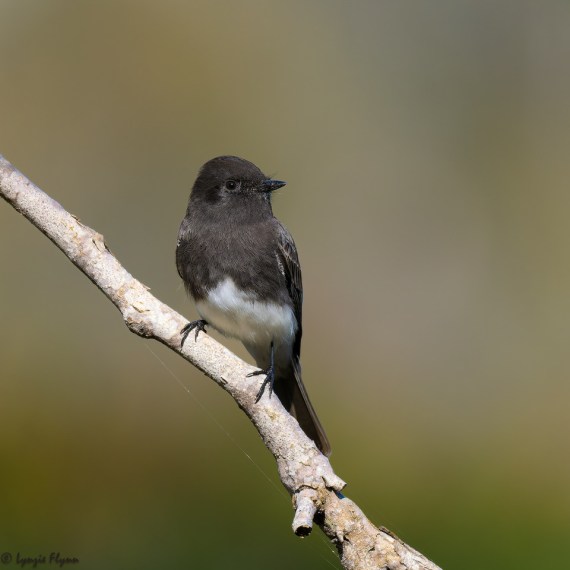
Black Phoebes are usually near water busily snagging bugs (Lynzie Flynn 10-14-23)
Saturday October 14 was a lovely day for birding Huntington Central Park. The sun, though briefly partially eclipsed, shone warmly, but not too much so.

Annular (not annual) eclipse of the sun, but no “ring of fire” in SoCal (Lynzie Flynn 10-14-23)
The park is well used, but we were not in any way physically or audibly encroached upon. A group of ten people seemed just about right.

Gulf Fritillary Butterfly (Agraulis vanillae), under and over (L-Lynzie Flynn, R-Ray Juncosa 10-14-23)
We were greeted right off (it seemed) by a very green Green Heron. Someone commented that you often don’t see the green, but there it was.
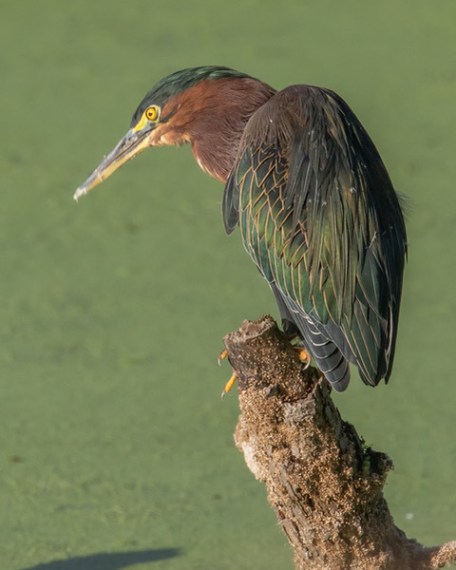
The Green Heron really honestly truly does have an iridescent olive-green back. Sometimes. (Chris Tosdevin 10-14-23)
The water in the pond was clear in very few places. Where there wasn’t duckweed, there was an apparently invasive lettuce that must make it hard to fish in.
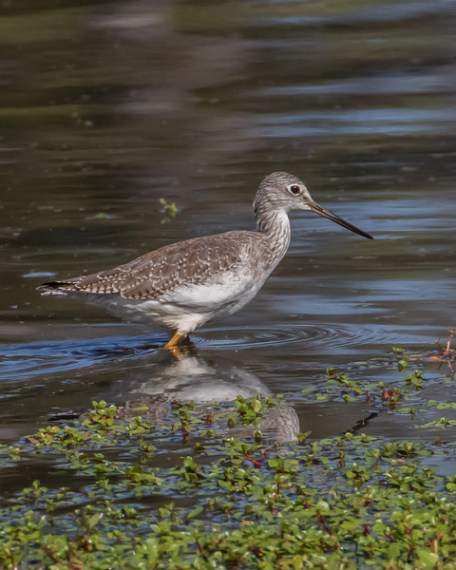
Greater Yellowlegs wading away (Chris Tosdevin 10-14-23)

Spotted Sandpiper, sans spots (Lynzie Flynn 10-14-23)
Anyway, other than many Mallards and some Egyptian Geese, there were very few ducks.

Egyptian Goose, resting from his long long flight (Lynzie Flynn 10-14-23)
Although an Osprey was hard at work, no doubt trying to find a hole in the lettuce.

Osprey overhead finds no flying fish (Ray Juncosa 10-14-23)
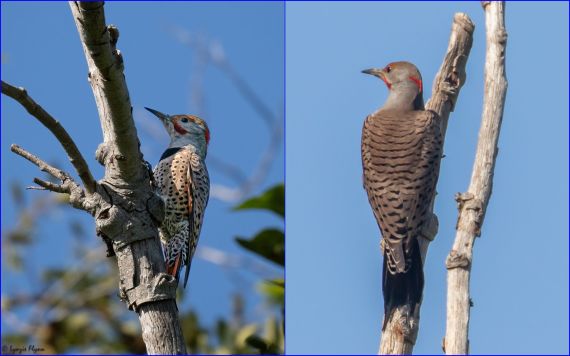
Northern Flicker red-shafted X yellow-shafted: left bird – note red at whisker and edges of wing & tail; right bird red at whisker & nape (L-Lynzie Flynn, R-Chris Tosdevin 10-14-23)
We were more lucky with woodpeckers. Several Northern Flickers entertained the group well, I think everyone has memorized their call by now. The group was mightily impressed by the flight of one that showed up its red under-wings. One flicker was of mixed heritage (see photos above). We also had Nuttall’s and Downy Woodpeckers.

Downy Woodpecker, note short bill compared to head size (Chris Tosdevin 10-14-23)
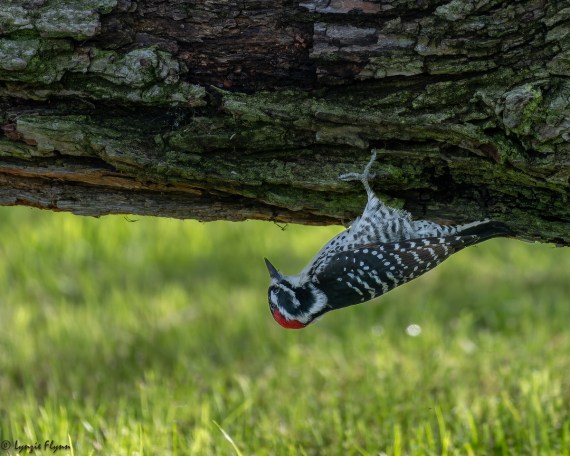
Nuttall’s Woodpecker sees things differently (Lynzie Flynn 10-14-23)
Western Bluebirds chased each other through the sparkling grass and the trees.
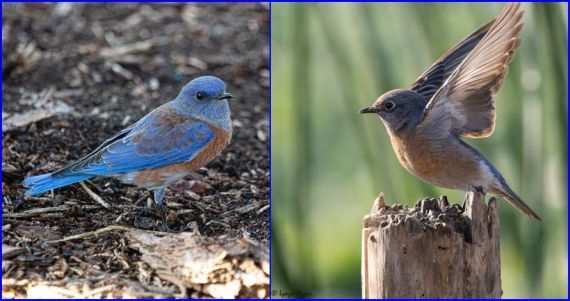
Western Bluebirds (L-Ray Juncosa, R-Lynzie Flynn 10-14-23)
But the most delight was provided by Warblers. In addition to Yellow-rumped Warblers, Orange-crowned Warblers and Common Yellowthroats, we saw, several of us for the first time, Black-and-white as well as Townsend’s Warblers, complete with caterpillars gleaned from tree trunks.

Yellow-rumped Warbler with white spots showing on left side of tail only (Lynzie Flynn 10-14-23)
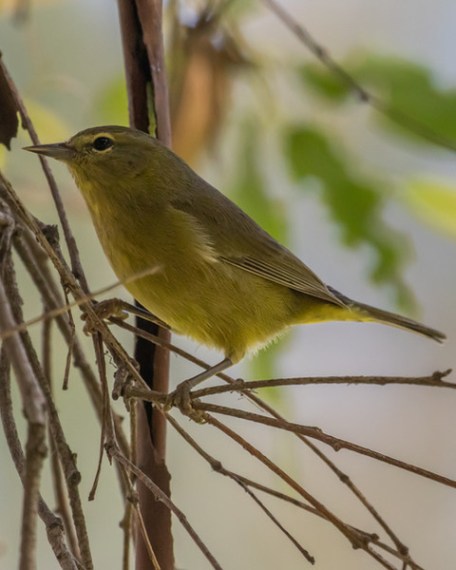
Orange-crowned Warbler, far orangier in the west than in the east. (Chris Tosdevin 10-14-23)
We all got very good looks, and it made me happy to see people so excited to see such beautiful birds.
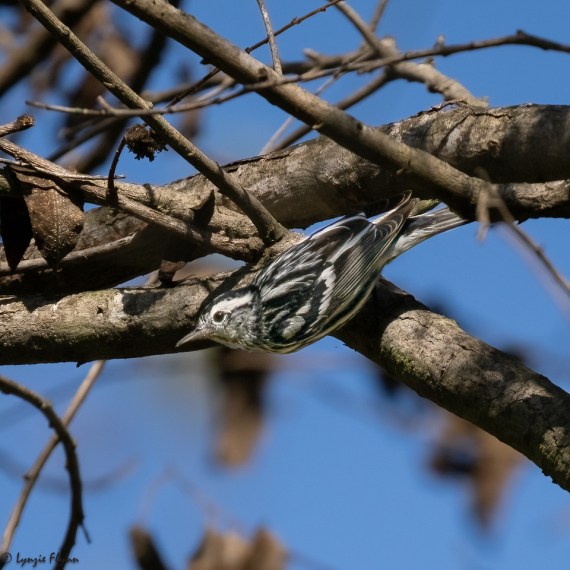
Black-and-white Warbler, crawling around limbs and trunks like a nuthatch or miniature woodpecker (Lynzie Flynn 10-14-23)
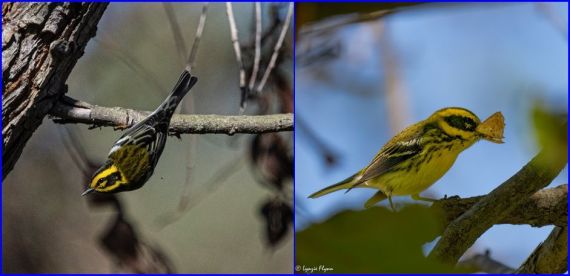
Townsend’s Warbler, with and without black throat (L-Ray Juncosa, R-Lynzie Flynn 10-14-23)
A Cassin’s Kingbird perched regally high in a tree’s bare branches.

Cassin’s Kingbird – note white chin (Chris Tosdevin 10-14-23)
What we didn’t see: No roosting owls were to be seen, and although several people saw the Swinhoe’s (formerly Japanese) White-eye, no Whydahs or Munias. Better luck next year.

Swinhoe’s (formerly Japanese) White-eye peers quizzically back at us (Chris Tosdevin 10-14-23)

House Wrens rarely hold still in a shootable location (Chris Tosdevin 10-14-23)
Many thanks to our photographers without whom there would be only a few words and your imaginations: Lynzie Flynn, Ray Juncosa, and Chris Tosdevin
Trip lists 2018-2023
“X” = seen, number not counted
Capitalized = Introduced
White-eye: Originally believed to be Japanese, but the species was split up, now classified as Swinhoe’s.
| Huntington Beach Central Park | |||||
| Year | 2023 | 2022 | 2019 | 2018 | |
| Date | 10/14 | 10/15 | 10/12 | 10/13 | |
| 1 | Egyptian Goose | 4 | X | X | |
| 1 | Cinnamon Teal | 1 | |||
| 1 | Gadwall | X | |||
| 1 | Eurasian Wigeon | X | |||
| 1 | American Wigeon | 1 | 5 | X | |
| 1 | Mallard | 16 | 37 | X | |
| 7 | Rock (Feral) Pigeon | 1 | |||
| 7 | Mourning Dove | 5 | X | ||
| 8 | Anna’s Hummingbird | 2 | X | X | |
| 8 | Allen’s Hummingbird | 2 | 7 | X | X |
| 2 | American Coot | 11 | 30 | X | X |
| 5 | Long-billed Dowitcher | 18 | |||
| 5 | Spotted Sandpiper | 2 | |||
| 5 | Greater Yellowlegs | 1 | |||
| 6 | Gull (species) | 1 | |||
| 2 | Double-crested Cormorant | 1 | 1 | X | |
| 3 | Great Blue Heron | 2 | 1 | X | |
| 3 | Great Egret | 1 | 2 | X | X |
| 3 | Snowy Egret | 1 | 3 | X | X |
| 3 | Green Heron | 1 | 1 | X | |
| 3 | Black-crowned Night-Heron | 1 | 3 | X | X |
| 3 | White-faced Ibis | 4 | 1 | X | X |
| 4 | Turkey Vulture | 1 | |||
| 4 | Osprey | 2 | 1 | ||
| 4 | Cooper’s Hawk | 2 | X | ||
| 4 | Red-shouldered Hawk | 1 | 3 | X | X |
| 4 | Red-tailed Hawk | 1 | |||
| 8 | Belted Kingfisher | 1 | 1 | X | |
| 8 | Downy Woodpecker | 1 | 2 | X | X |
| 8 | Nuttall’s Woodpecker | 2 | X | ||
| 8 | Northern Flicker | 1 | 2 | X | X |
| 4 | American Kestrel | 1 | X | X | |
| 9 | Cassin’s Kingbird | 1 | |||
| 9 | Western Wood-Pewee | X | |||
| 9 | Pacific-slope Flycatcher | X | |||
| 9 | Black Phoebe | 5 | 8 | X | X |
| 9 | Say’s Phoebe | 2 | |||
| 9 | Warbling Vireo | 1 | |||
| 9 | California Scrub-Jay | 1 | |||
| 9 | American Crow | 1 | 10 | X | X |
| 9 | Common Raven | X | |||
| 9 | Bushtit | 30 | X | X | |
| 9 | Swinhoe’s White-eye | 4 | 10 | X | |
| 9 | Ruby-crowned Kinglet | 1 | |||
| 9 | Blue-gray Gnatcatcher | 1 | 1 | X | X |
| 9 | House Wren | 2 | 2 | X | X |
| 9 | Western Bluebird | 10 | 25 | ||
| 9 | Hermit Thrush | 2 | X | ||
| 9 | American Robin | 2 | X | ||
| 9 | Bronze Mannikin | X | |||
| 9 | Scaly-breasted Munia | X | X | ||
| 9 | Pin-tailed Whydah | X | |||
| 9 | House Finch | 6 | 12 | X | X |
| 9 | Lesser Goldfinch | 2 | 4 | X | X |
| 9 | American Goldfinch | 2 | X | ||
| 9 | Dark-eyed Junco | 1 | |||
| 9 | White-crowned Sparrow | 3 | X | X | |
| 9 | Song Sparrow | 2 | 1 | X | X |
| 9 | California Towhee | X | X | ||
| 9 | Hooded Oriole | X | |||
| 9 | Brewer’s Blackbird | X | |||
| 9 | Orange-crowned Warbler | 1 | 4 | X | X |
| 9 | Nashville Warbler | X | |||
| 9 | MacGillivray’s Warbler | 1 | |||
| 9 | Common Yellowthroat | 1 | 7 | X | X |
| 9 | Yellow Warbler | X | |||
| 9 | Yellow-rumped Warbler | 16 | 14 | X | X |
| 9 | Black-throated Gray Warbler | X | |||
| 9 | Townsend’s Warbler | 4 | 1 | X | X |
| 9 | Wilson’s Warbler | X | |||
| 9 | Western Tanager | X | |||
| Totals by Type | 2023 | 2022 | 2019 | 2018 | |
| 1 | Waterfowl | 21 | 43 | ||
| 2 | Water Birds – Other | 12 | 31 | ||
| 3 | Herons, Egrets & Ibis | 10 | 11 | ||
| 4 | Quail & Raptors | 5 | 7 | ||
| 5 | Shorebirds | 3 | 18 | ||
| 6 | Gulls & Terns | 0 | 0 | ||
| 7 | Doves | 5 | 1 | ||
| 8 | Other Non-Passerines | 9 | 12 | ||
| 9 | Passerines | 97 | 77 | ||
| Totals Birds | 162 | 200 | 42 | 41 | |
| Total Species | 2023 | 2022 | 2019 | 2018 | |
| 1 | Waterfowl | 3 | 3 | 3 | 3 |
| 2 | Water Birds – Other | 2 | 2 | 1 | 2 |
| 3 | Herons, Egrets & Ibis | 6 | 6 | 4 | 6 |
| 4 | Quail & Raptors | 4 | 4 | 2 | 3 |
| 5 | Shorebirds | 2 | 1 | 0 | 0 |
| 6 | Gulls & Terns | 0 | 1 | 0 | 0 |
| 7 | Doves | 1 | 1 | 1 | 0 |
| 8 | Other Non-Passerines | 6 | 4 | 5 | 5 |
| 9 | Passerines | 23 | 13 | 26 | 22 |
| Totals Species – 71 | 47 | 35 | 42 | 41 | |



 SANTA MONICA BAY AUDUBON SOCIETY BLOG