Free email delivery
Please sign up for email delivery in the subscription area to the right.
No salesman will call, at least not from us. Maybe from someone else.
Bird Photographer of the Year | 2021 contest winners
[Posted by Chuck Almdale]
Great photos. Do you need to know more?
This takes you to the 2021 winners.
https://www.birdpoty.com/2021-winners
Once there, the tab “Winners” at the top of the page takes you to five previous years of winners.
A Siege of Bitterns | Book Recommendation
[Posted by Chuck Almdale]
There are dozens* of sub-genres of murder mysteries. If you haven’t yet heard of birding murder mysteries, add that to your list, although so far Steve Burrows is the only writer I know of in that genre. His credentials on birds and birding are excellent: birded on six continents, former editor of the Hong Kong Bird Watching Society magazine, contributing field editor for Asian Geographic. At the time he wrote his first book, A Siege of Bitterns, he lived with his wife Resa in Oshawa, Ontario, Canada. He apparently enjoys collective nouns of the venery.
A Siege of Bitterns is a good mystery and a good novel. The title is critically important. Characters are numerous, interesting and well-drawn; the environs are described in detail. I didn’t figure it out before the “big reveal.” It’s certainly not “noir” or “hardboiled;” “cozy” would work as the sub-genre, as the tone is light throughout. It’s fun to read, especially if you’re already a birder, and Burrows is not afraid to make appropriate fun of birder peculiarities.
If you’ve never been to the setting—Norfolk, England—it’s one of the top birding spots in the world and certainly at or near the top in Great Britain. There are probably more birders per square meter living there than anywhere else in the world. If you’ve never birded in Norfolk…well, now you can do it from your armchair.
A Siege of Bitterns is the first in a series of birder murder mysteries. It won the 2015 Arthur Ellis Award for Best First Novel, presented annually by the Crime Writers of Canada for the best Canadian crime and mystery writing published in the previous year.
Other books in the series:
A Pitying of Doves – June 2015
A Cast of Falcons – May 2016
A Shimmer of Hummingbirds – Mar 2017
A Tiding of Magpies – Nov 2018
A Dance of Cranes – Aug 2019
A Siege of Bitterns: A birder murder mystery featuring DCI Domenic Jejeune.
Steve Burrows | Pub. Point Blank | Dist. Simon & Schuster | 2014 | 344 pages
Publisher’s Description:
In this first Birder Murder mystery newly appointed police inspector Domenic Jejeune doesn’t mind ruffling a few feathers to flush out suspects in the brutal murder of a renowned ecological activist.
Newly appointed police inspector Domenic Jejeune doesn’t mind ruffling a few feathers. Indeed his success has elevated him into a poster boy for the police. The problem is Jejeune doesn’t really want to be a detective at all; he much prefers watching birds.
Recently reassigned to the small Norfolk town of Saltmarsh, located in the heart of Britain’s premier birding country, Jejeune’s two worlds collide with the grisly murder of a prominent ecological activist. His ambitious police superintendent foresees a blaze of welcome publicity, although doubts soon emerge when Jejeune’s best theory involves a feud over birdwatching lists. A second murder does little to bolster confidence.
Jejeune must call on all his birding know-how to solve the mystery and deal with unwelcome public acclaim, the mistrust of colleagues and his own insecurities. For, in the case of the Saltmarsh birder murders, the victims may not be the only casualties…
*It’s been decades since murder mysteries morphed and became a collection of genres. Here’s a quick list: caper, cozy, domestic, drawing room, forest ranger, hardboiled, investigator (sub-sub genres: male, female, black, teen male, teen female), noir (sub-sub genres by location: Los Angeles, Miami, New Orleans, New York, San Francisco), procedural, race track, religious orders, science fiction, southern, supernatural, suspense, thriller, travel, true crime, western, young adult. There are a lot more potential genres: specific sports, fishing, jungle exploration, pets, and every nation in the world, to name a few.
Stints, Baird’s & other birds, Malibu Lagoon, 22 August 2021
[Posted by Chuck Almdale]
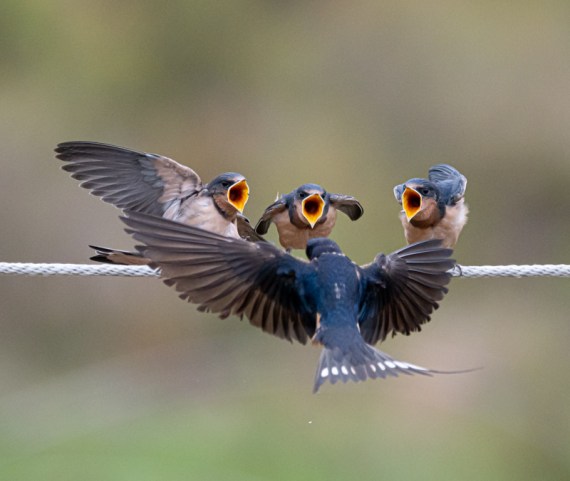
Hexagonal mouths? Who knew?
August can be excruciatingly hot. At least in theory. In actual practice on seaside Sunday mornings it’s quite pleasant. Today was slightly foggy—that’s our famous SoCal morning fog “burning off by noon.” The temperature was at 68°F at 0830, and 73°F at 1130. That is only slightly below the typical late August morning.

A break in the algae. (Lillian Johnson 8-22-21)
For the 13-year period 2009-21:
Temperature at 0830 ranged 63-72°F, average 68.3°F
Temperature at 1130 ranged 68-81°F, average 75.5°F.
Nothing to complain about there.
Then check back at 1700, after the temperature’s gone past 100°F.
Migrants from the north and possibly elsewhere continue to drop into the lagoon. We keep seeing reports of a Reddish Egret hopping around at the lagoon, but no one I personally know has ever been there at the right time to spot it. One of our birders keeps leapfrogging it: it’s there on Thursday, he’s there on Friday, it’s there on Saturday, he’s there on Sunday. So it goes, as Kurt Vonnegut frequently observed.

Our total species count popped up to 62 from July’s 40 and June’s yearly low of 34 species. Most Mallards and Gadwall have left, now that they have grown flight feathers and can fly, and the numbers of gulls, terns, cormorants and pelicans dropped. The shorebirds jumped up though: 341 birds in 17 species versus July’s 138 birds in 9 species.
The lagoon water level was high: 7’8.4″ on the tidal clock.

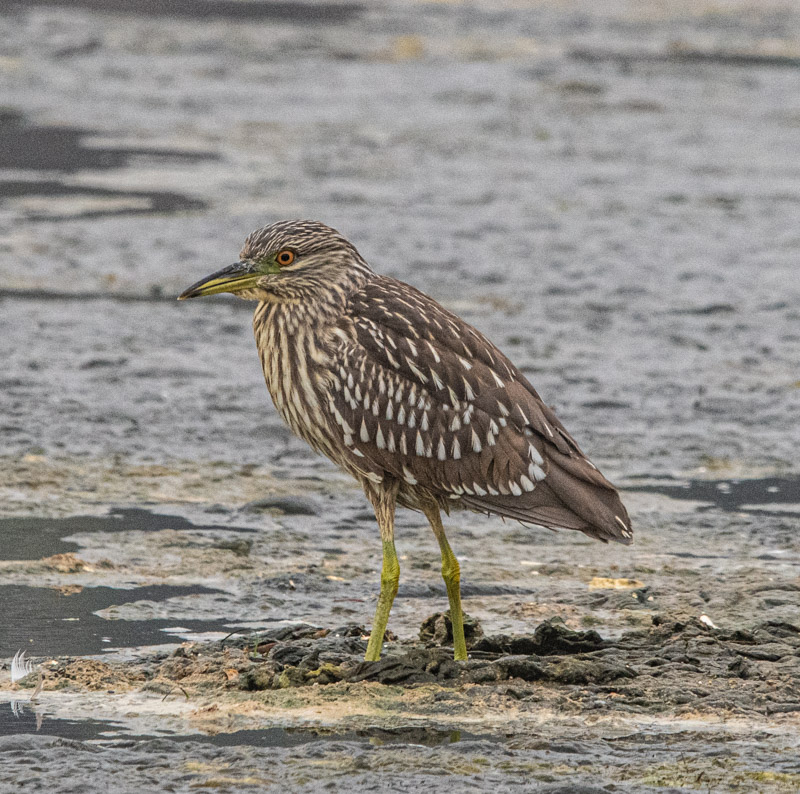
Black-crowned Night-Heron adult & juvenile (Ray Juncosa 8-22-21)
We dawdled at the meeting point, waiting for another group to vacate our next stop, the viewpoint near the Pacific Coast Hwy bridge. We didn’t want to be crowded, due to—you know—the current Covid-19 Delta variant explosion in infected, sick and dying.
And this is where a typical relaxed August morning’s birding took a sharp left turn.

We were sorting through a small group of about a dozen shorebirds wandering around on the thick algae coating the channel. Mostly Western and Least Sandpipers, at least 75 yards away and sunward, so we’re squinting to see color and patterns.

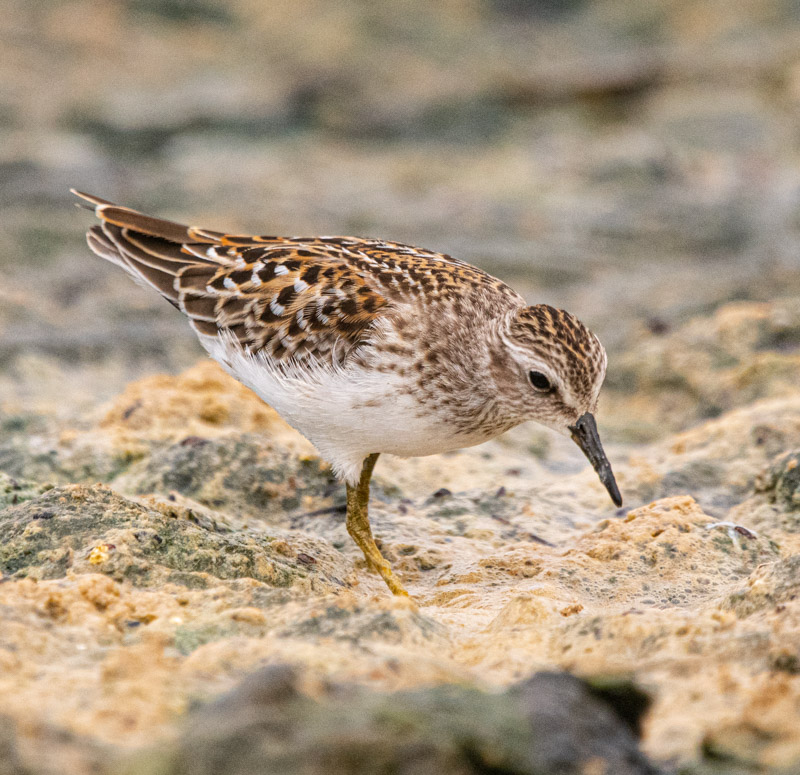
Western (L) and Least (R) Sandpipers (Ray Juncosa 8-22-21)
We picked out a couple of Baird’s Sandpipers, which tend to show up in small numbers at this season. Baird’s normally travel south from their high Arctic breeding grounds via the central flyway—Mississippi River and Great Plains—but a few always wander out our way. They’re about one inch longer than the 6.5” Western Sandpiper, which itself is 0.25-.50” larger than the Least Sandpiper (the world’s smallest sandpiper). Baird’s have shorter, straighter bills than the Western, and an odd yellowish color on their breasts and heads, with thin dark streaks running vertically through the yellow breast.

Chris Lord got our attention (not everyone at once) when he said: “I think one of those Baird’s has a darker throat, sort of orange or reddish…not really yellow. Maybe you should take a look at it. It might be something different.” So we all—one by one—figured out where it was and watched it through out binoculars and several scopes, as it walked around, poking at tiny invertebrates on the surface of the algae. Views weren’t wonderful.
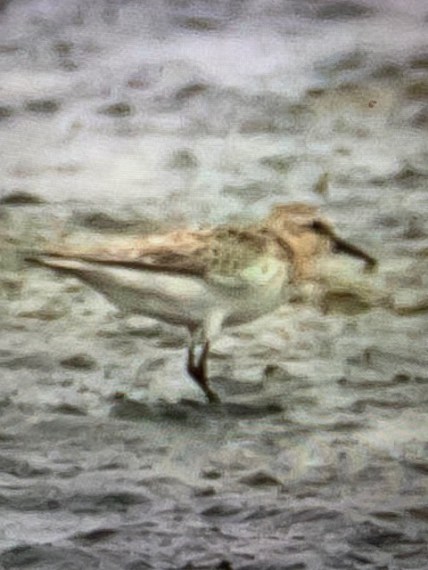
(Photo: Chris Tosdevin, 8-22-21, time: approx 08:58)
This could be a late-in-life Claude Monet painting.
Chris Tosdevin commented at some point: “There are little dark spots on the breast below the orange.” Chris Lord said that was a good mark to remember.

(Photo: Femi Faminu, 8-22-21, time: 08:58)
After several minutes of squinting sunward at the bird, we had decided: the color of the throat was decidedly darker in an orange or reddish or rufous sort of way; the bill was definitely short, almost straight, and thicker than the thin bill of the Least Sandpipers; the wings seemed longer than the tail although we couldn’t see the tail to judge how much longer, there were some flecks of rufous in the scapulars (back); the bird was not larger than the Western Sandpiper, possibly slightly smaller.

One of our group, either Lillian or me, commented, “Maybe it’s a Red-necked Stint. [Ha ha ha.] It sort of looks like one. [Ha ha ha.]” At some point, recalls Chris L, he asked me what my candidate species were and I said Red-necked Stint, which got him looking at his Sibley. We were all now taking turns checking through my National Geographic Field Guide to the Birds of North America and Chris L.’s copy of Sibley’s Field Guide to Birds of Western North America. I don’t think anyone was ready to take this suggestion seriously; not because it didn’t look like a Red-necked Stint—it did—but because it was so galfangled rare.
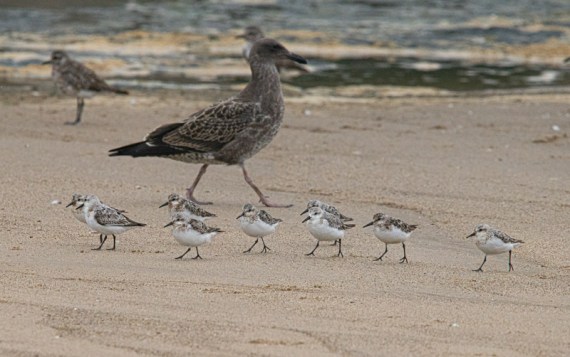
After a few more minutes we were slowly moving towards thinking maybe that was not an absurd speculation after all and the bird actually was a Red-necked Stint, a species none of us had ever seen in North America. Lillian and I had seen a few of them in 1988-89, thirty-three years ago, in Singapore, Australia and New Zealand, when it was in basic (non-breeding or Winter) plumage, lacking any trace of red. Many of the others had never seen one at all. So…not a lot of experience in our group with this species. We’re starting to agree among ourselves that yeah, maybe it really is a Red-necked Stint, what do you think?, too bad it’s so far away, any chance at getting a photo?, and I’m looking at the bird through the telescope when it flies out of the field of view, heading west towards the private golf course.
It didn’t land, it didn’t come back. We waited 5-10 minutes but it was gone. Cue moans and groans.


Western Pygmy Blue Butterfly, Brephidium exilis, Malibu Lagoon (Chris Tosdevin 8-22-21) The smallest butterfly in the world with wing-span of 3/8ths to 3/4ths of an inch. Many live in the brush around the lagoon, almost too tiny to see.


Black-crowned Night-Heron & Great Egret (Ray Juncosa 8-22-21)
We then continued on our usual route, heading east to the viewspot near the PCH bridge. There we found a few ducks and saw a lot of shorebirds—Willets, Whimbrels, a Spotted Sandpiper, peeps, Black-bellied Plovers, a Least Tern and two Caspian Terns, a few gulls and cormorants and some scurrying Snowy Plovers—far across the lagoon to the south, on the lagoon shore of the beach. So we headed back around the lagoon to get a closer look at them.

We birded as we went, as always. Four species of egret/heron, some Killdeer, Anna’s and Allen’s Hummingbird, a moblet of Bushtits, House Finches, several Common Yellowthroats, a Mockingbird, Black Phoebes, Starlings, Great-tailed Grackles. The usual suspects.


We made our way through the beach crowd enraptured by large, surfer-covered waves, and to the SE corner of the lagoon, past the long flock of gulls, Double-crested Cormorants, Brown Pelican and the many larger shorebirds including Willet, Whimbrel, Marbled Godwit and Black-bellied Plovers. Here, walking on the algae coat, were about 150 peeps—small shorebirds like Western and Least Sandpiper, Sanderling, Dunlin, Ruddy Turnstone, Semipalmated Plover and two Short-billed Dowitcher. Nearby, in the sand, were about thirty Snowy Plovers, doing their best to dodge the many zombified beachwalkers oblivious to the presence of tiny sandpipers underfoot.

Main lagoon is mostly clear of algae. (Lillian Johnson 8-22-21)
Among the peeps on the algae were a few Baird’s Sandpipers and far out, near the edge of the algal mat, two Red-necked Phalaropes. Unbeknownst to us, Chris Lord was vigorously scope-combing one-by-one through the peeps for the “stint,” subjecting them to this analysis: “It was the only bird I sought in those peeps. I used a yes/no screen until I got to yes! I called our attention to it, ‘That orangey bird is right in front of us,’ then gave better directions.”
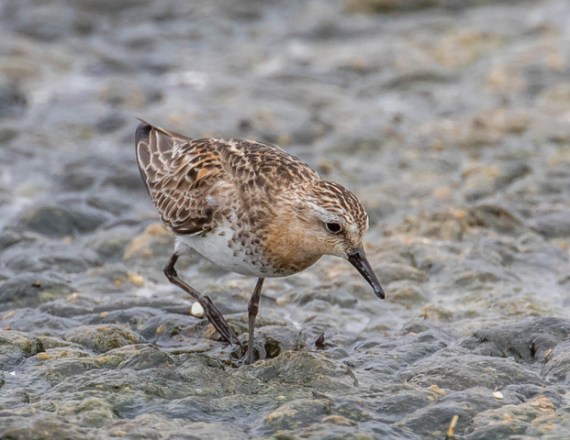
I waved in the few members of our group who were off chatting, and we all got on the bird for at least 40 minutes. The light was better at this angle, the bird was closer, and we slowly became more certain that it was indeed a Red-necked Stint. Not convinced, just more certain. Several of us got photos.

Chris Lord recollects: “As we discussed the bird’s field marks, all indicated Red-necked Stint. I also pointed out that nothing we’d seen made it not a Red-necked Stint except the unlikelihood of its being in Malibu. I should have quoted (but didn’t) my uncle Ralph, the first bird watcher I knew or even heard of, who would say about finding an unlikely oddity, ‘Well you know they have wings, and they fly.’ However anybody else saw and described the color, it was always—rightly or wrongly—orangey to me, never rufous or otherwise.”
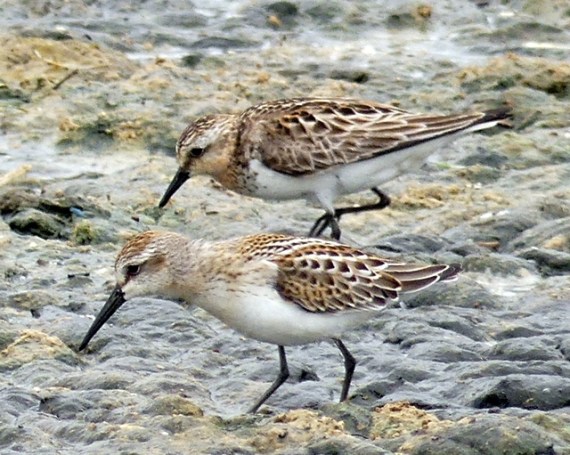
Malibu Lagoon (Photo: Femi Faminu, 8-22-21, time: 11:08)
Most of us don’t carry phones (what’s the collective noun for Luddites?—how about A smashing of Luddites) and no one had anyone we could call anyway. So I suggested to Chris T. that he send some photos off to Kimball Garrett at the L.A. County Museum of Natural History when he got home. He did that, posted the sighting with some photos into eBird and after Kimball confirmed the sighting as Red-necked Stint, Chris sent a note to the manager of LA County weekly rare bird report.
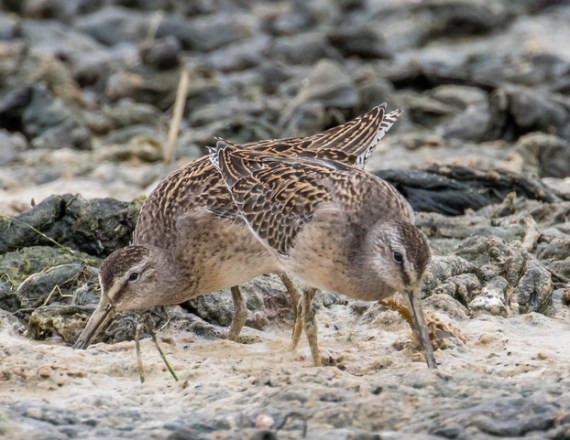
Apparently others were interested in seeing this bird, and a few people showed up before dawn the next day (Monday, 23 August). It (or another Red-necked Stint just like it) was relocated around 0810. Three days later, it’s still there. As of blog posting time, it was last reported to LACoBirds hot line on Weds. 25 Aug, and last reported to eBird on 26 Aug at 7:26am., the 71st such reporting.
Link to Malibu Lagoon on eBird


Ruddy Turnstone plumage variations (Ray Juncosa 8-22-21)
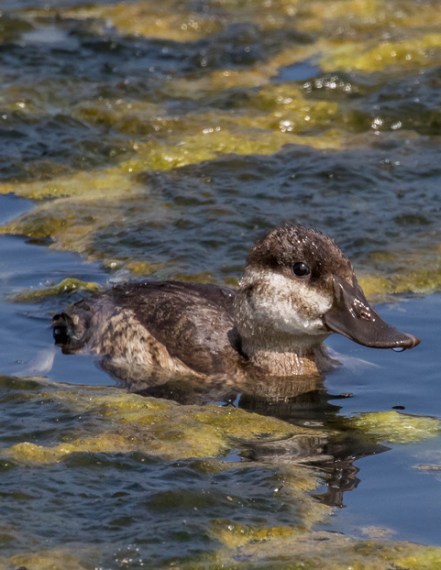
Birds new for the season: Ruddy Duck, Marbled Godwit, Red-necked Stint, Sanderling, Dunlin, Baird’s Sandpiper, Short-billed Dowitcher, Spotted Sandpiper, Willet, Glaucous-winged Gull, Least Tern, Pelagic Cormorant, Red-shouldered Hawk, Belted Kingfisher, Rough-winged Swallow, Wrentit, Lesser Goldfinch, Spotted Towhee, California Towhee.


Two plovers: Semipalmated and Western Snowy (ringed g:y/g) (Chris Tostevin 8-22-21)
Many thanks to photographers: Femi Faminu, Lillian Johnson, Ray Juncosa & Chris Tosdevin
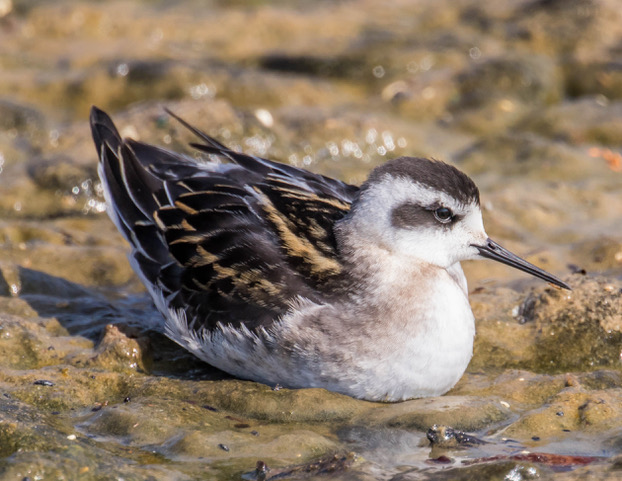

Two Red-necked Phalaropes (Chris Tosdevin 8-25-21)
The next SMBAS scheduled field trips: Maybe January 2022. Wear your masks, get your shots, and maybe someday we can have organized trips again.
The next SMBAS program: Zoom Evening Meeting, Topic TBA, early October, 7:30 p.m.
The SMBAS 10 a.m. Parent’s & Kids Birdwalk remains canceled until further notice due to the near-impossibility of maintained proper masked social distancing with parents and small children.
Links: Unusual birds at Malibu Lagoon
9/23/02 Aerial photo of Malibu Lagoon
Prior checklists:
2021: Jan-July
2020: Jan-July, July-Dec 2019: Jan-June, July-Dec
2018: Jan-June, July-Dec 2017: Jan-June, July-Dec
2016: Jan-June, July-Dec 2015: Jan-May, July-Dec
2014: Jan-July, July-Dec 2013: Jan-June, July-Dec
2012: Jan-June, July -Dec 2011: Jan-June, July-Dec
2010: Jan-June, July-Dec 2009: Jan-June, July-Dec.
The 10-year comparison summaries created during the Lagoon Reconfiguration Project period, remain available—despite numerous complaints—on our Lagoon Project Bird Census Page. Very briefly summarized, the results unexpectedly indicate that avian species diversification and numbers improved slightly during the restoration period June’12-June’14.
Many thanks to Jean Garrett, Lillian Johnson, Ray Juncosa, Chris Lord, Chris Tosdevin, Ruth Tosdevin, and others for their contributions to this month’s checklist.
[Chuck Almdale]
| Malibu Census 2021 | 3/22 | 4/25 | 5/22 | 6/20 | 7/22 | 8/22 | |
| Temperature | 60-61 | 58-63 | 59-68 | 63-69 | 66-74 | 68-73 | |
| Tide Lo/Hi Height | L+0.86 | H+4.83 | L+1.57 | H+4.89 | H+4.20 | H+4.55 | |
| Tide Time | 1223 | 0843 | 0736 | 0627 | 1148 | 1034 | |
| 1 | (Black) Brant | 1 | |||||
| 1 | Canada Goose | 6 | 8 | 6 | 10 | ||
| 1 | Cinnamon Teal | 7 | |||||
| 1 | Northern Shoveler | 8 | |||||
| 1 | Gadwall | 16 | 25 | 18 | 65 | 48 | 12 |
| 1 | American Wigeon | 8 | |||||
| 1 | Mallard | 16 | 18 | 22 | 40 | 37 | 9 |
| 1 | Green-winged Teal | 25 | |||||
| 1 | Surf Scoter | 2 | |||||
| 1 | Red-breasted Merganser | 12 | 3 | 1 | 1 | 1 | |
| 1 | Ruddy Duck | 2 | |||||
| 2 | Pied-billed Grebe | 6 | 1 | 1 | 2 | 1 | |
| 2 | Eared Grebe | 2 | |||||
| 2 | Western Grebe | 11 | 4 | ||||
| 7 | Feral Pigeon | 6 | 9 | 15 | 9 | 15 | 6 |
| 7 | Mourning Dove | 6 | 2 | 4 | 3 | ||
| 8 | Anna’s Hummingbird | 3 | 1 | 1 | 1 | 1 | 1 |
| 8 | Allen’s Hummingbird | 2 | 4 | 2 | 1 | 3 | |
| 2 | American Coot | 235 | 75 | 6 | 9 | 8 | 2 |
| 5 | Black Oystercatcher | 4 | |||||
| 5 | Black-bellied Plover | 31 | 22 | 5 | 13 | 43 | 90 |
| 5 | Snowy Plover | 23 | 9 | 29 | |||
| 5 | Semipalmated Plover | 29 | 1 | 4 | |||
| 5 | Killdeer | 7 | 1 | 6 | 4 | 9 | 20 |
| 5 | Whimbrel | 6 | 3 | 19 | 9 | 51 | 17 |
| 5 | Marbled Godwit | 10 | 4 | ||||
| 5 | Ruddy Turnstone | 5 | 2 | 2 | 8 | ||
| 5 | Red-necked Stint | 1 | |||||
| 5 | Sanderling | 160 | 12 | ||||
| 5 | Dunlin | 1 | 2 | ||||
| 5 | Baird’s Sandpiper | 5 | |||||
| 5 | Least Sandpiper | 8 | 1 | 8 | 35 | ||
| 5 | Western Sandpiper | 4 | 20 | 12 | 65 | ||
| 5 | Short-billed Dowitcher | 3 | |||||
| 5 | Spotted Sandpiper | 1 | 2 | ||||
| 5 | Willet | 6 | 2 | 1 | 40 | ||
| 5 | Red-necked Phalarope | 1 | 4 | ||||
| 6 | Heermann’s Gull | 42 | 28 | 280 | 2 | 1 | |
| 6 | Ring-billed Gull | 12 | 6 | ||||
| 6 | Western Gull | 65 | 40 | 35 | 45 | 52 | 55 |
| 6 | California Gull | 130 | 35 | 10 | 4 | 1 | 4 |
| 6 | Herring Gull | 1 | |||||
| 6 | Glaucous-winged Gull | 1 | 1 | 1 | 1 | ||
| 6 | Least Tern | 1 | |||||
| 6 | Caspian Tern | 4 | 20 | 13 | 3 | 2 | |
| 6 | Royal Tern | 24 | 6 | 2 | 5 | ||
| 6 | Elegant Tern | 395 | 107 | 1 | 240 | 1 | |
| 2 | Double-crested Cormorant | 25 | 12 | 26 | 26 | 52 | 27 |
| 2 | Pelagic Cormorant | 1 | 1 | ||||
| 2 | Brown Pelican | 27 | 105 | 235 | 27 | 58 | 30 |
| 3 | Great Blue Heron | 3 | 2 | 5 | 4 | ||
| 3 | Great Egret | 2 | 1 | 1 | 4 | 11 | 4 |
| 3 | Snowy Egret | 3 | 2 | 1 | 6 | 22 | 24 |
| 3 | Green Heron | 1 | |||||
| 3 | Black-crowned Night-Heron | 9 | 3 | ||||
| 4 | Turkey Vulture | 1 | 1 | ||||
| 4 | Osprey | 2 | 2 | 1 | |||
| 4 | Cooper’s Hawk | 1 | 1 | ||||
| 4 | Red-shouldered Hawk | 2 | 1 | ||||
| 8 | Belted Kingfisher | 1 | |||||
| 4 | Peregrine Falcon | 1 | |||||
| 9 | Black Phoebe | 2 | 8 | 6 | 3 | 4 | |
| 9 | Western Kingbird | 1 | |||||
| 9 | California Scrub-Jay | 2 | 1 | 1 | |||
| 9 | American Crow | 5 | 4 | 4 | 3 | 4 | 4 |
| 9 | Common Raven | 1 | |||||
| 9 | Violet-green Swallow | 2 | |||||
| 9 | Rough-winged Swallow | 6 | 2 | 3 | 2 | ||
| 9 | Cliff Swallow | 8 | 4 | 4 | |||
| 9 | Barn Swallow | 10 | 25 | 30 | 18 | 40 | 25 |
| 9 | Oak Titmouse | 2 | 1 | 2 | |||
| 9 | Bushtit | 20 | 1 | 8 | 4 | 1 | 20 |
| 9 | Wrentit | 1 | |||||
| 9 | Western Bluebird | 2 | |||||
| 9 | Northern Mockingbird | 2 | 4 | 5 | 2 | 1 | 1 |
| 9 | European Starling | 75 | 5 | 8 | 30 | ||
| 9 | House Finch | 10 | 6 | 6 | 6 | 6 | 18 |
| 9 | Lesser Goldfinch | 16 | 2 | 2 | |||
| 9 | Spotted Towhee | 1 | 1 | ||||
| 9 | California Towhee | 4 | 3 | 1 | |||
| 9 | Song Sparrow | 7 | 7 | 8 | 4 | 5 | 3 |
| 9 | White-crowned Sparrow | 6 | 2 | ||||
| 9 | Hooded Oriole | 1 | 1 | ||||
| 9 | Red-winged Blackbird | 2 | 2 | 4 | 25 | ||
| 9 | Brown-headed Cowbird | 2 | 1 | 1 | |||
| 9 | Great-tailed Grackle | 8 | 6 | 6 | 8 | 20 | 5 |
| 9 | Common Yellowthroat | 3 | 4 | 2 | |||
| 9 | Yellow Warbler | 2 | |||||
| 9 | Yellow-rumped Warbler | 15 | 1 | ||||
| Totals by Type | Mar | Apr | May | Jun | Jul | Aug | |
| 1 | Waterfowl | 100 | 55 | 46 | 116 | 86 | 24 |
| 2 | Water Birds – Other | 306 | 198 | 268 | 62 | 120 | 61 |
| 3 | Herons, Egrets & Ibis | 5 | 3 | 6 | 12 | 47 | 35 |
| 4 | Quail & Raptors | 3 | 3 | 4 | 0 | 1 | 2 |
| 5 | Shorebirds | 264 | 80 | 31 | 28 | 136 | 341 |
| 6 | Gulls & Terns | 279 | 531 | 446 | 55 | 300 | 65 |
| 7 | Doves | 12 | 9 | 15 | 11 | 19 | 9 |
| 8 | Other Non-Passerines | 5 | 5 | 3 | 2 | 1 | 5 |
| 9 | Passerines | 198 | 78 | 99 | 62 | 107 | 126 |
| Totals Birds | 1172 | 962 | 918 | 348 | 817 | 668 | |
| Total Species | Mar | Apr | May | Jun | Jul | Aug | |
| 1 | Waterfowl | 9 | 5 | 3 | 4 | 3 | 4 |
| 2 | Water Birds – Other | 6 | 6 | 4 | 3 | 4 | 5 |
| 3 | Herons, Egrets & Ibis | 2 | 2 | 4 | 3 | 4 | 4 |
| 4 | Quail & Raptors | 2 | 2 | 3 | 0 | 1 | 2 |
| 5 | Shorebirds | 11 | 9 | 4 | 4 | 9 | 17 |
| 6 | Gulls & Terns | 8 | 8 | 6 | 5 | 5 | 7 |
| 7 | Doves | 2 | 1 | 1 | 2 | 2 | 2 |
| 8 | Other Non-Passerines | 2 | 2 | 2 | 2 | 1 | 3 |
| 9 | Passerines | 20 | 17 | 17 | 11 | 11 | 18 |
| Totals Species – 89 | 62 | 52 | 44 | 34 | 40 | 62 |
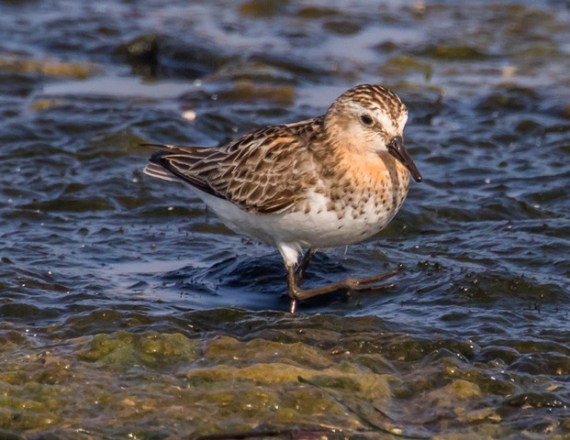
Red-necked Stint at Malibu Lagoon 8-22-21
[Posted by Chuck Almdale]
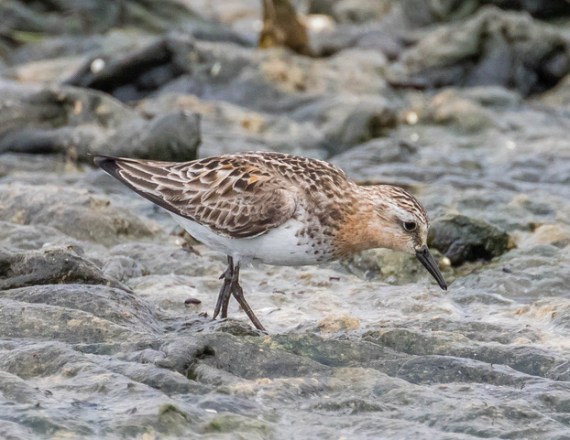
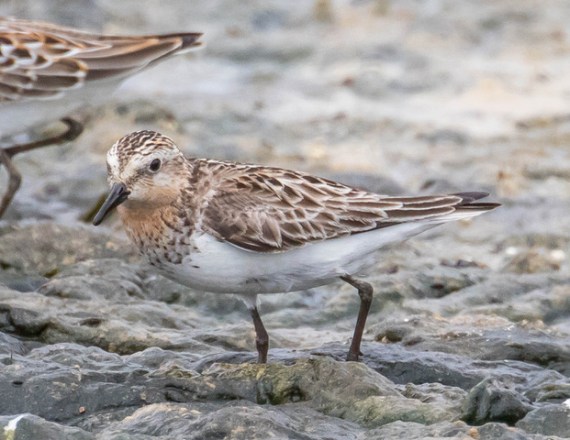
The first eleven photos of the Red-necked Stint, taken by two photographers (Femi Feminu & Chris Tosdevin), are all of the same bird at two location at Malibu Lagoon, over a period of about 130 minutes, if the camera’s internal clocks are correct. The bird was first seen in the northwest section of the lagoon (channels area) between the westernmost sand island and the peninsula/island closest to the parking lot. It flew from there, but was rediscovered about 40 minutes later in the at the far southeast corner of Malibu Lagoon (see map at bottom), walking on the thick coat of algae.
Other shorebirds present within 25 yards and walking on the algae, sand and mud, but not shown here were: Black-bellied Plover, Killdeer, Semipalmated Plover, Snowy Plover, Ruddy Turnstone, Sanderling, Dunlin, Baird’s Sandpiper, Least Sandpiper, Western Sandpiper, Short-billed Dowitcher, Red-necked Phalarope. Larger shorebirds, gulls, terns, egrets and herons were farther away.
Chris Tosdevin later posted the sighting and photos to eBird, sent his photos to Kimball Garrett at the L.A. County Museum of Natural History. Garrett confirmed the sighting as a Red-necked Stint, and Tosdevin reported the sighting to LACoBirds hot line.
This is reportedly the 4th sighting of Red-necked Stint in Los Angeles County.
Th stint was most recently reported to LACoBirds at 12:40 25 Aug 2021, so it’s been there at least 4 days.
There will be another posting of the day’s trip, including a description of our finding & re-finding the stint, in a few days.
Three more photos were added to this posting on 25 Aug 2021, marked as “added.” Photos are displayed in order of time taken.
An additional eleven photos, taken by Chris Tosdevin on 25 Aug 2021, are at the bottom but above the map.
The first two photos (added) were taken at the first location, from the pavilion south of the parking lot.
(Photo: Femi Faminu, 8-22-21, time: 08:58) This photo was added to this blog on 8-25-21.
This photo was added to this blog on 8-25-21.

Red-necked Stint, approaching. Malibu Lagoon (Photo: Chris Tosdevin, 8-22-21, time: 10:01:11)




Mountain Lion freeway crossing
[Posted by Chuck Almdale]
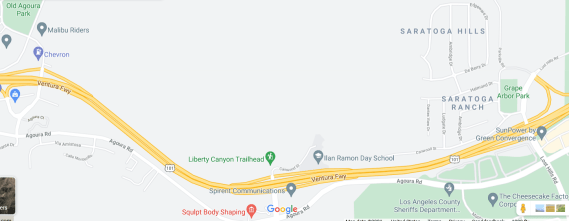
SaveLAcougars.org, working in conjunction with the National Wildlife Federation, wants to put the world largest wildlife corridor crossing over the 101 freeway at Liberty Canyon. They want your help.
If you’ve been reading the local news, you already know that one of the biggest problems our local mountain lions have is to find one another without getting killed crossing one of our many major roads and freeways. Studies have been done and it was determined that the best spot to put a wildlife corridor crossing was at Liberty Canyon.
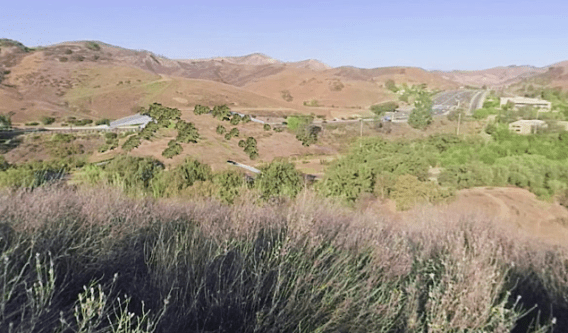
Obviously, all sorts of local animals will be able to use the corridor. Not just cougars. Western Fence Lizards for instance. And possums.
They already have a lot of support. As of right now, Saturday 21 August, 2021, 3,989 donors have contributed over $52 million dollars, or 61.2% of their goal of $85 million dollars. Some of these supporters are listed on their site: The Annenberg Foundation, State of California Wildlife Conservation Board, Coastal Conservancy, The John Logan Foundation, Santa Monica Mountains Conservancy, The Carolyn J. Davis Charitable Trust, Mary Jo and Hank Greenberg Animal Welfare Foundation, Wanda & Bud Waugh, California Dept. of Fish & Wildlife, Leonardo DiCaprio Foundation, M. Piuze Foundation and 3,978 other helpful people and organizations.
Make that 3,979 others. I refreshed the page and it went up one.
Follow this link to their website, watch this cool (animated) video of the wildlife corridor construction over the 101 freeway, and then you can choose how to leave them some money.
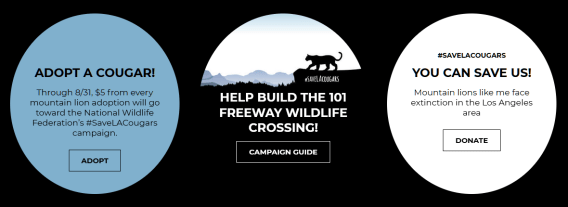
As the label says below, $5 from every mountain adoption will go towards the National Wildlife Federation’s #SaveLAcougars campaign. If you want to give in that way, go the the SaveLAcougars website, find the Adopt a Cougar! blue button, and click ADOPT, which then takes you to the NWF website.
Or, click the white button and give directly to SaveLAcougars.com
Refreshed it again. Make that 3,981 others.



 SANTA MONICA BAY AUDUBON SOCIETY BLOG