Terns & other birds: Malibu Lagoon, 28 May 2023
[By Chuck Almdale]
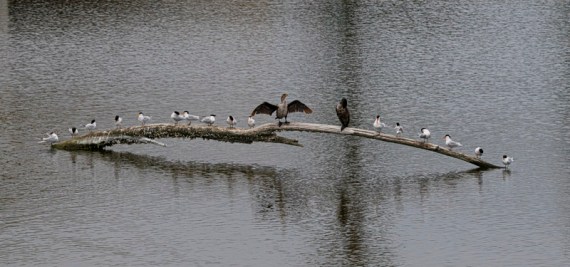
Almost ready for choir practice (Ray Juncosa 5/28/23)
I thought it time to dust off and trot out the annual “June Gloom” epithet, but the Los Angeles Times had a new one the other day — “May Gray” — so I’ll borrow that one, returning it when finished of course.

More terns, probably all Elegant (Ray Juncosa 5/28/23)
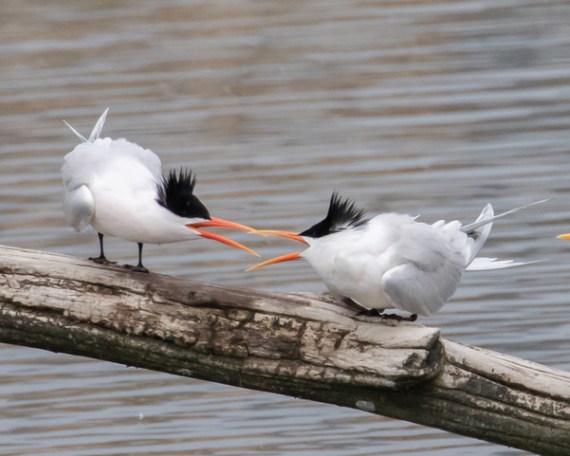
Elegant Terns bickering (Chris Tosdevin 5/28/23)
You may notice that the lighting on all these photos is a bit…underwhelming. It’s May Gray! I commented to someone that it’s often warmer in the depths of winter than the 61-62°F we had today. If you look at the bird checklist below you’ll see that both April 23 and Christmas Day of all days were both warmer than today’s “May Gray” day. [Say that rapidly six times.] Another “The sun always shines in sunny sunny sunny California” myth lies twitching in the dust.

New Elegant Terns kept dropping in (Ray Juncosa 5/28/23)
I think it must have been the Memorial Day weekend that brought so many birders out, about twice as many as I expected: faces new and faces unseen for many a month. All were welcome. Too bad the species count was a bit impoverished, as is typical for May, when most of the wintering birds are gone and the migrants have already passed through. Here’s the numbers for the past ten Mays, working backwards starting from 5/28/23: 44, 39, 44, 32, 33, 41, 30, 41, 48 and 55 on 5/25/14, for an average of 41 species. So today was slightly better than average for May.
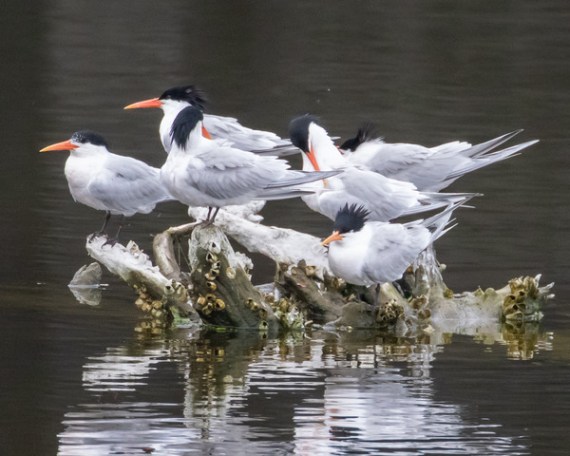
It’s possible the two upper left terns are Royal as their bills seem a little thick. (Chris Tosdevin 5/28/23)
What we did have was a sufficiency of terns. That’s a new “collective noun of the venery” I just made up. The “official” phrase is “A committee of terns,” first used quite recently in 2014. See our blog from 4/1/22 “A Cornucopia of Collective Nouns of the Venery,” which contains links to two lists; one of them has all 934 avian collective nouns, doubly alphabetized, the other has only the really old ones. You can print them off, then whip them out at the next party you attend and cite from them ad nauseam — it’s guaranteed to win you friends and influence people.
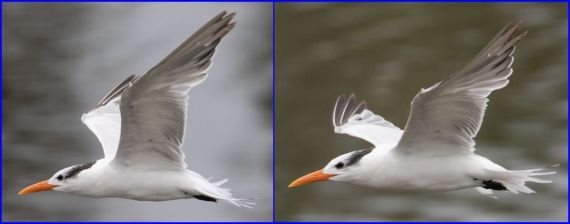
The same Royal Tern a split-second apart. Does the bill seem thicker that those of the birds in the photo above? The dark eye and nape fringe are definitely Royal. (Chris Tosdevin 5/28/23)
Elegant Terns are just so…elegant!
— Abigail King, SMBAS founding member

This pair can’t even wait until they get to their nesting grounds. (Chris Tosdevin 5/28/23)
Finally, something that not an Elegant Tern; at 13.5″ long it’s the smallest gull we get at Malibu Lagoon. This gull is named not for Bonaparte the Emperor of France, but for his nephew Charles Lucien Jules Laurent Bonaparte, naturalist and resident of the United States, considered the father of American systematic ornithology.
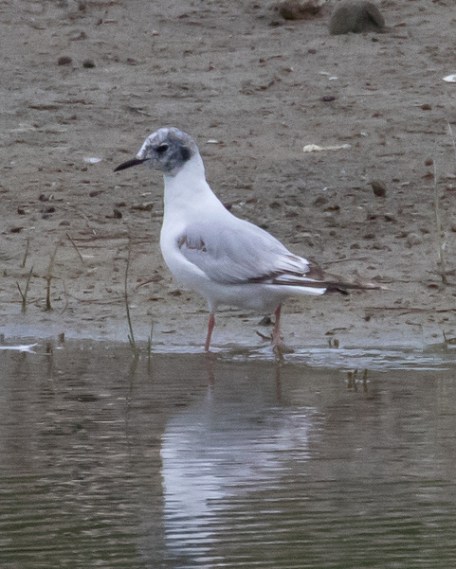
Bonaparte’s Gull stops by on its way to breed in Alaska or Canada, not quite into breeding (alternate) plumage. (Chris Tosdevin 5/28/23)
The Double-crested Cormorants and a few egrets are breeding across the street in the shopping center. This Double-crested Cormorant below is pretty young; note the pale brown colors on breast and belly.

Double-crested Cormorant (Ray Juncosa 5/28/23)
The Great Egret below is currently breeding, as the facial skin is green.
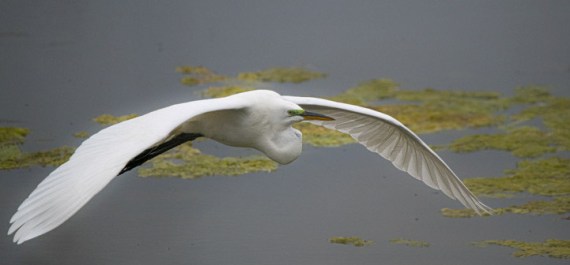
Great Egret, breeding (Ray Juncosa 5/28/23)

Great Blue Heron, getting ready to leap into the air (Chris Tosdevin 5/28/23)
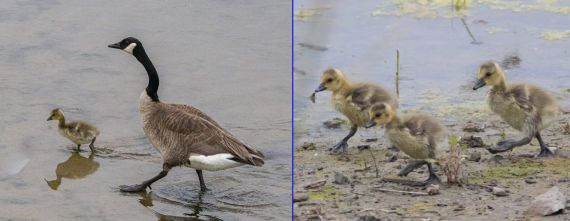
Four of the five Canada Geese present. They’ve been breeding at the lagoon on the sandy brushy islands for at least the past three years. One pair this year, but there were three pairs one year. (Left: Ray Juncosa; Right: Chris Tosdevin, 5/28)
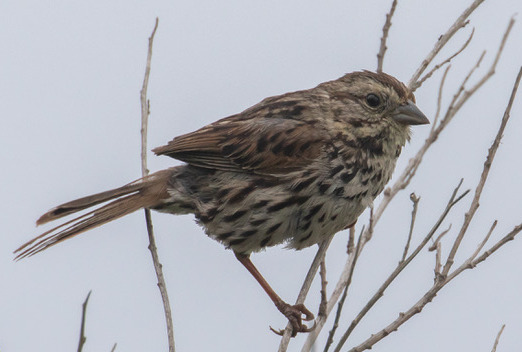
Quiz time! What species are the two birds below, both seen today at the lagoon? They may be same or different species. Answer below the trip list.

Chris Tosdevin both photos, 5/28/23

Our one and only shorebird species today, the Killdeer, which breeds at the lagoon. (Chris Tosdevin 5/28/23)
Birds new for the Season: Eurasian Collared-Dove, Bonaparte’s Gull, Dark-eyed Junco, Wilson’s Warbler.

Male Allen’s Hummingbird. When the light isn’t at the proper angle, the structural colors of the gorget disappear. (Chris Tosdevin 5/28/23)
Malibu Lagoon on eBird as of 6-03-23: 6895 lists, 319 species
Many thanks to photographers: Ray Juncosa & Chris Tosdevin

Young Heermann’s Gulls were the third most common species at the lagoon today.
(Chris Tosdevin 5/28/23)
Upcoming SMBAS scheduled field trips:
- Mt. Piños Birds & Butterflies; Uncertain, Sat Jun 17, 8am. Call/email if coming.
- Malibu Lagoon, Sun Jun 25, 8:30 am. No reservations or Covid card required.
- Malibu Lagoon, Sun Jul 23, 8:30 am. No reservations or Covid card required.
- Malibu Lagoon, Sun Aug 27, 8:30 am. No reservations or Covid card required.
- These and any other trips we announce for the foreseeable future will depend upon expected status of the Covid/flu/etc. pandemic at trip time. Any trip announced may be canceled shortly before trip date if it seems necessary. By now any other comments should be superfluous.
- Link to Programs & Field Trip schedule.
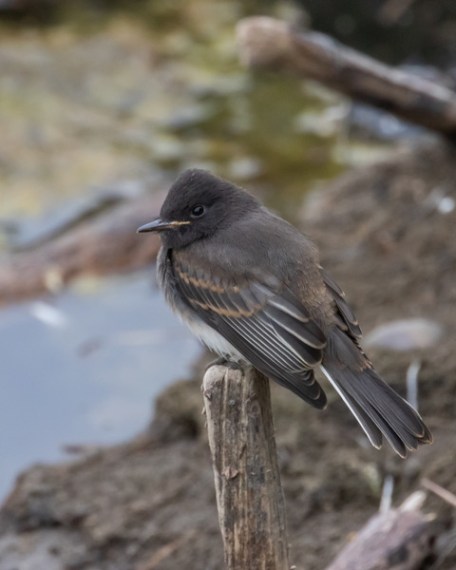
It may look like a weird Red-winged Blackbird, but it’s a juvenile Black Phoebe. (Chris Tosdevin 5/28/23)
The next SMBAS Zoom program: TBA. Tuesday, 3 Oct. 2023, 7:30 p.m.
The SMBAS 10 a.m. Parent’s & Kids Birdwalk restarted April 23. Reservations for groups (scouts, etc.) necessary, but not for families.
Links: Unusual birds at Malibu Lagoon
9/23/02 Aerial photo of Malibu Lagoon
More recent aerial photo
Prior checklists:
2021: Jan-July, July-Dec 2022: Jan-June, July-Dec
2020: Jan-July, July-Dec 2019: Jan-June, July-Dec
2018: Jan-June, July-Dec 2017: Jan-June, July-Dec
2016: Jan-June, July-Dec 2015: Jan-May, July-Dec
2014: Jan-July, July-Dec 2013: Jan-June, July-Dec
2012: Jan-June, July-Dec 2011: Jan-June, July-Dec
2010: Jan-June, July-Dec 2009: Jan-June, July-Dec
The 10-year comparison summaries created during the Lagoon Reconfiguration Project period, remain available—despite numerous complaints—on our Lagoon Project Bird Census Page. Very briefly summarized, the results unexpectedly indicate that avian species diversification and numbers improved slightly during the restoration period June’12-June’14.
Many thanks to Femi Faminu, Chris Lord, Ruth & Chris Tosdevin and others for their contributions to this month’s checklist.
The species lists below is irregularly re-sequenced to agree with the California Bird Records Committee Official California Checklist as updated 4 Feb 2023. If part of the chart’s right side is hidden, there’s a slider button at the bottom of the list.
[Chuck Almdale]
| Malibu Census 2022-23 | 12/25 | 1/22 | 2/26 | 3/26 | 4/23 | 5/28 | |
| Temperature | 65-72 | 49-57 | 53-55 | 57-60 | 57-66 | 61-62 | |
| Tide Lo/Hi Height | H+6.59 | H+6.81 | L+0.81 | L+0.28 | L-.041 | L+0.81 | |
| Tide Time | 0950 | 0858 | 0911 | 0800 | 0637 | 1131 | |
| 1 | Canada Goose | 4 | 2 | 6 | 4 | 5 | |
| 1 | Cinnamon Teal | 1 | |||||
| 1 | Northern Shoveler | 7 | |||||
| 1 | Gadwall | 16 | 26 | 58 | 42 | 24 | 17 |
| 1 | American Wigeon | 8 | 4 | ||||
| 1 | Mallard | 6 | 20 | 32 | 12 | 15 | 12 |
| 1 | Green-winged Teal | 38 | 15 | 26 | 5 | ||
| 1 | Redhead | 3 | |||||
| 1 | Surf Scoter | 3 | 1 | 6 | 22 | 3 | 2 |
| 1 | Bufflehead | 11 | 10 | 5 | |||
| 1 | Common Goldeneye | 2 | |||||
| 1 | Hooded Merganser | 5 | 1 | ||||
| 1 | Red-breasted Merganser | 7 | 6 | 3 | 2 | ||
| 1 | Ruddy Duck | 42 | 8 | ||||
| 2 | Pied-billed Grebe | 5 | 2 | 1 | 1 | 2 | |
| 2 | Horned Grebe | 1 | |||||
| 2 | Eared Grebe | 5 | |||||
| 2 | Western Grebe | 1 | 8 | 40 | 80 | 6 | |
| 7 | Feral Pigeon | 6 | 16 | 5 | 6 | 1 | 8 |
| 7 | Eurasian Collared-Dove | 2 | |||||
| 7 | Mourning Dove | 2 | 1 | 2 | 2 | ||
| 8 | White-throated Swift | 5 | |||||
| 8 | Anna’s Hummingbird | 2 | 1 | 1 | |||
| 8 | Allen’s Hummingbird | 2 | 3 | 3 | 2 | 1 | |
| 2 | American Coot | 130 | 38 | 73 | 37 | 6 | |
| 5 | Black-bellied Plover | 51 | 43 | 62 | 3 | ||
| 5 | Killdeer | 11 | 4 | 12 | 5 | 4 | 4 |
| 5 | Semipalmated Plover | 14 | |||||
| 5 | Snowy Plover | 16 | 16 | 1 | |||
| 5 | Whimbrel | 9 | 7 | 2 | 25 | 16 | |
| 5 | Marbled Godwit | 23 | 18 | 17 | 2 | ||
| 5 | Ruddy Turnstone | 2 | 6 | 3 | |||
| 5 | Sanderling | 27 | 35 | 32 | 2 | ||
| 5 | Dunlin | 2 | |||||
| 5 | Least Sandpiper | 19 | 22 | 27 | 19 | ||
| 5 | Western Sandpiper | 4 | 30 | ||||
| 5 | Willet | 15 | 15 | 9 | 7 | 2 | |
| 6 | Bonaparte’s Gull | 3 | |||||
| 6 | Heermann’s Gull | 85 | 27 | 3 | 3 | 80 | 152 |
| 6 | Short-billed Gull | 1 | |||||
| 6 | Ring-billed Gull | 55 | 36 | 40 | 46 | 120 | 12 |
| 6 | Western Gull | 68 | 49 | 38 | 26 | 50 | 72 |
| 6 | California Gull | 450 | 1330 | 237 | 95 | 60 | |
| 6 | Herring Gull | 2 | 1 | 2 | |||
| 6 | Glaucous-winged Gull | 7 | 4 | ||||
| 6 | Caspian Tern | 2 | 2 | ||||
| 6 | Royal Tern | 2 | 14 | 13 | 3 | ||
| 6 | Elegant Tern | 90 | 630 | 305 | |||
| 6 | Black Skimmer | 3 | |||||
| 2 | Red-throated Loon | 1 | 1 | ||||
| 2 | Pacific Loon | 1 | 1 | ||||
| 2 | Common Loon | 2 | 1 | ||||
| 2 | Brandt’s Cormorant | 1 | 12 | 8 | |||
| 2 | Pelagic Cormorant | 1 | 6 | 1 | 2 | 3 | 3 |
| 2 | Double-crested Cormorant | 62 | 36 | 67 | 26 | 53 | 74 |
| 2 | American White Pelican | 1 | |||||
| 2 | Brown Pelican | 158 | 343 | 159 | 62 | 655 | 168 |
| 3 | Great Blue Heron | 5 | 2 | 2 | 1 | ||
| 3 | Great Egret | 3 | 2 | 2 | 2 | 1 | 2 |
| 3 | Snowy Egret | 35 | 16 | 6 | 2 | 1 | 3 |
| 3 | Black-crowned Night-Heron | 1 | |||||
| 3 | White-faced Ibis | 1 | |||||
| 4 | Turkey Vulture | 1 | 1 | 5 | 5 | 1 | |
| 4 | Osprey | 1 | 1 | 1 | |||
| 4 | Cooper’s Hawk | 1 | |||||
| 4 | Red-tailed Hawk | 3 | 1 | 2 | 2 | ||
| 8 | Belted Kingfisher | 1 | |||||
| 8 | Nuttall’s Woodpecker | 1 | |||||
| 4 | American Kestrel | 1 | |||||
| 4 | Merlin | 1 | |||||
| 4 | Peregrine Falcon | 1 | |||||
| 9 | Cassin’s Kingbird | 1 | 1 | 1 | |||
| 9 | Pacific-slope Flycatcher | 1 | |||||
| 9 | Black Phoebe | 2 | 3 | 3 | 2 | 1 | 6 |
| 9 | Say’s Phoebe | 1 | |||||
| 9 | California Scrub-Jay | 1 | 1 | ||||
| 9 | American Crow | 3 | 11 | 27 | 6 | 4 | 3 |
| 9 | Common Raven | 2 | 1 | 2 | 2 | ||
| 9 | Northern Rough-winged Swallow | 2 | 6 | 6 | 5 | ||
| 9 | Barn Swallow | 14 | 15 | 30 | |||
| 9 | Cliff Swallow | 24 | 3 | 25 | 4 | ||
| 9 | Bushtit | 15 | 14 | 3 | 3 | 2 | 8 |
| 9 | Wrentit | 2 | 1 | 1 | 1 | ||
| 9 | Ruby-crowned Kinglet | 1 | 2 | 1 | |||
| 9 | Cedar Waxwing | 12 | |||||
| 9 | Blue-gray Gnatcatcher | 1 | |||||
| 9 | House Wren | 1 | 2 | ||||
| 9 | Marsh Wren | 1 | |||||
| 9 | Bewick’s Wren | 1 | |||||
| 9 | Northern Mockingbird | 1 | |||||
| 9 | European Starling | 6 | 9 | 2 | 3 | ||
| 9 | Hermit Thrush | 1 | |||||
| 9 | House Finch | 16 | 9 | 6 | 5 | 7 | 13 |
| 9 | Lesser Goldfinch | 4 | 10 | 5 | 2 | 5 | |
| 9 | Dark-eyed Junco | 1 | |||||
| 9 | White-crowned Sparrow | 16 | 12 | 25 | 12 | ||
| 9 | Song Sparrow | 4 | 5 | 5 | 7 | 10 | |
| 9 | California Towhee | 1 | 3 | 3 | 1 | 5 | 3 |
| 9 | Hooded Oriole | 1 | 1 | ||||
| 9 | Red-winged Blackbird | 8 | 12 | 2 | 4 | ||
| 9 | Brown-headed Cowbird | 1 | 3 | ||||
| 9 | Great-tailed Grackle | 6 | 4 | 2 | |||
| 9 | Orange-crowned Warbler | 1 | 1 | 3 | 1 | 1 | |
| 9 | Common Yellowthroat | 1 | 2 | 4 | 3 | 1 | |
| 9 | Yellow-rumped Warbler (Audubon’s) | 15 | 6 | 2 | 7 | ||
| 9 | Townsend’s Warbler | 1 | |||||
| 9 | Wilson’s Warbler | 1 | |||||
| Totals by Type | Dec | Jan | Feb | Mar | Apr | May | |
| 1 | Waterfowl | 136 | 85 | 152 | 92 | 46 | 36 |
| 2 | Water Birds – Other | 363 | 434 | 343 | 212 | 739 | 253 |
| 3 | Herons, Egrets & Ibis | 44 | 20 | 9 | 6 | 2 | 6 |
| 4 | Quail & Raptors | 6 | 1 | 7 | 8 | 5 | 1 |
| 5 | Shorebirds | 161 | 166 | 180 | 44 | 88 | 4 |
| 6 | Gulls & Terns | 658 | 1453 | 341 | 277 | 940 | 549 |
| 7 | Doves | 6 | 16 | 7 | 7 | 3 | 12 |
| 8 | Other Non-Passerines | 2 | 5 | 3 | 8 | 3 | 1 |
| 9 | Passerines | 84 | 96 | 128 | 99 | 89 | 106 |
| Totals Birds | 1460 | 2276 | 1170 | 753 | 1915 | 968 | |
| Total Species | Dec | Jan | Feb | Mar | Apr | May | |
| 1 | Waterfowl | 9 | 9 | 11 | 7 | 4 | 4 |
| 2 | Water Birds – Other | 8 | 7 | 8 | 9 | 9 | 4 |
| 3 | Herons, Egrets & Ibis | 4 | 3 | 3 | 3 | 2 | 3 |
| 4 | Quail & Raptors | 4 | 1 | 3 | 3 | 4 | 1 |
| 5 | Shorebirds | 9 | 9 | 9 | 6 | 8 | 1 |
| 6 | Gulls & Terns | 4 | 7 | 9 | 8 | 5 | 7 |
| 7 | Doves | 1 | 1 | 2 | 2 | 2 | 3 |
| 8 | Other Non-Passerines | 1 | 4 | 1 | 2 | 2 | 1 |
| 9 | Passerines | 15 | 20 | 18 | 20 | 20 | 20 |
| Totals Species – 107 | 55 | 61 | 64 | 60 | 56 | 44 |
Photo Quiz Answer: Left – Black Phoebe, Right – Northern Rough-winged Swallow.
Among other differences, the swallow’s wings are nearly as long at the tail; not so with the phoebe.
Discover more from SANTA MONICA BAY AUDUBON SOCIETY BLOG
Subscribe to get the latest posts sent to your email.



Hi. Hope this gets to you. The term May Gray has been around for decades. So has June Gloom. I was just talking to a neighbor about the horrid possibility of it extending into July again, and he came up with: July No Sky. However, Gray, it is, it’s better than sweltering under an extended heat.
LikeLike
Yup. A friend told me he heard of May Gray (or Gray May) many years before he’d heard of June Gloom. So it goes, as Kurt Vonnegut used to write all the time, although someone else probably wrote it first. I don’t think July No Sky will catch on, although No Sky July just might, even if it sounds a bit like Armageddon. How about August Bust? You heard it here first.
LikeLike