Uncommon visitors, old friends at Malibu Lagoon: 27 September 2026
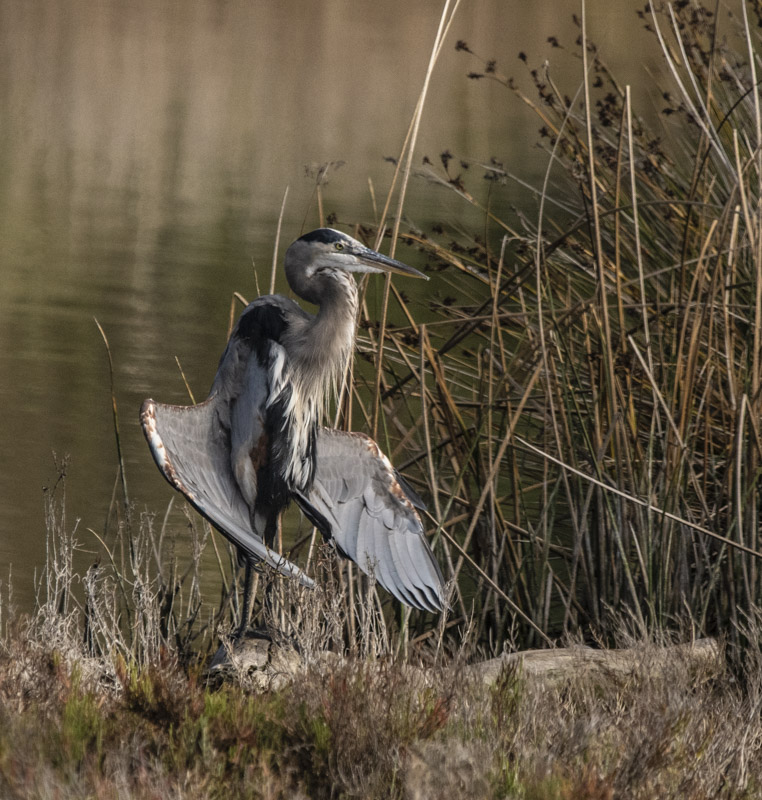
[By Chuck Almdale; photos by Femi Faminu, Ray Juncosa, Grace Murayama & Chris Tosdevin]
Warm, cloudy and humid. Not Florida or Carolina humid; it’s never that bad, where it rains inside your house while the sun shines outside. Here, anything over 25% is considered humid, and it was 87-90% at 6 am. At the beach the clouds were low and they never lifted.
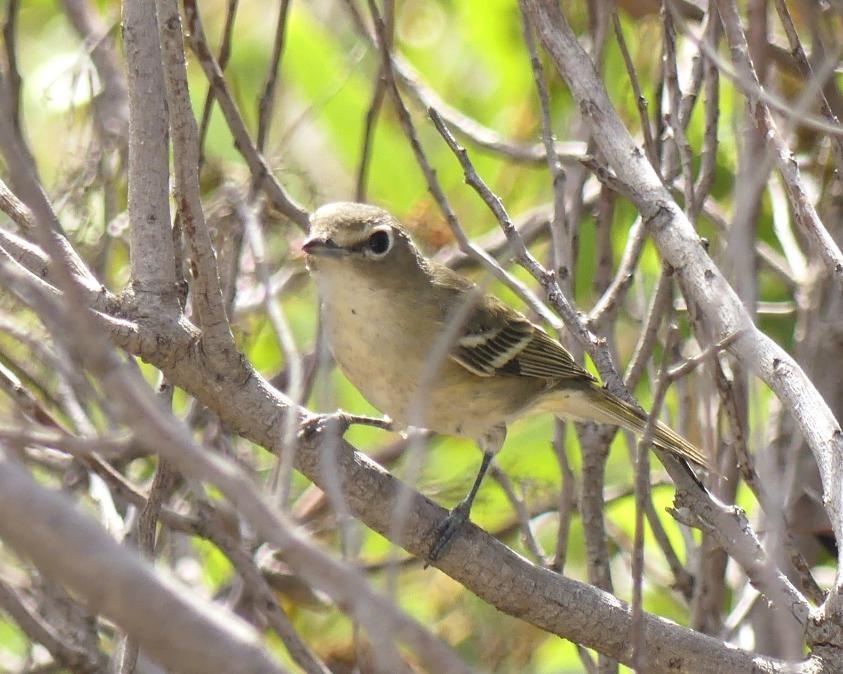
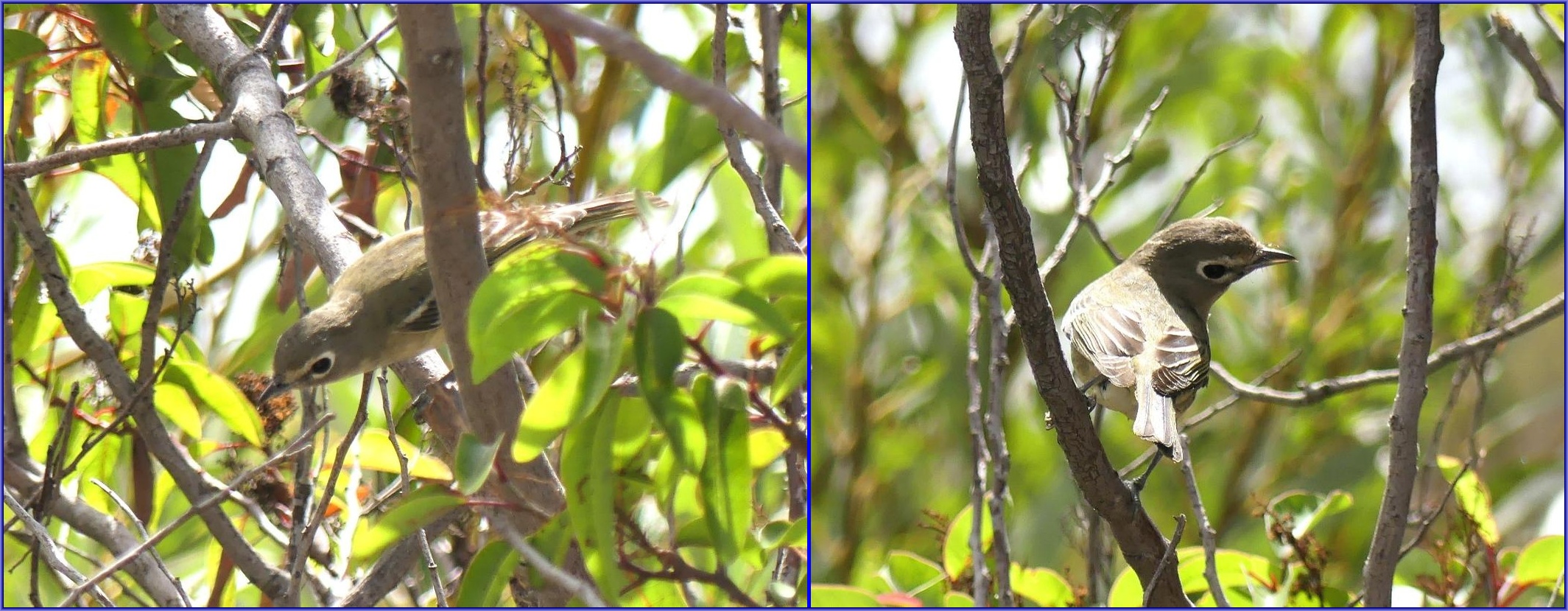
The best bird of the day was unfortunately missed by most people. Femi Faminu and Marie Barnidge-McIntyre saw it somewhere along the path to (or from) the beach and got some photos. I saw it when I opened my email the following day, just like you, right now. So…I.D. aficionados, avoid the captions and put on your ID hat. Eye-ring, bill thickness and wing bars are helpful.
Don’t read below yet.
Yes! It’s a Cassin’s Vireo Vireo cassinii. It wasn’t all that long ago that it was a Solitary Vireo, but in 1997 the AOU split it into Cassin’s (Western), Plumbeous (Great Basin–Rockies) and Blue-headed (Eastern). In SoCal we can see all three, as the Blue-headed’s breeding range edges into eastern British Columbia, and when migrating southward in the fall they sometimes cross the mountains and pass through California. The Plumbeous’ breeding range edges Eastern California and they too wander westward.
But, despite being our more-or-less local version of the former Solitary Vireo, it’s very uncommon at the lagoon. The few trees and coastal chaparral brush around the lagoon are not it’s preferred habitat. That would be dry, open woodlands, especially conifers of all sorts but also oak, cottonwood, and aspen, up to 8,000 feet. So it’s not wildly improbable that they would show up so infrequently in the brush and trees around the lagoon. According to eBird their first sighting at the lagoon was on 9/23/24 when ten people, likely all members of the Southwest Bird Study Club, reported the bird. Marie and Femi’s sighting is only the second sighting at the lagoon. Alert birding at it’s best.
Double-crested Cormorants (DCCO) are at the opposite end of the frequency spectrum, 100% since January 2010. In the lagoon, on the shore, on the beach, on the sand islands, on the offshore rocks, swimming and diving in the water, or flying by offshore in long strings. But in certain plumages they can be confused with the recently range-expanding Neotropical Cormorant (NECO). Both are brownish when young, black as adults, with orange bills and gular pouches. The NECO at 26″ long (bill-tip to tail-tip) is about 20% smaller than the 32″ DCCO, but frankly that’s hard to detect unless they’re both standing erect next to each other.
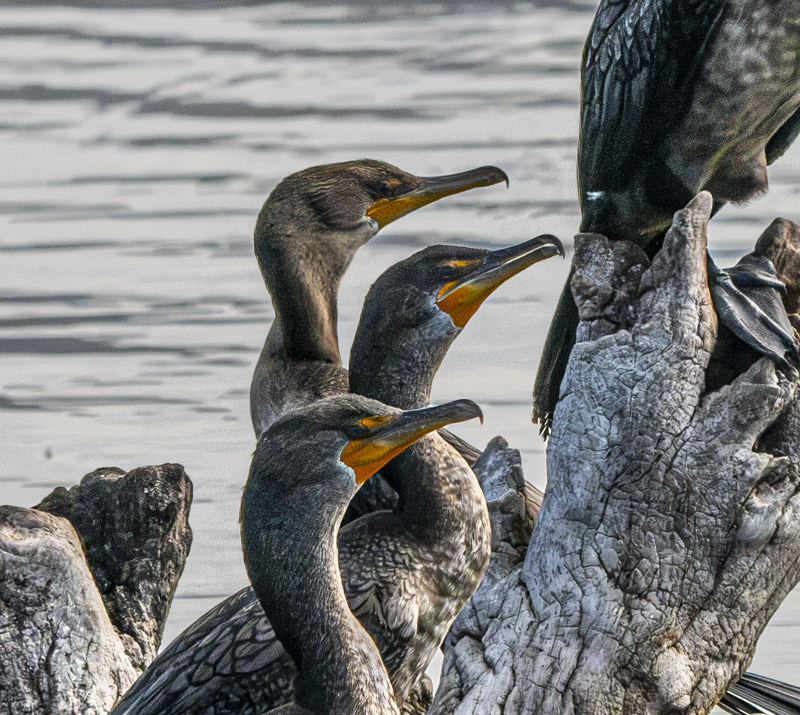
The main way to tell them apart is that the NECO lacks the orange flesh above the eye, and has a (usually) more prominent white boarder around the bill. But as you can see below, the DCCO often has a variable white border. It’s usually less prominent and less extensive, but it can fool you. The lack of orange flesh over the eye of the NECO is more reliable. The NECO is widespread from east Texas to Tierra del Fuego, and is slowly becoming more common in SoCal, mostly on fresh water. eBird lists two sightings at the lagoon but I’ve yet to see them there.
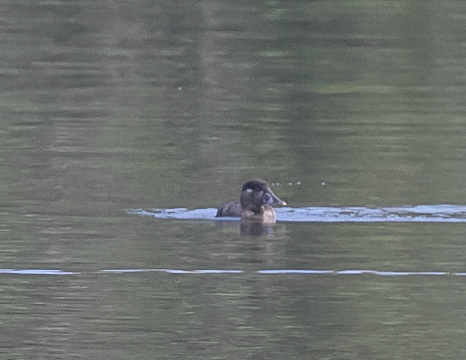
Our Surf Scoter, which still looks like a juvenile to me, is still with us. As yet we have not seen it fly, but at least it is not simply sitting on the western sand island but is swimming around and diving. So if it was sick or wounded, as it appeared to be, it seems to be holding on with good prospects for recovery. As previously mentioned, Surf Scoters much prefer the sea or large harbors. We very rarely see them within the lagoon, but they regularly float and dive offshore.
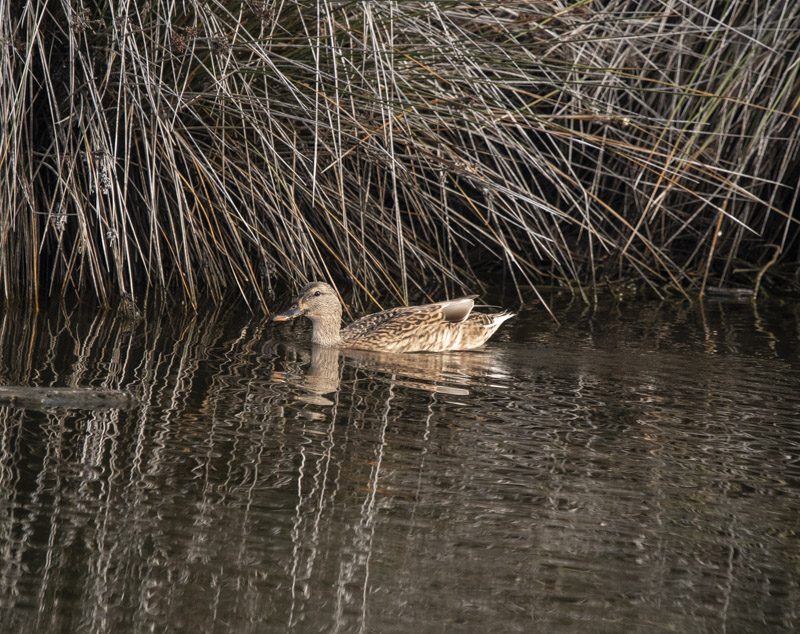
The next photo is another good look at a common but easily-confused bird, the female Mallard. Mallards and Gadwalls are the two most common ducks in the lagoon, present 98% and 89% of the time respectively (since Jan. 2010), and the females are very similar. When you can’t see the wing secondaries – white for Gadwall, purple-blue for Mallard, the best field mark is the bill. It’s black and orange for both females, but the female Mallard has an irregular black “saddle,” well illustrated below, while the Gadwall had a largely-black upper bill with orange “lips” around the edges. But both these features are frequently not well defined.
We had yet another unexpected visitor, actually our first, found at the start of the trip. It was located at the edge of a reed bed bordering the sand island we pass on the way to the viewpoint near Pacific Coast Highway. September is a good month to closely check all the reed bed edges (the only part you can actually see) as that’s where any Sora, Virginia or rarer rail will be. No rails were found, but we turned up this bird below, staring into the thicket, bill and front half of head hidden by reeds. Finally it shifted a little and we could see the bill color, an important field mark. What is it?
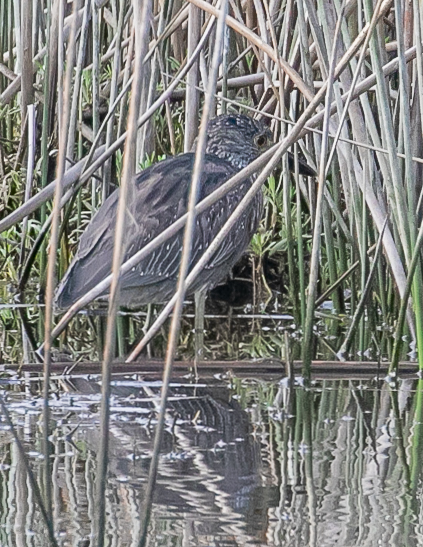
Yellow-crowned Night Herons at Malibu Lagoon has been reported on eBird 108 times, but 60 of those sightings were same-day sightings, leaving no more than 48 different birds, and probably far less, as they can hang around for many days. Many of the 48 “possibly” different birds were on consecutive days. A partial record: 2017: 1 report; 2018-19: no reports; 2020: 2 reports; 2021: no reports; 2022: 43 reports 7/19-8/29, more than half of those were on the 12 consecutive days 8/18-8/29. These latter reports were almost certainly the same individual bird, and quite possibly all the 2022 sightings were of the same single bird.
At any rate, they are being seen more frequently around SoCal. With the juveniles, the best way to differentiate them from juvenile Black-crowned Night Herons are the tiny white spots on the folded grayish wings, the black and shorter bill and the overall very dusky colors lacking any hint of reddish-brown. This appears to be another species extending their range northward from Mexico.
Spotted Sandpipers (SPSA) appear almost equally in numbers each month August to April, rarely in May, never in June and usually in very low numbers. Of the 184 times we’ve seen them since October 1979, we’ve have 374 birds, averaging almost exactly 2 birds per visit. The only time they’ve been in double digits was on 10/25/15 when 10 were scattered around the lagoon. They don’t care much for each other’s company, apparently. That vertical white shoulder mark and their usually-bobbing tail are the best field marks.
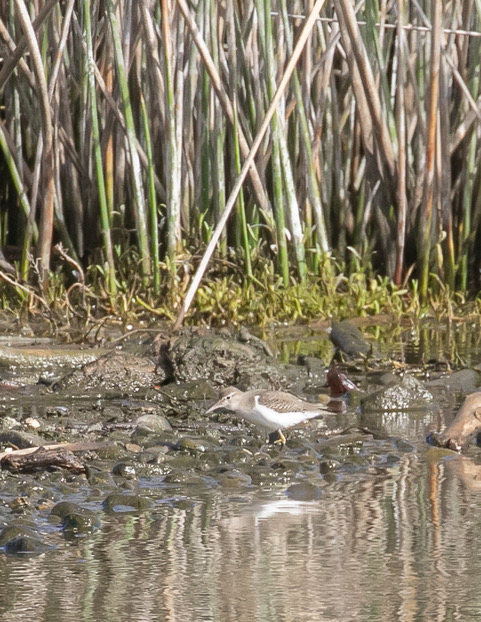
Compare that to the Sanderling, our chapter’s mascot, which have numbered over 100 on 28 occasions. They’re very friendly, but safety in numbers probably has something to do with it. They’re out running around on the open beach where any hungry passing gull could nab them, whereas the SPSA skulks along the vegetated lagoon edges.
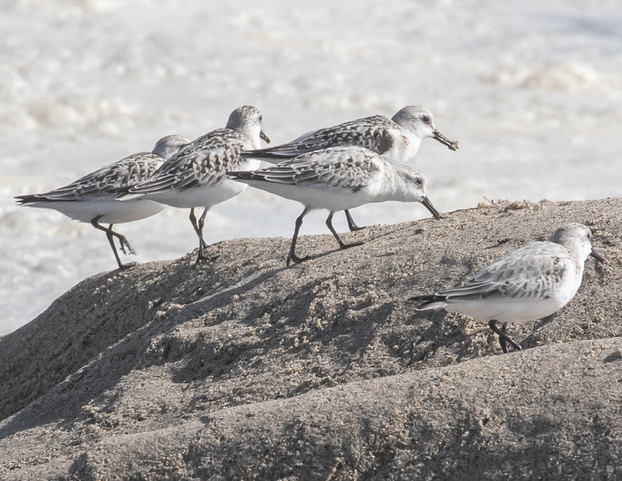
As previously mentioned, it remained cloudy all day, keeping the temperatures relatively low.
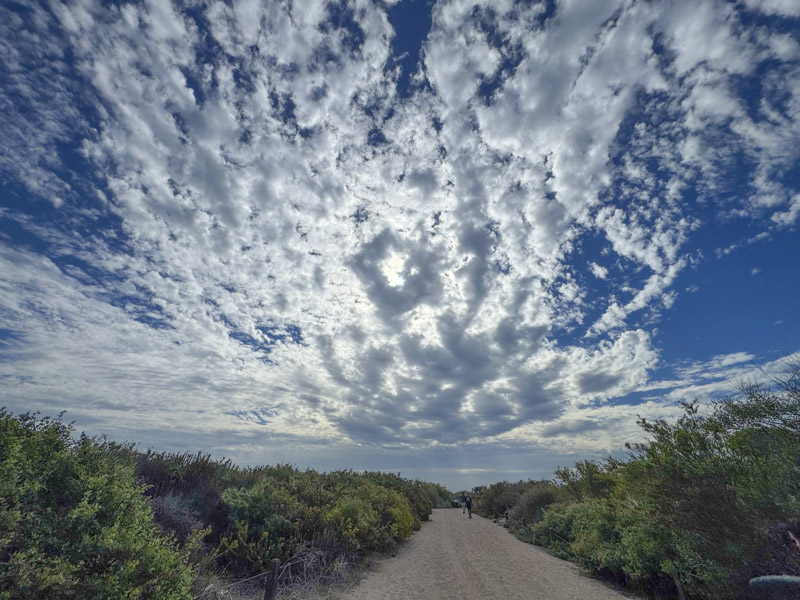
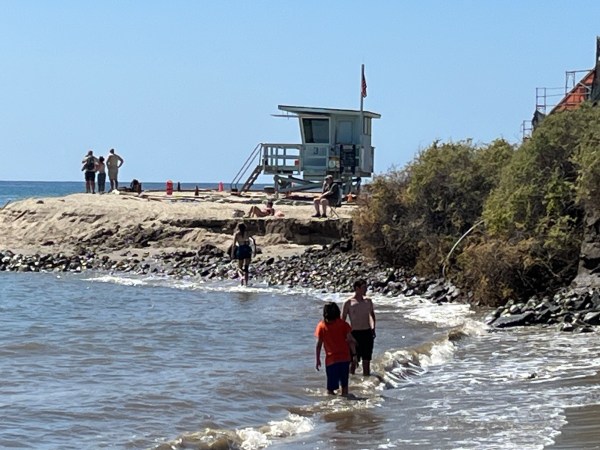
Nevertheless, some of us got quite warm, and one person was tempted into taking the shorter route from the lifeguard station to the main part of the beach where all the birds were resting, as it looked far sandier and safer than in the photo below, taken nine days earlier shortly after crashing storm-surf from Baja ate a large hole in the beach. Appearances were deceiving but the water was warm and refreshing.
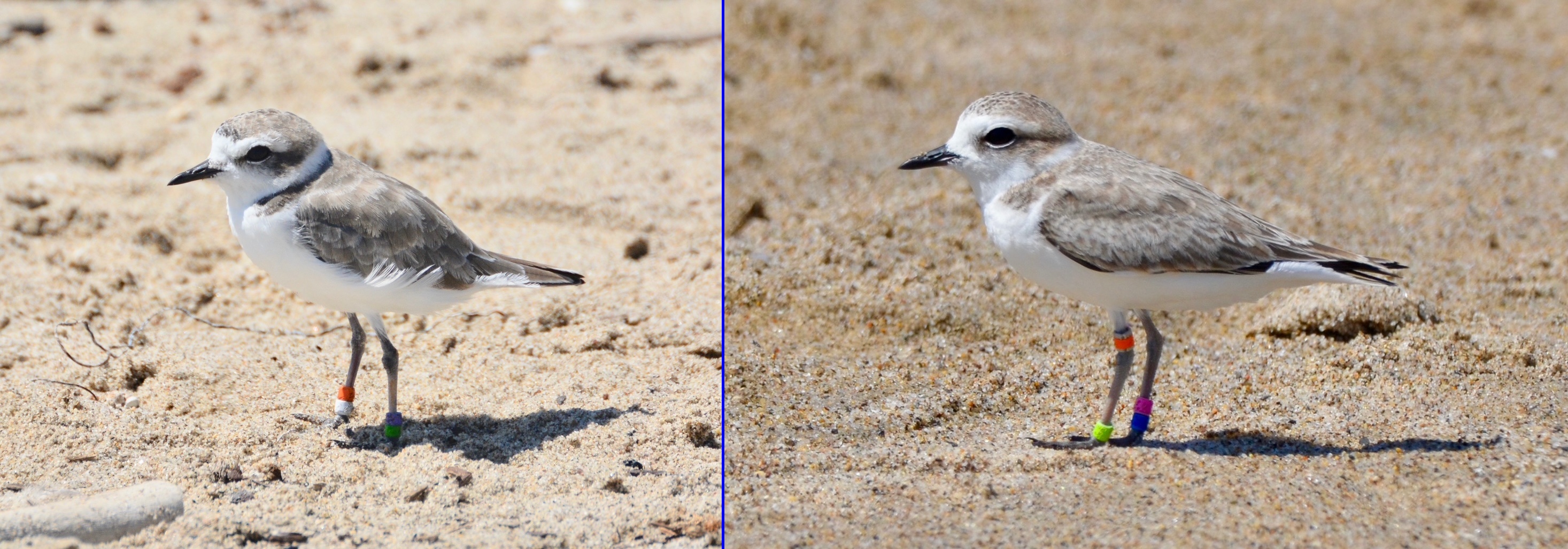
Over on the main part of the beach we encountered most of the birds. I’m including a few photos of banded Western Snowy Plover who had appeared earlier in September.
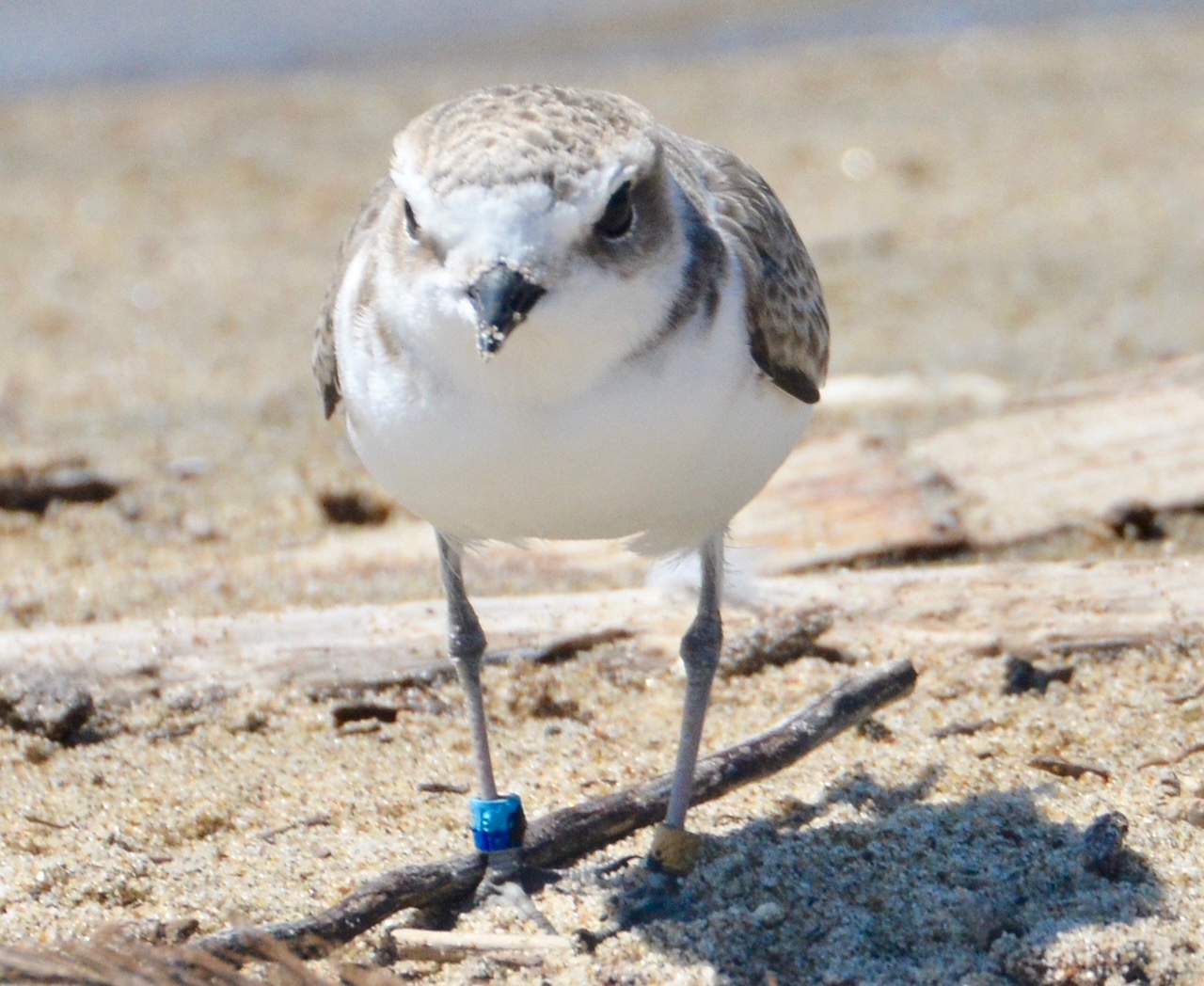
Grace Murayama, photographer and decades-long monitor and censuser of Western Snowy Plovers, in reference to the photo below, added:
Oh, and, as I was making my way back to the walkpath, I must’ve disturbed a large spider, who hitched a ride on me & my clipboard. At first, it startled me; 😮, but, just look at the size and color! So silvery!
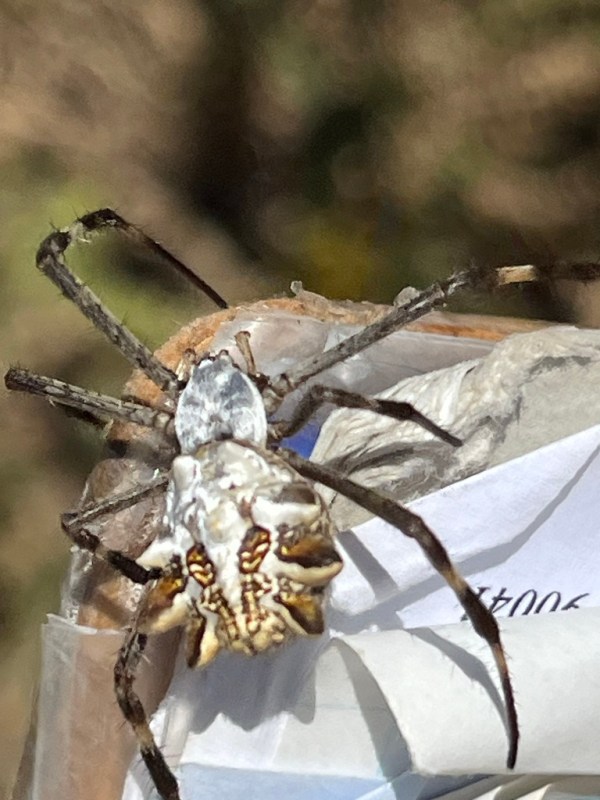
Grace and her husband Larry are pros. No spider the size of a dinner plate suddenly appearing on their neck or arm or clipboard is going to rattle them. It’s just another photo op!
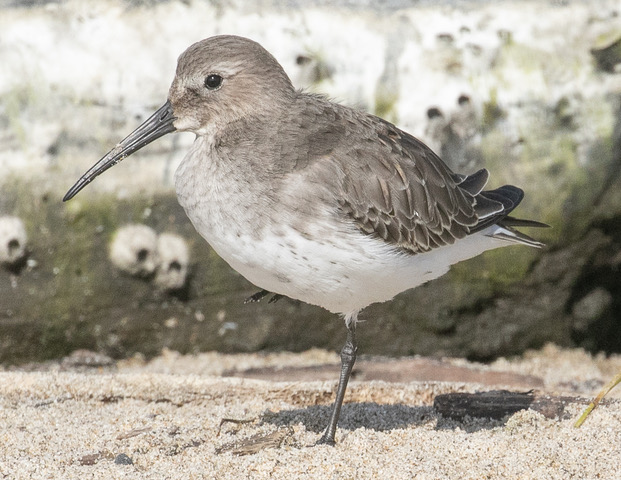
Dunlins are one of those shorebirds we always look for, and seem to think we see more often that we actually do see them. They’re a very plain gray most of the year, and their long curved black bill seems to be variable in length. Either that, or there’s some remarkable shorter-billed Dunlin-mimics running around on our beaches. In 47 years we’ve seen 64 of them on 36 occasions at the lagoon, with 75% of those occasions in April, September and October.
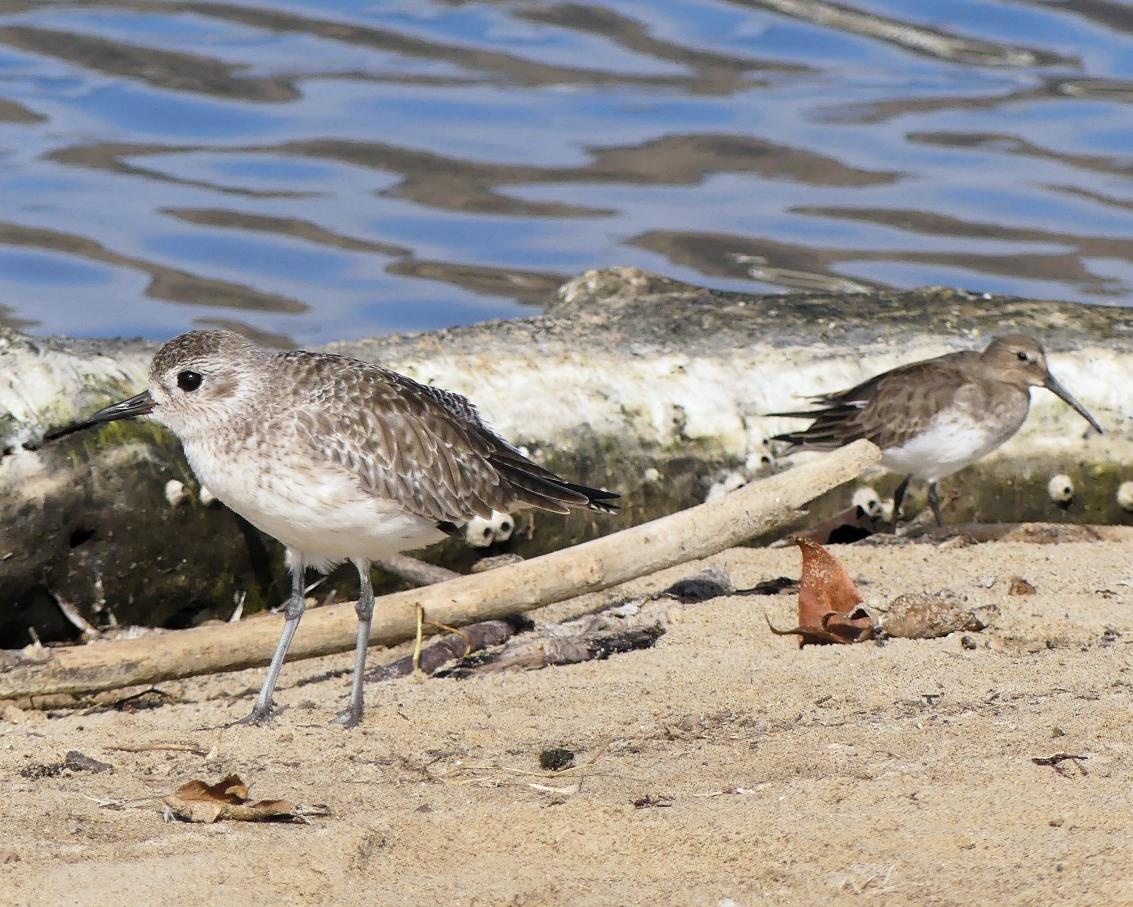
Here’s a good size comparison, with the 8.5″ Dunlin standing slightly behind the 11.5″ Black-bellied Plover. Remember that length is measured bill-tip to tail-tip (forget the legs). The plover’s length is mostly in the body and tail, whereas much of the Dunlin’s length is in the bill. The plover is 35% longer, but weighs an average of 200% more (Dunlin: 49-81 grams, BB Plover: 182-223 grams). No wonder the plover looks so massive when standing next to the Dunlin.
Dunlin Calidris alpina are extremely widespread, nearly everywhere north of the equator and nearly nowhere south of the equator. The Dunlin passing through California are primarily C.a. pacifica, and winter along our Pacific coast from southern Alaska to mid-Mexico. Another North American subspecies C.a.articola winters in SE Asia along with many C.a.pacifica, while C.a.hudsonia winters along the Atlantic and Gulf coasts.
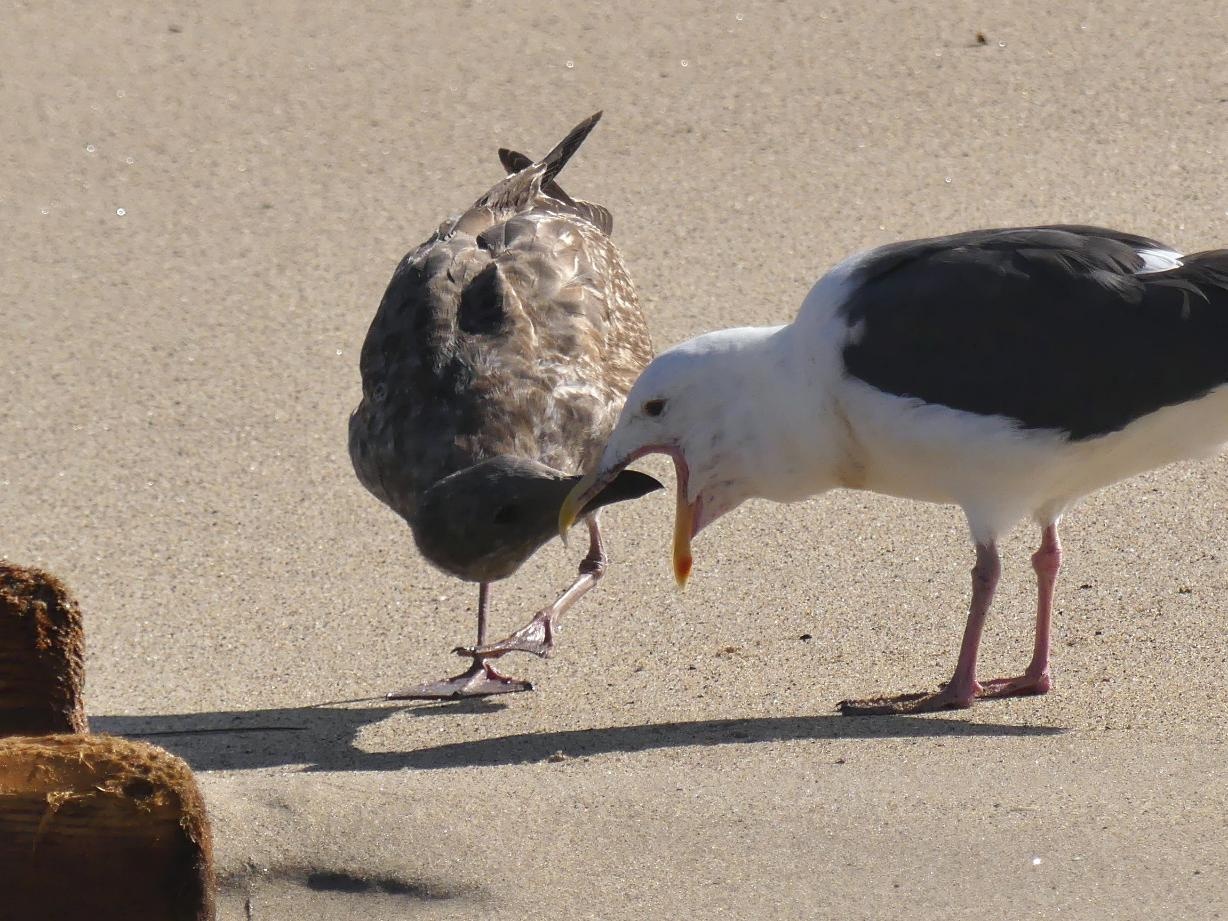
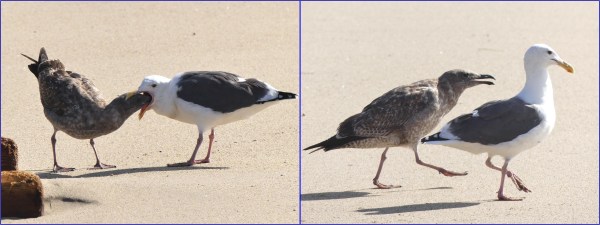
Not quite sure what’s going on here. Most likely this juvenile is looking for a meal from its parent. On the other hand, perhaps a favorite pebble went missing, or someone can’t find the car keys.
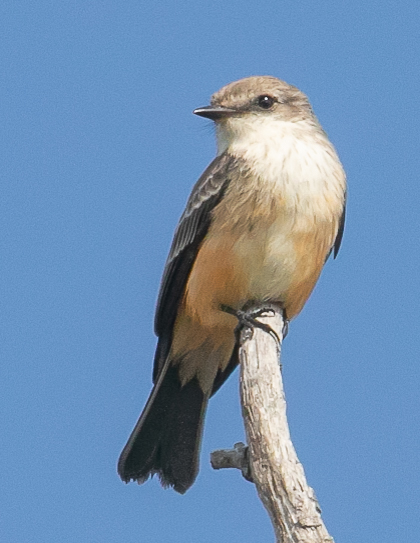
Passerine migrants kept appearing. In the trees over the boathouse at Adamson House we found two Vermilion Flycatchers, bringing us to a grand total of three over the past 45 years, making it about as common as the Cassin’s Vireo above. Both were females or juveniles. The only prior bird was a singleton on on 21 Oct 2020. To be fair, they’re not particularly common anywhere in L.A. County, but they have been steadily increasing over the past several decades. We used to have to drive out to Morongo Valley in the desert to see one. Now they’re popping up everywhere. Checking eBird for lagoon sightings, I found 16 reports for 4 events: 1 bird by Kimball Garrett on 11/4/89; 10 sightings of 1 bird Oct 17-21 2020, 1 sighting on 10/15/25, and our four reports for our bird(s), split as to whether it was one bird or two.
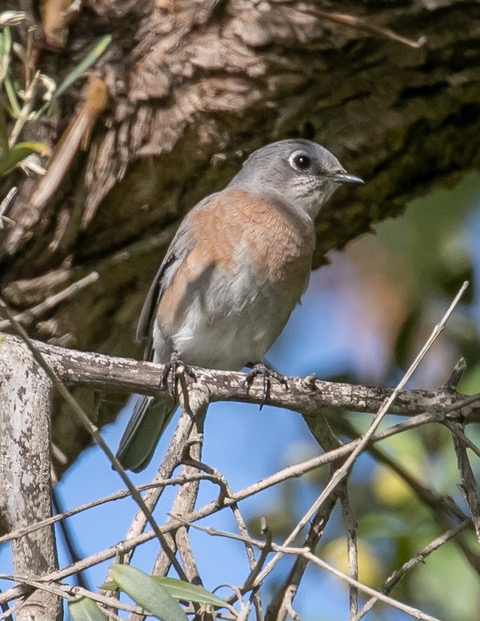
Western Bluebirds are certainly more abundant at the lagoon than are Vermilion Flycatchers, but still not common. They’ve appeared quite regularly since 2016, once a year, until last year when they showed up three times. So far this year it’s been twice, but with five birds this time. Whew! Stunningly abundant.
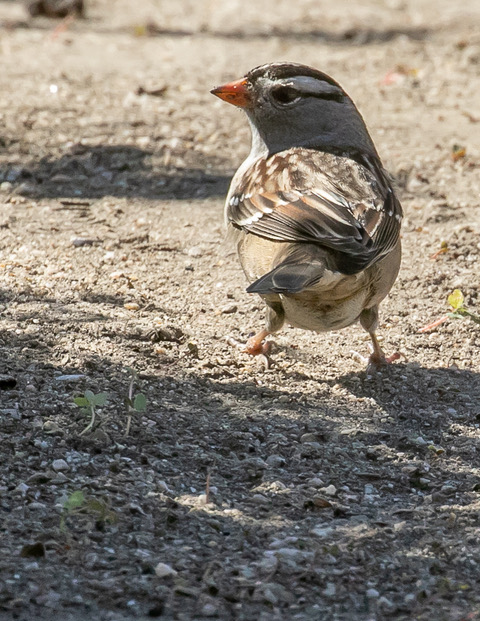
And the ever-faithful White-crowned Sparrows are with us from September through March, every year. Solid, reliable members of the Malibu Beach winter community who have never failed to return their books on-time to the library.
Malibu Lagoon on eBird as of 9-30-26: 9699 lists, 3179 eBirders, 325 species. https://ebird.org/hotspot/L597658
Most recent new species:
Northern Parula: 9/23/26 by Dessi Sieburth (no photo). https://ebird.org/atlascalifornia/checklist/S395608570
Red-footed Booby: 9/13/26 by Susan Gulliland, photos. https://ebird.org/checklist/S392641130
Canyon Wren, 06/11/26 by Judith Olsen (no photo). https://ebird.org/checklist/S355993537
Birds new for the season: Marbled Godwit, Sanderling, Dunlin, Eared Grebe, Yellow-crowned Night Heron, Belted Kingfisher, Nanday Parakeet, Say’s Phoebe, Vermilion Flycatcher, Cassin’s Vireo, Wrentit, Swinhoe’s White-eye, Northern Mockingbird, Scaly-breasted Munia, Dark-eyed Junco, White-crowned Sparrow, Yellow Warbler. “New for the season” means it has been three or more months since last recorded on our trips.
Many, many thanks to photographers Femi Famosa, Ray Juncosa. Grace Murayama & Chris Tosdevin
Upcoming SMBAS scheduled field trips; no reservations or Covid card necessary unless specifically mentioned:
- Madrona Marsh, Sat. Oct 10, 9 am
- Malibu Lagoon, Sun. Oct 25, 8:30 am (adults) & 10 am (parents & kids)
- Malibu Creek State Park, Nov 7, 8 am
- Malibu Lagoon, Sun. Nov 22, 8:30 am (adults) & 10 am (parents & kids)
- These and any other trips we announce for the foreseeable future will depend upon expected status of the Covid/flu/etc. pandemic, not to mention landslides, fires, local flooding and atmospheric rivers at trip time. Any trip announced may be canceled shortly before trip date if it seems necessary. By now any other comments should be superfluous.
- Link to Programs & Field Trip schedule.
The next SMBAS Zoom program: Tuesday, October 6, 7:30pm; Important Birds of Ancient Lake Cahuilla and the Salton Sea, with Kurt Leuschner.
The SMBAS 10 a.m. Parent’s & Kids Birdwalk has again resumed. Reservations not necessary for families, but for groups (scouts, etc.), please call Jean (213-522-0062).
Links: Unusual birds at Malibu Lagoon
9/23/02 Aerial photo of Malibu Lagoon
Aerial ‘film’ flying north over lagoon
More recent aerial photo
Prior checklists:
2025: Jan-June, July-Dec 2026: Jan-June
2023: Jan-June, July-Dec 2024: Jan-June, July-Dec
2021: Jan-July, July-Dec 2022: Jan-June, July-Dec
2020: Jan-July, July-Dec 2019: Jan-June, July-Dec
2018: Jan-June, July-Dec 2017: Jan-June, July-Dec
2016: Jan-June, July-Dec 2015: Jan-May, July-Dec
2014: Jan-July, July-Dec 2013: Jan-June, July-Dec
2012: Jan-June, July-Dec 2011: Jan-June, July-Dec
2010: Jan-June, July-Dec 2009: Jan-June, July-Dec
The 10-year comparison summaries created during the 2012-13 Lagoon Reconfiguration Project period, remain available—despite numerous complaints—on our Lagoon Project Bird Census Page. Very briefly summarized, the results unexpectedly indicate that avian species diversification and numbers improved slightly during the restoration period June’12-June’14. We also have a newly-refurbished slide show of the reconfiguration from just before it started until the recent 13-year celebration.
Many thanks to Marie Barnidge-McIntyre, Femi Faminu, Chris Lord, Chris Tosdevin and others for contributions made to this month’s census counts.
The species list below was re-sequenced as of 12/31/25 to agree with the eBird sequence. If part of the right side of the chart below is hidden, there’s a slider button inconveniently located at the bottom end of the list. The numbers 1-9 left of the species names are keyed to the nine categories of birds at the bottom. Updated lagoon bird check lists can be downloaded here.
[Chuck Almdale]
| Malibu Census 2025-26 | 4/26 | 5/24 | 6/28 | 7/26 | 8/23 | 9/27 | |
| Temperature | 55-64 | 60-63 | 61-66 | 72-76 | 67-81 | 71-79 | |
| Tide Lo/Hi Height | H+4.32 | L+0.42 | H+3.35 | H+3.49 | H+3.64 | H+5.71 | |
| Tide Time | 0624 | 1126 | 1034 | 0949 | 0858 | 1001 | |
| 1 | Brant (Black) | 1 | 2 | ||||
| 1 | Cackling Goose | 1 | |||||
| 1 | Canada Goose | 4 | |||||
| 1 | Gadwall | 25 | 18 | 10 | 11 | 15 | 3 |
| 1 | Mallard | 8 | 12 | 15 | 35 | 6 | 4 |
| 1 | Northern Pintail | 1 | |||||
| 1 | Surf Scoter | 1 | 1 | 1 | 8 | ||
| 1 | Red-breasted Merganser | 3 | 1 | ||||
| 2 | Feral Pigeon | 8 | 10 | 2 | 1 | ||
| 2 | Mourning Dove | 1 | 3 | 2 | 3 | ||
| 2 | Black-chinned Hummingbird | 1 | |||||
| 2 | Anna’s Hummingbird | 2 | 1 | 3 | 1 | ||
| 2 | Allen’s Hummingbird | 2 | 6 | 3 | 6 | 4 | 3 |
| 3 | American Coot | 3 | 2 | 4 | 20 | ||
| 4 | Black-bellied Plover | 3 | 3 | 2 | 35 | 50 | 25 |
| 4 | Killdeer | 6 | 3 | 3 | 2 | 8 | 6 |
| 4 | Semipalmated Plover | 6 | 1 | ||||
| 4 | Snowy Plover | 1 | 17 | 20 | 3 | ||
| 4 | Hudsonian Whimbrel | 6 | 7 | 11 | 2 | 2 | |
| 4 | Long-billed Curlew | 1 | |||||
| 4 | Marbled Godwit | 6 | |||||
| 4 | Spotted Sandpiper | 1 | 1 | 1 | |||
| 4 | Willet | 9 | 1 | 6 | 6 | ||
| 4 | Ruddy Turnstone | 1 | 2 | 1 | |||
| 4 | Sanderling | 7 | |||||
| 4 | Dunlin | 1 | |||||
| 4 | Least Sandpiper | 3 | 2 | 7 | |||
| 4 | Western Sandpiper | 29 | |||||
| 5 | Bonaparte’s Gull | 1 | |||||
| 5 | Heermann’s Gull | 75 | 2 | 18 | 9 | 1 | |
| 5 | Western Gull | 40 | 22 | 29 | 68 | 51 | 21 |
| 5 | American Herring Gull | 1 | |||||
| 5 | California Gull | 110 | 6 | 1 | 2 | 4 | |
| 5 | Caspian Tern | 11 | 3 | 5 | 1 | 1 | |
| 5 | Elegant Tern | 750 | 185 | 3 | 12 | 4 | 3 |
| 5 | Royal Tern | 18 | 3 | 3 | 9 | 31 | 2 |
| 6 | Pied-billed Grebe | 1 | 6 | 3 | 4 | 7 | 4 |
| 6 | Eared Grebe | 1 | |||||
| 6 | Western Grebe | 4 | 35 | 1 | |||
| 6 | Red-throated Loon | 1 | |||||
| 6 | Pacific Loon | 1 | |||||
| 6 | Common Loon | 1 | 1 | ||||
| 6 | Brandt’s Cormorant | 4 | 2 | 1 | |||
| 6 | Pelagic Cormorant | 2 | 1 | 2 | 1 | 1 | 1 |
| 6 | Double-crested Cormorant | 26 | 25 | 10 | 30 | 21 | 9 |
| 6 | Yellow-crowned Night-Heron | 1 | |||||
| 6 | Black-crowned Night-Heron | 3 | |||||
| 6 | Snowy Egret | 2 | 3 | 2 | 8 | 7 | 6 |
| 6 | Green Heron | 1 | 1 | 1 | |||
| 6 | Great Egret | 2 | 1 | 2 | 2 | 1 | |
| 6 | Great Blue Heron | 3 | 1 | 3 | 2 | 2 | 5 |
| 6 | Brown Pelican | 395 | 28 | 64 | 15 | 2 | 4 |
| 7 | Turkey Vulture | 4 | 10 | 2 | 2 | ||
| 7 | Osprey | 1 | 1 | 1 | |||
| 7 | Red-shouldered Hawk | 1 | 1 | ||||
| 7 | Red-tailed Hawk | 1 | 1 | 2 | |||
| 8 | Belted Kingfisher | 1 | 2 | ||||
| 8 | Nuttall’s Woodpecker | 1 | |||||
| 7 | American Kestrel | 1 | |||||
| 7 | Peregrine Falcon | 1 | 1 | ||||
| 8 | Nanday Parakeet | 1 | |||||
| 9 | Western Flycatcher | 1 | |||||
| 9 | Black Phoebe | 2 | 4 | 2 | 1 | 3 | 3 |
| 9 | Say’s Phoebe | 2 | |||||
| 9 | Vermilion Flycatcher | 2 | |||||
| 9 | Cassin’s Kingbird | 1 | |||||
| 9 | Hutton’s Vireo | 1 | |||||
| 9 | Cassin’s Vireo | 1 | |||||
| 9 | California Scrub-Jay | 2 | 1 | 1 | 1 | 2 | |
| 9 | American Crow | 2 | 8 | 8 | 4 | 5 | 5 |
| 9 | Common Raven | 1 | 1 | 1 | |||
| 9 | Oak Titmouse | 1 | 1 | 3 | 2 | ||
| 9 | Tree Swallow | 3 | |||||
| 9 | Violet-green Swallow | 2 | |||||
| 9 | No. Rough-winged Swallow | 5 | 3 | 2 | 10 | ||
| 9 | Barn Swallow | 8 | 12 | 15 | 35 | 15 | |
| 9 | Cliff Swallow | 25 | 20 | 3 | 5 | 2 | |
| 9 | Bushtit | 1 | 10 | 25 | 8 | 15 | 20 |
| 9 | Wrentit | 1 | 2 | 2 | 1 | ||
| 9 | Swinhoe’s White-eye | 1 | |||||
| 9 | Northern House Wren | 1 | 1 | 6 | |||
| 9 | Marsh Wren | 1 | 1 | ||||
| 9 | European Starling | 2 | 6 | 5 | 12 | 30 | |
| 9 | Northern Mockingbird | 2 | |||||
| 9 | Western Bluebird | 3 | 5 | ||||
| 9 | American Robin | 1 | |||||
| 9 | Scaly-breasted Munia | 3 | |||||
| 9 | House Finch | 10 | 9 | 7 | 22 | 6 | 6 |
| 9 | Lesser Goldfinch | 2 | 5 | ||||
| 9 | Dark-eyed Junco | 1 | 2 | ||||
| 9 | White-crowned Sparrow | 1 | |||||
| 9 | Song Sparrow | 6 | 4 | 4 | 3 | 4 | 5 |
| 9 | California Towhee | 1 | 2 | 2 | 1 | 1 | 2 |
| 9 | Spotted Towhee | 1 | |||||
| 9 | Hooded Oriole | 2 | 4 | 1 | |||
| 9 | Red-winged Blackbird | 2 | 5 | 4 | |||
| 9 | Great-tailed Grackle | 4 | 8 | 1 | 3 | ||
| 9 | Orange-crowned Warbler | 1 | 1 | 1 | 3 | ||
| 9 | Common Yellowthroat | 4 | 7 | ||||
| 9 | Yellow Warbler | 1 | |||||
| 9 | Black-headed Grosbeak | 1 | |||||
| Totals Birds by Type | Apr | May | Jun | Jul | Aug | Sep | |
| 1 | Waterfowl & Quail | 42 | 35 | 25 | 47 | 22 | 15 |
| 2 | Doves, Swifts & Hummers | 11 | 21 | 6 | 15 | 4 | 5 |
| 3 | Rails & Coots | 0 | 0 | 3 | 2 | 4 | 20 |
| 4 | Shorebirds | 54 | 6 | 22 | 70 | 97 | 58 |
| 5 | Gulls & Terns | 1005 | 221 | 60 | 99 | 90 | 30 |
| 6 | Grebe, Loon, Heron, Pelican | 435 | 105 | 91 | 63 | 46 | 33 |
| 7 | Hawks & Falcons | 6 | 11 | 3 | 3 | 3 | 4 |
| 8 | Kingfish, Peckers & Parrots | 2 | 0 | 0 | 0 | 0 | 3 |
| 9 | Passerines | 70 | 92 | 96 | 100 | 81 | 123 |
| Totals Birds | 1625 | 491 | 306 | 399 | 347 | 291 | |
| Total Species by Group | Apr | May | Jun | Jul | Aug | Sep | |
| 1 | Waterfowl & Quail | 6 | 6 | 2 | 3 | 3 | 3 |
| 2 | Doves, Swifts & Hummers | 3 | 4 | 3 | 5 | 1 | 3 |
| 3 | Rails & Coots | 0 | 0 | 1 | 1 | 1 | 1 |
| 4 | Shorebirds | 7 | 2 | 5 | 8 | 9 | 10 |
| 5 | Gulls & Terns | 7 | 6 | 7 | 5 | 6 | 4 |
| 6 | Grebe, Loon, Heron, Pelican | 8 | 10 | 10 | 8 | 11 | 10 |
| 7 | Hawks & Falcons | 3 | 2 | 2 | 2 | 3 | 3 |
| 8 | Kingfish, Peckers & Parrots | 2 | 0 | 0 | 0 | 0 | 2 |
| 9 | Passerines | 16 | 21 | 19 | 17 | 15 | 26 |
| Totals Species – 101 | 52 | 51 | 49 | 49 | 49 | 62 |
Discover more from SANTA MONICA BAY AUDUBON SOCIETY BLOG
Subscribe to get the latest posts sent to your email.



