Free email delivery
Please sign up for email delivery in the subscription area to the right.
No salesman will call, at least not from us. Maybe from someone else.
Gull, Loon, Wren and Winter Rain, 22 December, 2019
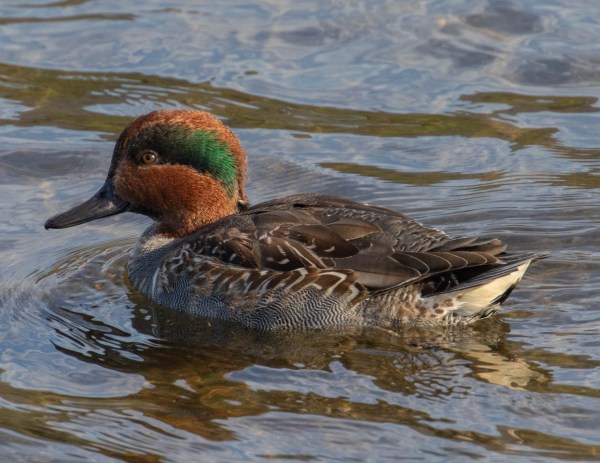
Green-winged Teal male (Chris Tosdevin 12-22-19)
Cool weather, predictions of rain and Christmas coming at us like an angry goose kept away the crowds. About fifteen birders assembled and had the beach to themselves. Less than a handful of surfers bobbed in the water. Even the yoganistas failed to appear, as did the threatened rain.

North channel view from meeting pavilion (Lu Plauzoles 12-22-19)
November’s bird counts were down from October’s, but species counts were up. December is a reversal: 1733 birds in 52 species. [See trip list at end of report.] The five-year December average for 2014-2018 is 1716 birds in 63 species, so this December’s total bird count is extremely average but species diversity is low.
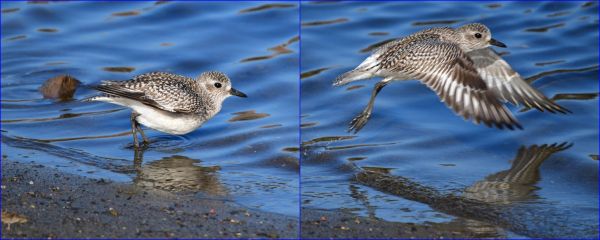
Black-bellied Plover (Adrian Douglas 12-22-19)
Rain rushing down Malibu Creek blew a hole through the beach, just as always occurs this time of year. The standard pattern is for the creek flow to take a direct path to the ocean by cutting through the beach directly opposite the PCH bridge.
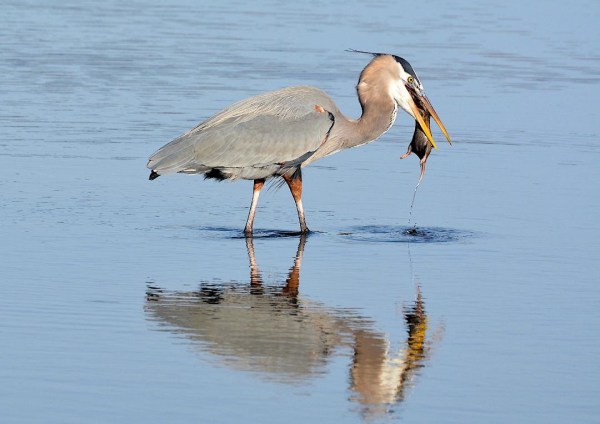
Great Blue Heron eating something other than a fish, for a change.
(G. Murayama 12-20-19 Malibu Lagoon)
After the flow subsides, our longshore current, strongly flowing eastward, moves the sea end of the outlet eastward, with the lagoon end of the outlet following along behind. We see this movement in transition in the two photos below, taken 16 days apart.
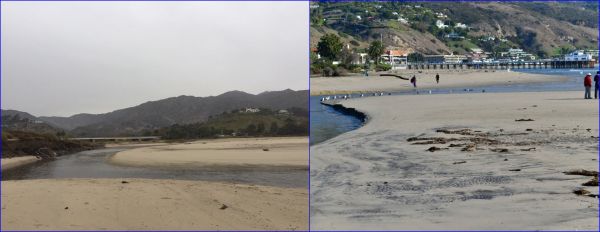
Malibu Creek blows through the beach
Left: Day after the beach breach (G. Murayama 12-6-19)
Right: Two weeks later (A. Douglas 12-22-19)
Our birding quandaries this month focused on two species: one loon and several gulls.
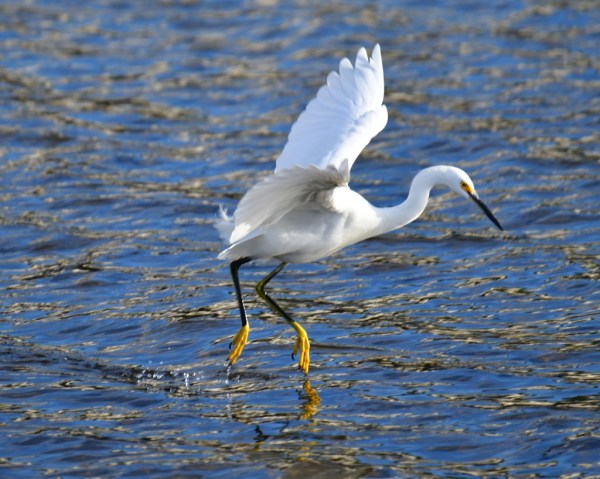
Snowy Egret (A. Douglas 12-24-19)
Chris the Brit spotted the loon from our meeting area. It was all the way across the channel, the sunlight wasn’t particularly helpful and it was facing us. Chris thought it was a Common Loon, but as we peered at it through our telescopes, we revised our opinions, bouncing back and forth (and back and forth) between Common and Pacific Loons. Red-throated didn’t seem likely, primarily because it had dark plumage nearly surrounding the eye and we couldn’t see a bevel in the lower bill. But we needed to see it more closely. Perhaps the light and angle would improve.

Red-throated Loon (C. Tosdevin 12-24-19)
The other side of the channel afforded better view, but the light was still not good and our group watched and debated it for about 10 minutes. [Actually, many got bored with endlessly staring at the same bird and wandered away.] As we stared, more details appeared. The back was finely speckled with white spots, the head was held tilted upwards slightly, we could see a hint of a bevel in the lower mandible, it had no sign of a dark chin strap or uneven dark half-collar. We tentatively concluded it was a Red-throated Loon after all, but waited to see the photos. This species’ scientific name is Gavia stellata; stellata means “starred” and refers to the finely-spotted back in the winter.

Red-throated Loon slightly oiled on breast, belly and flank (C. Tosdevin 12-24-19)
The legs of loons are far back on their bodies. This makes them wonderful and powerful swimmers, but exceptionally poor at walking on land. They don’t like coming to land, so if you see one on the shore, it’s likely to be ill, wounded or oiled. This bird was slightly oiled on the breast and flank.
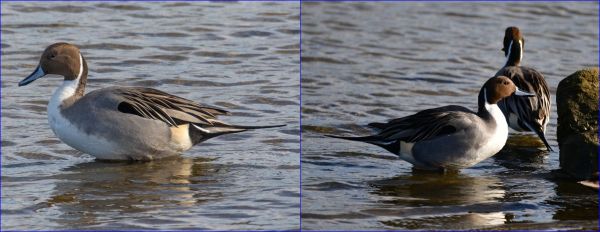
Northern Pintails (Left – C. Tosdevin, Right – A. Douglas, both 12-24-19)
A little farther on, at the 2nd viewpoint, a very obliging Marsh Wren, well away from his usual reedy redoubt, flitted around the lagoon edge, under a large fallen log, and through the pickleweed. Most of us eventually saw this fast-moving little devil.
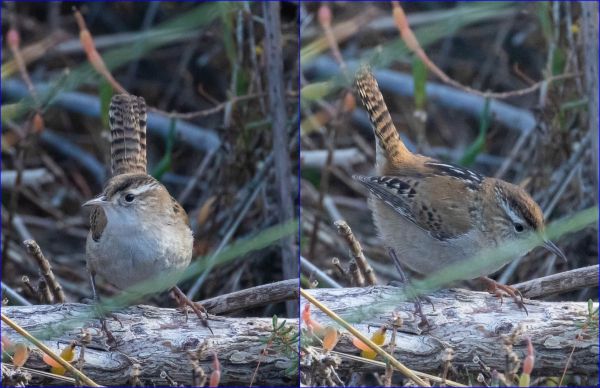
Marsh Wren, away from the reed bed (C. Tosdevin 12-24-19)
On the beach we sorted through the large and fluctuating gull flocks: some were in the lagoon, some on the beach, some on the two slightly offshore “islands” of low-tide-exposed rocks. Most (86%) were California Gulls, with 9% Western, 4% Ring-billed, four Heermann’s, three Glaucous-winged (first year) and one whole Herring Gull. We debated about the Glaucous-winged Gulls, trying to turn one into an Iceland (Thayer’s) Gull, but failed.
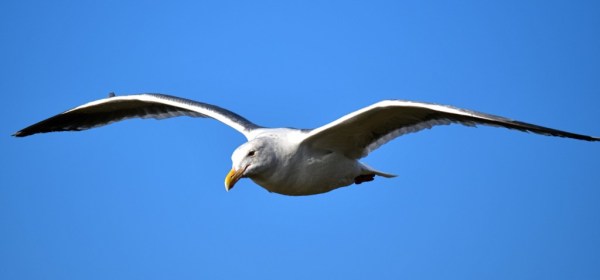
Western Gull gliding in to the lagoon (A. Douglas 12-24-19)
Glaucous-winged Gulls are regular winter visitors in small numbers. “Glaucous” means “waxy,” and the young birds do look – when compared to other species – as if they’re dipped in wax. We get mostly first-year (first-cycle) birds in SoCal. They nest around the Bering Sea and not many stray farther south than northwestern Oregon. It may be that young birds stray farther south in order to avoid directly competing with the older and better-informed adult birds. Young birds still in juvenal plumage have a slightly “buttery” yellowish tinge to their plumage. This becomes more clearly white (see below) sometime during the winter. [The timing of plumage molts in gulls are generally erratic and birds of the same age may perform the same molt months apart.)

Glaucous-winged Gull 1st winter, with bleached and abraded secondary feathers
(C. Tosdevin 12-24-19 Malibu Lagoon)
Our Snowy Plover population is still holding steady, despite the storm-caused changes to beach configuration: September – 42, October – 40, November – 43, December – 39. Most were roosting on the relative high beach east of the outlet. The rest busily ran around across the damp sand.

Ruddy Turnstone (A. Douglas 12-24-19)
When we left it was still cool – for Malibu – at 64° and the rain did not arrive until after nightfall.

Double-crested Cormorant drying wing feathers (A. Douglas 12-24-19)
Birds new for the season: Northern Pintail, Western Sandpiper, Red-throated Loon, Red-tailed Hawk, American Pipit, Golden-crowned Sparrow.
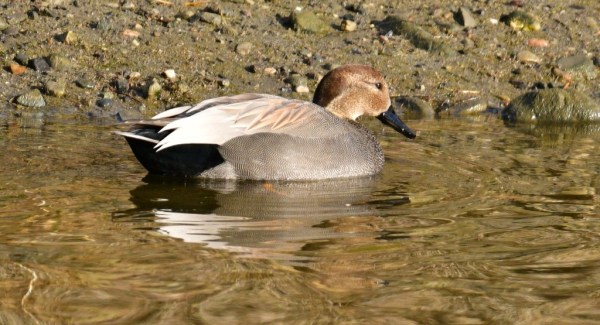
Gadwall male (A. Douglas 12-24-19)
Many thanks to our photographers: Adrian Douglas, Grace Murayama, Lu Plauzoles, Chris Tosdevin.

Whimbrel (A. Douglas 12-24-19)
Our next four scheduled field trips: LA Xmas Count – Santa Monica area, Sat 4 January; Antelope Valley Raptor Search, Sat 11 January; Malibu Lagoon 8:30 & 10am, Sun 26 January.
Our next program: Cuban Birds & Island Biogeography, with Tom Hinnebusch. Tuesday, 4 February, 7:30 p.m., Chris Reed Park, 1133 7th St., NE corner of 7th and Wilshire Blvd. in Santa Monica.
NOTE: Our 10 a.m. Parent’s & Kids Birdwalk meets at the shaded viewpoint just south (towards the water) of the parking area. Watch out for Willie the Weasel. He’ll be watching for you and your big floppy feet.
Links: Unusual birds at Malibu Lagoon recently updated with new photos
9/23/02 Aerial photo of Malibu Lagoon
Prior checklists:
2019: Jan-June,
2018: Jan-June, July-Dec 2017: Jan-June, July-Dec
2016: Jan-June, July-Dec 2015: Jan-May, July-Dec
2014: Jan-July, July-Dec 2013: Jan-June, July-Dec
2012: Jan-June, July -Dec 2011: Jan-June, July-Dec
2010: Jan-June, July-Dec 2009: Jan-June, July-Dec.
The 10-year comparison summaries created during the Lagoon Reconfiguration Project period, despite numerous complaints, remain available on our Lagoon Project Bird Census Page. Very briefly summarized, the results unexpectedly indicate that avian species diversification and numbers improved slightly during the restoration period June’12-June’14.
Many thanks to Adrian Douglas, Femi Faminu, Lillian Johnson, Chris Lord, Lu Plauzoles & Chris Tosdevin for their contributions to this month’s checklist. [Chuck Almdale]
| Malibu Census 2018-19 | 7/28 | 8/28 | 9/22 | 10/27 | 11/24 | 12/22 |
| Temperature | 62-66 | 72-78 | 70-77 | 61-71 | 62-72 | 54-64 |
| Tide Lo/Hi Height | H+3.46 | H+3.39 | L+3.21 | H+6.41 | H+6.43 | H+6.08 |
| Tide Time | 0817 | 0725 | 0930 | 0907 | 0705 | 0603 |
| Snow Goose | 1 | |||||
| Gr. White-fronted Goose | 2 | |||||
| Canada Goose | 6 | |||||
| Gadwall | 18 | 20 | 8 | 14 | ||
| American Wigeon | 6 | |||||
| Mallard | 18 | 18 | 40 | 35 | 15 | 22 |
| Northern Pintail | 2 | |||||
| Green-winged Teal | 2 | 4 | 20 | |||
| Redhead | 1 | |||||
| Ring-necked Duck | 4 | 1 | ||||
| Greater Scaup | 1 | |||||
| Red-breasted Merganser | 5 | 13 | ||||
| Ruddy Duck | 3 | 10 | 22 | |||
| Pied-billed Grebe | 1 | 2 | 8 | 6 | 7 | 6 |
| Horned Grebe | 1 | 1 | ||||
| Eared Grebe | 4 | 8 | 2 | |||
| Western Grebe | 14 | |||||
| Rock Pigeon | 18 | 5 | 6 | 8 | 8 | 6 |
| Eurasian Collared-Dove | 2 | |||||
| Mourning Dove | 8 | 2 | 1 | 2 | 2 | 2 |
| Anna’s Hummingbird | 1 | 1 | 2 | 1 | 1 | |
| Allen’s Hummingbird | 9 | 1 | 5 | 4 | 3 | 5 |
| Sora | 1 | |||||
| American Coot | 4 | 4 | 84 | 870 | 210 | 45 |
| Black-bellied Plover | 36 | 72 | 78 | 74 | 85 | 35 |
| Snowy Plover | 11 | 14 | 42 | 40 | 43 | 39 |
| Semipalmated Plover | 2 | 2 | 3 | |||
| Killdeer | 8 | 4 | 5 | 10 | 17 | 17 |
| Whimbrel | 85 | 15 | 20 | 3 | 3 | 3 |
| Long-billed Curlew | 2 | 1 | 1 | |||
| Marbled Godwit | 1 | 17 | 24 | 24 | 10 | 12 |
| Ruddy Turnstone | 2 | 4 | 8 | 12 | 10 | |
| Black Turnstone | 2 | 3 | ||||
| Sanderling | 57 | 35 | 24 | 28 | ||
| Least Sandpiper | 3 | 5 | 3 | 1 | ||
| Pectoral Sandpiper | 1 | |||||
| Western Sandpiper | 1 | 17 | 1 | 1 | ||
| Short-billed Dowitcher | 3 | 1 | ||||
| Spotted Sandpiper | 1 | 1 | 3 | 1 | 1 | |
| Willet | 15 | 16 | 52 | 13 | 6 | 4 |
| Red-necked Phalarope | 5 | 8 | ||||
| Heermann’s Gull | 15 | 2 | 14 | 16 | 22 | 4 |
| Ring-billed Gull | 8 | 45 | 25 | 50 | ||
| Western Gull | 80 | 18 | 29 | 85 | 110 | 120 |
| California Gull | 2 | 93 | 115 | 420 | 1100 | |
| Herring Gull | 2 | 1 | ||||
| Glaucous-winged Gull | 1 | 1 | 3 | |||
| Least Tern | 2 | 5 | ||||
| Caspian Tern | 3 | 12 | ||||
| Royal Tern | 2 | 4 | 1 | 5 | 9 | 4 |
| Elegant Tern | 64 | |||||
| Red-throated Loon | 1 | |||||
| Pacific Loon | 1 | |||||
| Brandt’s Cormorant | 1 | 1 | ||||
| Double-crested Cormorant | 22 | 20 | 39 | 35 | 35 | 37 |
| Pelagic Cormorant | 1 | 2 | ||||
| Brown Pelican | 34 | 6 | 30 | 52 | 12 | 26 |
| Great Blue Heron | 4 | 3 | 3 | 7 | 6 | 4 |
| Great Egret | 2 | 4 | 4 | |||
| Snowy Egret | 19 | 11 | 18 | 8 | 3 | 24 |
| Green Heron | 1 | 1 | 1 | |||
| Black-crowned Night-Heron | 2 | 3 | 3 | 1 | ||
| Turkey Vulture | 2 | 2 | ||||
| Osprey | 1 | 1 | ||||
| Cooper’s Hawk | 1 | |||||
| Red-tailed Hawk | 1 | 1 | ||||
| Belted Kingfisher | 1 | 2 | 1 | 1 | ||
| Nuttall’s Woodpecker | 1 | 1 | 1 | |||
| American Kestrel | 1 | |||||
| Black Phoebe | 3 | 2 | 8 | 5 | 8 | 2 |
| Say’s Phoebe | 1 | 2 | 2 | 2 | ||
| Cassin’s Kingbird | 1 | |||||
| Western Kingbird | 3 | |||||
| California Scrub-Jay | 1 | 1 | ||||
| American Crow | 5 | 4 | 6 | 8 | 5 | 4 |
| Common Raven | 1 | |||||
| Rough-winged Swallow | 1 | |||||
| Cliff Swallow | 11 | |||||
| Barn Swallow | 21 | 7 | 2 | |||
| Bushtit | 30 | 20 | 5 | 8 | 40 | |
| House Wren | 4 | 1 | 1 | |||
| Marsh Wren | 1 | 5 | 3 | 2 | ||
| Bewick’s Wren | 1 | 2 | 1 | 1 | ||
| Blue-gray Gnatcatcher | 4 | 3 | 11 | |||
| Ruby-crowned Kinglet | 1 | |||||
| Wrentit | 1 | 1 | 3 | 2 | ||
| Western Bluebird | 7 | |||||
| Northern Mockingbird | 4 | 2 | 2 | 2 | 2 | 1 |
| European Starling | 25 | 8 | 23 | 50 | 18 | |
| Cedar Waxwing | 18 | |||||
| American Pipit | 1 | |||||
| House Finch | 25 | 3 | 5 | 5 | 6 | 6 |
| Lesser Goldfinch | 2 | |||||
| California Towhee | 2 | 1 | 3 | |||
| Song Sparrow | 4 | 3 | 8 | 8 | 6 | 5 |
| White-crowned Sparrow | 2 | 10 | 4 | 5 | ||
| Golden-crowned Sparrow | 1 | |||||
| Western Meadowlark | 1 | 2 | ||||
| Hooded Oriole | 4 | 2 | ||||
| Brown-headed Cowbird | 15 | 1 | ||||
| Brewer’s Blackbird | 34 | |||||
| Great-tailed Grackle | 4 | 2 | 1 | 7 | 4 | 2 |
| Orange-crowned Warbler | 1 | 3 | ||||
| Common Yellowthroat | 2 | 1 | 7 | 3 | 8 | |
| Yellow Warbler | 5 | |||||
| Yellow-rumped(Aud) Warbler | 15 | 5 | 11 | |||
| Totals by Type | Jul | Aug | Sep | Oct | Nov | Dec |
| Waterfowl | 42 | 18 | 40 | 73 | 45 | 93 |
| Water Birds – Other | 61 | 32 | 162 | 969 | 290 | 119 |
| Herons, Egrets & Ibis | 27 | 21 | 29 | 16 | 11 | 28 |
| Quail & Raptors | 0 | 1 | 2 | 2 | 2 | 3 |
| Shorebirds | 162 | 172 | 305 | 213 | 205 | 149 |
| Gulls & Terns | 111 | 107 | 137 | 268 | 587 | 1282 |
| Doves | 26 | 7 | 9 | 10 | 10 | 8 |
| Other Non-Passerines | 11 | 2 | 6 | 8 | 6 | 8 |
| Passerines | 130 | 84 | 143 | 152 | 132 | 43 |
| Totals Birds | 570 | 444 | 833 | 1711 | 1288 | 1733 |
| Total Species | Jul | Aug | Sep | Oct | Nov | Dec |
| Waterfowl | 3 | 1 | 1 | 8 | 8 | 6 |
| Water Birds – Other | 4 | 4 | 5 | 7 | 10 | 7 |
| Herons, Egrets & Ibis | 4 | 4 | 5 | 3 | 4 | 2 |
| Quail & Raptors | 0 | 1 | 2 | 1 | 2 | 2 |
| Shorebirds | 10 | 14 | 16 | 11 | 11 | 9 |
| Gulls & Terns | 7 | 7 | 4 | 6 | 6 | 7 |
| Doves | 2 | 2 | 3 | 2 | 2 | 2 |
| Other Non-Passerines | 3 | 2 | 2 | 3 | 4 | 4 |
| Passerines | 13 | 17 | 27 | 18 | 21 | 13 |
| Totals Species – 105 | 46 | 52 | 65 | 59 | 68 | 52 |
a
Carbon Tax: The Best Way to Slow Climate Change? | Video from KQED’s Above the Noise
Climate change is happening faster than expected. Is a carbon tax the answer?
The 2018 UN report shows that climate change is happening a lot faster than scientists originally predicted. As a result, there’s a renewed interest in carbon taxes as a way to slow the effects of climate change. The problem is, it’s not always a popular solution as opponents argue it would unfairly hurt the poor- as we’ve seen play out in France lately with the Yellow Vest protests.
ABOVE THE NOISE is a show that cuts through the hype and takes a deeper look at the science behind controversial and trending topics in the news. Hosted by Myles Bess and Shirin Ghaffary.
This series is aimed at teens, but after viewing a few episodes, I’m sure that most adults will benefit from it as well. Let us know what you think.
This is another installment of KQED’s Above the Noise series. If no film or link appears in this email, go to the blog to view it by clicking on the blog title above. If the film stops & starts in an annoying manner, press pause (lower left double bars ||) to let it buffer and get ahead of you. [Chuck Almdale]
Rockjumper’s twelve best birds of 2019
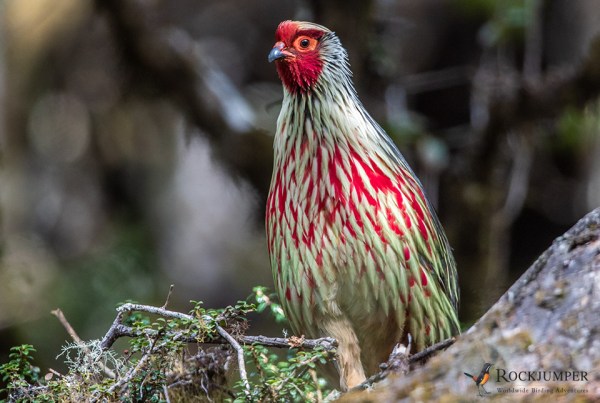
Blood Pheasant – January 2019 Rockjumper Bird-of-the-Month (David Hoddinott, Rockjumper)
Rockjumper, based in South Africa is one of the larger bird tour companies in the world, and every year they have dozens of trips going just about everywhere. I’ve never traveled with them, for no particular reason, but I know many who have and the reports have always been good, with the occasional rave review.
What I do personally know and like about them is their Bird-of-the-Month emails (you can subscribe on this link – monthly birds overlap slightly with the best twelve birds). The photos are always great – often so stunning that your ears may smoke and spin – and come with always-interesting information about the bird, plus the usual advertising for their bird tours, one or more of which just may be going to look for this particular bird. Clever, eh?
So this year they did something new (to me) and have their Twelve Best Birds of 2019, each picked by one of their field trip leaders for their own personal reasons. It’s a great photo show, and you can test your bird knowledge by guessing what the species is, and in some cases, what the family is. Or just drool over the species and the photo. I got three species right and 4.5 families wrong. I’m telling you that not so that you’ll write in and tell me how many you got right or wrong, but just to let you know that the right answers aren’t always obvious.
[Chuck Almdale]
Guam Rail back after 40 years of extinction in the wild

Guam Rail – a fine-looking bird (CNN photo)
From the CNN article:
Almost four decades after completely disappearing from the wild, a bird that had survived only in captivity now roams freely on two tropical islands.The Guam rail’s native home is a remote, 212-square-mile island in the Pacific Ocean, half way between Australia and Japan.
Read the entire article, with photos, maps and links to reports on other Guam birds and other endangered species.
[Chuck Almdale]
Back Bay Newport Rails, Ducks and Herons: 14 December 2019
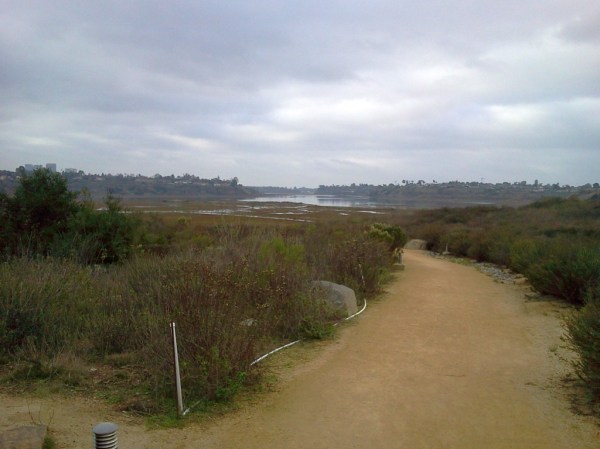
Down the path to the Nature Center (L. Johnson 12-14-19 Upper Newport Bay)
And yet again The God of Tides was with us for a third year in a row, granting us a 6.21 foot high tide at 9:37 AM. The Weather Gods were also in a good mood, squeezing in fair weather and moderate temperatures for us. Keep it up, guys (or gals). Our only problem was getting there. Three out of four cars, traveling separately, completely missed the turnoff from the #405 onto the #73 freeway and were forced to jockey their way there via surface streets. This can be dangerous in Orange County where one can easily become traffic-funneled into a Disneyland parking lot, never to be seen alive again. The fourth car was Orange County local Enid who arrived by a different route.
Master photographer Ray Juncosa who shot all the bird photos last year and took many more this year, suffered a photo-trauma when the central processing unit in his camera went kablooey (a technical term with elusive definition) and ruined almost all his photos, including all the rail photos. So the photos for this essay may look a bit odd.
Identifying birds can be a tricky affair. There are many variables affecting your ability to figure out what you’re looking at, and they fall roughly into two categories: Set and Setting. [I’m not following someone’s thesis on this but am making it up as I write, so forgive me if it lacks coherence.]
Setting includes: location, habitat, brightness and location of ambient light, obscuring vegetation, movements of the bird, reflections, wind, air moisture (rain, fog, snow), rarity or commonness of the species, plumage variations, orientation of the bird to you (side, front, rear, above, below or other view), and probably other factors not coming immediately to mind.
Set includes: you. Everything external and internal about your body and mind, such as: acuity of vision, annoying aspects of wind and sun, fatigue of mind or body, pain in your left foot, hunger, thirst, familiarity with the bird family, genus or species, handiness and accuracy of your field guide, and – not least – your expectations. What do you expect to see in this location, season and time, what other possibilities are there, do you know what the field marks are and have you remembered to look for them on the bird?
All of this is my rationalization of why I had a tough time finding and figuring out three of today’s target birds. I know, I know; excuses, excuses.

The railing and the bay. The railing becomes a high wall further down.
(L. Johnson, Upper Newport Bay 12-8-18)
The late high tide – 9:37am rather than 8am or earlier – gave us plenty of time to get lost (see above), amble around looking for California Gnatcatchers (heard but not seen) and look at every bird within sight. We finally arrived at the marsh edge at a location where the wall wasn’t too high for all of us to see over – hey, whose bright idea was it to build such a high wall next to a bird-filled marsh, anyway? – where we finally found a rail to study, sitting on some floating vegetation, surrounded by thin, obscuring reeds. I decided that it was probably a Ridgway’s (née Clapper) Rail (14.5″ long) rather than the much smaller Virginia’s (9.5″).
Hallelujah! It decided to move, and came directly towards us. Halfway along its journey it passed right by a Coot (15.5″). Check the photo below. It’s fuzzy, but you should be able to see the brownish blob in the foreground.
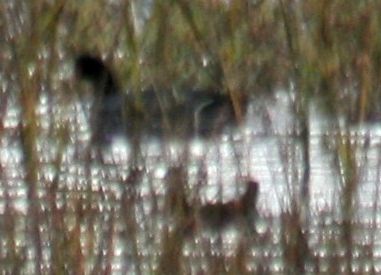
Brown blob in foreground is a Virginia Rail, much smaller than the nearby coot (Marie 12-14-19 Upper Newport Bay)
This was far too small to be a Ridgway’s so it had to be a Virginia Rail. All this time we were looking more-or-less directly towards the sun, with lots of reflecting water. Viewing birds with the sun behind them, rather than behind you, always washes out all colors. You see shades of gray rather than reds, browns and blacks. When feasible, it’s useful to change your location to improve your angle of view, but in this case it was impossible. The bird got very close but instead of climbing up on some vegetation or floating detritus to give us wonderful views, it disappeared behind a low berm, never to be seen again.

Virginia Rail, two views. Notice the bright chestnut breast which you can’t actually see. (Marie, 12-14-19 Upper Newport Bay)
Upon returning home and checking my 2018 report, I found my comment:
This 14.5” species (Ridgway’s Rail) looks a lot like the 9.5” Virginia Rail, and at several hundred yards it’s difficult to judge their size, other than that they were obviously all the same size, thus the same species. When a 13.5” Pied-billed Grebe paddled up to one and the rail was at least as large as the grebe, we erased the final wisps of doubt.
Lightning had struck twice in the same place, but not in exactly the same way.
A little later we saw more rails, ten in total, including a string of seven sitting on the same line of floating vegetation or detritus, several hundred yards away, again mostly into the sun. Hard to see, hard to judge size. I thought I could see back feathers with warm brown edges and black centers. Well, sometimes, anyway. Sometimes they looked gray. Or dull brown. I assumed they were all Virginia’s like the first bird although I really couldn’t see them well enough to be certain.

Bushes, bay and rail-hiding berm (L. Johnson 12-14-19 Upper Newport Bay)
The photo below is the best we have of any of these birds. The colors are a bit weird (enhanced, perhaps?). The back looks green to me, you can’t see the striped flanks and I can’t get any useful pattern off the cheek. Femi sent it to me saying she thought it was a Ridgway’s because “Long bill and it’s seen much more frequently than Virginia’s in that area.” Those are valid reasons for her conclusion, if they’re accurate.
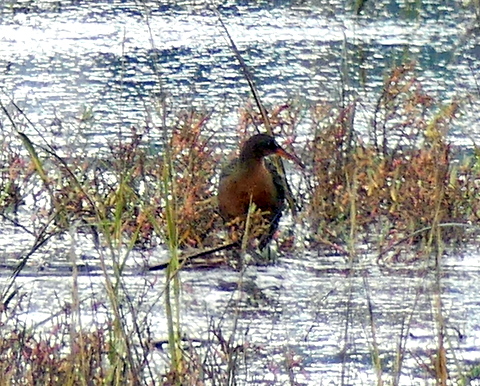
Ridgway’s Rail (F. Faminu 12-14-19 Upper Newport Bay)
The Ridgway’s Rail is more common at Upper Newport Bay in both my experience and according to eBird (Ridgway’s Rail versus Virginia Rail – click blue and red symbols on the linked maps for sighting details) and is reported far more frequently and in greater numbers, as it likes brackish water a lot more than does the Virginia, which prefers fresh water. But the long bill? I decided to check.
When comparing species with long bills, such as sandpipers and rails, it’s often useful to determine the length of bill compared to the head length front-to-back, which a profile view supplies. Skulls works well for this, but my complete collection of bird skulls of the world never magically appeared, so I use bird handbooks and field guides instead, measuring the photos or paintings as exactly as I can. This works nicely for Greater vs. Lesser Yellowlegs, or
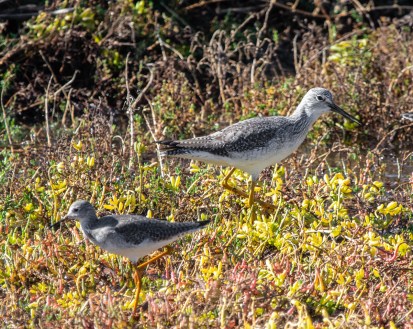
Lesser (L) & Greater (R) Yellowlegs. Note relative difference in bill-length. (R. Juncosa, Upper Newport Bay 12-8-18)
Sanderling vs. Snowy Plover. I didn’t know if it would for Virginia vs. Ridgway’s Rails. In both these species bill-length exceeds head-length. But by how much? I got out my National Geographic Society Field Guide to the Birds of North America (6th edition, 2011) and my millimeter ruler. The Virginia bill-length exceeded head-length by 33%. Ridgway’s was relatively longer, at 43%. So the Ridgway’s bill was relatively 10% longer.
I don’t know know about you, but I doubt that I can see that small a relative difference in length unless the bird is extremely close, like lying in my hand, conveniently dead.
I do this kind of obsessive nitpicking, infrequently, because it’s nearly impossible to judge absolute size ( 5″, 8″, 15″, etc.) of a bird or bird part unless you have something to compare it to, optimally the other species you are considering, right next to your target bird. In my opinion, people who claim to be able to judge size – large or small – of a single isolated bird at a distance should be regarded with skepticism. An eagle at a great distance is the same visual size as a tiny falconet close up. You need other details such as wing position, tail-to-torso length or bill-to-head length.
Just to be obsessively safer, I did the same measurements using the Handbook of Birds of the World (HBW, 1996) and Sibley’s Field Guide to Birds of Western North America (2003). Unfortunately, while the Ridgley’s bill was consistently longer than the Virginia bill, the relative bill-lengths and relative species difference varied. See the chart below.
| NGS | HBW | Sibley | Average | |
| % Length | % Length | % Length | % Length | |
| Bill > Head | Bill > Head | Bill > Head | Bill > Head | |
| Virginia Rail | 33% | 14% | 31% | 26% |
| Ridgley’s Rail | 43% | 48% | 54% | 48% |
| Difference | 10% | 33% | 23% | 22% |
Figure 1. Comparison of bill-length vs. head-length in Virginia and Ridgley’s Rails.
The Virginia relative bill-length varied from 14-33% and the Ridgway’s from 43-54%, with the species difference varying from 10-33%. If you take the average difference of 22% (Ridgway’s relatively bill-length exceeding Virginia bill-length), this might be visible to a good birder with good eyesight and good binoculars in good light with good angle at a reasonable distance. We didn’t have all those conditions, and I’m not sure I’m good enough to discern this difference anyway except at a very close distance.
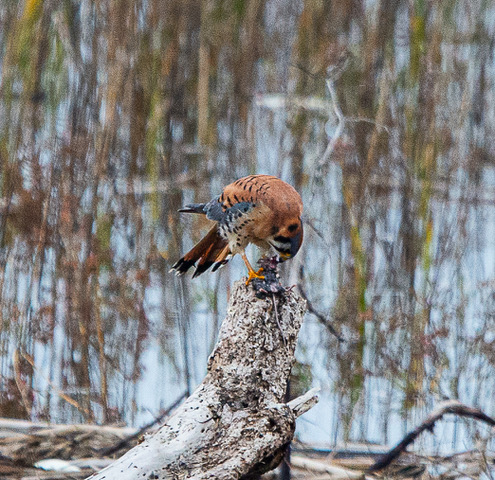
American Kestrel working on a small rodent
(R. Juncosa 12-14-19 Upper Newport Bay)
However, I agree with Femi’s conclusion. All the rails we saw, except the first bird which swam past the coot towards us, were Ridgway’s. The first bird, which I’m not sure she saw, was a Virginia. Problems of light, distance, obstructing vegetation, reflection, comparable species, familiarity, knowledge, expectation and assumption all interfered with my analytical process.
There were plenty of ducks, and we spent a long time searching through the numerous rafts and grouping for uncommon species like Blue-winged Teal, Canvasback or Goldeneye. We didn’t see any.

Green-winged Teal males (R. Juncosa 12-14-19 Upper Newport Bay)
What I noticed was that the ducks were very “clumpy.” We’d see a group of 25-100 birds and they’d all be the same species – American Wigeon, Green-winged Teal, Canada Goose, Northern Pintail, Redhead, Bufflehead or Ruddy Duck – with a very few birds of other species among them. Diving ducks like Bufflehead and Ruddy prefer deeper water where they can chase fish or find crustaceans and mollusks under water, and the “dabbling” ducks like Mallard and Pintail prefer shallow water so they can find food while “tipping” at the surface. But even withing their preferred hunting areas, they clumped.
We went over to the bay’s southern shore and drove along the Mountains to the Sea Trail and Bikeway – a cumbersome name, and yes, it’s legal to drive on it, one-way, 15 mph. We stopped at a dirt pullout and scanned the herons and ducks. The reported Tricolored Heron immediately flew into my binocular view and landed, about 50 yards away. That was convenient!
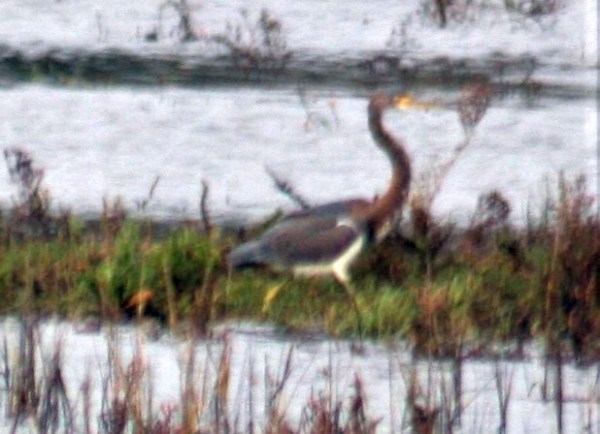
Tricolored Heron (Maria 12-14-19 Upper Newport Bay)
This species is fairly common along the coast of the southeastern and gulf states, down into Mexico and the Caribbean, and the mainland Mexican and Baja coasts. It’s from Baja that they occasionally wander north into SoCal. Not very often or very far north, though. I’d previously seen them only once in SoCal, and never in Los Angeles County. They behave a lot like Reddish Egrets, dancing and jumping around. The “tricolor” refers to their reddish, blue-gray and white plumage. Afterwards we cruised up the road looking at everything, but searching for a reported Little Blue Heron. We didn’t see it.
We lunched at the nearby San Joaquin Marsh, home of Sea & Sage Audubon. Although birding here can be very good, with rare birds often appearing, we left to search for the Red-footed Booby recently and repeatedly seen on the Corona del Mar jetty. Our only new birds (not on the list below) were an American Pipit on the lawn and some White Pelicans on the marsh.
Corona del Mar charges an exorbitant rate in their parking lots. $4.80 for an hour. They don’t tell you the price ahead of time, if you can find a working machine. They take credit cards and exact cash, although I don’t know how you pay in exact cash if you don’t know the exact amount.
We searched the jetties and rocks, picking up Brandt’s Cormorant and Heermann’s Gull, but no Booby. This is another tropical species that occasionally wanders northward. There seem to be more and more such birds recently, with occasional outbreaks of boobies and frigatebirds appearing. Perhaps this is a symptom of our increasingly warmer offshore waters.
Rather than go directly home, we decided to again drive along the upper bay’s south side. Perhaps we’d find the Little Blue Heron. Probably not.
Little Blue Herons come in two colors: blue and white. The juveniles are white, with some small dusky areas, two-toned bluish bills, blue lores, dark (often hidden) wingtips, and darkish legs and feet. It’s necessary to separate them from the similarly plumaged and sized and much more common Snowy Egrets. Normally, if the bird is white, that is mentioned by those who report it, so as to save time for people looking for it. It’s a tricky distinction to make at a distance, so it’s necessary to keep the field mark differences in mind.
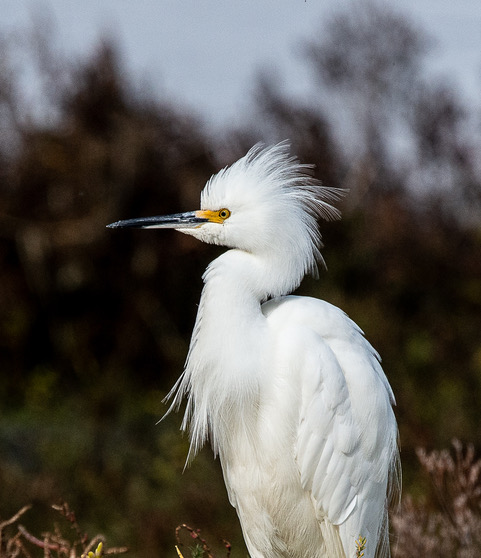
Snowy Egret (R. Juncosa 12-14-19 Upper Newport Bay)
I had seen no mention made of its plumage in the several on-line reports I’d read. So I assumed that the bird was blue, and searched for a Snowy Egret-sized dark blue heron. None were to be seen.
At about our third stop, sitting in the car, idling as bicyclists rode by, we were looking around when Marie spoke from the back seat: “That egret not far away looks a bit weird. It’s got some splotchy dark patches on it.” I looked, and it certainly looked like it could be a juvenile Little Blue Heron, although again we were looking into the sunlight.
Little Blue Heron in white juvenile plumage
(Marie 12-24-19 Upper Newport Bay)
By the time we got the telescope out of the trunk and tripod extended, the bird had flown a couple of hundred yards away and looked pretty small. But we could see dusky patches, dark wing tips, two-toned bluish bill and dark legs with no yellow feet or yellow-green stripe running up the back of the legs. Little Blue Heron! A nice ending to the day.
The drive home was horrible, stop and go all the way, taking more than twice as long as did the morning drive.
Many thanks to our photographers Femi Faminu, Lillian Johnson, Ray Juncosa and Marie.
| Trip Lists – Back Bay Newport | 12/14/19 | 12/8/18 | 11/4/17 |
| Canada Goose | X | X | X |
| Gadwall | X | X | |
| American Wigeon | X | X | X |
| Mallard | X | X | X |
| Blue-winged Teal | X | ||
| Cinnamon Teal | X | X | |
| Northern Shoveler | X | ||
| Northern Pintail | X | X | X |
| Green-winged Teal | X | X | X |
| Canvasback | X | ||
| Redhead | X | X | |
| Greater Scaup | X | ||
| Lesser Scaup | X | X | |
| Bufflehead | X | X | X |
| Hooded Merganser | X | ||
| Ruddy Duck | X | X | X |
| Pied-billed Grebe | X | X | X |
| Eared Grebe | X | ||
| Western Grebe | X | X | |
| Clark’s Grebe | X | X | |
| Double-crested Cormorant | X | X | X |
| American White Pelican | X | ||
| Brown Pelican | X | X | |
| Great Blue Heron | X | X | X |
| Great Egret | X | X | X |
| Snowy Egret | X | X | X |
| Little Blue Heron | X | ||
| Tricolored Heron | X | ||
| Green Heron | X | ||
| Turkey Vulture | X | X | X |
| Osprey | X | X | |
| Northern Harrier | X | X | X |
| Cooper’s Hawk | X | X | |
| Red-tailed Hawk | X | X | X |
| Virginia’s Rail | 1 | ||
| Ridgway’s Rail | 10 | 15 | |
| Sora | 1 | X | |
| American Coot | X | X | X |
| American Avocet | X | X | |
| Black-bellied Plover | X | ||
| Spotted Sandpiper | X | ||
| Greater Yellowlegs | X | X | |
| Willet | X | X | X |
| Lesser Yellowlegs | X | ||
| Whimbrel | X | ||
| Long-billed Curlew | X | X | |
| Marbled Godwit | X | X | X |
| Sanderling | X | ||
| Least Sandpiper | X | X | |
| Ring-billed Gull | X | X | X |
| Western Gull | X | X | X |
| California Gull | X | ||
| Rock Pigeon | X | X | |
| Mourning Dove | X | X | X |
| Anna’s Hummingbird | X | X | X |
| Allen’s Hummingbird | X | X | |
| Belted Kingfisher | X | X | X |
| Northern Flicker | X | ||
| American Kestrel | X | X | X |
| Peregrine Falcon | X | ||
| Black Phoebe | X | X | X |
| Say’s Phoebe | X | X | X |
| Cassin’s Kingbird | X | X | |
| California Scrub-Jay | X | ||
| American Crow | X | X | X |
| Common Raven | X | ||
| No. Rough-winged Swallow | X | ||
| House Wren | X | ||
| Marsh Wren | H | X | X |
| Bewick’s Wren | X | ||
| Blue-gray Gnatcatcher | X | X | |
| California Gnatcatcher | H | X | |
| Ruby-crowned Kinglet | X | ||
| California Thrasher | X | H | |
| Northern Mockingbird | X | X | X |
| Orange-crowned Warbler | X | ||
| Common Yellowthroat | X | X | |
| Yellow-rumped Warbler | X | ||
| California Towhee | X | X | |
| Savannah Sparrow | X | X | X |
| Song Sparrow | X | X | X |
| Lincoln’s Sparrow | X | ||
| White-crowned Sparrow | X | X | X |
| Western Meadowlark | X | ||
| House Finch | X | X | X |
| Lesser Goldfinch | X | X | |
| Total Species – 80 | 59 | 65 | 52 |
| X – Seen | |||
| H – Heard only | |||
| 1, 15 – Number seen |



 SANTA MONICA BAY AUDUBON SOCIETY BLOG