Loons and the Peepless Day: Malibu Lagoon: 24 May 2026
[By Chuck Almdale; photos by Ray Juncosa & Chris Tosdevin]
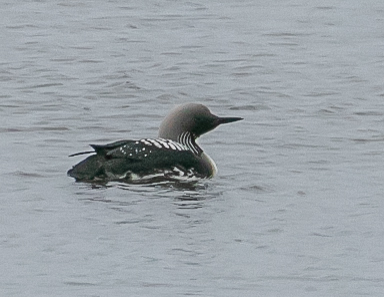
We don’t get a lot of Pacific Loons at the lagoon. We don’t get a lot of any loons at the lagoon for that matter, as the chart below shows.
| 347 Trip Visits: Oct’79 – May’26 | Individuals | Visits | Pct. of 346 Total Visits | Singles | 2-5 | > 5 |
| Red-throated Loon | 71 | 43 | 12% | 26 | 16 | 1 |
| Pacific Loon | 300 | 83 | 24% | 53 | 24 | 6 |
| Common Loon | 125 | 67 | 19% | 40 | 25 | 2 |
The only month we’ve never had any loons was July, but they are scarce June through October. In our monthly charts April appears as the best for Pacific Loon sightings, but that’s due to two large flocks skewing the totals: 20 birds on 4/24/11 and 80 on 4/23/17, which account for 1/3rd of all Pacific Loon sightings at the lagoon.
All three loon species are holarctic, although the Common does not nest in Eurasia east of Finland. Pacific Loons (PALO) begin flying north in April as they start nesting in May as soon as their target nesting areas in Alaska and northern Canada thaw out. Although most hug the coast during migration, between Point Conception (west of Santa Barbara) and northern Baja most fly the direct route over the sea adjacent to or west of the Channel Islands. [Note: I didn’t include Yellow-billed Loon (0 sightings) or Arctic Loon (1 sighting) in these comments.]
They tend to nest in the same area year after year. They sit on their eggs for a month, and the young fledge two months after hatching, which explains why we never see them in July.
Although they molt into their alternate (breeding) plumage before migrating north, we don’t see it often – if ever – because they’re usually miles out to sea when south of Point Conception.
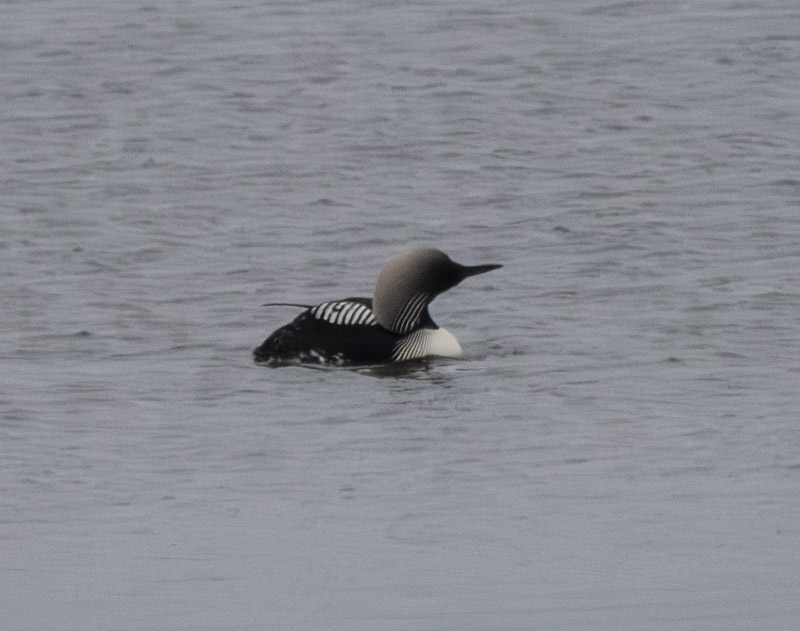
So we got lucky. Triplely lucky, as this bird – which had been floating most conveniently for us in the south lagoon rather than out past the surf zone – took off over the southern channel like a low-flying rocket at about 9:30am and disappeared off to the west.
Incidentally, the genus and family name for Loons – gavia – is from Latin for “gull.” Go figure.
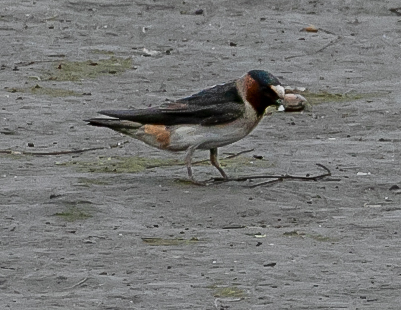
The swallows were very busy, particularly the Barn Swallows catching flies and the Cliff Swallows grabbing mouthfuls of mud, especially from the creekside mud flat just inland of the PCH bridge. Some were nesting under the bridge where you can see their mud nests where adjoining walls and ceilings meet, each nest made from the accumulation of many dozens of mud-mouthfuls. It’s hard to see just exactly what the bird below has in its mouth, whether mud or vegetation. Their bills are very short but very wide, all the better to catch insects on the wing. I saw the bird fly away with something stringy trailing out behind from its bill. They do use grass, leaves and feathers to cushion and insulate their eggs, but the stringy thing looked like a strip of seaweed, not particularly good for insulation, I would think.
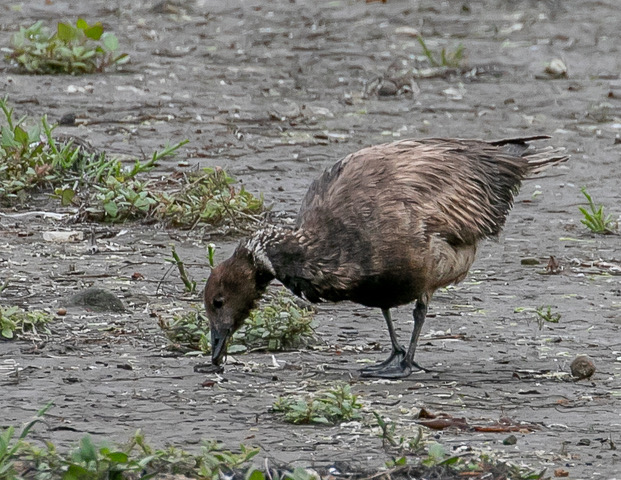
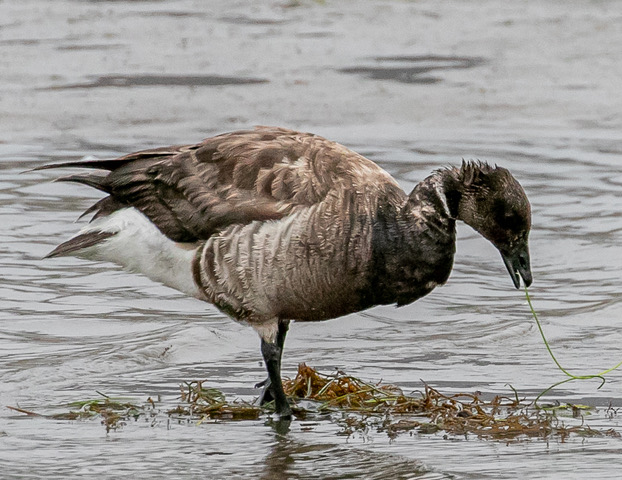
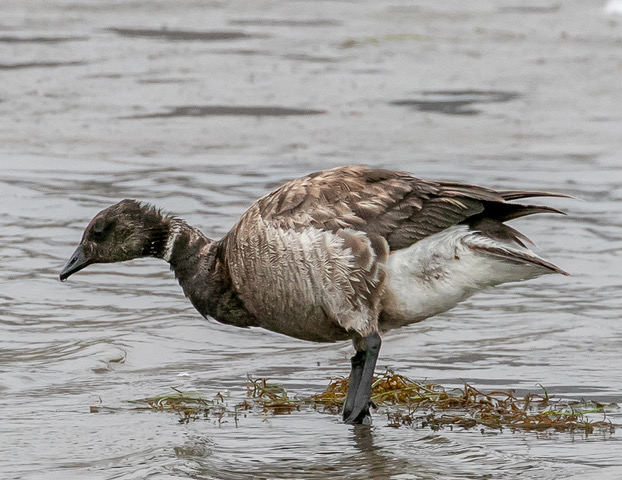
There has been a Brant (Goose) at the lagoon for seven consecutive months. At first it was hiding motionless but inadequately in some beach brush and it’s plumage looked terrible. That was last November 23 and I didn’t think it would survive. But in following visits it was out and about, on the water or beach. A few months ago some new plumage appeared and it was looking quite fit. But no one has seen it fly, and my assumption has always been that it has a damaged wing.
This month a second Brant appeared, but they didn’t get together; the new (we think) one was darker and stayed in the third channel, the old one was it its usual place on the beach in the SW corner of the lagoon or in the nearby lagoon water. But different angles, sunlighting and water vs. land make for differences in appearances, so in the photos below, I’m not sure which one is which, but pressed to guess, I’d say 2 & 3 are the same original bird.
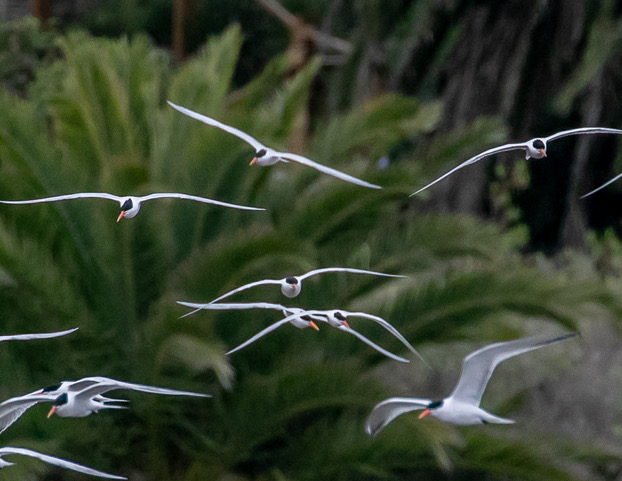
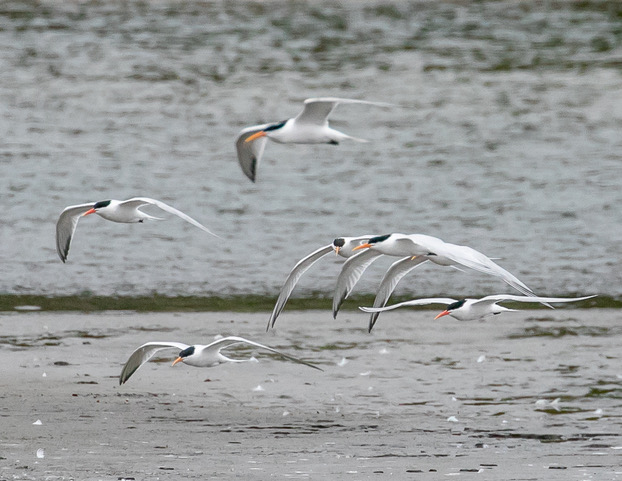
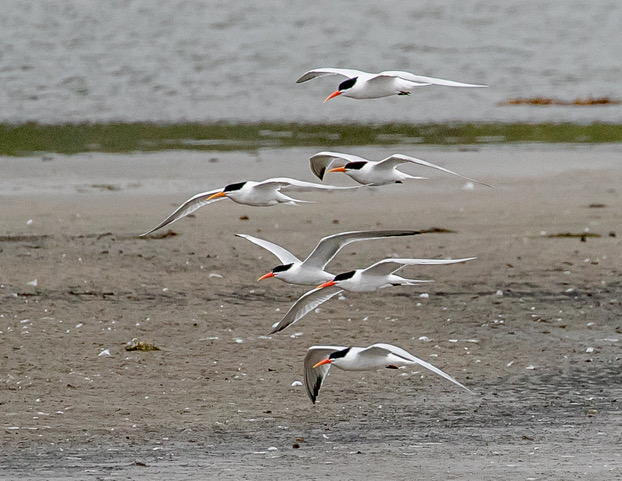
There weren’t as many Terns as last month’s near-800 birds, but of the 190 terns at around 8am, all were Elegants except for 3 each of Royal and Caspian Tern. You can rely on terns being nearly continuously noisy and rising up every 15-30 minutes to frantically fly about. Occasionally they have a reason, as when the Peregrine Falcon flew by, probably on its way north, and made a pass at them.
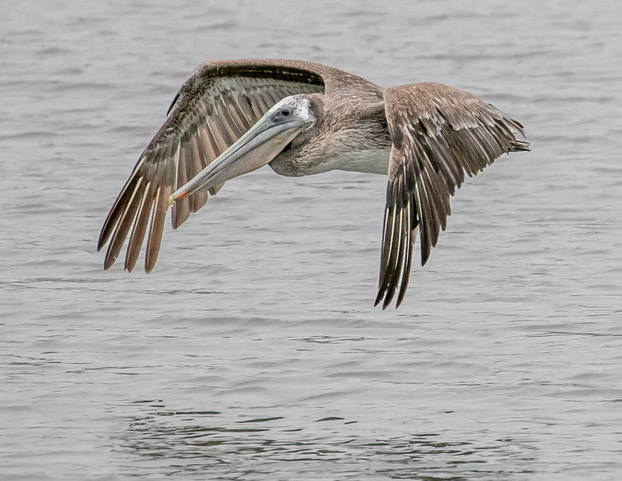
There may be another outbreak of domoic acid going on. We saw several dead Brown Pelicans by the edge of the lagoon including the one the many Turkey Vultures kept disassembling. There was also a dead Brandt’s Cormorant and a staring, motionless pelican by the edge of one the exposed rocky reefs. No dead or sick Harbor Seals or Sea Lions near the lagoon, as far as I know.
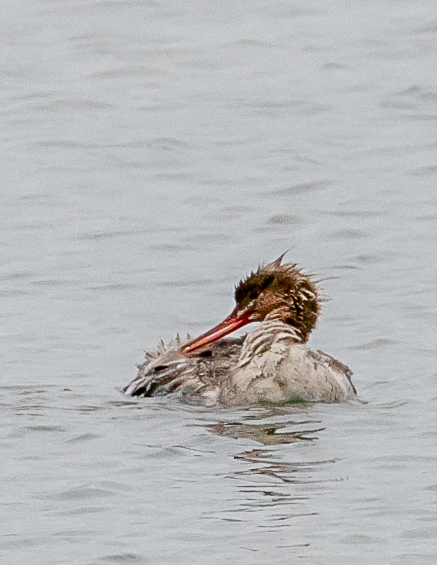
You can frequently find Red-breasted Mergansers actively diving for fish in the surf zone, as was this bird, but it’s easier to find them within the lagoon.
Nearly all the Black-bellied Plovers have left. We saw 88 last October and 20 in February, after which it was single digits. In June they historically hit their lowest point of the year, as one or more are present only about 20% of the time.
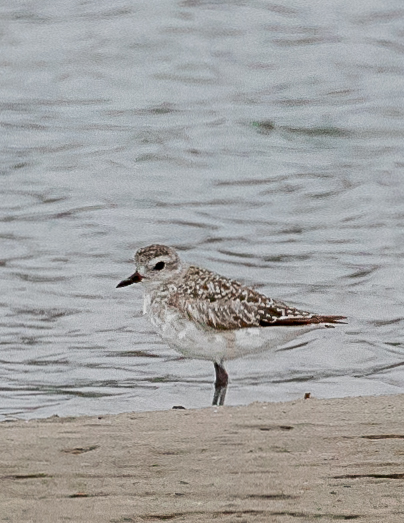
(Chris Tosdevin 5-24-26)
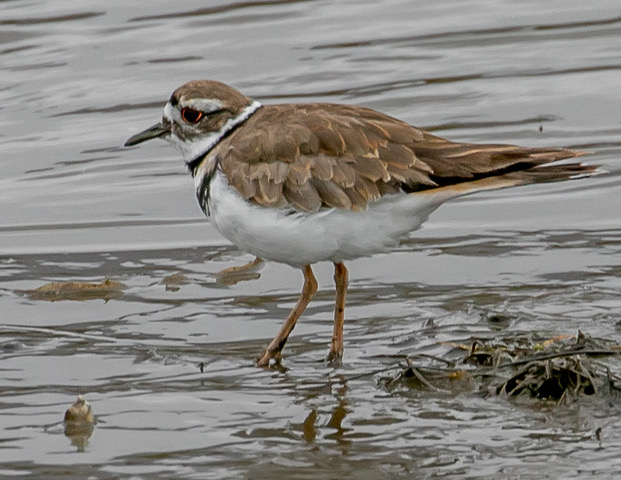
Their close relative Killdeer, on the other hand, are present in small numbers year around, and have nested at the lagoon for decades. I spent about half-an-hour today watching one Killdeer prowl the western main channel mudflats, finding something quite minute to eat about every five seconds. I could never see what it was (or they were), and it never returned to its nest which I think must be somewhere nearby. Their nests and eggs are incredibly cryptic, and it’s very easy to accidentally step on an egg before you see it, no matter how careful you are, so I didn’t want to go tromping around on the lagoon shore without first having a pretty good idea where the nest was.
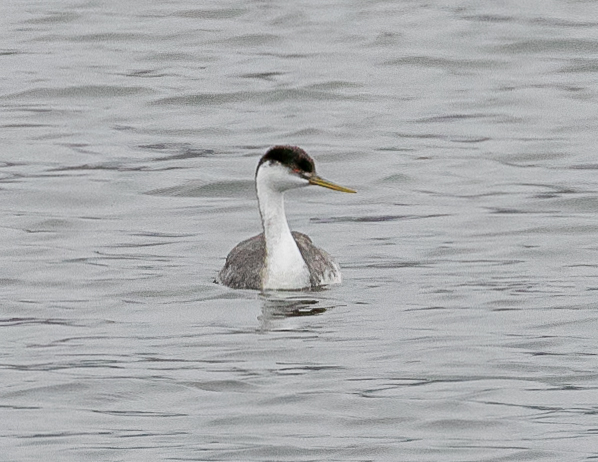
Most of the Western Grebes were in a single flock eastward of the lagoon, but one floated around the lagoon for a long time.
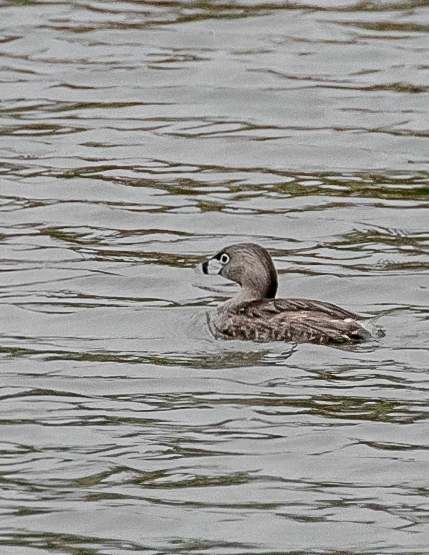
And although they don’t look much alike these two species of grebe don’t mind floating near one another in the lagoon. They both dive for fish, but probably for differently-sized fish.
There are no photographs of any sandpipers (we’ll ignore stilts, avocets, oystercatchers and plovers for this paragraph) today because there was not one single sandpiper of any of the 27 species of sandpipers – from Red-necked Stint to Long-billed Curlew, or Hudsonian Whimbrel to Western Sandpiper – that we’ve had over the years at the lagoon. This struck me as perhaps a unique situation, but my records proved me wrong. Since the beginning of 2010, or for the past 195 monthly visits, there have been thirteen months in which we had 3 or fewer sandpipers; five months had zero sandpipers, not including today. All these months were May or June.
This is why I say, “June is the cruelest month for SoCal birders.” May is apparently the second cruelest. Breeding season has called “our” birds elsewhere.
Malibu Lagoon on eBird as of 5-25-26: 9441 lists, 3085 eBirders, 322 species
Most recent new species seen: Nelson’s Sparrow, 11/29/24 by Femi Faminu (SMBAS member).
Birds new for the season: Cackling Goose, Surf Scoter, Western Flycatcher, California Scrub-Jay, Violet-green Swallow, Red-winged Blackbird. “New for the season” means it has been three or more months since last recorded on our trips..
Many, many thanks to photographers Ray Juncosa and Chris Tosdevin.
Upcoming SMBAS scheduled field trips; no reservations or Covid card necessary unless specifically mentioned:
- Malibu Creek State Park, Sat. June 13, 8 am
- Malibu Lagoon, Sun. June 28, 8:30 am (adults) & 10 am (parents & kids)
- Malibu Lagoon, Sun. July 26, 8:30 am (adults) & 10 am (parents & kids)
- Malibu Lagoon, Sun. Aug 23, 8:30 am (adults) & 10 am (parents & kids)
- These and any other trips we announce for the foreseeable future will depend upon expected status of the Covid/flu/etc. pandemic, not to mention landslides, fires, local flooding and atmospheric rivers at trip time. Any trip announced may be canceled shortly before trip date if it seems necessary. By now any other comments should be superfluous.
- Link to Programs & Field Trip schedule.
The next SMBAS Zoom program: Tuesday, October 6, 7:30pm; TBA
The SMBAS 10 a.m. Parent’s & Kids Birdwalk has again resumed. Reservations not necessary for families, but for groups (scouts, etc.), please call Jean (213-522-0062).
Links: Unusual birds at Malibu Lagoon
9/23/02 Aerial photo of Malibu Lagoon
Aerial ‘film’ flying north over lagoon
More recent aerial photo
Prior checklists:
2025: Jan-June, July-Dec
2023: Jan-June, July-Dec 2024: Jan-June, July-Dec
2021: Jan-July, July-Dec 2022: Jan-June, July-Dec
2020: Jan-July, July-Dec 2019: Jan-June, July-Dec
2018: Jan-June, July-Dec 2017: Jan-June, July-Dec
2016: Jan-June, July-Dec 2015: Jan-May, July-Dec
2014: Jan-July, July-Dec 2013: Jan-June, July-Dec
2012: Jan-June, July-Dec 2011: Jan-June, July-Dec
2010: Jan-June, July-Dec 2009: Jan-June, July-Dec
The 10-year comparison summaries created during the 2012-13 Lagoon Reconfiguration Project period, remain available—despite numerous complaints—on our Lagoon Project Bird Census Page. Very briefly summarized, the results unexpectedly indicate that avian species diversification and numbers improved slightly during the restoration period June’12-June’14. We also have a newly-refurbished slide show of the reconfiguration from just before it started until the recent 13-year celebration.
Many thanks to Marie Barnidge-McIntyre, Femi Faminu, Chris Lord, Chris Tosdevin and others for contributions made to this month’s census counts.
The species list below was re-sequenced as of 12/31/25 to agree with the eBird sequence. If part of the right side of the chart below is hidden, there’s a slider button inconveniently located at the bottom end of the list. The numbers 1-9 left of the species names are keyed to the nine categories of birds at the bottom. Updated lagoon bird check lists can be downloaded here.
[Chuck Almdale]
| Malibu Census 2025-26 | 12/28 | 1/25 | 2/22 | 3/22 | 4/26 | 5/24 | |
| Temperature | 60-69 | 47-55 | 49-63 | 65-76 | 55-64 | 60-63 | |
| Tide Lo/Hi Height | L+1.35 | L+1.31 | L+0.65 | L-0.31 | H+4.32 | L+0.42 | |
| Tide Time | 1047 | 0846 | 0655 | 0640 | 0624 | 1126 | |
| 1 | Brant (Black) | 1 | 1 | 1 | 1 | 1 | 2 |
| 1 | Cackling Goose | 1 | |||||
| 1 | Canada Goose | 14 | 3 | 4 | 5 | 4 | |
| 1 | Cinnamon Teal | 2 | |||||
| 1 | Northern Shoveler | 4 | 2 | ||||
| 1 | Gadwall | 20 | 34 | 35 | 15 | 25 | 18 |
| 1 | American Wigeon | 15 | 4 | 4 | 6 | ||
| 1 | Mallard | 12 | 5 | 7 | 14 | 8 | 12 |
| 1 | Northern Pintail | 1 | 1 | ||||
| 1 | Green-winged Teal | 5 | 11 | 8 | |||
| 1 | Surf Scoter | 4 | 3 | 6 | 1 | ||
| 1 | Bufflehead | 4 | |||||
| 1 | Red-breasted Merganser | 5 | 6 | 7 | 4 | 3 | 1 |
| 1 | Ruddy Duck | 11 | |||||
| 2 | Feral Pigeon | 5 | 4 | 2 | 8 | 10 | |
| 2 | Mourning Dove | 1 | 3 | 1 | 3 | ||
| 2 | Anna’s Hummingbird | 1 | 1 | 2 | |||
| 2 | Allen’s Hummingbird | 3 | 3 | 3 | 5 | 2 | 6 |
| 3 | American Coot | 25 | 50 | 55 | 4 | ||
| 4 | Black Oystercatcher | 1 | 3 | ||||
| 4 | Black-bellied Plover | 62 | 34 | 20 | 6 | 3 | 3 |
| 4 | Killdeer | 4 | 4 | 6 | 5 | 6 | 3 |
| 4 | Semipalmated Plover | 6 | |||||
| 4 | Snowy Plover | 7 | 17 | 4 | 1 | ||
| 4 | Hudsonian Whimbrel | 4 | 3 | 4 | 6 | 6 | |
| 4 | Marbled Godwit | 10 | 3 | 4 | 1 | ||
| 4 | Long-billed Dowitcher | 1 | |||||
| 4 | Spotted Sandpiper | 1 | |||||
| 4 | Willet | 7 | 7 | 3 | 4 | ||
| 4 | Ruddy Turnstone | 3 | 2 | 3 | |||
| 4 | Sanderling | 14 | 35 | 10 | |||
| 4 | Least Sandpiper | 10 | 20 | 20 | 8 | 3 | |
| 4 | Western Sandpiper | 13 | 29 | ||||
| 5 | Bonaparte’s Gull | 3 | 1 | ||||
| 5 | Heermann’s Gull | 10 | 22 | 75 | 2 | ||
| 5 | Short-billed Gull | 1 | |||||
| 5 | Ring-billed Gull | 5 | 17 | 4 | 3 | ||
| 5 | Western Gull | 85 | 45 | 41 | 61 | 40 | 22 |
| 5 | American Herring Gull | 1 | 1 | 1 | |||
| 5 | California Gull | 650 | 275 | 140 | 95 | 110 | 6 |
| 5 | Glaucous-winged Gull | 1 | |||||
| 5 | Caspian Tern | 3 | 11 | 3 | |||
| 5 | Elegant Tern | 24 | 750 | 185 | |||
| 5 | Royal Tern | 25 | 12 | 28 | 34 | 18 | 3 |
| 6 | Pied-billed Grebe | 6 | 2 | 2 | 3 | 1 | 6 |
| 6 | Horned Grebe | 1 | |||||
| 6 | Eared Grebe | 1 | |||||
| 6 | Western Grebe | 10 | 45 | 4 | 24 | 4 | 35 |
| 6 | Clark’s Grebe | 2 | |||||
| 6 | Red-throated Loon | 2 | |||||
| 6 | Pacific Loon | 1 | 45 | 1 | |||
| 6 | Brandt’s Cormorant | 1 | 35 | 5 | 3 | 4 | |
| 6 | Pelagic Cormorant | 3 | 1 | 3 | 2 | 1 | |
| 6 | Double-crested Cormorant | 17 | 28 | 15 | 18 | 26 | 25 |
| 6 | Snowy Egret | 11 | 3 | 3 | 1 | 2 | 3 |
| 6 | Green Heron | 2 | |||||
| 6 | Great Egret | 1 | 1 | 1 | 2 | 2 | 1 |
| 6 | Great Blue Heron | 5 | 5 | 3 | 3 | 3 | 1 |
| 6 | Brown Pelican | 3 | 13 | 10 | 30 | 395 | 28 |
| 7 | Turkey Vulture | 2 | 2 | 2 | 3 | 4 | 10 |
| 7 | Osprey | 1 | 2 | 1 | |||
| 7 | Sharp-shinned Hawk | 1 | |||||
| 7 | Red-shouldered Hawk | 2 | |||||
| 7 | Red-tailed Hawk | 2 | 1 | 2 | 1 | ||
| 8 | Belted Kingfisher | 1 | 1 | 1 | 1 | ||
| 8 | Downy Woodpecker | 1 | |||||
| 8 | Nuttall’s Woodpecker | 1 | |||||
| 7 | Peregrine Falcon | 1 | 1 | ||||
| 8 | Nanday Parakeet | 2 | |||||
| 9 | Western Flycatcher | 1 | |||||
| 9 | Black Phoebe | 1 | 3 | 3 | 2 | 2 | 4 |
| 9 | Say’s Phoebe | 1 | |||||
| 9 | Cassin’s Kingbird | 1 | 3 | 1 | |||
| 9 | Hutton’s Vireo | 1 | 1 | ||||
| 9 | California Scrub-Jay | 1 | 2 | ||||
| 9 | American Crow | 6 | 11 | 10 | 6 | 2 | 8 |
| 9 | Common Raven | 1 | 2 | 1 | 1 | ||
| 9 | Oak Titmouse | 1 | 1 | 1 | 1 | ||
| 9 | Tree Swallow | 3 | |||||
| 9 | Violet-green Swallow | 2 | |||||
| 9 | No. Rough-winged Swallow | 25 | 5 | 3 | |||
| 9 | Barn Swallow | 8 | 12 | ||||
| 9 | Cliff Swallow | 25 | 20 | ||||
| 9 | Bushtit | 19 | 20 | 5 | 8 | 1 | 10 |
| 9 | Wrentit | 1 | 2 | 2 | 1 | 1 | 2 |
| 9 | Swinhoe’s White-eye | 2 | 2 | ||||
| 9 | Ruby-crowned Kinglet | 1 | |||||
| 9 | Blue-gray Gnatcatcher | 1 | |||||
| 9 | Northern House Wren | 1 | 1 | 1 | 1 | ||
| 9 | Bewick’s Wren | 1 | |||||
| 9 | European Starling | 1 | 10 | 13 | 2 | ||
| 9 | Northern Mockingbird | 1 | 1 | ||||
| 9 | Western Bluebird | 1 | |||||
| 9 | American Robin | 1 | |||||
| 9 | House Finch | 15 | 7 | 10 | 12 | 10 | 9 |
| 9 | Lesser Goldfinch | 2 | 7 | 2 | 6 | ||
| 9 | American Goldfinch | 4 | |||||
| 9 | Dark-eyed Junco | 1 | 1 | 2 | 1 | ||
| 9 | White-crowned Sparrow | 18 | 6 | 5 | 10 | ||
| 9 | Savannah Sparrow | 1 | |||||
| 9 | Song Sparrow | 3 | 5 | 7 | 6 | 6 | 4 |
| 9 | California Towhee | 2 | 3 | 2 | 3 | 1 | 2 |
| 9 | Hooded Oriole | 2 | |||||
| 9 | Red-winged Blackbird | 2 | |||||
| 9 | Great-tailed Grackle | 3 | 10 | 3 | 5 | 4 | |
| 9 | Orange-crowned Warbler | 1 | 1 | 1 | 1 | 1 | |
| 9 | Common Yellowthroat | 1 | 1 | 2 | 1 | ||
| 9 | Yellow-rumped Warbler | 8 | 6 | 6 | 4 | ||
| 9 | Black-throated Gray Warbler | 1 | |||||
| Totals Birds by Type | Dec | Jan | Feb | Mar | Apr | May | |
| 1 | Waterfowl & Quail | 95 | 67 | 74 | 48 | 42 | 35 |
| 2 | Doves, Swifts & Hummers | 9 | 3 | 8 | 11 | 11 | 21 |
| 3 | Rails & Coots | 25 | 50 | 55 | 4 | 0 | 0 |
| 4 | Shorebirds | 123 | 128 | 74 | 44 | 54 | 6 |
| 5 | Gulls & Terns | 777 | 349 | 214 | 247 | 1005 | 221 |
| 6 | Grebe, Loon, Heron, Pelican | 59 | 134 | 47 | 134 | 435 | 105 |
| 7 | Hawks & Falcons | 5 | 5 | 7 | 4 | 6 | 11 |
| 8 | Kingfish, Peckers & Parrots | 1 | 3 | 2 | 0 | 2 | 0 |
| 9 | Passerines | 91 | 86 | 77 | 116 | 70 | 92 |
| Totals Birds | 1185 | 825 | 558 | 608 | 1625 | 491 | |
| Total Species by Group | Dec | Jan | Feb | Mar | Apr | May | |
| 1 | Waterfowl & Quail | 11 | 8 | 9 | 8 | 6 | 6 |
| 2 | Doves, Swifts & Hummers | 3 | 1 | 3 | 4 | 3 | 4 |
| 3 | Rails & Coots | 1 | 1 | 1 | 1 | 0 | 0 |
| 4 | Shorebirds | 11 | 10 | 9 | 8 | 7 | 2 |
| 5 | Gulls & Terns | 7 | 4 | 5 | 10 | 7 | 6 |
| 6 | Grebe, Loon, Heron, Pelican | 11 | 9 | 11 | 11 | 8 | 10 |
| 7 | Hawks & Falcons | 3 | 3 | 4 | 2 | 3 | 2 |
| 8 | Kingfish, Peckers & Parrots | 1 | 2 | 2 | 0 | 2 | 0 |
| 9 | Passerines | 21 | 17 | 22 | 23 | 16 | 21 |
| Totals Species – 109 | 69 | 55 | 66 | 67 | 52 | 51 |
Discover more from SANTA MONICA BAY AUDUBON SOCIETY BLOG
Subscribe to get the latest posts sent to your email.



