Free email delivery
Please sign up for email delivery in the subscription area to the right.
No salesman will call, at least not from us. Maybe from someone else.
[posted by Chuck Almdale]
The LA Times tells a good story about our dunes. Watch closely and some of the lovely artwork will move. I hope the LAT website lets you in. It deserves sharing.
California beach dunes once teemed with plants and birds
Los Angeles Times | Rosanna Xia, Paul Duginski & Sean Greene | 2 Aug 2020
California beach dunes once teemed with plants and birds
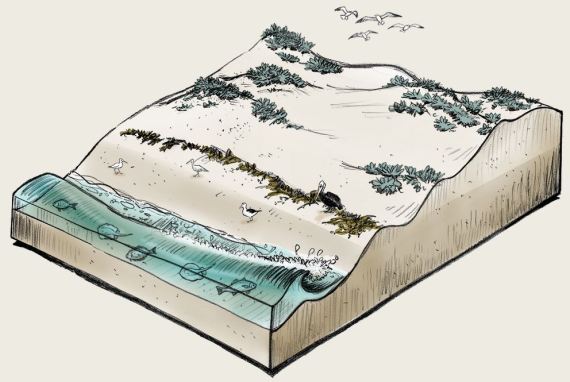
But their habitats were flattened to make room for us.

Can this forgotten ecosystem thrive again? Scientists are trying to find out.
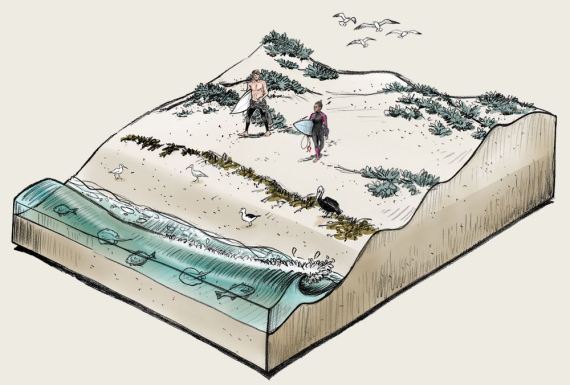
Along a postcard stretch of Southern California, beneath the geologic grandeur of Point Dume, Sara Cuadra cradled a rake and prodded what seemed like just a patch of white sand.
To the untrained eye, this was just another pretty spot in Malibu — a popular site for film shoots and Instagrams, body surfing and long walks by the sea. But here among the bluffs of Westward Beach, where the shoreline has quietly eroded with each passing year, Cuadra has spent weeks tending, square foot by square foot, a forgotten ecosystem that has long since been destroyed.
“That should do it,” she said, patting the sand with satisfaction. “I think we can start seeding.”
And much much more….
A welcome gloom at Malibu Lagoon, 25 July 2021
[Posted by Chuck Almdale]
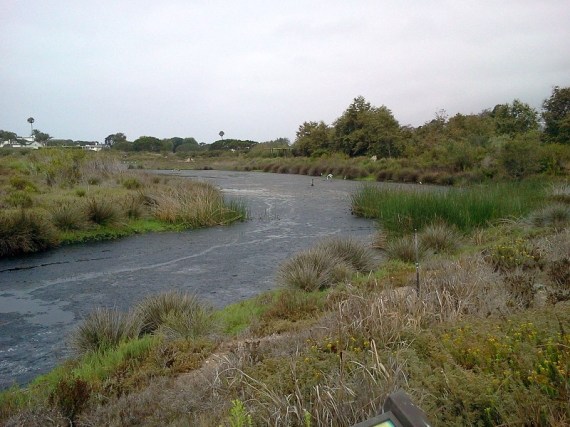
As usual for summer months the Malibu Lagoon outlet is closed and the water level is high, still about 7 ft. above sea level. The surface algae is thick and the smallest ducklings can gallop over it. Surf shapes were really nice, waves festooned with surfers and the slim portion of beach outside the Snowy Plover exclosure was jammed gill-to-gill with families, beachlayers and surfwatchers. Some of our birding group, upon seeing the dense crowd, decided to skip a last look at the lagoon’s south shore and head home, probably to a beer and sandwich (always a recommended choice of refreshment).
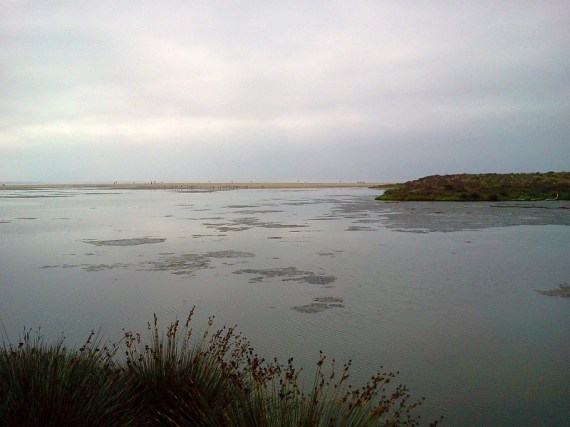
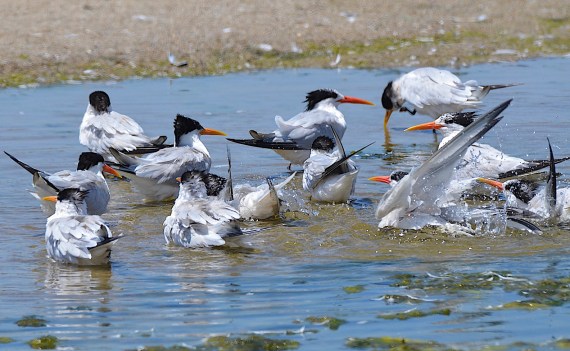
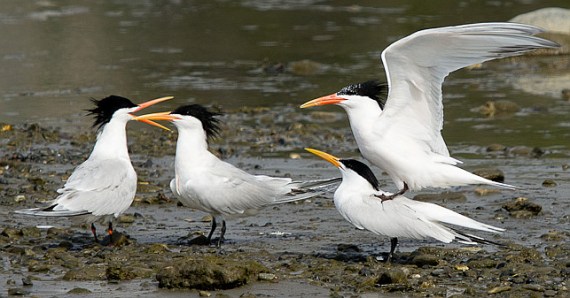
June gloom stretches into July, welcome when nearby valley temperatures head towards and past 100°F. At 8:30 am it was 66°F, then 74°F at 11 am, when we left. Very pleasant. Again, as usual, birding begins to pick up after the low diversity of June. Today we had 819 birds in 40 species; in June it was 348 and 34, respectively. The resting flock of Elegant Terns accounted for half of the increase.
Should you ever want to see what eBird has to report on Malibu Lagoon, go here: https://ebird.org/hotspot/L597658
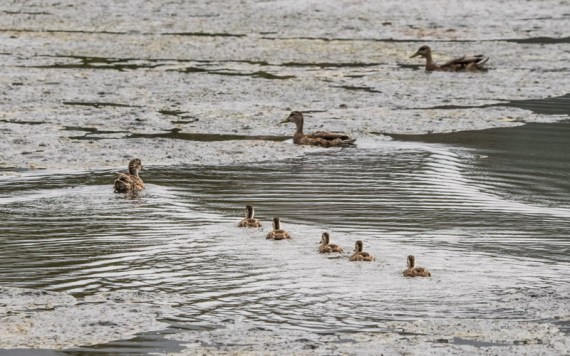
Duck numbers (Mallard and Gadwall) dropped about 20%. Immature ducklings account for about 80% of the ducks, so most of the drop was probably youngsters. The ducks certainly spread their breeding period out, as there are nearly full size and well-plumaged ducklings, as well as small and exceedingly buoyant puffballs. The Canada Geese were gone.
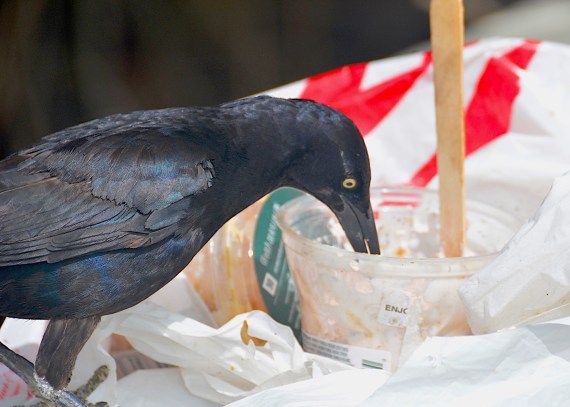
The Great-tailed Grackles are still quite noisy and busy. One got into the snack portion of lagoon-resident Sergio’s possession-pile. Others preened, sky-pointed, gurgled and boinked from pole-top and tree.
Shorebirds are returning. June’s paltry four species are now nine and numbers jumped from 28 to 138. Most of the increase were Whimbrels and Black-bellied (Grey, for you Brits) Plovers, some still with black bellies.
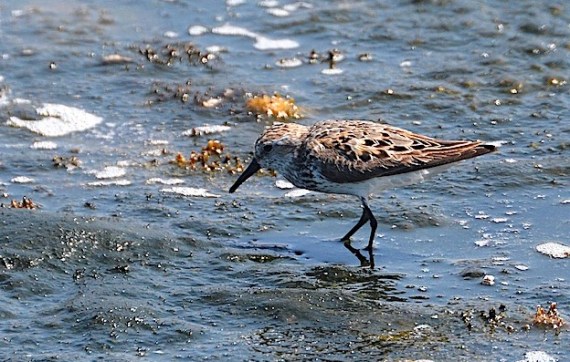
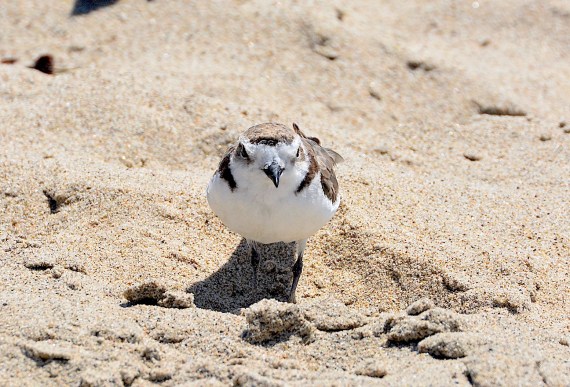
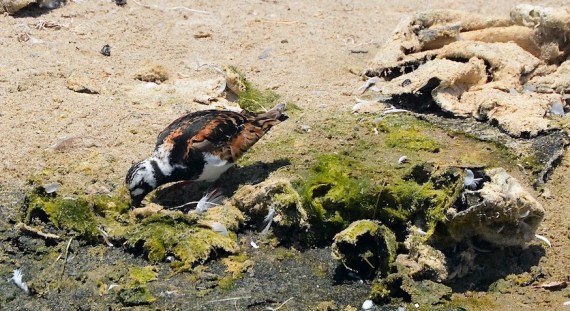
But there were also Least and Western Sandpipers in small numbers, a crowd of three Red-necked Phalaropes in the algae-free portion of the lagoon, two stunning Ruddy Turnstones, and nine Western Snowy Plovers pockmarked the beach.
And all those noisy Elegant Terns, with a few Royal Terns mixed in just to keep them honest.
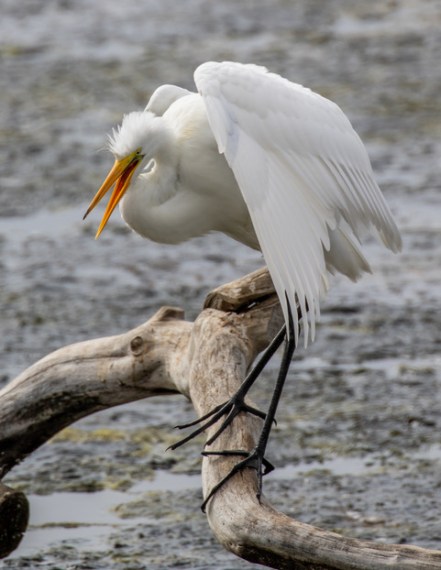
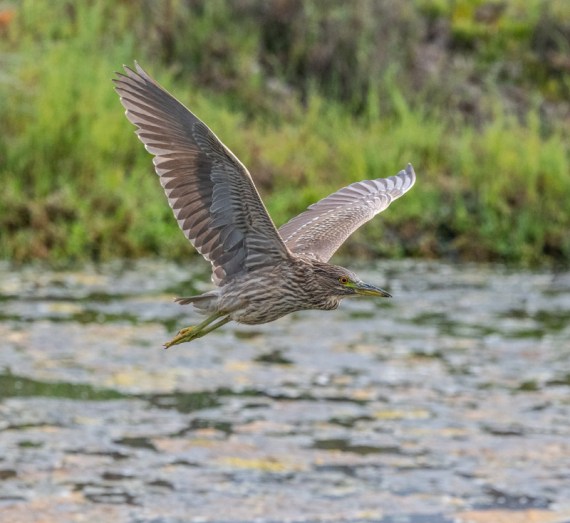
Perhaps most unusual were all the Black-crowned Night-Herons (not to mention 38 other herons/egrets). Eight juveniles were scattered around the lagoon edge, standing on logs, lurking in the pickleweed.
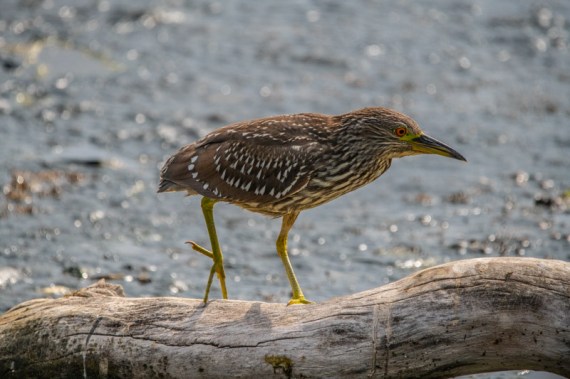
As their name implies, you might expect night-herons to be out at night. Otherwise why call them “night”-herons? Daytime feeding is the default for herons, so we don’t call them “day”-herons. However, by the time the newly-fledged juvenile night-herons get to Malibu Lagoon, they’re on their own. Mom and dad no longer feed them, so they must hunt for themselves and do it when they can. They’re less efficient than adults, they have to spend more time doing it and they do get hungry. So daytime feeding is common among juveniles.
Adult night-herons tend to day-roost in dense trees, reeds or bushes during the day. We used to find a dozen or so of them in the row of eucalypts behind the market across PCH, well-hidden high in the foliage.
Night-herons comprise the subfamily Nycticoracinae in the heron family of Ardeidae, with eight species spread over three tribes. Black-crowned is the most widespread species, found on all continents except Australia and Antarctica, and some islands. The similar Yellow-crowned breeds from the U.S. eastern seaboard and Baja California down both coasts to south of the equator in Brazil and Ecuador. In recent decades they have extended their coastal breeding range northward in California.
Yellow-crowned Night Herons have expanded their breeding range and multiple pairs now nest in a restricted area at the nearby Point Mugu Naval Air Station in Ventura County, which is now the northern end of their West Coast breeding range. First successful nesting of this species in California was in 2006 at Imperial Beach, San Diego County. Despite its recent range expansion, it remains a rarity in most of California. Six subspecies are recognized. This [Santa Barbara county bird, photo on linked page] is N. v. bancrofti characterized by pale coloration, narrower dorsal streaks and having a thicker bill than the nominate East Coast race. Distribution of N. v. bancrofti is weird with two widely spaced populations, one centered in NW Mexico and the other in the Bahamas and West Indies.
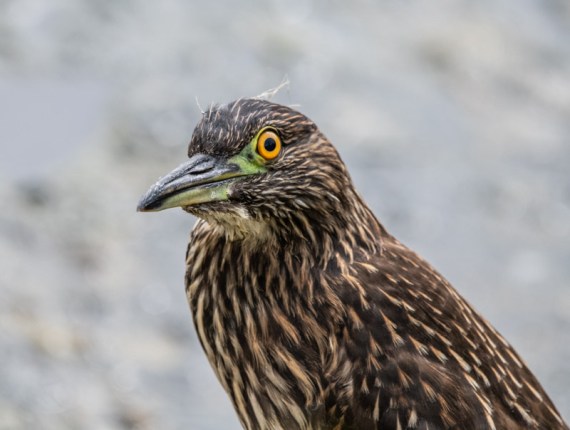
A few of us thought one of our birds might be a Yellow-crowned, due to some coloration on the face or neck or lores (fleshy area between the eyes and bill). But all the birds had the Black-crowned two-toned bill and large pale teardrop-spots on the back. Juvenile Yellow-crowned have a dark bill, grayish face and smaller spots on the back. I’m sure a Yellow-crowned will eventually show up on one of our walks. We did have a hybrid Yellow/Black-crowned juvenile about a decade ago.
The other six night-herons are scattered around the world: Rufous Night-Heron in Australasia; White-backed in sub-Saharan Africa; White-eared is restricted to a tiny area in southern China; Japanese in Japan, China and Philippines; Malayan in Malaysia, China, Philippines and Indonesia. Boat-billed Heron, in its own Tribe of Cochleariini, has an enormous bill and is found from southern Mexico to southern Brazil.
All the Night-herons have, for herons, large eyes, the better to see you with in the dark, my dear. They could be called crepuscular-herons, as they prefer feeding at dusk and dawn, but they will feed at night, so Night-herons it is.
Earlier in the day Chris Tosdevin and I watched a Cooper’s Hawk flush and fly across the lagoon. It shot into a large eucalypt (I believe) at the east end of Malibu Colony, and an adult Black-crowned Night-Heron immediately shot out the other side. I checked this tree before leaving the beach and sure enough, about 20 ft. above a patch of whitewashed leaves, I found the night-heron peering down at me from behind a clump of foliage.
(R. Juncosa 7-25-21)
Birds new for the season: Snowy Plover, Semipalmated Plover, Least Sandpiper, Western Sandpiper, Red-necked Phalarope, Black-crowned Night-Heron, Cooper’s Hawk, California Scrub-Jay.
Many thanks to photographers: Lillian Johnson, Ray Juncosa, Larry Loeher, Grace Murayama & Chris Tosdevin
The next SMBAS scheduled field trips: Maybe in September. We’ll see.
The next SMBAS program: Most likely a Zoom Evening Meeting, Tuesday, 5 October, 7:30 p.m.
The SMBAS 10 a.m. Parent’s & Kids Birdwalk remains canceled until further notice due to the near-impossibility of maintained proper masked social distancing with parents and small children.
Links: Unusual birds at Malibu Lagoon
9/23/02 Aerial photo of Malibu Lagoon
Prior checklists:
2021: Jan-July
2020: Jan-July, July-Dec 2019: Jan-June, July-Dec
2018: Jan-June, July-Dec 2017: Jan-June, July-Dec
2016: Jan-June, July-Dec 2015: Jan-May, July-Dec
2014: Jan-July, July-Dec 2013: Jan-June, July-Dec
2012: Jan-June, July -Dec 2011: Jan-June, July-Dec
2010: Jan-June, July-Dec 2009: Jan-June, July-Dec.
The 10-year comparison summaries created during the Lagoon Reconfiguration Project period, remain available—despite numerous complaints—on our Lagoon Project Bird Census Page. Very briefly summarized, the results unexpectedly indicate that avian species diversification and numbers improved slightly during the restoration period June’12-June’14.
Many thanks to Adrian Douglas, Lillian Johnson, Ray Juncosa, Chris Tosdevin and others for their contributions to this month’s checklist.
[Chuck Almdale]
| Malibu Census 2021 | 2/22 | 3/22 | 4/25 | 5/22 | 6/20 | 7/25 |
| Temperature | 65-74 | 60-61 | 58-63 | 59-68 | 63-69 | 66-74 |
| Tide Lo/Hi Height | L-0.13 | L+0.86 | H+4.83 | L+1.57 | H+4.89 | H+4.20 |
| Tide Time | 1314 | 1223 | 0843 | 0736 | 0627 | 1148 |
| (Black) Brant | 1 | |||||
| Canada Goose | 8 | 6 | 8 | 6 | 10 | |
| Cinnamon Teal | 4 | 7 | ||||
| Northern Shoveler | 8 | |||||
| Gadwall | 12 | 16 | 25 | 18 | 65 | 48 |
| American Wigeon | 12 | 8 | ||||
| Mallard | 10 | 16 | 18 | 22 | 40 | 37 |
| Northern Pintail | 2 | |||||
| Green-winged Teal | 11 | 25 | ||||
| Surf Scoter | 15 | 2 | ||||
| Bufflehead | 4 | |||||
| Red-breasted Merganser | 12 | 12 | 3 | 1 | 1 | |
| Ruddy Duck | 25 | |||||
| Pied-billed Grebe | 6 | 6 | 1 | 1 | 2 | |
| Eared Grebe | 1 | 2 | ||||
| Western Grebe | 4 | 11 | 4 | |||
| Feral Pigeon | 4 | 6 | 9 | 15 | 9 | 15 |
| Mourning Dove | 1 | 6 | 2 | 4 | ||
| Anna’s Hummingbird | 2 | 3 | 1 | 1 | 1 | 1 |
| Allen’s Hummingbird | 2 | 2 | 4 | 2 | 1 | |
| American Coot | 210 | 235 | 75 | 6 | 9 | 8 |
| Black Oystercatcher | 4 | 4 | ||||
| Black-bellied Plover | 25 | 31 | 22 | 5 | 13 | 43 |
| Snowy Plover | 27 | 23 | 9 | |||
| Semipalmated Plover | 29 | 1 | ||||
| Killdeer | 4 | 7 | 1 | 6 | 4 | 9 |
| Whimbrel | 3 | 6 | 3 | 19 | 9 | 51 |
| Marbled Godwit | 11 | 10 | ||||
| Ruddy Turnstone | 5 | 2 | 2 | |||
| Sanderling | 50 | 160 | ||||
| Dunlin | 1 | |||||
| Least Sandpiper | 4 | 8 | 1 | 8 | ||
| Western Sandpiper | 1 | 4 | 20 | 12 | ||
| Spotted Sandpiper | 1 | 1 | ||||
| Willet | 11 | 6 | 2 | 1 | ||
| Red-necked Phalarope | 3 | |||||
| Heermann’s Gull | 2 | 42 | 28 | 280 | 2 | |
| Ring-billed Gull | 38 | 12 | 6 | |||
| Western Gull | 80 | 65 | 40 | 35 | 45 | 52 |
| California Gull | 235 | 130 | 35 | 10 | 4 | 1 |
| Herring Gull | 1 | |||||
| Glaucous-winged Gull | 1 | 1 | 1 | 1 | ||
| Caspian Tern | 4 | 20 | 13 | 3 | ||
| Royal Tern | 6 | 24 | 6 | 2 | 5 | |
| Elegant Tern | 395 | 107 | 1 | 240 | ||
| Pacific Loon | 1 | |||||
| Brandt’s Cormorant | 5 | |||||
| Double-crested Cormorant | 52 | 25 | 12 | 26 | 26 | 52 |
| Pelagic Cormorant | 1 | 1 | ||||
| Brown Pelican | 12 | 27 | 105 | 235 | 27 | 58 |
| Great Blue Heron | 3 | 3 | 2 | 5 | ||
| Great Egret | 2 | 2 | 1 | 1 | 4 | 11 |
| Snowy Egret | 9 | 3 | 2 | 1 | 6 | 22 |
| Green Heron | 1 | |||||
| Black-crowned Night-Heron | 1 | 9 | ||||
| Turkey Vulture | 1 | 1 | ||||
| Osprey | 2 | 2 | 1 | |||
| Cooper’s Hawk | 1 | |||||
| Red-shouldered Hawk | 2 | |||||
| Peregrine Falcon | 1 | |||||
| Black Phoebe | 2 | 2 | 8 | 6 | 3 | |
| Western Kingbird | 1 | |||||
| California Scrub-Jay | 1 | 2 | 1 | |||
| American Crow | 2 | 5 | 4 | 4 | 3 | 4 |
| Common Raven | 1 | |||||
| Violet-green Swallow | 2 | |||||
| Rough-winged Swallow | 6 | 2 | 3 | |||
| Cliff Swallow | 8 | 4 | ||||
| Barn Swallow | 10 | 25 | 30 | 18 | 40 | |
| Oak Titmouse | 2 | 1 | ||||
| Bushtit | 8 | 20 | 1 | 8 | 4 | 1 |
| Western Bluebird | 2 | |||||
| Northern Mockingbird | 2 | 4 | 5 | 2 | 1 | |
| European Starling | 75 | 5 | 8 | |||
| House Finch | 4 | 10 | 6 | 6 | 6 | 6 |
| Lesser Goldfinch | 4 | 16 | 2 | |||
| Spotted Towhee | 1 | |||||
| California Towhee | 1 | 4 | 3 | |||
| Song Sparrow | 4 | 7 | 7 | 8 | 4 | 5 |
| White-crowned Sparrow | 5 | 6 | 2 | |||
| Hooded Oriole | 1 | 1 | ||||
| Red-winged Blackbird | 2 | 2 | 4 | 25 | ||
| Brown-headed Cowbird | 2 | 1 | 1 | |||
| Great-tailed Grackle | 1 | 8 | 6 | 6 | 8 | 20 |
| Common Yellowthroat | 3 | 4 | ||||
| Yellow Warbler | 2 | |||||
| Yellow-rumped Warbler | 14 | 15 | 1 | |||
| Totals by Type | Feb | Mar | Apr | May | Jun | Jul |
| Waterfowl | 115 | 100 | 55 | 46 | 116 | 86 |
| Water Birds – Other | 292 | 306 | 198 | 268 | 62 | 120 |
| Herons, Egrets & Ibis | 15 | 5 | 3 | 6 | 12 | 47 |
| Quail & Raptors | 0 | 3 | 3 | 4 | 0 | 1 |
| Shorebirds | 141 | 264 | 80 | 31 | 28 | 138 |
| Gulls & Terns | 362 | 279 | 531 | 446 | 55 | 300 |
| Doves | 5 | 12 | 9 | 15 | 11 | 19 |
| Other Non-Passerines | 4 | 5 | 5 | 3 | 2 | 1 |
| Passerines | 46 | 198 | 78 | 99 | 62 | 107 |
| Totals Birds | 980 | 1172 | 962 | 918 | 348 | 819 |
| Total Species | Feb | Mar | Apr | May | Jun | Jul |
| Waterfowl | 11 | 9 | 5 | 3 | 4 | 3 |
| Water Birds – Other | 9 | 6 | 6 | 4 | 3 | 4 |
| Herons, Egrets & Ibis | 4 | 2 | 2 | 4 | 3 | 4 |
| Quail & Raptors | 0 | 2 | 2 | 3 | 0 | 1 |
| Shorebirds | 11 | 11 | 9 | 4 | 4 | 9 |
| Gulls & Terns | 6 | 8 | 8 | 6 | 5 | 5 |
| Doves | 2 | 2 | 1 | 1 | 2 | 2 |
| Other Non-Passerines | 2 | 2 | 2 | 2 | 2 | 1 |
| Passerines | 11 | 20 | 17 | 17 | 11 | 11 |
| Totals Species – 87 | 56 | 62 | 52 | 44 | 34 | 40 |
Ocean temperature contour maps | NOAA
[Posted by Chuck Almdale]
A few years ago, after a few thousand of our favorite jumping fish (Striped “Jumping” Mullet) died in Malibu Lagoon after many days of high heat and low O2 levels in the lagoon water, I posted a thermal map of the Pacific Ocean, as there was a local “hot blob” ocean temperature anomaly stretching up the SoCal coast from Baja to Santa Barbara. Here’s that map.
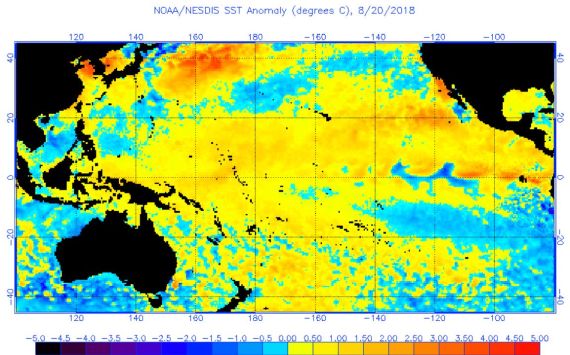
This particular map can be found on the NOAA site here.
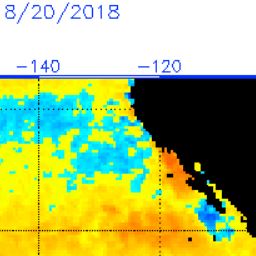
Many hundreds of maps for this and other “anomalies” for period 1996-2019 are available from NOAA here. Here’s a close-up of the map above, a bit pixelated.
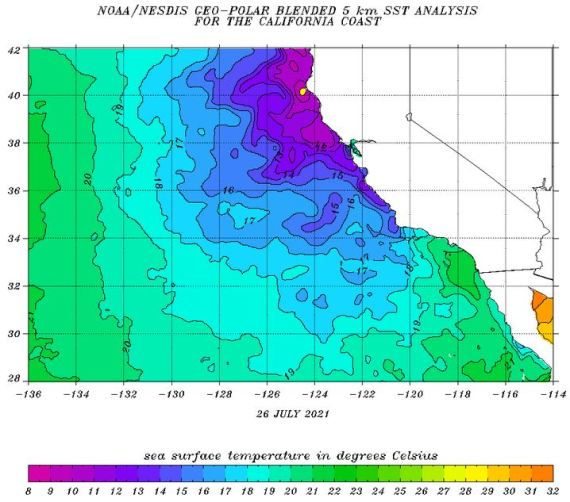
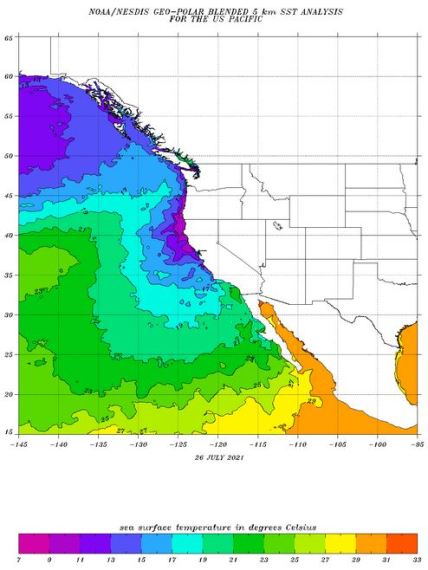
Dozens of temperature maps like these for at least sixteen areas are available daily from NOAA. Here’s one for roughly the same area for the most current day, Monday 26 July, 2021. There is no anomaly right now. Big difference, eh? Link to current day map.
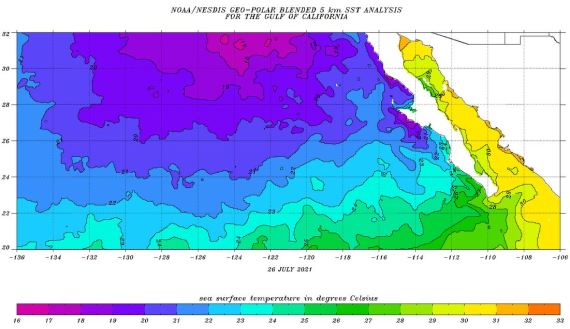
The next one focuses on the Gulf of California, 26 July 2021. Any blobs in our near future will most likely appear here first, then spread north.
A wider-view one of the U.S. Pacific coast, 26 July 2021.
The entire world, below on 26 July 2021, found here.

The links to the maps above, except the 2018 anomaly map, will take you to the most recent day posted by NOAA.
Now that you know where to look, you can keep an eye out for any approaching fish-killing “blobs.” Let me know if you see one and we’ll post it here.
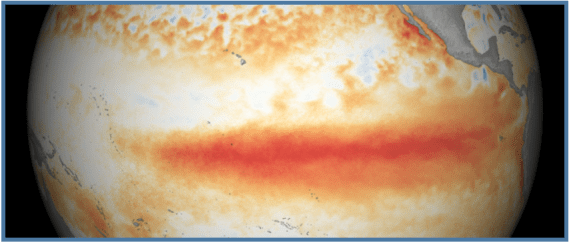
While we on the subject of ocean temperatures, here’s a page on El Niño from Pacific Marine Environmental Laboratory that will answer all your El Niño questions.
Why does El Niño occur?
El Niño results from interaction between the surface layers of the ocean and the overlying atmosphere in the tropical Pacific. It is the internal dynamics of the coupled ocean-atmosphere system that determine the onset and termination of El Niño events. The physical processes are complicated, but they involve unstable air-sea interaction and planetary-scale oceanic waves. The system oscillates between warm (El Niño) to neutral (or cold) conditions with a natural periodicity of roughly 3-4 years. External forcing from volcanic eruptions (submarine or terrestial) have no connnection with El Niño. Nor do sunspots as far as we know.
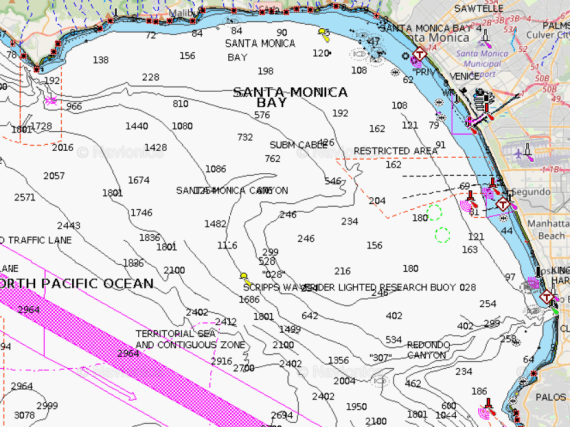
Two more useful maps
U.S. Fisherman’s map of Pacific Ocean
Shows depths, zoom in/out
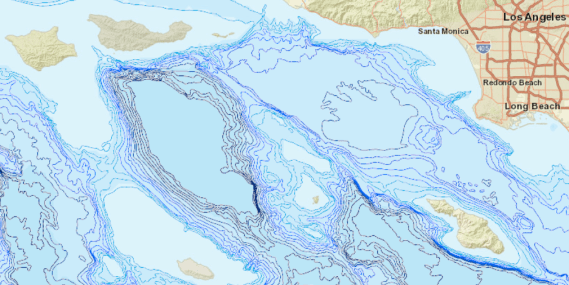
Database.org – 100 Meter depth contours
This map is capable of many interactive tricks
[Posted by Chuck Almdale]
As we mentioned a week ago, thousands of Elegant Terns that abandoned their nests at Bolsa Chica Ecological Reserve in Orange County after a drone helicopter crashed in their midst, flew northwest to Long Beach Harbor and renested on two barges. Things could be better (like no crashing drones) but they’re managing with a little help from their friends at International Bird Rescue and the barge owners.
The barges were never designated as nesting grounds for birds. Construction firm Connolly-Pacific Co. was getting ready to send them to Naval Weapons Station Seal Beach when they discovered their rock-filled barges had been commandeered by 17″-long seabirds.
As best as I could discover (Handbook of Birds of the World) Elegant Terns incubate their single egg (2% lay two eggs) for about 25 days. The young fledge (leave the nest) after another 30-35 days, but continue to accompany and be fed by the young until November. We saw many hundreds of Elegant Terns at Malibu Lagoon yesterday (Sunday 25 July). For them, nesting season is over.
As baby terns washed up on the Long Beach shore just after July 4th, it’s reasonable to assume they’ll occupy the barges for a month after that, or until Mid-August.
I hope someone somewhere in the government is giving thought to compensating barge-owner Connolly-Pacific Co. for loss of income. Not everyone obeys the law in such matters, and they are to be commended for their good citizenship.
Here’s the write-up from the Los Angeles Times.
In Long Beach, a better turn for the Elegant Terns
Los Angeles Times | Faith E. Pinho | 26 July 2021
Conservation group is rescuing seabirds that settled on barges after colony was disrupted.
Want to help defray International Bird Rescue’s costs for rescuing tern chicks? Go to their donation page.
[Posted by Chuck Almdale]
You’d have to be loony* to not like loons. The first time you hear their eerie, plaintive, ________ (insert your preferred adjectives here) call on a quiet northern lake, you fall in love. It’s a call from one creature’s heart to the soul of another.
[*Sorry, couldn’t resist.]
Loon Lessons: Uncommon Encounters with the Great Northern Diver
James D. Paruk | University of Minnesota Press | 2021 | 256 pages
From University of Minnesota Press:
The nature of the common loon, from biology to behavior, from one of the world’s foremost observers of the revered waterbird.
Written by one of the world’s foremost experts on the subject, Loon Lessons is a compendium of knowledge about the common loon and an engaging record of scientific sleuthing, documenting more than twenty-five years of research. It describes the common loon’s biology in an entertaining style that affords a deeper understanding of the bird’s natural history and annual life cycle.
James D. Paruk has written a wonderful, personal account of loon biology. He recounts thirty years of adventures with loons, summarizing what we know about them in the context of loons’ basic biology and behavior. Highly readable and informal, this book is for anyone who wants to learn more about loons. — Charles Walcott, former director, Cornell Laboratory of Ornithology




 SANTA MONICA BAY AUDUBON SOCIETY BLOG