Kingdom Plantae | Taxonomy 3
[By Chuck Almdale]
Kingdom Plantae
Kingdom Plantae includes everything we call plants which have chlorophyll, but also includes parasitic plants which lack chlorophyll. They are multicellular, eukaryotic and autotrophic (thanks to chlorophyll). As usual, systematic disagreements exist and different systems can use anywhere from 3 to 5 groups (clades), and 5 to 14 divisions (= phyla). The cladogram below from Cal Poly Humboldt Natural History Museum does a great job of laying out five groups (clades) and twelve divisions, showing nodes, branches, dates and groups. This example demonstrates a primary reason cladograms have been replacing written sequences for the higher levels of taxonomy: they are easy to see and understand and you can pack a lot of useful information into a small space. The rest of this posting is not intended to be a complete description of the plant kingdom as the taxonomy and systematics of plants are currently in great flux, with incompatible systems in use and an enormous number of additional clades used and proposed. We’ll keep this extremely simple and the following accounts of the major ranks and groups are brief. The information is organized to correspond to the following cladogram, but be aware there are many other taxonomic systems currently in use.
From: Cal Poly Humboldt Natural History Museum
Terms of Biological Nomenclature:
Taxonomy: A practice and science concerned with classification or categorization on the basis of shared characteristics, typically with two parts:
a. Taxonomy: The development of an underlying scheme of classes.
b. Classification: The allocation of things to the classes, ranks or taxa.
Taxon: In biology, a taxon (back-formation from “taxonomy”; plural: taxa) is a group of one or more populations of an organism or organisms seen by taxonomists to form a unit. Although neither is required, a taxon is usually known by a particular name and given a particular ranking, especially if and when it is accepted or becomes established.
Systematics: The branch of biology that deals with classification and nomenclature.
Binomial Nomenclature: System of scientifically naming organisms with two words.
Genus: The taxonomic category above species.
Species: The most basic taxonomic category consisting of individuals who can – in the biological definition of “species” – produce fertile offspring.
Clade: A biological grouping that includes the common ancestor and all the descendants (living and extinct) of that ancestor.
Polyphyletic: When a group of organisms derive from more than one common evolutionary ancestor or ancestral group and are therefore not suitable for placing in the same taxon.
A Few Biological Definitions
Division: Kingdom Plantae uses the rank “division” rather than “phylum.”
Gametophyte: One of the two alternating multicellular phases in the life cycles of plants and algae, in which a haploid multicellular organism develops from a haploid spore that has one set of chromosomes. The gametophyte is the sexual phase in the life cycle of plants and algae. The plant develops sex organs which produce gametes – haploid sex cells which when fertilized form a diploid zygote (two sets of chromosomes). Cell division of the zygote results in a new diploid multicellular sporophyte which produces haploid spores by meiosis. When germinated they produce a new generation of gametophytes.
Thallus: A plantlike vegetative body (as of algae, fungi, or mosses) lacking differentiation into distinct parts (stem, leaves, roots, etc.) and does not grow from an apical tip of shoots or roots. They have no vascular tissue but may have structures analogous to their vascular “equivalents.”
Repeats from Taxonomy 2
Autotrophic: Able to produce their own food using light, water, carbon dioxide, or other chemicals; plants with chlorophyll are the best-known autotrophs.
Heterotrophic: Must eat other organisms for energy and nutrients, as do animals likes lice and humans.
Eukaryote: Organisms whose cells contain a membrane-bound nucleus, including all known non-microscopic organisms such as worms and humans. In other words, every living thing except bacteria mentioned from here on in this series.
Prokaryote: Unicellular organisms lacking a nucleus and other membrane-bound organelles: the Archaea and Bacteria.
Leaf-like thallus of Pellia epiphylla. Wikipedia – Thallus
Clade one: Algae
Algae are chlorophyll-bearing, simple, thalloid, autotrophic and largely aquatic (both fresh water and marine) organisms. They occur in a variety of other habitats: moist stones, soils and wood. Some of them also occur in association with fungi (lichen) and animals (on sloth fur). Algal form and size is highly variable, ranging from colonial forms like Volvox, to filamentous forms (Spirogyra) to massive bodies (giant kelp). Many taxonomic systems don’t include Algae as a plant and assign algae to as many as five different divisions (plant phyla).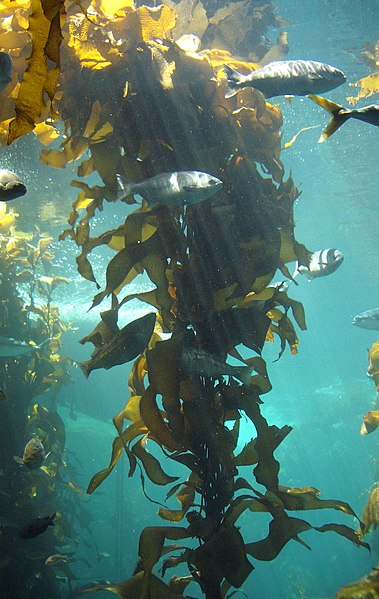
The kelp forest exhibit at the Monterey Bay Aquarium: A three-dimensional, multicellular thallus. Photo: Stef Maruch Wikipedia – Algae
Clade two: Bryophytes
A nonvascular subclade of embryophytes (land plants), first appearing 420 million years ago.
Division Marchantiophyta – Liverworts: A division of non-vascular land plants commonly referred to as hepatics or liverworts. With mosses and hornworts, they have a gametophyte-dominant life cycle, in which cells of the plant carry only a single set of genetic information. Most look like small (2-20 mm) flattened mosses. There may be as many as 9,000 species. 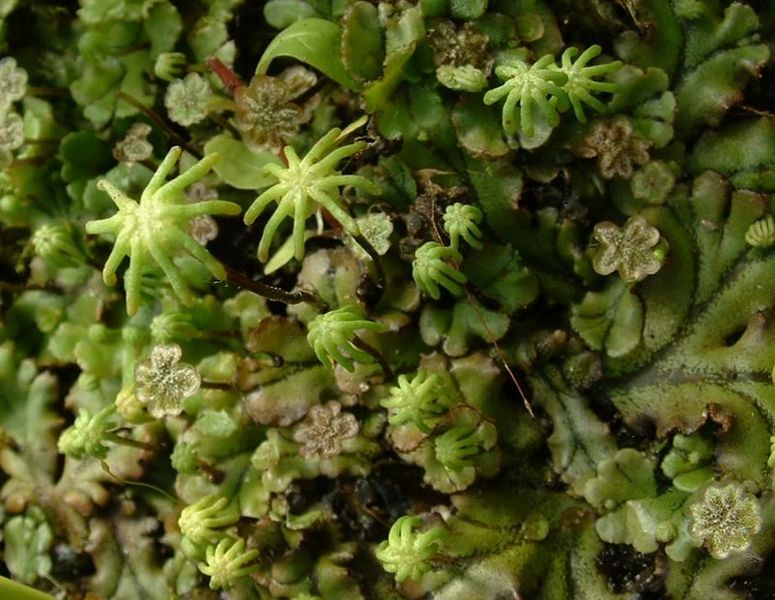
Marchantia polymorpha, with antheridial and archegonial stalks.
Photo: Jeffdelonge Wikipedia – Marchantiophyta
Division Anthocerotophyta – Hornworts: They look a bit like a cross between a horsetail and a fern and grow up to 3 meters high, with a sporophyte structure that looks like a horn. They grow in damp or humid places, possibly worldwide, and there may be only 100-150 species although 300 have been described. 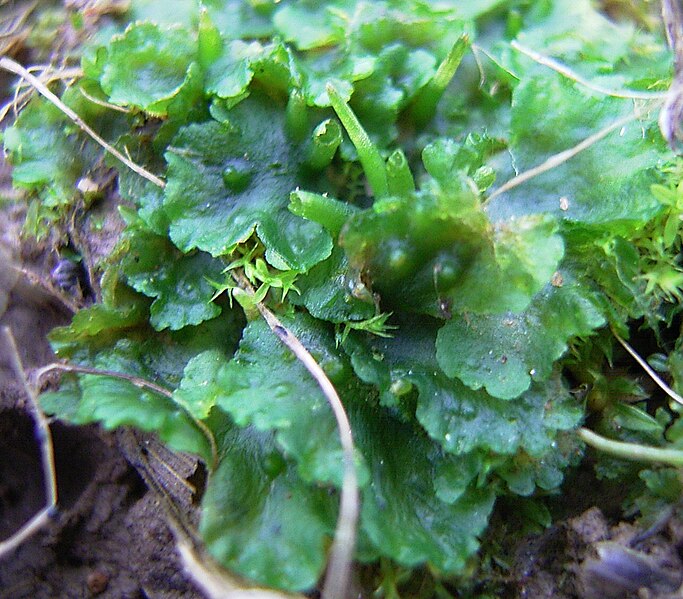
Phaeoceros laevis. Photo: de:Benutzer:Oliver_s. Wikipedia – Hornwort
Division Bryophyta – Mosses: Small, non-vascular flowerless, typically forming dense green clumps or mats, usually in damp or shady spots. Individual plants are usually composed of simple leaves one cell thick, attached to a branched or unbranched stem that conducts very little water or nutrients. Unlike liverworts and hornworts, they do have vascular systems. Seedless, they develop sporophytes topped with single capsules containing spores. The world’s tallest moss is Dawsonia, growing up to 20” high. There are approximately 12,000 species.
Clade three: Pteridophyta – Vascular plants
These are vascular plants (xylem transports nutrients from root to leaf, phloem transports them from leaf to root) and reproduce by means of spores, producing neither flowers no seeds. They appeared 410-375 million years ago.
Division Lycophyta – Clubmosses, fernmosses, spikemosses and quillworts. These have microphyllous leaves (single unbranched leaf vein) and reproduce with spores. During the Carboniferous Era they grew up to 50 m tall, formed extensive forests and contributed heavily to coal deposits. There may be as many as 1,200 extant species, all are small understory plants, often only an inch or two tall. 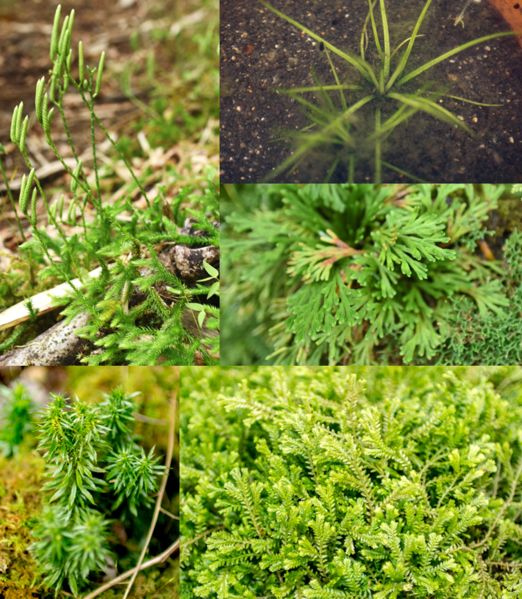
Modern lycophytes, clockwise from upper left: Lycopodium clavatum (Lycopodiales, Lycopodioideae), Isoetes japonica (Isoetales), Selaginella tamariscina, Selaginella remotifolia Selaginellales, Huperzia serrata (Lycopodiales, Huperzioideae). Photo: Kingfiser. Wikipedia – Lycophyta
Division Polypodiopsida (or Polypodiophyta) – Ferns: Their complex leaves (megaphylls) have multiple veins within the leaf and leaf gaps above them in the stem. Most ferns are leptosporangiate (the spore-forming enclosure is itself formed from a single epidermal cell, not from a group of cells [as are the eusporangiate ferns]). The fronds begin as coiled fiddleheads which uncurl as they grow. There are over 10,500 known extant species. The tallest fern in the world is the tree fern Cyathea australis,native to southeastern Australia, which grows to a 20 m (65 ft 6 in) high, with fronds up to 3 m (9 ft 9 in) long. Wikipedia – Fern

Unfolding frond of a Ponga (tree fern), Akatarawa River, New Zealand.
Photo: Karora. Wikipedia – Cyatheales
Division Equisetophyta or Sphenophyta – horsetails, marestails, snake grass, puzzlegrass. Some botanists consider this a subclass of Polypodiopsida (ferns), others maintain it as a division. As with the Lycopods they grew very large during the Carboniferious period, up to 98 ft tall. They are now “living fossils,” reduced to a single living genus and about 20 species. They like wet areas and have whorls of needle-like branches radiating at regular intervals from a single vertical segmented hollow stem. The small leaves are microphylls. Some stems will bear small cones (strobili) at their tips, comprised of sporangiophores. 
Northern Giant Horsetail, Equisetum telmateia (Equisetopsida) at Cambridge Botanic Garden. Typically 12–59 in. tall, rarely to 94 in. Photo: Rror. Wikipedia – Equisetophyta
Clade four: Gymnospermae
Vascular plants reproducing by means of an exposed (naked) seed or ovule which are directly fertilized by pollination. These began appearing 300 million years ago.
Division Cycadophyta – Cycads: They have a stout woody (ligneous) trunk with a crown of large, hard, stiff, evergreen and (usually) pinnate leaves (growing in pairs on the sides of a central shaft). They are dioecious (each plant is either male or female), Often mistaken for but unrelated to palms or ferns, they live long and grow slowly to heights of a few centimeters to several meters tall. There are over 300 cycad species in three families, and cycad leaves are featured on the flag of Vanuatu. 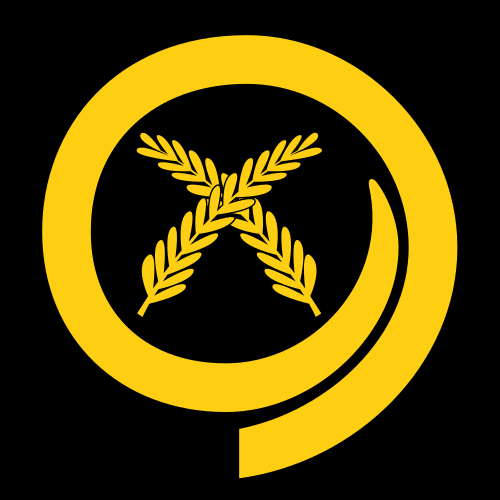
Section of flag of Vanuatu showing cycad leaf. Wikipedia – Vanuatu
Division Ginkgophyta – Ginkgo: Although Ginkos are an ancient group dating back 300 million years to the early Carboniferous period, there is only remaining extant species, Ginkgo biloba. The tree is dioecious, with pollen organs similar to the catkins of angiosperms. Pollen organs and sporophylls grow at the juncture of leaves and stems, and ovules are fertilized by flagellated male gametes which can move about. Their leaves are wide and flat with two lobes. 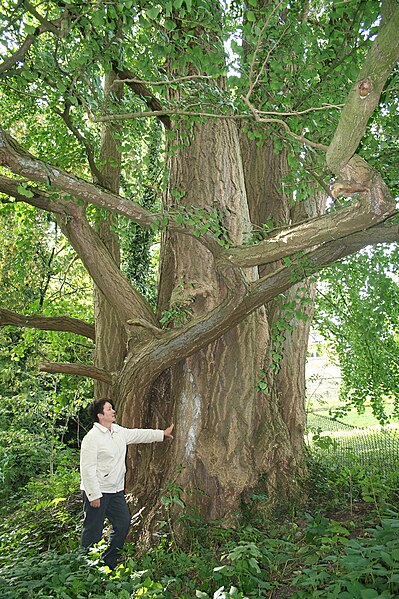
Ginkgo biloba tree in Tournai, Belgium.
Photo: Jean-Pol Grandmont. Wikipedia – Ginkgo biloba
Division Pinophyta or Coniferophyta or Coniferae – Conifers: These are perennial woody plants which exhibit secondary growth, resulting from cell division in the cambium (tissue between xylem and phloem) or lateral meristems and which causes the stems and roots to thicken. Seeds are born in cones. The single living class contains seven families containing over 600 species, including the well-known and important cedars, cypresses, firs, junipers, pines, redwoods, spruces and yews. Recently the gnetophytes, sometimes considered a separate division (or class, subclass or order), may be considered a subclade within Pinophyta. Wikipedia – Conifer
Clade five: Angiospermae, formerly Magnoliophyta
Angiosperms have enclosed seeds with many complex fertilization arrangements. They include all forbs (flowering plants without a woody stem), grasses and grass-like plants, nearly all broad-leaved trees, shrubs and vines, and most aquatic plants. “Angiosperm” derives from Greek angeion (‘container, vessel’) + sperma (‘seed’), indicating that the seeds are enclosed within a fruit. This most diverse group of land plants began diverging from the gymnosperms 300 million years ago and their diversification began exploding 120 million years ago. They now have 64 orders, 416 families, about 13,000 genera and 300,000 described species. As one might expect with such a large and important group of organisms, there are many systems for dividing them up. The following system is one used on Wikipedia.
Basal Angiosperms: These are perhaps 175 species of flowering plants which diverged early from the lineage leading to most flowering plants, collectively known as ANA grade and include Amborella (a single shrub species from New Caledonia), Nymphaeales (water lilies) and Austrobaileyales (aromatic woody plants including star anise). 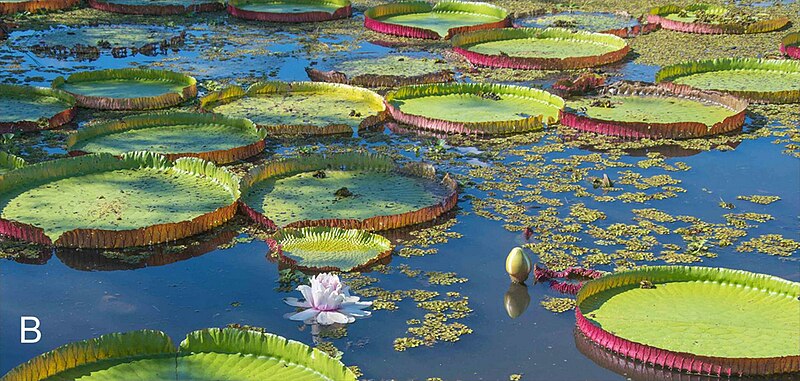
Giant Water Lily Victoria boliviana sp. nov. (Bolivia, Beni); leaves are up to 3 m. across. Photo: Carlos Magdalena; Wikipedia – Nymphaeales
Clade Mesangiospermae – Core Angiosperms: These comprise all the rest of the flowering plants. The following five groups make up this core.
Clade Magnolianae or Magnoliidae – Magnoliids: The third largest group and includes about 10,000 species, characterized by trimerous flowers (3 each of sepals, petals, stamens or carpels), pollen with one pore, and usually branching-veined leaves. It includes such common and popular plants as: magnolias, nutmeg, bay laurel, cinnamon, avocado, black pepper and tulip tree. 
Flower of Asimina triloba – Pawpaw.
Photo: User:Phyzome. Wikipedia – Magnoliids
Clade Chloranthaceae – Chloranthales: This group consists of a single family of 79 species of woody or weakly woody plants occurring in SE Asia, the Pacific, Madagascar, Central and South America, and the West Indies. They are fragrant shrubs or herbaceous plants that produce new side branches only on new growth. Evergreen leaves are arranged in pairs on opposite sides of the cylindrical stem. Petals and sometimes sepals are absent on the small flowers. Fruits are drupes or berries. Their ancestors date back to the early Cretaceous and have been found on all continents. 
Fortune’s Chloranthus, Chloranthus fortunei.
Photo: bastus917. Wikipedia – Chloranthaceae
Clade Monocotyledons – Monocots: The second largest group of about 70,000 species are the grasses and grass-like flowering plants whose seeds typically contain only one embryonic leaf (cotyledon), which is the first to pop out of the sprouting seed. This used to be one of the two major groups – the other was the dicots with two “seed leaves” – into which flowering plants were traditionally divided, but no longer. Monocots include 20,000 species of orchids and 12,000 of true grasses. The major grains (rice, wheat, maize), sedges, sugar cane and bamboo are monocots. 
Onion slice: the cross-sectional view shows the veins that run in parallel along the length of the bulb and stem. Photo: flikr0114. Wikipedia – Monocotyledon
Clade Eudicotidae – eudicots, formerly dicots: These are characterized by having two seed leaves (cotyledons) upon germination. They have previously been called tricolpates or non-magnoliid dicots. Estimates range from 175,000 to 280,000 species which includes many of our commonly cultivated and edible plants and most leafy, mid-latitude trees. Sunflower, dandelion, forget-me-not, cabbage, apple, buttercup are all eudicots. 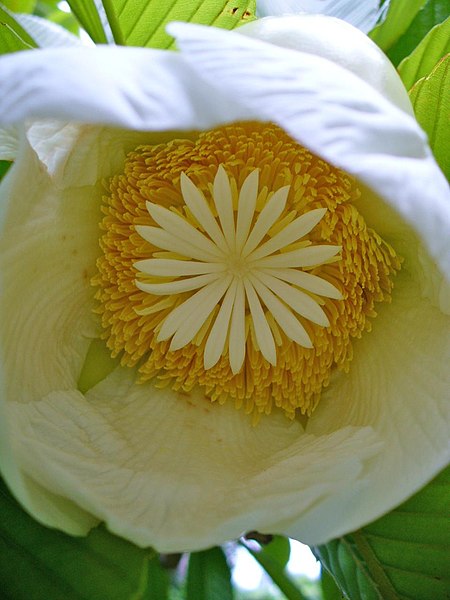
Flower of Elephant Apple or Ou Tenga, Dillenia indica, native to tropical Asia. Photo: Scott.zona. Wikipedia: Pentapetalae
Division Ceratophyllaceae – Coontails: Found worldwide but composed of a single genus with 6-30 species, therefore the subject of arguments. Also known as hornworts, but completely unrelated to the hornworts discussed earlier. They are common in ponds, marshes and quiet streams in tropical and temperate regions, submerged as they grow up to the surface where they float as they grow. 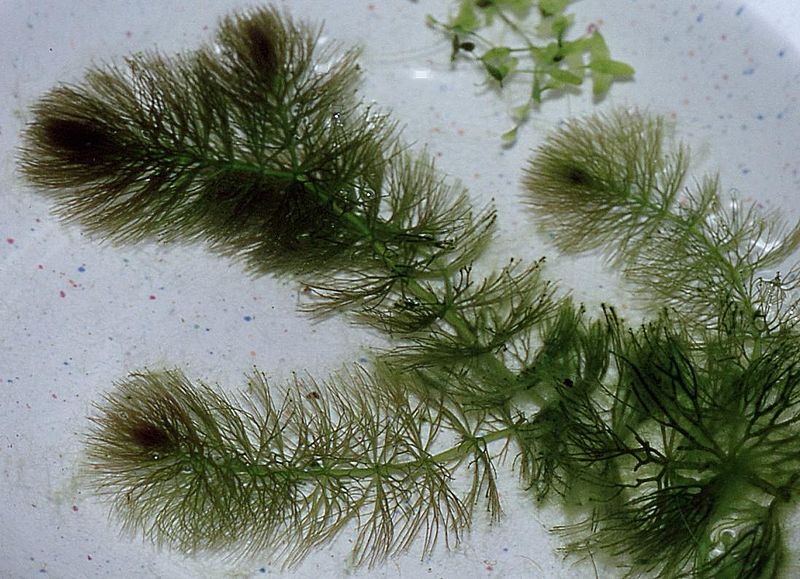
Soft Hornwort, Ceratophyllum submersum.
Photo: Christian Fischer. Wiki – Ceratophyllaceae
Below is another cladogram, “Land Plants,” with a slightly different presentation from the cladogram at the beginning of this post, giving you more phyla, more dates, and some synapomorphies (derived shared traits). 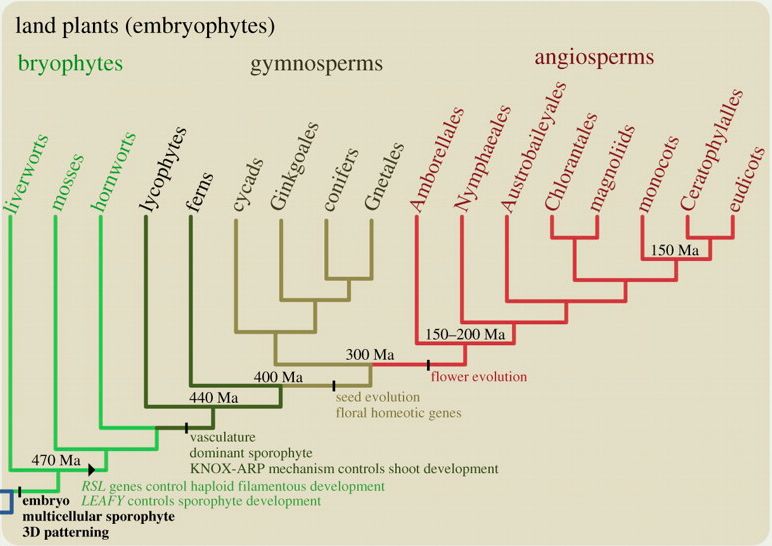
From: Garden Riots blog – An Introduction for Gardeners to the Eudicots
The Taxonomy Series
Installments post ever other day; installments will not open until posted.
Taxonomy One: A brief survey of the history and wherefores of taxonomy: Aristotle, Linnaeus and his binomial system of nomenclature, taxonomic ranks and the discovery and application of biological clocks.
Taxonomy Two: Introduces the higher levels of current taxonomy: the three Domains and the four Kingdoms. We briefly discuss Kingdom Protista, then the seven phyla of Kingdom Fungi.
Taxonomy Three: Kingdom Plantae.
Taxonomy Four: Kingdom Animalia to Phylum Annelida.
Taxonomy Five: A discussion of Cladistics, how it works and why it is becoming ever more important.
Taxonomy Six: Phylum Chordata, stopping at Class Mammalia.
Taxonomy Seven: Class Mammalia.
Taxonomy Eight: Class Aves, beginning with a comparison of five different avian checklists of the past 50 years.
Taxonomy Nine: A cladogram and discussion of Subclass Neornithes (modern birds) of the past 110 million years, reaching down to the current forty-one orders of birds.
Taxonomy Ten: A checklist of Neornithes including all ranks and clades down to the rank of the current 251 families of birds (plus a few probable new arrivals) with totals of the current 11,017 species of birds.
Discover more from SANTA MONICA BAY AUDUBON SOCIETY BLOG
Subscribe to get the latest posts sent to your email.



 SANTA MONICA BAY AUDUBON SOCIETY BLOG