Avian Checklist of 41 Orders & 251 Families | Taxonomy 10
[By Chuck Almdale]
Introduction
My research could uncover no single source for the most up-to-date taxonomic information on birds (or anything else); even if they were such a thing, there is such wide disagreement among those working on the avian phylogenetic sequence that it could be biased and a source more for dissension than agreement. One such source may exist that everyone in the world agrees is completely accurate and completely up-to-date, but if there is, it’s a very well-kept secret.
Therefore, the following taxonomic sequence draws from multiple sources, most notably Birds of the World (BOW) website – Orders & Families, Distribution and Taxonomy of Birds of the World (Sibley & Monroe, 1990), several papers especially “The Origin and Diversification of Birds” (Brusatte, O’Conner & Jarvis, 2014) [Link to Article] and numerous Wikipedia pages, especially Passerine and Passerea and the separate pages for their nearly innumerable subdivisions. [Wikipedia is remarkably unbiased, and their articles frequently offer multiple taxonomic sequences where disagreement exists.] Research continues; refinements and rearrangements will continue to appear as research is completed; gradually a unified picture is developing. The following sequence is as accurate as I could make it at this time. What follows are some guidelines as to what is in the sequence and a few choices I made for the sake of presentation.
All 41 orders and 251 families are numbered according to the BOW Orders & Families as of mid-June 2024, which may well have changed by the time this gets posted. I expect some major changes to this sequence to occur within the coming year as the International Ornithological Union (IOU) Working Group Avian Checklist Committees [Link] complete their work, or at least post some updates. Following this, eBird/Birds of the World will undoubtedly update their sequences, as they regularly do at least yearly as the Clements List is updated. It may come to pass within the next few years that the Clements and IOU checklists are brought more into alignment, particularly in regards to the higher levels of taxonomy (from Class down to Family).
When Sibley & Monroe published their book in 1990, their table of contents utilized many additional taxonomic ranks that possessed useful suffixes (in brackets below) for uniformity in their nineteen taxonomic ranks:
Class: Super-, Class, Sub-, Infra- (-es), Parv- (-ae)
Order: Super- (-imorphae), Order (-iformes), Sub- (-i), Infra- (-ides), Parv- (-ida)
Family: Super- (-oidea), Family (-idae), Sub- (-inae), Tribe (-ini), Subtribe (-ina)
Genus: Genus, subgenus
Species: species, subspecies
These ranks are still used in many books, papers and websites and I retained them whenever possible. But a lot of taxonomic research, particularly in the development of evolutionary clocks, has occurred in the 34 years since that book was published.
Clades
The use of clades and clade terminology has grown enormously over the past few decades. Many of the previous terms have been adopted into the clade structure, especially Order, Family, Genus and Species, but also many of the subdivisions listed above. The clade structure, which works far better in cladogram diagrams than in writing, emerged out of the growing body of information concerning divergences in evolutionary lineages and the development and availability of “evolutionary clocks.” When an evolutionary line divides, a “node” with two branches is created at that point which can be dated by means of the evolutionary clock. The terms Order, Suborder, etc. worked well for creating a hierarchy of ranks, but the number of nodes of division and clade ranks have already vastly outrun this restricted terminology, and the number of ranks can only continue to grow. Every time a species evolves into two subspecies than evolve farther apart into two species, a node is created and should be given a name. From the level of Class Aves down to Passer domesticus domesticus, there are at least seventeen named Linnaean-style ranks. Now, as we saw in Taxonomy 6, Clade63 Subclass Neornithes is only the beginning of extant modern birds. The cladogram in Taxonomy 9 added another 10 ranks to get to Order Passeriformes, and Sibley & Monroe add eight more ranks to arrive at Passer domesticus domesticus. That’s a total of 81 ranks, so far. Once the sequence to P.d.domesticus is fully mapped – and ranks are continually inserted all along the sequence – there could be well over a hundred ranks. I sure Linnaeus, who thought 10,000 species would cover the lot of living things, never conceived of such complexity even in his most fevered dreams of discovery and classification. People are already working on developing taxonomic modifications or replacement systems.
Although there are still nodes where there are more than two branches (daughter lineages), it is widely viewed that such polytomies are an artifact of insufficient information. When an evolutionary lineage branches, the process involves a single species branching into two species only, not three or more. As researchers produce finer-grained results, it is expected that all such polytomies will be replaced with a series of paired branches.
A good system of upper-level nomenclature could utilize a combination of names and numbers. If we kept only Class, Order, Family, Genus, Species we could use have Class 1, class 2, etc.; Order 1, order 2, etc.; Family 1, family 2, etc.;…genus 1, genus 2, etc. Class 1 = the original level of class, Class 2 = the next step down…Class 10 = the 9th level below Class 1, and so on. They could adopt subscripts as I did in prior postings, e.g. Class1, Class2…Class63, although, frankly, typing out all those subscripts was a nuisance. There would be no limit to the number of steps which could be added as necessary when new divergences are discovered. Currently many new clades are given names, but many aren’t, and you can find many cladograms where nodes and their daughter lineages are not named. The previous names from Infraclass to Subtribe had their unique suffixes, which was a good clue as to where they fell in the sequence (Passer-imorphae, Passer-iformes, Passer-idae, Passer) but most of the new clade names, if they are even named, give no linguistic clue as to their position in the sequence. One can see the nodes on a cladogram, but not in the written descriptions. A simple – yet sufficiently descriptive – system needs to be developed. The portmanteau clade names utilizing the next two taxa to form the new taxon name is a good start (e.g. Xenacoelomorpha: Xena + coel + omorpha, combines the two daughter ranks xenoturbella and acoelomorpha).
Key to the Avian Taxonomic List Below
Totals of Orders, Families and Species
1. Most ranks have a set of numbers indicating the number of major subdivisions (Order, Family, Species).
Subclass: Neornithes 41/251/11017 means it has 41 orders, 251 families, 11,017 species.
2. Orders have two numbers for families and species:
18. Order: Gruiformes – Cranes & allies – 6/192 means that Order 18 Gruiformes has 6 families, 192 species.
3. Families show a single number for species: 123. Family:
Viduidae – Indigobirds – 20 means that family 123 Viduidae has 20 species.
4. Most intermediate steps are similarly numbered, although a few unnamed clades are not.
5. Many ranks have used (or are still using) multiple names (e.g. Superorder Caprimulgimorphae = Clade Strisores). I did not search for these alternate names, but where I encountered them, I included them in parentheses).
Bold, Italics & Indentation
Bold and italics to differentiate higher-level and lesser-known sequence steps from the more common ranks. Each lower taxonomic rank is indented 3 spaces. Equal indentation means equivalent rank (two orders, two families, etc.). Indentation is recalibrated twice (locations noted within the sequence) to avoid word-wrapping.
Colors
The forty-one orders from the Chart of Five Checklists and the prior posting’s cladogram are numbered and highlighted in blue.
The nine major clades from the prior posting’s cladogram are highlighted in red.
I included a few families (unnumbered and highlighted in blue) that I think are likely to be added within the coming year, but did not include the probable number of the species classified to them as they are counted within their current families.
Family Number
Each family (e.g. 1. Family: Rheidae – Rheas) is given the sequence number as shown on the BOW website – Orders & Families. Sometimes, primarily in Passeriformes, their sequence in this list within (and even between) groups is not in numerical order. This occurs where I have strong reason to believe that sequences other than the BOW are more up-to-date and the BOW sequence will likely soon change.
The top levels (Domain to Class) were discussed in the earlier postings in this series.
You may find it interesting to compare the following written sequence to the cladogram included in Taxonomy 9. They agree to one other, but each includes information not contained within the other. Working together, they demonstrate the different strengths each form of presentation possesses.
If you’d like an 8-page PDF document of the entire sequence, click below.
Taxonomic Sequence of Avian 41 Orders and 251 Families
Family Size

It may or may not signify anything to note that most of the 251 bird families contain few species, only a few contain many dozens or hundreds of species. I noticed this when I discovered that 37 families (15.5% of 251 families) contained only a single species. As this was roughly 1/6th of the total, I divided the families into six groups based on species totals. One sixth of families are monotypic, one-sixth have more than 80 species each. It’s interesting to speculate on this peculiar fact as you go through the entire family list. What is it in the evolutionary process that makes so many species sufficiently different from all other species to warrant their own family? Do large families signify relative evolutionary success, adaptability or greater speed of speciation? Are monotypic families evolutionarily closer to the root of their clade?
The first extant species in the list.
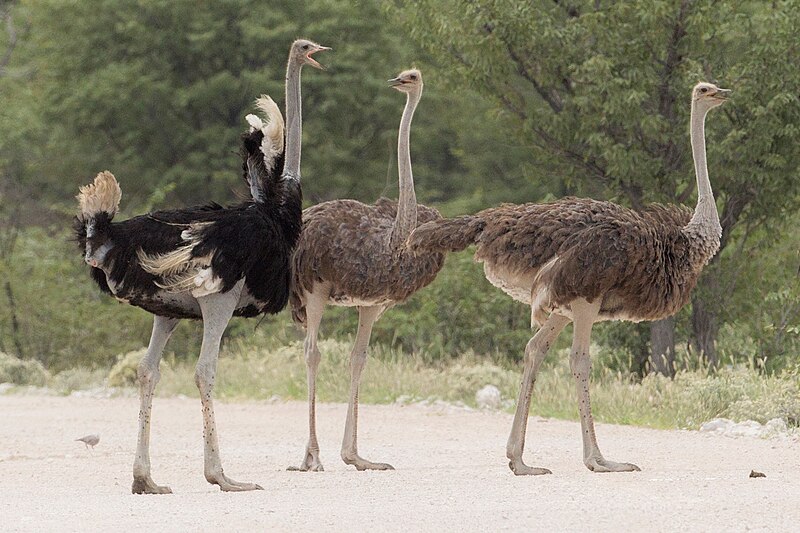
The heaviest, tallest and probably most ancient bird in the world, the Common Ostrich, Struthio camelus. Photo: Yathin S Krishnappa. Wikipedia: Ostrich
The Taxonomic Sequence of Avian Orders and Families
Domain: Eukaryota
Kingdom: Anamalia
Phylum: Chordata
Subphylum: Vertebrata
Class: Aves
Subclass: Archaeornithes – birds extinct Jurassic & early Cretaceous
Subclass: Neornithes – all living birds – 41/251/11017
Infraclass: Paleognathae – Ancient Jaw – 5/5/59
Superorder: Struthionimorphae – 1/1/2
1. Order: Struthioniformes – 1/2
1. Family: Struthionidae – Ostriches – 2
Superorder: Rheimorphae – 1/1/2
2. Order: Rheiformes – 1/2
1. Family: Rheidae – Rheas – 2
Superorder:Tinamimorphae – 1/1/46
3. Order: Tinamiformes – 1/46
1. Family: Tinamidae – Tinamous – 46
Superorder: Apterygimorphae – 2/2/9
4. Order: Apterygiformes – 1/5
1. Family: Apterygidae – Kiwis – 5
5. Order: Casuariiformes – 1/4
1. Family: Casuariidae – Cassowary & Emu – 4
Infraclass: Neognathae – 36/246/10958
Parvclass Galloanseres – 2/8/483
6. Order: Anseriformes – 3/178
1. Family: Anhimidae – Screamers – 3
2. Family: Anseranatidae – Magpie Goose – 1
3. Family: Anatidae – Ducks, Geese & Waterfowl – 174
7. Order: Galliformes – 5/305
1. Family: Megapodiidae – Megapodes – 21
2. Family: Cracidae – Guans, Chachalacas & Curassows – 57
3. Family: Numididae – Guineafowl – 8
4. Family: Odontophoridae – New World Quail – 33
5. Family: Phasianidae – Pheasants, Grouse & Allies – 186
Parvclass Neoaves – 34/238/10475
To conserve horizontal space, Parvclass Neoaves is moving 21 spaces to the left.
Parvclass Neoaves – 34/238/10475
Clade Columbea – 5/5/400
Clade Superorder: Phoenicopterimorphae – 2/2/28 (or Clade Mirandornithes)
8. Order: Phoenicopteriformes – 1/6
1. Family: Phoenicopteridae – Flamingos – 6
9. Order: Podicipediformes – 1/22
1. Family: Podicipedidae – Grebes – 22
Clade Superorder: Columbimorphae – 3/3/372
10. Order: Columbiformes – 1/353
1. Family: Columbidae – Pigeons & Doves – 353
11. Order: Mesitornithiformes – 1/3
1. Family: Mesitornithidae – Mesites – 3
12. Order: Pterocliformes – 1/16
1. Family: Pteroclidae – Sandgrouse – 16
Clade Passerea – 29/233/10075
Clade Otidae – 4/11/805
Clade Superorder: Otidimorphae – 3/3/196
13. Order: Otidiformes – 1/26
1. Family: Otididae – Bustards – 26
14. Order: Musophagiformes – 1/23
1. Family: Musophagidae – Turacos – 23
15. Order: Cuculiformes – 1/147
1. Family: Cuculidae – Cuckoos – 147
Superorder: Caprimulgimorphae – 1/8/609 (Clade Strisores)
16. Order: Caprimulgiformes – Nightbirds, Swifts, Hummers – 8/609
2. Family: Caprimulgidae – Nightjars & Allies – 97
Clade Vanescaves
3. Family: Nyctibiidae – Potoos – 7
4. Family: Steatornithidae – Oilbird – 1
Clade Letornithes
1. Family: Podargidae – Frogmouths – 16
Clade Daedalornithes
5. Family: Aegothelidae – Owlet-nightjars – 9
Clade Apodiformes
Clade Suborder Apodi
6. Family: Apodidae – Swifts – 112
7. Family: Hemiprocnidae – Treeswifts – 4
Clade Suborder Trochili
8. Family: Trochilidae – Hummingbirds – 363
Clade Gruae – 3/26/579
Clade Superorder: Opisthocomimorphae – 1/1/1
17. Order: Opisthocomiformes – 1/1
1. Family: Opisthocomidae – Hoatzin – 1
Clade Superorder: Gruimorphae 2/25/578 (or Charadriimorphae, Cursorimorphae)
18. Order: Gruiformes – Cranes & allies – 6/192
Suborder: Ralli – 3/173
1. Family: Sarothruridae – Flufftails – 15
2. Family: Rallidae – Rails, Gallinules & Coots – 155
3. Family: Heliornithidae – Finfoots – 3
Suborder: Grui – 3/19
4. Family: Aramidae – Limpkin – 1
5. Family: Psophiidae – Trumpeters – 3
6. Family: Gruidae – Cranes – 15
19. Order: Charadriiformes – Shorebirds & Gulls – 19/386
Suborder: Charadrii – 8/105
1. Family: Pluvianellidae – Magellanic Plover – 1
2. Family: Chionidae – Sheathbills – 2
3. Family: Burhinidae – Thick-knees – 10
4. Family: Pluvianidae – Egyptian Plover – 1
5. Family: Recurvirostridae – Stilts & Avocets – 9
6. Family: Ibidorhynchidae – Ibisbill – 1
7. Family: Haematopodidae – Oystercatchers – 12
8. Family: Charadriidae – Plovers & Lapwings – 69
Suborder: Scolopaci – 5/113
9. Family: Pedionomidae – Plains-wanderer – 1
10. Family: Thinocoridae – Seedsnipes – 4
11. Family: Rostratulidae – Painted-Snipes – 3
12. Family: Jacanidae – Jacanas – 8
13. Family: Scolopacidae – Sandpipers & Allies – 97
Suborder: Lari – 6/168
14. Family: Turnicidae – Buttonquail – 18
15. Family: Dromadidae – Crab-Plover – 1
16. Family: Glareolidae – Pratincoles & Coursers – 17
17. Family: Stercorariidae – Skuas & Jaegers – 7
18. Family: Alcidae – Auks, Murres & Puffins – 25
19. Family: Laridae – Gulls, Terns & Skimmers – 100
Clade Superorder Eurypygimorphae – 2/3/5 (or Phaethontimorphae)
20. Order: Eurypygiformes – 2/2
1. Family: Rhynochetidae – Kagu – 1
2. Family: Eurypygidae – Sunbittern – 1
21. Order: Phaethontiformes – 1/3
1. Family: Phaethontidae – Tropicbirds – 3
Clade Aequornithes – Core Waterbirds – 6/16/365
Clade Superorder: Gaviimorphae – 1/1/5
22. Order: Gaviiformes – 1/5
1. Family: Gaviidae – Loons – 5
Clade Feraequornithes – 5/15/360
Clade Austrodyptornithes – 2/5/164 (or Superorder Procellariimorphae)
23. Order: Sphenisciformes – 1/18
1. Family: Spheniscidae – Penguins – 18
24. Order: Procellariiformes – 4/146
1. Family: Diomedeidae – Albatrosses – 20
2. Family: Oceanitidae – Southern Storm-Petrels – 10
3. Family: Hydrobatidae – Northern Storm-Petrels – 18
4. Family: Procellariidae – Shearwaters & Petrels – 98
Clade Superorder: Pelecanimorphae – 3/10/196
25. Order: Ciconiiformes – 1/20
1. Family: Ciconiidae – Storks – 20
Clade: Pelecanes – 2/9/176
26. Order: Suliformes – 4/59
1. Family: Fregatidae – Frigatebirds – 5
2. Family: Sulidae – Boobies & Gannets – 10
3. Family: Anhingidae – Anhingas – 4
4. Family: Phalacrocoracidae – Cormorants & Shags – 40
27. Order: Pelecaniformes – 5/117
Suborder: Pelicani – 3/10
1. Family: Pelecanidae – Pelicans – 8
2. Family: Balaenicipitidae – Shoebill – 1
3. Family: Scopidae – Hamerkop – 1
Suborder: Ardei – 2/107
4. Family: Ardeidae – Herons, Egrets & Bitterns – 71
5. Family: Threskiornithidae – Ibises & Spoonbills – 36
Clade Telluraves (Core Landbirds) – 14/177/8321
Clade Infraclass Afroaves – 10/28/1254
Clade Superorder: Accipitrimorphae – 2/4/259
28. Order: Cathartiformes – 1/7
1. Family: Cathartidae – New World Vultures – 7
29. Order: Accipitriformes – 3/252
1. Family: Sagittariidae – Secretarybird – 1
2. Family: Pandionidae – Osprey – 1
3. Family: Accipitridae – Hawks, Eagles & Kites – 250
Clade Superorder: Strigimorphae – 1/2/247
30. Order: Strigiformes – 2/247
1. Family: Tytonidae – Barn-Owls – 18
2. Family: Strigidae – Owls – 229
Clade Superorder: Coriciimorphae – 7/22/748
31. Order: Coliiformes – 1/6
1. Family: Coliidae – Mousebirds – 6
Clade Cavitaves – 6/21/742
32. Order: Leptosomiformes – 1/1
1. Family: Leptosomidae – Cuckoo-roller – 1
Clade Eucavitaves – 5/20/741
33. Order: Trogoniformes – 1/46
1. Family: Trogonidae – Trogons – 46
Clade Picocoraciae – 4/19/695
34. Order: Bucerotiformes – 4/75
Suborder: Upupi – 2/11
1. Family: Upupidae – Hoopoes – 3
2. Family: Phoeniculidae – Woodhoopoes & Scimitarbills – 8
Suborder: Buceroti – 2/64
3. Family: Bucorvidae – Ground-Hornbills – 2
4. Family: Bucerotidae – Hornbills – 62
Clade Picodynastornithes – 3/15/620 (was Superorder: Coraciimorphae)
35. Order: Coraciiformes – 6/185
Clade unnamed
1. Family: Todidae – Todies – 5
2. Family: Momotidae – Motmots – 14
3. Family: Alcedinidae – Kingfishers – 117
Clade unnamed
4. Family: Meropidae – Bee-eaters – 31
5. Family: Coraciidae – Rollers – 13
6. Family: Brachypteraciidae – Ground-Rollers – 5
36. Order: Galbuliformes (sometimes suborder Galbuli in Picaformes) – 2/55
1. Family: Bucconidae – Puffbirds – 37
2. Family: Galbulidae – Jacamars – 18
37. Order: Piciformes – 7/380
Infraorder Ramphastides – 5/129
1. Family: Lybiidae – African Barbets – 41
2. Family: Megalaimidae – Asian Barbets – 35
3. Family: Capitonidae – New World Barbets – 15
4. Family: Semnornithidae – Toucan-Barbets – 2
5. Family: Ramphastidae – Toucans – 36
Infraorder: Picides – 2/251
6. Family: Indicatoridae – Honeyguides – 16
7. Family: Picidae – Woodpeckers – 235
Clade Infraclass Australaves – 4/149/7067
38. Order: Cariamiformes – 1/2
1. Family: Cariamidae – Seriemas – 2
Clade Superorder Eufalconimorphae – 148/7065
39. Order: Falconiformes – 1/65
1. Family: Falconidae – Falcons & Caracaras – 65
Clade Psittacopasseres – 147/7000 (formerly Passerimorphae)
40. Order: Psittaciformes – 4/405
Superfamily: Strigopoidea – 1/4
1. Family: Strigopidae – New Zealand Parrots – 4
Superfamily: Cacatuoidea – 1/22
2. Family: Cacatuidae – Cockatoos – 22
Superfamily: Psittacoidea – True Parrots – 2/379
3. Family: Psittaculidae – Old World Parrots – 202
4. Family: Psittacidae – New World & African Parrots – 177
41. Order: Passeriformes – 143/6595
The final extant species in the non-passerine list.
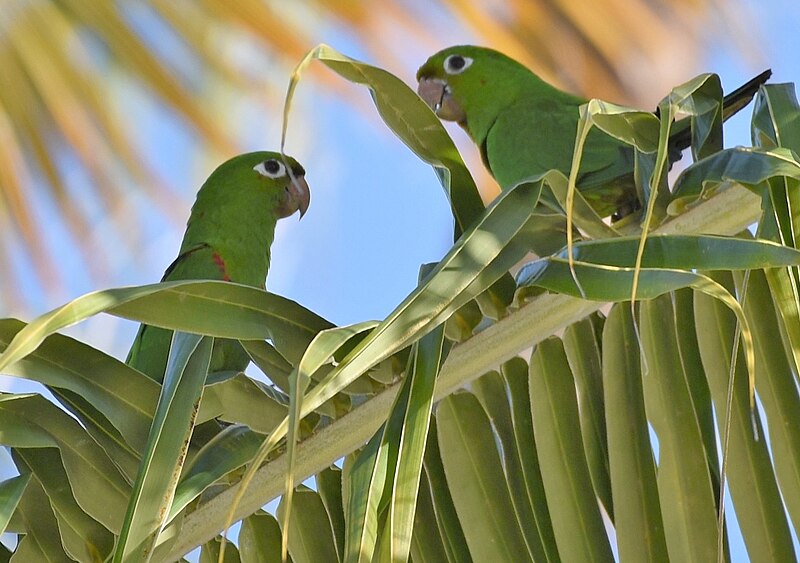
Hispaniolan Parakeet, Psittacara chloropterus.
Photo: Martingloor. Wikipedia: Hispaniolan Parakeet
To conserve horizontal space, Order Passeriformes is moving 27 spaces to the left.
The first extant species in the passerine list.

Rifleman, female, Acanthisitta chloris, of South Island, New Zealand. An insectivorous wren-like member of a four-species family basal to all passerines, endemic to New Zealand. Photo: digitaltrails. Wikipedia: Rifleman
As you go through the following list, note the 3 suborders, 4 infraorders, 5 parvorders and 10 superfamilies.
41. Order: Passeriformes – 143/6595
Suborder Acanthisitti – 1/4
1. Family: Acanthisittidae – New Zealand Wrens – 4
Suborder Tyranni – Non-oscine Passerines – 17/1386
Infraorder Eurylaimides – Old World Suboscines – 5/68
5. Family: Philepittidae – Asities – 4
3. Family: Eurylaimidae – Asian & Grauer’s Broadbills – 10
2. Family: Calyptomenidae – African & Green Broadbills – 6
4. Family: Sapayoidae – Sapayoa – 1
6. Family: Pittidae – Pittas – 47
Infraorder Tyrannides – New World Suboscines – 12/1318
Parvorder Furnariida – 7/714
8. Family: Melanopareiidae – Crescentchests – 4
9. Family: Conopophagidae – Gnateaters – 12
7. Family: Thamnophilidae – Typical Antbirds – 237
10. Family: Grallariidae – Antpittas – 70
11. Family: Rhinocryptidae – Tapaculos – 65
12. Family: Formicariidae – Antthrushes – 12
13. Family: Furnariidae – Ovenbirds & Woodcreepers – 314
Parvorder Tyrannida 5/604
14. Family: Pipridae – Manakins – 55
15. Family: Cotingidae – Cotingas – 65
16. Family: Tityridae – Tityras and Allies – 35
17. Family: Oxyruncidae – Sharpbill, Royal Flycatcher & Allies – 8
Family: Onychorhynchidae–Royal Flycatcher–Part of Oxyruncidae
18. Family: Tyrannidae – Tyrant Flycatchers – 441
Suborder Passeri – Oscine Passerines 125/5205
Basal families in Passeri clade – 11/342
20. Family: Atrichornithidae – Scrub-birds – 2
19. Family: Menuridae – Lyrebirds – 2
22. Family: Climacteridae – Australasian Treecreepers – 7
21. Family: Ptilonorhynchidae – Bowerbirds – 27
23. Family: Maluridae – Fairywrens – 32
25. Family: Dasyornithidae – Bristlebirds – 3
26. Family: Pardalotidae – Pardalotes – 4
27. Family: Acanthizidae – Thornbills & Allies – 66
24. Family: Meliphagidae – Honeyeaters – 191
28. Family: Pomatostomidae – Pseudo-Babblers – 5
29. Family: Orthonychidae – Logrunners – 3
Infraorder Corvides – 30/847 (previously parvorder Corvida)
Basal families in Corvides clade – 4/107
30. Family: Cinclosomatidae – Quail-thrushes & Jewel-babblers – 12
31. Family: Campephagidae – Cuckooshrikes – 89 (some in Orioloidea)
32. Family: Mohouidae – Whiteheads – 3
33. Family: Neosittidae – Sittellas – 3
Superfamily: Orioloidea 8/180
34. Family: Psophodidae – Whipbirds & Wedgebills – 5
35. Family: Eulacestomatidae – Ploughbill – 1
37. Family: Falcunculidae – Shrike-tits – 3
36. Family: Oreoicidae – Australo-Papuan Bellbirds – 3
38. Family: Paramythiidae – Tit Berrypecker & Crested Berrypecker – 3
39. Family: Vireonidae – Vireos, Shrike-Babblers & Erpornis – 61
40. Family: Pachycephalidae – Whistlers & Allies – 63
41. Family: Oriolidae – Old World Orioles – 41
Superfamily: Malaconotoidea – 8/154
42. Family: Machaerirhynchidae – Boatbills – 2
43. Family: Artamidae – Woodswallows, Bellmagpies & Allies – 24
44. Family: Rhagologidae – Mottled Berryhunter – 1
49. Family: Malaconotidae – Bushshrikes & Allies – 50
47. Family: Pityriasidae – Bristlehead – 1
48. Family: Aegithinidae – Ioras – 4
45. Family: Platysteiridae – Wattle-eyes & Batises – 32
46. Family: Vangidae – Vangas, Helmetshrikes & Allies – 40
Superfamily: Corvoidea – 10/406
50. Family: Rhipiduridae – Fantails – 64
51. Family: Dicruridae – Drongos – 28
54. Family: Monarchidae – Monarch Flycatchers – 100
53. Family: Ifritidae – Ifrita – 1
52. Family: Paradisaeidae – Birds-of-Paradise – 44
55. Family: Corcoracidae – White-winged Chough & Apostlebird – 2
56. Family: Melampittidae – Melampittas – 2
58. Family: Laniidae – Shrikes – 34
57. Family: Platylophidae – Crested Shrikejay – 1
59. Family: Corvidae – Crows, Jays & Magpies – 130
Infraorder Passerides – 84/4016 (previously parvorder Passerida)
Basal families in Passerides clade – 8/76
60. Family: Cnemophilidae – Satinbirds – 3
61. Family: Melanocharitidae – Berrypeckers & Longbills – 12
62. Family: Callaeidae – Wattlebirds – 5
63. Family: Notiomystidae – Stitchbird – 1
64. Family: Petroicidae – Australasian Robins – 50
67. Family: Eupetidae – Rail-babbler – 1
65. Family: Picathartidae – Rockfowl – 2
66. Family: Chaetopidae – Rockjumpers – 2
Parvorder Sylviida – 26/1363
Basal families in Sylviida clade – 9/364
68. Family: Hyliotidae – Hyliotas – 4
69. Family: Stenostiridae – Fairy Flycatchers – 9
70. Family: Paridae – Tits, Chickadees & Titmice – 63
71. Family: Remizidae – Penduline-Tits – 11
73. Family: Panuridae – Bearded Reedling – 1
72. Family: Alaudidae – Larks – 93
74. Family: Nicatoridae – Nicators – 3
75. Family: Macrosphenidae – African Warblers – 18
76. Family: Cisticolidae – Cisticolas & Allies – 162
Superfamily: Locustelloidea – 6/231
77. Family: Acrocephalidae – Reed Warblers & Allies – 60
78. Family: Locustellidae – Grassbirds & Allies – 67
79. Family: Donacobiidae – Donacobius – 1
80. Family: Bernieridae – Malagasy Warblers – 11
81. Family: Pnoepygidae – Cupwings – 4
82. Family: Hirundinidae – Swallows – 88
Superfamily: Sylvioidea 7/640
83. Family: Pycnonotidae – Bulbuls – 156
88. Family: Sylviidae – Sylviid Warblers & Allies – 32
89. Family: Paradoxornithidae – Parrotbills – 38
90. Family: Zosteropidae – White-eyes, Yuhinas & Allies – 148
91. Family: Timaliidae – Tree-Babblers, Scimitar-Babblers & Allies – 58
93. Family: Leiothrichidae – Laughingthrushes & Allies – 143
Family: Alcippeidae – Alcippe fulvettas (now in Leiothrichidae)
92. Family: Pellorneidae – Ground Babblers & Allies – 65
Superfamily: Aegithaloidea – 4/128
84. Family: Phylloscopidae – Leaf Warblers – 80
85. Family: Hyliidae – Hylias – 2
87. Family: Aegithalidae – Long-tailed Tits – 11
86. Family: Scotocercidae – Bush Warblers & Allies – 35
Family: Cettidae – Cettia bush warblers & allies (now in Scotocercidae)
Family: Erythrocercidae – Yellow flycatchers (now in Scotocercidae)
Parvorder Muscicapida – 19/856 (previously superfamily Muscicapoidea)
Superfamily: Bombycilloidea – 6/15
110. Family: Dulidae – Palmchat – 1
107. Family: Bombycillidae – Waxwings – 3
109. Family: Ptiliogonatidae – Silky-flycatchers – 4
111. Family: Hylocitreidae – Hylocitrea – 1
112. Family: Hypocoliidae – Hypocolius – 1
108. Family: Mohoidae – Hawaiian Honeyeaters – 5
Superfamily: Muscicapoidea – 8/693
100. Family: Elachuridae – Spotted Elachura – 1
101. Family: Cinclidae – Dippers – 5
106. Family: Muscicapidae – Old World Flycatchers – 345
105. Family: Turdidae – Thrushes & Allies – 175
102. Family: Buphagidae – Oxpeckers – 2
103. Family: Sturnidae – Starlings – 125
104. Family: Mimidae – Mockingbirds & Thrashers – 34
94. Family: Regulidae – Kinglets – 6
Superfamily: Certhioidea 5/148
95. Family: Tichodromidae – Wallcreeper – 1
96. Family: Sittidae – Nuthatches – 29
97. Family: Certhiidae – Treecreepers – 11
98. Family: Polioptilidae – Gnatcatchers – 21
99. Family: Troglodytidae – Wrens – 86
Parvorder Passerida – 31/1721 (previously superfamily Passeroidea)
Basal families in Passerida clade – 15/863
113. Family: Promeropidae – Sugarbirds – 2
114. Family: Modulatricidae – Dapple-throat & Allies – 3
116. Family: Nectariniidae – Sunbirds & Spiderhunters – 148
115. Family: Dicaeidae – Flowerpeckers – 53
118. Family: Chloropseidae – Leafbirds – 12
117. Family: Irenidae – Fairy-bluebirds – 3
119. Family: Peucedramidae – Olive Warbler – 1
120. Family: Urocynchramidae – Przevalski’s Pinktail – 1
121. Family: Ploceidae – Weavers & Allies – 123
123. Family: Viduidae – Indigobirds – 20
122. Family: Estrildidae – Waxbills & Allies – 138
124. Family: Prunellidae – Accentors – 12
125. Family: Passeridae – Old World Sparrows – 43
126. Family: Motacillidae – Wagtails & Pipits – 69
127. Family: Fringillidae – Finches, Euphonias & Allies – 235
Superfamily: Emberizoidea 16/858 (previously New World 9-primaried oscines)
129. Family: Rhodinocichlidae – Thrush-Tanager – 1
128. Family: Calcariidae – Longspurs & Snow Buntings – 6
130. Family: Emberizidae – Old World Buntings – 44
142. Family: Cardinalidae – Cardinals & Allies – 51
141. Family: Mitrospingidae – Mitrospingid Tanagers – 4
143. Family: Thraupidae – Tanagers & Allies – 384
131. Family: Passerellidae – New World Sparrows – 132
140. Family: Parulidae – New World Warblers – 115
138. Family: Icteriidae – Yellow-breasted Chat – 1
139. Family: Icteridae – Troupials & Allies – 106
132. Family: Calyptophilidae – Chat-Tanagers – 2
136. Family: Zeledoniidae – Wrenthrush – 1
137. Family: Teretistridae – Cuban Warblers – 2
134. Family: Nesospingidae – Puerto Rican Tanager – 1
135. Family: Spindalidae – Spindalises – 4
133. Family: Phaenicophilidae – Hispaniolan Tanagers – 4
The final extant species of the final family Phaenicophilidae (Hispaniolan Tanagers) in the Passerine list.
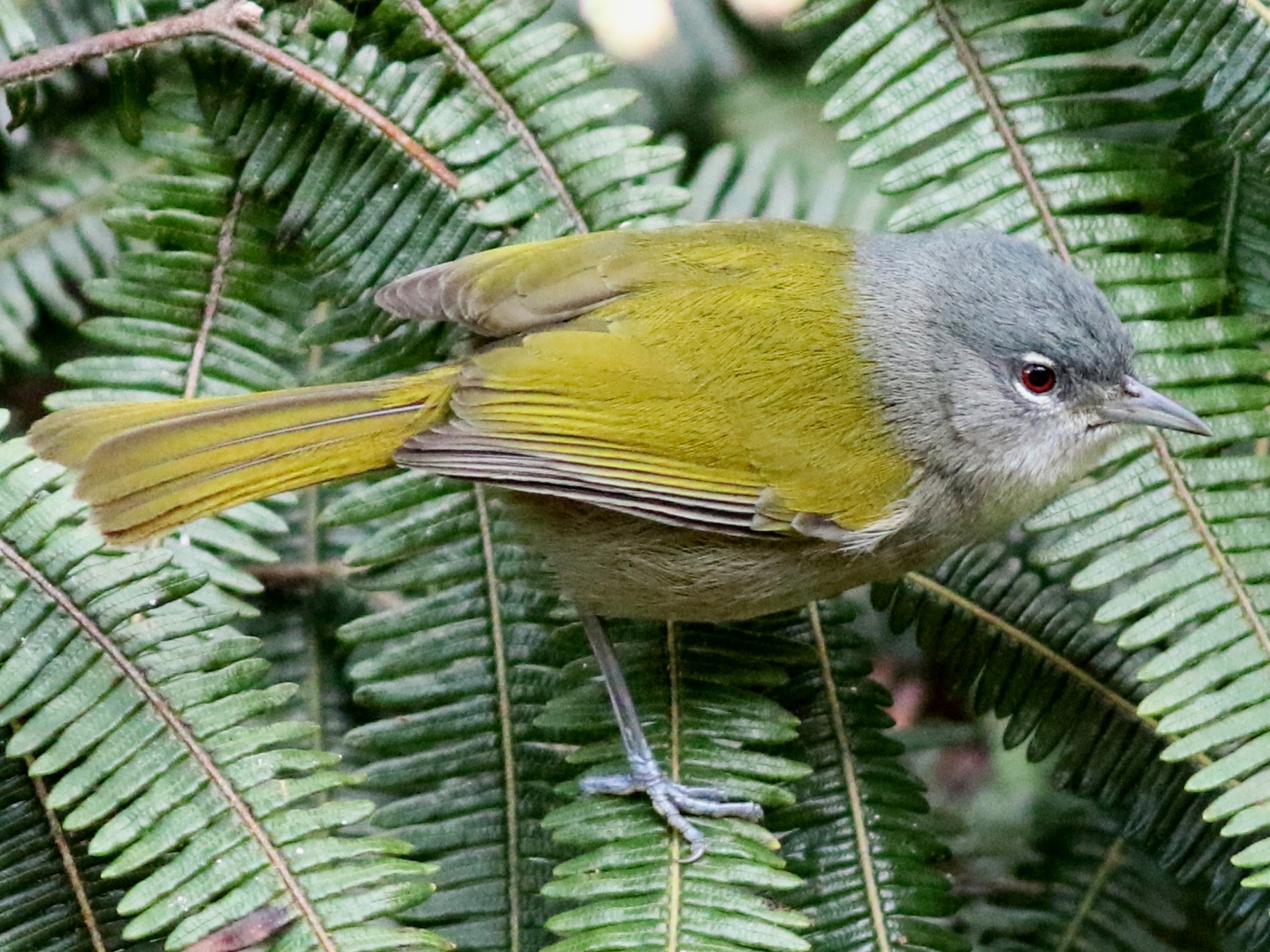
Green-tailed Warbler (or Ground-Tanager) Microligea palustris.
Photo: John C Sullivan. eBird: Green-tailed Warbler
That’s the end of it. Now all you have to do is go out and find all those Orders and Families and Genera and Species of birds.
I hope you found these ten postings as enlightening and entertaining as I did composing and presenting them. Don’t forget to check back in a year or so by which time everything will have changed utterly.
A few useful and informative links
https://avibase.bsc-eoc.org/familytree.jsp?lang=HA
https://checklist.americanornithology.org/taxa/
http://creagrus.home.montereybay.com/sylvid-new.html
https://tree.opentreeoflife.org/opentree/opentree14.9@ott1041547/Passeriformes
https://en.wikipedia.org/wiki/Passerine
https://en.wikipedia.org/wiki/Passerine#Suborder_Acanthisitti
https://en.wikipedia.org/wiki/Passerine#Taxonomic_list_of_Passeriformes_families per IOU
https://en.wikipedia.org/wiki/Strisores
http://www.j-avianres.com/en/article/doi/10.5122/cbirds.2013.0016
A review of the recent advances in the systematics of the avian superfamily Sylvioidea, Per ALSTRÖM Urban OLSSON, Fumin LEI
The Taxonomy Series
Installments post ever other day; installments will not open until posted.
Taxonomy One: A brief survey of the history and wherefores of taxonomy: Aristotle, Linnaeus and his binomial system of nomenclature, taxonomic ranks and the discovery and application of biological clocks.
Taxonomy Two: Introduces the higher levels of current taxonomy: the three Domains and the four Kingdoms. We briefly discuss Kingdom Protista, then the seven phyla of Kingdom Fungi.
Taxonomy Three: Kingdom Plantae.
Taxonomy Four: Kingdom Animalia to Phylum Annelida.
Taxonomy Five: A discussion of Cladistics, how it works and why it is becoming ever more important.
Taxonomy Six: Phylum Chordata, stopping at Class Mammalia.
Taxonomy Seven: Class Mammalia.
Taxonomy Eight: Class Aves, beginning with a comparison of five different avian checklists of the past 50 years.
Taxonomy Nine: A cladogram and discussion of Subclass Neornithes (modern birds) of the past 110 million years, reaching down to the current forty-one orders of birds.
Taxonomy Ten: A checklist of Neornithes including all ranks and clades down to the rank of the current 251 families of birds (plus a few probable new arrivals) with totals of the current 11,017 species of birds.
There will be a relatively brief look at “pecularities & problems of the checklist,” not yet written. Following that there may be some brief accounts of a few monotypic species which I think may be the most interesting birds.
Discover more from SANTA MONICA BAY AUDUBON SOCIETY BLOG
Subscribe to get the latest posts sent to your email.



 SANTA MONICA BAY AUDUBON SOCIETY BLOG