Kingdom Animalia | Taxonomy 4
[By Chuck Almdale]
Kingdom Animalia (or Metazoa, Choanoblastaea, Gastrobionta or Euanimalia)
Now we finally get to the animals, Kingdom Animalia, all those warm and fuzzy creatures so dear to our hearts. There are over 1 ½ million described living animal species of which over 1 million are insects, 85,000 are molluscs, 65,000 are vertebrates; only 6,400 are mammals of which more than half are rodents or bats. Warm and fuzzy animal species you’d be happy to hold on your lap are definitely in the minority.
Estimates of total extant animal species range 7.8 – 30 million, or 5 – 15 times as many organisms as are now known; most of these nameless entities are insects. Animals are multicellular eukaryotic organisms which – with very few exceptions – consume organic material, breath oxygen, have myocytes (muscle cells), are able to move, and can reproduce sexually. Early in their development animal embryos go through a blastula stage. Animalia is considered a true clade as they (or we, really) developed from a single common ancestor. Yes, all those worms, sponges and things that go squish in the night are your many-times-removed cousins. [Getting a feeling for just how many times removed is one of the purposes of this series.] Animal length ranges from 8.5 μm (0.00033 in) to 180 feet long (a worm, not a whale). And, as with all the other kingdoms, there are many systems for organizing taxonomic relationships, with phyla numbering from seven to over forty. We’ll pick an intermediate system that has sixteen phyla; fourteen of them are numbered below, the final two will be presented in a posting-to-come. As all those reading this qualify as animals and are of course intimately familiar with their own personal kingdom, I’m not going to go into great detail. Link to a good article on Animal Diversity.
A few definitions:
Basal Clade: The earliest clade to branch in a larger clade (kingdom, phylum, class, etc.); not part of any core or adjacent crown group clade.
Blastula: An early stage in animal embryonic development, consisting of a hollow sphere of cells (blastomeres) surrounding a fluid-filled cavity (blastocoel), produced by repeated cleavage of a fertilized egg.
Combination Clade Term: Combines terms used in the immediate daughter clades, often with suffix “-morpha (form).” Example: Xenacoelomorpha: Xena + coel + omorpha, combines the two daughter terms xenoturbella and acoelomorpha. This is a useful and increasingly-popular design for clade names.
Duterostome: “second + mouth.” The first embryonic opening becomes the anus.
Eukaryotic: Having cells that contain a membrane-bound nucleus and organelles. The Eukaryota consists of all known non-microscopic organisms, including protozoa, fungi, plant and animals.
Heterotrophic: Getting food by consuming other plants or animals. Example heterotrophs: worms, insects, jellyfish, lions, humans.
Hox Genes: A subset of homeobox genes and a group of related genes that specify regions of the body plan of an embryo along the head-tail axis of animals.
Proterostome: “first + mouth.” The first embryonic opening becomes the mouth.
A. Kingdom Animalia, the Basal Clades
1. Phylum Porifera: Translation “pore + bearing.” This basal animal sponge clade are multicellular filter-feeding organisms with bodies full of pores and channels allowing water to circulate through them, consisting of jelly-like mesohyl (connective tissue containing amoeboid cells, fibrils and skeletal elements) sandwiched between the external pinacoderm cell layer and the internal choanoderm layer. There are 5,000-10,000 species. Most reproduce sexually but some can also reproduce asexually. Link to Sponges. 
Sponge biodiversity and morphotypes at wall lip site in 60 feet of water. Included: yellow Tube Sponge, Aplysina fistularis, purple Vase Sponge, Niphates digitalis, red Encrusting Sponge, Spirastrella coccinea, and gray Rope Sponge, Callyspongia sp. Photo: Twilight Zone Expedition Team 2007, NOAA-OE. Wikipedia: Sponge
2. Phylum Placozoa: Translation: “flat + animal.” Another basal and primitive metazoan clade, they constitute a phylum of marine, free-living (non-parasitic) animals, simple blob-like aggregates of cells lacking body parts or organs. Described as “the simplest animals on Earth,” they move through water by waving cilia, eat by engulfment through the cell membrane and reproduce by fission (splitting) or budding. We currently know of only four families and four species. Link to Placozoa.
Not a meat patty, but a placozoan, a small, flattened animal, typically about one mm across and about 25 microns thick. Like the amoebae they superficially resemble, they continually change their external shape. In addition, spherical phases occasionally form which may facilitate movement. Trichoplax lacks tissues and organs. There is no manifest body symmetry so it is not possible to distinguish anterior from posterior or left from right. It is made up of a few thousand cells of six types in three distinct layers.
Photo: Michael G. Hadfield Wikipedia: Placozoa
3. Phylum Cnidaria: Translation: “sting + nettle.” Jellies, gorgonians, anemones and corals are the primary members of this worldwide phylum of fresh water and marine animals. They have a decentralized nervous system distributed throughout a gelatinous body, with cnidocytes – specialized cells with ejectable venomous flagella used primarily to capture prey. The body consists of mesoglea, non-living, jelly-like substance, sandwiched between two layers of densely-packed epithelium that are mostly one cell thick. They can reproduce both sexually and asexually. They are radially symmetrical with mouth is surrounded by cnidocyte-laden tentacles, their single body cavity handles digestion, excretion and respiration. Many live in colonies, some are parasitic. The 11,000 described species fall into three subphyla: Anthozoa (corals and anemones), Medusozoa (jellyfish and hydroids), and Myxozoa (parasites). Link to Cnidaria.
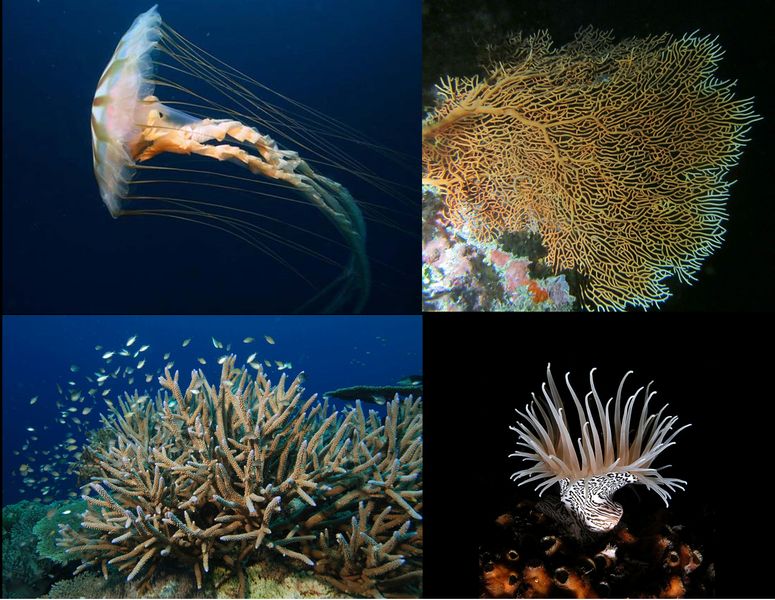
Four examples of Cnidaria (clockwise, from top left): jellyfish Chrysaora melanaster, gorgonian Annella mollis, sea anemone Nemanthus annamensis, stony coral Acropora cervicornis.
Photos: Frédéric Ducarme. Wikipedia: Cnidaria
4. Phylum Ctenophora: Translation: “comb + carry.” Comb Jellies are a worldwide phylum of marine invertebrates. The “combs” are groups of cilia used for swimming. They are the largest animals to use cilia for swimming and can grow to 5 ft. long. The body is a mass of jelly two layers thick, each layer two cells thick. They have a wide variety of body shapes, some egg-shaped with retractable tentacles to capture prey, some flat and combless, some with large mouths to consume other ctenophores. 186 living species in two classes are currently recognized. Link to Ctenophora. 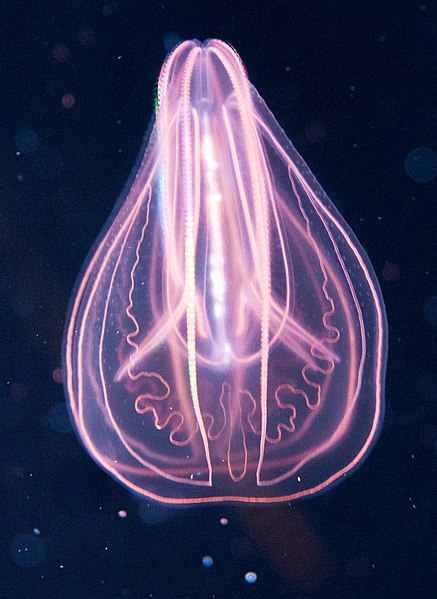
“Ctenophorae” (comb jelly). Photo: Orin Zebest. Wikipedia: Ctenophora
B. Kingdom Animalia, Clade Bilateria:
All remaining animals not previously discussed fall into this large clade (or infrakingdom) characterized by bilateral symmetry (left and right sides are mirror images during embryonic development). Nearly all (except echinoderms) remain bilateral into adulthood, with body plans laid around a longitudinal axis with head, tail, back and belly. Many are cephalized – specialized sense organs and central nerve ganglia (brain) are concentrated at the front end. In 2011, a now-widely accepted taxonomic alteration occurred resulting in the top-level division between Phylum Xenacoelomorpha and Clade Nephrozoa. Link to Bilateria.
5. Clade Bilateria, Phylum Xenacoelomorpha: A combination clade term, translation “friend + hollow.” Some of this phylum’s known 414 species were previously considered to be deuterostomes (“second mouth,” see definition at top), but DNA analysis showed they were a clade (common ancestor) and none were deuterostome or protostome. Most of these tiny, flat, wormlike organisms live in the spaces between grains of marine or brackish sediment. Link to Xenacoelomorpha. 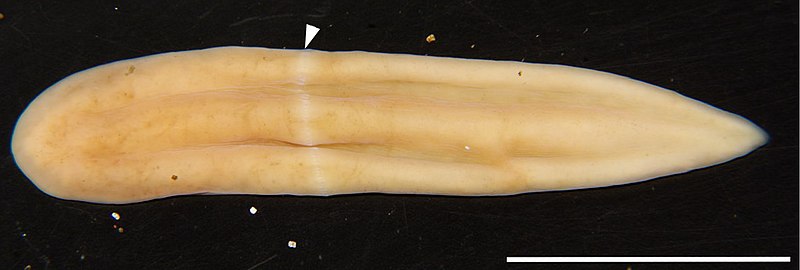
Xenoturbella japonica holotype female. The white arrowhead indicates the ring furrow. Photo: Hiroaki Nakano, Hideyuki Miyazawa, Akiteru Maeno, Toshihiko Shiroishi, Keiichi Kakui, Ryo Koyanagi, Miyuki Kanda, Noriyuki Satoh, Akihito Omori & Hisanori Kohtsuka Wikipedia: Xenacoelomprpha
C. Kingdom Animalia, Clade Bilateria, Clade Nephrozoa:
Translation “kidney + animal.” This clade, sister taxon to Phylum Xenacoelomorpha, contains all other animals not previously discussed, divided into Superphylum Deuterostomia and Clade Protostomia. Prior to 2011, Deuterostomia and Protostomia were the top division, appearing 650 mya, immediately below Bilateria. We’ll discuss the Protostomids first, then continue with the Deuterostomid cordates in the next blog in this series. Link to Nephrozoa.
D. Clade Bilateria, Clade Nephrozoa, Clade Protostomia:
Translation “first + mouth.” Originally thought to be characterized by the formation of the organism’s mouth before its anus during embryonic development, but since found to be extremely variable. Well known examples of protostomes are arthropods, molluscs, annelids, flatworms and nematodes. Link to Protostomia.
6. Phylum Nematoda – Roundworms: Translation: “thread + like.” Both free-living and parasitic, they have a tubular digestive tract opening at each end. Reduced number of Hox genes. Worldwide in many ecosystems. 25,000 described species, estimate of total species range from 40,000 to over a million. Link to Nematoda.

Gravid adult female Nippostrongylus brasiliensis, roundworm gastrointestinal parasite of rodents, with lifecycle similar to human hookworm parasites, collected from the small intestine of an infected BALB/c mouse. The photo shows a hooked anterior end containing eggs. Photo: J. Claire Hoving. Wikipedia: Nematode
7. Phylum Tardigrada – Water Bears: Translation: “slow + walk.” Worldwide in every ecosystem, they are probably the hardiest animals known, able to survive the vacuum of outer space. Eight-legged, plump, segmented and small (0.004-0.06” long). 1,335 known species. Link to Tardigrada.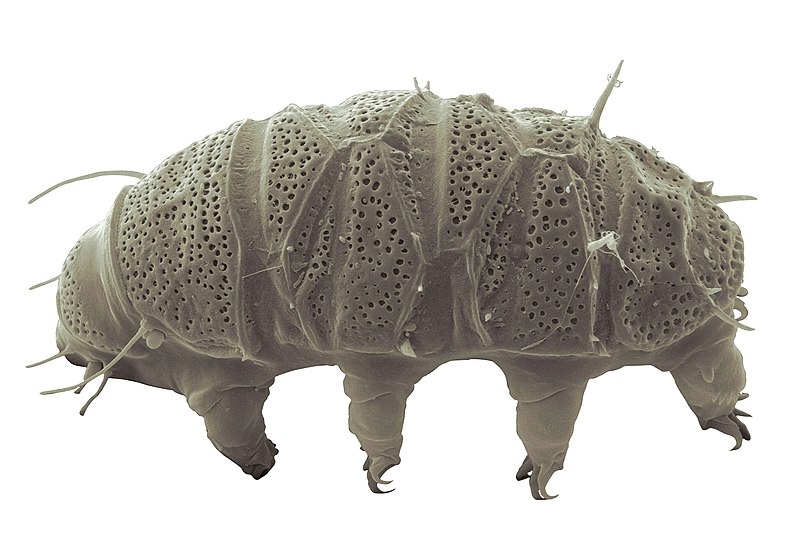
Echiniscus insularis – a heterotardigrade or “water bear.”
Photo: Kiosya Y, Vončina K, Gąsiorek P. Wikipedia: Tardigrade
8. Phylum Arthropoda – Arthropods: Translation “jointed + feet.” Segmented bodies with a hard exoskeleton of chitin and jointed appendages, growing by shedding their exoskeleton. Worldwide in all ecosystems, over 1,200,000 described species, with 5-15 times more still undescribed. Link to Arthropoda. 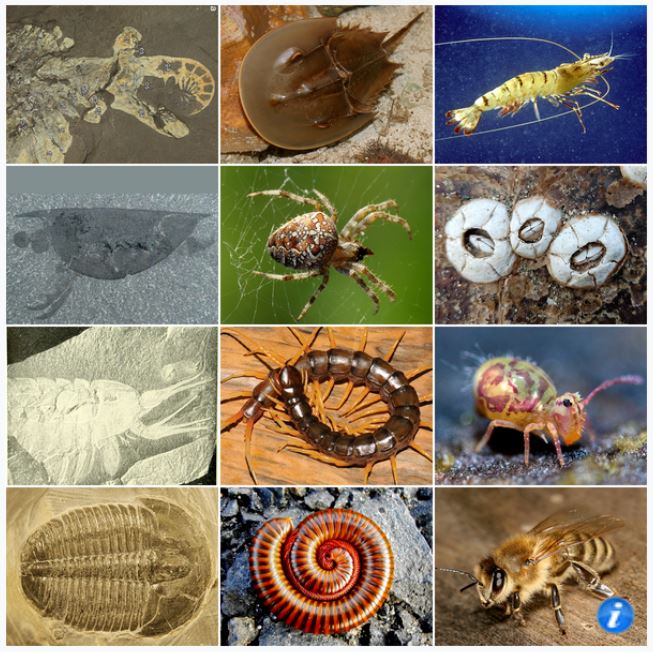
Twelve Arthropods L to R: Row top: Anomalocaris, Horseshoe Crab, Decapod; Row 2: Isoxys, Arachnid, Barnacle; Row 3: Leanchoilia, Centipede, Springtail, Row bottom: Trilobite, Millipede, Insect (bee).
Photo: various. Wikipedia: Arthropod
9. Phylum Rotifera – Wheel Animals. Translation “wheel + bearing.” First described in 1696 as “an animal like a large maggot which could contract itself into a spherical figure and then stretch itself out again; the end of its tail appeared with a forceps like that of an earwig.” Mostly microscopic, ranging in size 0.0020 in. to 0.79 in., common in fresh water worldwide, with a few saltwater species. The cylindrical body has a head, trunk and foot, a ciliated corona is on the head surrounding the mouth. Some are free swimming, others “inchworm” along substrates, others are sessile or planktonic. In June 2021 a rotifer was revived after 24,000 years in the Siberian permafrost. 2,000 known species. Link to Rotifera. 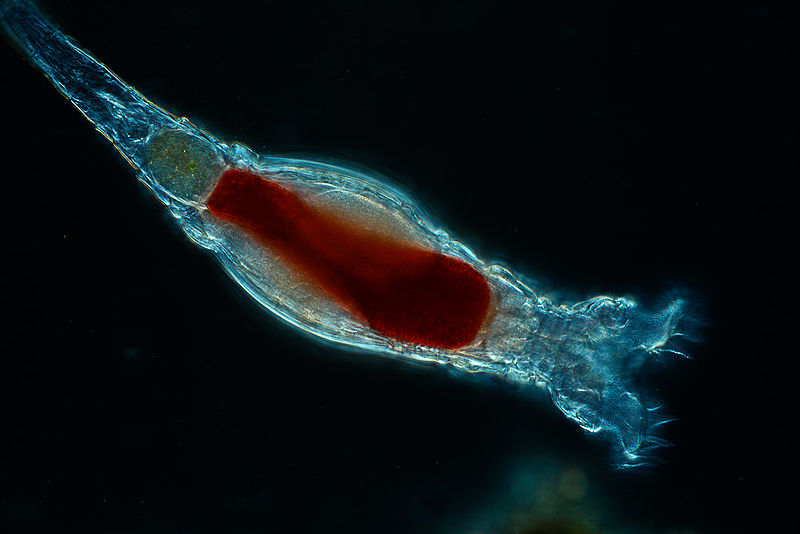
A Bdelloid Rotifera (wheel animal). Photo: Frank Fox. Wikipedia: Rotifer
10. Phylum Platyhelminthes – Flatworms: Translation “flat + worm”. Relatively simple, unsegmented soft-bodied acoelomates (no body cavity). As they have no specialized circulatory or respiratory organs, they must be flat to allow oxygen and nutrients to move throughout their bodies by diffusion. A single opening into the digestive cavity allows nutrients to pass in and wastes to pass out, thus food cannot be processed continuously. The three classes of Cestoda (Tapeworms), Trematoda (Flukes) and Monogenea are all parasitic. The former Class or clade of Turbellaria held the 4,500 species in the sub-groups that are not exclusively parasitic but mostly predatory. These range from 0.039 in. to freshwater forms more than 20 in. long. There are 29,500 described species. Link to Platyhelminthes. 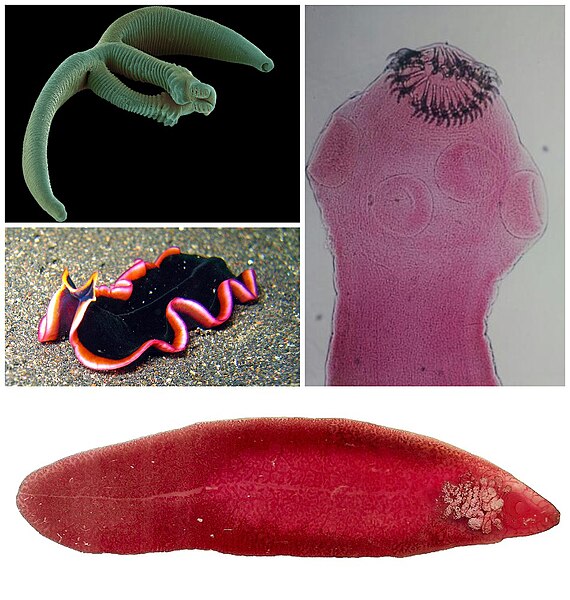
From top left clockwise: Eudiplozoon nipponicum (monogeneans), tapeworm head (tapeworms), liver fluke (trematodes), Pseudobiceros hancockanus (Turbellaria). Photo: OJJ Wikipedia: Flatworm
11. Phylum Nemertea: Ribbon or Proboscis Worms. Translation from “Nereis” (unerring one, for the accuracy of the proboscis), named for Greek sea-nymph Nemetes. Very thin and slow moving, most under 20” long, one species 180 ft. long. Mostly in the ocean, some live on the sea floor. 1350 known species. Link to Nemertea. 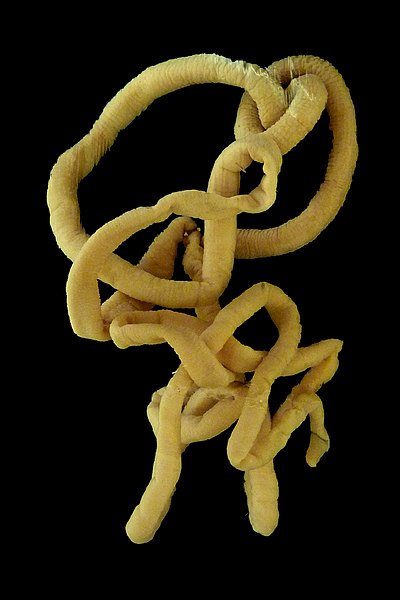
Bootlace Worm Lineus longissimus, a species of ribbon worm captured offshore from Britain, one of the longest known animals with specimens up to 180 ft. long being reported. Its mucus is highly toxic to human skin.
Photo: Citron / CC-BY-SA-3.0. Wikipedia: Lineus longissimus
12. Phylum Bryozoa: Translation “moss + animal.” Worldwide in salt or fresh water, mostly tropical at depths less than 100 meters. Nearly all are colonial, feed using a crown of tentacles (lophophore). 6,000 species described, all are small (0.015” long). Link to Bryozoa.

Greater Hornwrack Flustra foliacea (Linnaeus, 1758) from Belgium coastal waters. It looks like seaweed but is a colonial animal, each “leaf” is bilaminar, or two zooids (individual animals) thick. Photo: Hans Hillewaert. Wikipedia: Bryozoa
13. Phylum Mollusca – Snails, slugs, clams, chitons, squid, ammonites, tusk shells, worm-like molluscs. Translation “soft.” The second-largest animal phylum with 85,000-107,000 described species, another estimated 60,000-100,000 species undescribed, around 23% of all marine organisms, many also in fresh water and terrestrial habitats. Highly diverse in size, structure, behavior and habitat, divided into 6 or 7 extant classes plus 2 or 3 extinct classes. The most universal features are a body of solid muscle, a mantle cavity used for breathing and excretion, a hard tongue-like radula and a nervous system using nerve cords and ganglia. The extant Classes are: Gastropoda – snails and slugs, 70,000 known species, 80% of all molluscs. Bivalvia – clams, mussels, etc., 20,000 species. Polyplacophora – Chitons, 1,000 species. Cephalopoda– Squid, octopus, ammonites, 900 species. Scaphopoda – Tusk Shells, 500 species. Aplacophora – Worm-like seabed molluscs, 320 species. Monoplacophora – Seabed molluscs with cap shells. Link to Mollusca. 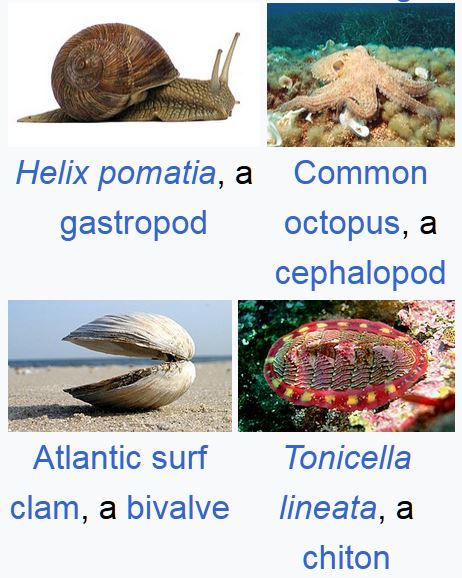
A few of the many mollusks. Wikipedia: Mollusca
14. Phylum Annelida – Segmented worms. Translation: “little ring.” They are worldwide in nearly all habitats. They are bilaterally symmetrical (as are all the bilateria), triploblastic (3 germ layers in the gastrula which follows the blastula in embryonic growth, as with all the bilateria), coelomate (body cavity surrounds all the organs), invertebrate, and move by means of parapodia (external body protrusions bearing bristly chaetae). There are 17,000-22,000 known species, including ragworms, earthworms and leaches, and range in size from microscopic to Microchaetus rappi, the African giant earthworm which grows up to 22 ft. and weighs 3.3 pounds. Link to Annelida.

Spirobranchus giganteus – Christmas Tree Worm, a marine annelid living in holes in coral; the colorful “tree,” which can retract in a fraction of a second, is used for feeding and respiration. Wikipedia: Spirobranchus giganteus
Our next posting in this series is on Cladistics. Following that we return to Kingdom Animalia where we’ll look at Superphylum Deuterostomia which includes our own Phylum Chordata and our sister taxa Phylum Echinodermata, home of starfish and sea urchins who look so much like us it’s sometimes hard to tell us apart.
The Taxonomy Series
Installments post ever other day; installments will not open until posted.
Taxonomy One: A brief survey of the history and wherefores of taxonomy: Aristotle, Linnaeus and his binomial system of nomenclature, taxonomic ranks and the discovery and application of biological clocks.
Taxonomy Two: Introduces the higher levels of current taxonomy: the three Domains and the four Kingdoms. We briefly discuss Kingdom Protista, then the seven phyla of Kingdom Fungi.
Taxonomy Three: Kingdom Plantae.
Taxonomy Four: Kingdom Animalia to Phylum Annelida.
Taxonomy Five: A discussion of Cladistics, how it works and why it is becoming ever more important.
Taxonomy Six: Phylum Chordata, stopping at Class Mammalia.
Taxonomy Seven: Class Mammalia.
Taxonomy Eight: Class Aves, beginning with a comparison of five different avian checklists of the past 50 years.
Taxonomy Nine: A cladogram and discussion of Subclass Neornithes (modern birds) of the past 110 million years, reaching down to the current forty-one orders of birds.
Taxonomy Ten: A checklist of Neornithes including all ranks and clades down to the rank of the current 251 families of birds (plus a few probable new arrivals) with totals of the current 11,017 species of birds.
Discover more from SANTA MONICA BAY AUDUBON SOCIETY BLOG
Subscribe to get the latest posts sent to your email.



 SANTA MONICA BAY AUDUBON SOCIETY BLOG