Free email delivery
Please sign up for email delivery in the subscription area to the right.
No salesman will call, at least not from us. Maybe from someone else.
Fresh from The Guardian; a study of bird song and sex!
[Posted by Lucien Plauzoles]
The Guardian, which has become a universal English language daily via the internet, we read this interesting article from British researchers.
https://www.theguardian.com/environment/2026/apr/19/hidden-world-of-female-birdsong-book
Rattlesnake Season
[by Chuck Almdale]
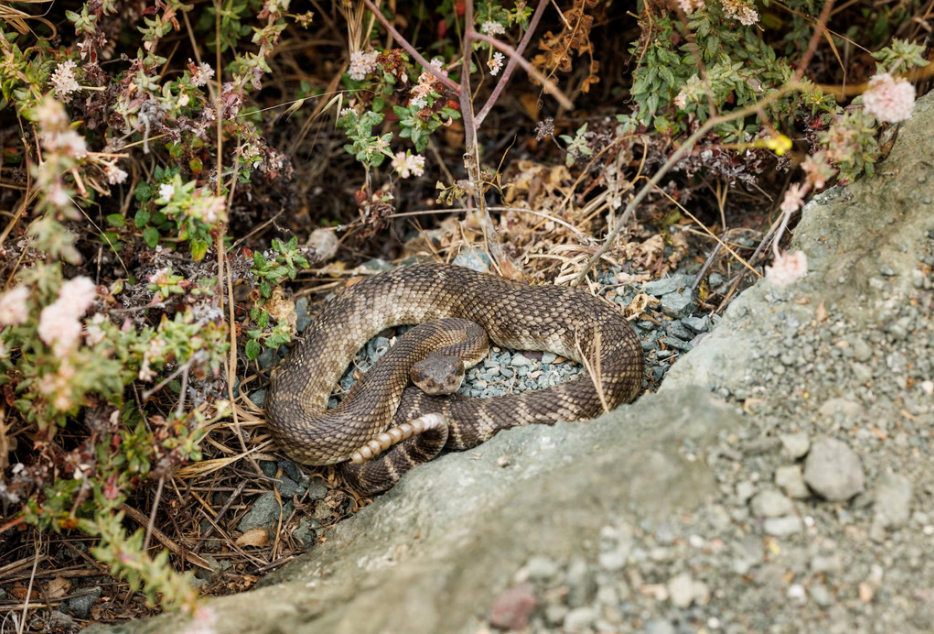
I was birding with a friend in O’Melveny Park near Granada Hills in the San Fernando Valley back on March 30, and we met a trailside rattlesnake. It was not happy to see us.
A little more detail. We had stopped to check out a hillside bushtop singing bird, which turned out to be a Rufous-crowned Sparrow – a good bird – and our Merlin app confirmed the insect-like (to my ears) song ID. Meanwhile, down the brushy slope behind us, some park maintenance person had turned on a sprinkler. After 10-20 seconds and the sprinkler not changing its sound one whit, I decided to look around to see where this sprinkler was. The sound was unusually steady, a high ssssssssss, there was no sign or sound of water falling anywhere, and downslope there was only brush. What park sprinkles their untamed hillside bushes at 11 AM? And the sprinkler seemed close. But it didn’t sound like a rattlesnake. Well…maybe a little.
It turned out to be a rattlesnake all right, coiled up, in the shade of a bush about two feet the other side of the trail, and when I saw him in my binos, it was staring straight at me. That sssssss sound really didn’t sound like any rattle I’ve ever hear from a rattlesnake, as it was seamlessly constant – not rattley – and higher pitched than the typical rattle, but it didn’t look like it was hissing. We looked at it a bit, then continued down the trail, mentioning the snake to passersby and suggesting they keep their eyes open. Three other groups had also seen rattlesnakes that day, further up the trail. I’ve birded in O’Melveny dozens of times, and never seen a rattlesnake. In nearby Placerita Canyon, I’ve seen them several times.
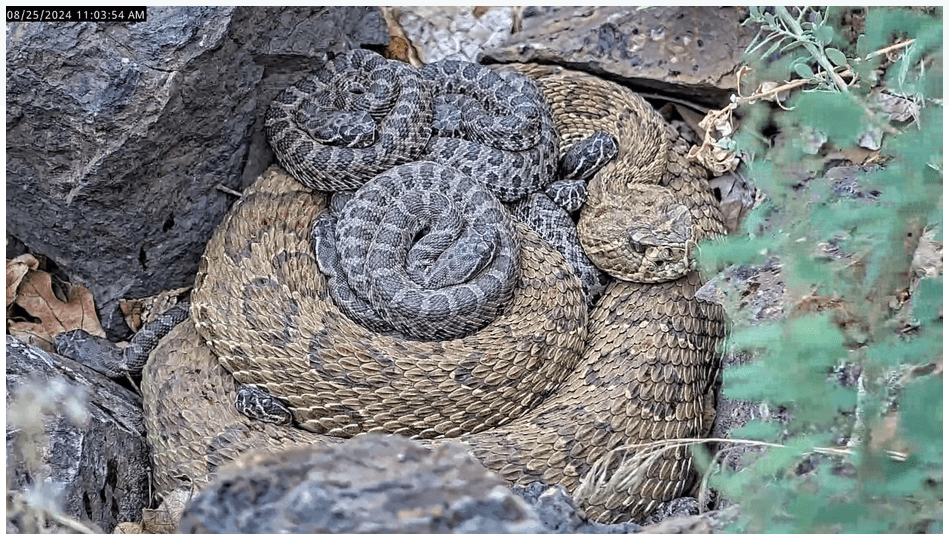
Rattlesnakes gather in underground or rockpile dens for the winter. When they emerge in spring and you’re in the area, it might seem like they’re everywhere. So I’ve heard and read, and I suspect that is what was going on.
Because rattlesnakes are now out and about, people have been bitten, and two people in our area have died, I thought I’d assemble a few tips and comments.
Tips from California Fish & Wildlife (link)
- Stay alert when outdoors.
- Wear sturdy boots and loose-fitting long pants. DO NOT wear sandals or flip-flops in brushy areas.
- Stay on well-used trails. Avoid tall grass, weeds, and heavy underbrush.
- Check rocks, stumps or logs before sitting down.
- Shake out sleeping bag and tent before use.
- Let others know where you are going, when you plan to return, and carry a cell phone. Hike with a companion when possible.
- DO NOT grab “sticks” in water. Rattlesnakes can swim.
- DO NOT let dogs off leash. Dogs are at increased risk when sniffing the ground near brushy areas.
- DO NOT try to touch or handle a snake, dead or alive. Dead rattlers may still inject venom shortly after death.
Tips from other sources
- Don’t pick up or get close to snakes. A 10 ft. distance is minimum.
- Make sure you can see where you plan to step or put your hands (e.g. when climbing rocks).
- Step on, not over, large rocks or logs.
- Avoid hiking alone so that you have help in case of an emergency.
- Scan the ground ahead of you as you walk, jog, or ride.
- Listen for the buzz of a rattlesnake’s rattle warning you it is there.
- Most bites result from trying to catch, drive off or kill the rattlesnake. Avoid it and go on your way.
Project RattleCam has livestreaming and archived videos of rattlesnakes.
Comments
A California study found two-thirds of rattlesnake bites were on the hand or arm, and 80 percent of victims were young men. Most bites occur from handling or accidentally touching snakes. [Sonoma Co. Parks]
In the unlikely event that you are bitten by a rattlesnake, remain calm and have someone call 911 immediately. Keep the affected limb below your heart. Don’t use a tourniquet or try to remove the venom yourself. If you are alone, call 911 or walk calmly to the nearest phone. Avoid running, but seek medical care as soon as you are able is vital. [East Bay Regional Parks]
A startled rattlesnake may NOT rattle before striking defensively. They also may not deliver an envenomed bite – a ‘dry bite’ may be used as a warning because venom creation and use can be energetically expensive for the snake. However, all bites from a rattlesnake should be treated as a venomous bite until appropriate medical attention is provided.
- Rattlesnakes are sensitive to ambient temperature and adjust their behavior accordingly. In warmer weather, you may see one basking in the sun to raise it’s body temperature.
- In Spring and Summer – Most active at dawn, dusk, and night to avoid overheating.
- In Fall and Winter – Inactive, and some may go into brumation (a state of dormancy with periods of activity), for several months in rock crevices, rodent burrows, or thick vegetation.
- Often multiple rattlesnakes may gather and establish dens during the colder months. These are often in rocky crevices where heat is retained, but may be found underneath homes or man-made structures. [Calif. Fish & Wildlife]
Rattlesnakes are important mid-level predators. They help with population and disease control by eating rodents that carry diseases like Lyme disease and plague, and which would otherwise over-reproduce and eat down all of our crops and native plants. And by eating those small rodents, they also package that energy into a nice big snake-shaped sausage for top predators like mountain lions or owls to eat. And, rattlesnake venoms are currently being studied for drug development. There’s a drug that’s been on the market for decades now that is derived from rattlesnake venom. If you know someone who’s had a heart attack or gotten a stent in their heart or been treated for being at a high risk for blood clots, they might have been treated with this drug. We haven’t been able to synthetically develop anything in a lab that is nearly as good. [Cal Poly News]
If you see a rattlesnake out in the wild, like on a hiking trail, just give it space. Stay 10 feet away from it and let it move along its way because you’re in its house. If rattlesnakes are in someone’s yard or in their house or that sort of thing, the evidence-based best approach is to relocate that rattlesnake. Best thing to do is call a professional. There’s also a website called freesnakerelocation.org where people can find a relocation service in their area.
Partial closure 405 N in Sepulveda pass 4/18/26
[Posted by Chuck Almdale]
The northbound 405 through the Sepulveda Pass between Skirball Center and Ventura Blvd. will be reduced to three lanes, 10pm Friday 4/17 through 5am Monday, 4/20. Also closed are: northbound off-ramp to Getty Center Drive, Skirball Center on-ramp to 405 N. Supposedly the southbound lanes will not be affected, but web sources didn’t agree on this.
If you’re planning on coming on our trip to Bear Divide banding station in the mountains above Sylmar, north of the San Fernando Valley, please take this possible slowdown into account, especially if you’re planning on arriving at the carpool meetup spot 6:45-7:00 am.
I’m not certain that three open lanes at 6:30-7:00 am on the northbound 405 constitute massive tie-ups, but there will be slowing at the least.
Death Valley Sage
[by Chuck Almdale]
National Public Radio (NPR) recently did a report of the very rare Death Valley Sage (Salvia furneria).
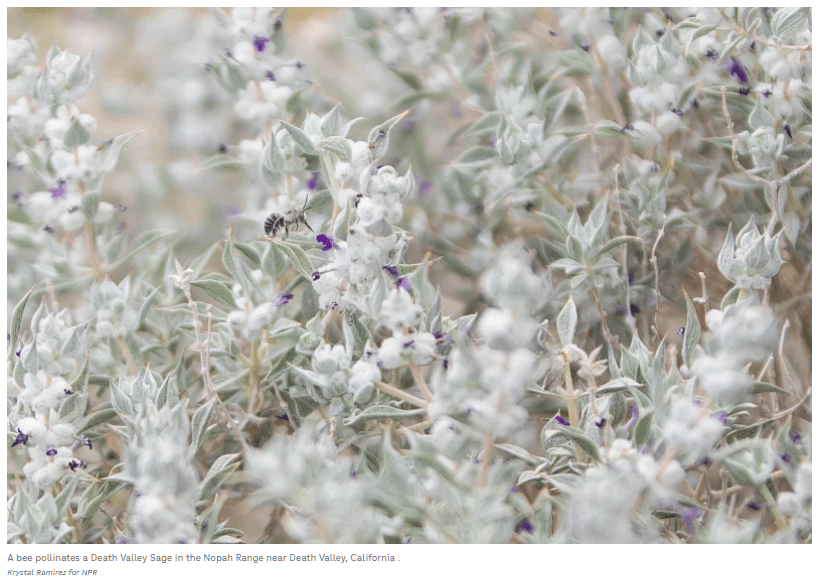
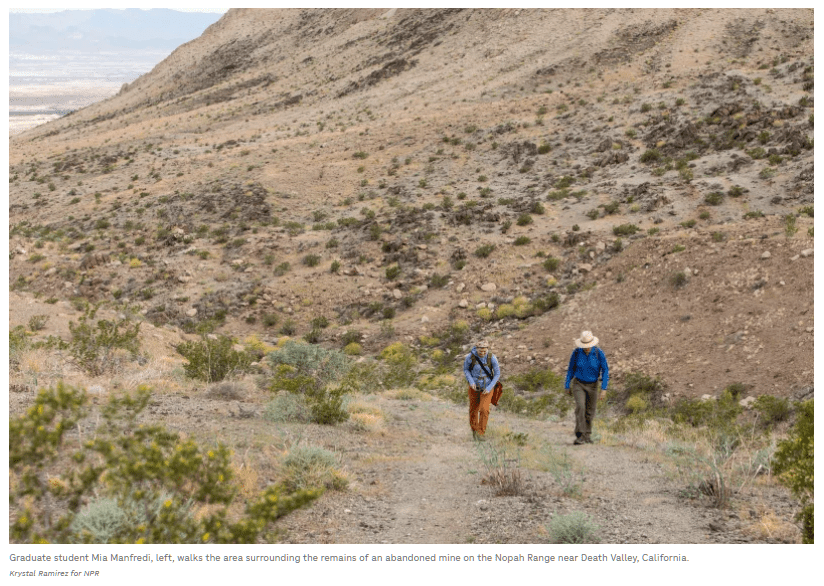
Most of the report focused on the work of botanist Naomi Fraga of the California Botanic Garden. For more than 15 years she has been trying to collect seeds from this plant, which will then be put into a vault for safekeeping, similar to the giant Svalbard (Norway) Global Seed Vault containing the seeds of important crop plants from around the world. She did collect many seeds from many other plants, but so far she’s empty handed with Salvia funeria. In 2026 the desert really bloomed, hope springs eternal, and she trying again.
Read the report, see the photos and listen to the 5-minute interview.
https://www.npr.org/sections/the-picture-show/2026/04/01/nx-s1-5749446/botanist-search-seeds-rare-death-valley-sage
Other web pages on Salvia funeria: Calscape, CNPS, Wikipedia
Read Naomi Fraga’s bio: https://naomifraga.com/naomi/
The California Botanic Garden where Naomi works, has their own website https://www.calbg.org/, well worth a look for anyone interested in native plants. You can:
- Visit their garden Tue-Sat 8am-7pm (what’s beautiful today)
- Become a member, get free admission to the garden,discounts on purchases, and more
- Volunteer
- Buy native plants
- Learn about the seed bank and buy seeds from over 6,000 California plant species
- Get their very interesting 12-page monthly Oak Notes newsletter
- Take classes & attend events
- Attend Seminar series’
- Donate to help
California Botanic Garden
1500 N. College Ave., Claremont CA 91711
909-625-8767 | info@calbg.org
[By Chuck Almdale]
It’s really easy to add an existing eBird checklist to the California Bird Atlas. If you have checklists for 2026 and noted breeding behavior codes on the list, you can add the entire checklist to the project in about one minute. [They prefer entire checklists.] If you noted any sort of breeding behavior but didn’t select a breeding code, you can select and enter the code during this process.
The California Bird Atlas (CBA) has a nicely done video showing you how to do it, only 2:48 long.
I suggest that you first determine if any of your 2026 eBird checklists have any breeding bird information in them. If you find one, then watch the video below in a separate tab, pausing the video and performing the steps.
You can watch the video here. If you want a transcript to read, scroll down past this video below.
Want a transcript to appear?
Watch the video on the CBA YouTube page.
Just below their name is a colored area with a blurb text beginning with “This video was created…”
Click the “…more” area, then scroll down to find the “Show Transcript” button and click it. The transcript appears to the right of the video and scrolls up as the video progresses.
When you’re done moving a checklist, a little 6-dot icon appears next to it in your ebird “My Checklists.”



