Free email delivery
Please sign up for email delivery in the subscription area to the right.
No salesman will call, at least not from us. Maybe from someone else.
Avian Checklist of 41 Orders & 251 Families | Taxonomy 10
[By Chuck Almdale]
Introduction
My research could uncover no single source for the most up-to-date taxonomic information on birds (or anything else); even if they were such a thing, there is such wide disagreement among those working on the avian phylogenetic sequence that it could be biased and a source more for dissension than agreement. One such source may exist that everyone in the world agrees is completely accurate and completely up-to-date, but if there is, it’s a very well-kept secret.
Therefore, the following taxonomic sequence draws from multiple sources, most notably Birds of the World (BOW) website – Orders & Families, Distribution and Taxonomy of Birds of the World (Sibley & Monroe, 1990), several papers especially “The Origin and Diversification of Birds” (Brusatte, O’Conner & Jarvis, 2014) [Link to Article] and numerous Wikipedia pages, especially Passerine and Passerea and the separate pages for their nearly innumerable subdivisions. [Wikipedia is remarkably unbiased, and their articles frequently offer multiple taxonomic sequences where disagreement exists.] Research continues; refinements and rearrangements will continue to appear as research is completed; gradually a unified picture is developing. The following sequence is as accurate as I could make it at this time. What follows are some guidelines as to what is in the sequence and a few choices I made for the sake of presentation.
All 41 orders and 251 families are numbered according to the BOW Orders & Families as of mid-June 2024, which may well have changed by the time this gets posted. I expect some major changes to this sequence to occur within the coming year as the International Ornithological Union (IOU) Working Group Avian Checklist Committees [Link] complete their work, or at least post some updates. Following this, eBird/Birds of the World will undoubtedly update their sequences, as they regularly do at least yearly as the Clements List is updated. It may come to pass within the next few years that the Clements and IOU checklists are brought more into alignment, particularly in regards to the higher levels of taxonomy (from Class down to Family).
When Sibley & Monroe published their book in 1990, their table of contents utilized many additional taxonomic ranks that possessed useful suffixes (in brackets below) for uniformity in their nineteen taxonomic ranks:
Class: Super-, Class, Sub-, Infra- (-es), Parv- (-ae)
Order: Super- (-imorphae), Order (-iformes), Sub- (-i), Infra- (-ides), Parv- (-ida)
Family: Super- (-oidea), Family (-idae), Sub- (-inae), Tribe (-ini), Subtribe (-ina)
Genus: Genus, subgenus
Species: species, subspecies
These ranks are still used in many books, papers and websites and I retained them whenever possible. But a lot of taxonomic research, particularly in the development of evolutionary clocks, has occurred in the 34 years since that book was published.
Clades
The use of clades and clade terminology has grown enormously over the past few decades. Many of the previous terms have been adopted into the clade structure, especially Order, Family, Genus and Species, but also many of the subdivisions listed above. The clade structure, which works far better in cladogram diagrams than in writing, emerged out of the growing body of information concerning divergences in evolutionary lineages and the development and availability of “evolutionary clocks.” When an evolutionary line divides, a “node” with two branches is created at that point which can be dated by means of the evolutionary clock. The terms Order, Suborder, etc. worked well for creating a hierarchy of ranks, but the number of nodes of division and clade ranks have already vastly outrun this restricted terminology, and the number of ranks can only continue to grow. Every time a species evolves into two subspecies than evolve farther apart into two species, a node is created and should be given a name. From the level of Class Aves down to Passer domesticus domesticus, there are at least seventeen named Linnaean-style ranks. Now, as we saw in Taxonomy 6, Clade63 Subclass Neornithes is only the beginning of extant modern birds. The cladogram in Taxonomy 9 added another 10 ranks to get to Order Passeriformes, and Sibley & Monroe add eight more ranks to arrive at Passer domesticus domesticus. That’s a total of 81 ranks, so far. Once the sequence to P.d.domesticus is fully mapped – and ranks are continually inserted all along the sequence – there could be well over a hundred ranks. I sure Linnaeus, who thought 10,000 species would cover the lot of living things, never conceived of such complexity even in his most fevered dreams of discovery and classification. People are already working on developing taxonomic modifications or replacement systems.
Although there are still nodes where there are more than two branches (daughter lineages), it is widely viewed that such polytomies are an artifact of insufficient information. When an evolutionary lineage branches, the process involves a single species branching into two species only, not three or more. As researchers produce finer-grained results, it is expected that all such polytomies will be replaced with a series of paired branches.
A good system of upper-level nomenclature could utilize a combination of names and numbers. If we kept only Class, Order, Family, Genus, Species we could use have Class 1, class 2, etc.; Order 1, order 2, etc.; Family 1, family 2, etc.;…genus 1, genus 2, etc. Class 1 = the original level of class, Class 2 = the next step down…Class 10 = the 9th level below Class 1, and so on. They could adopt subscripts as I did in prior postings, e.g. Class1, Class2…Class63, although, frankly, typing out all those subscripts was a nuisance. There would be no limit to the number of steps which could be added as necessary when new divergences are discovered. Currently many new clades are given names, but many aren’t, and you can find many cladograms where nodes and their daughter lineages are not named. The previous names from Infraclass to Subtribe had their unique suffixes, which was a good clue as to where they fell in the sequence (Passer-imorphae, Passer-iformes, Passer-idae, Passer) but most of the new clade names, if they are even named, give no linguistic clue as to their position in the sequence. One can see the nodes on a cladogram, but not in the written descriptions. A simple – yet sufficiently descriptive – system needs to be developed. The portmanteau clade names utilizing the next two taxa to form the new taxon name is a good start (e.g. Xenacoelomorpha: Xena + coel + omorpha, combines the two daughter ranks xenoturbella and acoelomorpha).
Key to the Avian Taxonomic List Below
Totals of Orders, Families and Species
1. Most ranks have a set of numbers indicating the number of major subdivisions (Order, Family, Species).
Subclass: Neornithes 41/251/11017 means it has 41 orders, 251 families, 11,017 species.
2. Orders have two numbers for families and species:
18. Order: Gruiformes – Cranes & allies – 6/192 means that Order 18 Gruiformes has 6 families, 192 species.
3. Families show a single number for species: 123. Family:
Viduidae – Indigobirds – 20 means that family 123 Viduidae has 20 species.
4. Most intermediate steps are similarly numbered, although a few unnamed clades are not.
5. Many ranks have used (or are still using) multiple names (e.g. Superorder Caprimulgimorphae = Clade Strisores). I did not search for these alternate names, but where I encountered them, I included them in parentheses).
Bold, Italics & Indentation
Bold and italics to differentiate higher-level and lesser-known sequence steps from the more common ranks. Each lower taxonomic rank is indented 3 spaces. Equal indentation means equivalent rank (two orders, two families, etc.). Indentation is recalibrated twice (locations noted within the sequence) to avoid word-wrapping.
Colors
The forty-one orders from the Chart of Five Checklists and the prior posting’s cladogram are numbered and highlighted in blue.
The nine major clades from the prior posting’s cladogram are highlighted in red.
I included a few families (unnumbered and highlighted in blue) that I think are likely to be added within the coming year, but did not include the probable number of the species classified to them as they are counted within their current families.
Family Number
Each family (e.g. 1. Family: Rheidae – Rheas) is given the sequence number as shown on the BOW website – Orders & Families. Sometimes, primarily in Passeriformes, their sequence in this list within (and even between) groups is not in numerical order. This occurs where I have strong reason to believe that sequences other than the BOW are more up-to-date and the BOW sequence will likely soon change.
The top levels (Domain to Class) were discussed in the earlier postings in this series.
You may find it interesting to compare the following written sequence to the cladogram included in Taxonomy 9. They agree to one other, but each includes information not contained within the other. Working together, they demonstrate the different strengths each form of presentation possesses.
If you’d like an 8-page PDF document of the entire sequence, click below.
Taxonomic Sequence of Avian 41 Orders and 251 Families
Family Size

It may or may not signify anything to note that most of the 251 bird families contain few species, only a few contain many dozens or hundreds of species. I noticed this when I discovered that 37 families (15.5% of 251 families) contained only a single species. As this was roughly 1/6th of the total, I divided the families into six groups based on species totals. One sixth of families are monotypic, one-sixth have more than 80 species each. It’s interesting to speculate on this peculiar fact as you go through the entire family list. What is it in the evolutionary process that makes so many species sufficiently different from all other species to warrant their own family? Do large families signify relative evolutionary success, adaptability or greater speed of speciation? Are monotypic families evolutionarily closer to the root of their clade?
The first extant species in the list.
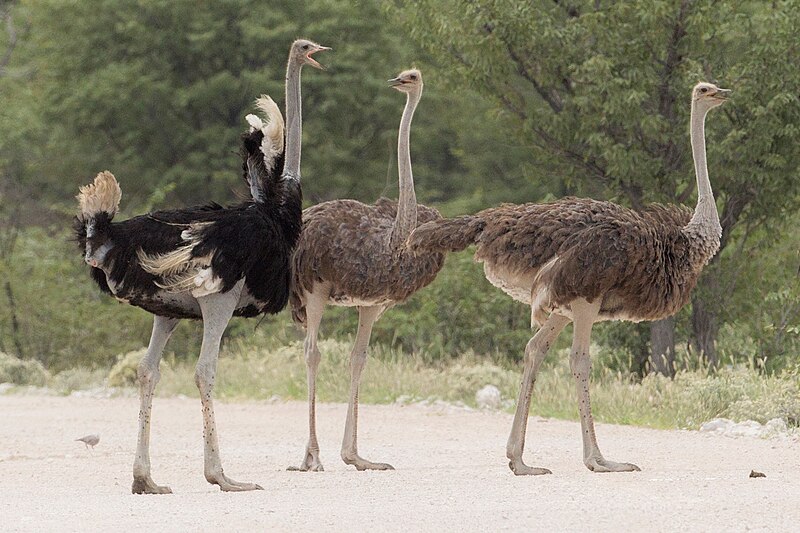
The heaviest, tallest and probably most ancient bird in the world, the Common Ostrich, Struthio camelus. Photo: Yathin S Krishnappa. Wikipedia: Ostrich
The Taxonomic Sequence of Avian Orders and Families
Domain: Eukaryota
Kingdom: Anamalia
Phylum: Chordata
Subphylum: Vertebrata
Class: Aves
Subclass: Archaeornithes – birds extinct Jurassic & early Cretaceous
Subclass: Neornithes – all living birds – 41/251/11017
Infraclass: Paleognathae – Ancient Jaw – 5/5/59
Superorder: Struthionimorphae – 1/1/2
1. Order: Struthioniformes – 1/2
1. Family: Struthionidae – Ostriches – 2
Superorder: Rheimorphae – 1/1/2
2. Order: Rheiformes – 1/2
1. Family: Rheidae – Rheas – 2
Superorder:Tinamimorphae – 1/1/46
3. Order: Tinamiformes – 1/46
1. Family: Tinamidae – Tinamous – 46
Superorder: Apterygimorphae – 2/2/9
4. Order: Apterygiformes – 1/5
1. Family: Apterygidae – Kiwis – 5
5. Order: Casuariiformes – 1/4
1. Family: Casuariidae – Cassowary & Emu – 4
Infraclass: Neognathae – 36/246/10958
Parvclass Galloanseres – 2/8/483
6. Order: Anseriformes – 3/178
1. Family: Anhimidae – Screamers – 3
2. Family: Anseranatidae – Magpie Goose – 1
3. Family: Anatidae – Ducks, Geese & Waterfowl – 174
7. Order: Galliformes – 5/305
1. Family: Megapodiidae – Megapodes – 21
2. Family: Cracidae – Guans, Chachalacas & Curassows – 57
3. Family: Numididae – Guineafowl – 8
4. Family: Odontophoridae – New World Quail – 33
5. Family: Phasianidae – Pheasants, Grouse & Allies – 186
Parvclass Neoaves – 34/238/10475
To conserve horizontal space, Parvclass Neoaves is moving 21 spaces to the left.
Parvclass Neoaves – 34/238/10475
Clade Columbea – 5/5/400
Clade Superorder: Phoenicopterimorphae – 2/2/28 (or Clade Mirandornithes)
8. Order: Phoenicopteriformes – 1/6
1. Family: Phoenicopteridae – Flamingos – 6
9. Order: Podicipediformes – 1/22
1. Family: Podicipedidae – Grebes – 22
Clade Superorder: Columbimorphae – 3/3/372
10. Order: Columbiformes – 1/353
1. Family: Columbidae – Pigeons & Doves – 353
11. Order: Mesitornithiformes – 1/3
1. Family: Mesitornithidae – Mesites – 3
12. Order: Pterocliformes – 1/16
1. Family: Pteroclidae – Sandgrouse – 16
Clade Passerea – 29/233/10075
Clade Otidae – 4/11/805
Clade Superorder: Otidimorphae – 3/3/196
13. Order: Otidiformes – 1/26
1. Family: Otididae – Bustards – 26
14. Order: Musophagiformes – 1/23
1. Family: Musophagidae – Turacos – 23
15. Order: Cuculiformes – 1/147
1. Family: Cuculidae – Cuckoos – 147
Superorder: Caprimulgimorphae – 1/8/609 (Clade Strisores)
16. Order: Caprimulgiformes – Nightbirds, Swifts, Hummers – 8/609
2. Family: Caprimulgidae – Nightjars & Allies – 97
Clade Vanescaves
3. Family: Nyctibiidae – Potoos – 7
4. Family: Steatornithidae – Oilbird – 1
Clade Letornithes
1. Family: Podargidae – Frogmouths – 16
Clade Daedalornithes
5. Family: Aegothelidae – Owlet-nightjars – 9
Clade Apodiformes
Clade Suborder Apodi
6. Family: Apodidae – Swifts – 112
7. Family: Hemiprocnidae – Treeswifts – 4
Clade Suborder Trochili
8. Family: Trochilidae – Hummingbirds – 363
Clade Gruae – 3/26/579
Clade Superorder: Opisthocomimorphae – 1/1/1
17. Order: Opisthocomiformes – 1/1
1. Family: Opisthocomidae – Hoatzin – 1
Clade Superorder: Gruimorphae 2/25/578 (or Charadriimorphae, Cursorimorphae)
18. Order: Gruiformes – Cranes & allies – 6/192
Suborder: Ralli – 3/173
1. Family: Sarothruridae – Flufftails – 15
2. Family: Rallidae – Rails, Gallinules & Coots – 155
3. Family: Heliornithidae – Finfoots – 3
Suborder: Grui – 3/19
4. Family: Aramidae – Limpkin – 1
5. Family: Psophiidae – Trumpeters – 3
6. Family: Gruidae – Cranes – 15
19. Order: Charadriiformes – Shorebirds & Gulls – 19/386
Suborder: Charadrii – 8/105
1. Family: Pluvianellidae – Magellanic Plover – 1
2. Family: Chionidae – Sheathbills – 2
3. Family: Burhinidae – Thick-knees – 10
4. Family: Pluvianidae – Egyptian Plover – 1
5. Family: Recurvirostridae – Stilts & Avocets – 9
6. Family: Ibidorhynchidae – Ibisbill – 1
7. Family: Haematopodidae – Oystercatchers – 12
8. Family: Charadriidae – Plovers & Lapwings – 69
Suborder: Scolopaci – 5/113
9. Family: Pedionomidae – Plains-wanderer – 1
10. Family: Thinocoridae – Seedsnipes – 4
11. Family: Rostratulidae – Painted-Snipes – 3
12. Family: Jacanidae – Jacanas – 8
13. Family: Scolopacidae – Sandpipers & Allies – 97
Suborder: Lari – 6/168
14. Family: Turnicidae – Buttonquail – 18
15. Family: Dromadidae – Crab-Plover – 1
16. Family: Glareolidae – Pratincoles & Coursers – 17
17. Family: Stercorariidae – Skuas & Jaegers – 7
18. Family: Alcidae – Auks, Murres & Puffins – 25
19. Family: Laridae – Gulls, Terns & Skimmers – 100
Clade Superorder Eurypygimorphae – 2/3/5 (or Phaethontimorphae)
20. Order: Eurypygiformes – 2/2
1. Family: Rhynochetidae – Kagu – 1
2. Family: Eurypygidae – Sunbittern – 1
21. Order: Phaethontiformes – 1/3
1. Family: Phaethontidae – Tropicbirds – 3
Clade Aequornithes – Core Waterbirds – 6/16/365
Clade Superorder: Gaviimorphae – 1/1/5
22. Order: Gaviiformes – 1/5
1. Family: Gaviidae – Loons – 5
Clade Feraequornithes – 5/15/360
Clade Austrodyptornithes – 2/5/164 (or Superorder Procellariimorphae)
23. Order: Sphenisciformes – 1/18
1. Family: Spheniscidae – Penguins – 18
24. Order: Procellariiformes – 4/146
1. Family: Diomedeidae – Albatrosses – 20
2. Family: Oceanitidae – Southern Storm-Petrels – 10
3. Family: Hydrobatidae – Northern Storm-Petrels – 18
4. Family: Procellariidae – Shearwaters & Petrels – 98
Clade Superorder: Pelecanimorphae – 3/10/196
25. Order: Ciconiiformes – 1/20
1. Family: Ciconiidae – Storks – 20
Clade: Pelecanes – 2/9/176
26. Order: Suliformes – 4/59
1. Family: Fregatidae – Frigatebirds – 5
2. Family: Sulidae – Boobies & Gannets – 10
3. Family: Anhingidae – Anhingas – 4
4. Family: Phalacrocoracidae – Cormorants & Shags – 40
27. Order: Pelecaniformes – 5/117
Suborder: Pelicani – 3/10
1. Family: Pelecanidae – Pelicans – 8
2. Family: Balaenicipitidae – Shoebill – 1
3. Family: Scopidae – Hamerkop – 1
Suborder: Ardei – 2/107
4. Family: Ardeidae – Herons, Egrets & Bitterns – 71
5. Family: Threskiornithidae – Ibises & Spoonbills – 36
Clade Telluraves (Core Landbirds) – 14/177/8321
Clade Infraclass Afroaves – 10/28/1254
Clade Superorder: Accipitrimorphae – 2/4/259
28. Order: Cathartiformes – 1/7
1. Family: Cathartidae – New World Vultures – 7
29. Order: Accipitriformes – 3/252
1. Family: Sagittariidae – Secretarybird – 1
2. Family: Pandionidae – Osprey – 1
3. Family: Accipitridae – Hawks, Eagles & Kites – 250
Clade Superorder: Strigimorphae – 1/2/247
30. Order: Strigiformes – 2/247
1. Family: Tytonidae – Barn-Owls – 18
2. Family: Strigidae – Owls – 229
Clade Superorder: Coriciimorphae – 7/22/748
31. Order: Coliiformes – 1/6
1. Family: Coliidae – Mousebirds – 6
Clade Cavitaves – 6/21/742
32. Order: Leptosomiformes – 1/1
1. Family: Leptosomidae – Cuckoo-roller – 1
Clade Eucavitaves – 5/20/741
33. Order: Trogoniformes – 1/46
1. Family: Trogonidae – Trogons – 46
Clade Picocoraciae – 4/19/695
34. Order: Bucerotiformes – 4/75
Suborder: Upupi – 2/11
1. Family: Upupidae – Hoopoes – 3
2. Family: Phoeniculidae – Woodhoopoes & Scimitarbills – 8
Suborder: Buceroti – 2/64
3. Family: Bucorvidae – Ground-Hornbills – 2
4. Family: Bucerotidae – Hornbills – 62
Clade Picodynastornithes – 3/15/620 (was Superorder: Coraciimorphae)
35. Order: Coraciiformes – 6/185
Clade unnamed
1. Family: Todidae – Todies – 5
2. Family: Momotidae – Motmots – 14
3. Family: Alcedinidae – Kingfishers – 117
Clade unnamed
4. Family: Meropidae – Bee-eaters – 31
5. Family: Coraciidae – Rollers – 13
6. Family: Brachypteraciidae – Ground-Rollers – 5
36. Order: Galbuliformes (sometimes suborder Galbuli in Picaformes) – 2/55
1. Family: Bucconidae – Puffbirds – 37
2. Family: Galbulidae – Jacamars – 18
37. Order: Piciformes – 7/380
Infraorder Ramphastides – 5/129
1. Family: Lybiidae – African Barbets – 41
2. Family: Megalaimidae – Asian Barbets – 35
3. Family: Capitonidae – New World Barbets – 15
4. Family: Semnornithidae – Toucan-Barbets – 2
5. Family: Ramphastidae – Toucans – 36
Infraorder: Picides – 2/251
6. Family: Indicatoridae – Honeyguides – 16
7. Family: Picidae – Woodpeckers – 235
Clade Infraclass Australaves – 4/149/7067
38. Order: Cariamiformes – 1/2
1. Family: Cariamidae – Seriemas – 2
Clade Superorder Eufalconimorphae – 148/7065
39. Order: Falconiformes – 1/65
1. Family: Falconidae – Falcons & Caracaras – 65
Clade Psittacopasseres – 147/7000 (formerly Passerimorphae)
40. Order: Psittaciformes – 4/405
Superfamily: Strigopoidea – 1/4
1. Family: Strigopidae – New Zealand Parrots – 4
Superfamily: Cacatuoidea – 1/22
2. Family: Cacatuidae – Cockatoos – 22
Superfamily: Psittacoidea – True Parrots – 2/379
3. Family: Psittaculidae – Old World Parrots – 202
4. Family: Psittacidae – New World & African Parrots – 177
41. Order: Passeriformes – 143/6595
The final extant species in the non-passerine list.
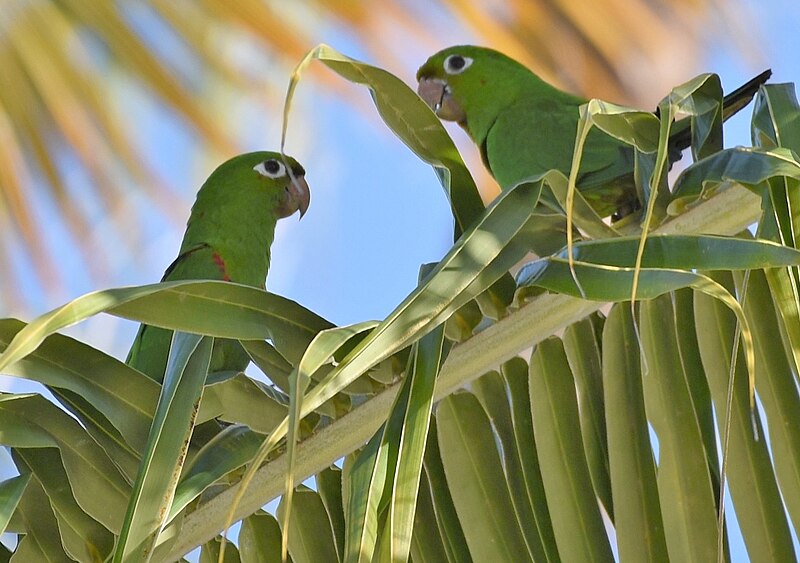
Hispaniolan Parakeet, Psittacara chloropterus.
Photo: Martingloor. Wikipedia: Hispaniolan Parakeet
To conserve horizontal space, Order Passeriformes is moving 27 spaces to the left.
The first extant species in the passerine list.

Rifleman, female, Acanthisitta chloris, of South Island, New Zealand. An insectivorous wren-like member of a four-species family basal to all passerines, endemic to New Zealand. Photo: digitaltrails. Wikipedia: Rifleman
As you go through the following list, note the 3 suborders, 4 infraorders, 5 parvorders and 10 superfamilies.
41. Order: Passeriformes – 143/6595
Suborder Acanthisitti – 1/4
1. Family: Acanthisittidae – New Zealand Wrens – 4
Suborder Tyranni – Non-oscine Passerines – 17/1386
Infraorder Eurylaimides – Old World Suboscines – 5/68
5. Family: Philepittidae – Asities – 4
3. Family: Eurylaimidae – Asian & Grauer’s Broadbills – 10
2. Family: Calyptomenidae – African & Green Broadbills – 6
4. Family: Sapayoidae – Sapayoa – 1
6. Family: Pittidae – Pittas – 47
Infraorder Tyrannides – New World Suboscines – 12/1318
Parvorder Furnariida – 7/714
8. Family: Melanopareiidae – Crescentchests – 4
9. Family: Conopophagidae – Gnateaters – 12
7. Family: Thamnophilidae – Typical Antbirds – 237
10. Family: Grallariidae – Antpittas – 70
11. Family: Rhinocryptidae – Tapaculos – 65
12. Family: Formicariidae – Antthrushes – 12
13. Family: Furnariidae – Ovenbirds & Woodcreepers – 314
Parvorder Tyrannida 5/604
14. Family: Pipridae – Manakins – 55
15. Family: Cotingidae – Cotingas – 65
16. Family: Tityridae – Tityras and Allies – 35
17. Family: Oxyruncidae – Sharpbill, Royal Flycatcher & Allies – 8
Family: Onychorhynchidae–Royal Flycatcher–Part of Oxyruncidae
18. Family: Tyrannidae – Tyrant Flycatchers – 441
Suborder Passeri – Oscine Passerines 125/5205
Basal families in Passeri clade – 11/342
20. Family: Atrichornithidae – Scrub-birds – 2
19. Family: Menuridae – Lyrebirds – 2
22. Family: Climacteridae – Australasian Treecreepers – 7
21. Family: Ptilonorhynchidae – Bowerbirds – 27
23. Family: Maluridae – Fairywrens – 32
25. Family: Dasyornithidae – Bristlebirds – 3
26. Family: Pardalotidae – Pardalotes – 4
27. Family: Acanthizidae – Thornbills & Allies – 66
24. Family: Meliphagidae – Honeyeaters – 191
28. Family: Pomatostomidae – Pseudo-Babblers – 5
29. Family: Orthonychidae – Logrunners – 3
Infraorder Corvides – 30/847 (previously parvorder Corvida)
Basal families in Corvides clade – 4/107
30. Family: Cinclosomatidae – Quail-thrushes & Jewel-babblers – 12
31. Family: Campephagidae – Cuckooshrikes – 89 (some in Orioloidea)
32. Family: Mohouidae – Whiteheads – 3
33. Family: Neosittidae – Sittellas – 3
Superfamily: Orioloidea 8/180
34. Family: Psophodidae – Whipbirds & Wedgebills – 5
35. Family: Eulacestomatidae – Ploughbill – 1
37. Family: Falcunculidae – Shrike-tits – 3
36. Family: Oreoicidae – Australo-Papuan Bellbirds – 3
38. Family: Paramythiidae – Tit Berrypecker & Crested Berrypecker – 3
39. Family: Vireonidae – Vireos, Shrike-Babblers & Erpornis – 61
40. Family: Pachycephalidae – Whistlers & Allies – 63
41. Family: Oriolidae – Old World Orioles – 41
Superfamily: Malaconotoidea – 8/154
42. Family: Machaerirhynchidae – Boatbills – 2
43. Family: Artamidae – Woodswallows, Bellmagpies & Allies – 24
44. Family: Rhagologidae – Mottled Berryhunter – 1
49. Family: Malaconotidae – Bushshrikes & Allies – 50
47. Family: Pityriasidae – Bristlehead – 1
48. Family: Aegithinidae – Ioras – 4
45. Family: Platysteiridae – Wattle-eyes & Batises – 32
46. Family: Vangidae – Vangas, Helmetshrikes & Allies – 40
Superfamily: Corvoidea – 10/406
50. Family: Rhipiduridae – Fantails – 64
51. Family: Dicruridae – Drongos – 28
54. Family: Monarchidae – Monarch Flycatchers – 100
53. Family: Ifritidae – Ifrita – 1
52. Family: Paradisaeidae – Birds-of-Paradise – 44
55. Family: Corcoracidae – White-winged Chough & Apostlebird – 2
56. Family: Melampittidae – Melampittas – 2
58. Family: Laniidae – Shrikes – 34
57. Family: Platylophidae – Crested Shrikejay – 1
59. Family: Corvidae – Crows, Jays & Magpies – 130
Infraorder Passerides – 84/4016 (previously parvorder Passerida)
Basal families in Passerides clade – 8/76
60. Family: Cnemophilidae – Satinbirds – 3
61. Family: Melanocharitidae – Berrypeckers & Longbills – 12
62. Family: Callaeidae – Wattlebirds – 5
63. Family: Notiomystidae – Stitchbird – 1
64. Family: Petroicidae – Australasian Robins – 50
67. Family: Eupetidae – Rail-babbler – 1
65. Family: Picathartidae – Rockfowl – 2
66. Family: Chaetopidae – Rockjumpers – 2
Parvorder Sylviida – 26/1363
Basal families in Sylviida clade – 9/364
68. Family: Hyliotidae – Hyliotas – 4
69. Family: Stenostiridae – Fairy Flycatchers – 9
70. Family: Paridae – Tits, Chickadees & Titmice – 63
71. Family: Remizidae – Penduline-Tits – 11
73. Family: Panuridae – Bearded Reedling – 1
72. Family: Alaudidae – Larks – 93
74. Family: Nicatoridae – Nicators – 3
75. Family: Macrosphenidae – African Warblers – 18
76. Family: Cisticolidae – Cisticolas & Allies – 162
Superfamily: Locustelloidea – 6/231
77. Family: Acrocephalidae – Reed Warblers & Allies – 60
78. Family: Locustellidae – Grassbirds & Allies – 67
79. Family: Donacobiidae – Donacobius – 1
80. Family: Bernieridae – Malagasy Warblers – 11
81. Family: Pnoepygidae – Cupwings – 4
82. Family: Hirundinidae – Swallows – 88
Superfamily: Sylvioidea 7/640
83. Family: Pycnonotidae – Bulbuls – 156
88. Family: Sylviidae – Sylviid Warblers & Allies – 32
89. Family: Paradoxornithidae – Parrotbills – 38
90. Family: Zosteropidae – White-eyes, Yuhinas & Allies – 148
91. Family: Timaliidae – Tree-Babblers, Scimitar-Babblers & Allies – 58
93. Family: Leiothrichidae – Laughingthrushes & Allies – 143
Family: Alcippeidae – Alcippe fulvettas (now in Leiothrichidae)
92. Family: Pellorneidae – Ground Babblers & Allies – 65
Superfamily: Aegithaloidea – 4/128
84. Family: Phylloscopidae – Leaf Warblers – 80
85. Family: Hyliidae – Hylias – 2
87. Family: Aegithalidae – Long-tailed Tits – 11
86. Family: Scotocercidae – Bush Warblers & Allies – 35
Family: Cettidae – Cettia bush warblers & allies (now in Scotocercidae)
Family: Erythrocercidae – Yellow flycatchers (now in Scotocercidae)
Parvorder Muscicapida – 19/856 (previously superfamily Muscicapoidea)
Superfamily: Bombycilloidea – 6/15
110. Family: Dulidae – Palmchat – 1
107. Family: Bombycillidae – Waxwings – 3
109. Family: Ptiliogonatidae – Silky-flycatchers – 4
111. Family: Hylocitreidae – Hylocitrea – 1
112. Family: Hypocoliidae – Hypocolius – 1
108. Family: Mohoidae – Hawaiian Honeyeaters – 5
Superfamily: Muscicapoidea – 8/693
100. Family: Elachuridae – Spotted Elachura – 1
101. Family: Cinclidae – Dippers – 5
106. Family: Muscicapidae – Old World Flycatchers – 345
105. Family: Turdidae – Thrushes & Allies – 175
102. Family: Buphagidae – Oxpeckers – 2
103. Family: Sturnidae – Starlings – 125
104. Family: Mimidae – Mockingbirds & Thrashers – 34
94. Family: Regulidae – Kinglets – 6
Superfamily: Certhioidea 5/148
95. Family: Tichodromidae – Wallcreeper – 1
96. Family: Sittidae – Nuthatches – 29
97. Family: Certhiidae – Treecreepers – 11
98. Family: Polioptilidae – Gnatcatchers – 21
99. Family: Troglodytidae – Wrens – 86
Parvorder Passerida – 31/1721 (previously superfamily Passeroidea)
Basal families in Passerida clade – 15/863
113. Family: Promeropidae – Sugarbirds – 2
114. Family: Modulatricidae – Dapple-throat & Allies – 3
116. Family: Nectariniidae – Sunbirds & Spiderhunters – 148
115. Family: Dicaeidae – Flowerpeckers – 53
118. Family: Chloropseidae – Leafbirds – 12
117. Family: Irenidae – Fairy-bluebirds – 3
119. Family: Peucedramidae – Olive Warbler – 1
120. Family: Urocynchramidae – Przevalski’s Pinktail – 1
121. Family: Ploceidae – Weavers & Allies – 123
123. Family: Viduidae – Indigobirds – 20
122. Family: Estrildidae – Waxbills & Allies – 138
124. Family: Prunellidae – Accentors – 12
125. Family: Passeridae – Old World Sparrows – 43
126. Family: Motacillidae – Wagtails & Pipits – 69
127. Family: Fringillidae – Finches, Euphonias & Allies – 235
Superfamily: Emberizoidea 16/858 (previously New World 9-primaried oscines)
129. Family: Rhodinocichlidae – Thrush-Tanager – 1
128. Family: Calcariidae – Longspurs & Snow Buntings – 6
130. Family: Emberizidae – Old World Buntings – 44
142. Family: Cardinalidae – Cardinals & Allies – 51
141. Family: Mitrospingidae – Mitrospingid Tanagers – 4
143. Family: Thraupidae – Tanagers & Allies – 384
131. Family: Passerellidae – New World Sparrows – 132
140. Family: Parulidae – New World Warblers – 115
138. Family: Icteriidae – Yellow-breasted Chat – 1
139. Family: Icteridae – Troupials & Allies – 106
132. Family: Calyptophilidae – Chat-Tanagers – 2
136. Family: Zeledoniidae – Wrenthrush – 1
137. Family: Teretistridae – Cuban Warblers – 2
134. Family: Nesospingidae – Puerto Rican Tanager – 1
135. Family: Spindalidae – Spindalises – 4
133. Family: Phaenicophilidae – Hispaniolan Tanagers – 4
The final extant species of the final family Phaenicophilidae (Hispaniolan Tanagers) in the Passerine list.
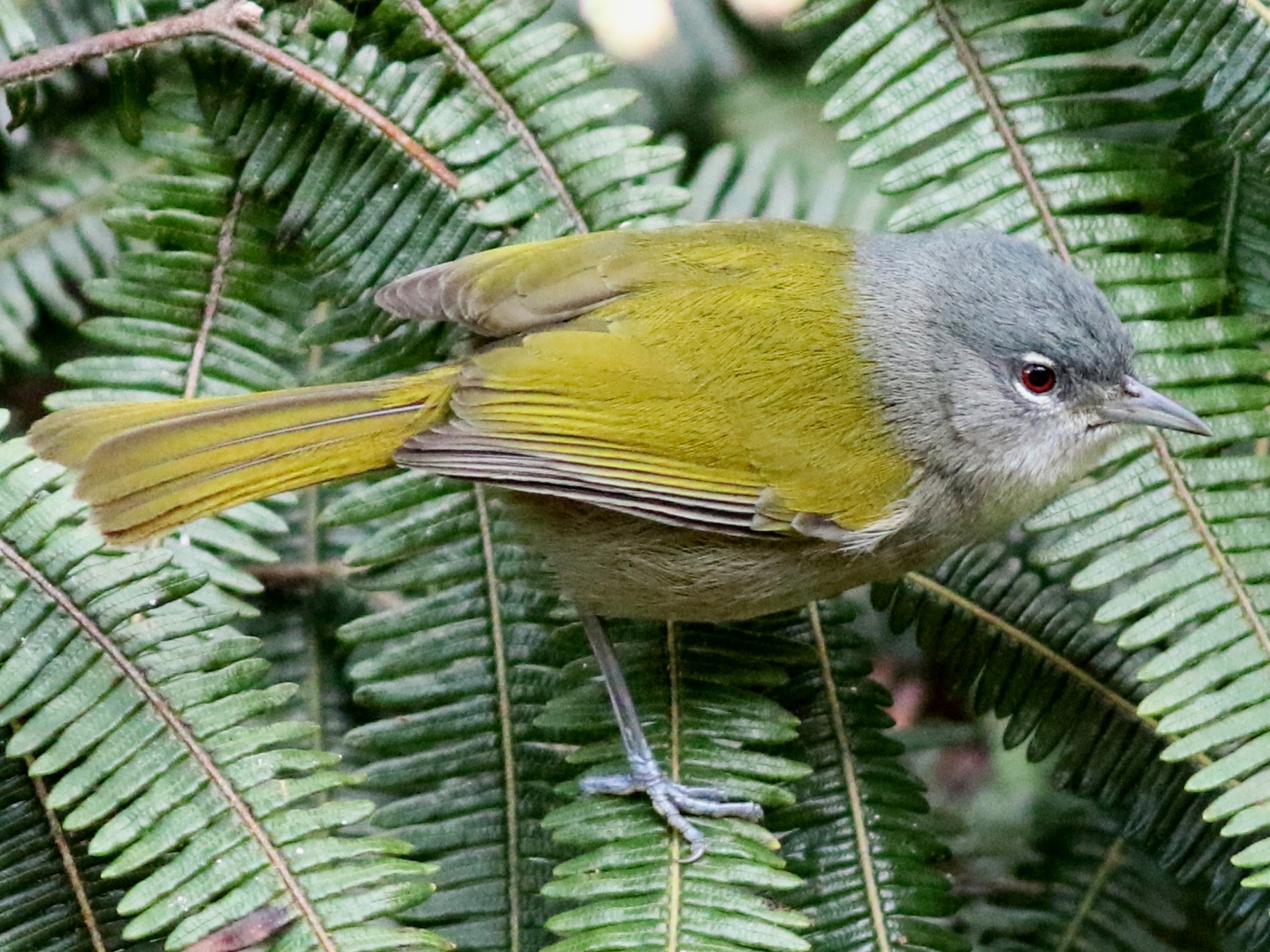
Green-tailed Warbler (or Ground-Tanager) Microligea palustris.
Photo: John C Sullivan. eBird: Green-tailed Warbler
That’s the end of it. Now all you have to do is go out and find all those Orders and Families and Genera and Species of birds.
I hope you found these ten postings as enlightening and entertaining as I did composing and presenting them. Don’t forget to check back in a year or so by which time everything will have changed utterly.
A few useful and informative links
https://avibase.bsc-eoc.org/familytree.jsp?lang=HA
https://checklist.americanornithology.org/taxa/
http://creagrus.home.montereybay.com/sylvid-new.html
https://tree.opentreeoflife.org/opentree/opentree14.9@ott1041547/Passeriformes
https://en.wikipedia.org/wiki/Passerine
https://en.wikipedia.org/wiki/Passerine#Suborder_Acanthisitti
https://en.wikipedia.org/wiki/Passerine#Taxonomic_list_of_Passeriformes_families per IOU
https://en.wikipedia.org/wiki/Strisores
http://www.j-avianres.com/en/article/doi/10.5122/cbirds.2013.0016
A review of the recent advances in the systematics of the avian superfamily Sylvioidea, Per ALSTRÖM Urban OLSSON, Fumin LEI
The Taxonomy Series
Installments post ever other day; installments will not open until posted.
Taxonomy One: A brief survey of the history and wherefores of taxonomy: Aristotle, Linnaeus and his binomial system of nomenclature, taxonomic ranks and the discovery and application of biological clocks.
Taxonomy Two: Introduces the higher levels of current taxonomy: the three Domains and the four Kingdoms. We briefly discuss Kingdom Protista, then the seven phyla of Kingdom Fungi.
Taxonomy Three: Kingdom Plantae.
Taxonomy Four: Kingdom Animalia to Phylum Annelida.
Taxonomy Five: A discussion of Cladistics, how it works and why it is becoming ever more important.
Taxonomy Six: Phylum Chordata, stopping at Class Mammalia.
Taxonomy Seven: Class Mammalia.
Taxonomy Eight: Class Aves, beginning with a comparison of five different avian checklists of the past 50 years.
Taxonomy Nine: A cladogram and discussion of Subclass Neornithes (modern birds) of the past 110 million years, reaching down to the current forty-one orders of birds.
Taxonomy Ten: A checklist of Neornithes including all ranks and clades down to the rank of the current 251 families of birds (plus a few probable new arrivals) with totals of the current 11,017 species of birds.
There will be a relatively brief look at “pecularities & problems of the checklist,” not yet written. Following that there may be some brief accounts of a few monotypic species which I think may be the most interesting birds.
Cladogram of forty-one Avian Orders | Taxonomy 9
[By Chuck Almdale]
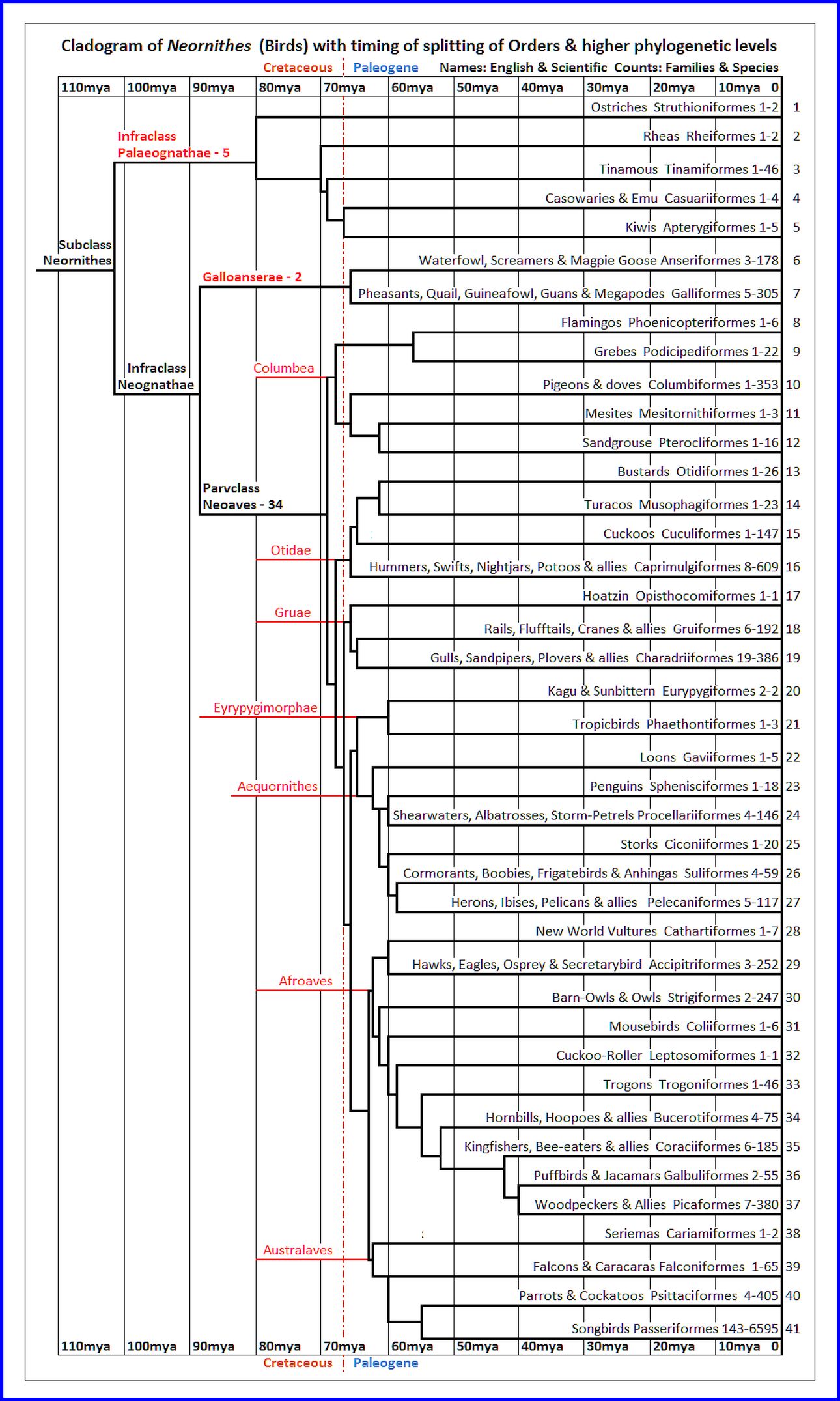
Presented below is a cladogram of the forty-one currently recognized Orders of birds. A cladogram is a graphic representation of relationships between organisms with one of the axes, in this case the horizontal, capable of representing the passage of time, if the designer chooses to do so. For those unfamiliar with cladograms in general, Taxonomy 5 on cladistics will help; this cladogram’s significant features are also listed below. Frequent referral to the cladogram should clarify the descriptions of the clades.
The Cretaceous–Paleogene (K–Pg) extinction event
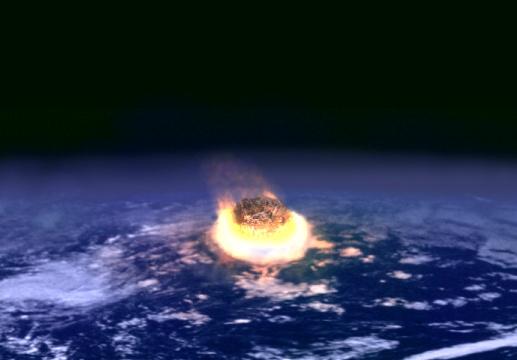
Asteroid strikes the earth 66 mya; not an actual photograph of the event. Wikipedia: K-Pg Extinction Event
Critically important in the evolution of birds was the Cretaceous–Paleogene (K–Pg) extinction event, perhaps better known by the prior term Cretaceous–Tertiary (K–T) extinction. (Cretaceous is spelled with a “K” in German). Approximately 66 million years ago an asteroid smashed into the earth where the Gulf of Mexico now lies, throwing an immense quantity of water, rock and dirt into the atmosphere. This material spread by winds around the earth, causing a “nuclear-winter”-type worldwide blackout that wiped out an estimated three-quarters of plant and animal species on earth. All non-avian dinosaurs became extinct as did most tetrapods weighing over 55 pounds (25 kg), excepting a few cold-blooded species such as sea turtles and crocodilians. This marks the end of the Cretaceous period and the entire Mesozoic era and the beginning of the Paleogene period of the Cenozoic era, our current geological era. The asteroid impact left a thin layer of sediment – the K–Pg (K–T) boundary, found worldwide in marine and terrestrial rocks – which contains high levels of iridium, a metal more common in asteroids than in the Earth’s crust. Many of the avian clade evolutionary divergences displayed in the cladogram occurred at or very shortly after this event.
Features of the Cladogram
K-Pg (K-T) event: This is marked by a vertical broken orange line.
Timescale: At top and bottom, 110 million years ago on left, current day on right.
41 Orders: Listed on right side, generally the most ancient at top, the youngest at bottom, numbered on right margin. For three higher ranks the number of orders they contain is listed, e.g. Parvclass Neoaves – 34.
Families & Species: Listed next to the Order name, e.g. “Rheas Rheiformes 1-2” means 1 family, 2 species within Order Rheiformes.
Heavy Dark Lines: The branches of the evolutionary tree. The tree starts near the upper left with Subclass Neornithes, appearing 110-101 million years ago, and branches right with branch tips ending at the current 41 Orders.
Nine Clades: In red. the same nine clades used in the chart of five checklists presented in Taxonomy 8.
The Diversification Cluster: Many major lineage divisions occurred within a few million years following the K-Pg extinction event.
The cladogram was created in MS Excel.
Overview of Class Aves to Subclass Neornithes
The biological Class Aves includes fossil groups of birds as well as modern taxa. It is generally considered to have emerged out of the Theropod (bipedal carnivorous) dinosaurs 150 million years ago (mya), with Archaeopteryx, the feathered, toothed and bony-tailed dinosaur as the first of its kind. Archaeopteryx could not lift its wings above its back, but could flap downward, and it’s now believed it could fly a bit like a pheasant, with short bursts of active flight as well as short glides. Recent X-ray studies revealed nearly hollow bones. It had asymmetrical feathers suggesting flight ability; flightless birds have symmetrical wing feathers (except for those lacking wings). Scientists are still debating how it got into the air: did it run, leap from a perch or wait for a strong breeze? The question of whether it should be considered a dinosaur or the first bird is also up in the air. Others avians appeared during the late Jurassic or early Cretaceous periods (150 – 110 mya); all are extinct and are placed in Subclass Archaeornithes (not on this cladogram). This leaves remaining the line leading to the as-yet-extant species, Subclass Neornithes, located at upper left in the cladogram below.
Subclass Neornithes includes all extant avian species. The earliest divergence within Neornithes, around 102 mya, split Infraclass Paleognathae (ratites and tinamous) from Infraclass Neognathae. Neognathae include two primary major groups of birds, Parvclass Galloanserae and Parvclass Neoaves. Galloanserae in turn is composed of two Orders, Anseriformes (waterfowl) and Galliformes (chickens and allies). All other modern birds fall into Parvclass Neoaves.
The information in the Subclass Neornithes cladogram below is relatively up-to-date (new information keeps pouring in), and comes from a variety of sources. The currently accepted 41 orders of bird appear roughly in sequence of oldest to youngest, and fall into nine major clades (in red). Credible dates of appearance (e.g. 60 mya) of any clade can vary 5% (e.g. 63-57 mya) from dates indicated.
To print or save an image of the chart: click here.
Increase chart size: <Control> +; Decrease: <Control> -.
The rest of this post discusses the nine clades (above in red), each beginning with a excerpt from the main cladogram.
Subclass Neornithes – Infraclass Palaeognathae
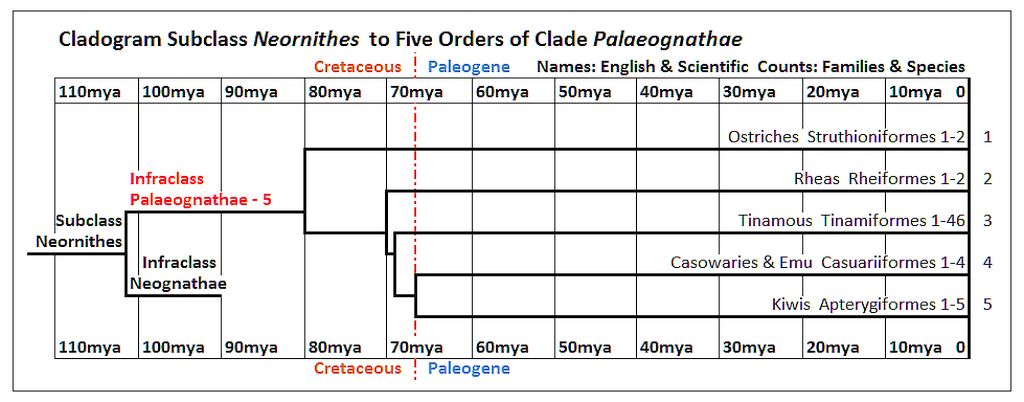
About 102 million years ago, birds began to diversify into two major clades, the Palaeognathae and the Neognathae. The small clade of Palaeognathae began diversifying about 80 million years ago (mya) and is currently comprised of five of the most ancient orders of birds. The line leading to modern Struthioniformes (Ostriches) was the first to diverge 80 mya, followed by the Rheiformes (Rheas in South America) around 71 mya, then the Tinamiformes (Tinamous of Central and South America) at 69 mya, leaving Superorder Apterygimorphae, consisting of the Orders of Apterygiformes (Kiwis) and Casuariiformes (Cassowaries and Emu). These last two orders diverged from one another at the K-Pg extinction event 66 mya. The Emu later diverged (not shown here) from Cassowaries around 32 mya. Today the Palaeognathae contains 5 orders, 5 families and 59 species, 46 of them Tinamous. There are no monotypic families.
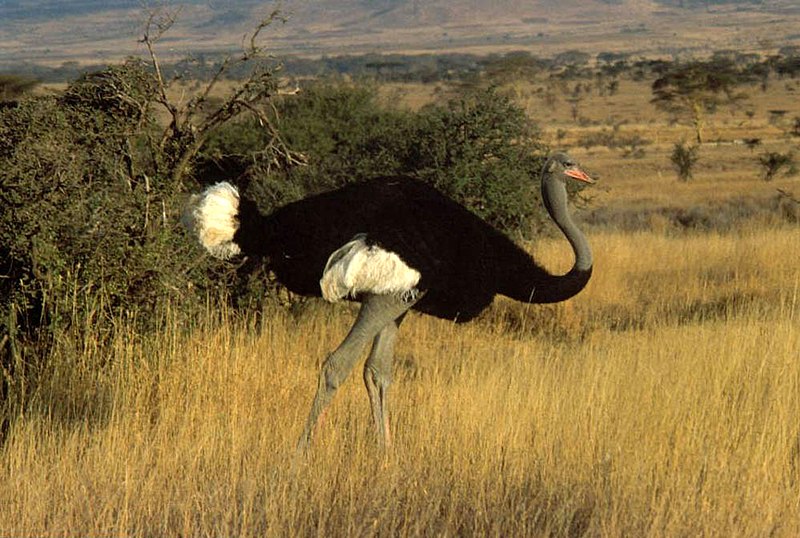
Somali Ostrich, getting closer to extinction.
Photo: Christiaan Kooyman, Jan. 2003. Wikipedia: Somali Ostrich
Cladogram used as source for Palaeognathae splits
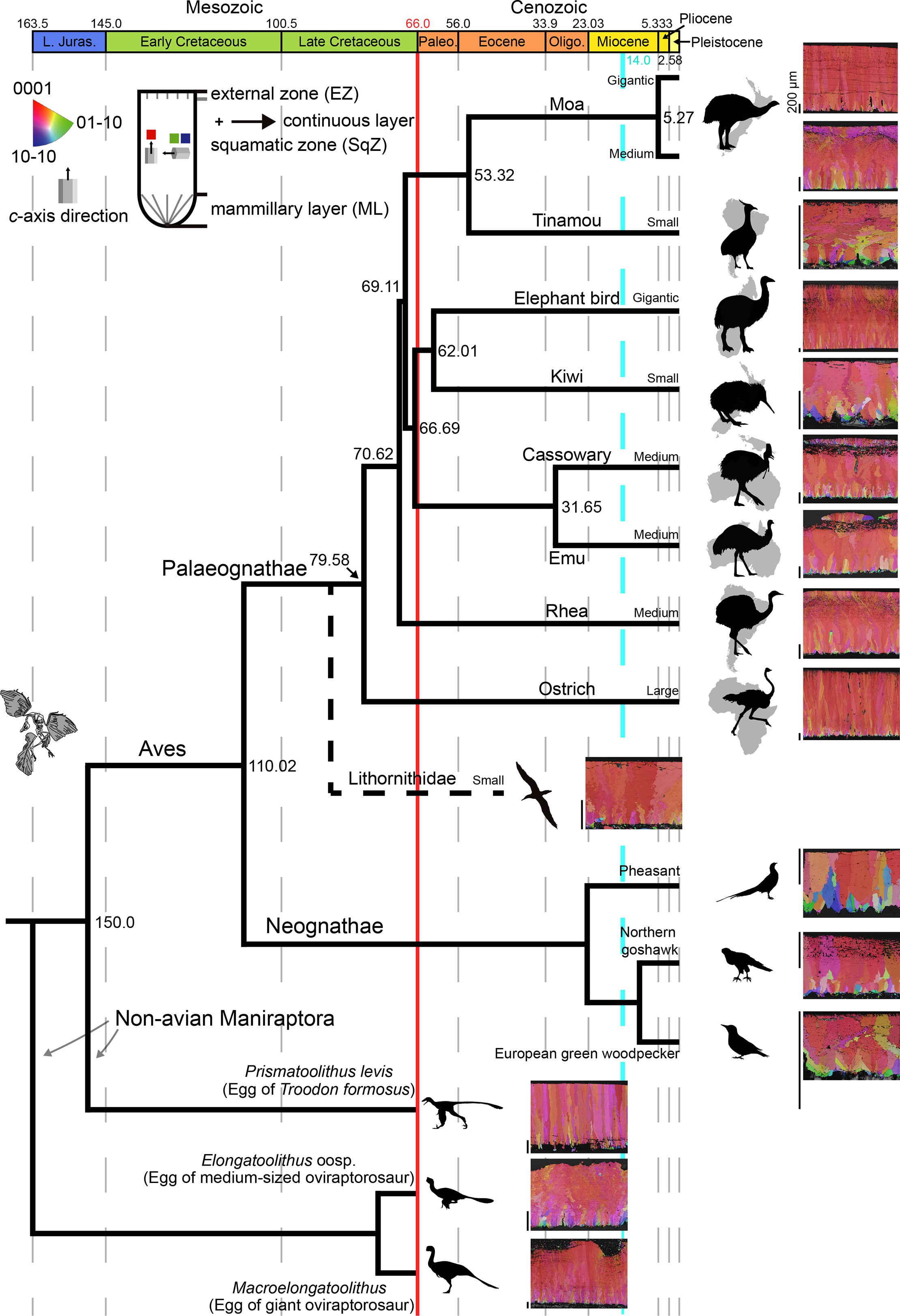
Diagram from: Microstructural and crystallographic evolution of palaeognath (Aves) eggshells. Seung Choi, Mark E Hauber, Lucas J Legendre, Noe-Heon Kim, Yuong-Nam Lee, David J Varricchio. Jan 31, 2023.
Link: https://elifesciences.org/articles/81092 scroll to Fig. 13 about 1/3rd way down.
There is a potential problem with the Palaeognathae cladogram directly above, also depicted in the Palaeognathae portions of the Neornithes cladograms. Ostriches, Rheas, Cassowaries, Emu and Kiwis were long considered to be each other’s closest relatives and constituted the Ratites, flightless birds with a flat (not keeled) sternum (breastbone). The sternal keel – possessed by all flying birds – provides additional bone attachment surface for breast muscles. However, Tinamous are not flightless and possess a sternal keel: they don’t like to fly and prefer running or walking away silently into the forest or grassland, never to be seen but only heard, but can fly when necessary. But if the Tinamou line is embedded within the ratites – now described as “mostly flightless” in order to accommodate the capable-of-flight Tinamous – it means Tinamous developed their sternal keel separately from the Neognathae, the clade which includes all birds except the ratites and tinamous. The depicted schema also has Tinamous, Cassowaries, Emu and Kiwis diverging from Rheas around 70 mya. But Tinamous and Rheas are currently endemic to the Americas, while the other three groups live in Australia, New Guinea and New Zealand. Based on geography, one might assume that a Tinamou-Rhea group diverged from a Cassowary-Emu-Kiwi group, then each group continued their own divergences. Yet a 2010 study suggests that the extinct Moa of New Zealand is the Tinamou’s closest relative. All of these birds have a similar and distinctive Palaeognath palate. Supercontinent Gondwana didn’t finish breaking up into Africa, India, Australia, South America and Antarctica until after – perhaps well after – the start of the Paleogene (66 mya), so these flightless birds had many millions of years to walk to their current ranges from wherever in Gondwana they began. The current opinion holds that the ratites developed flightlessness several times; it may be that flight developed several times as well (Tinamous and Neognathae). However, if some of the dating studies are inaccurate, it may yet be that the Tinamous were first to diverge from the rest of the Palaeognaths (or vice-versa which amounts to the same thing, but suggests that the ratites developed from a flying ancestor), a possibility depicted occurring about 84 mya in the partial cladogram below.
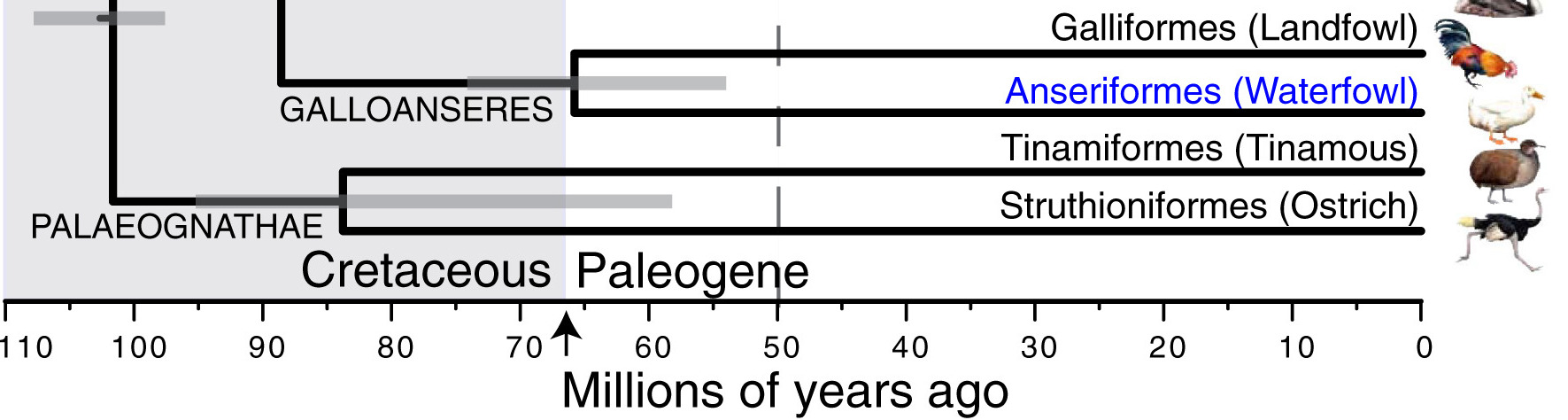
Ordinal-level genome-scale family tree of modern birds. The Origin and Diversification of Birds. Stephen L. Brusatte, Jingmai K. O’Connor, and Erich D. Jarvis. Current Biology Review; Vol. 25, Issue 19; 5 Oct 2015, figure 6. [Link]
What these Palaeognaths do have in common is indicated by their name which means “ancient jaw”: the bones of their palate are described as retaining basal (primitive) morphological characteristics, thus closer to the reptilian palate than that of the birds in Infraclass Neognathae (“new jaw”).
It seems there may still be details to be worked out with the Palaeognathae relationships among themselves and with the Neognathae. “Early days” perhaps, as they say in BBC police shows, meaning “We’re still working on it, please stop asking and go away.”
Subclass Neornithes – Infraclass Neognathae
The clade Infraclass Neognathae is the sister taxon to Infraclass Palaeognathae. This clade contains the remaining 36 orders of birds and the rest of the approximately 11,000 (a perpetually increasing number) species of birds. This clade – some say Infraclass, others say Parvclass and still others simply leave it as a clade – diverged from the Palaeognathae 102 mya and began diversifying into two clades around 88 million years ago. The smaller of these two clades is Parvclass Galloanserae, consisting of two orders and 483 species, and the much larger Parvclass Neoaves consisting of the remaining 34 orders.
Subclass Neornithes – Infraclass Neognathae – Parvclass Galloanseres
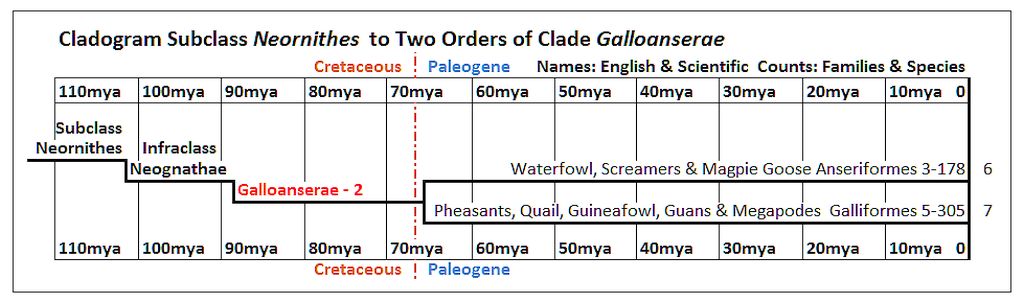
Parvclass Galloanserae diverged from the rest of Neognathae 88 million years ago, when a major breakup within the supercontinent Gondwana occurred. The Galloanseres lineage began their diverging into two orders at the start of the Paleogene Period (66-23 mya): Anseriformes consisting of Waterfowl, Screamers (South America) and the Magpie-Goose (Australia), 3 families totaling 178 species; the other is Galliformes, a diverse worldwide order containing Pheasants, Quail, Guineafowl (Africa), Guans (Central & South America) and Megapodes (Australasia), 5 families totaling 305 species. The Megapodes have the unique behavior of not sitting on their eggs but using warm earth, fermenting vegetation or geothermal heat to incubate them. Later Galloanserae diversification followed their dispersal to the various continents and islands during the Eocene (56-33.9 mya). The monophyletic (one lineage) relationship of these two orders and their placement as the closest relative (sister taxon) of Neoaves are well supported. Background: Waterfowl and Gamefowl (Galloanserea); Pereira, Sergio L. & Baker, Allan J.; page 416, Link: Timetree.temple
The largest families are Phasianidae (Pheasants & allies, 186 species) and Anatidae (Ducks & allies, 174 species). Family Anseranatidae (Magpie Goose of Australia) is monotypic.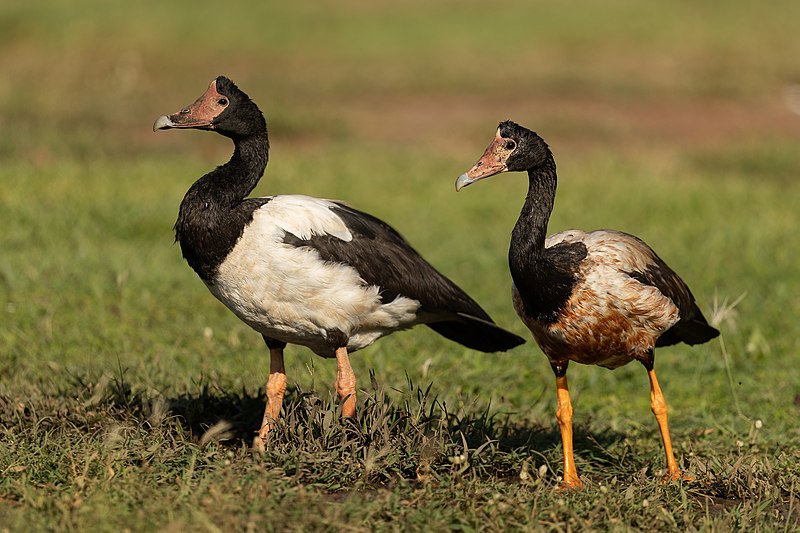
Magpie Goose (Anseranas semipalmata), a monotypic family of northern Australia and southern New Guinea.
Photo: JJ Harrison, Dec. 2019. Wikipedia: Magpie Goose
As mentioned previously, molecular clocks aren’t the only factor in drawing up cladograms which include dates on the nodes of divergence; morphology is still important, especially when it comes to calibrating a lineage’s molecular clock. Following are two examples of how morphological studies are still being used.
Vegavis the Neoornithine
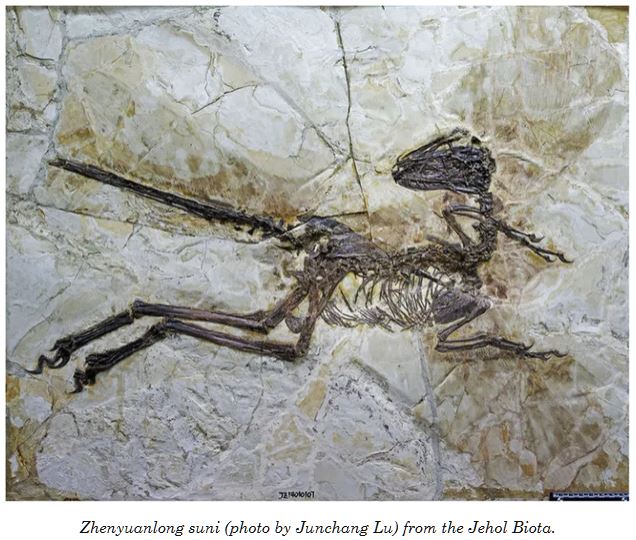
Vegavis fossil from Letters from Gondwana. Source: Paleonerdish OK
Although a Cenozoic origin for Galloanserae has been long hypothesized based on fragmentary and incomplete specimens, definitive evidence was found only recently. Vegavis iaii, the oldest known anseriform fossil from the Maastrichtian stage (72.1-66 mya) of the late Cretaceous, is closely related to the lineage of ducks and geese. This finding implies that modern anseriform families, and hence their closest living relative, the Galliformes, were already independent lineages in the late Cretaceous. From: Waterfowl and Gamefowl (Galloanserea); Pereira, Sergio L. & Baker, Allan J.; page 416, Link: Timetree.temple
The single best record of a Cretaceous neornithine is the partial skeleton of Vegavis from the last sliver of the Cretaceous period (around 68–66 million years ago) in Antarctica. This bird is assigned to the Neornithes subgroup of modern birds known as Galloanserae which includes Anseriformes (ducks and geese) based on the morphology of its well-developed hypotarsus.
Source: The Origin and Diversification of Birds. Stephen L. Brusatte, Jingmai K. O’Connor, and Erich D. Jarvis. Current Biology Review; Vol. 25, Issue 19; 5 Oct 2015, page. [Link]
The Hypotarsus

Hypotarsus process on the tarsometatarsus. Pinterest: Mark Kobelka
The hypotarsus is a process [bony bump] on the posterior side of the upper end of the tarsometatarsus (the long bone immediately above the foot) of many birds; aka the calcaneal process. A protruding hypotarsus “enhances the capacity of diving birds to propel their feet backward and power underwater swimming.”
Source: Research Gate, Comparative hindlimb myology of foot‐propelled swimming birds, article by Glenna T. Clifton, Jennifer A Carr & Andrew A Biewener.
The Avian Quadrate Bone
We previously discussed the avian quadrate bone in the first and eighth posting in this series, but it doesn’t hurt to be reminded of this major marker in the early evolution of birds. You’ll never look at ducks and chickens the same way again.
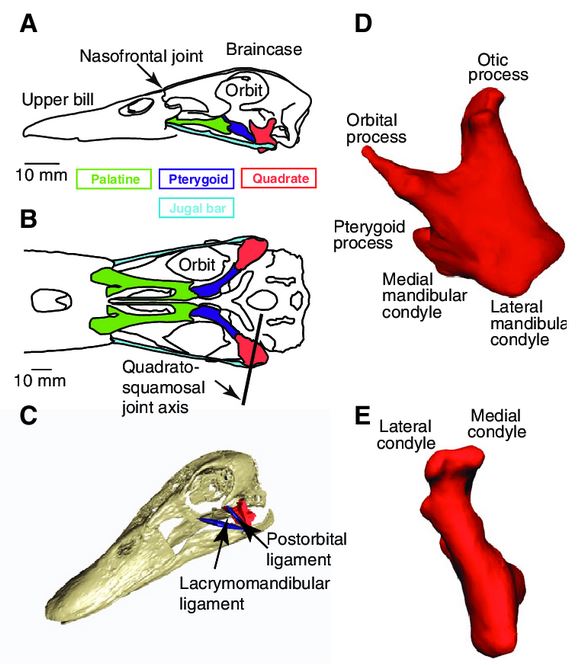
Mallard skull and quadrate anatomy. (A) Lateral view, (B) Ventral view. Bones: Quadrate (red), Pterygoid (purple), Palatine (green), Jugal (blue), Upper Bill. From: Kinematics of the Quadrate Bone During Feeding in Mallard Ducks. [Link] (2011) Megan M Dawson, Keith A Metzger, David B Baier & Elizabeth L Brainerd. [Diagram used in Taxonomy 1 & 8.]
In birds and [other] reptiles, the quadrate acts as a hinge between the lower jaw and the skull and plays an important role in avian cranial movement. In a study by Kuo, Benson and Field (2023), the quadrate of 50 currently living galloanseran species were examined resulted in a reconstruction of the ancestral Galloanserae which closely approximated the average of living modern galloanserans. But when they added early fossil galloanseran quadrates to the study the results shifted, indicating that the quadrate of the common ancestor of galliforms and anserforms was closer to the quadrate of living galliforms than that of living anserforms. In short, the common ancestor of all chickens and ducks was [likely] more like a chicken than a duck. Morphology still has important things to add.
Subclass Neornithes – Infraclass Neognathae – Parvclass Neoaves
The remaining 34 orders and the rest of almost 10,500 species of birds are in the Parvclass clade of Neoaves, which we will discuss as seven clades. All of these clades appeared 60-70 mya, close to the end of the Cretaceous era and start of the Paleocene era 66 mya, caused by that cataclysmic impact of an asteroid into what is now the Gulf of Mexico, north of the Yucatan peninsula. Except for the warm-blooded birds, the dinosaurs vanished and the Neoavian evolutionary radiation exploded. All dates are molecular clock calculations, based not on proteins but on ~30 million pairs of genomic (chromosomal) DNA. There are many competing systems for Neoaves phylogeny, this site shows ten of them.
Subclass Neornithes – Infraclass Neognathae – Parvclass Neoaves – Clade Columbea
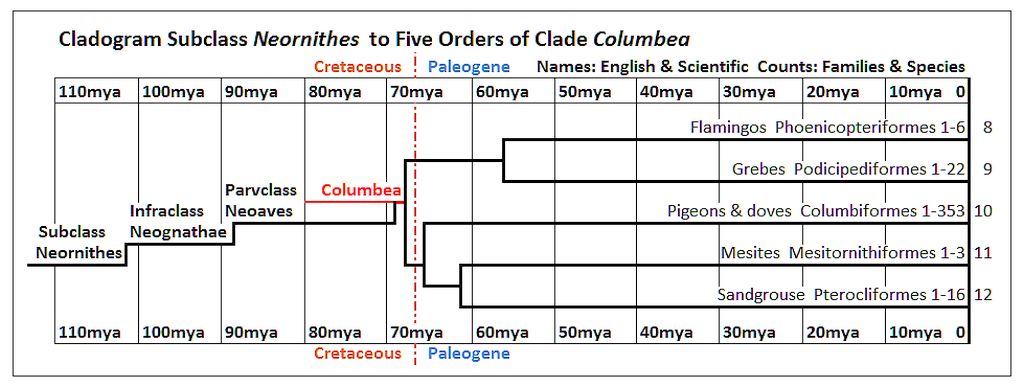
The Clade Columbea currently consists of 5 orders, 5 families and 400 species. Their first divergence was the widespread Phoenicopterimorphae Superorder (orders of flamingos and grebes) from Columbimorphae at 68 mya. Within Columbimorphae Order Columbiformes (Pigeons & Doves) diverged at 65 mya, followed at 62 mya by the divergence between Order Mesitornithiformes (Mesites of Madagascar) and Order Pterocliformes (Sandgrouse, ranging from east Asia to southern Africa). [Some scientists do not combine Phoenicopterimorphae and Columbimorphae into a single clade; one such alternative suggest two clades, Mirandornithes (Flamingos & Grebes) and Columbimorphae (Pigeons, Mesites and Sandgrouse) as two simultaneously emerging clades, with sister taxon Passerea containing all remaining birds. This creates a polytomy which in the current view cannot be correct.] Several of the following cladesSome scientists do not combine Phoenicopterimorphae and Columbimorphae into a single clade. Several of the following clades are larger with more divergences. If you’ve compared the text so far with the cladogram(s), you should have a feeling for the grouping and divergences and won’t need all the additional detailed descriptions as have been supplied so far. The largest family in Clade Columbea by far is Columbidae (Pigeons & Doves, 353 species). The smallest family is Mesitornithidae (Mesites of Madagascar, 3 species).
Subdesert Mesite (Monias benschi) of southwestern Madagascar.
Photo: Ben Rackstraw, Nov. 2006. Wikipedia: Mesite
Subclass Neornithes – Infraclass Neognathae – Parvclass Neoaves – Clade Passerea
After the divergence of the clade Columbea, the remaining Neoaves are tentatively classified into the clade Passerea. This encompasses all the remaining 29 orders, 233 families and 10,075 species. We will discuss these as six clades.
Subclass Neornithes – Infraclass Neognathae – Parvclass Neoaves – Clade Passerea – Clade Otidae
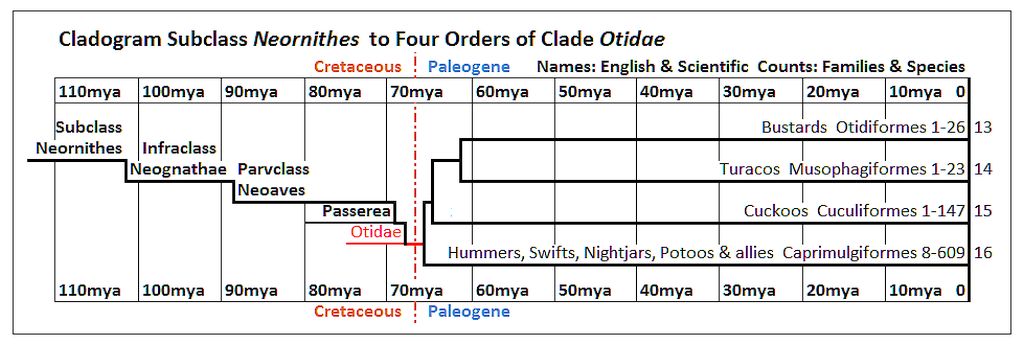
The first group within this large clade of Passerea consist of the Clade Otidae. This contains superorders Caprimulgimorphae & Otidimorphae, which combined comprise 4 orders, 11 families and 805 species. 609 of these species are in the Order Caprimulgiformes, an increasingly diverse order comprising 8 families: Hummingbirds, Treeswifts, Swifts, Owlet-Nightjars, Oilbird, Potoos, Nightjars and Frogmouths. Fifty years ago there were only 105 species in 5 families classified to Caprimulgiformes. These two superorders diverged from the rest of Clade Passerea 68 mya, the same time that Superorder Phoenicopterimorphae diverged from the rest of Clade Columbea (described above). With the 5% (+/- 3.4 million years) credible dates (margin of error), this was when the asteroid extinction even occurred. During the very early Paleogene (65-61 mya) this clade diverged into its current four Orders of Caprimulgiformes (Hummingbirds, Swifts, Nightjars, Potoos & allies), Cuculiformes (Cuckoos), Musophagiformes (Turacos of Sub-Saharan Africa) and Otidiformes (Bustards – widespread but uncommon in the Old World). The largest families are Trochilidae (Hummingbirds, 155 species in the Americas), Cuculidae (Cuckoos, 147 species worldwide) and Caprimulgidae (Nightjars and allies, 97 species worldwide). The only monotypic family is: Steatornithidae (Oilbird of the American tropics).
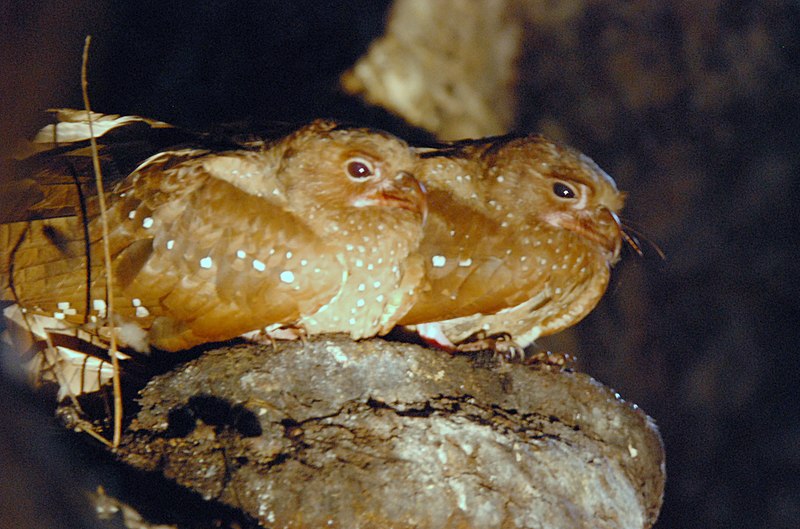
Oilbirds (Steatornis caripensis) nest and roost in caves across northern and northwestern South America.
Photo: The Lilac Breasted Roller. April 2007. Wikipedia: Oilbird
Subclass Neornithes – Infraclass Neognathae – Parvclass Neoaves – Clade Passerea – Clade Gruae
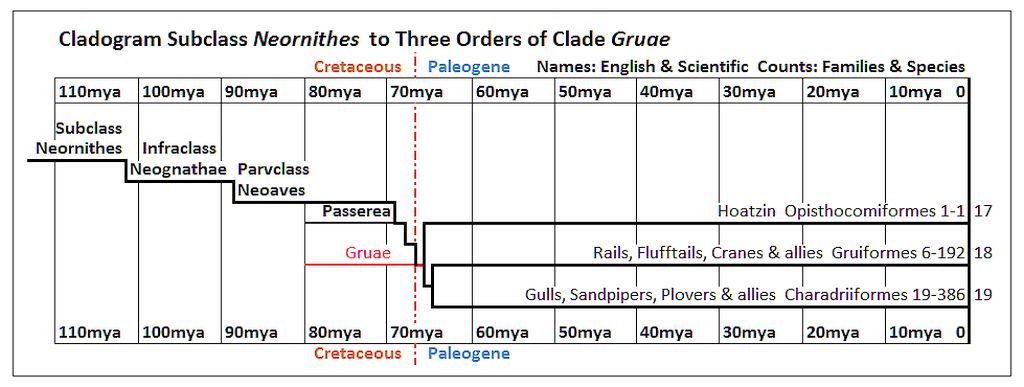
The clade Gruae appeared at the K-Pg extinction event, 66 mya. Within two million years it had already begun diversifying into two Superorders, Opisthocomimorphae and Gruimorphae. Opisthocomimorphae today consists of a single family Opisthocomidae with a single species (the Hoatzin of South America). Gruimorphae diverged into two orders: Gruiformes (six families of Flufftails, Coots, Finfoots, Limpkin, Trumpeters and Cranes – 192 species worldwide), and the very diverse Charadriiformes (19 families of Gulls, Sandpipers, Plovers, Alcids, Buttonquail, Pratincoles, Oystercatchers, Thick-knees and 11 other families of under ten species each – 386 species worldwide). The largest families are Rallidae (Rails, 155 species), Laridae (Gulls and allies, 100 species) and Scolopacidae (Sandpipers, 97 species). There are six monotypic families: Opisthocomidae (Hoatzin of South America), Aramidae (Limpkin So.-Cent. America), Pluvianellidae (Magellanic Plover of Southern South America), Ibidorhynchidae (Ibisbill of South Asian mountains), Pedionomidae (Plains-wanderer of eastern Australia) and Dromadidae (Crab-Plover around the Indian Ocean).
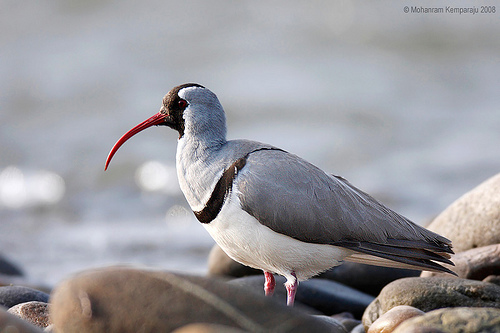
Ibisbill (Ibidorhyncha struthersii) , a bird of central Asian mountain streams.
Photo: Mohanram Kemparaju, March 2008. Wikipedia: Ibisbill
Subclass Neornithes – Infraclass Neognathae – Parvclass Neoaves – Clade Passerea – Clade Eurypygimorphae (or Phaethontimorphae)
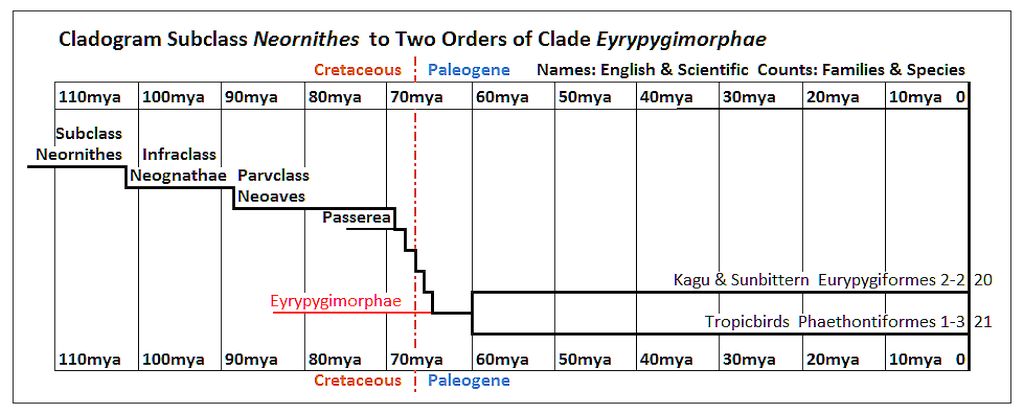
Clade Eurypygimorphae is a small clade consisting of the two Orders Eurypygiformes and Phaethontiformes, two families and only 5 extant species. It is the sister taxon to Clade Aequornithes as their common ancestor appeared shortly after the K-Pg extinction event, and these two clades began to separate within a million years after that. The reason I denote it as a separate clade is because an important source report (Brusette, O’Conner, Jarvis 2015 The origin and diversification of birds; link) classified them as within Clade Passerea, but not within the clade of Core Waterbirds (Aequornithia), thus indicating that they were a basal clade. The two orders within this clade diverged from each other 5 million years later, or 60 mya. Order Eurypygiformes contains only the Kagu of New Caledonia and the Sunbittern of the American tropics, two widely-separated locations. Order Phaethontiformes contains three species of Tropicbirds, previously classified to the order Procellariformes next to the Pelicans.
Sunbittern (Eurypyga helias) of Central and northern South America, displaying its “suns.” Stavenn, Jan 2007. Wikipedia: Sunbittern
Subclass Neornithes – Infraclass Neognathae – Parvclass Neoaves – Clade Passerea – Clade Aequornithes (Core Waterbirds)
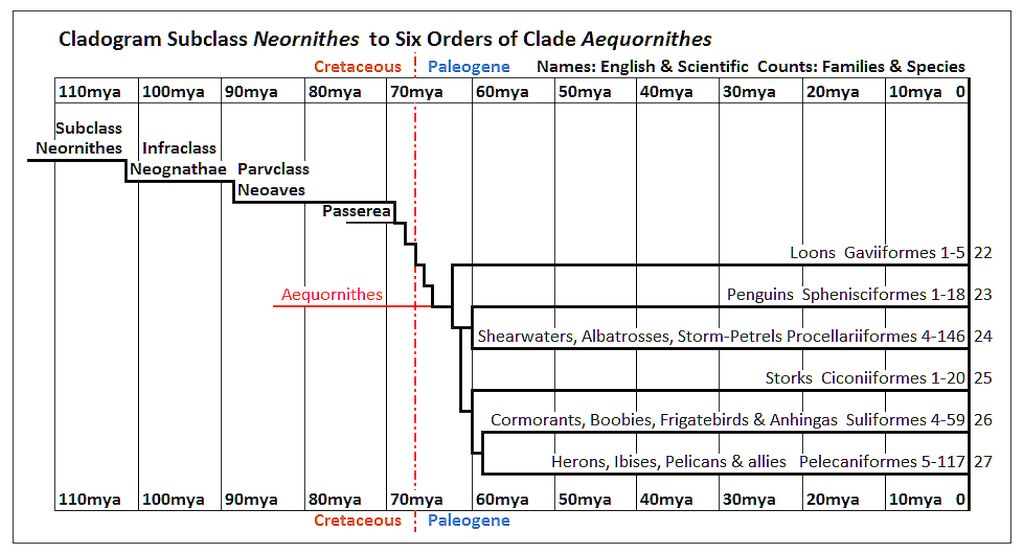
Clade Aequornithes (or Aequornithia) or Core Waterbirds consists of three sub-clades, six orders, 16 families and 365 species. Clades Aequornithes and sister taxon Eurypygimorphae diverged from the final two clades of Afroaves and Australaves, see below) very soon after the K-Pg extinction event. Aequornithes separated from Eurypygimorphae about 1 million years later. The loons then diverged, soon followed by divergence of the Stork, Cormorant and Pelican Orders from the Penguins and Tubenoses, 61 mya. Within a few million years these clades had further diversified into the six current orders. The largest families are Procellariidae (Shearwaters and Petrels – 98 species worldwide) and Ardeidae (Herons, Egrets, and Bitterns – 71 species worldwide). There are two monotypic families: Balaenicipitidae (Shoebill of Central Africa), and Scopidae (Hamerkop of sub-Saharan Africa).
Hamerkop (Scopus umbretta) of sub-Saharan Africa, southwest Arabia and Madagascar. This 1 lb. 22 inch tall bird builds one of the largest nests in the world; one was estimated to contain 8,000 sticks.
Photo: Sumeet Moghe, August 2012. Wikipedia: Hamerkop
Subclass Neornithes – Infraclass Neognathae – Parvclass Neoaves – Clade Passerea – Clade Telluraves (Core Landbirds)
Clade Telluraves is the sister taxon to Clade Aequornithes and has two main branches, the sister taxa of Clade Afroaves and Clade Australaves. These two clades diverged 63 mya.
Subclass Neornithes – Infraclass Neognathae – Parvclass Neoaves – Clade Passerea – Clade Telluraves (Core Landbirds) – Clade Afroaves
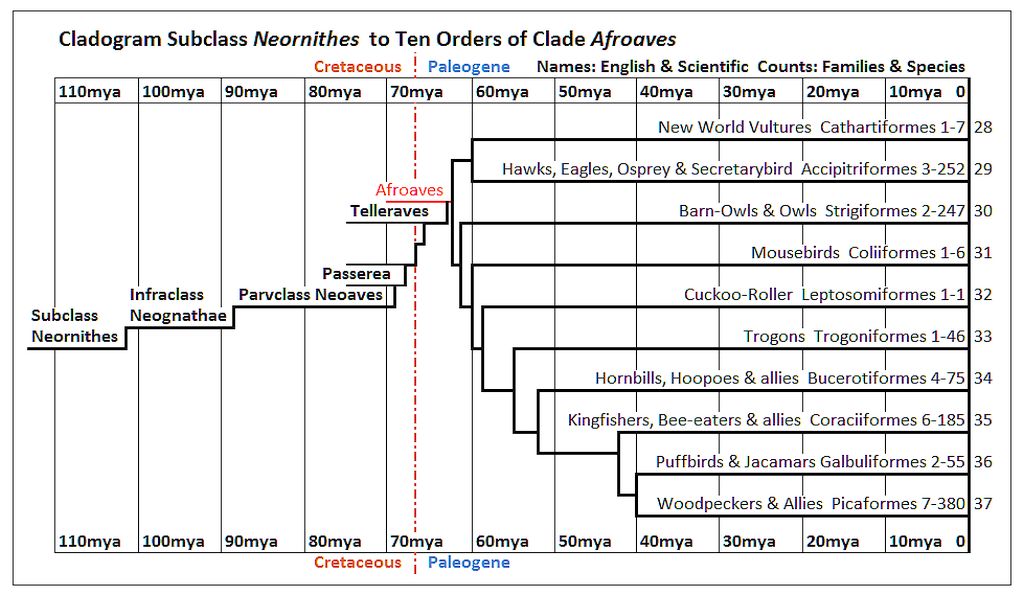
Our last two clades and sister taxa of Afroaves and Australaves diverged from one another 63 mya (+/- 3.2 my). Looking at the cladogram you’ll see that Clade Afroaves diverged up to seven more times before reaching the rank of Order. The clade’s current ten orders evolved 63-42 mya and now totals 28 families (11.2% of 251 families) and 1,254 species (11.4% of 11,017 species). [Those two percentages seem oddly similar.] The three largest families by far are: Accipitridae (Hawks, Eagles & Kites – 250 species worldwide), Picidae (Woodpeckers – 235 species worldwide), and Strigidae (Owls – 229 species worldwide). Three families are monotypic: Pandionidae (everyone’s favorite land-based fish-eater, the Osprey, found worldwide), Sagittariidae (the Secretarybird of sub-Saharan Africa) and Leptosomidae (the Cuckoo-roller, a Madagascar endemic). Cuckoo-Roller is the sole denizen of one of the two monotypic orders; the other is the Hoatzin of Opisthocoformes.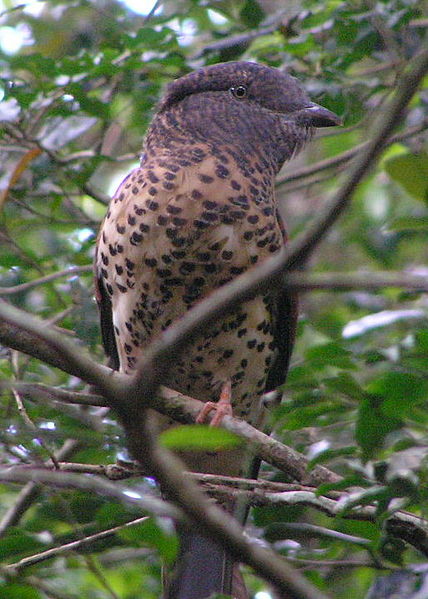
Cuckoo-Roller (Leptosomus discolor) of Madagascar an Comoros Islands, female or juvenile; named for its resemblance to both cuckoos and rollers.
Photo: frank wouters, October 2005. Wikipedia: Cuckoo-Roller
Subclass Neornithes – Infraclass Neognathae – Parvclass Neoaves – Clade Passerea – Clade Telluraves (Core Landbirds) – Clade Australaves
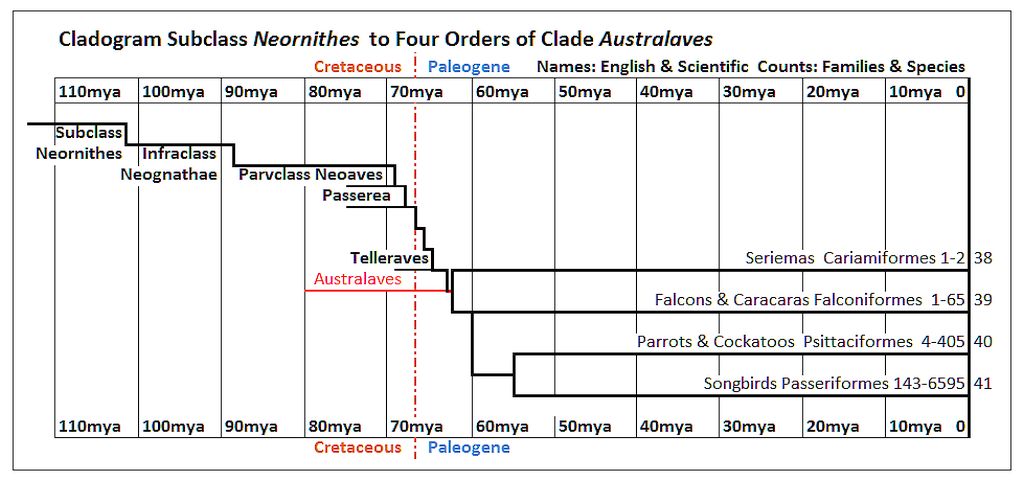
Our last clade, in some ways the most unusual, diverged from its sister clade Afroaves 63 mya (+/- 3.2 my), shortly after that infamous K-Pg asteroid strike. The small Order of Cariamiformes (Seriemas, 2 species endemic to the grasslands of central South America) diverged perhaps less than a million years later from, leaving Clade (or Superorder) Eufalconimorphae (falcons, parrots & passerines) remaining. Falconiformes (Falcons & Caracaras, 65 species worldwide, all in one family) diverged 60 mya, leaving clade Psittacopasseres, a portmanteau name encompassing the two remaining Orders of Psittaciformes and Passeriformes. As Cariamiformes and Falconiformes are more basal (closer to the root) than Psittacopasseres, it suggests that the last common ancestor of the entire clade had a predatory lifestyle. The final divergence 55 mya was between sister taxa Psittaciformes (Parrots & Cockatoos, 405 species in 4 families, worldwide) and Passeriformes. Passeriformes (songbirds) is an enormous order: a whopping 143 families [57% of 251 total families] and a stunning 6,595 species [60% of 11,017 species], 49% more species than all the 40 other orders combined). It is again interesting to note that the percentages for family and species diversity are nearly the same. The size of this order – 60% of all bird species – explains why most birders frequently speak of birds as divided into only two groups: passerines and non-passerines.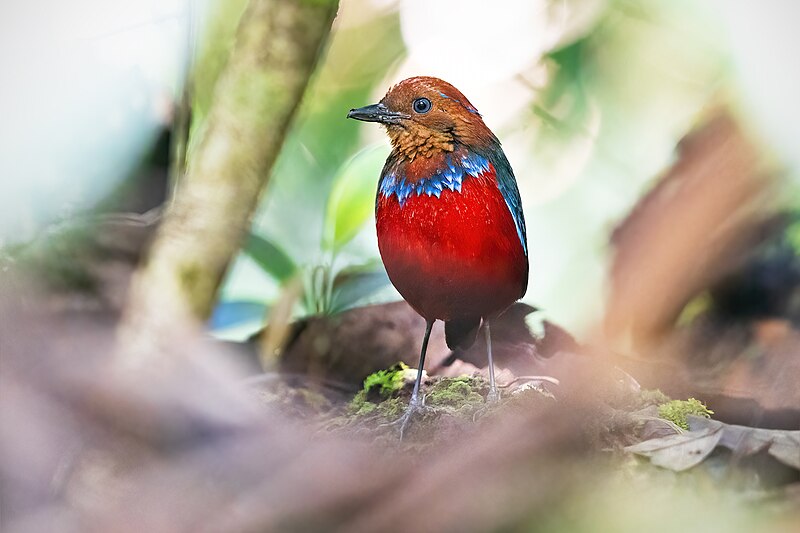
Blue-banded Pitta (Erythropitta arquata) of Borneo, a beautiful member of a beautiful and reclusive family.
Photo: JJ Harrison. Wikipedia: Blue-banded Pitta
Our next and penultimate posting in this series will focus on the huge and hugely diverse Order Passeriformes.
The Taxonomy Series
Installments post ever other day; installments will not open until posted.
Taxonomy One: A brief survey of the history and wherefores of taxonomy: Aristotle, Linnaeus and his binomial system of nomenclature, taxonomic ranks and the discovery and application of biological clocks.
Taxonomy Two: Introduces the higher levels of current taxonomy: the three Domains and the four Kingdoms. We briefly discuss Kingdom Protista, then the seven phyla of Kingdom Fungi.
Taxonomy Three: Kingdom Plantae.
Taxonomy Four: Kingdom Animalia to Phylum Annelida.
Taxonomy Five: A discussion of Cladistics, how it works and why it is becoming ever more important.
Taxonomy Six: Phylum Chordata, stopping at Class Mammalia.
Taxonomy Seven: Class Mammalia.
Taxonomy Eight: Class Aves, beginning with a comparison of five different avian checklists of the past 50 years.
Taxonomy Nine: A cladogram and discussion of Subclass Neornithes (modern birds) of the past 110 million years, reaching down to the current forty-one orders of birds.
Taxonomy Ten: A checklist of Neornithes including all ranks and clades down to the rank of the current 251 families of birds (plus a few probable new arrivals) with totals of the current 11,017 species of birds.
A FEW USEFUL & INFORMATIVE SITES:
https://en.wikipedia.org/wiki/Aequornithes
https://en.wikipedia.org/wiki/Afroaves
https://en.wikipedia.org/wiki/Australaves
https://en.wikipedia.org/wiki/Austrodyptornithes
https://en.wikipedia.org/wiki/Cavitaves
https://en.wikipedia.org/wiki/Eufalconimorphae
https://en.wikipedia.org/wiki/Gruae
https://en.wikipedia.org/wiki/Otidimorphae
https://en.wikipedia.org/wiki/Passerea
https://en.wikipedia.org/wiki/Pelecanimorphae
https://en.wikipedia.org/wiki/Phaethoquornithes
https://en.wikipedia.org/wiki/Picocoraciae
https://en.wikipedia.org/wiki/Strisores
https://en.wikipedia.org/wiki/Telluraves
Volunteers needed at Audubon Ballona Wetlands Education Program
[Posted by Chuck Almdale, submitted by Cindy Hardin]
Nature Nexus Institute has taken over the operation of Los Angeles Audubon’s school outreach program of school field trips to the Ballona Wetlands. Santa Monica Bay Audubon Society has helped support this organization for several decades.
Nature Nexus Institute is all about sharing and teaching local school children about the special habitats found right here in Los Angeles. They will be starting their six-week Fall Training on 17 September to get ready for school field trips to the Ballona Wetlands. Their tours take place on Tuesdays and Thursdays. All you need to be a volunteer is a love of the outdoors and the enthusiasm to work with school age aspiring nature lovers. Please contact Cindy Hardin at chardin@naturenexusinstitute.org or give her a call at 310-745-2118 if you are interested.
The following announcement is from them.

One of the Ballona Salt Marsh channels (Leslie Davidson ’07)
We are looking for Volunteers!
Time: 9 am to noon, unless otherwise noted (see below)
Contact: Cindy Hardin, Ph/Text 310-745-2118, <chardin@naturenexusinstitute.org>
September 17th – Welcome back and welcome newcomers, an overview of the program, the mission of Nature Nexus institute, description of Learning Stations and route of field trips. Speaker: me, Cindy Hardin!
September 24th – Wetland Ecology by speaker Dr. Dave Bader. Dave handles education at the Marine Mammal Care Center in San Pedro, and has lots of knowledge to share about the unique and vanishing wetland habitats of our coast. He is new to our roster, and I hear he is an excellent speaker!
October 1st – Program history and goals, Restoration Ecology and Education by Dr. Margot Griswold. Margot has been the driving force behind our work at both the Baldwin Hills and Ballona, and has done numerous restoration projects throughout the region. Her knowledge of native plants and habitats is unparalleled! She has also done huge advocacy work to spread knowledge to underserved communities-our target audience!
October 8th – To be determined. I am hoping that Greg Pauly, curator of Herpetology at the Natural History Museum will be available, but I am waiting to hear back from him. I will keep you all posted. If Greg is not available we will fill in the slot with another program. If anyone has a suggestion, I am all ears!
October 15th – Gabrieleno History, Practices and Culture by Matthew Teutimez. Mr. Teutimez has a wealth of knowledge about local indigenous culture, and he is a very compelling speaker. I have seen a couple of his talks, and they are quite informative and memorable. He will be very helpful in showing us what we can best communicate to our student visitors about local Native Peoples. PLEASE NOTE: OUR START TIME FOR THIS SESSION WILL COMMENCE ONE HOUR LATER THAN USUAL, AT 10 AM.
October 22nd – Birds and Birding with our own Walter Lamb. Walter is a fantastic birder, and patient and generous in sharing his skills and knowledge. He has a huge following for his Bird Walks that he leads during our Open Wetlands events, and I am so glad he has the time to work with our group.
Thanks,
Cindy
Five Avian Checklists, 1965-2024 | Taxonomy 8
By Chuck Almdale
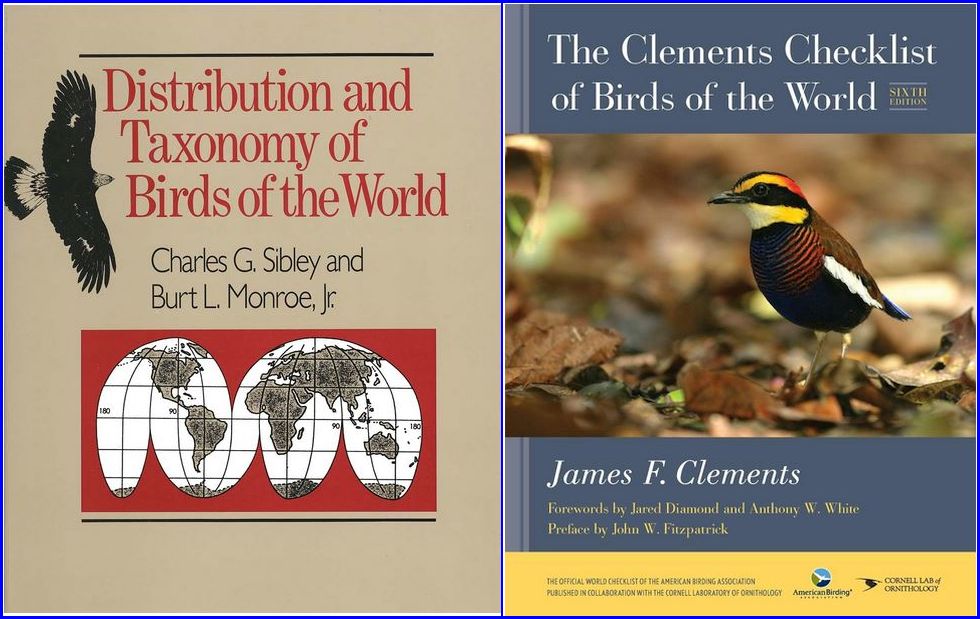
Charles Sibley & Burt Monroe 1990 || James Clements, 6th Ed. 2007
The Five Checklists
We’ll now shine some light on avian checklist changes over the past fifty years by looking at five checklists of birds dating from 1975 to 2024, focusing largely but not exclusively on the taxonomic rank of Order. For each of the five checklists the chart below lists the Orders and the number of Families and Species in each of the forty-one Orders. As such, this chart is more about the recent evolution of information about birds and its presentation than it is about the evolution of birds themselves. These checklists were, and are, snapshots in time; research continues and new information appears at a lightning pace compared to past centuries and decades. As it filters down to we non-professionals, avian systematics is likely to produce significantly changed sequences within a year or two. With that in mind, we’ll look atthese five snapshots of recent avian history. From here on the comments will refer to the chart below and won’t make much sense without referring frequently to it.
Sibley & Monroe, 1990
Charles Sibley and Burt Monroe’s book was a radical departure from prior (and some later) checklists of birds which were based entirely on morphology, and a foreshadowing of what was to come. Briefly, S&M used the most recent AOU information on what were recognized species, then adjusted the higher ranks (order, family and possibly genus) to the results of their DNA-DNA hybridization experiments, “to compare the genomes of birds for evidence of the branching pattern of avian phylogeny,” as Sibley writes in his Preface. The book contained information on habitats, ranges and subspecies, discoverers and discovery dates, name changes and variants and much more; it was far more than a bare-bones checklist. The table of contents functioned as a branching checklist and introduced new (to me, at least) ranks such as Parvorder and Subfamily, mentioned in prior installments of this series. I was impressed by this work and in February 1990, reviewed/commented on it for the Santa Monica Bay Audubon Society newsletter, The Imprint, from which I’ll take the liberty of quoting myself (with author’s consent). At that time the author could not assume that his audience had any familiarity whatsoever with DNA structure, nor any means to easily gather it. [World Wide Web, Google, Wikipedia – what’s that?] Our general familiarity with DNA structure and tinkering with it is far better now.
The field is called DNA-DNA Hybridization. This is how it works in a nutshell. They take a chromosome from the nucleus of a bird cell and heat it up. At a particular temperature it will unwind from its naturally coiled state and split apart lengthwise. Sort of like sawing a ladder in half by cutting all the rungs down the middle, only this ladder has about a half a million rungs. They repeat this process with a functionally identical chromosome from a different species of bird. Then they take the ‘left’ half from the first chromosome and the ‘right’ half from the second chromosome, put them together lengthwise, and let them cool down. Where a molecular ‘ladder rung’ on the left chromosome matches one on the right an electronic attraction is created and the two halves stick together. This new ‘hybridized’ strand of DNA is reheated, and when the halves separate again, the exact temperature is carefully noted. This temperature will always be lower than that needed for the original separation, as the hybrid will always have fewer rungs connected and will be easier to separate. A comparison of these two temperatures of separation will reveal a ratio that indicates how closely matched the chromosomal halves are. The closeness of the match indicates how closely related the species are. Thus, a high temperature of hybrid DNA separation = a more complete ladder = a close match of DNA strands = closely related species. Conversely, a low temperature = distantly related species.
They’ve taken a number of DNA samples from 1058 species of birds, doing multiple hybridizations of the same pairing of species to try to eliminate flukes and errors, kept track of all those temperatures, and compared the numbers to figure out if species #1 is more closely related to species #2 than to #3, and how #4 and #5 fit into the resulting scale. It’s time consuming work.
Time consuming indeed, as by the time the book was published Charles Sibley and John Ahlquist had been working on their hybridization experiments for fifteen years. Towards the end of the piece, I summed up my thoughts as follows, with which – 34 years later – I still agree; with 20-20 hindsight, they seem obvious.
Keep in mind that these are proposed changes, based on the DNA-DNA hybridization research. It will take years of arguing among the researchers and experts before any of these changes are officially recognized. Some of the research may prove to be incomplete or incorrect. New methods – faster or more accurate – of genetic research may be discovered. These conclusions may prove to be based on inadequate sampling, and more advanced methods may come up with different familial relationships. But one thing is certain: changes will come and there will be big surprises in store for us.
Changes certainly came; they’re still coming. Improvements in speed and accuracy were certainly made. Arguments certainly still rage, and surprises keep arriving. But Sibley & Monroe and Ahlquist’s work was groundbreaking. A great deal of work since then have brought the changes and results we will now begin reviewing. S&M&A’s work 1975-1990 produced a “snapshot in time.” The equipment improved, more snapshots were taken, and what you’re now reading is itself a snapshot in time of snapshots in time. Change will continue. Be prepared for updates.
Definitions
Nomenclature: A system for giving names to things within a particular profession or field, especially in science; e.g. “the Linnaean system of biological nomenclature.”
Systematics: The study of the diversification of living forms, both past and present, and the relationships among living things through time.
Taxonomy: A practice and science concerned with classification or categorization on the basis of shared characteristics, typically with two parts:
a. Taxonomy: The development of an underlying scheme of classes.
b. Classification: The allocation of things to the classes, ranks or taxa.
Top to bottom the following chart presents forty-one Orders of birds in what is currently believed to be the sequence of their earliest appearance on earth. This sequence comes from eBird/Birds of the World (BOW, online) as of 4/15/24; the data from the BOW checklist is presented in the rightmost chart column. These forty-one Orders fall into nine major Clades, grouped vertically down the chart. This sequence of Clades and Orders follows the cladogram to be presented in Taxonomy 9.
The four columns to the left are the four earlier checklists presented in date order left-to-right. It is important to note that all five checklists list the Orders using the same 4/15/24 top-to-bottom sequence. The four earlier checklists may have used a slightly different phylogenetic sequence for their Orders and they didn’t all have the same orders or same number of orders. Comparison between checklists would be impossibly complicated had I left each list in their original sequence.
At the top and bottom are checklist totals for orders, families and species for each checklist. Except for species numbers, the changes between checklists largely reflect the enormous changes due to DNA research during the past ten years. The changes in totals of species reflect both the discovery of new species as well as the raising of known subspecies to full species status.
Deciphering Changes Between Checklists
41 Orders: Numbered in the left column. There was little change 1975 to 2013, then a 46% increase from 28 orders (2013) to 41 (2024) orders. This was due to the ever-more-swiftly-growing mountain of information from molecular and DNA studies and the application of evolutionary clocks. Five previous Orders disappeared from the 2024 checklist and their members redistributed to other Orders; these vanished Orders have red letters A-E in the left column.
251 Families: There were two major changes: 40% increase in families (145 to 203) from 1990 to 2007, and 24% increase (203 to 251) from 2013 to 2024, for a net 58% increase in families 1975 to 2024. The reasons are the same as above.
11,017 Species: Two major changes: 7.6% increase (8,984 to 9,669, or increase of 685) from 1975 to 1990, and 9.7% increase (10,039 to 11,017 or increase of 978) from 2013 to 2024; the total increase 1975-2024 was 23%, or 2,033 species. New species are discovered yearly, but I suspect (I haven’t done the math) is the result of of raising subspecies to full species status. Biological clock data has undoubtedly contributed to this raising of rank.
To print or save an image of the chart: click here.
Chart Size Increase: <Control> +; Decrease: <Control> -.

The Nine Clades and Forty-one Orders
Clade Infraclass Palaeognathae: “Old Jaw.” This most ancient of clades saw little change between checklists, except that prior to 2024 the first four orders were classified as families within the single order of Struthioniformes. The rest of the ~11,000 extant birds are in its sister taxon Infraclass Neognathae “new jaw.” These sister taxa diverged over 100 million years ago. [Dates listed here will be made visibly apparent in the next posting’s cladogram; they’re mentioned here for anyone wondering about this. All these dates are +- 5% accurate, or so the researchers hope.]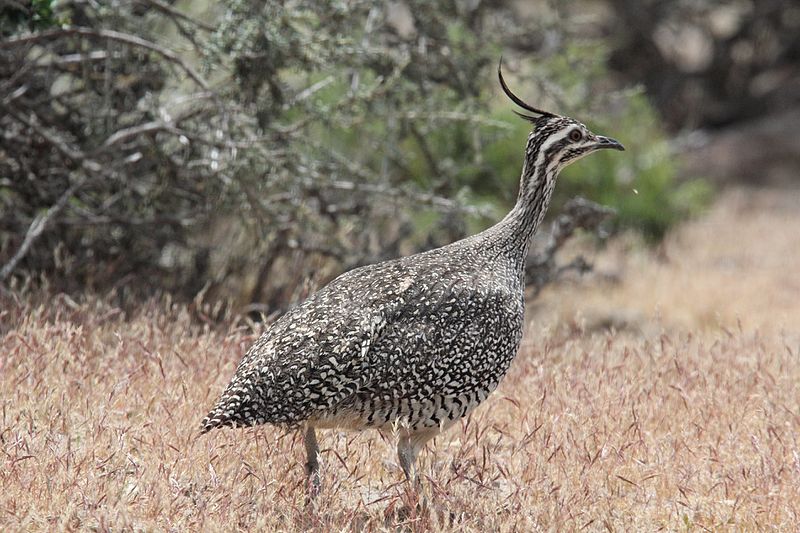
Elegant Crested Tinamou (Eudromia elegans), Argentina.
Photo: Dominic Sherony. Wikipedia: Tinamou
Clade Infraclass Neognathae: Neognathae (“New Jaw”) is the sister taxon to Infraclass Palaeognathae, containing the rest of the ~11,000 extant bird species.
Mallard skull and quadrate anatomy. (A) Lateral view, (B) Ventral view. Bones: Quadrate (red), Pterygoid (purple), Palatine (green), Jugal (blue), Upper Bill. From: Kinematics of the Quadrate Bone During Feeding in Mallard Ducks. [Link] (2011). Megan M Dawson, Keith A Metzger, David B. Baier & Elizabeth L. Brainerd. [Diagram used in Taxonomy 1.]
Clade Superorder Galloanseres: 88 million years ago Neognathae split into two clades, Parvclass Neoaves and Superorder Galloanseres. “Galloanseres” is a portmanteau name, increasingly common in clade nomenclature, formed by combining the names of the ranks below, in this case Galliformes (chickens) and Anseriformes (ducks). Species numbers fluctuated over the past 50 years, starting at 420 and ending at 483, most of that increase occurring within the past 10 years. Sibley & Monroe (1990) added two orders, a move few others accepted. Members of the Orders Craciformes and Turniciformes were reclassified to Galliformes. The study of the quadrate bone in jaws of all reptiles and birds led to discoveries that 1) Anseriformes (ducks & allies) and Galliformes (chickens & allies) were each other’s closest relatives, and 2) they were a basal clade, closer to their reptilian ancestors than all other Neognathae members.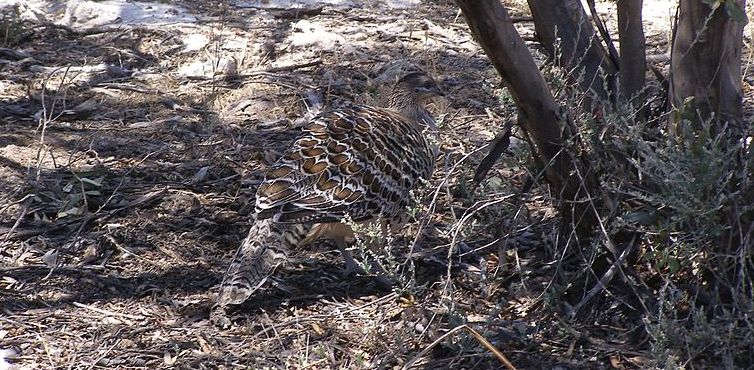
The cryptic Malleefowl (Leipoa ocellata), a megapode of Australia.
Photo: Kerry Raymond. Wikipedia: Malleefowl
Clade Parvclass Neoaves: Neoaves is the sister taxon to Superorder Galloanseres, containing the rest of the 10,480+ extant bird species.
Clade Columbea: Order Mesitornithiformes (the 3 mesite species of Madagascar) was recently moved to this group. Total species jumped from 349 in 2013 to 400 in 2024, almost entirely due to a 14% rise (44 species) in the pigeons and doves. I don’t know the cause but my best guess is raising subspecies to full species status, especially in Southeast Asia. This clade split from the Neoaves 69 million years ago. The Pterocliformes (Sandgrouse) Order moved around a bit; for example, Sibley & Monroe considered them part of the Stork Order Ciconiiformes in 1990.
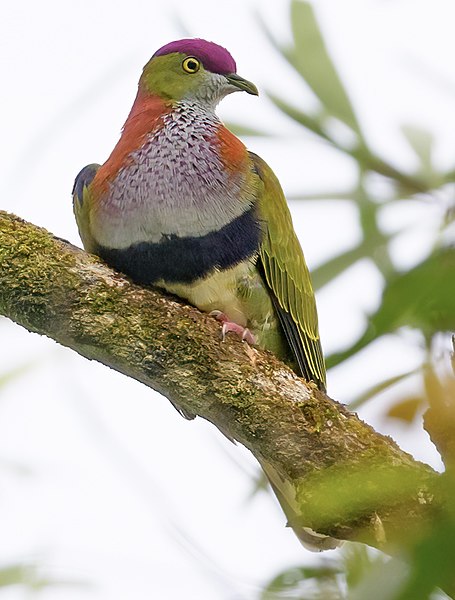
Superb Fruit-Dove (Ptilinopus superbus): Cape York, Queensland, Australia. Photo: Roger MacKertich. Wikipedia: Superb Fruit-Dove
Clade Passerea: Passerea is the sister taxon to Clade Columbea, containing the rest of the 10,080+ extant bird species in five subsidiary clades: Otidae, Gruae, Eurypygimorphae, Aequornithes (Core Waterbirds) and Telluraves (Core Landbirds). Telluraves has two major subsidiary clades: Afroaves and Australaves.
Clade Passerea: Clade Otidae: A lot of shifting around has occurred within this clade. Total species drifted up and down and up with a net 19% increase: 676 (1975) to 805 (2024). Otidiformes (Bustards) was raised from Family rank within Gruiformes (Cranes & allies) to its own Order. The Musophagiformes (Turacos) Order appeared in 1991, disappeared in 2007, then reappeared in 2024. The Orders of Apodiformes (Swifts) and Trochiliformes (Hummingbirds) were split apart in 1990, recombined in 2007, then both Orders disappeared in 2024, gobbled up by the expanding Caprimulgiformes (Nightjars & allies) Order, within which they now rank as families. This is one of the many clades that diverged around the time of – or shortly after – the Cretaceous-Paleogene asteroid extinction event 66 million years ago. Life on earth was tossed up into the air; when it settled back down, nothing looked the same.
Guinea (or Green) Turaco (Tauraco persa); west Africa.
Photo: Ian Wilson. Wikipedia: Turaco
Clade Passerea: Clade Gruae: The major change in this clade occurred in 1990 when Sibley & Monroe reclassified gulls, sandpipers and allies to the Order Ciconiiformes (Storks), together with many other families and orders previously scattered around the sequence. This was all undone, and Ciconiiformes is currently in Clade Aequornithes, farther down. The monotypic Hoatzin (Opisthocomiformes) had long been considered most closely related to Cuculiformes (Cuckoos) in Clade Otidae immediately above. Other than these ins and outs, total species 1975-2024 increased only 8%, from 535 to 579. As with Clade Otidae, Clade Gruae also appeared in the 66-60 mya period. 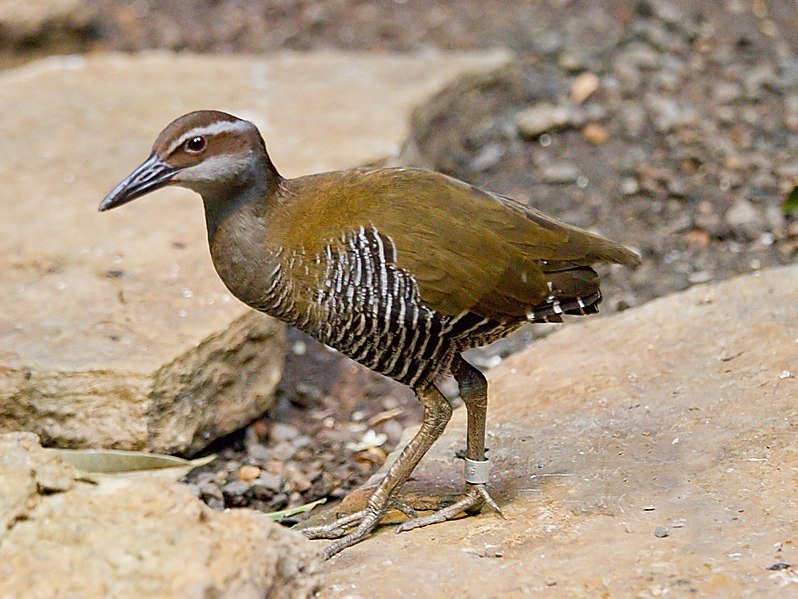
The nearly flightless Guam Rail, locally the ko’ko’ (Hypotaenidia owstoni), extinct in the wild, surviving only in captivity. Photo: Greg Hume. Wikipedia: Rail
Clade Passerea: Clade Eurypygimorphae: Although this clade – so tiny it barely exists, consisting only of Eurypygiformes (the Kagu of New Caledonia and the Sunbittern of South America) and the three species of Phaethontiformes (Tropicbirds) – diverged from the far larger Aequornithes line about 65 mya, this relationship was not recognized until recently, thanks to evolutionary clocks. For example, Sibley & Monroe (1990) classified them all to their massive Order Ciconiiformes (Storks & allies) which contained 1,027 species, with Sunbittern placed closest to Cranes and Tropicbirds closest to Hawks. In 2007, Clements classified both Kagu and Sunbittern to the Order Gruiformes (Cranes & allies) next to Finfoots and Seriemas, and Tropicbirds were with the Tubenoses (albatrosses, shearwaters, etc.) in Procellariiformes where they were placed between Diving-Petrels and Pelicans. Since then Seriemas has moved most radically; no longer a gruiform, they now have their own order and are considered to be most closely related to Falcons (see Clade Australaves below).
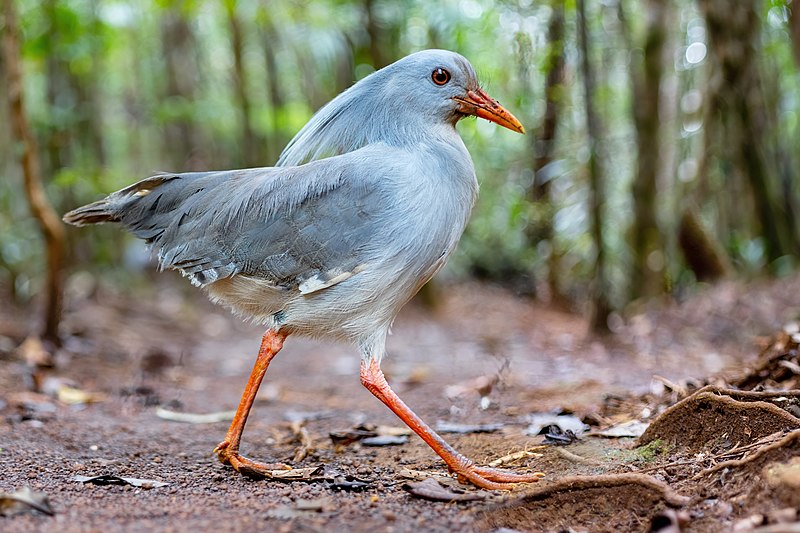
Kagu (Rhynochetos jubatus), a monotypic family of New Caledonia.
Photo: JJ Harrison. Wikipedia: Kagu
Clade Passerea, Clade Aequornithes (Core Waterbirds): Aequornithes diverged from the previous clade Eurypygimorphae 65 mya, and began diversifying 3 million years later into what has become six orders currently totaling 365 species. The main “bump” was Sibley & Monroe’s vast expansion in 1990 of the Stork Order Ciconiiformes, later undone by everyone. The cormorants, boobies, etc. were recently raised to their own order Suliformes after spending forever within Pelecaniformes. Pelicaniformes rose to 117 species in 2024 largely because Ciconiiformes was reduced to only the Storks (20 species), even though Pelicaniformes lost the three species of Tropicbirds, now classified to their own Order Phaethontiformes. Total 1975 species of 307 increased only 19% (58 species) to 365 in 2024, most of that increase in the Tubenose order of Procellariiformes.
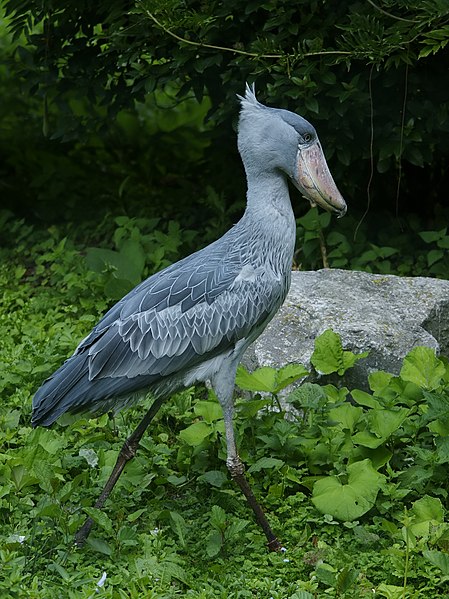
Shoebill (Balaeniceps rex), specializes in eating lungfish, central Africa. Photo: Hans Hillewaert. Wikipedia: Balaenicipitidae
Clade Telluraves (Core Landbirds), Clade Afroaves: Afroaves and Australaves are sister clades within Telluraves, appearing and diverging three million years after the CP (or KT) extinction event. All the basal clades of Afroaves are predatory birds and it is presumed the last common ancestor of the clade was itself a predator. One major recent change is that Hawks (formerly in Falconiformes, now in Acciptriformes) and Falcons were placed in separate orders, with Falconiformes now moved next to Parrots and Passerines as their closest relatives, while the hawks stayed in Clade Afroaves. The Cuckoo-Roller of Madagascar, previously a monotypic family within the Kingfisher Order Coraciiformes, is now the monotypic Order Leptosomiformes. Hornbills, Hoopoes and allies, which gained their own order in 1990 only to lose it by 2007, were also broken out of Coraciiformes and placed in their own Order Bucerotiformes, still in the same clade. Some experts classify Galbuliformes (Puffbirds & Jacamars) not as an Order but as two families within Coraciiformes (Kingfishers & allies). Overall species numbers rose significantly from 767 in 1975 to 1,254 in 2024, or 487 species (64%). Some of that increase is an artifact of families moving between orders.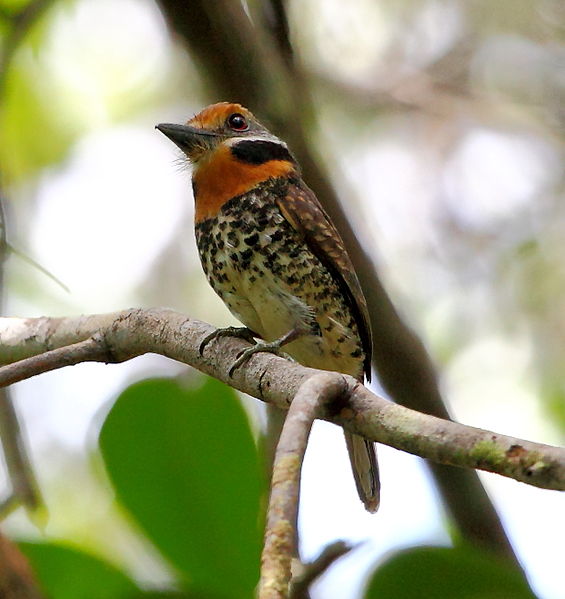
Spotted Puffbird (Bucco tamatia) of Brazil.
Photo: Hector Bottai. Wikipedia: Spotted Puffbird
Clade Telluraves (Core Landbirds), Clade Australaves: Australaves, the last of our major clades, appeared with its sister clade Afroaves 63 mya, and very quickly (1 million years, which is nothing on the evolutionary scale) diverged with the appearance of the ancestor of Order Cariamiformes (the two Seriema species of the central South American grasslands). Previously everyone classified the Seriemas with the Cranes. The Parrots and Passerines split from the Falcons 60 mya, then split from each other five million years later. Parrots and Falcons certainly flourished since then, but nothing like the Passerines. A few numbers will illustrate the passerine expansion:
- Passerine portion of all avian species: 1975 – 5,265 (59%), 2024 – 6,595 (60%).
- Increase in Passerine species from 1975 to 2024: 1,330 (25%).
- Increase in total species 1975 (8,984) – 2024 (11,017): 2,033 (23%)
- Passerine portion of total avian increase: 65%
- Increase in total avian families 1975 (159) – 2014 (251): 92 families (58%)
- Increase in Passerine families 1975 (60) – 2024 (143): 83 (138%)
- Passerine portion of total increase in number of families: 90%
For those who have ever wondered why birders frequently divide ‘passerines’ (a single order) from ‘non-passerines,’ (forty orders) this is why.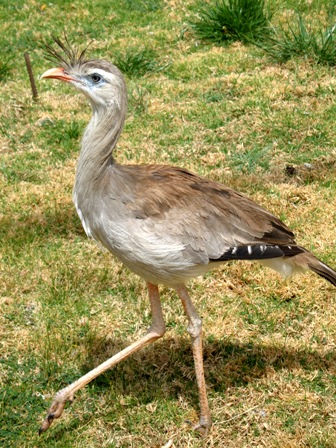
Red-legged Seriema (Cariama cristata), predator of the grasslands of central South America; 28-35” high, capable of flight but prefers to walk or run at which it is quite proficient. Seriemas and falcons diverged 64 million years. Photo: Whaldener Endo. Wikipedia: Cariamiformes
I reiterate that it’s not the birds themselves that have changed or increased, it’s our knowledge of them that has changed and the resulting systemic reorganization brought by this new knowledge. The Falcons themselves didn’t exchange their former close relationship with hawks to snuggle up with the Parrots, who had similarly abandoned the Doves and Cuckoos to climb into bed next to the Passerines. It’s humans who discovered that they’d been wrong for centuries, that the conclusions they’d reached based entirely on morphology were not always correct – although they were mostly correct – and that proteins and DNA were capable of providing a more detailed and accurate lineage, a lineage that included the special bonus of an evolutionary clock. Convergent evolution –when two species with quite different ancestral lineages come to look like one another because they’re behaving similarly in similar habitat – can fool the best of us.
What has recently been the most noticeable change to the everyday checklists we everyday birders use in our everyday birding is this proximity of these final three orders – Passeriformes (Passerines), Psittaciformes (Parrots) and Falconiformes (Falcons) – to one another. Suddenly we found parrots and falcons, not where we all knew they belonged much earlier in the taxonomic sequence, but right next to flycatchers. That’s ridiculous! Who decided this? Well, the birds “decided” it sixty-five to fifty-five million years ago. We just now deciphered the message they left, encoded in their – and our – proteins and DNA.
We live in interesting and exciting times.
The Taxonomy Series
Installments post ever other day; installments will not open until posted.
Taxonomy One: A brief survey of the history and wherefores of taxonomy: Aristotle, Linnaeus and his binomial system of nomenclature, taxonomic ranks and the discovery and application of biological clocks.
Taxonomy Two: Introduces the higher levels of current taxonomy: the three Domains and the four Kingdoms. We briefly discuss Kingdom Protista, then the seven phyla of Kingdom Fungi.
Taxonomy Three: Kingdom Plantae.
Taxonomy Four: Kingdom Animalia to Phylum Annelida.
Taxonomy Five: A discussion of Cladistics, how it works and why it is becoming ever more important.
Taxonomy Six: Phylum Chordata, stopping at Class Mammalia.
Taxonomy Seven: Class Mammalia.
Taxonomy Eight: Class Aves, beginning with a comparison of five different avian checklists of the past 50 years.
Taxonomy Nine: A cladogram and discussion of Subclass Neornithes (modern birds) of the past 110 million years, reaching down to the current forty-one orders of birds.
Taxonomy Ten: A checklist of Neornithes including all ranks and clades down to the rank of the current 251 families of birds (plus a few probable new arrivals) with totals of the current 11,017 species of birds.
Phylum Chordata, Class Mammalia | Taxonomy 7
[By Chuck Almdale]
We now have only the mammal class to describe, but there’s a lot of ground to cover. As further illustration of how the clade system adds much more detail (lineage branches and nodes of division), we’ll repeat what we did in Taxonomy 6 and start at the top with Domain and use the subscript numbers to keep track of the steps. The subscript will again be on “Clade” which we’ll apply to every rank whether it already has a Linnaean rank or not, just to be uniform. Linnaean ranks (kingdom, phylum, class, order…superclass…suborder, etc.) are clades in concept, and were so long before the term “clade” was invented. But, as mentioned previously, with the discovery of molecular clocks and DNA analysis, the ability to discover the points of separation between lineages took a quantum leap forward.
The mammalian line follows the line for the previously presented chordate classes – amphibians, reptiles, snakes, crocodiles and birds through Clade20 Amniota (or Class Reptilia) below. At Clade21 Synapsida the line towards the mammals diverges from that towards lizards, snakes, turtles, crocodiles and birds.
Clade1 Domain Eukaryota, Clade2 Kingdom Animalia, Clade3 Subkingdom Eumetazoa, Clade4 ParaHoxozoa (Planulozoa), Clade5 Infrakingdom Bilateria, Clade6 Superphylum Deuterostomia, Clade7 Phylum Chordata, Clade8 Olfactores, Clade9 Subphyla Craniata (Vertebrata), Clade10 Infraphylum Gnathostomata, Clade11 Superclass Osteichthyes, Clade12 Sarcopterygii, Clade13 Rhipidistia, Clade14 Tetrapodomorpha, Clade15 Eotetrapodiformes, Clade16 Elpistostegalia, Clade17 Stegocephali, Clade18 Superclass Tetrapoda, Clade19 Reptiliomorpha (or Pan-Amniota), Clade20 Amniota (or Class Reptilia), Clade21 Synapsida, Clade22 Eupelycosauria (or Metopopora), Clade23 Sphenacodontia, Clade24 Sphenacodontoidea, Clade25 Therapsida, Clade26 Theriodontia, Clade27 Eutheriodontia, Clade28 Cynodontia, Clade29 Epicynodontia, Clade30 Eucynodontia, Clade31 Probainognathia, Clade32 Prozostrodontia, Clade33 Mammaliamorpha, Clade34 Mammaliaformes, and
Clade35 Class Mammalia – Mammals: Translation “of the breast.” Mammals uniquely possess: milk-producing mammary glands for feeding young, a neocortex region of the brain, fur or hair, and three middle ear bones. Their ancestors first appeared in the Carboniferous Period over 300 million years ago. There are approximately 6,400 extant described species, divided into 27 orders, give or take a few depending (as always) on who is counting. Below the level of Class Mammalia the taxonomic systems multiply incompatibly. Rather than become utterly confusing, I’ll stick with the mildly confusing and use a fairly simple system. The important Linnaean ranks and a few important clades are in blue, including all 27 orders. Important divergences get a comment, e.g. “The line towards Monotremes diverges from other mammals, then diversifies into two families.“
There is a list of all twenty-seven mammalian orders with totals for family, genera and species following the illustrated indented sequence below.
You probably skimmed the above (and mildly annoying) list. Here’s the same thing, indented. It takes up more space, but is much easier to read. It also leaves room for very short notes.
Clade1 Domain Eukaryota
Clade2 Kingdom Animalia
Clade3 Subkingdom Eumetazoa
Clade4 ParaHoxozoa (Planulozoa)
Clade5 Infrakingdom Bilateria
Clade6 Superphylum Deuterostomia
Clade7 Phylum Chordata
Clade8 Olfactores
Clade9 Subphyla Craniata (Vertebrata)
Clade10 Infraphylum Gnathostomata
Clade11 Superclass Osteichthyes
Clade12 Sarcopterygii – [Link] Lobe-finned fish
Clade13 Rhipidistia
Clade14 Tetrapodomorpha
Clade15 Eotetrapodiformes
Clade16 Elpistostegalia
Clade17 Stegocephali
Clade18 Superclass Tetrapoda – [Link] Amphibian divergence
Clade19 Reptiliomorpha (or Pan-Amniota)
Clade20 Amniota (or Class Reptilia) – Last common ancestor reptiles & mammals
Clade21 Synapsida – [Link] The line to mammals line diverges from the reptilian line
Clade22 Eupelycosauria (or Metopopora)
Clade23 Sphenacodontia
Clade24 Sphenacodontoidea
Clade25 Therapsida
Clade26 Theriodontia
Clade27 Eutheriodontia
Clade28 Cynodontia
Clade29 Epicynodontia
Clade30 Eucynodontia
Clade31 Probainognathia
Clade32 Prozostrodontia
Clade33 Mammaliamorpha
Clade34 Mammaliaformes
Clade35 Class Mammalia – [Link] Mammals
Moving the line back to the left, we start with Clade35 Class Mammalia – Mammals.
Clade35 Class Mammalia – Mammals
The line towards Monotremes diverges from other mammals, then diversifies into two families.
Clade36 Order Monotremata – [Link] Translation “single-opening;” two families of egg-laying, live-bearing, milk-producing, furry monotremes.
Clade37 Family Tachyglossidae: [Link] four species of Echidna.
Clade37 Family Ornithorhynchidae: [Link] one species of Duck-billed Platypus. Monotremes, clockwise from upper left: Platypus, Short-beaked Echidna, Eastern Long-beaked Echidna (replica, New Guinea), Western Long-beaked Echidna. Wikipedia: Monotreme
Clades(36-42) Crown group and branches to extinct taxa. Clade36 is sister taxon to Monotremata.
Clade43 Subclass Theria – [Link] Last common ancestor marsupials and placentals.
The lines into sister taxa Metatheria (Marsupials) and Eutheria (Placentals) diverge; Marsupials diversify into seven orders.
Clade44 Metatheria (Marsupialiformes) – All Marsupials. Sister taxon to Eutheria (Placental Mammals).
Clade45 Infraclass Marsupialia – [Link] Pouched animals. The young are born in a relatively undeveloped state, then nurtured within a pouch on their mother’s abdomen; primarily in Australasia. There are seven orders of Marsupials in three groups.
Clade46 Order Didelphimorphia – [Link] Opossums. Translation “two-womb-form;” 1 family, 126 species in the Americas, 1 species north of Mexico.  Female Virginia Opossum (Didelphis virginiana) with nine young, the only U.S. and Canadian marsupial species. Photo: Specialjake. Wikipedia: Opossum
Clade46 Order Paucituberculata – [Link] Shrew Opossums. Translation “few bumps (on teeth)”; 1 family, 7 species in South America.  Eastern Caenolestid (Caenolestes sangay), South America.
Photo: Jbritomolina. Wikipedia: Paucituberculata
Clade46 Superorder Australidelphia (or Agreodontia) Originating in Gondwana, 5 orders, 266 species mostly in Australasia.
Clade47 Order Microbiotheria – [Link] Little Monkey of the Mountain. Translation “small wild animal;” 2 species in SW South America, extinct species in Australia & South America.  Monito Del Monte or Colocolo Opossum (Dromiciops gliroides).
Photo: José Luis Bartheld. Wikipedia: Microbiotheria
Clade47 Order Diprotodontia – [Link] Kangaroos, Wallabies, Possums, Koalas, Wombats. Translation “two forward teeth;” mostly carnivorous (or insectivorous); 11 families, 151 species in Australia and New Guinea.  Kangaroo Island Kangaroo (Macropus fuliginosus fuliginosus) displaying his or her two forward teeth, Kangaroo Island, South Australia.
Photo: DiverDave. Wikipedia: Diprotodontia
Clade47 Grandorder Agreodontia
Clade48 Order Dasyuromorphia – [Link] Numbat, Quoll, Marsupial Mice, Tasmanian Devil. Translation “hairy tail;” mostly carnivorous (or insectivorous); 3 families, 88 species in Australia and New Guinea.  Numbat (Myrmecobius fasciatus), Dryandra Woodland, Western Australia.
Photo: JJ Harrison. Wikipedia: Dasyuromorphia
Clade48 Order Notoryctemorphia – [Link] Marsupial Moles. Translation “southern-digger-form;” specialized to forage through loose sand; 1 family, 2 species in Australian interior. Northern Marsupial Mole (Notoryctes caurinus) eating a gecko in the Tanami Desert, Northern Territory, Australia. Source: Australian Geographic.
Photo: Auscape Int’l Pty Ltd via Alamy. Wikipedia: Notoryctidae
Clade48 Order Peramelemorphia – [Link] Bandicoots and Bilbies. Translation “pouched badger;” 3 families, 23 species in Australian interior. Greater Bilby (Macrotis lagotis), Australia.
Photo: Kevin503. Wikipedia: Peramelemorphia
Following are the remaining mammals, nineteen orders of placentals.
Clade44 Eutheria – [Link] Placental Mammals. Sister taxon to Infraclass Marsupialia. Translation “true beasts;” all placental mammals, numerous differences in skeletal and tooth structure. There are eleven clades (as of 12 Aug 2024) between Clade Eutheria and Infraclass Placentalia which branch off only to extinct species. We’ll omit listing them (I could not find their names, if any) and go directly to Infraclass Placentalia which contains all extant placental mammals.
Clade56 Infraclass Placentalia – [Link] All extant placental mammals. Two groups: Atlantogenata and Boreoeutheria.
Clade57 Atlantogenata: [Link] Two radiations: Xenarthra (So. American) & Afrotheria (African).
Clade58 Superorder Xenarthra – [Link] So. American placentals. Two orders: Cingulata and Pilosa.
Clade59 Order Cingulata – [Link] Armadillos. Translation “belted;” 2 families, 22 species. Glyptodont (Glyptodon asper),(Vienna Museum), lived throughout the New World until c. 10,000 BCE; Nine-banded Armadillo (Dasypus novemcinctus), lives throughout the New World.
Photo: Hunadam, Tomfriedel. Wikipedia: Cingulata
Clade59 Order Pilosa – [Link] Anteaters and sloths. Translation “hairy;” 4 families, 17 species. Giant anteater (Myrmecophaga tridactyla) Mato Grosso, Brazil.
Photo: Nortondefeis. Wikipedia: Pilosa
Clade58 Superorder Afrotheria – [Link] African origin placentals. Sister taxon to Xenarthra. Two groups: Paenungulata and Afroinsectiphilia.
Clade59 Grandorder Paenungulata: [Link] Two groups: Hyracoidea and Tethytheria.
Clade60 Order Hyracoidea – [Link] Hyraxes. Translation “Greek for shrew-mouse;” 1 family, 6 species. Young Hyrax on Mount Kenya, widespread in Africa.
Photo: Josski at Dutch Wikipedia. Wikipedia: Hyrax
Clade60 Mirorder Tethytheria – [Link] Sister taxon to: Hyracoidea. Two groups: Sirenia and Proboscidia.
Clade61 Order Sirenia – [Link] Sea Cow & Dugong. Translation “of the Sirens (Greek mythical creatures);” 2 families, 4 species. Dugong near Marsa Alam, Egypt. Range E. Africa to West Pacific.
Photo: Thomas Breuer. Wikipedia: Sirenia
Clade61 Order Proboscidea – [Link] Elephants. Translation “nose, esp. if long;” 1 family, 3 species. Forest elephants (Loxodonta cyclotis), Nouabalé-Ndoki National Park, Congo. Photo: Thomas Breuer. Wikipedia: Proboscidea
Clade59 Grandorder Afroinsectiphilia: [Link] Sister taxon to: Paenungulata. Two groups: Tubulidentata and Afroinsectivora.
Clade60 Order Tubulidentata – [Link] Aardvark. Translation “tube-tooth;” 1 family, 6 species. Aardvark (Orycteropus afer), sub-Saharan Africa.
Photo: Kelly Abram. Wikipedia: Aardvark
Clade60 Mirorder Afroinsectivora: [Link] Sister taxon to Tubulidentata. Two orders: Macroscelidea and Afrosoricida.
Clade61 Order Macroscelidea – [Link] Elephant shrews. Translation “long-leg;” 1 family, 20 species. Black and rufous elephant shrew (Rhynchocyon petersi), non-Saharan Africa.
Photo: Joey Makalintal. Wikipedia: Elephant Shrew
Clade61 Order Afrosoricida – [Link] Shrews & Tenrecs. Translation “African shrew-like;” 3 families, 55 species. Lesser Hedgehog Tenrec (Echinops telfairi), Central Africa & Madagascar.
Photo: Wilfried Berns. Wikipedia: Afrosoricida
Clade57 Magorder Boreoeutheria – [Link] Most males have a scrotum. Sister taxon to Atlantogenata. Two groups: Euarchontoglires and Laurasiatheria.
Clade58 Superorder Euarchontoglires: [Link] Two groups: Glires and Euarchonta.
Clade59 Grandorder Glires: [Link] Two groups: Rodentia and Lagomorpha.
Clade60 Order Rodentia – [Link] Rodents. Translation “gnawer;” continuously growing incisors; 35 families, 2,680 species. Capybara (Hydrochoerus hydrochaeris) with Cattle Tyrant (Machetornis rixosa), both feeding; largest rodent in the world, up to 4.5 ft. & 150 lbs. South America. Photo: Fidel León Darder. Wikipedia: Rodent
Clade60 Order Lagomorpha – [Link] Rabbits & Picas. Translation “hare-shape;” 3 families, 111 species. Large-eared Pika (Ochotona macrotis) in Ladakh.
Photo: Karunakar Rayker. Wikipedia: Lagomorpha
Clade59 Grandorder Euarchonta: [Link] Sister taxon to Glires. Two groups: Scandentia and Primatomorpha.
Clade60 Order Scandentia – [Link] Treeshrews. Translation “climber;” 2 families, 23 species.  Pygmy Treeshrew (Tupaia minor), native to SE Asia.
Photo: Paul J. Morris. Wikipedia: Treeshrew
Clade60 Mirorder Primatomorpha: [Link] Sister taxon to Scandentia. Two orders: Dermoptera and Primata.
Clade61 Order Dermoptera – [Link] Colugos. Translation “skin-wing;” 2 families, 2 species. Sunda Flying Lemur (Galeopterus variegatus). Colugos (which are not lemurs and cannot fly) are arboreal gliding mammals found in SE Asia.
Photo: Lip Kee Yap. Wikipedia: Colugo
Clade61 Order Primata – [Link] Sister taxon to Dermoptera. Lemurs, Tarsiers, Simians. Translation “first, prime;” 19 families, 517 species.  Female Pygmy Slow Loris (Nycticebus pygmaeus) of SE Asia, clinging to a human arm. Photo: Lionel Mauritson. Wikipedia: Primate
Clade58 Superorder Laurasiatheria: [Link] Sister taxon to Euarchontoglires. Two groups: Eulipotyphla and Scrotifera.
Clade59 Order Eulipotyphla – [Link] Hedgehogs, moles, true shrews, soledons. Translation “truly fat and blind;” 5 families, 584 species.
 Young European hedgehog (Erinaceus europaeus).
Photo: Michael Gäbler. Wikipedia: Eulipotyphla
Clade59 Scrotifera: [Link] Sister taxon to: Eulipotyphla.Two groups: Chiroptera and Ferungulata.
Clade60 Order Chiroptera – [Link] Bats. Translation “hand-wing;” 21 families, 1466 species.
 Newborn foundling Common Pipistrelle (Pipistrellus pipistrellus), 3 cm., on the back of a hand. Photo: Mnolf. Wikipedia: Bat
Clade60 Grandorder Ferungulata: [Link] Translation “wild-beasts & ungulates.” Sister taxon to: Chiroptera. Two groups: Pan-Euungulata and Ferae.
Clade61 Pan-Euungulata Sister taxon to: Ferae.
Clade62 Mirorder Euungulata: [Link] Two groups: Pan-perissodactyla and Paraxonia.
Clade63 Pan-perissodactyla Sister taxon to Paraxonia.
Clade64 Perissodactylamorpha
Clade65 Order Perissodactyla – [Link] Odd-toed ungulates. Translation “odd-toe;” includes horses, zebras, rhinoceroses, tapirs; digest cellulose in their intestines; 3 families, 18 species.
 Quagga, extinct subspecies of zebra.
Photo: Frederick York (d. 1903). Wikipedia: Perissodactyl
Clade63 Paraxonia Sister taxon to: Pan-perissodactyla
Clade64 Order Artiodactyla – [Link] Even-toed ungulates. Translation “even-toe;” includes cetaceans, hippopotamuses, antelopes, deer, giraffes, camels, llamas, sheep, goats and cattle; digest cellulose in their stomachs; 23 families, 360 species.
 Artiodactyls, clockwise from upper left: Giraffe, American Bison, Dromedary Camel, Wild Boar, Orca, Red Dear. Wikipedia: Artiodactyl
Clade61 Mirorder Ferae – [Link] Sister taxon to: Pan-Euungulata. Two groups: Pan-carnivora and Pholidotamorpha.
Clade62 Pan-Carnivora Sister taxon to Pholidotamorpha.
Clade63 Carnivoramorpha (Carnivoriformes)
Clade64 Order Carnivora – [Link] Carnivores. Translation “flesh-devour;” 16 families, 310 species.  Carnivores, clockwise from upper left: Binturong (SE Asia), Raccoon, American Mink, Walrus, Fossa (Madagascar), Indian Grey Mongoose.
Wikipedia: Carnivora
Clade62 Pholidotamorpha Sister taxon to Pan-carnivora.
Clade63 Order Pholidota – [Link] Pangolins or Scaly Anteaters. Translation “horny-scale;” 1 family, 8 species. Wikipedia – Pangolin  Philippine Pangolin (Manis culionensis), curled-up mother and pup.
Photo: Shukran888. Wikipedia: Pangolin
According to a self-described “mammalogist who works on mammal taxonomy and systematics” the Mammal Diversity Database is the “best and most up-to-date source for mammal taxonomy,” as it “gets regularly updated based on reviews of taxonomic changes in the primary literature.” Although the sequence of Orders on their website was different from what I have been following, I used their data for the following chart of 27 Orders of mammals while – for the sake of internal consistency – following the sequence I had already adopted. There are plenty of clades between Infraclass Placentalia and these orders which I shall not mention. Judging by the numbers below, rodents are the most important mammals, well ahead of the second-place bats. Primates are in forth place, edged out by shrews.
Another way of looking at Class Mammalia is the round phylogenetic tree below (the common ancestor root is not identified, so it’s not a cladogram). This one shows a sample of 126 mammal species, or a whopping 1.9% of the complete 6,611 species. Still, it’s enough to build a tree as it averages almost 6 species per order. The relationships are shown, but the length of lines do not represent dates or elapsed time, as all the smallest “steps” are of equal length, something that doesn’t happen in the real world of evolution.
The major clades are colored: Marsupials (magenta), Xenarthrans (orange), afrotherians (red), laurasiatherians (green), and euarchontoglires (blue). To get you started, Ornithorhynchus is the Platypus in order Monotremata, and the Xenarthrans (below) are members of the above orders of Cingulata and Pilosa. The rest is straightforward.
Here’s a question that we’ll address in a future posting.
Find the three species of horses (Equus) at about 5 o’clock, the cats (Felis) at about 6 o’clock, and cattle (Bos) at 9 o’clock. Which, if any, of these three is most closely related to the Armadillo (Dasypus) at about 4 o’clock? And why? Answer is at the very bottom.
 Genus-level molecular phylogeny of 116 extant mammals inferred from the gene tree information of 14,509 coding DNA sequences.
Produced by OrthoMaM team, Institute of Evolutionary Sciences of Montpellier & University of Montpellier. Original paper – OrthoMaM: A database of orthologous genomic markers for placental mammal phylogenetics. Ranwez V., Delsuc F., Ranwez S., Belkhir K., Tilak M. & Douzery E. J. P. BMC Evolutionary Biology, 2007, 7 : 241.
WEBLINK: https://en.wikipedia.org/wiki/Mammal#Molecular_classification_of_placentals
The Taxonomy Series
Installments post ever other day; installments will not open until posted.
Taxonomy One: A brief survey of the history and wherefores of taxonomy: Aristotle, Linnaeus and his binomial system of nomenclature, taxonomic ranks and the discovery and application of biological clocks.
Taxonomy Two: Introduces the higher levels of current taxonomy: the three Domains and the four Kingdoms. We briefly discuss Kingdom Protista, then the seven phyla of Kingdom Fungi.
Taxonomy Three: Kingdom Plantae.
Taxonomy Four: Kingdom Animalia to Phylum Annelida.
Taxonomy Five: A discussion of Cladistics, how it works and why it is becoming ever more important.
Taxonomy Six: Phylum Chordata, stopping at Class Mammalia.
Taxonomy Seven: Class Mammalia.
Taxonomy Eight: Class Aves, beginning with a comparison of five different avian checklists of the past 50 years.
Taxonomy Nine: A cladogram and discussion of Subclass Neornithes (modern birds) of the past 110 million years, reaching down to the current forty-one orders of birds.
Taxonomy Ten: A checklist of Neornithes including all ranks and clades down to the rank of the current 251 families of birds (plus a few probable new arrivals) with totals of the current 11,017 species of birds.
Mammal question: They’re all equally related to the Armadillos. Horses, cats and cattle are descended from an unnamed common ancestor which is more closely related to the Armadillos than are any of it’s descendants. This is why checklists that don’t show relationships in a branching tree are inherently deceptive whenever one “branch” abuts another.
Now figure out – according to the same phylogenetic tree – if the cats and cattle are equally related to the horses, or if one is closer than the other.



 SANTA MONICA BAY AUDUBON SOCIETY BLOG