Free email delivery
Please sign up for email delivery in the subscription area to the right.
No salesman will call, at least not from us. Maybe from someone else.
Kingdom Plantae | Taxonomy 3
[By Chuck Almdale]
Kingdom Plantae
Kingdom Plantae includes everything we call plants which have chlorophyll, but also includes parasitic plants which lack chlorophyll. They are multicellular, eukaryotic and autotrophic (thanks to chlorophyll). As usual, systematic disagreements exist and different systems can use anywhere from 3 to 5 groups (clades), and 5 to 14 divisions (= phyla). The cladogram below from Cal Poly Humboldt Natural History Museum does a great job of laying out five groups (clades) and twelve divisions, showing nodes, branches, dates and groups. This example demonstrates a primary reason cladograms have been replacing written sequences for the higher levels of taxonomy: they are easy to see and understand and you can pack a lot of useful information into a small space. The rest of this posting is not intended to be a complete description of the plant kingdom as the taxonomy and systematics of plants are currently in great flux, with incompatible systems in use and an enormous number of additional clades used and proposed. We’ll keep this extremely simple and the following accounts of the major ranks and groups are brief. The information is organized to correspond to the following cladogram, but be aware there are many other taxonomic systems currently in use.
From: Cal Poly Humboldt Natural History Museum
Terms of Biological Nomenclature:
Taxonomy: A practice and science concerned with classification or categorization on the basis of shared characteristics, typically with two parts:
a. Taxonomy: The development of an underlying scheme of classes.
b. Classification: The allocation of things to the classes, ranks or taxa.
Taxon: In biology, a taxon (back-formation from “taxonomy”; plural: taxa) is a group of one or more populations of an organism or organisms seen by taxonomists to form a unit. Although neither is required, a taxon is usually known by a particular name and given a particular ranking, especially if and when it is accepted or becomes established.
Systematics: The branch of biology that deals with classification and nomenclature.
Binomial Nomenclature: System of scientifically naming organisms with two words.
Genus: The taxonomic category above species.
Species: The most basic taxonomic category consisting of individuals who can – in the biological definition of “species” – produce fertile offspring.
Clade: A biological grouping that includes the common ancestor and all the descendants (living and extinct) of that ancestor.
Polyphyletic: When a group of organisms derive from more than one common evolutionary ancestor or ancestral group and are therefore not suitable for placing in the same taxon.
A Few Biological Definitions
Division: Kingdom Plantae uses the rank “division” rather than “phylum.”
Gametophyte: One of the two alternating multicellular phases in the life cycles of plants and algae, in which a haploid multicellular organism develops from a haploid spore that has one set of chromosomes. The gametophyte is the sexual phase in the life cycle of plants and algae. The plant develops sex organs which produce gametes – haploid sex cells which when fertilized form a diploid zygote (two sets of chromosomes). Cell division of the zygote results in a new diploid multicellular sporophyte which produces haploid spores by meiosis. When germinated they produce a new generation of gametophytes.
Thallus: A plantlike vegetative body (as of algae, fungi, or mosses) lacking differentiation into distinct parts (stem, leaves, roots, etc.) and does not grow from an apical tip of shoots or roots. They have no vascular tissue but may have structures analogous to their vascular “equivalents.”
Repeats from Taxonomy 2
Autotrophic: Able to produce their own food using light, water, carbon dioxide, or other chemicals; plants with chlorophyll are the best-known autotrophs.
Heterotrophic: Must eat other organisms for energy and nutrients, as do animals likes lice and humans.
Eukaryote: Organisms whose cells contain a membrane-bound nucleus, including all known non-microscopic organisms such as worms and humans. In other words, every living thing except bacteria mentioned from here on in this series.
Prokaryote: Unicellular organisms lacking a nucleus and other membrane-bound organelles: the Archaea and Bacteria.
Leaf-like thallus of Pellia epiphylla. Wikipedia – Thallus
Clade one: Algae
Algae are chlorophyll-bearing, simple, thalloid, autotrophic and largely aquatic (both fresh water and marine) organisms. They occur in a variety of other habitats: moist stones, soils and wood. Some of them also occur in association with fungi (lichen) and animals (on sloth fur). Algal form and size is highly variable, ranging from colonial forms like Volvox, to filamentous forms (Spirogyra) to massive bodies (giant kelp). Many taxonomic systems don’t include Algae as a plant and assign algae to as many as five different divisions (plant phyla).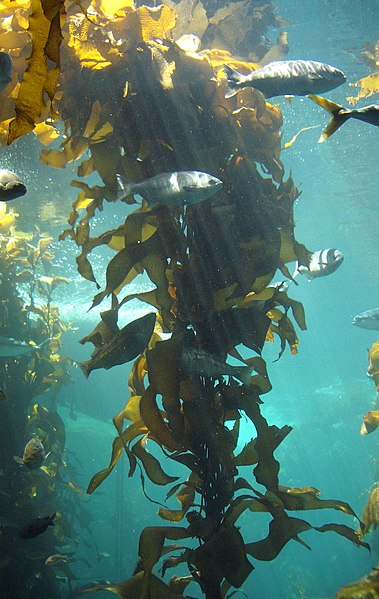
The kelp forest exhibit at the Monterey Bay Aquarium: A three-dimensional, multicellular thallus. Photo: Stef Maruch Wikipedia – Algae
Clade two: Bryophytes
A nonvascular subclade of embryophytes (land plants), first appearing 420 million years ago.
Division Marchantiophyta – Liverworts: A division of non-vascular land plants commonly referred to as hepatics or liverworts. With mosses and hornworts, they have a gametophyte-dominant life cycle, in which cells of the plant carry only a single set of genetic information. Most look like small (2-20 mm) flattened mosses. There may be as many as 9,000 species. 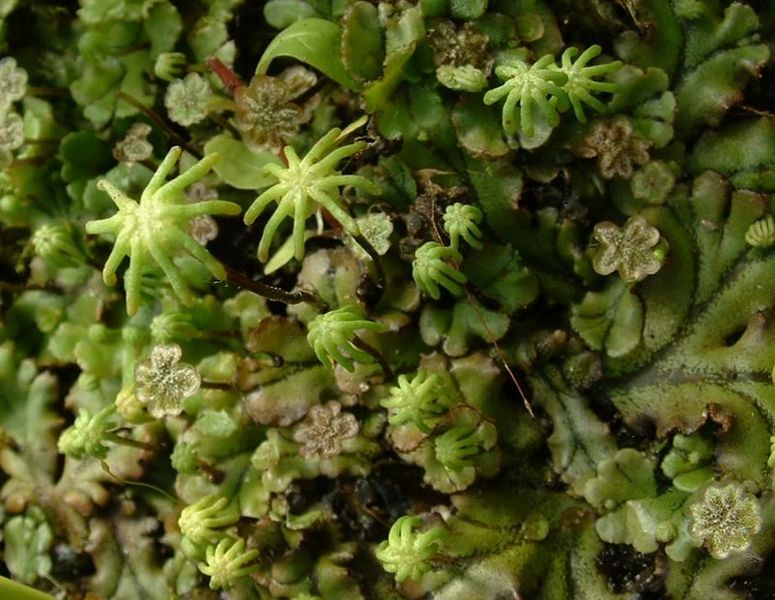
Marchantia polymorpha, with antheridial and archegonial stalks.
Photo: Jeffdelonge Wikipedia – Marchantiophyta
Division Anthocerotophyta – Hornworts: They look a bit like a cross between a horsetail and a fern and grow up to 3 meters high, with a sporophyte structure that looks like a horn. They grow in damp or humid places, possibly worldwide, and there may be only 100-150 species although 300 have been described. 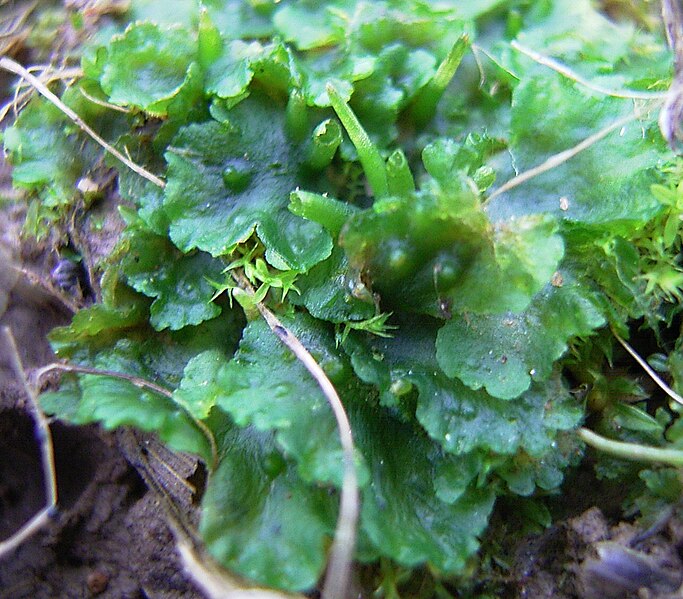
Phaeoceros laevis. Photo: de:Benutzer:Oliver_s. Wikipedia – Hornwort
Division Bryophyta – Mosses: Small, non-vascular flowerless, typically forming dense green clumps or mats, usually in damp or shady spots. Individual plants are usually composed of simple leaves one cell thick, attached to a branched or unbranched stem that conducts very little water or nutrients. Unlike liverworts and hornworts, they do have vascular systems. Seedless, they develop sporophytes topped with single capsules containing spores. The world’s tallest moss is Dawsonia, growing up to 20” high. There are approximately 12,000 species.
Clade three: Pteridophyta – Vascular plants
These are vascular plants (xylem transports nutrients from root to leaf, phloem transports them from leaf to root) and reproduce by means of spores, producing neither flowers no seeds. They appeared 410-375 million years ago.
Division Lycophyta – Clubmosses, fernmosses, spikemosses and quillworts. These have microphyllous leaves (single unbranched leaf vein) and reproduce with spores. During the Carboniferous Era they grew up to 50 m tall, formed extensive forests and contributed heavily to coal deposits. There may be as many as 1,200 extant species, all are small understory plants, often only an inch or two tall. 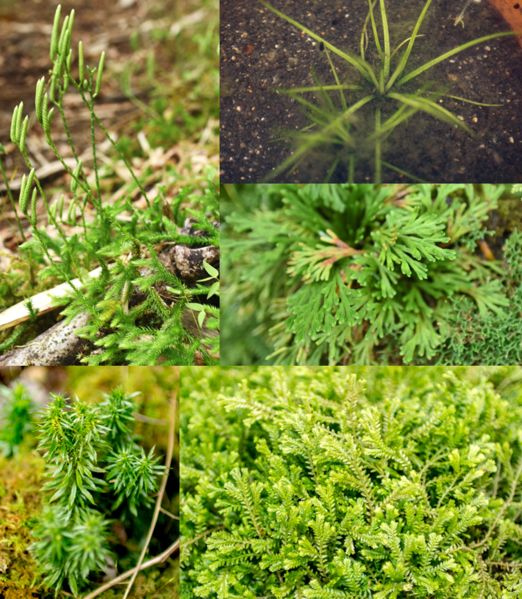
Modern lycophytes, clockwise from upper left: Lycopodium clavatum (Lycopodiales, Lycopodioideae), Isoetes japonica (Isoetales), Selaginella tamariscina, Selaginella remotifolia Selaginellales, Huperzia serrata (Lycopodiales, Huperzioideae). Photo: Kingfiser. Wikipedia – Lycophyta
Division Polypodiopsida (or Polypodiophyta) – Ferns: Their complex leaves (megaphylls) have multiple veins within the leaf and leaf gaps above them in the stem. Most ferns are leptosporangiate (the spore-forming enclosure is itself formed from a single epidermal cell, not from a group of cells [as are the eusporangiate ferns]). The fronds begin as coiled fiddleheads which uncurl as they grow. There are over 10,500 known extant species. The tallest fern in the world is the tree fern Cyathea australis,native to southeastern Australia, which grows to a 20 m (65 ft 6 in) high, with fronds up to 3 m (9 ft 9 in) long. Wikipedia – Fern

Unfolding frond of a Ponga (tree fern), Akatarawa River, New Zealand.
Photo: Karora. Wikipedia – Cyatheales
Division Equisetophyta or Sphenophyta – horsetails, marestails, snake grass, puzzlegrass. Some botanists consider this a subclass of Polypodiopsida (ferns), others maintain it as a division. As with the Lycopods they grew very large during the Carboniferious period, up to 98 ft tall. They are now “living fossils,” reduced to a single living genus and about 20 species. They like wet areas and have whorls of needle-like branches radiating at regular intervals from a single vertical segmented hollow stem. The small leaves are microphylls. Some stems will bear small cones (strobili) at their tips, comprised of sporangiophores. 
Northern Giant Horsetail, Equisetum telmateia (Equisetopsida) at Cambridge Botanic Garden. Typically 12–59 in. tall, rarely to 94 in. Photo: Rror. Wikipedia – Equisetophyta
Clade four: Gymnospermae
Vascular plants reproducing by means of an exposed (naked) seed or ovule which are directly fertilized by pollination. These began appearing 300 million years ago.
Division Cycadophyta – Cycads: They have a stout woody (ligneous) trunk with a crown of large, hard, stiff, evergreen and (usually) pinnate leaves (growing in pairs on the sides of a central shaft). They are dioecious (each plant is either male or female), Often mistaken for but unrelated to palms or ferns, they live long and grow slowly to heights of a few centimeters to several meters tall. There are over 300 cycad species in three families, and cycad leaves are featured on the flag of Vanuatu. 
Section of flag of Vanuatu showing cycad leaf. Wikipedia – Vanuatu
Division Ginkgophyta – Ginkgo: Although Ginkos are an ancient group dating back 300 million years to the early Carboniferous period, there is only remaining extant species, Ginkgo biloba. The tree is dioecious, with pollen organs similar to the catkins of angiosperms. Pollen organs and sporophylls grow at the juncture of leaves and stems, and ovules are fertilized by flagellated male gametes which can move about. Their leaves are wide and flat with two lobes. 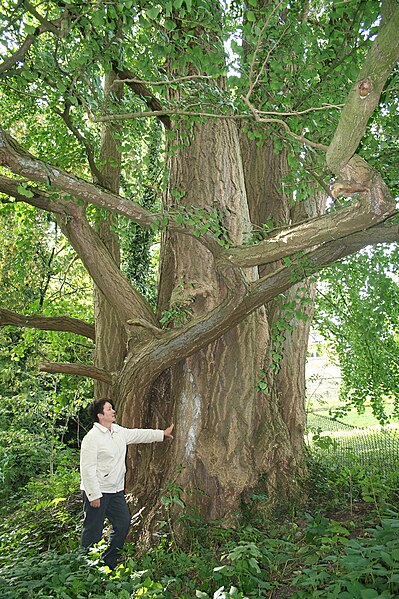
Ginkgo biloba tree in Tournai, Belgium.
Photo: Jean-Pol Grandmont. Wikipedia – Ginkgo biloba
Division Pinophyta or Coniferophyta or Coniferae – Conifers: These are perennial woody plants which exhibit secondary growth, resulting from cell division in the cambium (tissue between xylem and phloem) or lateral meristems and which causes the stems and roots to thicken. Seeds are born in cones. The single living class contains seven families containing over 600 species, including the well-known and important cedars, cypresses, firs, junipers, pines, redwoods, spruces and yews. Recently the gnetophytes, sometimes considered a separate division (or class, subclass or order), may be considered a subclade within Pinophyta. Wikipedia – Conifer
Clade five: Angiospermae, formerly Magnoliophyta
Angiosperms have enclosed seeds with many complex fertilization arrangements. They include all forbs (flowering plants without a woody stem), grasses and grass-like plants, nearly all broad-leaved trees, shrubs and vines, and most aquatic plants. “Angiosperm” derives from Greek angeion (‘container, vessel’) + sperma (‘seed’), indicating that the seeds are enclosed within a fruit. This most diverse group of land plants began diverging from the gymnosperms 300 million years ago and their diversification began exploding 120 million years ago. They now have 64 orders, 416 families, about 13,000 genera and 300,000 described species. As one might expect with such a large and important group of organisms, there are many systems for dividing them up. The following system is one used on Wikipedia.
Basal Angiosperms: These are perhaps 175 species of flowering plants which diverged early from the lineage leading to most flowering plants, collectively known as ANA grade and include Amborella (a single shrub species from New Caledonia), Nymphaeales (water lilies) and Austrobaileyales (aromatic woody plants including star anise). 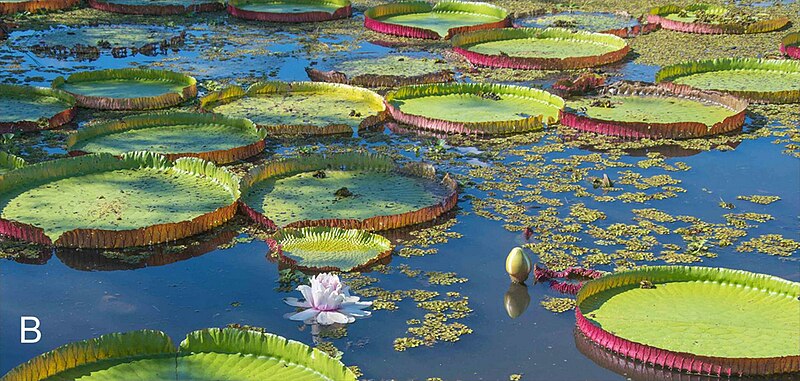
Giant Water Lily Victoria boliviana sp. nov. (Bolivia, Beni); leaves are up to 3 m. across. Photo: Carlos Magdalena; Wikipedia – Nymphaeales
Clade Mesangiospermae – Core Angiosperms: These comprise all the rest of the flowering plants. The following five groups make up this core.
Clade Magnolianae or Magnoliidae – Magnoliids: The third largest group and includes about 10,000 species, characterized by trimerous flowers (3 each of sepals, petals, stamens or carpels), pollen with one pore, and usually branching-veined leaves. It includes such common and popular plants as: magnolias, nutmeg, bay laurel, cinnamon, avocado, black pepper and tulip tree. 
Flower of Asimina triloba – Pawpaw.
Photo: User:Phyzome. Wikipedia – Magnoliids
Clade Chloranthaceae – Chloranthales: This group consists of a single family of 79 species of woody or weakly woody plants occurring in SE Asia, the Pacific, Madagascar, Central and South America, and the West Indies. They are fragrant shrubs or herbaceous plants that produce new side branches only on new growth. Evergreen leaves are arranged in pairs on opposite sides of the cylindrical stem. Petals and sometimes sepals are absent on the small flowers. Fruits are drupes or berries. Their ancestors date back to the early Cretaceous and have been found on all continents. 
Fortune’s Chloranthus, Chloranthus fortunei.
Photo: bastus917. Wikipedia – Chloranthaceae
Clade Monocotyledons – Monocots: The second largest group of about 70,000 species are the grasses and grass-like flowering plants whose seeds typically contain only one embryonic leaf (cotyledon), which is the first to pop out of the sprouting seed. This used to be one of the two major groups – the other was the dicots with two “seed leaves” – into which flowering plants were traditionally divided, but no longer. Monocots include 20,000 species of orchids and 12,000 of true grasses. The major grains (rice, wheat, maize), sedges, sugar cane and bamboo are monocots. 
Onion slice: the cross-sectional view shows the veins that run in parallel along the length of the bulb and stem. Photo: flikr0114. Wikipedia – Monocotyledon
Clade Eudicotidae – eudicots, formerly dicots: These are characterized by having two seed leaves (cotyledons) upon germination. They have previously been called tricolpates or non-magnoliid dicots. Estimates range from 175,000 to 280,000 species which includes many of our commonly cultivated and edible plants and most leafy, mid-latitude trees. Sunflower, dandelion, forget-me-not, cabbage, apple, buttercup are all eudicots. 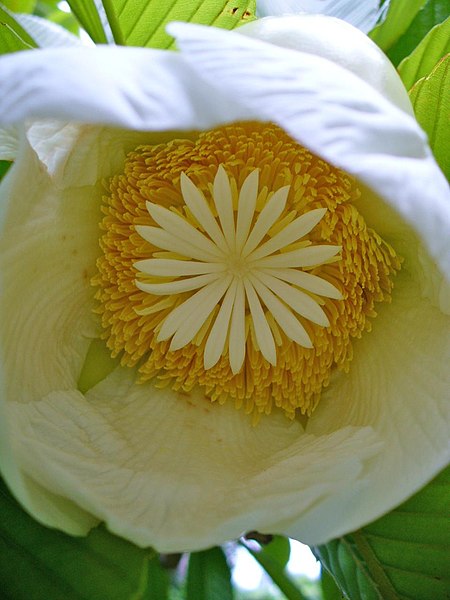
Flower of Elephant Apple or Ou Tenga, Dillenia indica, native to tropical Asia. Photo: Scott.zona. Wikipedia: Pentapetalae
Division Ceratophyllaceae – Coontails: Found worldwide but composed of a single genus with 6-30 species, therefore the subject of arguments. Also known as hornworts, but completely unrelated to the hornworts discussed earlier. They are common in ponds, marshes and quiet streams in tropical and temperate regions, submerged as they grow up to the surface where they float as they grow. 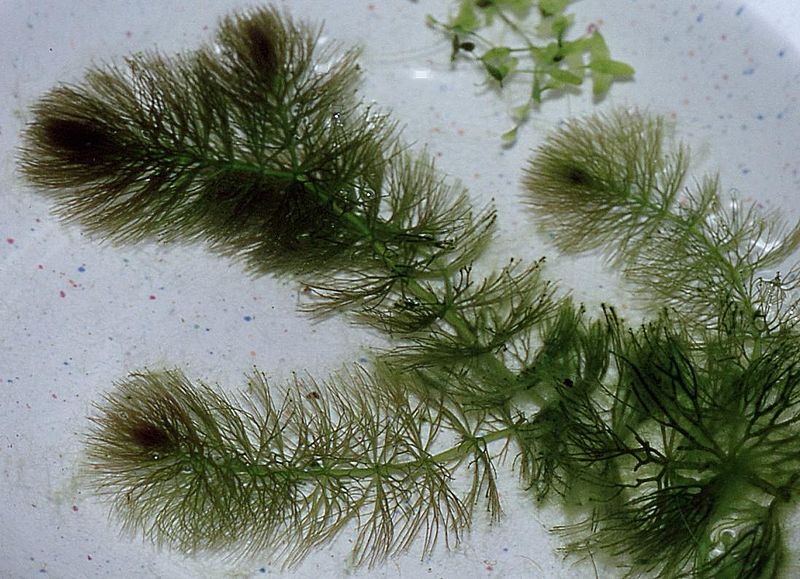
Soft Hornwort, Ceratophyllum submersum.
Photo: Christian Fischer. Wiki – Ceratophyllaceae
Below is another cladogram, “Land Plants,” with a slightly different presentation from the cladogram at the beginning of this post, giving you more phyla, more dates, and some synapomorphies (derived shared traits). 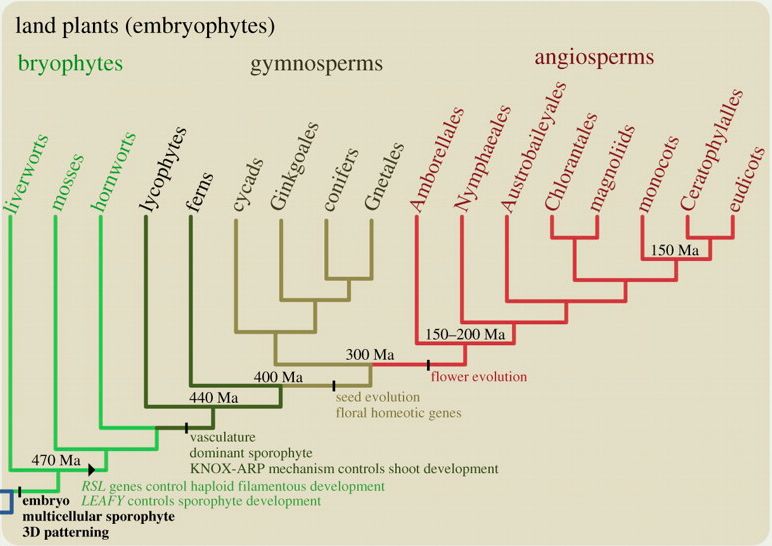
From: Garden Riots blog – An Introduction for Gardeners to the Eudicots
The Taxonomy Series
Installments post ever other day; installments will not open until posted.
Taxonomy One: A brief survey of the history and wherefores of taxonomy: Aristotle, Linnaeus and his binomial system of nomenclature, taxonomic ranks and the discovery and application of biological clocks.
Taxonomy Two: Introduces the higher levels of current taxonomy: the three Domains and the four Kingdoms. We briefly discuss Kingdom Protista, then the seven phyla of Kingdom Fungi.
Taxonomy Three: Kingdom Plantae.
Taxonomy Four: Kingdom Animalia to Phylum Annelida.
Taxonomy Five: A discussion of Cladistics, how it works and why it is becoming ever more important.
Taxonomy Six: Phylum Chordata, stopping at Class Mammalia.
Taxonomy Seven: Class Mammalia.
Taxonomy Eight: Class Aves, beginning with a comparison of five different avian checklists of the past 50 years.
Taxonomy Nine: A cladogram and discussion of Subclass Neornithes (modern birds) of the past 110 million years, reaching down to the current forty-one orders of birds.
Taxonomy Ten: A checklist of Neornithes including all ranks and clades down to the rank of the current 251 families of birds (plus a few probable new arrivals) with totals of the current 11,017 species of birds.
Domains & Kingdoms; Protista & Fungi | Taxonomy 2
[By Chuck Almdale]
Domains
The newest and highest rank of taxonomic classification is the Domain. As we will find throughout this blog series, all these taxonomic ranks and their contents are under constant revision. What is presented here is not only one snapshot in time, it is one snapshot among several snapshots of the same moment in time. Please keep that in mind. This field is in flux.
Domains of Three
 The Diversity of Archaea. Photo: Maulucioni. Wikipedia – Archaea
1. Domain Archaea
The appropriately-named Archaea are considered the most ancient form of life on earth. The Archaea are prokaryotes (see below) because they lack a nucleus and other membrane-bound organelles. They also have biochemical and RNA markers which distinguish them from the other and better-known prokaryotes, bacteria. Archaea have very diverse metabolisms and include methanogens that produce methane, halophiles that live in very saline water, and thermoacidophiles which live in acidic high-temperature water. Some are autotrophic, some are heterotrophic. Some live in the gut of mammals. The National Library of Medicine [Link] estimates there are 20,000 species of Archaea in thirty phyla in the world. The paper “The next million names for Archaea and Bacteria” [Link] on Science Direct estimates millions to billions of species of Archaea and Bacteria, but doesn’t estimate how many of each.
Terms of Biological Nomenclature:
Nomenclature: A system for giving names to things within a particular profession or field, especially in science; e.g. “the Linnaean system of biological nomenclature.”
Taxonomy: A practice and science concerned with classification or categorization on the basis of shared characteristics, typically with two parts:
a. Taxonomy: The development of an underlying scheme of classes.
b. Classification: The allocation of things to the classes, ranks or taxa.
Taxon: In biology, a taxon (back-formation from “taxonomy”; plural: taxa) is a group of one or more populations of an organism or organisms seen by taxonomists to form a unit. Although neither is required, a taxon is usually known by a particular name and given a particular ranking, especially if and when it is accepted or becomes established.
Systematics: The branch of biology that deals with classification and nomenclature.
Binomial Nomenclature: System of scientifically naming organisms with two words.
Genus: The taxonomic category above species.
Species: The most basic taxonomic category consisting of individuals who can – in the biological definition of “species” – produce fertile offspring.
Clade: A biological grouping that includes the common ancestor and all the descendants (living and extinct) of that ancestor.
Polyphyletic: When a group of organisms derive from more than one common evolutionary ancestor or ancestral group and are therefore not suitable for placing in the same taxon.
Biological Definitions:
Autotrophic: Able to produce their own food using light, water, carbon dioxide, or other chemicals; plants with chlorophyll are the best-known autotrophs.
Heterotrophic: Must eat other organisms for energy and nutrients, as do animals such as lice and humans.
Eukaryote: Organisms whose cells contain a membrane-bound nucleus, including all known non-microscopic organisms such as worms and humans. In other words, every living thing except bacteria mentioned from here on in this series.
Prokaryote: Unicellular organisms lacking a nucleus and other membrane-bound organelles: the Archaea and Bacteria.
2. Domain Bacteria
Bacteria are also prokaryotes but with cell membranes made of a phospholipid bilayer and differently structured RNA in their ribosomes. They range from 1-10 microns long and 0.2-1.0 micron wide (micron = micrometer = 1 millionth of a meter = ~0.00004 in.) Estimates range from 39 trillion bacteria living within our entire body to 100 trillion living just in our intestinal tract. There are over 30,000 known species of bacteria and scientists conjecture there may easily be trillions of species. All are unicellular, but some bacteria form large, non-microscopic colonies held together by biofilms, such as those growing – right now, silently – on your teeth, known as plaque. As with the Archaea, some bacteria are autotrophic and some heterotrophic. They are not extremophiles and they thoroughly enjoy sharing our environment with us, especially our intestinal tract, sinus cavities and mouth.
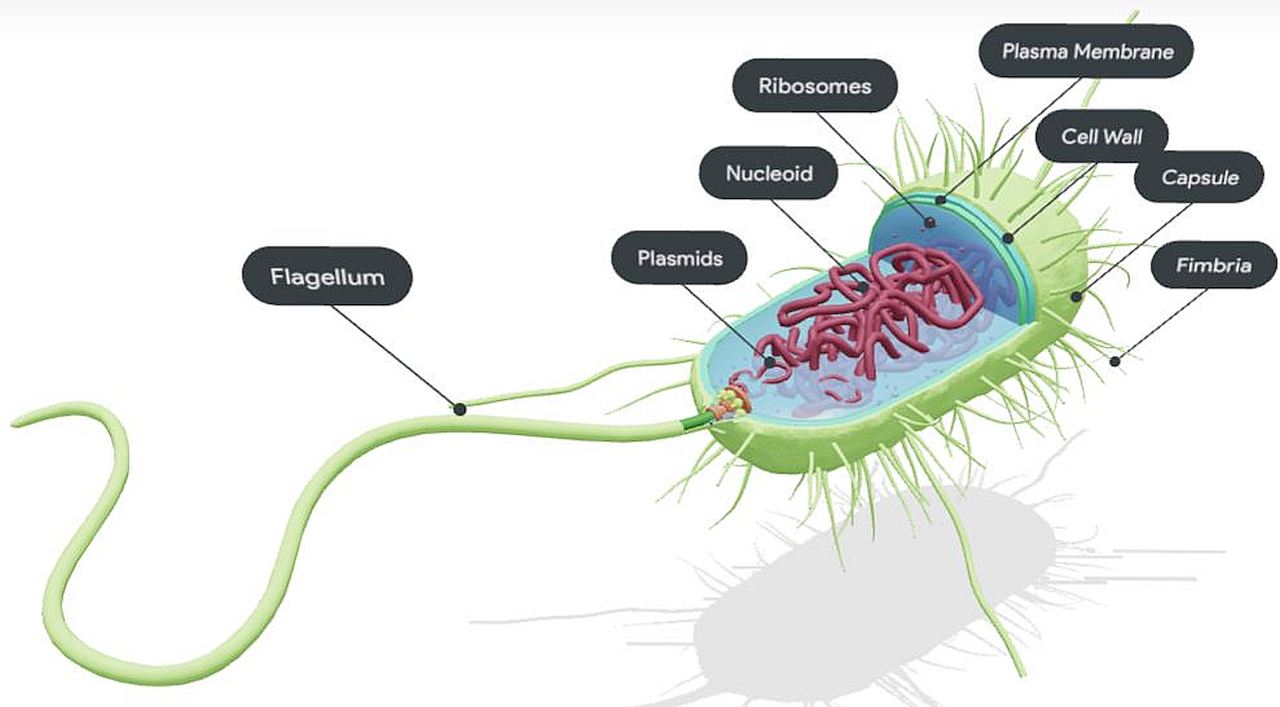
Typical bacteria, a prokaryote. Source: Visible Body, where it rotates in 3-D.
A few more awe-inspiring bacterial factoids from the book Think, by Guy P. Harrison:
Edward O. Wilson thought that had he one more life he would give up ants and study bacteria, and once wrote: “Ten billion bacteria live in a gram of ordinary soil, a mere pinch between the thumb and forefinger. The represent thousands of species, almost none of them known to science. Into that world I would go with the aid of modern microscopy and molecular analysis. I would cut my way through clonal forests sprawled across grains of sand, travel in an imagined submarine through drops of water proportionately the size of lakes, and track predators and prey in order to discover new life ways and alien food webs. All this, I need venture no farther than ten paces outside my laboratory.”
The bacterium Desulforudis audaxviator was found living a half mile below the surface near Death Valley, Ca., and is believed to be the same species found two miles below ground level in South Africa. They live in complete isolation in an environment that is sunless, hot (up to 140°F/60°C,), lacks oxygen and organic matter, where it lives on the by-products of radioactive decay in the surrounding rock. Researches think they sometimes ride to the surface via natural water springs, then are blown thousands of feet into the air where they are carried thousands of miles, then fall back to earth in raindrops, finally to find their way deep into the earth in a new location.
In samples of air taken twelve miles up in the upper troposphere, scientists have found more than 2100 microbial species. They appear to have their own atmospheric pathways and travel around the globe. Are they influencing our weather, or are we sharing theirs?
3. Domain Eukaryota
Eukaryotes are organisms whose cells contain a membrane-bound nucleus, including all known non-microscopic organisms such as worms and humans. In other words, every living thing mentioned in this series from this point on. The rest of this post and the following eight posts are devoted to Eukaryota.
Kingdoms: From Two to Eight
The number and nature of Domains and the next level of Kingdoms are far from settled science. Depending on whom or where or when you ask, there are as few as two or as many as eight kingdoms.
Three (or two) Kingdoms
As we saw in Taxonomy One, Linnaeus described three kingdoms: Animale, Vegetabile and Lapideum (mineral). Minerals – generally considered to be non-living and non-sentient (except by crystal-worshippers) – were long ago dropped from inclusion, so Linnaeus really described two biological kingdoms.
Four (or five) Kingdoms:
Robert Whittaker’s system of 1969 described four Eukaryota Kingdoms:) Animalia (Metazoa), Plantae, Fungi and Protista. A fifth kingdom, Monera (or prokaryotes, divided into Archaea and Bacteria when discussed above) is often included, in which case the use of “Domains” become unnecessary.
Six Kingdoms
Archaebacteria, Eubacteria, Protista, Fungi, Plantae, and Animalia. As with five kingdoms, this eliminates “Domains” and places the Archaea (Archaebacteria) and Bacteria (Eubacteria) on the same level as the other four kingdoms. Another way of looking at it with three domains and four (eukaryotic) kingdoms – which I shall adopt – is illustrated below.

Three Domains, four Kingdoms model. Source: Texas Gateway
Seven Kingdoms
To our two prokaryotic kingdoms of Archaea (Archaebacteria) and Bacteria (Eubacteria), and our three multicellular kingdoms of Fungi, Plantae, and Animalia, this schema renames Protista (from the six kingdoms schema) to Protozoa and breaks Chromista out from Protozoa. Most Chromists, like plants, are photosynthetic and have chloroplasts. Chromista chloroplasts are located in the lumen of their rough endoplasmic reticulum, rather than in the cytosol.
Eight Kingdoms
This system was developed by British zoologist Thomas Cavalier-Smith and first appeared in 1978, but continued to be modified until Cavalier-Smith died in 2021. It included the usual six kingdoms: Archaebacteria, Bacteria (Monera), Plantae, Animalia, Fungi, Protista, plus Chromista and Archezoa. Archezoa consisted of protists that lack mitochondria (organelles that generate adenosine triphosphate, used by the cell for chemical energy.) As additional organisms were assigned to Archezoa, the taxon became polyphyletic (composed of unrelated taxa lacking a common origin). Cavalier-Smith originally considered Archezoa a Subkingdom, then elevated it to Kingdom when he described Chromista. Later he assigned the members of Archezoa members to phylum Amoebozoa and eliminated Archezoa altogether. 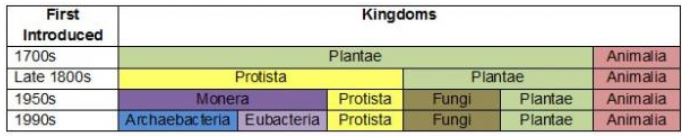
The evolution of evolutionary trees. Source: Texas Gateway
The four Kingdoms
With all that uncertainty in mind, from here on I’ll be using the Three Domains, Four Kingdoms model previously pictured. But not much, as from here on we never really discuss Domains again.
The four Kingdoms of Protista, Fungi, Plantae and Animalia will be considered the members of Eukaryota, the third of the three Domains. We’ll leave Kingdom Archaea (Archaebacteria) and Kingdom Bacteria (Eubacteria) within their own separate Domains.
Kingdom Protista or Protozoa
Protozoa have cell membranes, not cell walls. They have often been considered part of Kingdom Anamalia, but are now considered part of Protista, which also includes plant-like Phytotrophs, and fungus-like slime molds.
Protista consists of any eukaryotic organism other than animal, land plant, or fungus. They are all eukaryotic; most are unicellular, some multicellular; they can be autotrophic or heterotrophic. They are classified by how they move, as cilia (Paramecium), flagella (Euglena), or pseudopods (Amoeba). This is not a natural clade but a polyphyletic grouping of several independent clades that evolved from their last eukaryotic common ancestor.The term may be gradually abandoned as phylogenetic analysis and electron microscopy develop further, and the various protists are reclassified to various supergroups. There may be 60,000 – 200,000 species of protists, but many have not been described.
Kingdom Fungi
All fungi are eukaryotic and heterotrophic, most are multicellular, but some are unicellular (yeast). They used to be considered plants. However, nearly all fungal cell walls contain chitin which also forms the exoskeletons of many invertebrate animals. Additionally, Chytridiomycota (1st phylum below) zoospores and animal sperm both have a single posterior flagellum. Some scientists consider them sister clades and classify them into a common ancestor Opisthokont clade (opistho posterior + kont flagellum). Fungi examples: Mushrooms, mold, mildew, ringworm. Estimates of total fungi species range from 1.5 million to 11 million, but only 150,000 species have been described. As usual, there are various systems of organizing fungi; we’ll present a British system which contains seven phyla.
Fungi definitions:
Coenocytic: A multinucleate mass of protoplasm resulting from repeated nuclear division unaccompanied by cell fission.
Diploid: Having two sets of chromosomes in a cell (as do humans).
Flagella: Slender threadlike structures that enable many protozoa, bacteria, spermatozoa, etc. to swim.
Haploid: Having a single set of chromosomes in a cell (as with spermatozoa and unfertilized ova).
Meiosis: Cell division resulting in four daughter cells each with half the number of chromosomes of the parent cell, as in the production of gametes and plant spores.
Meiospore: A haploid spore resulting from meiosis.
Mycelia: The mass of branched, tubular filaments (hyphae), making up the thallus, or undifferentiated body, of a typical fungus.
Mycorrhiza, an intimate association between the branched, tubular filaments (hyphae) of a fungus and the roots of higher plants.
Saprotrophic: Taking in nutrients in solution form from dead & decaying matter.
Zygote: A diploid cell resulting from the fusion of two haploid gametes; a fertilized ovum.
Zygotic Meiosis: A diploid zygote (e.g. fertilized ovum) undergoes meiosis to produce haploid cells forming multicellular haploid individuals (as with slime molds).
1. Phylum Chytridiomycota: Mainly aquatic, some are parasitic or saprotrophic; unicellular or filamentous; chitin and glucan cell walls; primarily asexual reproduction by motile spores (zoospores); mycelia; contains two classes totaling about 1,000 species. Wikipedia – Chytridiomycota 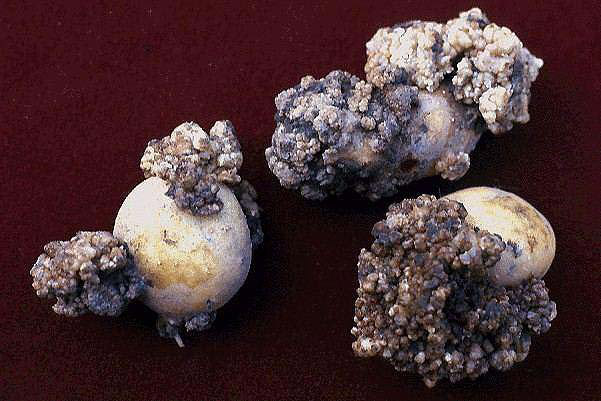
Synchytrium endobioticum on potatoes.
Photo: USDA-APHIS-PPQ. Wikipedia: Chytridiomycota
2. Phylum Neocallimastigomycota: Anaerobic fungi found in digestive tracts of herbivorous mammals, reptiles and humans; zoospores with one or more posterior flagella; lacks mitochondria but contains hydrogenosomes (hydrogen-producing, membrane-bound organelles that generate energy in the form of adenosine triphosphate, or ATP). One class with roughly 36 species. Wikipedia – Neocallimastigomycota
3. Phylum Blastocladiomycota: Parasitic on plants and animals, some are saprotrophic; aquatic and terrestrial; flagellated; alternates between haploid and diploid generations (zygotic meiosis); contains 1 class with less than 200 species. Wikipedia – Blastocladiomycota 
Plant leaf with Physoderma menyanthis (former Cladochytrium menyanthis) signs. Photo: James Lindsey. Wikipedia: Blastocladiomycota
4. Phylum Microsporidia: Spore-forming parasites formerly thought to be protozoans or protists. The spores contain an extrusion apparatus that has a coiled polar tube ending in an anchoring disc at the apical (highest point of a shape) part of the spore. 1,500 species named out of probably more than one million species. Wikipedia – Microsporidia 
Microsporidan Glugea stephani is a common parasite in the intestines of dab (Limanda limanda). Picture taken from a dab from the Belgian continental shelf. Photo: Hans Hillewaert Wikipedia: Microsporidia
5. Phylum Glomeromycota: Forms obligate, mutualistic, symbiotic relationships in which hyphae penetrate into the cells of roots of plants and trees (arbuscular mycorrhizal associations); coenocytic hyphae; reproduces asexually; cell walls composed primarily of chitin. Approximately 230 species named. Wikipedia – Glomeromycota 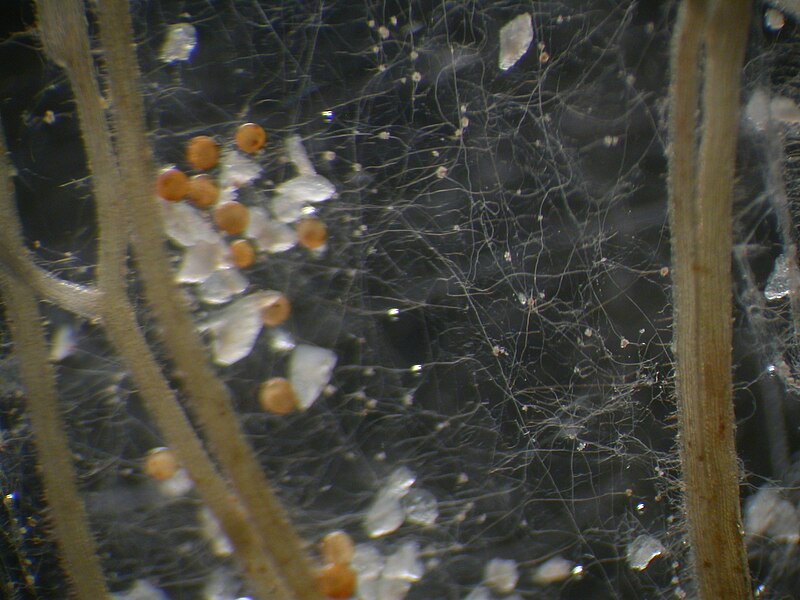
Gigaspora margarita in association with Lotus corniculatus.
Photo: Mike Guether Wikipedia – Glomeromycota
6. Phylum Ascomycota – Sac Fungi: The largest phylum of Fungi, with over 64,000 species. The “ascus” is a microscopic sac in which nonmotile spores are formed. Includes morels, truffles, brewer’s and baker’s yeast, cup fungi, and are symbiotic with algae to form lichens. Wikipedia – Ascomycota 
Sarcoscypha coccinea: shown is the ascocarp, a “fruit body.”
Photo: User:Velela Wikipedia – Ascomycota
7. Phylum Basidiomycota – Filamentous fungae: Most species composed of hyphae and reproducing sexually via specialized club-shaped cells called basida that normally bear four external meiospores. Includes: agarics, puffballs, stinkhorns, jelly fungi, boletes, chanterelles, smuts, rusts, and Cryptococcus (human pathogenic yeast). Around 31,000 species Wikipedia – Basidiomycota 
Common Stinkhorn Phallus impudicus, one of the Basidiomycota.
Photo: Birger Fricke. Wikipedia – Phallaceae
This is by no means the only system for fungi. Another system reduces Microsporidia in rank within Superphylum Opisthosporidia, and moves two incertae sedis (“of uncertain placement,” see below) taxa, Subphyla Zoopagomycotina and Subphyla Mucroromycota (both currently within Phyla Glomeronycota), into full phyla status, for a total of nine phyla.
8. Phylum Zoopagomycotina: Endoparasitic (lives in the body) or ectoparasitic (lives on the body) on nematodes, protozoa, and fungi; thallus branched or unbranched; asexual and sexual reproduction. Approximately 1,000 species.
9. Phylum Mucoromycotina: Parasitic, saprotrophic, or ectomycorrhizal (forms mutual symbiotic associations with plants); asexual or sexual reproduction; branched mycelium. Approximately 325 species.
Book Source
Think: Why You Should Question Everything, Guy P. Harrison; 2013, Prometheus Books, Amherst, NY. Pgs. 195-196
The Taxonomy Series
Installments post ever other day; installments will not open until posted.
Taxonomy One: A brief survey of the history and wherefores of taxonomy: Aristotle, Linnaeus and his binomial system of nomenclature, taxonomic ranks and the discovery and application of biological clocks.
Taxonomy Two: Introduces the higher levels of current taxonomy: the three Domains and the four Kingdoms. We briefly discuss Kingdom Protista, then the seven phyla of Kingdom Fungi.
Taxonomy Three: Kingdom Plantae.
Taxonomy Four: Kingdom Animalia to Phylum Annelida.
Taxonomy Five: A discussion of Cladistics, how it works and why it is becoming ever more important.
Taxonomy Six: Phylum Chordata, stopping at Class Mammalia.
Taxonomy Seven: Class Mammalia.
Taxonomy Eight: Class Aves, beginning with a comparison of five different avian checklists of the past 50 years.
Taxonomy Nine: A cladogram and discussion of Subclass Neornithes (modern birds) of the past 110 million years, reaching down to the current forty-one orders of birds.
Taxonomy Ten: A checklist of Neornithes including all ranks and clades down to the rank of the current 251 families of birds (plus a few probable new arrivals) with totals of the current 11,017 species of birds.
From the Bible to Molecular Clocks | Taxonomy 1
[By Chuck Almdale]
How names began: One early explanation
Among humanity’s most notable characteristics is our ability to learn names and our unquenchable drive to name things. And what are nouns, verbs and adjectives but names for things, actions and qualities? Over 2,500 years ago some member or members of a Middle Eastern tribe, while musing on life in general and how the human race in particular came into being and what they got up to at the very beginning of time, composed the following:
So God formed out of the ground all the wild animals and all the birds of heaven. He brought them to the man to see what he would call them, and whatever the man called each living creature, that was its name. Thus the man gave names to all cattle, to the birds of heaven, and to every wild animal…
— Genesis 2:19-20 NEB —
The writer(s) of the Jewish Scriptures imagined that among the very first things that the very first human did was…name things. That’s how critically important and utterly typical of humans this behavior is. Our ability and need to name and communicate are at the top of the list of things that make us human and helped our ancestors to survive in a lion-eats-man-and-jackal-gnaws-the-bones world. We’ve known that since before written history began, and we’re still busily finding or creating new things to name and then going on to name them. There are over 7,000 languages in use today. English, the most popular second language for most of the world, has a vocabulary of over 1 million words. Although no one knows or uses them all, each word was concocted by some person for what seemed to them a perfectly good reason.
In a recent TV science program, a speaker from a small cultural group said (I paraphrase), “In our culture we give ourselves permission to see similarities between things and not dwell on differences. We might say a tree and an animal and a person are kin.” But that’s not special or unusual; we all do that, we always have. Logically speaking, you can’t classify words or what they refer to into a group with shared traits or a “unity” without simultaneously excluding words/things that don’t share those traits. Inclusion and exclusion are simultaneous and mutually dependent activities.
This blog series is about not only the naming of things, but the development and application of a particular rational system, a schema, a science, for the naming of things. For those not familiar with this system, this series will introduce you to the structure, its application, some of the most recent changes in the system and some of its problems. We often forget that alike and unalike are far more than a simple binary. Same<——>Different is a spectrum: to be truly useful, scientific nomenclature should incorporate, if possible, the degree of similarity and dissimilarity.
The Naming and Classification of Organisms
If it is true that to know something you must first name it, then Linnaeus made the plant kingdom knowable. — Christopher Joyce, Earthly Goods, 1994
Prior to the appearance of Carl Linnaeus on the world scientific scene, taxonomy existed in a series of rudimentary forms. Over 2,300 years ago Aristotle created his “Great Chain of Being;” eleven levels classifying all life according to simplicity and complexity, as he perceived it. Plants were at the bottom, followed by animals, then humans, and finally angels and other supernatural beings at the top, of course, right where everyone knew they belonged. He also applied the term species to any particular identifiable organism, and genus for a collection of organisms with a shared set of traits. Later philosophers created their own systems, usually beginning at the top with a few large groups (plants, animals, birds, fish, etc.) and subdividing their way down to individual organisms. Descriptions and even the names of organisms could get quite lengthy. I read long ago that prior to Linnaeus one such “descriptive-name” for the European Robin (Erithacus rubecula) ran to over a page of text; the fact that the breast was red was not mentioned until somewhere on page two. That’s not terrifically useful.

By the 18th Century and due in part to the explosive growth of international trade and exploration, European scientists were drowning in a sea of new organisms with no good system to organize them, until the arrival of Carl (or Carolus) Linnaeus (1707-1778). Linnaeus recognized his mission in life and wrote of himself, Deus creavit, Linnaeus disposuit (“God created, Linnaeus organized”). Linnaeus was a thoroughgoing Christian who believed both in God’s creation and that there were no deeper relationships to be expressed than what could be seen in nature. All we needed to do was look deeply and record what we saw, no small task. In 1735 he presented the first edition of his Systema Naturæ, consisting of eleven large pages listing the plants and animals which he had so far identified. His book provided descriptive identification keys enabling readers to identify animals and plants. For plants he made use of previously ignored smaller parts of the flower.

Among Linnaeus’ greatest concerns and contributions to science was his gradual adoption of Aristotle’s system of giving each organism a unique scientific name, using only Latin (and/or Latinized Greek), which was the language of philosophy, religion and science throughout Europe at the time. He used Aristotle’s terms: species to refer to a particular organism, and genus for a general grouping of organisms with a shared set of traits. As new organisms were described and placed into a group (genus), his list (or key) of differentiating descriptions grew longer. To make the list easier to use, Linnaeus printed in the margin two names, the name of the genus and one word from the list of differences or from some former name. This latter word became the more specific name, the species.
This became the scientific binomial system of nomenclature we still use today; “two names,” with the first generic name capitalized, the second specific name not capitalized, e.g. Homo sapiens and Passer domesticus.
For higher organization Linnaeus created a nested hierarchy with three kingdoms at the top: Regnum Animale (animal), Regnum Vegetabile (plants) and Regnum Lapideum (mineral). Below that were two additional ranks of Class and Order, followed by the binomial of Genus and Species. Below species he sometimes recognized a rank now standardized as variety in botany and subspecies in zoology. At the start Linnaeus was certain the number of organisms in the world could not possibly exceed 10,000, and he devoutly wished to see them all named and described within his lifetime. By the time he died in 1778, his Systema Naturæ in its 12th edition (1766-1768) had grown to 2,400 pages and contained over 12,000 organisms.

Table of the Animal Kingdom (Regnum Animale) from Carolus Linnaeus’s first edition (1735) of Systema Naturae. Subdivision first column Quadrupedia: Anthropomorpha (Man, apes, sloth), Ferae (wild animals), Glires (= mice), Jumenta (pack animals), Pecora (cattle) and Paradoxa. Go to the Wikipedia photo, zoom in and actually read it.
Over the past 250 years, the Linnaean system has expanded significantly and codified with rules governing priority of names and the official adding of dates and describer. The term “Phylum” was coined by Ernst Haeckel in 1866 and soon widely adopted, and in 1883 August W. Eichler added its equivalent of “division” to plant taxonomy. The term “Family” was first used by French botanist Pierre Magnol in 1689; Carl Linnaeus had used it in 1751 in his Philosophia Botanica to categorize significant plant groups such as trees, herbs, ferns and palms; it appeared in French botanical publications, from 1763 to the end of the 19th century as an equivalent to order (Latin ordo); finally, in Zoology it was introduced as a rank between order and genus in 1796 by Pierre André Latreille. There are currently approximately 1.8 million scientifically described (and duly named) organisms. Estimates of remaining unnamed animal species alone ranges from five to thirty million. Feel free to make your own guess. Don’t even think about the unnamed bacteria species; there could be billions.
For well over a century the zoological divisions consisted of: Kingdom, Phylum, Class, Order, Family, Genus, Species (and subspecies, but ignore that for this paragraph). As in the study of medicine, mnemonics were invented to help memorize this: King Philip Came Over For Good Soup, or Keep Pot Clean Otherwise Family Gets Sick. The version I learned in California was: Keep Police Cars On Fresno’s Great Streets. There are doubtless many mnemonics in many languages. Use whatever works for you, but such a mnemonic really does help to learn the sequence, and knowing the sequence will vastly enhance your enjoyment of whatever you wish to learn in biology, as well as help you get through the rest of this blog series.
Microscopes were invented and improved and became widely available. In recent decades they became immensely more powerful and innumerable microscopic organisms – the Prokaryotes – were discovered. The microscopic Prokaryotes – unicellular organisms which lack a nucleus and other membrane-bound organelles – were then discovered to be of [at least] two kinds.To locate these new, fundamentally different organisms on the developing “tree of life” a new top rank of Domain was added. Further research demonstrated that these two kinds of Prokaryote were sufficiently and fundamentally different from one another for each to warrant their own domain.
Not to worry: If you add Do or Did to the beginning of your mnemonic you’ll keep it accurate.
Evolutionary Clocks
Until the 1960’s our understanding of relationships between various species, genera, families and orders was based on morphology, the study of the form and structure of organisms, and especially on comparative morphology, the analysis of the patterns of structures and their locations within an organism’s body plan and their similarity/dissimilarity to other organisms. Paleontologists and comparative morphologists studied bones from animals living and extinct and made educated guesses about how closely they were related and how long ago their common ancestor might have lived. In our own crude way everyone does this: obviously fish are more closely related to other fish than to mammals, just look at them with their fins and gills!; wolves and coyotes are closer to each other than to cats; gulls and terns are closer to each other than to sandpipers; whales and sharks are closer to each other than to hippos. Well, not that last one, but the morphologists dug deeply into the details and by current standards got most of it right.
In 1962, while studying amino acids in hemoglobin in different animal species, Linus Pauling and Émile Zuckerkandl noticed that the number of hemoglobin amino acid differences between lineages changed linearly over time, as estimated from fossil evidence. This suggested that the rate of evolutionary change of any specific protein was approximately constant over time and over different lineages. If valid, this finding could be used as a “molecular clock” to date evolutionary change: to estimate time since two lineages diverged and to calculate “genetic drift,” the neutral changes that don’t affect DNA functioning. In 1964 they presented their highly influential paper “Evolutionary Divergence and Convergence in Proteins,” which introduced the term “evolutionary clock” and presented a derivation of its basic mathematical form.
Soon afterward, in 1963, Emanuel Margoliash made a critical discovery, the genetic equidistance phenomena. He wrote:
“It appears that the number of residue differences between cytochrome c* of any two species is mostly conditioned by the time elapsed since the lines of evolution leading to these two species originally diverged. If this is correct, the cytochrome c of all mammals should be equally different from the cytochrome c of all birds. Since fish diverges from the main stem of vertebrate evolution earlier than either birds or mammals, the cytochrome c of both mammals and birds should be equally different from the cytochrome c of fish. Similarly, all vertebrate cytochrome c should be equally different from the yeast protein.” — Wikipedia: Molecular Clock
*Note: Cytochrome c is a small hemeprotein found loosely associated with the inner membrane of the mitochondrion (an organelle within cells called the “powerhouse of the cell” with its own DNA) where it plays a critical role in cellular respiration.
Because all eukaryotes (organisms whose cells have a membrane-bound nucleus) contain cytochrome c, it became the basis of biological molecular clock research. For example, the difference between a carp’s cytochrome c and that of a frog, turtle, chicken, rabbit or horse is a very constant 13% to 14%. Similarly, the difference between a bacterium’s cytochrome c and that of yeast, wheat, moth, tuna, pigeon or horse ranges from 64% to 69%. In other words, every species on one branch of the “tree of life” is equally distant from every species on a different branch.
In 1967 Vincent Sarich and Allan Wilson were comparing albumin proteins of primate lineages to a more-distant lineage and discovered that these proteins had approximately constant rates of change in modern primate lineages. Humans and chimpanzees were about equally distant from New World Monkeys (Ceboidea), and they estimated that humans and chimpanzees diverged only ~4–6 million years ago (mya). It was later discovered that the molecular clocks of most lineages needed to be calibrated with independent evidence about dates, primarily from the fossil record.
In the last twenty years, other molecular clocks have appeared and morphology continues to be used. Two examples:
1. The cladogram [Link] I used for most of the detail (Palaeognathae and Galloanseres excepted – you’ll see) of the cladogram presented in posting nine in this series came from a paper published in October 2015 and was based on ~30 million pairs of genomic (chromosomal) DNA, rather than on proteins. This is a new development in biological molecular clocks.
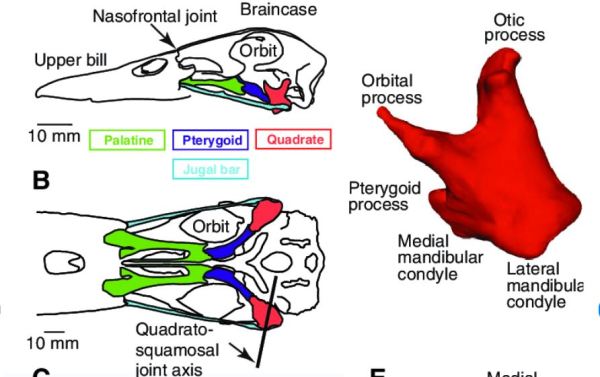
2. The quadrate bone in the jaws of all reptiles and birds has been used to study the relationship of Anseriformes (ducks & allies) to Galliformes (chickens & allies). Such studies, when combined with molecular clock studies, indicate that these two orders are not only each other’s closest relatives, but that they are more closely related to their reptilian ancestors than the other members of their Neognathe group. For this characteristic they were placed in their own Clade Galloanseres. We’ll mention this again when we get to the Galloanseres clade in the Neoaves cladogram in posting nine.
The Taxonomy Series
Installments post ever other day; installments will not open until posted.
Taxonomy One: A brief survey of the history and wherefores of taxonomy: Aristotle, Linnaeus and his binomial system of nomenclature, taxonomic ranks and the discovery and application of biological clocks.
Taxonomy Two: Introduces the higher levels of current taxonomy: the three Domains and the four Kingdoms. We briefly discuss Kingdom Protista, then the seven phyla of Kingdom Fungi.
Taxonomy Three: Kingdom Plantae.
Taxonomy Four: Kingdom Animalia to Phylum Annelida.
Taxonomy Five: A discussion of Cladistics, how it works and why it is becoming ever more important.
Taxonomy Six: Phylum Chordata, stopping at Class Mammalia.
Taxonomy Seven: Class Mammalia.
Taxonomy Eight: Class Aves, beginning with a comparison of five different avian checklists of the past 50 years.
Taxonomy Nine: A cladogram and discussion of Subclass Neornithes (modern birds) of the past 110 million years, reaching down to the current forty-one orders of birds.
Taxonomy Ten: A checklist of Neornithes including all ranks and clades down to the rank of the current 251 families of birds (plus a few probable new arrivals) with totals of the current 11,017 species of birds.
Reference Paper
*The Origin and Diversification of Birds. Stephen L. Brusatte, Jingmai K. O’Connor, and Erich D. Jarvis. Current Biology Review; Vol. 25, Issue 19; 5 Oct 2015, figure 6.
https://www.sciencedirect.com/science/article/pii/S0960982215009458
Volunteers needed at Audubon Ballona Wetlands Education Program
[Posted by Chuck Almdale, submitted by Cindy Hardin]
Nature Nexus Institute has taken over the operation of Los Angeles Audubon’s school outreach program of school field trips to the Ballona Wetlands. Santa Monica Bay Audubon Society has helped support this organization for several decades.
Nature Nexus Institute is all about sharing and teaching local school children about the special habitats found right here in Los Angeles. They will be starting their six-week Fall Training on 17 September to get ready for school field trips to the Ballona Wetlands. Their tours take place on Tuesdays and Thursdays. All you need to be a volunteer is a love of the outdoors and the enthusiasm to work with school age aspiring nature lovers. Please contact Cindy Hardin at chardin@naturenexusinstitute.org or give her a call at 310-745-2118 if you are interested.
The following announcement is from them.

One of the Ballona Salt Marsh channels (Leslie Davidson ’07)
We are looking for Volunteers!
Time: 9 am to noon, unless otherwise noted (see below)
Contact: Cindy Hardin, Ph/Text 310-745-2118, <chardin@naturenexusinstitute.org>
September 17th – Welcome back and welcome newcomers, an overview of the program, the mission of Nature Nexus institute, description of Learning Stations and route of field trips. Speaker: me, Cindy Hardin!
September 24th – Wetland Ecology by speaker Dr. Dave Bader. Dave handles education at the Marine Mammal Care Center in San Pedro, and has lots of knowledge to share about the unique and vanishing wetland habitats of our coast. He is new to our roster, and I hear he is an excellent speaker!
October 1st – Program history and goals, Restoration Ecology and Education by Dr. Margot Griswold. Margot has been the driving force behind our work at both the Baldwin Hills and Ballona, and has done numerous restoration projects throughout the region. Her knowledge of native plants and habitats is unparalleled! She has also done huge advocacy work to spread knowledge to underserved communities-our target audience!
October 8th – To be determined. I am hoping that Greg Pauly, curator of Herpetology at the Natural History Museum will be available, but I am waiting to hear back from him. I will keep you all posted. If Greg is not available we will fill in the slot with another program. If anyone has a suggestion, I am all ears!
October 15th – Gabrieleno History, Practices and Culture by Matthew Teutimez. Mr. Teutimez has a wealth of knowledge about local indigenous culture, and he is a very compelling speaker. I have seen a couple of his talks, and they are quite informative and memorable. He will be very helpful in showing us what we can best communicate to our student visitors about local Native Peoples. PLEASE NOTE: OUR START TIME FOR THIS SESSION WILL COMMENCE ONE HOUR LATER THAN USUAL, AT 10 AM.
October 22nd – Birds and Birding with our own Walter Lamb. Walter is a fantastic birder, and patient and generous in sharing his skills and knowledge. He has a huge following for his Bird Walks that he leads during our Open Wetlands events, and I am so glad he has the time to work with our group.
Thanks,
Cindy
Oarfish in La Jolla
[Posted by Chuck Almdale]
It’s a long deep-sea fish, and it’s only the 20th time one has washed up in California since 1901. There are of course superstitions attached to it, as with hoot-owls calling.
Oars, when captured, are sometimes mounted on the wall as trophies.

The following links to a film.
A few articles:
https://abcnews.go.com/US/wireStory/rarely-deep-sea-fish-found-california-scientists-112875324
San Diego news station
https://fox5sandiego.com/news/local-news/rare-sighting-oarfish-washes-up-at-la-jolla-shores/
L.A. Times
https://www.latimes.com/california/story/2024-08-15/rare-giant-oar-fish-washes-ashore



 SANTA MONICA BAY AUDUBON SOCIETY BLOG