Free email delivery
Please sign up for email delivery in the subscription area to the right.
No salesman will call, at least not from us. Maybe from someone else.
A few words on Clades & Cladograms |Taxonomy 5
[By Chuck Almdale]
We previously traveled through the Kingdoms of Protista, Fungi, Plantae and have journeyed most of the way through Kingdom Animalia. We have one brief stop before we enter Phylum Chordata. The above diagram is the nicely-designed cladogram we used for the plant kingdom in Taxonomy 3, complete with dates of divergence and synapomorphies. From: Cal Poly Humboldt Natural History Museum
Cladistics
We have mentioned clades a few times in passing, but as we’re about to plunge deeper into them we need to introduce a few terms and concepts. The term “clade” first appeared almost 70 years ago, but it took a few decades for it to become accepted and widely use. Before the discovery and use of evolutionary clocks, classification and ranking was based on morphology; the concept of connecting species to their proper ancestor, and then speaking of the entire group – one common ancestor and all its descendants whether extant or extinct – was a goal difficult if not impossible to achieve with a high (or perhaps even low) degree of certainty. After the discovery (or creation) of the biological clocks and the beginning of graphic representations of the relationships between organisms – often including elapsed time as one of the axes – scientists quickly realized they were now capable of reaching a far higher level of detail with a high level of reliability. They also saw a problem in taxonomic nomenclature approaching.
The approximately thirty ranks in the Linnaean system were far too few. There were potentially hundreds – perhaps many thousands – of rank levels waiting to be discovered and named. The day could quickly arrive when words would literally fail to describe. They needed a simpler method of depicting the proliferation of newly-discovered relationships between organisms and their ancestral lineages, and the cladogram was the result. With the new method of description and presentation, a new terminology had to be created. The following definitions are like an evolutionary tree, in that the fundamentals are presented before the specifics.
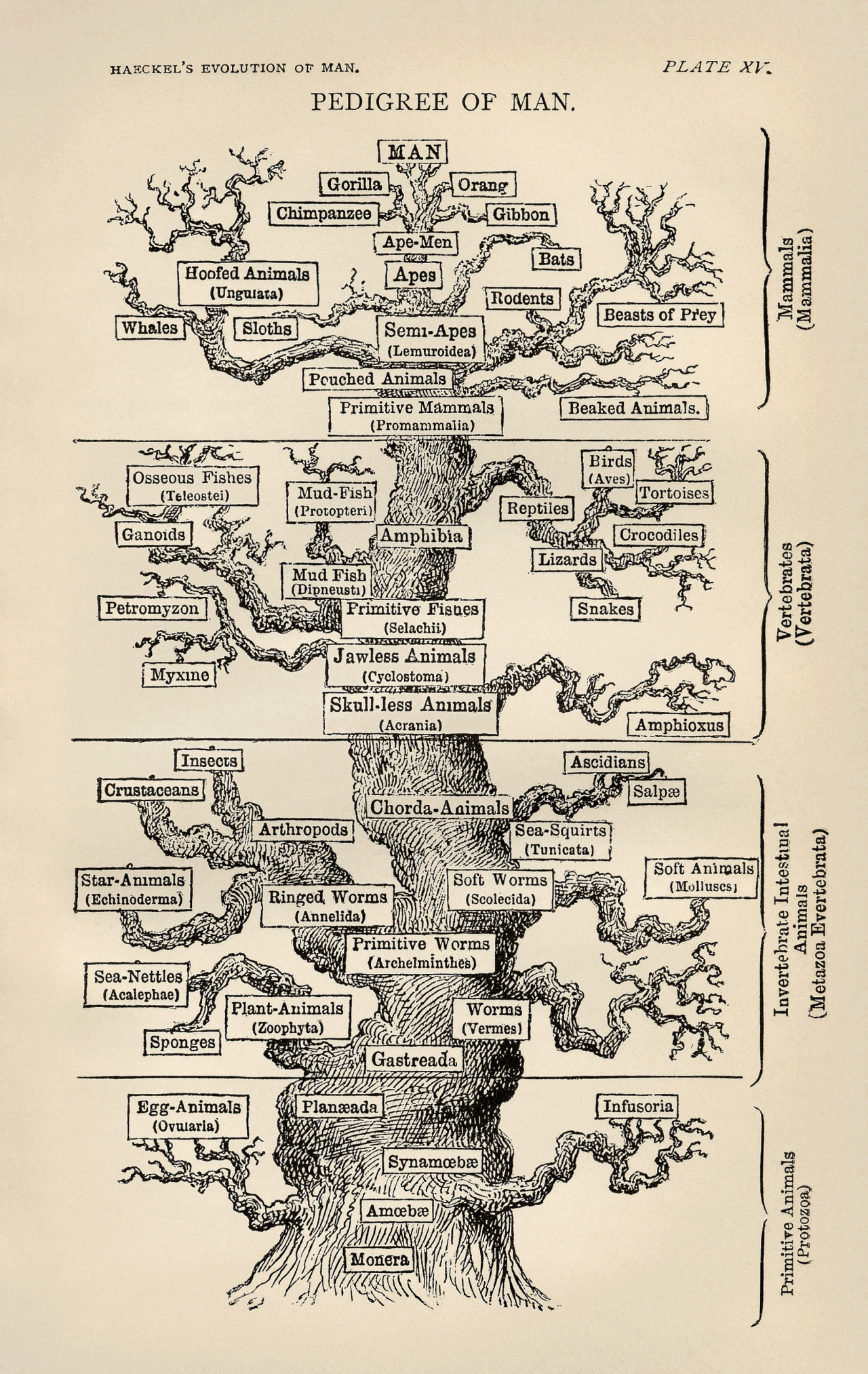
Darwin’s metaphor for the pattern of universal common descent made literal by his German language popularizer Ernst Haeckel in his 1879 The Evolution of Man. “Man” is at the crown of the tree. Wikipedia: Ernst Haeckel
Clade: A group of organisms that consists of a common ancestor and all of its descendants. Biologist Julian Huxley coined the term in 1957. The name of a clade is conventionally plural; the singular refers to each member individually. Valid clades are monophyletic (defined below).
Cladogram: A graphical presentation of the results of phylogenetic/cladistic analyses. They are vaguely tree-shaped (Haeckel’s is explicitly a tree) and all their branches are phylogenetic hypotheses. A cladogram can place the root at the left and branch to the right, or branch from the top down, even place the root at the center and branch in all directions (example below).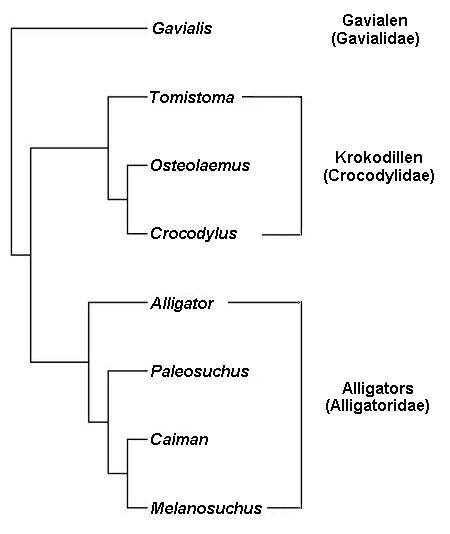
Gavialidae, Crocodylidae and Alligatoridae are clade names here applied to a right-branching phylogenetic tree of crocodylians. As it is missing the common ancestor root at left, it is not a true cladogram. Wikipedia – Clade
Root: The common ancestor of a clade. Except at the root of all life, every root is a branch in an earlier ancestor’s clade, and every common ancestor’s clade of descendants nests within larger clades.
Rootless: Many phylogenetic trees have no root; they may contain many clades but are not a cladogram in their entirety.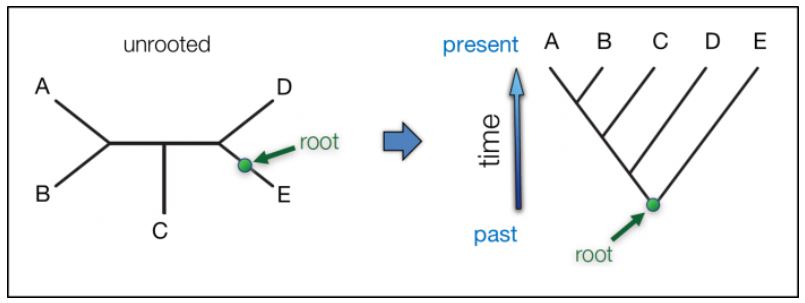
Before and after rooting the phylogenetic tree. (Branch lengths are not to any scale). Many phylogenetic reconstructions don’t estimate root position as that increases the number of possible trees and the time it takes to calculate the tree. Visualize the left tree as made from string; push a pin into the root spot, then rotate the remaining branches around the pin-point to yield the tree on the right. The arrow indicates the direction of evolution as implied by the root position. EMBL-EBI – Intro to Phylogenetics
Taxon (plural taxa): A group of one or more populations of an organism or organisms seen by taxonomists to form a unit. Taxonomists now try to avoid naming taxa that are not demonstrably monophyletic (defined farther below).
Taxonomic Rank: The level of a taxon within a taxonomic hierarchy. Phylum is higher rank than Class, Genus is lower than Family, higher is more general, lower is more specific. To identify a particular organism only genus and species are necessary, specification of higher ranks is not necessary.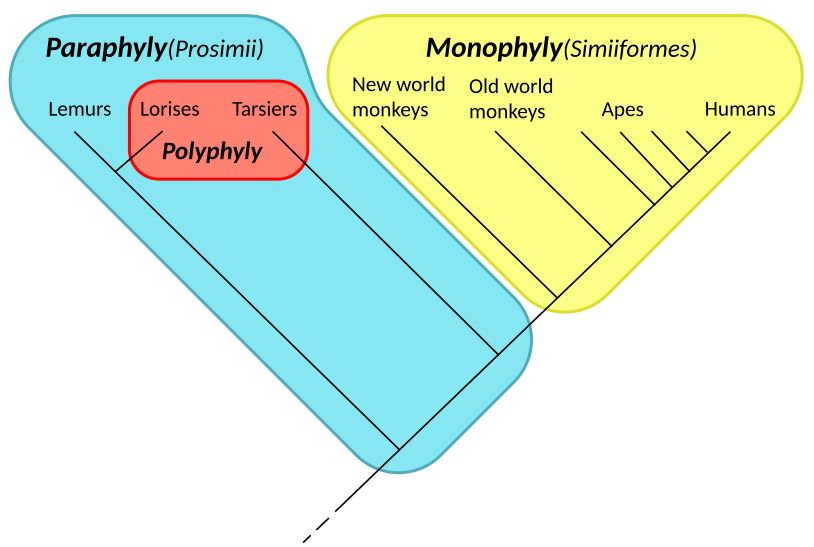
Primate phylogenetic tree (root is located but not identified): Monophyly (yellow) in Simians; Paraphyly in Prosimians (blue, including red); Polyphyly (red) in Lorises & Tarsiers, both night-active primates. Diagram: Chiswick Chap. Wikipedia – Paraphyly
Monophyletic: When a group includes the common ancestor and all of its descendant groups.
Paraphyletic: When a group includes the common ancestor but not all the descendant groups.
Polyphyletic: When a group is derived from more than one common evolutionary ancestor or ancestral group and therefore not truly suitable for placing in the same taxon. With the advent of protein and/or DNA analysis and biological clocks, many groups formerly believed to be monophyletic were revealed to be polyphyletic and thus needed to be disassembled and reclassified into monophyletic (or at least paraphyletic) clades. This goal is not yet fully achieved but a lot of progress has been made. If you’ve noticed that a lot of bird families and/or orders have been disassembled within the past fifteen years with species sent in various directions and new ones inserted, this is why.
Sister taxa, polytomy and basal taxon all in one clade. Quora – Basal
Branch: The branch shows the path of transmission of genetic information from one generation to the next. When branch lengths indicate genetic change or elapsed time, a reference scale or explanation should be supplied; i.e. the longer the branch, the more elapsed time or genetic change (divergence) has occurred. Branch length often signifies nothing beyond appearance for appearance sake.
Branch Tip: The end (tip) of a branch in a phylogenetic tree represents the latest descendant, whether extant or extinct, of that particular lineage.
Node: The points in a cladogram where lines intersect or branch. This point is the common ancestor of both lineages and represents divergences (speciation events).
Nested: When a clade located is located within another clade. In the diagram below, the Great Ape clade nests within the Ape clade which nests within the Catarrhine clade which nests within the Simian clade and so on down the line.
Sister Clades (or taxa): When two clades have an immediate common ancestor. In the diagram below, lemurs and lorises are sister clades, while humans and tarsiers are not.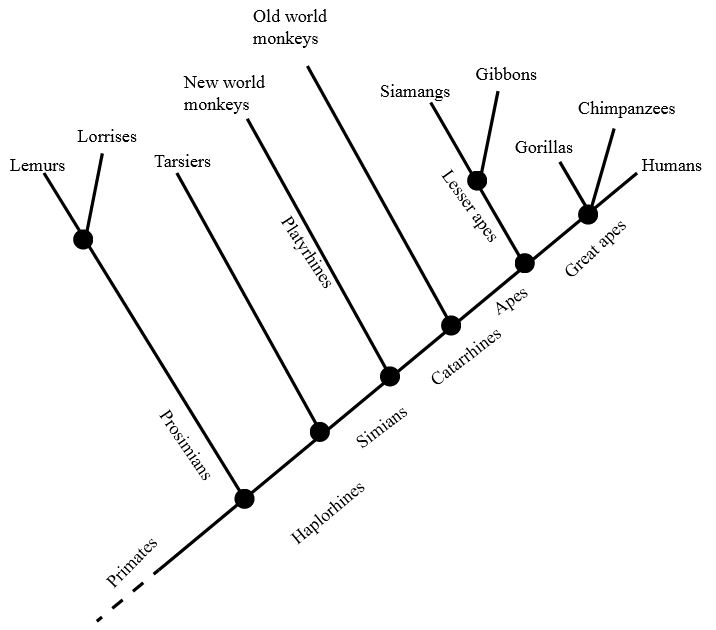
Cladogram of modern primate groups, showing branches, (Prosimians, etc.) branch tips (Tarsiers, etc.), and nodes (black dots where branches diverge (or meet). Above each node is the group name , which could be replaced or augmented by the synapomorphy (common character) as shown in the following two cladograms. All tarsiers are haplorhines, but not all haplorhines are tarsiers; all apes are catarrhines, but not all catarrhines are apes; etc. Wikipedia – Clade
Basal: Close to the root of a tree; the group which gave rise to later forms, a non-judgmental term to replace ‘primitive’ or ‘ancestral.’ A group of organisms which diverge early in the evolutionary history of a clade, forming an ‘outgroup’ to the rest of the clade. Basal forms often retain traits of the ancestral form lost in other and later (‘derived’) descendants, thus providing insights into the early stages of evolutionary history of the clade. Basal traits are original condition of the common ancestor. ‘Advanced’ means the character evolved within a later subgroup of the clade, with no judgment about complexity, superiority or adaptiveness of that trait. In the primate diagram above, the prosimian clade is basal to the haplorhines clade, and both prosimian and tarsier clades are basal to the simian clade. Also see the basal taxon in the second diagram above.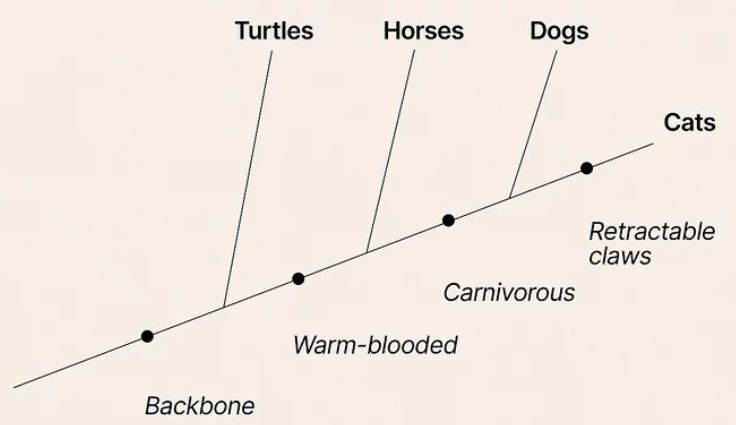
Constructing a simple cladogram using synapomorphies (carnivorous, etc.) rather than group names. Wikihow – Read a Cladogram
Extant: Still existing; the taxon still has living members.
Extinct: No longer existing; no members of the taxon are alive today.
Stem Group: An extinct species or collection of species that is more closely related to an extant clade than the extant clade is to its most closely related sister clade. Example: Modern humans are more closely related to the stem group of extinct hominins (Homo erectus, etc.) than they are to extant chimpanzees.
Crown Group: For a clade to be a crown group it must have extant species with common character(s) (synapomorphy). It will also include all extinct clade members as well as the most recent common ancestor of all clade members whether they are extant or extinct.
Apomorphy: A derived trait; a novel character or character state that has evolved from its plesiomorphy (ancestral form).
Synapomorphy: A character or trait that is shared by two or more taxonomic groups and is derived through evolution from a common ancestral form. The cladogram below designates synapomorphies with red bars. Diagonal trees such as this are preferred when indicating synapomorphies.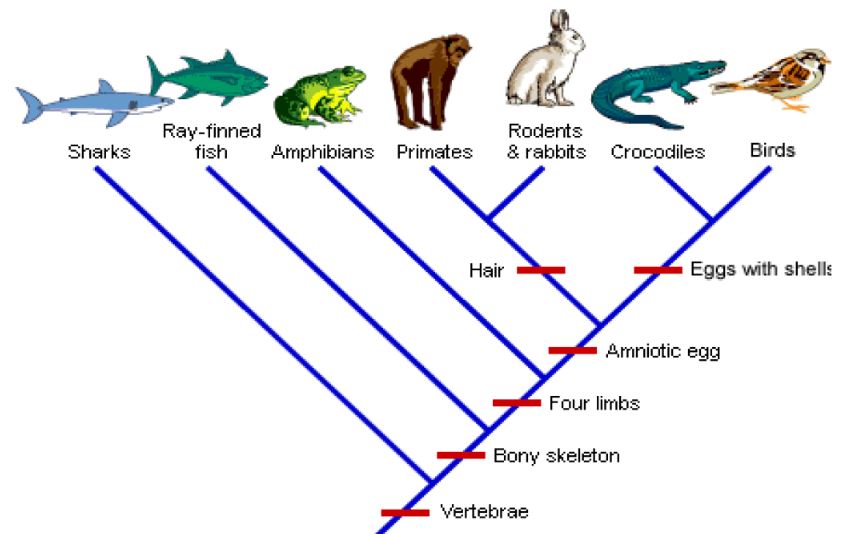
Sample teaching cladogram from: University of British Columbia
Lineage: A single line of descent or linear chain within a tree connecting the common ancestor to a particular tip taxon.
Polytomy: On a phylogeny tree where more than two branches (lineages) descend from a single ancestral lineage. The presumed reason is that we do not yet have enough evidence to strongly support one set of possible relations over other possible sets. It might mean (but probably doesn’t) that we think that the descendant lineages speciated simultaneously. Ranks and individuals within polytomies are frequently labeled incertae sedis, “of uncertain placement.” Complete information should eventually resolve all polytomies.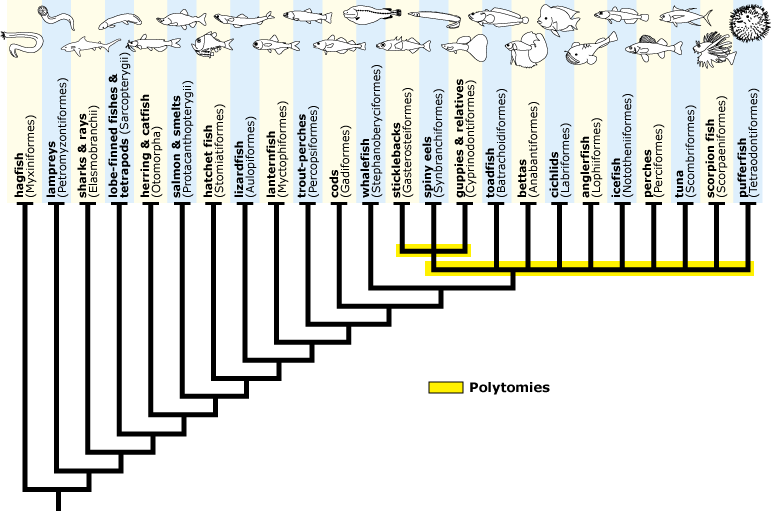
Fish cladogram with two polytomies. UC Berkeley
In the following five postings in this series, many of these terms will appear, especially the term “clade.” Unlike “Superorder, Order, Suborder…”, “clade” gives no indication of where in a taxonomic sequence it falls, and only by identifying the prior and following ranks will one have a clue. To clarify this situation somewhat, where appropriate I’ve inserted the term Cladesubscript 1,2,3…
A term like “Clade19 Class Amphibia” will then indicate a rank 19th in the sequence beginning with Clade1 Domain Eukaryota, as well as the Linnaean rank of Class. This is my own invention which you may find useful, confusing or unnecessary. I’m not entirely happy with it, but if nothing else, it shines a little light on how confusing this nomenclatural problem can get. It also helps when constructing and reading long indented phylogenetic trees and lineages which otherwise can become confusing.
Cladograms can get quite complex. The following pair of cladograms pertain to the virus SARS-CoV-2. Pressing <control>+ makes the diagram larger and (one hopes) clearer.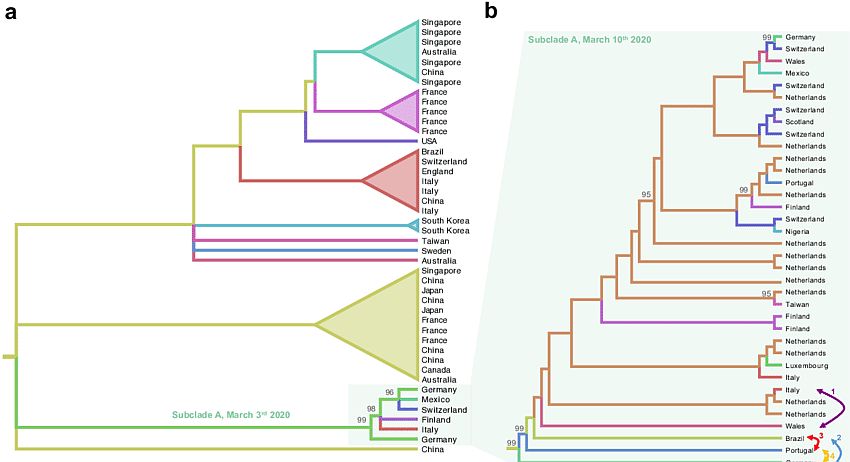
Cladograms of SARS-CoV-2 subclades. Cladograms extracted from ML phylogenies rooted by enforcing a molecular clock. Colored branches represent country of origin of sampled sequences (tip branches) and ancestral lineages (internal branches). Numbers at nodes indicate ultrafast bootstrap (BB) support (only >90% values are shown).
(a) Cladogram of a monophyletic clade within the SARS-CoV-2 ML tree inferred from sequences available on March 3 rd 2020 (Supplementary Figure S1). The subclade including sequences from Italy and Germany, named Subclade A (lower right), is highlighted.
(b) Cladogram of subclade A of the SARS-CoV-2 ML tree including additional sequences available on March 10th 2020 (Supplementary Figure S2).
Link to Research Gate report.
A cladogram of SARS-CoV-2 genetic variants. This may actually be a phylogenetic tree, not a cladogram, as there may be no root defined at the center (but who can tell?).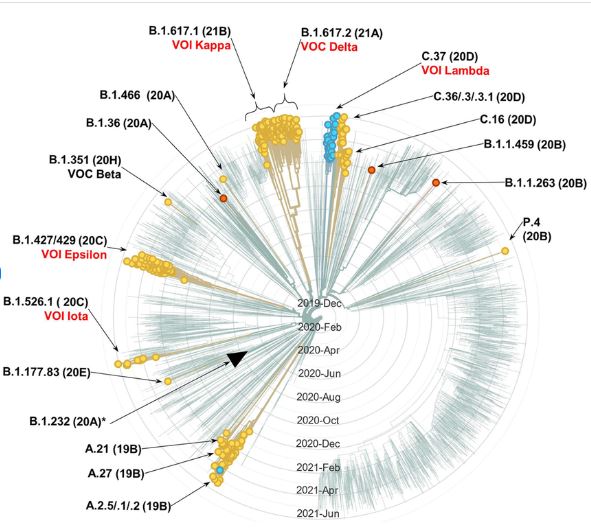 Nextstrain-generated radial cladogram of SARS-CoV-2 genetic variants (as of 12 June 2021). Showing 519 of 3,883 genomes randomly sampled between Jun 2020 and May 2021, belonging to 23 PANGO lineages. Circles tip branches containing genomes with any mutation in L452 (circles on branches without the mutations were manually removed for a visual clarity). Yellow circles, branches with L452R; blue, with L452Q; orange, with L452M. Black triangle tips the branch of lineage that includes CAL.20A. (At the date of analysis, CAL.20A strains were not among the sampled genomes in the Nextstrain database, and only three B.1.232 [all non-CAL.20A] lineages were found). Nomenclature: PANGO lineage followed by Nextstrain clade in parenthesis and the current VOC/VOI designation. In red, VOC/VOI with an omnipresent or nearly omnipresent L452 mutation (VOC beta is in black, as the L452 mutation is found only in few genomes of the variant). Link to Research Gate report.
When examined close up, the gray area fringing the circular cladogram above is revealed to be tiny cladograms. I can’t imagine how much you’d have to blow it up (and somehow maintain clarity) to be able to actually read it.
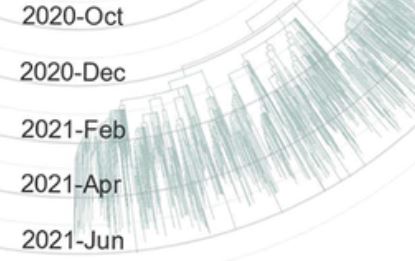
From: Research Gate report.
For additional information:
AmphibiaWeb – Taxonomy
The Burgess Shale – Stem groups & crown groups
Digital Atlas of Ancient Life – Crowns & stems
Wikipedia – Clade
Wikipedia – Crown Group
Wikipedia – List of Latin and Greek words commonly used in systematic names
Wikipedia – Phylogenetic nomenclature
The Taxonomy Series
Installments post ever other day; installments will not open until posted.
Taxonomy One: A brief survey of the history and wherefores of taxonomy: Aristotle, Linnaeus and his binomial system of nomenclature, taxonomic ranks and the discovery and application of biological clocks.
Taxonomy Two: Introduces the higher levels of current taxonomy: the three Domains and the four Kingdoms. We briefly discuss Kingdom Protista, then the seven phyla of Kingdom Fungi.
Taxonomy Three: Kingdom Plantae.
Taxonomy Four: Kingdom Animalia to Phylum Annelida.
Taxonomy Five: A discussion of Cladistics, how it works and why it is becoming ever more important.
Taxonomy Six: Phylum Chordata, stopping at Class Mammalia.
Taxonomy Seven: Class Mammalia.
Taxonomy Eight: Class Aves, beginning with a comparison of five different avian checklists of the past 50 years.
Taxonomy Nine: A cladogram and discussion of Subclass Neornithes (modern birds) of the past 110 million years, reaching down to the current forty-one orders of birds.
Taxonomy Ten: A checklist of Neornithes including all ranks and clades down to the rank of the current 251 families of birds (plus a few probable new arrivals) with totals of the current 11,017 species of birds.
Kingdom Animalia | Taxonomy 4
[By Chuck Almdale]
Kingdom Animalia (or Metazoa, Choanoblastaea, Gastrobionta or Euanimalia)
Now we finally get to the animals, Kingdom Animalia, all those warm and fuzzy creatures so dear to our hearts. There are over 1 ½ million described living animal species of which over 1 million are insects, 85,000 are molluscs, 65,000 are vertebrates; only 6,400 are mammals of which more than half are rodents or bats. Warm and fuzzy animal species you’d be happy to hold on your lap are definitely in the minority.
Estimates of total extant animal species range 7.8 – 30 million, or 5 – 15 times as many organisms as are now known; most of these nameless entities are insects. Animals are multicellular eukaryotic organisms which – with very few exceptions – consume organic material, breath oxygen, have myocytes (muscle cells), are able to move, and can reproduce sexually. Early in their development animal embryos go through a blastula stage. Animalia is considered a true clade as they (or we, really) developed from a single common ancestor. Yes, all those worms, sponges and things that go squish in the night are your many-times-removed cousins. [Getting a feeling for just how many times removed is one of the purposes of this series.] Animal length ranges from 8.5 μm (0.00033 in) to 180 feet long (a worm, not a whale). And, as with all the other kingdoms, there are many systems for organizing taxonomic relationships, with phyla numbering from seven to over forty. We’ll pick an intermediate system that has sixteen phyla; fourteen of them are numbered below, the final two will be presented in a posting-to-come. As all those reading this qualify as animals and are of course intimately familiar with their own personal kingdom, I’m not going to go into great detail. Link to a good article on Animal Diversity.
A few definitions:
Basal Clade: The earliest clade to branch in a larger clade (kingdom, phylum, class, etc.); not part of any core or adjacent crown group clade.
Blastula: An early stage in animal embryonic development, consisting of a hollow sphere of cells (blastomeres) surrounding a fluid-filled cavity (blastocoel), produced by repeated cleavage of a fertilized egg.
Combination Clade Term: Combines terms used in the immediate daughter clades, often with suffix “-morpha (form).” Example: Xenacoelomorpha: Xena + coel + omorpha, combines the two daughter terms xenoturbella and acoelomorpha. This is a useful and increasingly-popular design for clade names.
Duterostome: “second + mouth.” The first embryonic opening becomes the anus.
Eukaryotic: Having cells that contain a membrane-bound nucleus and organelles. The Eukaryota consists of all known non-microscopic organisms, including protozoa, fungi, plant and animals.
Heterotrophic: Getting food by consuming other plants or animals. Example heterotrophs: worms, insects, jellyfish, lions, humans.
Hox Genes: A subset of homeobox genes and a group of related genes that specify regions of the body plan of an embryo along the head-tail axis of animals.
Proterostome: “first + mouth.” The first embryonic opening becomes the mouth.
A. Kingdom Animalia, the Basal Clades
1. Phylum Porifera: Translation “pore + bearing.” This basal animal sponge clade are multicellular filter-feeding organisms with bodies full of pores and channels allowing water to circulate through them, consisting of jelly-like mesohyl (connective tissue containing amoeboid cells, fibrils and skeletal elements) sandwiched between the external pinacoderm cell layer and the internal choanoderm layer. There are 5,000-10,000 species. Most reproduce sexually but some can also reproduce asexually. Link to Sponges. 
Sponge biodiversity and morphotypes at wall lip site in 60 feet of water. Included: yellow Tube Sponge, Aplysina fistularis, purple Vase Sponge, Niphates digitalis, red Encrusting Sponge, Spirastrella coccinea, and gray Rope Sponge, Callyspongia sp. Photo: Twilight Zone Expedition Team 2007, NOAA-OE. Wikipedia: Sponge
2. Phylum Placozoa: Translation: “flat + animal.” Another basal and primitive metazoan clade, they constitute a phylum of marine, free-living (non-parasitic) animals, simple blob-like aggregates of cells lacking body parts or organs. Described as “the simplest animals on Earth,” they move through water by waving cilia, eat by engulfment through the cell membrane and reproduce by fission (splitting) or budding. We currently know of only four families and four species. Link to Placozoa.
Not a meat patty, but a placozoan, a small, flattened animal, typically about one mm across and about 25 microns thick. Like the amoebae they superficially resemble, they continually change their external shape. In addition, spherical phases occasionally form which may facilitate movement. Trichoplax lacks tissues and organs. There is no manifest body symmetry so it is not possible to distinguish anterior from posterior or left from right. It is made up of a few thousand cells of six types in three distinct layers.
Photo: Michael G. Hadfield Wikipedia: Placozoa
3. Phylum Cnidaria: Translation: “sting + nettle.” Jellies, gorgonians, anemones and corals are the primary members of this worldwide phylum of fresh water and marine animals. They have a decentralized nervous system distributed throughout a gelatinous body, with cnidocytes – specialized cells with ejectable venomous flagella used primarily to capture prey. The body consists of mesoglea, non-living, jelly-like substance, sandwiched between two layers of densely-packed epithelium that are mostly one cell thick. They can reproduce both sexually and asexually. They are radially symmetrical with mouth is surrounded by cnidocyte-laden tentacles, their single body cavity handles digestion, excretion and respiration. Many live in colonies, some are parasitic. The 11,000 described species fall into three subphyla: Anthozoa (corals and anemones), Medusozoa (jellyfish and hydroids), and Myxozoa (parasites). Link to Cnidaria.
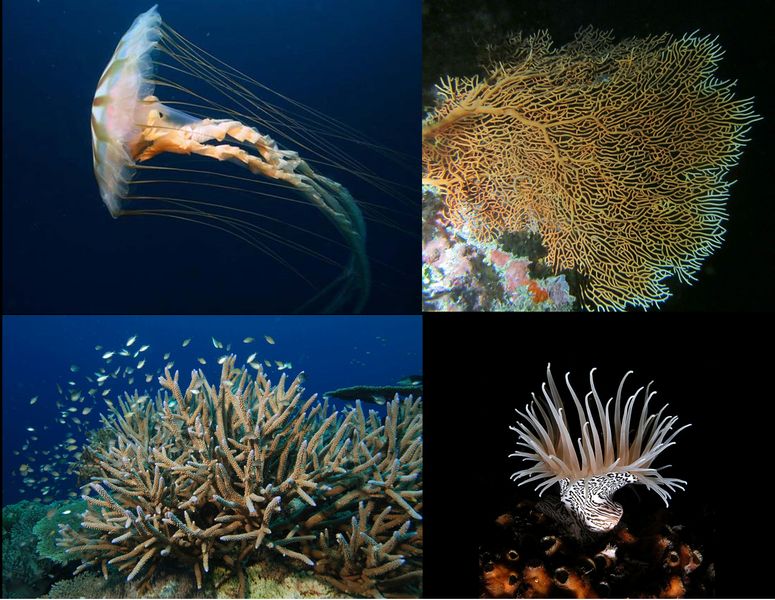
Four examples of Cnidaria (clockwise, from top left): jellyfish Chrysaora melanaster, gorgonian Annella mollis, sea anemone Nemanthus annamensis, stony coral Acropora cervicornis.
Photos: Frédéric Ducarme. Wikipedia: Cnidaria
4. Phylum Ctenophora: Translation: “comb + carry.” Comb Jellies are a worldwide phylum of marine invertebrates. The “combs” are groups of cilia used for swimming. They are the largest animals to use cilia for swimming and can grow to 5 ft. long. The body is a mass of jelly two layers thick, each layer two cells thick. They have a wide variety of body shapes, some egg-shaped with retractable tentacles to capture prey, some flat and combless, some with large mouths to consume other ctenophores. 186 living species in two classes are currently recognized. Link to Ctenophora. 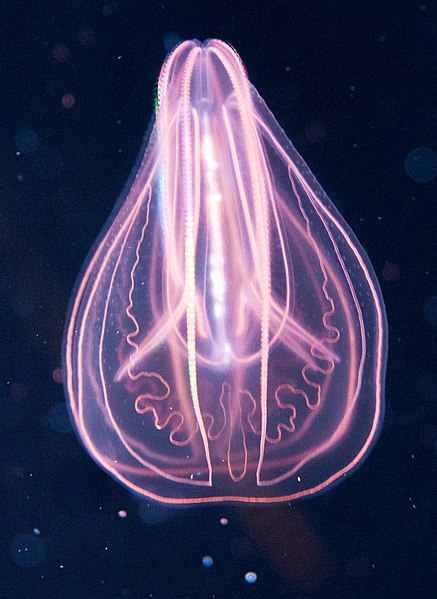
“Ctenophorae” (comb jelly). Photo: Orin Zebest. Wikipedia: Ctenophora
B. Kingdom Animalia, Clade Bilateria:
All remaining animals not previously discussed fall into this large clade (or infrakingdom) characterized by bilateral symmetry (left and right sides are mirror images during embryonic development). Nearly all (except echinoderms) remain bilateral into adulthood, with body plans laid around a longitudinal axis with head, tail, back and belly. Many are cephalized – specialized sense organs and central nerve ganglia (brain) are concentrated at the front end. In 2011, a now-widely accepted taxonomic alteration occurred resulting in the top-level division between Phylum Xenacoelomorpha and Clade Nephrozoa. Link to Bilateria.
5. Clade Bilateria, Phylum Xenacoelomorpha: A combination clade term, translation “friend + hollow.” Some of this phylum’s known 414 species were previously considered to be deuterostomes (“second mouth,” see definition at top), but DNA analysis showed they were a clade (common ancestor) and none were deuterostome or protostome. Most of these tiny, flat, wormlike organisms live in the spaces between grains of marine or brackish sediment. Link to Xenacoelomorpha. 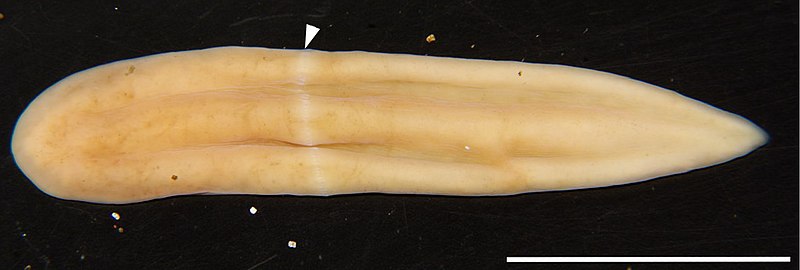
Xenoturbella japonica holotype female. The white arrowhead indicates the ring furrow. Photo: Hiroaki Nakano, Hideyuki Miyazawa, Akiteru Maeno, Toshihiko Shiroishi, Keiichi Kakui, Ryo Koyanagi, Miyuki Kanda, Noriyuki Satoh, Akihito Omori & Hisanori Kohtsuka Wikipedia: Xenacoelomprpha
C. Kingdom Animalia, Clade Bilateria, Clade Nephrozoa:
Translation “kidney + animal.” This clade, sister taxon to Phylum Xenacoelomorpha, contains all other animals not previously discussed, divided into Superphylum Deuterostomia and Clade Protostomia. Prior to 2011, Deuterostomia and Protostomia were the top division, appearing 650 mya, immediately below Bilateria. We’ll discuss the Protostomids first, then continue with the Deuterostomid cordates in the next blog in this series. Link to Nephrozoa.
D. Clade Bilateria, Clade Nephrozoa, Clade Protostomia:
Translation “first + mouth.” Originally thought to be characterized by the formation of the organism’s mouth before its anus during embryonic development, but since found to be extremely variable. Well known examples of protostomes are arthropods, molluscs, annelids, flatworms and nematodes. Link to Protostomia.
6. Phylum Nematoda – Roundworms: Translation: “thread + like.” Both free-living and parasitic, they have a tubular digestive tract opening at each end. Reduced number of Hox genes. Worldwide in many ecosystems. 25,000 described species, estimate of total species range from 40,000 to over a million. Link to Nematoda.

Gravid adult female Nippostrongylus brasiliensis, roundworm gastrointestinal parasite of rodents, with lifecycle similar to human hookworm parasites, collected from the small intestine of an infected BALB/c mouse. The photo shows a hooked anterior end containing eggs. Photo: J. Claire Hoving. Wikipedia: Nematode
7. Phylum Tardigrada – Water Bears: Translation: “slow + walk.” Worldwide in every ecosystem, they are probably the hardiest animals known, able to survive the vacuum of outer space. Eight-legged, plump, segmented and small (0.004-0.06” long). 1,335 known species. Link to Tardigrada.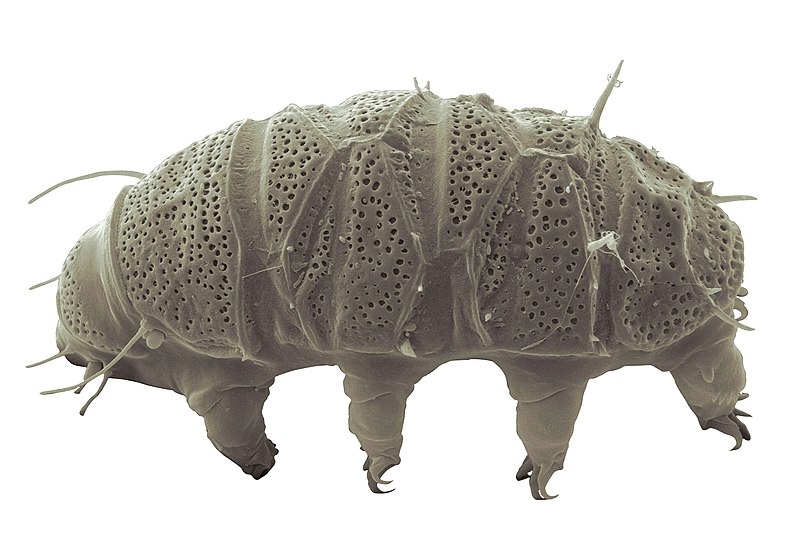
Echiniscus insularis – a heterotardigrade or “water bear.”
Photo: Kiosya Y, Vončina K, Gąsiorek P. Wikipedia: Tardigrade
8. Phylum Arthropoda – Arthropods: Translation “jointed + feet.” Segmented bodies with a hard exoskeleton of chitin and jointed appendages, growing by shedding their exoskeleton. Worldwide in all ecosystems, over 1,200,000 described species, with 5-15 times more still undescribed. Link to Arthropoda. 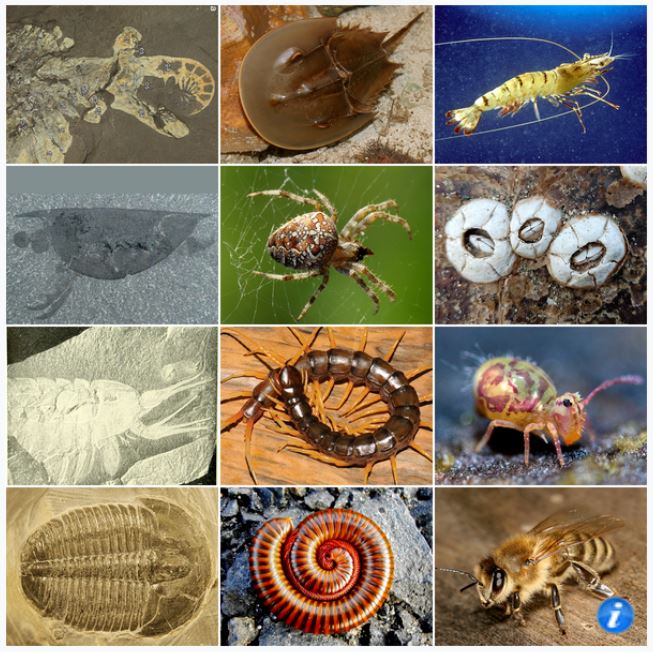
Twelve Arthropods L to R: Row top: Anomalocaris, Horseshoe Crab, Decapod; Row 2: Isoxys, Arachnid, Barnacle; Row 3: Leanchoilia, Centipede, Springtail, Row bottom: Trilobite, Millipede, Insect (bee).
Photo: various. Wikipedia: Arthropod
9. Phylum Rotifera – Wheel Animals. Translation “wheel + bearing.” First described in 1696 as “an animal like a large maggot which could contract itself into a spherical figure and then stretch itself out again; the end of its tail appeared with a forceps like that of an earwig.” Mostly microscopic, ranging in size 0.0020 in. to 0.79 in., common in fresh water worldwide, with a few saltwater species. The cylindrical body has a head, trunk and foot, a ciliated corona is on the head surrounding the mouth. Some are free swimming, others “inchworm” along substrates, others are sessile or planktonic. In June 2021 a rotifer was revived after 24,000 years in the Siberian permafrost. 2,000 known species. Link to Rotifera. 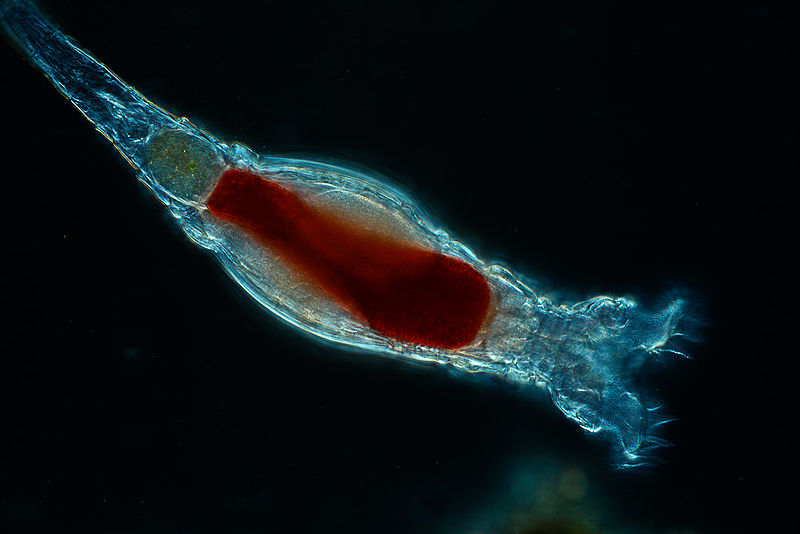
A Bdelloid Rotifera (wheel animal). Photo: Frank Fox. Wikipedia: Rotifer
10. Phylum Platyhelminthes – Flatworms: Translation “flat + worm”. Relatively simple, unsegmented soft-bodied acoelomates (no body cavity). As they have no specialized circulatory or respiratory organs, they must be flat to allow oxygen and nutrients to move throughout their bodies by diffusion. A single opening into the digestive cavity allows nutrients to pass in and wastes to pass out, thus food cannot be processed continuously. The three classes of Cestoda (Tapeworms), Trematoda (Flukes) and Monogenea are all parasitic. The former Class or clade of Turbellaria held the 4,500 species in the sub-groups that are not exclusively parasitic but mostly predatory. These range from 0.039 in. to freshwater forms more than 20 in. long. There are 29,500 described species. Link to Platyhelminthes. 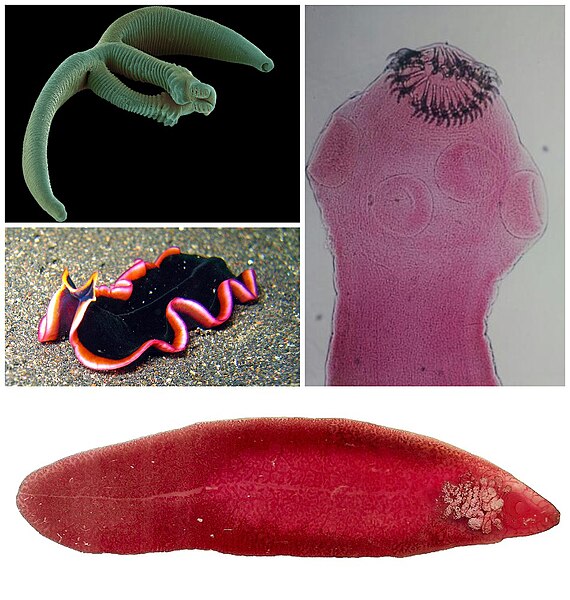
From top left clockwise: Eudiplozoon nipponicum (monogeneans), tapeworm head (tapeworms), liver fluke (trematodes), Pseudobiceros hancockanus (Turbellaria). Photo: OJJ Wikipedia: Flatworm
11. Phylum Nemertea: Ribbon or Proboscis Worms. Translation from “Nereis” (unerring one, for the accuracy of the proboscis), named for Greek sea-nymph Nemetes. Very thin and slow moving, most under 20” long, one species 180 ft. long. Mostly in the ocean, some live on the sea floor. 1350 known species. Link to Nemertea. 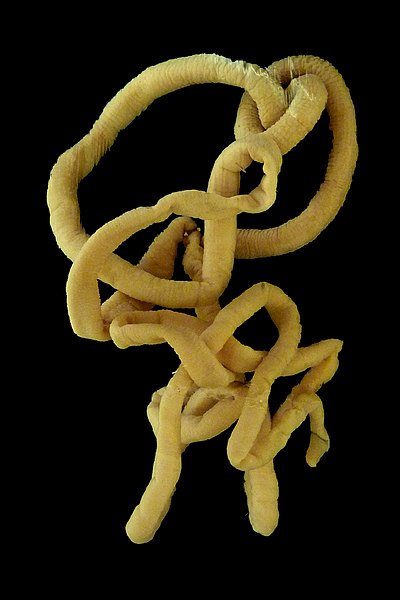
Bootlace Worm Lineus longissimus, a species of ribbon worm captured offshore from Britain, one of the longest known animals with specimens up to 180 ft. long being reported. Its mucus is highly toxic to human skin.
Photo: Citron / CC-BY-SA-3.0. Wikipedia: Lineus longissimus
12. Phylum Bryozoa: Translation “moss + animal.” Worldwide in salt or fresh water, mostly tropical at depths less than 100 meters. Nearly all are colonial, feed using a crown of tentacles (lophophore). 6,000 species described, all are small (0.015” long). Link to Bryozoa.

Greater Hornwrack Flustra foliacea (Linnaeus, 1758) from Belgium coastal waters. It looks like seaweed but is a colonial animal, each “leaf” is bilaminar, or two zooids (individual animals) thick. Photo: Hans Hillewaert. Wikipedia: Bryozoa
13. Phylum Mollusca – Snails, slugs, clams, chitons, squid, ammonites, tusk shells, worm-like molluscs. Translation “soft.” The second-largest animal phylum with 85,000-107,000 described species, another estimated 60,000-100,000 species undescribed, around 23% of all marine organisms, many also in fresh water and terrestrial habitats. Highly diverse in size, structure, behavior and habitat, divided into 6 or 7 extant classes plus 2 or 3 extinct classes. The most universal features are a body of solid muscle, a mantle cavity used for breathing and excretion, a hard tongue-like radula and a nervous system using nerve cords and ganglia. The extant Classes are: Gastropoda – snails and slugs, 70,000 known species, 80% of all molluscs. Bivalvia – clams, mussels, etc., 20,000 species. Polyplacophora – Chitons, 1,000 species. Cephalopoda– Squid, octopus, ammonites, 900 species. Scaphopoda – Tusk Shells, 500 species. Aplacophora – Worm-like seabed molluscs, 320 species. Monoplacophora – Seabed molluscs with cap shells. Link to Mollusca. 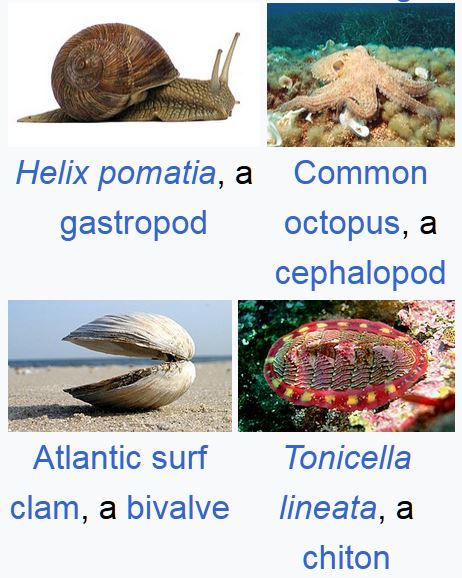
A few of the many mollusks. Wikipedia: Mollusca
14. Phylum Annelida – Segmented worms. Translation: “little ring.” They are worldwide in nearly all habitats. They are bilaterally symmetrical (as are all the bilateria), triploblastic (3 germ layers in the gastrula which follows the blastula in embryonic growth, as with all the bilateria), coelomate (body cavity surrounds all the organs), invertebrate, and move by means of parapodia (external body protrusions bearing bristly chaetae). There are 17,000-22,000 known species, including ragworms, earthworms and leaches, and range in size from microscopic to Microchaetus rappi, the African giant earthworm which grows up to 22 ft. and weighs 3.3 pounds. Link to Annelida.

Spirobranchus giganteus – Christmas Tree Worm, a marine annelid living in holes in coral; the colorful “tree,” which can retract in a fraction of a second, is used for feeding and respiration. Wikipedia: Spirobranchus giganteus
Our next posting in this series is on Cladistics. Following that we return to Kingdom Animalia where we’ll look at Superphylum Deuterostomia which includes our own Phylum Chordata and our sister taxa Phylum Echinodermata, home of starfish and sea urchins who look so much like us it’s sometimes hard to tell us apart.
The Taxonomy Series
Installments post ever other day; installments will not open until posted.
Taxonomy One: A brief survey of the history and wherefores of taxonomy: Aristotle, Linnaeus and his binomial system of nomenclature, taxonomic ranks and the discovery and application of biological clocks.
Taxonomy Two: Introduces the higher levels of current taxonomy: the three Domains and the four Kingdoms. We briefly discuss Kingdom Protista, then the seven phyla of Kingdom Fungi.
Taxonomy Three: Kingdom Plantae.
Taxonomy Four: Kingdom Animalia to Phylum Annelida.
Taxonomy Five: A discussion of Cladistics, how it works and why it is becoming ever more important.
Taxonomy Six: Phylum Chordata, stopping at Class Mammalia.
Taxonomy Seven: Class Mammalia.
Taxonomy Eight: Class Aves, beginning with a comparison of five different avian checklists of the past 50 years.
Taxonomy Nine: A cladogram and discussion of Subclass Neornithes (modern birds) of the past 110 million years, reaching down to the current forty-one orders of birds.
Taxonomy Ten: A checklist of Neornithes including all ranks and clades down to the rank of the current 251 families of birds (plus a few probable new arrivals) with totals of the current 11,017 species of birds.
[Text by Chuck Almdale; photos by Ray Juncosa & Chris Tosdevin]
*Original title of a 1992 film about legal eagles.
Don’t miss the quiz at the bottom.
It’s not a bird, but it was certainly among the most stunning flying creatures seen. But birders tend to appreciate (or simply envy) just about anything that flies: butterflies, moths, bats, grasshoppers, bees, even the occasional fly or those Jade Beetles (my name) that eat our figs unless the squirrels find them first. Mosquitoes and hornets, not so popular.

This diurnal moth of the family Erebidae, one of the largest moth families, is the Brown (or Brown-winged) Ctenucha, and is found from Central to Southern Coastal California. The body of Ctenucha brunnea is 20–26 mms (0.79–1.02 in) long and is blue with red markings on the head and shoulders; the wingspan 35–50 mm (1 3/8–2 in). Richard Harper Stretch first described it in 1872. Wikipedia says the adults are on wing mid-May to mid-July, but here it is August and this one is still out and about. They feed on the nectar of Toyon (Heteromeles arbutifolia), a very common shrub of our coastal sage scrub.

The eggs are round, laid in rows and fade from white to yellow. Larvae are black with buff-colored or yellow hairs, with two black tufts on the front and rear and an amber or orange head. They feed on Wild Rye (Leymus condensatus) plus other grasses and sedges. The pupae are chestnut in color and wrapped loosely in a cocoon of the larval hairs. From Santa Maria and north into Oregon it is replaced by Ctenucha multifaria. Keep an eye out for them! Two Links: Moth Photographers, Bug Guide
This won’t be all about moths and butterflies, but I have to put in some more photos of our very locally very common Pygmy Blue Butterfly (Brephidium exilis), reportedly the smallest butterfly in the world (some waffling websites say among the smallest, hrumpf!), wingspan 0.47-0.79″. Several dozen (at least!) were seen near a short stretch of the pathway to the beach, although you have to be careful of such claims are there are flies in the area nearly as large.

Although the low tide was not particularly low at +2.0 ft, it was less than an hour after the low that we began birding, and nearly all the water had run out of the channels and lagoon into the ocean.

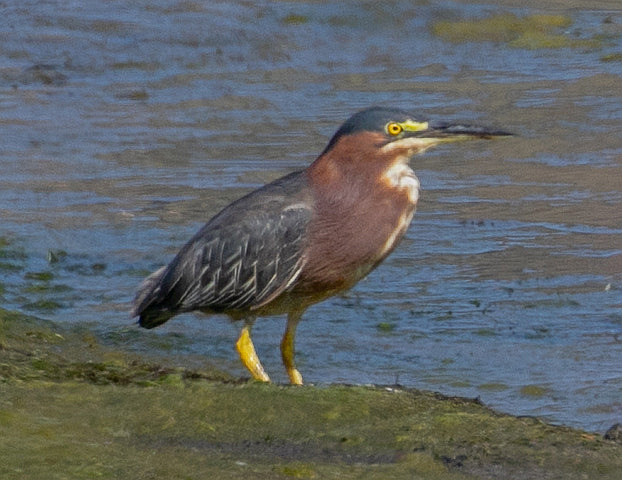
Unlike the other herons and egrets we never get many Green Herons, but we’ve had one per month for the past three months. Our records show that we had 6 on one occasion, 4 once, 3 four times, and the rest mostly singletons. They show up only 13% of the time – Black-crowned Night Heron is the next lowest at 47% of the time, and Snowy Egret tops the frequency list at 99% – but they’re better than the others at hiding and being obscure so they’re probably here more often than we think. Their neck is much longer than it looks here, but they keep it scrunched and hidden by feathers except when they lunge. As previously mentioned, the green is a muted olive-green, often not seen except in bright sunlight.
The shorebirds were definitely returning – five species “new for the season,” and twelve in all. The Ruddy Turnstones are among the most beautiful in breeding plumage (try Churchill on the Hudson Bay in June for thousands of them). The one below is a bit past the peak, but still quite lovely.

Not just shorebirds were dropping in. A small flock of six Western Kingbirds landed in the brush near us, and perched awhile before setting about on some serious flycatching.

One of the birds of the day was the Hairy Woodpecker. A couple of our birders who still have good hearing – probably Chris, Femi or Ruth – heard it among the cypress at the back of Malibu Colony. We watched it climb up and down the trunk and limbs before it took off. The lagoon is not exactly Woodpecker-rich habitat. Over the past 45 years our grand totals are: 6 species, 34 sightings, 35 individual birds. The six species: Acorn 1, Downy 7, Nuttall’s 16 and Hairy 3 Woodpeckers, Red-breasted Sapsucker 1 and Northern Flicker 7. I’ve seen more woodpecker species and higher counts in 5 hours of birding in a Georgia forest.

A few hours later the lagoon level was rising.

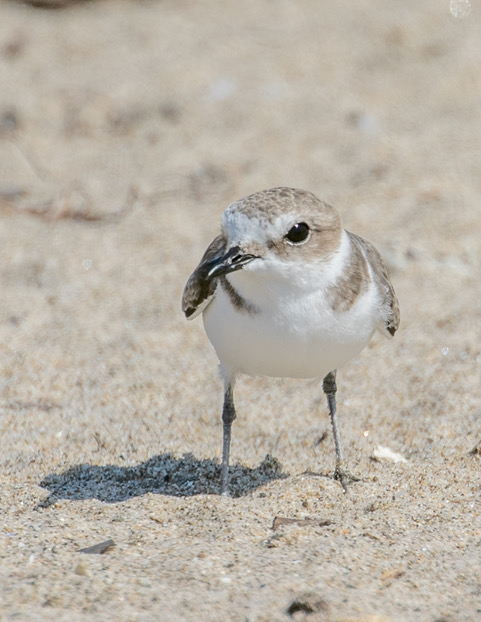
The Western Snowy Plovers were back last month with six birds; 22 this month. We didn’t see any banded birds. They were resting peacefully (as they do during rising tides) at the lagoon’s SE corner until two young women strolled right through the middle of them and they moved elsewhere not so easily seen nor trodden upon.
Black-bellied Plovers were in all shapes and forms, seventy birds strong.

European Birders call them Grey Plovers. As their bellies turn black in spring and back to off-white in late summer, thus spending more time “grey” than “black-bellied,” that may be a better name, as Golden Plovers also get black-bellies in breeding. There really is no one-name-fits-all-members-all-the-time-and-only-members for this species, and most other species as well. This one below seems to be losing a wing feather.

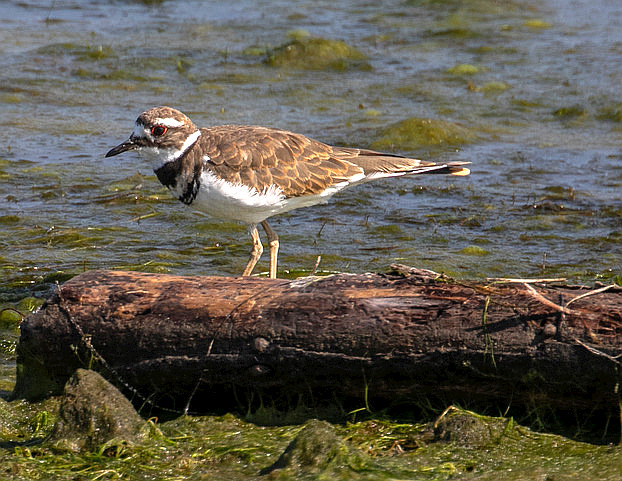
The Killdeer is a close cousin of the Black-belled Plover, albeit a different genus and 1″ shorter. Killdeer have bred around the lagoon for decades; I spotted my first Killdeer nest there in 1995, and their residency probably predates the previous ice age.
Long-billed Curlew is a species that drops in during migration for some R&R, but rarely stays long as the habitat isn’t really right for them. My first sighting of them here was 39 birds in mid-August 1980, a real anomaly, as my total for this species at the lagoon is only 70 birds on 22 occasions. Fifteen of those sightings were of single birds.

The lagoon edge was quite curvaceous, as befits the Surfrider Beach locale.

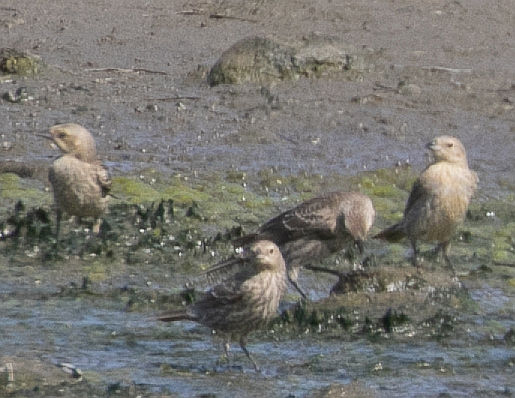
Shortly before leaving Chris Tosdevin saw a flock of birds drop down next to some distant water (hence photo blurriness). He decided upon closer photo analysis they were Brown-headed Cowbirds and I concur. They look like some sort of finch when they’re in this juvenile light brown coloration. Several of them were molting into dark plumage as is one of these below.

Our most unusual shorebird, a Greater Yellowlegs, managed to elude our photographers. They’ve been here on 39 occasions, a total of 51 individuals, or only 4% of our recorded visits. That’s not a lot for 319 total visits, but the Lesser (perhaps that ought to be Fewer) Yellowlegs is even less common: two occasions, two birds total.
Quiz Time!
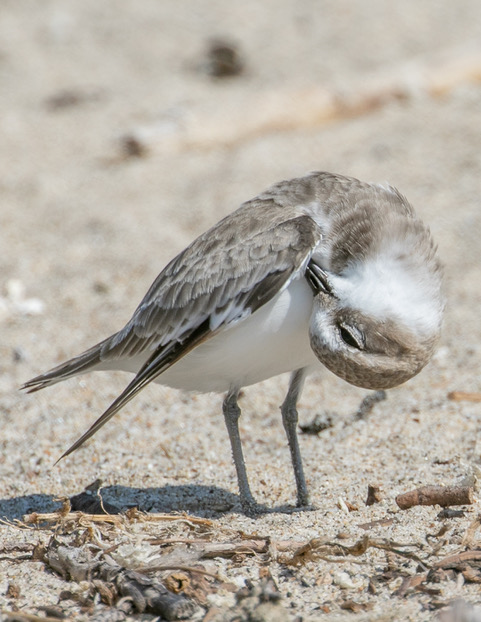
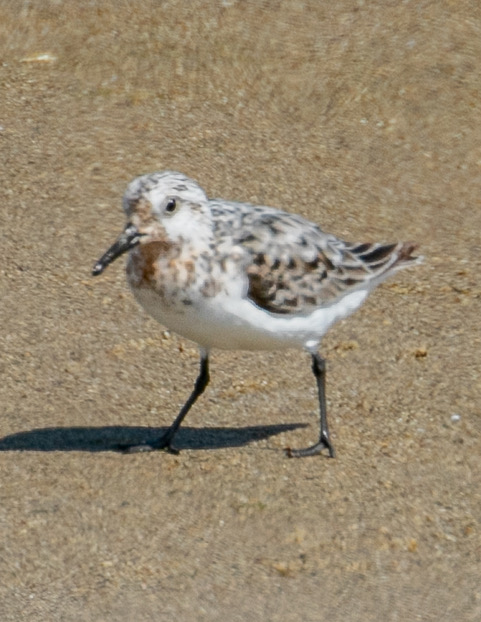
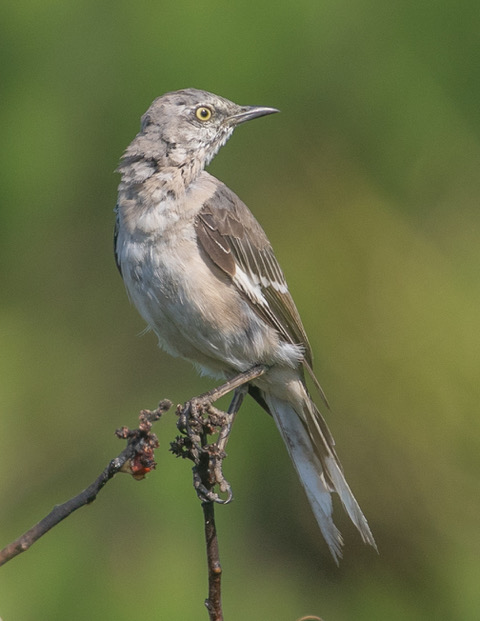
As these photos are all taken this August at the lagoon, many of the birds may be in plumage transition. Hint – Some of the following hints are “jokes” as they should be obvious and therefore of little use, but I’m not saying which ones.






Quiz Answers & credits
#1. Western Kingbird (Chris Tosdevin 8/25/24) White outer tail feathers.
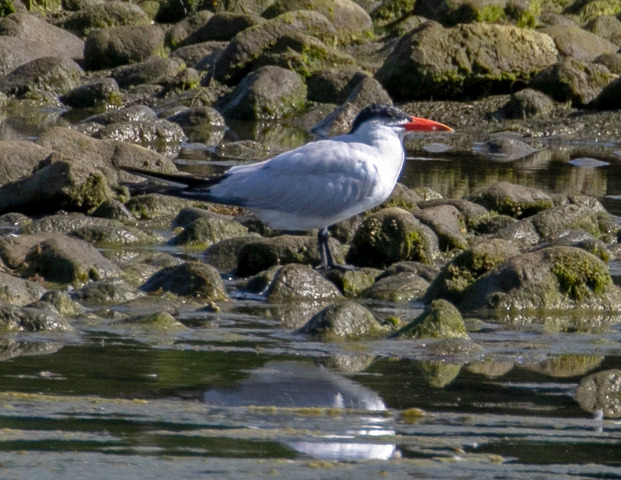
#2. Caspian Tern Tosdevin 8/25/24). Bloody great bloody red bill.
#3. Black-bellied Plovers, all of them. (Ray Juncosa 8/25/24)
#4. Sanderlings (Chris Tosdevin 8/25/24)
#5. Western Snowy Plover (Chris Tosdevin 8/25/24)
#6. Sanderling, partially molted (Chris Tosdevin 8/25/24)
#7. Northern Mockingbird (Chris Tosdevin 8/25/24). Question: Why is it “Northern?” Seriously.
#8. Brown-headed Cowbirds (Chris Tosdevin 8/25/24) in juvenile plumage.
#9. Black-bellied Plover and Sanderling (Chris Tosdevin 8/25/24)
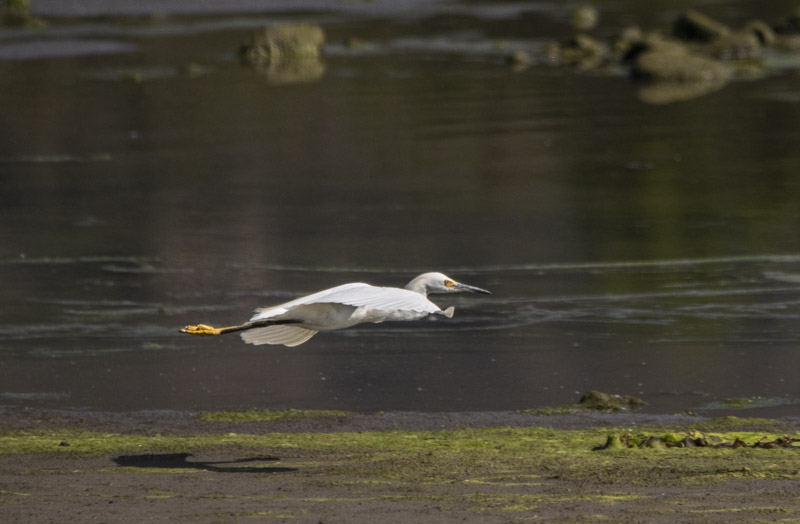
#10. Snowy Egret (Ray Juncosa 8/25/24)
#11. Double-crested Cormorants, end of nesting season in shopping center tree. (Ray Juncosa 8/25/24)
#12. Glaucous Winged Gull (Chris Tosdevin 8/25/24)
#13. Two Least Sandpipers and four Semipalmated Plovers (Chris Tosdevin 8/25/24)
#14. Allen’s Hummingbird (Chris Tosdevin 8/25/24)
Malibu Lagoon on eBird as of 8-28-24: 7985 lists, 2561 eBirders, 320 species.
Most recent species added: Red-breasted Nuthatch (31 October 2023, Kyle Te Poel).
Birds new for the season: American Coot, Semipalmated Plover, Greater Yellowlegs, Ruddy Turnstone, Sanderling, Least Sandpiper, Ring-billed Gull, Forster’s Tern, Royal Tern, Belted Kingfisher, Hairy Woodpecker, Ash-throated Flycatcher, Cassin’s Kingbird, Western Kingbird, Oak Titmouse, Blue-gray Gnatcatcher, House Wren, European Starling, Northern Mockingbird, Dark-eyed Junco, Brown-headed Cowbird, Orange-crowned Warbler, Common Yellowthroat. “New for the season” means it has been three or more months since last recorded on our trips.
Many, many thanks to photographers: Ray Juncosa, Chris Tosdevin.
Upcoming SMBAS scheduled field trips; no reservations or Covid card necessary unless specifically mentioned:
- Coastal Cleanup Day Sat. Sep 21, 9 am – Noon
- Malibu Lagoon, Sun. Sep 22, 8:30 (adults) & 10 am (parents & kids)
- Huntington Central Park, Sat. Oct 12, 8 am, contact leader
- These and any other trips we announce for the foreseeable future will depend upon expected status of the Covid/flu/etc. pandemic at trip time. Any trip announced may be canceled shortly before trip date if it seems necessary. By now any other comments should be superfluous.
- Link to Programs & Field Trip schedule.
The next SMBAS Zoom program: Professor Barney Schlinger, UCLA Dept. of Ecology & Evolutionary Biology; Language and the Brains of Birds & Humans, Evening Meeting, Tuesday, October 8, 2024, 7:30 p.m.
The SMBAS 10 a.m. Parent’s & Kids Birdwalk is again running. Reservations not necessary for families, but for groups (scouts, etc.), call Jean (213-522-0062).
Links: Unusual birds at Malibu Lagoon
9/23/02 Aerial photo of Malibu Lagoon
More recent aerial photo
Prior checklists:
2023: Jan-June, July-Dec 2024: Jan-June
2021: Jan-July, July-Dec 2022: Jan-June, July-Dec
2020: Jan-July, July-Dec 2019: Jan-June, July-Dec
2018: Jan-June, July-Dec 2017: Jan-June, July-Dec
2016: Jan-June, July-Dec 2015: Jan-May, July-Dec
2014: Jan-July, July-Dec 2013: Jan-June, July-Dec
2012: Jan-June, July-Dec 2011: Jan-June, July-Dec
2010: Jan-June, July-Dec 2009: Jan-June, July-Dec
The 10-year comparison summaries created during the Lagoon Reconfiguration Project period, remain available—despite numerous complaints—on our Lagoon Project Bird Census Page. Very briefly summarized, the results unexpectedly indicate that avian species diversification and numbers improved slightly during the restoration period June’12-June’14.
Many thanks to Marie Barnidge-McIntyre, Femi Faminu, Lillian Johnson & others for their contributions to this month’s checklist.
The species lists below is irregularly re-sequenced to agree with the California Bird Records Committee Official California Checklist. If part of the right side of the chart below is hidden, there’s a slider button inconveniently located at the bottom end of the list. The numbers 1-9 left of the species names are keyed to the nine categories of birds at the bottom.
[Chuck Almdale]
| Malibu Census 2023-24 | 3/24 | 4/28 | 5/26 | 6/23 | 7/28 | 8/25 | |
| Temperature | 46-54 | 62-72 | 57-64 | 62-72 | 63-72 | 64-78 | |
| Tide Lo/Hi Height | H+4.71 | L-0.14 | L-0.77 | L-1.17 | L+1.81 | L+2.00 | |
| Tide Time | 0936 | 0738 | 0635 | 0537 | 0916 | 0735 | |
| 1 | Brant (Black) | 2 | |||||
| 1 | Canada Goose | 7 | 6 | 8 | 9 | 4 | |
| 1 | Cinnamon Teal | 2 | |||||
| 1 | Northern Shoveler | 4 | 2 | ||||
| 1 | Gadwall | 24 | 20 | 22 | 35 | 27 | 12 |
| 1 | American Wigeon | 4 | |||||
| 1 | Mallard | 12 | 10 | 14 | 15 | 6 | 2 |
| 1 | Green-winged Teal | 4 | |||||
| 1 | Surf Scoter | 6 | 4 | ||||
| 1 | Long-tailed Duck | 1 | |||||
| 1 | Red-breasted Merganser | 9 | 4 | 2 | |||
| 2 | Pied-billed Grebe | 1 | 1 | 1 | 1 | ||
| 2 | Western Grebe | 9 | 1 | ||||
| 7 | Feral Pigeon | 2 | 5 | 3 | 6 | 9 | |
| 7 | Mourning Dove | 2 | 5 | 2 | 3 | ||
| 8 | Anna’s Hummingbird | 2 | 2 | 2 | 1 | 2 | |
| 8 | Allen’s Hummingbird | 5 | 1 | 5 | 1 | 2 | 3 |
| 2 | American Coot | 63 | 1 | 2 | |||
| 5 | Black-necked Stilt | 2 | |||||
| 5 | Black Oystercatcher | 4 | |||||
| 5 | Black-bellied Plover | 3 | 1 | 51 | 70 | ||
| 5 | Killdeer | 3 | 6 | 4 | 3 | 12 | 4 |
| 5 | Semipalmated Plover | 9 | 13 | ||||
| 5 | Snowy Plover | 20 | 6 | 22 | |||
| 5 | Whimbrel | 39 | 4 | 2 | 52 | 2 | |
| 5 | Long-billed Curlew | 1 | 1 | ||||
| 5 | Marbled Godwit | 20 | |||||
| 5 | Wilson’s Phalarope | 1 | |||||
| 5 | Spotted Sandpiper | 1 | 2 | ||||
| 5 | Willet | 4 | 2 | 2 | 9 | 5 | |
| 5 | Greater Yellowlegs | 1 | 1 | ||||
| 5 | Ruddy Turnstone | 1 | |||||
| 5 | Sanderling | 2 | |||||
| 5 | Least Sandpiper | 12 | 2 | 23 | |||
| 5 | Western Sandpiper | 20 | 6 | 13 | |||
| 6 | Bonaparte’s Gull | 2 | 10 | ||||
| 6 | Heermann’s Gull | 16 | 6 | 65 | 42 | 5 | |
| 6 | Ring-billed Gull | 18 | 4 | 3 | 2 | ||
| 6 | Western Gull | 58 | 16 | 45 | 160 | 220 | 113 |
| 6 | Herring Gull | 3 | |||||
| 6 | California Gull | 170 | 60 | 38 | 3 | 10 | 23 |
| 6 | Glaucous-winged Gull | 1 | 1 | 1 | |||
| 6 | Caspian Tern | 2 | 20 | 8 | 14 | 4 | |
| 6 | Forster’s Tern | 1 | 2 | ||||
| 6 | Elegant Tern | 200 | 190 | 25 | 240 | 10 | |
| 6 | Royal Tern | 4 | 60 | 2 | 5 | ||
| 2 | Red-throated Loon | 2 | |||||
| 2 | Common Loon | 1 | |||||
| 2 | Brandt’s Cormorant | 1 | 35 | ||||
| 2 | Pelagic Cormorant | 1 | 1 | 4 | 1 | ||
| 2 | Double-crested Cormorant | 32 | 26 | 120 | 24 | 28 | 37 |
| 2 | Brown Pelican | 171 | 235 | 348 | 125 | 163 | 27 |
| 3 | Black-crowned Night-Heron | 1 | 1 | 2 | 1 | 1 | |
| 3 | Snowy Egret | 3 | 3 | 2 | 7 | 4 | 3 |
| 3 | Green Heron | 1 | 1 | 1 | |||
| 3 | Great Egret | 5 | 4 | 9 | 3 | 3 | |
| 3 | Great Blue Heron | 1 | 4 | 3 | 3 | 4 | |
| 4 | Turkey Vulture | 1 | 4 | 1 | |||
| 4 | Osprey | 1 | |||||
| 4 | Red-shouldered Hawk | 1 | |||||
| 8 | Belted Kingfisher | 1 | |||||
| 8 | Nuttall’s Woodpecker | 1 | |||||
| 8 | Hairy Woodpecker | 1 | |||||
| 9 | Black Phoebe | 2 | 4 | 7 | 3 | 6 | 3 |
| 9 | Ash-throated Flycatcher | 1 | |||||
| 9 | Cassin’s Kingbird | 4 | 1 | ||||
| 9 | Western Kingbird | 8 | |||||
| 9 | Warbling Vireo | 1 | |||||
| 9 | California Scrub-Jay | 2 | 1 | ||||
| 9 | American Crow | 4 | 3 | 4 | 6 | 4 | 4 |
| 9 | Common Raven | 1 | 2 | 3 | |||
| 9 | Oak Titmouse | 1 | |||||
| 9 | Tree Swallow | 1 | 3 | ||||
| 9 | Violet-green Swallow | 2 | 8 | ||||
| 9 | No. Rough-winged Swallow | 5 | 5 | 2 | 5 | 2 | |
| 9 | Barn Swallow | 10 | 10 | 20 | 20 | 20 | 20 |
| 9 | Cliff Swallow | 30 | 6 | 4 | |||
| 9 | Bushtit | 2 | 2 | 5 | 9 | 19 | 5 |
| 9 | Wrentit | 2 | 1 | ||||
| 9 | Blue-gray Gnatcatcher | 1 | 1 | ||||
| 9 | House Wren | 1 | 2 | ||||
| 9 | European Starling | 5 | 1 | ||||
| 9 | Northern Mockingbird | 1 | |||||
| 9 | Scaly-breasted Munia | 1 | |||||
| 9 | House Finch | 15 | 10 | 15 | 11 | 12 | 5 |
| 9 | Lesser Goldfinch | 20 | 2 | 5 | 2 | ||
| 9 | Dark-eyed Junco | 2 | 1 | ||||
| 9 | White-crowned Sparrow | 15 | |||||
| 9 | Song Sparrow | 14 | 10 | 5 | 5 | 4 | 10 |
| 9 | California Towhee | 1 | 1 | 4 | 4 | 1 | 1 |
| 9 | Spotted Towhee | 1 | 1 | ||||
| 9 | Hooded Oriole | 1 | 1 | 1 | |||
| 9 | Red-winged Blackbird | 4 | 11 | ||||
| 9 | Brown-headed Cowbird | 2 | 18 | ||||
| 9 | Great-tailed Grackle | 3 | 2 | 3 | 3 | ||
| 9 | Orange-crowned Warbler | 1 | 1 | 1 | 1 | ||
| 9 | Common Yellowthroat | 2 | 1 | 1 | |||
| 9 | Yellow-rumped Warbler | 4 | |||||
| Totals by Type | Mar | Apr | May | Jun | Jul | Aug | |
| 1 | Waterfowl | 72 | 45 | 50 | 59 | 37 | 14 |
| 2 | Water Birds – Other | 268 | 263 | 516 | 155 | 192 | 68 |
| 3 | Herons, Egrets & Ibis | 4 | 13 | 7 | 22 | 12 | 12 |
| 4 | Quail & Raptors | 1 | 1 | 1 | 0 | 4 | 1 |
| 5 | Shorebirds | 123 | 29 | 6 | 9 | 139 | 157 |
| 6 | Gulls & Terns | 272 | 362 | 302 | 254 | 527 | 165 |
| 7 | Doves | 2 | 0 | 7 | 8 | 8 | 12 |
| 8 | Other Non-Passerines | 7 | 3 | 8 | 2 | 2 | 7 |
| 9 | Passerines | 115 | 57 | 118 | 92 | 70 | 92 |
| Totals Birds | 864 | 773 | 1015 | 601 | 991 | 528 | |
| Total Species | Mar | Apr | May | Jun | Jul | Aug | |
| 1 | Waterfowl | 9 | 6 | 6 | 3 | 3 | 2 |
| 2 | Water Birds – Other | 5 | 3 | 8 | 5 | 3 | 5 |
| 3 | Herons, Egrets & Ibis | 2 | 4 | 3 | 5 | 5 | 5 |
| 4 | Quail & Raptors | 1 | 1 | 1 | 0 | 1 | 1 |
| 5 | Shorebirds | 8 | 8 | 2 | 5 | 8 | 12 |
| 6 | Gulls & Terns | 8 | 7 | 8 | 5 | 6 | 9 |
| 7 | Doves | 1 | 0 | 2 | 2 | 2 | 2 |
| 8 | Other Non-Passerines | 2 | 2 | 3 | 2 | 1 | 4 |
| 9 | Passerines | 22 | 14 | 19 | 17 | 9 | 22 |
| Totals Species – 98 | 58 | 45 | 52 | 44 | 38 | 62 |
Citizen Science: Smoke and Birds
The Santa Monica Bay Audubon Society is encouraging all our members to participate in an important research project by counting and reporting the number of birds seen or heard, by species, for 10 minutes each week in a location convenient to them. Eventually this information will support our efforts to maintain or improve the abundance of birds in our area by clarifying the impacts of wildfires due to anthropogenic Climate Change.
Project Phoenix is a community science project supported by the UCLA La Kretz Center for California Conservation Science and the Natural History Museum of Los Angeles County (NHMLAC). The goal is to engage communities in monitoring birds in their neighborhoods during Summer and Fall to learn more about how wildfire smoke and urban air pollution impact bird behavior and species distributions. This research will help identify the places and resources birds use when it is smoky to inform local conservation strategies and protect birds in the age of megafires. The program is open to birders of all ages and backgrounds including families and beginner birders. There is no cost to participate, and online training is available for folks new to birding. Volunteers sign up to conduct weekly, 10-minute, stationary point counts of birds at a monitoring site of their choosing – their backyard, favorite park, etc. They may contribute additional observations (e.g., from additional surveys or opportunistically) if they choose. Last year’s Project focused on monitoring birds in California for 3 months – August through October. In 2024, it is expanding to include communities in Washington and Oregon and collecting data for 5 months – July through November. Identification of species by sound may be determined using The Cornell Lab “Merlin” app on your smartphone. Reporting of the data is via eBird.
Project Phoenix research goals:
-
Collect data on the presence and abundance of birds during the fire season.
-
Evaluate the impact of urban air pollution and wildfire smoke on bird distributions, and consider if these responses vary across habitats.
-
Propose local intervention strategies to help birds during acute smoke events
To participate, go to https://www.project-phoenix-investigating-bird-responses-to-smoke.org/
NB: Many thanks to Whittier Audubon for the above article. Also, surveying is from now to November so there is plenty of time to participate.
Kingdom Plantae | Taxonomy 3
[By Chuck Almdale]
Kingdom Plantae
Kingdom Plantae includes everything we call plants which have chlorophyll, but also includes parasitic plants which lack chlorophyll. They are multicellular, eukaryotic and autotrophic (thanks to chlorophyll). As usual, systematic disagreements exist and different systems can use anywhere from 3 to 5 groups (clades), and 5 to 14 divisions (= phyla). The cladogram below from Cal Poly Humboldt Natural History Museum does a great job of laying out five groups (clades) and twelve divisions, showing nodes, branches, dates and groups. This example demonstrates a primary reason cladograms have been replacing written sequences for the higher levels of taxonomy: they are easy to see and understand and you can pack a lot of useful information into a small space. The rest of this posting is not intended to be a complete description of the plant kingdom as the taxonomy and systematics of plants are currently in great flux, with incompatible systems in use and an enormous number of additional clades used and proposed. We’ll keep this extremely simple and the following accounts of the major ranks and groups are brief. The information is organized to correspond to the following cladogram, but be aware there are many other taxonomic systems currently in use.
From: Cal Poly Humboldt Natural History Museum
Terms of Biological Nomenclature:
Taxonomy: A practice and science concerned with classification or categorization on the basis of shared characteristics, typically with two parts:
a. Taxonomy: The development of an underlying scheme of classes.
b. Classification: The allocation of things to the classes, ranks or taxa.
Taxon: In biology, a taxon (back-formation from “taxonomy”; plural: taxa) is a group of one or more populations of an organism or organisms seen by taxonomists to form a unit. Although neither is required, a taxon is usually known by a particular name and given a particular ranking, especially if and when it is accepted or becomes established.
Systematics: The branch of biology that deals with classification and nomenclature.
Binomial Nomenclature: System of scientifically naming organisms with two words.
Genus: The taxonomic category above species.
Species: The most basic taxonomic category consisting of individuals who can – in the biological definition of “species” – produce fertile offspring.
Clade: A biological grouping that includes the common ancestor and all the descendants (living and extinct) of that ancestor.
Polyphyletic: When a group of organisms derive from more than one common evolutionary ancestor or ancestral group and are therefore not suitable for placing in the same taxon.
A Few Biological Definitions
Division: Kingdom Plantae uses the rank “division” rather than “phylum.”
Gametophyte: One of the two alternating multicellular phases in the life cycles of plants and algae, in which a haploid multicellular organism develops from a haploid spore that has one set of chromosomes. The gametophyte is the sexual phase in the life cycle of plants and algae. The plant develops sex organs which produce gametes – haploid sex cells which when fertilized form a diploid zygote (two sets of chromosomes). Cell division of the zygote results in a new diploid multicellular sporophyte which produces haploid spores by meiosis. When germinated they produce a new generation of gametophytes.
Thallus: A plantlike vegetative body (as of algae, fungi, or mosses) lacking differentiation into distinct parts (stem, leaves, roots, etc.) and does not grow from an apical tip of shoots or roots. They have no vascular tissue but may have structures analogous to their vascular “equivalents.”
Repeats from Taxonomy 2
Autotrophic: Able to produce their own food using light, water, carbon dioxide, or other chemicals; plants with chlorophyll are the best-known autotrophs.
Heterotrophic: Must eat other organisms for energy and nutrients, as do animals likes lice and humans.
Eukaryote: Organisms whose cells contain a membrane-bound nucleus, including all known non-microscopic organisms such as worms and humans. In other words, every living thing except bacteria mentioned from here on in this series.
Prokaryote: Unicellular organisms lacking a nucleus and other membrane-bound organelles: the Archaea and Bacteria.
Leaf-like thallus of Pellia epiphylla. Wikipedia – Thallus
Clade one: Algae
Algae are chlorophyll-bearing, simple, thalloid, autotrophic and largely aquatic (both fresh water and marine) organisms. They occur in a variety of other habitats: moist stones, soils and wood. Some of them also occur in association with fungi (lichen) and animals (on sloth fur). Algal form and size is highly variable, ranging from colonial forms like Volvox, to filamentous forms (Spirogyra) to massive bodies (giant kelp). Many taxonomic systems don’t include Algae as a plant and assign algae to as many as five different divisions (plant phyla).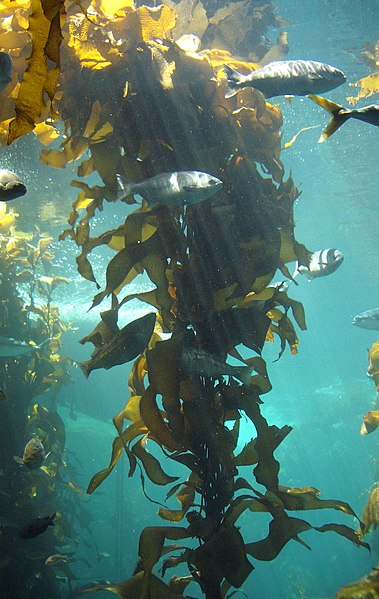
The kelp forest exhibit at the Monterey Bay Aquarium: A three-dimensional, multicellular thallus. Photo: Stef Maruch Wikipedia – Algae
Clade two: Bryophytes
A nonvascular subclade of embryophytes (land plants), first appearing 420 million years ago.
Division Marchantiophyta – Liverworts: A division of non-vascular land plants commonly referred to as hepatics or liverworts. With mosses and hornworts, they have a gametophyte-dominant life cycle, in which cells of the plant carry only a single set of genetic information. Most look like small (2-20 mm) flattened mosses. There may be as many as 9,000 species. 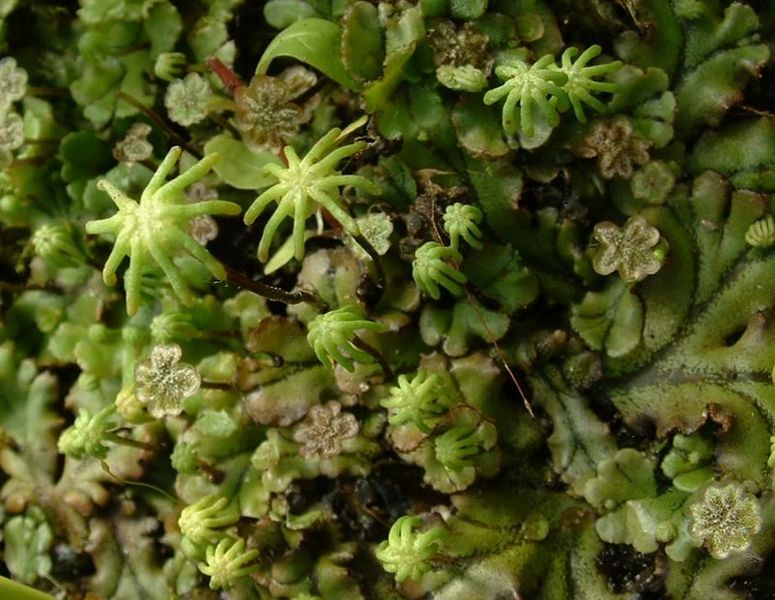
Marchantia polymorpha, with antheridial and archegonial stalks.
Photo: Jeffdelonge Wikipedia – Marchantiophyta
Division Anthocerotophyta – Hornworts: They look a bit like a cross between a horsetail and a fern and grow up to 3 meters high, with a sporophyte structure that looks like a horn. They grow in damp or humid places, possibly worldwide, and there may be only 100-150 species although 300 have been described. 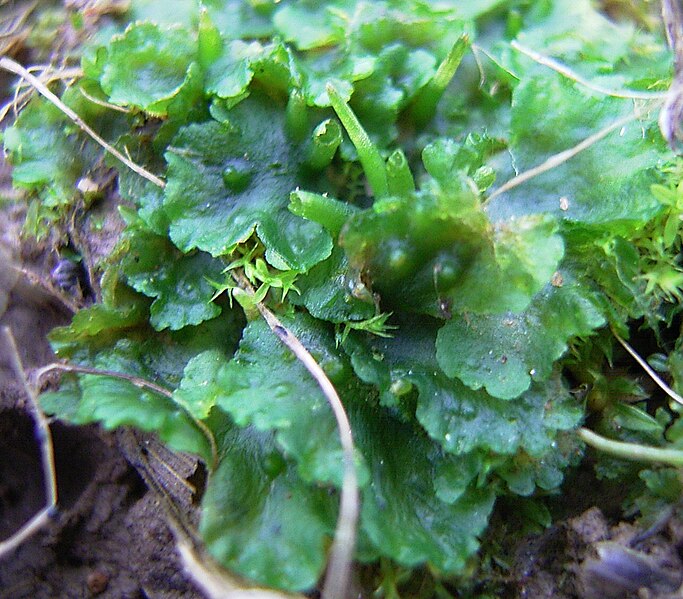
Phaeoceros laevis. Photo: de:Benutzer:Oliver_s. Wikipedia – Hornwort
Division Bryophyta – Mosses: Small, non-vascular flowerless, typically forming dense green clumps or mats, usually in damp or shady spots. Individual plants are usually composed of simple leaves one cell thick, attached to a branched or unbranched stem that conducts very little water or nutrients. Unlike liverworts and hornworts, they do have vascular systems. Seedless, they develop sporophytes topped with single capsules containing spores. The world’s tallest moss is Dawsonia, growing up to 20” high. There are approximately 12,000 species.
Clade three: Pteridophyta – Vascular plants
These are vascular plants (xylem transports nutrients from root to leaf, phloem transports them from leaf to root) and reproduce by means of spores, producing neither flowers no seeds. They appeared 410-375 million years ago.
Division Lycophyta – Clubmosses, fernmosses, spikemosses and quillworts. These have microphyllous leaves (single unbranched leaf vein) and reproduce with spores. During the Carboniferous Era they grew up to 50 m tall, formed extensive forests and contributed heavily to coal deposits. There may be as many as 1,200 extant species, all are small understory plants, often only an inch or two tall. 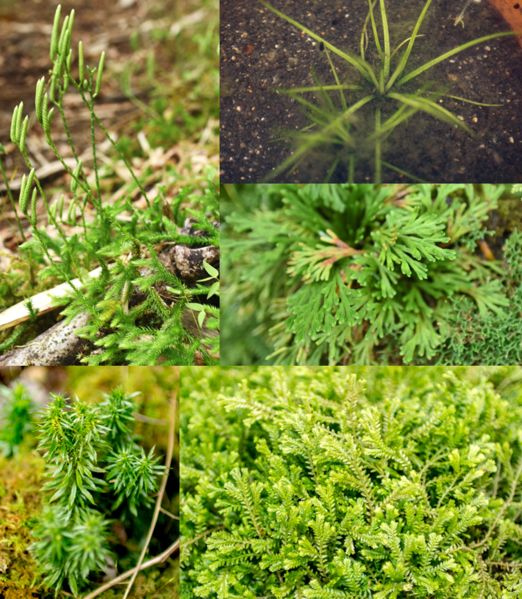
Modern lycophytes, clockwise from upper left: Lycopodium clavatum (Lycopodiales, Lycopodioideae), Isoetes japonica (Isoetales), Selaginella tamariscina, Selaginella remotifolia Selaginellales, Huperzia serrata (Lycopodiales, Huperzioideae). Photo: Kingfiser. Wikipedia – Lycophyta
Division Polypodiopsida (or Polypodiophyta) – Ferns: Their complex leaves (megaphylls) have multiple veins within the leaf and leaf gaps above them in the stem. Most ferns are leptosporangiate (the spore-forming enclosure is itself formed from a single epidermal cell, not from a group of cells [as are the eusporangiate ferns]). The fronds begin as coiled fiddleheads which uncurl as they grow. There are over 10,500 known extant species. The tallest fern in the world is the tree fern Cyathea australis,native to southeastern Australia, which grows to a 20 m (65 ft 6 in) high, with fronds up to 3 m (9 ft 9 in) long. Wikipedia – Fern

Unfolding frond of a Ponga (tree fern), Akatarawa River, New Zealand.
Photo: Karora. Wikipedia – Cyatheales
Division Equisetophyta or Sphenophyta – horsetails, marestails, snake grass, puzzlegrass. Some botanists consider this a subclass of Polypodiopsida (ferns), others maintain it as a division. As with the Lycopods they grew very large during the Carboniferious period, up to 98 ft tall. They are now “living fossils,” reduced to a single living genus and about 20 species. They like wet areas and have whorls of needle-like branches radiating at regular intervals from a single vertical segmented hollow stem. The small leaves are microphylls. Some stems will bear small cones (strobili) at their tips, comprised of sporangiophores. 
Northern Giant Horsetail, Equisetum telmateia (Equisetopsida) at Cambridge Botanic Garden. Typically 12–59 in. tall, rarely to 94 in. Photo: Rror. Wikipedia – Equisetophyta
Clade four: Gymnospermae
Vascular plants reproducing by means of an exposed (naked) seed or ovule which are directly fertilized by pollination. These began appearing 300 million years ago.
Division Cycadophyta – Cycads: They have a stout woody (ligneous) trunk with a crown of large, hard, stiff, evergreen and (usually) pinnate leaves (growing in pairs on the sides of a central shaft). They are dioecious (each plant is either male or female), Often mistaken for but unrelated to palms or ferns, they live long and grow slowly to heights of a few centimeters to several meters tall. There are over 300 cycad species in three families, and cycad leaves are featured on the flag of Vanuatu. 
Section of flag of Vanuatu showing cycad leaf. Wikipedia – Vanuatu
Division Ginkgophyta – Ginkgo: Although Ginkos are an ancient group dating back 300 million years to the early Carboniferous period, there is only remaining extant species, Ginkgo biloba. The tree is dioecious, with pollen organs similar to the catkins of angiosperms. Pollen organs and sporophylls grow at the juncture of leaves and stems, and ovules are fertilized by flagellated male gametes which can move about. Their leaves are wide and flat with two lobes. 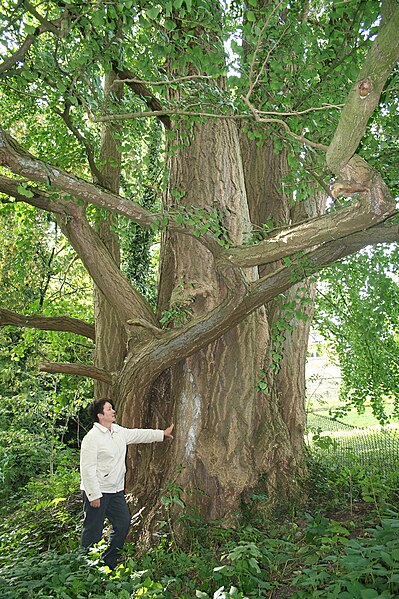
Ginkgo biloba tree in Tournai, Belgium.
Photo: Jean-Pol Grandmont. Wikipedia – Ginkgo biloba
Division Pinophyta or Coniferophyta or Coniferae – Conifers: These are perennial woody plants which exhibit secondary growth, resulting from cell division in the cambium (tissue between xylem and phloem) or lateral meristems and which causes the stems and roots to thicken. Seeds are born in cones. The single living class contains seven families containing over 600 species, including the well-known and important cedars, cypresses, firs, junipers, pines, redwoods, spruces and yews. Recently the gnetophytes, sometimes considered a separate division (or class, subclass or order), may be considered a subclade within Pinophyta. Wikipedia – Conifer
Clade five: Angiospermae, formerly Magnoliophyta
Angiosperms have enclosed seeds with many complex fertilization arrangements. They include all forbs (flowering plants without a woody stem), grasses and grass-like plants, nearly all broad-leaved trees, shrubs and vines, and most aquatic plants. “Angiosperm” derives from Greek angeion (‘container, vessel’) + sperma (‘seed’), indicating that the seeds are enclosed within a fruit. This most diverse group of land plants began diverging from the gymnosperms 300 million years ago and their diversification began exploding 120 million years ago. They now have 64 orders, 416 families, about 13,000 genera and 300,000 described species. As one might expect with such a large and important group of organisms, there are many systems for dividing them up. The following system is one used on Wikipedia.
Basal Angiosperms: These are perhaps 175 species of flowering plants which diverged early from the lineage leading to most flowering plants, collectively known as ANA grade and include Amborella (a single shrub species from New Caledonia), Nymphaeales (water lilies) and Austrobaileyales (aromatic woody plants including star anise). 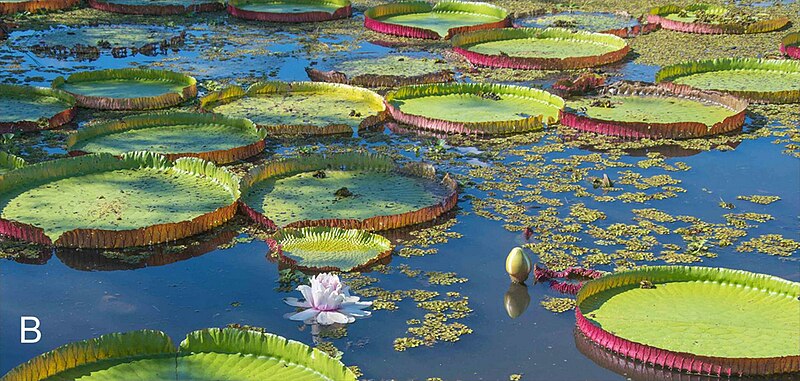
Giant Water Lily Victoria boliviana sp. nov. (Bolivia, Beni); leaves are up to 3 m. across. Photo: Carlos Magdalena; Wikipedia – Nymphaeales
Clade Mesangiospermae – Core Angiosperms: These comprise all the rest of the flowering plants. The following five groups make up this core.
Clade Magnolianae or Magnoliidae – Magnoliids: The third largest group and includes about 10,000 species, characterized by trimerous flowers (3 each of sepals, petals, stamens or carpels), pollen with one pore, and usually branching-veined leaves. It includes such common and popular plants as: magnolias, nutmeg, bay laurel, cinnamon, avocado, black pepper and tulip tree. 
Flower of Asimina triloba – Pawpaw.
Photo: User:Phyzome. Wikipedia – Magnoliids
Clade Chloranthaceae – Chloranthales: This group consists of a single family of 79 species of woody or weakly woody plants occurring in SE Asia, the Pacific, Madagascar, Central and South America, and the West Indies. They are fragrant shrubs or herbaceous plants that produce new side branches only on new growth. Evergreen leaves are arranged in pairs on opposite sides of the cylindrical stem. Petals and sometimes sepals are absent on the small flowers. Fruits are drupes or berries. Their ancestors date back to the early Cretaceous and have been found on all continents. 
Fortune’s Chloranthus, Chloranthus fortunei.
Photo: bastus917. Wikipedia – Chloranthaceae
Clade Monocotyledons – Monocots: The second largest group of about 70,000 species are the grasses and grass-like flowering plants whose seeds typically contain only one embryonic leaf (cotyledon), which is the first to pop out of the sprouting seed. This used to be one of the two major groups – the other was the dicots with two “seed leaves” – into which flowering plants were traditionally divided, but no longer. Monocots include 20,000 species of orchids and 12,000 of true grasses. The major grains (rice, wheat, maize), sedges, sugar cane and bamboo are monocots. 
Onion slice: the cross-sectional view shows the veins that run in parallel along the length of the bulb and stem. Photo: flikr0114. Wikipedia – Monocotyledon
Clade Eudicotidae – eudicots, formerly dicots: These are characterized by having two seed leaves (cotyledons) upon germination. They have previously been called tricolpates or non-magnoliid dicots. Estimates range from 175,000 to 280,000 species which includes many of our commonly cultivated and edible plants and most leafy, mid-latitude trees. Sunflower, dandelion, forget-me-not, cabbage, apple, buttercup are all eudicots. 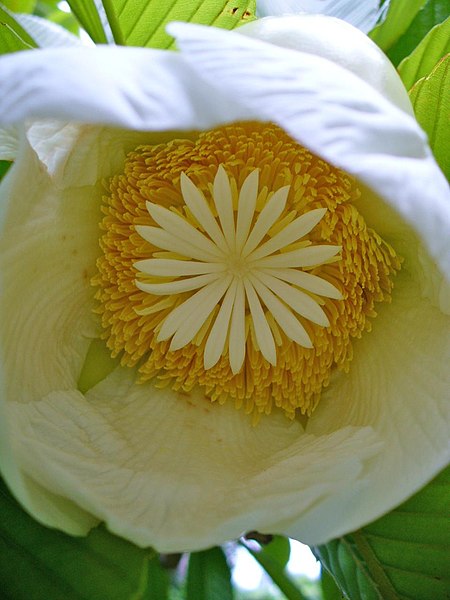
Flower of Elephant Apple or Ou Tenga, Dillenia indica, native to tropical Asia. Photo: Scott.zona. Wikipedia: Pentapetalae
Division Ceratophyllaceae – Coontails: Found worldwide but composed of a single genus with 6-30 species, therefore the subject of arguments. Also known as hornworts, but completely unrelated to the hornworts discussed earlier. They are common in ponds, marshes and quiet streams in tropical and temperate regions, submerged as they grow up to the surface where they float as they grow. 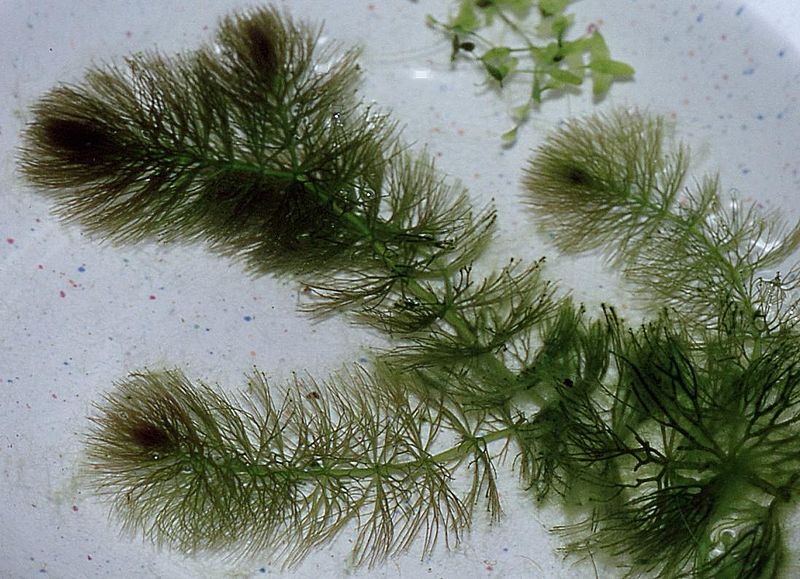
Soft Hornwort, Ceratophyllum submersum.
Photo: Christian Fischer. Wiki – Ceratophyllaceae
Below is another cladogram, “Land Plants,” with a slightly different presentation from the cladogram at the beginning of this post, giving you more phyla, more dates, and some synapomorphies (derived shared traits). 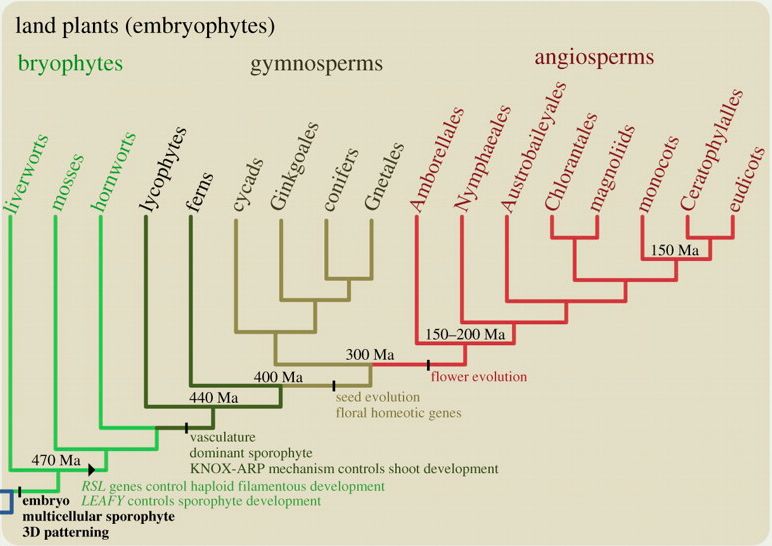
From: Garden Riots blog – An Introduction for Gardeners to the Eudicots
The Taxonomy Series
Installments post ever other day; installments will not open until posted.
Taxonomy One: A brief survey of the history and wherefores of taxonomy: Aristotle, Linnaeus and his binomial system of nomenclature, taxonomic ranks and the discovery and application of biological clocks.
Taxonomy Two: Introduces the higher levels of current taxonomy: the three Domains and the four Kingdoms. We briefly discuss Kingdom Protista, then the seven phyla of Kingdom Fungi.
Taxonomy Three: Kingdom Plantae.
Taxonomy Four: Kingdom Animalia to Phylum Annelida.
Taxonomy Five: A discussion of Cladistics, how it works and why it is becoming ever more important.
Taxonomy Six: Phylum Chordata, stopping at Class Mammalia.
Taxonomy Seven: Class Mammalia.
Taxonomy Eight: Class Aves, beginning with a comparison of five different avian checklists of the past 50 years.
Taxonomy Nine: A cladogram and discussion of Subclass Neornithes (modern birds) of the past 110 million years, reaching down to the current forty-one orders of birds.
Taxonomy Ten: A checklist of Neornithes including all ranks and clades down to the rank of the current 251 families of birds (plus a few probable new arrivals) with totals of the current 11,017 species of birds.



 SANTA MONICA BAY AUDUBON SOCIETY BLOG